
Darcy Pattison's Blog, page 2
August 2, 2018
Big Ideas: Why a Children’s BOOK?
Big ideas: Why a children’s BOOK?
In this post, I’m emphasizing the question of why create a BOOK?
When you have an idea about something you want to tell children, you have many options for communicating that information or story. You could create a video, have a conversation with your grandchild, write a magazine piece, write an editorial letter to the local newspaper, write a letter, draw a single picture, create a greeting card, or any number of other things. Depending on the information/story, you might sew a teddy bear, build a swing set, or ask a kid to help you cook.
WHY a BOOK? Books Need Big Ideas
If you think about media, a radio report lasts for a day or so. A daily newspaper lasts for a day. Magazines take a longer look and they can last a month or so. Of course, all these can be archived, but their intent is short-term. The analysis, the detail, the emotions – everything is meant for short term consumption.
The book, however, is our society’s archival medium. Books take the long view. They analyze something in depth, and from a broader perspective. Fictional books present deeper emotions, broader truths, and bigger canvases.
So, I ask you: why a children’s book?
Questions to Ask Before You Publish a Children’s Book: Is this a Big Idea?
Does your idea have lasting qualities?
Does the idea have big emotions?
Does the idea have broader truths?
Does the idea have the possibility of amazing aesthetics?
Does the idea have a wider reach than a single person or family?
Now here’s a contradiction: It’s an odd thing in literature, but if you try to be generic and appeal to EveryMan, you’ll apply to NoOne! But if you write something specific–one unique character, in a unique, specific setting, with a personally overwhelming problem–then you’ll appeal to everyone. Because humans are humans are humans. But if you write EveryMan, it’ll go no where.
It’s a tension that we deal with when we write books: big ideas are specific and yet, universal.
Why a Children’s Book: Examples of Not-So-Big-Ideas
Should this be a children’s picture book or not?
Learning to brush your teeth correctly.
A walk in my neighborhood.
Listening to a piece of music.
And of course, it’s not an easy question. Each of those COULD be a children’s picture book (and you’ll likely leave me an example of that in the comments!). But only if they are done in a way that makes them bigger and more universal than the kernel idea. They aren’t big ideas at first glance.
Learning to brush teeth might be most appropriate as a video, a brochure, a one-on-one with a child, or a visit to the dentist. To make it something that our society should archive in a book, you’d need to widen the emotional impact of the story some way.
A walk in my neighborhood could be a boring book. Or it could be a fascinating look at how people live in a specific area. A walk around a village in Papua New Guinea would be vastly different than a walk around the neighborhood in Manhattan. The point would be how to make either or both of them universal in some way. Or, how to celebrate the uniqueness. For a concept book like this, language play can help elevate the story because the way you say something–your voice–could be something worth archiving. Shakespeare is archived for that very reason: his writer’s voice expressed common truths in a way that elevates them.
Listening to a piece of music is such an abstract concept, which is the other problem with ideas for children’s books. Children need concrete ways to understand abstract ideas. It’s also a question of emotions translating to the written/illustrated medium. Music evokes emotions and expresses emotions. That’s why music is the sound-track for movies. That means it’s also hard to translate to words. Instead, why not listen to a piece of music with a kid? You might talk about how it makes you feel, but you might not.
I also know that sometimes the idea develops as you write and becomes bigger. The sum of the parts–idea, writing, and art–becomes gestalt, where the sum of the parts of bigger than it should be.
Still.
Not every idea is worthy to be a book.
The post Big Ideas: Why a Children’s BOOK? appeared first on Fiction Notes.


July 30, 2018
Professional Attitude: Self-Publishing Quality Without Apology
A professional attitude is crucial to successful self-publishing.
What if I wanted to sell you a dress and I said something like this?
“I grew the cotton myself, spun the yarn and wove it. So, it’s going to have a rough feel to the cloth. Sorry about that but I don’t really know what I’m doing. I designed the dress myself, too, so, you know, it won’t QUITE be up to the standards of Paris or anything. But you’ll love the dress. I really poured my heart into it and it represents who I really am. It may not fit and may not exactly be the right color for you. It’s kinda expensive, too. BUT you’ll love it! Really, you will!!!!!!!”
Unprofessional. That’s all you can say. And yet, I hear a version of that about children’s picture books all the time.
Professional Attitude: Produce Quality and Stop Apologizing
Step One, produce a quality book. Writing, editing, illustrations, marketing–do it with quality and integrity. Sure, opinions vary. People have different aesthetics. But opinions and aesthetics don’t excuse poor quality books. Be totally convinced that on your terms, your book is quality.
Step Two, stop apologizing for it. Act like a professional instead, who is confident of their product, and eager to share it with the world.
Don’t apologize for the story, the illustrations, the printing, the price, or anything else. An editor once told me that in this crazy business you live or die by your opinion. Proudly stick to your opinion. Own it. (You are SURE it’s quality, right?)
Don’t hesitate to submit your book for any purpose: reviews, awards, consideration for a store, teacher review, and so on. If you hesitate, STOP! Ask yourself, “Why am I hesitating?” Is it because you instinctively know on some level that the quality isn’t there. Then, go back to Step 1: Produce a quality book.
Don’t apologize that your budget wouldn’t allow ________ (fill in the blank). There’s nothing wrong with doing everything yourself, unless you fail at Step One. Then, do what’s necessary to produce quality, even if that’s hiring someone to help with a task. I will never do my own illustrations because they don’t measure up to my standard of quality. If you can’t afford it, then this isn’t the right business for you. There are production costs and you can’t shortcut them or you’ll fail at Step One. Don’t jump into this business if you can’t afford to do it with quality, or if you can’t do it with a professional attitude.
The post Professional Attitude: Self-Publishing Quality Without Apology appeared first on Fiction Notes.
July 24, 2018
Your First Self-Published Book: How Accidents Happen
Your first self-published book – the decision may take you by surprise. It did for me.
It was 2008. Since 1999, I’d traveled to teach my Novel Revision Retreat. The retreat’s workbook had grown from 30 pages to over 80 pages, which meant it was increasingly difficult for event coordinators to afford the printing. Then, I had a problem with one booking. We’d agreed on a price, but they came back and said they had to lower that price. It was still a decent fee, so I said, “OK. But participants will have to buy the workbook.”

Novel Metamorphosis: Uncommon Ways to Revise, 2nd edition
Price: $9.99
Voila! I became a self-publisher. I published Novel Metamorphosis: Uncommon Ways to Revise, which is in its second edition. It happened because print-on-demand technology was so easy. You format the book (I used InDesign from the start), upload the files to the POD printer, and books are only printed when there’s an order. Slick. No boxes in my spare bedroom. And I got paid.
Your First Self-Published Book. Did you Plan it?”
It does happen that people decide to self-publish and then strategically plan the first book as the start of their list. But just as often, someone shrugs, and says to themselves, “Why not?”
The reality of self-publishing today is that it’s dead simple. So what if you publish a couple books and they do badly? You just want it “out there.”
One friend has started by publishing blank books as travel journals. The only difference from one journal to the next was the cover. Simple. What will she do next? There’s no plan for more, but after you break the ice, it’s likely that more will follow.
One friend is thinking about self-publishing a Bible study that she wrote.
Another published a story that she’d told to her grandchildren.
The step toward self-publishing is simple and risk-free. Buy a pre-made cover or hire a friend to do a quick Photoshop cover. Or, get a cheap Fiverr cover. Get the files uploaded.
It’s not great publishing by any means. I see these early efforts as something that allows you to try the process. Uploading blank book journals still means you walk through the entire process: creating files, dealing with ISBN (even if you use a free one from Createspace), creating accounts with the POD printers, checking sales, and getting paid. If you only make $5/month on those early books, it’s fine. They taught you what you needed to know.
Takeaway from Your First Self-Published Book
My takeaway on my first book was that I could actually do the whole process myself. I created about 30 covers before I decided I liked one. The interior formatting was harder because there was less help available. But I worked through it. Hey, I thought, I can DO this.
Some other lessons from the first book:
Books don’t sell themselves. It’s a harsh reality that slapping a book up on Amazon doesn’t mean sales. Unless you market someway, it doesn’t happen. When I taught a Novel Revision Retreat, sales went up as participants told friends about the book. If there was a long time between retreats, sales slumped.
People don’t care about HOW you published the book; they care about the CONTENT of the book. Participants in my retreats didn’t care that the book was published by my company. What they cared about was this: will it help me improve my novel? As long as everything looked professional, they didn’t care who published it. Of course, fiction is less forgiving than non-fiction, which is why non-ficiton is a good starting place.
Quality is imperative. I knew right away that quality in layout, covers and copy editing was important. I was lazier about the copy editing part than I should’ve been. But no one is perfect in those early books. Because I’d been traditionally published (See my bibliography) before I turned indie, I knew the quality demanded by the marketplace. The first book taught me to respect that standard of quality.
One thing leads to another. And after that first book, well, it just was easy to do the next and the next.
And a thousand other small things that you’d do different the next time. . .
For most people I’ve watched, the decision to self-publish isn’t one decision: its an aggregation of many smaller decisions that lead you to this business plan for publishing. After the first book, it’s not a given that your next will be published the same way. The decision to really commit to self-publishing can be a long road with multiple cross roads.
Crossroads: Each Book is a New Decision
For example, your next manuscript. What will you do? It’s a crossroad for you. You can negotiate with yourself. Submit to XYZ editor at ABC company? Yes! But they can only look at it six months. I’m tired of slow rejections after twelve months, or three years. This time, they’ve got to decide and decide quick. Or I’m going to self-publish. You can change that decision at any time. Each book has its own decision process.
Those are the types of negotiations you do with yourself as you decide where your next book will land. And that’s OK. At each decision point, it’s OK to go the self-publishing route, and it’s OK to submit traditionally. It’s OK. The lines are blurred more than ever, and each book represents a choice. How and when will your first self-published book happen? Look out. Accidents happen!
Isn’t it great?
The post Your First Self-Published Book: How Accidents Happen appeared first on Fiction Notes.
July 17, 2018
What is Voice? How would you define a writer’s voice?
Voice is —
– Voice is a way of telling that can “make events reverberate. (Thaisa Frank and Dorothy Wall, Finding Your Writer’s Voice)
Voice is the key element in fiction, the one which, in effect, contains and shapes all the other.
Voice is elements of the story. (Johnny Payne, Voice and Style)
Voice is the effect of style. (Dona Hickey, Developing a Written Voice)
Voice is the magical heard quality in writing. Voice is what allows the reader’s eyes to move
over the silent print and hear the writer speaking. . . Voice is the music in language.
(Donald M. Murray, The Craft of Revision)
To ‘find’ voice, find the hidden story. (Frank & Wall)
The longer you stay a writer, the more voices you find in your own voice and the more voices
you find in the world. (Allan Gurganus, quoted in Murray, The Craft of Revision)
Each work of fiction has its own distinctive voice and the challenge for the writer – at times a
challenge that evokes intense anxiety – is to discover and to refine the voice that is unique to that
work. (Joyce Carol Oates, A Study of Short Fiction)
“The first line sets the tone, the melody. If I hear the tone, the melody, then I have the book.” (Elie Wiesel, Against Silence: The voice and vision of Elie Wiesel)
A Year of Voice
For the next year or so, I’ll be studying voice. Each week, I’ll write about what I’m learning about voice and how to control the voice of your writing. I taught a retreat this spring on the topic and I want to explore it further. This won’t be a theoretical discussion; instead, I want to be practical. What can a writer do to affect voice?
Why tackle this question? A friend once got a rejection on a story with an editorial letter that said something to this effect: The story is great, but the voice just isn’t there. And you can’t edit for voice. You can’t teach it. It’s either the right voice or not.
I was astounded. As a writing teacher, I definitely think writing can be taught, including voice. I’ve hesitated to write and teach about this for a long time, though, because it’s such a nebulous concept. But this is the year. How can we consciously change the voice of a piece of writing? Let’s find out.
How do you define voice? What makes the voice of a piece stand out and how do you create the right voice for your story? Let’s talk.
The post What is Voice? How would you define a writer’s voice? appeared first on Fiction Notes.
May 28, 2018
Category: How to Improve Your Book Sales by Choosing a Competitive Category
What category books do you write? I’m at that between stage of writing where I’m deciding what novel to write next, and I decided to do some genre research. Writers coming from the traditional world don’t usually worry about where their story falls as a genre because that’s the job of the marketing department. But as an indie publisher, I do need to worry about where my story will be marketed, especially on Amazon, where book categories can make or break the book sales.
I quickly realized I didn’t know as much about fantasy and science fiction genres as I thought, especially for children and YA. When you’re setting up a book on the Kindle Digital Publishing Program (KDP) or Createspace, both Amazon services, you may choose two categories for your book, and then later ask support to add additional categories. The categories will determine your competition and your access to the correct readers.
Popularity List v. Best Selling List
Author David Goffman suggests that you should look at the popularity list rather than the best-selling list for Kindle books. The bestseller list shows recent best-selling books; the popularity list takes a longer look at which books are popular and selling over a longer time period. Notice that we’ll be talking about researching Kindle categories because you can directly choose these. However, children’s books often sell better in paperback. The paperback store doesn’t break down the categories into the sub categories or subgenres, so it’s difficult to do this research for paperbacks. Keep in mind this subtle difference as research Kindle books but hope to sell paperback!
It’s a little bit difficult to find the popularity list but the screenshot should help first go to Amazon’s homepage and under the search box you’ll see a listing for departments. Click on the departments choose Kindle ereaders & Books > Kindle store > Kindle books. Then on the left-hand column navigate to the category that you are considering for your book category.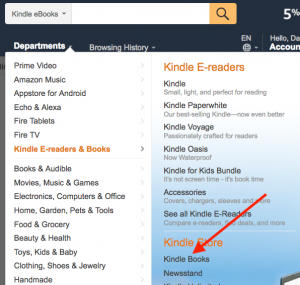
I have a middle grade novel that I’m interested in putting into the correct category, so I chose children’s e-books> science fiction, fantasy & scary stories> fantasy and magic. You’ll see that there are five categories listed: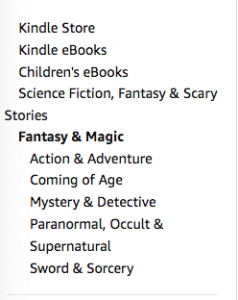
Action and adventure
Coming-of-age
Mystery & Detective
Paranormal, occult & supernatural
Sword & Sorcery
In fact, I don’t even want that top category of fantasy and magic, because the competition is too stiff in that big a category. You want to drill down to the most specific category possible so that you have a chance to compete well. If you’re listed in one of these five subcategories you will automatically be listed in the categories above it. So your best bet for doing well in category is defined the most niche category possible rank well there and hope that pushes you up to the category above it .
I’m looking for a category that I might can be competitive in for middle grade fantasy novel. A good category would have these characteristics:
The top ranked books in the category will be very high.
The number 20 top-ranked book will be considerably lower in ranking than the number one book.
The number 100 top-ranked book will be lower than 25,000 in rank in the overall store, so that it’s easier to rank in that top 100.
Sub-Category
#1 Book
#1 Ranking
#20 Boook
#20 Ranking
#100 Book
#100 Ranking
Action & Adventure
The Trials of Apollo, Book 3: The Burning Mage by Rick Riordian
514
The Son of Neptune by Rick Riordan
3833
Ranger’s Apprentice, Book 8
By John Flanagan
20,815
Coming of Age
Harry Potter and the Order of the Phoenix
220
Dragonfriend by Marc Secchia
2415
Song of the Quarkbest by Jasper Fforde
227,523
Mystery & Detective
Waste of Space (Moon Base Alpha) by Stuart Gibbs
6614
Lockwood & Co: The Screaming Staircase by Jonathan Stroud
8867
Trace Evidence: A Virals Short Story by Kathy Reichs & Brendan Reichs
150,816
Paranormal, occult & supernatural
The Inheritance Cycle Complete Collection: Eragon, Eldest, Brisingr, Inheritance (box set) by Christopher Paolini
10,707
Rapture (Fallen) by Lauren Kate
24,575
Rogue: The Paladin Prophecy Book 3 by Mark Frost
52,816
Sword & Sorcery
The Trials of Apollo, Book Three: The Burning Maze by Rick Riordian
514
The Dragon Librarian (Scrolls of Fire, Book 1) by Marc Secchia
9366
Dragon Legends (Return of the Darkening Book 2) by Ava Richardson
20,119
Notes about the Subgenres or Sub-Category Listings:
Action & Adventure – heavily dominated by Rick Riordian and Harry Potter, and other traditionally published books, which means competing will be very stiff.
Coming of Age – This category begins with Harry Potter (like almost every fantasy category) but an indie book by Sever Bronny is #6, and many indie titles fill the list. The #100 rank is quite low, though. Still this would be a good category for a indie fantasy book to compete in, as long as you fit the coming-of-age type of story.
Mystery & Detective – this list is dominated by traditionally published books also. The rankings are lower which means not as many people are reading this category.
Paranormal, occult & supernatural – while this category rocks in the YA books, it’s not popular for children’s books. The ranking of the number 20 book is almost 25,000, and the number 100 book is about 50,000. Still 50,000 isn’t bad in the Kindle store and that means almost every book in this category is relatively high. Competition is very stiff, and it might be a place where you want your book to live.
Sword & Sorcery – this is a strange, messy category because it includes such diverse books such as Roahl Dahl’s Fantastic Mr. Fox, Kate the Camillo’s The Miraculous Journey of Edward Tulane, Magic Treehouse books (early readers, not middle grade), and Minecraft titles. However, it also includes books that you would normally think of sword-and-sorcery such as dragon books and typical fantasy stories.
Overall Rankings in the Kindle Store
Let’s pause here and talk about rankings.
You can use Kindlepreneur’s Calculator to estimate how book ranks translate into sales.
One way to look at overall rankings in the Kindle store is to consider levels:
Level 1: 1-99, more than 1000 books per day
Level 2: 100-499, more than 175 books per day (175-1000)
Level 3: 500-999, more than 113 books per day ( 113-175)
Level 4: 1000-4999, more than 34 books per day (34-113)
Level 5: 5000-9999 more than 15 books per day (15-34)
Level 6: 10,000-99,999 more than 1 book per day (1-15)
Level 7: 100,000-499,999 less than 1 book per day. The calculator doesn’t give a number of 500,000.
Deciding on the Best Category
There are several ways to approach the question of which category.
1) Competition. How many books do you think you can sell a day? If you have a good idea of what your book so, you could search for the most competitive category. You may like the competition of the coming-of-age category because the lowest book is down around 225,000 which may give your book room to shine. However if your books regularly sell well you may want to jump into one of the other categories because even the number 100 book in sword and sorcery is rented about 20,000. Also notice that in two categories–Action & Adventure and Mystery & Detectives–the titles are mostly traditional books, therefore, hard for an indie book to compete.
2) Compare with past performance. Could you level up to a new tier of sales? Another way to look at the competition is to look at your past performance. Maybe your previous book never got higher than the 50,000 sales rank but for your new title you’d like to push that up to 20,000. Which would be the best category?
3) Content. Are you surprised that I didn’t suggest the content as the first way to choose a category? It’s partly because the categories can be so scattered. Rick Riordian dominates several categories. The Miraculous Journey of Edward Tulane is not a sword and sorcery type yet it ranks for that category. But I also want to talk about this in a different way which I’ll do below
Content Categories
One of the things I needed to do also was to go back and review or discover the meanings of the different categories. For example, what does sword and sorcery really mean? In the world of fantasy there are many ways to categorize sub-genres or sub-category: high fantasy, low fantasy, heroic fantasy, sword and sorcery fantasy, urban fantasy, paranormal fantasy, science fantasy, and so on.
I spent some time trying to parse this out. Most agree that epic or high fantasy covers huge topics such as the rise and fall of the kingdom. Sword and sorcery or heroic fantasy is more about the individual hero. Sword and sorcery tends to have antiheroes or anti-heroines, while, of course, heroic fantasy has heroes or heroines. Urban fantasy generally is in a realm of the city. Paranormal fantasy has something of a ghost or other paranormal activity thrown in. Science fantasy combines both fantasy and science fiction into its own genre.
Why does this matter? Because once you’ve done the market research some people suggest that you must also write to your chosen category. For example, if I choose sword and sorcery then I should have a story that is about an individual hero/ine or antihero/ine. And there are other tropes that go with that genre.
Tropes actually means a way to organize words, such as metaphors, while schemes means a way to organize sentences, such as parallel structures. However, in the common vernacular today, a trope is a common element in the story. It might be a theme of the story, a certain type of character, or certain plot points that need to occur. I recently listened to a podcast and the broadcasters said that if you are reading widely in your genre – which you should be – you would recognize the tropes of your genre.
However, I find it difficult to tell you the tropes for sword and sorcery children’s fantasy novels. The pod casters notwithstanding, it takes an analytical mind to keep in mind a wide sampling of books in your genre, and then to pull out commonalities. I think it’s a rather difficult thing to do. Or maybe, I’m making it too hard, and the generalities are more general than I think.
The benefits of finding common tropes is that you hit your readers expectations, therefore, your book should be more popular and sell better. It should also help you plan and execute your story much quicker; speed writing is valued in the in the world.
Tropes of an Historic Fantasy
Fortunately, it’s easy to find some of the tropes by looking at tvtropes.org. A caveat: TV tropes is a site for TV not literature; also, almost everything it says will relate to adult fiction not strictly to children’s fiction, so you must translate that also. However here are the some of the common tropes it suggests for heroic fantasy (and THESE I could have told you).
Magic. You should explain where the magic comes from, how it’s created, what are the rules of the magic, and whether the magic is morally neutral or outright evil.
World building. Sword and sorcery and heroic fantasy rarely occurs in the contemporary world. The setting for these stories is crucial.
A hero/heroine or antihero/antiheroine. For children’s books this is usually a child who for some reason is chosen. It might be a prince or princess in hiding, a young dragon who will grow up to take over the dragon kingdom, or an orphan who searches for his/her family and discovers s/he’s royalty.
If we followed the hero’s journey, we could probably define even more tropes that would be appropriate for a children’s novel in the sword and sorcery or heroic category. That’s the level where I find it easier to get bogged down.
In the end you must choose a category within which your novel will compete. We tend to think of this in terms of the content of our stories and that’s correct to an extent. However, we also need to consider the competition, and work to find the best fit for our books within the ecosystem of Amazon, and within the wider bookselling market. A deep dive into Amazon categories can give us insight that should help us position our book in the marketplace.
What Amazon category is best for YOUR book?
The post Category: How to Improve Your Book Sales by Choosing a Competitive Category appeared first on Fiction Notes.
May 15, 2018
Introverts: You Can Do Book Marketing!
Book marketing for introverts is painful. These are the writers who only want to hole up in their cave and write. Why should they come out and face the world? They only want to write!
And yet, if your story stays in your cave, you’ll never sell that book, which means you don’t have a career.
Fortunately, there are many things you CAN do as an introvert that don’t require you to interact widely with the world. There’s a continuum of activities from very engaged with the world to not engaged at all.
If you’re a confirmed introvert, you’re not likely to do these things: write chatty newsletters, manage a street team, or do public appearances. Introverts freeze in public, and would rather die than tell you about their cat. Street teams mean managing and interacting with people, often on a social media platform. An introvert might lurk in a Facebook group, but will seldom post. Children’s book writers especially cringe at school visits, long touted as a cornerstone of marketing a children’s book.
I consider myself an introvert, but I’m also an extrovert-on-demand. When I teach, I switch to extrovert mode and interact with students. Still I’m best in a smaller groups, where the overload to my senses is manageable.
That means I can do public appearances, even talking to 1000 kids. But I still balk at chatting newsletters and a street team. Those would require too much vulnerability and on-going interaction. (Yes! Email me with your good news! Just don’t expect a long extended back-and-forth conversation!)
Book Marketing for Introverts: Say YES to These Tasks!
So, what are techniques that work for introverts. There are three basic things you can do: write fast, nail your metadata, and advertise.
Introverts: Write faster.
The best thing that introverts can do is to write rapidly and do a rapidly release of their books. For indie authors this often means releasing a new book every month. The momentum gained by writing a series and rapidly releasing means that you have to do less marketing. I like Rachel Aaronson’s approach to writing fast!
2k to 10k: Writing Faster, Writing Better, and Writing More of What You Love
Price: $6.99
Introverts: Master the basics.
If you are an introvert and you don’t want to interact with your readers then you must master the basics. That means you must have an author website that has basic information on you and your books. It’s best if you have some sort of reader magnet to attract subscribers to your mailing list. That would be for example giving away a short story, a novella, or other writing that would attract readers. You need a mailing list with an automated sequence. This takes away the stress of writing a chatty newsletter because you write one sequence of emails and then send it out over and over and over every time you get a new subscriber. You may want to refresh those occasionally and you may want to add in a monthly newsletter or at least a an email when you have new books coming out.
You must also master metadata especially on Amazon. On Amazon you’re allowed to categories for any e-book in one category for print. You may have seven keywords. Your blurb should pull readers in and want them to and make them want to read your book. Your cover must be pristine and spot on for your genre. And your Amazon look-alikes must be perfect so that readers can sample the book before they purchase. If you don’t know how to do any of those there are tons of resources online. Here are some resources that I’ve found helpful.
Make A Killing On Kindle 2018 Edition: Book #1 In The Killing It On Kindle Series
Price: Check on Amazon

Strangers To Superfans: A Marketing Guide to the Reader Journey (Let's Get Publishing Book 2)
Price: Check on Amazon
One optional activity is newsletter swaps with other authors. Even introverts need a few best friends in the business and you can reach out to just a few of your favorite authors to suggest the newsletter swaps. Or join Instafreebie or Book Funnel and use their newsletter swap services to find the right marketing swaps for your for your book.
Introverts: Master Advertising.
Advertising is cold and impersonal – perfect for the introvert. Besides that, if you are an introverted geek and you love spreadsheets this will be your sweet spot. I know that folks still fuss about advertising their books, but that’s foolish. You’re a small business and the most reliable way to bring in customers is advertising.
There are two types of advertising: ongoing advertising and price promotion advertising. I do ongoing advertising with AMS (Amazon Marketing Service). I was stumbling around until I found Brain Meek’s Facebook group where he gives away an amazing spreadsheet for tracking the ads. Read his book, but for the most information and benefit, join his group. (I know, you’re an introvert. Just grab his spreadsheet and hang out. It’s cool.)
Mastering Amazon Ads: An Author's Guide
Price: $16.99
Others swear by Facebook advertising or BookBub advertising, and resources abound. Look for free options before plunging into an expensive course.
One caution: if you go the advertising route set a budget for experiments so that you can optimize your ads to get the best return on investment. It often takes multiple ads and an investment of a couple hundred dollars to find the right way to advertise your particular book.
For introverted children’s authors, I also recommend that you place your books with educational distributors. Sign up here to receive contact information on the four major distributors. Each education distributor has advertising opportunities that you can take advantage of. Again you’ll have to test to see which platforms work best for your books.
A final thing that you can do is to submit your books for awards. Awards are not a marketing plan because they are too uncertain. Depending on who the judges are that year your book may or may not have a good chance of winning an award. However I added here because you should be submitting for appropriate words and if and when you get lucky, it adds marketing muscle. Here’s a list of likely awards for children’s books.
Introverts: Last Ditch Option – Hire a Book Marketer or a Virtual Assistant.
Finally, if the marketing thing is totally overwhelming to you, don’t do it. Hire an extravert to do it for you. This can be a local person that you train, an experienced book marketer, or a virtual assistant. They’ll need to have or to develop expertise in a wide range of activities, so choose wisely.
Introverted writers, breathe easy. Book marketing doesn’t mean you have to do public appearances non-stop. You have many options that are actually perfect for your strengths. Find the things that work for you and get help for the things that stress you out. Either way, market your book. Because it won’t market itself!
The post Introverts: You Can Do Book Marketing! appeared first on Fiction Notes.
April 26, 2018
Bologna Children’s Book Fair 2018
Guest post by Leslie Helakoski
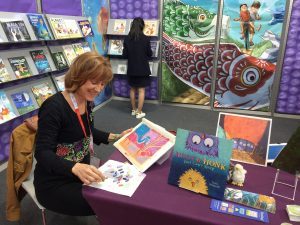
Illustrator Leslie Helakoski doing an art demo and book showcase in the SCBWI booth at the Bologna Book Fair.
If you’re a writer or illustrator of children’s books, you may have heard about the Bologna Children’s Book Fair (BCBF on Facebook) that takes place each spring in Bologna, Italy. It is the largest children’s book fair in the world. Over 1,000 exhibitors and visitors from over 90 countries. For three days each spring, the halls of the convention center are filled with agents, editors, and publishers with their heads bent over small tables talking non-stop.
Interior of Bologna Children’s Book Fair 2018
Foreign Rights Deals for Children’s Books
Just what goes on at this international fair? What are all those editors and agents talking about? The Bologna fair is all about buying and selling foreign rights. Bologna connects publishers and agents with editors and their foreign counterparts. It’s a great way for them to see what’s hot in different countries, promote books they represent, and try to sell the rights to foreign publishers. Editors come to meet with other editors and to gauge the market—what topics are popular, what are editors seeing a lot of and what is lacking.
The Illustrator’s Exhibition
The fair is a haven for illustrators around the world, with the highlight (for me anyway) being the Illustrators Exhibition. Over 15,000 works of art are chosen by a prestigious international jury for display and circulation in the 2018 illustration annual.The show this year included 3,053 illustrators from 72 countries. Traditionally, very few from the U.S. make the cut but this year there were three Americans included.
The Illustrator’s Survival Corner and Illustrator’s Cafe host world-known illustrators as well as authors and other pros from the industry who share expertise through classes, workshops and portfolio reviews.
In addition, personal exhibitions of Ludwig Bolded and Manuel Marsol were displayed along with the special Exhibition of Chinese Illustration Art as China was the 2018 Guest of Honor. Meters and meters of blank wall space fills itself day after day with drawings, cards, proposals and contacts which sometimes lead to meetings and professional opportunities. Many publisher booths along with the SCBWI booth provided both scheduled and impromptu portfolio reviews. Excited and talented artists line up to get the chance for recognition and advice.
SCBWI Booth at the Bologna Children’s Book Fair
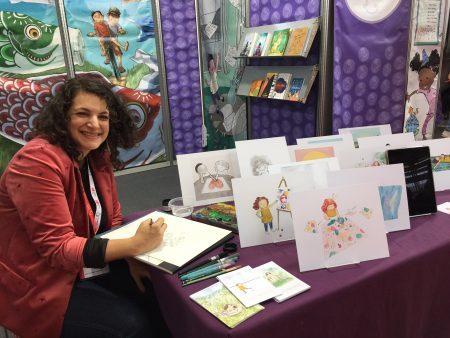
Sarah Baker is the Director of Illustration and Artist Programs at the Society of Children’s Book Writers and Illustrators. This is the art demo and display area of the SCBWI booth.
The SCBWI (Society of Children’s Book Writers and Illustrators) booth provides the opportunity for its members to have their books as part of their showcase display as well as a warm friendly place to say hello. For a small fee, members also have the opportunity to have their book in the digital catalog that is given out to hundreds of publishers and is also on display in the SCBWI booth. Members attending can also apply for a private showcase of their work for an hour. Illustrators are encouraged to include an art demo during their showcase which draws attention to the booth. SCBWI also hosts the much appreciated Dueling Illustrators activity. Two at a time, illustrators stand before large easel and listen to a new PB manuscript. The artists are given two minutes to sketch each scene. It’s a glimpse into the mind of how an illustrator tackles the first ideas words bring forth and to compare how different or similar their responses are.
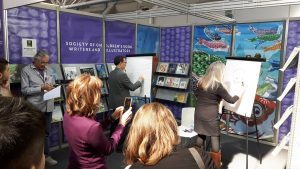
Dueling Illustrators, Julien Chung and Elizabeth Dulemba: A look into the mind of an illustrator
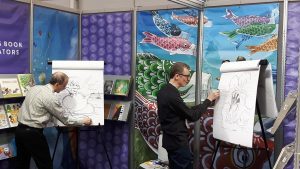
Two dueling illustrators, John Shelley and Paul O. Zelinsky, at the 2018 Bologna Children’s Book Fair going head to head in illustrating a new manuscript.
Children’s Literature Awards at the Bologna Children’s Book Fair
A number of special awards are given with the most prestigious being awarded at the fair itself. This year, the Astrid Lindgren Memorial Award winner —which celebrates the winner’s entire work and humanist spirit, is American Jacqueline Woodson. And the Hans Christian Andersen Award, created to encourage the best of children’s publishing and promote its circulation throughout the world, winners were Eiko Kadono (author) from Japan and Igor Oleynikov from Russia (illustrator).
There’s more, of course. Digital art demos, life-sized merchandising creatures roaming the halls, translated panels and discussions going on at all times.
The price of admission is around $43 for one day, less for multiple days. It’s a bargain for the experience of the fair. And well worth it if you happen to be planning a trip to Italy.
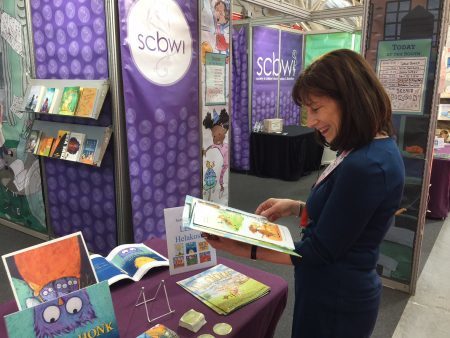
Jeanne B. de Sante Marie browsing at the 2018 Bologna Children’s Book Fair. Notice Leslie Helakoski’s HONK book!
—

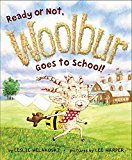
Ready or Not, Woolbur Goes to School!
Price: $17.99
Author and illustrator Leslie Helakoski is the author of about ten children’s picture books. Along with Darcy Pattison, she teaches the popular PB&J: Picture Books and All that Jazz workshop at Highlights Foundation. Her popular character, Woolbur, returns in a new picture book in June, 2018.
The post Bologna Children’s Book Fair 2018 appeared first on Fiction Notes.
April 21, 2018
Kobo eBook Readers Coming to WalMart
Are you a Kobo reader?
If not, you may be soon because Kobo ebook readers are coming to Wal-Mart by the end of the year. Read about the deal on Wal-Mart’s blog. This might be a perfect time to find out what your students will be discussing this fall and putting on their Christmas wish lists.
Kobo has a free ebook reader app, available on all platforms.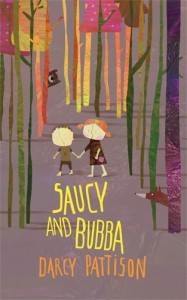
Saucy and Bubba. A Contemporary Hansel and Gretel Story.
Want to get a headstart?
All of Mims House books are available on Kobo.
In fact, Saucy & Bubba is on sale until April 23.
Use this code for a 40% discount: 40APRIL
CLICK HERE!
COMPELLING AND ULTIMATELY HOPEFUL STORY
In this modern-day Hansel and Gretel story, Saucy and Bubba struggle to get along with Krissy, their alcoholic stepmother. One freezing cold night, Krissy locks Saucy out of the house and Saucy must sleep in the barn. In a desperate move, Saucy and Bubba run away to their aunt’s house-except Aunt Vivian isn’t home. Trying to take care of Bubba for several days forces Saucy to take charge of her own life and accept a terrible sacrifice in order to find safety for herself.
This middle grade novel is a heartbreakingly simple story that weaves through the tangled threads of a family and builds to an ending full of hope. Author Darcy Pattison recently wrote about the need for books about troubled families on the Children’s Book Council Diversity blog.
Stories like this one carry a certain darkness, even if the events carry the weight of truth. It’s in the tradition of Dicey’s Song by Cynthia Voigt, and The Great Gilly Hopkins by Katherine Paterson. Both of these award-winning books tell of painful truths, but they manage to do so with respect for the child reader. I especially like Paterson’s statement that she always ends her stories with a note of hope. Fortunately, Saucy’s story also ends with hope that the family will work things out and come back together
Join Saucy and Bubba in their poignant search for family.
PRAISE FOR THIS BOOK FROM NATIONAL BOOK AWARD WINNER, DEBBY DAHL EDWARDSON:
Sometimes you have to help yourself before you can help someone else, but if you mark your trail, you can always find your way home. That’s what the spunky main character of Darcy Pattison’s Saucy and Bubba learns in this modern day Hansel and Gretel tale. Saucy is a real character dealing with real stuff—hard stuff that doesn’t have easy answers, not in real life and not in fairy tales, either. This is a really compelling and ultimately hopeful story. Highly recommended.
Try out KOBO eBooks Today: Use this code for a 40% discount: 40APRIL
CLICK HERE!
Put Your Books on Kobo
Kobo is an anagram of BOOK; in other words, it’s the same letters, just scrambled to a new order.
Kobo Writing Life is the portal for indie publishers to upload ebooks. You’ll need an epub version and a cover file. Supported file type(s): .epub, .doc, .docx, .mobi, .odt
I prefer to create an epub version, instead of using the Kindle/mobi file. Kobo offers competitive rates: Kobo vendors receive a 70% or 45% royalty rate on each eBook sold through the Kobo Store, depending on the price of their eBook. Distribution is worldwide. You’ll also have the option to distribute to Overdrive, the service used by many public libraries. For more information, go here.
The post Kobo eBook Readers Coming to WalMart appeared first on Fiction Notes.
April 10, 2018
Illustrators: Finding and Working with an Illustrator for Your Children’s Picture Book
Here’s the thing about searching for illustrators for your indie children’s picture books: it’s all about creating the best book possible. Within the bounds of your story, your creative sensibility, and your budget, how do you create the best book possible?
(NOTE: If you plan to submit your work to a traditional publisher, this article isn’t for you. Read instead about the biggest mistake you must avoid.. If you read on, you understand that we’re talking about independently publishing your own book.)
The problem, of course, is that you can’t draw, paint, illustrate, design, or even color a picture. You only do the words. How do you work with an illustrator? First, educate yourself about art. This article from Graphic Mama explains the different mediums, or the type of art materials such as watercolor or woodcuts. Take art appreciation classes and study layout and design.
The key, however, is that you know Story, with a capital S. You’re a writer who has created a special story, and you’ve provided great prompts in the text for an illustrator. As you work through the process, concentrate on the story, not trivial details. Does the finished book create the right reader experience for your story? That’s your sole criteria for judging the art.
FINDING ILLUSTRATORS
So, let’s jump into details on how to find an illustrator. I find it best to cast a wide net, certainly past your own acquaintances. Usually your neighbor who’s a hobby artist will not be able to create the book of your dreams.
Behance.net is a social media platform from Adobe where illustrators worldwide post portfolios. I regularly spend time sifting through the artwork. Sometimes, I’ll look for children’s book artists because they’ll be experienced and you’ll have fewer blunders in the process. If you’re not comfortable with art direction, you may want to stick to someone who’s done a few books already.
Sometimes, though, I’ll just put in a keyword related to my book, such as “spiders” or “ghosts.” This widens my choices of artists. In other words, I don’t care if they’ve published a children’s book before. I’m confident that I can give enough art direction that a great artist can work within. Most of my illustrators publish their debut book with me.
Behance allows you to contact the illustrator through their platform, but often, there are links to the artist’s website. I usually click through because it’s good to look through their entire range of art.
Professionals already working in children’s books can be found through the Society of Children’s BookWriters and Illustrators (SCBWI). Sometimes, you can find collectives of artists work such as Children’s Book Artists.
Below these professionals are a host of sites that connect creative people with someone needing their services; always read Terms of Service to be sure you understand their policies:
Reedsy.com
Guru.com
Freelancer.com
CONTACTING ILLUSTRATORS
So, you’ve found a great illustrator and you should contact them immediately, right? Wrong.
Let’s back up to the project in question. Let’s say your book is August Follies, and is the story of a family picnic.
What kind of illustrations do you want for this book to enhance the reader’s experience?
What style?
How many illustrations?
What medium?
What have you allotted in your budget for an illustrator?
Illustrators are freelance professionals and before you contact them, you need to know the specifications for the project so they can decide if the price is right for the amount of work you’re asking.
Here’s what you need to know so you can write those specs.
PRINT SPECS FOR ILLUSTRATORS
How will you print the book? Print on demand or offset? Does the printer provide templates for the interior and/or cover?
What trim size will work best for this project? In other words, how big, or how many inches (or cm) width and height will the book be?
How many pages? Standard picture books are 32 pages; however, with print-on-demand technology, you can go up or down if you have a good reason.
CONTRACTS FOR ILLUSTRATORS
Next, you’ll need to know what type of contract you’ll offer.
DISCLAIMER: I’m not a lawyer and you should consult one to develop a contract for your company. This is only general information. I use and recommend Aimee Bissonette at Little Buffalo Law.
Work for hire means the artists creates commission work specifically for this project and you will own all copyright to the art.
Licensing artwork usually mean the artist retains copyright, and you only license the right to use the art in this project. In this case, the art may be re-licensed and appear in other publications later. As part of the contract agreement, you can negotiation if the artist must wait for a time period or restrict it from certain uses, such as other children’s books.
A royalty agreement means you’ll be sharing the profits with the illustrator. Traditional publishers offer an advance on royalties, which means they pay the artist a certain amount upfront, and will pay no more until that amount is “earned out.” Then, they specify a percentage of sale price that they’ll pay. For example, an artist might receive $5000 advance, with 5% royalty for a picture book that costs $20 (to make the math easy). In other words, for each book that sells, the illustrator receives $1. The book must sell 5000 copies to “earn out” the advance. After that, the book would accumulate royalty payments that are paid out twice a year. Some publishers offer royalty based on net proceeds instead of sale price, so the book would need to sell even more copies before the advance is earned out.
A final contract agreement is a partnership, which means you and the illustrator will share any profits. Usually this is 50% – 50%, but you can negotiate anything that makes sense to both parties.
As an indie publisher, how to do you plan to pay the illustrator? If you consider the accounting, work for hire is the easiest, and the complexity increases with each of the other options.
The other question you must answer is how much to offer the illustrator. First, set up a budget for the book. This isn’t the article to go into that, but you’ll need to have an idea of other costs and how much you can afford. Keep in mind that the illustrator’s time and work are valuable. I wish I could give you a figure, but it varies from $1000 to $20,000, or more. What can you afford and still make a profit? Set your budget and stick to it. There are likely a variety of illustrators available in your price range.
Online Video Course: How to Write a Children’s Picture Book
I offer an online video course with 32 videos, plus a workbook, on How to Write a Children’s Picture Book. For more information, CLICK HERE.
ILLUSTRATORS AND YOUR PRODUCTION SCHEDULE
How fast do you want the art done? It’s helpful to set up a timeline for certain events in the publishing process. You’ll want to include any outside deadlines or events, key dates for delivery of sketches and final art, time needed for copy edits, time needed for the book designer to complete work, time to send to review journals, and some leeway in case anything goes wrong. Each book needs a slightly different timeline, especially if you’re working with other professionals such as a book designer or copy editor.
The illustrator doesn’t need to know all of that, of course, but you do because it’s good practice to give them deadlines for delivery of art in a couple phases. I usually pay 25% on signing the contract, 25% on approval of sketches and 50% on delivery of final art. Sketches and final art both have deadlines.
After all the decisions, here’s a typical spec sheet:
AUGUST FOLLIES by Jane Doe
32 page illustrated color picture book, 8.5” x 8.5” Indesign or Photoshop template provided that specify the final size of art.
To include:
Double-page color cover, Indesign or Photoshop template provided.
15 double-page spreads
Single page illustration for page 32.
All images must be delivered as tiff or jpeg files at 300 dpi.
Work for hire contract, world-wide rights, with payment of $XXXX, to be paid following this schedule.
25% payment upon signing contract
25% payment upon approval of sketches
50% payment upon delivery of final art.
Of course, modify to fit your needs.
NOW YOU’RE READY TO CONTACT ILLUSTRATORS
Be professional. You’re a book publisher with a children’s book project. You know what you need and how much you can afford. Behance allows you to contact artists through their platform, but I usually go to email when possible. Other platforms such as Guru.com and Freelancer.com provide means of contacting and even managing the process of payment.
About costs: On your first couple projects, your budget may be very tight. Fine. Don’t apologize. You’re offering work, and the artist makes a professional decision based on their own needs and desires. If your published books have awards, mention them, but don’t promise any kind of award for the current project.
Your first contact with an illustrator should be a general inquiry asking if they have interest in working on a children’s book. If they answer yes, you can provide specs and the manuscript. If they are still interested, you’ll move into contract negotiations.
Observation: Often, foreign artists have lower cost of living and can afford to accept a lower payment. I’ve successfully worked with artists in Great Britain, Poland, and Columbia. Payments for overseas artists is usually through PayPal or Western Union.
NEGOTIATE CONTRACTS WITH ILLUSTRATORS
The contract that you sign with the illustrator is a legal document. Be sure to have a lawyer vet all contracts. Basically, though, everything is negotiable. Go into the process knowing what you want and where you can and cannot budge. Often, the only thing an illustrator asks for is a bigger payment, so be ready with a counter offer and know your absolute limit, past which you’ll have to look for a different illustrator.
For signing the contract, I use SIGNNOW, an online service that manages the document signing process smoothly. A digital signing service also makes it easy to work with someone overseas.
WORKING WITH YOUR ILLUSTRATOR
Hurrah! You’ve signed up an illustrator for AUGUST FOLLIES. Now what?
First, deliver any reference material. My books are often nonfiction, which require the illustrator to use reference photos. For example, THE NANTUCKET SEA MONSTER is based on a true event for which there is great documentation.
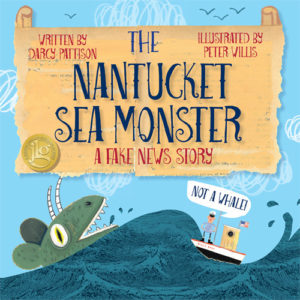
2017 Fall Junior Library Guild selection
Because I work with internationals, I usually use DropBox or a similar service to deliver large files. It works worldwide and is a simple process. Also, discuss with the illustrator how they prefer to communicate: email, phone calls, or video calls.
Next, answer questions. There are always questions about the story, the reference material, your preferences, and so on. Be available and prompt in communicating with the artist, and in return, they’ll be prompt and available. I’ve found that good communication is one of the most important things to making a project work well.
SKETCHES PHASE
I find the sketches phase to be exciting. The illustrator divides the text into pages, or follows your instructions on text placement. They do loose, b/w sketches that show layout and composition. Each artist works differently and has different sketching styles. I prefer that that the art is placed into the interior book template on Indesign (professional software for print layout), so I can visualize the final book. Another good option is to use a thumbnail layout for picture books (Google to find a wide variety!)
When you get the sketches, this is your chance to change anything and everything. The artist hasn’t invested lots of time yet, so it’s easy to suggest changes. Here are some things to look for.
Layout – Is the page layout and composition pleasing? Does it support the story? (See Molly Bang’s book in the resources below for more on composition.)
Text placement – In the West, we read picture book text right to left and top to bottom. On a double-page spread, say pages 2-3, the text flow is top left, bottom left, top right, bottom right. You can skip any of those or indeed, just use one placement. Just be sure the story flows across the page correctly.
Gutter – When books are printed and bound, the binding takes some room. The area near the center binding is called the gutter. Nothing important should be placed near the gutter: art elements, text, or important design elements. Artists can get lost in the composition and forget that the double-page spread must accommodate that gutter. Usually book interior templates account for this and push important elements away, but I always check gutters in the sketch phase.
Storytelling – There’s a big difference in a great artist and a great illustrator. The illustrator works to add emotions and to fill out the story. Their art conveys character, action, and setting. This is the time to make sure that the story is told in both art and text.
Page Turns – Often when I write a picture book manuscript, I’ll work to add a page turn. In other words, the text is divided up in such a way that the reader is compelled to turn the page. Sometimes, you can divide a sentence in half and finish it on the next double-page spread. The first half makes the reader want to find out what happens next, and the page turn reveals the answer. These are often set up with leading words: Until, Then, But. During the sketch phase, I like to reevaluate all page turns and create the most interesting possible.
Pacing – When you divide a picture book text, you may end up with lots of text on one double-page spread and only a single sentence or a single work on another spread. This pacing of the story makes the reader speed up, slow down, pay attention, gasp or shiver, or any number of emotional responses. Now’s the time to enhance story suspense by pacing the illustrations.In THE NANTUCKET SEA MONSTER STORY, I realized that we could create a combination of a great page turn and a wordless spread. Sketches stage is crucial for creating synergy between the art and the words to create a great picture book.
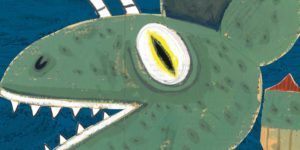
Interior Page – The Nantucket Sea Monster | DarcyPattison.com
This wordless spread allows readers to take in the sea monster before the page turn reveals a surprise. This spread was crucial to the pacing of the story.
Cover – The cover is your book’s most important sales tool. Now is the time to try out different fonts, text placement, etc. That way, the art will fit with the cover layout. Don’t wait for these crucial decisions until the art comes in. That’s too late.
WHILE THE ILLUSTRATOR FINISHES COLOR ART
Usually artists send me a couple updates during the process of creating the final color art. I like it best when they put the art into the InDesign template and create a low-resolution pdf to send. (Again, use Dropbox or similar service for any large files.) It’s good to touch base now and then because this can take a long time, depending on the artist’s style and other projects. Usually, I like to just see that there’s some progress. Of course, I’m always available to answer questions. Be a cheerleader for the artist and celebrate every milestone.
PROBLEMS IN THE PROCESS OF WORKING WITH ILLUSTRATORS
You want to change the specs. Let’s say that you’ve been getting bids from printers and decide to change the finished trim size from 8.5” x 8.5” to 8.5” x 11”. That’s the sort of thing that might legitimately happen. Unfortunately, you signed a contract based on the first specs. It’s not fair to change the specs in any way without extra payment. Any changes should be in writing and a substantial change order would include extra fees. Be very sure of your specs before you sign that contract.
Deadline not met. Late art is another common problem. When I set up a timeline for a book’s production, it’s not random. It’s based on deadlines for submission to distribution partners, review journals, and the marketplace. You’ll have to decide how to deal with this on a case by case basis. Why is the art late? Illnesses, natural disasters, and so on are excusable, if irritating. But if the artist is simply not working, and you’ve seen no art at tall, you may need to consider terminating the contract. It’s not fun, but the process should be in your contract. Work with artists when possible, but remember that you’re a business person and make decisions accordingly.
Personal problems. One of my best illustrators had twin boys. Besides the difficult last days of pregnancy, it meant about two years when her focus was on her family. It happens. Emotional problems, divorce, break up of a relationship—life often interferes with the artistic process. Again, deal with these on a case by case basis. For the mother of twins, I waited two years for art because it was book four of a series, and I loved her work.
Artwork won’t create the best book possible. What if you’ve gone through the whole process and you look at the final art and cringe? Should you publish it anyway?
This is a personal, professional and business decision that you’ll have to figure out for yourself.
If you’ve paid for the final art, you’ve kept your end of the contract. But you always have the option to simply not publish and to go back and begin again.
It goes back to what we started with: Does the finished book create the right reader experience for your story?
If it does, publish.
If it doesn’t, stop. Think. Decide what to do next.
Indie novelists have an easy time choosing art. They only care about the cover, the sales tool. Children’s picture books, however, must consider how storytelling meshes together text and words into a gestalt experience. If you publish a children’s picture book, you’ve got to gain the crucial skills of finding and working with great illustrators. What challenges, joys and problems have you found in the process?
Resources
The more you understand about the process of illustrating a children’s picture book, the better you’ll be able to direct the artist. Here are some starting points.
Blogs:
Shelley, John. Picture book Basics – Understanding Format. Words & Pictures Blog, Online Magazine of the SCBWI British Isles.
Shelley, John. Picture Book Basics – Sketches and Layout. Words & Pictures Blog, Online Magazine of the SCBWI British Isles.
The Design of a Picture Book blog has many interesting posts on picture books, including layout and design.
Books:
Bang, Molly. Picture This. Originally pubished in 1991, this book is now available as a pdf. This is an excellent book that explains how layout and composition within a page can evoke emotions. I’ve done this with kids and had amazing results.
Online Video Course: How to Write a Children’s Picture Book
I offer an online video course with 32 videos, plus a workbook, on How to Write a Children’s Picture Book. For more information, CLICK HERE.
The post Illustrators: Finding and Working with an Illustrator for Your Children’s Picture Book appeared first on Fiction Notes.
April 9, 2018
Accounting for Writers
Have you sold any writing at all, any place, any time? Yes? That means you need to know about accounting for writers. You know – the tax people want to know how much money you made, and what you spent to make that money, and if you have anything left over as profit at the end of the day. That accounting.
Unfortunately, I’ve never had a course in accounting. When I opened Mims House five years ago, I knew nothing. It’s been a painful five years, partly because I was doing everything on a tight budget which didn’t stretch to hiring an accountant. My husband and I have always done our own taxes, so I thought I could do it. Besides, if I had to spend $500 on something, I wanted to spend it on great art for a picture book, not an accountant to take care of numbers. The choices were always easy to make. To my regret.
Accounting for Writers – Getting Started
I’m still not an expert! You should hire an accountant! Don’t do what I did, but be wiser!
Standard disclaimer: I am not an accountant or a lawyer. You should consult professionals for all your needs.
OK. If you didn’t believe me or if you’re so broke like I was that you really can’t afford an accountant, then I want to tell you my story.
At first, after investigating tons of programs, I went with the standard Quickbooks program. It’s relatively inexpensive, and is widely touted as a good program. It is good–if you know what you’re doing.
I hired an accountant friend to set up the systems for me, and then did my own bookkeeping. I’m using the terms accounting and bookkeeping separately here. Bookkeeping is the practice of recording daily transactions, either purchases or sales. Accounting is slotting all those transactions into categories that make sense and will give you an overview of your business.
Here’s the sad truth: I’d rather write a new chapter than do bookkeeping. Everything was put off and put off and put off. Twice a year, I spent a couple weeks of bookkeeping to catch up, and I moaned during the whole process. I did it twice a year because for a couple projects, I had a partner who needed an accounting twice a year. Until I was required to do that for her, I flat refused to do anything.
Tip: If I was setting up the partnership with someone again, I’d investigate BundleRabbit.com because they allow for collaborations. I’ve not used the service yet, so I can’t recommend it whole-heartedly; but I’ve heard good things.
Quickbooks worked for a couple years, but it’s been badly broken. I could report my income for taxes, but everything was a mess. I also knew that my accounting wasn’t set up correctly. When you first set up accounting, there’s a chart of accounts that you must create. These are the categories into which transactions are slotted. At first, with only a few books out, I set up an account for each book. Now that I have over 30 books out, that’s cumbersome, redundant and foolish.
A New Accounting Day
This year, I determined that I would sort this out and not let the accounting get so out of hand. For self-published or indie writers it’s all difficult anyway. We want to write, not play with numbers. And it’s complicated. Let’s say that you upload ebooks directly to Apple’s iBookstore. Let’s assume that you sell one ebook to someone in Norway and make a profit of $0.50. You must account for that $0.50, each and every time. Multiply that times 59 countries times the different ebook stores such as Kobo, B&N Press, Publish Drive, Smashwords, StreetLib and so on and so forth. It can be overwhelming.
I wanted something simple that would allow me to keep up on a daily basis. And I wanted to totally redo my chart of accounts to reflect the current status of my business. In other words, I decided on priorities for my accounting, and then went looking. I wanted to remove all the obstacles to doing good accounting, such as manually inputting transactions.
After investigating, I went with Xero.com as the accounting program. It’s an online subscription, so it costs more. However, it has several advantages. First, it pulls in data from my bank daily. In order to make that happen, I changed to an online-only banking account. I still have the local bank account which I have to manually upload once a month. But I’m switching almost all transactions over to the online banking program so that eventually 90% of my transactions will be pulled daily into Xero. To deposit a check, I take a photo of the check to upload. I also chose Xero because I have an eye on selling books online via Shopify, and Xero integrates with that platform. In other words, I was also looking forward and trying to make sure I don’t have switch again anytime soon.
The biggest disadvantage is that Xero is a subscription-based service. I pay monthly. But my business is at a point where I can pay for this convenience, if it makes a difference in my bookkeeping.
And it’s made a huge difference. Instead of manually adding transactions, or manually downloading/uploading from my local bank, the transactions appear like magic in Xero. My new rule is that I must check Xero daily and reconcile all outstanding transactions THAT DAY! So far, it’s working. I am, as of this writing, completely up to date on my bookkeeping and accounting.
While I was at it, I totally redid the chart of accounts. For any given business, the chart needs to be customized. After struggling through a bad chart of accounts for a couple years, I knew the pain points and where I wanted to change it.
Understanding Accounting
It’s not enough, though, to just do bookkeeping and accounting. You need to know what it all means. Are you making a profit? How do you know?

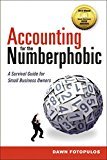
Accounting for the Numberphobic: A Survival Guide for Small Business Owners
Price: $19.95
For me, the answers have been in an amazing book, Accounting for the Numberphobic: A survival guide for small business owners .
Author Dawn Fotopulos says there are three reports that small business owners should understand. And make no mistake: Authors are small business owners!
She says there are three reports you should learn to understand:
Net Income Statement. Fotopolus says this is comparable to the speedometer of a car, telling you how fast your business is growing.
Cash Flow Statement. This report is likened to a gas gauge, which tells you how much fuel you have, which in turn tells you how much farther you can go before filling up again.
Balance Sheet. If you want to know the overall state of your car, though, you should check your oil pressure gauge. Likewise, this report, tells you the overall health of your business.
Fotopolus puts financial terms into simple analogies that make it easy for me to understand. After setting up my new accounting system, I generated these reports and decided that everything is healthy! Fortunately!
Writers don’t talk about accounting much, because we’d rather talk about plotting and characterization. Even subplots and placement of commas is more interesting than accounting. However, if you’re an author, you’re a small business person. That means you should take the time to learn the basic accounting practices. I’m finally on a more solid foundation than before because I took the time to find ways to streamline the process and make it manageable. Probably, your answers won’t be the same as mine, but I urge you to find ways to solve your own accounting problems.
The post Accounting for Writers appeared first on Fiction Notes.


