
Darcy Pattison's Blog, page 33
August 5, 2013
Keeping Relationships Consistent
START YOUR NOVEL
Six Winning Steps Toward a Compelling Opening Line, Scene and Chapter
29 Plot Templates
2 Essential Writing Skills
100 Examples of Opening Lines
7 Weak Openings to Avoid
4 Strong Openings to Use
3 Assignments to Get Unstuck
7 Problems to Resolve
The Math adds up to one thing: a publishable manuscript.
Download a sample chapter on your Kindle.
On my current WIP novel, I am revising to make sure the character relationships are consistent. The main character has three main relationships in the story, with a friend and traveling companion, with her father and with the villain.
Among other things, a first reader pointed out some inconsistencies in these relationships. I agreed and decided to tackle this. The first thing I did was the re-read the manuscript and find the places where the main character interacts with each of the others.
It was actually fairly easy because each interaction had about three chapters each, at least in the first half of the novel that I am working on. I physically separated these into three stacks of paper and then marked them up. I was looking for emotional content, reactions to each other, all those small things that create a relationship. Surprisingly, these can be a small part of chapter/scene. You’ve got to have the action going along and the plot will take up a lot of space. There’s description and dialogue. Some of the emotional stuff is in all of this because you can and should color any of it with an attitude.
But surprisingly little of it directly reflects the relationship between these two characters.
Now, I just need to decide on what the relationship should be–actually the hardest part of all. For a father-daughter relationship, should the father be wishing for a son, instead of a daughter? Or does he support his daughter in all her hopes and dreams? Of course, we know what the perfect father would do. But this is fiction, which about dysfunctional families, and the ways in which relationships can get tangled up. Once I decide where it should go, then it will be easy to see where to revise.
Then, I just need to repeat it for the other two relationships.
For me, it is easier to gain consistency by pulling out chapters like this to look at a specific aspect of the story.


July 31, 2013
Reading Helps Revision Process: Guest Post by AnneMarie O’Brien
START YOUR NOVEL
Six Winning Steps Toward a Compelling Opening Line, Scene and Chapter
29 Plot Templates
2 Essential Writing Skills
100 Examples of Opening Lines
7 Weak Openings to Avoid
4 Strong Openings to Use
3 Assignments to Get Unstuck
7 Problems to Resolve
The Math adds up to one thing: a publishable manuscript.
Download a sample chapter on your Kindle.
Guest post by Annemarie O’Brien
Annemarie Obrien is celebrating the release of her novel, LARA’S GIFT. She talks here about the revision process.
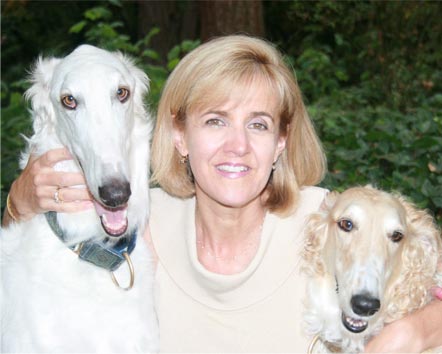
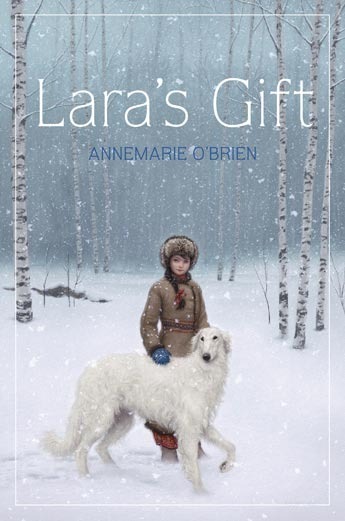 The seed for LARA’S GIFT was born over twenty years ago when I was gifted a borzoi puppy while I was working in Russia. It was such a magical moment in my life that I knew it would one day inspire the kind of story I would have wanted to read as a kid.
Although I could easily see Lara’s story unfold in my head, the biggest challenge I had in writing LARA’S GIFT was where to start it. I must have written and re-written the opening scene thirty times before I landed on the final version. And while I wasn’t able to use any of these openings in my manuscript, all of them were beneficial to me as a writer. Each failed attempt informed future revisions and helped me dig more deeply as I tried to “re-think” and “re-envision” a new opening.
Because kids often juggle multiple high-tech gadgets, it’s essential to immediately grab your reader’s attention by evoking some kind of emotion in your reader within the first 150 words through a believable character, planted in a unique setting, with a distinct voice and meaningful goal pitted against a hint of conflict. Tall order, huh?
The “ah-ha” moment behind what finally became “the opening” of LARA’S GIFT came to me when I read the prologue in TAMAR written by Mal Peet. It was so brilliantly crafted that it not only made me curious, it also made me sit back and pause, especially since I wasn’t a fan of prologues and never read them as a kid. Prologue to me meant start with chapter one.
Mal Peet’s prologue in TAMAR changed all that. It not only hooked me, but it also pointed me to what I needed to kick start LARA’S GIFT. It’s what I call a “defining-moment-in-the-past” prologue that would:
put Lara in a unique Russian setting
show us how important the borzoi dogs are to her
reveal the conflict of her visions
There are plenty of revision techniques to explore as you revise your own story. The one approach that has shaped my craft and helped me solve trouble spots in my own manuscripts is reading. Every book I read teaches me something and shows me how other authors handle craft from story structure, language, plot, to scene building and satisfying endings. So read as many books as you can and read them as a writer with an analytical eye on craft.
WIN A COPY OF LARA’S GIFT! Leave a comment and share this post on some social media platform to win a copy of LARA’S GIFT. For every share, your name will be entered into the drawing pot. The winner will be drawn and announced by Darcy Pattison on August 20 on Fiction Notes.
For more opportunities to win a copy of LARA’S GIFT and/or a manuscript critique by Deborah Halverson from Dear Editor, check out these internet sites on these dates:
Fiction Notes (7/31)
Kissing the Earth (8/1)
Quirk and Quill (8/1)
Simple Saturday (8/1)
Coffee with a Canine (8/5)
Dog Reads (8/5)
World Reads (8/5)
Dear Editor (8/6)
Word Spelunking (8/7)
Random Acts of Reading (8/8)
The Hiding Spot (8/9)
Beth Fish Reads (8/13).
For more information about LARA’S GIFT, check out:
www.AnnemarieOBrienAuthor.com
For a Teacher’s Guide:
http://annemarieobrienauthor.com/cont...
Lara’s Gift Book Trailer
If you can’t see this video, click here.


July 29, 2013
First Readers v. Manuscript Critique
START YOUR NOVEL
Six Winning Steps Toward a Compelling Opening Line, Scene and Chapter
29 Plot Templates
2 Essential Writing Skills
100 Examples of Opening Lines
7 Weak Openings to Avoid
4 Strong Openings to Use
3 Assignments to Get Unstuck
7 Problems to Resolve
The Math adds up to one thing: a publishable manuscript.
Download a sample chapter on your Kindle.
When you finish your draft, do you look for a manuscript critique or a first reader? They are different and serve different purposes.
Manuscript Critique. The reader puts on his/her critical glasses and looks at your manuscript through that lenses. How does this story match up with the ideal novel? Of course, that assumes that you have common concepts about the ideal novel and that your concepts will match up with the editor’s understanding of ideal novels.
For beginning to intermediate writers, or for those particularly difficult stories, a manuscript critique can be helpful. It shows you where the story fails to touch a reader. It points out weaknesses and strengths. For example, you may find out that you failed to write the climax of the story; instead, you skipped over that chapter and wrote the aftermath of the climax. That’s a common problem and a critique can remind you why you need to actually write it.
 A disadvantage of the critique is that it is by nature a process of tearing apart your novel and matching up the parts to the ideal novel. It is destructive in many ways. The intent is to help you reconstruct, but it can be devastating. Editors, by and large, are manuscript critiquers and a ten-page revision letter is normal.
First Reader. On the other hand, a first reader has one task: to monitor his/her impressions as s/he reads and report those impressions to you. Some suggest a structured approach and ask readers to write in the margins something like this. B=bored. C=confused. E=emotional.
You can make up some sort of code like that, or you can just let the reader report as they wish.
The advantage of this is that it gives you feedback on what you actually put on the page. I often think that I’ve communicated anger, but the reader is merely confused. Especially after a revision, I need a first reader–and a naive one who hasn’t read the story before–to find out if I inadvertently added or subtracted something in the process of revising.
I am ALWAYS surprised by what a first reader will say. They are confused, bored, angry, or emotional in ways that surprise me–both good and bad. In other words, I need to fine-tune the story to the needs of a reader.
The disadvantage of a first reader is that you don’t always know the structural and technical problems that a manuscript critique might point out. A first reader might report that s/he was bored with the ending and then you’ll have to figure out why. The manuscript critique will tell you that you left out the climax. You get to the same revision, but by different routes.
Which do you prefer? A manuscript critique or a first reader?


July 24, 2013
Dialogue: Make Each Character Unique
START YOUR NOVEL
Six Winning Steps Toward a Compelling Opening Line, Scene and Chapter
29 Plot Templates
2 Essential Writing Skills
100 Examples of Opening Lines
7 Weak Openings to Avoid
4 Strong Openings to Use
3 Assignments to Get Unstuck
7 Problems to Resolve
The Math adds up to one thing: a publishable manuscript.
Download a sample chapter on your Kindle.
Dialogue, what characters say, is an important element in any story.
DH, a reader here, is puzzled how to switch from one character to another.
Here’s an example she gave:
“Hey Danielle! Come check out this new book I got!” says Viola. “Okay just a sec.” says Danielle.
See, what I’m asking? I need to know what ways are there to talk between characters without having to say says Danielle, or says Viola or says Darcy.
Dialogue is what characters actually say and it is set off with quotes. Each time a character finishes talking and another begins, it is a new paragraph. If the character’s speech is a sentence, then it ends with a comma that goes inside the quote. If it is a question or exclamation point, that goes inside the quote instead of the comma. Generally, stories are told in past tense, so you would use “said” instead of “says,” which would be used for first person stories. And finally, I tend to put the character’s name before the said/says. In some ways this is a personal preference, but some references consider “said Viola” to be more juvenile than “Viola said.” Decide which you like and stick with it. It’s also a pet peeve for a character to constantly call the other person’s name. I don’t talk to people that way and characters shouldn’t either.
“Hey, come check out this new book I got!” Viola said.
“Okay, just a sec,” Danielle said.
That’s a good basic dialogue structure but now there are things that can help the story move along smoothly. First, is a beat or some sort of action. You can also insert the “she said” into the middle of the dialogue to vary the rhythm of the exchange.
Viola held up a shiny book. “Hey, come check this out!”
“Okay,” Danielle said. “Just a sec.”
Let’s add some setting.
From across the library, Viola held up a shiny book. “Hey!” she called in a stage whisper. “Come check this out!”
“Okay.” Danielle shoved back her chair and said, “Just a sec.”

It is also important to distinguish each character simply by the way they say something.
Viola: Hey, come check this out!
What are some possible responses for Danielle?
“Sure thing.”
“Why? Boring.”
“Girl, you know I don’t like books.”
“I’m busy.”
“Not now.”
“Go away.”
(Silence. She ignores Viola)
“Be quiet.”
Which one would THIS Danielle be most likely to say? It’s a matter of character. What is her attitude about reading and books and being in a library? What is her emotional state? Is she mad, sad, bored, or engrossed in a book of her own? All of those things will infuse the dialogue with something unique. And the reader should be able to tell Danielle’s voice from Viola’s. Because you also know all that about Viola and that should be in what she says and how she says it.
From across the library, Viola waved the new Harry Potter book. “It’s here! Come check it out.”
“Okay.” Danielle yawned, then put down her worn copy of Pride and Prejudice. “I’m coming.”
Dialogue must do more than just have people talking. It must also characterize and show attitude and move the story along. It’s worth the time it takes to explore options.


July 22, 2013
The Writer’s Journey: 9 Metaphors
START YOUR NOVEL
Six Winning Steps Toward a Compelling Opening Line, Scene and Chapter
29 Plot Templates
2 Essential Writing Skills
100 Examples of Opening Lines
7 Weak Openings to Avoid
4 Strong Openings to Use
3 Assignments to Get Unstuck
7 Problems to Resolve
The Math adds up to one thing: a publishable manuscript.
Download a sample chapter on your Kindle.
I am just back from an amazing week-long conference about writing and indie publishing. It was held on the Oregon coast and at one point Dori Butler, Carol Gorman and I took advantage of the setting and went on a hike. It became, for us, a metaphor of the writing journey that we all take and the journey we were taking as writers that week.
We hiked Cascade Head Nature Conservancy trail. There is a three-mile hike that is open year round, but there’s also a shorter trail that only opens after July 15. The road to this upper trail is a gravel road that winds through magnificent forest land. And that’s how the metaphors began.
Stop and ask for help. The road to the trail is not well marked and we were in totally unfamiliar territory. When you are venturing into new writing lands, stop and ask for help. We knew we had passed the road, but hadn’t seen it, so we stopped at a local restaurant and the waitress kindly drew us a map that we confirmed with our Google Maps app.
Keep going. The road was steep and curvy and was often uncomfortably close to a steep drop-off. After some miles of climbing, the road dipped and headed downhill. We were confused and became more and more uncertain. Finally, someone said, “We should turn back.” No. We couldn’t give up yet! We decided to go on and around the next bend–yes, around the next bend–there was the parking area for the trail head. Are you tempted to stop writing? Take that next step: submit the manuscript, write that last chapter, keep going. You don’t know what is just beyond the bend.
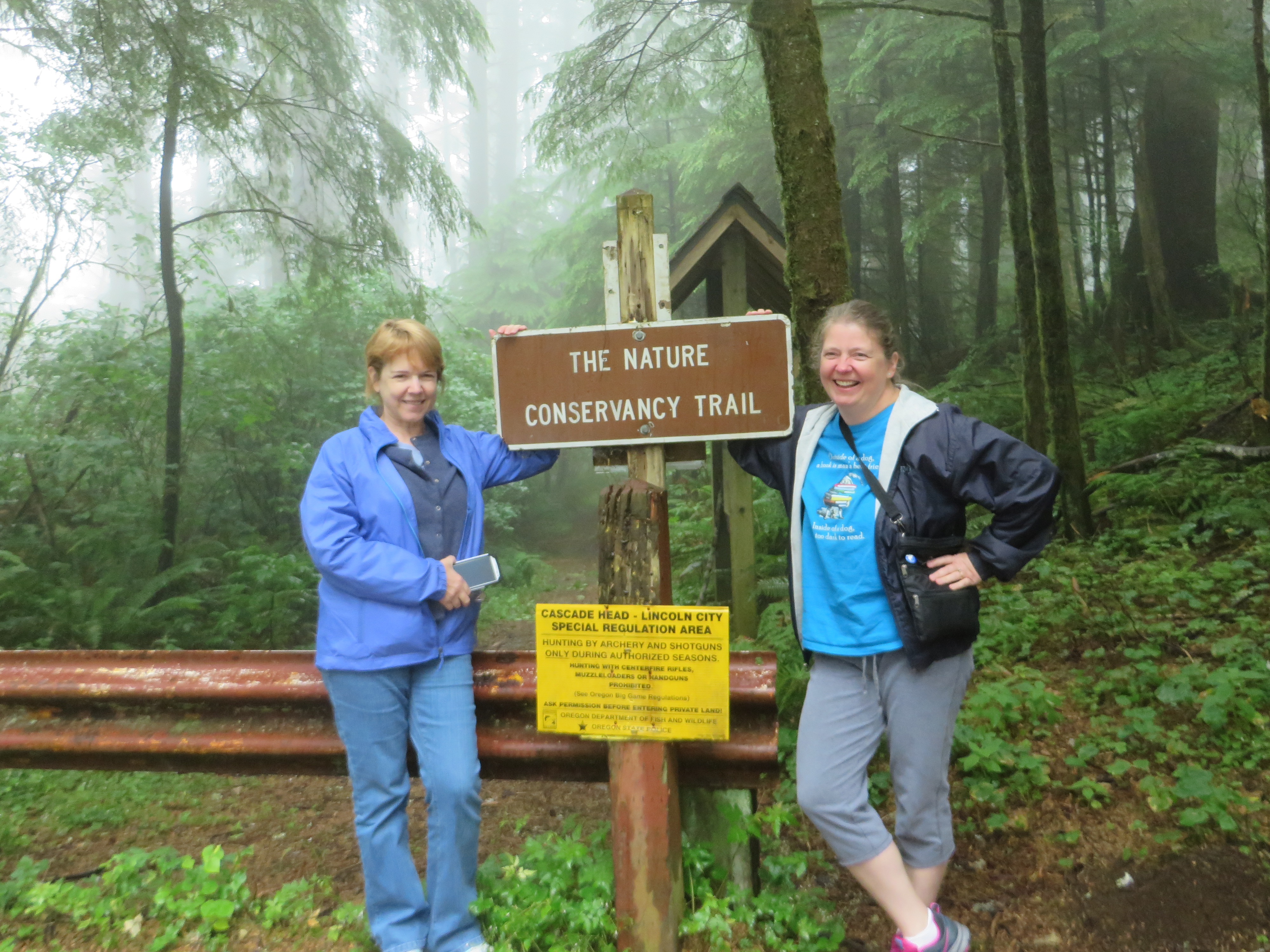
Carol Gorman and Dori Butler at trailhead of Nature Conservancy Cascade Head trail, outside Lincoln City, OR.
No one around. It was early morning, foggy. A lonely road, a quiet space. Writing can feel lonely, too. We work and work and if feels like no one cares. But, remember this: there was a path. Clearly someone had gone before us and surveyed this land, decided it was worth the conservation effort, built and groomed a trail. Writing may feel lonely, but others have gone this direction before. And there is a promise of a fantastic view at the end of the trail. Keep going.
You can’t see clearly in the fog. Now, this wasn’t just any old fog. It was foggy enough that you couldn’t see more than a couple hundred feet. As with writing, we only saw the immediate surroundings, the long views were closed to us. That didn’t mean it was scary or ugly. In fact, the fog held a peculiar beauty, diffusing the light, creating an almost cozy atmosphere that sheltered and protected. It was a space in which you could keep going by focusing on the task in front of you.
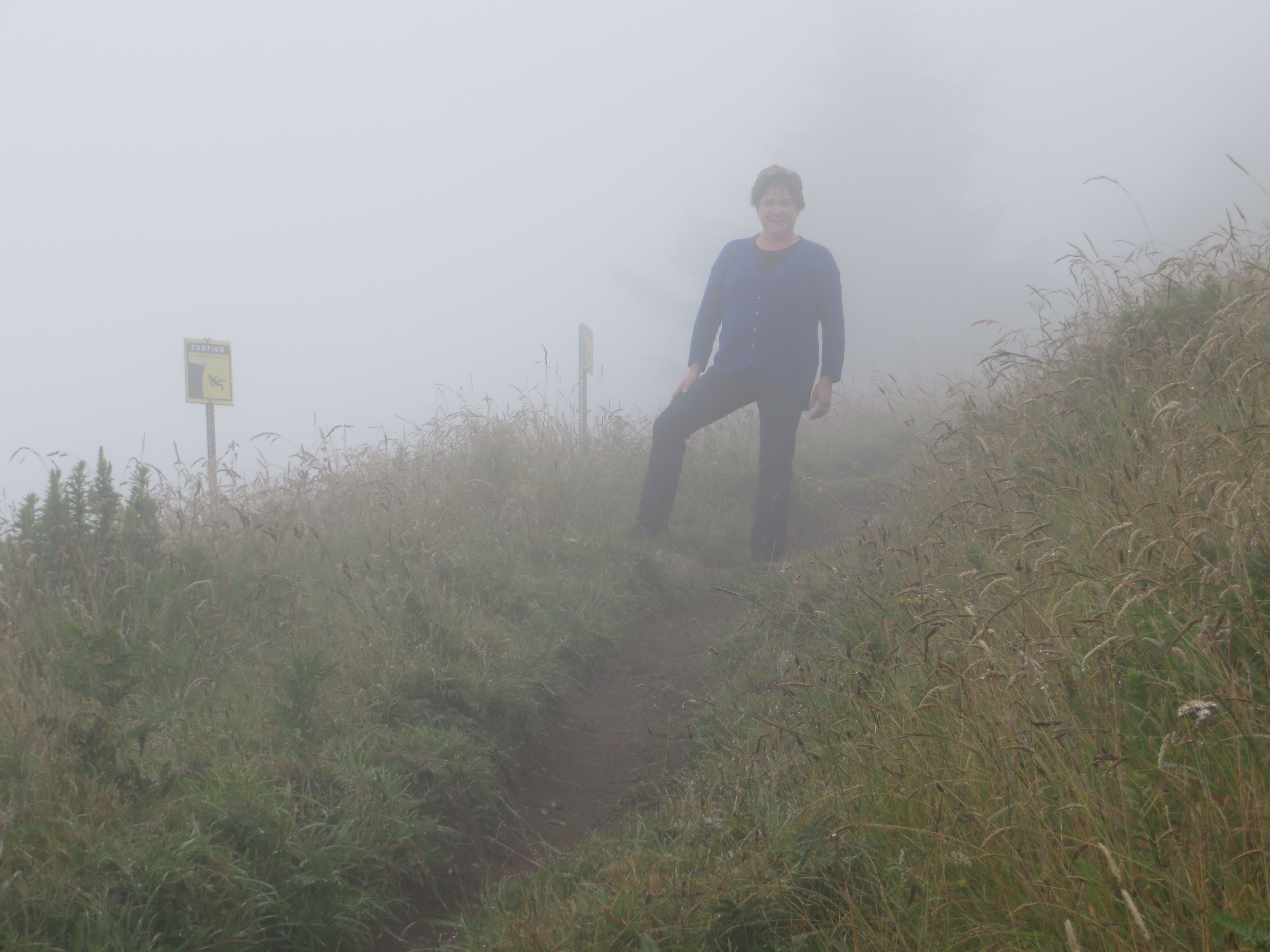
Fog hung over Cascade Head all morning.
Spider Webs. Wow. At the edge of a grassy pasture, foxgloves glittered in the fog. A spider web was hung with water droplets like a Christmas tree hung with lights. We stopped to look closer. Likewise, in your writing, enjoy the journey of writing a story. Don’t just look for the finished book or the pay check at the end. Instead–stop and look for spider webs. (Don’t you think that is much better than, “Stop and smell the roses”?)

Stop and look for spider webs.
Honor our differences. We all carried cameras and when we found this rope looped around a branch, we snapped away. Then we compared and each of us had a different view of the rope and tree–just as each of us carries around a different view of story.

You may not know when you reach the top. Because of the fog, we weren’t sure what we were supposed to see and where we were supposed to go to see it. We reached a pasture and thought it was supposed to be the top, but we didn’t know. Sometimes, in our writing careers, we reach a certain point and look around, only to be puzzled. Is this the top? Why can’t we see any clearer?
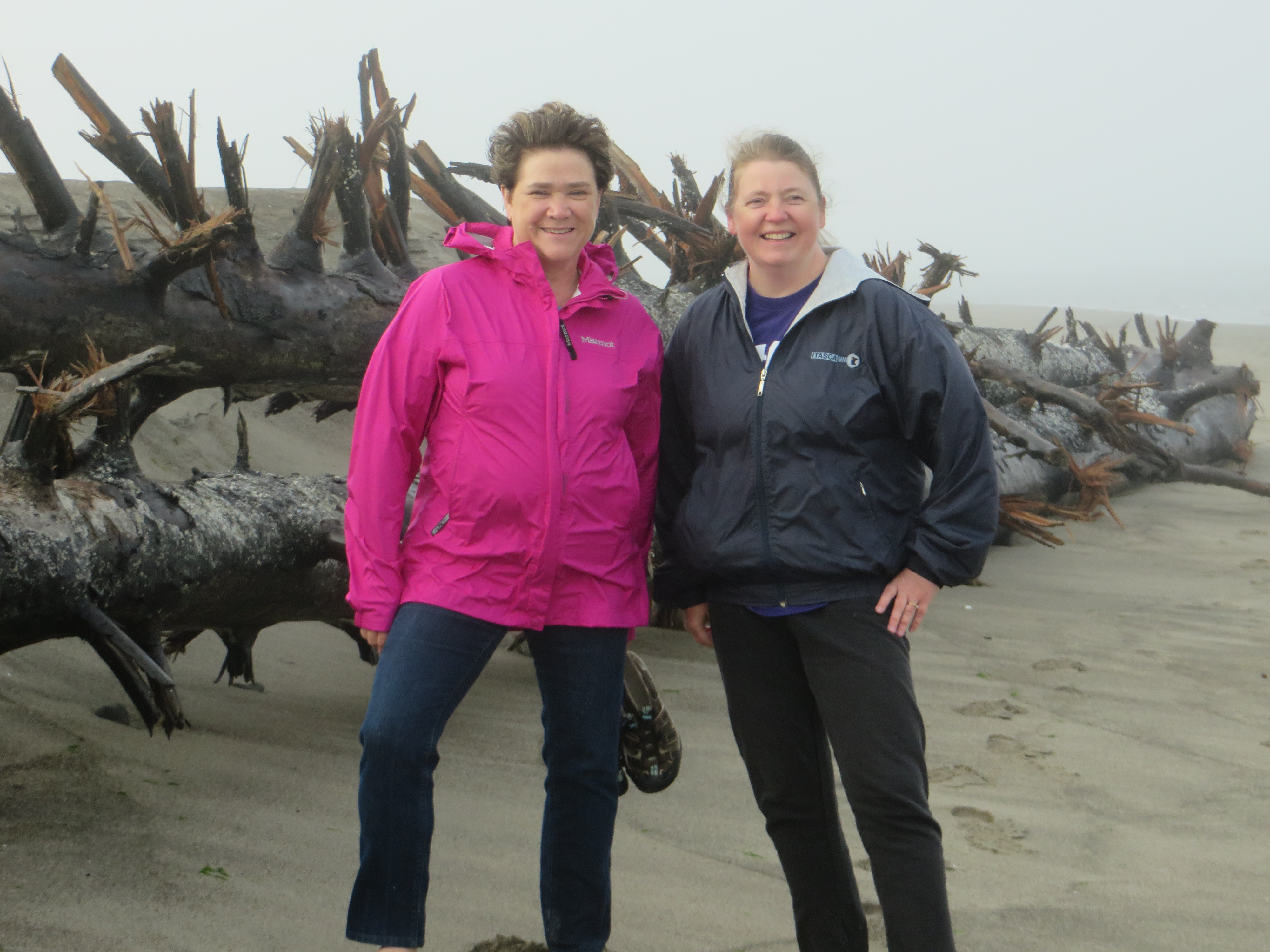
Darcy and Dori, Writing Buddies.
Paths diverge and converge. Several times there was an obstacle in the path–a fallen tree, a mud puddle–and we had to choose to go right or left. Our paths diverged and converged. As writing buddies, this has been true, too. Over the years I’ve known Dori, we’ve had periods of intense conversations and back and forths, and then the ebb and flow of life takes us different directions. But always–we are writing buddies and we work to have our paths converge, even if only for a week’s retreat.
Timing is important. We were disappointed not to be able to see the ocean from the top of Cascade Head, so a couple days later, we had some free time in the afternoon, instead of morning. We decided to head back to Cascade Head and try again. Sun shone brightly in the valley, but we saw a cloud hanging over the top of Cascade Head. Was it thick fog again? We pulled into the parking area and it was almost raining. We hesitated. We had been out there once; would we find nothing but fog again? Like in our writing career, you just have to try. You have to write that next novel or story, and you can’t give up. We climbed out of the car and took off.
This time–Wow! The view was amazing.

On a clear day, the coastland stretches into the distance, a sight worth the trouble of going back again and again until the view is clear.
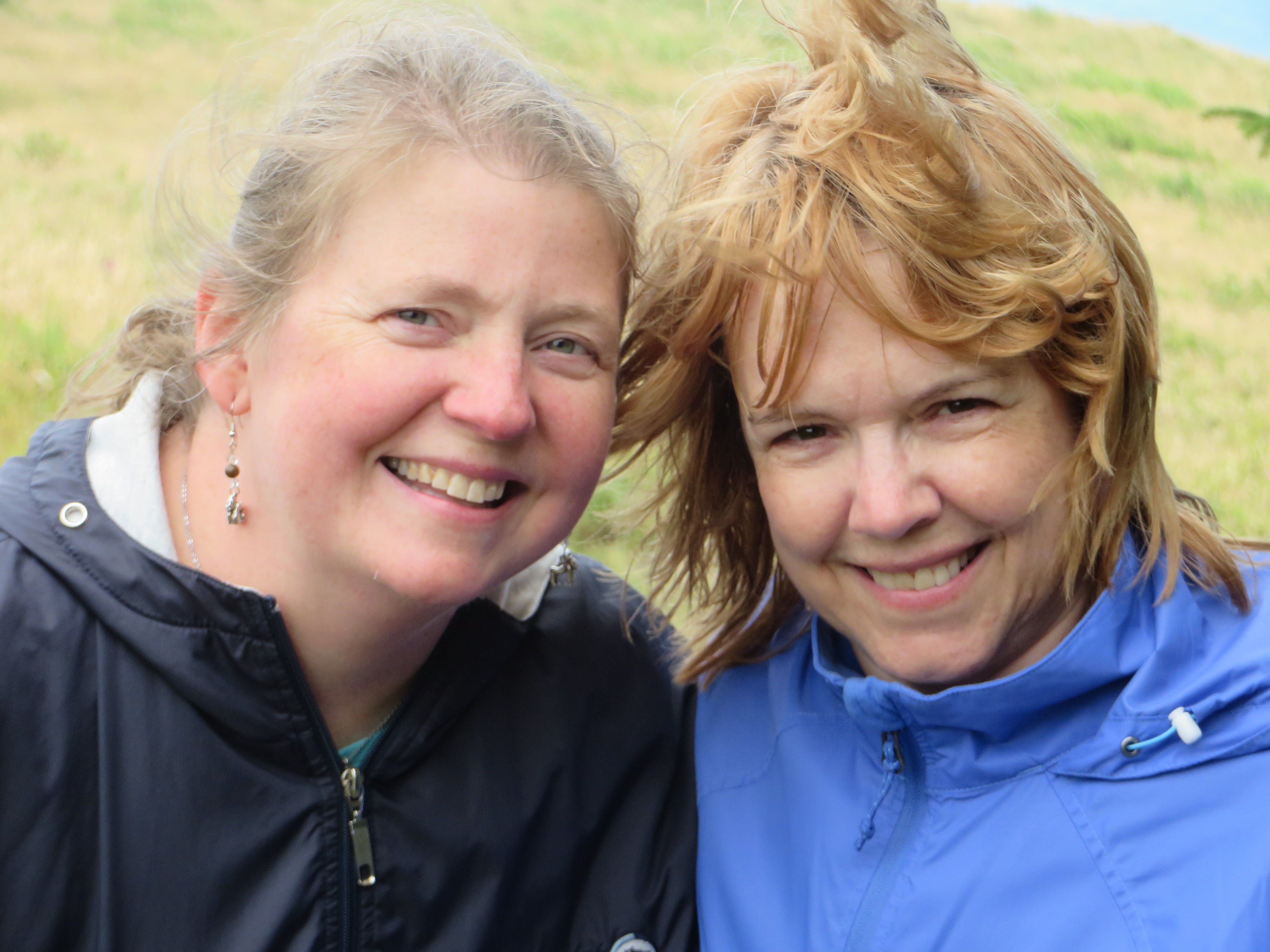
Dori Butler and Carol Gorman. Great writers, great friends.
Thanks, Dori and Carol. It was a great week!


July 15, 2013
63 Character Emotions to Explore
START YOUR NOVEL
Six Winning Steps Toward a Compelling Opening Line, Scene and Chapter
29 Plot Templates
2 Essential Writing Skills
100 Examples of Opening Lines
7 Weak Openings to Avoid
4 Strong Openings to Use
3 Assignments to Get Unstuck
7 Problems to Resolve
The Math adds up to one thing: a publishable manuscript.
Download a sample chapter on your Kindle.
Readers want to get emotional when they read a piece of fiction, whether it is a novel or a picture book. We concentrate usually on character and plot, but often forget the emotional thread of a story.
Emotions are one place where the author should “show, don’t tell,” or “show, then tell.” Show, Don’t Tell, refers to the idea that fiction should create the emotion in the reader by zooming in and giving enough details for the reader to feel as if they are in the story itself.
My modification is Show, then Tell, by which I mean that once you have Shown the emotion, you can also–not all the time, but selectively–also name the emotion. For example, if a girl comes along and slaps a boy’s face, the reader has to wonder why that happened. Is it anger, outrage, embarrassment or some other emotion that prompted the action? Just tell the reader. It’s OK. You showed the physical expression of the outrage, so just name the actual emotion.
Another consideration for creating emotion is where the emotion goes. There is a natural progression that should be observed most of the time: action, reaction, emotion. A car screeches on the road, the girl turns to look, and if horrified by a wreck. If you get those out of order, the reader is apt to be confused.
OUT OF ORDER: Gerry burst into tears of grief because of the car wreck that happened after the car squealed its tires and the driver lost control.
IN ORDER: Suddenly, a squeal split the calm, and Gerry whirled to see a mini-van careening out of control toward–oh no!–it slammed into an oak. She dashed toward the blue vehicle, but her stomach gripped in a sudden pain, grief already starting to overwhelm her. This was going to be bad. Very bad.
One problem with character emotions I see is that a character gets stuck on one and only one emotion. A teenager is full of angst and is angry, angry, angry. And angry. Or a child’s mother has died and she is sad, sad, sad. Very sad. Extremely sad. And further more, she is very extremely sad.
Instead, characters need a vivid and varied emotional life, with lots of variety to keep the reader interested. In a typed-double-spaced manuscript page of 250 words, I like to see 2-4 changes of emotion. Even at a funeral where everyone is sad, someone can joke about Aunt Flora’s awful fruit cakes, or that pesky cousin makes a snide remark and you want to slap her, or the boyfriend you’ve been fighting with has shown up to give you a hug and to murmur that he is there for you. Life is full of conflicting emotions and your characters should be also.
How would you describe this girl's emotions?
Here is a list of emotions to explore–which one best describes the girl in the photo?: anger, annoyed, anxiety, apathy, betrayal, bravery, bravado, confusion, contentment, curiosity, desire, despair, defiance, disgust, dismay, desperation, embarrassment, excitement, eagerness, fear, fondness, forgiveness, frustration, gratitude, grief, guilt, happiness, hate, hope, hostility, irritation, jealousy, loneliness, longing, love (parent-child), love (romantic), nostalgia, panic, pride, passion, remorse, reluctance, resignation, restlessness, revenge, regret, rejection, relief, sadness, serious, shock, shame, surprise, suspicion, sympathy, tenderness, tired, thrilled, terrorized, taken aback,uncertain, worries, waiting.
With the wide variety of emotions possible, don’t let your character get stuck on just one. No one likes a character who is jealous and jealous and jealous. And even more jealous. And furthermore, very jealous.


July 8, 2013
5 Quotes to Plot Your Novel By
START YOUR NOVEL
Six Winning Steps Toward a Compelling Opening Line, Scene and Chapter
29 Plot Templates
2 Essential Writing Skills
100 Examples of Opening Lines
7 Weak Openings to Avoid
4 Strong Openings to Use
3 Assignments to Get Unstuck
7 Problems to Resolve
The Math adds up to one thing: a publishable manuscript.
Download a sample chapter on your Kindle.
I am currently slogging through plot development of a new series of novels. Here are some helpful quotes.
“A plot is just one thing after another, a what and a what and a what.” Margaret Atwood.
It is hard to narrow down the possibilities of a story to a particular “WHAT happened next?”. It is a tricky process of going back and forth between character and interconnected events, refining both at the same time you make a decision about WHAT. Because I am planning a series, I am writing three plots with the same characters, which gives each character an internal conflict arc for individual books, as well as for the series overall. If an individual plot line doesn’t give me an idea for WHAT, I switch to series conflict; or I switch to a subplot.
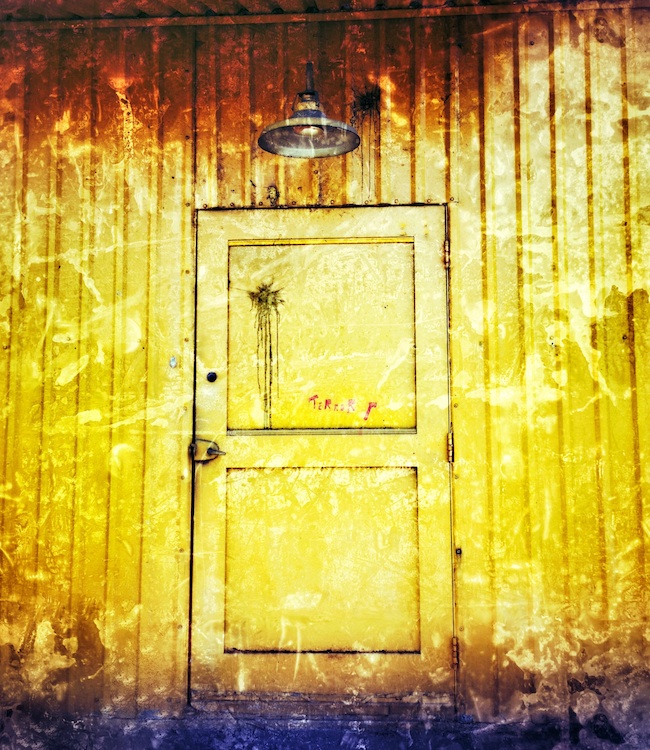
Terror: The Doorway to Great Plots
“Real suspense comes with moral dilemma and the courage to make and at upon choices. False suspense comes from the accidental and meaningless occurrence of one damned thing after another.” John Gardner.
In the midst of all the WHAT, I am constantly searching for the moral dilemma. Versus. Good versus good. Understandable versus understandable, even if you might disagree. Moral dilemmas make for great plots.
“Writing about writing, Checkhov instrucs us that no gun should go off unless we have first shown it hanging on the wall: every surprise must have its sublimated genesis.” Cynthia Ozick.
If WHAT happens at the end of Book 3, how can I prepare the reader for it and surprise the reader at the same time? How needs to remain unstated in Books 1 and 2? In Acts 1 and 2 of each book?
“Years ago, someone said to me, ‘Jackson, your books must be printed on scar tissue.’ I was pleased.” Richard Jackson
Beware of characters who are too perfect, of plots that fit together too neatly. Life is messy and while art works to make sense of that mess, if it is too structured, it fails to connect emotionally. Embrace the scars of your characters. Embrace your own scars as a writer, as a person.
“Get your character in trouble in the first sentence and out of trouble in the last sentence.” Barthe DeClements
Pacing of plots is crucial; never give the reader a place to put the story down. This focus on tension on every page begins at the stage of slogging out a plot and continues till the last copyedit.


July 3, 2013
Fiction Techniques for Nonfiction
START YOUR NOVEL
Six Winning Steps Toward a Compelling Opening Line, Scene and Chapter
29 Plot Templates
2 Essential Writing Skills
100 Examples of Opening Lines
7 Weak Openings to Avoid
4 Strong Openings to Use
3 Assignments to Get Unstuck
7 Problems to Resolve
The Math adds up to one thing: a publishable manuscript.
Download a sample chapter on your Kindle.
All those fiction techniques you’ve spent time mastering — dialogue, description, setting, mood, scenes, characterization, and plot — are equally useful in writing nonfiction. Yes, there is more leeway in nonfiction than in the last twenty-five years, but publishers still value creative nonfiction or fiction written with fiction techniques.
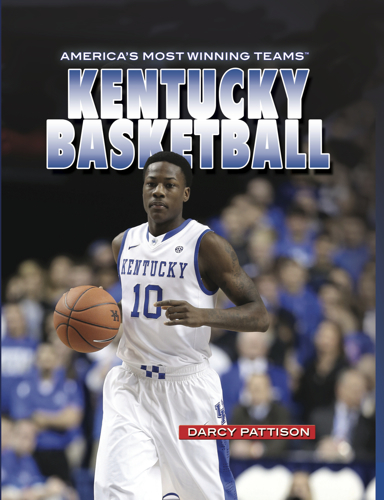
For example, I have a new nonfiction coming out next year, Kentucky Basketball: America’s Winningest Teams (Rosen, 2014). I searched and searched for an interesting opening to the story, until I found a scene that was worthy of describing.
It was Valentine’s Day, 1938. Packed into the University of Kentucky Alumni Gym were over 4000 people, some sitting in windows, others literally hanging from the rafters. The UK Wildcat basketball team led top-ranked Marquette University team by 10 points.
It’s an exciting rivalry game, early in the history of the basketball program at Kentucky. Fiction techniques dictated that I set the scene immediately. Then I use sensory details to fill in the scene to describe the fast-paced last few minutes. Joe “Red” Hagan shoots a long 49-foot field goal from near the half-court line. When Marquette missed three more times, it becomes the winning score. Then, the interesting part started. In the audience was “Happy” Chandler, governor of Kentucky. He was so excited by the win, and especially Red’s winning shot, that he called for a hammer and nail. He rushed onto the court and at the spot from which Red shot, Chandler hammered a nail into the floor to commemorate the moment.
It’s stuff of legends. And it deserved a full scene, which meant fiction techniques.
Research Details for NonFiction: Think Fiction
This means that while I was researching the nonfiction topic of Kentucky basketball, I was really looking for a certain type of information.
Scenes. I look specifically for scenes with a beginning, middle with conflict, and ending. It needs to be something fun and interesting, a specific event.
Details. Next, I look for details. Here’s a fact: the basketball arena was meant to seat 2500, but 4000 fans were in attendance. A newspaper article of the times specifically said that fans were literally sitting in windows and hanging from the rafters. I look for numbers, colors, sizes, shapes, extended descriptions, and other specific details. These will all help the story come alive.
Timelines. The timeline of the basketball game was important to lay out and newspaper reports were helpful. The details of the first half were important to understand, so I could focus on the last three minutes.
Personalities or Characters. This story is made richer by the presence of Happy Chandler, governor of Kentucky. What a happy thing that he was named Happy! It added to the appeal of the story that the governor with such a nickname was so Happy that he did something unexpected.
Unexpected. The story is interested because of the governor’s unexpected reaction. Stories of last-minute wins are commonplace, even if in the moment it feels like a miracle. By itself, Red Hagan’s shot isn’t remarkable enough to include in a book like this. But add to that the unexpected hammer and nail, and it becomes a remarkable story of a fan who wanted to acknowledge a miraculous shot. That’s why this story made it into the book’s introduction, surprise.
Research and document all your research; but while you’re researching, think fiction techniques. And your nonfiction article will become an interesting story that both informs and entertains.


June 29, 2013
Storing up LIFE to Write About Later
START YOUR NOVEL
Six Winning Steps Toward a Compelling Opening Line, Scene and Chapter
29 Plot Templates
2 Essential Writing Skills
100 Examples of Opening Lines
7 Weak Openings to Avoid
4 Strong Openings to Use
3 Assignments to Get Unstuck
7 Problems to Resolve
The Math adds up to one thing: a publishable manuscript.
Download a sample chapter on your Kindle.
This week, I have been Frederick. The classic children’s book talks about a mouse who watches all 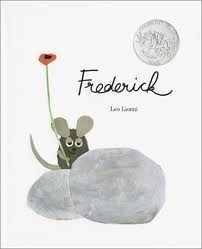 the other mice gather seeds and grains for the winter, storing them away for the cold days. Frederick is a gatherer, too, but he gathers the sights, sounds, tastes, smells and feel of summer. When dreary days of winter come, Frederick is ready with poetry to remind the others that good days would come again.
My daughter delivered her second son, my fourth grandchild this week, and I’ve concentrated on just living. On being a Frederick who soaks up life at it grandest and stores it in the depths of my heart to be brought out in a written form when needed.
Here are some of the images of the week: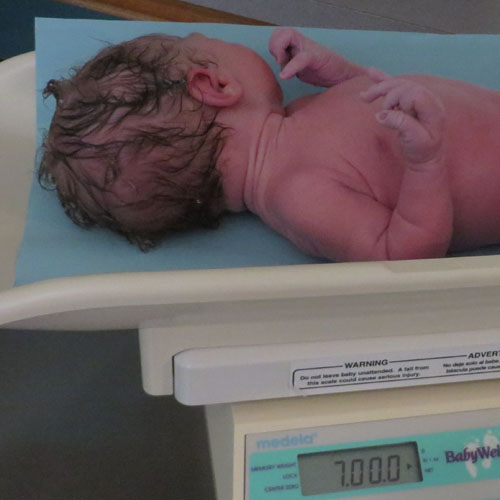
Mr. GFR weighed in a 7 lbs, 20.5 inches.
Big brother marched into the hospital and literally charmed the entire nursing staff. They were all hanging over the desk to get a look at his fedora and glasses.

Mr. EIR stole the show from his little brother.
And while the household slept, I took early morning walks, just rejoicing in the richness of our lives.
Heron on the Lake on the day that GFR was just two days old.
Sometimes, every once in a while, it’s good to be a Frederick! When is the last time you just lived and enjoyed the fullness of life?


