
Jonathan Chait's Blog, page 3
September 1, 2011
Rick Perry's Smart Court Reform

Rick Perry's platform may consist of great heaps of terrifying reactionary obscurantism, but it also features a couple nice little dollops of reassuring liberal reform. Here's one of them:
One solution the governor embraces is to end lifetime tenure — a cornerstone of the Constitution, whose drafters worried far less about activist or senile judges than about meddling tyrants and political pressure. ...
In the book, Perry only alludes to how he would change judicial tenure, referring to a plan that would stagger Supreme Court terms so there’s a retirement every two years. In that plan, justices would get 18-year terms, to ensure that no single president gets to pick a majority of the nine-member court.
The current system of lifetime tenure creates real problems. Huge policy swings hinge on the simple health and longevity of Supreme Court justices. This results in very old justices clinging to their seats until a sufficiently friendly president can take office. It also gives presidents an incentive to nominate the youngest possible justice who can be confirmed, as opposed to the most qualified possible justice. And eliminating some element of the sheer randomness by which each party gets to appoint justices would tend to reduce the chances of the court swinging too far one way or another from the mainstream of legal thought.
It's hard to imagine the incentive structure for any president to propose such a reform -- why volunteer to the the first president whose judicial nominees don't get lifetime tenure? But it is slightly reassuring to see glimmers of sense in Perry's platform.


Woman Punches Bear In Face
So the Palin thing didn't completely work out, but I expect the Republican presidential candidate to give this Alaska woman a call:
A 22-year-old Alaska woman said on Wednesday she punched a black bear in the face to save her small dog from being carried off and possibly eaten.
Juneau resident Brooke Collins said she hit the bear Sunday night to save the life of her dachshund, Fudge. She said she discovered the bear crouched down, clutching Fudge in its paws and biting the back of the dog's neck.
"It had her kind of like when they eat salmon," Collins said Wednesday. "I was freaking out. I was screaming at it. My dog was screaming. I ran up to it ... I just punched it right in the snout and it let go."
It's like Palin but better -- she not only takes on animals, but does it empty-handed. And she has even less political experience.
Is Mitt Romney Good At Politics?
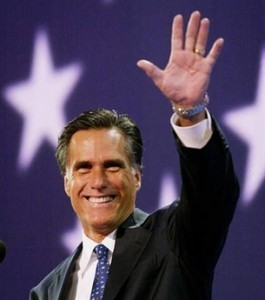 Jonathan Last argues no. He tallies up Romney's mixed record of winning elections in Massachusetts with his poor record during the 2008 primaries, and concludes:
I’d argue that his electoral prospects are even worse than they look from his won-loss record. Here’s why:
(1) Romney made his political career out of his “close” 17-point loss to Ted Kennedy. But keep in mind that to only lose by 17, he spent $7M of his own money. But more importantly, this was the 1994 midterm election—so he got blown out during the biggest Republican wave in half a century.
(2) The high-point of his electoral career was the 2002 MA governor’s race, where he took 49.77%. Even in the biggest win of his life, he couldn’t capture more than 50% of the vote.
(3) It’s funny that Romney’s line of attack on Perry seems to be that Perry is a “career politician” because he’s been in elective office since 1984. Well, Mitt Romney would have been a career politician too, if only voters would have let him. He’s been running since 1994. His real gripe about Perry is actually, “Hey, that guy wins all the time! No fair!”
I think this is somewhat unfair to Romney. Running as a Republican in Massachusetts is hard. Rick Perry couldn't win statewide office there if he were running against Lee Harvey Oswald. What's more, Last tallies up Romney's primary record as if each race were a separate election. In reality, the primaries are all connected with each other, and a loss in one place makes further losses more likely.
Still, he's not wrong about the big picture. Romney has trouble attracting core supporters because he is so transparently political, as Scott Galupo explains:
You can practically hear the clanging and buzzing of Romney Robotic Manipulation technology:
What are Rick Perry's political weaknesses?
Ding!—Extreme rhetoric on constitutionality of Medicare and Social Security—Beep-Beep-Ding!—From border state; soft on immigration—Ding!—[Making necessary adjustments in left hemisphere of RomneyBrain]. ...
flip-flopping isn't necessarily a fatal flaw. It's when voters trust neither your flip nor your flop—that's when you're toast.
Flip-flopping isn't fatal. But it is true that voters make broad judgments about politicians that amount to more than a mere tallying up of issue stances. The best politicians create a successful persona.
I think Romney is a below-average presidential nominee, but that this has been obscured by the competition, which he towers above. Rick Perry would be a really bad nominee, and Michelle Bachmann a horrible one. In 2008, I considered Romney the weakest possible nominee of the Republican field. Now he's the strongest, and not because he's done anything better. To put it differently, if the 2008 version of John McCain -- the popular war hero whose many breaks against the Bush administration were fresh in voters' memory -- were the nominee, he'd be a very strong favorite to win.
August 31, 2011
&c
-- Maybe one reason Jewish Republicans like Romney is that he too is a religious minority.
-- The truth behind the "CEOs who make more than their companies pay taxes" study.
-- Our heroic ambassador to Syria.
-- The kerfuffle over the timing of Obama's job speech is almost a parody of the pathologies of political discourse.
Life In Ohio, A Continuing Series
I feel that Hamilton, Ohio has been the home of numerous incidents like this:
A repeat public indecency offender has been arrested for allegedly engaging in "sexual activity" with a pink inflatable swimming pool raft, according to Hamilton police.
Edwin Charles Tobergta, 32, was arrested at his Harmon Avenue home early Sunday after he was spotted in the act in an alley in the 1800 block of Howell Avenue behind a residence, a police report shows.
A male witness, who owns the raft and lives in the home near the alley, told Hamilton Police Officer William Thacker he shouted at the suspect to stop.
Tobergta took the raft and fled, the report states.
In other Ohio news, this happened:

Rick Perry Embraces New Deal Revisionism
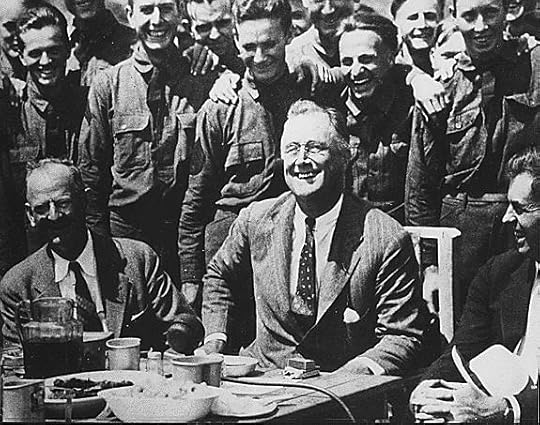
Rick Perry, in his anti-Obama spiel, drops in some interesting New Deal revisionism:
“What’s dumb is to oversee an economy that has lost that many millions of jobs, to put unemployment numbers that over his four years will stay probably at 9 percent, to downgrade the credit of this good country, to put fiscal policies in place that were a disaster back in the '30s and to try them again in the 2000s,” Perry said on Sean Hannity’s radio show. “That’s what I consider to be the definition of dumb.”
The previously-marginal notion that Franklin Roosevelt worsened the Depression has rapidly hardened into conventional wisdom within the vanguard of the conservative movement. (In 2009, I wrote a review essay about the phenomenon.) But it's remained largely hidden from the political stage. My suspicion is that most Americans consider the New Deal a great success, and Franklin Roosevelt a great president. Indeed, the full political force of the conservative backlash has mobilized the belief that President Obama is taking away good, earned benefits from middle-class Americans and giving them to the undeserving poor.
I could see why this would put Perry in good stead with conservative Republican activists. But does he really want to run in the general election against Obama as Roosevelt?
The Balanced Budget Scam
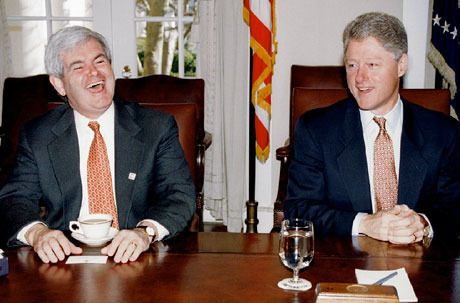
The 1997 Balanced Budget Act is one of the great propaganda coups in the history of American governance. It is remembered today fondly by right and left as the hallmark of a bygone era of bipartisan cooperation, when the two parties came together in the spirit of shared sacrifice in order to secure a balanced budget. Here's Matthew Yglesias noting how the law "managed to raise revenue." Here are conservatives like Keith Hennessey and Paul Ryan holding it up as a case of the government cutting taxes and balancing the budget.
What really happened in 1997? What happened is that deficits had been rapidly disappearing, as a result both of fast growth and of 1990 and 1993 laws that raised taxes and cut spending. By 1997, it was apparent the budget would be balanced the following year. Both President Clinton and Congress recognized an opportunity to take credit for this development by passing a law called the "Balanced Budget Act."
The resulting agreement cut payments to Medicare providers, and divvied up the proceeds between a new childrens' health insurance program (for Democrats) and a capital gains tax cut (for Republicans.) It also imposed budget caps, which means a generalized promise to reduce domestic spending programs without specifying where the cuts will occur and which, naturally, was ignored.
The resulting agreement did not hasten or in any way contribute to the balancing of the budget. Michael Linden explains:
The Balanced Budget Act of 1997 actually increased the deficit for 1998. Indeed the CBO reported that the passage of that bill resulted in a $21 billion deficit increase, which more than offsets any fiscal improvement stemming from the previous year’s legislation. The combined legislative changes passed during the first three years of Speaker Gingrich’s tenure added $5 billion the deficit in 1998.
This was not Clinton's finest moment. The purpose was to engage in some horse trading that amounted to the opposite of fiscal responsibility -- your rich guys get their taxes cut, our sick kids get medical care -- while posing as creators of the balanced budget. Even as a raw political maneuver, I consider it a long-term strategic blunder by Clinton. He had been in position to claim a lions' share of the credit for the balanced budget, as the one legislative change during his term that significantly reduced the deficit was his 1993 budget, which Republicans unanimously and hysterically opposed. (George H.W. Bush's 1990 budget did even more to reduce the deficit, and this, too, was fiercely opposed by the right for its mild tax hikes on the rich.) Instead, Clinton created a mythology that allowed Republicans to split credit for balancing the budget.
In any case, over the long run, all substantive analysis of the "1997 Balanced Budget Act" has been subsumed by the raw propagandistic power of the name "1997 Balanced Budget Act." I suppose the lesson is that if both parties decide to strike a bargain, then people will remember the law for doing whatever it is they claim it accomplished, regardless of the reality.
Lesson For Stimulus Critics: Employment Is Fungible
The right-wing Mercatus Center has a new gotcha study about the American Recovery and Reinvestment Act. It finds that not all the workers hired by firms that received stimulus funds were unemployed:
Hiring isn’t the same as net job creation. In our survey, just 42.1 percent of the workers hired at ARRA-receiving organizations after January 31, 2009, were unemployed at the time they were hired (Appendix C). More were hired directly from other organizations (47.3 percent of post-ARRA workers), while a handful came from school (6.5%) or from outside the labor force (4.1%)(Figure 2). Thus, there was an almost even split between “job creating” and “job switching.” This suggests just how hard it is for Keynesian job creation to work in a modern, expertise-based economy: even in a weak economy, organizations hired the employed about as often as the unemployed.
Let's ponder this. Suppose Company A creates a new job, and fills it by hiring a worker away from Company B. What do the authors suppose think happens to the job at Company B? Do they say, well, that's it, we lost Joyce, nothing we can do about that in an economy with unemployment at only 9%.
I read the paper in the vain hope of finding the authors' explanation of what they think happens when a new job is filled by moving a worker from another job. I did not see one. Nor did I see any attempt to demonstrate, or even suggest, that the newly-opened jobs of workers moving into stimulus-created jobs were going unfilled. They genuinely seem to assume that "job shifting" is simply the opposite of job creation. (They also seem to think that hiring half of new workers from the ranks of the unemployed, when some 90% of the potential workforce has jobs, is a wildly low figure.)
Suppose the authors of this study, Garrett Jones and Daniel Rothschild, lost their jobs (though I can't imagine any circumstances that would allow such a thing to happen.) Now suppose the Koch brothers announced they were pouring another $100 million into new think-tanks devoted to cranking out anti-government tracts, but that these new organizations would only be allowed to hire staffers who were already employed in the anti-government tract-cranking industry. None of these new jobs could hire unemployed persons such as themselves. Would Jones and Rothschild view this development as worthless for their chances of securing employment?
August 30, 2011
&c
-- “it's like Bridges of Madison County meets Copland.” Gawker on Bill O'Reilly, his wife, and the police.
-- Perry panic takes over liberaldom.
-- This says something about Canada. Not sure what. And this says something else entirely.
-- Conservatives and “experts.”
Does Rick Perry Have It In The Bag?
[image error]
John Ellis thinks so:
Once Labor Day has passed, there will be five debates, in quick succession, on the GOP presidential candidates' calendars. These will be important tests for Perry. If at the end of two or three, it's clear that he's every bit the equal of Mitt Romney on matters of policy and politics, then the Perry juggernaut becomes all but unstoppable. Romney's "I'm the only electable one" argument will vanish and the party's base will nominate one of their own. If Perry stumbles badly in the debates, Romney's campaign gets a second wind.
Knowing that the only things standing between Perry and the GOP nomination are a couple of "good enough" debate performances, the GOP "establishment" faces a choice: they can cross their fingers and hope for the best or mount a sustained negative campaign to destroy Perry with the party's base. It is likely that, after Labor Day, a sustained negative campaign against Perry will be launched.
The sewage flood-gates have already opened, to some degree. For the past few months, Washington bureau chiefs of major news organizations have been inundated with rumors of Perry's alleged personal indiscretions and peccadilloes. And virtually every major news organization has some kind of "investigative team" looking into allegations of "pay to play" and other forms of corruption. If all that that amounts to are some negative articles in The Washington Post and The New York Times, Perry won't be harmed. It will take something serious, something big and proven to bring him down.
I agree. Perry isn't a lock, but something has to happen to take him down, or he will win. Political pundits have been dismissing Perry's lead by claiming that early polls "mean nothing." But when you examine this view closely, it turns out to mean "early polls meant nothing in the 2007-2008 cycle." In general, early polls mean a great deal in Republican primaries. They're not perfect, but they are strong indicators.
Obviously, you can't be certain about anything, and you have to make human judgments about the field. Does a candidate's lead represent a name recognition bubble that's likely to pop once voters learn more about the candidate's history or platform? (Think Joe Lieberman 2004.) When I look at the GOP field, I see an incredibly vulnerable Mitt Romney just waiting for someone to point out all the ways he's flouting the party's most deeply held beliefs, and see Rick Perry as both the man to do it and a a perfect embodiment of the party id.
Another, more prosaic advantage for Perry is the distribution of the voters' support:
Rick Perry: 32 (18)
Mitt Romney: 18 (23)
Michele Bachmann: 12 (9)
Newt Gingrich: 7 (8)
Ron Paul: 6 (14)
Herman Cain: 3 (5)
Gary Johnson: 2 (n/a)
Jon Huntsman: 1 (5)
Rick Santorum: 1 (2)
Thad McCotter: 1 (n/a)
Ask yourself, which of Perry or Romney has the best chance to eat into the support of candidates currently supporting neither? The practically-nonexistent Jon Huntsman vote is sure to go to Romney. Maybe he can pick up the lion's share of the Gary Johnson vote. But the Bachmann and Gingrich votes, and probably, to a lesser extent, the Ron Paul vote, is all far better suited to Perry than to Romney. You can't assume that all voters are picking their candidates ideologically, but there is surely an ideological component at work. If and when the field gets narrowed to a Perry-Romney race, Perry will be in a commanding position to increase his share. Unless something knocks him off.
Jonathan Chait's Blog

- Jonathan Chait's profile
- 35 followers

