Allan Hudson's Blog, page 33
September 22, 2019
Returning Author John Sutherland of Fredericton, NB.
Greater love has no man.
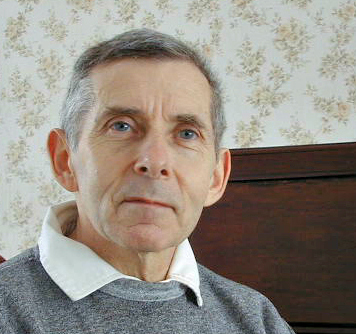
John K. Sutherland.
It’s a pleasure to have John back on the Scribbler. He is an award-winning author. His first visit was in December, 2017 when he talked about his short stories and novels. You can read his bio from the last visit HERE
This short story is taken from a novel of the Civil War, written by this author, and entitled ‘In Love and War.’ There is another version; much more explicit, entitled ‘Baptism by Fire’. Both stories may be feely read on inkitt.com along with almost 40 other stories by this author. Give my profile about 20 seconds to load.
https://www.inkitt.com/johnksutherland
https://www.facebook.com/john.k.sutherland.7

The story begins at the start of the Civil War and takes place mostly upon the Belding Plantation, in Mississippi.
Belding, has three grown children at the time of the story. A stepdaughter, Angelique; brought into his family when he married his second wife; a son, Charles, by his first wife; and Elizabeth, his youngest child.
Belding, mostly illiterate, and estranged from his son, relies upon Elizabeth, as young as she is, to run things on the plantation. She succeeds, where he failed. She changes many things behind his back to alleviate the burdens of the slaves, and to save the women from the rapacious ways of her father.
After a major argument and violence, after a slave comes to her defense in one of her many confrontations with her father, Elizabeth realizes that to save the life of the slave who defended her, that she will have to kill her father.
She does not hesitate. But first, she writes a will, for her father.
Soon after, encountering her half-brother, raping her half-sister, she shoots him too.
Peace returns to the plantation even as the war rages on around them.
Then, one day…after the war had ended… seven, ragged, Confederate soldiers rode into her yard.
Trouble of the worst kind!
They are saved by a Yankee, leaving seven renegades dead! He changes everything.
It ends here, and now.
Elizabeth was first alerted to something wrong by the sound of horses riding into the yard in front of the house. How could they have approached without being seen, or without Zeb coming down out of the woods to warn them that such a group was so close?
She felt a tight knot of apprehension in her stomach and a sudden feeling of unease gripped her.
They had been careful to have approached out of sight of the house and of the cabins.
She cursed herself for having let her guard down, lulled into foolishness by the euphoric news that the war had ended. She should have known better than to believe that. Wars never ended cleanly or when they were supposed to; history should have taught her that.
She could still escape out of the back of the house.
She hesitated, and then, staying out of sight, she glanced out of the open door of the washhouse and saw seven men on horseback. Confederates! But they had drawn guns and were not there for any honest purpose.
 Photo credit: John Straton
She saw one man dismount and grab hold of one of the women close to him; Dorothea, who was not fast enough to get out of his way; the others threatened anyone who thought to intervene.
Elizabeth began to feel sick at what their intentions were. She recovered her father’s pistol from under some cotton sheets in the washhouse, saw that it was loaded, and immediately ran out of the house, into the yard, heedless of any danger to herself now.
Dorothea was like a sister to her, and she would do everything in her power to stop them if she could.
The man who had dismounted and had stopped Dorothea from escaping him, ripped off her dress as he laughed at her efforts to escape him, revealing her naked body beneath. The other men on horseback were watching nervously, their guns ready for any resistance, though they already knew that there were no men worth considering at the main house, and the rest of the slaves were either in the fields or in plain view. They would not be trusted with weapons anyway.
They watched as he twisted the woman’s arm up behind her back and then pushed her ahead of him around the corner of the building and out of sight. His friends would make sure that no one followed them. He didn’t like an audience for what he was about to do. The woman could do nothing to fight him. Some man, possibly her husband if there was the formality of marriage between them, ran forward to defend her and was shot. He fell back clutching at his side.
“Next shot, I kill you!”
As the first man went around the corner to the cabin, pushing his captive ahead of him, Elizabeth moved into the yard. She pointed the pistol at the man who was obviously the leader, and pulled the trigger.
It did not function as she'd expected.
She cursed the wayward thing and quickly tried to find out what was wrong with it, but by then he had seen her and what she hoped to do.
On the other side of the small cluster of cabins, and also out of sight of those in the yard in front of the house, Forrester had seen the beginning of what was unfolding.
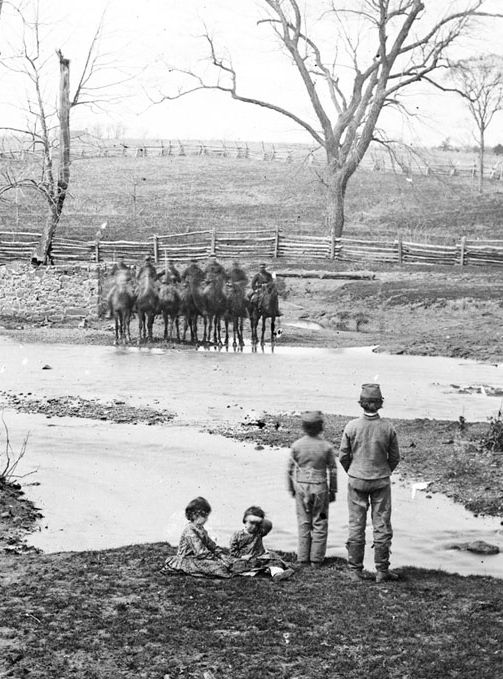 He would have liked to have shot more of them before they got this far, but the ground here was not in his favor against so many men, and with too few places to disappear to and melt away, as he had been able to do before. They were also on horseback and would escape. There was no one here that he could rely upon. He could see their intent and what they would likely do to all of those here who witnessed what they intended, before they were able to escape over the river after torching the place.
He would get a chance to remove one more of them, without any sound of a gunshot to give him away, if he was lucky. He walked around the corner of the building with his revolver trained on the man roughly handling the woman as he pushed her to the ground and stood over her.
He did not see Forrester. The man’s attention was elsewhere, struggling to get his own clothing undone while restraining the now silent woman, and stopping her from crawling off as he stood over her. The black woman didn’t say anything. She lay still, thinking of protecting as many lives of her own people from these men as possible, by staying quiet, no matter what happened to her. She had seen her own man shot in the side for thinking to intervene. Both men could hear some ruckus in the yard on the other side of the building: the sound of horses moving about and of raised voices.
Dorothea said nothing, but watched with wide eyes and lay still when Forrester swung his pistol at the man’s head, breaking bones and knocking him to his knees, at least mostly senseless if not worse. Before he could fall, Forrester grabbed him by the hair and then hauled him backward as he holstered his pistol and retrieved his knife, both with the same action, and then decisively cut the man’s throat before he could give any sound of alarm. He hoped the woman was not going to be hysterical at the sight of all of that blood suddenly spurting everywhere, even onto them both, or the man’s gurgling as he fought for air with suddenly gaping eyes and hands that rose unsteadily to his throat to find out what had happened with some horror, finding only blood to breathe on.
She was too terrified to say anything just watching this second man, wondering what he would do now, and to her. He was not one of the others, she knew that. He let the man fall off to one side and paid him no further attention other than to wipe his knife off on the fallen man’s clothing before he re-sheathed it.
 Photo Credit: Veronica ShelleyHe signaled for her to remain silent as she sat up in a tight ball against the cabin wall, whispering for her to stay where she was.
 He had no choice about what he must do now, but at least he would have the element of surprise on his part. He picked up the man’s gun and stuck it into his own belt, and then picked up his Henry repeating rifle as he retreated back the way he had come. The woman, still scared, watched him leave, but did not stay immobile for long with that dying man, jerking close by, still spouting blood and looking as he did, with his eyes wide and staring in horror. She rose to her feet and followed him, seemingly not put out by her nakedness, which was the last thing on her terror-filled mind at that moment, but wanting his protection, as uncertain as that might prove to be, and to get as far away from that other man making a strange noise, as he kicked at nothing, staring up into the sky. Seeing nothing.
The men on horseback were distracted by the sudden appearance of the younger woman, and at her intent, as she had tried to fire her pistol at their leader. He saw what she intended and rode at her quickly, seeing what had happened with her pistol.
Before she could correct what had gone wrong, he rode into her, sending her flying, with the gun lost from her grasp. As the others watched nervously, he dismounted quickly and hauled her to her feet. Another shot rang out behind him to discourage any concerted action by those blacks still standing there who would have come to her rescue. Before she could get back to her feet and escape, he had grasped her by the hair and pulled her back to him, holding her around her middle and around her breasts, endeavoring to trap her arms so that she could not fight him; but she could bite, and she did so... on the arm that came too close to her head. He struck her hard in the face for that.
“Well, lads, we got what we came for. She’s a feisty one.” He laughed. “She even had the gall to come out at us, as brazen as you please. We didn’t have to flush her out or go lookin’ for her. We’ll have us some fun tonight with this one, and for a while after that too. She’ll be a kicker and a screamer. At least for a while. She bites well enough.”
He recognized that they would have to leave now, after those shots, before others came out of the fields in response. He raised his voice and shouted so that their companion, supposedly still occupied with the woman behind the cabin, could hear him.
He could not have known what had already happened to him.
 Photo Credit: Bible Reflections“Adam, we’re leaving. Now! Bring her along too, you can finish up with her later, and bring anyone else you can snag.” One of his friends passed him a length of cloth to bind his captive’s hands, and then, as he threw her facedown over his saddle, he took off his own neckcloth and bound her feet, as she almost slid headfirst off the horse.
 “Adam?” He shouted for the man behind the cabin. “You hear me? We ain’t got time to waste. Bring her with you. We’re leaving.”
They had already been here too long. There would be others rushing back from the fields at the sound of gunfire. He turned to another man.
“Get us some food, or get some of those hens. Check inside that cabin and shoot whoever gets in your way, and then let’s get out of here, and see what’s keeping Adam. He’s never been longer than a couple of minutes, before.”
He climbed onto his horse and adjusted the struggling body in front of him, and then raised her long skirt to reveal her white skin and more.
“Stop struggling, damn you.” He spanked her hard, twice, on her bare buttocks for being difficult, liking what he saw there, exposed to him.
It would be an uncomfortable ride for her, but he didn’t care. That would be only the start of it. It would quieten her down and knock some of the fight out of her for later, and a very uncomfortable and busy night. He raised his voice.
“If any of you try to follow us, I’ll kill both of the women. You hear me?”
They probably would kill them anyway. No one moved or said anything, but the angry looks on their faces told him that they would not be easily discouraged. Let them learn the hard way. He fired a shot at a dog that had been barking and running in and out of the horse’s feet. He missed, but set the horses dancing nervously, almost unseating him, so did not repeat that act.
He heard another single shot, to one side, probably to discourage the slaves from intervening, and then another one.
That didn’t sound right!
He looked around and saw one of his companions lying on the ground, where he had just fallen, and another slumped over in his saddle with half of his head shot away. The others were shooting wildly at someone to his right and behind him.
Something had changed! Downey had not expected any resistance or anyone to have any guns. Slaves were not usually trusted with guns. Who the hell was doing this? There were no men in the house, he knew that. They had watched it for ten minutes and had learned as much from a small black child that one of them had questioned back along the road. He had been heading away from the house, or he would not have survived.
 They learned that the men were all at war, or were working out in the far fields getting the crops planted. He pulled the horse about with one hand as he steadied his burden with the same hand resting on her, across her bare buttocks, and the other hand reaching for his own pistol. He saw one man on foot, shooting at them from about twenty feet away and taking each shot with deliberation and care but not wasting any time either.
 A Yankee! Where had he come from? There were not supposed to be any white men here. He felt as though he recognized him from somewhere.
Him again!
His three remaining friends had already started to open fire at this new target—what little they could see of him—shooting at them; but with their horses moving beneath them, startled by the sudden noise of gunfire, and the dog, and being in each other’s way, they were not having much success, as they were still picked off with unerring accuracy. The man took his time over each shot, heedless of the bullets flying around him and with some of them undoubtedly hitting him as he flinched, but was not deterred. Another man, fell.
 Downey brought his own pistol up but saw—with complete horror—his hand holding the gun, separated from his arm by a long blade of some kind—he could not see it clearly—wielded by a black man who had somehow got too close to him as he had been distracted with the woman; and then he lost all interest even before any pain could be felt from that, as a bullet entered his brain, followed shortly after that by that same weapon that had taken off his hand. It lodged in his head, splitting him down to his chin.
The black man who had done that pushed the body off the horse, steadied it from dancing around, then carefully pulled his mistress off the horse, out of the line of fire, trying to protect her, as the man fell to the ground under the horse’s feet. He would go nowhere now, and was beyond feeling anything.
The two remaining men understood what was happening to them. They threw their empty pistols down, turned their horses, and spurred off in desperation, riding low over their horses’ necks to make as small a target as possible.
Unfortunately for them, it was all open ground with no cover of any kind, and with slaves hurrying along it back to the house after they heard the shots.
These two, knew the man shooting at them. They had learned of him in the previous weeks, but had thought that he was now dead. He, did not miss. They had found that out to their cost on several occasions as he had painstakingly hunted them down, picking them off, one after another over the last few weeks from a great distance, or from unassailable cover until they had laid a trap for him. Somehow, he had survived that!
Forrester dropped his empty pistol into the dust and brought the rifle he carried in his other hand up to his shoulder. He chambered a cartridge and took his time, as he had before. He squeezed off a shot, seeing one of the two men arch his back as he stood up in his stirrups before he fell back off his horse. One of his feet was still caught in the stirrup. His body began flying about in death, like a marionette at the end of its strings as the horse’s rear feet tore into his head and upper body, throwing him around enough to break bones and tear him limb from limb. The man felt nothing by then. Nobody had heard his cry over the noise of the gunshot. He was already dead. The horse would soon stop and wait nervously to be freed of that twisted burden.
 Photo Credit: Richmond ConfidentialForrester ignored all of that and his own pains as he worked the action and then focused on the one receding target still left. He ignored all else around him. He could allow for the increasing distance, but the man made it relatively easy for him, riding directly away from him.
He had been doing this for the last four years and was a master at it. He aimed for the top of the man’s body so as not to hit the horse. He knew that he could hit a target the size of an apple at two hundred yards, but he was tired, and trembling even, and this target was moving. He took a deep breath and held it as he brought the man into view along the sight.
He took his shot and saw the man slump from the saddle and fall off the galloping horse to bounce and then roll to lie motionless in a relatively small lump of what seemed like balled-up rags before he had gone more than four hundred feet. If the shot had not killed him, the fall from a galloping horse had, breaking many of the bones in his body. All seven men were accounted for.
Forrester limped over to the four that he was reasonably sure about, ready to use the other pistol taken from his belt. He saw the man, Downey, that he had taken pains to be sure he killed, with a blade cleaving his head down to his chin. He could see that he was certainly dead, as were the others. He had completed what he had set out to do all of those weeks earlier. He sat down heavily in the dust, relieved to have brought it all to an end. At least he had stopped them before they killed anyone else, or did any more damage. Now he could die. The devil could have him now after playing with him for the last four years, and throwing ever greater atrocities in his way.
He lost all consciousness of his surroundings as he fell over.
Thank you, John for being our guest this week and sharing your writing with our readers.

Thank you dear readers for visiting the Scribbler. Please leave a comment below, would love to hear from you.
Don't forget your copy of my newest story - Shattered Figurine - check the top right sidebar above to get your copy now.


September 15, 2019
A Healing Gift. Guest Author Maggie McLaughlin of Fredericton, NB.
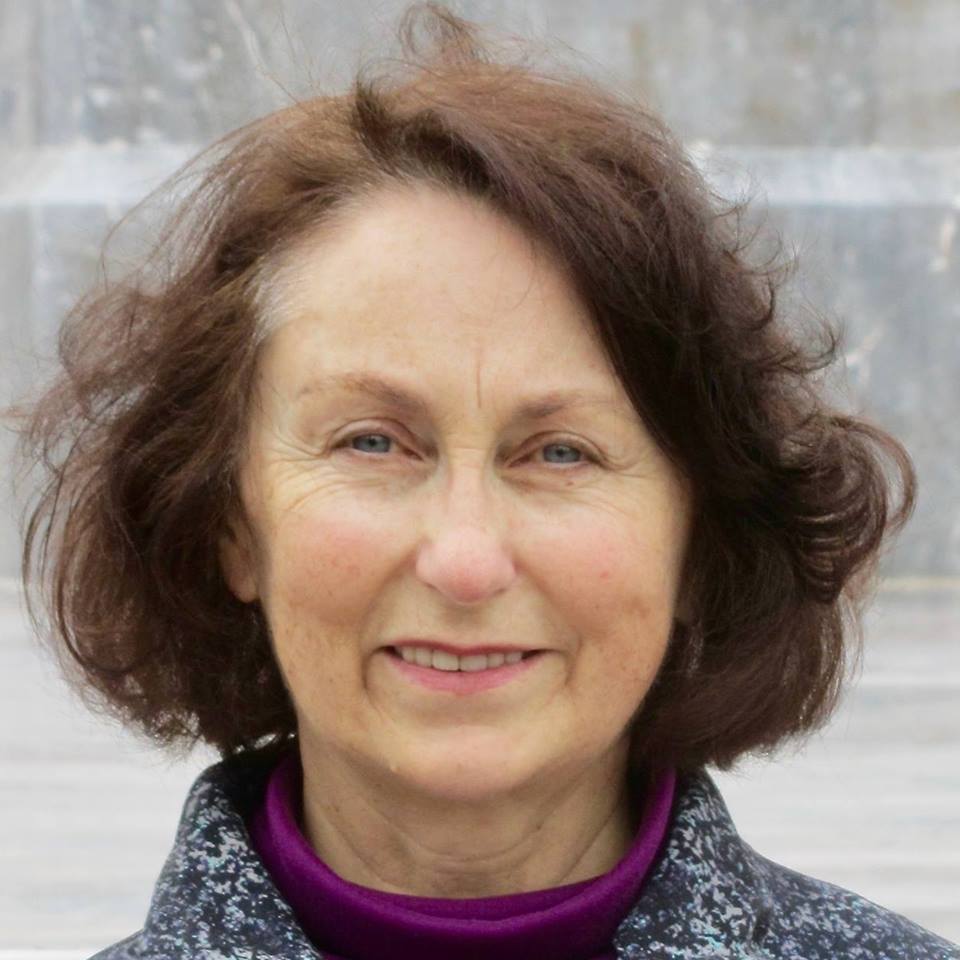
A Healing Gift Cognitive Energy Healing
Here’s a testimonial for Margaret’s book:
“A must read for anyone interested in alternative medicine. Maggie takes us along a journey of how she healed herself and others of debilitating allergies. Her healing modality (CEH) can also be used to address auto-immune disorders and releasing emotional baggage that hinder our ability to fully enjoy life. A truly inspiring read”
The Kirkus Review: Maggie McLaughlin's readers may find her "... creativity, effusive tone of spiritual uplift, and reassuring success stories to be just what the doctor ordered. ... A warm hearted and encouraging ... alternative-medicine guide."
The Scribbler is happy to have Maggie visit us today and participate in a 4Q Interview and she is graciously sharing an excerpt from her book.
Let me share a bit of my story.
 My parents grew up along the Richibucto River and I was born in Rexton. Shortly thereafter my family moved to St. Stephen (my dad worked for NB Power) where my brother Jim was born. A few years later dad was transferred to Moncton where my parents bought their first house and three more siblings, Sharon, Carla and Billy, joined the team. I attended primary school at Notre Dame, and went onto Notre Dame d'Acadie for my ninth grade.
The especially good part about the move to Moncton is that my parents bought a small cottage on the river close to Rexton, near to our many relatives and friends. It was here that we spent every summer and most weekends from spring through fall during my childhood years. Those were fabulous summers spent on the coast: boating, digging clams in Little Aldouain, hiking through the lagoon and over the sand dunes to Kouchibouquac's Kelly Beach (long before it was a national park), visiting rellies throughout Kent County, and swimming in the Northumberland Straight at Richibucto Cape. From these roots came my love of coastal saltwater air, tidal waterways and the ocean, all an essential part of my being.
By the time I reached high school my family had moved to Fredericton - a difficult move for a shy kid entering high school. Subsequently, I went to UNB where I received a BA in French and Social Sciences followed by a BEd degree. While at UNB I was fortunate to take a painting course with Molly Lamb Bobak, and from there my passion for art and the arts blossomed. And I met my husband John. So began our very happy and rewarding life together. Today we are the proud parents of three amazing adult children and grandparents to five delightful grandchildren.
Following the birth of our daughter Heather, John continued his graduate studies in Madison, Wisconsin, where we made many life-long friends. While there I took painting classes at the Madison Art Center and later on, while living in Ottawa, I took advanced painting classes at the Ottawa School of Art and Design. Over time I increasingly came to see myself as an artist. However, by the time my children were in school and we were settled back in Fredericton, I shifted my focus to teaching in the French Immersion program. Painting did return to my life later, when I worked on commissions (including book covers), and had a number of solo art exhibits.
My life's journey has been filled with love, adventure, and any number of amazing world travel experiences. As with most people, I have also had a fair number of challenges along the way, including a few that were life changing. If one is fortunate, these challenges can provide a new path for learning and living. This proved to be the case for me.
After some serious health challenges, I came to eventually develop a new and effective alternative healing treatment. Then, sparked with the idea of sharing this new knowledge with others, I wrote my book A Healing Gift: Cognitive Energy Healing.
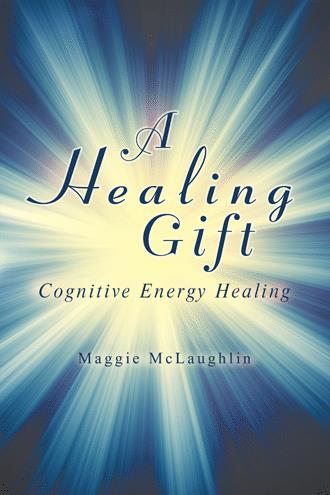
4Q: Let’s talk about your book. Please tell us what it’s about.
MM: It all begins with my personal journey into hell and back! Following a period of extended exposure to environmental toxins, I became very sick. At some point I realized that even with all the medical help I was receiving there was no hope that I would ever be well again. Somehow, I had to take control of my own destiny, to figure out a way to overcome my illness.
The book is many things: it is the story of my journey to wellness, it's also about the new energy healing practice I developed called Cognitive Energy Healing. Besides providing an overview of the methodology and its application, the book provides a number of interesting case studies. In the process, the reader is invited to consider exploring their options when living with healing issues left unresolved following medical treatment.
As for the title A Healing Gift, it speaks to my quest to heal myself, to the answers which came in a most unexpected way, and to the sharing of my healing knowledge. So, mustering the courage to try something entirely foreign to me, I tried to figure out how to go about writing a book and getting it published. Over a period of about three years I spent hours each day (except for the occasional foray off on a trip as we retired people tend to do) toiling away.
4Q: Cognitive Energy Healing. This is new to me. Please tell us more.
MM: The challenge for many people living with chronic health concerns is to regain the wellness they once knew. Naturally, this is not always possible for any number of reasons, even after rigorously pursuing and following every medical approach available. For others however, those willing to consider a new way of addressing their healing concerns, there may well be hope and the very real possibility of being well once again.
 Photo credit: Bio Aesthetics/Rosita PaimanCognitive Energy Healing or CEH (pronounced say) for short, is a new alternative healing practice and a new form of energy healing that has not only enabled me to be here and lead a normal life, it has provided life changing healing for a number of other people as well. Its comprehensive holistic applications address healing concerns of the body, mind and spirit - i.e., the whole person. Working to identify the root causes of health concerns, CEH releases energy blockages caused by traumas, both physical and emotional, negative memories, and physical and emotional pain to promote lasting healing. Other applications have proven effective in the release of maladaptive core beliefs and behaviours. In addition to all this, certain epigenetically caused malfunctions have been successfully addressed by this treatment.
Put simply, the practice applies the trained and informed use of vital energy and verbal communication to eliminate blockages that enable and free the body to heal itself. The root causes of healing concerns are identified and corrected through engaging the healing link of the subconscious mind and the body's subtle energies. In other words, CEH applications act to bridge the communication gap between mind and body, so that healing can take place. The body itself knows how to heal; sometimes it just needs a little guidance so it can learn what is not functioning as it should.
4Q: Please share a childhood memory or anecdote.
MM: I think you may have been expecting something different, however I would like to share a teenage memory in poem form. May my words paint the scene and the experience as best I can:
Afloat
Afloat
in evening
silence
upon still waters
calm
rhythmically
oars dip down
gently into
the meniscus
a surface-mirror
reflecting
an expanse
of twilight
sky
My backward
pull
gives forward
thrust
across
tranquil waters
a smooth
glide
trailed only
by a gentle
wake
I sail out
to open waters
calling
I feel
and know
these currents
a mighty force
powerfully
churning
below
commanding
respect
demanding
caution
And still fearlessly
determined
I row
Stopping to rest
oars drawn in
at my side
breathing in
deeply
nourished
with salty air
spirit buoyed
upward
rejoicing silently
my solitude
A fleeting moment
to simply
be
Carried
as if cradled
within my small
water craft
soon waves begin
to rise
twilight fades
my boat
rocks
tranquility flees
alerted
A message
from time's passage
received
Now
awakened
to the journey
homeward
night is fast
approaching
as darkness
begins to cast
its shroud
upon once familiar
waters
All beneath
a softly moon lit
sky
Maggie McLaughlin ©2019
4Q: What’s next for Margaret McLaughlin, the author?
 Photo Credit: Poetry FoundationMM: I do love to drift into the "flo" of poetry as I find the artistic expression relates closely to the imagery and passion of painting. I may publish a collection of my paintings and associated poems at some point. This idea has been percolating in the back of my mind for some time. I would like to thank Donna Allard, an acclaimed NB author of a number of books of poetry, for re-awakening my interest in this art form.
As regards Cognitive Energy Healing, I have been working for the past couple of years on an instruction manual, compiling treatment information and updating my on-going research. So, eventually there may be a follow up to a Healing Gift. In the meantime, I am looking to start a blog from my website: cognitiveenergyhealing.ca
4Q; Anything else you’d like to add?
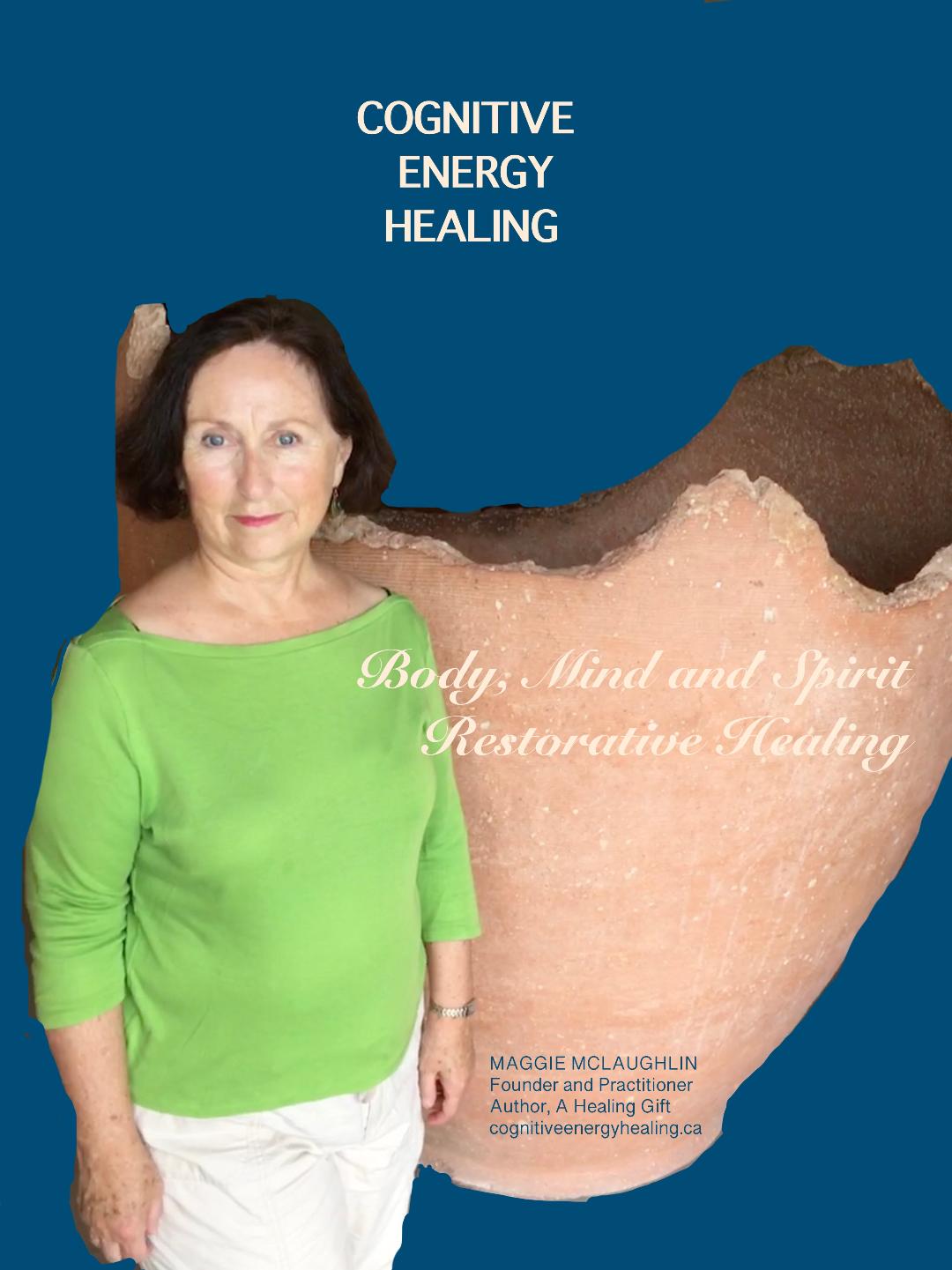 MM: Following the publication of my book, I have had the opportunity to speak to various groups about CEH. Also, I am considering offering a course in the CEH practice of self-healing.
 My book was featured at the New York Book Fair and is posted in the URLink Print and Media catalogue for that event.
While semi-retired, I do still see the occasional client and continue my research into ways of enhancing the Cognitive Energy Healing practice.
An Excerpt from The Healing Gift:
A Gift of Life
"We must be willing to let go of the life we planned so as to have the life that is waiting for us." —Joseph Campbell
We never know where our lives will lead us or what challenges we will encounter and learn from along the way. This is a story of learning to see with new eyes, of discovering a new way of being, and of developing a new healing method to restore holistic wellness. Passage from my early life pathway to the one I am happily enjoying now required a profound change in who I was and what I believed my life's purpose to be at the time. In effect, the impetus for such a dramatic change is usually brought about by a significant life-altering jolt of some kind. Mine came in the form of trauma and illness.
Little did I know I was setting out on a twenty-year journey of research, study and experience beyond anything I could have ever imagined. Initially this is a story of survival and my determination to get my life back during years of living with environmental illness, autoimmune disorders, and other related physical and emotional health concerns caused by a prolonged exposure to environmental toxins.
The turning point in my healing journey came with the realization that no medical remedy was available to enable me to be well again. While medications helped to lessen my symptoms minimally, I found myself in the inescapable grip of pain and illness with despair making inroads daily. Gratefully, this reality remained true only until that fateful day when I was inspired or should I say guided to learn a new way to heal myself and be well again. It is through this and other healing revelations that I have come to experience personally a healing story worth sharing, one that offers hope to others in need of healing for a significant number of unresolved health concerns.
Since that time, not only has this healing enlightenment led to the creation of the new healing practice I call Cognitive Energy Healing, a non-invasive, comprehensive body, mind, spirit approach to healing, it has also helped restore the health of an ever-increasing number of people. Beyond its initial application for allergy elimination, the breadth of health concerns that can be helped effectively or completely alleviated by this modality continues to grow. And so now in this writing, it is my intention to share this message of hope for restored wellness with a broader audience of people in search of help for their unresolved health concerns.
In and of itself, life is the greatest gift one can ever receive. This became all too real for me when suddenly I found myself in an ongoing battle to save own my life. The initial three years proved to be unrelenting and challenging. Eventually, however, the menacing shadow of my illness had to relinquish its power as I came to learn some amazing insights about how to heal myself. As I healed and was able to move my focus beyond healing myself to the healing of others, my life was set back on a new and vital pathway. Today, it is my greatest joy to report that the scope of what is possible through Cognitive Energy Healing has grown far beyond anything I could have ever imagined.

For me to apply this great gift in a healing way, all I had to do was give myself permission to recognize and engage my own innate healing ability. Amazingly, as it turns out, the only essential tools for Cognitive Energy Healing practice are always with us and readily accessible. These include healing hands to engage and restore normal energy flow, and the practitioner's conscious subliminal healing directives to engage the executive power of the brain to make corrections that enable the holistic body to heal. Absolutely no testing devices, appliances or energy vials are required. While my early treatments were primarily allergy focused, the scope of the practice has grown holistically to address the significantly broader body, mind and spirit scope of healing concerns.
Eventually, as my health improved I came to a place where I wanted to help others in the way I had been helped. Initially, I ventured to share a small part of this journey of recovery with family and a few of my closest friends. As they came to learn about my self-healing practice, I was surprised to discover that this sharing didn’t cause the stir or the negative reaction I had expected. In fact, for the most part, they were relieved that I had found a way to make myself well again. At that time, it had never occurred to me that someday I would take this sharing to a significantly larger audience in the hope of helping others as I have been helped.
This book provides an overview of the CEH methods and techniques used in the healing of both oneself and others. By acting to correct and eliminate the physical, emotional, psychological, social and spiritual underlying causes of a broad range of health concerns, these modalities provide an effective and reliable approach to healing. This holistic body, mind, spirit approach promotes healing by engaging both mind and body to release the specific causes of energy blockages to healthy energy flow. Usually a single treatment takes only seconds to perform, and outcomes have proven to be amazingly successful. Clients usually report feeling energized following a treatment session. And for those who have completed a treatment regime, the vast majority report their healing results as being positive, significant, and for some, life-changing.
Thank you, Maggie, for being our guest this week.

Please follow these links to learn more about Maggie and her book.
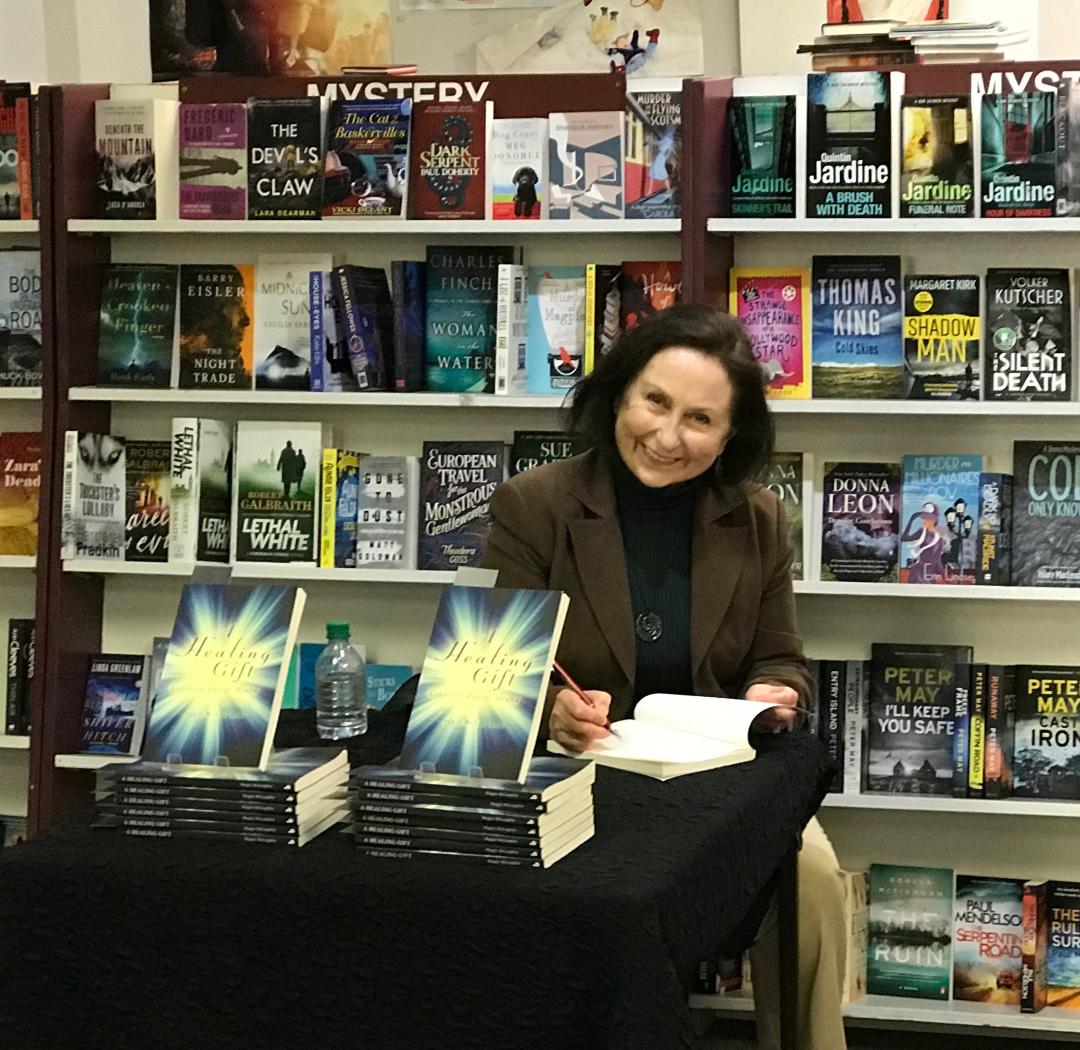
A Healing Gift: Cognitive Energy Healing is published by Balboa Press ©2018
Available in all three formats online through: Amazon, Chapters/Indigo and Barnes and Noble
Please visit my website: cognitiveenergyhealing.ca
September 7, 2019
Award winning Author Sonia Saikaley of Ottawa, ON.
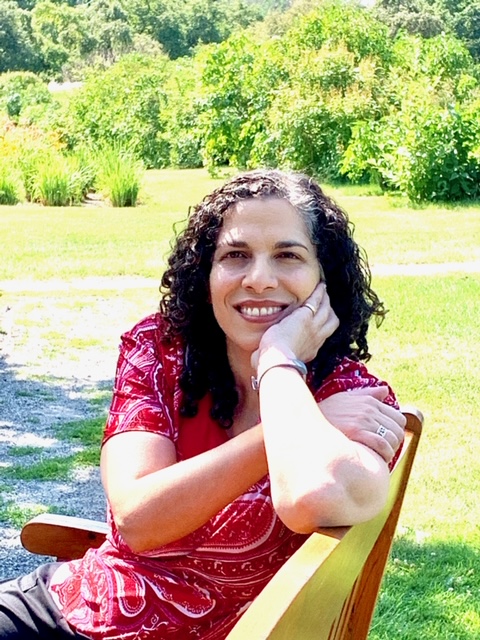 It’s great news for an author to receive recognition for their dedication to the art of writing. Our guest this week co-won the 2012 Ken Klonsky Novella Competition for her debut novel – The Lebanese Dishwasher. Great news is that she is our guest this week. A 4Q interview and an excerpt from her work.
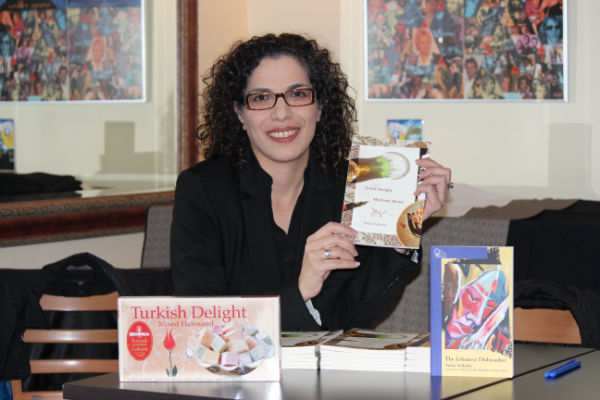
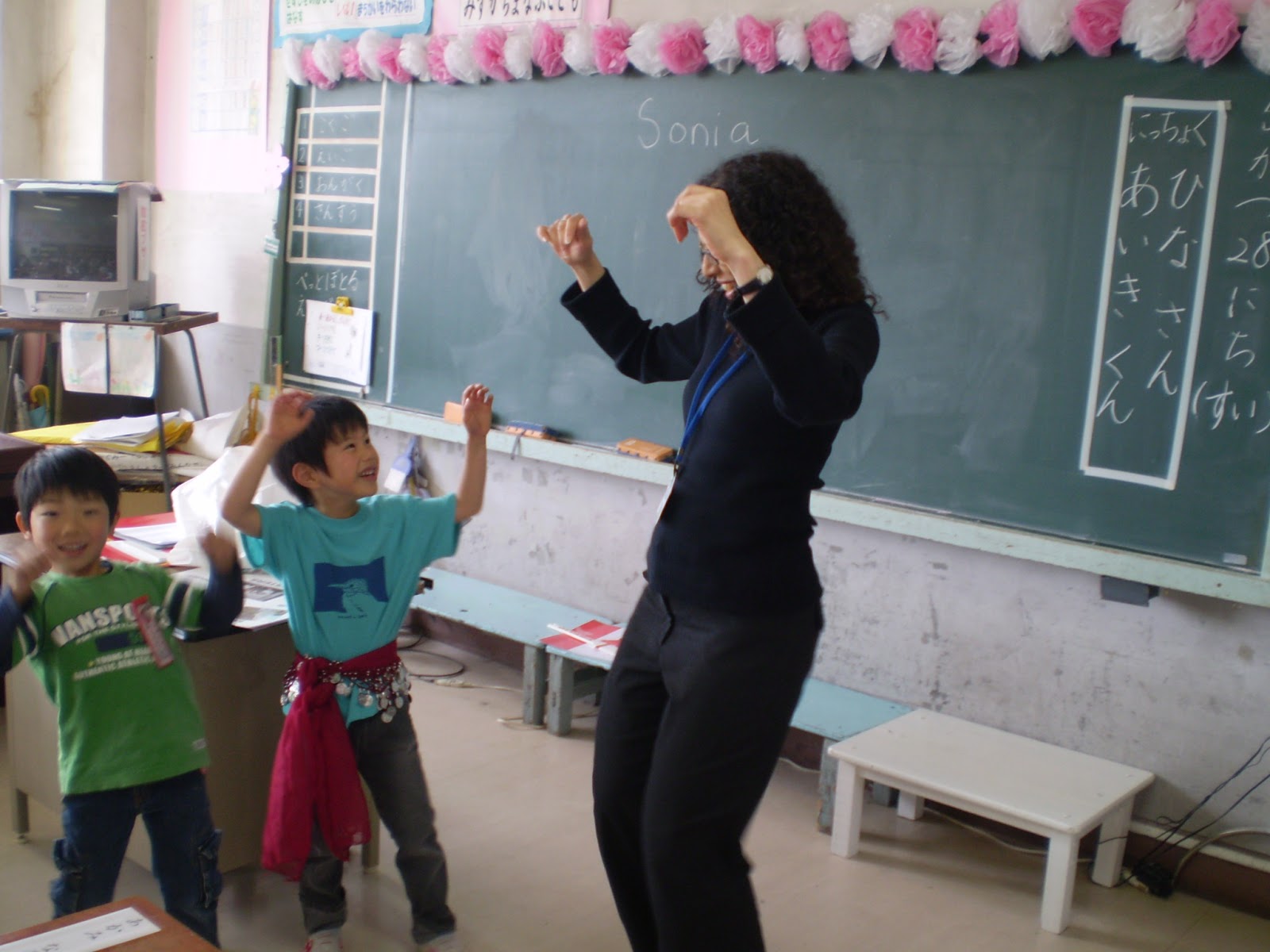
Sonia Saikaley was born and raised in Ottawa, Canada to a large Lebanese family. The daughter of a shopkeeper, she had access to all the treats she wanted. Her first book, The Lebanese Dishwasher, co-won the 2012 Ken Klonsky Novella Contest. Her first collection of poetry, Turkish Delight, Montreal Winter, was published in 2012 and a second collection, A Samurai’s Pink House, was published in 2017 by Inanna Publications. A graduate of the University of Ottawa and the Humber School for Writers, she lives in her hometown of Ottawa. In the past, she worked as an English teacher in Japan where she introduced belly dancing to her students. Her novel The Allspice Bath was recently published by Inanna Publications.
4Q: It is a wonderful feeling I expect to be a co-winner in a writing competition. Please tell us about that and the novel that won.
 SS: It truly is an amazing feeling to be selected as a co-winner in a writing competition. What was even more amazing was that I was on the brink of giving up writing when I found out that I had co-won the contest. I had been working on my craft for almost twenty years and I wasn’t having any luck finding a publisher for my work. I was getting very discouraged. It was also an extremely difficult time for me as I was struggling with some health issues and awaiting to undergo major surgery. Then I saw Quattro Books call for submissions to their Ken Klonsky novella contest. The problem was that the deadline was fast-approaching and I didn’t have a novella manuscript. If I wanted to enter this contest, I would have to write the story within three weeks while at the same time working full-time and dealing with my health challenges. I made a bet with myself that if I didn’t win this contest, I would give up on writing, let go of my dream. Well, I managed somehow to write the manuscript and sent it off in time to meet the deadline. Two days after the deadline, I underwent surgery but before doing so, I told one of my sisters about the contest in case the operation didn’t go well. Fortunately, everything went well and after my recovery and return to my full-time job, I checked my emails on my lunch hour and opened a message from Quattro Books congratulating me on co-winning the contest. I actually cried and one of my coworkers asked if I was all right. Crying and smiling simultaneously, I told her I had won a literary contest and my first book would be published. Winning this contest uplifted me at a time when I needed encouragement and strength.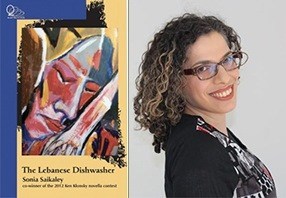
The Lebanese Dishwasher is a sad but hopeful story about a man struggling with a painful past and coming to terms with his sexuality. It is a story about finding your dream again in a new country and also finding love and accepting who you are in spite of cultural constraints.
4Q: You also have published two impressive collections of poetry. Can you tell us about them?
 SS: The same year The Lebanese Dishwasher was published, I was also fortunate to have my poetry collection Turkish Delight, Montreal Winter enter the world. This collection is about the immigrant experience. The characters in Turkish Delight, Montreal Winter find themselves in situations that reveal the grafting onto or adapting of the old world to new. This collection takes the reader from Lebanon’s olive groves to Montreal’s winding stairs. Distant steamships push the immigrant dream into Canadian harbours where new citizens must maneuver through fading memories, prejudices and hopes for a better life. My second poetry collection A Samurai’s Pink Housealso deals with the transformation of lives from Matsuo Basho’s travels to a love affair between a kabuki cross-dresser and a lonely geisha and the struggles of women in ancient and modern-day Japan. The collection takes the reader on a journey through the fascinating culture of Japan across rice fields, tea houses, cherry orchards and narrow alleys where characters, at different stages of life, strive to find identity, peace and love. I wrote the poems in A Samurai’s Pink House when I lived in Japan teaching English and introducing belly dancing to my students. It was an amazing experience that helped me grow as a person and writer.
 4Q: Please share a childhood memory or anecdote.
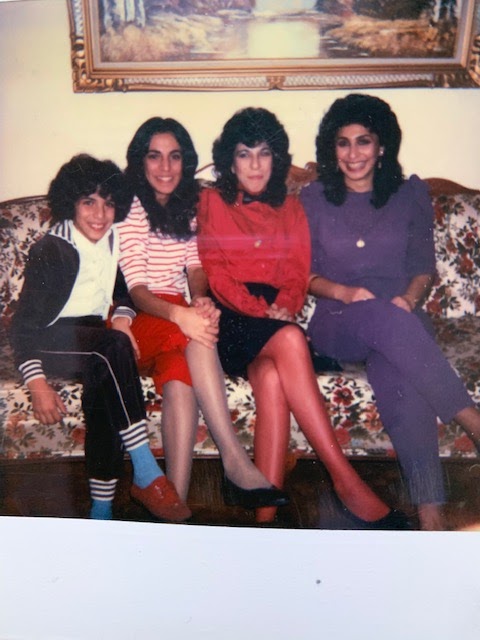 SS: Growing up as the youngest of four sisters meant that I was the queen of hand-me-downs and also the one my older sisters would tease. Every now and then my parents bought me something new and shiny. On my ninth birthday I received a purple velvet tracksuit. I loved it! I wore it often. Eventually, I grew out of the velvet pants but the jacket still fit me and I wore that jacket with jeans, with shorts, with pants. The velvet began to fade and then one day, the jacket vanished. I frantically searched all over the house for it. How hard could it be to find a purple jacket? But I couldn’t find it anywhere. I asked my sisters where the jacket went and they said they didn’t know while looking slyly at each other. I knew something was up. Being the youngest, I could get away with crying and making my sisters feel guilty. So I whimpered until my sisters finally admitted they took my jacket. One of my sisters pulled it out from its hiding place. I clutched the jacket close to my chest. My sisters groaned, “You wear it every day! It doesn’t match anything. It’s time to give it up.” “But I love this jacket!” I said. “More than us?” one of them asked. I looked away from them for a second then gazed up with my big brown eyes and big smile and said, “Of course not, even though you tease me.” They ruffled my curly hair and apologized for hiding the jacket. “But you wear the tacky thing every day! Too purple like grapes!” I laughed and said, “I love grapes just as much as I love this purple jacket.” In the corner of the family room was a bag filled with clothes my parents wanted to donate to the Salvation Army. When my sisters told me that someone else could use the jacket more than I could, I knew my sisters were right. I folded my beloved jacket and tucked it gently in the bag. My sisters told me they were proud of me. Smiling, I hugged them. That day, I learned about giving even if it meant giving up something you love.
 4Q: Your website tells us you are working on your next novel – Jasmine Season on Hamra Street. What can you tell us about this?
SS: I have been working on my novel Jasmine Season on Hamra Street for the last nine years. The story is set against the backdrop of the Lebanese Civil War of 1975 and tells one woman’s struggle to find her independence. The novel approaches the universal question of how much should one give up for family. It is also a love story between this Lebanese woman and the Jewish man she meets in Beirut. It has been a long haul but I am hopeful I will finalize the latest draft soon.
4Q: Where is that favorite spot for your writing Sonia? What are your writing habits?
 SS: My favourite spot to write is in my home office with the birds chirping in the background. I wake up at four in the morning to focus on my craft. I need silence when I work except for those lovely chirping birds! I write and/or edit every day before my day job. When I compose poetry, I write the initial draft by longhand. There is something soothing about letting the words flow on the pages of my journal. With prose, I use my desktop and set aside about two hours a day for my writing. I am disciplined when it comes to my writing routine. It wasn’t always this way but for the last ten years I have carved out the time and working in the early morning hours is best for me since it doesn’t take away time from my family.
 4Q: Anything else you would like to share with us?
SS: It took me twenty years to get my latest novel The Allspice Bath published. Everyone kept saying ‘no’ to it so whatever you have in your heart, go for it because you never know when you will find the right people to help you and who will equally believe in your dream. Here’s to dreams and never giving up!

An Excerpt from The Allspice Bath:
Elias turned the car into a small alley, barely wide enough for two vehicles. He parked the old Mercedes around the corner. Adele stepped out of the passenger’s side and followed Elias through the cobblestone street, and down a flight of stairs that led to the entrance of a small café. When Elias pulled the door open, the smell of sumac and thyme enveloped Adele along with the warmth of a large stone oven that was radiating heat at the far end of the establishment. Six small tables covered with flower-print tablecloths filled the room. A water pipe was positioned behind the cramped counter where an old man sat on a wooden stool, his eyes half-closed. He looked to be in his mid-eighties; his cheeks drooped and deep wrinkles lined his forehead. Beyond him, two windows were open wide, allowing a gentle breeze to enter the softly-lit, tiny restaurant that was empty but for the old man and one other customer. The old man was dressed in what appeared to be a woman’s polo shirt and baggy trousers common to older Middle Eastern men. He greeted them with a broken smile and a large space between his two front teeth flashed when he opened his mouth. “Marhaba. It’s a beautiful morning,” he said, wiping his hands on the grease-stained apron around his protruding belly.
“It sure is,” Adele answered in Arabic.
“You’re not from here. I can tell by your accent.”
She smiled timidly; she was surprised the old man could tell immediately that she had an accent. She spoke hesitantly and now wondered in the warm heat of the café how she had lost this language that had been her first as she looked at her reflection in the mirrored walls behind the cash register. Her curly hair dropped over her shoulders and her face was unusually pale compared to Elias’s and the old man’s equally dark complexion. Yet, unmistakably, she looked like them.
“Come on,” Elias said, waking her from her thoughts. He placed his hand on the small of her back. She didn’t move away and let his hand ease into her spine. He guided her to one of the small tables, pulled out a chair for her to sit on, and then dropped his hand to his side. Immediately, she missed its warmth. She sat down and she sighed loudly as she followed Elias’s movements, his long legs striding elegantly across the restaurant back to the old man, who handed him a plate filled with zahter and two cups of steaming ahweh.
When Elias returned, she smiled up at him. He stood beside the table and began to serve her as if she were his guest. The aroma of the flat bread powdered with dried thyme, sumac, and sesame seeds caressed her nose. As he placed the dish and coffee cups down, he smiled then smacked his large hand on his forehead. “Oh, I forgot! You’re not a coffee drinker. Back in one moment with your halib.”
Affection filled her heart for this thoughtful man. She touched his wrist and said, “It’s okay, Elias. Sit down. You’ve done so much for me already. Sit and share this wonderful meal with me.”
“Our last breakfast?” he said, slipping onto the chair opposite her.
“I suppose. But does that mean there will be a resurrection of sorts?”
A smile lifted his mouth. “Most definitely. Resurrected from family obligations…”
“And guilt,” Adele added quietly. They ate in silence until the old man came to their table and placed a round bowl of zeitouns in front of them, the oil glistening on the green olives.
“These come from tree in yard at home,” he said in broken English. He also handed them a basket of pita bread. “I make bread too. Well, not right. Wife make bread,” he said, kneading his knuckles on the tabletop. “She make on ground. Hard on knees. She yell every time she do bread. Allah, she say, why you curse me to be woman?”
Adele raised her eyebrows and frowned. She didn’t like this last comment because it seemed that being born a woman was indeed a curse, the worst possible fate. She looked away from the old man and out the window. A few feet away a young man dressed in military garbs with a finely-trimmed beard and crew-cut was standing with a rifle flung over his left shoulder. His slender body bent forward as he questioned people in their cars. She imagined his voice resonant with forced authority. He looked boyish. She guessed he was only a few years older than herself. Twenty-two at the most. Adele sensed the old man’s eyes on her. She turned her attention back to him.
“I say something bad? You mad?”
Adele asked quietly, “Why does your wife think it’s a curse to be a woman?”
“Life not easy for woman. They cook, clean, take care of child, husband. They work hard and for what?” He slapped his hands together. “Nothing. No respect, only grief. A woman lose lots. Husband boss, child make body fat then break it in birth. Not easy to be woman, that why curse. Man have easy life.”
She stared at the man. There was neither coldness nor meanness in his eyes. He wiped his hands on his apron and smiled.
“Now eat. Enough about man, woman. Can’t live with woman. Can’t live with no woman, right? This American phrase?”
She nodded and popped an olive in her mouth.
Thank you Sonia for being our guest this week.

Thank you, Allan, for having me! I am grateful for this wonderful opportunity. Thank you for helping other writers share their work with the world.
For you readers that want to follow Sonia and/or discover more about her and her writing, please follow these links.
Website: https://www.soniasaikaley.com/
Facebook: https://www.facebook.com/Sonia-Saikaley-1030439696980837/
Twitter: @SaikaleySonia https://twitter.com/saikaleysonia?lang=en
September 1, 2019
Guest Poet & Author Richard Doiron of New Brunswick.
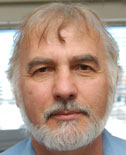 As a poet and writer, Richard has a long, long list of accomplishments. Actively writing for over forty years, his first book of poetry was published in 1978 and there has been no looking back. In the small amount of space on the Scribbler, it would be impossible to know everything about Richard but he’s agreed to a 4Q Interview and I trust we will all get to know him a little better. As a bonus, he is sharing some of his writing.
Born Jan. 22, 1947 in Moncton, NB. Second of nine children. Quit school at age 14. Started writing poetry shortly thereafter. A decade later, in Ontario, took upgrading and got a certificate in journalism. First published in a letter to the Editor, Feb. 1964, Moncton Times, 1000 words left intact. Have never known a"dry" spell since. First poems published 1970. Published in well over 100 anthologies, periodicals, personal books. Also published two novels (one I consider
my best writing ever), also two biographical works. Participated in local, national, and international literary festivals; invited to festivals in various parts of the world, including the Middle East and Asia. Profiled extensively in mainstream media. Usually introduced as "peace poet," which is consistent with my writing.
Nominated for numerous awards, including the Governor-Generals Award (2), the Griffin Prize, and 2019 for the Order of New Brunswick.
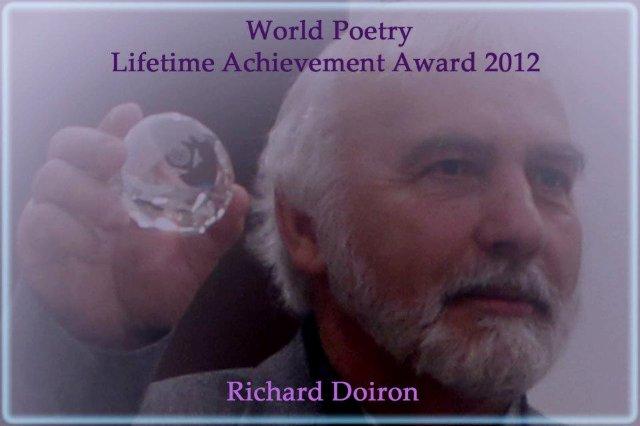
4Q: When I visited your website – www.spiritsinpeace.com – I am overwhelmed of all the highlights of your writing journey, specifically the World Poetry Lifetime Achievement Award you received in 2012 in Richmond, British Columbia. Please tell us about this.
RD: First, Allan, let me thank you for inviting me to your prestigious forum.
I first got online in early 2001. The Internet opened up a whole new world for me. Always curious, I was soon a member of many poetry groups, where I was mostly well-received and made lifetime friends. At that time, writing profusely, in whatever poetry genre I encountered, I posted poems daily. I eventually cut back on the number of groups, now posting in about ten daily. That has represented a lot of poetry over 18 full years. There were key groups for me, such as World Poetry Canada, out of Vancouver, that group headed by Nobel Nominee, Ariadne Sawyer, a tireless worker. Ariadne has done a live radio show weekly for 21 full years, the show now heard live in 124 countries. I was invited to read on air a few times. Eventually, I was nominated for a Lifetime Achievement Award, at the time having had poetry published for 42 years already. This was a big deal. Not one for travelling much, especially by plane, that was rather daunting, too, and there were costs to such a venture; enter my friends, artist Jesus Salgueiro and Art Smith, former personal chef to Oprah Winfrey; I had written the wedding vows for the pair two years earlier, vows that had brought 500 celebrities to tears, as per the Washington Post and Chicago Tribune; I was asked for my bank account info and told to go to my bank. Sufficient funds had found their way into my account to cover a return flight to Vancouver and for me to spend 8 days in BC, where I got to spend quality time with numerous people, most notably Ariadne Sawyer; there, I also connected with the Poet Laureate of New Westminster, Candice James, whom I later assisted in writing a book of sonnets. As well, I got to meet one of the most underrated poets on earth, Mr. Marc Creamore, who gifted me with one of his books. Then there was time spent with Dr. Epitacio Tongohan of the Philippines; better known in the world of literature as Doc PenPen, this man facilitates literary festivals in various countries of the world yearly. I already belonged to his group, Pentasi B World Friendship Poetry, where I posted the usual poems. In 2017, Pentasi B also gave me a Lifetime Achievement Award and, this year, named me World Poet Laureate. Doc PenPen is one of the most charismatic people I have ever met. Known in the world as "The Father of Visual Poetry," the pathologist/philanthropist is a living legend, received by heads of states wherever he facilitates a literary event, this year doing his thing in Uzbekistan and China (I being a participant in the latter, via one of my books).
Of note, too, I was nominated for a Lifetime Achievement Award with ARTeryUSA, by former Senator of the California Senior Legislature, James Pasqual Bettio, who chanced upon my writing in 2017 and wrote me asking for a bio for the purpose of nominating me. Mr. Bettio is a man of renown in American artistic circles.
Because of my ongoing involvement with such groups as named, I am now regularly invited to participate in other international groups. Suffice it to say that I have an appreciable following.
4Q: Ancestor’s Dance is an amazing and impressive publication of two hundred and twenty-two sonnets. Please tell us about the collection.
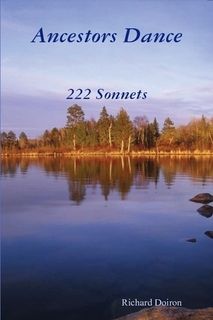 RD: You know, Allan, I am tone-deaf, meaning music is out for me. But poetry is its own kind of music, especially the metrical kind. I don't read much, but one day I came across a write-up in the Saint John paper showcasing a few of Shakespeare's sonnets. I thought I would give the form a try. That first year, 1999, I wrote 275 of those; the second year, I wrote over 1500. Writing has always been a mystery to me, so when I say I wrote poems, it needs a bit of clarifying: sonnets have come through me within five minutes, intact, with great impact. On April 9, 2011, I stopped writing sonnets. By then I had written 5,555.5 of them, which may get chuckle from some people; see, I had initially set a goal of 5000, but then discovered that if I multiplied this number of sonnets exactly, I would have 77,777 metered lines, sonnets containing 14 lines (and 7 was my lucky number eh). So, the last one is not finished. I still write metered poetry, and it would be easy enough to add two extra lines, but I promised myself no more sonnets. As for the title, Ancestors Dance, I have always had a strong affinity with First Nations people, and I will add the sonnet at the end of this interview. I don't think anyone had ever published 222 sonnets before - Shakespeare in his life had penned a mere 154 (although there were all those plays, eh). Anyway, I had co-edited a sonnet periodical for some time and had had quite a few published along the way, so doing my own book of sonnets seemed apropos at the time. But sonnets are only one of maybe 100 forms I have written in, as well as free verse and prose poetry. While I don't publish much anymore, my overall body of poetry would no doubt fill several hundred volumes at this point.
4Q: Please share a childhood memory or anecdote.
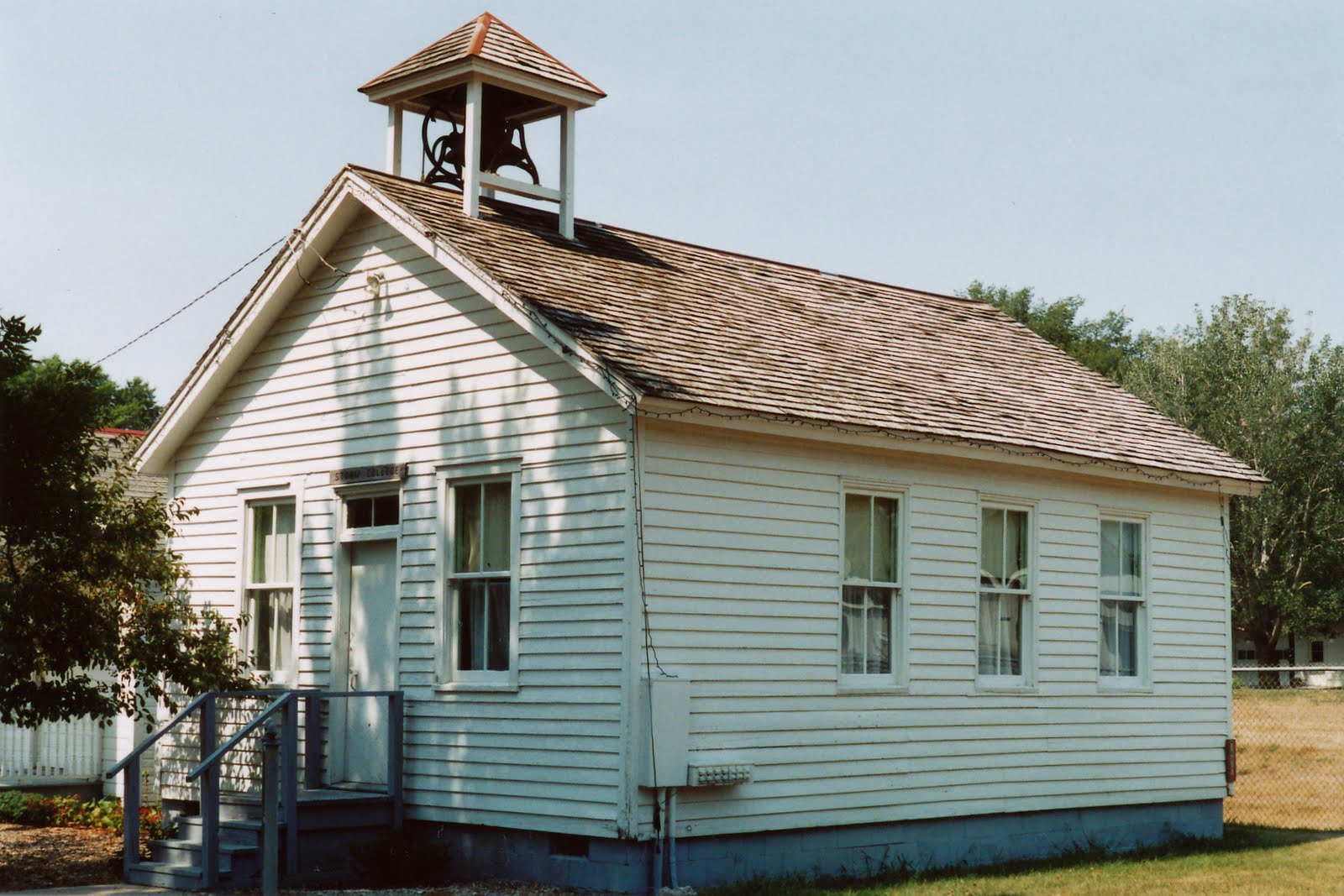 RD: Allan, most of my schooling was done in a one-room schoolhouse, in an Acadian village, where one teacher was actually younger than some of the students; at 16, she only had grade 8 and taught 8 grades; English was not taught at that time in that place; we moved to Moncton in the fall of 1959, and I was suddenly in a big school, with things done far differently. We suddenly had electricity and a television set; my marks were exceptionally high despite the initial schooling. Still, times were hard, and I struggled to adapt in certain settings; by the fall of 1961, I had quit school; shortly thereafter, I found myself at the Moncton Library, where I picked up a book of poetry by the American poet, Sara Teasdale and I fell in love with the poetry (and likely the poet, too). I had a dog and he and I spent a lot of time in the woods, where I would take a note pad and sit on the bank of the local stream and write poetry. It was all in English. It always had to be for me. In 1964, we lost two homes to fires; at the time, I still managed to save whatever writing I had produced to that time; however, a move to Ontario in 1965, my writing left behind in Moncton, a year later that work had disappeared; so I have no copies of any of my original work. But one thing I must say is this: I was always different, pensive, attuned to something I may not have quite understood, suffice it to say, however, that I was aware of that "force" within me; as such, then, I consider myself a channel, deeming poems already written, waiting somewhere in the ether to be accessed. See, there is a phenomenon at play here, and that will not be denied. For tens of thousands of poems to have been penned by someone seems impossible, I would think, but not if looked at from a certain perspective. I like that part of it. I once read in a group, and man yelled, "Boy, I wish I could write like that," to which I replied, "So do I." It's never been hard to write, but reading, now, that is not something I have mastered doing.
4Q: With such a large body of work, you must find inspiration in many things. How do you get your writing ideas and what are your writing habits, Richard?
 RD: Well, Allan, I don't know that I have writing habits at all, though with a novel (no longer on the market, though it should be), I got up faithfully each morning and penned a chapter, if rather in a trance-like state at times. I had been walking down the street, when the title came to me: StraightWalk - whoa! I ran half a mile to my computer and penned 7500 words; I shared that with a friend via computer, and he would call me for the next chapter. I knew something unusual was happening, and I went with it. In less than five weeks, that novel was done, and I don't think much editing was necessary anywhere; the book tells of a Native man who has visions (I have two copies and would gladly lend you one). One thing, though, I always know something special is happening when a first line comes to me. All I have ever needed is that first line; then I get out of the way and let the poem happen. I can always tell when I have endeavoured to write a poem, as opposed to when a poem decided to be "born." I have written poems in loud places, in quiet settings, on birch bark when no paper was available. When the poem comes, one has to accommodate it then best one can; that's being true to your calling. I have been asked, "Why do you write?" I have occasionally answered, "Why do you breathe?" Over the years I discovered something interesting: if I put, say, 12 random words at the top of the page, I could write a 12-line poem from those words; that has never failed me; over time, people, from various parts of the world, have had occasion to send me 12 words, or 20, even 40, oftentimes total strangers; poems have appeared then that have jarred some people, as there were things in the poems I could not have known. You can try me on this, if you wish, Allan. Any 12 words, no proper nouns. No explanations of what the words may mean. Now, mostly, I write in English, yet on several occasions poems or lyrics have come to me in French, out of the blue, one such piece being the lyric to the quite-famous Acadian song, "Mon Acadie," to which Richibucto musician Yrois Robichaud added a most incredible melody. 25 years later, the song remains timeless and likely will forever. I will include a link to that as well. Oh, and speaking of songs, this past year, I have developed a collaboration with a man named Joey Bernados, a Filipino now living in California, a gifted musician; we now have 18 completed songs and are hopeful that something good will come from that undertaking.
4Q: Anything else you’d like to share with us?
RD: Well, Allan, I'm a straight-shooter, so here goes: when we have a phenomenon in our midst, we look into it, we don't hide it, or make it near-impossible for that bird to take flight. To have produced such a large body of work, so well received globally, yet to not be known locally makes little sense to me. Twenty years ago, Margaret McCain stated publicly that I was a New Brunswick treasure. The Lady had used my poetry in Government House throughout her tenure as Lt-Governor of the province.

There is a lot of pretension in the world. Ten years ago, I read in a NB city and got a standing ovation, the only one there to have that; one person, with a Ph.D, who had stood up and applauded, came by and shook my hand, saying a job well done; then that person asked what university I had gone to and when I replied that I had not gone to university, that person stomped off without another word.
Here I will close with a quote from Kahlil Gibran:
"Poets are two kinds: an intellectual with an acquired personality, and an inspired one who was a self before his human training began. But the difference between intelligence and inspiration in poetry is like the difference between sharp fingernails that mangle the skin and ethereal lips that kiss and heal the body's sores."
- Kahlil Gibran (1883 -1931) - The "Prophet of Lebanon."
A Sample of Richard’s writing:
(Copyright is held by the Author. Used with permission)
1
Let There Be Peace
Let there be peace
Peace in the Four Corners, that it should be
a promise, and real;
Peace in our nations, that the spectre should be
turned on its heel;
Peace in our cities, that fear should abandon
our streets and walkways;
Peace in our schools, that violence should be
routed, and always;
Peace in our churches, that God’s children should be
families, assembling;
Peace in our homes, that our young ones should
cease in their trembling;
Peace in our hearts, that our tempers should be
cancelled and curbed;
Peace in our words, that our masses should be
studied, and stirred;
Peace in our creations, that our galleries should be
temples, adorned;
Peace in our visions, that Love, in our time,
should be born, and reborn;
Peace in our deeds, that never a doubt should
awake, and arise;
Peace in our souls, that it should be
mirrored in our eyes.
Let there be peace.

2
Ancestors Dance
-a sonnet-
Ancestors dance upon each blade of grass
the fields alive for everyone to see
and dreamers dream to see paraders pass
their eyes now cast upon that family tree.
Ancestors dance upon the mountainside
the hills alive for steps upon the stone
and dreamers dream such dreams as coincide
with things that are if are too little known.
Ancestors dream whereas the rivers run
the streams alive for gurgling that is heard
and dreamers dream the dream has just begun
as will be dreamt forever afterwards.
Ancestors dance upon the dashing dawn
let dreamers dream the dance is dreaming on.
Thank you, Richard, for being our Guest this week. All the best in your writing journey.

Thank you most sincerely, Allan, for this wonderful opportunity. The Scribbler is of great service to both artists and to the community at large, a great initiative on your part.
For those wishing to discover more about this talented writer, please follow these links:
www.spiritsinpeace.com
https://www.facebook.com/richard.doiron.7
Mon Acadie: https://www.youtube.com/watch?v=NjnG5ASLfPk
August 28, 2019
The FarOut World - a short story by Allan Hudson Part 2

Welcome back to the rest of the story.
If you're just joining us for the first time, Part one of The FarOut World was posted August 25th and you can read it HERE

This short story is a follow up to another short story titled The FarOut Mall. Humans now live in Off Earth Living Pods but they still need to shop. Originally published on the Scribbler, it is now available in my collection of short stories - A Box of Memories.
The FarOut World Part 2.
“I’m getting the bot-credits for the water and as soon as the truck’s empty, I’m leaving. If I have to walk through those revolving doors to the purser’s office, I’m not going in this hellhole without my weapons. So you have two choices. Either go get the payment and bring it to me, or try taking the weapons from me. Your call.
”
The patrolmen look at each other. They’re not usually challenged, and when they are, they make quick work of the opponent. They step closer, side by side, a formidable wall. Bay-grunts pause in their work to watch, grinning at the commotion. Eye Patch grits his teeth.
“We’re not errand boys, so we’ll take you up on option two. You’ve got five seconds before…
”
Geo doesn’t give the leader time to finish his threat. He drives the point of his middle finger into the good eye with enough force to pop it out of the socket. A thin knife, concealed under the sleeve of his armor, extends with the flick of the wrist and penetrates the brain through the now empty eye socket. In the same instant, he draws his right sidearm and, triggering the firing mechanism, slices the arm off patrolman No. 2 just above the elbow. Eye Patch drops to the bay floor, dead before he makes contact. No. 2 is howling in pain and tries to activate the wrist-paralyzer on his left hand when Geo gives him his full attention. With unmatched precision, he slices away the weapon, taking a layer of skin with it, drop kicks the big man with enough force to propel him against the revolving doors, which shatter from the impact, and the man falls to the floor, unconscious. Geo walks casually to the fallen man, places his weapon against his forehead and pulls the trigger.
 Except for the hum of the huge pumps, everything is silent. Geo looks around for any other menaces before he holsters his weapon. The bay-grunts don’t meet his eyes as they return to their tasks. It’s not the first time they’ve seen death in these bays, but it’s the first time anyone’s beaten these two. Geo steps over the dead body and through the shattered glass doors on his way to the purser’s office, which is two down on the left. He ignores the Do Not Disturb sign on the prompter and walks in. The purser is a fat man, bald and sweaty, with perspiration forming droplets on his brow. He looks up at the intruder, intending to scold, when he sees Geo looming over his desk. He is startled by the fact that someone has gotten this far with weapons. He knows without a doubt that Morgan and Delvecchio – the patrolmen – are either incapacitated or… dead.
 He’s scared. No one makes it past them.
“What… what do you want?”
“H2O from Earth is being downloaded as we speak. You owe me 48,000 bot-credits.”
“I… I don’t have that much here.”
“Why not? You knew I was coming today.”
“I wasn’t expecting you this early. I’ll need a few minutes. Can you wait here?
”
“No. I’ll go with you. Now let’s hurry. I’ve got other loads to deliver and my safety window is rapidly closing.
”
Perspiration blooms under the armpits of Fat Man as he gets up from his desk.
“Okay… okay, then follow me.”
 Thirty-two minutes after arrival, Geo maneuvers through the debris field and enters the safe zone. Returning to home base, LP2429, he will fill up and make a delivery to LP2599. He hasn’t been there since before Gracia Moeller, the owner of Alexander’s Fine Jewelry’s flagship store was charged with the murder of one of her clients. The charges were dropped when it came to light that she had been informed the weapon she had used was not loaded.
Following a power outage and virkon-eptile feasting, Gracia had installed pulse pistols to protect herself as well as her staff and patrons from the monsters. In an act of frustration with an abusive customer and believing the pistol was not charged, she pointed it at the woman in anger. That customer became dust.
Geo now wants to meet Gracia.
InterCosmic Manor 2599 is an enormous golden octagon orbiting the Earth at twenty-six thousand miles per hour in low earth orbit, six hundred and three miles above the Earth’s surface, moving west to east. It circles the globe every 57 seconds. Approaching it at slightly higher speed, Geo sights it visually, about to enter darkness over the Pacific Ocean. It glistens in the dying light like a radiant citrine. Within a hundred miles, he matches the speed of the giant satellite. Coaxing the ship into place, he prepares to dock on the lower level. Giant arms reach out to clamp onto Potizo’s outer docking frames. Once secure, Geo locks down the ship. Preparing himself for a visit to the Mall area, he dons a clean shirt from the locker along with his black and chrome spacesuit and matching helmet. He knows women stare lustfully at him when he wears it. A dab of his favorite cologne and he’s off.
 Leaving his jetpack in storage, he informs the loadmaster he’ll return shortly then transports to the 16-A Octagonal. The doors open facing a food court. The aroma of heavy spices used in roasting moon chicken is wafting into the hallway. His stomach growls, reminding him he needs to eat. Alexander’s Fine Jewelry is at the front and on the right. The food court is busy with shoppers relaxing and dining; people are browsing in the hallways, many with shopping bags full. The murmur of the different voices hums over it all.
 He takes in the hovering droids
over his head, whose only purpose is to kill virkon-eptiles. The abandoned InterCosmic PRT (prison/rehab/termination) 2344 houses the majority of beasts still living. Some escape. Bounty hunters probe the LPs for any that may be hiding.
The jewelry store has only two patrons. A young man is serving one of them and a middle-aged lady is serving another. He notices the lady’s fine business suit, the latest fashion from Stile designers. Her short hair is in the latest bob; gems hang from her small ears. She has her back to him when Geo enters the store but looks toward him when she hears the bell over the door. Both stop in their tracks and stare at each other; the attraction is immediate.
She holds up a finger, asking him to wait one moment, and assists her client in making a purchase. Geo can’t take his eyes off her and hopes this is the owner he’s heard so much about. She approaches him with a genuine smile that softens the fine lines around her eyes. Extending a hand she introduces herself.
“Hello space jockey. Welcome to Alexanders. I’m Gracia.
”
He takes her hand and looks down at her;
she’s a foot shorter than him. He stares at the twinkle of mischief he sees in her eyes.
“Name’s Geo. Happy to meet you, Gracia. Are you the owner?”
“Yes, I am. What brings you into our store today?
”
“You do, actually.”
Dropping his hand, she blushes at his directness.
“Me?”
“Yes, I wanted to meet the lady who vaporized her guest.
”
The rouge in her cheeks is replaced by a frown and beetled brow. He didn’t mean to be so blunt and can see she’s offended. He points at the pulse pistol in the fashionable holster on her hip.
“I’m sorry, I didn’t
mean to upset you, but I admire your gusto. Of course, everyone was talking about it, and it was an accident, but there are not many women comfortable using pulse pistols. And only the most trusted applicants get permits.”
She stands back from Geo and leans against one of the counters.
“It was an accident, a deadly one. As you likely know, the pistols are to protect us and our patrons from the deadly eptiles, but I really don’t want to talk about it.
”
“I understand. Bet no one messes with you. Have you had to use it since?”
This causes the weakest of smiles; she is overwhelmed by the big man’s sexual allure and softens her stance.
“Well, not on any customers, thank goodness. I’ve been practicing with the safety and have it down to a microsecond thumb flip, so it’s safe to shop here now.
”
He likes the way she laughs. She likes the cologne he wears.
“Did you really come here just for that, Geo? Or do you need to pick up something for your wife… or girlfriend perhaps?
”
 He’s about to comment when the overhead lights flicker. Every main door on every floor slams shut. People hustle for cover, crowding near the stationary defbots that have their own emergency power source. Gracia does as she’s been trained. There’s only one patron, her two staff and Geo. She rushes everyone to the main counter. The lights do an off-and-on dance for ten or fifteen seconds before everything goes dark. Gracia draws her pistol. Everyone listens. Eptiles travel at great speed, their hardened scales clattering on the overhead pipes. Several are on the move. Bursting through grills, they spill into different locations in the Octagonal.
Two slither into the food court. In the dark, you can smell them – a scent that can only be described as rot. The worm-like beings have two short legs in the front, three toes with talons, the posterior moves with leather-like scales. A mouth slit is on the underbody, lined with crunching bones. The defbots are programmed to recognize the eptiles by smell, sound or sight. Detection is immediate. Pulses from a droid’s cannon cut the first one in half, the front clawing to escape before secondary pulses blast it to ashes. The second one receives a direct burst under its antennae that vaporizes the front half of its six-foot length. The unmoving rear section gets zapped also, and nothing of the beast remains.
 The other one is perched on an overhead mirror in Alexander’s Fine Jewelry. They hear it enter after something falls to the floor. Gracia urges them to stay quiet and behind her. Geo stands at her side. The monster is young, only four feet long, hunting by instinct. It senses its prey below and is about to leap when the lights come back on. Like its kin, it is tormented by bright lights and scrambles for the opening that it came through. Gracia is fast with her pulse pistol and releases several bursts from her weapon. The first pulse of pure energy obliterates the eptile, the second, third and fourth pulse reflect off the mirror. One takes out a large section of the front door, another obliterates the counter with moon crystals, and the third vaporizes Geo. Gracia stare at the pile of ash at her feet and clamps a hand to her mouth.
“Oh, shit!”
The End
Thank you for visiting the Scribbler today. I hope you enjoyed the story as much as I enjoyed writing it.

If you would like to read more of my short stories, I'd invite you to pick up a copy of
A Box of Memories.
Ebook available at amazon, Kobo, Barnes & Noble, Draft2digital.

Looking for a hard copy? Contact me. sbscribbler@yahoo.com
August 25, 2019
The FarOut World - a short story by Allan Hudson Part 1

Outer Space - that void above the skies has always intrigued me. I think Space Travel is worth every penny we spend on it.
I work in the jewellery business and I wondered what it might be like to shop for jewellery in outer space some time in the future. I wrote a short story called The FarOut Mall. It was first published here on the Scribbler and is now available in my short story collection - A Box of Memories.
Today's short story takes place in same quadrant of Outer Space where humans live in Off Earth Living Pods. The only thing they can't supply themselves is...Water!
The FarOut World
September 23, 2657
 The Caterpillar XN4789 is the largest truck out of this world. Its sole purpose is to transport water to the off-Earth living pods (LPs) hovering above the globe, anywhere from the International Space Boundary (ISB) of two hundred miles to the InterCosmic Manor 2599 – the farthest LP, which orbits at six hundred and three miles. All two hundred and sixty-three LPs are self-sustaining except for their water supply. There’s no shortage of Adam’s ale on planet Earth. Not since the ice caps melted late in the twenty-fourth century, followed by a downpour of biblical proportions. Now, only the extremely rich and some water-heavy industry exist on the mountaintops.
 Macintosh Fairweather, who foresaw and forecasted the extreme conditions coming to the planet, had proposed to the world’s leaders that the only way the human population would survive was to build living pods in space. At first they scoffed at his proposal, calling it the vision of a madman. He assured them that they had the raw materials, the finances, the ease and simplicity of space travel. That they should act now. Most rejected his idea. But eventually he convinced the most populous countries – China, Canada, India and the United States – to divert funds to erecting the first LPs. Unfortunately, their timing was too late and billions of people perished in the flooding. Besides the 1,500 residents living and working in the mountaintops, the rest of the human population lives off-Earth, in LPs, in the twin cities of Aether and Hemera in the Tranquillittatis Mare of the moon, or in the Arcadia Planitia of Mars.
Interplanetary travel is a breeze thanks to the forward thinking of Geronimo Placedo, who pioneered teleportation in the twenty-first century, a concept only possible in science fiction in the nineteenth and twentieth centuries. Nowadays, teleportation is taken for granted and travelers often complain about the forty-two minutes it takes to get from one planet to the next as being too slow. No one complains about the 1.2 second trip from Earth to the moon though.
Geoffrey (Geo) Galanos is the only person with enough experience to handle the XN4789. In Earth’s atmosphere, the vehicle would weigh over a million pounds. In space, it weighs nothing but possesses abundant inertial mass. Improper or inexperienced handling of the controls and thrusters could extensively damage an LP during docking. So only the most experienced orbital jockeys are hired to operate the large water transports. Galanos has nicknamed the vehicle Potizo, the Greek word for irrigate. Today is the first delivery for the colossal machine and the first LP needing an immediate resupply is the hostile LV2. Galanos is the only one of three drivers who volunteers for deliveries to either LV1 or LV2. As evil as the owners are, they know better than to fuck with Galanos. He carries not one but two extremely rare Remington Valences, the most powerful ionic handguns in off-Earth. Dubbed sensei by the practitioners of sangfroid, the deadliest of Canadian martial arts, he has few equals in hand-to-hand combat. His very demeanor and Greek arrogance cause the boldest of men to step aside.
LP2429 (numbered for the year it was built) was the first LP built by the Save the World Conglomeration. Updated many times, the lowest orbiting LP is now a docking and work station for water transports and other space vehicles. The smaller transports that enter the Earth’s atmosphere are hardy “pickups” that skim the surface, filling their tanks for transfer to the larger trucks that are too big to travel back and forth. Mainly financed by Toyota, LP2429 contains a spacecraft dealership, work bays, body shops, a gym, a college for mechanics, welders, electricians, plumbers and millwrights, its own “breathe and feed” levels, and the mandatory hospital and living quarters for the 2,300 people who inhabit the LP. It also contains an armory. That’s where Geo is now while Potizo is being loaded.
Geo is a big man. Muscles bulge from his limbs like tree knots. His long dark hair is tucked behind his ears; his eyes shine in anticipation. He’s wearing the latest design in spacesuits, slick and body forming. The armorer, Rieta Balser, helps him strap the Valances to his thighs after charging the weapons. She slaps him on the ass after she’s tightened the straps, pausing for a moment to squeeze the firm buttock. She winks at him before he leaves.
“If you make it back from LV2, big guy, I’m off at 1800 and I’d love to rub your sore muscles. Know what I mean?”
“Don’t you worry about me making it back, Rieta. There’s nothing on LV2 that I can’t handle. If your offer’s good, you’d better rest up while I’m away. Know what I mean?”
 Before they go their separate ways with a chuckle and a promise, she warns him of the virkon-eptile detected on LV2 several days ago and passes him a Threat Detector calibrated for the unique sound of slithering scales, the faint scent of raw meat, and x-ray visuals of the flesh-eating monsters. If one of the virkon-eptiles is within a range of thirty feet, it will sound a loud warning and he’ll have but seconds to react. Otherwise, he’ll be fodder for the beasts.
Proceeding to the docking station on the second level, Geo sees the setting sun reflecting off Potizo’s golden skin through the tall windows. It’s huge. It reminds him of the Zeppelins of the nineteenth century that he saw at the aviation museum on LP2589, only five times bigger. Passing through the airlock, he removes his helmet and oxygen pack and leaves them in his locker.
When he enters the cockpit, he breathes in the rare aroma of real leather on the pilot’s seat. They had gone all out on the interior. Sitting at the controls, he admires the 240-degree viewing field. Hovering cam-bots show the spacecraft at every angle. Settled in, the control panel senses his implant and appears within easy reach. The tryedellium panel is pure energy, stored in the ship’s memory, responsive to touch, voice. Due to limited breakthroughs in thought-control technology and advances in human implants, he can command it to appear and rest at will.
“Check engines.”
A multi-gauge panel appears over the control panel. Everything is in the green.
“Rear cam-bots.”
The top panel is replaced by a ten-screen panel with images from behind. The docking arms hold the ship in place; he sees the glistening exterior of the LP with the sun shining directly on it along with the hovercraft of the exterior maintenance crew. Several cameras show the rear of the truck. The sleek metallic skin, the docking and transfer hub, the rear-mounted laser cannon. He presses a combo of keys on his left pad and the gun swivels and rotates. The lower right screen zooms in and a bull’s eye follows its every move. Even with the world mostly at peace, there are still pirates, especially where he is going.
“Ship monitor.”
The screen is replaced by the command center and communications. The right-hand pad controls the engine, steering thrusters, all external components. Entering the right combination, the ship unlocks from the docking arms; the top thrusters ignite and push the ship slowly away. Letting inertia carry him a thousand feet, another finger command and the fisome-fueled engine grows hot. Deeming his distance beyond launch perimeter, he commands the main thruster to boost him toward outer space. Satellites keep him posted at all times of where each LP is located, where it is in its orbit. LV2 is at mile 455. The Scatter Zone, or debris field, where LP2344 had been destroyed by an asteroid, extends from mile 445 to mile 465. The computers have calculated his path in and, exactly thirty-three minutes later, the path back out.
 universavvyWhen he reaches the outer perimeter of the Scatter Zone, Geo leaves Potizo on autopilot, ready on a second’s notice to take over manually if necessary. At mile 448, the ship hovers in its path when a chunk of the former LP whizzes by overhead at 20,000 miles an hour. A whole section, maybe three hundred feet across, circles the globe endlessly. The ship reaches LV2 at the apogee of its orbit, the timing synched by the delivery team. Going manual, Geo calls up cam-bots six and eight. The docking station on LV2 is on the lowest level. Huge bay doors with wild graffiti and murals line the No. 3 octagonal. The second door slowly slides apart. Potizo would never fit inside, so Geo skillfully parks its ass-end nearby, and the docking arms clamp onto his upper frame. He shuts it down and dissolves the control panel.
Freeing himself from his seat, he grabs his helmet and life support system, and after strapping everything on, he steps into the airlock. He backs into his extravehicular mobility unit (EMU) – custom designed by Bombardier Propulsion – locks in, hits the exit cycle button, and as soon as the vacuum is restored, the door slides upward and he flies out. He loves the jetpack; it’s their newest model: lighter, much faster than the previous one and easier to control.
Landing in the cargo bay, he watches the docking personnel, called bay-grunts, marveling at the size of Potizo, swarming around the outer perimeter, admiring the sleek lines and high gloss, while others swing the off-load tubes into place and connect to the ship. They know who he is and stay out of his way. By the time he enters the platform airlocks, he can see the huge pipes pulsating from the pumps sucking the precious liquid into storage tanks on the second level. When oxygen is restored, he removes his helmet, unstraps his EMU and places them in an open visitor’s rack and locks it, pocketing the key. Even in the twenty-seventh century, nothing beats an old-fashioned lock.
 Behance.net photo creditThe receiving bays are the busiest in the LV2. Every LP has manufacturing levels, but LV2 manufactures very little, so shipping is a small section of the service octagonal. Their specialty is drugs, weapons, gambling, prostitution and alcohol. Anyone needing such vices came here; very little got shipped out, other than waste and dead bodies. Geo is met by two members of the Pod Patrol, LV2’s own policing unit. Even though Geo is over six feet tall, the two men tower over him. Clad in black mondicor armor, which is hard and flexible, weapons strapped to wrists and ankles, they are an intimidating duo. The one with the eye patch and tattooed face is obviously senior and greets Geo with a raised hand.
“No entering the Pod with weapons, you’ll have to leave them with us.”
Geo stands, arms akimbo, and glares at the two men. Without weapons, he’s a dead man.
“I’m getting the bot-credits for the water and as soon as the truck’s empty, I’m leaving. If I have to walk through those revolving doors to the purser’s office, I’m not going in this hellhole without my weapons. So you have two choices. Either go get the payment and bring it to me, or try taking the weapons from me. Your call.”
To be continued August 28th........

Thanks for visiting today. I hope you're enjoying the story and that you'll be back for the rest. Please leave a comment. Tell me if you like it...or hate it!
August 17, 2019
Award Winning Author MJ LaBeff of Arizona, US.

MJ LaBeff is an American author best described as the girl-next-door with a dark side. She’s drawn to writing suspense novels, featuring complicated characters and twisted plot lines that will keep readers turning page after page. (quoted from MJ’s website – mjlabeff.com)
The Scribbler is beyond happy to have MJ as this week’s guest. An accomplished and award-winning author. She also goes “above and beyond” sharing other people’s work and accomplishments, an author’s best friend. She has generously agreed to a 4Q Interview and is sharing an excerpt from one of her novels.
***Since MJ and I put together her interview and Excerpt, MJ received the fantastic news that her novel Last Fall’s Hunted (Book 2 in the series) is the winner in the 2019 American Fiction Awards.

Thanks for inviting me to join your blog today! It’s always fun chatting writing and books with a fellow author.
My bio is on my website mjlabeff.com along with other fun tidbits about me and also included in all of my books. You captured most of it nicely in your fantastic introduction. Basically this is a snapshot of moi: MJ LaBeff grew up in northeastern Ohio but traded snow for sunshine and moved to southern Arizona over two decades ago where she lives with her husband and three dogs. When she’s not writing or plotting her next novel, MJ enjoys reading, running, lifting weights, and volunteering for the American Cancer Society. She has a Bachelor of Arts degree in Communications-English from Gannon University in Erie, PA and currently works in the financial services industry. MJ says, “I play with numbers all day and words all night.” Although she’s a morning person, night time is her time when it comes to writing her next thriller.
4Q: Before we chat about your books, please tell us what draws you to Suspense novels, the kind you like to write.
 MJ: As I young reader I was initially drawn to mystery books and especially enjoyed The Hardy Boys and Nancy Drew. I gravitated toward light horror and paranormal books too. One of the first paranormal stories I read was The Poltergeist of Jason Morey by Gloria Skurzynski. As young girl I was fascinated by things that happen that we can’t explain. I also lost many loved ones when I was young and I think that opened my mind to the possibility that somehow their presence was still with me. When your under the age of 14 and suffer the death of your maternal grandmother, uncle, aunt and the family dog- it leaves an impression and plenty of questions. I think my Catholic faith helped me understand death a little better at those tender ages, but it didn’t make the loss any less painful or me any less curious about the afterlife. I became more receptive of the idea of the paranormal. Perhaps some readers of faith will find that an odd or interesting contradiction. During my freshman year in college I discovered author Mary Higgins Clark and that’s when I fell in love with the idea of becoming an author. I devoured her books and could read and reread some of the smart prose. From there I explored edgier crime fiction and suspense. That changed me as a writer. I wanted to take readers into the minds of the victims and criminals. I wanted to explore what drove a criminal mind. I needed to try to understand the “Why”. Why is this person doing these things? I find posing the why questions like this to be helpful. Why do you hurt people? Why do you enjoy doing the horrific things you do? Why are you angry, scared, sadistic, manipulating, deceitful, untrusting and more, so many whys! My early and later years as a reader shaped the way I write today.
4Q: Your website tells us that you’ve written two romantic suspense novels and the Last Cold Case series. Tell us about series.
MJ: The series is best described as the TV shows Criminal Minds meets Ghostly Encounters with the romantic pull of Castle happening between Homicide detective Rachel Hood and FBI agent Nick Draven. Each story has a current case linked to a cold case. Rachel’s dad is a retired detective and in the first two books the cold case she inherits were originally unsolved by her dad.
Last Summer’s Evil book 1 opens with Rachel searching for her missing sister Amy who has been missing for the last four years. She’s tracking a serial killer who strikes every year during the summer solstice. Each summer one woman disappears and another is brutally murdered and left clutching a ragdoll made of the previous deceases victim’s clothes. Rachel’s pushed to the brink searching for this elusive serial killer and hoping to find her sister alive.
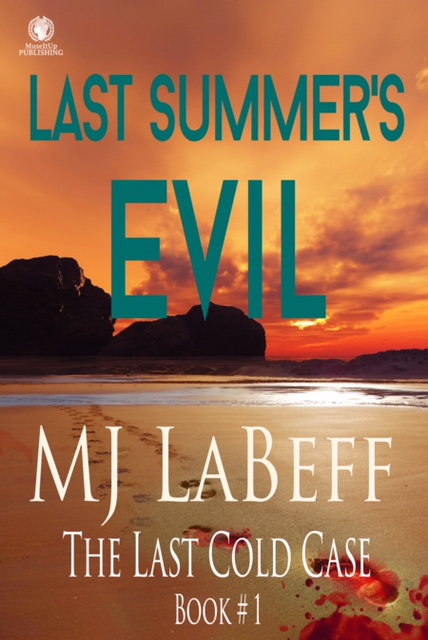 FBI Agent Nick Draven was assigned to the multiple murder cases with Rachel when he was with the Ohio Detective’s Bureau, and now he’s back again. Rachel has also been struggling with something she doesn’t understand. Every time the killer takes another victim she can feel every ounce of the victim’s pain but is paralyzed and powerless to save her. She confides in Nick- an occult crimes specialist with the FBI who is hiding some psychic secrets of his own. Personally and professionally Rachel’s struggling with her newly discovered psychic empathy but remains committed and focused to the cases. Time is not on their side, and together they’re racing against the clock before another woman is taken and another murdered. It’s a fast paced thriller that leads readers in many directions. Even my editors could not figure out “who dunnit”. The book also won the 2018 American Fiction Award in the thriller general category.
 In Last Fall’s Hunted book 2 Rachel is drawn into a hunt for a deranged serial killer harvesting kidneys from his victims’ corpses during the fall equinox. A dismembered body is found in Kill Buck Wildlife area in Snug Harbor, Ohio, and the discovery of two more victims within a twelve mile radius suggests a sadistic killer's return.
 She joins forces with FBI Agent Nick Draven again to hunt for a killer who after a twenty year hiatus strikes again. But, why? (See that- Whys are always important to me!) They draw a parallel between his first crime and the recent murders. His first victim was murdered in 1991 during the rare occurrence of the super harvest moon, an event that will happen this year and fuel his blood lust to kill again. Time is not on their side. Hood and Draven have five days to find the killer before the next full moon rises and another teenage girl is found murdered and missing her kidneys. Rachel’s psychic empathy is helpful but it’s also a hindrance.
 Cases are built on hard evidence, not feelings, but she’s trying to learn how to use her psychic gift much like she would her cop’s instinct. This might be my favorite book in the series, but how can author love one book baby more than any other. Well, I might spoil the story if I shared my deeper connection, but maybe not. When I was 14, I lost an aunt to kidney disease. That led me to my “Whys” with this story.
This brings us to Last Winter’s Taken book 3. It’s a chilling tale about a sociopath, who murders expectant mothers and abducts infants during the winter solstice. The murder of Willow Danby, a married woman and expectant mother, thrusts Homicide Detective Rachel Hood into a murder investigation and missing person’s case as she searches for the baby ripped from Willow’s body. The mysterious undertone surrounding the current investigation forces Rachel to reopen a similar cold case.
 Yvonne Johnson and Willow Danby couldn’t have been more different. Wrong side of the tracks meets white picket fence. The only thing the two women have in common: they’re both dead and their infants are missing. The sinister murders and infant abductions reunite her with psychic FBI Agent Nick Draven. Even with a long list of suspects to interview, they are no closer to solving Danby’s or Johnson’s deaths. Rachel’s psychic empathy draws her closer to the taken infants, and she suffers from a haunting premonition. A single clue left at each of the crime scenes links the cases together and leads Rachel to a mystery dating back to the year 1638. They unearth a mysterious enigma for the first time in over 372 years that draws them closer to a modern day sociopath, murdering expectant mothers and taking their unborn infants. By now, Rachel has come to embrace her psychic empathy and puts her own life in jeopardy. This book was fun to write because I enjoyed the close knit neighborhood where the Danbys lived and the envy, jealousy and gossip amongst neighbors. I think one reader commented it’s a little like Real Housewives but with murder!
 4Q: Please share a childhood anecdote or memory.
MJ: I grew up on a small town in northeastern Ohio. When I was a little girl my dad owned a Ford dealership. The local radio station WWOW was doing a promo and put me on the air. I said, “Come buy a car from my daddy because I need a new pair of shoes!”
 My mom was mortified. I was six or seven years old and vaguely recall we had been out shopping that day. The irony of it is: I’m a clotheshorse and love shoes to this day.
4Q: Many authors have the “special place” where they feel most creative. Please tell us about yours and your writing habits.
MJ: Since I work fulltime, my writing day looks like a notebook and pen that sits next to my desk at work, just in case an idea sparks to move my current work in progress forward. My job requires my full attention but having a pen and paper helps to jot something down. So, I’m a night writer.
 My morning starts early just after 5 a.m. with a cup of coffee and my iPhone. I catch up with my friends on Twitter and sometimes Facebook and then I’m racing to get ready and out the door. Depending upon book edits or writing, I may visit social media again before I start working on my book(s) at night.
 My desk has two computers on it. An old trusty Asus netbook for writing and an HP laptop that’s 4 or 5 years old for editing, research and social media. However, I really use my iPhone for posting on FB and Instagram and tweeting on Twitter. I also have a couple of paperweights, several rocks from the shores of Lake Erie, including a piece of quartz from Arizona, small writing pads, a file for my current work in progress, and a wooden caddy for pens, bills and more paper. Sometimes, I like to get away from my desk so I’ll take my netbook out to my dining room, light a candle and write there.
4Q: What’s next for MJ LaBeff, the author?
MJ: I have a few books that are unpublished. I’m concentrating on finding a literary agent and hope to connect with someone who is interested in the books I write and can connect me with an editor at a larger
 publishing house. I finished a single title standalone thriller last year, titled The Perfect Revenge. I’ve had a nibble but still don’t know if I’ve caught a fish. It’s a process and takes time.
The next novel in the Last Cold Case series, Last Spring’s Stranger has been with my current publisher Muse It Publishing for over a year and I’m not-so-patiently waiting for edits, HaHaHa! The wheels of publishing move slowly at times and one of my editors at Muse recently left to care for her health and family. I wish her the very best. As they say, “Life happens”. Being a writer is a job. So I keep writing and searching for traditional publishing avenues to share my work.
Thank you again for inviting me to be part of your blog and for the opportunity to share more about the books I write. This has been fun. If people would like to connect with me, please visit my website mjlabeff.com. There are links to my books and social media; I’m on FB, Twitter and Instagram.
4Q: Anything else you’d like to share?
MJ: Here’s a sneak peek at Last Spring’s Stranger book 4 in the Last Cold Case series. This book will have readers questioning everything they thought they knew about Homicide Detective Rachel Hood!
Secrets can have deadly and life altering consequences. The legend of Verch’s Hollow has intrigued the residents of Snug Harbor, Ohio for generations. Myths about the abandoned property abound.
 When a teenage girl is murdered in the Hollow, her gruesome death threatens to expose a secret from Homicide Detective Rachel Hood’s past. Forced to face the truth of her deception, she reopens a cold case that could jeopardize her career. A victim of adolescent cyber bullying, messages fill her personal inbox with threatening undertones from years ago. Do keep evidence and share it with an authority. Enter FBI Agent Nick Draven an occult crimes specialist and Hood’s fiancé. As they delve deeper into the sender’s motive, Rachel has to confront the harsh reality she left behind over twelve years ago: a murdered friend, Tina; a glimpse of the killer at the scene of the crime, but she can’t identify the person despite her psychic empathy; and her own involvement with the evening’s sinister events.
I’m delighted to share a short Excerpt from my book Last Winter’s Taken. Book 3 of the Last Cold Case thriller series. It’s hard to believe the book released over a year ago on May 15, 2018. I hope this piques readers’ interest in this story and encourages them to check out the other books too.
“I’d like to contact someone at the historical museum to exam the swatch,” Nadia said. “As I said before, this textile is not a modern fabric. I’m hoping to find an expert to help me determine its origin.”
“Excellent idea,” Nick said. “Let us know what you find and if you’d like help from the bureau.”
“Would you mind if we went to the lab and you can show us the fabric under a microscope?” Rachel asked.
“Not at all.” Nadia flattened her hands on the top of her desk but didn’t push herself up from behind the desk. “But, first tell me what brings you by.” She peered beneath her glasses to the bag near Rachel’s feet.
“A couple of things, first we’re trying to locate a diamond ring Tyson had recently given Willow. The diamond was set in the baby’s birthstones so we’re looking for a diamond set in aquamarine gem stones. Do you have it in the evidence file?”
“The only rings we have are her wedding rings.”
Rachel looked over at Nick. “Maybe our killer took a souvenir after all.”
She turned her attention back to Nadia. “Second, I need you to check this wine bottle and these glasses for any foreign substances.” She picked up the bag and set it on top of the desk. “One of the neighbors, Paisley Reed, paid Tyson a visit last night. I think she might have drugged him. Enter this into evidence under her name. We’re in the middle of a double homicide. Reed was killed in a car accident last night. We suspect foul play. The fuse for her emergency contact system was pulled.”
Nadia stared at the bag. “I’ll rush this and let you know what I find.”
She entered the items into an evidence log then pushed her chair back from the desk and picked up the bag. Rachel and Nick followed her to the door. Nadia waited for them to exit, locked her office, and then led them to the lab.
With a plethora of possible cross-contaminates the three of them donned blue gowns, matching blue booties and caps to cover their heads. Next, they snapped on gloves. Nadia escorted them into the lab. Other scientists worked in silence with their heads bent over microscopes and other devices used to analyze evidence.
She fished in her lab coat for a set of keys. The swatch of fabric was pressed beneath several glass slides. Carefully, she exchanged the bag containing the wine bottle and glasses for the tray of slides and then locked the evidence in the cabinet.
“We’ll need to use the scope over here,” Nadia said.
She placed the first slide beneath the microscope and peered down at it, making some adjustments for their viewing pleasure.
Rachel stepped up and bent over the microscope. She squeezed her left eye into a permanent wink and squinted into the lens with her right eye. All she could see was a bunch of squiggly lines which meant absolutely nothing to her.
“You did keep the main sample intact, didn’t you?” she asked Nadia.
“Of course, this is a tiny cross section.”
Nadia walked back to the locked evidence case and came back with the swatch of fabric. It was exactly as Rachel had remembered it except now the blood that had saturated the fabric had dried. She extended her hand, and Nadia handed the bag to her. She lifted the bag, scrutinizing the hardened swatch.
“I haven’t found any other biological evidence. The blood is the victim’s.”
Rachel nodded. “I’m not surprised. It was placed beneath her pelvis after she was probably dead. Even if she was still clinging to life, it’s unlikely she could have struggled with her attacker.”
“The sample you were looking at are strands of dark black hair, not threads,” Nadia said.
Rachel lowered the evidence bag to her side and bent over the microscope again, pressing her eyeball against the lens.
“When I first discovered the strands of hair I thought we might have recovered hair from the perpetrator or victim but upon closer examination it was clear the hair had been woven into the fabric. To be certain I removed two cross sections. As I mentioned, the weave is not from a modern textile. That much I do know. That’s why I’m hoping someone from the historical museum can identify what time period the fabric came from.”
Rachel’s eye strained. The sample beneath the microscope lens danced. She blinked and readjusted her position to gain a better view of the sample. Squinting harder, she tried to focus on the image. The black strands climbed up and swirled around her, taunting her. A mist formed before her open eye peering down through the magnifying lens.
A pair of hands rose up from the mist, reaching for her. She gasped but before she could look away the hands opened, revealing a bloody, fleshy, wriggling mass. The mist evaporated. A woman appeared. She walked toward Rachel with outstretched arms. She drew closer and in her upturned hands was a baby.
The woman’s face with glowing eyes jumped out at her.
“Thou shall not conceive and deceive!”
Her face withered from Rachel’s vision, behind her stood a weeping woman. Tears streamed down her cheeks. Faint sobs and ragged breathing grew louder, louder, louder. Her sorrowful cries shattered Rachel’s heart, pulling her emotionally closer to the woman. The weeping woman drew in a deep breath. She blew out a mist of black haze in Rachel’s face.
“Give me my baby,” she pleaded, and then broke into the most terrifying cry Rachel had ever heard.
The weeping woman’s shrill shrieks pierced Rachel ears. She dropped the evidence bag and fell to her knees, hands cupping each ear in an attempt to drown out the weeping woman’s words and sobs that echoed like unwanted ringing.
A huge thank you to you MJ for being our guest this week. Wishing you all the best in your future writing.

It was my pleasure and greatly appreciated. Wishing you the same with your writing and books!
***For those of you wanting to discover more about our talented guest, please follow MJ’s links below.
www.mjlabeff.com
My books are available where all eBooks are sold and in print online at Amazon and Barnes and Noble.
Links to my latest release Last Winter’s Taken: http://getbook.at/LWT
https://www.kobo.com/us/en/ebook/last-winter-s-taken
https://itunes.apple.com/us/book/last-winters-taken/id1369358675?mt=11
https://www.barnesandnoble.com/w/last-winters-taken-mj-labeff/1128474608?ean=2940155580201
https://museituppublishing.com/bookstore/index.php/museitup/horror-dark-fiction/psychological-thriller/last-winters-taken-detail
Watch the book trailer: https://youtu.be/Cj5KdOGcIe4
A
 special thank you to you, our faithful readers. Please feel free to leave a comment below, we’d love to hear from you.
August 10, 2019
Blindshot – A Thriller from Guest Author Denis Coupal of Montreal, Quebec.
 Denis’ debut novel – Blindshot - published by Linda Leith Publishing, is receiving a lot of attention, as well it should. A thriller that promises suspense, twists and an enthralling read. Accolades pour in from other authors and reviewers. It’s the next novel on my list and I’m anxious to discover what Denis Coupal has to say. He has graciously accepted an invitation to the Scribbler. A 4Q and an excerpt from his thriller.
Denis Coupal is a Montreal writer and business strategist. By day, he works as Director of Business Development for BDO Canada, a global accounting and business advisory firm. By night, and on weekends, he writes fiction. His feature-length screenplays were funded by the Foundation to Underwrite New Drama for Pay Television, Roger’s Pay Television and SODEC. His short story, Brand Loyalty, won Honourable Mention in the 2011 Quebec Writing Competition and was published in the anthology Minority Reports, New English Writing from Quebec. Denis is also Chairman of the Board of Dawson College Foundation, is an active in the Mergers and Acquisitions Club of Canada and of the Montreal Board of Trade’s major partners program.
Blindshot is his first thriller.

4Q: After visiting your website (deniscoupal.ca) and reading a recent interview from The Miramichi Reviewer, your novel is a must read. Please tell the Scribbler’s readers what to expect.
DC: I love hearing that Blindshot is a ‘must read’. So cool! Great thanks Allan and South Branch Scribbler for this invitation. It’s an honour and I look forward to your thoughts on Blindshot. I hope it lives up to all the hype. Writing the book, then publishing it, and now selling it and talking about it, has been such great fun. The reaction of readers, and other authors as well, has been even better than I expected. In fact, I’m not sure I had expectations. I just tried to do the very best work I could, with the support, of course, of the team at Linda Leith Publishing. Needless to say, publishing is a hard, rather quirky, business. It isn’t an easy ride for anyone involved in the process. What makes it work, though, or perhaps the oil in the machine, is the passion that everyone puts into it. People love books and stories and that’s what makes it all work. I hope all the passion poured into Blindshot, my first novel, comes through to readers as they turn the pages. And I hear the pages are turning fast!
 Blindshot originated as a movie idea, many years ago. The story had about thirty-two working titles before becoming Blindshot. That’s just part of the process. But at first it was a movie idea about a stray bullet, or perhaps a purposefully shot bullet, that kills a financier and family man. When the police don’t, or won’t, solve what could be a murder, his two teenage sons take on community, demanding a proper investigation, and then demanding the truth from those they feel are responsible. The two boys take matters into their own hands, putting in motion a plan that leads to events they could not have predicted. Their mother is one of the main characters and she faces a difficult decision when she finds herself caught between the law, the community, and her well-meaning, vigilante sons. She has to choose. Not easy.
 Important to me was the idea that Blindshot be both entertaining and have literary muscle. I aimed to write a book that I would want to read. That meant creating a merge of genres. Dangerous to do in a first book. One of my inspirations for the concept of Blindshot was Lord of the Flies (Did I really dare to put both of those titles in the same sentence?). I love that book, as many do, and I hoped to create a fable, of sorts, that had social relevance. Slaughterhouse Five, was an important book to me as well. Vonnegut’s “The Children’s Crusade” helped propel Blindshot, whether anyone would know it by the final work or not. That’s how inspiration works, in my view. It’s like choosing to sit by a creek, in a far-off forest, as you work, with water flowing, making that delicate, trickling sound in your ears that is constant and soothing. The world, the life, around you drops ideas in your head. Ideas like that propel your work. But no one needs to know exactly where this creek in the forest might be that pushed forward your creativity. That’s your secret.
**Read the Miramichi Review here
4Q: An interesting note on your background is the writing of screenplays which I find fascinating. How does the writing of a screenplay and a novel differ, if they do?
DC: They are disciplines that to me are indivisible from one another. I matured as a writer by opening my creative spirit to film many years ago and the rigorous methodology behind good, tightly edited, screenwriting. So books and music were always equally important. In interest of full disclosure, music was just as important. Music is the binding element in my ideas, as if there’s always a humming in the back of my head, whether writing for film or prose. Ennio Morricone was as much an inspiration as the great Sergio Leone himself. I’ve read a great deal of books and watched a great deal of movies. No surprise that Blindshot is very visual. It’s how I write, I am discovering. Since I’ve written only one book, I won’t pretend to claim a developed voice or way of writing. I’m learning and hopefully learning enough to keep moving forward. I’m like an actor with one play under his belt. That doesn’t make me a veteran of the stage, and certainly not a star. Hopefully, I’ve told a story that brings readers on a meaningful, entertaining journey. The books are selling fast, and reader comments are amazing, so maybe I’ve achieved at least that.
 I wrote my first screenplay at sixteen. It was the story of a group of high school friends that borrowed a car and went on an expedition to a small airport in the country in order to parachute for the first time. It was a light, juvenile comedy. However lacking in structure, it was my first script. I learned from writing it, and my friends enjoyed reading it and figuring out which characters they had inspired. Inside me though, I was bitten by the writing bug as much as by the movie bug. The bite though, was like that of a shark, with three rows of teeth. It never let go.
 Over the years, I’ve written over a dozen feature-length screenplays. One or two of them good. There were a few occasions when serious deals were on the table. It got very exciting once or twice. But wow, what a fickle industry and things did not materialize as I would have liked… or you would have heard about it already. With the publishing of Blindshot, the fire is lit again. The concept would lend itself wonderfully to the movies. Personally, the creativity is pouring out and projects are in the works.
 For example, in collaboration with my wife Josée-Lisa LeFrançois, I’ve written a French language feel-good movie that we are shopping around. I’m actively writing a new screenplay, in English. It’s an urban thriller about a special crimes unit facing off with an extraordinarily smart serial killer. It’s great fun to write. See you at the movies.
 Technically, books and screenplays are very different. The script is not geared to a wide audience, but specifically aimed at an audience of producers, directors, cinematographers, and the creative crew that it takes to make a film. Writing a screenplay does not really require the application of a love of language. Books, of course, need that. Scripts are technical documents, within which all sorts of language might be contained and supported, but not all elements within a screenplay (like technical direction) is part of its lyrical expression. Where books and screenplays come together, is that they both require an expression of a story and, fundamentally, a vision or a dream. Without vision, the story is just a list of occurrences no more special than a grocery list. Vision raises a work of fiction, film or prose, up past the clouds and into the wide, blue yonder where great stories float and are remembered by the people and their communities down here on the ground. Writers are alchemists. Freaky.
4Q: Please share a childhood anecdote or memory.
 Photo credit: Jamie BeckDC: Well, this will be the first time I share this. When I was in first year of high school, a young boy in my grade began missing classes. He was liked by everyone. He had a gentle demeanor and laughed easily. It became very apparent that he was very sick and battling something serious. He then stopped coming to school entirely. Being a friend, his family invited me to visit him at his house. Perhaps I could distract him and raise his spirits, they proposed? When I got there, he was so sick he could barely hold up his head to talk to anyone. He didn’t even look like himself. There wasn’t a hair left on his head. I tried talking with him, but it was too difficult for him. He was moved to his room where he could lie down to sleep. He passed away a few weeks later. He was missed by all at school. The following semester, I wrote a short story about him and how bravely he fought, right to the end, against leukemia. When came time to name characters in my first novel, I named the father in the family, the victim of a tragic incident, after my late friend. His name was Paul, just like the name of the main character in one of my favourite books, Dune, that I was reading at the time.
 4Q: Every creative person has that niche they escape to when they want to write or paint. What’s your favorite spot and writing habits?
 DC: I have none. I write anywhere, anytime. I don’t have the luxury of routine in my life, so I’m ready to right anytime the opportunity comes. I always carry notebooks for ideas. I love writing by hand as much as with computers. On weekends I pop open a laptop and begin writing. Where? Anywhere. I love cafés and restaurants, filled with people and buzzing with talk and music. I’m lucky that I can concentrate and get in my ‘niche’ or zone absolutely anyplace. My usual ‘niche’ at home, usually early morning, is somewhere not too far from my wife, Josée-Lisa, each of us with a coffee in hand. I wrote Blindshot with my youngest son Luca sitting right next to me, almost for every sentence, himself writing or drawing his own projects. No surprise he inspired the character of Noah in Blindshot.
 4Q: What’s next for Denis Coupal, the author?
 DC: My next novel will be a thriller set mainly in Montreal, more urban than Blindshot, but which will also have strong international elements. It’s a bigger, more ambitious story than I’ve done before. I dare to say that it’s a blend of James Michener, John Le Carré, John Irving and Michael Crichton. I had a really great time reading Dan Brown’s Origin last month, so that might have an impact. I also admire Blake Crouch, who’s really someone to watch as he tackles cutting edge technological ideas. Crazy mix, but that’s how I think. Again, it will be a book that just has to become a great, big movie that everyone has to see. As you can tell, I’m having a lot of fun with this.
 4Q: Anything else you’d like to share?
DC: Sure. Here’s my pitch for why you should buy and read my book. You have bought many books from, from many writers, in your life. You have likely bought books from Stephen King, David Baldacci, Michael Connelly, John Steinbeck, Margaret Atwood and so many other writers known across the world. But you don’t know them. They don’t know you. They are strangers, and you might never know them. And they may never know you. They are unreachable. So why not read my book? I’m here in Montreal, reachable by social media and I will love to hear from you and learn what you thought of my book. And Blindshot is great fun to read! LOL. I’m a shameless promoter of my book, yes absolutely. But I mean it, please read my book and let me know your thoughts. You will be helping me make it a better movie! LOL. Cheers to all.

An Excerpt from Blindshot.
(Copyright is held by the Author. Used with permission)
PROLOGUE
BLOOD
The night air was fresh, filled with the rich scents of the forest that wrapped the Carignan family property, Valhalla, in the Eastern Townships of Quebec.
Paul Carignan, family man, father of two, successful corporate financier, walked to the woodpile near the west wall of his cherished Valhalla, went down on one knee and sorted through logs to find just the right ones for this evening’s fire.
A rifle shot sounded from far off in the woods. A flock of crows scattered up and away.
Paul’s vision blurred. He tried to shake it off, dropping the logs. The biggest one fell hard on his ankle but a sudden sensation in his abdomen preoccupied him more, burning to his lower back, intensifying. He lost his breath as he looked down at himself. He slid his hands into his clothes to his mid-section, pain spreading, throbbing through his veins like a freight train. He felt the warm wetness creeping to his legs, confirming the incredible.
He had been shot.
He fell over. With a gasp, he could feel his spirit struggling to leave him, wanting to fly up, chase the frightened crows and disappear beyond the valley and over the dark woods.
The wound burned like nothing ever had.
Thoughts assailed him. What if he were to die right now, on this evening, by this bullet? What would his boys, Jack and Noah, do? They were still so young, with much to learn. What would Catherine do? She was barely getting through their pending divorce. Deep down, he still loved her. They had lost their way, their passion fading, as with so many couples they knew who had children and demanding careers. He had sought passion from another woman and had surprised even himself with his unfaithfulness. He would never have the chance to redeem himself now, not to Catherine, not to himself. All seemed to be over, here and now, by this bullet that had pierced him in the dark.
 Maybe he was getting what he deserved? But who had shot him? Why? The possibilities swirled in his panicked, weakening mind. He had been a tough business adversary to many over the years. His penchant for taking over flailing manufacturing companies, restructuring and reselling them, or sometimes liquidating their parts, had pushed many good people aside, destroyed careers of veteran entrepreneurs, broken partnerships, and set industry veterans adrift. He had taken no prisoners. That was just his way and he had made it work for his benefit. It was easy for Paul to imagine a great number of enemies who might want him gone.
Blood poured from his gut.
“Catherine!” he shouted, but it came out a whisper. She was nowhere near, and no matter how much he yearned for her to be right there, ready to help, from however deep in him this came, it wouldn’t matter. Catherine wasn’t there, and she would never know how often he thought of her. She would never know and might scarcely believe that he had always thought of her and not his girlfriend, Anne, as his soulmate. Anne was young and striking, but hadn’t Catherine been his muse, his guide, with him through the lean years and the greater part of his life? Together, Paul and Catherine had overcome myriad obstacles and produced, in their view, two of the greatest people on the planet. Jack and Noah were amazing boys. He wondered now, as he bled, if he had done all he could for them. Had he even told them often enough how much he cared? His mind raced to remember precisely, but his energy dropped.
Paul tried to rise, but instead spun weakly sideways and crashed into the grassy slope, sliding downward. Once still, he couldn’t stop his eyes from closing. He reached out, or at least tried to tell his arm to reach out, for anything, for anyone, for the darkness above to lower and provide a soft blanket to comfort him, to warm him. He was so cold.
Footsteps. He heard something like footsteps. He wasn’t sure. Was it only the mad beating of his heart? His imagination was on overdrive. Was someone coming to save him? Or was it his killer, closing in to finish him off, getting closer and closer?
Silence. Nothing stirred. Paul heard only his own wheezing. Had his killer turned away, convinced Paul was taken care of, bleeding to his inevitable death?
Or was his killer standing over him, quietly watching?
Was this all there would ever be? Paul’s world went dark.
Merci Denis. Thank you for being our guest. Wishing you much success with your writing journey and especially with Blindshot!

For you readers wanting to discover more about Denis and his writing, please follow these links.
I’m very active and present on social media, so there are multiple ways readers can follow me. And I like to add that I’m very interested in hearing back from readers. There is nothing, for me right now, as fun as discussing my book. It’s been a long road to get it out there and when someone reactions to it, well, wow, what a thrill. The other day, I got an email from a reader. She told her Facebook followers that she had been reading Blindshot, finished the last page while riding the bus, and when she read the ending, she jumped out of her seat and gasped. Too funny.
www.deniscoupal.ca
www.facebook.com/denis.coupal
August 4, 2019
“The Path to Writing a Novel is Never Smooth” Returning Guest Author Ritu Bhathal of Kent, United Kingdom
“The Path to Writing a Novel is Never Smooth”

The opening line from Ritu’s web site is a reminder of all the hard work that goes into writing.
Yet, Ritu is doing it, and doing it quite well. She has been a guest on the Scribbler before with a delightful, entertaining short story - The Bag Lady – and if you missed it, please go HERE
.
The Scribbler is pleased to have her back as a guest with a 4Q Interview and an excerpt from
Marriage: Unarranged.
 Ritu Bhathal was born in Birmingham in the mid-1970’s to migrant parents, hailing from Kenya but of Indian origin. This colorful background has been a constant source of inspiration to her. From childhood, she has always enjoyed reading. This love of books is mostly credited to her mother. The joy of reading spurred her on to become creative with her own writing, from fiction to poetry. Winning little writing competitions at school and locally gave her the encouragement to continue writing.
As a wife, mother, daughter, sister, and teacher, she has drawn on inspiration from many avenues to create the poems that she writes.
A qualified teacher, having studied at Kingston University, she now deals with classes of children as a sideline to her writing!
Ritu also writes a blog, a mixture of life and creativity, thoughts and opinions, which recently was awarded Best Book Blog at the Annual Blogger’s Bash Awards.
Ritu is happily married and living in Kent with Hubby dearest and two children….and not to forget the furbaby, Sonu Singh.
4Q: Your web site tells us there is a novel in the works and/or completed. Care to tell us about it?
 RB: My website is not telling any lies! Yes, I have been working on this story for a long time, almost twenty years, to be honest. It started as a little idea before I got married, and I managed to write a few words here and there, until I started blogging in earnest. Here, I was given the courage to work on it in a more determined fashion. I am just finishing the tweaks after my editor read through it. How to describe it? I like to call it Chick Pea Curry Lit, a bit of chick lit with an Indian twist!
“Aashi’s life was all set.
Or so she thought.
After finding out her fiancé was not the man she thought, she vows to put him, and her innocence behind her.
Accompanied by her brothers and best friend, she embarks upon an enlightening journey, where memories created and new relationships forged, have far reaching effects.”
Set in 2000, in the Indian suburbs of Birmingham, UK – yes, Indian because every city here seems to have a mini India where the Indian immigrants congregate!
It is set between Birmingham and India actually.
A story of a British born Indian girl, and her family, as they come to terms with her broken engagement.
There’s love lust, humour and a little bit of seriousness too!
And even better: since I received feedback from my first released draft, and from my editor, there are two sequels which will be able to be read as stand alone too in the pipeline!
4Q: A previously published book of poetry, titled Poetic RITUals has been called “A collection of poetry drawing on the experiences of the writer……. Please tell us about your collection of poems.
 RB: My poetry comes from the heart and is very much inspired by my life. You will find poems of a humorous nature, about being a mother, and dealing with children, and all sorts of life situations that we find ourselves in, from work to relationships. I write what I am feeling at the time, so they are all truly from the heart.
4Q: Please share a childhood memory or anecdote.
RB: I feel blessed to have had a wonderful childhood, peppered with fantastic memories, as the daughter of a Kenyan born couple, who was born and brought up here. I have an abundance of family, cousins coming out of my ears, and enough uncles and aunties to furnish most of the households on my street with one of each, and still have more left over!
This kind of family means there are plenty of stories to tell. We would spend summers in Kenya, splitting the four or five weeks out there between my Pops’s family home and my Mum’s.
 One memory, amongst thousands, is of the time I (attempted to) learn how to ride a small 50cc motorbike that my cousin used to get around the farm on. She was my age and size. It wasn’t going to be too hard, was it? Famous last words. Anyone who knows me, knows how clumsy I am. It all went well for the first few feet. I rode it straight, then it started to veer to the right, and I panicked instead of straightening the handlebars, and ended up in one of my Nani’s (grandmother) rose bushes! My Nani had been watching me through a window and came rushing out. I held up my arms to her, hoping for a comforting hug, and got pulled out so she could fuss over the plant instead! My Nani was a character and a half and I do miss her, God rest her soul.
4Q: When the creative juices are flowing, where do you go to write? What are your writing habits?
 RB: Hmm, I’m not sure what my specific writing habits are. As a working wife and mother, I have to grab opportunities to write when I can. Usually, during term time it is after 9pm when the children are in bed, and we have eaten dinner. I get my little bit of peace then, and try and either write, or edit in that hour or so before I switch off with whatever I am reading at the time. I am usually found on my bed, laptop on my lap (where else?), typing away. And there is always a notebook handy, wherever I go!
During the longer holidays, I am up early, as my usual schedule dictates, so I use a couple of hours then, to write, before the rest of the family wakes and draws me into their world!
4Q: You have an award winning blog aptly titled – But I Smile anyway…. It must’ve been a thrill winning “Best Book Blog” How did that feel?
 RB: I feel blessed that so many voted for me, over a huge amount of other bloggers, to be honest! It was a total surprise. I was sitting there, minding my own business, waiting to politely clap the winner, and my blog’s name got called out! Those around me say my face was a picture. It was so unexpected. But I am grateful.
 I write, I read, I share.
Many others do the same, and in my eyes, in a much better way than me, so it was so lovely to get validation via the votes of the public, that what I do put out there, is being read, and appreciated.
4Q: Anything else you’d like to tell us?
RB: I think I’d like to hark back to that first line you started the post with.
“The Path to Writing a Novel is Never Smooth”
I set off on this story writing quest with airy fairy ideas about penning a novel that would become a bestseller, because publishers would be beating my door down to sign me up and get my book out there.
 Little did I know how much work goes into writing that first draft, let alone the rest of the work that you have to do after, including numerous drafts, the nervousness as you wait for others to read and give feedback, then the rigmarole of deciding whether to go it alone, and self-publish, or try and find an agent or publisher who has faith in you.
I will always be thankful to the huge amount of people I have met, via my blogging, who have become an invaluable support network, full of advice, helpful tips and bucketfuls of encouragement. Without them, I would be nowhere near quite possibly publishing this book as I am now.
Never underestimate the friendships you can create via this beautiful blogisphere.
An Excerpt from Marriage: Unarranged
(Copyright is held by the Author. Used with permission)
Aashi opened the door an inch and took a deep breath. She flung it wide and stood there with her arm extended and her palm turned upwards. Her eyes searched Ravi’s face and then fell to the piece of tissue lying in her hand... Inside the tissue was... a condom wrapper.
“What is this? Don’t say it, I know what it is, but why is it here?” Aashi felt tears begin to prick the back of her eyes
“Babe, I can explain, you see, one of my mates came around the other night, and he had his girlfriend with him, and well, they must have, well you know... Don’t worry I’ll have a word with him.”
Aashi pushed past him into the bedroom. Her whole body shaking, she sat on the bed and wiped the tears away. That’s right; of course, Ravi wouldn’t do anything. How could I even think it? She looked around for a tissue box. Aah,on the bedside table. Noticing the drawer was slightly open, she absentmindedly tugged at it. Something was stuck so she went to put it back properly and shut the drawer. Out of the corner of her eye, she spotted Ravi’s hand, shooting out towards her.
Too late.
She took the empty box, which had once contained three condoms, and looked at it.
Aashi shoved Ravi away and fled down the stairs. She grabbed her bag and car keys and rushed out of the house. Tears blurred her vision as she unlocked the car, opened the door and sat down. Looking at herself in the rear-view mirror, she burst into fresh tears.
 What’s so wrong with me? She searched the tear-stained, slightly blotchy, face in the mirror. How could he do this to me? After all those long chats about the future and how important it was to save yourself for the right one. Has there been anyone else?
As she studied her face, Aashi became aware of a figure, approaching the car. Ravi. Oh no you don’t! Aashi locked the car and went to start the ignition when Ravi appeared at her window.
“Please, babe, open the door. We’ve got to talk.”
“Leave me alone!” Aashi screamed. “I don’t want to see your face, EVER AGAIN!” With that, she turned away and started the engine.
“Look, honey, you have to listen to me.” Strange, that voice sounds too clear for someone standing outside the car... Aashi looked to the left, and there he was, sitting beside her.
“Please, get out, before I do something I regret.” In her hurry to start the car she had somehow pressed the central locking button on her key. Typical. Even inanimate objects are betraying me now.
Thank you Ritu, for being our guest this week.

For you wonderful readers that would like to discover more about this talented author and her writing, please follow these links:
Blog Website: http://www.butismileanyway.com
Author Website: http://www.ritubhathal.com Twitter: https://twitter.com/RituBhathal Instagram: https://www.instagram.com/ritubhathalwrites/
Facebook: https://www.facebook.com/butismileanyway/
Facebook: https://www.facebook.com/RituBhathal/
Pinterest: https://uk.pinterest.com/bhathalpadhaal/
Goodreads: https://www.goodreads.com/user/show/56854412-ritu-bhathal
Mix: https://mix.com/butismileanyway
Tumblr: https://www.tumblr.com/blog/ritusmiles
LinkedIn: https://www.linkedin.com/in/ritu-bhathal-48941648/
Bloglovin: https://www.bloglovin.com/@ritubhathalpadhaal
July 27, 2019
Guest Author Kade Cook of Shediac, New Brunswick
Real Magic Dusted With Life

– That’s what you’ll read when you visit Kade’s Facebook Author page. How’s that for a tempting lead-in?
I met Kade at the recent Metro Book Festival, a charming and friendly lady that writes supernatural fantasy novels. The Scribbler is most fortunate to have Kade as out guest this week. She has agreed to a 4Q Interview and to sharing a brief excerpt from one of her novels.
Kade Cook is a major fantasy fangirl. Her love of Twilight, The Mortal Instruments and A Court of Thorns and Roses inspired her to write her own fantasy book series, The Covenant of Shadows.
Book one, GREY, was a finalist for the 2017 Emerging Writer's Prize for Canada's best new books in Speculative Fiction.
Born and raised as a 'Maritimer' through and through, Kade will always be at home around good times and kind hearts, proud to be a daydreamer with a story to tell.
4Q: Your series is titled The Covenant of Shadows. Tell us about the series and what inspired it.

KC: The series is about a young Phycologist that is anything but illogical and in complete control of her world but when she starts seeing colors around people, and starts getting visits from clients that no one else can see, she begins to question her own sanity.
Her world is not only changing and becoming unstable, but she can’t even return to the life she knew before. She is now awakening to the real world around her, one filled with Magik, Supernaturals and maybe even a dash of romance.
It is a journey of discovery, of finding hope in the darkest hours, and of internal importance.
These books were inspired by the desire to find myself when life had decided to put a label on me that didn’t quite fit right.
4Q: Please tell us about your writing journey, when did it start and what do you love about it?
 KC: I never dreamed of being a writer though I have always been in awe of those who could. And once I quit my day job of the IT sector, I became mom of a large brood of kids. Though I love my children deeply, my mind became bored and unhappy without cerebral stimuli to engage in. So, my husband told me if I was so bored with my life, why don’t I write a book. And so I did to his surprise and haven’t looked back since.
 The entire writing process from start to finish is a journey that engages my entire existence and brings my soul to life with each and every word I am granted with. Though I had never seen myself as an Author, I can now happily say that I cannot imagine myself being anything but. No longer do I search for who I am, I’ve met me, within the pages of my books.

4Q: Please share a childhood memory or anecdote.
KC: I’ve never fit in as a child, not like everyone else. I’ve always danced to the beat of a different drum, once which sometimes had caused people to either truly love being around me or quite quickly shy away as I will admit to anyone, that I am weird.
 But I guess since I spent most of my time in my father’s woods, my only companion on many days was my trusty best friend Lady Dawn – a dog, searching for fairies and little folk in the twisted trees and the thick mystical underbrush, it was only a natural step forward in my world to actually pick up a pencil and set my interpretation of the world into word. I had only really written one story that I can remember as a child, called the Hounds of Hell. I can’t quite remember all of it but at the time, the story reflected my fear of the dark and those things that lingered in it.
 Now I write stories that bring the darkness goodness, turning what I feared most into a place of peace and protection, aka Shadow Walker Guardians in my series.
4Q: Most creative people have a “special spot” where they perform their magic. Tell us about yours.
 KC: My magic spot is not anything wondrous or majestic place. It is a boring little corner of my basement upon an aging treadmill where I stare into a blank chocolate brown wall as I walk and daydream. I find most of my stories there. While my body is busy walking and being healthy, my mind is free to roam and dream, to watch and listen to the characters as they take form, and what they have to tell me about the story they want to tell. I am merely a scribe to the beautiful characters that live in my imagination.
 4Q: Anything else you’d like to add?
KC: I just want to say to all the readers out there who keep believing in us, and dreaming right along with us in our stories, Thank You!
An Excerpt from GREY
(Copyright is held by the author. Used with permission)
This is at the point Gabrian Shadwell, my main character is having some major issues with her new world and being introduced to some of the Elders of the Magical Realm she is now a part of. Let’s just say she isn’t exactly handling it well…
Now seated across from her unwelcomed guests, Gabrian listens quietly as Rachael begins to introduce them one by one.
“Gabrian, I would like for you to meet Ariah, Elder to the Fellowship of Vindere,” Rachael says, pointing toward the smaller woman that holds resemblance to herself. “In common English, the Reincarnate Fellowship. This is the fellowship that I belong to.”
Fellowship? Belong to? Is she in some kind of cult or strange group that I was unaware of? Gabrian ponders, silently deciding that she is going to make it a point to monitor her future employee’s extracurricular activities a little more closely—not to mention screen her choice in friends.
“You already know Orroryn, or Mr. Redmond, as we call him.” As she continues, Gabrian notices that Rachael’s face flushes slightly as she speaks of Mr. Redmond. “He is the Elder to the Fellowship of Schaeduwe or the Shadows Fellowship better known as Shadow Walkers.”
Ah, what did she just say? Shadow What? Gabrian’s legs begin to tremble as she feels the angst building within. Her fingers have shifted from a warm tingling sensation to a full-blown burn. She hears Rachael still talking in the background, but Gabrian’s mind focuses on trying to decipher what a Shadow Walker might be. All she catches is the word ‘Air’.
“Excuse me, I didn’t catch that last part.” Gabrian giggles unwillingly. The comic book creations that her delusional best friend is trying to feed to her are a bit distracting. “All I heard was something about air.” Gabrian closes her eyes and presses firmly against the bridge of her nose, reaching for reasoning while trying to sort through all the deranged details piling up inside of her mind. She hungers for some type of understanding of how any of this could make sense.
Vaeda interjects when it comes time for her portion of the introductions in a sultry voice. “I am Vaeda, the Elder to the Fellowship of Zephyr. We are the Air Fellowship as we are one with the wind.”

Not knowing what to say to that, Gabrian just raises her eyebrows and nods her head slowly.
“Gabrian, we are friends of your parents, Sarapheane and Jarrison. Ariah, Vaeda, and I have known them all our lives for they too are people of the Realm from the Schaeduwe Fellowship like me. We have existed in each other’s presence for eons, training in the ways of the Schaeduwe. Our ancestors are descendants of the ancients and act as the Guardians to the Covenant.”
Gabrian freezes, the small rapport she had built with this man has now been obliterated by the words spewing out of his mouth. He seemed so normal. She shifts her view to Rachael. She seemed so normal too. She sits in a stupefied state, playing a tennis match with her eyes as she looks back and forth between them all, completely at a loss. She becomes brutally aware she is in a room surrounded by strangers who are absolutely, undeniably off their rockers.
Gabrian chews on her bottom lip as she contemplates how she ended up in this situation—youngest Valedictorian in her graduating class to date, undisputable ability to detect those in need of help in the reality department, and an obsessive need to be in control of all aspects in her life to a fault. How was Rachael able to fly under the radar and get close enough to her that she was able to put Gabrian in a situation this deranged—and possibly psychopathically dangerous?
Unsure of what else to do, Gabrian slowly stands up. Smiling her best I-need-to-get-me-the-Hell-out-of-here smile, she studies her route of escape and hopes to make it to the door of her apartment before any type of violent reaction breaks out with these people.
Rachael, having witnessed every altering mood-swing since the time she met Gabrian, senses her escalating anxiety. She takes note of how Gabrian’s new, permanent grey aura, swirls and whips itself around her like a veil of protection and realizes what may come next—she is going to try and make a break for it.
“She is going to run!” Rachael yells just as Gabrian quickly darts toward the door.
Flying full speed across the room, she reaches for the doorknob and fumbles with it but manages to open it. With the door wide open, and the small glimpse of freedom in front of her, Gabrian bursts forward and tries to run through the open frame. In the same instant, Vaeda speaks in Zephyr tongue and curls her fingers gently inward.
“Claustra solidus,” she whispers, and Gabrian slams into an invisible wall manifested by the will of Vaeda’s words, knocking her backward onto the floor. Panicked and running on pure adrenaline, Gabrian picks herself back up for another try at escape.
“Silozan Dvarah!” Vaeda continues and the door of Gabrian’s apartment slams shut before she can reach it. As the door closes, Orroryn instinctively reaches for the hem of the shadow beside him and pulls it across his massive body. Almost instantaneously, he expels himself out of the darkened contour of the entry leading to the door. He thrusts his hand outward and twists the knob on the straight bolt before Gabrian can stand, halting her exit plans.
 Holy crap! You are going to die!her mind screams, eliminating any chance of rational thought. Staring at the massive wall of man before her—and knowing the sparkly wicked witch of the west is behind her—Gabrian decides it is fight-or-flight time, and her survival instincts take over. Flashes of the bodies from the park swirl dizzily within her memory, blinding her sight with the visions of those left lying lifeless. She rushes into her mind and rips at the sensations that surround her, figuring it may be her only way out.
 If she can take out three people without even trying, she can conjure up whatever is in her to slow down these crazies.
Thank you Kade, for being our special guest this week.

For you readers that want to discover more about Kade and her writing, please follow these links:
Join me on my journey as I attempt to pull you into my magical world filled with Vampires, Shadow Walkers and Mages...and maybe even a few ‘Monsters’ along the way. (KC)
Amazon links: https://www.amazon.com/Kade-Cook/e/B01M64VACI/
Wordpress: https://kadecookbooks.wordpress.com/
Instagram: https://www.instagram.com/kade.cook/
Twitter: https://twitter.com/CovOfShadows/
Bookbub: https://www.bookbub.com/authors/kade-cook
Pinterest: https://www.pinterest.ca/AuthorKadeCook/
Goodreads: https://www.goodreads.com/Kade_cook