Allan Hudson's Blog, page 2
September 13, 2025
The Story Behind the Story with Author Becca Blue of Lincoln, New Brunswick, Canada.
We have another new author for youto meet.

I had the good fortune to meetBecca at the GMRD Book Fair in April. We met lots of readers and had a fun day.
She has kindly accepted our invitationto be our guest this week.
Read on, my friends.
BeccaBlue is a writer, director, photographer and graphic designer whose work blendsemotional depth with a touch of the supernatural. She is the author of The Guardians of Your Heart series and the children’s series My Dog Bruce . Becca has spent 25 years workingin the entertainment world on many popular film and television series. Herfirst award-winning indie film, All I Need , became the prelude to The Guardians of Your Heart series , establishing her signature styleof love, loss, and redemption. When she isn’t writing or making her next film,she’s crafting book trailers and helping other authors publish their ownstories with her small business Sakura Blue Studios based in Lincoln, NewBrunswick.
UpcomingBook Title:
My newest booksI’m about to release this year are The Guardians of Your Heart Series, whichincludes Stay With Me | Don’t Tell Me Goodbye | You’re NotAlone. The first one will release in September 2025, the second one beforeChristmas this year, and the last one in February 2026!

Synopsis:
Sophie Reid’s life changes foreverwhen Nathan Hayes, her guardian angel, defies heavenly rules to save her fromthe darkness threatening to consume her. Their forbidden love grants Nathan asecond chance at life, and together they begin to build a future filled withhope and passion. But their happiness is shattered when a vengeful spirit fromNathan’s past emerges from purgatory, determined to destroy Sophie and reclaimNathan. Thrust into a supernatural battle where secrets unravel and dangerlurks in every shadow, Sophie must confront her deepest fears and makeimpossible choices as their love is tested in ways she never imagined. StayWith Me, the first installment in The Guardians Of Your Heart series is agripping tale of love, sacrifice, and redemption that will leave readersbreathless and yearning for more.

TheStory Behind the Story – why you wrote it, what inspired it…
This story has been in my head since I was sixteen years old. Throughout highschool, I wrote many stories with different variations of the same character,Nathan. I even had dreams of scenes and conversations, and lucky enough, Iwrote them all down over the years. These little segments eventually cametogether while I was in college and became the prelude to my massive trilogy,The Guardians Of Your Heart. I published the first story, "All INeed," in 2009 and soon after adapted it into a full-length feature filmthat I directed and produced independently. That film went on to win at theCanadian International Film Festival. Since then, I knew this story was biggerthan anything else I was doing in life. So, I dedicated my work to this seriesover the next few years, and I’m so excited to be finally releasing it all,starting in September 2025 with part one, “Stay With Me.” The secondinstallment will be released by Christmas, and the last part in February 2026!This story is so important to me because I put a lot of myself into this book,my growth, my pain, my beliefs and more. I’ve always found writing and makingmovies to be an exciting way to share stories and uniquely reach others. Youcan be as creative as you want, and with self-publishing, your possibilitiesare endless. I’ve always been a super expressive person with my artwork, andthe best part about the work I do now is meeting people who share some of thesame experiences at book events, some have the same interests and more. It’snice to connect with people who love the things you do! I’ve met some amazingpeople throughout this journey, and I can’t wait to hear what people thinkafter reading this series! I am a strong believer that sometimes things in lifestick with you because secretly…. there’s something else you should be doing.That they are trying to tell you something… so that’s what I think Nathan wasdoing for me. I’m happy I decided to listen.
Becca's Facebook page: Please go HERE.
Buy the book HERE.
Aquestion before you go, Becca:

Wheredoes your creative energy come from?
Becca: My creative energy comes from various places. Music is abig one and of course movies. I also get inspired by others who are trying newthings. When I find people who have the same creative energy as myself, we tendto fire each other up when hanging out and it’s so amazing! I like to travel,see new things, learn new skills and meet new people. All of this inspires medaily. I think the more you get out there in the world, the more you cancontinue to grow. I’m also a person who likes to try for the impossible. Idon’t like to be told no, or that I can’t do something. I think if you wantsomething bad enough, it all comes down to your drive and work ethic. I’malways up for a challenge, even if it’s not the normal or “right” way of doingsomething.

“Be careful how you think,your thoughts could shape your reality.” It was true. My life was a lotdifferent now, better now that he was gone. I had managed to move on in theshort time since he left, or at least trick my mind into believing I had. Successfullycutting everyone and everything out of my life that had caused me any emotionalor physical distress, past or present. Hiding away and burying myself in myacting career, I had no time for anyone or anything—not even to think. If I didstart to think about my old life or him, I immediately snapped myself out of itand began a new task or hobby to keep busy.
I had even moved out ofour—well, my old place and into a small run-down apartment just big enough forme. The idea was to erase everything from my old life, including him. I wantedeverything new and fresh. Different. Because I knew if I thought for just onesplit second about him, it would destroy me. So this was all I could do to tryand live a normal life. This was me controlling my thoughts, holding tight tothe life I had left, the life that hadn’t been what I planned. I had seen,experienced, and lived through more than the average person, and I didn’t careto relive any of it. I was a whole new girl now. I was... one piece of a life.
Thanks for sharing thegood news, Becca. And for being our guest this week. WE wish you continued successwith your writing.

And another HUGE thankyou to all our visitors and readers.


September 6, 2025
An interview and short story with Author Doug Dolan of New Brunswick, Canada.
Welcome back!

Welcome to all visitors and to our guest this week, Doug Dolan.
He has previously been on the Scribbler and we are most pleased to have him back. If you missed the first visit, please go HERE.
Read on, my friends.
Doug Dolan was born and raised in the small village of Nelson, beside the magnificent Miramichi River in North-East New Brunswick. Doug is a seventy-year-old novice writer. He has self-published “Stories From the River” a memoir profiling his struggle to find his way through a painful gay labyrinth at a time when it was best to keep such a sexual orientation to oneself. A wide variety of readers has positively reviewed it. He recently completed the historical fiction. “The Mill” It follows the Burchill family of Miramichi over their 140-year dynasty in the lumber industry. He is working on an anthology of Christmas-themed stories to be released in 2025. He has recently completed a novella looking at the murders of two Moncton police officers in 1974. It offers a unique look at the effects their deaths had on one of their own. Doug lives with his husband in Moncton, N.B.
Therehave been several large wildfires in NB this summer including on the Miramichi.Your story is timely. Where did you get the idea for it?
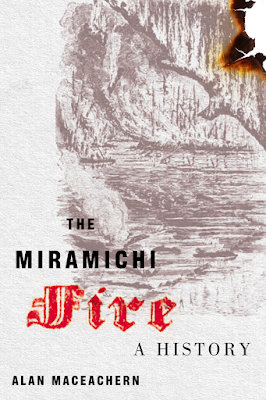
I was born and spent most of adult life inMiramichi. I have experienced the fear and anxiety of a nearby forest fire.Allan MacEachern’s book,“The Miramichi Fire”, is an excellent factual account of the 1825 events.Valerie Sherrard (a Miramichi author) wrote, “Three Million Acres of Flame “Itspeaks to the effects that fire had on the people of the region.
Tellus about your story.
“A Question of Faith” is based on theactual experience of John Jackson, the sexton of St. Paul’s Anglican Church andhis effort to save the church from destruction. As the flames advance, Johnstruggles to balance his dedication to his faith and his role as a father.
Whatdrew you to write the story?
Thepower of religion in the lives of some people interest me. And the lengths somefolks will go to give testimony to their faith. The evidence in this case isfound in the graveyard of St. Paul’s Cemetery.
Youare a novice writer in your seventies and have written two books. Will youcontinue to write?
“Stories From The River”chronicles my young life growing up in Miramichi, coming to accept andcelebrate being gay. “The Mill” describes the creation of the lumber empire ofthe Burchill family; a story of resilience and innovativeness covering 140years. My third book, “Christmas On The River” will be published in November.It includes some of my stories and real experiences of a few, relatives andneighbours including my ninety – eight-year-old aunt.
AQuestion of Faith
The Miramichi Fire
October 07, 1825 7:30am
Thedawn cracked like a scar on the cloudless sky. Dew lay miserly on the few remainingplants. It had been four months since rain had fallen. John Jackson tended to hisduties as Sexton of St. Paul's Anglican Church in Bushville. The small butdedicated congregation had erected the building in the Spring and Summer of1825. It sat prominently on a knoll close to the river. John was honoured whenhe was asked to oversee its maintenance and operation. He and his wife Ann hadlived in the Miramichi Valley for a decade. They had made the dangerous journeyfrom their native Scotland with two sons, William and Charles. The boys nowfifteen and thirteen were joined by three brothers and a sister (Margaret). Theperiod leading to and a year after the voyage from Edenborough had beenunseasonably cold with constant rain. The crops failed forcing the Jacksons andthousands of other Europeans to escape famine. A volcanic eruption on MountTambora, Indonesia the previous year had spread a layer of ash across theglobe, blocking out the sun for months. The memory of that uncertain period haddissolved with the promise of a brighter future for the young couple and theirchildren.
11:00am
John answered a loudrapping on the vestry door. A terror-stricken resident grabbed John’s coat andpulled him outside pointing wordlessly to the western horizon. The azure bluesky was erased by a coal black cloud thirty kilometers wide and towering kilometershigh. His first thoughts were the safety of Ann and the children. He raced totheir home and directed William and Charles to gather the bedding and soak it inthe river. He and the boys worked to place the wet materials on the wooden roof.Ann was busy distracting the younger children, while leading them to the cellar.He reasoned their stone house would not be a source of ignition. If the firejumped across the one quarter mile river, they would be secure in the earthen crawlway.
2:00 p.m.
Wordhad come from Nelson that Malcom's Chapel; the Catholic Church had beendestroyed. In a miraculous turn of events, the rest of the community wasspared. Several ships loaded with masts bound for England had been caught in arain of flame and were charred to their water lines. Like most Miramichiresidents, John Jackson had no experience with forest infernos. But he hadstudied the historical documents brought from congregants' homes to make achurch library.
Oneof the papers described previous incidents which occurred in the region. Herecalled with fear and some hope one of the characteristics of a big blaze.Crowning is a product of the firestorm. The superheated embers are carried atextended intervals often giving the perception that a structure has combustedspontaneously. Jackson prayed fervently that this phenomenon would spare himand his family. John looked across to Rosebank and Douglastown. He wept as hewitnessed a single sheet of flame nearing forty metres in height and kilometresin length bore down on the area. Across the half-kilometre distance, he heardthe shrieks of terror from man and beast as they sought a common refuge in thewater.
Johnbegan to realize that the Bushville side was not experiencing the worsteffects.
His thoughts turned tohow he might save his church. He ran the short distance to the church whereearlier he had placed buckets of water around and sheets provided byneighbours. He had placed a ladder high enough to gain access to the peak. Jacksonspent the remainder of the night laying the wet materials across the roof. Thevaliant effort worked and as the grey smoked filled dawn broke, he felt amoment of joy and triumph. As the black curtain diminished, John recognized afellow parishioner half stumbling up the wagon path from the direction ofJohn's home. His clothing was burnt and face blackened. His voice was strangledfrom acrid smoke as he told Jackson the unimaginable news that Ann and three oftheir beautiful children were dead.
October 08, 1825, 8:00am
JohnJackson looked over the site of his massive defeat. His lovely Ann and three oftheir children were gone forever. Trapped in their stone house, they suffocatedas the waves of flame stole any oxygen in the area. The remaining children hadbeen taken to a temporary hospital. The sound of the painful screams callingfor their mother reverberated in his head. Mercifully they later died fromtheir injuries.
Conversationswith his God, when he pondered risking the safety of family to save his Churchleft him wanting. Jackson died alone six months later in February 1826. Ann andher children are buried in the cemetery of St. Paul's Anglican Church, which standsintact today, a conflicted symbol of religious devotion and the recognition ofthe price one person had paid for it.
Conclusion
Statisticshelp explain the scope of the 1825 Miramichi fire. Sixteen thousand square km(6,000 sq. miles) of forest land was burned in an area extending approximately150 km (90 miles) northeast of Fredericton. The track of the fire moved toNewcastle, Douglastown Bartibogue on the west and Nelson, Bushville, Chathamand Napan to the east. One hundred and sixty people died. Nine hundred homesand structures were destroyed.
Overthe years, an idealized version of the recovery has become a legend. TheMiramichi is portrayed as a Phoenix, rising from the ashes, leading to there-emergence of a prosperous region. The truth is somewhere in the middle. Thetown of Newcastle suffered the most deaths and property loss followed closelyby the hamlet of Douglastown. The initial fear that 3,000 woodsmen spreadthroughout the Miramichi Valley had perished was proven unfounded.
In addition, there was a common belief thatthe maelstrom had consumed all the lands. That also was overstated. Crowningand spot fires leave sections of the forest untouched. A survey five yearsafter the fire concluded that a large portion of marketable timber remainedintact.
Thesenotations do not diminish the courage and determination of the Miramichi people.Many immigrants decided to remain and rebuild their independent communities andeventually their commitment to a united city over a century later. As time wenton, the population of the Miramichi Valley did not match the growth ofneighbouring counties but it gradually recovered. The export of solid whitepine masts to the British Navy dropped. That was a result of negative pressmore than a reduction in fibre availability. The vacuum was taken up as Britainexpanded its colonial possessions, needing more ships and supplies. And so, thelapse in exports was short term.
TheMiramichi region eventually assumed its place in the province of New Brunswickand the Confederation of Canada. The fire of October 7, 1825, has become afootnote of our history. The strength and determination of the people continueto grow.
NOTE: The author gratefully acknowledges AlanMacEachern's "The Miramichi Fire: A History" as a source document.
Thank you, Doug, for sharing the story and for being our guest.

A BIG thank you to all our visitors and readers.
Feel free to tell us what's on your mind.
Comment box below.
August 30, 2025
The Story Behind the Story with Author Alex Daggett of Quispamsis, New Brunswick, Canada.
Let’s welcome Alex to the Scribbler.

I had the pleasure of meeting Alex at the GMRD Book Fair lastApril when he shared a table with his author wife, Joanne.
He has kindly accepted our invitation to share the SBTS of hismemoir.
Joanne has been a guest on the Scribbler recently and if youmissed her post, please go HERE.
Read on, my friends.
Alex: I live in Quispamsis N.B. with my wife of thirty-eight years,Joanne. I have been involved with carpentry for close to forty years, and enjoybeing creative with what I build. I have three children and seven grandchildrenand I cherish each and every moment with them.
Title: Where Did My Son Go?

Synopsis:
Drugs, addiction, homelessness,mental illness and incarceration. These are not the words or wishes for anyparent for their children. My book comes from a father’s heart for my son andreflects on the past twenty year journey.
It covers many difficult topics in dealing with my son, his addictionand his out of control behaviour. I discuss many topics such as anger, grief,doubt, faith, boundaries, enabling, and depression.
It is a raw and vulnerable true story, told from a dad who, at times,doesn’t know what to do, where to turn for help, and even questions God and hisfaith.

Story Behind the Story:
My dad passed away on Good Fridayin 2023. He was a man I looked up to, took advice and wisdom from, who was allabout family. I loved him very much. This started a process of reflection of mydad, myself, and my son and his family.
I never planned on writing our story, which is mainly due to our son’sstory and journey, but in the early spring of 2024 I felt the call to write. Myheart was nudged to put pen to paper and share the details of what had become atwenty year battle. I have witnessed so many people, parents, siblings, andloved ones deal with drugs and addiction. I have seen firsthand what it does tofamilies.
I decided to start journaling, pondering the events and emotions of thepast twenty years. Soon a book began to take form. Opening up and sharing aboutmy family in an intimate way was a difficult and gut-wrenching experience.However, I knew I was committed to pouring it all out.
In writing this book Where Did My Son Go? my hope and prayer is that itwill help those who need to read the message. I pray it gives clarity to manyfamily members who face traumatic and confusing events when dealing with alost, struggling loved one.

Visit Alex’s Facebook page by going HERE.
Buy the book HERE.
Tell us about your writing habits,Alex.

Alex: My favorite spot to write is on our deck or at the kitchen table,both of which face the beautiful Kennebecasis River.
I am definitely a messy writer. Mywife has the long task of editing and typing out my messy scribbles on paper.
My beverage of choice whilewriting on the deck on a hot day would be a Diet Pepsi or a can of carbonatedflavoured water.
Thanks for sharing your story with us, Alex.
And for being our guest this week.
.jpg)
Thanks to all our visitors and readers.
Please feel free to leave us a comment.August 23, 2025
The Story Behind the Story with Mila Maxwell of New Brunswick, Canada.
It’sour pleasure to welcome Mila to the Scribbler.

Wediscovered her book online and she has kindly accepted our invitation to be ourguest.
Shewill tell you what it’s all about.
Readon my friends.
Mila Maxwell is an author from Clare,Nova Scotia, with a deep-rooted passion for storytelling and a love of theoutdoors. A proud French Acadian, Mila draws inspiration from both her culturalheritage and her adventurous lifestyle, which includes being a volunteerfirefighter. She lives in Sussex, New Brunswick with her husband Jeremy, sonBennett, and French Bulldogs Royce and Marlo. When not writing, you can findMila out in nature, at the gym, or helping others through her work in thecommunity.
Title: Finding Lady Baltimore

Synopsis:
Nestled in a quiet seaside village in Nova Scotia, Morgan has always feltovershadowed by her sister’s differences. She longs for a life unburdened bythe weight of expectations, sometimes wondering what it would be like to letthe powerful tides of the Bay of Fundy sweep her away. But when she stumblesupon a peculiar old suitcase, its unexpected contents shatter everything shethought she knew—about herself, her family, and the truths she’s been tooafraid to face.
As Morgan unravels the mystery hiddenwithin the suitcase, she is forced to confront her deepest fears and regrets.Along the way, she discovers that the things she once resented might hold thekey to a deeper understanding—not just of her sister, but of herself.
Set against the backdrop of an untamedcoastline, this poignant and suspenseful novel explores the complexities ofgrowing up alongside a sibling with disabilities. A story of love, guilt, andself-discovery, it will resonate with anyone who has ever struggled to findtheir place in a family shaped by differences. Whether you are a sibling, aparent, or simply someone who understands the delicate balance of love andlonging, Morgan’s journey is sure to stay with you long after the final page.

The Story Behind the Story:
My younger sister Sara has cerebral palsy and I always wonderedwhat being her was like. One night, as I was falling asleep, I got thissentence in myself that made me sit up and go “holy sh*t that’s a book!” Iwanted to tell my story of growing up alongside her and some of the strugglesI’ve faced, but I also wanted to share her perspective, as well as those of myparents. Not only the challenges we faced, both individually and as a family,but the gifts that also come with growing up alongside a sibling withdisabilities.
Website. Please go HERE.

Buy the book HERE.

A question before you go, Mila:
Scribbler: Tell us about your writing habits. Morning, late night, anytime? Music or solitude? What is your beverage of choice while writing?
Mila: I tried to be as consistent as possible with my writing. I found it easier to write earlier in the day, so as soon as my son would leave for school I would make a tea or coffee and sit down at my desk. Some days I was able to write for hours, missing lunch, and other days I would stare at the curser, barely writing a word. But I found consistency in those efforts, and small steps forward, well, really helped because I got a book out of it!

Thank you, Mila for being our featuredguest this week. We wish you continued success with your writing.
.jpg)
And another BIG thank you to all ourvisitors and readers. Please leave a comment below.
August 16, 2025
The Story Behind the Story with Author Joe Powers of New Brunswick, Canada.
Let’s welcome Joe back to theScribbler.

Always a popular guest, we are happyhe accepted our invitation to tell you about his new book. As a bonus, he’ssharing an excerpt.
If you missed his previous post,please go HERE.
Read on my friends.
Joe Powers is a Canadian horror writer, New Brunswick native, and long-time fan of all things scary. He's the author of Terror in High Water, Seventeen Skulls, Old Bones, and Putting Down Roots. His short stories have appeared in various anthologies and collections.
Among his many inspirations he lists Stephen King, Jack Ketchum, Michael Crichton, Vincent Price, Peter Benchley and Richard Matheson. He enjoys introducing the reader to flawed, believable characters and leading them on dark journeys with an unexpected twist. He isn’t afraid to mix and match genres, fearlessly weaving horror into noir, western, or sci fi.
Joe enjoys poking around in the dark recesses of nature, off the beaten path, chasing down old legends and new stories. In his spare time, he's an avid hockey fan and dog lover, and still finds time to teach several classes at UNB's College of Extended Learning.
Joe currently lives in Maugerville with his wife and fellow author, Sheryl, and a wide array of creatures. Follow Joe at www.joepowersauthor.com.
Title: Putting Down Roots

Synopsis: Matt and Rachel Bailey have uprooted theirfamily and moved across the country to a quiet college town in New Brunswick.Their new house is a beautiful old Victorian with a sprawling yard on a cornerlot in a nice suburban neighbourhood. Rachel’s got a great job at theuniversity, the kids are making new friends, and everything’s coming together.
There’sjust one problem.
Huddledin the far corner of the lot, just inside the high board fence that surroundsthe yard, stands an old, massive tree. The moss-covered branches hang low tothe ground, like skeletal hands reaching for those who wander too close. Thethick, gnarled roots ripple just below the surface of the ground like probingtentacles. Matt finds it creepy and unsettling and plans to remove it as soonas possible. But it won’t be that easy.
Beforelong, unease turns to terror as the true nature of the tree slowly begins tounravel. This is no mere tree, but an ancient evil presence that has preyed onunsuspecting animals and people for centuries.
Andgetting rid of it won’t be as easy as he thinks.
Withthe safety of his wife, two curious children, and the family dog at risk, Mattdoes everything he can to protect his family from the rooted predator thatlurks mere feet away from their back door. One false move, a step too close, isall it takes for tragedy to strike. And just how close to the house do theroots reach? Is anywhere safe?
Aftera close call that he narrowly escapes, and with the number of victims on therise, Matt must devise a plan to destroy the menacing evil before it destroyseverything he loves.

TheStory Behind the Story:
One day about tenyears ago I sat down and wrote a short story that I called Putting Down Roots.It was a quick little thing, born from a “what if?” idea I had about a treethat attacks and eats people. For the older crowd who may remember the Peanutscomic strips, the idea was a kind of spin on the kite-eating tree that used totorment Charlie Brown, only this one eats people instead of kites. It was a funlittle thing, but I was never quite happy with it. As time went by, I realizedthat was because it simply wasn’t finished – there was a lot more story totell. So I dusted it off and went to work. Gradually, characters came to life,the tension and suspense crept higher as the story took shape. It was closer towhat it was supposed to be, but still, I wasn’t satisfied. Stumped anddiscouraged, I put it aside once more.
More time wentby, other projects came and went, and all the while that insidious tree hauntedme, demanding I tell its story properly. So last fall, all these years later, Iwas ready to finish what I started. I relocated the story to the fictional townof Beaverbrook, which might sound familiar to those who have read my secondnovel, Seventeen Skulls. Unfortunately, my writing style and skill had changeda great deal in the time since the first draft’s inception, so I had toeffectively rewrite the entire thing from scratch. It was a long process, butit allowed me to get reacquainted with the story all over again and reminded meof what made me want to tell it in the first place. I have never in my lifetaken so long to finish writing something, but I’m pleased with the way itturned out, and very glad I stuck with it to the end.
Website: Please go HERE.

You can buy your copy HERE:
Scribbler: Where is your favourite spot to write? Are you messy or neat? Your beverage of choice?

Joe: I write portions of each book at various places. The concept notes can come together wherever I happen to be. My notes are a blur of frantic handwriting, nearly indecipherable until I transcribe them. Sometimes, when I’m at large and trying to work through something I’ll write in an email draft that I can later cut and paste into my document. Once I get settled and ready to begin writing in earnest, I split my time between writing on my laptop and writing freehand scenes or fragments that will be added later on. I frequently have an array of web pages open to whatever I’m researching at a given time, and notes scattered all around me. Sheryl is fond of telling me my approach to writing is odd and unorthodox, and I don’t necessarily disagree. My style is my style, it might not work for everyone but it seems to work for me.
I like to get comfy in my usual spot on the couch, dogs sprawled all around me, laptop at the ready, one of a few specific musical selections in the background, and a Rockstar energy drink close at hand. In terms of music, it varies depending on the tone of what I’m working on. I choose something familiar from a small selection of regular titles so it isn’t a distraction.
An Excerpt from Putting Down Roots

The afternoon sun had drifted across the sky, casting long,eerie shadows over the yard. He stared intently at the carnivorous tree from asclose as he dared to go. It simultaneously frightened and infuriated him, andtrying to come to terms with how to deal with it perplexed him. The worst thingwas that for the most part, it seemed deceptively serene, albeit frightening,and certainly appeared no more like a killer than any tree could be capable of.And the fact of the matter was he had yet to actually see it do anything otherthan stand there and look formidable, if somewhat dilapidated. Still, there wasno mistake about what had been going on since his family had moved into thehouse, and apparently, for much longer. He wondered how many pets had gone missingin the area. Or kids. The thought made him shiver.
The tree had to go. That much had become obvious. The trick,then, was to figure out the best way to destroy it once and for all. Itoccurred to him that maybe nobody had ever tried to kill it. Maybe, hereasoned, they had preferred to keep it around for its potentially usefulabilities. In the early days, when it had been used as a tool of justice, thatwould almost certainly have been the case. In the years since, it seemed tohave drifted from known entity to local legend, to all-but-forgotten folklore. Yetsurely somebody, at some point, must have tried. Revenge, perhaps, for thedeath of a loved one. For that matter, how it had escaped the destructive swathof developers for so long remained a mystery. Maybe they’ve tried. Itprobably eats landscapers, too. Maybe even city planners. It made his headswim to think of just how much carnage the tree had caused over the years.
He pondered his options while he stared and studied the detailsof the tree and examined the angles for the best possible point of access. Hewas vaguely aware of Crunchy’s muffled bark, a steady, agitated roop-roopfrom within the house, muffled by the glass door. He had no idea what the dogwanted and tried to push it out of his head and ignore it while he plotted. Heconsidered the possibility of an attack from one of the sides with an axe or,even better, a chainsaw. Could he do enough damage before it fought back? Heshivered as he recalled the stealthy attack on Shaw and doubted that wouldwork.
He started toward the shed, then turned back toward the houseonly to stop himself again in mid-stride. He paced out of nervousness andhabit, he realized, with no clue where to go or what he was trying toaccomplish. Is the knothole watching me? Can it see me? A disturbingthought occurred to him. Maybe that’s the eye of the beast that neversleeps, waiting for its next meal to wander too close. He paced severalfeet back and forth in front of the tree, his eyes locked on the hole, watchingfor any sign of recognition or cognizance. He realized how crazy his actionswould appear to anyone who happened to see him and almost turned back, but hejust couldn’t risk it. On the other hand, he reasoned, maybe it would be betterif the authorities were to deal with the tree. At least that way, ifsomeone gets eaten, it won’t be me. He gave a sharp cackle, somewhatsurprised at his ability to find humour despite the circumstances. It occurredto him that he might be losing his mind, that Shaw’s death may have been thelast straw that forced him over the edge.
The ground shifted violently, and the tree suddenly vanishedfrom his line of sight. His world was spinning, and he was falling backward. Helanded hard with a grunt almost before he even knew his feet had gone out fromunder him. So intent was he on solving the conundrum facing him that he hadfailed to notice the earth ripple beneath his feet, or the snaking root thathad broken the surface and latched onto its target. He gave a strangled cry andstruggled mightily to free himself, but unlike with that first encounter HerbShaw had experienced, there would be no narrow escape; the root was wrappedtightly around his foot, and he was held fast in a vice-like grip. He lookedaround frantically for any sign of someone who might help but saw nobody, heardnothing save for the faint creak of the root tightening its grip and the rustleof something much larger slithering just under the surface. With a groaningswoosh, one of the low-hanging branches reached around and ensnared him despitehis desperate resistance. He thrashed and fought like a man possessed but wassurrounded and forced to fend off attacks from all sides at once. He grabbed anearby limb with both hands and strained with all his might, to no avail. Itfelt like steel cables wrapped around his leg, reeling him in.
More branches had twisted themselves around his legs as he wasslowly drawn toward the sinister hole in its trunk with a steady and unyieldingforce. Most of his attention was drawn to the knothole that lay ahead; thoughit was mid-afternoon, not a hint of sunlight penetrated the murky depths of thebranches. The only illumination present was a faint green glow that emanatedfrom within the knothole itself.
I’m going to die, Matt thought bleakly. I am going to be dragged screaminginto that hole, which is far too small to accommodate me. The tree doesn’tcare, it will pull me through anyway. The pain is going to be horrible, andwhatever is left of me is going to get a really good look at what makes thisthing tick.
Thank you for taking the time to visit and read about my new novel.

Thank you Joe, for being our guest. We wish you continued success with your writing.
Thanks to all our visitors and readers.
I hope you’ll leave a comment below. We’d love to hear from you.
August 9, 2025
The Story Behind the Story with Author Jordan Buchanan of Northern Ontario, Canada.
Looking for the next new book?

Jordan and I connected through an mutual author friend.
He has kindly accepted our invitation to share the SBTS ofhis novel with you and he’s treating us to an excerpt.
Stick around!
I live off grid inNorthern Ontario on a beautiful lake near the City of Greater Sudbury. I beganwriting in College and University and tried my hand as editor of the CanadianAssociation of Police Polygraphists Journal for two years, I decided to try a careeras a novelist in my late 50’s after a 30 year career in policing. While apolice officer, I spent 18 of those years as a detective in the CriminalInvestigation Division working as an Intelligence Officer, GeneralInvestigations, Homicide, Sexual Assault Investigator, Forensic PolygraphExaminer and Major Case Manager.
Today I enjoy canoetrips, kayaking, SUP board, hiking, quadding, snowmobiling (I drive a trailgroomer on nightshift in the winters as a part time job now). I love to read,play guitar and write. It was always a lifelong passion to become a writer andwith publishing my first novel, I have reached that dream.
Title:

Synopsis:
DetectiveStaff Sergeant Enoch Brown’s life takes anunthinkable turn after a lightning strike during a solo canoe trip. When heawakens, he’s haunted by vivid,fragmented visions, memories that don’t belong to him.Desperate for answers, he turns to a psychiatrist who, through hypnosis,unlocks an astonishing discovery: Enoch has inherited “echo memories,”vivid recollections passed down from his parents and grandparents, all of whomwere police officers in Sudbury, Ontario.
Each echo memory opens awindow into unsolved cases from his family’spast, stretching across a century of policing. Driven by a deep sense ofjustice, and the unshakable connection to his family’slegacy, Enoch reopens these long-cold cases. Using cutting-edge forensictechniques and modern investigative methods, he uncovers truths hispredecessors could never have imagined, solving crimes that have lingered inthe shadows for decades.
This novel masterfullyweaves a heartfelt exploration of family legacy with the evolution of lawenforcement, from horseback patrols to high-tech crime labs. Past Ghosts Echoedis a deeply human story of memory, duty, and the enduring pursuit of truth thatbridges generations.

TheStory Behind the Story:
I spent 10 years thinkingabout the story. I was trying to find a way of tying historical periods ofpolicing in the Sudbury area. I also wanted to write what I knew about policingtoday. I came upon the idea of “echo memories”, something I invented for thenovel. I give theories and elude to concepts of how these “echo memories”, ofthe main character’s parents and grandfathers who were all police officers,came about. In the end, the reader can decide which theory they believe.
I did about a year ofresearch into the various time periods of policing. I spent time outlining thebook and having what I call idea noodles, small notes of things that might goin the book. I sat down to write the book in about 4 months. It then took another5 months for editing, polishing and publishing.
The locations and policeprocedures are real. The cases are fictionalized but are based on real cases inSudbury. The modern forensics and policing techniques I used are all ones thatI used in my policing career.
The novel is a historicalnovel, police procedural, thriller and mystery. I like to place it in the realmof what I call Maple Leaf Noir. A genre of Canadian noir novels like TartanNoir and Nordic Noir. I hope the audience will be international but I am happyto see it reach Canadians who may relate to it.
Website: Please go HERE.

Buy it HERE.
Scribbler: Tell us about your writing habits, Jordan. Morning, late night, anytime? Music or solitude? What is your beverage of choice while writing.?

Jordan: Forwriting, I have two offices for summer and winter. Both are unique spacessurrounded by books and music. An office in my home and one in a large shed(10’ x 16’) I call my pod. I also enjoy writing in coffee shops and at variouslibraries.
I like to write in themorning and early afternoon with a cup of coffee, of course.
I am very messy with pilesof papers of scribbled ideas. It matches my thinking which is scattered. I havethe uncanny ability to reach into any pile and pull out exactly what I amlooking for and need.
I love to outline my storiesfirst, giving me a template that I do not religiously follow but more meanderas though walking beside a stream changing things as I find something moreinteresting on my journey.
An Excerpt from : Past Ghosts Echoed

“My name is Jane McDonald, Iam a police woman with Sudbury Regional Police. I was an OPP officer but Ichanged jobs in 1973 when the Sudbury Regional Police was formed. I recentlyjoined the Grubbies really known as the Old Clothes Detail (OCD). I was partneredwith another officer and they still considered this my training. I would stayfor 2 or 3 years then back to Uniform. I would sometimes work with other Unitslike the Intelligence Branch and the Drug Unit. We sometimes even worked withthe RCMP and OPP.
I was working an afternoonshift from 4 pm to 2 am with my partner and 2 Morality Squad detectives doingbar checks. Looking for underage drinkers, people smoking and selling drugs,checking licenses and capacity numbers for the fire department. A call cameover the radio of shots fired on Durham Street downtown. We were on LisgarStreet heading up the alley toward Durham Street when I saw someone crawlingaround the corner. It was a guy I had arrested a few weeks before selling weed.He had blood on his leg and hands. He was fast crawling like an alligator forhis life.
As we got closer I saw hehad nothing in his hands. My partner was driving so I jumped out drawing my .38Smith and Wesson Chief snub nose revolver. I ordered him to stop. He yelled atme, “Theyfuckin’ shot me. Help.”
“Isaid to stop. Don’t move. Let me seeyour hands.”
My partner called for anambulance and a Sergeant to attend the scene. I passed the wounded druggie andpeeked around the corner toward the Coulson Hotel. I saw no one on the streetand no vehicles.
“Heystop crying,” My partner told the guy. “Who shot you?”
“Idon’t know,” he replied. “Butit was two guys and they left on foot toward Minto. I ran around the cornerthen fell down and crawled to the alley. I never saw them before and I can’t describe them.”
A likely story.
He was Tony Vincent, date ofbirth August 12, 1954. Currently on charges for trafficking for selling me weedin the Ledo Hotel bar. He had a criminal record or CNI (Criminal Name Index)under CPIC for break and enter, theft and drugs. A stellar citizen to be sure.My partner, Joe MacDonald, used Tony’s t-shirt to stanchthe blood on his wound. Tony was crying and appeared to be in shock. Joe gaveout on the radio what little description we had and suggested since we camefrom Lisgar that they either ran all the way up Cedar Street or more likelyinto Memorial Park which was dark and not well lit. Uniform units attendedthere.
I stayed at the corner ofthe alley with my gun out to cover my partner and the victim in case theshooters returned.
“HeyMick, you have quite the maternal instinct there,” said the Sergeant as hepulled up in his marked station wagon Sergeant’svehicle with his window down smoking a cigarette. My short time as a Grubbieworking with Joe has led to us both getting new nicknames that stuck. McDonaldand MacDonald. They called us Mick and Mack. Too cute. I wanted to barf but youdon’t get to pick yournickname when you’re a cop.
I said, “Withrespect Sarge, fuck you.”
“Haha.You’re too much Mick. Theambulance is coming. I’ll have a car go tothe General Hospital or Memorial Hospital as soon as they tell us whichEmergency Room they’re heading too,” theSergeant responded.
“It’s 10 pm. Memorial stops taking newpatients and closes their Emergency Room at midnight,” I replied.
“Wellthey can tell us anyway before I send a cruiser.”
“Speakingof time, pretty quiet for this time of night here. Like everybody left beforewe got here,” said Mack.
I winced at what he said. “Whythe fuck would you say the Q word?”
Sheepishly, my partnerlooked at me saying, “SorryMick.”
Now we were jinxed for therest of the shift. No good ever came from the Q word in any context. I justshook my head. Mack and I had been cops the same amount of time but all histime was with City of Sudbury Police and when they became Sudbury Regional PoliceForce, he became a Grubbie. So he had two years on me in Old Clothes and wastraining me. We worked well together and got along great.
He also knew my secret. Iwas seeing a Detective in CID.
Jordan: Thank you for your consideration of my new novel “PastGhosts Echoed”. The main character, Enoch Brown, will return in my second novelthat takes place in New York, 2002, in the aftermath of 9/11 working with theNYPD to catch a serial rapist and serial killer.

Thank you to all our visitorsand readers.
Feel free to leave a commentbelow.
We’d love to hearfrom you.August 2, 2025
The Story Behind the Story with Lise Mayne of Alberta, Canada.
Another guest who is new to the Scribbler.

Lise was introduced to me by another author wholives in western Canada. She has kindly agreed to share the STBS with you and adds an excerpt for your reading pleasure.
Lise Mayne, author, lives in Nanton, Alberta, Canada. Historical injustice and the search for home are central themes of her work. Her new novel Time Enough, Oprelle Publications, 2024, is the migration saga of a family from Isle of Man to Canada via Michigan in the early 1900’s. An excerpt was published by Sunspot Literary Journal in the Rigel 2022 contest. Lise’s poetry is published in international literary journals, nominated for five awards. A member of The Writers’ Union of Canada, The League of Canadian Poets and the Alexandra Writers’ Society, Lise also volunteers as a Rocky Mountain bluebird nest-box monitor, plays the harp, and cherishes her family.
Title: Time Enough

Synopsis:
In the early 1900’s, a Manx family of miners subsists on a small-hold farm; their lives are stable, steeped in routines, love and faery lore, but they are on the verge of ruin. The young family must leave forever, in search of a new life. How will a mother of six, Euphemia, and her eldest son, Henry, make a home in a totally unfamiliar place? William’s younger brother, Thomas, posts their bond for emigration to Michigan. Euphemia suspects her first lover has ulterior motives and that he will destroy her. Henry, almost a man, longs to remain and save their land. No matter. They must go. Too late, they discover they are trapped. Euphemia and Henry together and separately, must struggle to surmount betrayal, abuse and heartbreak. On a three-decade journey from Isle of Man to Saskatchewan, via Michigan and Manitoulin Island, we are immersed in this moving saga of Euphemia and Henry’s fight for independence. A sweeping novel about sacrifice, courage and the unexpected rewards of risk and resilience. Can forgiveness restore love and bring hope? Is there time to heal the past and build a future?
The Story Behind the Story:
As a child, I lookedforward to Saturday visits with my maternal grandparents, enraptured by theirstories of homesteading in Alberta and Saskatchewan. Starting from scratch inthe wilderness seemed like an adventure to me, even though they didn't gloss overthe hardship and sacrifice. They taught me about kindness, hard work andcreativity, to save every scrap, grow and preserve food, how to make somethingout of nothing. The house was filled from attic to dirt basement with oldstuff. Grandma used a wood stove and wringer washer. Grandpa would show me hiscollection of arrowheads, gathered during the first ploughing on his quartersection. He said these points represented the people who'd come before, whom headmired for their ability to survive on the open prairies. All this was foodfor my imagination.
I believed all mygrandparents, pioneers on both sides, weren’t "ordinary" people, as Isaw everyone else. They'd been so brave, intrepid and dedicated to a dreambigger than themselves. Offered a chance at a better life, they took a huge riskand set off into the unknown. I could only imagine what they went through. So Idid.
Time Enough was a ten-yearendeavour of research, genealogy, travel and constant writing. I discoveredthat my grandfather, although we knew he was of Manx descent, was born inMichigan. As I learned more about where my maternal ancestors originated, bothon Isle of Man and Manitoulin Island, I began to create a fictional story ofimmigration to Canada. The ending, however, was told to me by my grandmotherwhen I was a child, and was my first inspiration. The heartbreaking story ofleaving the homestead in the Great Depression kept me going, all those years. Iwrote my way backwards, into what might have been the beginning. I believe manypeople, even today, can relate to losing everything, and being forced to setout on a new path, as many of our ancestors did. Learning about their courageand resilience can bring us understanding and hope.
Website:Please go HERE.

Buy it HERE.
Scribbler: Where is your favourite spot to write? Are you messy or neat? Your beverage of choice?
Lise: While working on the novel, I wrote at my dining room table, very early in the morning. I journal every day, trying to catch the blue hour before sunrise, to get my writing juices flowing. For ten years, I inhabited the world I was creating from about 6:30 to 10:00, most weekdays. Coffee was always on the go, usually ending up ice cold, as I became immersed in my work. Now that the book is published, I tend to share morning coffee-time with my husband, a luxury after so many years of focussed work. A lot of time is now devoted to marketing and networking, which is an important aspect of the writing life. I continue to work on a chapbook of poetry, which I will get back to. There’s always “time enough,” I’ve come to learn.
Excerpt from Chapter One, Time Enough
(Place: Isle of Man, May, 1904: A grandmother and her daughter-in-law are sitting side-by-side on Faery Hill, presenting the daily offering to the faeries, as is customary amongst the Manx people. The grandmother, Nan, shares the secret that she has asked her son in America to rescue the family from disaster.)
“Whatever do you mean, Nan?” Her tone harkened back to fifteen years ago. Is she sinking into depression again, after all this time? Oh no. “You’re here, Nan. We’re all here. Our Henry’s learning from you; the others will too. There’s no rush. Don’t you always say there’s time enough: traa dy liooar, is it? I’ve learned that much, you all say it so often.” She attempted a laugh. Please, please let me bring her out of it, like I did before.
Nan patted her hand.“Well done, my chree. You’ve an ear for Manx.” Then she shook her head. “I’m sorry to say, there is no more time.” Her muffled voice dropped the words into her lap. She pounded her fistagainst her thigh, then raised her head to meet Euphemia’s gaze. Suddenly it seemed the birds fell silent and the wind droppedto earth. Whatever can she mean? She seems angry, and sad, both.
Nan inhaled, as ifpreparing to push a boat into the water. “The Little Ones had something important to say, t’other night. Terrible news, I’m afraid, my chree. Themselves said someone in the house will pass over. Soon. “Goll sheese ny liargagh: he’s going down the slope, fast.” Didn’t need them to tell me that. I know it. As do you.”
“Know what?” A roar like crashing waves on the sea blocked her ears against Nan'sshaky voice.
“Please, we must be honest and face facts, dear one. I’ve suspected since New Year’s morn. Saw it plain as day, in he ashes from the chiollagh, which I spread on the floor, to foretell the year ahead, ye ken,according to the old ways. The faery footprints led out the door, not in. Luckhas left our house.” Nan paused and looked past the cliffs, breathing harder than she hadafter mounting the hill.
The ominous tonetempted Euphemia to laugh. Nan seemed to sense her doubt. “I didn’t want to believe it, either; I’ve watched for the signs and now I’m sure. William’s been poisoned, by the lead mine. We call it “the milk reek,” my chree. The sweats, the shakes, and especially the ill temper, so unlike myboy. He’s getting worse every day. Goll sheese ny liargagh.”
Euphemia’s lips parted, but the protest caught in her throat, as if clogged withashes from the hearth. She collapsed backward, nearly overturning the littlecups. Nan lifted her head and held the cool flask to her lips.
“Drink a bit, lass.”
Euphemia jerked upright, grabbed the flask, and gulped. She coughed and wiped her mouthwith the back of her hand.
“It can’t be,” she said, sputtering. As she tipped the flask back again, whisperswhirled around her. “Yes, yes, it is. Yes, it is. Yes, it is.” The hair rose on her arms. Her head swam. Tears stung behind her eyesbut wouldn’t fall.
“Aye, doesn’t bear thinking about, my chree, I know. I tried to pretend, too. I’ve seen you do the same, seen the worry at you, when William coughs, orshouts at the boys. It’s not him. It’s the sickness, my chree. Oh God, the loss of another son to those damned mines.” She hit her thighs, as if hurting herself could ease her pain. Euphemiarecognized that impulse. “So many families torn apart. So many wid—” A sob completed the awful word.
True. Eva, Mary,Amy, others whose names she didn’t know, gone away, forced to find work in English factories after theirhusbands’ passing, their children left with kinfolk, or orphaned. If anything happens to William, could I leave my five youngsters,least of all my newborn babe? To be raised by their grandparents, who mightn’t live long enough to see them grown? Now tears and milk spilled freely. My milk will be spoiled tonight, curdled. Hugh will get the colic andnot sleep….
“Shh. There, there, I’ve a solution.” Nan’s voice brightened as she expelled one word: “Thomas.” Euphemia thought she detected a note of excitement, where usually Nansounded disappointed, even angry, when mentioning her youngest surviving son…
“And now, why, the mine’s killing my William. Well, not if Themselves and I can help it.” Her voice retrieved its headstrong tone. “Thomas brought me a daughter, and you’ve given us grandchildren. He’ll do his duty again, you’ll see. I’m awaiting his answer.”
“No, no, please, Nan—” The last thing she wanted was Thomas to return. Well, there could beone worse thing. She fell back on the ground, damp seeping into her clothes.She yanked at the grass with clenched fists.
“Come, lass, the dew’s falling. You’ll catch your death. We’d best get back or they’ll think we’ve been fetched away. Not a word to William, mind. I’m prepared for a battle with him. Quick, there’s the first star. Help me up,” she said, patting Euphemia’s knees.
“We mustn’t be caught here after sunset or the Red Caps will take us, sure. The way down is much easier. I can almost run, likea young girl. Ah, was, was,” Nan expressed her customary wistfulness for times past. “Here’s the basket, my chree. Let’s see who gets home first.”

Buy it HERE.
I hope you’ll leave a comment below. We’d love to hear from you.
July 26, 2025
The Story Behind the Story with S.D. Miller of Nova Scotia, Canada.
Let’s welcome another newcomer to theScribbler.

Scott’s stories are sure to please. He was introduced to the Scribbler by one of our popular guests and weare happy to have him join us this week.
Read on my friends.
S.D. Miller is an author and educator from Nova Scotia, Canada. Hisnon-fiction writing has been featured in EdSurge and his debut novel, NekonikonPunk: Ctrl Break garnered critical acclaim, winning Best Sci/fi ActionAdventure of 2024 from Indies Today. His stories balance action and socialcommentary inviting readers to explore technology, power, and resistance.
Title: Nekonikon Punk Trilogy

Synopsis:
Nekonikon Punk is a near-future science fiction series where corporations formed townships that ended up seceding from the USA, establishing their own city-states along the Pacific coast. When originally forming the townships, people were promised jobs, comfortable homes, and a good quality of life, so they flocked there in response to the cost-of-living crisis. However, after a war called The Great Secession, these city-states became increasingly authoritarian as they competed with each other, and within their own territories, for ever more power. Nekonikon is one such city-state.
The story picks up long after the war is over and Nekonikon is established. The main character is a young guard-in-training named Juan who wants nothing more than to protect what he holds dear. As graduation nears he is exposed more and more to the corruption of his home and finds himself sympathizing with the oppressed, especially a rebel punk band known as Corpslayer.
From there we launch into a fast-paced adventure, following a colourful cast of characters with competing philosophies on morality, power, and personhood.

TheStory Behind the Story:
Anger andfrustration at our current world order.
Ha ha, it’s true!I find it frustrating to see how the middle class has dissolved over the past40 years, and there is an ever-increasing wealth gap between the haves andhave-nots. I’m not against people being wealthy, but there is no excuse for aperson to have more money than their grandchildren could ever spend existing inthe same world where children die every day of malnutrition. Of course this hasalways been the case to a degree, but with the post-COVID cost-of-living crisiswe are facing worse conditions than any time in my memory. Canadians arecarrying more personal debt than ever before just trying to make ends meet andfood banks across the country are struggling to keep up with demand. This is heading nowhere good.
As an educator, Iworry about young people and wonder what their futures will look like. And,when I’m honest with myself, I don’t see things getting better for them. Howwill they ever afford a home? What will the climate be like? Who will pay fortheir social assistance when they are older?
The more I thinkabout it, the more my scenario of corporations sweeping in and creatingold-fashioned townships seems inevitable. It’s not hard to imagine some techbros deciding that they know better how to run a society than electedgovernments. So, they invest their money (which is more than some nations have)and establish their own working towns, providing people with homes and jobs.Then slowly, as costs rise, they creep back the benefits ever more or requiremore of your personal information in order to continue living there. They wouldeventually tire of paying taxes to state and national governments who they seeas doing nothing but interfering with their prosperity. A secession movementalso seems likely, and it would be supported by their loyal denizens.
Power corruptsand eventually these places would morph into authoritarian states. Once I hadthis history in my head, I decided it would be a great jumping off point tocreate a narrative about resistance and the importance of freedom andself-determination.
I chose cyberpunkas a genre because it hit a number of themes I wanted to explore. For example,one of the main characters is an aboriginal woman calling herself Penny Fame.For her, the battle didn’t begin with the Great Secession, it began with the colonialsettlers taking her people’s land in the 1850s in the Rogue River Wars. Sherefuses to acknowledge Nekonikon as a legitimate state and refers to it as theoriginal pronunciation Necanicum. The idea of history echoing itself is one ofthe themes and we can see through Penny how colonial patterns are not all thatdifferent from capitalist patterns.
The NekonikonPunk series needs to be three books because ultimately I have a hopeful messageI want to convey. But to get there, I need to take the reader through thedystopian realities of such a system in order to arrive at what I think is anoptimistic vision of the future. Books one and two are finished, and I hope tohave the third book finished by next spring. I also have plans to write aprequel called “The Great Secession” once the trilogy is complete.

Website: Please go HERE.
Scribbler:

Where is your favourite spot to write? – At my desk in the basement. No one bothers me except my cat, and it allows for long periods of focus once I’m in the zone.
Are you messy or neat?- Very neat.
Your beverage of choice?- black coffee in the AM, water in the afternoon, Forty Creek whiskey for the nights.
An Excerpt from Nekonikon Punk: Ctrl+Break: A conversation between Penny and Juan:

“So why bother?You told me sometimes you don’t even do it for payment.”
Looking down ather drink, Penny gave a rueful chuckle. “Yeah, Mela hates it when we do that.”She finished her Tecumtum’s Revenge in a gulp. Nodding to his empty glass,“Another?”
“One more…if youanswer my question.”
She was silentfor a few seconds, then pointed to her RRW tattoo. “You know what this standsfor? Rogue River Warrior. You know what that is?
“Ahh, no. Ican’t say I do.” Something about her tone made his chest tighten.
She stood,walked to the other side of the bar, and started fixing the drinks, “It’s wheremy people are from, south of here. Many generations ago, the Americans spreadfurther and further west, eventually settling all around these parts.” Shepaused, staring blankly into the glass. “When they found gold in the mountains,they decided it was worth more than my ancestors.”
“What happened?”His chest was tighter.
“What alwayshappens.” She slid him his drink and cupped her own in her hands looking downat it as she spoke. “My people fought, held out in the mountains for quite sometime, but the industrial machines of colonialism wore them down. The earthwent bad.”
She looked upfrom her glass, “Do you know that I can’t even tell you exactly which peoplewere my ancestors? Too many groups were moved together to an areafurther north. The people jumbled together, over the years we lost our land,our languages…” she met his eyes, “…our history.”
“Penny, I…” Shehad struck a chord deep within his chest. He didn’t have the words.
“I know. It’sOK, we’re good.” She sat next to him and patted his leg. “If we weren’t good, Iwouldn’t bother telling you this.” She looked him in the eye and smiled beforelooking back down at her glass. “You asked why we bother. Because it’s the sametoday. The Americans displaced my people, moved us to a region useless to them.Then when they wanted that land, they moved us again and again, further north.”Anger rose in her voice. “Eventually they stopped, but only because themegacorps wanted the land.” She looked at Juan, this time with steel in hereyes, “Necanicum was my home first…” She pointed to her RRW tattoo, “…and I’llbe damned if they move me without a fight.”
Juan nodded. Hereflected on one of Wagner’s lessons, “The state monopoly on violence.”
Penny’s interestpiqued, “You’ve read Weber?”
Confused, Juanshook his head, “Who? No, just what you said made me think about one ofWagner’s lessons. That the state’s monopoly on violence was the greatest moderninvention.”
“You might besurprised, but I don’t entirely disagree.” Her demeanor changed, she was livelyand engaged. “A legitimate state should have a monopoly on violence. It gets usaway from family blood feuds, revenge killings, all that kind of stuff.”
“Never thoughtI’d get you to agree with Wagner.”
“I agree withWeber, who actually created that argument. Not Wagner who uses it forpropaganda.” She sipped and took Juan’s silence as an invitation to elaborate.“Nekonikon is not a legitimate state. The Five are essentially figureheadscontrolled by dictatorial megacorps. They exist to hold us down– you included–for their own benefit. All the while, they hand out scraps and feed lies totheir faithful. Those of us who aren’t loyal end up here in the Row. And Idon’t need to tell you how their guards treat us down here, do I?”
Juan’s faceflushed with shame. He had seen it with his own eyes. Participated in it withhis own fists.
Noting hisreaction, Penny gave him some time to think before continuing, “You ever hearof the veil of ignorance?”
“Ahem, ah nope.I don’t think so.”
“It’s a thoughtexperiment. One that helps a person envision an ideal society. It asks you tothink of a world in which you would want to live. But there’s a catch. You haveto envision the society with ignorance as to what role you will have in thatworld. Maybe you will be a CEO, maybe a prisoner in a jail, maybe a guard inthe security force, or maybe even a punk rocker. With that veil of ignorance,would you create Nekonikon or something different?”
Juan didn’tanswer. He didn’t have to. They sat in silence as they finished their drinks.
After some time,Penny patted his leg again, “You should sleep here. Tred and Kara will havetheir patterns ready in the morning and then we can continue our training. Thecouch in the green room is all yours.”
“Thanks Penny.”He remained seated as she stood up and made her way to the back rooms, haltinghalfway when he called out, “Penny?”
Looking over hershoulder, “Yeah Juan?”
“Umm, I-I’msorry. I didn’t know.”
She nodded toherself. “I know. I see you.”
His eyes welledup, “Goodnight.”
“GoodnightJuan.”
Buy it HERE.

Thank you for sharing that intriguing excerpt and for being our guest. We wish you the best of luck and success with your writing.
And another BIG thank you to all our visitors and readers.
July 19, 2025
The Story behind the Story with Author Eve Koguce of Latvia, Europe.
Let’swelcome Eve back to the Scribbler!

I’ve hadthe chance to read Eve’s work and she is a talented author with captivatingstories.
She’s beenfeatured here before and if you missed her visit, please go HERE.
Read on myfriends.
I’ve been blessed to be born in the best placeon the planet. My hometown, Jurmala in Latvia, is a seaside town on the coastof the Baltic Sea with an endless sandy beach. Riga, the capital of Latvia, isa city rich with history and extraordinary architecture. Riga has the largestnumber of splendid Art Nouveau buildings in the world. After quitting myrelatively successful career as a civil servant in a vibrant field ofinternationally funded cooperation projects, I dedicated my life to my familyand writing. Since then, as an independently published author, I’ve publishedsix books: a high-concept fantasy trilogy, two novels set in Latvia (crime noirand coming-of-age), as well as a women’s fiction book set in the UnitedKingdom.
Title: “Broken Chances”

Synopsis:
A young wife. A much older husband. Is it only the age gap that threatens to ruin their marriage?
When Margo marries Michael, she believes that her life will change forever. And it really does, only not in the way a young girl from a small country in Northern Europe thought it would.
Latvia, a dreamy land with rich historical heritage and endless beaches stretching for miles, for Margo, is a gloomy place where she would have to struggle for years to have a decent life. All she knows is her hometown – a depressing place built for the needs of the factory workers – dull commuting to the capital Riga, and a bar in the Old Town where she works, always full of loud and often unceremonious tourists.
Skipping a chance to explore her home country and the opportunities it might offer, Margo accepts Michael’s proposal and moves to a dramatically picturesque island in England.
A small, tightly-knit community, where everyone knows everyone and where nothing ever happens, is not particularly welcoming to a newcomer. Unfamiliar with local traditions and quirks, Margo often finds herself in awkward situations. Still, with each walk she takes along the coastal path on the small island she now calls home, Margo falls deeper in love with the stunning landscapes of the Jurassic Coast in Dorset. Alas, with each day she spends with Michael, she realises more clearly that her marriage is falling apart.
Margo keeps asking herself why what she thought was a chance of a lifetime turned into a disaster. Will she find the answer? And will she love again after having been bitterly disappointed in marriage and relationships?
Set against the backdrop of breathtaking landscapes of the Jurassic Coast in Dorset, England, “Broken Chances” is a self-discovery journey with a dash of cosy mystery and clean romance.
P.S. Expect to be smitten by charming dogs and majestic horses.
Literary awards:
* Finalist award in the Pacific Book Awards contest 2025 / Best Women’s Fiction category;
* 3rd place winner in the DBT Literary Awards contest 2024 / Fiction category;
* Finalist award in the Global Book Awards 2024 / Contemporary Fiction category.

TheStory Behind the Story:
“Broken Chances” is set in beautiful Dorset in the United Kingdom, on the fictional island of Southbay. I’ve chosen this setting for a reason. I spent a couple of years living in the region, and, like Margo does in the book, fell in love with the Isle of Portland, where my office was located and the magnificent Jurassic Coast.During the time I lived in the UK, my lack of knowledge of local customs got me into some awkward situations. So, writing “Broken Chances” was a great chance to share these funny stories. When you read an episode where Margo has no idea she is walking straight into the trap by saying the most innocent thing, please know that it was actually I who had to blush and feel like an ignorant foreigner.
I met many wonderful people while living in Dorset. Before moving there, I’d heard that people in Western countries generally keep to their own business and do not show much interest in other people’s lives. Instead, I found kindness, support, and a genuine wish to get to know me despite the cultural differences. People were open and did not hesitate to help me, even when I did not ask for it. I wanted to share this experience through a book, and that is why you will meet a bunch of secondary characters in “Broken Chances” who play a significant role in Margo’s life.
“Broken Chances” is a story about a woman struggling in a marriage that turns out not the way she thought it would be when accepting a man’s proposal. In books and movies, we are usually presented with an exaggerated version of such situations. I wanted to show that domestic violence isn’t always about broken bones and apparent bruises. In real life, we often don’t see any visible marks on the people who suffer from mistreatment by their family members. It is also because those with oppressive personalities aren’t always prone to use physical cruelty. A lot of people who ‘feed’ on diminishing others and making them feel inferior, prefer more subtle methods, such as emotional pressure, which, stripping the victims of self-respect and confidence in their abilities, tie them to the aggressor.
Through “Broken Chances”, I have shared my admiration for the unique part of the world, the memories of which I still cherish, even after the two decades that have passed since the days when I called beautiful Dorset my home.
Website: Please go HERE.

A question before you go, Eve:
Scribbler: Where do you draw creative energy from?
Eve: For as long as I can remember myself, stories written on the pages fascinated me. I loved listening to my parents read to me before bedtime. I loved nothing better than reading a book after school and before I had to leave for the music school. Spending time with fictional characters – the ones created by others and of my own imagination – always held more allure to me than running about with my friends. So, I’d say that generating creative energy is a natural part of who I am. Still, any energy needs a source of nourishment and replenishment. It really is motivating that my husband and my son are my greatest supporters. Some days, I can be grumpy and distracted, and it is enough for them if I say, ‘My characters won’t stop talking, so, sorry guys, I have to listen to them and not to you today.’ They don’t tell me that I must always put them first and write only when they don’t need me, in the wee hours of the morning or after everyone is asleep.
I always feel refreshed and ready to continue writing the story I work on at the moment after a long walk along the beach or in the forest. I am lucky to have both literally on my doorstep.
An Excerpt from “Broken Chances”

During our meetingsbefore we got married, even the look in his grey eyes was different. He lookedat me with warmth and treated everyone, including waiters in the restaurants hetook me to, with a fatherly kindness. Benevolence and content emanated fromhim. Now I know that the things that drew me to him weren’t his natural traits.They came in a package with the king of the world role. After he lostit, I found myself married to the man who Michael Birkett actually wasunderneath those layers of gloss. A man whom I wouldn’t have married, orfollowed thousands of miles from everything I knew and loved, if I’d seen thetruth of him before I’d said yes.
I stare at Michael ashe’s changing into his casual clothes. It is difficult to gather the courage toask him even the simplest question. I’ve learned what usually triggers him intosnapping at me. Still, I’m not sure I’ve discovered all the ways to displeasehim.
“Should I change intojeans then?” I finally ask, touching my dress. I stopped wearing dresses afterSuzie asked me if it was my birthday when I came to her café dressed in a jeansskirt. The dress I put on for the funeral today is a simple black sheath midiaffair that I bought on sale in Topshop in Eastpoole. It cost ten pounds butlooks like it belongs on a catwalk. It’s not too form-fitting, and I feelconfident in it.
My husband gives me afleeting glance. I haven’t heard a compliment from him since our wedding. “No,leave it on. George is used to the women around him looking like Moulin Rougedancers.”
I almost dash to thewardrobe, but then we hear the car horn. “Let’s go.” Michael leaves the room,having not cast a look my way.

Buy it HERE.
This story sounds like one I need to have a look at.
Thanks for being our guest this week, Eve. We wish you continued success with your writing.
.jpg)
And a special thank you to all our visitors and readers.
July 12, 2025
The Story Behind the Story with Author Erika LeClair of New Brunswick, Canada.
A new author for you to discover.

I met Erika at the recent GMRD Book Fair last Spring where she was an eager participant.
She has kindly accepted my invitationto be our guest this week.
Her novel has received rave reviewsand she’s going to tell us about it.
Read on my friends.
Erika LeClair is a dystopian science fiction author and editor fromFredericton, New Brunswick, where she lives with her husband and cat. When sheisn’t working on her next book, Erika often spends her time reading horror,science fiction, and fantasy. Her debut novel, The Quarantine Drift, wasreleased in 2022, with a sequel on the way.
Title: The Quarantine Drift

Synopsis:
Sixteen years ago, an alien ship crashed into Carina Linderoth’s home.
Sixteen years ago, she saw her twin sister for the last time.
Since that night, Carina has spent every waking moment searching for answers. What happened to her sister? Why did the aliens take Sonja and not her? And why do people keep telling her she never had a twin sister—that Sonja isn’t real?
Now, sixteen years later, Carina is approached by a mysterious genetic research company. They want her to work on a top-secret project, genetically engineering the human race with Eluridan—alien—DNA.
For any geneticist, it’s the opportunity of a lifetime.
For Carina, it’s something more.
This is her chance to return to Mount Desert Island, the scene of the crash, home to the stranded aliens. Back to the place where this all began. This is her chance to finally learn what happened to her sister.
If Sonja ever existed.

TheStory Behind the Story:
When I first hadthe idea for The Quarantine Drift, I was studying biology at UNB anddrawing a ton of inspiration from my classes. Everything was so interesting,and I couldn’t help thinking of ways I could use what I was learning in astory. In my third year, I latched on to an idea I felt good about. I knew Iwanted a dystopian setting, something dark and spooky and gory and set here onEarth, but with a more flexible, imaginative element—like aliens—that I couldhave fun with. Studying environmental sciences can give you a bit of a bleakoutlook on the future, so that naturally wormed its way into the premise in theform of a global water crisis. I’m also a sucker for characters with heaps ofemotional baggage (sorry, Carina), so that was an inevitability. That was alsothe year I joined my first writing group, which changed everything. Sharing mywork and exchanging feedback with other writers finally broke my cycle ofstarting projects and not knowing how to finish them. It also gave me theperspective I needed to really study my writing and understand how I couldimprove. I eventually graduated and started working in laboratories, and thoseexperiences gave me even more ideas I could use. Between the constant stream ofscientific inspiration and my fellow writers pushing me to improve, the storykept transforming, and that was exciting as hell. I eventually left lab work topursue writing and editing full-time, but this book feels a bit like a time capsuleof those seven years of my life.
Website: Please go HERE.

A question before you go, Erika:
Scribbler: Where is your favourite spot to write? Are you messy or neat? Your beverage of choice?
Erika: My favorite spot to write: I have an office lined with bookshelves, a big desk, and a window with a view of the trees outside. At every opportunity, I have the window wide open to let in the breeze and listen to the birds chirping. It’s a great setup, but I sometimes get restless, so when the weather is nice, my favorite spot is outside on my balcony with my laptop. The fresh air and lack of distractions from my cat (who is almost always pawing at the glass, demanding I come back inside) make for the perfect writing environment. It’s also nice to get a bit of sun and feel like I’m sort of outside, since working from home means I don’t leave the house as much as I probably should.
My beverage of choice: My fun answer is an iced chai latte with oat milk, with a little sprinkle of cinnamon on top. My honest answer is water—no ice, no flavoring (I know, I know, I’m a monster, but at least I’m a hydrated one).
An Excerpt from The Quarantine Drift

“Tostart, I’d like to discuss your doctoral thesis.” Dr. Sarian leaned back in herseat comfortably and tented her hands. “I’ve read it twice, and I have to saythat your vision for the future of genetics is exactly what we’re looking for.”
“Future?”Carina had to laugh. “I work in a government-run medicinal genetics laboratory.Not much hope for the future there.”
“True.A waste of your talents and a far cry from the content of your doctorate. Yourfocus was on the use of gene therapy to enhance human tolerance to changingenvironmental conditions.”
“Yes,but—”
“Theclimate continues to change, Dr. Linderoth. Humanity has struggled for decadesto overcome increasingly uninhabitable conditions. In the last fifty years,over four billion people have died globally of illnesses related to a simplelack of water. The time for tinkering with medicinal therapies is long past.”
She’dwaited years to hear another scientist utter those words. “If the governmentstopped restricting our research, we could solve the water crisis within thedecade, without making changes to the environment.”
Dr.Sarian smiled. “I won’t dance around it. Genidex conducts geneticresearch—among other fields of study—not unlike what you’ve mentioned. In fact,we’ve already taken your idea quite a few steps further.” She smirked, her eyessearching Carina’s expression.
“Whatdo you mean, further?”
“We’vebeen working on the exact avenue of research you’ve been proposing for the lastseven years. We’ve begun genetically engineering human DNA with that of otherorganisms. The organism we have inmind, however, is more advanced than anything you’ve proposed. What we aim torecombine with human DNA…” Dr. Sarian’s eyes flashed, and she grinned. “…is Eluridan.”
Buy it HERE.
Thanks for sharing an excerpt with ourreaders, a real teaser.
Your story sounds intriguing and I’manxious to know how it goes.
Thanks for being our guest this week.We wish you continued success with your writing.
Thank you to all our visitors and readers