An interview and short story with Author Doug Dolan of New Brunswick, Canada.
Welcome back!

Welcome to all visitors and to our guest this week, Doug Dolan.
He has previously been on the Scribbler and we are most pleased to have him back. If you missed the first visit, please go HERE.
Read on, my friends.
Doug Dolan was born and raised in the small village of Nelson, beside the magnificent Miramichi River in North-East New Brunswick. Doug is a seventy-year-old novice writer. He has self-published “Stories From the River” a memoir profiling his struggle to find his way through a painful gay labyrinth at a time when it was best to keep such a sexual orientation to oneself. A wide variety of readers has positively reviewed it. He recently completed the historical fiction. “The Mill” It follows the Burchill family of Miramichi over their 140-year dynasty in the lumber industry. He is working on an anthology of Christmas-themed stories to be released in 2025. He has recently completed a novella looking at the murders of two Moncton police officers in 1974. It offers a unique look at the effects their deaths had on one of their own. Doug lives with his husband in Moncton, N.B.
Therehave been several large wildfires in NB this summer including on the Miramichi.Your story is timely. Where did you get the idea for it?
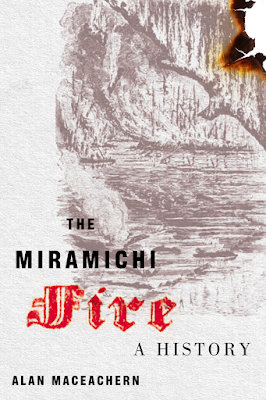
I was born and spent most of adult life inMiramichi. I have experienced the fear and anxiety of a nearby forest fire.Allan MacEachern’s book,“The Miramichi Fire”, is an excellent factual account of the 1825 events.Valerie Sherrard (a Miramichi author) wrote, “Three Million Acres of Flame “Itspeaks to the effects that fire had on the people of the region.
Tellus about your story.
“A Question of Faith” is based on theactual experience of John Jackson, the sexton of St. Paul’s Anglican Church andhis effort to save the church from destruction. As the flames advance, Johnstruggles to balance his dedication to his faith and his role as a father.
Whatdrew you to write the story?
Thepower of religion in the lives of some people interest me. And the lengths somefolks will go to give testimony to their faith. The evidence in this case isfound in the graveyard of St. Paul’s Cemetery.
Youare a novice writer in your seventies and have written two books. Will youcontinue to write?
“Stories From The River”chronicles my young life growing up in Miramichi, coming to accept andcelebrate being gay. “The Mill” describes the creation of the lumber empire ofthe Burchill family; a story of resilience and innovativeness covering 140years. My third book, “Christmas On The River” will be published in November.It includes some of my stories and real experiences of a few, relatives andneighbours including my ninety – eight-year-old aunt.
AQuestion of Faith
The Miramichi Fire
October 07, 1825 7:30am
Thedawn cracked like a scar on the cloudless sky. Dew lay miserly on the few remainingplants. It had been four months since rain had fallen. John Jackson tended to hisduties as Sexton of St. Paul's Anglican Church in Bushville. The small butdedicated congregation had erected the building in the Spring and Summer of1825. It sat prominently on a knoll close to the river. John was honoured whenhe was asked to oversee its maintenance and operation. He and his wife Ann hadlived in the Miramichi Valley for a decade. They had made the dangerous journeyfrom their native Scotland with two sons, William and Charles. The boys nowfifteen and thirteen were joined by three brothers and a sister (Margaret). Theperiod leading to and a year after the voyage from Edenborough had beenunseasonably cold with constant rain. The crops failed forcing the Jacksons andthousands of other Europeans to escape famine. A volcanic eruption on MountTambora, Indonesia the previous year had spread a layer of ash across theglobe, blocking out the sun for months. The memory of that uncertain period haddissolved with the promise of a brighter future for the young couple and theirchildren.
11:00am
John answered a loudrapping on the vestry door. A terror-stricken resident grabbed John’s coat andpulled him outside pointing wordlessly to the western horizon. The azure bluesky was erased by a coal black cloud thirty kilometers wide and towering kilometershigh. His first thoughts were the safety of Ann and the children. He raced totheir home and directed William and Charles to gather the bedding and soak it inthe river. He and the boys worked to place the wet materials on the wooden roof.Ann was busy distracting the younger children, while leading them to the cellar.He reasoned their stone house would not be a source of ignition. If the firejumped across the one quarter mile river, they would be secure in the earthen crawlway.
2:00 p.m.
Wordhad come from Nelson that Malcom's Chapel; the Catholic Church had beendestroyed. In a miraculous turn of events, the rest of the community wasspared. Several ships loaded with masts bound for England had been caught in arain of flame and were charred to their water lines. Like most Miramichiresidents, John Jackson had no experience with forest infernos. But he hadstudied the historical documents brought from congregants' homes to make achurch library.
Oneof the papers described previous incidents which occurred in the region. Herecalled with fear and some hope one of the characteristics of a big blaze.Crowning is a product of the firestorm. The superheated embers are carried atextended intervals often giving the perception that a structure has combustedspontaneously. Jackson prayed fervently that this phenomenon would spare himand his family. John looked across to Rosebank and Douglastown. He wept as hewitnessed a single sheet of flame nearing forty metres in height and kilometresin length bore down on the area. Across the half-kilometre distance, he heardthe shrieks of terror from man and beast as they sought a common refuge in thewater.
Johnbegan to realize that the Bushville side was not experiencing the worsteffects.
His thoughts turned tohow he might save his church. He ran the short distance to the church whereearlier he had placed buckets of water around and sheets provided byneighbours. He had placed a ladder high enough to gain access to the peak. Jacksonspent the remainder of the night laying the wet materials across the roof. Thevaliant effort worked and as the grey smoked filled dawn broke, he felt amoment of joy and triumph. As the black curtain diminished, John recognized afellow parishioner half stumbling up the wagon path from the direction ofJohn's home. His clothing was burnt and face blackened. His voice was strangledfrom acrid smoke as he told Jackson the unimaginable news that Ann and three oftheir beautiful children were dead.
October 08, 1825, 8:00am
JohnJackson looked over the site of his massive defeat. His lovely Ann and three oftheir children were gone forever. Trapped in their stone house, they suffocatedas the waves of flame stole any oxygen in the area. The remaining children hadbeen taken to a temporary hospital. The sound of the painful screams callingfor their mother reverberated in his head. Mercifully they later died fromtheir injuries.
Conversationswith his God, when he pondered risking the safety of family to save his Churchleft him wanting. Jackson died alone six months later in February 1826. Ann andher children are buried in the cemetery of St. Paul's Anglican Church, which standsintact today, a conflicted symbol of religious devotion and the recognition ofthe price one person had paid for it.
Conclusion
Statisticshelp explain the scope of the 1825 Miramichi fire. Sixteen thousand square km(6,000 sq. miles) of forest land was burned in an area extending approximately150 km (90 miles) northeast of Fredericton. The track of the fire moved toNewcastle, Douglastown Bartibogue on the west and Nelson, Bushville, Chathamand Napan to the east. One hundred and sixty people died. Nine hundred homesand structures were destroyed.
Overthe years, an idealized version of the recovery has become a legend. TheMiramichi is portrayed as a Phoenix, rising from the ashes, leading to there-emergence of a prosperous region. The truth is somewhere in the middle. Thetown of Newcastle suffered the most deaths and property loss followed closelyby the hamlet of Douglastown. The initial fear that 3,000 woodsmen spreadthroughout the Miramichi Valley had perished was proven unfounded.
In addition, there was a common belief thatthe maelstrom had consumed all the lands. That also was overstated. Crowningand spot fires leave sections of the forest untouched. A survey five yearsafter the fire concluded that a large portion of marketable timber remainedintact.
Thesenotations do not diminish the courage and determination of the Miramichi people.Many immigrants decided to remain and rebuild their independent communities andeventually their commitment to a united city over a century later. As time wenton, the population of the Miramichi Valley did not match the growth ofneighbouring counties but it gradually recovered. The export of solid whitepine masts to the British Navy dropped. That was a result of negative pressmore than a reduction in fibre availability. The vacuum was taken up as Britainexpanded its colonial possessions, needing more ships and supplies. And so, thelapse in exports was short term.
TheMiramichi region eventually assumed its place in the province of New Brunswickand the Confederation of Canada. The fire of October 7, 1825, has become afootnote of our history. The strength and determination of the people continueto grow.
NOTE: The author gratefully acknowledges AlanMacEachern's "The Miramichi Fire: A History" as a source document.
Thank you, Doug, for sharing the story and for being our guest.

A BIG thank you to all our visitors and readers.
Feel free to tell us what's on your mind.
Comment box below.