
Bill Treasurer's Blog, page 11
October 13, 2021
The Fall Hike Effect

When faced with a challenge, whether professionally or personally, it is often fear that holds us back. Maybe you are afraid to start because you might fail. Afraid to put your idea out there at the meeting, because of what others might think. Afraid to take a personal risk for fear of rejection. Fear is the predecessor, and instigator, of courage. Indeed, because courage is a response to fear, you can’t demonstrate courage unless you are afraid. Though people falsely assume that courage is about being fearless, in reality, the opposite is true. Courage is completely full of knee-knocking, teeth-chattering fear.
Coward or Courageous?The difference between a coward and a courageous person is not that one is afraid and the other isn’t. To be sure, both are afraid. Rather, the difference is in how each responds to fear. To be a coward is to turn and run from fear when you are fully capable of confronting it, but unwilling to do so. Conversely, to be courageous is to stay and confront fear even though you are afraid, not with Neanderthal bravery, mind you, but by allowing yourself to stay present with all your fearful feelings and then to walk through them.
To be courageous is to stay and confront fear even though you are afraid.
Even though courage is full of fear, it takes the risk anyway. By definition then, courage means acting in the face of fear. When we demonstrate courage, the best of ourselves emerges, and our character is displayed. Self-satisfaction comes from knowing that we are doing something that is difficult for us.
The Fall Hike EffectIt takes courage to live in a courageous way. Doing so means continually allowing yourself to experience fearful situations. But the more you courageously face fear, the less intimidating it becomes. I call this the Fall Hike Effect. My wife, Shannon, and I enjoy hiking in the mountains of North Georgia, especially during Georgia’s short fall season.
Fear is the predecessor, and instigator, of courage.
On these chilly fall days, I’ll often get all bundled up to insulate myself from the frigid air. Early on, all my woolen armor helps me brave the cold. But before long, my physical exertion starts to heat up my internal furnace. After a while I am not cold at all, I am hot, and I have to start peeling off the layers. My condition is now fully reversed from when I started! In the same way, when facing your fear, your early perceptions about the fear are likely to be very intimidating. However, as you begin exercising your courage, the Fall Hike Effect is likely to kick in, and your cold feelings of fear will turn into warm feelings of excitement. And when they do, you won’t fear your risk, you’ll relish it.
Where is fear holding you back, and how might courage give you the push you need to start the climb?
Photo by Aaron Burden on Unsplash.
The post The Fall Hike Effect appeared first on Giant Leap Consulting.


September 22, 2021
Team Building in a Remote or Hybrid Office

The pandemic has forced a change in the way we work, as well as the where we work. As many organizations return to work, many more are reminding remote, or exploring creating a hybrid office. This environment has a percentage of employees working from home at least one day a week. Working relationships have been strained as we faced the changes over the last 18 months, but one thing that has stayed the same is that collaboration and teamwork are essential to a thriving organization.
Teamwork in the Hybrid OfficeWhether remote, in person, or operating in a hybrid office model, great teams take time to develop. For seven years I traveled around the world as a member of the U.S. High Diving Team, diving from heights that scaled to over 100 feet into small pools that were only 10 feet deep. If we didn’t team well together, people could die. So building a strong team was extra important.
What I learned both as a member of a team and by working with hundreds of work teams, is that teams need a challenge, rewards and incentives, and ongoing team building. This team-building is even more essential as daily interactions continue to be limited. Bruce Tuckman, who developed the Forming/Storming/Norming/Performing model of team development, had it right.
FormingThis stage is characterized by initial excitement and fear of the unknown. Leaders and team members are getting to know one another, and are forming the foundation for working together.
StormingA normal, predictable, even necessary, stage in team development. The project is now underway but is usually in the early stages. The goal of this stage is not to squelch healthy conflict, but to minimize the “real” loss of productivity which may result and to keep to a minimum the length of time in which the team may feel as if it is floundering.
NormingThe stage in the team’s development in which most team members have negotiated both interpersonal and team strategies for working together. Momentum toward progress and results is building. There is a sense of “we are in this together” and “this is the way we do things on our team.” During this stage, leaders should help the team celebrate its history, and remind the team of the challenges that they’ve overcome together.
PerformingThis stage is signaled by the awareness and acknowledgment of individuality. Trust is high among team members because they’re so familiar with each other’s working styles and preferences. Their behaviors are not scrutinized for disloyalty but are trusted to be contributing to the good of the team. This is also the period when individuals learn from the actions and behaviors of their colleagues and feel able to consciously develop themselves. The concern to make judgments in terms of right and wrong that characterizes the first three stages is replaced by a desire to learn from the approaches and experiences of individual and collective behavior.
As Henry Ford said,
Coming together is a beginning. Keeping together is progress. Working together is success.
As a team member, it’s good to know which stage you’re in so that you don’t freak out if the team isn’t getting along. And if you’re the leader of a team, it’s important to mindfully guide members through these stages of team maturation. As we navigate the new normal, with the future of work looking different than it has in the past, the task seems daunting. Encouraging collaboration in your remote and hybrid teams is imperative to the health and success of any team. Yes, teaming takes hard work. But it’s wonderfully rewarding. Once you build a great team, you can take some real giant leaps together!
How is the new normal of our working environment changing the way you approach team building in your organization?
The post Team Building in a Remote or Hybrid Office appeared first on Giant Leap Consulting.
September 15, 2021
Ignite Imaginations with a Change of Place

One challenge most leaders face is how to inspire more workplace creativity. There are plenty of clock punchers out there—folks who are physically working but mentally retired. Elevating people to higher standards of performance and inspiring useful ideas requires igniting their imaginations. In my book Leaders Open Doors, I talk about open-door leaders, those individuals who are keen to prevent complacency and lethargy. They know that the mental grooves of habit eventually form ruts of routine. When people see things the way they’ve always seen them, everything stays the same, dulling work to the point of drudgery.
Elevating people to higher standards of performance and inspiring useful ideas requires igniting their imaginations.
As we transition back to work, whether it is in the office, at home, or somewhere in between, keeping employees engaged, connected, and inspired in this new normal is more important than ever. Inspiring creativity and imagination often requires disrupting people’s mental routine and catching them off guard. Consider the marketing meetings a large manufacturer of paper plates held to figure out how to reach more customers. To the people who spent most of their working life centered on this commodity product, the answer was simple: discounting! Whenever the company wanted to increase market share, they would simply pump out more Sunday coupons. But the temporary discount-driven boost in market share would often come at the expense of lower profit margins.
As a result, the division’s leader wanted his employees to be more imaginative than just defaulting to discounting all the time. He wanted them to remember that they weren’t just selling plates, cups, and napkins, they were working for a brand that was deeply connected to the family experience.
To lift his employees out of the rut of discount thinking, the division leader conducted a brainstorming meeting. But this meeting was at a new location, a beautiful community park near the corporate headquarters. The meeting was different because it was set up as a backyard barbeque. There were picnic tables with red-and-white checkered tablecloths, an outdoor grill sizzling with hotdogs and hamburgers, even outdoor games like horseshoes and tetherball.
When people see things the way they’ve always seen them, everything stays the same.
Of course, there was also something else: lots of the company’s plates, cups, and napkins. They weren’t just commodities; they were an essential part of the experience. The division’s open-door leader used this picnic to help his employees shift their thinking away from commodities and toward values and traditions. They started seeing that on any fall day, their products were smack-dab in the middle of people’s backyard barbeques, picnics, and family birthday parties. The products were important because they helped make family time more fun, enjoyable, and worry-free. Without the picnic table, grill, and their products, a backyard would just be a patch of land behind the house.
If you want uncommon ideas, don’t choose common approaches.
Contrast this leader’s approach to inspiring people’s imaginations to the alternative, which you have probably experienced. Your boss likely gathered everyone in the same old meeting room—the one where people usually drone over monthly accounting reports—to get lots of great ideas. You probably had to hunt all over the building to find a flipchart. Then search again to find a marker that actually worked. As a bonus, the 2 p.m. meeting was just in time for everyone’s after-lunch coma to set in. After everyone arrived, your boss, standing next to a white piece of flipchart paper and holding a black marker, gleefully said, “Okay everyone, let’s get creative!”
The quickest way to get stale, retread, and uninspired ideas is to situate everyone where they do their routine work and have routine meetings. When it comes to inspiring great ideas, the climate you create to gather those ideas matters a lot. Any boss can hold a boring meeting in a tired conference room. By contrast, any boss can also hold an inspiring gathering at the local park, but few do. If you want uncommon ideas, don’t choose common approaches.
How can you create space for your team to think in a more inspired way?
The post Ignite Imaginations with a Change of Place appeared first on Giant Leap Consulting.
August 18, 2021
The Impact of Fear on Performance

If you want to learn about courage, invariably you must also learn about fear. Courage and fear have a strong and interwoven relationship. Most typically, when we choose to behave courageously, we are choosing to engage with fear. And engage we should. No other emotion has as much of an obliterating effect on performance as fear. Despite that fact, fear flourishes in workplace settings.
Few places are as fraught with fear as work, and few sources of fear are as potent as the behavior of leaders. When leaders stoke people’s fears to get things done, they reinforce the age-old hierarchical construct of dominance and submission. Even in the 21st Century, many workplaces still use terms like “superior” and “subordinate.” If you slow down your language and think about it, by describing your boss as your “superior,” what does that make you? Inferior?
Fear Impacts PerformanceIn many workplaces, fear, sadly, is the preferred method that leaders use to motivate people to do things. But fear is not just localized to the behavior of leaders and often permeates the entire organizational system. Performance appraisal systems are largely unidirectional, cascading in a straight line from the top down, and are often focused less on raising up performance and more on checking up on performance. Time reporting systems ensure that the moment-by-moment activities of each and every worker are tracked and accounted for. Elaborate and expensive software systems are implemented so workers’ emails and Internet usage can be monitored. And in some workplace settings, workers are subject to random drug testing.
Regardless of how justified such systems may be, collectively they serve to convey two powerful messages to the workforce:
We are watching you.You are not trusted.When infused throughout the entire workplace, the suspicion and anxiety created by this lack of trust can create a fear-based organization.
Fear is Bad for BusinessDespite its prevalence as a primary motivational tool, fear is bad for business. While fear may temporarily motivate workers to toil harder, faster, or longer, it also shuts down their willingness to take the necessary risks that innovation, new product development, and sales, for example, require. Fear clams workers up, shutting down the flow of feedback that is so necessary for keeping leaders from making wrongheaded decisions. On a larger scale, fear—often under the guise of “healthy” internal competition—puts up walls between company divisions, causing workers to horde knowledge to keep their divisions from losing. Not incidentally, fearful work environments aren’t much fun to work in either.
The total costs of fear, if they could be monetized, would be so staggering that any right-minded organization would reject fear as a strategy for motivating performance.
Does your workplace lead with fear? What systems or practices might actually be making workers feel fearful, anxious, or unsafe? How about your boss? Does he or she lead with fear? In what ways? More importantly, what about YOU? Are you creating a work environment where people feel physically, emotionally, and psychologically safe?
Photo by Daria Shevtsova on Unsplash.
The post The Impact of Fear on Performance appeared first on Giant Leap Consulting.
August 11, 2021
Good Leaders and the Endowment of Power

Leadership is as ancient as humanity. Since the first tribes of barefooted humans hunted on the African plains, there have been leaders. In fact, leadership is probably older than humanity, in that animals and other organisms display leadership. Pecking orders are part of many species that have been around much longer than we have.
What usually sets a leader apart from those being led, whether in the animal kingdom or in groups of human beings, is an endowment of power. The physically, socially, intellectually, and sometimes spiritually dominant individual usually stands at the top of the heap. The earliest leaders were likely those who could climb the highest tree, hunt the biggest game, or mix the most powerful healing elixirs. More often, they were just the badass mesomorphs who could kick the butts of punier tribesmen!
Most people agree that the world would benefit by having more good leaders. We pin our hopes on good leaders because we view them as demonstrators of high ideals. Leaders are people who are in some way exceptional, and who live and act with the highest integrity. But as long as there have been good leaders, there have also been leaders who compromised their integrity and turned bad.
Most people agree that the world would benefit by having more good leaders.
It’s the behavioral latitude, the “because I can” freedom, that necessitates the joining of morality to leadership. Just because you can do things that non-leaders can’t, doesn’t mean you should. But it is also the “because I can” freedom that causes some leaders to lead in a compromised and self-serving way. The unwritten understanding that leaders and followers share is that when you’re the one who sets the rules, judges others’ performance, and doles out the rewards, you have more unimpeded power and freedom than those who don’t get to do these things. Others serve at your pleasure and are accountable to you, not the other way around.
In 2018, I co-authored The Leadership Killer with retired Navy SEAL Captain, John Havlik. As we wrote the book, John and I became more convinced than ever before, that the world needs good and healthy leaders. It is a basic truth that humankind’s grandest achievements would never have happened without good leadership. But it is also true that the world’s most wretched tragedies are always a direct result of bad and arrogant leadership. In the wrong hands, leadership, which is supposed to represent the highest human ideal, can become profanely twisted, misused, and monumentally damaging. The subtitle of our book may be more important than the title: Reclaiming Humility in an Age of Arrogance.
It is a basic truth that humankind’s grandest achievements would never have happened without good leadership.
Some of the best leadership lessons are gained by working for a bad leader. For example, I learned to be more decisive after working for a weak leader who couldn’t make a decision. Think of a bad leader that you’ve personally experienced. What impact did the leader’s behavior have on you and others? What lessons did you learn about how not to lead? The best way to show that you’ve learned from the bad leaders you’ve encountered is to not act like them. As John and I wrote in the book, being a good leader should never require being a bad person. Our advice, keep doing the next right thing … especially when it’s hard.
Photo by Nastuh Abootalebi on Unsplash
The post Good Leaders and the Endowment of Power appeared first on Giant Leap Consulting.
July 14, 2021
Perfectly Imperfect

Nobody’s perfect, but that doesn’t seem to stop people from trying. And why not? There are lots of good reasons for wanting to be perfect. Some professions, for example, greatly benefit from their inherent perfectionism. This is especially true of professions where the consequences of mistakes would be catastrophic, where the human or the financial costs of errors are simply too great to bear. Indeed, the higher the potential for catastrophe, the more necessary and warranted is the perfectionistic behavior. Consequently, among the most perfectionistic people you’ll ever meet are bridge-building engineers, skyscraper architects, nuclear physicists, software engineers, and brain surgeons. I, for one, thank God for that. If you ever had the misfortune of requiring brain surgery and had to choose between a pursed-lipped, anal-retentive surgical tactician or a giddy, free-wheeling improvisationalist, who would you choose?
The trouble with perfectionism is that it impedes our ability to take risks. Perfectionists are better suited for mitigating risks than for taking them. This mostly stems from their almost obsessive preoccupation with anticipating what can go wrong. Perfectionists are prone to “catastrophizing,” focusing on worst-case scenarios in order to account for, and control, every possible negative outcome. This, in turn, lends itself toward a doom-n-gloom outlook when facing a risk. Thus, risks themselves are seen through a prism of negativity that not only makes the risk-taking experience unenjoyable, but through the power of expectancy often sets it up for failure as well.
Facing YourselfBeing perfectly imperfect means being rigorously honest. It means to stop denying or repressing your less-than-perfect parts and to boldly face reality, in all its starkness. As the great American artist Walter Anderson once said,
“Our lives improve only when we take chances—and the first and most difficult risk we can take is, to be honest with ourselves.”
The point of facing our imperfections is not to root them out so we can be perfect. Rather, we should acquaint ourselves with them, so that our self-knowledge is more complete. When we do this, we are better able to direct their influence over us, often converting them from sources of maladaptive behavior to a more adaptive kind.
Be Perfectly ImperfectI read somewhere that many great quiltmakers like to sew an imperfect stitch among their patchwork. They do this as an act of homage—the idea being that only God has the right to be perfect. Imperfection provides a needed contrast for beauty to emerge so that it can be most appreciated. To be perfectly imperfect is to allow our imperfections to distinguish our more admirable qualities. Perhaps it is for this reason that, as my Grandmother used to say, “Everything God makes has a crack in it.”
Mistakes are not personal failings, but mile-markers on the winding road of progress
And how can you commit yourself to being perfectly imperfect? Replace self-rejection with self-acceptance. Value your shortcomings for giving you your character, your quirkiness, and your humanness. Give yourself a break and recognize that mistakes are not personal failings, but mile-markers on the winding road of progress. When you commit yourself to being perfectly imperfect, you come to appreciate risk-taking as a process of discovery, full of shortfalls and setbacks, but also full of serendipity and satisfaction. Being perfectly imperfect doesn’t mean triumphing over our imperfections, it means triumphing with them.
Photo by Malachi Brooks on Unsplash.
The post Perfectly Imperfect appeared first on Giant Leap Consulting.
July 7, 2021
Courageous Leadership: HRchat Podcast

This month I had the opportunity to be a guest on the HRchat Podcast with Bill Banham. We discuss how courageous leadership can have an impact on your team at every level. For more insights on Human Resources and improving the ways you work, visit the HR Gazette.
Image by Sasin Tipchai from Pixabay
The post Courageous Leadership: HRchat Podcast appeared first on Giant Leap Consulting.
June 16, 2021
Trust Courage
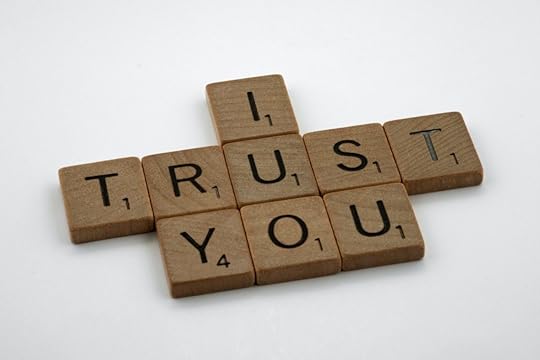
In my previous post I introduced you to Try Courage, the courage of first attempts. In this post, we will explore the next of three types of courage, Trust Courage. Learn more about all three types of courage in my book Courage Goes to Work.
Learning how to trust others is a difficult feat. It requires a certain amount of powerlessness, and for most of us, that feeling creates discomfort. However, if we learn how to trust ourselves in our innate abilities, we find the courage to believe in others. As leaders, having faith in those who follow us is the only way everyone continues to grow. There’s inherent reciprocity in its offering.
Letting Go of ControlThe act of trusting often requires letting go of our need to control outcomes or people, our defense mechanisms, and our preconceptions about what is “right.” For hard-driving controlling types, such as the coffee-clutching professionals who make up much of today’s workforce, this goes against the grain of everything they stand for. Trust runs counter to the take-charge ethos that typifies today’s business world. In many companies, the most valued employees are those who, when encountering challenging situations, control chaos, force order, and take decisive action. As the Roman poet, Virgil said,
“Fortune favors the bold.”
TRUST Courage, for leaders, is a tricky thing. On the one hand, you need your employees to trust you so that they follow your direction enthusiastically. On the other hand, you have to monitor their performance, which, if done too closely, often feels distrusting. Plus many leaders work in companies layered with systems that are inherently distrustful. It is more difficult to fill workers’ TRUST buckets if you’re an extension of a system that doesn’t trust them. “Sure,” your workers may say, “I’ll trust you . . . just as soon as you get the company to stop random drug testing, monitoring our emails, and making us submit time reports.”
New leaders in particular are challenged with TRUST Courage. Consider, for example, how hard it is for new leaders to delegate important tasks to employees. In such instances, if the employee screws up, it can reflect on the leader, not the employee. Consequently, many new leaders struggle to fully let go of delegated tasks, choosing to hover above direct reports like smothering parents. In so doing, they are thwarting employee development and keeping themselves mired in tasks that they should have outgrown by this stage in their careers.
DelegateDelegation involves not acting on the temptation to grab the task back from the employee. The ability to delegate is directly proportional to how much trust a leader has in an employee. Trust doesn’t come easily for new leaders (or immature experienced ones), because it involves intentionally refraining from controlling an outcome (or a person). If the leader doesn’t trust that the employee will get the job done, he will grab the task back and do it himself—or worse, he won’t even give the task to the employee in the first place. The result is a sort of leadership dependency whereby workers wait to be told what to do, like baby birds waiting to be fed. When what to do, like baby birds waiting to be fed. When this happens, a dangerous cycle begins; the leader keeps doing the tasks, which keeps the workers from gaining the skills to do the tasks, which keeps the leader from delegating the tasks, which keeps the leader doing the tasks, et cetera.
Trust is risky. When you trust, you become vulnerable to actions that are beyond your direct control. Your success becomes dependent upon someone else’s action. The challenge here is one of reliance; you have to give up direct control and rely on the actions of others. It is this lack of control that makes trust so difficult. Trusting you can harm me. Because of this risk, it takes courage to place trust in others. It takes TRUST Courage, for example, to let employees do their jobs without interference. It takes TRUST Courage to accept that, despite their best efforts, employees will make occasional mistakes.
The only way to make a man trustworthy is to trust him.
Henry Stimson
Photo by Brett Jordan on Unsplash
The post Trust Courage appeared first on Giant Leap Consulting.
June 2, 2021
Try Courage

My clients make me brave. That’s because for almost twenty years I’ve run a courage-building consulting firm, Giant Leap Consulting. For over two decades I’ve worked with thousands of leaders throughout the world facilitating Courageous Leadership workshops. For me, the richest part of the workshops are the insightful client discussions about the role the courage has played in their careers. My book, Courage Goes to Work, captures many of the unique insights stemming from those discussions.
One insight that my clients taught me is that not all expressions of courage are the same. There are at least 3 distinct behavioral expressions of courage: TRY Courage, TRUST Courage, and TELL Courage. This post focuses on TRY Courage, the courage of initiative, such as what it takes to ‘step up to the plate.’ In future posts I’ll cover the other two expressions
TRY Courage is the courage of first attempts—trying something for the very first time. Think back, for example, to your first day of school, or your first kiss, or the first time you drove a car. At the time, these firsts were, for you, pioneering events, thresholds that you had to cross over to ensure your advancement as a member of the human community. While such firsts look ordinary now, when you were actually contending with them, you were probably desperately nervous.
Managers contend with “trying firsts” all the time. Remember, for example, when you first moved into a management role? Or when you first became responsible for the performance of an employee? Or when your boss asked you to lead a pioneering initiative for your division? All of those things required TRY Courage on your part. Similarly, your direct reports contend with trying situations when they struggle to learn a new and more sophisticated software system, or uproot their families and relocate to a different geographic area, or become responsible for a project of their own for the first time. Such situations are ripe for the development of TRY Courage.
Having TRY Courage requires overcoming the inertia of the moment. Challenges of initiative heighten a person’s awareness of the gap between where she is and where she wants to be. The greater the gap, the more energy, discomfort, and TRY Courage will be required to close it. For this reason, a lot of people avoid trying because closing the gap just takes too much effort. Unless a person actively deals with the DNA-level inertia that seems to want to keep everything the same, he won’t fully experience his TRY Courage capabilities. Whether the challenge requires the person to start something new or to stop something he has grown comfortable with, overcoming inertia is key to building TRY Courage.
All forms of courage involve taking risks. With TRY Courage, the underlying risk is that your actions end up inflicting harm on others or yourself. Who loses, for example, if that pioneering initiative you’re leading is a colossal failure? Your people lose, your company loses, and you lose. Such consequences raise the stakes, bringing risk to the situation. Without the risk, however, such situations wouldn’t be worthy of your courage.
Trying once is often not enough. When it comes to courage, persistence matters. As the old saying goes, “If at first you don’t succeed, try, try again”. Persistent effort—what I call TRY, TRY Courage, is sometimes needed to ensure a successful outcome. Sometimes the most instructive lessons about courage come from the stories of people who fail . . . but who refuse to lose.
As leaders, it is important to differentiate between a successful outcome and a courageous act. Being courageous, by definition, means to take on challenges despite the potential for failure. Courageous workers do, in fact, fail. But failure is an outcome and courage is a means. Just because someone fails on the back end doesn’t mean he wasn’t courageous on the front end. Rewarding courageous behavior is just as important as rewarding a successful outcome.
Do you take the time in your organization to recognize courageous behavior?
Image by cindylori11 from Pixabay
The post Try Courage appeared first on Giant Leap Consulting.
May 19, 2021
Put Yourself on the Line: Learning to Take Risks

Before I became an organizational development professional, I was a professional high diver with the U.S. High Diving Team. Every day for seven years, I climbed to the top of a hundred-foot ladder, stood atop a one-foot-by-one-foot perch, and hurled myself off — plummeting 10 stories down at speeds of more than fifty miles per hour into a pool that was only ten feet deep.
Fifteen hundred high dives, all completed with no parachute, no bungee, and no safety gear. Keep in mind, I’m a high diver who remains terrified of heights.
What would possess a guy so petrified of heights to become a high diver? I wrote my book, Right Risk: 10 Powerful Principles for Taking Giant Leaps with Your Life, to figure out the answer to that question. The front cover has a picture of me diving while on fire. No kidding.
Life is one long procession of risks. But during our lives, only a handful of risks are truly destiny-changing. These are moments that, once passed, make up life’s reminiscence. Relish these giant leap moments, as you are taking them, instead of longing for them once they’ve gone.
“Every act of creation is first of all an act of destruction.”
—Picasso
Stand on the edge of a cliff and tilt forward. What happens? Thankfully, the invisible hand of self-preservation rocks you back in place. Without this unseen protector, you would fall off the edge and die. But sometimes self-preservation holds you back, even in safe places. In these instances you are not graced by a benevolent protector, but enslaved under the strict control of a punitive headmaster. And headmaster is exactly the role that self-preservation often assumes. It can lord over your mind, directing every action toward protecting you from danger, until even the slightest risk is viewed as threatening.
In the worst cases, the desire to preserve your-self becomes a straightjacket where every move must be painstakingly planned and predicted, and where caution and carefulness hold greater importance than unfettered enjoyment. This preservationist’s fear-based approach to life underpins such things as neurosis, paranoia, hypochondria, and agoraphobia. To them, life is something to be contained, not enjoyed.
It is not that seasoned risk-takers discard self-preservation entirely. They are not suicidal. Rather, they refuse to be controlled by it. They recognize that enjoyment comes at a price, and the price is often the acknowledgment and acceptance of your own mortality.
As high divers, for example, we were all well aware that every dive carried a real, albeit remote, chance of injury or death. Except for the 30 stitches I got after falling off the stage in Texas, I never got hurt. But many of my buddies did. I recall, for example, joining our troupe at Six Flags Over Georgia the day after one of our divers broke both of his ankles after performing a 60-foot high dive into an 8-foot pool. Everyone knew that taking these unusual risks was an unnatural act and that injury (or worse) came with the territory. The price of admission to all that temporary excitement was the miniscule chance of certain death. It is not that high divers are not afraid to die, it’s just that they are not afraid to live. They would rather risk the possibility of death while embracing life’s fullness of spirit than live a dispirited death-avoiding life.
Let’s face it, sometimes the only reason that you put your-self on the line is because someone shoved you over the line. Not all risks can be planned and well thought out. Not all risks are afforded the luxury of time. Sometimes we are forced to react quickly, relying on our instincts to see us through. For this reason, maintaining a regular risk regimen will increase your risk fitness so that when risks are thrust upon you, you will be better prepared to handle them intuitively. At the same time, just the act of taking risks prepares you for more risk. In going through an intense risk experience, you stretch your capability—and perhaps even your need—for more risk.
What about your identity or career could change as a result of taking your big risk?
Photo by Nicholas Sampson on Unsplash
The post Put Yourself on the Line: Learning to Take Risks appeared first on Giant Leap Consulting.


