
Bill Treasurer's Blog, page 35
July 11, 2013
You’re Invited to the Leadership Opportunity Fest Blog Tour!
Last month, I gathered together some of my friends and fellow Berrett-Koehler authors to talk about the people who saw potential in us when we couldn’t see it in ourselves. These people opened doors of opportunity that helped us get to where we are today, and it was time to express our thanks.
If you joined us on that webinar, or listened to the recording, perhaps it inspired you to think about the people who have opened doors for you along the way. It might have been a teacher, coach, mentor, friend, boss, or even a stranger. After all, you don’t have to know someone well to make an introduction or open a door!
Take Action: If you would like to share an open-door story, then I invite you to join me, right here, on August 13th for the Leadership Opportunity Fest Blog Tour. Write a blog post between now and August 5th and send the link to my team.
Please include the text below at the end of your post:
This post is part of Leadership Opportunity Fest Blog Tour, hosted by Bill Treasurer . Watch the Leadership Opportunity Fest webinar here , find his book on Amazon , and then join us for the blog tour on August 13 as we celebrate leaders who open doors!
And feel free to use this graphic in your post.

On August 13th, come back to read through the links that were sent, reflecting on the fact that it has taken a lot of people to get us to where we are now. I would encourage each of us to not only say thanks to those who helped us, but to take the opportunity to open doors for others!
See you next month!
The post You’re Invited to the Leadership Opportunity Fest Blog Tour! appeared first on Giant Leap Consulting.


July 1, 2013
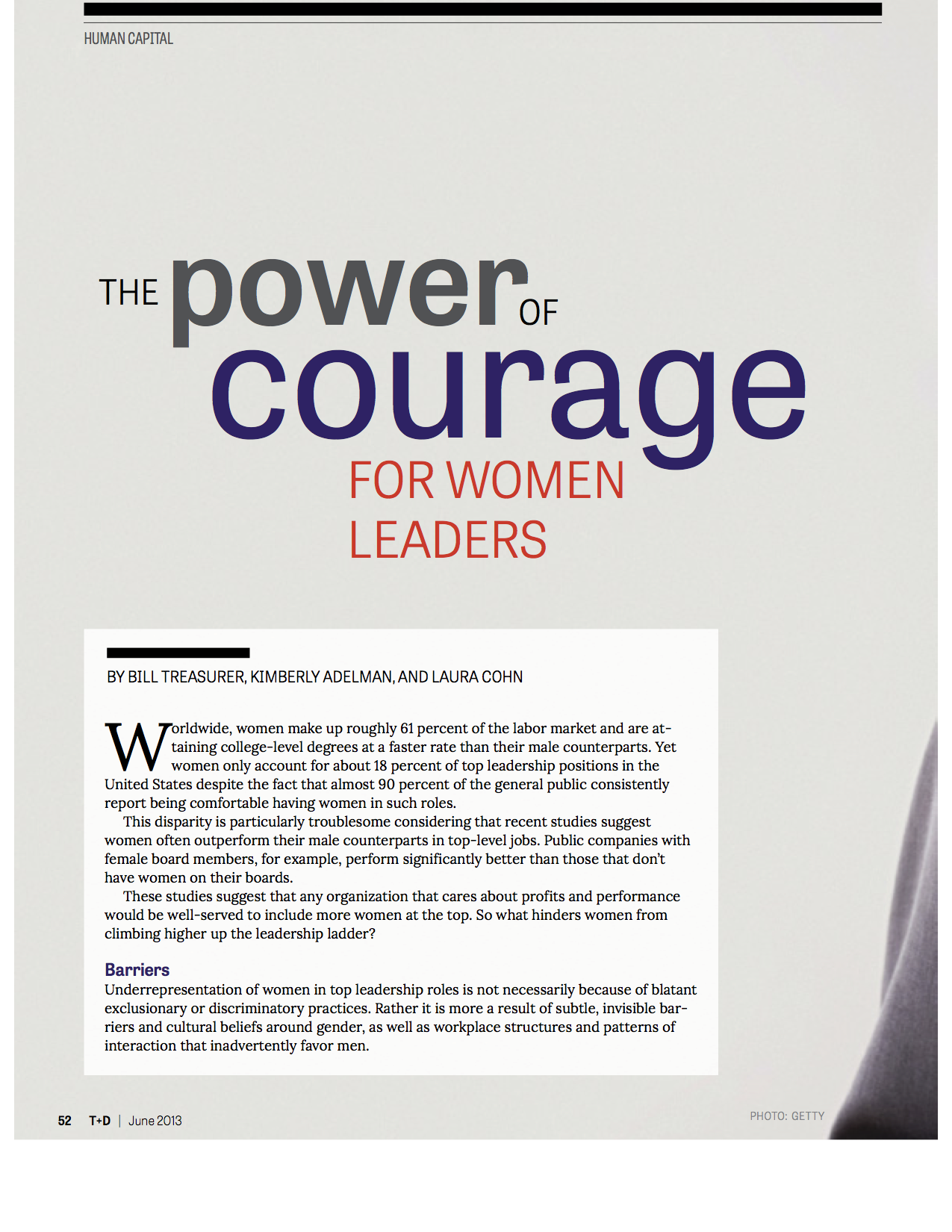
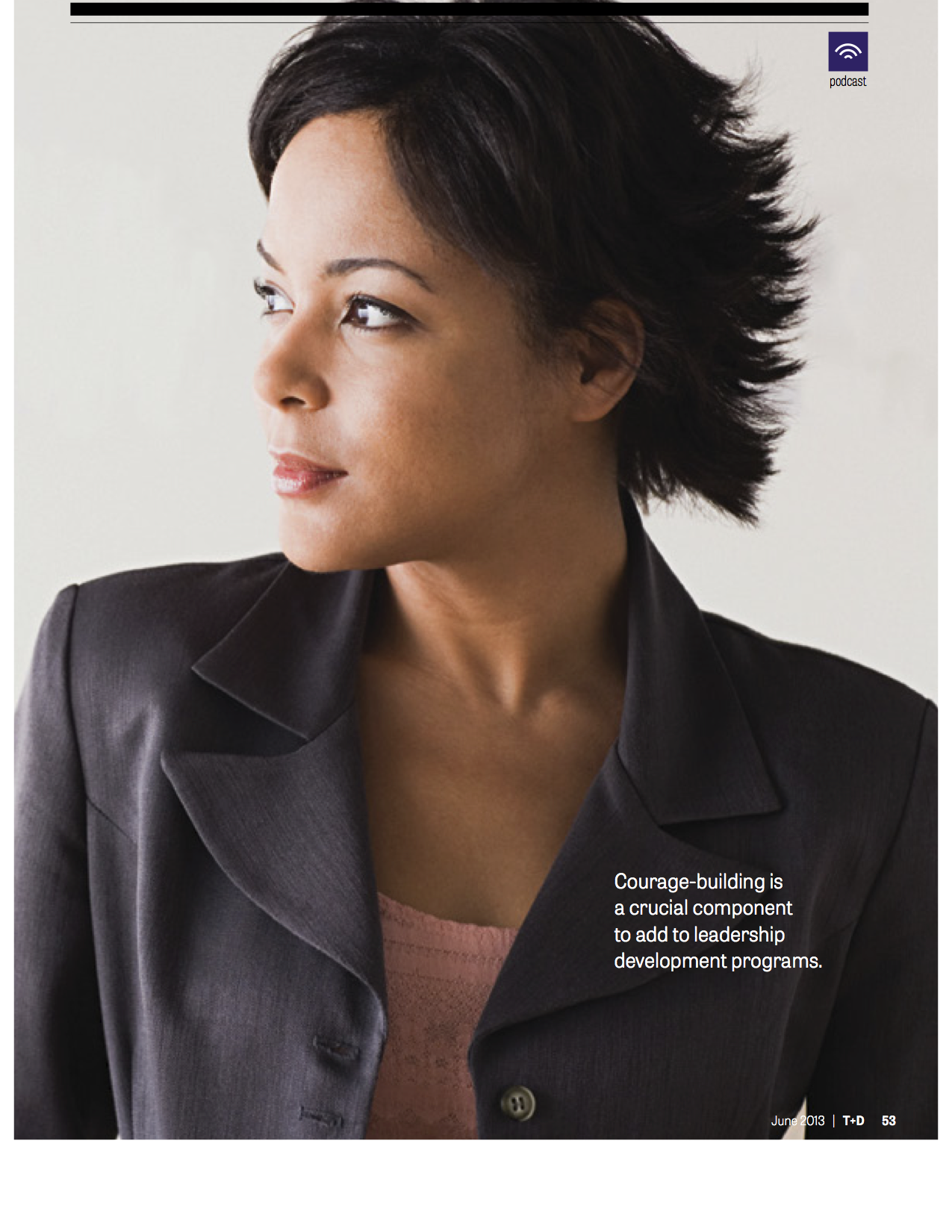
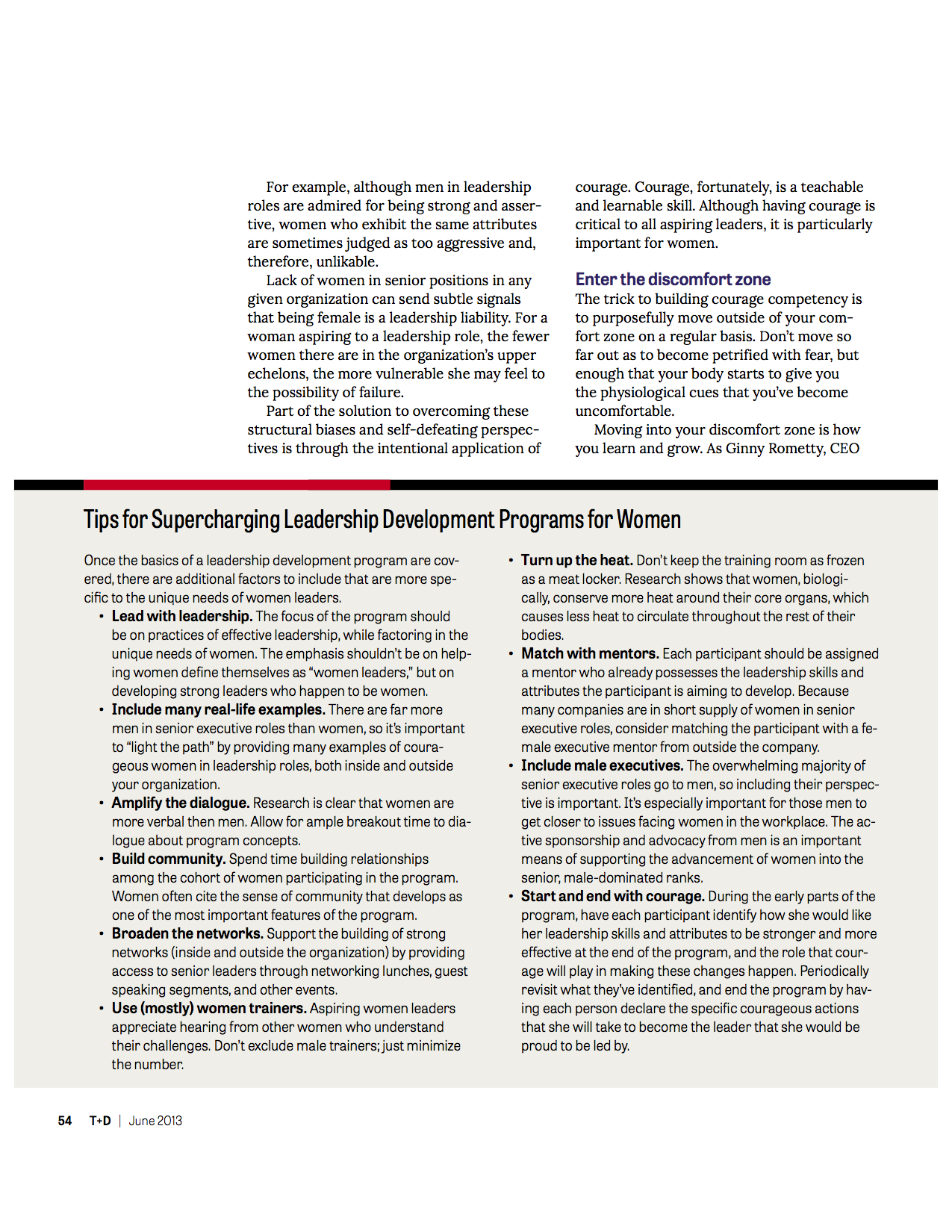
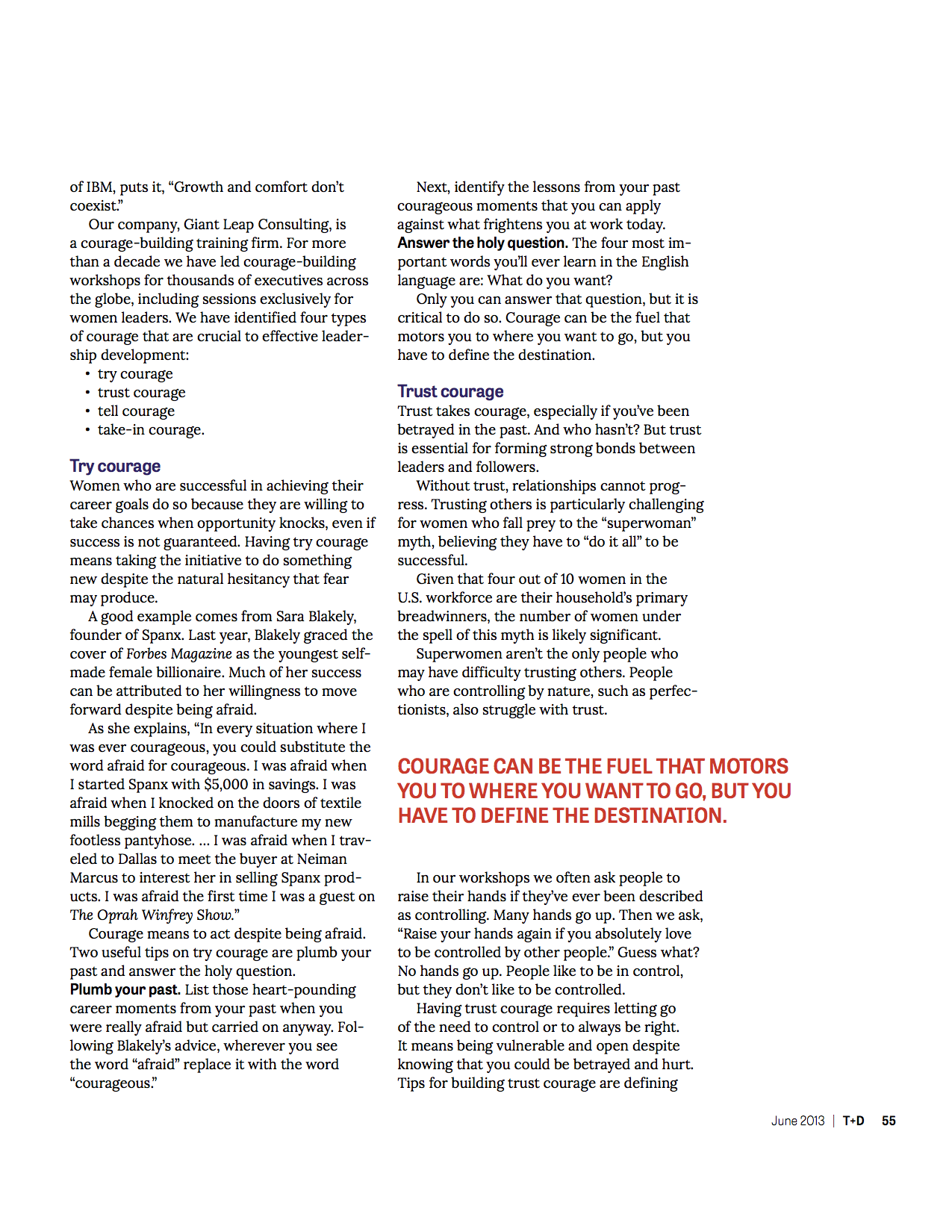
The Power of Courage For Women Leaders
The following article appeared in Training and Development Magazine in their June 2013 Issue.
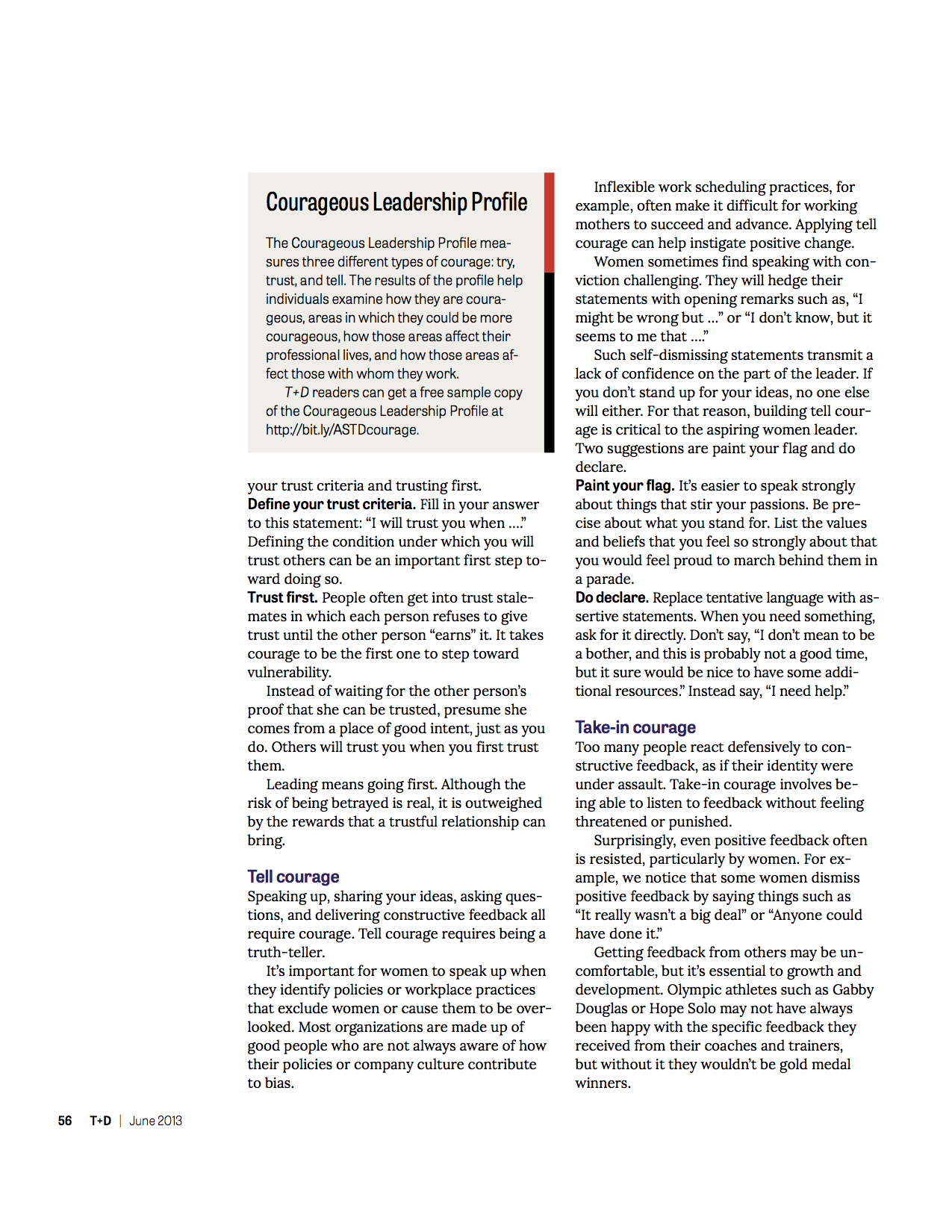

The post The Power of Courage For Women Leaders appeared first on Giant Leap Consulting.
Why Servant Leadership Is Slightly Off — And What to Do Instead
*This article originally appeared on Huffington Post and was written by Lisa Earle McLeod*
What constitutes a great leader?
Is it charisma? Someone with a great vision who fearlessly leads the team up the hill?
Or perhaps it’s servant leadership, a humble leader who patiently and selflessly puts him or herself into the service of others?
Leadership is the most over analyzed, thoroughly dissected, and utterly confusing topic in business. From trust falls to ropes courses people are always looking for activities and metaphors that symbolize great leadership.
Servant leadership is the current trend, but personally, I don’t like the term, in fact, I loath it.
While I’m in absolute agreement with the principles of servant leadership, whenever I hear the phrase “servant leader,” I envision a long-suffering manager wearily going about their job with no spark or power whatsoever.
Charismatic leadership seems sexier, but it’s a breeding ground for narcissism.
But after years of searching, I’ve finally found a leadership metaphor that fits: Leaders Open Doors.
It comes courtesy of leadership expert Bill Treasurer. In his new book, Leaders Open Doors: A Radically Simple Leadership Approach to Lift People Profits, and Performance, Treasurer provides a model that is both humble and powerful.
The concept for “Leaders Open Doors” came out of a short conversation with his son.
Treasurer writes: “My five-year-old son, Ian, is a preschooler at the Asheville Montessori School in Asheville, North Carolina, where we live. Each Monday his teachers pick one person to be the “class leader” for the day. I only became aware of this because one sunny afternoon Ian came bounding up the stairs proclaiming, “Guess what, Daddy — I got to be the class leader today!”
Being the class leader would be a big deal for any five-year-old kid. For Ian, who is used to playing second fiddle to his more dominant firstborn twin brother and sister, Alex and Bina, being selected as the first fiddle was even more special. Ian’s exuberance caught my attention.
“Really? Class leader? That’s a big deal, little buddy. What did you get to do as the class leader?”
Ian’s answer was simple, funny, and in its own way, profound.
“I got to open doors for people!”
In a matter of 15 seconds, with seven simple words, Ian clarified what’s most important about leadership.”
Think about it, what do you want from your boss? Someone who can quote the seventeen steps of change management? Or someone who shows up every day ready to open doors so that you can charge through?
Treasurer, a long time leadership consultant (Giant Leap Consulting) and best-selling author of Courage Goes to Work says, “I think we’ve made leadership hard. I was part of the legion of leadership complexifiers with our quadrant and statistical models.”
Yet he says, “I got as much out of a conversation with my son as I did three years in grad school.”
The aim of the book is simple: “to help you open doors of opportunity for the people you lead.”
But just because the idea is simple doesn’t mean it’s easy. Open door leadership takes work. It requires mastering the duality of power and service, being both confident and humble at the same time. It also means helping your people become more confident and pulling through opportunity rather than pushing through fear.
Treasurer provides a powerful reframe of a quality that is still in short supply: leadership.
Because at the end of the day, the world still need more great leaders.
Lisa Earle McLeod, a sales leadership consultant, is the author of several books including Selling with Noble Purpose: How to Drive Revenue and Do Work That Makes You Proud, a Wiley publication, released Nov. 15, 2012. More info is available at www.LisaEarleMcLeod.com
and on Lisa’s blog: “How Smart People Can Get Better At Everything.”
The post Why Servant Leadership Is Slightly Off — And What to Do Instead appeared first on Giant Leap Consulting.
Leaders Open Doors: A Radically Simple Leadership Approach to Lift People, Profits, and Performance
*This article originally appeared on Linked2Leadership as a book review by Tom Schulte*
Bill Treasurer’s new book “Leaders Open Doors” is exactly what the subtitle suggests: a radically simple leadership approach that I certainly can image would lift people, profits, and performance in any organization.
Premise:
The premise of the book is that a simply selfless approach to leadership that has one opening doors and creating opportunities for others is the jackpot mentality to effective leadership.
Intro:
As a self-confessed former “complexifyer” of leadership, he went from a journey as a young man in graduate school where his thesis was this:
“The efficacy of the initiation of psychological structure through the use of directive leadership styles as a negative correlate of role ambiguity and positive correlate of employee satisfaction in workplace that have undergone a recent reduction in force.”
to understanding from a simple conversation with his five-year old preschool son Ian about what it means to be leader where his son answered the question “What did you get to do as the class leader?” with this gem
“I got to open doors for people!“
This simple statement struck the author with such clarity that he renounced his quarter-century membership in what he calls the “Legion of Leadership Complexifiers (LLC)” and takes a pledge “to speak plainly and simply.”
And in this book, he does just that. His simplicity and clarity is radiant and the radical approach to dropping complexity and picking up a servant-leadership mentality is pure genius. He takes a machete and cuts through years of Organizational Development (OD) and Leadership Development “hairballs” and allows his voice to speak simple truths in a busy world.
A Reader’s Guide
One of the things I enjoyed in this book is how the author breaks down for the reader what they will be reading and tells them how it will benefit them. He has a place early on that tells you “What You’ll Understand” and “Key Chapter Takeaways” in the introduction and in each of the nine concise chapters.
The reader will easily understand the following 10 points:
What a leader is, simply
Why leadership means opening doors
Why focusing on problem-solving is far less effective than focusing on the opportunities those “problems” nearly always provide
Why making people uncomfortable – in a way they can absorb – is every leader’s primary job
Why giving people opportunities to prove themselves taps into people’s need to excel and can supercharge motivation
How the actions leaders take can help broaden and shift people’s perspective so they can face challenges more creatively
How you can gain deep loyalty and commitment when you open a door to a second chance, especially after big mistakes
Why leaders need to pay special attention to the needs of people who are outside the majority
How instrumental leaders can be in bringing about career and life transformations for people
How you can have the greatest positive impact on people only when you open yourself up and show your true self to those you lead

Book Review Rating by Tom Schulte of Linked 2 Leadership
I give this book the L2L 5-Star rating and strongly recommend getting it for yourself, your team, or even your boss. I give it my highest recommendation. You can buy it here.
I rate it this way because of its stunning clarity, its humble,honest, concise and practical approach, and for the step-by-step way to get anyone to become a more effective leader.
Editors Note >>> 100% of book proceed are going to charity.
I got this note from the author:
“The good news is, I’m donating 100% of the royalties to programs that support children with special needs. You may recall that I have a 9-year old daughter who has cerebral palsy and is deaf. Since the book is about creating opportunities for others, it seemed natural to donate all the royalties to charity. Now the book will open doors for others too!”
The post Leaders Open Doors: A Radically Simple Leadership Approach to Lift People, Profits, and Performance appeared first on Giant Leap Consulting.
June 5, 2013
Mentoring Matters
They have been the difference-makers for me. Now that I am at life’s halfway point – I turned 50 this year – I am especially conscious about how much of an impact they have had on who I am.
I’m always troubled when a budding leader tells me that he or she doesn’t have a mentor. Progressing in the absence of a caring mentor seems unimaginable to me. Mentors are supremely important to an aspiring leader. They are the voices whose feedback reaches our heart and head. They are the steady hands that firmly hold us accountable to our own potential. They are the polishers of our conscience, the magnifiers of our potential, and the encouragers of our self-worth. Mentors, in short, matter.
Mentors have been so instrumental in my life that I dedicated my new book, Leaders Open Doors, to five mentors who, I believe, made me a better human being. One of my mentors, O.K. Sheffield, was 35-years older than me. Whenever I was out-of-sorts with the world, he would listen calmly and then ask a simple but important question: How’s Bill with Bill? Though O.K. died a few years back, I still ask myself that question whenever I’m convinced that the world is doing me wrong (which it almost never is).
One of my mentors, Hines Brannan, a former partner at Accenture, once told me that I was starting to become a brownnoser. The feedback stung because I knew it was true. But I also knew that Hines wouldn’t have given me that tough and important feedback unless he cared deeply about me and my career. He gave me permission to care less about what people thought about my opinions and ideas, which freed me up to be a stronger writer and more honest consultant. His words made for a better me.
My friend and colleague Chip Bell, along with world-leading executive coach Marshall Goldsmith, have just released Managers As Mentors. The book is chock-full of practical ideas and wonderful stories about mentoring. It’s also has a bunch of one-on-one interviews with top-level executives and experts who attribute their own success to mentoring. Reading the book is like having two sage mentors serve you with expert advice so you can become a great mentor too. The book is beyond valuable…it’s essential!
Chip and Marshall’s book makes me reminisce about my earliest mentoring experiences. My first boss and mentor was Dr. Henry “Dick” Thompson, the founder of High Performing Systems. Dick gave me my job as a leadership development professional, not long after I had finished graduate school. I was fortunate to have gotten to work with someone who knew way more about leadership than what I had learned in the textbooks of academia. Dick had served two tours in Vietnam behind enemy lines. He had been the head of the ROTC program at the University of Georgia. He had a Ph.D. He was (and is) smart, thoughtful, precise, and gutsy. Working closely with Dick was a great start to my career.
One of the most wonderful mentoring experiences takes place years after the mentoring has finished. It happens when a mentee makes their way in the world and then comes back to thank the mentor for teaching them “the right way” early on. Last year, some twenty years after working with Dick Thompson, I invited him to co-facilitate a leadership workshop for one of my clients. The best part was being able to introduce Dick to the group, and look him straight in the eyes and thank him for everything he had done for me. The truth is, I would be nothing if it hadn’t been for mentors like him.
Bill Treasurer is the author of Leaders Open Doors, which focuses on how leaders create growth through opportunity. Bill is also the author of Courage Goes to Work, an international bestselling book that introduces the concept of courage-building. He is also the author of Courageous Leadership: A Program for Using Courage to Transform the Workplace, an off-the-shelf training toolkit that organizations can use to build workplace courage. Bill has led courage-building workshops for, among others, NASA, Accenture, CNN, PNC Bank, SPANX, Hugo Boss, Saks Fifth Avenue, and the US Department of Veterans Affairs. To inquire about having Bill work with your organization, contact info@giantleapconsulting.com.
The post Mentoring Matters appeared first on Giant Leap Consulting.
April 28, 2013
On the Importance of Leader Imperfection
Leadership is a messy business…at least when it’s being done right. It requires making bold decisions, often while relying on ambiguous, shifting, or contradictory information. Sometimes you have to get it wrong, a lot, before you can get it right. Just ask any leader in Silicon Valley, where having had some spectacular failures is how you get your business creds.
To be sure, results reign supreme, and amassing a track record of stellar results will determine one’s legacy as a leader. High standards matter. But leaders shouldn’t be judged against a standard of perfection, because it’s a willingness to be imperfect that fuels a leader’s ability to experiment, innovate, and evolve. Unless a leader has the courage to try new things, where perfect outcomes are not guaranteed, she will never grow. When it comes to leadership, imperfection is more important than perfection.
Let’s face it, some tasks demand a rigor of perfection. If you’re a bridge-builder, air traffic controller, or brain surgeon, you are expected to do your job right every time. No exceptions. But it’s the task that’s expected to be perfect, not the person doing the task. It doesn’t matter if you’re socially awkward, a subpar communicator, or if you dress in secondhand vintage clothing. No one cares that you aren’t a perfect human being. Perfectionists have few rivals in their ability to annoy and repel others. Conversely, imperfections and idiosyncrasies are often the most endearing human qualities. Doing some critical tasks perfectly makes perfect sense. Being a perfect human being does not.
Here are a few tips for embracing your leadership imperfection.
Review Your Imperfect History: Think back on all the risks you’ve taken, and mistakes you’ve made, during the course of your career. Which ones are you most proud of? How did the mistakes you made help you become the person you are today? What does that tell you about the value of making mistakes?
Let Go: What tasks are you holding on to because you’re convinced that others won’t do them as well as you do? Perfectionists make great micromanagers. But micromanagers don’t make great leaders. Let go of tasks that others deserve the chance of doing.
Bust Up Your Routines: Perfectionists are habitualists, preferring tried and true over new and improved. Leaders, conversely, are expected to bring about positive change. Purposely disrupt your habits and break up your routines. Try a different route to work, order something new off the menu, and let someone else lead the meeting. You get the idea.
Reward Smart Mistakes: Value imperfection in the people you lead. When they make non-habitual mistakes, especially mistakes that key the business on to a new business insight, always high-five the mistake-maker.
Keep in mind that perfectionism doesn’t just inhibit a leader’s ability to take risks; it inhibits her ability to enjoy it as well. Nobody’s perfect, not even the perfectionist. So if you’re a person who can’t be fully satisfied until things are perfect, you’ll be perpetually dissatisfied. Perfectionism, then, is a joyless experience. Knowing that, imperfection is a way more attractive leadership proposition!
Bill Treasurer is the Chief Encouragement Officer of Giant Leap Consulting. His latest book is Leaders Open Doors (www.leadersopendoors.com), and focuses on simplifying leadership (#leadsimple). Connect with Bill on Twitter @btreasurer.
The post On the Importance of Leader Imperfection appeared first on Giant Leap Consulting.
March 21, 2013
Stop Playing Safe: Q&A with Best-Selling Author Margie Warrell
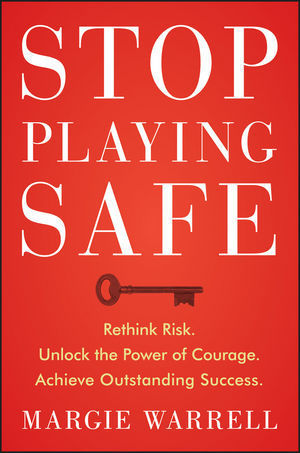 Margie Warrell is a Forbes Columnist, best-selling author, popular keynote speaker, media commentator and internationally recognized thought leader in human potential. Her latest book, Stop Playing Safe: Rethink Risk. Unlock the Power of Courage. Achieve Outstanding Success., helps the reader identify how their risk aversion is holding them back from the kind of success that is within their reach. Margie was gracious enough to sit down for a lengthy Q&A with Giant Leap Consulting. As a courage-building company, we strive to bring you the resources we know can have a positive impact on your life and career. Margie’s work is an excellent resource that we are very happy to share with you.
Giant Leap Consulting (GLC): Stop Playing Safe builds upon, but goes farther than, your first book, Find Your Courage. What took place between the writing of the two books that inspired you to write Stop Playing Safe?
Warrell: Lots! After writing Find Your Courage, I began working more and more with high achieving people in demanding roles in competitive and pressure laden workplaces. As successful as many of them were, many wanted to feel a greater sense of purpose in their work every day and struggled to over come fear and self-doubt in how they went about it.
While Find Your Courage provided a foundation for understanding where fear can hold us back in our lives over all, it wasn’t focused on fear in the workplace and how it can sabotage our professional success. Nor did it address some of the more complex challenges that people face as they try to navigate a career path forward, and try to build their influence and ‘brand’ in organizations where their was a culture of fear, and playing safe often seemed like the smartest thing to do in order to survive.
Of course the global financial crisis of 2008 only fueled fear in many organizations, giving many the excuse they wanted to hunker down, stay silent, play safe and hope for the best.
Yet, as I wrote in Stop Playing Safe, while there’s no doubt that we are living in turbulent times, and the economic landscape has changed, it’s those who are willing to challenge status quo thinking, speak up, embrace change and look for the opportunity with it who will differentiate themselves and enjoy more fulfillment in their working lives.
GLC: Given the dangers of our times, it makes sense that people play it safe. But too much safety can be a dangerous thing, right? How can a person know whether they are being smartly safe, versus dangerously safe?
Warrell: Obviously I’m preaching to the choir when I say to you that playing safe can be a very high risk strategy in our career, business and personal lives. The reality is that we have to take risks throughout the course of our lives if we want to achieve the goals that inspire us and really accomplish what we are capable of doing.
Of course there’s a distinct difference between courageous risk taking and reckless risk taking. We have to do our homework, research the options and be honest in assessing the possible consequences. Great questions to ask are:
1. Where am I over-stating (‘catastrophizing’ and over dramatizing) the risks of what might happen in ways only fuel my fear of action?
2. What’s the worst thing that could happen if I try this and it doesn’t work out? How likely is that to happen if I prepare in advance, and proceed with a plan?
3. How will it cost me if I choose to do nothing? What’s the default path I will end up on if I don’t make this change or take this chance?
4. Where am I at risk of looking back and regretting not having been more decisive, and courageous?
GLC: The story about your brother was very personal, and very affecting. Please share some of that story with our readers.
Warrell: I come from a big close family of seven kids. I’m the second and have an older brother Frank. Four years ago Frank was doing what he has enjoyed doing many times over the years- going out with his buddies riding motor bikes. On this occasion he was riding his bike over the sand dunes outside Doha, the capital city of Qatar, in the Arabian gulf where he was working as an engineer at the time. Unfortunately the particular sand dune Frank rode up didn’t slope down the other side but ended with a sheer cliff. So when Frank reached the top instead of riding down the other side he was flying through the air, 25 feet above rock below. He shared later that in the few seconds he was airborn he wondered if they would be his last. He was an engineer after all and knew his situation was precarious to say the least.
On landing, he lay there and realized he was still alive. He then proceeded to move his head, then his hands and arms to diagnose his injuries. When he got to his legs he could feel nothing. Within a few moments he realized that it was possible he had injured his spinal chord.
Unfortunately he had. In that moment of impact he had severed his spinal chord at T12 and became a paraplegic.
I flew down to Doha as soon as I could, farming out logistics for my four children’s activities to friends as best I could. I spent two weeks with Frank in the rehab hospital in Doha before he was stabilized enough to be flown back to Australia for his full rehabilitation. I recall vividly sitting beside his bed and share the story in my book. But in short it was a profound lesson in the power of reframing as Frank committed to not spend the rest of his life focused on what he could no longer do (which was a lot) but to focus on what he could. He has since learnt how to snow ski, water ski, play tennis and takes an annual trip to Bali to go scuba diving.
It goes without saying that I’m very proud of Frank and that his resilience in the face of adversity inspires me every day. It’s a powerful lesson for everyone – to focus on what you can do, not on what you can’t.
What I didn’t share in the book is that two years after Franks accident my youngest brother Peter took his life after a long battle with schizophrenia. That story will be part of my next book, but I mention it because losing Peter taught me that sometimes life doesn’t go to plan, that it can be unfair, and that sometimes our best efforts aren’t enough, but that to live truly meaningful lives we have to continually give it our best effort anyway.
GLC: What would be your greatest hope for this book and its messages?
Warrell: It’s my passionate belief that every person has the ability to make a really meaningful contribution through the work they do. I hope that Stop Playing Safe helps those who read it connect to a deeper sense of purpose, and to find the courage to fulfill their highest potential in the world, engaging in bigger conversations, challenging their beliefs about what is possible for them and refusing to buy into the fears and self0doubt that drive so many…. too many… to settle, sell out on themselves and who they have it within them to become.
Our special thanks to Margie who took time out of a hectic schedule to talk with us about Stop Playing Safe. Connect to Margie on Twitter, Facebook, or through the Stop Playing Safe website.
—
Disclosure of Material Connection: Giant Leap Consulting has not been paid to endorse this book. We read it, and thought our readers would also value it. We are disclosing this in accordance with the Federal trade Commission’s 16 CFR, Part 255:”Guides Concerning the Use of Endorsements and Testimonials in Advertising.”
The post Stop Playing Safe: Q&A with Best-Selling Author Margie Warrell appeared first on Giant Leap Consulting.
February 5, 2013
Leading Away from Comfort
 It may surprise you that your job as a leader is to make people uncomfortable. Why? Because people learn, develop, and progress in a zone of discomfort, not comfort. It is in the pursuit of challenges that are hard, scary, and uncomfortable that people discover their worth, and convert potential into actual skills.
Most good career opportunities, for example, are – at least on some level -uncomfortable and cause anxiety. When you are asked to lead a group of employees for the very first time, it is an opportunity. It’s also uncomfortable. When you are asked to make a new product pitch to the board of directors, it is an opportunity. It is also uncomfortable. When you are slotted to be your boss’s successor, it is an opportunity. It’s also uncomfortable. If something is uncomfortable, there’s a good chance that it is also an opportunity for personal growth and professional advancement.
Ginny Rometty, the CEO of IBM, says, “Growth and comfort don’t coexist.” Over the course of her career she purposefully sought out work roles where, for a little while, she was in over her head. Doing so ensured that she’d have to quickly learn new skills to stay above water. She attributes much of her success – she is, after all, the first female CEO of the storied company – to her willingness to embrace discomfort.
As a leader, there are two essentials relative to discomfort. First, you have to step out into your own discomfort zone in order to model the importance of doing so to others. Joe Forehand, the former CEO of Accenture, calls this leadership by “sweaty palms.” You have to occasionally do things that are so challenging that they ignite the physiological responses that both fear and excitement provoke (e.g., sweaty palms, stomach butterflies, racing heartbeat, etc.).
The second essential is to nudge people into their discomfort zone so that they stretch their skills and capabilities. The idea isn’t to get people to do wildly uncomfortable things, just willfullyuncomfortable things. If you shove them too far into discomfort, they may get paralyzed with fear, their performance will suffer, and they’ll resent you. They need to know that you’re asking them to do uncomfortable things to promote their growth and career advancement.
In order for this to work, you need to know your employees’ goals, aspirations, and areas for growth, and then provide uncomfortable opportunities to promote those aims. For example, if you’ve got a painfully introverted worker who also aspires to be a leader, you might have that person lead the weekly status meeting in your absence. Conversely, if you’ve got an employee who’s extraverted to the point of being offensive, or oblivious about how everyone else perceives him or her, you might have that person be the note taker at the same meeting, instructing the über-extravert not to talk, only to listen and scribe. The opportunities you provide as leader should be outside of those areas where people already feel comfortably skilled.
This post originally ran at the Human Capital Institute on January 24, 2013. It is reused with permission.
The post Leading Away from Comfort appeared first on Giant Leap Consulting.
January 15, 2013
Looking for the Right Risks in Your Life
 New opportunities – how scary and exhilerating they can be! The tricky thing with opportunity is that they also come with risk. The risk might stop you in your tracks, but do you really want your fear of risk to stop you from accessing all of the opportunities that come into your life? Right now, I’m getting ready for a major change. My husband starts a new job in March, and it requires us to relocate.
The new position is a great fit for him, while also being an excellent opportunity to push himself outside of his comfort zone to learn new skills. But my gracious did we have many intense conversations and sleepless nights while we considered the job offer. While the job was a great opportunity, it also requires us to leave a community we have been a part of for over 10 years and relocate to an area where we know no one. If we moved, we would have to seek out a new community of friends, we would be farther away from family, my husband would be challenged with greater job responsibility, AND we would be leaving our favorite local butcher!
It was a major opportunity, with lots of possibility and also lots of risk. As we considered our options, I used the Right Risk model my colleague Bill Treasurer wrote about in his book Right Risk: 10 Powerful Principles for Taking Giant Leaps with Your Life. Over the next couple of weeks, I’ll be talking about each of the 10 principles here, so be sure to come back for those, but right now, I want to explain what I mean by a Right Risk.
There are four hallmarks of a Right Risk:
1. Passion – Right Risks are risks that have great meaning for us and that we care about deeply. Sometimes a Right Risk will make you suffer because it is something that matters so much. That high degree of caring and suffering stirs up our passion and gives us the energy we need to get through the Right Risk.
2. Purpose – A Right Risk is taken out of a deep sense of purpose. That purpose focuses our passion and provides direction. Right Risks have meaning and represent something more than just ego gratification. Right Risk-takers ask, “How will this risk make me a more complete person?” and “How will this risk further my life’s purpose?
3. Principle – Right Risks are framed by principles. Risks are essentially decisions, and when facing a decision of great consequence, principles form a criteria against which the risk can be considered. These principles might include: truth, independence, compassion, and responsibility.
4. Prerogative – Right Risk-taking involves the action of choice. By making conscious choices that are aligned with purpose and principle, Right Risk-takers are making active choices that move them towards desired goals.
As my husband and I weighed the pros and cons, considered the risk of going, and the risk of not going – we arrived at our decision to accept the new position and move the comfort of these safe harbors. We know we are setting out on an adventure together. After all, don’t most great stories begin with a quest?
Now that I’ve introduced the concept of a Right Risk, remember to check back in to learn about the 10 Principles of Right Risk-taking.
The post Looking for the Right Risks in Your Life appeared first on Giant Leap Consulting.
December 17, 2012
The Role We All Can Play in Preventing Violence Against Children

It’s been a hard few of days. The tragedy in Connecticut on Friday is frightening and numbing. One of the little girls was named Olivia. My nieceis named Olivia. How my heart would have broken had she been a victim in that classroom? How do those parents and families and friends carry on without their little Olivia? We are so sorry for your loss and join with so many others in offering our support.
There is no answer to the question “Why?” that will satisfy. The debate on how to prevent these tragic acts of violence from continued occurance in our country will not be a simple one. This is a complex issue that will likely require multiple levels of response.
Events such as this can often make us feel powerless. We are overwhelmed by the loss and the scope of the problem. Often we look to government mandates, laws, or regulations to address the prevention of such violence. While our government is an important part of the solution, there are also steps that we, as leaders in organizations, can take to contribute to safe, stable, and nurturing relationships and environments for our children.
This week, I’ll share with you some resources about what we can all do – right now – to prevent the maltreat of children. I’ve always said that one of the things I love most about working at Giant Leap is the variety of people and perspectives I get to encounter through my work. For several years, I have had the honor of working with the Knowledge to Action Consortium. This think tank of experts meets a few times a year at the Centers for Disease Control and Prevention, and their focus is to identify ways of preventing child maltreatment at the community and social levels. To treat child maltreatment as a public health issues, that effects the whole community, if you will.
One of the personal effects of facilitating this group is that I have come to a deeper understanding of the value of having prevention be a value within a community. I challenge you to not think of prevention as the domain of non-profits. Rather I urge you to think about what role can businesses and employers play in creating environments that contribute to safe, stable and nurturing relationships for all kids.
Need some ideas to get started? Here are three of the things that we have done at Giant Leap:
1. Support the capacity and knowledge building of organizations that work on prevention issues. Since 2002, we have served on project teams, focus groups, review panels, and offered pro bono services. Look for a chapter of Prevent Child Abuse America in your state, city, or town as a great place to get started.
2. Sponsor a staff training that focuses on the prevention of child sexual abuse. We took the online version of Darkness to Light, and that training reminded me that it is the responsibility of adults to keep kids safe, not to prove that abuse has occurred. The online version doesn’t take much time, but there may be options is your area to have a group training at your organization. If you’re in Georgia and want to have training at your organization, check out the prevention initiative at the Georgia Center for Child Advocacy.
3. Training is not your only resource. We have a flexible working schedule, so that we can flex our time to attend recitals, sports games, family gatherings, volunteer events, or even focus on tending to a sick child. This allows me to not feel as stressed at work if there is a family need to which I need to attend. It helps me to contribute more when I am at work and be more attentive when I am with family.
These are some of the ways that we are working to prevent child maltreatment as an organization. Prevent Child Abuse America released a series of articles titled Why Prevention Matters. Each article is a great resource, but let me draw your attention to one in particular. Michael E. Axelrod is the Managing Member of Trinova Partners LLC, a business consulting firm in Atlanta, GA, contributed to this series and wrote the article “Better Lives for Children Lead to Better Climate for Business.” In it, Michael does a great job of explaining why contributing to the prevention of child abuse also benefits an organization’s bottom line.
There are so many children who are victims of violence in our country. We all have a role is preventing it. Are there things that your organization does to prevent child abuse and contribute to creating safe, stable, and nurturing communities?
The post The Role We All Can Play in Preventing Violence Against Children appeared first on Giant Leap Consulting.


