
Bill Treasurer's Blog, page 30
November 24, 2015
The Courage to Make Mistakes
Sara Blakely, founder of Spanx, shares a story from her childhood — a perspective that helped her build a company with just $5000 and turn it into an international retail powerhouse.
Each weekend, her dad would sit down and ask Sara and her brother one question, a question that helped her learn how to “fall forward” both personally — and later on, as a leader of a multi-billion-dollar company.
His question? What have you failed at this week?
If you never extend yourself to the point of failure, you’re never going to amount to much. tweet this
If you want your people to innovate and use their imagination — learn to increase your tolerance for some degree of making (honest) mistakes.
Hear the full story, plus two ways to immediately put this into practice, in this 2 minute video!
The post The Courage to Make Mistakes appeared first on Giant Leap Consulting.


November 17, 2015
Six Steps to Strong Company-Wide Communication
 Maintaining good communication with co-workers is something that each individual employee must be consistently working on, with the support of informed and involved leaders, of course.
But creating an environment of effective communication is the responsibility of the leadership. tweet this
These tips will help YOU, the Courageous Leader, encourage strong communication throughout your organization.
1. Always identify your target audiences, and encourage others to do so too.
Targets are the various audiences who will be the recipients of the messages you create. They can be managers, field workers, customers, vendors, etc. A single executive message often has to be crafted in multiple ways to satisfy the different needs of the various audiences. Consider including audience-targeting as part of your training or enhancement programs. This will encourage employees and fellow leaders to think carefully about who their message is intended for and how to best communicate with that individual or group.
2. Define your key messages.
Key messages are defined as what you want recipients to go away thinking or doing differently. Generally, key messages stem from strategic goals and/or major company changes. Be sure to know what key messages you are trying to get across before communication begins, and if need be, summarize key messages as defined “takeaways” from the conversation. Knowing your key messages will save the time and frustration that comes with unstructured or goal-less communication.
3. Decide on the best channel/vehicle.
Selection of the best channel depends on the size of the audience, the nature of the info to be shared, and the vehicles to which the audience has historically responded. Many messages are easiest to convey in writing, most often email. However, sometimes a more personal or weighty issue may require a letter or note. And of course, nothing replaces face-to-face communication. Though at times gathering employees together for meetings may seem cumbersome, it may be necessary for certain instances. Rather than convenience, consider effectiveness when choosing a channel or vehicle for communication.
4. Determine the message sender.
For any given message, the sender should be seen as reliable, credible, and believable by the target audiences. They should be someone who can inspire action, and who has enough content knowledge to answer questions accurately. For example, the project manager may be most directly involved with the clients work — but for a big announcement or request, it may be more effective and appropriate for the owner of the company to convey the message.
5. Pinpoint the right time.
Always find the appropriate time to discuss issues with employees and customers. News — both “good” and “bad” — should be shared at a time when it will be well received. For instance, if an employee is feeling particularly down about a mistake made with a client, use your position to empower and re-ignite them, and save the constructive criticism for a time when it will be more helpful to them. When you model opportunistic thinking, you increase the likelihood of a self-sufficient “can do” spirit among employees.
6. Determine the feedback mechanism.
Good communication has a “feedback loop” to ensure that messages are received and acted upon. Be sure that systems are in place that guarantee valuable communication and feedback are not lost in the bogs of email/phone calls/meetings that take place. If needed, add more check-ins or updates along the way.
Achieving solid company-wide communication can seem a complicated and arduous task — but with the correct checks and balances, you can create the kind of environment for communication that is accountable, consistent, and staged for maximum growth and success!
To learn more about Giant Leap’s Communication and Listening workshop, contact info@giantleapconsulting.com.
The post Six Steps to Strong Company-Wide Communication appeared first on Giant Leap Consulting.
November 10, 2015
What Is Your High Dive?
A lot of people ask me, “How did you get interested in the virtue of courage?”
My answer? It actually started with a profound fear!
I was never a great athlete as a kid, but one day at the local pool I “accidentally” did a complete back-flip. I went on to compete in low-board diving — until colleges started asking about my high-board diving. I didn’t have an answer for them, because I had (and still do have) a profound fear of heights. I had to decide whether to face my fear, or walk away from another sport.
How did the kid with a profound fear of heights find the courage to jump off his platform of safety — and become a high dive champion? tweet this
Watch this 3-minute video to find out!
The post What Is Your High Dive? appeared first on Giant Leap Consulting.
October 27, 2015
Risk-Taking Advice from America’s Greatest Mountaineer
 Ed Viesturs is arguably the greatest American mountaineer that ever lived, or more accurately, lives. Ed has a reputation for being a calculated risk-taker, who refuses to compromise safety because of ambition.
As a result, he has summited Mount Everest seven times, almost all without supplemental oxygen. Ed helped people off the mountain during the ill-fated expedition in 1996, which cost the lives of eight people and was featured in two motion pictures, both titled, Everest. Ed has also climbed all 14 of the world’s 8000 meter summits (over 26000 feet) – also known as the “eight-thousanders.”
I came to admire Ed during the writing of my first book, Right Risk. Having been a professional high diver, I wrote the book to help explain why some people are drawn toward risk while others are repelled by it. I wrote about Ed in the book, and since then he’s become one of my risk-taking role models.
I recently caught up with Ed as part of a client engagement that I’m bringing him in to. Risk is an ever-present part of a mountain climber’s reality. As Ed explained, “When I get on a plane with five other climbers, there’s a chance that one or two of us won’t be coming home.”
So what does Ed think is central to accessing risk?
“Listen to the mountain. The mountain decides whether I climb, not me. The mountain has been there for millions of years. I need to continually remind myself that I’m just a visiting guest. I need to respect the mountain. It tells me whether I get to climb, I don’t get to decide.”
Ed shared some additional risk-taking tips that are well worth heeding.
Reject Outside Pressure: You’ll likely make a lousy risk decision if you base it on the influence of outside pressure. Professional mountain climbers face pressure from many sources, including the media, equipment sponsors, paying clients, etc. “There’s a huge difference between feeling that I have to do something and knowing what I should do. Feeling that you have to take a risk is usually a red flag that you’ve lost perspective and choice.”
Instinct Matters: When facing danger, your inner wisdom is the best guide. “Whether I climb or don’t climb often comes down to instinct. If something doesn’t feel right at the gut level, I won’t do it. I’ve learned to trust that instinct.”
Have the Courage to Say No: The closer you get to the summit, the greater the temptation to keep climbing. The ambition of hungry “yes” can cloud one’s judgment. “It takes courage to stop in your tracks and climb back down the mountain before reaching the summit. But because conditions change rapidly up there, sometimes walking back down is the choice that will keep you alive.”
Longevity in a sport like mountain climbing is a precious thing. There’s a reason that Ed Viesturs is a mountaineering legend: he’s disciplined about taking risks. When you choose a life of high stakes being disciplined gives you better odds. For Ed, a thrilling adventure never trumps staying alive. As he says, “Getting up is optional, getting down is mandatory.”
You don’t have to be a mountain climber to benefit from Ed’s advice. When you’re leading a large complex project, or evaluating a big investment, or standing at the threshold of a consequential decision, you’ll better your odds by listening to your inner wisdom, rejecting the notion that you have to make the bold move, and having the backbone to say “no” when the temptation to say “yes” is skewing your judgment. It comes down to respecting the risk and following its lead.
Ed’s right – your odds of taking a successful risk comes down to listening to the mountain.
Originally shared on Huffington Post.
Image credit: atmstudio
The post Risk-Taking Advice from America’s Greatest Mountaineer appeared first on Giant Leap Consulting.
October 20, 2015
The People Have Spoken: Results from Last Month’s Survey
 In last month’s edition of the newsletter, I sent a survey to get your improvement ideas. I want to thank everyone who participated for their thoughtful input. We create these newsletters for you, and I am thrilled to have such valuable feedback moving forward.
Below are some takeaways from the survey, as well as some actions that we are committing to in order to better meet your needs:
Almost all survey participants agreed upon the need for briefer, more practical points that can be read quickly and on-the-go. Specifically, many readers are interested in succinct leadership tips that offer practical solutions to everyday problems and situations. Going forward, you can expect these tips to be a more prominent part of the newsletter, and I look forward to hearing how you apply them!
I was also thrilled to receive a number of specific requests for content! One reader would like advice on “how to wage guerrilla warfare against a culture that’s too afraid to make decisions.” Courageous leadership is always necessary for organizational success but, as this reader points out, today’s world is increasingly squeamish about taking action. I look forward to addressing this confusing situation that so many of us can relate to!
Another good question was: “If no one has had Courageous Leadership training but me, what are tips to help change the culture to be more courageous, direct, straightforward, etc.?” As we know, it’s much more difficult to ignite change in others than in ourselves, especially when the “others” are lacking in certain aspects of their education or training. Questions like these are fuel for our newsletter fire—please email us with any questions that you may have and we will do our best to address them!
In addition to requests for content, we did also receive some feedback about how we can do better — which was really the point of this survey. The consensus seems to relate back to the desire for more brevity and conciseness. As one reader summed it up, “Be more real, be brief. Get to the point!”
The last thing we want to do is bog you down with another long-winded email that will quickly be re-directed to the trash! The bottom line is, starting today, you can expect a shorter, to-the-point newsletter with valuable leadership tips that addresses your questions and concerns.
Thank you so much to all of our newsletter subscribers, with a special tip of the hat to those who participated in the survey. We look forward to making changes and improvements that will help you be a better, more courageous leader each day.
And if you haven’t signed up yet to receive the newsletter — why not? Sign up here!
Image credit: Stuart Miles
The post The People Have Spoken: Results from Last Month’s Survey appeared first on Giant Leap Consulting.
October 13, 2015
Keeping An Opportunity Mindset
 Opportunities are the venues where people can try themselves, test themselves, better themselves, and even find themselves. The leader’s job is to match the opportunity to the person and to help the person, and the organization, exploit the opportunity for all it’s worth.
Being an open-door leader requires having an opportunity mindset, a significant shift from the more common threat-focused way of leading.
Fear and excitement prompt the same neurological responses. Think for a moment about what happens to you, physiologically, when you are really, really afraid. Your heart races, your palms sweat, your breath gets faster and shorter, and your stomach teems with butterflies. Well, guess what? Those same physiological responses happen when you are going to have sex!
If fear and excitement are both high-arousal states, why is fear so detrimental to creating opportunity while excitement is so effective?
Though there are almost no neurological and physiological differences, there is one critical distinction between the conditions of fear and excitement. You experience fear as displeasure, and you experience excitement as pleasure. It follows that you move toward situations that provide pleasure and you avoid situations that provoke displeasure.
Here are some specific impacts of keeping an opportunity focus:
Opportunity Pulls: Leading by stoking people’s fears provokes anxiety and negative thoughts of impending painful consequences. But opportunities are hopeful situations that evoke positive thoughts of pleasurable rewards. Leadership is most effective when it moves people toward a desired outcome rather than getting them to run away from a bad outcome. Opportunity attracts; fear repels.
Opportunity Points in the Right Direction: When you are talking about opportunities, you are talking about the conditions you want instead of the conditions you want to prevent from happening. Because outcomes often follow the direction of our thoughts, it’s best to focus on what you want vs. what you don’t. “Our opportunity is to keep the ball in the air” is better than “Whatever you do, don’t drop that ball!”
Opportunity Activates Imagination: We “take advantage of” or “capitalize on” opportunities. They are conditions that don’t yet exist, and require people’s hard work and imagination to be fully exploited.
Opportunity Inspires Courage: Opportunities are not sure things. The positive outcome you hope to create is not guaranteed. Thus opportunities come with potential risks. The risk is what infuses the pursuit of opportunities with pleasurable excitement.
Opportunity Begets Opportunity: Would you rather have your employees coming to you with new ideas and opportunities they want you to support — or problems they want you to resolve? When you model opportunistic thinking, you increase the likelihood of building a self-sufficient, can-do spirit among employees.
Focusing on opportunity instead of problems is not just a matter of semantics. By viewing and explaining situations as opportunities, you create a field of excitement where employees are more apt to face challenges than shirk them.
Leaders create leaders by opening doors of opportunity that have a positive and lasting impact on the behavior of those they lead.
The post Keeping An Opportunity Mindset appeared first on Giant Leap Consulting.
October 6, 2015
Answer the Holy Question
Let’s say you decide to start being more courageous at work, home, or life in general. That’s great!
So where do you start?
You start by answering the “holy question” — what do you want? A lot of people can tell you what they don’t want, but they aren’t really sure what they do want.
Watch this short video to learn more, and start closing the gap between where you are today and where you could be if you applied more courage in your life.
The post Answer the Holy Question appeared first on Giant Leap Consulting.
September 23, 2015
Opening the Thought-Shifting Door
 In addition to providing people with tangible, skill-developing work opportunities, open-door leaders need to know how to shift people’s thinking. Real opportunities can be found in convincing people to become imaginative by freeing them from narrow, negative, or habitual thinking.
You may be surprised to hear that encouraging thought-shifting is not as difficult or complicated as it may seem.
Consider Your Words
Sometimes just making small language shifts can have a huge impact on how people define themselves and their roles. The owner of a $4 billion construction company wanted his division heads to do less managing and more leading. For decades, the division heads had been called business group managers.
Was it really any wonder then that their focus was on managing their divisions? But the owner now needed them to focus less on internal operational issues (management) and more on external opportunities, such as developing business with clients (leadership). So he did something simple but important: he changed their job titles and, by definition, the expectation and focus of their jobs. Now the division heads are called business group leaders.
There are many simple ways that a shift in language can lead to a shift in thought. For example, do you refer to those you lead as your “employees” or your “team?” Are you the “boss” or the “leader?” Are you conducting a “performance review” or a “check-in”?
Shifting from a negative framework to a positive one is another effective way to shift thinking. For example, when you hear a good idea from an employee, instead of responding “Not bad!” say “Pretty good!” Choose your language deliberately and you will be amazed by how quickly it will shift your thinking and the thinking of those around you.
Catch Them Off Guard
Inspiring creativity and imagination often requires disrupting people’s mental routine and catching them off guard.
For example, a large manufacturer of paper plates held a series of marketing meetings. For people who spent most of their working life centered on this commodity product, the way to reach more customers was pretty straightforward: discounting! Any time the company wanted to increase market share, they would just pump out more Sunday coupons. But the temporary discount-driven boost in market share would often come at the expense of lower profit margins.
The division’s leader needed people to be more imaginative than just defaulting to discounting all the time. He wanted people to remember that they weren’t just selling plates, cups, and napkins. They were working for a brand that was deeply connected to the family experience.
To lift people out of the rut of discount thinking, he conducted a brainstorming meeting at a beautiful community park near the corporate headquarters. The meeting was different because it was set up as a backyard barbeque. There were picnic tables with red-and-white checkered tablecloths, an outdoor grill sizzling with hotdogs and hamburgers, even outdoor games like horseshoes and tetherball. Of course there was something else too: lots of the company’s plates, cups, and napkins. They weren’t just commodities; they were an essential part of the experience. The division’s open-door leader had helped people shift their thinking away from commodities and toward values and traditions.
New ideas started to emerge quickly — such as partnering with an outdoor grill company, including summer-inspired flower designs on the borders of the plates, clever wording on the packaging, and other methods for appealing to people’s values rather than just their wallets. Someone even thought to create a website where people could swap summer recipes, an idea that could potentially connect countless individuals and rally them around the company brand.
Changing your language or going outside (literally or figuratively) are two simple ways you can shift the thinking in your work environment. However, the means you use matter less than getting people to think positively, constructively, and productively.
You can begin your thought-shifting campaign by asking yourself the following questions:
What are some ways that your organization typically tries to inspire creative ideas?
What about the approach works well?
What opportunities for improvement do you see?
Image credit: Antranias
The post Opening the Thought-Shifting Door appeared first on Giant Leap Consulting.
August 26, 2015
Leadership Is Freakin’ Hard
 Congratulations! You’ve become a leader! At last, your ideas will be listened to, valued and heeded. People will finally take you seriously. Now your impact, influence, and income will grow.
Ah, the life of leader. Issuing orders. Imparting wisdom. Developing underlings. Effecting results. Reaping rewards. After all those years slogging it out in the trenches, you finally get to be in charge…where you belong.
But before you put on your leader cape and start saving people from their own destruction, there’s something you need to know. Something that most leadership books gloss over or avoid altogether. Something that will shift your perspective, temper your idealism, and keep your leadership centered. Leadership is freakin’ hard.
So What’s the Problem?
Leadership that’s hard is leadership that’s unattractive. One global study of 2,422 millennials showed that less than 20% of them desire to be a leader at a large organization. Why? Because they view the traditional role of a leader as one that places too much emphasis on profits and production, and not enough on developing people or contributing to societal good. To them, launching their own venture is vastly more attractive than working in a large organization, with 70% viewing entrepreneurship as the preferred career path. The thought of leading in a large organization, from their perspective, is as sane as living in a Dilbert cartoon.
People need to believe in leadership again. Attracting and inspiring future generations of leaders will require a more grounded, realistic, and authentic view of leadership. Budding leaders don’t need any more advice from celebrity leaders, politicians, or sports heroes. They don’t need a toolkit for breaking into the corner office. They don’t need any more cotton candy leadership platitudes. They don’t need more tips for moving from good to great. The starting point for new leaders isn’t “good” — it’s “Holy crap! What have I gotten into?!”
What’s So Hard about Leading?
Good leaders nearly always start out as bad leaders. They become more effective by first becoming less ineffective. Doing that requires a careful understanding of what makes leadership so freak’n hard.
Adults Are Big Babies: You lead people, and people are fickle, quirky, and often petty. Adults are just grown up kids wearing bigger clothes and sporting larger and more fragile egos. Yes, they can also be smart, passionate, and upstanding. But on any given day, in any given work situation, it is hard to predict which people are going to act like adults and which are going to act like whiney, sniveling, irritable babies. Some people will respond to your feedback receptively, others will stew with resentment. Many days you’ll be the biggest baby in the room. Usually when you think everyone around you are acting like babies.
Demands Are Relentless, Unforgiving Bastards: You’re only deemed successful as a leader if you get results. The drive to produce results is incessant. No matter how well you do this quarter, or with this project, or with this customer, you’ll be expected to do more and better next time. Your reputation is always on the line. You’ll go through a lot of antacids.
Making People Uncomfortable is Your Job: People are comfort-seeking creatures. But because people grow, progress, and evolve in a zone of discomfort, the harsh reality is, your job as a leader is to make people uncomfortable. But guess what? People get mighty upset when you make them uncomfortable.
The Cavalry Isn’t Coming: You’ll often feel under siege by the challenges you’re facing. Regardless, you’ll be expected to bring them to resolution – without the aid of a handbook. With no cavalry to rescue you, you’re forced to grope your way through, often making things up as you go along. Often you’ll feel like a fake on the inside while portraying confidence on the outside.
The Biggest Problem is Mostly You: Leaders often get in their own way by being overly judgmental, holding people to unrealistic standards, and caring more for results than people. When results suffer, leaders often resort to intensifying these kinds of behaviors, negatively impacting performance, loyalty, and morale.
Leadership is Crazy Good!
So why put yourself through all the hardship and criticism? The answer is found in the most satisfying result of a leader’s impact: more leadership.
In my work as an author and leadership consultant, I’ve had the privilege of working with thousands of leaders throughout the world. One question I often ask leaders is this: At the end of your leadership career, what will have made the challenge of leadership all worthwhile? By far the most frequent answer goes something like this: “I will have built other leaders who themselves are building other leaders.”
When you are privileged to be lead others, your influence can impact the trajectories of people’s entire careers, potentially helping them become more courageous, just and humane. When done right, the best of you may bring out the best in others. In the process, they may become inspired to lead too. The pain associated with enduring the hardships of leading others is offset by the satisfaction of making a positive difference for the people and organization you serve.
Starting with a presumption that leadership is hard helps to mitigate over-confidence, inspire earnest preparation, and activate a deeper and more authentic commitment to lead. Ultimately, by soberly and thoughtfully assessing how freakin’ hard leadership is, you’ll stop freaking out about having to lead.
Originally published at Huffington Post on 8/18/2015
Photo credit: unsplash
The post Leadership Is Freakin’ Hard appeared first on Giant Leap Consulting.
July 30, 2015
Getting Real in the Bubbily Boo
 My kids are my greatest teachers. Here’s a quick story to illustrate one powerful lesson they recently taught me.
My youngest son, Ian, started singing a song that he had heard on the Disney channel, “Down in the Bubbily Boo.” The song was cute and catchy, so the rest of the family joined in. To mix things up, my three kids would do various renditions of the song. “Sing it like an old lady this time!” or “Sing it with a French accent!”
After many different Bubbily Boo renditions, including versions in Opera and Munchkin, my son Alex challenged my son Ian to sing it like “Dad when he’s being the business person.” Ian then stiffened his back, cleared his throat, and started sing-talking like a newscaster delivering a special report. “Down in the bubbily boo,” he said, with furrowed brow and deliberate hand gestures.
Through the humor, I got the point: regular dad is distinctly different than business-person dad. With one innocent imitation – of me – my kids had pointed out the gap between my self-self and my business self.
I’ve decided that I want to close that gap. The truth is, I’ve been playing it very safe in my writing, and in my business dealings in general. There are a lot of crazy and upsetting things happening inside and outside of work, and I’ve kept my mouth shut for fear of alienating some of my readers and clients. In the process, I’ve become politely benign.
You’ll notice a shift in this blog post. We’re going to more assertively participate in conversations that need to happen. In other words, we’re going to live more consistently with our company’s mission: to help people and organizations be more courageous.
Going forward I plan on writing occasional posts under the header “Bill in the Bubbily Boo.” I’ll share my perspective on things that we tend push underneath the murky waters of simmering indifference – the sensitive stuff that scares us with a big “Boo!” You’ll always have the option of not reading the Bubbily Boo bits if you prefer to stick with Giant Leap’s standard business stuff. But I do hope you’ll consider joining me down in the bubbily boo!
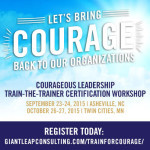 Did you know that when people operate from a place of courage and confidence they are more innovative, build stronger teams, and speak up more often? Are you curious about the impact courage can have on your workplace? Check out our Courageous Leadership Train the Trainer program to learn more about our September program in Asheville, NC, and the October program in Minneapolis, MN.
The post Getting Real in the Bubbily Boo appeared first on Giant Leap Consulting.


