
Bill Treasurer's Blog, page 31
July 1, 2015
Taking a Velvet Hammer to Time-Wasting Meetings
 I was speaking with a friend recently who is at his wits’ end about how his weekly staff meeting runs.
He is already doing a lot of things right. He creates and circulates an agenda in advance. He emphasizes the start and end times of the meeting, and why it is important for them to end on time. Over lunch, he and the staff have time to socialize to get all of their stories out before the staff meeting begins.
During the meeting, he tries to redirect, focus people, and give each person a set amount of time to cover their area. Despite all of these steps, his staff meetings balloon and never end at the 90-minute mark. They always run long. Have you ever been in those shoes?
Have you ever struggled with how to turn a chronically frustrating meeting into a more productive use to everyone’s time?
As I continued to reflect upon his situation, I began to think it was time for him to use his velvet hammer. The velvet hammer is a crucial tool for all leaders. It’s what Bill Treasurer described in Leaders Open Doors as wrapping the hard, difficult message in a style of delivery that helps people receive it.
How would I use the velvet hammer in this situation? Here are the five steps I would take:
Plan and Share the Agenda – As usual, create the agenda, make clear start and stop times, allocate time to each person, and distribute that agenda to your staff. The change? Put the staff who try to keep meetings on-track first on the agenda. Place the chronic meeting de-railers on the back half of the agenda.
Remind Your Staff – Meet one-on-one with each of the staff in advance of the upcoming meeting. Remind them that the meeting will end after 90-minutes, even if all areas haven’t been addressed. This is the time to let them know you’re serious.
Run the Meeting with Confidence – Remember, you set the tone. Use a timer everyone can see that will ring loud enough for everyone to hear. Start the meeting on time, and remind everyone that you’re sticking to the agenda. As you move through agenda segments, praise them if you’re on time or point out that you’re however many minutes behind.
Hold Your Ground – Finish the meeting at the 90-minute mark. If they got all business concluded, praise them again! They’ve turned over a new leaf. However, if their previous patterns continued and all business hasn’t been covered, you’ve still got to end the meeting. Say, “That’s all the time we have. You all knew we had 90 minutes and we had to end for that reason, yet we still didn’t cover all the areas. Next week, our staff meeting will also be 90 minutes long, and I expect that we will cover all areas. If we didn’t get to your area, stick around and we’ll schedule 5 minutes together to be sure you can keep making progress on your work.”
Keep Holding Your Ground – Some of your staff will get frustrated, especially if one of the time-wasters didn’t get to cover their area. Talk with them and remind them that you warned them. Now is the time you need to keep holding your ground and stick to what you say. Let everyone know the next staff meeting will be run in just the same way.
I know this is a jarring approach to keeping a meeting on track, and it shouldn’t be your first strategy to deploy. But sometimes a jarring encounter with the velvet hammer is what your team needs to understand your expectations and improve their performance.
When you are faced with meetings that can’t stay on track, what do you do?
Let us know on Twitter and Facebook!
Image Credit: Unsplash
The post Taking a Velvet Hammer to Time-Wasting Meetings appeared first on Giant Leap Consulting.


June 25, 2015
What are your kids teaching you about leadership?
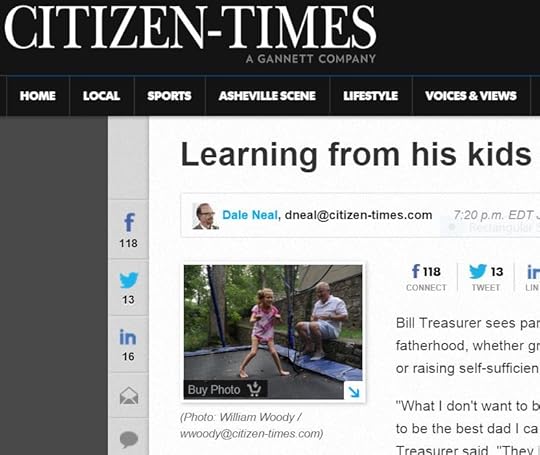 To all of the fathers and father-figures out there, we want to say thank you!
This past week, the Asheville Citizen-Times spoke with our own Bill Treasurer about fatherhood, his kids, and how those things influence his work.
In the article (click here to read the full feature), Bill reminds us that we can equate leadership to parenting in a direct exchange. As leaders, we certainly don’t want to guide our employees as much as children need to be guided. At the same time, there is much we can learn from our children that can positively influence our leadership in the work sphere of our lives.
As Bill says in the article, “The best fathers [and mothers] and the best leaders try to bring out the full potential in their children or their employees.”
We want to say thank you to all of the fathers and father figures out there who are trying to bring out the best in both the children they care for the and the people they lead! Connect with us on Facebook or Twitter to let us know some of the lessons your children have taught you about leadership.
The post What are your kids teaching you about leadership? appeared first on Giant Leap Consulting.
May 5, 2015
The Best Part of Leading
 Leadership is hard work. It takes making accurate decisions based often on inaccurate or incomplete data. It requires bringing about change and contending with the resistance that it prompts. It requires caring about those you lead, but remaining objective enough not to get swayed by peoples’ sucking-up. It takes having a thick enough skin to weather the unending second-guessing and Monday-morning-quarterbacking of critics who assume that could do better than you.
Given how hard – and often thankless – the role of leader is, the question becomes, why do it? Why put yourself through all the hardship and criticism? The answer is found in the most satisfying result of a leader’s impact: more leadership.
For nearly two decades I’ve designed, developed, and delivered leadership and succession planning programs for emergent and experienced leaders. One question I’ve asked thousands of leaders is this: At the end of your leadership career, what will have made the challenge of leadership all worthwhile? By far the most frequent answer goes something like this: “I will have built other leaders who themselves are building other leaders.”
When done right, leadership begets more leadership.
Let me give you an example. I’ve been working with a Chicago-based construction company for nearly ten years. I helped the company launch a leadership succession program to help develop the bench strength of the company’s next generation of leaders. In the decade since the program launched, many participants have moved up the ranks into senior leadership positions. I’ve literally watched people transform from just-out-of-college rookies to thoughtful business-minded leaders.
The best part of leading is bringing out the leader in others. Last week I led a strategic planning offsite with my Chicago client. As each of the transformed leaders forecasted the strategic outlook for their respective divisions, many of us grey-haired folks in the room swelled with pride. We knew their starting point. We had watched them grow from awkward or falsely-confident green-beans to comfortable-in-their-skin leaders.
Always remember that leadership is a privilege. When you’re in a leadership role, your influence may impact the trajectory of peoples’ entire career (and often life!). When you do it right, you create a legacy of other leaders who can bring their goodness into the world.
Here are some tips for helping build a leadership legacy:
Know Thy Leadership Self: Give some thought to the leader you aim to become, and the mark you hope to leave on others.
List Your Leaders: List the leaders who have most impacted you. What positive parts of their leadership do you carry with you in your thoughts and behaviors?
Seek Feedback: Invite people to share their perspective on your leadership. Send people a simple email asking them what it’s like to work with you, how they would describe your leadership style, and what leadership behaviors are most noticeable.
Show Gratitude: Say “Thank you” frequently and sincerely. Let people know that you don’t take the privilege of leading others for granted. Leadership is an honor, so be honorable.
To lead is to apply the best of yourself in order to get others to apply the best of themselves. The dividend of great leadership is more great leadership.
 Bill Treasurer is the Chief Encouragement Officer of Giant Leap Consulting. In 2014 his newest book, Leaders Open Doors (www.leadersopendoors.com), became the top-selling leadership training book on Amazon. Bill is also the author of Courage Goes to Work, an international bestselling book that introduces the concept of courage-building. He is also the author of Courageous Leadership: A Program for Using Courage to Transform the Workplace, an off-the-shelf training toolkit that organizations use to build workplace courage. His first book, Right Risk, provides strategies for smart risk-taking. Bill has worked with thousands of executives from top organizations, including NASA, Accenture, CNN, UBS Bank, Spanx, Hugo Boss, Saks Fifth Avenue, the Pittsburgh Pirates, and the US Department of Veterans Affairs. Contact Bill at btreasurer@giantleapconsulting.com, or on Twitter at @btreasurer.
The post The Best Part of Leading appeared first on Giant Leap Consulting.
March 10, 2015
Tips for Leaders Who Lead Teams of Leaders
 People want to follow leaders who know where the hell they’re going.
If the leadership team looks like a contentious disorganized mess, people throughout the organization will quickly lose confidence. When you and a small group of other leaders are entrusted with creating a better future for those you lead, being unified at the top is the surest way of gaining people’s confidence. This, of course, is easier said than done.
Gaining unity among senior leadership teams is, for a number of reasons, more challenging than at other levels in an organization.
First, leaders are used to leading, not teaming. A leader of a division or business unit is used to directing the team leaders who report to her. Even if the leader’s approach is collaborative, she is where the buck stops – the decider in chief of her domain. Shifting from the leader to just another member of the leadership team involves a diminishment of power that can feel unnatural.
Second, the ego stakes are also higher on top level teams. Leadership, consciously or unconsciously, often involves social and/or intellectual dominance. Senior leadership teams often struggle with dysfunctional competitive dynamics as team members try to out-dominate each other. For everyone looking for direction from the leadership team, it can be an ugly sight when they see big egos clashing with big egos.
So what’s a leadership team to do?
The tips that follow stem from Giant Leap’s experience working with senior executive teams:
Unify Around Values: Values are natural unifiers. While leadership team members may differ in style and approach, they can find commonality around values. The first place to start is with the organization’s values. If those haven’t been explicitly codified, have the team craft its own set of core values by asking this question: When we are working at our best, what shows up?
Be Behavioral Standard-Bearers: Leaders set the behavioral tone for the rest of the organization. If the leadership team members are petty, domineering, or uncooperative with each other, you can bet people in the rest of the organization will behave that way too. Have the leadership team flipchart their answers to these questions: What is the rest of the organization looking for our team to provide? What kind of leadership team do we need to be, to best serve the people in our organization?
Set Shared Goals: During leadership team meetings, pay more attention to shared organizational goals than to divisional or business unit goals. Place more emphasis on where the organization is going directionally than how each division is doing operationally.
Create Opportunities to Co-lead: Strategic initiatives are often spawned during senior leadership team meetings. When they are, rather than assigning one person to own or sponsor the initiative, let two or three members act as co-leaders. Doing so will necessitate cross-team collaboration, which can go a long way toward dismantling divisional walls.
Formally Schedule Informal Time: Leaders are under constant pressure to perform. Making results happen is always the priority. As such, members on leadership teams don’t often make time for the informal bonding that characterize strong teams. Whoever organizes the senior team meetings should weave occasional get-to-know-you segments into the agenda (it works best at the agenda’s start). Another approach is to task each team member with learning something unique about another member’s outside-of-work self and bringing what they learn back to the entire team. There are plenty of ways to promote informal bonding. Just get creative.
The most successful organizations are led by unified leadership teams.
When everyone else sees leaders who cooperate, collaborate, and team well together, they start to emulate the same behaviors. The benefit to the leadership team itself is just as powerful; enjoyment.
When top team leaders learn to play nice in the sandbox with one another, the team experience becomes more enjoyable. When that happens, the leadership team becomes a safe haven where top team members can support, guide, and encourage each other, becoming leaders helping leaders.
Bill Treasurer is the Chief Encouragement Officer of Giant Leap Consulting. In 2014 his newest book, Leaders Open Doors, became the top-selling leadership training book on Amazon. Bill has worked with thousands of executives from top organizations, including NASA, Accenture, CNN, UBS Bank, Spanx, Hugo Boss, Saks Fifth Avenue, the Pittsburgh Pirates, and the US Department of Veterans Affairs. Contact Bill at btreasurer@giantleapconsulting.com, or on Twitter at @btreasurer.
The post Tips for Leaders Who Lead Teams of Leaders appeared first on Giant Leap Consulting.
February 24, 2015
Let’s Cause Some Transformation Through Courage
 Earlier this month, I led a Courageous Leadership for Women workshop at the Training 2015 Conference in Atlanta. I spoke with a great group of around 45 women. And I forgot to take any pictures, sorry!
There was real energy and curiosity in the room. Interestingly, a number of women would say a variation of, “I don’t know if anyone else has had this experience, but…” It was interesting because 100% of the time one or more women in the room nodded in agreement that they, too, had had that experience.
Now for something I think is true for women and men. Challenges isolate us. We get into a frustrating situation or project, and we often think we’re the only one who has experienced it. We think we’re the only one to have felt insufficient to a problem, dismissed for our effort, or overlooked as a member of the team.
We can let challenges isolate us. We can also let challenges be the adhesive that connects us to our team.
We can take those challenges and points of frustration to lead, trust, and speak with greater courage. The challenge can become an opportunity. Or even a “whopper-tunity” as a former teacher of mine would say.
When we let courage fuel us and drive us to come together to work and learn, we can achieve transformation.
I’ve shared with you a lot about courage on my recent blog posts. Maybe you’re a trainer within an organization and find yourself curious to learn more about how to incorporate Courageous Leadership into your existing training. Or maybe you have your own consulting practice and want to see how Courageous Leadership might compliment your work.
If you want to dive deeper into Courageous Leadership, think about joining Bill and me at one of our Courageous Leadership Train-the-Trainers.
In 2015, we’re offering two Train-the-Trainers.
September 24-25, 2015 in Asheville, NC
October 26-27, 2015 in Minneapolis, MN
If you want special access to the world’s first courage-building training program, this is a train-the-trainer you don’t want to miss. Each session will be two days packed with information. Bill and I will be sharing everything we’ve learned about leading the program through our hundreds of hours of experience. Registration includes:
The Courageous Leadership Facilitator Guide (retail value: $228), containing…
2 thumb drives with ALL program PowerPoint slides
Workshop “scripts” so you know what to say during courage-building workshops
Alternative agendas to support multiple workshop formats (1 hour session, 1/2 day workshop, 1 day workshop)
Experiential activities you can use during courage-building workshops
Lots of other stuff!
Courage Goes to Work (retail value: $26.95), the book that introduced the new organizational development practice of courage-building.
2-days of intimate access to the world’s most experienced courage-building experts.
Class size is limited to 15 to ensure lots of one-on-one attention. We’re currently offering an early bird discount. You can reserve your place today for $899.
If you want to learn more and register, check out our train-the-trainer information page. I want to help you bring courage to your organization. Register for one of the train-the-trainers and let’s make it happen!
Tomorrow, our monthly newsletter comes out. In it, we give exclusive content to our subscribers. This month, I’ve got some brand new ideas about the impact that courage can have on women as a supercharging element to their goal achievement. If you would like access to this exclusive article, please subscribe here.
The post Let’s Cause Some Transformation Through Courage appeared first on Giant Leap Consulting.
February 23, 2015
How to Improve as a Trainer
 Do you want to continuously improve as a trainer?
Here are some training tips that I’ve learned through trial and error.
How long have you been a training professional? Whether you’ve been in it for 25 years, 6 years, or 4 months, you’ve probably dealt with a tough person or group.
I love being a trainer and workshop facilitator. It keeps me on my toes, and I feeling like I’m solving puzzles in my head the whole time. I know I’ve had a good session, when I leave feeling like I’m done a good workout. Because I know that I gave it my all and did everything I could to help the people connect with the ideas I was sharing.
While I haven’t found a 100% successful strategy for eliminating all challenges, I do have some strategies that help to me to prepare and deliver effective workshops.
It may sound silly, but you’ve got to remember to care deeply about the people you are training.
Bill Treasurer, the founder and CEO of Giant Leap, and I believe this so much that when we co-facilitate we literally look at each before a workshop and say, “Remember to love them.” For me, it helps ground me in the truth that these are people coming with their own wisdom and experience. I need to honor that and appreciate what they have to say.
One of my favorite things to say in a workshop is, “Tell me more about that.”
If you have someone who keeps giving you one word or short phrase answers, it’s a great way to draw them out and put the responsibility of their learning back on their own shoulders. Likewise, if you have a person who offers a really thought provoking statement, it’s a gentle way to have them provide even more insight.
I’ve prepared a free PDF download that provides you with Eight More Powerful Training Tips. They are strategies I employ that have worked for me. I hope they work for you too. Just click here to access it.
I hope you’ve found these ideas and resources I’ve been sharing with you valuable. I know you’ll do good and meaningful work with them. Tell me, what are some of your best training tips? Share them in the comments or over on Facebook.
The post How to Improve as a Trainer appeared first on Giant Leap Consulting.
February 19, 2015
How to Train for Courage
 Courage can be transformative. BUT how do you train for courage?
Now that’s a good question. We’ve talked now about the transformative potential of courage, both to your people and to your organization. But how do you unlock that potential? Let’s dive into that.
I’ve got three critical questions you’ve got to ask yourself:
What is driving the need for courage in your organization?
What are some appropriate displays of courage you would like to see more often?
Why do people, including yourself, avoid acting with courage?
Have you answered those? If you have, you’re on the way to understanding how to best incorporate courage into your organization. Courage is very personal. What requires me to be courageous is different from what requires you to be courageous. The same goes for your people. They won’t all show up tomorrow asking for new projects to lead. You’ve got to connect with them. Here are some ideas I’ve got on how to do that.
Start conversations. Remember, courage is personal. Talk with them. Find out what they want to do or learn but haven’t pushed themselves to do yet. Ask them about times they were nervous, anxious, or uncertain (all indicators that you’re encountering your fear), but pushed through that and did the tough thing anyway. Share with them times you didn’t push through your own discomfort, and as a result an opportunity passed by that you regret losing.
Banish this; replace with that. If you take only one thing from here, let it be this. Don’t talk to me (or your people) about what keeps you up at night. Stop spreading your fear and anxiety to me. Talk to me about what gets you up in the morning! I want to know what inspires you, excites you, makes you look forward to working with the people you spend so much time with. Don’t you think the people you lead and work with want to know the same thing?
Collaborate on the possibilities. Are you great at giving answers and direction, or do you take the time (probably extra time) to draw out possible answers and direction from your team members? I want to encourage you to be very deliberate about drawing people out on your team. Solicit their ideas, give room for that discussion, and strive to not dismiss their ideas immediately.
Make way for courage. If you are asking your team to show up with more courage, be prepared for them to do just that! This means you have to provide them with meaningful challenges, engage them in problem solving, share responsibility, and be open to their feedback and ideas.
Recognize the effort. Courageous decisions involve risk to some degree, which means every one won’t work out the way you had planned. As you work with your people to be more courageous, some of their work won’t turn out perfectly. They’ll stumble and make mistakes. Work with them to learn from those mistakes but remember to applaud the effort not just the results of their courageous decisions.
These ideas are focused on use as a leader, and I want to share two leadership dispositions.
The Filler – a leader that builds people’s confidence and encourages those they lead and work with to grow and move outside of their comfort zone
The Spiller – a leader that motivates through fear, they are often overly anxious or cautious and discourage those they lead
I’ve prepared a free PDF download that tells you even more about these two leadership dispositions and includes some tips on dealing with a Chronic Spiller. Just click here to access it.
For now, think about a boss you’ve had that you really admire. What did they do or say to encourage people?
Tell me in the comments or over on Facebook.
The post How to Train for Courage appeared first on Giant Leap Consulting.
February 17, 2015
Why Should You Train for Courage?
 Are you wondering, “What is this courage stuff, and why should I bother?” I’ve got some answers to those questions in this post, plus at the end I’ve got a free downloadable resource for you.
If you want to learn about courage, you also have to learn about fear.
Courage and fear have an interwoven relationship, and few places are as full of fear as our workplaces. Unfortunately in many of our workplaces, leaders bang on the fear drum as an attempt to motivate others. But it’s not only bosses who are fearful. Fear will often be present throughout an organization. What we’ve got to realize is that fear is bad for business. In the short run, fear might motivate workers to go harder, faster, or longer; it will also stifle their willingness to step-up and take on new challenges or speak-up and share important information.
Are you seeing employees trying to distract from problems or hide mistakes? Are you experiencing a decrease in engagement? Are your people just maintaining the status quo and conducting business as usual, devoid of any new ideas? Do you see high levels of distrust and dysfunction on your teams? Are you plagued by turnover?
If you said yes to any of those questions, you’re feeling the insidious effects of fear.
Courage is source material, the wellspring from which other concepts are fed and strengthened. If you get the courage right first, such things as leading, teaming, communicating, changing, and improving become easier. I believe that everyone can be courageous, you’ve just got to activate it.
Let me tell you how courage can make a transformational difference. I am in my seventh year with Giant Leap, and I love my work. I plan and lead training with clients, I speak at conferences, and I meet great folks at expos.
When Bill Treasurer, the founder and CEO of Giant Leap, and I met to discuss our big strategies for the year, he gave me a new opportunity. He invited me to take on new responsibilities for some behind-the-scenes work. It’s an area that I didn’t have a lot of knowledge in, but was excited to tackle. I’ve been consuming podcasts on the subject matter, reading books, and mapping out some bold plans for our year. I’m stepping up to this opportunity and love my work even more! Bill trusted that I would grow into the opportunity, and I moved toward that opportunity rather deflecting due to intimidation or fear.
That is why you and your organization need and should train for courage. When people are operating out of courage and conviction you see more personal accountability, confident upward communication, embracement of change, transparency and openness, initiative-taking and so much more.
I think courage can show up in the workplace in three ways:
Try Courage – the courage of action and pioneering first attempts
Trust Courage – the courage of relying on the action of others
Tell Courage – the courage of using your voice and speaking up
I’ve prepared a free PDF download that tells you even more about the three types of courage and some tips for activating your courage in each area. Just click here to access it.
Next time, I’ll share with you some ideas about how to effectively train for courage and give you some content on two leadership dispositions.
Until then, what courageous act have you been avoiding at work and why?
The post Why Should You Train for Courage? appeared first on Giant Leap Consulting.
February 10, 2015
Service With Sprinkles Takes Courage
 What makes a great cookie special? Sprinkles! What makes great service special? Innovative service.
Chip Bell expands on this theme in his newest book, Sprinkles: Creating Awesome Experiences Through Innovative Service, and shares a few of those thoughts in this delightful post!
You have been the sole proprietary of a small antique store that did so well a large chain made you an offer you could not refuse. So you cashed in and pocketed a sizable profit… enough to ensure a great retirement. After a few weeks, you are bored and ready to return to work.
You greatly miss the fun of delighting customers with your innovative extras in your store. You wore a tuxedo to work to the amazement of patrons who crossed your threshold. Fifties music played in the background, conjuring up great memories for customers as they perused your cornucopia of items for sale from yesteryear. On the checkout counter, next to the antique cash register you used, was a container of free sassafras candy and a complimentary copy of a replica of the local paper – fifty years prior. Even the receipt had a parchment look about it.
Your search for a new position landed you a supervisor slot at a very large nationwide department store. You arrive with many cool ideas about how to ramp up sales by raising the delight factor among customers and employees. You are told that the company had a policy for practically everything, as well as standards worked out over years of profits. If you had a new idea for how things should be different, it would have to be put in the suggestion box in the break area and could be practiced only if approved by corporate.
You fill the suggestion box with your nifty ideas over the next few weeks but never hear back from anyone. The store manager admonishes you to “just do your job” and leave innovation to him. While he praises your energy and enthusiasm he also cautions you to stop “stirring up trouble” with your crazy ideas only relevant for a small antique store. You could hang it up, but you really like your customers and you enjoy your associates.
So what do you do?
This is the dilemma faced by many leaders in big box enterprises. People who are eager to exercise ingenuity in the experiences they create for customers end up either leaving or they acquiesce to being obedient, leaving their creativity in the parking lot. It is what makes Zappos so unique as the antithesis. It is also why they are so successful.
In his book Courage Goes to Work, Bill Treasurer writes, “When courage goes to work, people actively seek out tasks that stretched their skills and capabilities. When courage goes to work, people speak up more frequently, forcefully, and truthfully. When courage goes to work, people say “yes” to company changes with more enthusiasm. When courage goes to work, people are less risk-averse, less self-conscious, and less apathetic.”
Customers win, organizations win, and employees win.
As customers more and more frequently demand service with sprinkles, not just service with standardization, the rule-bound organization will be forced to change from the leadership found in a product-making factory to that common in an R&D facility.
Rules and procedures create consistency with foreseeable results. But customers today want surprise and unexpected delight. “What about efficiency,” you ask? Efficiency is already hard-wired into the DNA of most every successful enterprise in the country.
Standards support consistency. But take a look at a scrumptious, enchanting cupcake with colorful sprinkles. There is anything but uniformity. Yet it displays the features of a customer experience most likely to yield a story your customers are eager to share.
Service with sprinkles takes courage. Do you have the moxie to make it happen?
 Chip R. Bell is a renowned keynote speaker and the author of several best-selling books. His newest book is the just released Sprinkles: Creating Awesome Experiences Through Innovative Service. He can be reached at chipbell.com.
The post Service With Sprinkles Takes Courage appeared first on Giant Leap Consulting.
February 4, 2015
3 Tips for Encouraging Women to Be More Courageous Leaders
 I believe in the positive impact of courage. Trust Courage is what motivates Bill to give me new and challenging responsibilities at Giant Leap. Try Courage is what empowers me to step up and grab those new opportunities with both hands. I’m fortunate. I work for a company that constantly encourages me to grow. Not all of us are in that type of organization.
Now, we can’t control all things, but we can influence some things. I was recently at the University of Michigan, working with over 100 women, talking about the unique ways that women can leverage the power of courage to become more effective leaders. I was awed by their enthusiasm. Across all business sectors, women are under-represented in positions of leadership. There is no one way to address this gap, but I believe courage can be a powerful tool.
Here are the three tips I shared with those women.
Tip 1 – Start with Yes!
Eileen Collins was the first female shuttle commander at NASA. She first commanded a shuttle flight in 1999 and then again in 2005. Eileen said, “When I was in fourth grade, I read this article on the Gemini program, “I’m nine years old and I’m thinking, ‘Why would anybody say no?’ Of course I need to go out in space.”
Often we let self-doubt creep in and allow it to erode our big ideas before we have even begun to try. Next time you’re faced with an opportunity that is pushing you out of your comfort zone and into your courage zone, quiet the self-doubt, and Start with Yes!
Tip 2 – Stick Together
According to the American Management Association, 95% of women felt undermined at some point in their career by other women. For instance, the Queen Bee boss is the alpha female who tries to preserve her power at all costs. Instead of promoting her younger counterparts, she feels threatened by them, judges them, talks about them, and ends up obstructing their attempts to climb the corporate ladder.
Let’s look at the early career of Christine Legarde (Spoiler: It’s successful. She is now the Managing Director of the International Monetary Fund.) In 1980, she was looking for her first job and encountered difficulty finding a firm in Paris open to having a female partner. Finally, a frustrated Lagarde nabbed an interview with a Chicago-based firm and found herself seated across from Monique Nion, who also happened to be managing partner of the Paris office. “She was a very affectionate and tough woman at the same time. There was the affectionate–‘I’ll look after the associates; I’ll help you grow up’–and there was the tough woman who was making more money than the men.” The combination was irresistible, and Lagarde took Baker’s offer.
Start practicing a theory of abundance and recognize that all ships will rise with the tide. Encourage the other women you work with, help make their ideas stronger, and revel in their success. Remember, we’ve got to Stick Together!
Tip 3 – Create Safety
In Courage Goes to Work, Bill introduces the concept of protective frames and the role they play when taking on opportunities that require courage. Bill’s daughter Bina has cerebral palsy. Kids with CP are often slow to walk, and some never learn to walk. They fall down a lot, and banging into hard surfaces again and again certainly dampens their interest in risking the effort. But Bill stumbled upon a way to create a protective frame for Bina. They started to practice standing and walking on their backyard trampoline. Gone was the unforgiving ground; if Bina fell, she would bounce and giggle. Now Bina is a running, jumping, dancing machine – because she had time with a protective frame to feel safe.
How can you create similar safety for yourself or other female coworkers? Do you need to learn new skills? Practice giving that big speech to a few supportive people? Find a mentor who provides you with valuable perspective? Figure out the courageous act you need to take, what reasons you’ve been giving yourself to not take it, and Create Safety for yourself so your excuses don’t hold you back from your own potential.
Next week, I’ll be at the Training 2015 Conference and Expo (link here) in Atlanta, where I’ll be leading a 60-minute workshop on (). If you were there, what burning questions would you want me to address? What would make that hour valuable for you? Tell me in the comments below or share them over on Facebook!
Thanks for reading this far! You deserve a reward! Print this pass (PDF format) to get in for free to the Training 2015 Expo hall.
If you attend, come by and say hello. I’ll be at Booth #624.
The post 3 Tips for Encouraging Women to Be More Courageous Leaders appeared first on Giant Leap Consulting.


