
Bill Treasurer's Blog, page 10
March 16, 2022
Be Courageous and Live a Life You are Proud Of
In 2008, a movie called The Bucket List was released, starring Jack Nicholson and Morgan Freeman. The two play terminally ill cancer patients who escape from a hospital, setting out to accomplish a list of adventurous things before they kick the bucket. The movie encourages us to be courageous. When you become keenly aware of life’s brevity, you become more willing to live it courageously.
If you knew you had only one more year to live, you would respond to the world very differently than you do today. And that response would be to live courageously. I’m sure you’d try more things, like traveling to exotic places or learning how to ride a motorcycle. And you’d make amends to people and open yourself up to trusting them more fully. I’m sure you’d express yourself with less care as to what people think of your opinions. In short, you would behave with more TRY, TRUST, and TELL courage.
Lead CourageouslyAll of this relates to how you manage people, too. Your employees are entitled to have a fulfilling career. That’s right, entitled! They bear much of the responsibility for crafting a fulfilling career. But you, as a manager, also bear some responsibility. Helping them to act with courage in the service of the company’s goals is not enough. You have to help them to be courageous in the service of their career goals, too. As a manager, you can do both by holding them accountable to their own potential, and providing them with meaningful and courage-inducing challenges. You have to fill them with courage.
I want you to live a long, healthy, and courageous life. And I want you to have a long, prosperous, and courageous career. I really do. What I don’t want is for you to have career and life longevity only to end up sitting on a barstool someday, com-plaining about all the things you wish you had done. Regrets, especially over things we should have done but didn’t because we were too comfortable or afraid when we faced them, burn hot in our souls. The risks we regret the most are always the ones we didn’t take.
Be Courageous!Giant Leap Consulting is all about living and leading courageously! In my opinion, courage is vitally important to life and work. I encourage people to think of those two words when facing challenging situations, intimidating people, or moments of hardship. Be courageous when you want to ask for a raise. And when you need to deliver a tough message to an errant employee, or when you suffer a career setback. Be courageous when you are thinking about transferring overseas and when situations or people try to compromise your integrity. Be courageous when you or someone else is being bullied and when you are deciding whether to start your own business. In work and in life, for yourself and for others, in all you do and say, be courageous!
The good news is, you’ve already had a lot of courageous life experiences to draw from. In other words, you already are courageous! Courage has been living inside you since the day you were born. You were courageous on your first day of school and when you learned how to drive a car. It took courage to leave home for college. And you were courageous when you said “I do,” and later when you bought a home. You were courageous when you went on your first job interview, became a manager, and led a huge project for your company. You were courageous every time you were afraid and uncomfortable but carried on anyway. All you have to do now is more of what your whole life has been teaching you to do: Be Courageous!
And the workplace needs your courage. But the rest of your world needs it, too. Courage goes to work wherever you take it. Whether at home, in your place of worship, on the racquetball court, in your civic organizations, or in your community, your courage is always needed. Think what the world would look like with less fear and more courage.
This passage was an excerpt from Courage Goes to Work. How will you put courage to work in your organization today?
The post Be Courageous and Live a Life You are Proud Of appeared first on Giant Leap Consulting.


February 23, 2022
Back to Basics: Leading in a Remote and Hybrid Workplace

As the effects of the pandemic continue to alter the world and workplace, many organizations have continued to follow a remote and hybrid model for work. Leading in a remote and hybrid workplace is a challenge. The work is face-paced, and the daily interactions we have with our team are often brief. A quick email. A rushed and interrupted phone call. A passing hello, with our hands full as we carry our laptops into the office to get settled.
When zoom fatigue has set in and our attempts at connection with our teams have left us feeling more disconnected than ever, it is time to slow down and get back to basics. Leading in a remote and hybrid workplace may be different, but leading well in that environment doesn’t have to be.
Basic Principles for Leading in a Remote and Hybrid WorkplaceBe Clear About Your Expectations
Give clear instructions. This is even more important when you are working with teams over a distance. When setting your expectations ask follow-up questions to check for understanding. If people do not know your expectations, how can they know if they are reaching them?
Be Timely with Your Feedback
When you realize that your expectations are not being met, give your feedback promptly. Don’t wait until their six-month review to address the problem areas. Address issues as soon as they come up. Accountability requires that you be accountable in holding people accountable! But this accountability and prompt feedback must be balanced!
Be Balanced
This is an incredibly important concept. There is nothing written in stone that says all forms of feedback must be negative. It is easy to give praise virtually through a quick note or shoutout, but don’t be tempted to save all negative feedback for those in-person interactions. Give positive feedback more than you give negative feedback in every interaction. Catch people doing things right!
You don’t have to reinvent the wheel when it comes to leading well in a remote and hybrid workplace.
Be Consistent
Don’t play favorites. Your expectations should apply to everyone on your team. Others will notice if you are inconsistent and let some people get away with things that others can’t.
Be Discrete
Avoid criticizing people in front of their peers. In a virtual office, don’t leave feedback in public forums or on tasks that others have access to. Save any critical notes, emails, phone class, or even better, in-person private interactions. The humiliation often coupled with that experience of being public will often lead to greater negative consequences. When giving people feedback, address them privately and respectfully.
Be Gracious
Forgiving a person who has failed to deliver on expectations is sometimes a way to set up better performances in the future. Everyone has undergone an incredible amount of stress over the last two years, and a little dose of grace goes a long way.
You don’t have to reinvent the wheel when it comes to leading well in a remote and hybrid workplace. The basic principles that worked in the office are still effective no matter where you are leading your team from.
What leadership principle do you find most effective in leading your remote or hybrid team?
Photo by Chris Montgomery on Unsplash.
The post Back to Basics: Leading in a Remote and Hybrid Workplace appeared first on Giant Leap Consulting.
February 9, 2022
Are you Ready to do the Hard Work?

Leadership is hard. All leaders will eventually confront this reality. Sure, leadership can be attractive and seductive, but that doesn’t mean it’s obligation-free. When you’re a leader, the demands on you are fast-moving and unrelenting. Your direct reports are wanting attention, fair treatment, growth opportunities, guidance, and recognition. At the same time, the people you answer to expect you to produce results. Everybody serves somebody. This is true even if you stand at the apex of the organization. In publicly held companies the CEO answers to a board and shareholders. In privately held companies the owners often answer to siblings, a spouse, and/or a board of advisors. Unless you’re the top banana in a banana republic, you answer to somebody. And that somebody always wants something from you.
The Pressure PointsThe common pressure points are responsibility, delivering results, and performing the leadership role. The pressure points are not extraordinary or unusual. In fact, they’re rather commonplace and banal. Each pressure point is universal and familiar. It is against the backdrop of the normalcy of these leadership pressures that hubris can remain hidden, ready to strike when you least expect it. For it is when you are under a tremendous amount of leadership pressure that you’ll be the most vulnerable to succumbing to hubris’s influence, and when you are most likely to do harm to yourself and others. Hubris turns a leader’s attention away from enriching the lives of others, to enriching himself.
When we asked world-renowned executive coach and author Marshall Goldsmith what makes leadership so hard, he replied, “Why is leading so hard? Why is staying in shape hard? Why is being a good person hard? It takes the courage to honestly look at ourselves in the mirror – and see ourselves the way our colleagues see us. It takes the humility to admit that we can always improve. And It takes the discipline to work at self-improvement day after day. None of this is easy. Most leaders either can’t or won’t do it. This is why great leaders– like great people in any field–are very rare.”
Doing the Hard WorkLeadership takes introspection and inner toil. It requires continually working on and improving, yourself. For a combination of reasons, the more powerful you become as a leader, the more complacent you may get about doing the work. First, you’re just busier, and making time for self-development may seem, well, selfish when considered against more pressing priorities. Second, you start getting used to having other people do work on your behalf, yet self-work can’t be delegated. Third, you’ve kind of gotten what you set out to get: more responsibility, more influence, and more money.
The need to work harder on yourself may seem beside the point now. Why bother? In fact, though, the opposite is true. The more your leadership power grows, the more strength it will take to harness that power. The surest way to keep hubris at bay is to honor the work required to be a good leader with a continual regimen of honest self-evaluation and deliberate self-development. Mark Divine, the founder of SEALFIT, says,
“Humility is essential to mental and spiritual fitness, and needs to be practiced on a daily basis.”
The great psychologist Carl Jung once said, “There is no coming into consciousness without pain.” The work ahead will not be easy and will involve fierce honesty, self-evaluation, and exploration, and, as Marshall Goldsmith and Mark Divine suggest, a strong dose of humility. The truth is, being (or becoming) a good leader takes hard work, persistent effort, and grappling with all shades of your human nature.
Are you ready to do the hard work?
This post is drawn from concepts in The Leadership Killer.
The post Are you Ready to do the Hard Work? appeared first on Giant Leap Consulting.
January 19, 2022
The Wrong Leadership Question

It is the most overused question in the history of business. I remember first hearing it over two decades ago during the recession of 2001, and at the time I knew there was something I didn’t like about it. That sentiment has only grown stronger with each passing CEO presentation or company town hall meeting where, inevitably, the question gets asked. Previously, it bothered me because it showcases leadership anxiety, but now it just bothers me because the question is stale and unoriginal. So what’s the leadership question?
What keeps you awake at night?
There are so many things wrong with this question that I could write ten blog posts. But at the risk of spiking my blood pressure, I’ll just stick to my bigger beefs. First, if we’ve learned anything about human performance in the last fifteen years, it’s that focusing on one’s strengths has far more impact than obsessing about one’s weaknesses. Yet our silly little question about nocturnal disturbance focuses precisely on what’s wrong, broken, or failing. The question gets a leader to focus not on what’s going right in their business, but on what they fear will go wrong. It’s not a strength-based question; it’s a weaknesses-based question.
Don’t Focus on FearsSecond, the question is fused with anxiety. The question behind the question is really, “What do you worry about a lot?” By answering, the leader gets to showcase – or worse, transmit – his or her fears. There is a subtle insinuation that if everyone in the workforce would just make whatever the leader is worried about their priority, the leader would be able to sleep more soundly at night. In other words, if everyone were woken up by this problem, whatever it may be, then the leader wouldn’t have to worry so much. Doesn’t putting the workforce on a leader’s twenty-four-hour fear cycle seem perverse to you? Seriously, insomnia shouldn’t be a leadership badge of honor.
My final beef with the nightmarish question is that it is completely overused. There is nothing inspired, original, or imaginative about it. In resorting to its use, the questioner exercises none of his or her curiosity, thoughtfulness, or intelligence. Asking the question has the same intellectual heft as asking “How’s the weather?”
So what’s a better question to ask? How about a question that prompts a leader to talk about the opportunities on the horizon? What about a question that gets a leader to clarify where the organization is headed and why that destination is so worthwhile and compelling? What about a question that taps into the leader’s formative lessons and how those lessons shape the leader’s viewpoint? How about a question that showcases the leader’s confidence, optimism, and deep belief in the workforce? How about instead of asking what keeps the leader awake at night we asked:
What gets you up in the morning?
Updated Jan. 2022
The post The Wrong Leadership Question appeared first on Giant Leap Consulting.
January 12, 2022
A Goal Driven Strategic Plan

If you have ever planned a vacation or a trip, you know the excitement that comes with planning each part of the journey. From booking a flight, or mapping the driving route to selecting where you will stay and each adventure you will experience. Once the planning process is over, it just becomes an itinerary. It is almost like a set of rules to follow to complete the planned trip. Yes, the vacation is still enjoyable, but the anticipation and future planning is what set our hearts on fire.
And the same is true for organizations. Each year most successful businesses take the time to create a strategic plan. By definition, a strategic plan is a collaborative process whereby an organization clarifies its direction by developing its mission, top-level goals, objectives and measures, actionable strategies, and the process for monitoring the plan. This team event can and should invoke the same level of excitement and drive into the new year that planning that family vacation does.
Breaking this down, a strategic plan consists of four parts:Developing a mission statement for your strategic plan and business.A mission statement is more than a dusty plaque on the wall in your reception area. It’s a cornerstone of your company culture and serves as a constant reminder of why you do what you do. Done right, this can be the springboard for renewed engagement for your team from top to bottom.Creating goal statements and optimal outcomes.Goal statements are high-level imperatives, long-term in nature that when accomplished collectively signal the achievement of the mission. First and foremost, start by defining goal areas or the critical pieces and parts that make up the mission. To create the right focus and trajectory, the next part of this stage is determining the desired outcome. These optimal outcomes are identified by taking each goal statement and asking, “If this goal were being significantly advanced, what outcomes, optimally, would we expect to see?” In order to measure progress toward your goals, outcomes need to be set.Determining actionable strategies to reach these goals.Determine specific tasks, or actions, that need to be accomplished in order to meet your goals and optimal outcomes. To accomplish your goals, work must be done, work that is being added to already full plates. To help prioritize, it’s important to map out the critical actions that will move the team toward the achievement of the determined optimal outcomes.Setting a process for monitoring progress. A unit of measure is a metric that can be used to determine whether progress is being made on goals. Often, this is referred to as “the number of” or “percent of.” Units of measure can be thought of as the yardstick on which organization goals will be tracked. Remember, the goal is the outcome you want to achieve. The measures are how you will get there. When determining your measures and targets, it can be helpful to ask, “How will we know when the goal is achieved?”Plans are worthless. Planning is everything.
—Dwight D. Eisenhower
Once the strategic plan has been created, however, there are a few things that need to happen next. Keep the drive and focus from fading when the planning meetings conclude:
Communicate the strategy, goals, and outcomes relentlessly.Drive operational improvement to support the strategy.maintain discipline in the face of emergencies, interruptions, and distractions.Measure progress against the strategy often.Efforts and courage are not enough without purpose and direction.
—John F. Kennedy
Our proven strategic planning process will bring each member of your team into clear alignment with your purpose, direction, and desired impact. However you define success, Giant Leap will teach you exactly how to achieve your courageous vision for a future that is worthy of your collective efforts and ambitions.
Photo by JESHOOTS.COM on Unsplash.
The post A Goal Driven Strategic Plan appeared first on Giant Leap Consulting.
December 15, 2021
The Courage Zone

As another new year approaches, many people are shifting their minds to change. The end of a year is a time to reflect and make goals to be better in the new year. But change takes courage and often forces us out of our comfort zone. But first, it’s time to get acquainted with your courage zone.
Every leader needs a courage zone.When we talk about courageous leadership in our workshops, we talk about the comfort zone. We all have a comfort zone and that is the place where we feel confident and capable. That is also the zone where we are not pushed to learn new ideas or challenge ourselves with different responsibilities. Learning does not happen in a zone of comfort.
Learning occurs in discomfort. Ginny Rometty, the former CEO of IBM, sums it up perfectly,
“Growth and comfort don’t coexist.”
It is important not to make yourself so uncomfortable that you freeze, but a certain amount of discomfort means that you are stepping into your courage zone. If you want to push yourself to new heights personally or professionally, you have to step into the courage zone.
The kicker is that this zone looks different for each of us. It could be that the idea of public speaking makes you tremble. That tremble means you are in your courage zone. Perhaps the possibility of taking on a new job that requires skills that eclipse your current skillset makes your heart race. That speeding heart means you are in your courage zone. Or maybe the idea of being truthful with your boss and letting them in on a personal matter that is affecting you at work makes your palms sweat. Those sweaty palms mean you are in your courage zone.
Workplace courage looks different to each of us because what causes us fear is different. I hope you have already identified some ways that you can challenge yourself to step into your courage zone more often, but that’s not the point about leadership I want to make today. Today, I want you to consider that your greatest responsibility as a leader is to encourage those you lead out of their comfort zones and into their courage zones.
If you want your organization to succeed and your people to flourish, they have got to be in a courageous culture. A place where new ideas are encouraged, people are given the time to speak up and share their point of view, and trust-filled relationships are developed. Good leaders want to develop the skills of the people around them. That means you have got to encourage them to move into their courage zone more often.
How do you get them into their courage zone? First, you have to find out what they want to accomplish and what causes them fear. Make these conversations part of the annual review process and incorporate this into how you hold them accountable. You also have to model courage to them. Tell them about the times that you moved through discomfort, even though something was risky or caused your heart to beat fast. Model and encourage courageous behavior. As a leader, you might end up impressed where your people lead you.
How will you encourage your team to get into their courage zone more often?
Updated December 2021.
Photo by Benjamin Davies on Unsplash.
The post The Courage Zone appeared first on Giant Leap Consulting.
December 8, 2021
Jump Start your New Year’s Resolutions

As the end of the year approaches many people and organizations begin to shift their focus to starting off the new year strong. In 2022 I will eat healthier. Or, in 2022 I will prioritize training in my organization. Strategic planning and goal setting are always essential to continued growth both as an individual and an organization. But this year, a jump start to your resolutions may help make these goals and strategies easier to achieve.
Often our motivation wanes on many goals through the holiday season. It is easy to get lost and off-track in the months from Halloween to the New Year. But what would it look like if you took action toward your goals today instead of waiting for a new year or a new week or a new month? Heading into the new year with a running start instead of jumping in with both feet and often taking a hard fall.
Motivation Jump StartMost people perform better when they are heading toward a goal. And each goal can be broken down into several parts:
The long-term goalThe mid-term goalThe short-term goalA goal for next monthA goal for next weekWhat can I do today?What can I do now?Focusing on what can be accomplished today and now can help you jump start your goals. It starts with the question, “What can I do today to move in the direction of my goal?” Creating goals that will motivate you or your team is a great place to start.
5 Characteristics of Goals that Motivate.Challenge – We are often motivated by achievement, so we’ll judge a goal by how difficult we perceive it to be. If it demands us to stretch ourselves, we are more likely to be motivated to excel.Commitment – For goal setting to be effective, the goals need to be agreed upon and understood. Consequently, the harder the goal the more commitment is needed.Clarity – Clear goals are SMART: Specific, Measurable, Actionable, Realistic, and Time-bound. When a goal is clear and specific, people know what needs to be done and what is expected.Feedback – Incorporating feedback into the goal-setting process allows for expectations to be clarified, difficulty to be adjusted, and recognition given.Task Complexity – For goals that are highly complex, we have to be sure to give people sufficient time to meet the goal. In addition, provide the time to practice or learn the skills that are necessary for success.Creating BenchmarksWhat can I do today to move in the direction of my goal?
Once the goals are defined, you need to determine objectives and ways to measure them. Otherwise, you did a lot of work for no reason. The true purpose of creating a strategic plan, communicating your goals, involving your people, setting objectives, and measuring them, is so that in the end, you will have RESULTS. Hopefully, they will amount to the tangibles you set out to achieve.
How will we know when this goal is achieved?
Remember, the goal is the outcome you want to achieve. The measures are how you will get there. When determining your objectives and measures it can be helpful to ask, “How will we know when this goal is achieved?”
A plan is only achieved with exceptional communication and clear goal-setting. Take the time today, not January 1st to get very clear about your goals and the ways that you will measure progress. Jump start your goals by working on what can be accomplished today to get you moving into the new year.
What goals do you have for yourself? Your organization? How will you get started today?
Photo by Daniel @ bestjumpstarterreview.com on Unsplash.
The post Jump Start your New Year’s Resolutions appeared first on Giant Leap Consulting.
November 17, 2021
Change often Means Loss to Your Teams

Change is never easy. The last 20 months have brought a rapid amount of changes in a very short amount of time. Organizations and employees alike have been impacted and challenged to endure an ever-growing list of changes. An effective leader must manage change in their organization. The first step is finding out why we are often so resistant to changes in the first place.
The Kubler-Ross Change CurveThe Kubler-Ross Change Curve which is also known as the 5 Stages of Grief is a model that was introduced by and is named after Swiss psychiatrist Elisabeth Kubler-Ross in her 1969 book called ‘Death and Dying’. The 5 stages included in this model are denial, frustration, depression, experiment, and decision. The model was expanded and found that it was valid in a majority of cases and situations relating to change or any personal loss. The model holds true when it comes to business, work, or employment.
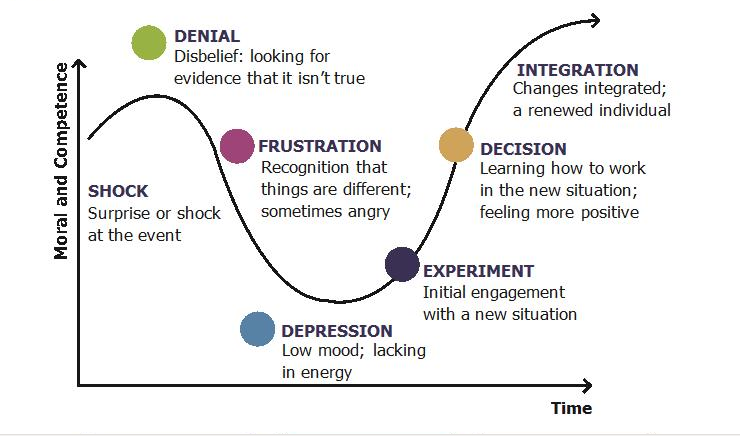
When you look at the chart above and understand the typical response people feel to a loss, you can see why organizational changes affect teams so deeply. People don’t resist change, they resist LOSS. When you ask a group of people to move from Point A to Point B, they have to give up Point A. During the pandemic, Point A for many organizations was where work is being completed. We lost the normalcy of our daily office grind. Here are some common things that are commonly lost during a change effort:
Loss of ControlChange is often “imposed” from the top. People feel that they have little choice (i.e., control) but to accept the change. Getting people’s input early on when the change is being contemplated will mitigate the loss of control.
Loss of CompetencyPeople know how to navigate “Point A.” It is known and familiar. “Point B” will require new skills, which means that – for a little while – people will feel incompetent. Training must support the changes.
Loss of RelationshipsOrganizational changes often impact reporting structures. “Re-orgs” almost always impact or disrupt the network of existing relationships.
Loss of SecurityWhen the path to success changes, people become insecure about their future. People need to see how embracing the changes will provide them with stability.
Addressing the root loss affecting your team as you begin to navigate a change can help ease the resistance. And potentially ensure that your employees are able to process and adjust and move quickly from the initial shock to fully implementing the initiative into daily practice.
The saying goes that nothing is certain, except death and taxes. I would like to add a third. You can be certain that change has and always will be a part of life. In order for an organization to grow and thrive in an ever-evolving economy, changes must be a part of strategic planning. Every organization needs to bring about changes in its management and policies.
Before starting Giant Leap Consulting, I worked for Accenture, one of the world’s largest and most respected management and technology consulting companies, as a manager in Change Management and Human Performance Practice. “Leading Change” is consistently one of GLC’s top-rated workshops.
How can you help your organization change for the better and lay the groundwork for future changes and greater success?
Photo by Chris Lawton on Unsplash.
The post Change often Means Loss to Your Teams appeared first on Giant Leap Consulting.
November 10, 2021
5 Strategies to Address Conflict as a Manager

There is no escaping the reality of conflict at work. Whether you are a new leader having to confront poor performance issues, or a seasoned leader having to protect your organization’s interests, to be successful, you’re going to have to be skilled at engaging in conflict. Running away is not an option.
Fundamentally, there are two types of conflict: productive or destructive. Most people avoid conflict because they have experienced or witnessed the painful effects of destructive conflict. The types of conflicts are costly, hurtful, and sometimes even dangerous. Getting conflict right and keeping it productive is extremely important. In fact, productive conflict is a sign of a healthy business.
Conflict is inevitable. Part of being an effective leader is managing conflict and ensuring it remains productive for your organization. Members of your team will disagree with you or with each other. As we return to the office after an extended period of working remotely these conflicts could be intensified. But when handled correctly these disagreements and tension points can actually be an impetus for change. These opportunities for change can propel your team forward together in a new more open way as team members get to know each other better.
But how do you address conflict well? Here are 5 strategies.
Discuss Problems Openly to Keep Conflict ProductiveIt does no one any good to let the problem fester. Get the problem out in the open. Address the issues. Begin the discussion so that you can define the problem.
Identify Differences and Points of AgreementOnce the problem is defined, identify the points that you agree on. Finding common ground will help you to work together. Follow that by identifying the differences in your perspectives. That way you delimit what the disagreement is actually about.
Build Understanding for Opposing Points of ViewAfter you have identified differences and points of agreement, state back exactly what you believe the point of view of the other person to be. Then make sure they do the same. Doing so ensures that each side understands where the other is coming from and can often offer opportunities for further clarification.
Reduce Defensiveness during ConflictThroughout the whole process, be sure to keep cool, stay calm, and keep your emotions out of it. If necessary, take a break so either side can calm down.
Begin Mutual Problem SolvingAfter you’ve gone through all the preceding steps, identify a list of alternatives that is satisfying to each of you.
Conflict isn’t always easy, but it is part of leadership. What is more important than whether you have conflict is how you handle conflict as a leader.
What other strategies have you found to be effective in dealing with conflict?
Updated November 2021.
Photo by Hassan Pasha on Unsplash.
The post 5 Strategies to Address Conflict as a Manager appeared first on Giant Leap Consulting.
October 20, 2021
Why Humility Makes You More Successful (and Coachable)

Guest Post by Sean Glaze
In his now famous TED Talk from 2013, Bill Gates explained in the first few minutes that his bridge game had improved – along with his executive impact – largely because he had a coach.
And he explained that “We all need a coach… we all need people who will give us feedback. THAT is how we improve.”
But I would disagree.
Bill, for all his wisdom and well-meaning, misses the vital point that is actually the obstacle to most people succeeding – whether in business as team leaders, as athletes, or as bridge players.
Coaches and advice and feedback are readily available for us.
Most of the executives I have met have secured coaches. And as a high school basketball coach, every one of the athletes that played for me had a fantastic coach!
But not every one of those executives or athletes has benefitted from the information and encouragement and suggestions that they received.
Because too few of us actually STAY COACHABLE.
If you want to improve your results… you need more than the seeds of helpful information and advice.
You need to prepare the soil to make it more fertile and accepting of those seeds so they can be planted and flourish.
I learned this first as a basketball coach, and more recently as a speaker and trainer working with teams across the country…
Because far too many leaders – and teammates – in organizations like yours are not as coachable as they should be.
And the feedback that could help them improve and navigate change goes unappreciated and unapplied. Which means that their results often remain the same.
If you want someone on your team to be more coachable, or if you recognize that YOU need to improve your coachability, it is likely because an unhealthy amount of EGO has limited their (or your) interest in applying good advice.
You cannot pour growth into a cup already full of ego and assumptions!A coachable person is someone that is so passionate about a goal that they are willing to embrace change and accept failure as part of learning to improve.
A coachable person is appreciative of advice and applies it.
A coachable person admits mistakes and seeks the wisdom of others.
But while we all START OUT coachable, not everyone stays coachable.
Because a key ingredient in the process of being a more coachable person is HUMILITY…
Part of the process of STAYING COACHABLE focuses on HUMILITY.
Here is an excerpt from my book explaining WHY humility is vital:
“HUMILITY is being willing to accept help.
But not everyone accepts, or even acknowledges, the help they need.
You first need to reflect on how you have handled feedback or responded to the people who shared advice with you in the past.
Here is why…
You can’t pour growth into a cup already full of assumptions and ego.
A dangerous obstacle to improvement is a refusal to accept, appreciate, and apply the help that is offered to you.
When you say “I know,” or refuse to listen to someone who can help you improve, your assumption is limiting your progress.
If you know it all, you can’t grow at all…
A full cup can’t accept any more, and it makes a mess when you try…
The mug is a physical reminder that you must remain greedy and grateful for the valuable ideas and suggestions that others might share.
It seems that good advice is much like deodorant –
Too many people believe the person next to them needs it more than they do!
I recall a regrettable situation with a promising young lady that I had hired.
There were three things I thought she could do that would make her more successful. But I never got them out. As soon as I began to point out any imperfection or opportunity, she would interrupt me with “you don’t understand…,” or “that’s just because…”
She had a habit of explaining away her every action.
She politely defended herself and was never willing to accept any suggestion or observation that would have contributed to her improvement. I eventually concluded that my offers to help her only led to uncomfortable disputes, so I stopped trying – and it was her performance that suffered.
An unhealthy ego is resistant to admitting mistakes.
To grow, you must stay thirsty and thankful for people to pour truth into you.
You cannot grow if you are a full cup.
Some people say they want to get better but are only willing to do it their own way.
They refuse to accept the wisdom of another’s experiences.”
Curious about the other parts of the process required for Staying Coachable ?
Sustaining success demands that you and your team all become more coachable.
All progress requires a desire to be better and a willingness to change.
And your willingness to CHANGE is likely going to be limited by your EGO, which years ago I learned was responsible for “eliminating growth opportunities.”
Your growth – the progress and improved results you desire – are ALL on the other side of your commitment to be a more coachable person.
That requires humility.
And while Bill Gates is right that “we all need people to give us feedback,” the truth is that you need more than quality seeds to grow an impressive garden.
You need to prepare the soil.
Humility makes you more successful and allows you to:
Become more vulnerable and approachable by your colleaguesAccept feedback with appreciation instead of annoyanceSee yourself as a contributor who asks “what does the team need?”Apply information and ideas from unlikely sourcesContinue improving regardless of your status or past wins
Because no matter how many coaches you hire… no matter how wise their counsel, if you and your team are not coachable then you will not appreciate or apply the ideas that could lead to significantly better results.
Staying Coachable is how good teams – and good leaders – get better.
Sean Glaze is an expert at helping leaders create exceptional team cultures.
His programs inspire your people to laugh together so they can have more success working together. Sean’s four books, The Unexpected Leader, Rapid Teamwork, The 10 Commandments of Winning Teammates, and Staying Coachable are entertaining parables with powerful take-aways for building and leading great teams!
As a successful coach and educator for over 20 years, Sean gained valuable insights into how to develop winning teams – and founded Great Results Teambuilding to share those lessons with smart team leaders…
Sean’s engaging conference keynotes and interactive teambuilding event programs equip and inspire the individuals on your team to be Winning Teammates!
What issues are you dealing with now that would disappear if you could build a team culture that inspired accountability, trust, and a team-first attitude?
Photo by Jesse Orrico on Unsplash.
The post Why Humility Makes You More Successful (and Coachable) appeared first on Giant Leap Consulting.


