R.L. Stedman's Blog, page 10
May 13, 2016
How to Market Your Book (without feeling like a salesman)
Marketing seems to freak out many writers, me included!
I guess it’s because we’re generally introverts who are happiest alone or in small groups – the thought of engaging with strangers to talk about a deeply personal work just doesn’t come naturally.
(Before I write a bit more, a big shout-out to all the salesmen and women who work ethically and professionally. You’re not who I’m talking about. I’m talking about the dodgy folk who prey on the elderly and vulnerable. No-one wants to feel like that.)
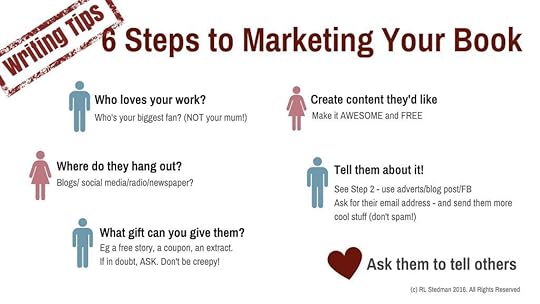
6 Steps to Marketing Your Book
Know your audience. If you don’t have an audience, think about the audience you want. It helps if you can get really specific here: not just male/female and age, but where they live and what are their interests; where they hang out, and who their influencers are.
Marketers call this ‘building an avatar’ – not a big blue alien, but an ideal customer. This has never worked for me, because being a writer, I have an extremely fertile imagination – and an avatar has to be reasonably accurate (i.e. not imaginary) to be useful.
Instead, I think of my two most passionate fans (that aren’t related to me:)) I don’t stalk them, obviously, but I know roughly how old these two fans are, where they hang out (facebook, goodreads, instagram, blogs etc) and I know what they like to read.
I develop content for ONLY these two fans. I call them K and N.
Develop content for your audience. Every blog post is written for either K or N. (Except this one, although K might find it interesting). Every post on social media is designed for them. My only criteria about each post is: would K or N like this? (This approach also MAKES me sit down and write my current WIP, because I know that the thing they most want from me is my next book.)
Share your content. When I’ve developed content, like this blog post, I go onto twitter or facebook or whatever, and I say, hey, I’ve made this! I don’t say ‘Hey N, here’s another post just for you,’ – that’s kind of weird. But often one or the other will pick it up and share it or retweet or whatever, and I love that, because it means I’ve done something that makes them happy.
Side note: This doesn’t have to be only social media. When I get to a milestone in my word count, I share it, because I know N is gagging for my next book! I popped a My Book Progress bar on my home page, because I know it’s what N wants to know.

Marketing Through Sharing Love
It took me a long time to learn this approach, and I’ve only just started working like this since the beginning of March. But since then interest in my blog is going up and downloads of my books are increasing. Why? Because it’s not just N and K buying my books – hell, I’ve given them my books – it’s because there’s enough people out there like N and K, and they also like the same material.
I am really, really grateful to N and K for their support and I want to deliver more content that makes them happy. It’s just a side benefit that other people like it too.
I’ve summarised this approach in a pdf, which you’re welcome to download.
I’ll also be talking about it again in my upcoming ebook.
Before I wrap up this extra-long post here’s a couple of things to consider.
Social Media is Not Essential
Don’t be spammy. Don’t stalk. Be compassionate, respectful and behave like a normal human.
Marketing doesn’t mean you have to slather yourself in social media. Old-fashioned print or radio works too.
If your fans don’t live online you may not even need a website (although I would, but that’s another post for another day); the point is, once you know who your fans are, you can design your marketing to serve their needs. Robert Free meets his fans through sending a ballad to Radio New Zealand every day. It seemed to take Robert AGES to get his website up and running, but I’m not sure this really mattered; he was already meeting his audience through radio.
Play to your strengths. If your fans are out and about on a variety of different channels – like blogs, youtube, instagram – chose the channels that suit you best. I like taking photos and I’m totally in love with my iphone, so instagram works well for me.
Kyle Mewburn, who writes books for kids, is a natural entertainer and has a youtube channel. This suits his fans, too, because teachers and parents can play it for their kids.
Finally, although I say you don’t need to be involved in social media, it sure helps you to meet more readers than traditional media. And unless you’re running adverts, social media is free. (As a side note, if you are thinking of running ads on social media, check out Mark Dawson’s Facebook training videos. They’re free, and are almost guaranteed to save you a ton of money.) It always saddens me when I hear (usually older) writers say “oh no, I don’t get facebook.” They’re missing out on an opportunity to hear and connect with readers, and surely, that is why we write, isn’t it?
Writing is Connection
Which takes me back to the beginning of this three-part series of blog posts: Why do we write? For me, it’s to connect; to share; to provide enjoyment. Writing, actually, is not about me. It’s about my reader.

Thanks for sticking with me through this incredibly long post. If you have any questions, please get in touch.
I’ve had some difficulties with the comments section of this blog (sorry, to those of you who tried to leave comments, they seemed to just disappear), but if you have questions and the comments doesn’t work, feel free to contact me through twitter, facebook, instagram or this website.
And thanks again, Vanda and Otago Access Radio, who sparked this series of posts. Now you’ve navigated your way to the end of them, here’s the link again to the podcast interview. I hope you enjoy!
[contact-form]
The post How to Market Your Book (without feeling like a salesman) appeared first on RL Stedman.


May 12, 2016
Considering Self-Publishing? 5 Helpful Resources To See You Through

Images from PinkPot Design
If you decide, as I did, that you don���t feel like joining the endless rounds of rejections and delays, you may decide to self-publish .
Here���s 5��resources that may help:
Join an author���s group, and search out authors networks online. I’ve joined Science Fiction Writers of America, Romance Writer’s of New Zealand and the New Zealand Society of Authors.
Listen to podcasts. My favourite is Mark Dawson’s Self-Publishing Formula, (www.selfpublishingformula.com)��but there are others.
Join the Kboards.
Download a couple of good books. The one I recommend is��David Gaughran���s Let���s Get Digital��. This post on his blog��is also an excellent resource.
Develop an author platform in advance; identify who your readers are, and develop��a relationship early.��More detail coming in the next post, or you can check out this blog post��from Smart Author Sites here.
Time and Money
Like learning how to succeed at any business, it takes time to learn self-publishing. It takes even longer to do it well!��You need to develop a grasp of book writing, book production and book selling.
If you don���t want to learn all these parts to the business, but��you have the funds, you may choose to��outsource some of these elements. It will probably take a few years to earn these costs back, but hey, as��I said in my last post, your rights last for at least 70 years, so you have plenty of time!
Check Before You Spend
Before spending anything, CHECK��any provider thoroughly. There are a few dodgy operators about, some who, at first glance, appear reputable. READ��this blog post from David Gaughran here.

Let me know if there’s anything I’ve missed. What resources have you used? Any other blogs or interest groups you’d recommend? [contact-form]
The post Considering Self-Publishing? 5 Helpful Resources To See You Through appeared first on RL Stedman.
May 10, 2016
How to Serve Your Readers (and sell more books!)

Image from PinkPot Designs
Rights, Publishing and Marketing Your Books
I���ve just been interviewed for Otago Access Radio���s Write On Show, hosted by Vanda Symon. We were talking about how to get your book published, how to self-publish and (briefly) how to market your books.
Time always seems to fly when I���m talking to Vanda and some things we just couldn���t fit into half an hour. So in the next few blog posts I���ll touch on some of the things we discussed in the��interview, as well as some of the things we didn���t have time to cover.
(If you don���t want to read all this, you can also listen to the interview via podcast. It will be live from tomorrow, 10 May 2016, NZST.)

How to Sell Your Books.
1.��Write the best work you can.
Whether it���s a cookbook, an anthology of poems, a novel. It doesn���t matter; just make it the best.
2.��Know your goals.
Are you writing for income? To inform people? For validation? Just for fun?
None of these goals are better than others, but they might help suggest the easiest way to get your books in front of readers. For example, if you���re wanting to write a hugely informative book with lots of photos, you might be better to approach a publisher. On the other hand, a non-illustrated novel is��relatively simple to self-publish.
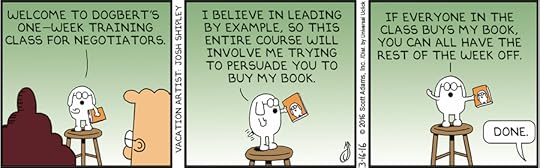
Dogbert’s Negotiating Class, from Dilbert.com
3.��Understand the value of your work.
The value of your book, or ���work��� lies in ���the rights���. This means the Intellectual Property Rights, generated automatically when you create an original work. Copyright is not just for print – it applies in whatever format the work is produced (audio, translation, video etc).��If you live in New Zealand, you can find out more about copyright from the Intellectual Property Office��. (If you live in a different country, you may have differing rules around copyright, so do check this for yourself.) In many countries, copyright lasts much longer than its creator��– up to��seventy years or so after your death.
So, because your work can generate income for a long time, you need to be wary when agreeing to offer other parties the right to generate income from it. I suggest the best way to view copyright is to see it as a major asset: like a car, or house. As an example: a cash asset, like money in the bank, of $50,000 returning interest at 3% pa will give you $1500 worth of revenue per year. If you think your books could conceivably earn you $1500 per year, you have a valuable asset!
Hopefully you wouldn���t give part of your house to someone you���d just met online. Now, the same applies when you���re talking about your rights!
There are an awful lot of publishing scams, but��there are genuine operators too. If you are offered a contract with a publisher or an agent (or anyone else, like a distributor) and they’re wanting a share of your rights, check the entity offering you the contract is legitimate. Think of it like a prenup!
Here���s what I would do:
A google search
check with Writer Beware��
Query your local author organisation and/or other writers if they know this entity or person
Two excellent blogs that provide more information are The Passive Voice blog ��and Kristine Kathryn Rusch
Consider how stable the entity is. Publishers go out of business all the time. Make sure if this happens your rights will be returned.
If you���re not sure, get a lawyer to check the agreement.
If something doesn���t feel right, discuss your concerns with the offering entity. If you still have concerns, DO NOT��sign. Remember, this is income for your kids and grandkids!
A side note: If you’re worried about how to manage these discussions, here’s��an earlier��blog post on the art of negotiation (this post includes��a downloadable cheat sheet).

Recording with Vanda Symon
The next post will cover self-publishing, and the following will cover��marketing. So stick with me, or, if this is all too much, just listen to the interview!
PS: I haven’t enabled comments on this post (I’ve had a few technical issues with them!), but if you have questions or feedback, please get in touch via Facebook or Twitter or just drop me a line��through this website.
Image from PinkPot Designs
The post How to Serve Your Readers (and sell more books!) appeared first on RL Stedman.
May 5, 2016
Bookish Fashion! 8 Amazing Fashion Looks
TGIF!��Here’s a lighthearted post to celebrate the end of the week – 8 examples of great writing inspiring great looks.
All these items are available from their creators at the links below. I am feeling blissed-out on clothes-envy here! (and there’s no affiliate links, BTW, I’m just in love).
1. Alice in Wonderland
Manuela Fridrich –��Alice in Wonderland coat. No idea if she sells it, but I for one would love this! Check out the buttons.

Manuela Fridrich – Mad Hatter Coat

Mad Hatter Buttons – Alice in Wonderland Coat
2. Lord of the Rings
Rooby Lane on Etsy – Elvish Script Skirt.
So cute! Not sure Gandalf would wear this though…

Elvish Script Skirt By Rooby Lane
3. Book Jewellery
Corygraphies on Etsy: Book Earrings

Book Jewelry by Coryographies
4. Bookish Footwear
CafePress by Gail Gabel has these��Flip Flops for Booklovers. The Aussies��call these thongs, but in the US they���re flip flops. Which we think sounds way better.

Flip Flops for Booklovers
5. Libraries
ShopJustWish on etsy has a��A Library Card��T Shirt.��Just like the olden days!

Ladies Library Due Date Card Graphic�� T-shirt
6. Harry Potter
Kay Pop Art – Etsy.��Check out this gorgeous��Harry Potter print dress. And you can buy a phone case to match!

Harry Potter Dress
7. Pride and Prejudice.
Evie Seo – Society 6.��Can���t go past Mr Darcy

Mr Darcy Tote Bag
8. All things Golden
The piece de resistance: Ryan Jude Novelline: the little golden books dress:
This stunning dress is made from little golden books! The bodice is made from the books foil spines; the paper skirt from the book illustrations.
More photos in the link.

Golden Book Gown
And that’s it!
Have a great weekend, everyone.
The post Bookish Fashion! 8 Amazing Fashion Looks appeared first on RL Stedman.
May 4, 2016
5 (Free) Resources to Make Your Teen a Lifetime Reader
It can be hard to find the right book for a teen. I know; I have two of them (teens, not books!). There’s so much vying for a teen’s attention: Videos, TV on demand, gaming, social media. Mostly all at once.
Image from Deposit Photos. Used under license.
The advantage of the right book, though, is that a) it doesn’t need batteries and b) teachers approve. And once you’ve found the right one you’re golden, because a teen will devour it, watch the movie, read the sequel, and wear the clothes. They’ll be quiet for hours, totally immersed in another world. Books may appear solitary, but teens use them to form communities. They’ll discuss their favourite books with on-line or real world friends; they form fandoms.
5 (free) Resources:
Your school librarian. A great school librarian is the best resource ever. If you home school, or don’t have the best library, you can try Teen Librarian Toolbox, a website for teen librarians (that is, librarians for teens, not the other way around!) or My Best Friends are Books, curated by the Amazing Zac from Christchurch City Library.
Goodreads, a social media site for readers. There are a lot of Young Adult (YA) pages, where readers can hang out with their peers.
#bookstagram on instagram, twitter or tumblr. Just pop it into the search bar and you’ll come up with a range of sites. Because many are curated by people under 25 you’ll generally find a whole bunch of book ideas and connect with a lot of passionate readers.
Bookblogs. I’m planning on doing a post on my favourite book bloggers later, but if you check out bookbub’s blog that’s a good start. Just pop “teen” into the search function on the right, and you’ll find a whole heap of suggestions.
Poetry is a rich resource. Check out Slam Poetry on Youtube (also check out the comments on this link – teens are fabulous supporters of one another.)
The Importance of Books
I follow @westerosreader on instagram. In one post he said he never was a great reader, until his Aunt leant him the Maze Runner and … well, now he’s hooked! He now has over 16K followers and a great fan base.
So never, never, stop encouraging kids to read; the right book at the right time can change a teen’s life.
Do you have any recommendations for resources? How did you get hooked on reading? Any other hashtags or book sites you’d like to share?
[contact-form]
The post 5 (Free) Resources to Make Your Teen a Lifetime Reader appeared first on RL Stedman.
May 2, 2016
So you want to write fantasy? 3 reasons why there are no rules.
When you���re writing fantasy there are only two rules.��The first rule: don���t do what other people do.��The second rule:��There are no rules.

There���s only three things to consider:
1. Tropes
Fantasy is truly one of the most awesome genres, because there are literally are no limits. In a fantasy, characters can travel through time, they can change faces, they can live in a castle or a hut in the woods or somewhere at the end of the universe. Fantasy makes great story-architecture.So, if you���re writing fantasy, read the frigging genre. Think of the current YA tropes: Another bunch of teens fighting the system, falling in love and whoops, there goes another love triangle. Try and be innovative. Lord knows, there���s plenty of scope.
Read as many myths and legends as you can get your grubby paws on. Don���t just read greco-roman; you���ll broaden your repertoire significantly if you spread your mythic wings to include Pacifica, Aztec, Native American, Chinese, Celtic storylines. Another great thing about fantasy? You can nick these myths (sorry, adapt) and you won���t have to worry about copyright. (Unless you start to infringe upon Disney. Don���t go there. Seriously.)
If you���re borrowing another culture���s story legacy, be respectful and understand the nuances of the story before you begin pulling it apart.
Because fantasy is often based on mythic lore it���s easy to hit your stride and walk straight into another unoriginal tale of elves and dwarves, so it does pay to be aware of the traditions before you start. Once you���re aware of the traditions, of course, rule two applies. Because once you really start to break the rules, you���re able to create a seriously funny work. Shrek did this well, as did Enchanted. Terry Pratchett is probably the ultimate trope-user. Check out the disc-world series.

Image from wikipedia
2. World-building
Fantasy usually involves world building. This is the most complex and delightful part of writing fantasy, and probably explains why some of the most successful fantasits (GRR Martin, Katharine Kerr) are Dungeon and Dragon fans.
When building a fantasy world, as JK Rowling says, you need to know the rules for that world. You may find yourself drawing maps and buildings, as Tolkein did, to help orientate yourself in your imaginary world.
Some writers like to plan the world in advance – maps, currencies, food, clothing, even (like Tolkein) complete languages. Others prefer to just write, and let the world develop around the character. Either approach is okay – like I say, there are no rules – but if you���re developing the world as you go, you���ll probably need a proof reader to make sure you haven���t inadvertently contradicted your fictional world.
One tip: It makes it a little easier if you use reality as an anchor for your imagination. For example, in The SoulNecklace Stories I based the Kingdom of the Rose on a real island (Anglesey, in North Wales). I did this partly because Anglesey’s��Welsh name is Ynys Mon, or Druid���s Island. I mean, how could I not use it!
I spent a lot of time looking at google maps and photos, and I visited Anglesey; this made it easier to describe everyday things like travel distances, directions, or the view from a window.

3. The M word.
Will you have magic in your world? Typically, fantasy does allow magic, although increasingly there���s a blur between technology and spells. The Name of the Wind, by Patrick Rothfuss, explores the technology behind magic; China Mieville has a steam-punk world named Bas-Lag in Perdido Street Station; Helen Lowe looks at what happens when one world���s culture meets another in her brilliant Wall of Night series.
A true fantasy novel describes the intersection between the known and the unknown. Because sometimes what looks like magic is actually technology – and who knows? Perhaps the opposite is also true, and what looks like technology is actually magic.

Extras
A short note: I’ve speckled links liberally through this post. Some lead to wikipedia entries; others lead to Amazon links, so you can read the wonderful books set out here. One link leads to an amazing Lord of the Rings interactive map. Check this out!
Or don’t. Like I say, there are no rules…
The post So you want to write fantasy? 3 reasons why there are no rules. appeared first on RL Stedman.
April 28, 2016
3 Amazing Podcast Interviews With Great Writers
I have a confession: I listen to podcasts. Actually, I love podcasts.

When I was a kid, we had no television in our house – we had the radio instead. Makes me sound as though I’m from the forties, but hey, this was in the eighties. My brother and I raided the televisions of friends and relations. Fortunately, I had a very patient friend.
We listened to radio a lot. I mean a LOT. We had our favourite radio shows – Just a Minute(and yes, folks, this is still playing in the UK) and a narration of the entire Sherlock Holmes books. Perhaps that is why I enjoy podcasts just so much – they bring back the memories of sitting around the radio, just listening.
That’s enough reminiscing.
One of the main reasons I listen to podcasts is to follow famous authors; to see what drives them, how they write and why they write.
The 3 best interviews (so far).
Frederick Forsyth. (The Guardian Books Podcast, 23 Jan 2016) Remember The Day of The Jackel? Forsyth, a fluent speaker of French and German, was a reporter in Paris in the 60s. In those days the French reporters socialised with the President’s security detail (hey, this is France, and a different era). Forsyth, being a french-speaker, hung out with them. Seems like de Gaulle’s security team weren’t as close-mouthed as they could have been, because Forsyth pieced together a plot that might conceivably work. Later, when flat broke, he wrote this idea up as The Day of the Jackel. Listen to the interview. It’s amazing.
Marian Keyes. (BBC World Book Club, May 2015) Have you read Rachel’s Holiday,a bittersweet story of recovery from addiction? Turns out Keyes went through a similar experience to her heroine and drew upon this experience when writing the book. In this lovely interview Keyes discusses addiction, why she likes happy endings and what you need to do to be a writer.
Paulo Coelho. (Four Hour Work Week, 23 April 2016). Writer of The Alchemist, Coelho lives in Brazil. This is more a running commentary on the art of writing than an interview, but to a writer it’s absolutely fascinating. Coelho doesn’t write in a notebook. “Just live your life, and when you come to write, whatever is important will remain. What isn’t just falls away.” I found this interview incredibly liberating. “A book,” says Coelho, “is a connection between the writer and the world. It must be written with love.” (I think I’ve got that right. You’ll have to listen to the interview to be sure!)

Paulo Coelho Quote. From LostBumbleBee Printables
The Benefits of Audio
It’s hard to find audio interviews with great writers. There are a few in newspapers and magazines, but but I find that somehow print dilutes the message – radio (and its modern child, the podcast) feels more personal, more immediate and fun. If you’re keen on reading, or you want to write, I do suggest you check these interviews out.
What podcasts have you listened to? What would you recommend?
[contact-form]
The post 3 Amazing Podcast Interviews With Great Writers appeared first on RL Stedman.
April 27, 2016
The Truth About my Glamorous Writing Life

Over the next few blog posts I’ll be talking about my YA novel, A Skillful Warrior. I’ll describe��a little of the��backstory and some of the plot elements. I might even give you a hint (a very, very small hint) about what is to come in the final book of the SoulNecklace Stories.
But before I dive into the world of Will and Dana and all the other gorgeous characters that I love so��much, I thought I’d give you a quick run down of my fabulous, glamorous and fun-filled day:
7.30 Breakfast.
8:00 Spend 20 minutes hunting for the��car keys, the cat, the kids and a pair of unladdered tights. [Confession time: I love working in an office. I get to dress up and wear nice clothes and talk to people ALL DAY and get PAID. No, the novelty does not wear off.] I currently work 3 days a week, and write for 2. This will change shortly, as I have a maternity leave contract coming up.
8:30 Start Work – if a work day. This means I send emails, web browse, answer phone calls and argue with people! Clients��are generally extremely nice to me, as I hold the purse strings. It’s amazing how being in a purchasing role encourages good behaviour.
If a writing��day – I write, frantically, for about 2 hours. I listen to Spotify – the hard rock track. It seems to be working at the moment, because my characters definitely do more when there’s loud music playing.
12:00 Lunch, listen to podcast and go��for a walk. My favourite podcasts are (in no particular order):
StartUp by Gimlet Media. I love his story-telling skills
Hack the Entrepreneur. This is a nice, bite-sized look at self-employed life. If you’re looking at setting up your own business, I really recommend this podcast.
Amy Porterfield – Amy is a master of social media. She’s also very good at podcasting! This is a sales funnel for her, so if you’re thinking of listening, just be aware that she’s very very good at what she does.
Smart Passive Income��– Pat Flynn’s been running this podcast for a couple of years now. He comes across as likeable and truly engaging. The thing I really, really like about his podcasts is he talks about serving his customers, which is something I totally relate to, as I feel very strongly about serving my readers. (Which is why I’m telling you what I listen to all day, because it might help you, too!). He interviews mostly online business people, but sometimes there are authors in there too, which mixes it up a bit.
Social Media��Examiner – this is a massive podcast machine.I skim this one, because it’s really heavy-duty marketing which doesn’t rock my boat that much, but sometimes there’s interesting things to take away.
Self-publishing Formula��– this is a newbie to the podcasting platforms, but very good. I recommend the free Facebook training, too.
Astonishing��Legends – This is��hilarious. AL is basically two guys jamming about the weird and wonderful. Think The Twilight Zone does Wikipedia. The production values are very good and the two presenters really��know how to construct a story.
The BBC Book Club – this is a little staid, but hey, you get to listen to Marian Keyes and John Grisham.
12.30 Work (if at work). If not, I’ll do boring administrative tasks. This week its my tax return. *Groan* . Chat to people on FB and Twitter and answer emails. Explain that no, I did not write Light Between Oceans, but I wish I had. (And I wish I had a different name).��Get sucked into social media…And read weird and wonderful stuff on the internet. It’s research, honestly!
3:00 Write some more. You can check out my progress on my website. I’m not doing quite as well as I want.
4:00 Take kids somewhere. Be a taxi-mum.
5:30 Begin cooking tea.
7:30-ish write a blog post. Hi there!

From Will Write for Chocolate by Debbie Ohi
Sounds exotic, doesn’t it? I bet Hemingway never did all that. I bet he just drank wine and sat at coffee shops and fought bulls…
Often I do not feel like a proper writer.
The post The Truth About my Glamorous Writing Life appeared first on RL Stedman.
April 24, 2016
Blog Highlights – Free Giveaway!
I’ve just completed a series of blog posts on writing.

They all have the same cover image (courtesy of PinkPot Designs, check her out, her work is amazing!), and I’ve filed them all with ‘How To’ and ‘Writing Tips’, so you should be able to follow them in sequence.
BUT
I know this is a bit awkward, so I’ve put the first of these posts together into a small ebook. I’ll be making it available to download shortly.

I’m hoping to distill a few more posts for you, from both this blog and my earlier blog, and will make these available as e-books also.
Note to Teachers/Librarians:
Please Share!
Writing Tips download includes printable resources – you’re welcome to copy and share these printables if you wish.
The post Blog Highlights – Free Giveaway! appeared first on RL Stedman.
April 20, 2016
Everything you ever wanted to know about The Prankster and the Ghost

Why did you decide to write this book?
My son was on holiday at a school camp. On on the first day there were three accidents: a girl was caught in the doors of the bus, the same bus nearly ran over a girl���s arm and my son broke his wrist on the confidence course. ���Mum,��� he said, when we were at the hospital, ���it was like the camp was haunted!���
This got me wondering: what would a haunted school camp be like? I ended up writing a short story about this, and in this story was an old school house. The idea of a haunted school house stuck with me, so although I never used the first short story, I recycled it into Prankster.
Are any of the characters in Prankster based on real people?
Not really, although the inspector was strongly influenced by an old teacher of mine. In the olden days, when I was young, teachers were often scarey (unlike the lovely people they are today :)). So I suppose Prankster was a way of getting even with someone I used to find totally terrifying!

Why did you write that Jamie came from Scotland? Why couldn���t he come from another country?
There were three reasons why I chose Scotland. The first is because I live in Dunedin, which has a strong Scottish heritage. The second is because of a true story: my son was starting at a new school, and I went along with him for his first day. A boy in the class was really friendly, but unfortunately, neither of us could understand him, because his Scottish accent was so strong! The other kids had to translate for him! Which made me think about how isolating it can be to have no-one understand you. Parents move kids around the world – mostly without asking them first and this can be really hard on the kid, because they have to go to a new school, and perhaps no-one will understand you. I wanted to use these ideas in a story. The third and final reason for using Scotland was because of a (true) ghost story that a friend told me about Edinburgh Castle. You can read about it here.
Do you speak with a Scottish accent?
No! But my boss does (he���s from near Glasgow), so everything Jamie said I mentally imagined my boss saying first! I listened to scottish podcasts and BBC radio too but they weren���t much use, because when the Scots really get going I find them almost impossible to understand!
Which part of writing Prankster did you find the hardest?
Chapter Twelve was definitely the hardest part to write. This is the scene in Jamie���s classroom. In this chapter the Ghosts start to write on the whiteboard, Milly vanishes into the iPad and Tayla realises that he can travel through the internet. ��The reason I found this scene so hard was because it has about eight characters in it, and they���re all talking at once! I ended up breaking the scene into little pieces, and each piece only having two or three people talking at one time. So there would be Becky talking to Tayla, then Tayla arguing with Milly and then Jamie talking to Tayla. This kept it a bit simpler! Roald Dahl worked a bit like that in Charlie and the Chocolate Factory, I think, and now I know why. If you want to see what it���s like to read a scene with lots of people in it, try and write one, and you���ll see exactly what I mean!
How did you come up with all the practical jokes?
The internet! – google and youtube���
The post Everything you ever wanted to know about The Prankster and the Ghost appeared first on RL Stedman.