R.L. Stedman's Blog, page 14
November 7, 2014
Steps to Self-Publishing
Steps to Self-PubIn my last post I warned about driving while under the influence of writing. Now, I'm going to talk about the steps I followed in to getting a book onto book shelves.
A little disclaimer: these are the steps, and the order, I've used. It isn't necessarily the only correct sequence, and it's not necessarily what I would recommend. It's just how things have played out. And my book, while on virtual shelves is not yet on physical, so there may be learnings yet to come.
Because I'm also using bricks and mortar stores to distribute my book, I have encountered more complexity than other self-pub writers. However, I wanted to use real bookshops because:
I wanted to see how the process workedI really like seeing my book for sale!
Set out below are the steps I took. I will go through these in more detail in the next series of blog posts, as some are quite involved. But in the meantime if you're wanting more content, try Head or Heart by Nina Harrington. There is also a lot of information on the web - provided you have the time to search for it. To make it easier for me (and for you) I have pinned a lot of self-pub resources to my pinterest board. Feel free to have a rummage.
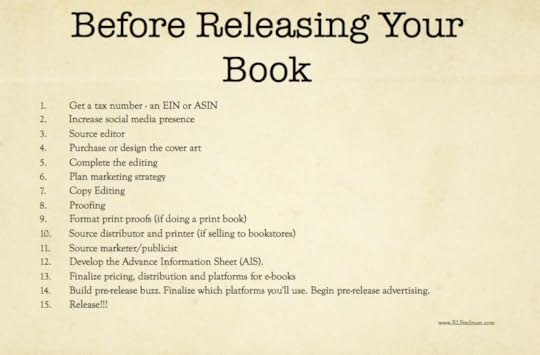
 from wikimedia commonsPre ReleaseGet a tax number - an EIN or ASINIncrease social media presenceSource editorPurchase or design the cover artComplete the editingPlan marketing strategyCopy editProofingFormat print proofs (if doing a print book)Source distributor and printer (if selling to bookstores)Source marketer/publicistDevelop the Advance Information Sheet (AIS). An AIS is a summary of your book. Here is the AIS to Inner Fire and here is a brief summary of what it should contain.Formatting for e-bookFinalise on pricing, distribution and platforms for e-booksBuild pre-release buzz. Finalise which platforms you'll use. Begin pre-release advertising.Release
Post Release
Quality check your productAdvertisingPress releaseInterviewsEnter competitions/blog toursSpecial offers or further advertisingPrepare for next bookAnd that's it! So far, anyway. I might add more steps as I get further into the process.
A little disclaimer: these are the steps, and the order, I've used. It isn't necessarily the only correct sequence, and it's not necessarily what I would recommend. It's just how things have played out. And my book, while on virtual shelves is not yet on physical, so there may be learnings yet to come.
Because I'm also using bricks and mortar stores to distribute my book, I have encountered more complexity than other self-pub writers. However, I wanted to use real bookshops because:
I wanted to see how the process workedI really like seeing my book for sale!
Set out below are the steps I took. I will go through these in more detail in the next series of blog posts, as some are quite involved. But in the meantime if you're wanting more content, try Head or Heart by Nina Harrington. There is also a lot of information on the web - provided you have the time to search for it. To make it easier for me (and for you) I have pinned a lot of self-pub resources to my pinterest board. Feel free to have a rummage.
 from wikimedia commonsPre ReleaseGet a tax number - an EIN or ASINIncrease social media presenceSource editorPurchase or design the cover artComplete the editingPlan marketing strategyCopy editProofingFormat print proofs (if doing a print book)Source distributor and printer (if selling to bookstores)Source marketer/publicistDevelop the Advance Information Sheet (AIS). An AIS is a summary of your book. Here is the AIS to Inner Fire and here is a brief summary of what it should contain.Formatting for e-bookFinalise on pricing, distribution and platforms for e-booksBuild pre-release buzz. Finalise which platforms you'll use. Begin pre-release advertising.Release

Post Release
Quality check your productAdvertisingPress releaseInterviewsEnter competitions/blog toursSpecial offers or further advertisingPrepare for next bookAnd that's it! So far, anyway. I might add more steps as I get further into the process.


October 31, 2014
Full On - The Rush to Self-Publish
This week has been really crazy. My son was ill, work was busy and...I crashed my car. Driving out of the garage. Yes, you wouldn't think it was possible, but I can tell you now, it is. So I have a massive dent in the side door and damaged plasterwork on the side of the house. Why did I do this? How did I do this?
It was because my head was full. The kindle format had not uploaded properly and I was worrying about a plot point in the novel I was planning, and my son wanted to watch a video because he was feeling poorly and I needed to write an overdue report for work. Unfortunately, little things like steering just went out the window.
So, here's a warning. Your first trip to self-pub land will take longer than you think. It will be more complicated than you'd realised and you'll spend more time worrying about it than you had thought you would. But on the plus side - there will be more fun times and excitement than you'd planned for, too.
 The Trip to Self-Pub Land
Today, I have just pushed the 'Publish' button on my first self-published novel, Inner Fire . Very exciting! In my next series of posts I will discuss the stages I've gone through to get it out into the world. I will try and give you pointers about What Went Well and What to Avoid. (Believe me, there are a lot of things to avoid.)
However, before even pushing the 'publish button' there's an important decision point you have to reach.
Will you, or not, do it yourself?
These are the steps I took to reach this decision.
Quality Control: You can purchase Inner Fire here . And if you buy it you'll be able to find out if all the things I talk about later in this blog have been worth the effort!
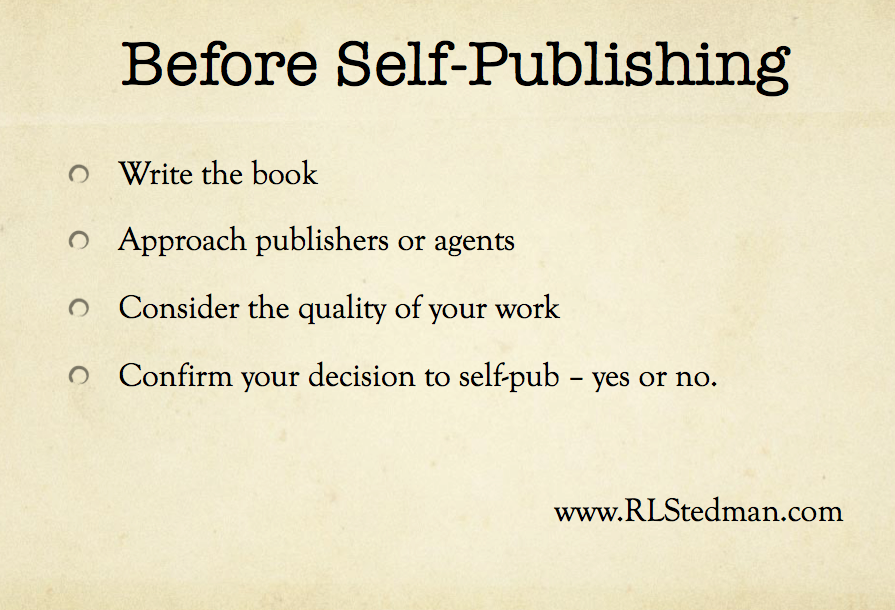
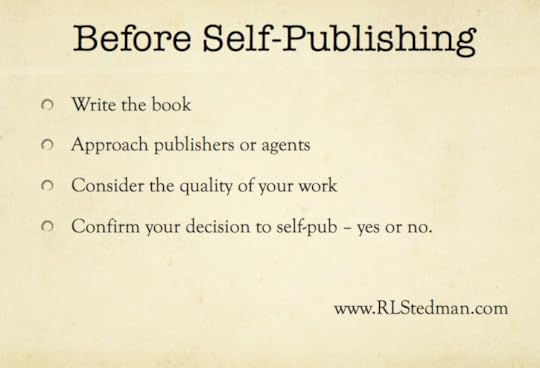 Before Self-Publishing
1. Write the book. This sounds obvious, and of course it is, but my point is more the sequence. Experienced self-published authors begin with marketing this new, yet-to-be-written book well in advance of writing it. I did not; partly from a superstitious fear that to do so might somehow jinx the process, and partly from a reluctance to commit to a deadline too early on.
2. Approach traditional publishers. There are advantages to trad publishing, as discussed earlier in this blog, but at some point you need to make a call as to whether you will continue to approach them or not. Because my last experience with traditional publishers involved manuscripts sitting on editorial desks for 8 - 12 months, I was hesitant about approaching trad publishers. I did not want to wait nearly a year before putting a book on kindle. So instead I compromised and sent copies of Inner Fire to five agents. One was semi-interested, but said the market was for contemporary drama at the moment (The Fault in Our Stars, The Perks of Being a Wallflower) and so declined it. The rest took either a long time to respond or declined within four weeks, which was great. Agents are a lot faster than editors about rejecting material! However, the first agent I approached, whom I already knew personally, has offered to assist with promotion, so who knows where that might lead. That's the beauty of self-pub. You continue to own the rights.
3. Really think hard. Is it good enough? There might be a reason why agents have declined it, quite apart from the market not being right. Use critique partners; give the novel to a trusted friend; use a manuscript assessor. In my earlier posts I discussed how to find critique partners, and you can access assessors from the New Zealand Society of Authors. There are two reasons why you need to consider the quality of your work. The first is because if the novel is bad, it won't sell, and you could spend a lot of time and effort for no return. The other reason is because it is horrible horrible horrible to get bad reviews. The beauty and the problem with the world wide web is that everybody's opinions can be shared in an unfiltered and unbiased way and when it's your own creative work, this can hurt. The worst thing, I find, is when a reviewer picks up on some flaw in your work that you really wish you'd seen and corrected. So do think hard before self-publishing.
I had just won a major award and had been shortlisted for several more, all of which gave me a little more confidence that yes, I might actually be able to product a quality work, regardless of whose brand was on the cover. So I decided that hey, what do agents and publisher's know. I liked the work. And I thought it was worth trying the process with it.
4. Decision point reached: Yes or No.
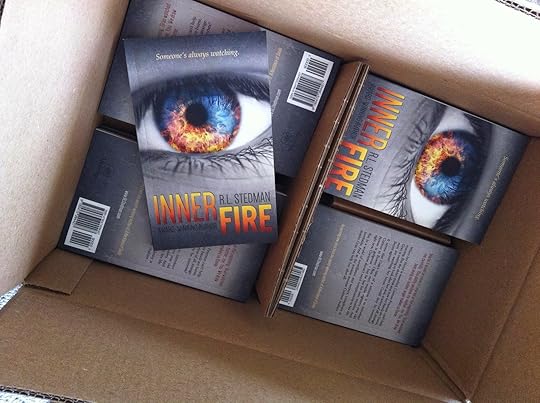
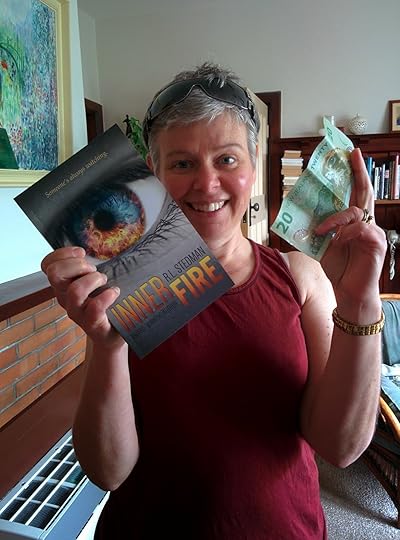
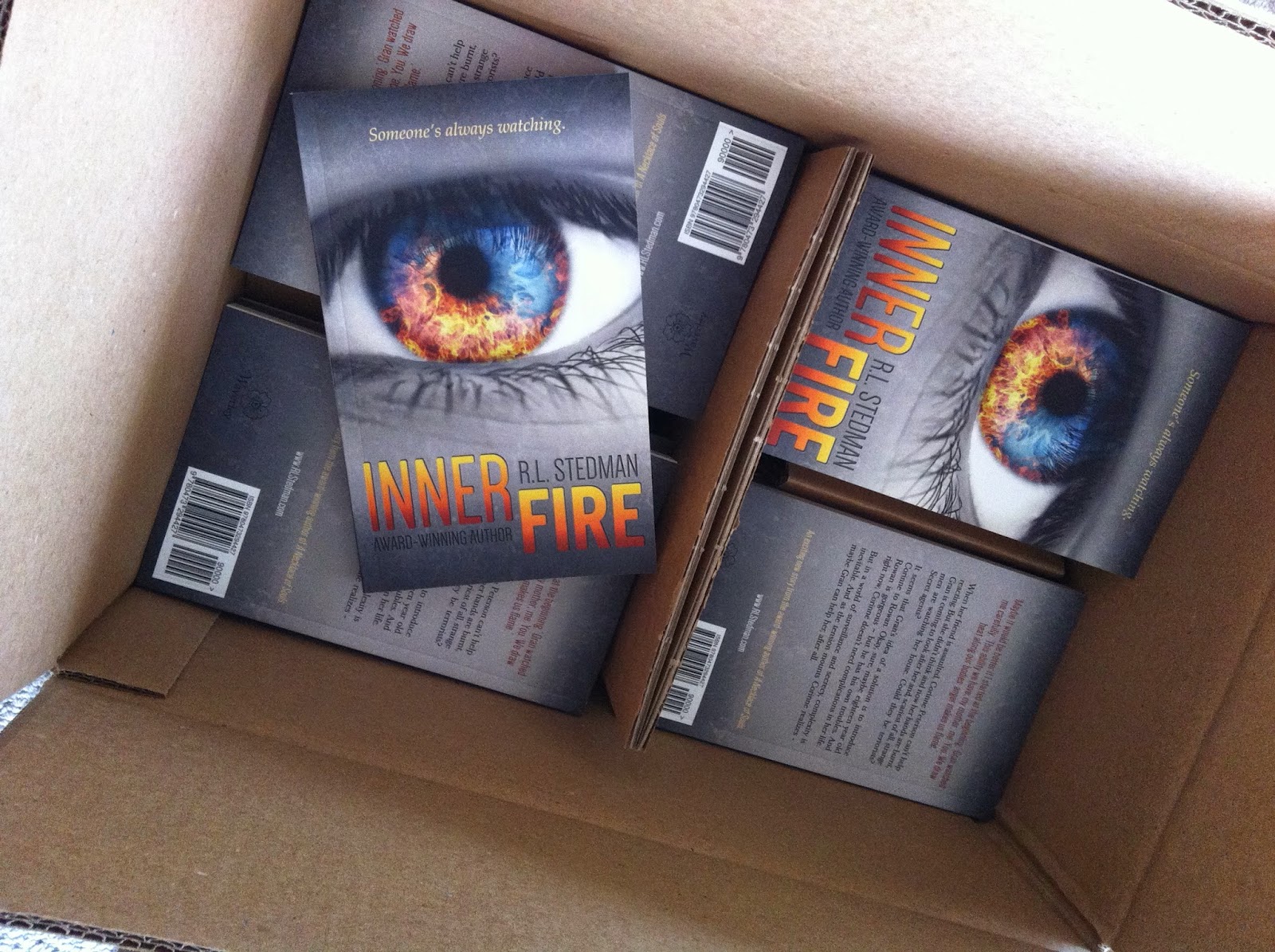
Best Moments so Far?A box of fantastic-looking books arriving by courier.My first sale. An email from a reader in the Philippines who said she 'loved it!'. And my first five-star review.
Over the next few weeks I'll talk through the steps I've taken to get Inner Fire onto book shelves. I'll let you know which steps went well and which did not. So stayed tuned.
And in the meantime, drive safely.
It was because my head was full. The kindle format had not uploaded properly and I was worrying about a plot point in the novel I was planning, and my son wanted to watch a video because he was feeling poorly and I needed to write an overdue report for work. Unfortunately, little things like steering just went out the window.
So, here's a warning. Your first trip to self-pub land will take longer than you think. It will be more complicated than you'd realised and you'll spend more time worrying about it than you had thought you would. But on the plus side - there will be more fun times and excitement than you'd planned for, too.
 The Trip to Self-Pub Land
Today, I have just pushed the 'Publish' button on my first self-published novel, Inner Fire . Very exciting! In my next series of posts I will discuss the stages I've gone through to get it out into the world. I will try and give you pointers about What Went Well and What to Avoid. (Believe me, there are a lot of things to avoid.)
However, before even pushing the 'publish button' there's an important decision point you have to reach.
Will you, or not, do it yourself?
These are the steps I took to reach this decision.
Quality Control: You can purchase Inner Fire here . And if you buy it you'll be able to find out if all the things I talk about later in this blog have been worth the effort!
 Before Self-Publishing
1. Write the book. This sounds obvious, and of course it is, but my point is more the sequence. Experienced self-published authors begin with marketing this new, yet-to-be-written book well in advance of writing it. I did not; partly from a superstitious fear that to do so might somehow jinx the process, and partly from a reluctance to commit to a deadline too early on.
2. Approach traditional publishers. There are advantages to trad publishing, as discussed earlier in this blog, but at some point you need to make a call as to whether you will continue to approach them or not. Because my last experience with traditional publishers involved manuscripts sitting on editorial desks for 8 - 12 months, I was hesitant about approaching trad publishers. I did not want to wait nearly a year before putting a book on kindle. So instead I compromised and sent copies of Inner Fire to five agents. One was semi-interested, but said the market was for contemporary drama at the moment (The Fault in Our Stars, The Perks of Being a Wallflower) and so declined it. The rest took either a long time to respond or declined within four weeks, which was great. Agents are a lot faster than editors about rejecting material! However, the first agent I approached, whom I already knew personally, has offered to assist with promotion, so who knows where that might lead. That's the beauty of self-pub. You continue to own the rights.
3. Really think hard. Is it good enough? There might be a reason why agents have declined it, quite apart from the market not being right. Use critique partners; give the novel to a trusted friend; use a manuscript assessor. In my earlier posts I discussed how to find critique partners, and you can access assessors from the New Zealand Society of Authors. There are two reasons why you need to consider the quality of your work. The first is because if the novel is bad, it won't sell, and you could spend a lot of time and effort for no return. The other reason is because it is horrible horrible horrible to get bad reviews. The beauty and the problem with the world wide web is that everybody's opinions can be shared in an unfiltered and unbiased way and when it's your own creative work, this can hurt. The worst thing, I find, is when a reviewer picks up on some flaw in your work that you really wish you'd seen and corrected. So do think hard before self-publishing.
I had just won a major award and had been shortlisted for several more, all of which gave me a little more confidence that yes, I might actually be able to product a quality work, regardless of whose brand was on the cover. So I decided that hey, what do agents and publisher's know. I liked the work. And I thought it was worth trying the process with it.
4. Decision point reached: Yes or No.
Best Moments so Far?A box of fantastic-looking books arriving by courier.My first sale. An email from a reader in the Philippines who said she 'loved it!'. And my first five-star review.

Over the next few weeks I'll talk through the steps I've taken to get Inner Fire onto book shelves. I'll let you know which steps went well and which did not. So stayed tuned.
And in the meantime, drive safely.
October 22, 2014
Getting Personal
It's hard to move from the elevated world of strategy to the up-close and personal worry of betting my own time and money on a marketplace. It's also hard to publicly admit failures so I'm kind of nervous about this next series of posts. But, as I said last week, it's all very well to analyse the market, but the test of success only comes by playing in it.
So this next series of posts will be about the process I have taken to enter the self-pub marketplace, and what I have found in doing so.
I've found two books to be really useful:
Head or Heart - Will Self-Publishing Make You Money? by Nina HarringtonLet's Get Visible: How to Get Noticed and Sell More Books by David GaughranBoth of these writers are established self-published authors of commercial fiction, and put their experiences and learnings into these books ('In a gold rush, sell shovels,' said my MBA lecturer).
There's also an interesting article in the Economist which is worth looking at (plus, it has a pretty cool interactive graph).
And before even starting on the self-pub route, there's a few skill sets that you need to have. Here's a list of questions to ask yourself.
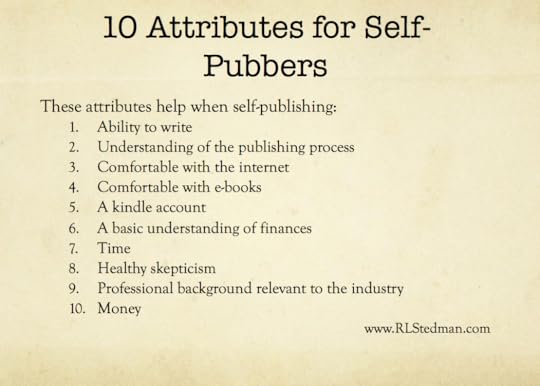
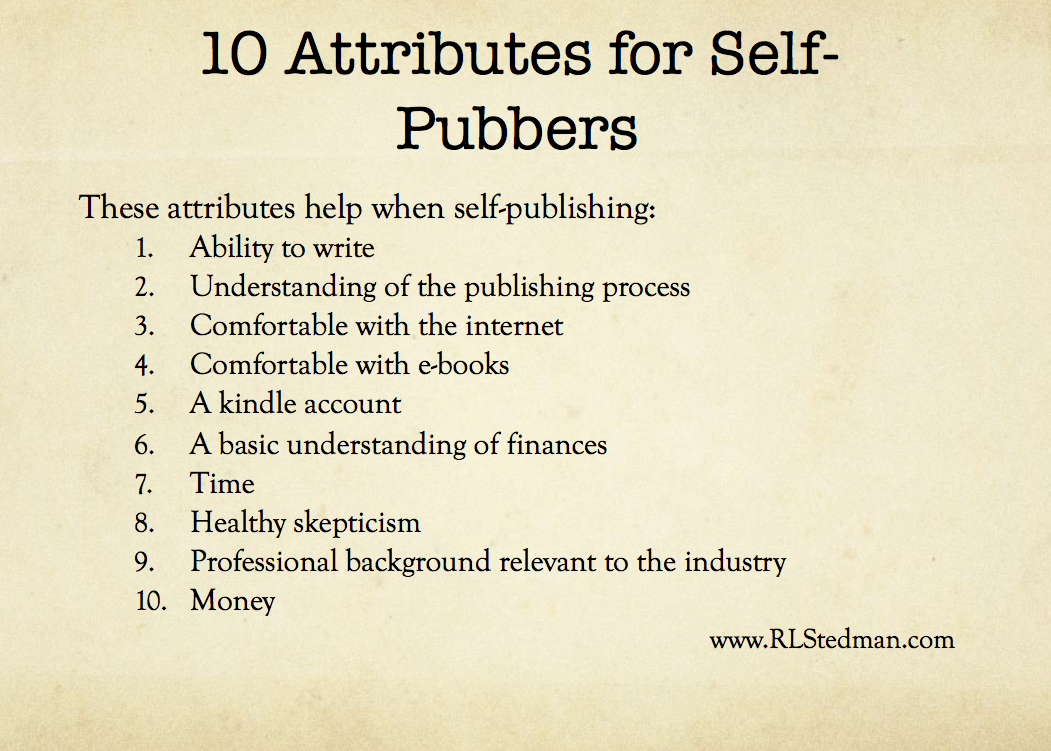
Do I have these 10 Attributes ?
1. Can I write?
I had just won a major prize - Best First Novel at the New Zealand Post Book Awards for my first novel, A Necklace of Souls, so I thought yes, I probably could.
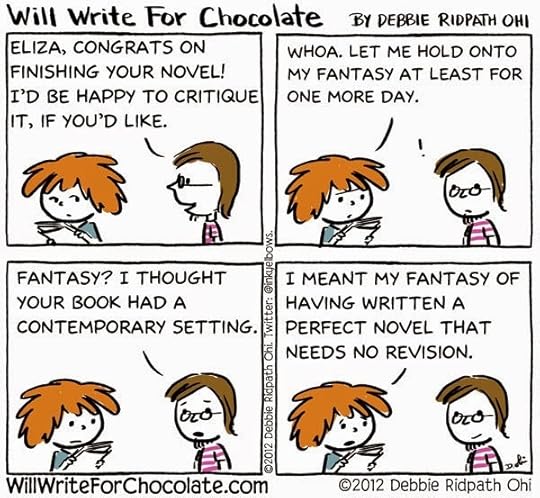
But if this is your first manuscript the chances are that, no, you probably can't. Sorry. Most writers have a few failed scripts in boxes somewhere. If this is your first manuscript, and its your first draft and you are planning on self-publishing I really suggest that you DO NOT ask people to pay for it - i.e. don't put it onto Amazon or ibooks. If you really think the idea is good (in between the normal 'it's crap' feeling that every writer has) I would try and get a Critique Partner, or put it onto WattPad or Fan Fiction - anything to get feedback. And do a course of study. Believe me, study really helps.
My last series of blog posts deals with the writing process, and includes tips on how to find a Critique Partner.
 From InkyGirl.com
2. Do I understand the publishing process?
Commercial publishers are very unlikely to publish even your final draft. Before it is set to print your book will have at least three edits - usually by three different people:a structural edit - where the structure of the plot, the characters and so forth are analysed and recommendations made on how to strengthen them a copy edit - where the spelling, grammar and so on is checkeda proofing edit - check for final errors
If self-publishing, you would be wise to follow this process. Otherwise your book won't be as good as it could be. Which is bad for reviews, bad for your reputation, and just bad for the reader. But be warned, professional editorial input is not free. It's worth it, in terms of product, but you may not get your money back in sales.
3. Are you comfortable with the internet?
If you're reading this on a blog site, chances are you are quite comfortable on a browser. Just be warned: self-publishing is a global industry and unless you want to pay someone a lot of money to do everything for you, you'll probably need to do it yourself. This means that invariably, you'll be on the internet a lot.
4. Are you comfortable with e-books?
Self publishing is really about e. The future is p, too, I think, but we're not there just yet. So if you're planning on self-publishing, make sure you enjoy and are familiar with reading on an e-platform. This means you'll have a greater understanding for the importance of layout, and you'll be more careful when it comes to formatting. Also, you'll be making purchasing decisions similar to your readers.
5. Do you have a kindle account?
Currently, Amazon is the dominator of the self-pub industry. According to Gaughran, this is because their algorithms don't favour established publishing houses - they only favour reader choice. Which means that self-pubs have an opportunity to compete. iTunes is coming on strong, too, but more people still read on Amazon apps or kindles. Nook isn't really a favourite of self-publishers. Gaughran says this is because its algorithims favour publishers, as they pay more for the opportunity to use the platform. So if you're really wanting to self-publish, I do suggest you become familiar with the Amazon store. Understand how books are presented to purchasers and download a few yourself. Get a feeling for what you like, and what features you don't. It is different to navigating your way through a bricks and mortars store.
6. Do you have a basic understanding of finances?
Here's a lesson for you. I have an MBA and I buy products professionally for a living, so I thought, well, no problem. I'll be fine here. And yet - I forgot about the exchange rate! I can't believe it, but I did. The problem is, Amazon presents all its prices in USD. For some arcane reason. Like, yes, everyone in the world uses USD. So when I calculated the costs of CreateSpace, I forgot to convert. This meant a price inflation of around 20%.
7. Do you have time?
Self publishing your first book will take you ages. Well, it's taken me ages. Everything is new. I don't know how to use the technology. This is what I have had to learn so far:
 how to download a mobi filehow to read a mobi filehow to format to a print-ready proofhow to format a word document to smashwords requirements (don't believe them when they say their Style Guide is easy to use. It isn't)how to organise a press releasehow to create, and edit, an .html document. What is bleed?How long are delivery times?What does a book distributor do? What does a book marketer do? How much do they cost?What is an ASIN and what is an ISBN?What paper thickness do I need? Do I need matt or gloss cover? What is a laminate?How do I get an EIN?How to organise a blog tourWhat is a marketing plan and what should it look like?How much should I price my book?How many copies should I order?
8. Do you have a healthy dose of scepticism?
In this industry - in most industries, really - there is no 'get rich quick' scheme. Yet, when you read the websites of Smashwords or Amazon, they say just upload your manuscript and click the 'publish' button and voila, your words in your way, ready to be read by the world. Don't believe them. Don't believe anyone when they tell you that it's simple. By the time I get to book number 5, it will be simple. Unless, of course, the industry changes, which is very possible. But right now, I'm on a steep, slow-climb up the learning curve.
9. Do you have a background that includes any or all of the following?
The following skill sets are really, really helpful. If you have some or all of these, you'll find the route to self-publishing so much easier.Scientific/AnalyticalCommerce/... ManagementIT10. Do you have enough money?
Self-publishing is not free. Well, I don't think it's free. Costs include time, of course, but there's also editorial, book covers, printers (if you get printing done), marketing and anything else you care to spend. You can do it on a really tight, tight budget of perhaps $500 USD, but some people pay a lot more. I have allowed for about $5000 for my first self-pub. The following novels will be less, because I won't do everything I've done on the first one. But the good thing is, these costs are all tax-deductible. One bonus of writing - you might not make much money, but pretty much everything you do can be claimed as a deduction.
And on a Positive Note
The ten qualities above are mostly personal qualities. They do not involve spending enormous amounts of money, or hiring employees, or building plant or buying expensive equipment. They do, however, involve spending large amounts of time.
Next post I'll go through the first steps to self-publishing - actually putting these skills into use.
So this next series of posts will be about the process I have taken to enter the self-pub marketplace, and what I have found in doing so.
I've found two books to be really useful:
Head or Heart - Will Self-Publishing Make You Money? by Nina HarringtonLet's Get Visible: How to Get Noticed and Sell More Books by David GaughranBoth of these writers are established self-published authors of commercial fiction, and put their experiences and learnings into these books ('In a gold rush, sell shovels,' said my MBA lecturer).
There's also an interesting article in the Economist which is worth looking at (plus, it has a pretty cool interactive graph).
And before even starting on the self-pub route, there's a few skill sets that you need to have. Here's a list of questions to ask yourself.
Do I have these 10 Attributes ?
1. Can I write?
I had just won a major prize - Best First Novel at the New Zealand Post Book Awards for my first novel, A Necklace of Souls, so I thought yes, I probably could.
But if this is your first manuscript the chances are that, no, you probably can't. Sorry. Most writers have a few failed scripts in boxes somewhere. If this is your first manuscript, and its your first draft and you are planning on self-publishing I really suggest that you DO NOT ask people to pay for it - i.e. don't put it onto Amazon or ibooks. If you really think the idea is good (in between the normal 'it's crap' feeling that every writer has) I would try and get a Critique Partner, or put it onto WattPad or Fan Fiction - anything to get feedback. And do a course of study. Believe me, study really helps.
My last series of blog posts deals with the writing process, and includes tips on how to find a Critique Partner.
 From InkyGirl.com
2. Do I understand the publishing process?
Commercial publishers are very unlikely to publish even your final draft. Before it is set to print your book will have at least three edits - usually by three different people:a structural edit - where the structure of the plot, the characters and so forth are analysed and recommendations made on how to strengthen them a copy edit - where the spelling, grammar and so on is checkeda proofing edit - check for final errors
If self-publishing, you would be wise to follow this process. Otherwise your book won't be as good as it could be. Which is bad for reviews, bad for your reputation, and just bad for the reader. But be warned, professional editorial input is not free. It's worth it, in terms of product, but you may not get your money back in sales.
3. Are you comfortable with the internet?
If you're reading this on a blog site, chances are you are quite comfortable on a browser. Just be warned: self-publishing is a global industry and unless you want to pay someone a lot of money to do everything for you, you'll probably need to do it yourself. This means that invariably, you'll be on the internet a lot.
4. Are you comfortable with e-books?
Self publishing is really about e. The future is p, too, I think, but we're not there just yet. So if you're planning on self-publishing, make sure you enjoy and are familiar with reading on an e-platform. This means you'll have a greater understanding for the importance of layout, and you'll be more careful when it comes to formatting. Also, you'll be making purchasing decisions similar to your readers.
5. Do you have a kindle account?
Currently, Amazon is the dominator of the self-pub industry. According to Gaughran, this is because their algorithms don't favour established publishing houses - they only favour reader choice. Which means that self-pubs have an opportunity to compete. iTunes is coming on strong, too, but more people still read on Amazon apps or kindles. Nook isn't really a favourite of self-publishers. Gaughran says this is because its algorithims favour publishers, as they pay more for the opportunity to use the platform. So if you're really wanting to self-publish, I do suggest you become familiar with the Amazon store. Understand how books are presented to purchasers and download a few yourself. Get a feeling for what you like, and what features you don't. It is different to navigating your way through a bricks and mortars store.
6. Do you have a basic understanding of finances?
Here's a lesson for you. I have an MBA and I buy products professionally for a living, so I thought, well, no problem. I'll be fine here. And yet - I forgot about the exchange rate! I can't believe it, but I did. The problem is, Amazon presents all its prices in USD. For some arcane reason. Like, yes, everyone in the world uses USD. So when I calculated the costs of CreateSpace, I forgot to convert. This meant a price inflation of around 20%.
7. Do you have time?
Self publishing your first book will take you ages. Well, it's taken me ages. Everything is new. I don't know how to use the technology. This is what I have had to learn so far:
 how to download a mobi filehow to read a mobi filehow to format to a print-ready proofhow to format a word document to smashwords requirements (don't believe them when they say their Style Guide is easy to use. It isn't)how to organise a press releasehow to create, and edit, an .html document. What is bleed?How long are delivery times?What does a book distributor do? What does a book marketer do? How much do they cost?What is an ASIN and what is an ISBN?What paper thickness do I need? Do I need matt or gloss cover? What is a laminate?How do I get an EIN?How to organise a blog tourWhat is a marketing plan and what should it look like?How much should I price my book?How many copies should I order?
8. Do you have a healthy dose of scepticism?
In this industry - in most industries, really - there is no 'get rich quick' scheme. Yet, when you read the websites of Smashwords or Amazon, they say just upload your manuscript and click the 'publish' button and voila, your words in your way, ready to be read by the world. Don't believe them. Don't believe anyone when they tell you that it's simple. By the time I get to book number 5, it will be simple. Unless, of course, the industry changes, which is very possible. But right now, I'm on a steep, slow-climb up the learning curve.
9. Do you have a background that includes any or all of the following?
The following skill sets are really, really helpful. If you have some or all of these, you'll find the route to self-publishing so much easier.Scientific/AnalyticalCommerce/... ManagementIT10. Do you have enough money?
Self-publishing is not free. Well, I don't think it's free. Costs include time, of course, but there's also editorial, book covers, printers (if you get printing done), marketing and anything else you care to spend. You can do it on a really tight, tight budget of perhaps $500 USD, but some people pay a lot more. I have allowed for about $5000 for my first self-pub. The following novels will be less, because I won't do everything I've done on the first one. But the good thing is, these costs are all tax-deductible. One bonus of writing - you might not make much money, but pretty much everything you do can be claimed as a deduction.
And on a Positive Note
The ten qualities above are mostly personal qualities. They do not involve spending enormous amounts of money, or hiring employees, or building plant or buying expensive equipment. They do, however, involve spending large amounts of time.
Next post I'll go through the first steps to self-publishing - actually putting these skills into use.
October 15, 2014
Am I An Oracle?
To use Business-Speak, my last few posts have been a situation analysis: a review of current state of play of an industry and a prediction of what is to come.
I do this all the time for work, and I love it! And as I have said so many times in this blog, wow it is so scary when you are proved right! Makes me feel like I'm some sort of oracle or something.
Of course it's nothing like that, it's just understanding basic business models and economic theory. Most industries are fairly predictable. It's just that people get swayed by emotion (also predictable) and hope that they can get onto the next best thing before everyone else can.
Want to hear a definition of an economist? Someone who won't bend to pick up a dollar on the sidewalk. Why not? Because he knows that someone else will get there first.
I think this is really funny, but then I know a lot of entrepreneurs, all busy bending for the dollars.
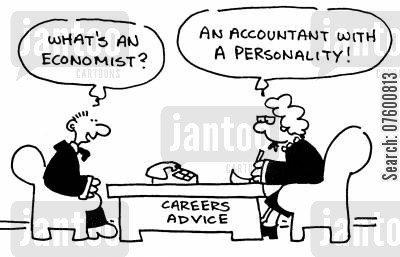 From Jantoo
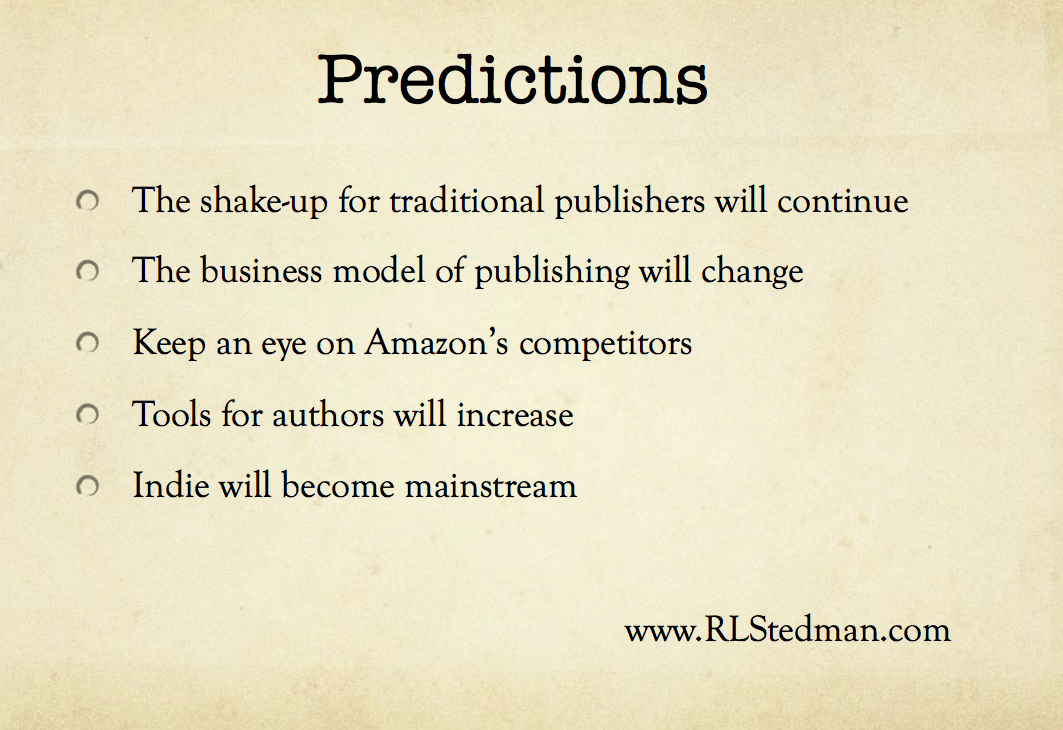
Okay, so here's my final industry overview, and my predictions for the future.
Predictions for the Future of Publishing
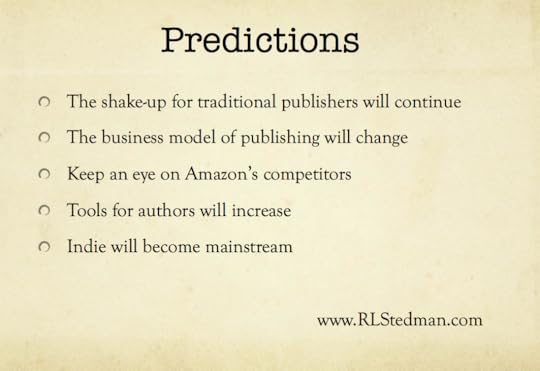
1. The shake-up for traditional publishers will continue
I do not see, both as an outsider and a supplier to the industry, the changes required by trad publishers to survive. And yet their pricing remains high (one of the arguments by Amazon in their ongoing dispute with Hachette), they are not developing new talent and there is a definite trend to outsourcing their supply chain. Access to available substitutes (e-books or POD) is increasing. Trad publishers of mass-market fiction have limited Unique Selling Points (USPs).
Personally, I think this is sad. Publishers do bring a lot of benefits - for one, they ensure the reading public receive a quality experience. They are arbiters of literature, and literature both defines and shapes a society.
2. The business model for publishing will change
Traditional publishing houses do have some competitive advantages and these will continue in the longer term.
Access to high performing authorsRights Competitive printing costsDistribution channelsHowever, the relationship between author/publisher will change. It is likely that there will be a shift to partnership models. Author-as-venture-capitalist. The author may part fund the publisher. This would be a massive shift for the industry, taking the writer from supplier to partner. There are signs this is emerging already: Ingram has announced a joint model with Barbara Freethy
Other organisations may also enter the market. Printed books are still the widest form of reading and are still where the margins are, so companies with strengths in print and distribution when combined with a high-performing author's stable could do well.
I think it will be an interesting time.
Similarly (as discussed earlier), there will also be a rise in indie publishing houses. The innovative will survive. Note to self: Keep an eye on IPOs for these ones - there are likely to be some very smart operators emerging in this space.
3. The demise (or plateauing) of Amazon as a digital publishing platform
I'm nervous about this prediction, as I'm also aware that Amazon is one of the smartest companies around. But Google is nothing to be sneezed at and increasingly, authors are looking at Google books. Similarly, the new iOS from Apple included ibooks as a standard app. And with the rise of tablets and smart phones as reading devices, kindle is loosing its edge. The irritation by authors with Amazon should not be understated; the perception in the industry that Amazon is 'arrogant' and 'in it for the money' (Duh!) has been stated by a number of very influential opinion-leaders. At best, this is massively bad publicity. At worse, this could lead to anti-trust suits.
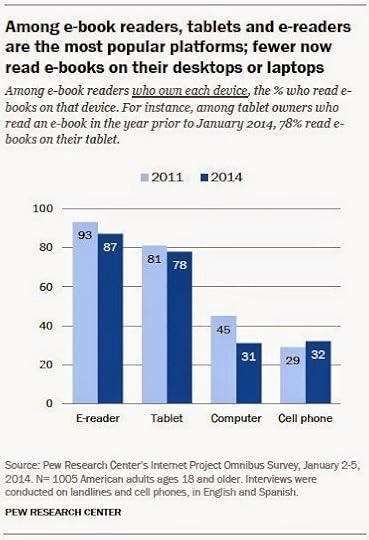 From A Snapshot of Reading in America, 20134. The smartening of authors
Twenty years ago, only the desperate or the marginal thought of self-publishing. Now, it's accepted practise, but you need to know how to navigate the process. Authors will have to become business-savvy to survive. There will be more people entering the market, and competition will increase. Already, most of the best sellers (including the traditionally published) are extremely smart business people. So, in addition to the smartening-up, I predict an increase in self-help tools for authors, including quasi full-service publishing houses.
5. Mainstreaming of Indie
Books are sold through personal experience and through word of mouth. And if good writers are self-publishing, good readers want to find them. Mainstream arbiters of taste, such as Publishers Weekly, are now offering reviews to self-pubbed authors. Goodreads, purchased last year by Amazon, offers the social media experience, directly connecting readers with writers. My prediction is there will be more 'established' platforms reviewing indie works and that the quality of indie works will rise. The term 'indie' will truly mean 'independent'.
This isn't a comprehensive list. I haven't talked here about pricing models or changing platforms (audio, streaming) or non-English speaking markets, although these are also trends worth watching.
Up Close and Personal
So where does this leave me, in my quest for financial security?
This is the last situation analysis post. From now on, it will all be personal. Because analysis only takes you so far. I have a feeling for where the opportunities are now, and I need to try it for myself. Stay tuned!
PS - if you're interested in reading more about strategy and industry predictions, have a look at Porter's Five Forces, a business model developed by Michael E Porter in a seminal paper in the Harvard Business Review.
I do this all the time for work, and I love it! And as I have said so many times in this blog, wow it is so scary when you are proved right! Makes me feel like I'm some sort of oracle or something.
Of course it's nothing like that, it's just understanding basic business models and economic theory. Most industries are fairly predictable. It's just that people get swayed by emotion (also predictable) and hope that they can get onto the next best thing before everyone else can.
Want to hear a definition of an economist? Someone who won't bend to pick up a dollar on the sidewalk. Why not? Because he knows that someone else will get there first.
I think this is really funny, but then I know a lot of entrepreneurs, all busy bending for the dollars.
 From Jantoo
Okay, so here's my final industry overview, and my predictions for the future.
Predictions for the Future of Publishing
1. The shake-up for traditional publishers will continue
I do not see, both as an outsider and a supplier to the industry, the changes required by trad publishers to survive. And yet their pricing remains high (one of the arguments by Amazon in their ongoing dispute with Hachette), they are not developing new talent and there is a definite trend to outsourcing their supply chain. Access to available substitutes (e-books or POD) is increasing. Trad publishers of mass-market fiction have limited Unique Selling Points (USPs).
Personally, I think this is sad. Publishers do bring a lot of benefits - for one, they ensure the reading public receive a quality experience. They are arbiters of literature, and literature both defines and shapes a society.
2. The business model for publishing will change
Traditional publishing houses do have some competitive advantages and these will continue in the longer term.
Access to high performing authorsRights Competitive printing costsDistribution channelsHowever, the relationship between author/publisher will change. It is likely that there will be a shift to partnership models. Author-as-venture-capitalist. The author may part fund the publisher. This would be a massive shift for the industry, taking the writer from supplier to partner. There are signs this is emerging already: Ingram has announced a joint model with Barbara Freethy
Other organisations may also enter the market. Printed books are still the widest form of reading and are still where the margins are, so companies with strengths in print and distribution when combined with a high-performing author's stable could do well.
I think it will be an interesting time.
Similarly (as discussed earlier), there will also be a rise in indie publishing houses. The innovative will survive. Note to self: Keep an eye on IPOs for these ones - there are likely to be some very smart operators emerging in this space.
3. The demise (or plateauing) of Amazon as a digital publishing platform
I'm nervous about this prediction, as I'm also aware that Amazon is one of the smartest companies around. But Google is nothing to be sneezed at and increasingly, authors are looking at Google books. Similarly, the new iOS from Apple included ibooks as a standard app. And with the rise of tablets and smart phones as reading devices, kindle is loosing its edge. The irritation by authors with Amazon should not be understated; the perception in the industry that Amazon is 'arrogant' and 'in it for the money' (Duh!) has been stated by a number of very influential opinion-leaders. At best, this is massively bad publicity. At worse, this could lead to anti-trust suits.
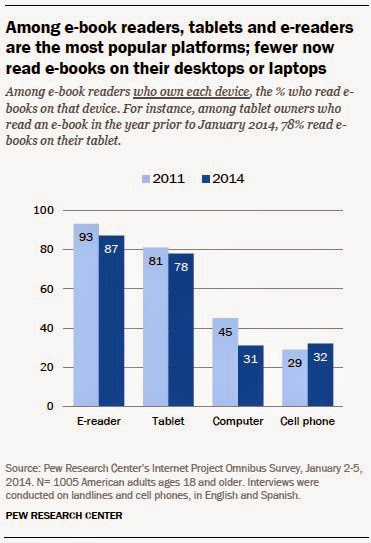 From A Snapshot of Reading in America, 20134. The smartening of authors
Twenty years ago, only the desperate or the marginal thought of self-publishing. Now, it's accepted practise, but you need to know how to navigate the process. Authors will have to become business-savvy to survive. There will be more people entering the market, and competition will increase. Already, most of the best sellers (including the traditionally published) are extremely smart business people. So, in addition to the smartening-up, I predict an increase in self-help tools for authors, including quasi full-service publishing houses.
5. Mainstreaming of Indie
Books are sold through personal experience and through word of mouth. And if good writers are self-publishing, good readers want to find them. Mainstream arbiters of taste, such as Publishers Weekly, are now offering reviews to self-pubbed authors. Goodreads, purchased last year by Amazon, offers the social media experience, directly connecting readers with writers. My prediction is there will be more 'established' platforms reviewing indie works and that the quality of indie works will rise. The term 'indie' will truly mean 'independent'.
This isn't a comprehensive list. I haven't talked here about pricing models or changing platforms (audio, streaming) or non-English speaking markets, although these are also trends worth watching.
Up Close and Personal
So where does this leave me, in my quest for financial security?
This is the last situation analysis post. From now on, it will all be personal. Because analysis only takes you so far. I have a feeling for where the opportunities are now, and I need to try it for myself. Stay tuned!
PS - if you're interested in reading more about strategy and industry predictions, have a look at Porter's Five Forces, a business model developed by Michael E Porter in a seminal paper in the Harvard Business Review.
October 9, 2014
Show Me The Money
Over the last few posts I've made statements about the future of publishing, the risk to authors, the rise of the self-pubbed industry and the decline and reshaping of the fiction market. It's easy to make such statements; harder to support it with proof.
However, I have been reviewing some data sets, which I'm going to share with you. Feel free to click on the links to get more details.
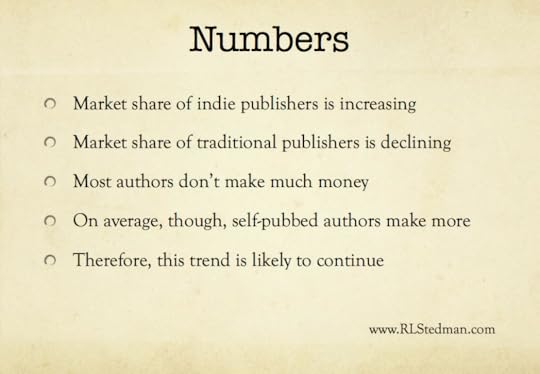
Firstly:The market share of indie writers to trad publishers appears to be increasing.
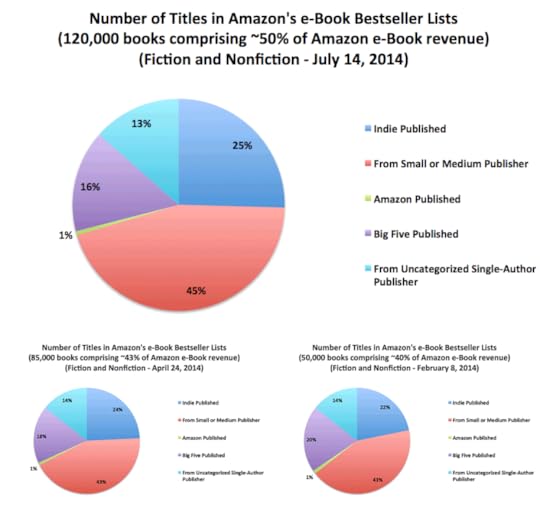
When I say market share, I mean the percentage of dollars going to indie authors. This was reported by AuthorEarnings.com (click on the link to read the report), although they note that this is just based on two data points and two data points does not a trend make. It does, though, make an encouraging sign (if you're an indie publisher. Not so fab if you're a traditional publisher!).
Also of note is the rise of the small to medium publishing houses. As I've already stated, they have many advantages in this brave new world.
Mark Coker from Smashwords also reports similar findings. You can download his dataset and have a play with the figures if you feel so included.
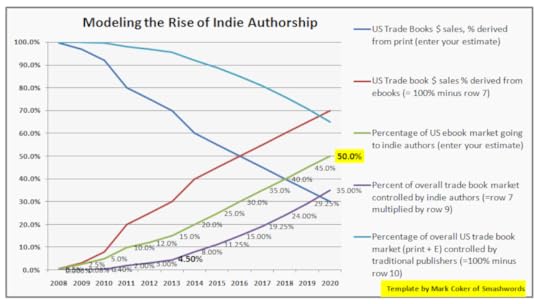
Of interest is that while number of titles in the best seller lists are increasing in the indie and small or medium groups, they are decreasing for the big 5. This suggests that the smaller, more nimble sectors are replacing the larger incumbents. They are competing and winning.
Again, it will be interesting to see if this is just a blip or if its a trend. My gut feeling is its a trend, but I'd need to dig into the annual reports of the big 5 to see this and right now I don't have the time.
A quick aside for the non-financially literate: companies that are publicly listed on a stock exchange have to product annual reports. There are often little gems in these reports, and if you're seriously interested in a sector, it pays to have a read of them. Note to self: get the Amazon one.
Secondly:
The big 5 make their money from only a few authors. This is hardly startling news - I said at the beginning of this blog that writing is a tournament market place and in a tournament the 80:20 rule definitely applies; 80 percent of the earnings will be derived from 20 percent of the population (look up Pareto's Theorem for more information).
If you are not in that crowd, your opportunities to earn a living wage are low. You may be better off in the self-published group.
Furthermore, if you have a backlist to which you have the rights, you might be even better placed to consider self-pub, at least for your backlist. Why? It's off the backlists that the publishers make their money. Why shouldn't you?
Finally:
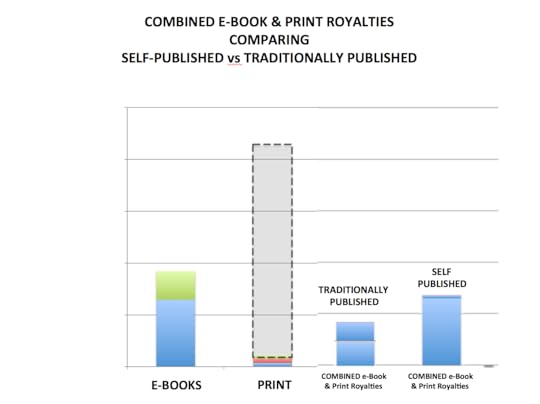
The reason so many of us are thinking of moving to self-publish is because the earnings in trad are not that stunning.
Take a look at this graph from Author's Earnings
If that were to change, its possible that many of us would shift back. So, here's a thought for publishers to consider. Perhaps more innovative ways of payment - such as profit sharing, co-investment, rebates/discounts, supply chain partnership - might be worth considering
A note of caution:
As more and more people begin to self-publish, it's inevitable that opportunities for profit will drop off. Glory days of double digit growth always, always come to an end. That's what markets do, remember? So don't go thinking that self-pub is a get rich quick scheme. There is no such thing. But there are always opportunities. Personally, I think it's worth digging into the data to know what and where these are.
However, I have been reviewing some data sets, which I'm going to share with you. Feel free to click on the links to get more details.
Firstly:The market share of indie writers to trad publishers appears to be increasing.

When I say market share, I mean the percentage of dollars going to indie authors. This was reported by AuthorEarnings.com (click on the link to read the report), although they note that this is just based on two data points and two data points does not a trend make. It does, though, make an encouraging sign (if you're an indie publisher. Not so fab if you're a traditional publisher!).
Also of note is the rise of the small to medium publishing houses. As I've already stated, they have many advantages in this brave new world.
Mark Coker from Smashwords also reports similar findings. You can download his dataset and have a play with the figures if you feel so included.

Of interest is that while number of titles in the best seller lists are increasing in the indie and small or medium groups, they are decreasing for the big 5. This suggests that the smaller, more nimble sectors are replacing the larger incumbents. They are competing and winning.
Again, it will be interesting to see if this is just a blip or if its a trend. My gut feeling is its a trend, but I'd need to dig into the annual reports of the big 5 to see this and right now I don't have the time.
A quick aside for the non-financially literate: companies that are publicly listed on a stock exchange have to product annual reports. There are often little gems in these reports, and if you're seriously interested in a sector, it pays to have a read of them. Note to self: get the Amazon one.
Secondly:
The big 5 make their money from only a few authors. This is hardly startling news - I said at the beginning of this blog that writing is a tournament market place and in a tournament the 80:20 rule definitely applies; 80 percent of the earnings will be derived from 20 percent of the population (look up Pareto's Theorem for more information).
If you are not in that crowd, your opportunities to earn a living wage are low. You may be better off in the self-published group.
Furthermore, if you have a backlist to which you have the rights, you might be even better placed to consider self-pub, at least for your backlist. Why? It's off the backlists that the publishers make their money. Why shouldn't you?
Finally:
The reason so many of us are thinking of moving to self-publish is because the earnings in trad are not that stunning.
Take a look at this graph from Author's Earnings
If that were to change, its possible that many of us would shift back. So, here's a thought for publishers to consider. Perhaps more innovative ways of payment - such as profit sharing, co-investment, rebates/discounts, supply chain partnership - might be worth considering

A note of caution:
As more and more people begin to self-publish, it's inevitable that opportunities for profit will drop off. Glory days of double digit growth always, always come to an end. That's what markets do, remember? So don't go thinking that self-pub is a get rich quick scheme. There is no such thing. But there are always opportunities. Personally, I think it's worth digging into the data to know what and where these are.

September 28, 2014
Shifting Sands
The Rise of the Hybrid
In my earlier posts I discussed the changing marketplace for fiction, and how the changing technological platforms will shift the power balance away from traditional publishing towards smaller publishing houses and towards the author-acting-as-publisher.
I also said that before this happens, there will be a marked period of uncertainty, where traditional publishing houses, seeking to reduce costs, are likely to downsize, amalgamate or acquire. As part of this uncertainty, publishers will also seek to offset risk, by increasing the liability clauses in their agreements - pushing liability onto the author - and requiring un-met advances to be paid back.
It's a very scary moment when you see your predictions coming true.
I presented at a writer's workshop last week (the reason this blog post is a little later than usual) where two highly respected writers presented. (I presented, too, but I don't include myself as up to their calibre!)
Both writers, Philip Temple and Jackie Ballantyne, have decided to self-pub. Philip, who has been writing professionally for over forty years, has had multiple residencies, holds the New Zealand Order of Merit for Services to Literature and was awarded an honorary doctorate by the University of Otago. Clearly, he has a long and respected literary career. And yet, and yet... Philip has experienced first hand a number of examples where publishers have been acquired by a larger house while a novel is coming out - to the detriment of the novel. He also reported that he has found terms and conditions are harsher; payments to authors are decreasing while expectations on them are increasing. So therefore, he has decided to self-publish his novel, MiStory, about climate change.
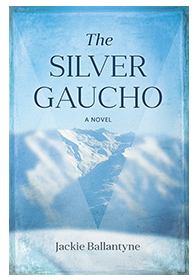
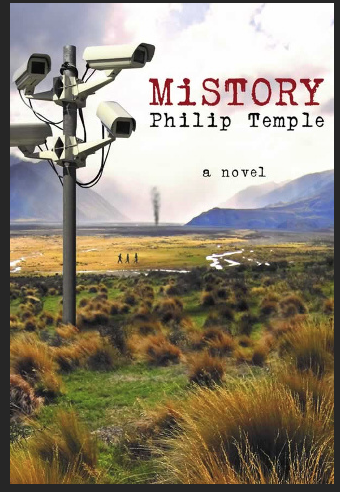 Jackie reports a similar experience. Her novel, The Silver Gaucho, has also been published this month.
Both novels are doing well, making the bestseller lists. Which, given the size of New Zealand, is unlikely to lead to fame and fortune. But it does represent something new, and something rather exciting. Jackie and Philip show that self-published novels can compete head to head in the bookstores and not only hold their own; they can do well.
These two writers represent an emerging phenomenon: the rise of the hybrid novelist.
Hybrid novelists are those writers who both self-publish and who publish through a traditional house. Some use their backlist, when their rights have reverted and discover a new readership (and income stream). Others write new works, and make a choice whether or not to self-pub.
This is the route I am interested in taking. Why?
Brand:
Traditionally, publishers have been expert at:
identifying talentquality control editingformattingproject managementprintingdistributionmarketingtalent managementThese components, taken together, have constituted their brand.
But now, as we've seen, publishers have less focus on talent identification, and a greater focus on short term return.
Editing, formatting and printing have been outsourced to freelancers. Distribution partnerships (with bricks and mortar stores) are decreasing. Marketing support is limited to the top sellers only; most authors are expected to manage the majority of their own marketing. Furthermore, much of the downsizing has meant experienced book publicists are now available as freelance. Talent management is almost non-existent. Most publishers have outsourced almost their entire supply chain!
This means that many large publishers have only three points of differencecapital (money)distributionaccess to reviewers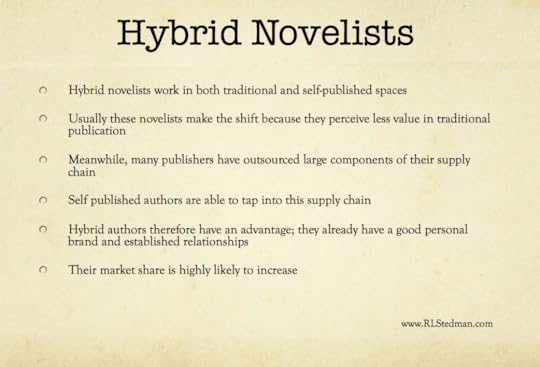
What Does This Mean?It means a massive brand dilution. Distribution can be replicated with technology or relationships. Reviewers are interested in the author, not the publishing house. Which leaves only money. And if the only thing differentiating you is money, you are highly, highly vulnerable.
Why?
Because of how the business life cycle works. To survive in a declining marketplace, a business must be able to differentiate on quality. Anything else is too easily substituted by new, emerging technology.
Brand Dilution means New Opportunities
Writers are now able to purchase editorial, printing and project management support. We are able to do this in a multitude of configurations and for a competitive price. Hybrid authors like Philip and Jackie are at a particular advantage here, as they have existing relationships within the industry and their names are synonymous with quality. They already have a brand.
After all, what do readers want? They want a good product. Self-published authors are now able to provide that product.
If what I saw this weekend is any symptom of the future, quality authors will be self-publishing quality books, and readers will be very interested.
So right now, I see definite advantages to joining the self-pub industry.
In my earlier posts I discussed the changing marketplace for fiction, and how the changing technological platforms will shift the power balance away from traditional publishing towards smaller publishing houses and towards the author-acting-as-publisher.
I also said that before this happens, there will be a marked period of uncertainty, where traditional publishing houses, seeking to reduce costs, are likely to downsize, amalgamate or acquire. As part of this uncertainty, publishers will also seek to offset risk, by increasing the liability clauses in their agreements - pushing liability onto the author - and requiring un-met advances to be paid back.
It's a very scary moment when you see your predictions coming true.
I presented at a writer's workshop last week (the reason this blog post is a little later than usual) where two highly respected writers presented. (I presented, too, but I don't include myself as up to their calibre!)
Both writers, Philip Temple and Jackie Ballantyne, have decided to self-pub. Philip, who has been writing professionally for over forty years, has had multiple residencies, holds the New Zealand Order of Merit for Services to Literature and was awarded an honorary doctorate by the University of Otago. Clearly, he has a long and respected literary career. And yet, and yet... Philip has experienced first hand a number of examples where publishers have been acquired by a larger house while a novel is coming out - to the detriment of the novel. He also reported that he has found terms and conditions are harsher; payments to authors are decreasing while expectations on them are increasing. So therefore, he has decided to self-publish his novel, MiStory, about climate change.
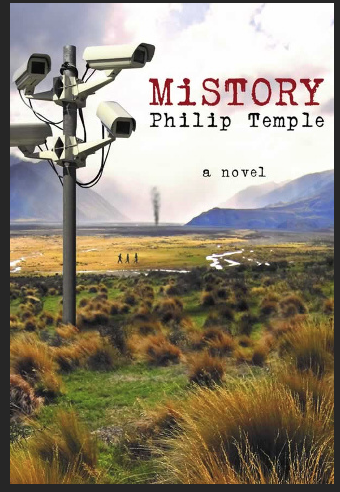 Jackie reports a similar experience. Her novel, The Silver Gaucho, has also been published this month.
Both novels are doing well, making the bestseller lists. Which, given the size of New Zealand, is unlikely to lead to fame and fortune. But it does represent something new, and something rather exciting. Jackie and Philip show that self-published novels can compete head to head in the bookstores and not only hold their own; they can do well.
These two writers represent an emerging phenomenon: the rise of the hybrid novelist.
Hybrid novelists are those writers who both self-publish and who publish through a traditional house. Some use their backlist, when their rights have reverted and discover a new readership (and income stream). Others write new works, and make a choice whether or not to self-pub.
This is the route I am interested in taking. Why?
Brand:
Traditionally, publishers have been expert at:
identifying talentquality control editingformattingproject managementprintingdistributionmarketingtalent managementThese components, taken together, have constituted their brand.
But now, as we've seen, publishers have less focus on talent identification, and a greater focus on short term return.
Editing, formatting and printing have been outsourced to freelancers. Distribution partnerships (with bricks and mortar stores) are decreasing. Marketing support is limited to the top sellers only; most authors are expected to manage the majority of their own marketing. Furthermore, much of the downsizing has meant experienced book publicists are now available as freelance. Talent management is almost non-existent. Most publishers have outsourced almost their entire supply chain!
This means that many large publishers have only three points of differencecapital (money)distributionaccess to reviewers
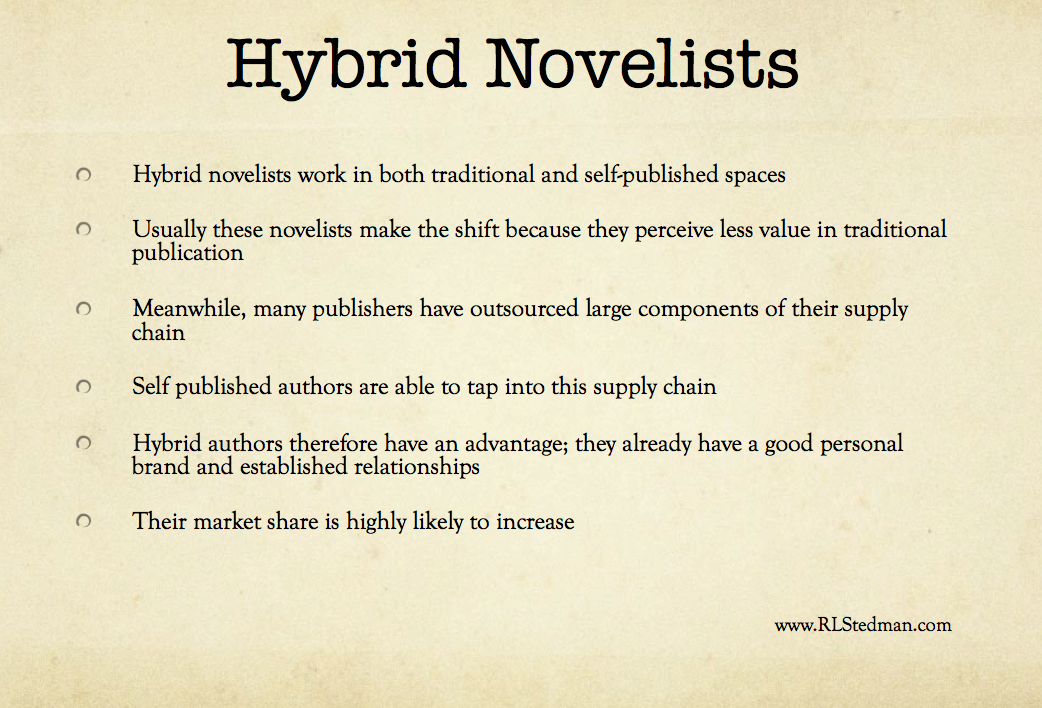
What Does This Mean?It means a massive brand dilution. Distribution can be replicated with technology or relationships. Reviewers are interested in the author, not the publishing house. Which leaves only money. And if the only thing differentiating you is money, you are highly, highly vulnerable.
Why?
Because of how the business life cycle works. To survive in a declining marketplace, a business must be able to differentiate on quality. Anything else is too easily substituted by new, emerging technology.
Brand Dilution means New Opportunities
Writers are now able to purchase editorial, printing and project management support. We are able to do this in a multitude of configurations and for a competitive price. Hybrid authors like Philip and Jackie are at a particular advantage here, as they have existing relationships within the industry and their names are synonymous with quality. They already have a brand.
After all, what do readers want? They want a good product. Self-published authors are now able to provide that product.
If what I saw this weekend is any symptom of the future, quality authors will be self-publishing quality books, and readers will be very interested.
So right now, I see definite advantages to joining the self-pub industry.
September 20, 2014
New Ways of Doing Business
Indie Publishers
In my last post (sounds like the army) I talked about profits per player being greatest in a growth market. And I talked about indie authors. But I forgot that there's another group of players also taking advantage of the growth market; that's indie publishers.
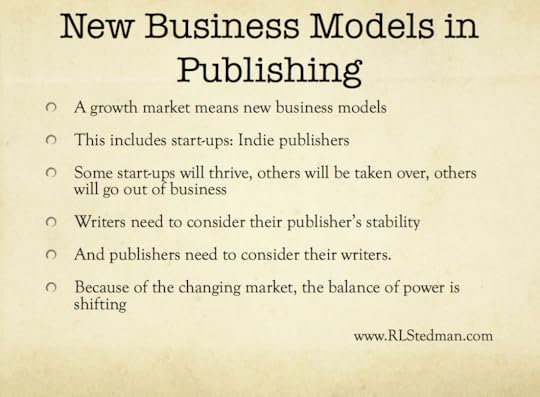
Indie publishers are an interesting group. These are the smart players that always emerge in a growth market, taking advantage of new technology and new processes. New players have a significant advantage; unencumbered by bureaucracy, they carry relatively little overheads and they don't have the tradition that can act as a stifler to innovation. These start ups usually operate in niche markets and often have deep knowledge and relationships within that market. These types of players are not unique to publishing - they are a consistent feature of all growth industries.
Start-ups like this are often balanced on a knife-edge. A lack of capital means that they are vulnerable to reductions in cash-flow and they can be take over targets by the big boys. Sometimes, they even operate in the big boys' space and this is really where you do not want to be, not if you're a startup. Unless, of course, you're an entrepreneur and you're wanting to be taken over, in which case you'll be happy to have an offer thank you very much and you can retire rich on your earnings.
The strength of the indie business model is demonstrated by the major players who have set up quasi-indie publication houses of their own. Examples of these can be seen in both the 'vanity' press of X-Libris and the like and the e-publishing arms of HarperCollins, or Swoonworthy, an imprint of Macmillian.
As the e-pub market matures, which it will do, it's inevitable as death and taxes, there will be amalgamation of indie houses; some will go under; some will be acquired. others will merge. If you're a writer, pick your indie publisher carefully. They could be a ticket to a gravy train or a road to oblivion.
My gut feeling is that for me, searching for financial stability in this wide world of writing, indie publishers are unlikely to offer significant advantages. I don't write in a heavily niched space that would make them a useful partner. And an indie publisher's margins are too tight and they are too capital poor to offer me the carrots of the big publishers: security, advances, accolades and wide-scale distribution.
However, for the start-out writer, I would really recommend the indies as an option. Because they are small, communication is easier, and because they are passionate about their niche they will be passionate about your work. Besides, you can learn a lot about publishing from them.
Publishers as Partners
In an earlier post I discussed how markets that are reliant on social capital - skills, creativity, talent - are much more stable than markets that are technology driven. Because if technology changes, the market changes. Writing is a social capital market, because good writing, great storytelling, cannot be substituted by technology. Publishing, on the other hand, has always been dominated by the technology of the printing press and the infrastructure of the distribution channels. And this technology is changing, shifting from physical to digital. I think we are only just at the beginning. See this article by Mark Coker in the Huffington Post.
Publishers are becoming commonplace. Good writing, however, is hard to find.
Economists would call this a relative scarcity.
With a shift in scarcity comes a change in price. And a change in price means a change in power.
Over the next five years it is highly likely that more and more writers will view their publishers as partners; even as suppliers. Publishers who can work with this paradigm shift will probably survive; those who don't, may not.
This means that writers now have options. We now have a variety of business models to consider - will we be supplier? or purchaser? Or a combination of the two?
I guess it depends on what we want. In my next post I'll talk more about goals and wishful thinking.
In my last post (sounds like the army) I talked about profits per player being greatest in a growth market. And I talked about indie authors. But I forgot that there's another group of players also taking advantage of the growth market; that's indie publishers.
Indie publishers are an interesting group. These are the smart players that always emerge in a growth market, taking advantage of new technology and new processes. New players have a significant advantage; unencumbered by bureaucracy, they carry relatively little overheads and they don't have the tradition that can act as a stifler to innovation. These start ups usually operate in niche markets and often have deep knowledge and relationships within that market. These types of players are not unique to publishing - they are a consistent feature of all growth industries.
Start-ups like this are often balanced on a knife-edge. A lack of capital means that they are vulnerable to reductions in cash-flow and they can be take over targets by the big boys. Sometimes, they even operate in the big boys' space and this is really where you do not want to be, not if you're a startup. Unless, of course, you're an entrepreneur and you're wanting to be taken over, in which case you'll be happy to have an offer thank you very much and you can retire rich on your earnings.
The strength of the indie business model is demonstrated by the major players who have set up quasi-indie publication houses of their own. Examples of these can be seen in both the 'vanity' press of X-Libris and the like and the e-publishing arms of HarperCollins, or Swoonworthy, an imprint of Macmillian.
As the e-pub market matures, which it will do, it's inevitable as death and taxes, there will be amalgamation of indie houses; some will go under; some will be acquired. others will merge. If you're a writer, pick your indie publisher carefully. They could be a ticket to a gravy train or a road to oblivion.
My gut feeling is that for me, searching for financial stability in this wide world of writing, indie publishers are unlikely to offer significant advantages. I don't write in a heavily niched space that would make them a useful partner. And an indie publisher's margins are too tight and they are too capital poor to offer me the carrots of the big publishers: security, advances, accolades and wide-scale distribution.
However, for the start-out writer, I would really recommend the indies as an option. Because they are small, communication is easier, and because they are passionate about their niche they will be passionate about your work. Besides, you can learn a lot about publishing from them.
Publishers as Partners
In an earlier post I discussed how markets that are reliant on social capital - skills, creativity, talent - are much more stable than markets that are technology driven. Because if technology changes, the market changes. Writing is a social capital market, because good writing, great storytelling, cannot be substituted by technology. Publishing, on the other hand, has always been dominated by the technology of the printing press and the infrastructure of the distribution channels. And this technology is changing, shifting from physical to digital. I think we are only just at the beginning. See this article by Mark Coker in the Huffington Post.
Publishers are becoming commonplace. Good writing, however, is hard to find.
Economists would call this a relative scarcity.
With a shift in scarcity comes a change in price. And a change in price means a change in power.
Over the next five years it is highly likely that more and more writers will view their publishers as partners; even as suppliers. Publishers who can work with this paradigm shift will probably survive; those who don't, may not.
This means that writers now have options. We now have a variety of business models to consider - will we be supplier? or purchaser? Or a combination of the two?
I guess it depends on what we want. In my next post I'll talk more about goals and wishful thinking.
September 13, 2014
A Rising Tide
Growth and Decline
The post last week considered the life cycle of markets, and how they grow, plateau and decline.
In growth markets, profits per player are high; as the market plateaus, profits decrease. In a decline phase, profits for the remaining players may be high, but usually there are a lot less players. In a declining market, the players will almost always be major international corporates.
However, in a growth market, it is normal to see a lot of start-ups. Drawn by the opportunity of profits and relatively low barriers to entry, smart companies can do well. In a growth market, there is a definite advantage to be small and nimble. Growth markets change rapidly and large corporates, being infrastructure heavy, can find it hard to compete.
Large corporates, being cash rich and highly aggressive, often lurk around the shoals of the growth market, snapping up clever smart start-ups, or creating little subsidiaries and sending them out into the wild west of the growth market, to see how they get on.
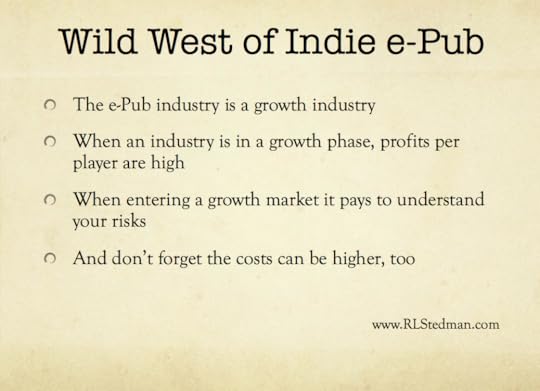
And that is exactly what we are seeing in the e-pub industry. Why? Because the e-pub industry is a classic case of a growth market.
The Wild West of Growth
The e-pub industry started quite small in 2004, when a new technology called an e-reader was introduced to the market. These e-readers took written content and digitised it; creating a virtual book. Slowly, readers moved to this new platform. New companies emerged, offering distribution services. Authors began exploring with putting their works on line. Companies developed offering print-to-digital services. And now, ten years on, Smashwords report double digit growth. The amount of books supplied in digital format is increasing at about 35 percent per annum.
And most of these books are from authors, publishing their own work.
If the number of books are increasing so rapidly, does this mean that earnings per author is also increasing, too?
Probably, earnings per author are not keeping up with the volume of product available. Writing is a tournament market, remember? However, I think it is safe to assume there will be a loose correlation between profit and product volume; the reason so many players are entering the market is because there is money to be made.
Large corporates are also entering the e-pub market. Corporates won't enter unless there's a reason; and this reason is always, always profit.
This suggests that profits per player are greater in the e-pub industry.
So in my quest for financial sustainability, shouldn't I just avoid trad. publishers, with their low profit opportunities, and go straight to e-pub? Wouldn't I be best just to publish my own work?
Well, not necessarily. Because in a tournament marketplace there is no such thing as a free meal ticket.
Costs and Risks
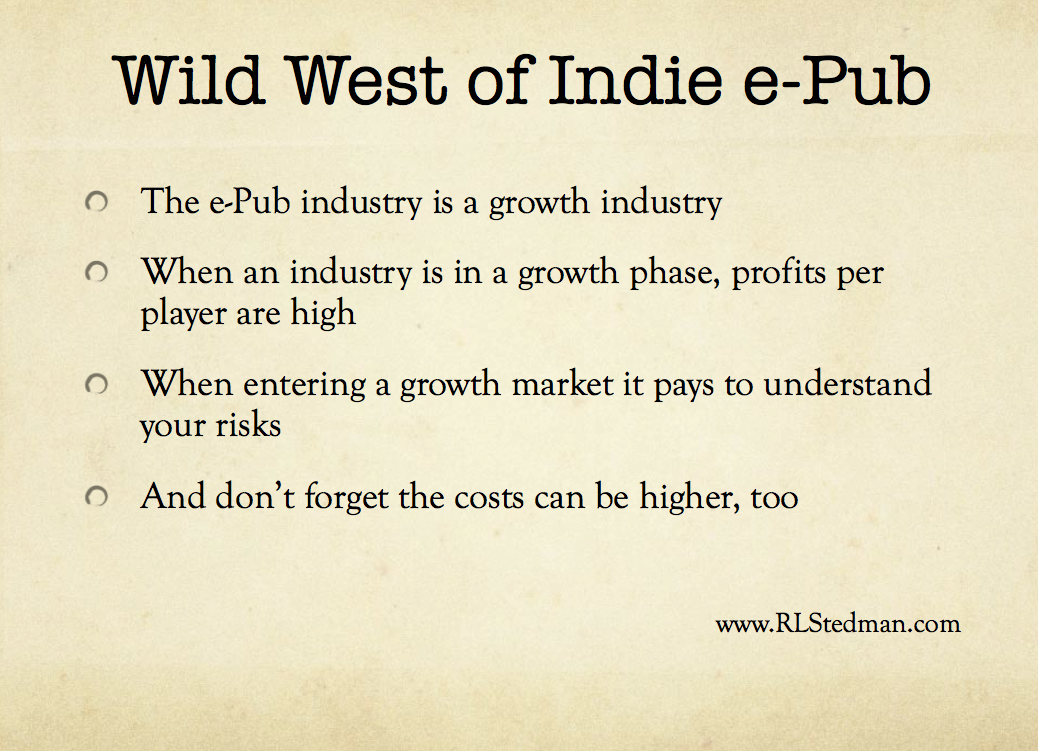
There are less controls in a growth market; controls take time to develop, and bureaucrats are slow to respond to change. This means that small players need to be careful; unscrupulous behaviour is highly likely, and fraudulent behaviour is possible. This is particularly evident in a technologically based industry like e-pub, where authors may not be that tech-savvy, and where suppliers can operate from multiple countries. Piracy is not the only behaviour writers need to worry about.
The e-pub market is based on technology and we have already seen that markets dependant on technology go through growth and decline cycles extremely quickly. This means that past behaviours which led to profits may rapidly out-date. Writers need to have wider skill sets now - it certainly helps if you have a grasp of the technology.
There is a high opportunity cost if e-pub. Time spent on organising formatting and distribution is time which a writer can't spend writing, and the writer will have to fund these activities themselves.
Reading is a personal experience, and quality is always important. So even if a writer can get a book out to market easily, in the end it's not quantity that matters; it's still quality and there is always a lead time to produce quality material. Self-publishing authors can't rely on advances or grants to fill this downtime.
In a crowded market, there is greater noise. How do readers find the quality material? For myself, I generally don't read self-pub work. Not because I'm snobby, but because I'm time-poor. If I read something from a trad publisher, I know it's been vetted by a panel of experts, edited professional and formatted correctly. I would rather pay more and read good material.
Which brings me to the next post: the rise of the hybrid author. Personally, I think this will be the way of the future.
The post last week considered the life cycle of markets, and how they grow, plateau and decline.
In growth markets, profits per player are high; as the market plateaus, profits decrease. In a decline phase, profits for the remaining players may be high, but usually there are a lot less players. In a declining market, the players will almost always be major international corporates.
However, in a growth market, it is normal to see a lot of start-ups. Drawn by the opportunity of profits and relatively low barriers to entry, smart companies can do well. In a growth market, there is a definite advantage to be small and nimble. Growth markets change rapidly and large corporates, being infrastructure heavy, can find it hard to compete.
Large corporates, being cash rich and highly aggressive, often lurk around the shoals of the growth market, snapping up clever smart start-ups, or creating little subsidiaries and sending them out into the wild west of the growth market, to see how they get on.
And that is exactly what we are seeing in the e-pub industry. Why? Because the e-pub industry is a classic case of a growth market.
The Wild West of Growth
The e-pub industry started quite small in 2004, when a new technology called an e-reader was introduced to the market. These e-readers took written content and digitised it; creating a virtual book. Slowly, readers moved to this new platform. New companies emerged, offering distribution services. Authors began exploring with putting their works on line. Companies developed offering print-to-digital services. And now, ten years on, Smashwords report double digit growth. The amount of books supplied in digital format is increasing at about 35 percent per annum.
And most of these books are from authors, publishing their own work.
If the number of books are increasing so rapidly, does this mean that earnings per author is also increasing, too?
Probably, earnings per author are not keeping up with the volume of product available. Writing is a tournament market, remember? However, I think it is safe to assume there will be a loose correlation between profit and product volume; the reason so many players are entering the market is because there is money to be made.
Large corporates are also entering the e-pub market. Corporates won't enter unless there's a reason; and this reason is always, always profit.
This suggests that profits per player are greater in the e-pub industry.
So in my quest for financial sustainability, shouldn't I just avoid trad. publishers, with their low profit opportunities, and go straight to e-pub? Wouldn't I be best just to publish my own work?
Well, not necessarily. Because in a tournament marketplace there is no such thing as a free meal ticket.
Costs and Risks
There are less controls in a growth market; controls take time to develop, and bureaucrats are slow to respond to change. This means that small players need to be careful; unscrupulous behaviour is highly likely, and fraudulent behaviour is possible. This is particularly evident in a technologically based industry like e-pub, where authors may not be that tech-savvy, and where suppliers can operate from multiple countries. Piracy is not the only behaviour writers need to worry about.
The e-pub market is based on technology and we have already seen that markets dependant on technology go through growth and decline cycles extremely quickly. This means that past behaviours which led to profits may rapidly out-date. Writers need to have wider skill sets now - it certainly helps if you have a grasp of the technology.
There is a high opportunity cost if e-pub. Time spent on organising formatting and distribution is time which a writer can't spend writing, and the writer will have to fund these activities themselves.
Reading is a personal experience, and quality is always important. So even if a writer can get a book out to market easily, in the end it's not quantity that matters; it's still quality and there is always a lead time to produce quality material. Self-publishing authors can't rely on advances or grants to fill this downtime.
In a crowded market, there is greater noise. How do readers find the quality material? For myself, I generally don't read self-pub work. Not because I'm snobby, but because I'm time-poor. If I read something from a trad publisher, I know it's been vetted by a panel of experts, edited professional and formatted correctly. I would rather pay more and read good material.
Which brings me to the next post: the rise of the hybrid author. Personally, I think this will be the way of the future.
September 3, 2014
Players, Markets and Pagers
First, A Warning!
I have a weird potpourri of skills and qualifications: physiotherapy, business and more recently, writing. This means I can tell you both how to maximise your earnings and how to fix your back! (Although I can't, my speciality has always been neuro rehabilitation. I'm rubbish at backs).
So I need to add a disclaimer to this post: it is quite technical.
If you hated economics at school, this is probably not the post for you.
On the other hand, if you enjoy understanding people's motivations, well, then this might be of interest. Because economics is really only about understanding why people do what they do - except economists usually view people's behaviour as aggregates, not as individuals.
This post is a very brief summary of today's publishing industry, and how writers can use this knowledge to their advantage. You should view this as an overview only - if you want to find out more, click on the links embedded in the text.
Okay, here we go...
Fiction Marketplaces are Like TennisThe writing marketplace is a 'Tournament Marketplace'.
Tournament marketplaces are characterised by
High numbers of playersLow average earnings per playerVery small number generating profitsHowever, profits for a tiny number of players are extremely highThese extremely high profits act as an incentive for new players to join the marketplace
Other examples of tournament markets could include professional tennis players or (get this!) merchant bankers. Seriously. (I once read a whole economics paper on this. Personally, I would have thought merchant bankers did okay, but apparently not. Poor things... )
So - If you want to get rich, DON'T join a tournament market. Instead, be an engineer or a doctor, where both the average earnings and the profits per player are high.
However, you may still have a dream of being a paid writer. Like me, you may even know in your head that the chances of making any money are incredibly low. *sigh* I still encounter people in writing groups who think they'll bang out a bestseller.
Basically, if you decide to enter a tournament marketplace, do it with your eyes open. You need to have an alternative form of income, at least until you manage to hit the jackpot!
The Product Life Cycle - What the Pager Can Teach Us
Markets generally go through recognised stages. We've all seen this happening - for example, in the personal messaging industry. In the 80s cool people wore pagers. Pagers were a sign that you were important; that people actually wanted to contact you. (Unless you were on call in a hospital, and then they were an absolute curse).
Pagers were expensive, available in a wide range of colours and you could get accessories - belt clips and bags and so on. Quite a few companies made pagers.
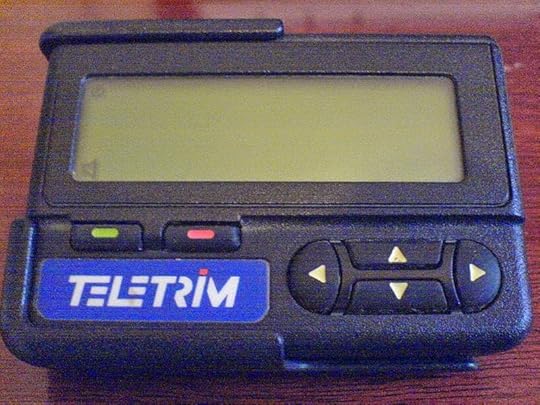 Image from Wikimedia Commons
In the late eighties, the cell-phone emerged.
 Image from Uncyclomedia Commons
Astonishingly, pagers remained popular until the early nineties.
Why? Because compared to early cellphones they were highly portable, they didn't interfere with medical devices (and they're still used in some hospitals), allowed messaging and in the early years, were cheaper. However over time less and less companies made them, because there just wasn't as much demand for them any more.
The pager lifecycle of growth, plateau and decline, is replicated in most industries. Turnover time is faster in industries that are heavily reliant on technology, because new technology is highly disruptive to a marketplace.
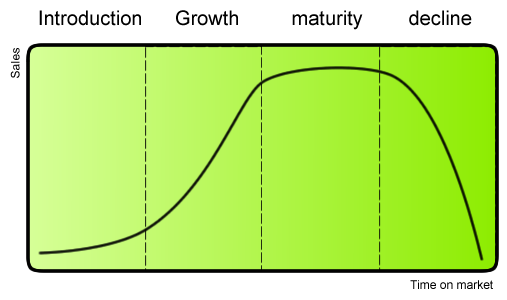 Product Lifecycle. Image from Wikimedia Commons
Industries that depend on human skills are have longer life cycles. Because while it's possible to replace technology, it's much, much harder to train a person. The major disruptors to skill-based industries are social factors: fashion, wages, or demographic shifts.
This means there will always be a demand for physiotherapists. Dammit. Why did I change professions???
How Does this Relate to Writers?The traditional publishing industry is a classic case of an industry in the decline phase.
By 'traditional publishing industry', I mean a little more than just the publishing house. I mean the whole industry: trad publishers + printers + distributors + bricks and mortar stores.
I'm also talking about first world publishing of trade fiction. The story for emerging markets is a little different, as is the marketplace for non-fiction.
Even within the trade marketplace there will be variations against the type of genre. For example, children's picture book market is quite different to romantic fiction - picture books require illustrators, they are purchased by adults (not the readers) and generally, kids and playgroups prefer paper.
Declining markets have the following characteristicsFew playersHigh barriers to entryLimited competitionHigh consolidation (ie players are large, complex organisations). Mergers and acquisitions are high.There is still profit to be made, but only by large players.Evidence for this decline can be seen across the publishing industry:Decreasing number of major publishing houses Strong differentiation of market - major players stick to their point of difference. This suggests there are major risk factors in moving into another market, suggesting that margins are extremely tight.Decline of bricks and mortar bookstoresReducing demand for printTherefore, profits per player in the traditional marketplace are low.
Writers of traditionally published fiction need to consider the following:
Traditional publishers are likely to be experiencing shrinking margins. This means that advances are likely to be smaller and royalties will be low. Publishers will seek to reduce risk (and therefore cost). Therefore, contracts are likely to include unlimited indemnity and liability clauses. Furthermore, if your sales are not up to forecast, you will be unlikely to get a second chance; you may even incur court action if a publisher cannot recoup its advance.Support for writers such as paying for publicity (advertising, marketing) or provision of any other 'value-add' like paying for a book launch, is likely to decrease.Publishers will reduce staff. This means that writers may be expected to participate more in the book-to-market process (for example, checking proofs) and that administration support is likely to be patchy. You would be wise to check everything - the cover art on Kindle, the price on ibooks - because it's likely that there won't be enough staff to monitor this properly. You could even find that your publisher downsizes or closes while your book is in press.Time taken to respond to queries will take longer, as will consideration of manuscripts.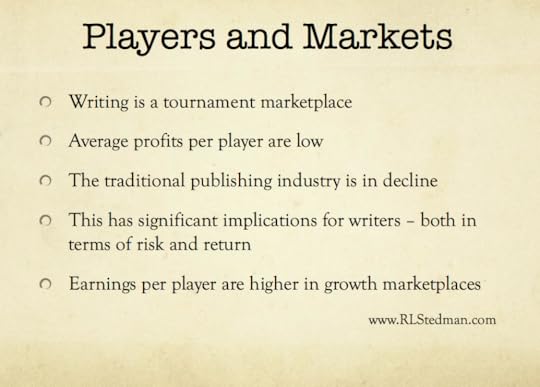
This suggests that for me, in the quest of increasing my earnings from writing, I would be better to focus my energy outside the traditional publishing market. I would be better to look for a market which is in a growth phase.
And where is this, you ask?
Well, stay tuned. I will discuss this in my next post.
I have a weird potpourri of skills and qualifications: physiotherapy, business and more recently, writing. This means I can tell you both how to maximise your earnings and how to fix your back! (Although I can't, my speciality has always been neuro rehabilitation. I'm rubbish at backs).
So I need to add a disclaimer to this post: it is quite technical.
If you hated economics at school, this is probably not the post for you.
On the other hand, if you enjoy understanding people's motivations, well, then this might be of interest. Because economics is really only about understanding why people do what they do - except economists usually view people's behaviour as aggregates, not as individuals.
This post is a very brief summary of today's publishing industry, and how writers can use this knowledge to their advantage. You should view this as an overview only - if you want to find out more, click on the links embedded in the text.
Okay, here we go...
Fiction Marketplaces are Like TennisThe writing marketplace is a 'Tournament Marketplace'.
Tournament marketplaces are characterised by
High numbers of playersLow average earnings per playerVery small number generating profitsHowever, profits for a tiny number of players are extremely highThese extremely high profits act as an incentive for new players to join the marketplace
Other examples of tournament markets could include professional tennis players or (get this!) merchant bankers. Seriously. (I once read a whole economics paper on this. Personally, I would have thought merchant bankers did okay, but apparently not. Poor things... )
So - If you want to get rich, DON'T join a tournament market. Instead, be an engineer or a doctor, where both the average earnings and the profits per player are high.
However, you may still have a dream of being a paid writer. Like me, you may even know in your head that the chances of making any money are incredibly low. *sigh* I still encounter people in writing groups who think they'll bang out a bestseller.
Basically, if you decide to enter a tournament marketplace, do it with your eyes open. You need to have an alternative form of income, at least until you manage to hit the jackpot!
The Product Life Cycle - What the Pager Can Teach Us
Markets generally go through recognised stages. We've all seen this happening - for example, in the personal messaging industry. In the 80s cool people wore pagers. Pagers were a sign that you were important; that people actually wanted to contact you. (Unless you were on call in a hospital, and then they were an absolute curse).
Pagers were expensive, available in a wide range of colours and you could get accessories - belt clips and bags and so on. Quite a few companies made pagers.
 Image from Wikimedia Commons
In the late eighties, the cell-phone emerged.
 Image from Uncyclomedia Commons
Astonishingly, pagers remained popular until the early nineties.
Why? Because compared to early cellphones they were highly portable, they didn't interfere with medical devices (and they're still used in some hospitals), allowed messaging and in the early years, were cheaper. However over time less and less companies made them, because there just wasn't as much demand for them any more.
The pager lifecycle of growth, plateau and decline, is replicated in most industries. Turnover time is faster in industries that are heavily reliant on technology, because new technology is highly disruptive to a marketplace.
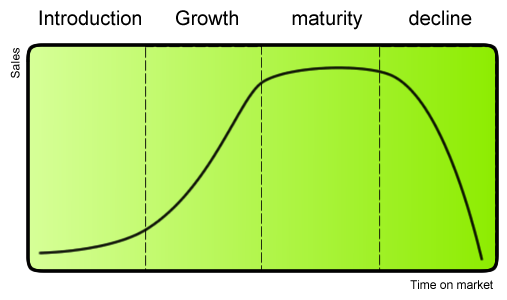 Product Lifecycle. Image from Wikimedia Commons
Industries that depend on human skills are have longer life cycles. Because while it's possible to replace technology, it's much, much harder to train a person. The major disruptors to skill-based industries are social factors: fashion, wages, or demographic shifts.
This means there will always be a demand for physiotherapists. Dammit. Why did I change professions???
How Does this Relate to Writers?The traditional publishing industry is a classic case of an industry in the decline phase.
By 'traditional publishing industry', I mean a little more than just the publishing house. I mean the whole industry: trad publishers + printers + distributors + bricks and mortar stores.
I'm also talking about first world publishing of trade fiction. The story for emerging markets is a little different, as is the marketplace for non-fiction.
Even within the trade marketplace there will be variations against the type of genre. For example, children's picture book market is quite different to romantic fiction - picture books require illustrators, they are purchased by adults (not the readers) and generally, kids and playgroups prefer paper.
Declining markets have the following characteristicsFew playersHigh barriers to entryLimited competitionHigh consolidation (ie players are large, complex organisations). Mergers and acquisitions are high.There is still profit to be made, but only by large players.Evidence for this decline can be seen across the publishing industry:Decreasing number of major publishing houses Strong differentiation of market - major players stick to their point of difference. This suggests there are major risk factors in moving into another market, suggesting that margins are extremely tight.Decline of bricks and mortar bookstoresReducing demand for printTherefore, profits per player in the traditional marketplace are low.
Writers of traditionally published fiction need to consider the following:
Traditional publishers are likely to be experiencing shrinking margins. This means that advances are likely to be smaller and royalties will be low. Publishers will seek to reduce risk (and therefore cost). Therefore, contracts are likely to include unlimited indemnity and liability clauses. Furthermore, if your sales are not up to forecast, you will be unlikely to get a second chance; you may even incur court action if a publisher cannot recoup its advance.Support for writers such as paying for publicity (advertising, marketing) or provision of any other 'value-add' like paying for a book launch, is likely to decrease.Publishers will reduce staff. This means that writers may be expected to participate more in the book-to-market process (for example, checking proofs) and that administration support is likely to be patchy. You would be wise to check everything - the cover art on Kindle, the price on ibooks - because it's likely that there won't be enough staff to monitor this properly. You could even find that your publisher downsizes or closes while your book is in press.Time taken to respond to queries will take longer, as will consideration of manuscripts.
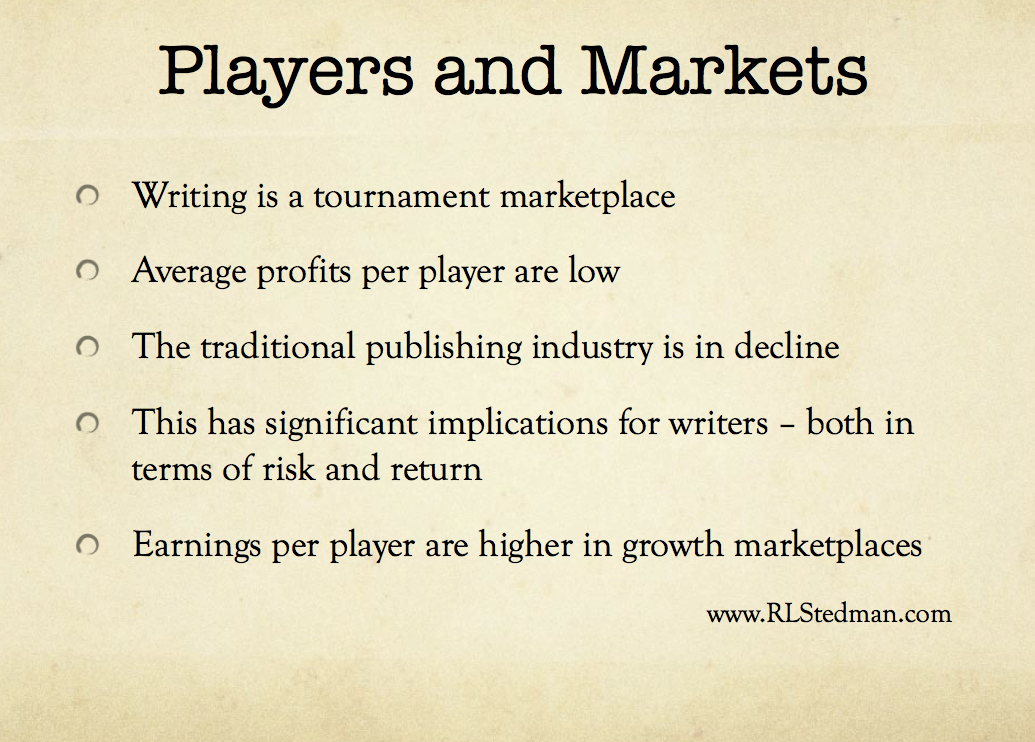
This suggests that for me, in the quest of increasing my earnings from writing, I would be better to focus my energy outside the traditional publishing market. I would be better to look for a market which is in a growth phase.
And where is this, you ask?
Well, stay tuned. I will discuss this in my next post.
August 28, 2014
Writers Need to Eat
The World of Books is Changing.
Established publishers are going into receivership, or being acquired by other publishers, or just ... disappearing. Indie publishers are starting up. Writers are publishing their own work. On-line digital platforms, like Amazon, Smashwords, iBooks, stock more titles than any bricks and mortar bookshop could ever do.
Books are available in multiple formats: print, or digital, or audio. They can be streamed. The number of bookstores are declining. Libraries are changing, too; no longer offering just print, they now provide music, games, art, even digital lending.
Writers, who traditionally used to spend their time alone, staring at a typewriter (or out the window) now use computers, and socialise on line with their readers, or with fellow-writers. There are a lot more distractions for a writer!
And the world is a lot more interconnected than it was.
While there's increasing competition for leisure time, especially with the rise of the gaming industry, there has also been an increased connectivity - gamers don't play by themselves. And there's an increased demand for good, believable stories. Now, the best games use narrative, dialogue and plot.
Readers, too, are changing. Reading has always been a solitary pleasure. But book clubs and book social media - Goodreads and the Reading Room are emerging power houses. Word of mouth has always sold books, but now there's a new way to recommend, and that's through reviews. Reviews, it turns out, may be worth more than sales.
In this new landscape of freely available publishing, you'd think it would be easier than ever for a writer to make money. All a writer has to do is to bang a few thousand words onto a page, format it correctly, push the 'publish' button and bang, thousands of eager readers leap forward and voila - a bestseller is born!
Alas, the reality is quite, quite different.
Writers Need to Eat
My first novel, A Necklace of Souls, was received very well critically, even winning Best First Novel at the New Zealand Post Awards. But it has earned me only a teeny, tiny amount. Barely enough to pay for ten weeks of groceries. But I need to eat for more than ten weeks in a year!
My last series of posts was about writing a novel in six months. This was a stretch goal for me. As I work nearly full-time and have a family, I was aware it might not be possible. But I was surprised to find that, not only was it achievable, it was a really great process and produced a seriously good YA novel called Inner Fire. I'm very pleased by the result, and I hope readers are too - Inner Fire will be in online bookstores by Christmas.
Critical success and good craft is just not enough. If I want to write full time - and I think I do - I need to earn more than ten weeks of groceries. I need to earn fifty-two weeks!
So I'm embarking on a new series of posts: How to make money from writing.
How to Make Money From Writing
These posts will be like a diary record of my successes and failures of turning an amazing hobby into a full-time business - that earns me enough that I can afford to write full time.
I'm going to give myself a stretch goal of one year, and just see what happens.
Feel free to join me on this venture. You can contact me through my Facebook page (https://www.facebook.com/soulnecklace) or on twitter @rlstedman
Established publishers are going into receivership, or being acquired by other publishers, or just ... disappearing. Indie publishers are starting up. Writers are publishing their own work. On-line digital platforms, like Amazon, Smashwords, iBooks, stock more titles than any bricks and mortar bookshop could ever do.
Books are available in multiple formats: print, or digital, or audio. They can be streamed. The number of bookstores are declining. Libraries are changing, too; no longer offering just print, they now provide music, games, art, even digital lending.
Writers, who traditionally used to spend their time alone, staring at a typewriter (or out the window) now use computers, and socialise on line with their readers, or with fellow-writers. There are a lot more distractions for a writer!
And the world is a lot more interconnected than it was.
While there's increasing competition for leisure time, especially with the rise of the gaming industry, there has also been an increased connectivity - gamers don't play by themselves. And there's an increased demand for good, believable stories. Now, the best games use narrative, dialogue and plot.
Readers, too, are changing. Reading has always been a solitary pleasure. But book clubs and book social media - Goodreads and the Reading Room are emerging power houses. Word of mouth has always sold books, but now there's a new way to recommend, and that's through reviews. Reviews, it turns out, may be worth more than sales.
In this new landscape of freely available publishing, you'd think it would be easier than ever for a writer to make money. All a writer has to do is to bang a few thousand words onto a page, format it correctly, push the 'publish' button and bang, thousands of eager readers leap forward and voila - a bestseller is born!
Alas, the reality is quite, quite different.

Writers Need to Eat
My first novel, A Necklace of Souls, was received very well critically, even winning Best First Novel at the New Zealand Post Awards. But it has earned me only a teeny, tiny amount. Barely enough to pay for ten weeks of groceries. But I need to eat for more than ten weeks in a year!
My last series of posts was about writing a novel in six months. This was a stretch goal for me. As I work nearly full-time and have a family, I was aware it might not be possible. But I was surprised to find that, not only was it achievable, it was a really great process and produced a seriously good YA novel called Inner Fire. I'm very pleased by the result, and I hope readers are too - Inner Fire will be in online bookstores by Christmas.
Critical success and good craft is just not enough. If I want to write full time - and I think I do - I need to earn more than ten weeks of groceries. I need to earn fifty-two weeks!
So I'm embarking on a new series of posts: How to make money from writing.
How to Make Money From Writing
These posts will be like a diary record of my successes and failures of turning an amazing hobby into a full-time business - that earns me enough that I can afford to write full time.
I'm going to give myself a stretch goal of one year, and just see what happens.
Feel free to join me on this venture. You can contact me through my Facebook page (https://www.facebook.com/soulnecklace) or on twitter @rlstedman