R.L. Stedman's Blog, page 6
September 9, 2017
So You Want to Be A Writer? Here’s What You Need to Do
So You Want to Be a Writer?
I began writing when I was about 6. I wasn’t particularly good, and my teachers seemed underwhelmed by my talent. But I loved writing, so I persevered. I entered competitions, wrote little short stories. Got nowhere. Then I stopped.
I trained to be a physical therapist – who needs to be a writer, anyway? – and began travelling the world. Much more exciting than getting rejection after rejection.
It was only when I became ill that I thought: what do I most want to do in the world. And the answer was: I want to write. So, the best writing advice I’ve ever had is the advice I told myself: if you really want to be a writer, then you have to write.
Which is what I did.
Keep Writing
About thirteen years ago I began a novella. I liked it, but no-one else did, so I got a lot of rejections. I kept writing. I wrote a couple of short stories, began another novel. Again: rejections. I did a couple of night school courses on writing. Crickets!
I volunteered to work on a trade magazine. I kept writing, and studied for a Certificate of Creative writing. And then, finally, a short story of mine was accepted! I was so excited!
Fast forward ten years: Now, I write pretty much every day. This includes blogging, journaling, creative first drafts, this interview. The words add up.
[image error]
Embrace the Fear
I’ve written six books. I’ve won three awards and have been shortlisted for a few more. I’ve had emails from folk all around the world who tell me my words have touched them.
Despite all this, I still feel as though I’m not very good. But I keep writing.
So, the best advice to any writer is: keep writing.
[image error]
The post So You Want to Be A Writer? Here’s What You Need to Do appeared first on R. L. Stedman.


July 20, 2017
Adore Old-Fashioned Romance? Here’s 7 Tales You’ll Love.
[image error]
Do you love secondhand stores, especially those that sell silver and hand-embroidered linen? You know the kind: staffed by an old lady and her dog; the rooms smell faintly of talcum powder and every item is labelled with a hand-written price tag?
If you’re like me, you love these places because they remind you of old-fashioned romance novels. Novels that feature independently minded women, gorgeous dresses and all-conquering love.
So … because it’s a wet day and I’m feeling nostalgic, I thought I’d share a list of my favourite romantic couples with you.
Hope you enjoy!
Top Fictional Romances
1. Anne Shirley and Gilbert Blyth.
Who can forget the wonderful Anne-with-an-e Shirley from Anne of Green Gables, and the foolish boy who called her ‘carrots’? At first she hates Gilbert Blyth, but as she grows into adulthood she learns he was only seeking her attention.
One of the things I most loved about the Anne of Green Gables series was how the books continued after marriage.
This isn’t just a kiss-and-happily ever after romance; this is a long-term relationship!
I’ve not watched the Netflix TV series yet, but I loved the 80s TV version. Here’s a clip.
2. Laura Ingalls and Almanzo Wilder
Okay, so this isn’t fictional; in the Little House in the Big Woods series Laura really did marry her Almanzo. But the way the stories are crafted reads like fiction. There’s the build-up, the tensions and finally the happily-ever-after resolution.
I think this was deliberate. Wilder’s earliest foray into writing was in writing non-fiction; she later crafted the Little House series into fiction, possibly to help it sell.
Like Anne and Gilbert, the series continue past the wedding, and because it’s based on real-life we know that Laura and Almanzo remained together until his death at age 92. Oh, how romantic!
3. Jane Eyre and Edward Rochester
I have mixed feelings about this romance. After all, in Jane Eyre Rochester keeps his first wife locked up! How could anyone love such a man? But despite my modern ideals I can’t help seeing him through Jane’s eyes, and she is totally besotted.
The main reason that this is romance number 3 is the ending: ‘Dear reader, I married him.’ What a perfect, perfect ending!
[image error]
4. Elizabeth Bennett and Mr Darcy
Mr Darcy’s name is actually Fitzwilliam, but he’s only ever known as ‘Mr.’ in Pride and Prejudice.
Why do I love this romance? Partly (if I’m being honest) is because of Colin Firth’s starring role in the BBC TV series!
But the other great thing about this novel is how Mr Darcy changes.
When Pride and Prejudice begins he is too proud to invite Elizabeth dance (even though he acknowledges her as “tolerable”), and his first proposal is absolutely terrible! But by the end of the narrative he admits his mistakes. So in Pride and Prejudice, the heroine rescues the hero.
5. Hero Wantage and Antony (Lord) Sheringham
Friday’s Child, by Georgette Heyer, is one of my fave period romances.
I mentioned Heyer in my last blog post. She wrote over twenty regency romances, and this is one of the best.
Friday’s Child is about Hero, who faces a future as a governess and her neighbour, Viscount Sheringham, who is in desperate need of a wife. Their runaway marriage creates chaos for their families and friends, but in saving his young bride, the erratic Antony finally learns maturity.
This is a hilarious book, because all the characters are just so stupid! It’s a perfect rainy day read.
6. Gwendolin Fairfax and John Ernest Worthing
The Importance of Being Earnest isn’t a novel; it’s a play, but who cares? This is Oscar Wilde at his funniest. Although Gwendolin and John are gorgeously earnest in their nature, I have a sneaking love for Algernon Moncrieff, Cecily Cardew, and of course, Lady Bracknell.
JACK: Gwendolen, it is a terrible thing for a man to find out suddenly that all his life he has been speaking nothing but the truth. Can you forgive me?
GWENDOLEN: I can. For I feel that you are sure to change.
If you get a chance, do watch the Rupert Everett/Colin Firth version (Colin Firth seems to be a common thread of this post). I’ve posted a clip here, just to whet your appetite.
7. Scarlett O’Hara and Rhett Butler
Despite not being a happily-ever-after, Gone With the Wind is the archetype of character romance. The passion between the main characters is so intense that it’s easy to overlook the ‘frankly my dear, I don’t give a damn,’ ending.
I love how Scarlett transforms from society belle to independent woman. I love Rhett’s air of danger. But mostly I adore the setting; this book takes the reader into another world. Gone With the Wind is one of those addictive reads that are almost impossible to put down.
And for this particular story, even though the movie is a classic and the costumes are amazing, I prefer the book.
What do you prefer? Book or movie? And which romances do you love?
The post Adore Old-Fashioned Romance? Here’s 7 Tales You’ll Love. appeared first on R. L. Stedman.
July 13, 2017
Love Pride and Prejudice? Here’s 4 Books To Read
If you love all things period romance, here’s 4 books I guarantee you’ll love.
But first, That Shirt…
[image error]
1. Emma
Emma is the second-best Jane Austen novel after Pride and Prejudice. Well, that’s what I think!
Like P&P, Emma abounds in eccentric individuals. And like Austen’s other work, there’s character transformation.
Emma, a rich and beautiful woman, is certain she should be a wonderful matchmaker — why, she knows which man deserves which woman, better even than the individuals themselves…
Like Pride and Prejudice, Emma is very funny and with a surprisingly contemporary tone. Personally, I don’t find it quite as fast-paced as P&P, but it’s still an enjoyable read.
Emma has been made into television shows, movies, stage plays.
Here’s one of my favourite clips from Gwyeneth Paltrow’s version.
2. Jane Eyre by Charlotte Bronte
Charlotte Bronte’s gothic novel about a governess who falls in love with her charge’s father is considerably darker than Austen’s romances.
Jane Eyre is a story of love and loss; of deceit and poverty. I love the settings of Jane Eyre, and Mr Rochester has, I think, more depth than many of Austen’s characters.
BUT — there’s not a whole heap of fun in this book.
However, if you like period romances with a gothic twist you must read Jane Eyre. In this work Bronte created a genre that we’re still enjoying today. From Twilight to Feverborn, readers love the attraction of the dark.
The movie trailer below shows why.
3. Three Men in a Boat by Jerome K Jerome
Three Men in A Boat is SUCH a good book! Like Pride and Prejudice, Three Men in a Boat (To Say Nothing of the Dog) is laugh-out-loud funny, and like P&P, it’s true to its era.
Unlike P&P, it’s not a romance. Three Men in a Boat is a travel book, quite possibly the first of its kind! It reads a little like Bill Bryson meets Queen Victoria.
Three Men in A Boat tells the tale of three (slightly hypochondriac) men who feel they need a holiday. So they take a week to travel from London to Oxford by rowing upstream along the Thames.
The story meanders like the river, moving from anecdote to anecdote, and as long as you’re happy to not journey in a straight line, it’s highly enjoyable. Published in 1889, Three Men in a Boat was a hit almost as soon as it hit the stores, and has retained all its charm.
I’ve actually rowed part of the portion in the book, and the descriptions are still accurate. Not all of the pubs remain, alas :).
It’s been made into TV, movies and has ripped off by plenty of comedians and writers. Watch this clip!
4. Arabella by Georgette Heyer
If you haven’t yet discovered Georgette Heyer, you’re in for a treat! Heyer specialised in regency romances and despite being written in the 1950s, her books feel true to period.
Like Austen, Heyer is very funny and like Austen, she manages to move between third-person limited point of view and third-person omniscient effortlessly. Note to non-writers: this is very hard to do.
Arabella has the classic prejudice of a heroine to the hero; and the hero in Arabella, is extremely proud, but the story is faster-paced than Austen’s.
A brief summary: Arabella is to journey to London to stay with her godmother. The oldest of eight children, from a penniless-but-respectable family, she knows it is her duty to marry well. Unfortunately, she convinces the monde that she is an heiress…
Heyer’s books are superbly written. They’ve been continuously in print since their first edition, and their popularity remains high. However, they’ve never been turned into television or movie, which is a real shame, and Heyer herself never appeared to gain recognition within the literary community.
But if you love P&P, Arabella is the ONE book in this list you must try. And once you read it, you’ll be hooked for life!
But wait – there’s more!
If you’re still short of reading material here’s some other works that are similar to P&P. These books were either written in the same period as Austen, or their tone is similar. The links here lead to the Amazon store, so you can check the description.
Wuthering Heights – by Emily Bronte
My Cousin Rachel – by Daphne Du Maurier
The Grand Sophy – by Georgette Heyer
You could also check out the Silver Petticoat Review; a blog for all things romantic!
Over to you – any books you’d recommend?
The post Love Pride and Prejudice? Here’s 4 Books To Read appeared first on R. L. Stedman.
July 6, 2017
Books to Read if You Love Downton Abbey
[image error]
Do you love period dramas that are absolutely BRIMMING over with romance?
If you love Downton Abbey: Here’s some books you’re guaranteed to love!
[image error]
A Room With A View
I know, I’ve talked about this book before. For good reason: it’s gorgeous.
A Room With a View is my favourite E. M. Forster work. The book is about Lucy, an upper-middle class young woman embarking on her first trip to Italy. Lucy is disappointed when she fails to gain a room with a view in the pensione; a widower with a son offers her his room — and thus her adventure begins.
The story about tolerance and love, and hence ‘A Room With A View’ is also about how the character’s own views change. A Room With a View is a really easy read, but don’t be fooled by how easy a read it is; it took Forster nearly ten years to construct this small masterpiece. As a writer, I don’t find this at all strange. Simplicity is hard.
Why is it a great read? Partly because of Lucy’s transformation, but mostly because of the characters: Mr Beebe, the parson; Freddy, Lucy’s “unpromising” brother and Charlotte Bartlett, Lucy’s cousin.
The 1985 movie by Marchant-Ivory won 3 Oscars and is fabulous viewing, particularly Maggie Smith, who gives Charlotte Bartlett more depth than even Forster managed. The score, featuring Kiri te Kanawa, is simply stunning.
Forster later wrote a satirical piece, called “A View Without A Room” as a postscript to this work.
The Remains of The Day
Like Downton Abbey, The Remains of the Day is set in a large country house in the years before World War Two, where a butler, Mr Stevens, and housekeeper, Miss Kenton, work together to ensure the comfort of Lord Darlington.
Mr Stevens is reluctant to admit his feelings for Miss Kenton and buries himself in his work of service. Only later does Stevens realise that perhaps this loyalty was misplaced; perhaps his days have passed, as have the days of the country houses.
The Remains of the Day won the Man Booker, but don’t let that put you off (!) — it’s a lovely read, especially if you like slower-paced period dramas.
The novel was made into a brilliant movie starring Anthony Hopkins and Emma Thompson, and their nuanced performances make the story come alive. I watched the movie first — its one of those rare creations that almost (not quite, but almost) better than the movie!
Brideshead Revisited
Brideshead Revisited is a tale of love: the love of the protagonist, Charles Ryder, for an upper class family, the Fyltes. He falls in love with the oldest son, Sebastian, but then there’s the sister, Julia … but mostly, the house Brideshead, is what he loves.
Brideshead Revisited is told from the perspective of Charles, beginning when he’s billeted at Brideshead as a soldier in WW2, so the novel is gripped by a sense of nostalgia and loss. The story deals with the homosexuality of Sebastian, what it’s like to be a Catholic in an Anglican society (the Fyltes are Catholic), but mostly it’s about the end of a privileged lifestyle.
Personally, Brideshead Revisited is my least favourite of these novels, although it’s probably the best retelling of the era, and possibly the most autobiographical. It was made into a television series in the 1970s. I remember this series as being staggeringly popular, but to me it seemed inordinately long!
Jeeves and Wooster
A series by P. G. Wodehouse, the Jeeves and Wooster novels feature the all-knowing valet Jeeves and his inept-but-harmless upper-class employer, Bertie Wooster. Wooster narrates over ten novels in a charmingly ignorant fashion, using pre-war slang; language that fits beautifully in the early Downton Abbey series.
The Jeeves novels are basically situational comedy. Wooster tumbles from complicated scrape to complicated scrape, requiring rescuing by Jeeves.
Jeeves and Wooster were incredibly popular characters, and the series influenced a number of British comedy writers: you can see aspects of Wodehouse in Blackadder and Monty Python, and Bertie Wooster and the sapient Jeeves have starred in a number of television shows.
(If you watch this clip you’ll see Downton Abbey in the background!)
Love in a Cold Climate
I have to confess: I’ve not read Love in a Cold Climate yet, despite it being on my TBR pile for ages!
Written in 1949 by Nancy Mitford, the story narrates the adventures of Polly Hampton and her love for her paedophilic uncle (nicknamed “Boy”). The story was a huge best seller and is still popular today.
Love in a Cold Climate takes place in similar settings and characters to Downton Abbey, and as Mitford moved in these circles (she was a contemporary and friend of Evelyn Waugh) the settings are authentic.
Mitford’s story is as interesting as her fictional romances; one of the notorious Mitford sisters, she was probably the least political of the set. The Times described them as: “Diana the Fascist, Jessica the Communist, Unity the Hitler-lover, Nancy the Novelist and Deborah the Duchess.”
Love in a Cold Climate (I wonder if its title was the reason for Love in a Time of Cholera) was made into a number of mini series. Here’s a clip of the 1982 version, staring a very young-looking Judi Dench.
The Larnachs
Unlike the other books in this blog post, The Larnachs isn’t set in England; the events in this story take place very close to my house – in Dunedin, New Zealand.
I’ve included The Larnachs in this list as the setting is similar in many ways to Downton Abbey, and there are similar themes of changing morality, wealth, privilege and class. However, unlike Downton, the events in this story actually happened.
William Larnach, a self-made millionaire, was a politician in colonial New Zealand. After the death of his first two wives he married Constance de Bathe Brandon, daughter of a well-to-do aristocratic family. William and Constance moved to Larnach’s new-built castle near Dunedin, where Constance met and fell in love with William’s oldest son, Dougie.
This is a sensitively-told story of a doomed love triangle. Marshall is a very empathetic writer, and sets the scene of this troubled family with compassion.
The story ends tragically, but the beautiful castle Larnach built has survived.
You can visit it today – we do, frequently. There’s supposed to be a ghost there, but we’ve never seen it!
I hope you enjoyed this list.
I know it’s not exhaustive; there’s plenty of other wonderful stories out there. Feel free to recommend your favourites in the comments!
The post Books to Read if You Love Downton Abbey appeared first on R. L. Stedman.
3 Books to Read if You Love Downtown Abbey
[image error]
Do you love period dramas that are absolutely BRIMMING over with romance?
If you love Downtown Abbey: Here’s three books you’re guaranteed to love
[image error]
A Room With A View
I know, I’ve talked about this book before. For good reason: it’s gorgeous.
[image error]
A Room With a View is my favourite E. M. Forster work. The book is about Lucy, an upper-middle class young woman embarking on her first trip to Italy. Lucy is disappointed when she fails to gain a room with a view in the pensione; a widower with a son offers her his room — and thus her adventure begins.
The story about tolerance and love, and hence ‘A Room With A View’ is also about how the character’s own views change. A Room With a View is a really easy read, but don’t be fooled by how easy a read it is; it took Forster nearly ten years to construct this small masterpiece. As a writer, I don’t find this at all strange. Simplicity is hard.
Why is it a great read? Partly because of Lucy’s transformation, but mostly because of the characters: Mr Beebe, the parson; Freddy, Lucy’s “unpromising” brother and Charlotte Bartlett, Lucy’s cousin.
The 1985 movie by Marchant-Ivory won 3 Oscars and is fabulous viewing, particularly Maggie Smith, who gives Charlotte Bartlett more depth than even Forster managed. The score, featuring Kiri te Kanawa is simply stunning.
Forster later wrote a satirical piece, called “A View Without A Room” as a postscript to this work.
The Remains of The Day
The Remains of the Day by Kazuo Ishiguro is very like Downtown Abbey, in that it’s set in a large country house in the years before World War Two.
The butler and housekeeper work together to ensure the comfort of Lord Darlington. Mr Stevens is reluctant to admit his feelings for the housekeeper, Miss Kenton, and buries himself in his work of service. Only later does Stevens realise that perhaps this loyalty was misplaced; perhaps his days have passed, as have the days of the country houses.
The Remains of the Day won the Man Booker, but don’t let that put you off (!) — it’s a lovely read, especially if you like slower-paced period dramas.
It was made into a very well-done movie starring Anthony Hopkins and Emma Thompson, and their nuanced performances make the story come alive. I watched the movie first — its one of those rare creations that almost (not quite, but almost) better than the movie!
Brideshead Revisited
Brideshead Revisited is a tale of love; the love of the protagonist, Charles Ryder, for an upper class family, the Fyltes. He falls in love with the oldest son, Sebastian, but then there’s the sister, Julia … but mostly, the house Brideshead, is what he loves.
The story isn’t a romance; it’s told from the perspective of Charles, beginning when he’s billeted at Brideshead as a soldier in WW2, so the novel is gripped by a sense of nostalgia and loss. The story deals with the homosexuality of Sebastian, what it’s like to be a Catholic in an Anglican society (the Fyltes are Catholic), but mostly it’s about the end of a privileged lifestyle.
Personally, Brideshead Revisited is my least favourite of these three novels, although it’s probably the best retelling of the era, and possibly the most autobiographical. It was made into a television series in the 1970s. I remember this series as being staggeringly popular, but to me it seemed inordinately long! Possibly I was too young to appreciate it!
I’d love your thoughts? Any stories you’d recommend?
The post 3 Books to Read if You Love Downtown Abbey appeared first on RL Stedman.
July 3, 2017
How to Get Published
[image error]
So you’ve got a story you’re aching to share? Here’s a step by step guide to getting published.
This is the fifth post in a series called Options for Publishing. This series is based on a talk I did recently in Taranaki.
Before reading this post, I suggest you go back and read the other posts in this series, as they tie together. Here’s the links:
The History of Publishing
Publishing and Profits
What Does a Publisher Do?
A Question of Rights
Here’s a slideshow of the talk:
How to Get Published:
1. Write
Keep a journal, a diary or a blog. Write poetry. The more writing you do the better. Think of it like fitness training; you don’t build a muscle without exercising it.
2. Read a lot
Read books from diverse genres. Read classic books, read contemporary novels. I prefer reading books that are ten + years old more than the latest blockbusters, because I find time sifts out a lot of dross. However, I know that’s not always the best idea if you’re trying to work out what the market wants, and writing styles are constantly evolving. But you can NOT write well if you do not read. Period.
3. Write for free
Writing for a wider audience is good discipline, and helps you to get used to criticism aka “feedback“. I edited a professional magazine; it taught me about deadlines, formatting and word redundancy. School or universities generally have magazines and often welcome contributors. If you’re in a community or church group you could either start or contribute to a magazine or blog.
4. Training
Doing a writing course is not essential, but it does help. There’s nothing like intensive tuition to improve the craft of writing. Personally, I wouldn’t suggest spending enormous amounts of money or time. Gaining a Masters in Creative Writing is expensive and may not be any more beneficial than say a twelve-week course at a polytechnic. I prefer face-to-face to online, but there’s nothing right or wrong. Just make sure you participate. You won’t learn if you do not do.
5. Develop networks
Often in this world it’s not WHAT you know, it’s WHO you know. Talk to other writers. Join professional societies, like the New Zealand Society of Authors. Attend meetings. Read the magazines. Interact in forums. Talk to writers on twitter. Be helpful. Only one rule: Don’t be a dick.
If you write romance, or novels with a romantic theme I strongly recommend joining your national Romance Writers Association. RWAs are generally very commercially savvy and they’re highly internationally networked.
6. Go to conferences
In New Zealand there are very few writing conferences, alas, but if you’re in the States it’s a lot easier. Reason for conferences: you meet other writers (networking), you can have lessons in craft (training) and most usefully of all: you can often do cold reads or pitch agents/publishers. This can short-cut a lot of slush piles.
7. Submit to competitions
This was my break. Competitions are frequently listed in the forums of various professional organisations, and you’ll find more online. I suggest the smaller comps, as anything with thousands of entries are almost a lottery. But with some of the smaller ones, like the RWA ones, (another reason for joining), you’ll get feedback from the judges, and if you’re shortlisted, you may get your manuscript read by an agent or publisher.
8. Publish your own
The last four posts are my explanation of why this isn’t as crazy as it seems! There are pluses and minuses to publishing your own work, just as there are to using a publisher. These days, it’s more about understanding your options than recommending one particular path.
But whether or not you use a publisher to reach your audience, or you do it yourself, I would still follow steps 1 – 7 above.
[image error]
How to Submit to Agents/Publishers
If you decide that you don’t want the hassle of publishing your own work, then you’ll probably need someone to publish for you. Generally this involves an agent or a publisher. This is the classical approach, and until 2010 (ish) it was pretty much the only way to get your book published.
Warning: This can take a long, long time.
1. Write your book
2. Find out who the publishers and agents are that might be interested. You want to know who’s looking for new writers, what kind of work they want (no point in sending erotica to a children’s publisher, for example!), what format they want you to submit in. FOLLOW THIS! Generally, this information will be on their websites.
Here’s what to do:
Check the lists on Writer’s Digest (US) or Writers and Artists Yearbook (UK)
Follow agents on twitter. You’ll get a definite vibe for their style and what they’re looking for. Search the hashtag #pitchwars.
Ask writer friends who they’d recommend.
Avoid scammers. If anyone charges you to read your work: run away. Check the Writer Beware list.
3. Make a list of who’s looking in your genre.
Be strategic – don’t submit to everyone at once. I’d start with 5 established agents with a great track record and 5 new ones who are hungry. Follow their submission instructions (have I said this before?!).
4. Send your submissions
Submissions generally consist of a query letter, a brief synopsis and, if requested, the first three chapters. This may vary, so again: check.
General rule of thumb seems to be that simultaneous submissions are okay to agents (that is, you it seems acceptable for you to submit to more than one agent at a time), but a definite no-no to publishers. If you are submitting to multiple agents at a time, I would let them know this; at the very least, it’s polite.
Here’s instructions on query letters and Marissa Meyer’s really good blog post on synopsis writing.
If an agent likes your work you’ll generally hear reasonably quickly. Publishers seem to take longer.
I allow 4 -6 weeks for an agent, and then I follow-up with an email. If I still don’t hear anything I follow-up with another email advising I’m sending elsewhere. If you’ve submitted to a publisher you may not hear anything for 4 – 6 months. Longer than that, and I usually send an email.
If you don’t get a good response to just a query submission, it might pay to rework your query letter.
Keep a spreadsheet of who you’ve submitted to, the date and the outcome.
Try not to get depressed. I know of writers who have submitted 1000 times before landing a deal!
If you want to short cut this process, enter competitions and go to conferences (see above!).
5. While you’re waiting, write another book. Or two. Or three…
An alternative approach:
Be famous or otherwise notorious. Publishers and agents LOVE writers with an audience. If you’ve got a million followers on wattpad, SAY this. If you’ve got a huge youtube following, again: mention it in your pitch.
[image error]
What’s best?
This depends on your goals.
If you are desperate to see your book in book stores, you may be better to follow the classical approach of using an agent/publisher. Book stores tend to work through established channels, although there are signs this is changing. If you love literary fiction and you prefer to write richly textured novels, you may be better to approach traditional publishers. If critical acclaim and acceptance is important, again: a traditional model may be better.
However, if you’re just wanting to find people who want to read your work, if you write in a commercial genre with a huge readership (such as romance) and you’ve previously run a small business, my suggestion is self-publishing.
I say this because in the long run, you may be better off by finding your own route to market than by relying on a publisher third-party, who may or may not have the same goals as you. It’s also about the rights. Given that your copyright can last 50 + years, and that rights are constantly evolving, you may be better off in the long run to own the lot.
The good news: nowadays writers have options.
What about you? Do you have any thoughts or tips you’d like to pass on?
The post How to Get Published appeared first on RL Stedman.
June 26, 2017
A Question of Rights
[image error]
Copyright
Copyright is an automatic right generated by the development of an original work. Sometimes you see it written as ©
In New Zealand, copyright lasts for fifty years after an author’s death. In the United States, it’s SEVENTY years.
The copyright is owned by the creator, but he or she may allow another person to use their work. While the copyright remains in place, someone has to have permission to use it. In the publishing industry, permission is often called ‘licensing’, and permission is usually granted through a formal contract.
You may need to prove that you are the copyright holder. General practice among authors is to register their titles with the US Copyright Office. This is not essential, because copyright is automatic. But if you have a problem with your titles being pirated, this may help.
Copyright is a property right. You can’t hold an idea, like you can hold, for example, a house. Copyright is Intellectual Property; an intangible but valuable product. Sometimes “intellectual property” is shortened to simply “IP”.
There are other forms of intellectual property, like designs, patents and trademarks. This means if you’re writing a book, the front cover and the layout of the words (typesetting or formatting), which are design work, may belong to the publisher or cover designer. It also means you should check the licensing of any art you use in your cover. Don’t forget poetry or songs are also original work. So before using someone else’s ideas, make sure you have permission to do this.
You can find out more information at the NZ Intellectual Property Office (this is a really user-friendly site, and is worth a look even if you’re not based in New Zealand.)
If you want more information on rights, check out Joanna Penn’s podcast here.
Disclaimer: I am not a lawyer and this does not constitute legal advice. For legal advice, see a legal professional!
[image error]
Image Source
How are Rights Used?
Rights can be sliced and diced in many different ways. Here are some examples:
By format: digital, audio, print, radio, screenplay, braille.
By location: World, Asia, Europe, Australia. There is a new rights location, called simply Space! This may sound crazy. But remember: if your rights last for at least 50 years after your death, it’s very possible that people will be in space before your rights expire. I love the thought of astronauts listening to my books on audio!
What Does This Mean For Me?
You should think of your rights as assets. When you write a book, you are in effect creating something that could generate income not just for you, but for your children and your grandchildren.
You need to consider this, when you consider a contract from a publisher. You should ask yourself: Is the amount a publisher offers me more than the amount I may make from this book?
And you should also think: can I exploit these rights myself?
For me, I’m not so worried about having worldwide rights for A Necklace of Souls in say, Chinese. So if someone was to send me an interesting rights offer for Chinese worldwide rights, I could be interested.
However, if translation services go the way that is widely expected, it’s possible I might be better off holding onto translation rights and waiting for a few years.
Take The Long View
The value of your rights may increase as you produce more books. So don’t get discouraged early on. (This is something I am constantly telling myself!) Remember, too, that technology and platforms are constantly evolving, and that something you never dreamed of having a commercial value (like Space) may one day be a real possibility.
I guess at the end of the day it always takes time to create something of value — whether its a book or a house. But an asset is generally worth having!
The post A Question of Rights appeared first on RL Stedman.
June 12, 2017
What Does a Publisher Do?
[image error]
There are many types of book publishers: traditional (large house) publishers; niche publishers or small press; assisted self-publishing and author-as-publisher. It’s a rapidly changing market place — by 2016 42% of trade fiction in the US was from non-traditional publishers.
This post discusses what publishers do for fiction authors, and what is expected in return.
This post is the third in a series of four posts. You can read the first and second posts here.
Agents
Publishers had so many submissions they began using specialists in finding and sourcing quality work. These specialists are called literary agents. Nowadays, many large houses will only look at work if presented by an agent. This does vary between houses, so check a publisher’s website before applying.
An agent is a broker, a negotiator, and editor and sometimes a coach. They may offer advice to an author as to which publishers are short of work, and frequently have a deep understanding of the industry. I don’t have an agent, and they’re not essential. However, many highly successful independently published authors have them, just as traditionally published authors do.
Publishing Process
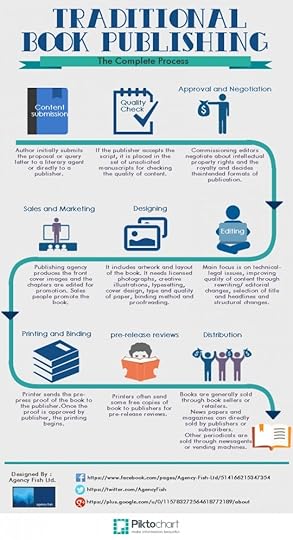
From Visually.
Types of Publishers
Large house
The publisher provides full editorial, printing, distribution and some marketing support.
Editorial Process:
Developmental edit. An editor will provide an overview of the plot, characters, and identify areas for improvement. For example: you need to bring out one character’s story. Or: it’s too long, you need to lose twenty thousand words. Developmental editing sometimes feels like a dance, and as in dancing, you need to trust your partner.
Structural edit: this is more like a continuity edit – checking for consistency in terminology, things like locations, directions and timelines are correct within the plot. This process sometimes includes a light copy edit – things like em dashes, speech marks, spelling.
Copy edit: detailed spelling. A style sheet for the work is developed and applied consistently.
Line edit/proofing edit: this usually happens just after the work is set for printing; the edit is done on the print proof. This is the last chance to catch any major errors.
Nowdays, many large publishers, having downsized their editorial teams, are likely to outsource to a freelancer. although sometimes they’ll do the copy and line-edit in house.
Marketing:
The publisher may use a PR agent to put out a press release and arrange interviews — radio, TV, newspaper and so on. Sometimes they may organise tours, like attending book festivals. Marketing teams have been downsized, so often they’re small on resource.
Social marketing, like Facebook, Instagram, Twitter, is usually done by an individual author; unless you’re a big name author, it seems unusual for the house to provide support in the social space. Some well-to-do authors hire assistants to do these activities.
A publisher works with distributors and printers to make sure the book is printed and ready for bookstores to order and arranges disposal of unsold books.
Other services :
If the publisher has world-wide rights for all formats, they may work with translators. They’ll make sure your book is set out in electronic format, and they may do audio versions.
Other (unspoken) benefits of a large house:
There is more catchet with a large house. If you have a contract with, say Penguin Random, my feeling is you’re more likely to be accepted for residences, have your work in stores, and asked to present at conferences/book tours. In New Zealand you are more likely to be supported by state agencies. For example, the NZ Book Council told me I ‘do not qualify as an author.’
Disadvantages of a large traditional publishing house:
It is very hard to get a book contract with a large house, and it’s normal for a large publisher to take up to a year before confirming they’ll accept your work. Over this time it’s bad form to submit to another house (simultaneous submissions). So submitting to a traditional house may tie your manuscript up for a long time.
Contracts with large houses are frequently drafted in favour of the house. For example, they may not have a termination date, and may require world-wide rights. If you get a contract, read it, and if you’re not sure, check with an author’s advocacy agency, such as the New Zealand Society of Authors.
Although a publisher may sign you up for worldwide rights, they may not exploit them. This can mean you only have your books sold in one territory. Even if you think readers in other places may be interested you’re unable to sell to them. So again: read the contract.
Large houses usually take around 85 – 90 percent of the sales price of the book, although this varies depending on print run and locality. The usual advance in New Zealand for children’s fiction seems to be around $2000 although it is higher internationally. Any advance is paid of over sales of the book, so the author doesn’t receive anything more until the royalties are paid off. In New Zealand, this seems to take around 2 years, although again it can vary between genres and publishers.
If you want to read more information on average incomes, royalties and advances, here’s a useful 2016 article by Horizon Research
Anecdotally, if you write literature for New Zealand children it is fairly common to receive the $2000 and then that’s it: unless your book is exceptionally popular, your work is unlikely to be reprinted.
A word of warning: If you’re fortunate enough to be offered a large advance, do not spend it; you should see it as a loan. Because if sales do not meet expectations a publisher may seek reimbursement of this advance.
[image error]
Small Press
Small presses have low overheads and may be owner-operator, that is, they only have one or two people working with them. As they usually service niche industries and operate with tight margins they can be insecure.
However, a small press may be very collegial, and the authors may act to support each other.
Generally, they’re full-service, offering editorial and other support. They may be only work in ebook format, so you may not be able to access bookstores or print-based distribution.
A small press can be a great option if you’re new to writing, as you get the editorial support and learn how the publishing process works. You’re less likely to receive an advance, but you may still be seen as being ‘published’ by the establishment, so therefore you may still be eligible for residencies and book tours.
Because small presses are vulnerable to closure or acquisition, make sure any contract you sign will give you your rights back. Sometimes if the publisher closes their author’s rights are sold off as an asset; make sure this doesn’t happen to you. If you’re not sure, talk with your local author’s society.
Assisted Publishing
Assisted publishing is basically a fee-for-service. A company may offer some or all of the services of a large traditional house, but rather than paying the author, the author pays for the services. Sometimes this is called ‘partner publishing’ or ‘vanity publishing’. The model varies between companies so make sure you know what you’re buying.
Assisted publishing is frequently very expensive, and sometimes is a scam: do your homework before you sign any deal. The New Zealand Society of Authors and the Writer Beware websites can offer you more guidance on how to avoid being scammed.
[image error]
From PinkPot Design
Do-it-Yourself or Independent Publishing
Indie publishers, like me, generally follow a similar process as a traditional publisher: editorial, design and marketing. But instead of an advance, we pay for it ourselves. We source editors and cover art. We may hire a formatter, engage a marketer and source our own PR. Some of these tasks we may do ourselves — for example, I do my own formatting. Sometimes we use software to help. Link to useful tools HERE
Independent publishing is a lot of work. However, royalties are around 30 – 90% on each sale, PLUS the author owns all the rights.
You’re unlikely to be offered a residency as an independent; frequently newspapers and other media are scathing of your abilities.
While it’s not technically difficult to do-it-yourself, it is time consuming. There is one mandatory requirement: you MUST be comfortable with computers.
Other models of publishing:
Publishing is changing all the time. Here’s a few examples:
Crowd-sourced – for example, Kickstarter
Commissioned work – textbooks, columns or articles
Social media – Check out Tyler Knott Gregson’s work.
Free sites – like Wattpad or FanFiction
Over to you – any other publishing processes I’ve missed out?
The post What Does a Publisher Do? appeared first on RL Stedman.
June 5, 2017
Publishing and Profits
This post is a continuation of the previous blog post. So if you’re starting here, I suggest that before beginning, you read this.
[image error]
Publishing Industry
Today there are five large publishing houses. They’re headquartered in NYC and are international; that is, they publish work across the globe.
PenguinRandom
HarperCollins
Hachette
MacMillian
Simon and Schuster
Mergers and acquisitions have become common in the publishing industry. You can see this in the names of these companies: PenguinRandom, for example, was once two separate publishing entities: Penguin Books and Random House.
Each house has a number of specialist imprints, such as Mills & Boon, Tor, Picador and Doubleday. My first book, A Necklace of Souls, was published under the Voyager imprint of HarperCollins; Voyager being a specialist Scifi-Fantasy imprint.
Although some of these large houses have an office in New Zealand, the NZ based office is really an offshoot of an Australian-based industry. Interestingly, some of these publishers operate in regional territories. Thus, rights that are held by one branch are independent of another.
So, if you sell your rights to the NZ office of say HarperCollins, you should not assume that the English branch of the same house will publish your work in the UK. The UK office have told me that an author holding a publishing contract with the NZ based office is a disincentive to obtaining the rights, because they will have to pay an additional fee to the NZ-based enterprise than if they, the UK office, owned the rights.
It is worth considering territories before you sell your work to a NZ based publisher; because in so doing you may build a barrier to reaching a global audience. This is particularly problematic in today’s ebook publishing industry; after all, Amazon and iBooks have a global audience.
[image error]
Retailers
Traditionally, publishing was broken up into the following functions:
Selection, curation and distribution
Printing
Retail
All three arms of publishing were quite separate and (generally) performed by different entities.
But today many online retailers act as publishers. Some, like Amazon, also have a print division (CreateSpace). In the online space the differences between the functions are blurred.
Changing Technology: Online Bookstores
There are four main online bookstores:
Amazon
iBooks
Kobo
Nook
Amazon is the dominant player. See the image below for the US 2015 market share (image from Author Earnings). This proportion and market share is likely to be reflected around the globe, although some significant non-English speaking regions, such as Russia and China, are dominated by language-specific stores.
[image error]
Books for children and adult nonfiction are still mostly sold as print. This is probably not surprising, as parents want kids to have less time on screens, not more. However, with the rise of Augmented Reality (AR), schools purchasing ePub files, and the increasing use of AI and voice activation technologies, its likely this may change.
It’s already changed for adult fiction. In the US, adult fiction sales are now 70% digital. That’s a MASSIVE shift.
[image error]
I don’t really know how I feel about this. Personally, I love my bookshelves, and there’s something deeply satisfying about holding a book in the hand. But when I’m travelling it’s a lot easier to take a kindle, and it’s a lot easier (and cheaper) to buy with one-click. So because I’m a book lover I mourn the decrease in books, as a reader, I love having access to cheaper and plentiful stories.
[image error]
As a writer, though, I’m pretty excited. Because not only are most fiction sales digital, nearly 42% of sales are NOT through the large traditional publishers. So although there are only 5 major international publishers, there is an increasing proliferation of small-time and independent presses. It’s easier now to have your work published than it ever was. Publishing is no longer the provenance of the wealthy and well-connected.
As long as you have a computer, time, energy and a little money, it’s possible to share your work with the world.
The post Publishing and Profits appeared first on RL Stedman.
June 4, 2017
The History of Publishing – How Everything Changed
[image error]
Publishing is sharing of ideas and information.
Think of the town crier; the temple scribe; the playwright — these are all publishing, and they’ve all been around for thousands of years.
[image error]
Pre-1440, dissemination of ideas was necessarily limited. A scribe can only pen so many books, and many people couldn’t read. New ideas spread slowly, limited by distance and education. The printing press arrived in 1440, and mass production of writing emerged. Books, tracts, magazines and newspapers could be read and shared.
And nowadays, publishing can be virtual and/or physical: blogs, journals, blogs, newspapers, books, radio, television, film…all is production and dissemination of creative work. The computer, and how we use it, changed everything.
Talk Transcript
This post is a transcript of a talk I will be delivering next week. Because the talk is quite long, I’ve set it out over three posts. I’ll put the slides for the talk at the end of the final blog post.
I thought it would be of interest to you, the reader (plus, I’m lazy; it’s a lot easier to write a talk twice than invent a whole new blog post!). The talk is called Your Story, Your Way: Options for Publishing, and I’m delivering it as part of a workshop for the Ronald Hugh Morrieson Awards.
Now, before I begin: a disclaimer. I am not a publisher, an expert in the publishing industry or a lawyer. Think of me as a gifted amateur — all information offered here is my own opinion. That being said, I have an MBA and I’m continually analysing markets for the Day Job.
This post is mostly about fiction because that’s what I write