R.L. Stedman's Blog, page 13
April 5, 2015
Formatting Woes
This last month I've taken a break from creative writing, and oh, how I miss it! But it's time for a massive pre-publishing work up and so I've been doing the proofing/editing/more proofing/formatting cycle that every writer needs to do before their book is ready.
Here, dear reader is a very brief summary of this painful process...
Proofing and Editing
Proofing and editing is one of those dreary-but-important tasks that every writer has to do. In brief, it involves going over and over and over your manuscript, refining the words. Making them tighter, more effective. Saying more with less. I lose between twenty and thirty percent of my word count in the edit phase.
If you have decided to self-publish your work, after the editing phase comes the formatting phase. Formatting is involves the final design, the layout of your manuscript and a final check for errors. It's a crucial step.
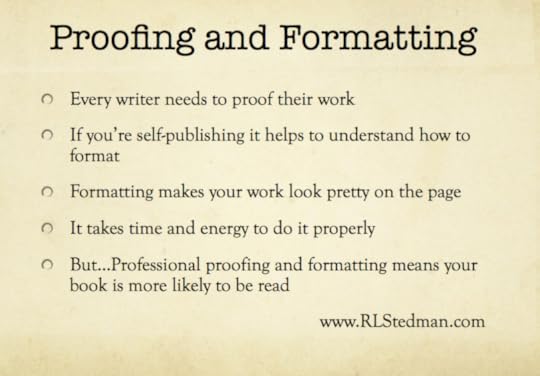
Formatting
If you have a traditional publisher, they will take care of all formatting, although they might send you a final proof for you to do a quick check on before it hits the printers. Tip One: SAVE A COPY of that a word version of that proof. Because one day your rights might be returned, and then you will be pleased you have an easy-to-format version.
I hate formatting. I am not very good at it, and it takes me ages. But just in case you're struggling too, here's what I do to make the process bearable. (This process only works if you write adult fiction without footnotes and very few illustrations. Formatting is quite different if you write picture books, graphic novels or illustrated non-fiction.)
First, I put a good music track onto iTunes. Then, following the Smashwords Style Guide I do the following:copy and paste the entire manuscript from word into TextEdit (or the PC equivalent). This strips all the formatting out of the document. Then I reinsert the formatting.
Yep! first I take it out, then I put it back in. Insane or what?
No , the reason is that Word is really buggy. It gets little glitches in it and then it doesn't seem to convert to other file formats very easily. So doing this properly at the beginning actually saves me time later on. (I've tried doing it the other way, too. Like, not cleaning it up first. Big mistake.)
Formatting includes:
double check for errorsfirst paragraph no indentssection breaks at the end of each chapterchapter headingsre-insert all italicsinsert any images write the back matter (that's the 'About this book' section that you might want to include at the end of the book)write the front matter (dedication, map etc)insert hyperlinks in the back matter check all spelling is USinsert table of contents (if required)check spacing around any poems is correct and that all lines of poetry have no indentcheck the spacing around the dinkus (asterix breaks) is correctremove all page numbersThis is my Master File
If I'm doing a print version of my book, I also: insert page headers (I follow the templates on Amazon, but I've customised them a little, so they look a little smarter)insert page numbersremove the table of contentsI save this as my Print File.
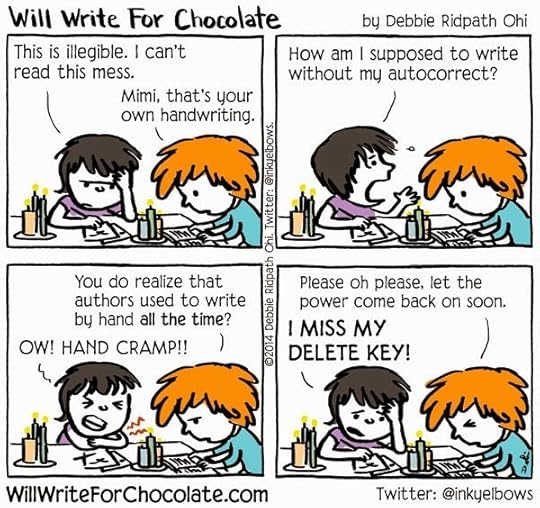 From Will Write For Chocolate
This takes Ages!
I've covered this really really quickly. This whole process takes me at least a week, sometimes longer. You can find details on how to do all this in the Style Guide (but be warned, the Style Guide is set out for PC. Plus, it's very colloquial. I prefer a recipe book-type instruction with screen shots, but No. The SG is all friendly and tells you about chickens and stuff. Plus, if, like me, you work on a mac, you'll find it a bit more complicated).
I do all the above in word, and then convert the files to a pdf for print on demand or to epub/mobi for e books.
File Conversion:
Conversion to epub or mobi can be tricky. I've tried two ways of doing this, but I know of three. These ways are:
Pay someone to do it. I've used Ebook Launch and they're really good, very professional, very fast. The downside is, you can't insert the hyperlinks or make changes easily to the final file. So if you suddenly spot a typo, you need to pay to get it changed. Use a conversion software, like Jutoh or write in inDesign and export as an ePub or mobi. Downside with this is you have to buy the conversion software, and you have to learn how to use it. Personally, my life is too short to use inDesign, although if you know the software, I would definitely give it a go, as people who do use it rave about it.Run it through an online conversion tool. I use the one on Draft 2 Digital. Then I have a mobi and ePub file generated relatively easily (although not always, the last one I did was really buggy and I'm still sorting it out) and once I'm ready, it's very easy to upload it through to the various vendors.Tip Two: Do not believe any website that tells you formatting is easy. "in three easy steps upload your book now!" It is not. Unless, I guess, you're a programmer or something.
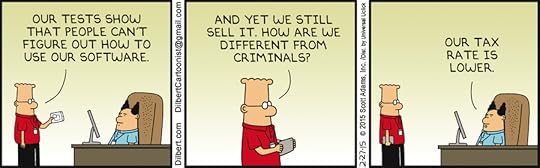 From Dilbert
So there you the summary of an awful lot of learning. It's not immediately obvious when you read this blog post, probably, but an enormous amount of heart-wrenching time and effort went into the knowledge set out here.
I am now a lot better at managing a large document. I can clean out most errors from a word file. But still, I struggle. So just be warned, if you do go down the self-publishing route, you will spend a lot of time in front of a computer screen.
And Remember:
Tip Three: make sure you back up everything.
And Tip Four: get the best and largest computer screen you can afford!
And finally:
The difference between success and failure as a self-published author is your proofing, your editing and your formatting.
Because no-one will read your work if it is full of errors.
Here, dear reader is a very brief summary of this painful process...
Proofing and Editing
Proofing and editing is one of those dreary-but-important tasks that every writer has to do. In brief, it involves going over and over and over your manuscript, refining the words. Making them tighter, more effective. Saying more with less. I lose between twenty and thirty percent of my word count in the edit phase.
If you have decided to self-publish your work, after the editing phase comes the formatting phase. Formatting is involves the final design, the layout of your manuscript and a final check for errors. It's a crucial step.

Formatting
If you have a traditional publisher, they will take care of all formatting, although they might send you a final proof for you to do a quick check on before it hits the printers. Tip One: SAVE A COPY of that a word version of that proof. Because one day your rights might be returned, and then you will be pleased you have an easy-to-format version.
I hate formatting. I am not very good at it, and it takes me ages. But just in case you're struggling too, here's what I do to make the process bearable. (This process only works if you write adult fiction without footnotes and very few illustrations. Formatting is quite different if you write picture books, graphic novels or illustrated non-fiction.)
First, I put a good music track onto iTunes. Then, following the Smashwords Style Guide I do the following:copy and paste the entire manuscript from word into TextEdit (or the PC equivalent). This strips all the formatting out of the document. Then I reinsert the formatting.
Yep! first I take it out, then I put it back in. Insane or what?
No , the reason is that Word is really buggy. It gets little glitches in it and then it doesn't seem to convert to other file formats very easily. So doing this properly at the beginning actually saves me time later on. (I've tried doing it the other way, too. Like, not cleaning it up first. Big mistake.)
Formatting includes:
double check for errorsfirst paragraph no indentssection breaks at the end of each chapterchapter headingsre-insert all italicsinsert any images write the back matter (that's the 'About this book' section that you might want to include at the end of the book)write the front matter (dedication, map etc)insert hyperlinks in the back matter check all spelling is USinsert table of contents (if required)check spacing around any poems is correct and that all lines of poetry have no indentcheck the spacing around the dinkus (asterix breaks) is correctremove all page numbersThis is my Master File
If I'm doing a print version of my book, I also: insert page headers (I follow the templates on Amazon, but I've customised them a little, so they look a little smarter)insert page numbersremove the table of contentsI save this as my Print File.
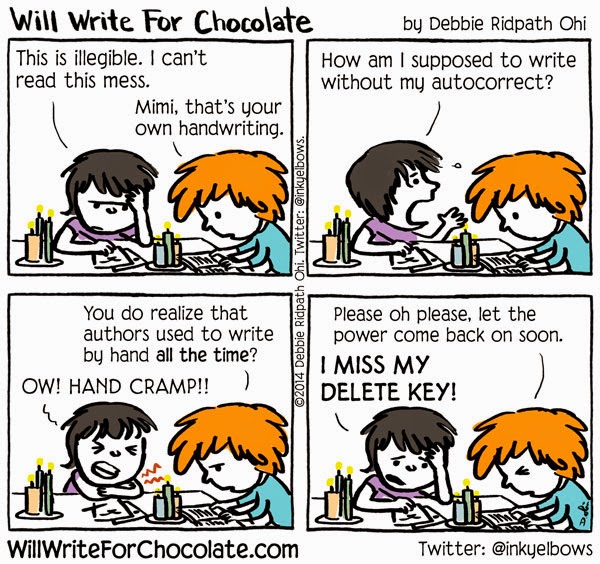 From Will Write For Chocolate
 This takes Ages!
I've covered this really really quickly. This whole process takes me at least a week, sometimes longer. You can find details on how to do all this in the Style Guide (but be warned, the Style Guide is set out for PC. Plus, it's very colloquial. I prefer a recipe book-type instruction with screen shots, but No. The SG is all friendly and tells you about chickens and stuff. Plus, if, like me, you work on a mac, you'll find it a bit more complicated).
I do all the above in word, and then convert the files to a pdf for print on demand or to epub/mobi for e books.
File Conversion:
Conversion to epub or mobi can be tricky. I've tried two ways of doing this, but I know of three. These ways are:
Pay someone to do it. I've used Ebook Launch and they're really good, very professional, very fast. The downside is, you can't insert the hyperlinks or make changes easily to the final file. So if you suddenly spot a typo, you need to pay to get it changed. Use a conversion software, like Jutoh or write in inDesign and export as an ePub or mobi. Downside with this is you have to buy the conversion software, and you have to learn how to use it. Personally, my life is too short to use inDesign, although if you know the software, I would definitely give it a go, as people who do use it rave about it.Run it through an online conversion tool. I use the one on Draft 2 Digital. Then I have a mobi and ePub file generated relatively easily (although not always, the last one I did was really buggy and I'm still sorting it out) and once I'm ready, it's very easy to upload it through to the various vendors.Tip Two: Do not believe any website that tells you formatting is easy. "in three easy steps upload your book now!" It is not. Unless, I guess, you're a programmer or something.
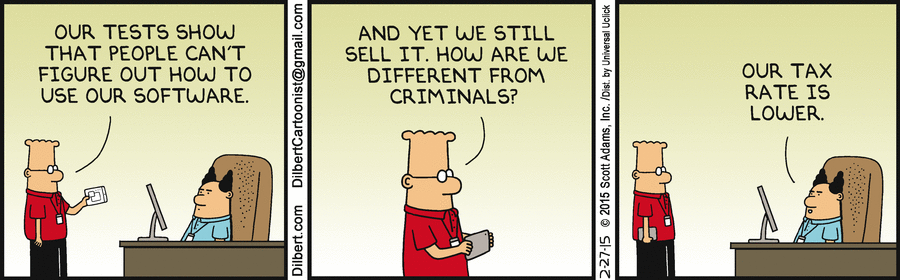 From Dilbert
So there you the summary of an awful lot of learning. It's not immediately obvious when you read this blog post, probably, but an enormous amount of heart-wrenching time and effort went into the knowledge set out here.
I am now a lot better at managing a large document. I can clean out most errors from a word file. But still, I struggle. So just be warned, if you do go down the self-publishing route, you will spend a lot of time in front of a computer screen.
And Remember:
Tip Three: make sure you back up everything.
And Tip Four: get the best and largest computer screen you can afford!
And finally:
The difference between success and failure as a self-published author is your proofing, your editing and your formatting.
Because no-one will read your work if it is full of errors.


March 21, 2015
Social Media and Pinterest
Apologies for such a prolonged absence from the blogosphere; I've gained two colds, courtesy of my kids, and a new job, courtesy of a previous boss. All this has massively crunched my writing time, meaning this blog has just had to sit on the sidelines.
Anyway, today I got a query from the amazing Rachael Craw (check out her book, Spark, here). What is this Pinterest thingy?

I've talked about social media before and Rachael is an expert at the use of twitter and Facebook, but it just goes to show not even us Rach's know everything. So, a quick summary of Pinterest in this post, just for you, Rach :)
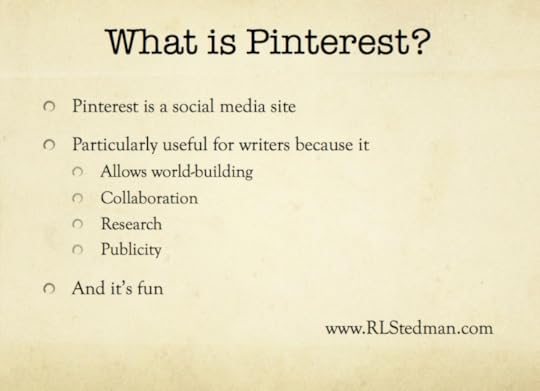
What is Pinterest?
Pinterest is a social media platform that acts as a virtual pinboard. Say you're building a house. Instead of collecting pictures from a magazine and pasting them in a scrapbook, with only a click of the mouse you can pin them to your board. All on-line content containing video or image files can be pinned. (You can't pin just text. And it doesn't seem to like Facebook too much, either.)
Pinterest is a bit more than just a pinboard, though. It's social. You can create group boards which other people can pin to.You can comment on other people's images and/or pin images they've collected to your board. You can make secret boards that are private, or you can make your boards public and able to be shared. (Pinterest has a lot more features but these are the ones I use the most).
Why is this Useful for Writers?
I use pinterest in my writing in four ways. Here's the link to my boards.
Creating value-add.
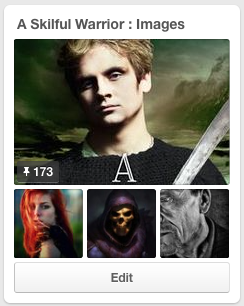
I pin links to research used in the creation of a book. I make a note of this board in the links at the back of the book (the back matter). Librarians, teachers and readers can gain a greater insight into the world building and the characters. This has been really useful, particularly when I was shortlisted for the NZ Post Award last year. Literacy Aotearoa did a spread on my book and linked my pinterest board into that spread.
Here's the board for my upcoming novel, A Skilful Warrior
Informing Media
I pin links to interviews, reviews and other material on a pinterest board. This makes it easy for anyone doing an article on me to quickly access this material.
Collaboration
My cover artists and I - Kura Carpenter and Christa Holland - are both on pinterest. Check out Christa's boards here, and Kura's here. Kura in particular has amazing boards, as in addition to her cover art she's a steampunk fanatic and a period costume designer.
When I've been in the throes of cover design with either of them I've started a group secret board to pin ideas to - covers I like, covers I don't like, font design and so on.
Plot Bunnies
I love collecting images that might lead to future stories. There's one board I have, called The Book of the Castaway which is a total story in development. I'm using the images in the board to cue the various narrative elements. It's quite a different plotting process to the linear way I normally work and I'm kind of enjoying the way the story is building.
Other Uses for Pinterest
Make a board for each character: their music, their clothes, where they live, their hobbies. Recipes they use, cars they drive and so on.You can list books you like, books you're reading (I started doing that, but now I just use goodreads), books you want to read or books that are similar to yours.Social context. Some people use this extensively, especially historical writers. House decor, fashions, current events, music, videos of a period can all be pinned to a board.Place. I had a whole board on castles, just so I could get the feeling of a castle, all that damp stone and narrow passagewaysCultural vibe. Pinterest is a good way to quickly see which images are trending: which TV shows are popular, which books are doing well, which fashions are coming. (Spark, with its beautiful cover is really popular). Pinterest is quite an interesting marker of a culture. And it's changing quite rapidly, as the platform is becoming more international.Promotion. Through clever use of images you can (in theory) drive traffic to your books, or to your website. Personally, I'm a bit slack at that, but a good friend of mine, Roomie, uses it really cleverly to link to her blog and her design business.
Couple of things to be aware of:
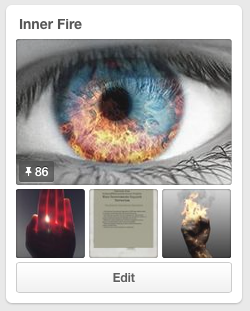
Copyright. Where possible, I have attributed images in A Necklace of Souls and Inner Fire (my novels) boards. I have also add a line to the board requesting the owner of the image to contact me if they wish to have an image removed or re-credited. Never use an image for your own commercial use without purchasing a license.Comments. Like all social media, keep comments positive.Content. Don't rely on the pinner's commentary to be accurate (this is really important if you're looking for historical material). Always check the original source.Image counts. The better the image, the more attention it will get.
You can find out more information about Pinterest here Just beware - Pinterest is addictive!
So, Rachael, hope this is helpful! And enjoy!
Anyway, today I got a query from the amazing Rachael Craw (check out her book, Spark, here). What is this Pinterest thingy?

I've talked about social media before and Rachael is an expert at the use of twitter and Facebook, but it just goes to show not even us Rach's know everything. So, a quick summary of Pinterest in this post, just for you, Rach :)
What is Pinterest?
Pinterest is a social media platform that acts as a virtual pinboard. Say you're building a house. Instead of collecting pictures from a magazine and pasting them in a scrapbook, with only a click of the mouse you can pin them to your board. All on-line content containing video or image files can be pinned. (You can't pin just text. And it doesn't seem to like Facebook too much, either.)
Pinterest is a bit more than just a pinboard, though. It's social. You can create group boards which other people can pin to.You can comment on other people's images and/or pin images they've collected to your board. You can make secret boards that are private, or you can make your boards public and able to be shared. (Pinterest has a lot more features but these are the ones I use the most).

Why is this Useful for Writers?
I use pinterest in my writing in four ways. Here's the link to my boards.
Creating value-add.
I pin links to research used in the creation of a book. I make a note of this board in the links at the back of the book (the back matter). Librarians, teachers and readers can gain a greater insight into the world building and the characters. This has been really useful, particularly when I was shortlisted for the NZ Post Award last year. Literacy Aotearoa did a spread on my book and linked my pinterest board into that spread.
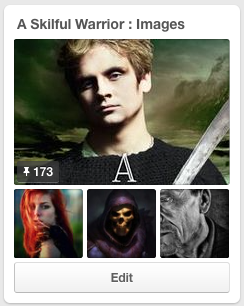
Here's the board for my upcoming novel, A Skilful Warrior
Informing Media
I pin links to interviews, reviews and other material on a pinterest board. This makes it easy for anyone doing an article on me to quickly access this material.
Collaboration
My cover artists and I - Kura Carpenter and Christa Holland - are both on pinterest. Check out Christa's boards here, and Kura's here. Kura in particular has amazing boards, as in addition to her cover art she's a steampunk fanatic and a period costume designer.
When I've been in the throes of cover design with either of them I've started a group secret board to pin ideas to - covers I like, covers I don't like, font design and so on.
Plot Bunnies
I love collecting images that might lead to future stories. There's one board I have, called The Book of the Castaway which is a total story in development. I'm using the images in the board to cue the various narrative elements. It's quite a different plotting process to the linear way I normally work and I'm kind of enjoying the way the story is building.
Other Uses for Pinterest
Make a board for each character: their music, their clothes, where they live, their hobbies. Recipes they use, cars they drive and so on.You can list books you like, books you're reading (I started doing that, but now I just use goodreads), books you want to read or books that are similar to yours.Social context. Some people use this extensively, especially historical writers. House decor, fashions, current events, music, videos of a period can all be pinned to a board.Place. I had a whole board on castles, just so I could get the feeling of a castle, all that damp stone and narrow passagewaysCultural vibe. Pinterest is a good way to quickly see which images are trending: which TV shows are popular, which books are doing well, which fashions are coming. (Spark, with its beautiful cover is really popular). Pinterest is quite an interesting marker of a culture. And it's changing quite rapidly, as the platform is becoming more international.Promotion. Through clever use of images you can (in theory) drive traffic to your books, or to your website. Personally, I'm a bit slack at that, but a good friend of mine, Roomie, uses it really cleverly to link to her blog and her design business.

Couple of things to be aware of:
Copyright. Where possible, I have attributed images in A Necklace of Souls and Inner Fire (my novels) boards. I have also add a line to the board requesting the owner of the image to contact me if they wish to have an image removed or re-credited. Never use an image for your own commercial use without purchasing a license.Comments. Like all social media, keep comments positive.Content. Don't rely on the pinner's commentary to be accurate (this is really important if you're looking for historical material). Always check the original source.Image counts. The better the image, the more attention it will get.
You can find out more information about Pinterest here Just beware - Pinterest is addictive!
So, Rachael, hope this is helpful! And enjoy!
February 11, 2015
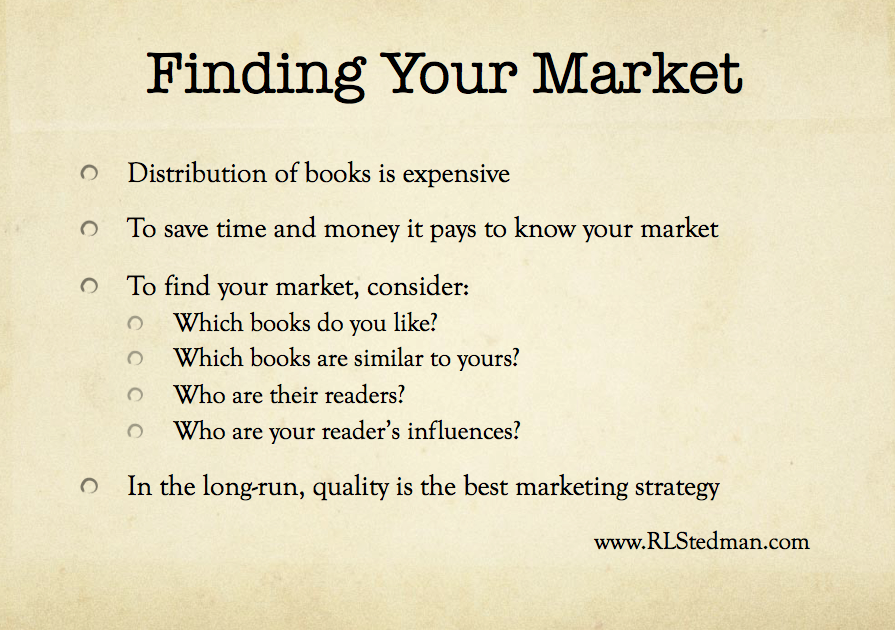
Finding Your Market
In my last post I wrote about customer's needs and wants, and how this relates to writing. In that post I listed three key elements to a successful business. To recap:
Identifying customer needs Creating a product/service that meets these needsDelivering this product to your customer
(this is really, really simple. There are other requirements, such as management of cashflow. But as a start-up, these are things you must have.)
Lots of people write books. A few write great books. But all the great words in the world won't matter a dime if readers can't get their hands on your writing! So this post offers ideas on how to deliver your book to your customer. This post discusses distribution options.
Distribution Channels? What are they?
Basically, distribution is getting a product to the customer. It's getting your book out to the market.
These days, writers are spoilt for choice. You can sell your book online, through a store, or direct. A publisher may do it for you; you can do it for yourself. You can hire a third party. And your book can be available in a number of formats: digital, print, audio.
Okay, then, you say - I'll do everything! I'll sell everywhere, using every available format. Um. No. I wouldn't.
Be Strategic - Know Your Market
Distribution costs. Formatting for multiple platforms costs, print is expensive and the time spent navigating software is time you're not writing. In business-speak, unless you've got a massive team behind you and a known customer base, adopting a mass-distribution strategy is unlikely to offer an effective return on investment.
Rather than rushing out and putting your book on every available platform, it's more efficient to be strategic. And the key to being strategic is really, really basic. It's called KNOWING YOUR MARKET.
 From Marketoonist
Identifying Your Market
You might already know your market. You've got a couple of books written. You've got a Facebook following, people email you begging for your next book. Readers ask for your newsletter. You will know the approximate age, sex, location and interests of your readers.
But what if this is your first book? How do you find your audience then?
Most writers of fiction write for one person - themselves. So, if you're trying to discover who on earth could possibly interested in reading what you've written, consider what other, recently published, books are similar in style and content to yours.
Think about your interests, age, sex, education. Where is your book set? Is the location likely to be appealing to a particular audience. Does the genre you're writing in have a broad appeal or are there a few niche groups that will be interested? Which groups do you belong to?
Philip Temple, a retired mountaineer, writes fiction and non-fiction about the New Zealand wilderness. He is passionate about the environment and deeply worried about climate change. His books appeal to mountaineers, environmentalists, travel readers. He reported that people have approached him from the UK, asking to put his recent book on a climate change blog.
Audience Characteristics
Look on Goodreads, see who's been reading this genre. What books do they recommend? Are the readers of these books male/female? What age? What do they say in their reviews? Do these readers prefer reading in e or in p? (usually, there are long threads on this very subject!). Do they say how they found this book?Social media is a great way of finding potential readers. I've followed a few book instagrammers. (Booklovers on instagram are great, because they always post a picture of the book cover, which makes the book much more memorable than just the title. I've found heaps of new, amazing books through instagram.)Often the discussion threads on social media sites are a good way of finding out about your potential readers. Quick Note on social media etiquette: If you really liked the book under discussion, join in; be social. Don't be a closet stalker, don't do the hard-sell. Just be friendly and interesting. Readers love to talk about books.Follow the writers of similar books on twitter. Often, they'll post links to reviews mentioning their book. If you don't like social media, read print reviews of these similar books. Often these reviewers say who they'd recommend this book to. These people are your audience.Think laterally. If you write books involving cupcakes and murders, your audience might include not only readers of detective fiction; it might also include people who enjoy baking.
The Importance of Influencers
Most of the time, there's only two ways I discover a new writer.
random selection - at the library or on the sales shelfrecommendation through a trusted third party (a reviewer, a librarian, a friend, a media article)
When considering your market, consider who their influencers are.
This is really, really important if you're writing for children. Children don't always select their own books; adults do it for them. If you write for children, you MUST consider their parents, and the school librarian. Basically, if you win over a good librarian (Hi there, Bridget!), they'll act as an advocate for you.
The Importance of Word of Mouth
Related to this last point - books are sold through recommendation. Your book must be as good as possible. I can't stress this enough. There's no point in ensuring your book is in all the right places if its no good. Therefore, before embarking on the final steps of getting your book to market (including how you will do that), pause for a moment.
Is your book good enough? Because, in the end, that's really what your audience needs - a good book, written well.
February 4, 2015
Needs and Wants
What do Customers Need?
Most businesses rely on three key factors:
Customer needsProduct creationDistributionSo today I'm going to look the needs of a reader. And over the next few weeks/months, I'll review these other points. So stay tuned!
Why do people read fiction?
Here's a few reasons - you may be able to think of others. EscapismEntertainmentRelaxationLearn new thingsTo become someone elseTo indulge a hobbyTo satisfy a teacherTo learn new wordsTo find out what happens
You can see from this list that reading isn't about words on a page at all - they're just tools to satisfy a deeper requirement. It's not an accident that high-selling genres offer escapism and entertainment (romance, crime, thriller); personally, I think that's why most people read. However, entertainment is easily substituted by other technologies. Computer games, perhaps, or movies. It pays to be aware of this, if you're writing in these genres.
Needs vs Wants
This highlights the difference between Needs and Wants. A customer's need is the fundamental reason they purchase a product, or use a service. The want is often the way this need is expressed. The classic example of this is the iPod, a device for data storage. Steve Jobs realised actually what people needed was portability. If he could offer a device (and a store) that satisfied this deeper need, you'll have an instant customer base.
This means that even if a reader says they want entertainment, they may in fact not. Why? Because there are such easily available substitutes for entertainment. This is why kids tend to gravitate away from books and towards their screens - reading is different to playing a computer game; it's much more demanding. It's also much more immersive. And reading doesn't require hand-eye co-ordination, internet connection or (often) a battery operated device.
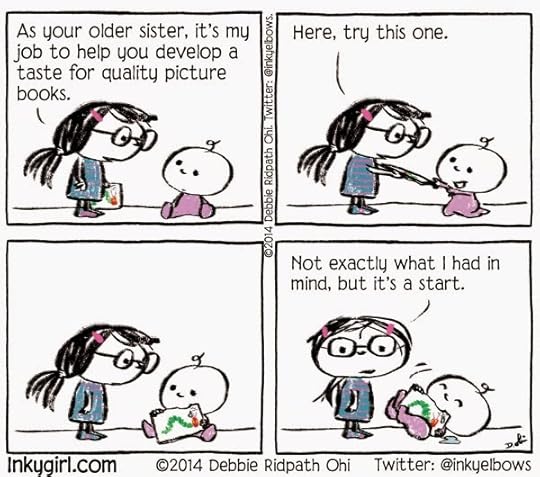 From InkyGirl
Some needs can only be met through fiction. Novels are, I think, the only way one can truly see the world through another person's point of view. Novels offer intellectual stimulation at the same time as providing entertainment. A good novel, written well, stimulates thought and discussion; even changes lives. And of course, fiction uses the most durable of technologies; words on paper.
Through this combination of low-cost technology and limited substitutes, fiction becomes an incredibly powerful long-term business proposition. The ultimate test of good fiction is time.
This means (and I'm writing to myself here), I should not look at the sales over the first month as an indication of success or failure. Probably not even in the first year.
What do customers of fiction need?
I think the list above can be simplified much, much further. InnovationEntertainmentStimulation
So If you don't want your books to be easily replaceable, write them well. If you write kids books, make them more fun than an iPad. Have an interesting story-line, something that's different, that stands out. And - I think this is the differentiator that leads to long term writing success - your books should make people think.
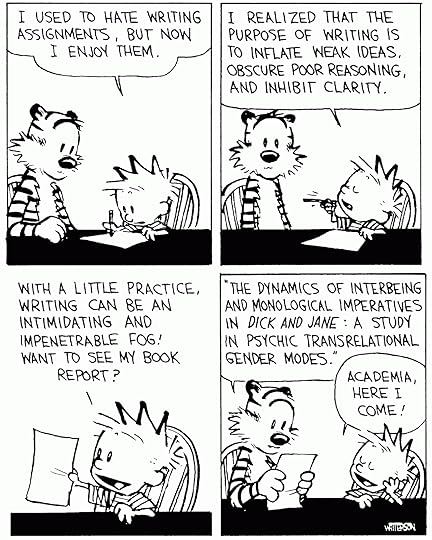 Calvin and Hobbs, downloaded from the Image Kid
Most businesses rely on three key factors:
Customer needsProduct creationDistributionSo today I'm going to look the needs of a reader. And over the next few weeks/months, I'll review these other points. So stay tuned!
Why do people read fiction?
Here's a few reasons - you may be able to think of others. EscapismEntertainmentRelaxationLearn new thingsTo become someone elseTo indulge a hobbyTo satisfy a teacherTo learn new wordsTo find out what happens
You can see from this list that reading isn't about words on a page at all - they're just tools to satisfy a deeper requirement. It's not an accident that high-selling genres offer escapism and entertainment (romance, crime, thriller); personally, I think that's why most people read. However, entertainment is easily substituted by other technologies. Computer games, perhaps, or movies. It pays to be aware of this, if you're writing in these genres.
Needs vs Wants
This highlights the difference between Needs and Wants. A customer's need is the fundamental reason they purchase a product, or use a service. The want is often the way this need is expressed. The classic example of this is the iPod, a device for data storage. Steve Jobs realised actually what people needed was portability. If he could offer a device (and a store) that satisfied this deeper need, you'll have an instant customer base.
This means that even if a reader says they want entertainment, they may in fact not. Why? Because there are such easily available substitutes for entertainment. This is why kids tend to gravitate away from books and towards their screens - reading is different to playing a computer game; it's much more demanding. It's also much more immersive. And reading doesn't require hand-eye co-ordination, internet connection or (often) a battery operated device.
 From InkyGirl
Some needs can only be met through fiction. Novels are, I think, the only way one can truly see the world through another person's point of view. Novels offer intellectual stimulation at the same time as providing entertainment. A good novel, written well, stimulates thought and discussion; even changes lives. And of course, fiction uses the most durable of technologies; words on paper.
Through this combination of low-cost technology and limited substitutes, fiction becomes an incredibly powerful long-term business proposition. The ultimate test of good fiction is time.
This means (and I'm writing to myself here), I should not look at the sales over the first month as an indication of success or failure. Probably not even in the first year.
What do customers of fiction need?
I think the list above can be simplified much, much further. InnovationEntertainmentStimulation
So If you don't want your books to be easily replaceable, write them well. If you write kids books, make them more fun than an iPad. Have an interesting story-line, something that's different, that stands out. And - I think this is the differentiator that leads to long term writing success - your books should make people think.
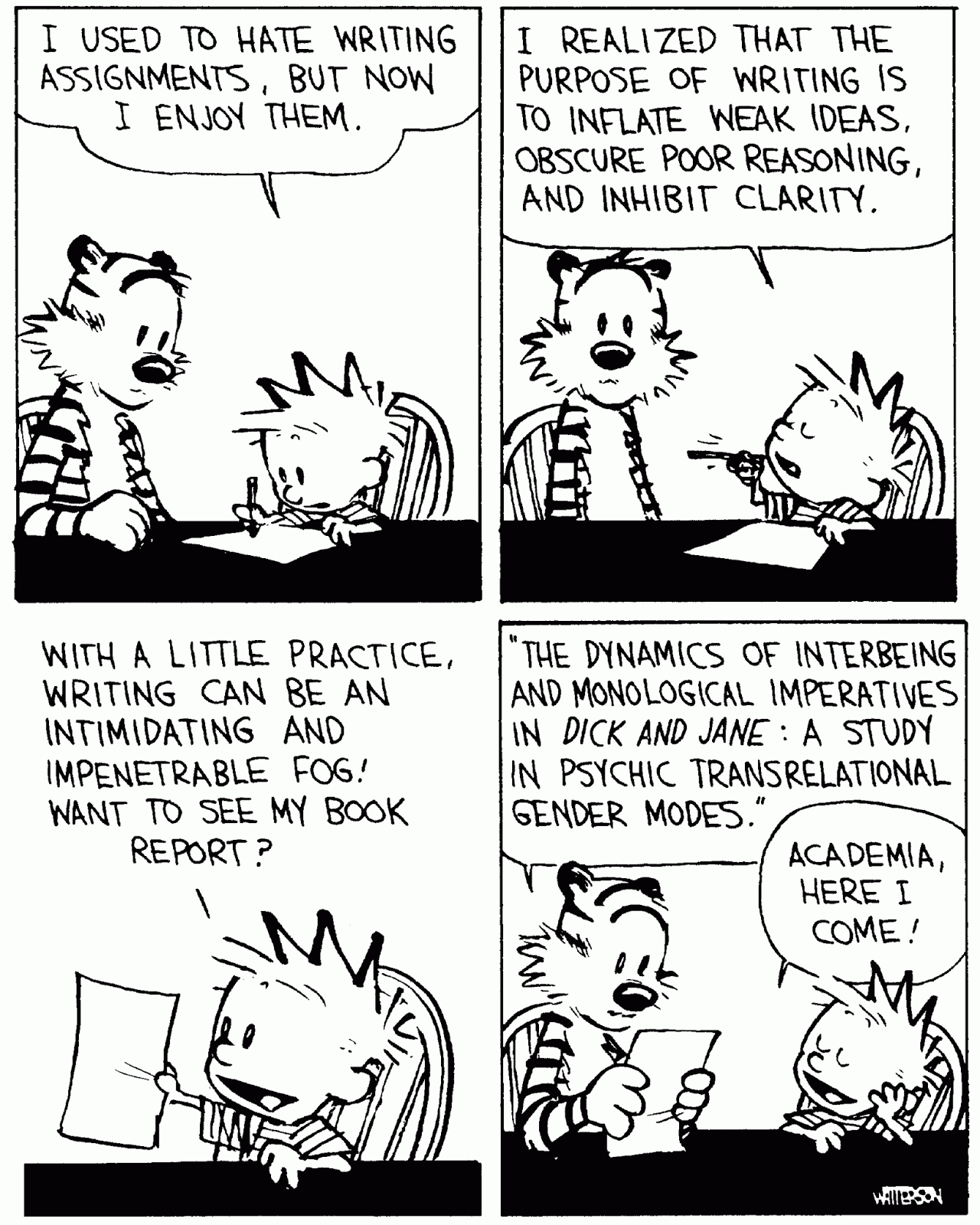 Calvin and Hobbs, downloaded from the Image Kid
January 12, 2015
A Tale of Two Novels
First Thirty DaysThis blog sets out the outcome of a little experiment. For those of you who haven't read last week's post, towards the end of 2014 I released two YA novels. One was called Inner Fire; the other was A Necklace of Souls. Inner Fire was released with significant publicity; A Necklace of Souls was launched with next to none.
More details on the two novels are set out below.
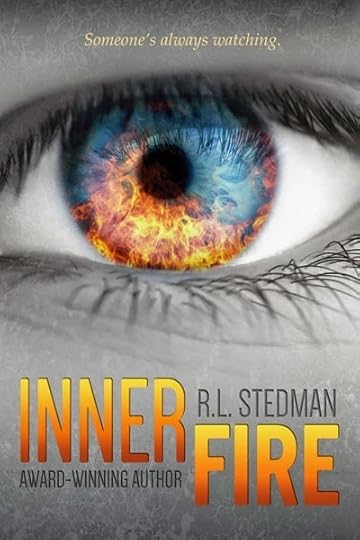
Two Novels- Inner Fire - YA - thriller/suspense - standalone - publisher: Waverley Productions, 2014
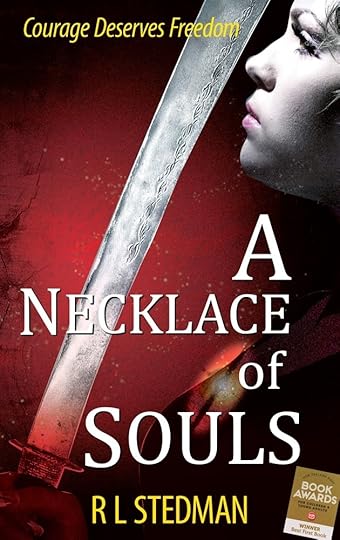
- A Necklace of Souls - YA - fantasy - #1 in series - publisher: harperCollins (Voyager) 2012-13; lately published by Waverley Productions, 2014. Winner: Tessa Duder Award, 2012; NZ Post Book Awards, 2013.
Publicity for Each Novel 1. Inner Fire:
Professional publicist and professional press releaseAvailable as on-line and print Advertising and publicity:Newspaper article (readership 250K +)Radio interviewReview in Collected, School Librarian magazineAdvertising in self-pub section in Publishers Weekly and application for review by Publisher's WeeklyAdvanced Readers Copies to local high-volume bloggers Blog tour to YA bloggersGoodreads giveawaySales channels - Inner Fire
Kindle unlimited, kindle select and countdown deal.CreateSpace - print copies, including extended distributionNZ specialty bookstores - print copies
2. A Necklace of Souls:
Advertising and Publicity:Advance reader copies to Goodreads followersFacebook advertisement Extensive publicity in NZ 2013-14 through NZ Post Book Awards. Approx 2000+ sales in NZ 2012 - 2013 before rights returned in 2014.Sales channels - A Necklace of Souls
Amazon Kindleitunes, barnes and noble, Nook and Scribd (via Draft2Digital)Print in local NZ bookstores - voyager imprint only From InkyGirl
Outcome - CaveatsNumbers set out below are approximate only.The cost of marketing only includes giveaways, publicity and advertising. It does not include cover art, editorial, website design or formatting.I don't have visibility into print sales through bookshops yet as these are not available until after 3 months. So this print sales volume includes direct print sales through my website only, not retail outlets.Inner Fire was in the top 50 on Amazon for the YA/thrillers/spies for the first thirty days.Although the loans look reasonably good for Inner Fire, the revenue for Kindle Unlimited is really uncertain. Greatest returns are through print sales through my website.There are other rewards than sales volumes. For Inner Fire, these have included people stopping me on the street and saying how much they enjoyed my book; emails from fans; emails from reviewers saying 'it's fabulous'; a parent telling me in a cafe how thrilled they were that their daughter, not a big reader, was reading my book and loving it.Results
Inner Fire A Necklace of Soulssales - amazon59loans (kindle unlimited)15-sales - print5-sales - electronic (other)0reviews - Goodreads242reviews - Amazon40approximate cost of marketing (NZD)$1,000.00$15.00
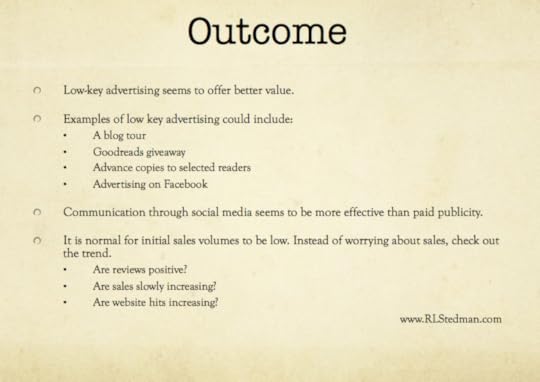
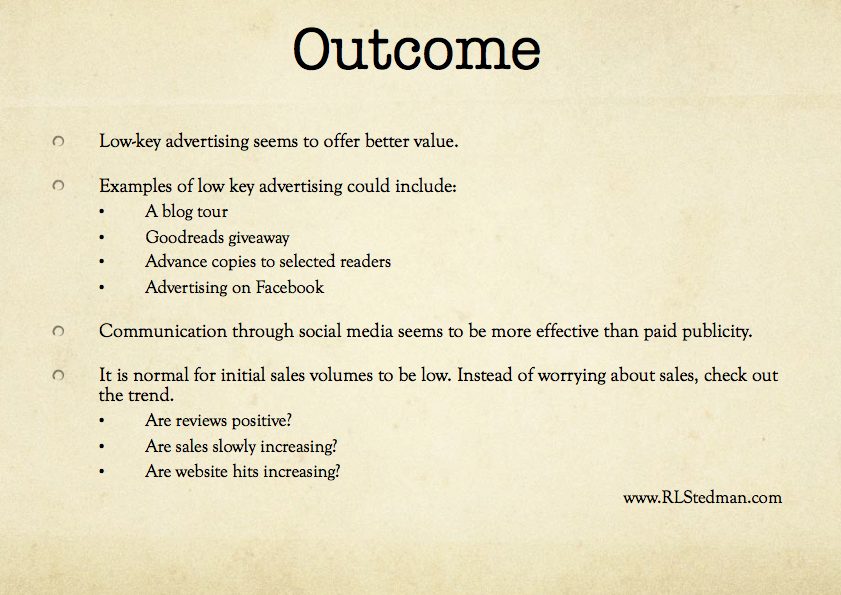
 The Sales Roller-coasterLearningsFormatting was a lot harder than I thought it would be; I wasted a lot of time on it.Using a local printer worked well (it was cheaper than CreateSpace), but the lack of print-on-demand facilities in New Zealand makes it expensive unless you do more than about 300 units.Print is a really effective advertising tool. People love getting free books. The Goodreads giveaway (which you can only do with a print book) was an effective promotional tool. However, sales were relatively low - although loans were higher than I'd expected.Using a professional formatter made life a lot easier but it's quite expensive. It is probably more cost-effective to use an outlet like Draft 2 Digital .Using a blog tour is good promotion (and is relatively inexpensive) but offers limited return in terms of sales. However, I gained a lot of followers on Facebook, Goodreads and Twitter following the blog tour, which was useful for the release of NecklaceUsing a professional publicist meant a high-quality press release and has gained some high-profile reviews, such as a national newspaper article, but has led to limited sales volume.Final ConclusionLow-key advertising seems to offer better value. So for A Skilful Warrior (the sequel to A Necklace of Souls) I will have a small blog tour, a Goodreads giveaway and, if you're a Goodreads follower, you might get offered a free advance copy. Get in quick! Social media seems to be more effective than paid publicity. And finally - these sales volumes will not make me rich. However, other very successful self-published authors report similar sales volumes early on, and so for the time being I'm actually not that discouraged. In general, the trend is positive. Reviews are good; readers are enjoying my books. And I'm working out a more hassle-free process as I go. So I do plan to produce one or two more books in 2015. Stay tuned!
More details on the two novels are set out below.

Two Novels- Inner Fire - YA - thriller/suspense - standalone - publisher: Waverley Productions, 2014
- A Necklace of Souls - YA - fantasy - #1 in series - publisher: harperCollins (Voyager) 2012-13; lately published by Waverley Productions, 2014. Winner: Tessa Duder Award, 2012; NZ Post Book Awards, 2013.
Publicity for Each Novel 1. Inner Fire:
Professional publicist and professional press releaseAvailable as on-line and print Advertising and publicity:Newspaper article (readership 250K +)Radio interviewReview in Collected, School Librarian magazineAdvertising in self-pub section in Publishers Weekly and application for review by Publisher's WeeklyAdvanced Readers Copies to local high-volume bloggers Blog tour to YA bloggersGoodreads giveawaySales channels - Inner Fire
Kindle unlimited, kindle select and countdown deal.CreateSpace - print copies, including extended distributionNZ specialty bookstores - print copies
2. A Necklace of Souls:
Advertising and Publicity:Advance reader copies to Goodreads followersFacebook advertisement Extensive publicity in NZ 2013-14 through NZ Post Book Awards. Approx 2000+ sales in NZ 2012 - 2013 before rights returned in 2014.Sales channels - A Necklace of Souls
Amazon Kindleitunes, barnes and noble, Nook and Scribd (via Draft2Digital)Print in local NZ bookstores - voyager imprint only
 From InkyGirl
Outcome - CaveatsNumbers set out below are approximate only.The cost of marketing only includes giveaways, publicity and advertising. It does not include cover art, editorial, website design or formatting.I don't have visibility into print sales through bookshops yet as these are not available until after 3 months. So this print sales volume includes direct print sales through my website only, not retail outlets.Inner Fire was in the top 50 on Amazon for the YA/thrillers/spies for the first thirty days.Although the loans look reasonably good for Inner Fire, the revenue for Kindle Unlimited is really uncertain. Greatest returns are through print sales through my website.There are other rewards than sales volumes. For Inner Fire, these have included people stopping me on the street and saying how much they enjoyed my book; emails from fans; emails from reviewers saying 'it's fabulous'; a parent telling me in a cafe how thrilled they were that their daughter, not a big reader, was reading my book and loving it.Results
Inner Fire A Necklace of Soulssales - amazon59loans (kindle unlimited)15-sales - print5-sales - electronic (other)0reviews - Goodreads242reviews - Amazon40approximate cost of marketing (NZD)$1,000.00$15.00
 The Sales Roller-coasterLearningsFormatting was a lot harder than I thought it would be; I wasted a lot of time on it.Using a local printer worked well (it was cheaper than CreateSpace), but the lack of print-on-demand facilities in New Zealand makes it expensive unless you do more than about 300 units.Print is a really effective advertising tool. People love getting free books. The Goodreads giveaway (which you can only do with a print book) was an effective promotional tool. However, sales were relatively low - although loans were higher than I'd expected.Using a professional formatter made life a lot easier but it's quite expensive. It is probably more cost-effective to use an outlet like Draft 2 Digital .Using a blog tour is good promotion (and is relatively inexpensive) but offers limited return in terms of sales. However, I gained a lot of followers on Facebook, Goodreads and Twitter following the blog tour, which was useful for the release of NecklaceUsing a professional publicist meant a high-quality press release and has gained some high-profile reviews, such as a national newspaper article, but has led to limited sales volume.Final ConclusionLow-key advertising seems to offer better value. So for A Skilful Warrior (the sequel to A Necklace of Souls) I will have a small blog tour, a Goodreads giveaway and, if you're a Goodreads follower, you might get offered a free advance copy. Get in quick! Social media seems to be more effective than paid publicity. And finally - these sales volumes will not make me rich. However, other very successful self-published authors report similar sales volumes early on, and so for the time being I'm actually not that discouraged. In general, the trend is positive. Reviews are good; readers are enjoying my books. And I'm working out a more hassle-free process as I go. So I do plan to produce one or two more books in 2015. Stay tuned!
January 2, 2015
New Year, New Year's Resolutions
The hardest thing about writing is that ... it's a slow process. It takes time to craft words well; it takes persistence to string them together to make sentences. And it takes even longer for these sentences to grow into a novel, to be edited and re-edited until the novel is complete. The trick to writing is to approach the task in increments. One paragraph at a time, each paragraph growing into a scene, into a chapter and so on.
The same is true for publishing. Getting a book onto virtual or physical bookshelves is best approached as a project. Tasks accomplished sequentially, in their required order. Rather like moving house, it's a good idea to sit down and plan the steps. I had a list of jobs that need to be done before the book is released. Some things needed to be done early, others waited until the last minute. One of the things which needed to be done early was launch preparation.
New Year, New BookMy New Year's resolution for 2015 is to get my a new book, A Skilful Warrior, out onto virtual bookshelves by April 2015. It's the sequel to A Necklace of Souls, and was written two years ago. Warrior was sitting on my publisher's in-tray for a year. Then along came a restructure, a down-sizing and two book awards later the manuscript was surplus to requirements. HarperCollins were fantastic, though; they gave my my rights back. Which has meant I have been able to re-publish A Necklace of Souls myself, with very little work, and with a brand-new cover.
Big Bang or Slow Release?In the meantime, however, I had written Inner Fire. Partly because I wanted to learn the craft of publishing on a stand-alone novel, and partly because the story had gripped me and I wanted to just get it out. So, rather amazingly I had two novels coming out over just a few months: Inner Fire was published in October 2014; A Necklace of Souls in December 2014. I have used two very different launch strategies for this publishing approach, as I wanted to see which offered the best value.
I've summarised these approaches below, and in my next post I'll discuss the outcome. Click on the links in the text if you want more information.
 From Dilbert
Inner Fire
Novel: YA, standalone, suitable for 15 years +. Planned Release: November 2014
June 2014- Decided to do print as well as e-copies
August 2014- Booked a book blog tour with YA Bound for December 2014- Engaged Lighthouse PR to do publicity- Final proofing of print copies template for CreateSpace- Prepared cover blurb
September 2014- Advertising strategy planned- Goodreads Giveaway- Engaged a print distributor- Engaged a local printer- Print proof prepared for local printer- Prepared Advance Information Sheet
October 2014- Formatting for kindle completed by Ebook Launch- Loaded onto kindle (but not published), decided on price and distribution channels- Increased social media presence - Books arrived- Press release prepared- Press release sent to interested parties by publicist- ebook released onto KDP Select and Kindle Unlimited- Advertisement placed on Publishers Weekly
November 2014- Advance release copies to media reviewers (I engaged my publicist to manage this)- Talk to local bookstores about upcoming release- Giveaway copies to friends, unofficial reviewers, bloggers- Increased social media presence- set up paypal on my website- joined Amazon Affiliates programme- sent marketing material (posters) to distributor
December 2014- Goodreads giveaway closed- Blog tour completed- print and e-available for sale- media interviews (newspaper and company magazine)
A Necklace of Souls
Novel: YA and Adult Fantasy, series, book #1, suitable age 13+. Published in 2013 by harperCollins, won a number of awards.
September 2014- Decided to do only e-book release in 2014; print in March 2015
October 2014 - sent pdf of manuscript to E-book Launch for formatting. They were unable to format from a pdf, so I went back to the word version. - Re-edited the manuscript- Engaged a cover artist
November 2014 - Cover design completed- Formatting completed for Kindle and Google play - Blog tour booked for March 2015
mid-December 2014- Mobi file loaded onto Kindle (not Kindle Select)- Word file loaded onto Draft 2 Digital.- Published to iTunes, Barnes and Noble, Nook (Kobo)- electronic advanced reading copies distributed to Goodreads followers- $15.00 advertisement on Facebook
Print vs E-books?
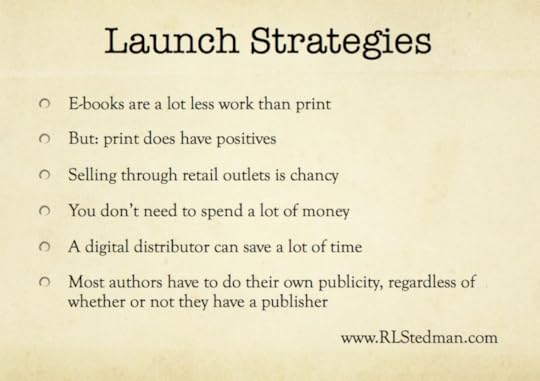
You need to think hard about whether you'll sell print or e-books or both. This will determine your launch strategy and determines your time frame.The approach I used for Necklace was pretty much the same that I used when being traditionally published. People say, oh but self-publishing is a lot of work, and it is, but it's not a lot more than trad publishing if you don't do a print version. There are benefits to print - people like it for giveaways, it's really really nice to touch a print book and you can sell signed copies. Print also offers you different price points on Amazon and a wider distribution. However, doing the layout and the proofing was a lot more work. Using a distributor like Draft 2 Digital was significantly easier than directly loading onto each platform. iTunes has a different platform to Nook, to Kindle, and they are none of them simple to understand. I am still trying to work my way through the Google Play platform! Next time I will just use D2D for every outlet. They are incredibly helpful, they pay monthly and there's no charge if you don't make a sale. Just remember, though, if you do decide to directly load to iTunes, Nook or Kindle later on, you may lose all the reviews that have accrued through your distributor sales.There is a real lack of transparency in print sales through retail outlets. I found this with traditional publishing, too; it's not my distributor's fault at all. This is partly because of the sales and return process which operates with retail. If a book doesn't sell, the retailer can return it to the distributor free of charge. This seems to operate in a 3 month timeframe, so sales volumes won't be evident for a few months. This means that if you do wish to sell through a print outlet, do NOT over-print, unless you are confident of your volumes. The quality of print from CreateSpace and from Ligare Print were both excellent. Better, I thought, than the printers used by HarperCollins.In the next post I'll talk a bit more about the outcome of these two strategies, so you can see which approach offered more return on my advertising investment.
Also...If you're wanting more information, also check out David Gaughran's Let's Get Visible ; it was very helpful when it came to setting pricing and deciding on which channels to use. I've also set out some links on my pinterest board.
If you have any questions on the information set out here, please do feel free to post a comment or to message me through Goodreads or Facebook.
And Happy New Year. Good luck with your New Years Resolutions, whatever they may be!
The same is true for publishing. Getting a book onto virtual or physical bookshelves is best approached as a project. Tasks accomplished sequentially, in their required order. Rather like moving house, it's a good idea to sit down and plan the steps. I had a list of jobs that need to be done before the book is released. Some things needed to be done early, others waited until the last minute. One of the things which needed to be done early was launch preparation.
New Year, New BookMy New Year's resolution for 2015 is to get my a new book, A Skilful Warrior, out onto virtual bookshelves by April 2015. It's the sequel to A Necklace of Souls, and was written two years ago. Warrior was sitting on my publisher's in-tray for a year. Then along came a restructure, a down-sizing and two book awards later the manuscript was surplus to requirements. HarperCollins were fantastic, though; they gave my my rights back. Which has meant I have been able to re-publish A Necklace of Souls myself, with very little work, and with a brand-new cover.
Big Bang or Slow Release?In the meantime, however, I had written Inner Fire. Partly because I wanted to learn the craft of publishing on a stand-alone novel, and partly because the story had gripped me and I wanted to just get it out. So, rather amazingly I had two novels coming out over just a few months: Inner Fire was published in October 2014; A Necklace of Souls in December 2014. I have used two very different launch strategies for this publishing approach, as I wanted to see which offered the best value.
I've summarised these approaches below, and in my next post I'll discuss the outcome. Click on the links in the text if you want more information.
From DilbertInner Fire

Novel: YA, standalone, suitable for 15 years +. Planned Release: November 2014
June 2014- Decided to do print as well as e-copies
August 2014- Booked a book blog tour with YA Bound for December 2014- Engaged Lighthouse PR to do publicity- Final proofing of print copies template for CreateSpace- Prepared cover blurb
September 2014- Advertising strategy planned- Goodreads Giveaway- Engaged a print distributor- Engaged a local printer- Print proof prepared for local printer- Prepared Advance Information Sheet
October 2014- Formatting for kindle completed by Ebook Launch- Loaded onto kindle (but not published), decided on price and distribution channels- Increased social media presence - Books arrived- Press release prepared- Press release sent to interested parties by publicist- ebook released onto KDP Select and Kindle Unlimited- Advertisement placed on Publishers Weekly
November 2014- Advance release copies to media reviewers (I engaged my publicist to manage this)- Talk to local bookstores about upcoming release- Giveaway copies to friends, unofficial reviewers, bloggers- Increased social media presence- set up paypal on my website- joined Amazon Affiliates programme- sent marketing material (posters) to distributor
December 2014- Goodreads giveaway closed- Blog tour completed- print and e-available for sale- media interviews (newspaper and company magazine)
A Necklace of Souls

Novel: YA and Adult Fantasy, series, book #1, suitable age 13+. Published in 2013 by harperCollins, won a number of awards.
September 2014- Decided to do only e-book release in 2014; print in March 2015
October 2014 - sent pdf of manuscript to E-book Launch for formatting. They were unable to format from a pdf, so I went back to the word version. - Re-edited the manuscript- Engaged a cover artist
November 2014 - Cover design completed- Formatting completed for Kindle and Google play - Blog tour booked for March 2015
mid-December 2014- Mobi file loaded onto Kindle (not Kindle Select)- Word file loaded onto Draft 2 Digital.- Published to iTunes, Barnes and Noble, Nook (Kobo)- electronic advanced reading copies distributed to Goodreads followers- $15.00 advertisement on Facebook
Print vs E-books?
You need to think hard about whether you'll sell print or e-books or both. This will determine your launch strategy and determines your time frame.The approach I used for Necklace was pretty much the same that I used when being traditionally published. People say, oh but self-publishing is a lot of work, and it is, but it's not a lot more than trad publishing if you don't do a print version. There are benefits to print - people like it for giveaways, it's really really nice to touch a print book and you can sell signed copies. Print also offers you different price points on Amazon and a wider distribution. However, doing the layout and the proofing was a lot more work. Using a distributor like Draft 2 Digital was significantly easier than directly loading onto each platform. iTunes has a different platform to Nook, to Kindle, and they are none of them simple to understand. I am still trying to work my way through the Google Play platform! Next time I will just use D2D for every outlet. They are incredibly helpful, they pay monthly and there's no charge if you don't make a sale. Just remember, though, if you do decide to directly load to iTunes, Nook or Kindle later on, you may lose all the reviews that have accrued through your distributor sales.There is a real lack of transparency in print sales through retail outlets. I found this with traditional publishing, too; it's not my distributor's fault at all. This is partly because of the sales and return process which operates with retail. If a book doesn't sell, the retailer can return it to the distributor free of charge. This seems to operate in a 3 month timeframe, so sales volumes won't be evident for a few months. This means that if you do wish to sell through a print outlet, do NOT over-print, unless you are confident of your volumes. The quality of print from CreateSpace and from Ligare Print were both excellent. Better, I thought, than the printers used by HarperCollins.In the next post I'll talk a bit more about the outcome of these two strategies, so you can see which approach offered more return on my advertising investment.

Also...If you're wanting more information, also check out David Gaughran's Let's Get Visible ; it was very helpful when it came to setting pricing and deciding on which channels to use. I've also set out some links on my pinterest board.
If you have any questions on the information set out here, please do feel free to post a comment or to message me through Goodreads or Facebook.
And Happy New Year. Good luck with your New Years Resolutions, whatever they may be!
December 17, 2014
Editorials: Dos and Don'ts and Xmas Deadlines
Why is this time of the year so crazy busy? Each year I promise myself that next year will be better. And it NEVER is. The problem is that here in New Zealand the long school holidays - a whole six weeks - coincide with the Christmas break, so not only is work closed, schools are also shut. This makes this time of the year a time of deadlines.
This post is about editing. I thought, rather than provide a long summary of What to Do, I would instead provide a list of Top Tips, in the hopes that you, dear reader, do not make the same mistakes as I. Because I am in a seasonal mood, you may find this list rather random. For this, I apologise. If you have questions, feel free to post a question on twitter or Facebook. (Or here, if you must).
I've set this out as DIY editing - things to do yourself. Then suggestions on how to engage a professional.
DIY Manuscript Editing
I roughly follow the practise set out in this earlier series of blog posts. I do my first draft, set it aside for about six weeks, take a deep breath and then read it again. I start a new folder called Draft Two_Structure. I move events and characters around to make sure the narrative flows. This is the Structural Edit and is filed in the new folder. I set it aside for a few weeks.Take another look. Check for consistency, continuity. Word repetition, sentence structure, clarity. Changes go in another folder: Draft Three_Copy. Set it aside again. After about two weeks I look at it. Now I consider at the whole thing. Is it any good? Do I like it? Characters make sense? Is it funny? Is the voice engaging? Does it read well? At that point, I find myself a critique partner. I make the changes he/she recommends. Decide on US or UK spelling. Do a spell-check. Set it aside again.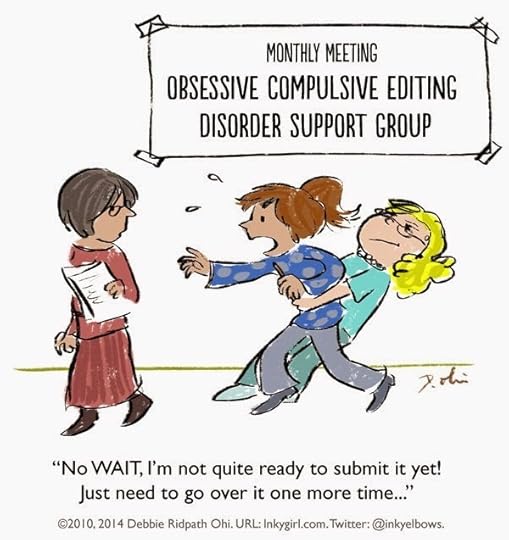 From Inky Girl.com
Professional Editing
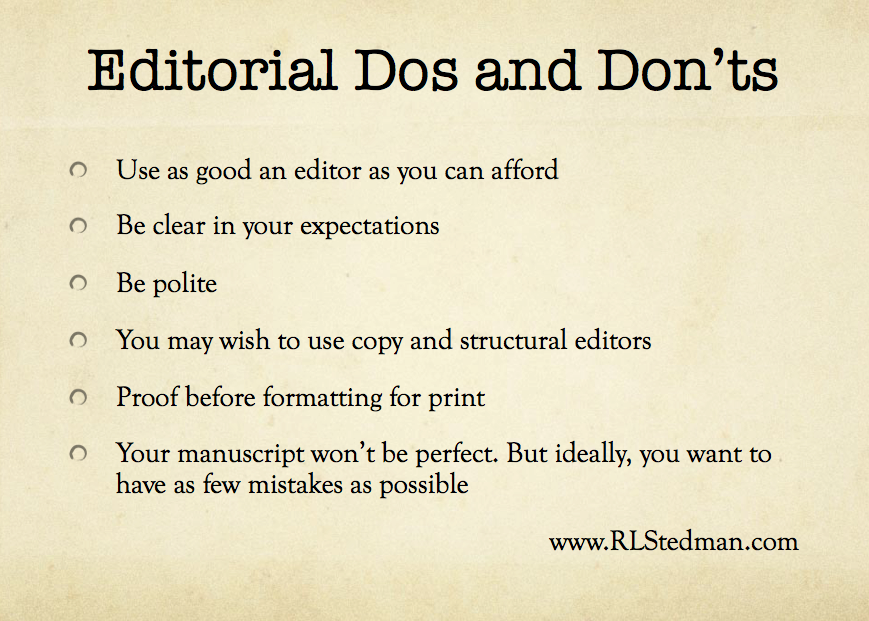
Use as good an editor as you can afford. Do not try and do it yourself; do not try and cut corners. Smashwords says 'spend money on your editor before your cover'. Basically, if you're self publishing, you'll need an even better editor than a trad publishing house. That's partly because traditional publishers do a lot of vetting at the acquisitions stage, so there's less editorial requirements. It's also because reviewers do look very critically at indie books. You want as good a review as possible.With traditional publishing, you don't have to pay an editor - the publishing house does. But if you're self publishing you're now a quasi-employer. This comes with complications. Especially money ones. My editor lives in Australia; I do not. A small business-person who likes books, she doesn't have a paypal account. I can't pay her by credit card. This meant I had to figure out how to do an international transaction. Allow for foreign exchange and transaction fees in your budgeting.Stipulate your deadline to your editor. They need to know your urgency factor so they can juggle other jobs. If it is actually urgent, tell them. Publishing houses often have contracts and so on that enforce compliance. Usually, you won't, so you need to be very clear on your requirements. Speaking of contracts: You can ask a lawyer to draw up an agreement, heck, you can draw one up yourself using an on line template. But even when I worked for a large government agency our editorial contracting was fairly adhoc. Common practise seems to be basically an email saying 'Can you do job X by time Y and I will pay you this much'. Technically, this is probably okay, although personally I think it's risky. But you don't want to alienate your amazing editor by insisting he/she signs an ten page agreement for a three hundred dollar job. Plus, it will cost you more than that in legal fees for the drafting. So just be aware that with editorial services it's probably wise to spell out your expectations, your time frame, your payment rates in advance and make sure your editor agrees to this in a return email. Editors usually appreciate this, too, as it offers them just as much protection as you.Most editors seem to charge per hour, although some charge per word count. If you have an editor on an hourly rate you might want to say 'I'll pay you up to a maximum of say ten hours and then if you need more than that, please let me know first.' That way you'll know in advance how much you'll have to spend.This might be obvious, but be POLITE to your editor. Apart from this being just ordinary human courtesy, remember you may wish to use their services again. In the self-employed sector, reputation is extremely important. If you develop a name for being hard to work with it's very possible you'll find it difficult to source good editors. Good editors get booked up real fast. One way of finding a great editor is to keep an ear to the grapevine: which publishing houses are disestablishing their in-house editors? That way you may be able to grab an amazing editor who's just starting out as freelance, so is looking for clients. Fortunately for us indie authors, there's an awful lot of publishing houses doing just that. Failing that, ask your writing buddies. Usually they'll have a few people that they would recommend. (Sometimes, they won't. Sometimes they want to keep the good editors to themselves :))You might want to consider two editors. With Inner Fire I used a structural editor first, then used a copy editor to check for spelling errors/typos. I found this helpful, as after I'd looked at the manuscript so many times I couldn't spot the mistakes, but a fresh pair of eyes did. Alternatively, you can give the final(ish) manuscript to someone who's a really, really slow, critical, reader. Although this can be problematic, especially if you don't appreciate their feedback, because at this stage in the game it is a little late to be making major changes.Then, BEFORE THE MANUSCRIPT IS FORMATTED FOR PRINT, do a final proofing. (I say this in capitals is because I never listen to myself.) The reason I emphasise this is because editing after the manuscript is formatted into a print-ready proof is expensive. I ended up paying an extra $200.00 for CreateSpace to do exactly that. Check chapter headings are formatted consistently, that they are spelt correctly. Write your back matter (the bits after the book is finished, like 'About the Author') and your back cover description.You'll find things that need to be changed at each step in the process. There are always typos, always sentences that aren't right, often spelling mistakes. My editor at harperCollins told me once that it's impossible to be a hundred-percent error free. But ideally, you want to have as few mistakes as you can.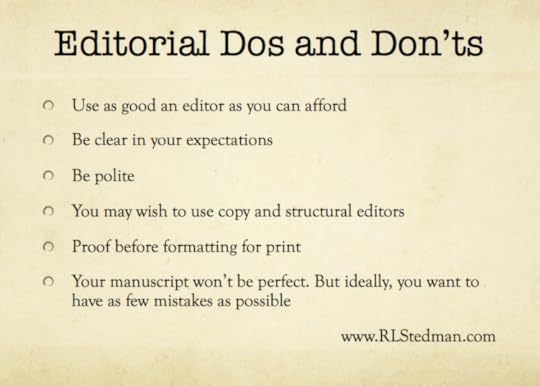
This post is about editing. I thought, rather than provide a long summary of What to Do, I would instead provide a list of Top Tips, in the hopes that you, dear reader, do not make the same mistakes as I. Because I am in a seasonal mood, you may find this list rather random. For this, I apologise. If you have questions, feel free to post a question on twitter or Facebook. (Or here, if you must).
I've set this out as DIY editing - things to do yourself. Then suggestions on how to engage a professional.
DIY Manuscript Editing
I roughly follow the practise set out in this earlier series of blog posts. I do my first draft, set it aside for about six weeks, take a deep breath and then read it again. I start a new folder called Draft Two_Structure. I move events and characters around to make sure the narrative flows. This is the Structural Edit and is filed in the new folder. I set it aside for a few weeks.Take another look. Check for consistency, continuity. Word repetition, sentence structure, clarity. Changes go in another folder: Draft Three_Copy. Set it aside again. After about two weeks I look at it. Now I consider at the whole thing. Is it any good? Do I like it? Characters make sense? Is it funny? Is the voice engaging? Does it read well? At that point, I find myself a critique partner. I make the changes he/she recommends. Decide on US or UK spelling. Do a spell-check. Set it aside again.
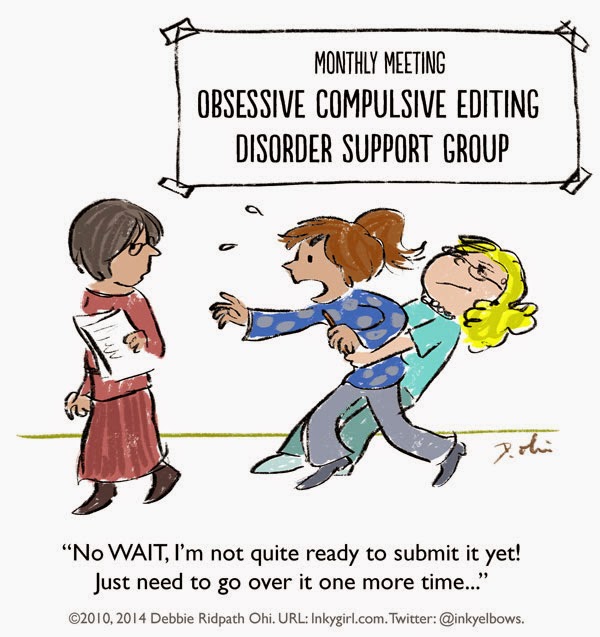 From Inky Girl.com
Professional Editing
Use as good an editor as you can afford. Do not try and do it yourself; do not try and cut corners. Smashwords says 'spend money on your editor before your cover'. Basically, if you're self publishing, you'll need an even better editor than a trad publishing house. That's partly because traditional publishers do a lot of vetting at the acquisitions stage, so there's less editorial requirements. It's also because reviewers do look very critically at indie books. You want as good a review as possible.With traditional publishing, you don't have to pay an editor - the publishing house does. But if you're self publishing you're now a quasi-employer. This comes with complications. Especially money ones. My editor lives in Australia; I do not. A small business-person who likes books, she doesn't have a paypal account. I can't pay her by credit card. This meant I had to figure out how to do an international transaction. Allow for foreign exchange and transaction fees in your budgeting.Stipulate your deadline to your editor. They need to know your urgency factor so they can juggle other jobs. If it is actually urgent, tell them. Publishing houses often have contracts and so on that enforce compliance. Usually, you won't, so you need to be very clear on your requirements. Speaking of contracts: You can ask a lawyer to draw up an agreement, heck, you can draw one up yourself using an on line template. But even when I worked for a large government agency our editorial contracting was fairly adhoc. Common practise seems to be basically an email saying 'Can you do job X by time Y and I will pay you this much'. Technically, this is probably okay, although personally I think it's risky. But you don't want to alienate your amazing editor by insisting he/she signs an ten page agreement for a three hundred dollar job. Plus, it will cost you more than that in legal fees for the drafting. So just be aware that with editorial services it's probably wise to spell out your expectations, your time frame, your payment rates in advance and make sure your editor agrees to this in a return email. Editors usually appreciate this, too, as it offers them just as much protection as you.Most editors seem to charge per hour, although some charge per word count. If you have an editor on an hourly rate you might want to say 'I'll pay you up to a maximum of say ten hours and then if you need more than that, please let me know first.' That way you'll know in advance how much you'll have to spend.This might be obvious, but be POLITE to your editor. Apart from this being just ordinary human courtesy, remember you may wish to use their services again. In the self-employed sector, reputation is extremely important. If you develop a name for being hard to work with it's very possible you'll find it difficult to source good editors. Good editors get booked up real fast. One way of finding a great editor is to keep an ear to the grapevine: which publishing houses are disestablishing their in-house editors? That way you may be able to grab an amazing editor who's just starting out as freelance, so is looking for clients. Fortunately for us indie authors, there's an awful lot of publishing houses doing just that. Failing that, ask your writing buddies. Usually they'll have a few people that they would recommend. (Sometimes, they won't. Sometimes they want to keep the good editors to themselves :))You might want to consider two editors. With Inner Fire I used a structural editor first, then used a copy editor to check for spelling errors/typos. I found this helpful, as after I'd looked at the manuscript so many times I couldn't spot the mistakes, but a fresh pair of eyes did. Alternatively, you can give the final(ish) manuscript to someone who's a really, really slow, critical, reader. Although this can be problematic, especially if you don't appreciate their feedback, because at this stage in the game it is a little late to be making major changes.Then, BEFORE THE MANUSCRIPT IS FORMATTED FOR PRINT, do a final proofing. (I say this in capitals is because I never listen to myself.) The reason I emphasise this is because editing after the manuscript is formatted into a print-ready proof is expensive. I ended up paying an extra $200.00 for CreateSpace to do exactly that. Check chapter headings are formatted consistently, that they are spelt correctly. Write your back matter (the bits after the book is finished, like 'About the Author') and your back cover description.You'll find things that need to be changed at each step in the process. There are always typos, always sentences that aren't right, often spelling mistakes. My editor at harperCollins told me once that it's impossible to be a hundred-percent error free. But ideally, you want to have as few mistakes as you can.
November 30, 2014
Getting Social
In my post, Steps to Self-Publishing, I set out a list of the key things I'd done prior to putting Inner Fire on the virtual book shelves.
This post covers the second item on that list: Social Media.
Writers seem to either love social media and embrace it wildly, or they run from it, only interacting when they have to.
Do you need to have a social media presence as a writer? No. Of course not. Does it help you be a better writer? Probably not. Does it help you sell more books. Ah, well. Yes. Probably, it does. Note the probably. This is because measuring Return on Investment (ROI) in social media is always an approximation. Even large companies struggle with calculation of investment return. That's why it's really helpful to have a website with google analytics; you have a tool that allows you to see the outcome of any social media presence. (Funnily enough just as I type this I'm also listening to a pod-cast by Joanna Penn exactly on this point).
Most people know how to use twitter, Facebook and so on so I won't do a huge post on how to do posts, because I am so definitely not an expert on this. However, I thought I'd note a few things I've found that have worked well - unlike my kids I'm not in a native child of the internet, so social media is not a space I play in naturally.
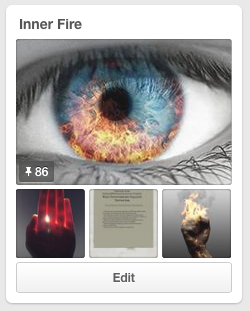
Tips for Using (and Enjoying) Social MediaStop focusing on the 'likes'. I don't know why people get so obsessed by how many followers they have. I hate to say it, but most of your followers are probably not going to buy your books. Actually, probably a lot of your followers are not even real. You can usually tell the non-real ones; they offer you a 'good time', food that contains strawberries (for some reason instagram bots seem to have a thing for strawberries. Maybe the red shows up well or something), and generally, they are young women wearing bikinis. Focus on engagement. I like social media because it allows me to talk to people. I like it because it helps other people to find out about me; it allows me to find out about other lives. I'm way more interested in how many people comment on a post (except my blog. I don't ask people to comment here, because I'm too lazy to reply).Cross-post and save time. If I post on instagram I can put the same image on twitter, tumblr and Facebook. I pin images from this blog onto pinterest; this allows other people to find this content. I tweet about my new blog post; I tweet about my old blog posts. One day I might turn this blog into a book. Who knows? Content is king. Maybe I'm old, but I kind of hope that real content is way more useful and interesting to readers than cat memes. And personally, I feel more comfortable sharing things that are actually useful. So hence this series of blog posts on Things that I Have Learnt. Besides, if you provide good content it can re-purposed (thanks, Joanna Penn, for your podcast!).Social Media is not about advertising - it's about sharing. Social media is a very valuable tool. For example, I use pinterest a lot because it's a very easy way to provide content that readers, librarians and teachers love. I have boards that I've pinned background research to. This includes videos or books, and readers seem to enjoy being able to watch sword fighting and stuff. I can add this link to my website, so students reading my book can easily access the research that sits behind it. As an example, here's the link to the pinterest board for Inner FireSocial media is exciting. The use of hashtags and the ability to comment allows really creative play on words, which as a writer I find fascinating. Social media is really innovative. At the moment, I'm very interested in instagram and how instagrammers see the world. The novel I'm currently planning has an instagram hashtag as a title.
The trick with social media is not to let it overwhelm your life, to spend a little bit of time on-line regularly and to content check with your (real-life) friends and relatives. It's always alarming when people I actually know comment on my blog or my Facebook page, but it's also a relief, because then I have confidence that what I'm saying is interesting! And quite often, people I've met through social media have become real-life friends. (Much to my teenagers' amusement - 'you are meeting someone you met online'?)
Through social media, the separation between virtual and physical is becoming increasingly blurred.
This post covers the second item on that list: Social Media.
Writers seem to either love social media and embrace it wildly, or they run from it, only interacting when they have to.
Do you need to have a social media presence as a writer? No. Of course not. Does it help you be a better writer? Probably not. Does it help you sell more books. Ah, well. Yes. Probably, it does. Note the probably. This is because measuring Return on Investment (ROI) in social media is always an approximation. Even large companies struggle with calculation of investment return. That's why it's really helpful to have a website with google analytics; you have a tool that allows you to see the outcome of any social media presence. (Funnily enough just as I type this I'm also listening to a pod-cast by Joanna Penn exactly on this point).
Most people know how to use twitter, Facebook and so on so I won't do a huge post on how to do posts, because I am so definitely not an expert on this. However, I thought I'd note a few things I've found that have worked well - unlike my kids I'm not in a native child of the internet, so social media is not a space I play in naturally.
Tips for Using (and Enjoying) Social MediaStop focusing on the 'likes'. I don't know why people get so obsessed by how many followers they have. I hate to say it, but most of your followers are probably not going to buy your books. Actually, probably a lot of your followers are not even real. You can usually tell the non-real ones; they offer you a 'good time', food that contains strawberries (for some reason instagram bots seem to have a thing for strawberries. Maybe the red shows up well or something), and generally, they are young women wearing bikinis. Focus on engagement. I like social media because it allows me to talk to people. I like it because it helps other people to find out about me; it allows me to find out about other lives. I'm way more interested in how many people comment on a post (except my blog. I don't ask people to comment here, because I'm too lazy to reply).Cross-post and save time. If I post on instagram I can put the same image on twitter, tumblr and Facebook. I pin images from this blog onto pinterest; this allows other people to find this content. I tweet about my new blog post; I tweet about my old blog posts. One day I might turn this blog into a book. Who knows? Content is king. Maybe I'm old, but I kind of hope that real content is way more useful and interesting to readers than cat memes. And personally, I feel more comfortable sharing things that are actually useful. So hence this series of blog posts on Things that I Have Learnt. Besides, if you provide good content it can re-purposed (thanks, Joanna Penn, for your podcast!).Social Media is not about advertising - it's about sharing. Social media is a very valuable tool. For example, I use pinterest a lot because it's a very easy way to provide content that readers, librarians and teachers love. I have boards that I've pinned background research to. This includes videos or books, and readers seem to enjoy being able to watch sword fighting and stuff. I can add this link to my website, so students reading my book can easily access the research that sits behind it. As an example, here's the link to the pinterest board for Inner FireSocial media is exciting. The use of hashtags and the ability to comment allows really creative play on words, which as a writer I find fascinating. Social media is really innovative. At the moment, I'm very interested in instagram and how instagrammers see the world. The novel I'm currently planning has an instagram hashtag as a title.
The trick with social media is not to let it overwhelm your life, to spend a little bit of time on-line regularly and to content check with your (real-life) friends and relatives. It's always alarming when people I actually know comment on my blog or my Facebook page, but it's also a relief, because then I have confidence that what I'm saying is interesting! And quite often, people I've met through social media have become real-life friends. (Much to my teenagers' amusement - 'you are meeting someone you met online'?)
Through social media, the separation between virtual and physical is becoming increasingly blurred.
November 21, 2014
Writing: Creation of an Art
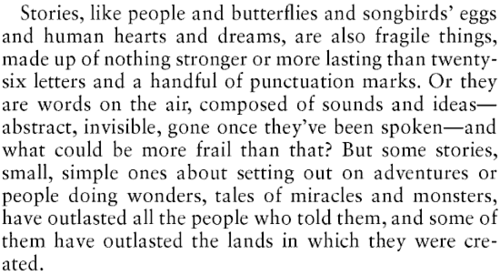
I just watched an amazing video: Ursula Le Guin's acceptance speech at the National Book Foundation. "We need writers who know the difference between the production of a commodity and the creation of an art."
So, as I embark on this next series of posts - the steps to bringing your book into the world, it seemed apposite to remember - writing is, first and foremost, an art. Words have power; words can change a world.
 Neil Gaiman - Fragile Things
In an earlier post 'Steps to Self Publishing' I listed the things I did before Inner Fire hit the Amazon shelves. I'm going to cover them sequentially, in detail. The purpose of these posts, dear reader, is help you in the creation of your art.
Step One: Tax Number
Witholding tax is tax that is deducted from your earnings ('withheld') by the vendor you have listed your book with. If your book is on Smashwords, Smashwords have to deduct tax on behalf of the US government. Amazon does the same, as does Draft to Digital. These witholding tax rates vary depending on your country of origin and the country of earnings, however it can be quite significant. (You can find a lot of information here.)
However, if your country has a tax treaty with the US you can be eligible for the standard US withholding tax rate, which is currently only about 5 percent. New Zealand has a tax treaty, and it's definitely worth the tax deduction it allows. To access these lower tax rates you need to have a number. Amazon will now accept your domestic tax number - for New Zealanders this would be the IRD number - but other vendors are a little less flexible, and seem to still require a US tax number.
Therefore, if you want to sell on a number of platforms currently it's way simpler if you have a US tax number. Basically, there's two types of numbers - a number for an individual (ITIN) or a number for an entity (EIN). Writers are both: an entity (i.e. we write for generating profit so therefore we are a business) and an individual. Therefore, we have a choice of number types.
Well, dear reader, following my own long and bitter experience over the ITIN, I can tell you now - it's a lot lot easier to get the EIN. Here's a brilliant blog post which explains it much better than I can. Amazon also has useful information.
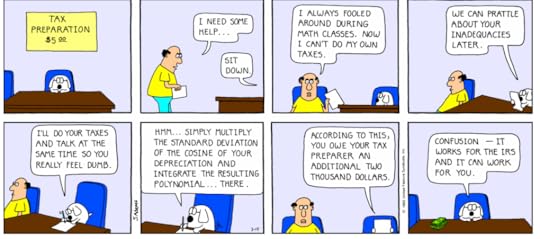 From DilbertI do recommend getting your tax number early in the process. As any interaction with the IRS is fraught with complexity, its a wise idea to get it out of the way soon as possible. Besides, the rest of the steps of getting your book to market are pretty much under your control. So, once you've got your tax number you can proceed with a fairly good idea of when your book will hit the virtual shelves.
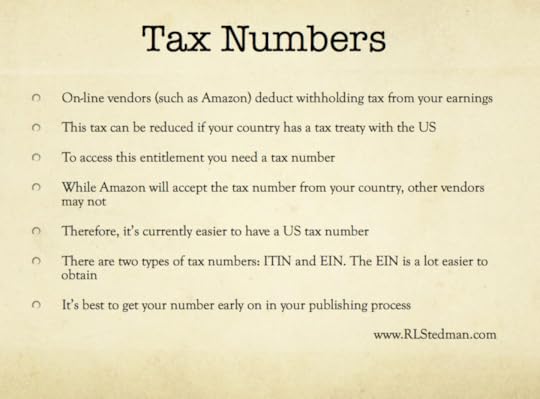
So, as I embark on this next series of posts - the steps to bringing your book into the world, it seemed apposite to remember - writing is, first and foremost, an art. Words have power; words can change a world.
 Neil Gaiman - Fragile Things
In an earlier post 'Steps to Self Publishing' I listed the things I did before Inner Fire hit the Amazon shelves. I'm going to cover them sequentially, in detail. The purpose of these posts, dear reader, is help you in the creation of your art.
Step One: Tax Number
Witholding tax is tax that is deducted from your earnings ('withheld') by the vendor you have listed your book with. If your book is on Smashwords, Smashwords have to deduct tax on behalf of the US government. Amazon does the same, as does Draft to Digital. These witholding tax rates vary depending on your country of origin and the country of earnings, however it can be quite significant. (You can find a lot of information here.)
However, if your country has a tax treaty with the US you can be eligible for the standard US withholding tax rate, which is currently only about 5 percent. New Zealand has a tax treaty, and it's definitely worth the tax deduction it allows. To access these lower tax rates you need to have a number. Amazon will now accept your domestic tax number - for New Zealanders this would be the IRD number - but other vendors are a little less flexible, and seem to still require a US tax number.
Therefore, if you want to sell on a number of platforms currently it's way simpler if you have a US tax number. Basically, there's two types of numbers - a number for an individual (ITIN) or a number for an entity (EIN). Writers are both: an entity (i.e. we write for generating profit so therefore we are a business) and an individual. Therefore, we have a choice of number types.
Well, dear reader, following my own long and bitter experience over the ITIN, I can tell you now - it's a lot lot easier to get the EIN. Here's a brilliant blog post which explains it much better than I can. Amazon also has useful information.
 From DilbertI do recommend getting your tax number early in the process. As any interaction with the IRS is fraught with complexity, its a wise idea to get it out of the way soon as possible. Besides, the rest of the steps of getting your book to market are pretty much under your control. So, once you've got your tax number you can proceed with a fairly good idea of when your book will hit the virtual shelves.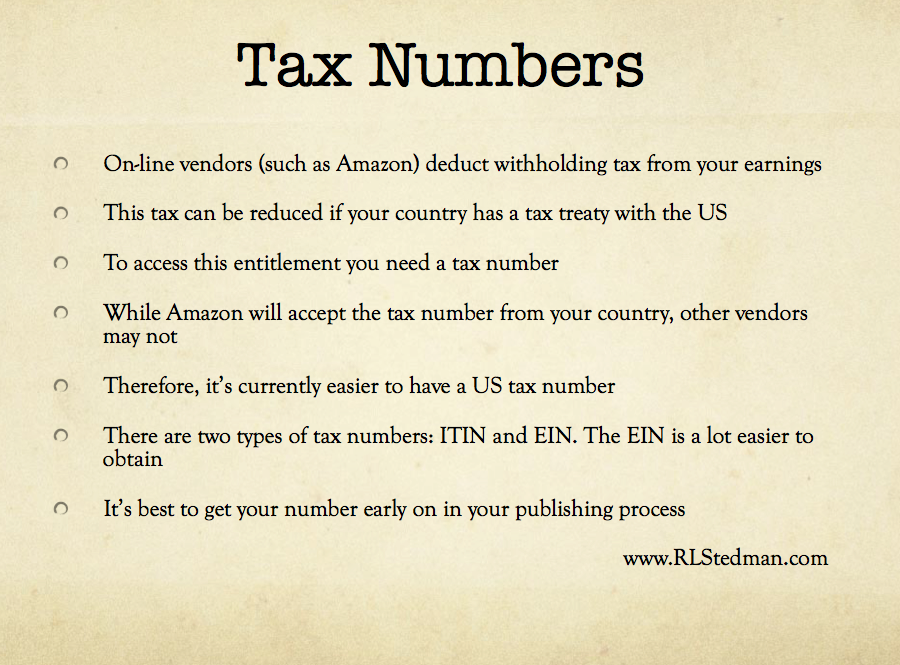
November 15, 2014
Tangled in the World Wide Web
In the last post I set out a list of things I found I needed to do in the process of getting Inner Fire out to market. However, there's one thing I left out.
The major thing I'd left off my Get-your-book-to-market list is your website.
The reason for this brain fade is that Inner Fire is actually my second novel - my first to be self-published, though - so I had already organised a site at the time my first novel, A Necklace of Souls, was published. This post contains some of the many Things I Wish I'd Known about websites. This is pretty basic information and you can find out a lot more technical material on the web. If you're a designer or someone who works in IT you won't need all the information below. But since I'm neither of these things, I thought other folk as ignorant as I may find all this interesting.
Do I Need a Website?
Of course you don't. You're writing books, not selling furniture. Stories are art, not commodities, and a website is not required to write a book. Time, persistence and talent maybe, but not a website.
But. Here's the thing. If you want to sell your books, well then, a website is a wise idea. Again, it's not mandatory; some writers I love do not have a web presence. Which is immensely frustrating, because I would really like to know what else they've written and what they're working on now. The hallmark of these writers is that they're pre-world wide web and/or they're all immensely famous so they don't really need the presence. Fair play to them.
But for me, a website has been a great investment. Why? Because a website isn't only about having your photo on the internet. A website offers you:
DiscoverabilityAnalyticsCommunicationIncomeSet out below are my main learnings from my web building experience.
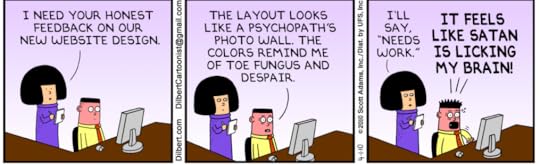 from Dilbert
What do I Need?You need to have a thought about what you want in a site. Do you want one page or multiple page? Do you want a 'contact me' form? An FAQ section? Here's a link to a couple of sites with quite diverse looks and feels to give you ideas:
Mary Winston PhotographyRachael Craw T K Roxburgh
Websites are not cheap. You can build one yourself, but if you're not a website person (and lots of writers aren't) chances are it will look and feel horrible. So personally, I suggest get a web designer to do it for you. Who? Look at websites of other creatives you like and see who their designer is. There will be a link somewhere in the footer of the page. Make contact with the designer and ask for a quote. You'll find they'll vary a lot and it will be dependant on what your requirements are. Here's the link to my web designer.
Don't forget that the website needs a domain name. www.RLStedman.com is my domain name. Your domain name could be the title of your book, or your name or something totally random. Popular domain names trade hands for thousands; a domain name has a value. If you think you've got a best seller on your hands, register its title as a domain name before anyone else does!
Your website will need to be hosted. Hosting is where the software for your site sits. Your designer can help you find hosting, or you can sort it yourself. Hosting isn't something we need to get too worried about as authors, but large companies do need to consider these hosting arrangements carefully, as they cannot afford for their hosting company to go out of business, or to be damaged in a fire or earthquake and take their data with them.
So the cost of your site will probably be development + hosting + domain name. I say 'probably' as the web world is always changing, so who knows what technology will bring. Currently, the usual process seems to be domain name and hosting is an annual fee; development is usually a one off cost, often a per hour charge. You may need additional development services if you want to modify your site.
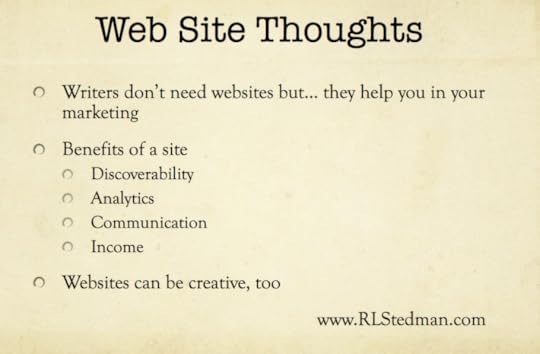 Benefits of a WebsiteDiscoverability
Search engine optimization (SEO) means how easily a site is found by search engines. Most people, if they're looking for me, will type 'Rachel Stedman' or 'A Necklace of Souls' or 'RLStedman' into their Google browser. Usually, my website is the first option on the list presented by Google. The idea of SEO means that people can find me easily. When you get your site, search yourself on Google, and check your site comes up. If it doesn't, the keywords may need to be changed.
Apart from SEO, your website needs to be kept current. Google can tell if the website's old, and if it's old it's not presented as a first choice to the searcher. Therefore, to keep your website fresh, it's wise to tweak your content probably every 3 months. Some people have a blog attached to their site (I don't), which acts the same way.
If you're not particularly technical you can get your web designer to make regular tweaks to your site, but then you'll probably have to pay them, so for me, I've learnt to do it myself. On a wordpress platform it's no harder than writing this blog. (Actually, it's easier, the blogspot software is very clunky).
AnalyticsAsk your designer to set you up with analytics to your site. Analytics measure who is clicking on your site, where they're based and even, if they're linked up to google +, their demographics - age, sex and so on. I can drill down into time periods, or country or referral patterns. This is useful because it helps me tell if say a campaign of Facebook ad has lead to any extra activity.
Analytics are the most valuable part of a website. They're the reason I wouldn't use a low cost alternative, like a tumblr page. I love knowing that readers in China and Russia and Brazil are interested in me. It's also encouraging; writing is a long term plan and I can tell, just from my analytics, that my presence and interest in my writing is slowly, slowly increasing.
I find the analytics more useful than sales figures. Why? Because most people discover a book by reading it for free. Someone lends it to them, or they get it from the library, or they get a free download. (Probably, this is why Scott Adams allows his awesome Dilbert cartoons to be used on blogs like mine).
Therefore, it's highly reasonable to assume that sales will lag significantly behind website analytics. It's the trend, though that interests me, and for me the trend is looking good. Not great, not amazing, but in the right direction.
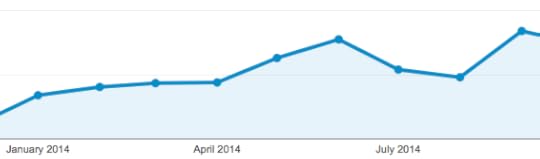 Website Analytics: Number of hits per month
CommunicationIf I'm giving a talk about my book, often the convener will introduce me with the blurb from my website. 'Hello,' I think, 'I've heard that before.' Last year, when A Necklace of Souls was shortlisted in the New Zealand Post Book Awards, school children were looking at my site. Teachers also are interested. As are media outlets - if someone's doing an interview with you they'll definitely check out your site first. I have a page that's just for readers/media/teachers, and people can contact me through my site. You can add newsletter sign-ups to your site.
IncomeThis is something I've only just realised - your blog or website can generate income for you. Not a lot, but still. You can put google adsense on your site (personally, i haven't because I think it looks tacky), but I have here on my blog. Look to the right, under the 'about me' section. You'll see an advert for something, probably self-publishing. Dear reader, if you click on that advertisement, I receive a small payment. Something like a dollar. Thus far, I have made TWO DOLLARS. So not retirement material.
Also on my website is a link to a 'buy now' for Inner Fire. This will take you to the amazon entry for the book. This is an affiliate link - if someone clicks on this link and purchases something from amazon over the next several hours (I forget the timeframe), a receive a small renumeration. Thus far, I have made ZERO DOLLARS. However, large book buying sites such as BookBub, can receive serious money from their affiliate links.
And of course, you can attach a paypal to your site, and people can purchase your work online. Do put this in. True story: I heard a wonderful singer/songwriter on the radio, an audience of probably 50,000. When asked 'Where can people buy your music?' she said, 'Oh they can send me a letter.' A letter! Don't make it hard for people to find your work. I've only just added the paypal function and I haven't used it yet, but it seems crazy that I didn't have it up earlier. It isn't hard and doesn't cost you anything unless you make a sale.
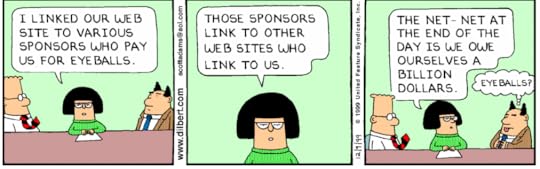 From Dilbert
CreativeWhen A Necklace of Souls was published in 2013 I was nervous about having an online presence. I thought people would stalk me or something. I was so wrong. A website allows people who are interested in you to contact you (I love getting emails through my site) but also, and I really had not anticipated this, a website allows you to be creative.
You can have a website page for a character, or a page for a story, or a page for the pictures you've drawn for your story. Some writers have whole websites devoted to their worlds (check out Ben Aaronvitch's site). In a very strange way your site reflects your personality; the colours, the layout, the images. A well designed website feels, rather weirdly, like an extension of yourself.
 My Site
The major thing I'd left off my Get-your-book-to-market list is your website.
The reason for this brain fade is that Inner Fire is actually my second novel - my first to be self-published, though - so I had already organised a site at the time my first novel, A Necklace of Souls, was published. This post contains some of the many Things I Wish I'd Known about websites. This is pretty basic information and you can find out a lot more technical material on the web. If you're a designer or someone who works in IT you won't need all the information below. But since I'm neither of these things, I thought other folk as ignorant as I may find all this interesting.
Do I Need a Website?
Of course you don't. You're writing books, not selling furniture. Stories are art, not commodities, and a website is not required to write a book. Time, persistence and talent maybe, but not a website.
But. Here's the thing. If you want to sell your books, well then, a website is a wise idea. Again, it's not mandatory; some writers I love do not have a web presence. Which is immensely frustrating, because I would really like to know what else they've written and what they're working on now. The hallmark of these writers is that they're pre-world wide web and/or they're all immensely famous so they don't really need the presence. Fair play to them.
But for me, a website has been a great investment. Why? Because a website isn't only about having your photo on the internet. A website offers you:
DiscoverabilityAnalyticsCommunicationIncomeSet out below are my main learnings from my web building experience.
 from Dilbert
What do I Need?You need to have a thought about what you want in a site. Do you want one page or multiple page? Do you want a 'contact me' form? An FAQ section? Here's a link to a couple of sites with quite diverse looks and feels to give you ideas:
Mary Winston PhotographyRachael Craw T K Roxburgh
Websites are not cheap. You can build one yourself, but if you're not a website person (and lots of writers aren't) chances are it will look and feel horrible. So personally, I suggest get a web designer to do it for you. Who? Look at websites of other creatives you like and see who their designer is. There will be a link somewhere in the footer of the page. Make contact with the designer and ask for a quote. You'll find they'll vary a lot and it will be dependant on what your requirements are. Here's the link to my web designer.
Don't forget that the website needs a domain name. www.RLStedman.com is my domain name. Your domain name could be the title of your book, or your name or something totally random. Popular domain names trade hands for thousands; a domain name has a value. If you think you've got a best seller on your hands, register its title as a domain name before anyone else does!
Your website will need to be hosted. Hosting is where the software for your site sits. Your designer can help you find hosting, or you can sort it yourself. Hosting isn't something we need to get too worried about as authors, but large companies do need to consider these hosting arrangements carefully, as they cannot afford for their hosting company to go out of business, or to be damaged in a fire or earthquake and take their data with them.
So the cost of your site will probably be development + hosting + domain name. I say 'probably' as the web world is always changing, so who knows what technology will bring. Currently, the usual process seems to be domain name and hosting is an annual fee; development is usually a one off cost, often a per hour charge. You may need additional development services if you want to modify your site.
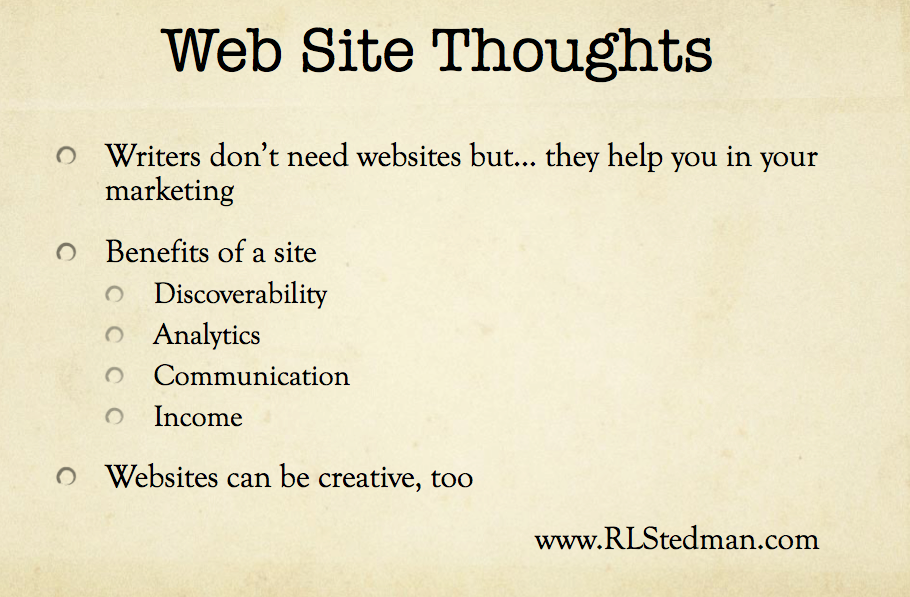 Benefits of a WebsiteDiscoverability
Search engine optimization (SEO) means how easily a site is found by search engines. Most people, if they're looking for me, will type 'Rachel Stedman' or 'A Necklace of Souls' or 'RLStedman' into their Google browser. Usually, my website is the first option on the list presented by Google. The idea of SEO means that people can find me easily. When you get your site, search yourself on Google, and check your site comes up. If it doesn't, the keywords may need to be changed.
Apart from SEO, your website needs to be kept current. Google can tell if the website's old, and if it's old it's not presented as a first choice to the searcher. Therefore, to keep your website fresh, it's wise to tweak your content probably every 3 months. Some people have a blog attached to their site (I don't), which acts the same way.
If you're not particularly technical you can get your web designer to make regular tweaks to your site, but then you'll probably have to pay them, so for me, I've learnt to do it myself. On a wordpress platform it's no harder than writing this blog. (Actually, it's easier, the blogspot software is very clunky).
AnalyticsAsk your designer to set you up with analytics to your site. Analytics measure who is clicking on your site, where they're based and even, if they're linked up to google +, their demographics - age, sex and so on. I can drill down into time periods, or country or referral patterns. This is useful because it helps me tell if say a campaign of Facebook ad has lead to any extra activity.
Analytics are the most valuable part of a website. They're the reason I wouldn't use a low cost alternative, like a tumblr page. I love knowing that readers in China and Russia and Brazil are interested in me. It's also encouraging; writing is a long term plan and I can tell, just from my analytics, that my presence and interest in my writing is slowly, slowly increasing.
I find the analytics more useful than sales figures. Why? Because most people discover a book by reading it for free. Someone lends it to them, or they get it from the library, or they get a free download. (Probably, this is why Scott Adams allows his awesome Dilbert cartoons to be used on blogs like mine).
Therefore, it's highly reasonable to assume that sales will lag significantly behind website analytics. It's the trend, though that interests me, and for me the trend is looking good. Not great, not amazing, but in the right direction.
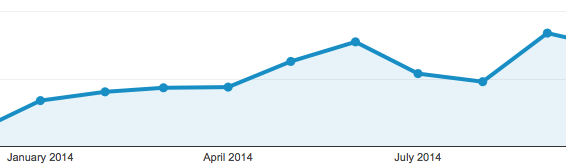 Website Analytics: Number of hits per month
CommunicationIf I'm giving a talk about my book, often the convener will introduce me with the blurb from my website. 'Hello,' I think, 'I've heard that before.' Last year, when A Necklace of Souls was shortlisted in the New Zealand Post Book Awards, school children were looking at my site. Teachers also are interested. As are media outlets - if someone's doing an interview with you they'll definitely check out your site first. I have a page that's just for readers/media/teachers, and people can contact me through my site. You can add newsletter sign-ups to your site.
IncomeThis is something I've only just realised - your blog or website can generate income for you. Not a lot, but still. You can put google adsense on your site (personally, i haven't because I think it looks tacky), but I have here on my blog. Look to the right, under the 'about me' section. You'll see an advert for something, probably self-publishing. Dear reader, if you click on that advertisement, I receive a small payment. Something like a dollar. Thus far, I have made TWO DOLLARS. So not retirement material.
Also on my website is a link to a 'buy now' for Inner Fire. This will take you to the amazon entry for the book. This is an affiliate link - if someone clicks on this link and purchases something from amazon over the next several hours (I forget the timeframe), a receive a small renumeration. Thus far, I have made ZERO DOLLARS. However, large book buying sites such as BookBub, can receive serious money from their affiliate links.
And of course, you can attach a paypal to your site, and people can purchase your work online. Do put this in. True story: I heard a wonderful singer/songwriter on the radio, an audience of probably 50,000. When asked 'Where can people buy your music?' she said, 'Oh they can send me a letter.' A letter! Don't make it hard for people to find your work. I've only just added the paypal function and I haven't used it yet, but it seems crazy that I didn't have it up earlier. It isn't hard and doesn't cost you anything unless you make a sale.
 From Dilbert
CreativeWhen A Necklace of Souls was published in 2013 I was nervous about having an online presence. I thought people would stalk me or something. I was so wrong. A website allows people who are interested in you to contact you (I love getting emails through my site) but also, and I really had not anticipated this, a website allows you to be creative.
You can have a website page for a character, or a page for a story, or a page for the pictures you've drawn for your story. Some writers have whole websites devoted to their worlds (check out Ben Aaronvitch's site). In a very strange way your site reflects your personality; the colours, the layout, the images. A well designed website feels, rather weirdly, like an extension of yourself.
 My Site