R.L. Stedman's Blog, page 20
August 26, 2013
Three Way Borders
A Three Way Border
There's a border in the Ardenne, near Gemmenich, where the borders of Holland, Belgium and Germany meet - a three way border. If you drive five kilometres down the road into Belgium, the road signs are in French. Drive the other way, into Holland, it's Dutch. And into Germany... well, yes, they are in German. I know this shouldn't be remarkable, but to my island-bound mind it is so.
Even more remarkable is how this forested area was fought over so bitterly in the War. Adjacent to the border, near to the cafes and the tourist labryinth and the high tower that you can climb for an exorbitant sum is a memorial to Peirre Roiseaux, a resistance fighter in the war.
More information is here: Places of Memory
You'd never know, walking through this late summer forest, full of blackberries and rowans and great tall beeches, that once men and women had fought and died here. Layers of history lie quiet on the land.
There's a border in the Ardenne, near Gemmenich, where the borders of Holland, Belgium and Germany meet - a three way border. If you drive five kilometres down the road into Belgium, the road signs are in French. Drive the other way, into Holland, it's Dutch. And into Germany... well, yes, they are in German. I know this shouldn't be remarkable, but to my island-bound mind it is so.
Even more remarkable is how this forested area was fought over so bitterly in the War. Adjacent to the border, near to the cafes and the tourist labryinth and the high tower that you can climb for an exorbitant sum is a memorial to Peirre Roiseaux, a resistance fighter in the war.
More information is here: Places of Memory
You'd never know, walking through this late summer forest, full of blackberries and rowans and great tall beeches, that once men and women had fought and died here. Layers of history lie quiet on the land.


August 24, 2013
A Life Medieval
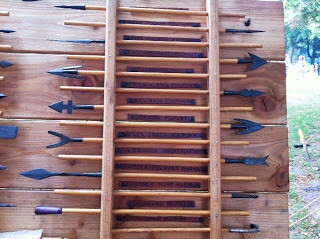
Weaponery
One of the great things about travelling in Europe is that you never know exactly what you'll encounter.
Today we went to a park in Nijmegen and found a community all set up within it, complete with horses, weaponry, jugglers and beggars.
For a fantasy writer, this was a gold mine!
I was able to see the different types of arrow heads and to hold a sword and medieval armour - and they were a lot heavier than I had expected. A full suit of armour, said the blacksmith, weighs approximately 40 Kilos. We spoke about swords and smiths, and I thought of a phrase from Mary Stewart's The Hollow Hills - the jewels set into the hilt of Arthur's sword are 'topaz and emeralds and sapphires, which in the language of swords means joy and honour and a clean death.' (I hope I have that quote right).
Which lead me to think: if you read, you learn all swords of stuff, and you never know when you might find it useful. Even if it's to encourage a discussion on weaponry swords with a medieval blacksmith by the side of a park in Nijmegen.
One of the great things about travelling in Europe is that you never know exactly what you'll encounter.
Today we went to a park in Nijmegen and found a community all set up within it, complete with horses, weaponry, jugglers and beggars.
For a fantasy writer, this was a gold mine!
I was able to see the different types of arrow heads and to hold a sword and medieval armour - and they were a lot heavier than I had expected. A full suit of armour, said the blacksmith, weighs approximately 40 Kilos. We spoke about swords and smiths, and I thought of a phrase from Mary Stewart's The Hollow Hills - the jewels set into the hilt of Arthur's sword are 'topaz and emeralds and sapphires, which in the language of swords means joy and honour and a clean death.' (I hope I have that quote right).
Which lead me to think: if you read, you learn all swords of stuff, and you never know when you might find it useful. Even if it's to encourage a discussion on weaponry swords with a medieval blacksmith by the side of a park in Nijmegen.
August 22, 2013
Overkill
More Travel TipsSo here we are! Made it to Europe!
Please bear with this jet-lagged post. In order to make it easier I thought I'd just recount the learnings thus far:
Tip One: Day Rooms:If in transit in Hong Kong for 17 hours or so, its worth investing in a day room; a room you can use for the day - check in in the morning, check out in the afternoon. We went to the Novotel; it was FANTASTIC. Pool, gym and wonderfully comfortable beds. 30 minutes into Hong Kong via the MTR and adjacent to a shopping mall (with food court) if you don't feel like going into the city.
Tip Two: Long Haul is awful.10+ hours in an airplane (with teenagers) is way too long. William Gibson describes 'soul lag' - the time delay for you soul to return to your body. Ways to improve the experience: earplugs. That's it. I can't think of anything else, bar automated unconsciousness. Next best thing is sleeping tablets, but I know some doctors disagree so I can't recommend pharmaceuticals - although they worked for me.
Tip Three: Air BnB have been great.Our hosts have been so welcoming it's unbelievable. So kind and comforting even though we are half asleep it makes us feel that instead of going to the other side of the world - we're coming home. So please ignore my earlier post...
Tip Four: Forget about the time.Whatever the time is outside, it is different to the time of your body clock. Again, I follow William Gibson and have my Personal Standard Time (PST). So the time of the day is whatever I feel like. Of course, you need to pay attention to watches and so on when you're catching a flight, but it pays to throw out the clock in between times. Currently, my Personal Standard Time is around 10.30 pm.
Finally:Book Review:Safe as Houses by Simone van der Vlugt. Hmmm. I've not finished it yet, so it might improve, but if you want a mommy-thriller set in a rural location - read Vanda Symon's Overkill
Please bear with this jet-lagged post. In order to make it easier I thought I'd just recount the learnings thus far:
Tip One: Day Rooms:If in transit in Hong Kong for 17 hours or so, its worth investing in a day room; a room you can use for the day - check in in the morning, check out in the afternoon. We went to the Novotel; it was FANTASTIC. Pool, gym and wonderfully comfortable beds. 30 minutes into Hong Kong via the MTR and adjacent to a shopping mall (with food court) if you don't feel like going into the city.
Tip Two: Long Haul is awful.10+ hours in an airplane (with teenagers) is way too long. William Gibson describes 'soul lag' - the time delay for you soul to return to your body. Ways to improve the experience: earplugs. That's it. I can't think of anything else, bar automated unconsciousness. Next best thing is sleeping tablets, but I know some doctors disagree so I can't recommend pharmaceuticals - although they worked for me.
Tip Three: Air BnB have been great.Our hosts have been so welcoming it's unbelievable. So kind and comforting even though we are half asleep it makes us feel that instead of going to the other side of the world - we're coming home. So please ignore my earlier post...
Tip Four: Forget about the time.Whatever the time is outside, it is different to the time of your body clock. Again, I follow William Gibson and have my Personal Standard Time (PST). So the time of the day is whatever I feel like. Of course, you need to pay attention to watches and so on when you're catching a flight, but it pays to throw out the clock in between times. Currently, my Personal Standard Time is around 10.30 pm.
Finally:Book Review:Safe as Houses by Simone van der Vlugt. Hmmm. I've not finished it yet, so it might improve, but if you want a mommy-thriller set in a rural location - read Vanda Symon's Overkill
August 20, 2013
Lost in Space and Time
Book Review - The Arthurian Quintet, by Mary Stewart
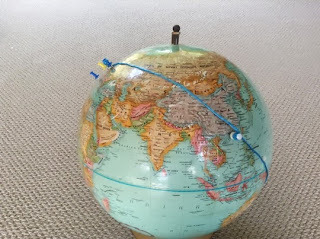
Airport lounges are strangely anodyne places; they could be anywhere in the world. It's dark outside, so only the photos on the wall tell me where I am. The decor, the food, the service: there's almost no variation, where-ever you are (unless it's remarkably bad). It's like airports exist outside of real space and time.
Lost in an airport world, it's nice to immerse yourself in fiction. So here's a short, a very short review of an old but great, series that transports you to another space and time, but in a much more pleasant way than any airport can.
Mary Stewart's Arthurian Quintet began in 1970, with The Last Enchantment, and ended in 1983 with The Wicked Day. Set in a post-Roman Britain c 500-600 AD, the stories are remarkable both for the quality of the prose and the integrity of the writer to a period of time about which little is known.
As a writer, what strikes me on re-reading these novels is the imagery 'his face was as grey as twice-used tallow'; 'a man on horseback can sink from sight as easily..as a spoon sinking into a bowl of gruel.' These are not modern images; how many people have seen a tallow candle, let alone a twice-used one? Yet they resonate in a way that is profound, for the narrator, Merlin, is a man of his times and these images are consistent with his world.
Rather stupidly, I did not put these novels on my reading list, even they take place in regions that I'm visiting. So this post doesn't really count, I guess. But if you enjoy historical fiction with an element of fantasy and want to take yourself away from airport angst, do try these books.
You can read more reviews on Goodreads
Airport lounges are strangely anodyne places; they could be anywhere in the world. It's dark outside, so only the photos on the wall tell me where I am. The decor, the food, the service: there's almost no variation, where-ever you are (unless it's remarkably bad). It's like airports exist outside of real space and time.
Lost in an airport world, it's nice to immerse yourself in fiction. So here's a short, a very short review of an old but great, series that transports you to another space and time, but in a much more pleasant way than any airport can.
Mary Stewart's Arthurian Quintet began in 1970, with The Last Enchantment, and ended in 1983 with The Wicked Day. Set in a post-Roman Britain c 500-600 AD, the stories are remarkable both for the quality of the prose and the integrity of the writer to a period of time about which little is known.
As a writer, what strikes me on re-reading these novels is the imagery 'his face was as grey as twice-used tallow'; 'a man on horseback can sink from sight as easily..as a spoon sinking into a bowl of gruel.' These are not modern images; how many people have seen a tallow candle, let alone a twice-used one? Yet they resonate in a way that is profound, for the narrator, Merlin, is a man of his times and these images are consistent with his world.
Rather stupidly, I did not put these novels on my reading list, even they take place in regions that I'm visiting. So this post doesn't really count, I guess. But if you enjoy historical fiction with an element of fantasy and want to take yourself away from airport angst, do try these books.
You can read more reviews on Goodreads
August 18, 2013
Accommodation for Four for Under 150 Euros
Booking Accommodation
We're heading off tomorrow so this is probably my last post until we arrive. An exciting thought!
Being a family with teenagers, our budget is limited, but we needed accommodation - 4 is too many to doss down with family or friends.
We started by asking a travel agent if she could book us hotels and guest houses and Wow! So Expensive. So we looked on the internet, using travel forums like Trip advisor and Fodor.
We've kept to an average budget of about $NZD200 per night (for four people). This equates to about 130 Euros.
Here's how we've done it:
Tip One - Behave like a local:
In Europe, most self-catering cottages seem to be Sat - Sat; in the UK it seems to be Friday - Friday. So if you want to stay in self-catering cottages in rural locations (like Devon), you might need to consider week-long stops.
Tip Two - go direct to the owners:
There's a lot of direct advertising by owners of their cottages. We found the following sites:
Air BnB
Holiday Lettings
Owners Direct
If you do use these sites, read the small print, and make sure you don't send the owners the money directly. Some sites have payment protection systems, whereby the money goes into a holding account until the date of your booking.
Some issues:
Sometimes the directions to the place aren't provided until you've paid the total fee, which is challenging if you're trying to work out logistics like train travel.It's difficult to get in touch with someone if you have an issueDamage deposits and booking fees can be expensive.Different owners seem to have different approaches to getting in touch. Some are really professional, others are friendly, others seem to think a postcode is all you need.
Tip Three - use Hostels:
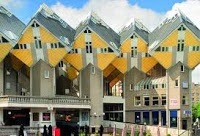 Image from Hostel RotterdamYouth Hostels offer free membership to <18 years and a joint membership for couples. You can join in NZ and use the membership around the world, and they have an excellent international booking system, so you can track your bookings. Lots of hostels seem to provide breakfast and family rooms and some look amazing!
Hostelling International
Tip Four - think small:
There's also a lot of regional based accommodation providers. Their websites aren't as flash, but so far they've provided really good service:
Helpful Holidays
Menai Holiday Cottages
With these smaller providers, we found it paid to phone to confirm the bookings.
Tip Five - do what you do at home:
Camping grounds offer interesting alternatives, especially in Amsterdam.
Bon Voyage!
We're heading off tomorrow so this is probably my last post until we arrive. An exciting thought!
Being a family with teenagers, our budget is limited, but we needed accommodation - 4 is too many to doss down with family or friends.
We started by asking a travel agent if she could book us hotels and guest houses and Wow! So Expensive. So we looked on the internet, using travel forums like Trip advisor and Fodor.
We've kept to an average budget of about $NZD200 per night (for four people). This equates to about 130 Euros.
Here's how we've done it:
Tip One - Behave like a local:
In Europe, most self-catering cottages seem to be Sat - Sat; in the UK it seems to be Friday - Friday. So if you want to stay in self-catering cottages in rural locations (like Devon), you might need to consider week-long stops.
Tip Two - go direct to the owners:
There's a lot of direct advertising by owners of their cottages. We found the following sites:
Air BnB
Holiday Lettings
Owners Direct
If you do use these sites, read the small print, and make sure you don't send the owners the money directly. Some sites have payment protection systems, whereby the money goes into a holding account until the date of your booking.
Some issues:
Sometimes the directions to the place aren't provided until you've paid the total fee, which is challenging if you're trying to work out logistics like train travel.It's difficult to get in touch with someone if you have an issueDamage deposits and booking fees can be expensive.Different owners seem to have different approaches to getting in touch. Some are really professional, others are friendly, others seem to think a postcode is all you need.
Tip Three - use Hostels:
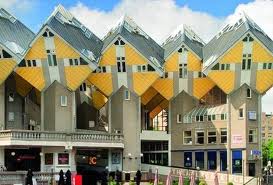 Image from Hostel RotterdamYouth Hostels offer free membership to <18 years and a joint membership for couples. You can join in NZ and use the membership around the world, and they have an excellent international booking system, so you can track your bookings. Lots of hostels seem to provide breakfast and family rooms and some look amazing!
Hostelling International
Tip Four - think small:
There's also a lot of regional based accommodation providers. Their websites aren't as flash, but so far they've provided really good service:
Helpful Holidays
Menai Holiday Cottages
With these smaller providers, we found it paid to phone to confirm the bookings.
Tip Five - do what you do at home:
Camping grounds offer interesting alternatives, especially in Amsterdam.
Bon Voyage!
August 16, 2013
Guide Books - A Necessary Evil?
Do I Need a Guide Book?
When I first started backpacking, nearly 25 years ago, you had to have a guidebook. In Thailand, everyone had the same one - Lonely Planet's SouthEast Asia on a Shoestring, and you saw the same people in the same places, all clutching the same book.
Nowadays, there's lots of information available on the web - trip advisor forums, fodor forums, various blogs. The quality varies, but the good blogs are really good. And guidebooks are heavy to carry, and they date so quickly.
 Image from AmazonBut a good guidebook has information that's been checked as accurate. The writers have researched the places they recommend (especially the bars) and generally, they're more reliable than relying on one person's opinion.
I have just discovered the perfect guidebook - in terms of presentation, not necessarily in content. I'll advise in later posts if the content is correct.
So here's a little rave about the Lonely Planet Guide to Great Britain: if you download it onto your kindle app (yes, I'm an app girl), it has links you can click on to the various sites. If, say, you're interested in a walking tour in London, you can click on the link and hey presto, you can book one. The contents page has hyperlinks which makes navigating the book so much easier than print, AND there are maps inside that you can click on and open up. Maps of Salisbury and Exeter, not just the main centres.
How this will work when we're not connected to wifi or if the battery goes low, I have no idea. But in the meantime, I'm having lots of fun looking, and oh, did I mention the way its all contained on the iPad? No more heavy books.
When I first started backpacking, nearly 25 years ago, you had to have a guidebook. In Thailand, everyone had the same one - Lonely Planet's SouthEast Asia on a Shoestring, and you saw the same people in the same places, all clutching the same book.
Nowadays, there's lots of information available on the web - trip advisor forums, fodor forums, various blogs. The quality varies, but the good blogs are really good. And guidebooks are heavy to carry, and they date so quickly.
 Image from AmazonBut a good guidebook has information that's been checked as accurate. The writers have researched the places they recommend (especially the bars) and generally, they're more reliable than relying on one person's opinion.
I have just discovered the perfect guidebook - in terms of presentation, not necessarily in content. I'll advise in later posts if the content is correct.
So here's a little rave about the Lonely Planet Guide to Great Britain: if you download it onto your kindle app (yes, I'm an app girl), it has links you can click on to the various sites. If, say, you're interested in a walking tour in London, you can click on the link and hey presto, you can book one. The contents page has hyperlinks which makes navigating the book so much easier than print, AND there are maps inside that you can click on and open up. Maps of Salisbury and Exeter, not just the main centres.
How this will work when we're not connected to wifi or if the battery goes low, I have no idea. But in the meantime, I'm having lots of fun looking, and oh, did I mention the way its all contained on the iPad? No more heavy books.
August 15, 2013
A Book Tour of Europe
Reading Around Europe
 This post is WAY more important than packs, budget or accommodation.
After much research, I have worked out my reading list for my trip. The criteria?
All books must be:
Entertaining; Available on Kindle; and (this is the most important) Based in the regions we are visiting.
So here's the list:
Safe as Houses by Simone van der VlugtThe Fault in our Stars by John GreenThe Diary of a Young Girl by Anne FrankThe Phantom of the Opera by Gaston Leroux - I meant to download The Hunchback of Notre Dame but what the heyA Year in Provence by Peter Mayle Neverwhere by Neil GaimanThe Hound of the Baskervilles by Arthur Conan DoyleThree Men and a Boat by Jerome K JeromeA Midsummer Nights Dream by William Shakespeare ( and maybe his sonnets)Christopher Hitchens and His Critics by Simon Cottee, Thomas Cushman and Christopher HitchensThe Book of Liverpool by assorted writersEnder's Shadow by Orson Scott Card
A very diverse list! Should keep me going for a while, provided I have access to the kindle (and it's not appropriated by some other member of my family).

I created the list using these websites:
Books Set In.... - a list of books set in a variety of countries, with a search function and links to amazon
Goodreads - particularly a great group, called Around the World in 80 Days
and - general knowledge.
Let's see how I go!
 Image from Free World Maps
 This post is WAY more important than packs, budget or accommodation.
After much research, I have worked out my reading list for my trip. The criteria?
All books must be:
Entertaining; Available on Kindle; and (this is the most important) Based in the regions we are visiting.
So here's the list:
Safe as Houses by Simone van der VlugtThe Fault in our Stars by John GreenThe Diary of a Young Girl by Anne FrankThe Phantom of the Opera by Gaston Leroux - I meant to download The Hunchback of Notre Dame but what the heyA Year in Provence by Peter Mayle Neverwhere by Neil GaimanThe Hound of the Baskervilles by Arthur Conan DoyleThree Men and a Boat by Jerome K JeromeA Midsummer Nights Dream by William Shakespeare ( and maybe his sonnets)Christopher Hitchens and His Critics by Simon Cottee, Thomas Cushman and Christopher HitchensThe Book of Liverpool by assorted writersEnder's Shadow by Orson Scott Card
A very diverse list! Should keep me going for a while, provided I have access to the kindle (and it's not appropriated by some other member of my family).

I created the list using these websites:
Books Set In.... - a list of books set in a variety of countries, with a search function and links to amazon
Goodreads - particularly a great group, called Around the World in 80 Days
and - general knowledge.
Let's see how I go!
 Image from Free World Maps
Reading Around EuropeThis post is WAY more importan...
Reading Around Europe
This post is WAY more important than packs, budget or accommodation.
After much research, I have worked out my reading list for my trip. The criteria?
All books must be:
Entertaining; Available on Kindle; and (this is the most important) Based in the regions we are visiting.
So here's the list:
Safe as Houses by Sophie van der VlugtThe Fault in our Stars by John GreenThe Diary of a Young Girl by Anne FrankThe Phantom of the Opera by Gaston Leroux - I meant to download The Hunchback of Notre Dame but what the heyA Year in Provence by Peter Mayle Neverwhere by Neil GaimanThe Hound of the Baskervilles by Arthur Conan DoyleA Midsummer Nights Dream by William Shakespeare ( and maybe his sonnets)Christopher Hitchens and His Critics by Simon Cottee, Thomas Cushman and Christopher HitchensThe Book of Liverpool by assorted writersEnder's Shadow by Orson Scott Card
A very diverse list! Should keep me going for a while, provided I have access to the kindle (and it's not appropriated by some other member of my family).
I created the list using these websites:
Books Set In.... - a list of books set in a variety of countries, with a search function and links to amazon
Goodreads - particularly a great group, called Around the World in 80 Days
and - general knowledge.
Let's see how I go!
Image from Free World Maps
This post is WAY more important than packs, budget or accommodation.After much research, I have worked out my reading list for my trip. The criteria?
All books must be:
Entertaining; Available on Kindle; and (this is the most important) Based in the regions we are visiting.
So here's the list:
Safe as Houses by Sophie van der VlugtThe Fault in our Stars by John GreenThe Diary of a Young Girl by Anne FrankThe Phantom of the Opera by Gaston Leroux - I meant to download The Hunchback of Notre Dame but what the heyA Year in Provence by Peter Mayle Neverwhere by Neil GaimanThe Hound of the Baskervilles by Arthur Conan DoyleA Midsummer Nights Dream by William Shakespeare ( and maybe his sonnets)Christopher Hitchens and His Critics by Simon Cottee, Thomas Cushman and Christopher HitchensThe Book of Liverpool by assorted writersEnder's Shadow by Orson Scott Card
A very diverse list! Should keep me going for a while, provided I have access to the kindle (and it's not appropriated by some other member of my family).
I created the list using these websites:
Books Set In.... - a list of books set in a variety of countries, with a search function and links to amazon
Goodreads - particularly a great group, called Around the World in 80 Days
and - general knowledge.
Let's see how I go!
Image from Free World MapsAugust 14, 2013
A First-World Problem
Backpack or Suitcase?
So we're going to Europe for eight weeks! To help manage costs (and make it easier on our kids) we'll be staying in places for mostly a week at a time. And those places will be self-catering: apartments, hostels and holiday cottages.
When we're in rural areas we'll hire a car, but in the main centres (Amsterdam, London, Paris) we won't - like the locals, we'll rely on the subway, our feet or bicycles.
So, here's the question of this post: do we take a suitcase, or a backpack?
Now, I've backpacked around Europe before. I know what it's like. Three months living out of a heavy canvas sack can really take the gloss out of travel. When I have a suitcase, I feel grown-up; a proper traveller. But here's the thing. Carrying a suitcase on the metro/subway/underground is a REAL drag. Not to mention a hazard. What if we get separated from our kids, all because we're trying to lug a suitcase's tiny wheels over the gap?
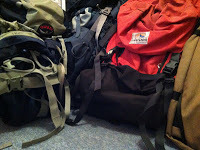
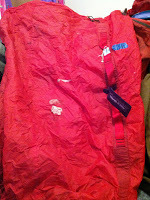 So following due consideration and plenty of research, we have decided: Packs are the Way-to-Go.
So here they are, neatly lined up, ready to be filled with clothes and electronica. We have pack covers from our backpacking days, so the packs will be covered before they go on the luggage carousel. These pack covers are so large and red, we will look like Santa.
If you want to know what swayed us, check out Rick Steve's blogpost on this very subject:
Rick Steves: Backpack or Rolling Bag
Alternatively, there's always a donkey:
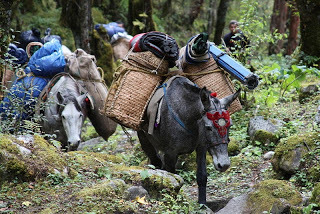 Image from Wikimedia Commons
So we're going to Europe for eight weeks! To help manage costs (and make it easier on our kids) we'll be staying in places for mostly a week at a time. And those places will be self-catering: apartments, hostels and holiday cottages.
When we're in rural areas we'll hire a car, but in the main centres (Amsterdam, London, Paris) we won't - like the locals, we'll rely on the subway, our feet or bicycles.
So, here's the question of this post: do we take a suitcase, or a backpack?
Now, I've backpacked around Europe before. I know what it's like. Three months living out of a heavy canvas sack can really take the gloss out of travel. When I have a suitcase, I feel grown-up; a proper traveller. But here's the thing. Carrying a suitcase on the metro/subway/underground is a REAL drag. Not to mention a hazard. What if we get separated from our kids, all because we're trying to lug a suitcase's tiny wheels over the gap?

 So following due consideration and plenty of research, we have decided: Packs are the Way-to-Go.
 So here they are, neatly lined up, ready to be filled with clothes and electronica. We have pack covers from our backpacking days, so the packs will be covered before they go on the luggage carousel. These pack covers are so large and red, we will look like Santa.
If you want to know what swayed us, check out Rick Steve's blogpost on this very subject:
Rick Steves: Backpack or Rolling Bag
Alternatively, there's always a donkey:
 Image from Wikimedia Commons
Backpack or Suitcase: A First-World ProblemSo we're going...
Backpack or Suitcase: A First-World Problem
So we're going to Europe for eight weeks! To help manage costs (and make it easier on our kids) we'll be staying in places for mostly a week at a time. And those places will be self-catering: apartments, hostels and holiday cottages.
When we're in rural areas we'll hire a car, but in the main centres (Amsterdam, London, Paris) we won't - like the locals, we'll rely on the subway, our feet or bicycles.
So, here's the question of this post: do we take a suitcase, or a backpack?
Now, I've backpacked around Europe before. I know what it's like. Three months living out of a heavy canvas sack can really take the gloss out of travel. When I have a suitcase, I feel grown-up; a proper traveller. But here's the thing. Carrying a suitcase on the metro/subway/underground is a REAL drag. Not to mention a hazard. What if we get separated from our kids, all because we're trying to lug a suitcase's tiny wheels over the gap?
So following due consideration and plenty of research, we have decided: Packs are the Way-to-Go.
So here they are, neatly lined up, ready to be filled with clothes and electronica. We have pack covers from our backpacking days, so the packs will be covered before they go on the luggage carousel. These pack covers are so large and red, we will look like Santa.
If you want to know what swayed us, check out Rick Steve's blogpost on this very subject:
Rick Steves: Backpack or Rolling Bag
Alternatively, there's always a donkey:
Image from Wikimedia Commons
So we're going to Europe for eight weeks! To help manage costs (and make it easier on our kids) we'll be staying in places for mostly a week at a time. And those places will be self-catering: apartments, hostels and holiday cottages.
When we're in rural areas we'll hire a car, but in the main centres (Amsterdam, London, Paris) we won't - like the locals, we'll rely on the subway, our feet or bicycles.
So, here's the question of this post: do we take a suitcase, or a backpack?
Now, I've backpacked around Europe before. I know what it's like. Three months living out of a heavy canvas sack can really take the gloss out of travel. When I have a suitcase, I feel grown-up; a proper traveller. But here's the thing. Carrying a suitcase on the metro/subway/underground is a REAL drag. Not to mention a hazard. What if we get separated from our kids, all because we're trying to lug a suitcase's tiny wheels over the gap?
So following due consideration and plenty of research, we have decided: Packs are the Way-to-Go. So here they are, neatly lined up, ready to be filled with clothes and electronica. We have pack covers from our backpacking days, so the packs will be covered before they go on the luggage carousel. These pack covers are so large and red, we will look like Santa.
If you want to know what swayed us, check out Rick Steve's blogpost on this very subject:
Rick Steves: Backpack or Rolling Bag
Alternatively, there's always a donkey:
Image from Wikimedia Commons