
C.P.D. Harris's Blog, page 74
July 2, 2013
Teaser Tuesday
Two weeks to go until Bloodlust: Will to Power is released on kindle/amazon (I hope). I’m knee deep in final approvals  … here is this week’s teaser:
“What’s this about?” asked Ravius. The two Gladiators could sense the subtle undercurrents of power surrounding Sax; the ogre was in full control of his magic and his weapons and armour were crackling with attuned runes. Sax now wore shining black armour that covered his full body like a second skin underneath his arena armour. When had he found the time to change into this garment? Even trusted master level Gladiators like Sax were rarely allowed full access to their power outside the arena. Few of them carried armour like that. Gavin felt a surge of excitement: he’d always known there was more to Sax.
“There has been an incident nearby.” said Cleothera. Her tone was filled with icy determination. “We are are going to investigate…”
One of the ideas I’m trying to explore in this book is that the world is still dangerous even inside the borders of the Domains. Things happen outside the arena, and I’d like to give more of an impression of that in this volume…
Another idea worth exploring, and somewhat more topical, namely exposing some of the more secretive organizations in the empire. Part of this involves exploring what Sax and Cleothera are up to…



June 30, 2013
With great power comes great banality
Lately it seems rare for protagonists to rise above the muck. I suspect it has something to do with the seething undercurrent of rage, frustration, and general insecurity of people the world over. Few countries seem happy with their leadership, at least on the news. It could also be that the limit of genre deconstruction has been reached, for now. Be that as it may, I’m somewhat suspicious movies about sad superheroes and read books about wizards and assassins who spend all the time brooding about their personal drama these days.
To illustrate my point I will use the most recent Iron Man and Batman series. Both are excellent and entertaining. In Christopher Nolan’s acclaimed Batman trilogy the character gets evermore dark and brooding, eventually rejecting the idea of heroic sacrifice and even the responsibility that comes with power and wealth. Iron Man is positively gleeful, manically flawed, and ultimately about moving from a selfish perspective to one of acceptance of power and taking responsibility. Both are billionaires, both are brilliant, both are powerful, but Iron Man seems to actually enjoy life while Batman broods more and more.
There have been quite a few excellent attempts over the last few decades to make powerful characters seem more human, but brooding has become nearly as formulaic as honour, courage, and melancholy for a mythic past used to be. Brooding, dark, even perverse anti-heroes are the low hanging fruit of modern genre fiction and comic books. Darker protagonists have frequently been popular in western literature, after all. There’s a reason guys and gals in cloaks with knives decorate the covers of most modern fantasies. Of course, after a while those characters and covers start to blend together. Skilled creators can still find ways of making characters like these shine, but in an ever-crowded field it might be more attractive for a novice to try other options.
There is a definite connection to salacious tabloid sensationalism here to boot. The qualities that make tabloid stories sell will make stories about superheroes, mages, and assassins fly off the shelves as well. Sex, violence, duplicity, scandal, and melodrama. This tabloid mix works for reality TV and the 24 hour news channels and to be honest it works in genre fiction too. This is not to say that using these elements is bad writing or lowers the work to the level of a tabloid, far from it. It the case of the masters, it is often a poignant commentary on society, or the truth about the nature of power. Just keep in mind it took some time for the greats to be able to make those points without seeming trite.
One of the reasons a good deconstruction is admired, is because it is hard to do without being banal.
Modern audiences do demand human, “realistic” characters, however. That is hopefully not going to change anytime soon. Depth of character in genre fiction is awesome. Powerful characters in particular need to be interesting if you are aiming for something other than escapism (I’m not saying that escapism is bad BTW). However beyond the very popular brooding and scandalous protagonists that populate the shelves of book and comic stores there is quite a bit of room for characters with very flawed personalities. Here a few useful traits:
1) The Failure: The failure is just horrible at everyday tasks. They might kick-ass when the time comes for action, but they generally just suck at the things that people need to do to get through the day. T.H. White’s Lancelot spent so much time perfecting the knightly arts in his youth that he never learned to do things like climb a tree, which turns out to be more of a disadvantage than you might think. Jim Butcher’s Dresden has trouble with technology of all sorts, and is a magnet for trouble, which makes it rather hard for him to hold down a steady job and makes relationships rocky (though he keeps trying instead of brooding.) A Darker version of the failure is someone who keeps losing their friends and loved ones, like Jon Constantine. These characters are all extremely powerful in their own right, but seem more human because of their inability to lead a normal life.
2) Recklessness: Power and recklessness make for an interesting combination, at least in works where actions have consequences. Conan is nearly invincible in combat, a great leader, a cunning thief, and tough as nails. Yet he always runs into trouble due to impulsive behaviour and suffers his only serious defeats due to his own overconfidence. Power is well known for making people reckless, and the consequences of great power and great irresponsibility can make a great narrative.
3) Lack of Empathy: Power can make a person lose touch with the rest of the world. Dr Manhattan from the watchmen is an excellent example of this. He is so removed from human that he simply cannot really understand other people anymore, becoming a sociopath of sorts. This is not only interesting, it makes a fair bit of sense.
4) Narcissism: Narcissism is a common trait in villains, but Robert Downey Jr’s Iron Man shows how it can be a really fun trait for a protagonist as well. Being self-centered and arrogant does not always mean you are unlikeable and evil, and it makes quite a bit of sense for a billionaire with his own suit of powered armour. It also gets him into a lot of trouble, creating nice conflicts with other characters.
5) Thrillseeker: A thrillseeker is a character who lives for danger. Boredom is the real root of this character, they need action and new experiences to drive away the tedium that haunts them. This one strokes me as hard to pull off without seeming fidgety and annoying.
6) Curiosity: Curiosity is both a virtue and a flaw. There is nothing more noble than the love of knowledge, but pursuit of knowledge can be dangerous. This is the root of many mystery series. Kvothe in the Name of the Wind and Elric of Melnibone are defined by their curiosity in many ways. This simple trait drives them to adventure, and gets them into trouble. Curiosity seems to have fallen out of favour, but I expect it to make a big comeback in the information age, especially with the emphasis on secrecy that seems to overshadow much of modern interactions. A curious character would be an excellent protagonist in a story with an evil NSA-like (did I just make a list somewhere?) organization.
7) Substance abuse: Alcoholism and drug addiction make for interesting traits in a protagonist. These simple, commonplace problems are faced by millions of people. Power and addiction make for an interesting story. Elric leads the way here, although Caramon Majere also springs to mind. Superstrength and awesome fighting prowess don’t actually help you against addiction, they might even make it worse in some ways since power isolates and the most effective ways of dealing with addiction is the support of others.
8) Envy: Even the powerful can know envy. Again, envy is usually a trait reserved for villains, but I see potential for a protagonist who has this kind of flaw. It is a very human emotion, and a powerful character could envy others for many reasons: romance, happiness, a normal life, and so on. The envy could drive rivalries, or even erratic behaviour.
9) Low Self-Esteem: T.H. White’s Lancelot leads the way here. His low sense of self worth drives him like a whip, pushing him into rigid self-perfection. His physical ugliness spurs him to become mannered and gracious. Despite being the best knight in the world, it is never enough for young Lancelot and he is always seeking for ways to prove himself to Arthur, then Guinevere, and lastly God. I try for this a little with Gavin in Bloodlust: Gladiators Tale.
Those are just a few I can think of off the top of my head 


June 28, 2013
Borderlands, Bunkers and Badasses: How DLC for a “silly” game earned my respect all over.
I enjoyed it.
SPOILERS (For Borderlands 2 and Tiny Tina’s Assault on Dragon Keep — Buy it if you enjoy Borderlands)
I am a bit of a fan of the Borderlands series from Gearbox software. I suspect to many who haven’t played it, the game would seem very odd. Here is an example of the latest DLC** (kinda NSFW). It is the only first person shooter that really appeals to me, with strong RPG*elements and a seemingly relaxed attitude towards everything but fun. I played the first installment religiously, especially during a grey period in my life when I was working a terrible job and wasn’t sure that I had it in me to finish my first novel. I enjoy the wacky signature characters, cartoonish approach to violence, and some of the behind the scenes cleverness of the writers. It is a great way to unwind and relax, just mindless fun for the most part.
That said, Borderlands 2 does have a surprising amount of deep commentary about heroism, reputation, and a sacrifice under the surface.
I enjoy the Borderlands 2 enough to buy the DLC. While I find the quality to be well above par in a world where many game companies overcharge for their offerings, I don’t expect much other than a few hours of fresh play. I get more than my money’s worth for the most part and a small sense of satisfaction at earning completion and enjoying the jokes. When I heard that the fourth (and final?) DLC: Tiny Tina’s Assault on Dragon Keep was something of a tribute to tabletop RPGs I was more intrigued than usual. You could say I was all in, especially since I’m waiting for the edits on my second book to come back and have a little R&R time  . For those who don’t know I am big fan of tabletop, with my first book being partly based off an old RPG design. So I grabbed the DLC, expecting the usual fun, witty, crazy fragfest with some D&D jokes and pop culture references thrown in. I got all of that, as well as some deep commentary on how games/fantasy can help us cope with sorrow and loss.
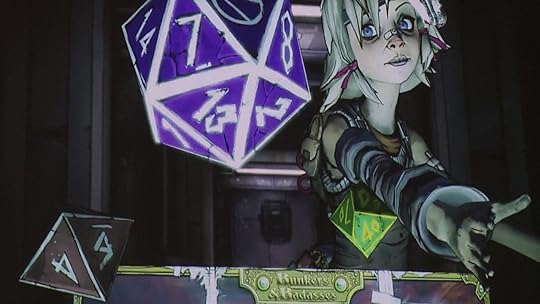
Note the old school screen. Respect.
The basic idea behind the DLC is that Tiny Tina, one of the Borderlands signature characters, wants to run (Gamemaster) a game of Bunkers and Badasses (D&D reference, screens and all). It is a game withing the game (playing an RPG within Borderlands), with the other signature characters providing commentary while you play through. At first it simply adds a nice narrative and a great reason to throw some fantasy elements into the Borderlands universe. Rampaging Orcs, skeletons with glowing eyes, annoying tinkerbells, dragons, and strange quests complete with a satisfying number of references to RPG and fantasy classics.
The game within a game is mostly an excuse for all kinds of additional fun. The Borderlands cast of signature characters is colorful in the extreme, and really one of the best parts about the whole series. The game within a game allows for a running commentary between many of these characters, which keeps the action and the story flowing. At first the commentary is strictly comedic, although it is interesting that Gearbox does use the game to point out some of the dos and don’ts of running a tabletop game with your friends starting with a hilarious discussion of how you shouldn’t kill all the player characters with a super-boss in the first encounter. Really fun stuff.
However, the writers decided to dig a little deeper on this one. I’m not exactly sure why, but I am intrigued. In the Borderlands 2 universe, Roland, a heroic character who rescued young Tiny Tina and befriended her has recently been killed. Tina seems to have trouble coping with this, and the Borderlands characters aren’t quite equipped to help her confront that. Throughout the game Tina actively wonders where Roland is, why he hasn’t shown up for the game yet. The other players keep trying to hint or gently remind her that Roland died in the fight against Handsome Jack and won’t be coming to the game. So Tina takes control of Roland’s “character” effectively putting him in her Bunker’s and Badasses game, to the growing dismay of the other characters on the Borderlands layer of the game (game within a game is almost inception-like). This provides a staggering level of dramatic tension as Tina keeps involving Roland and dodging acknowledging his death. It is interesting that Roland is portrayed as a paladin here and his idle conversation options are set to “I’ll always be here for you.” and “I like it here.” He is the reassuring face of the game, hope, and the ideal guardian for the preservation of innocence. I came to the realization that Tiny Tina’s Bunkers and Badasses game was actually her retelling some of the main game’s story (a subtext of the game with a game ). Eventually Tina does actually confront Roland’s death, and does so in a way that makes a fascinating comment on games and fantasy in general, and is surprisingly sweet and soulful. I actually just finished playing it an hour ago and still feel a little shaken.
Innocence, fantasy, sorrow, loss, and heroism. I’m sure some players won’t really care, but the DLC offers the usual slice of fun and humour on top of the lesson/meditation/discussion. I know I was touched. When I was younger my tabletop gaming group lost two of our friends Peter, and Andrew in separate tragic events. Both were young men full of promise, who’d shared countless hours fighting dragons, hiding in prismatic spheres, and haggling over gem prices. In some ways I can still sense their influences on my works today. I have to thank a funny little DLC for reminding me of that, unexpectedly and brilliantly. There is a lot of commentary about the role that games plat in our lives buried in that statement. Natural 20 boys and girls… I raise my glass to you.
*RPG = Role-Playing Game. Things like Dungeons and Dragons (Tabletop), Mass Effect (Computer), or Mind’s Eye Theatre (Live Action). They are share the idea of taking on the role of a character and guiding your own adventure.
**DLC = Downloadable Contents, little add-ons for your game.


June 25, 2013
Teaser Tuesday
A handful of chapter heading quotes
“In the arena, we are all equal. A blade does not care for the colour of the flesh it tears, a spell does not care for the sex of the warrior that weaves it, death and victory do not care for the race of those who deal them out.” Omodo diYava
“I have no equals.” Valaran diVolcanus
“The old games were pure. Battle is about life and death, not who scores the most points.” Valaran diVolcanus.
“I am all for harsh training, but we are constantly fighting against incursions in the west and bleeding men in the Trials. The cold, hard truth is that we need more Gifted trained to fight. Enough of this nonsense about the merits of the old games. We need Warbound, not corpses.” Chosen Mordhawk, 823 AR.
“Gladiatrix, Gladiatrix/Sword in her hand, blood on the Sand!/Death in her eyes, she’s battle-wise!/Gladiatrix, Gladiatrix/Come see her fight, the crowd’s delight!/Head in her hand, blood on the Sand!” An old arena cheer.
I’m trying to bring out the personalities of characters through these quotes whenever possible, allowing them to have a presence, even when off-stage.
The cheer is part of an attempt to flesh the world out a bit.


June 23, 2013
Kvothe is not a Mary Sue, Urban Fantasy, and the state of Fantasy Critique
“I have never listened to anyone who criticized my taste in space travel, sideshows or gorillas. When this occurs, I pack up my dinosaurs and leave the room.” Ray Bradbury, Zen in the Art of Writing
Spoiler Alert: If you have not read Name of the Wind by Patrick Rothfuss, there might be some minor spoilers here. Also, you should read it (seriously), maybe even before you read my book.
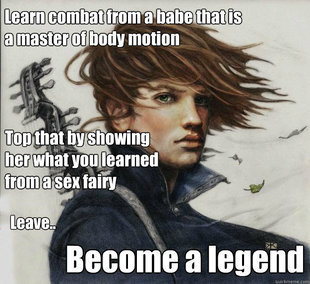
Fairly typical chatroom take on Kvothe as a Mary Sue
Critics have always struggled with genre fiction. The know when to clap loudly and vigorously when some due comes along and breaks formula in an interesting fashion, to point out when a writer pushes sexism or one of the many other -isms out there, and to expose exceptionally bad writing. Other than that critics run into the huge wall of fandom that often really, truly love the things that critics hate most about genre fiction, namely the tropes. Fantasy tropes include magic, elves, dwarves, magic swords, castles, and dragons. Tropes can also include common plots and storytelling devices, like quests and prophecies. Readers who love the genre, tend to enjoy the tropes, no matter how well worn they get. I suspect that in many cases it is only after prolonged exposure to critical opinion that readers begin to view the tropes as a bad thing. After all, when I got bored of Fantasy for a bit in the 90s, I simply moved on and read history and literature for a while and then returned with fresh eyes.
I”ll get to Kvothe in a minute.
Most forms of literature suffer tremendously when they become ridden by convention and formula. The great critics are those who have perceived and broken this sort of blockages, acting like a cleanser of the collective literary bowels. They seek the original and the fresh. Reviewers seek to emulate these great critics and often try to adopt their terminology and methodology. Genre Fiction however is based on tropes and formula, which makes it very difficult to criticize in this fashion. As formula breaking as A Song of Ice and Fire is, it still has magic, dragons, knights, and children seeking vengeance for their fallen Father. When I grabbed Game of Thrones off the shelves many years ago I picked it up because of the tropes, not in spite of them. In fact, Fantasy Fans who love George RR Martin, often love him more because with a deeper understanding of genre tropes and formula they can understand the changes he makes. At least up until book four 
Because of the difficulty of criticizing originality in genre fiction, fantasy reviewers are often reduced to attacking specific tropes. They’re tired of elves, or shining heroes, too much grimdark, etc etc. One of the most common criticisms in Fantasy is that the protagonist is simply too skilled, too powerful, and lacking in weakness. This is usually referred to as Mary Sue in fantasy discussion shorthand. Having just Name of the Wind, and Wise Man’s Fear, enjoying them immensely I am particularly interested in discussions of the books. A frequent criticism of Rothfuss’ creation is that Kvothe, the main character, is unabashedly Mary Sue. I have no problem with people disliking the book, or Kvothe, but I do have an issue with people labeling the character as Mary Sue as a criticism. Use of this term acts as a warning sign to certain readers, and will turn them off or prejudice them against the book. Here are five reasons why it is wrong to label Kvothe as Mary Sue. Bear in mind that these contain spoilers.
1) Kvothe is narrating his own story: The structure of the book is based around Kvothe recounting the story of his life to the Chronicler. He skips the boring parts. We always have his perspective and insight into events, which has obviously been polished by hindsight, and possibly embellished. The autobiographical nature of the account is key here.
2) Kvothe notes that he inflates his own reputation: Kvothe is a legend in the world he inhabits. Within the world he is definitely seen as a sort of Mary Sue figure, and often has powers and deeds falsely attributed to him. Part of the reason he is a legend is that he purposefully crafted a reputation for himself. Rothfuss delves fairly deep into the idea of how great men and women often owe much of their fame to the stories that grow around them, perhaps even becoming trapped within them. He definitely plays with the idea of the Mary Sue trope, but breaks it frequently.
3) Kvothe is frequently outclassed: Kvothe has the crap kicked out of him by a ten year old. He is beaten in a mystical contest of wills by a moneylender. He is frequently outwitted and outclassed by Ambrose, who uses money and influence to overcome Kvothe’s natural talent and skill. Even in music, he has rivals. He often outright fails, and while does eventually succeed at most things he tries, he certainly struggles.
4) Kvothe is an epic character with epic enemies: Kvothe is certainly very skilled. He picks up languages very easily. He charms a faerie queen (which is hardly unique… read some books people!). He survives distasters, He is a good fighter, magic user, and a brilliant musician. But he’s not better than everyone else. His foes are insanely powerful creatures of legend who carefully destroy any real trace of their existence. Who do you expect to go after the Chandrian? It would be rather worse than Mary Sue to have villains of that magnitude defeated by someone less than impressive.
5) No one who is worse with romance than I am is Mary Sue: Kvothe has many weaknesses. Denna is a prime example. Kvothe loves her and she seems to feel the same, but he falls for the same traps that we all do in romantic relationships instead of sweeping her off her feet. Seriously anyone who messes up basic relationships that badly is pretty human in my books.
So yeah, Kvothe is not really a Mary Sue character. I think confusion arises because the author is playing with the trope more than anything and it is a low hanging fruit for people who don’t like the book to grasp at.
Fantasy is also an expanding genre. This has led to another pet peeve of mine, although it has more to do with categorization than criticism. Urban Fantasy. I would categorize Urban Fantasy as any part of the genre that deals with elements of the fantastic and urban issues and environments. From Fafhrd and the Grey Mouser to Perdido Street Station to the Dresden Files. But the term seems confused and vague these days, and people often argue what counts as urban fantasy. Of course an astute reader will note that Steampunk, Paranormal Fantasy, and Flintlock Fantasy often deal with urban issues as well. Arg. It often annoys me because people throw these categories around a pejoratives or assign meaning to them beyond just helpful comparison. Criticism of any of these categories as a whole seems deeply suspicious to me.
On the other hand, I’m pretty happy to have these gripes. The world of literature outside of genre fiction is often dominated by experts who are into ideas that are opaque to the average reader. New writers are often savaged by these alpha critics unless they bow to the established structure. In Fantasy and other genre fiction, the less formal critical structure and the accessible nature of a form based on tropes, ensures that authors are more likely to write to the readers instead of to the critics.


June 20, 2013
Pitchfork Time: Externalizing Blame when a System Fails
When you want to know how things really work, study them when they’re coming apart. William Gibson, Zero History
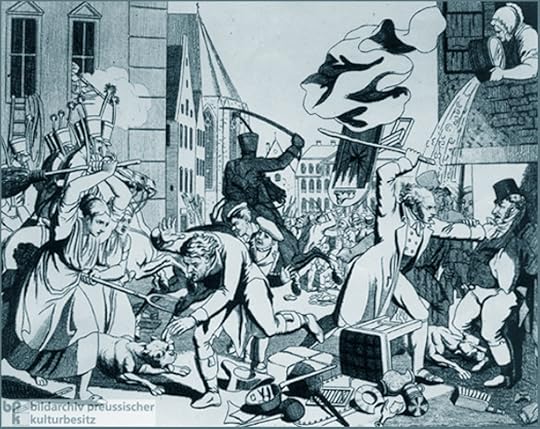
Its that dude’s fault, get him and everyone like him!
One the biggest problems of modern society, as I see it, is our obsession with laying blame (and avoiding blame). I frequently encounter situations in life and work, where people are so focused on blame that they ignore the actual problem, often letting it get worse. A reasonable approach to a problem is to solve or contain it first and only then move on to analysis, which should concentrate on responsibility (blame), but also prevention.
This propensity towards blame becomes truly disturbing (and fascinating) when systems, ideologies, and institutions fail. A failing ideology rarely accepts responsibility for its own failure, and instead often externalizes blame, looking to direct the anger of the people towards a convenient scapegoat. Blame is assigned to minorities, social classes, foreigners, homosexuals, or people who have different political or religious beliefs. We’ve seen just how ugly this can become, time and time again. Despite the ugliness, or perhaps because of it, this kind of conflict makes for an interesting Fantasy Story.
In previous musings, I have examined the potential systems and ideologies as villains in modern fantasy. The basic idea is that systems become corrupt and ideologies are never as perfect as they seem. When skewed badly enough they can become truly monstrous. The NSA surveillance scandal/Patriot act is an excellent example. I can almost feel The Eye of Sauron Homeland Security peering over my shoulder right now, just mentioning it. I am minded of William Gibson’s Spook Country, where the characters discuss how behaviors changed after 9/11, how we always consider the possibility of people listening to our calls now. Surprise! its true. This is an excellent example of a system starting to go awry, it is very easy to imagine how it could get worse and reach truly villainous levels. The power of an institution like the NSA makes for a truly epic villain, while remaining eminently believable since everyone who lives in modern society has felt the heavy hand of one of our institutions at one time or another. The human agents of the system provide the interactive component for a nice tale, normal men and women serving the dysfunctional and broken, almost victims themselves.
Here are a few generic examples of how this could play out in a Fantasy World:
1) The Bright Kingdom loses a war. The King is actually a terrible field commander, but no one is willing to tell him that. The Kingdom is humiliated by the loss and needs to pay a rather hefty tribute to the victor. Additional taxation makes the already irritated people angrier, with major unrest beginning. Before things get out of hand the King decides that he can deflect blame off himself by blaming the rich Dwarven tradesmen. The Dwarves are easy to blame because they are a relatively new people to the Bright Kingdom, and racial prejudice is always depressingly easy to to stir up. Plus the Dwarves have money, which helps pay off the war debt and line the king’s coffer. The King has his agents stir the pot with rumours, and then “discovers” that the Dwarves have been acting as spies for the enemy! The protagonists would a Dwarven Family trying to survive and a noble who sees through the king’s scheme.
2) Long ago after a terrible conflict with Demon worshiping cultists the people of the Midlands created a series of mystic Guardians to watch over their cities. These Guardians are the souls of the Greatest heroes lost in the conflict encased in powerful magical armour. Over time the Guardians have become synonymous with justice, righting many wrongs in their constant vigilance against the Demon cultists. An entire Order has grown around the Guardians, assisting them and growing strong. Problem is that the Guardians have started to go loopy and kill people who are not cultists. The Order fears that if people find out that Guardians are breaking that they will lose influence and possibly look weak to their enemies. So they blame the erratic behavior of the Guardians on magic and crackdown on “illegal magic, rounding up all mages.” The protagonist would be a mage who saw a Guardian go crazy.
3) The Scarlet Emperor is advised by the Guild of Celestial Mathematics. The Celestial Mathematics’ Calculations have just failed in a key prediction and adherents of the idea are frustrated. The Emperor is displeased and the Guild risks falling out of favour, In truth the problem lies with the idea of Celestial Mathematics, but instead of blaming the system the Guild decides to blame the scribes who performed calculations. They scribes declared unclean and their families are exiled. The protagonists would be one of the family members, and a mercenary bodyguard.
When a powerful entity lays blame on others to preserve itself, all kinds of chaos and brutality can ensue. Many of the great genocides, wars, and injustices of modern history begin with this sort of action. Fantasy is a great genre to examine this tendency. The writer can delve deeply into race, religion, and creed without involving real world groups, or even invent a distinction to act as a focus for prejudice, like the ability to wield magic. This step back from reality lets us examine the idea of prejudice and its relationship to externalizing blame in a pure environment. The reaction to this sort of blame makes an entertaining backdrop for any fantasy tale, especially those of a more modern bent. Failing systems and prejudice itself are the sort of villains that we intuitively understand in the modern day, and still seem strong to us. You don’t really need to look very far these days to run across examples of massive over-reach from our largest institutions.


June 18, 2013
Tuesday Teaser
“I want you to know that you brought this upon yourself,” said Valaran.
Short, but sweet. This week, after some last minute (after the deadline) feedback from my insightful beta readers, I finished polishing Bloodlust: Will to Power and sent it to edit. I have mixed feelings. I could literally spend another year polishing and re-writing and still want to do more. I’m not sure it would make it better though. The language would be more refined, the scenes that I want to highlight would have every ounce beauty teased out of them. I’m just not sure that that would make the book better. Bloodlust: Will to Power is more emotional, and perhaps better served by a slightly less refined, raw style.
At least that’s what I tell myself… the readers will decide.


June 16, 2013
The Great Cycle: Fate and Causality in Modern Fantasy
“The Wheel of Time turns, and Ages come and pass, leaving memories that become legend. Legend fades to myth, and even myth is long forgotten when the Age that gave it birth comes again.” Eye of the World by Robert Jordan, from the Wheel of Time series.

I’m just sayin’
The Great Cycle is a well worn fantasy trope that is heavily invested in the idea that the world is governed by a series of grand cycles, usually referred to as ages. These cycles end in cataclysms and war, from which the next cycle springs anew. There is usually a golden age and fall at some point during the cycle, as well. In most versions of the story the protagonists set themselves against the cycle, trying to break it and stave off the impending disaster. In some stories they succeed, in others they do not. Regardless of the outcome however, the Grand Cycle is a profound rejection of causality. The Cycle follows its own logic, or as Robert Jordan would say “The Wheel weaves as the Wheel wills.” It does not follow a causal chain, it is something that just happens because it is inevitable and the hand of fate always moves towards it.
Some books, movies, and even games have used the idea of a grand cycle are [Spoiler Alert]:
1) The Wheel of Time: Robert Jordans massive epic is perhaps the best use of the grand cycle in modern Fantasy. He makes good use of the lost golden age, the idea of a grand pattern, and a protagonist who eventually decides to try and end the cycle. I found it got too long and repetitive for my tastes, but I enjoyed that Jordan came right out and let the reader know he was writing a tale about the grand cycle right off.
2) Mass Effect: Nobody expects the Great Cycle in a Science Fiction computer game. The main enemies in the mass effect series are the reapers, monstrous artificial entities that periodically wipe out/harvest all life in the universe in order to further their own goals. The protagonists begin to learn of the cycle through contact with artifacts from a vanished species, the Protheans, who attempted to defeat the reapers last time around. I love Mass Effect’s spin on the great cycle. I could simply be a causal event on a grand scale. Although the reapers claim to be without beginning or end. Still cool.
3) Battlestar Galactica (2004): In the most recent iteration of BSG it is suggested that humanity is constantly wiped out by its own robotic creations, the cylons. The final episode contains the lines ”All of this has happened before. But the question remains, does all of this have to happen again?”
4) Ragnarok: Ragnarok in Norse Mythology is the fated end of the world, when most of the gods die. Interestingly it is seen as part of a cycle and the children of the Gods continue on, presumably to the next cycle.
5) The Stormlight Archive: Brian Sanderson’s next big project appears to include the grand cycle. The Way of Kings pointed toward a Grand Cycle, but with some possible differences… It will be interesting to see how he uses the idea.
The idea of the Grand Cycle has its roots in religious belief, likely originating in early agricultural societies who were very attached to seasonal cycles and thus inclined to view the world that way, I’d guess.
The Great Cycle in Fantasy fiction is ahistorical, being driven by fate over cause and effect. The events that line up to cause the are generally outside human agency. Thus if a story involves the Grand Cycle it is fate driven, even it breaks said cycle. The idea that events are predestined is not a product of reasoned cause and effect, except for notions of physics and philosophy well beyond the scale of most stories.
In theory though, some Grand Cycles, like Mass Effect could be rendered in causal terms. The Reapers claim to be without beginning, but establishing an origin for them would make the cycle causal, albeit on a metascale.
In general I don’t have a problem with the Grand Cycle as a device in Fantasy, or even mythology. On the other hand I hate the way people use the idea of the Grand Cycle in real life. The world as we know it is historical, and while the cause and effect of events are a matter for debate and study, juts because they lie beyond our grasp does not mean that we should shrug our collective shoulders and give up on seeking answers. War is a good example of this. I often hear people utter the phrase “war is inevitable.” On one hand this sort of truism is rather hard to disagree with considering some part of the planet is always at war. One the other hand it is also an excuse for ridiculously lazy thinking about how peace initiatives in the middle east are pointless because they are doomed to fail or how striving towards peace is naive because we will always be drawn into a war eventually. Dropping everything onto the lap of fate, and thus abdicating responsibility ignores the fact that history is progressive, with human life generally getting better as time goes on and science/knowledge advances.
Wars are caused by people, not fate. Attempting to understand the causes allows us to minimize the occurrence in the same way that modern medicine helps us to stave of infection, disease, and even live longer lives (awesome!).
Because I enjoy history I tend to prefer fiction that respects causality. Obviously some authors want to explore ideas of fate and Grand Cycles; I don’t hold that against them. Modern Fantasy is big enough for many different styles of storytelling, after all. However for examining ideas on a human scale, nothing beats causality. Fate and inevitability cheapen events on the human level by ignoring the question why?, which can easily be answered on the scale of human action.


June 13, 2013
Fantasy and Guns
One of my favorite read of late was Promise of Blood, an Epic Fantasy set in a period that approximates the Napoleonic Era. The book is advertised as Flintlock Fantasy, and prominently features guns and magic side by side. Now, when I was a wee lad, playing D&D and early video games and reading Fantasy, mixing guns with swords was almost heretical. It offended purists. Never mind that fact that guns and swords were used on the battlefield, at the same time, for a relatively long period of history. Guns were frowned on in Fantasy settings until relatively recently. Here are a few of my personal theories as to why.
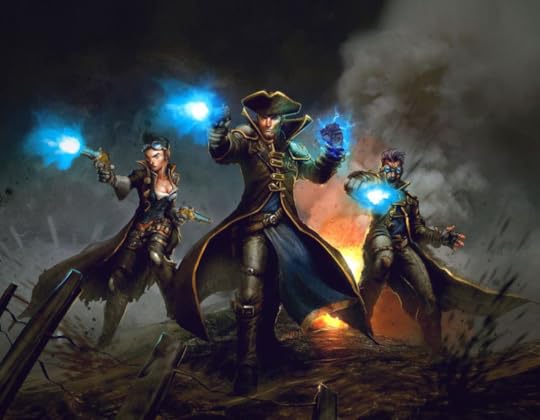
The Black 13th From Warmachine… mmm gunmages.
1) Realism: Who would wear plate-mail or bother to learn magic in a world with guns? This is an older argument and essentially a failure of imagination. The idea was that guns were such a dominant technology that they would overpower common Fantasy elements like mages and dragons. No seriously, people used to say this to me. As the genre broadened, writers have shown that they can easily accommodate both in the right setting.
2) Anachronism: Some pastoral Fantasy is certainly based on a yearning for the purity of an idealized pre-industrial middle ages, the kind of storybook setting you would see in an early Disney movie. This sort of vision has no place for guns. Even in modern day, Fantasies that want to evoke a strong medieval feel shy away from firearms. Think about how even simple gunpowder weapons or even explosives would alter a setting like Westeros or Middle Earth.
3) The idea that technology and magic cannot mix: Often magic was seen as the polar opposite of science. This makes a certain amount of sense since magic seems like a crazy superstition to us in the modern day. Thus when technology did show up in the same story as magic, the two would act as forces battling it out. However many of the ancient magical and alchemical traditions were seen as pretty legitimate forms of thinking in their day. Modern Fantasy writers like Patrick Rothfuss draw on these traditions to create magic systems that feel a little more rational and mesh better with technology and the age of reason.
4) Lost Golden Ages and progress: A common trope in pastoral fantasy is that everything was better in the past. In the case of swords this is somewhat true. The making of a proper Katana is nearly a lost art, and certainly well past its Zenith. With Firearms this is harder to sell. Guns are an invention that have improved dramatically even in my lifetime. Hell, we even have guns that can aim themselves and come with a mobile hotspot, these days. Guns as we see them now are an artifact of progress. It would be interesting to read a Fantasy world where firearms were the product of some lost golden age, a convention usually reserved for post apocalyptic settings.
What changed? As the industrial age gives way to information age, guns have become acceptable in Fantasy. The easy answer as to why is that Fantasy has become a broad, vibrant genre where internal consistency and a good narrative are more important than following a particular formula. We have seen several new sub-genres of Fantasy develop lately with steampunk and urban fantasy, and even more seem to be budding. These are not displacing traditional Fantasy settings, but rather growing alongside them. Makes sense. Sadly it leaves me 400 words short of my goal, so here are some more specific reasons as to why I think guns have become acceptable in Fantasy.
1) Star Wars, yo! (and a lil bit of 40k): In many ways, Star Wars is Fantasy with spaceships and blasters. The Force is pretty much a magic system. It could be argue that Lucas’ early Star Wars movies helped pave the way for guns in Fantasy by popularizing them. The same goes for properties like Warhammer 40k and possibly even Dune, where elements of mysticism exist in a futuristic setting. Even if you don’t buy that it is hard to deny that watching the Jedi parry blaster bolts with their lightsabers helped writers imagine how magic and guns might interact and share the field.
2) More experienced consumers: As Fantasy grew in popularity, its readers grew in sophistication. More books, games, and other media means more exposure to new ideas and paradigms. This makes it vastly easier for a new author to introduce new concepts like an enchanted gun with runed bullets that explode on contact. Sophisticated readers are willing to buy more divergent ideas, as long as they make sense. They can also help explain things to new readers, who might have trouble understanding what a spell is, let along a gun mage firing thunder-shot.
3) A niche to fill: As Fantasy becomes more and more popular it attracts more and more writers, people like me who want to make a living writing Fantasy books. It is harder to stand out writing traditional Fantasy. Fantasy with guns is yet another niche to explore for veteran authors and for new authors to try to establish themselves in.
4) Is the gun an anachronistic weapon? Terrorists use bombs, superpowers use fighter jets and drones. The gun still has a strong role on the battlefield, but it is hardly the sexiest technology in the arsenal these days. While some guns are crazily high tech, the idea of fighting wars with guns is pretty settled in our minds. Could it be that we are so familiar with guns that they seem to be a little anachronistic now? After all knives were pretty common weapons in the middle ages, but our soldiers still carry them. The gun is a banner artifact of the industrial age. If we are indeed moving to the information age, then perhaps Fantasy’s acceptance of the gun is merely an indication of a larger cultural shift…


June 11, 2013
Tuesday Teaser
These are character quotes from the synopsis in Bloodlust: Will to Power. They all have a similar theme.
“I love the challenge of a tough fight and the roar of the crowd. I will impress you.” Sadira Lacivia, aka Red Scorpion.
“There’s nothing quite like the feeling of finding that perfect comment to enrage an opponent. I will get under your skin.” Ravius Vergerus, aka Ravishing Rude Ravius
“My friends trust me to defend them on the fighting grounds, I can think of no greater compliment than that. I will not fail them.” Vintia Legarda, aka Brightshield
“The Great Games give us the opportunity to lend our strength to better causes. I will make a difference.” Omodo diYava, aka Hammerhorn
“The arena weeds separates the weak from the strong. I will not let anyone take what is mine.” Karmal Kolat, aka Crimson Dragon
“In spite of everything, I cannot deny that I enjoy the way the arena pushes me to test my limits. I will find my way.” Gavin Orphanus, aka Lionfang
The challenge with these character quotes is to convey familiarity, reminding the readers of the characters from Bloodlust: A Gladiator’s Tale, while showing how each of them feels about the Great Games.
The second part of today’s teaser covers familiar territory: A summary of the events of the first book. I took care to emphasize the key points that drive the narrative in the second book, hopefully without giving anything away.
Synopsis of Bloodlust: A Gladiator’s Tale
In the Domains of the Chosen magic is power. Because of the Reckoning, a cataclysm brought about by a war between magic-wielders, the Gifted are also feared and controlled. Only those willing to face the rigours of the Great Games, as Gladiators, can earn the right to wield their magic unfettered. A lucky few might even win a place among the Chosen, immortal rulers of the Domains.
Gavin, a thoughtful young man, begins his career as a Gladiator in the Campus Martius. He seeks the freedom that can only be gained through the path of the Gladiator. Gavin is soon joined by Ravius, a cunning, sociable skirmisher who was his only real friend in training. Ravius introduces Gavin to the amiable Armodon Omodo. After he executes a Heretic, Olek Agvarson, in a Deathmatch, Gavin begins to question his place in the bloody games. The man’s only crime, in Gavin’s mind, was wanting freedom.
Gavin meets Sadira, a dynamic Shadow-Elf Gladiatrix, and the two fall in love. Sadira, already a skilled fighter and a consummate performer, seems destined for greatness. Many people do not understand what Sadira sees in Gavin. One of these is Sadira’s friend and rival, Karmal, who sees Gavin as soft and weak.
Sadira, Gavin, Omodo, Ravius, Karmal, and Vintia, another of Sadira’s friends form a troupe and travel to the town of Dreadwood Junction. There they hope to Gain the attention of Faction League recruiters and gain a fast track to better leagues. They succeed in gaining the attention of the Red Faction, but not before Sadira and Gavin get tricked into a Deathmatch against local favourites Bella and Cat. During the match Karmal kills the corrupt arena master, Meady Mox, whom she was investigating on behalf of the deliberative.
The six Gladiators join the Red Faction and travel to Camp Valorous, a busy military town on the edge of the Empire. They meet Cleothera, a friendly Grey-Robe. They train hard here and become favourites. Sadira, in particular, gains the attention of the crowd. When a rival Faction challenges the recruits, Sadira and Vintia are selected to represent them, winning handily. During this fight Gavin meets Valaran diVolcanus, the most feared Gladiator in a generation. Valaran becomes obsessed with Sadira, who he believes is the only woman worthy of him, and begins to send her gifts. Gavin struggles with feelings of self-worth.
When they troupe moves on, Omodo remains behind at Camp Valaran. He feels he must overcome his aversion to crowds and become more self-reliant. He eventually joins the Green Faction, but remains in contact with his old friends.
The rest of the troupe joins the Red Faction at Scorpion’s Oasis. Sadira hopes to win the patronage of Chosen Giselle, which will greatly further her career. The Oasis is a town traditionally dominated by the Blue Faction. Sadira is put in charge of the troupe. She trains her friends hard, learns to lead, and masters the complex Faction challenge rules with Gavin and Vintia’s help.
The troupe give their all and lead the Red Faction at Scorpion’s Oasis to a winning season, working hard to do so. As the season goes on it becomes apparent that Chosen Giselle will sponsor Sadira’s ascension to a higher league, but she will have to part ways with Gavin. Thus their victory at Scorpion’s Oasis is bittersweet.
Sadira and Karmal join Chosen Giselle in Brightsand Halls. Sadira gets a chance to train with a woman she has adored since childhood, but she finds that having little time to spend with Gavin is a heavy price to pay for Glory.
Vintia is saddened to be separated from her childhood friends. She decides to remain behind in Scorpion’s Oasis and defend their title. At least that way she will be close to Sadira in Brightsands.
Gavin meets Master Sax after a rough match in the Oasis. Sax reveals that Gavin’s spear bears the maker’s mark of the smith Liam Valcoeur, who never gives weapons to just anyone. Curiosity to meet this enigmatic smith and a desire to prove himself worthy of Sadira drive Gavin to travel to the north and join the Free Leagues. Ravius, Sax, and Cleothera join him.
Meanwhile Valaran seeks to find a way to eliminate Gavin and make Sadira his, and all the while the great players of the Domains plot, getting ready for the coming Grand Championships where the victor will join the ranks of the Chosen.



