C.P.D. Harris's Blog, page 76
May 16, 2013
Battle Tactics: Lay of the Land — How Wondrous Geography could change warfare in Fantasy fiction
“Ground which can be abandoned but is hard to re-occupy is called entangling. From a position of this sort, if the enemy is unprepared, you may sally forth and defeat him. But if the enemy is prepared for your coming, and you fail to defeat him, then, return being impossible, disaster will ensue.” Sun Tzu, The Art of war
Memorable locations are a staple of Fantasy fiction. Describing the geography of the impossible is one of the noblest uses of prose in our little corner of literature. However these awesome mindscapes often fall flat when the writer gets to the action and fails to consider how this fantastic and unusual terrain might change the battle.
In an attempt to keep it short, I’m going to take five fairly common Fantastic landscapes and note how they would hinder and change typical battle tactics.
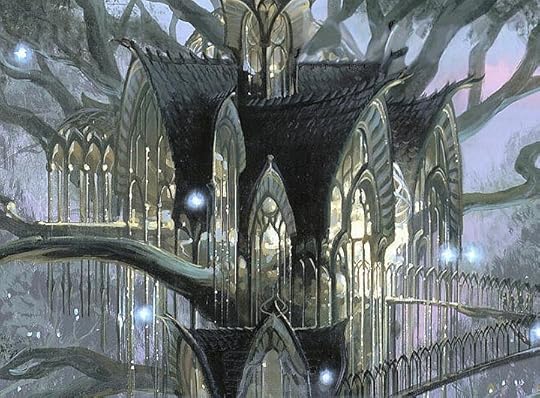
The Elven Treehouse City: Huge platforms built or grown high in the trees of an ancient forest or jungle. Some versions of Lothlorien have this, but the most familiar incarnation would be the Ewok City from Return of the Jedi. The Treehouse city provided basic shelter from ground attack simply because of its height and easily controlled access points.
Fire.
Think of the Treehouse City as a castle of sorts. The Trees serve the same function as a wall in many ways. The height keeps ground attackers out and provides an excellent vantage for firing down on attackers.
Chopping down the trees would be effective, but would by slow and expose any attacker to missile fire or dropped objects. Some trees in fantasy environments might be tougher than stone or have other defences.
Fire is a good bet. Most cities have water sources however and would already have a fire plan of some sort. It is a good opening gambit though. Even if lighting the trees on fire is impossible building fire underneath the Treehouse City will force the defenders to inhale copious amounts of smoke.
You don’t always have to attack from the ground. A smart foe might raise their own platforms and build over towards the city, or even attack from the canopy.
Fighting in a Treehouse City that gets invaded is likely to be a chaotic affair. It would be hard for most enemies to maintain formation on bridges, winding stairs, platforms, and elevators. Defenders would likely have drilled to fight in their home territory and would make excellent use of the terrain.
Falling is always a danger.
Giant Spiders and other quick-climbing creatures could really be the bane of this type of defence since they might have easier access to the city than those who live there.
Sky Islands: Sky Islands are a favorite of mine. They are generally depicted as floating chunks of rock that either drift on the winds or hover in place.
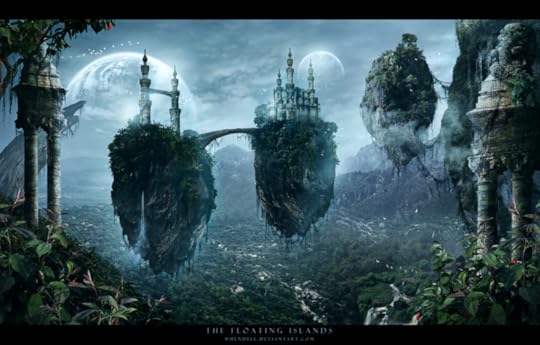
How would these guys go to war?
Most Fantasy novels tend to have people building on the Sky Island, but if the whole thing is made out of rock you could also carve structures into it.
A Sky Island is ridiculously defensible, but likely too small to have much food. Investing to starve the inhabitants out would be a good option if it stays in one place.
Assaulting a Sky Island requires flight. I suspect that most defences built on such a place would center around repelling attacks from the sky. A castle on a sky island would look cool, but huge, thick walls would serve little purpose unless someone can get a siege weapon up there.
I like the idea of little kingdoms on drifting sky islands that engage in warfare as their isles drift close. It would likely be an affair similar to a boarding action between two ships.
A Sky Island that drifts at the owner’s will would be an ideal siege platform in a Fantasy world. Hovering over an enemy city and dumping your refuse and rubble on them would be very effective. Cities in such a world would adopt strong aerial defences such a reinforced roofs and air defence platforms.
Dragons and other flying creatures would be ideal combatants for this terrain. A whole aristocracy of sky-riders could be the result.
Lava Flow Wasteland: Before modern Fantasy, evil Overlords lairing in inhospitable places like a volcanic wasteland was all the rage. Laying siege or fighting a battle in such an area would be interesting.
Lava flows are much more dangerous than most enemy combatants, and soldiers would be very wary of these if forces to fighting in such conditions.
Poisonous fumes are a concern.
Directing lava flow becomes a tactic for whoever holds the high ground.
Fighting on rock and obsidean is also unforgiving.
Causing an eruption might be a viable attacker’s tactic, but surrounding the place and starving the enemy out looks like a better option than fighting in most cases.
A powerful elementalist might be able to wield the terrain itself as a weapon in these areas, or settle it long enough to stage an assault.
Dungeons/Dwarf Holds: Underground cities are fairly common in Fantasy Fiction. Waging a battle in these could be very interesting.
As written in Lord of the Rings a small party can hold off a much bigger group of enemies using choke points like tunnels.
Light becomes a major issue for invaders, unless they can see in the dark.
Enemies from below invade by tunneling into your home territory, the patrols of the defenders would be alert for signs of mining.
Water flows downhill. Diverting a river into the dungeon is a great way to clean it out, at least partially.
There are all kinds of unique hazards underground. Pockets of Gas, unstable caves, and hidden drops just to name a few. In a fantasy world dangerous creatures would abound.
Formation fighting could be very effective in tunnels. I always picture Dwarves with reach weapons, braced against invaders in a phalanx.
Traps and collapsible architecture make for interesting possibilities for the defender, but also the the attacker.
Sealing off air-holes could be an excellent method of besieging such a place.
The Mega-Structure: Imagine a structure large enough to be a city unto itself, or even house more than one town or tribe. A huge tower or a massive Gothic castle like Gormenghast qualify as a mega-structure.
Rooms could become battlefields if they are large enough. The terrain of the battle would therefore depend on what the room was mean to be used for. Imagine a pitched battle in a colossal library or a massive kitchen.
External walls are less important against internal threats, controlling key passages would be key from the start.
The battlefield is functionally three dimensional, even for the landbound. Enterprising enemies would be able to attack from above or below.
Logistics in such a place would be bizarre, ranging towards storage areas and home territories.
Scouting and signaling become difficult.
Modern city fighting techniques might apply here, busting through weaker walls/roofs/floors
Damaging the structure you live in is less desirable. Less use of fire and scorched earth tactics.
Formations would be based on corridors and covering side passages.
These are just a few, very simple examples of how unusual terrain can change warfare. The best way to approach how these or any terrain elements might change a battle is to sit down and think about it, preferably with a few imaginative friends and some tasty beverages. Cheers!


May 14, 2013
Teaser Tuesday
Another Teaser from the book I am currently revising/polishing and will soon be doing edits on (Bloodlust: Will to Power):
“Disgusting,” said Ravius, said Ravius, indignant and revolted in equal parts. “I can’t believe how hard this stuff is to get off.”
“This part never makes it into the arena reports I guess.” said Gavin, shaking his head. They couldn’t get rid of the horrible smell; his stomach churned constantly filling his throat with bile.
“So much for the glory of being a Gladiator.” said Ravius. He dry heaved again. “Ancestors have mercy! I can still taste it. I drowned it that stuff. On days like this I wish I’d chosen to be a Vassal. I could be massaging some high lady right now instead of this…”
“Aye,” said Gavin with a chuckle. “No wonder Omodo hit the baths early. He probably couldn’t wait to escape the stench. Some days winning doesn’t feel like much of a victory.”
“I wish I could go back to the day I faced the choice,” said Ravius. Gavin’s eyes met his old friends; Ravius looked tired, defeated. Gavin knew the feeling.
“Would you take a different path?”
“I hate to admit it, little brother,” said Ravius, grimacing as he scrubbed his skin with a special scrubber that felt like a cheese-grater. “But I am beginning to share your pessimism towards the Great Games. It seems like such a waste of life. I often wonder why I’m still doing this.”
“I’m still in the Arena because of Sadira, I guess.” said Gavin. “I need to show her I’m worthy.”
“A warrior without pride is no warrior at all,” said Ravius, nodding. “I get it. I don’t have that excuse though. It doesn’t feel right to me any more. I thought fighting a Kraken would be grand… Now I just want to get clean and get drunk and hope I can forget the smell and drowning in vomit and inky water. I wonder if artificers, merchants, and tradesman and tradesmen have days like this?”
“I’m sure they do,” said Gavin. “But that’s just it… no one in the crowds sees the arena as a job. When we made the choice, we didn’t either. We just thought about the freedom that we would have when we joined the Chosen. We thought of killing monsters like the heroes we grew up reading about and watching in the Championships. Some of the works I read as a kid even mentioned the down side, but I never really understood that part until I’d experienced it. I only saw the positives.”
This discussion comes after a particularly grueling fight. We can see some character development here…


May 12, 2013
Battle Tactics: How Fantasy Elements can Change Warfare in the Age of Reason
—Captain Rees Howell Gronow, Foot Guards — The charge of the French Cavalry at Waterloo ( One of the most poetic description of the battle. The charge was a failure: The English formed infantry formed up and repelled the charge. Ney did not support the charge with Infantry to counter this and is often blamed for the French defeat.)
Flintlock Fantasy, Steampunk, and other forms of Fantasy set after the middle-ages are gaining prominence. Part of this is that as Fantasy matures as a genre, authors feel more confident branching out beyond the traditional settings. I also feel that part of the service that Fantasy offers is to mythologize the past and that we are now distant enough from the conflicts of the age of reason to parse them, anachronize or grimdark them, and re-introduce them to a broader audience through the wonders of popular fiction.
The Renaissance the Reformation, the Enlightenment, and the early industrial age, which I will collectively and brutishly refer to as the Age of Reason, brought great changes to warfare as well as to the rest of society. Introducing magic and other Fantasy elements to this volatile age is an exciting prospect, but one that is fraught with peril.
Take your standard Fantasy wizard type. We know he can change the classical battlefield or the wars of the middle-ages pretty easily (if you don’t read this and this). Fireballs could blast formations to pieces and hereditary magic could bump the knightly aristocracy down the food chain. But Gunpowder would change that, right? I mean muskets give a brigade of common men nearly equal footing with the great mages of Fantasy… could the Old Guard take down Gandalf? the answer depends entirely on who is writing and how they define magic in their world. The problem is just dumping magic onto an age of Reason battlefield without considering the implications results in problems. A firing line of muskets or the Grand Battery could certainly rival a great mage for power, but what happens if he can call lightning down on your powder stores? and don’t even get me started on what a Napoleon figure could do with a guy who could summon fog or rain.
To show how Fantasy Elements could change warfare in this period, I am going to discuss warfare what warfare in this period was like. Naturally this is extremely generalized and covers a broad swathe of history, and glosses over many of the more contentious arguments about warfare in this period. Don’t use this as research for your thesis 
Centralization of Power, Standing Armies, Conscripts and Drill: As the age of Reason progressed military power became more and more centralized, be it in the hands of a King or a president. Collections of feudal bonds were replaced by states. The old nobility with their personal armies were replaced by professional soldiers supplemented by militia and conscripts. The return of drill, more than anything, spelled the end for Knights of old.
Early in this period well-trained Pikemen become more and more common. Drilled to form up into a hedge (and later a square) against cavalry charges, these guys could even repel armoured knights. Some historians feel that well-trained longbowmen, drilled to shoot rapidly ended Chivalry. Courtly life at Versailles certainly did. As well trained footmen that could counter heavy cavalry became more common the knights in heavy plate disappeared and the role of Cavalry changed (see below). By the time the guys with guns show up Knighthood was a thing of the past.
Centralization of power and industrialization allow for uniform equipment of soldiers on a much larger scale.
Conscription and the return of the professional soldier led to bigger armies and reserves. The armies of these periods were often very large and some of the battles were colossal.
Skill at front-line fighting was no longer a necessity for a general. Leadership, Logistics, Tactics, and Strategy become more important. Keeping abreast of technological changes and adapting becomes increasingly vital.
Drill becomes extremely important. Well drilled artillery and musketeers fire faster and are less likely to break as men around them fall. Charging at the right moment or assuming the correct formation on time become pivotal. Discipline is king.
The Role of Infantry: Infantry gradually become prominent again in the Age of Reason. The Pikemen and Swordsmen of The Prince gradually gave way to musketeers, and then line infantry armed with “rifle” and bayonet. Gun technology progressed but the bayonet remained important throughout this period.
Early line Musketeers would fire at a short range and then charge. Gustavus Adolphus is said to have perfected this kind of warfare. He drilled his Line Infantry to fire en-masse , afix bayonets, then charge. The initial volley would shock the enemy line and make them more susceptible to the charge.
A rifle with a bayonet is as efficient as a spear in the hands of a well-trained soldier. Do not think of line infantry as weak in close combat.
With proper drill and discipline infantry armed with rifle and bayonet could assume formations that could repel Cavalry.
The famed square of the Napoleonic line infantry was a bayonet hedge on all sides with a hollow space in the middle. It was very resistant to flanking and charging. People would still shoot in and out of the square but the formations were so large that attrition could go on for some time. It was sub-optimal against line fire and really rather vulnerable to artillery though. They tended to drill so they could form up quickly when it was needed. The hollow area in the middle could be used to trap cavalry or shelter valuable personal/cannons/wounded, or the Emperor himself
Skirmishers armed with rifles saw use, particularly as screens.
Grenades saw use later in this period.
Infantry started to become more and more specialized.
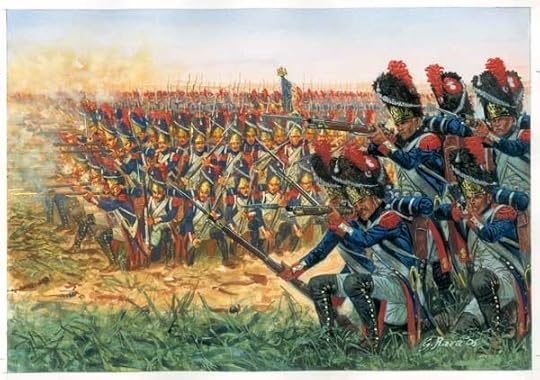
Firing from square formation. Not sure what this is depicting. Old Guard I think.
The Role of Cavalry: Cavalry still saw use well into the age of the gun. There were many types. Lancers, Heavy Cavalry armed with sword and pistol, Chasseurs armed with carbines, Dragoons that could fight with sabres or dismount and use rifles. They all had their uses.
Cavalry dropped the heavy armour in favour of speed. There were exceptions, like the Curassier, but even these were still not the Knightly tanks of old.
Proper use of Cavalry included destroying troops out of formation, artillery in vulnerable positions, or countering other cavalry.
Charging into cannons with proper fields of fire would result in dead Cavalry. Charging vulnerable cannons was key.
Over the Age of Reason the Cavalry charge stopped being a leading tactic and became a reaction tactic for the most part.
The use of Cavalry really ended with the machine gun, better guns, and trench warfare, somewhat beyond in this period. Cavalry still saw use in the American civil war and even in the World Wars.
Cavalry was absolutely vital in pursing the enemy and making sure units did not reform and rejoin the battle.
The Role of Artillery: Artillery gradually came to dominate the battlefield in this period of warfare. Cannons destroyed old fortifications, wrecked formations, ruined cavalry charges, and filled the air with thunder and smoke. Cannons, Mortars, and even Rockets saw use in this period. Specialty shot became common as well. Grapeshot was used to destroy massed of men who strayed too close or break charges. Cannon balls would streak through the air and blast through lines of men.
Most artillery was too heavy to move much during a battle.
Some smaller cannons could be moved bu horse and set up under fire, even during battle.
Cannons could be used massed or distributed through the ranks, varying by tactics.
I cannot imagine the terrible courage of men who stood in lines against cannon fire and massed musket fire. Perhaps being able to see the men opposite them struggling to reload spurred them to action. Maybe it was like a race.
Enemies would disable enemy cannons by spiking them, since they would often have to give up territory in the face of a counter-charge. Captured cannons were added to existing batteries after battles.
The Use of Terrain and Weather: The Generals of the Age of Reason used terrain to their advantage. A slight rise could shelter a line of men or hide a cavalry formation. The high ground could prove a decisive advantage. Fog could conceal troop movements and allow a surprise charge. Rain and mud could bog artillery down. Formation and Manoeuvre were of great importance in this style of battle.Naval Battles: This was the age of sail. Naval battles were thunderous, magnificent affairs. Ships would manoeuvre around trying to gain better fields of fire. Bigger, better ships, with more and more cannon became prominent. Naval warfare in this period deserves a post on its own.
A crippled vessel could be captured.
Boarding actions were prominent.
Naval power became exceptionally important in this period. Not only did it allow control of ports and colonies, it made moving and supplying armies easier.
Fortification in the Age of Reason: The old castles often could not stand up to cannon. City walls were useless against cannon that could fire over them or reduce them to rubble. However the fortifications that were actually built in this period were nigh impregnable. The star forts built by Vauban and others were so defensible that the generals of the period were loathe to attack the bloody things head on. This often forced long sieges and encouraged the smart general to seek out a decisive engagement in the field.
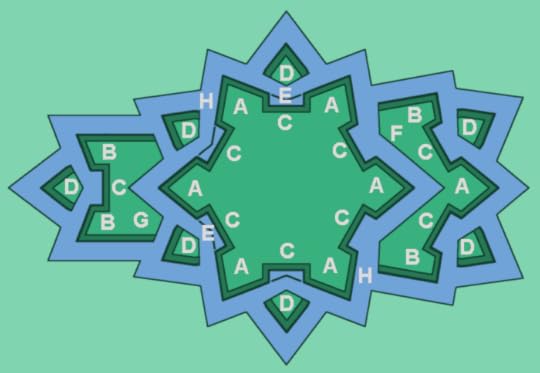
A simple star fort diagram (top down view) showing the overlapping fields of fire. Take one part of the fort and the rest could fire on you.
I could get into supply lines and the the goal of crushing the enemy army in the field as an expression of will, but you likely get the point. So what happens when you add magic to the field?Steampunk Elements: Steampunk tends to be Victorian but introducing some Steampunk tropes to the Age of Reason battlefield can be rousing good fun. The effect of Steampunk tech is generally to advance weapons technology a bit further on. Napoleonic era battles might look like a Flashier version of the American Civil war with Steamtech added in. Better rifles, machine guns, and cannon would end line warfare. Accurate long range rifles and cannon force the command structure back from the field. Exotic tech would have unusual effects.
Flight makes fortifications more vulnerable, and spying enemy formations easier. Gyrocopters and dirigibles would be superb spies.
Tesla cannons might replace grapeshot.
Knights might survive into this period with steamtech powered armour.
Coal suddenly becomes a burning issue for supply.
Steam Tanks would become a dominant force if introduces in significant numbers. They can survive cannon and rifle fire and advance through lines.
Fantasy Creatures: Fantasy creatures can have an interesting effect on the battlefield.
If a creature is large enough to haul a cannon around and can be trained for combat, mobile artillery can become way more fun. Ogres with cannons and giants with guns mounted on them are a popular staple of fantasy wargaming. I personally like dire trolls throwing gunpowder bombs myself.
Dragons might be vulnerable to cannon-fire, but gunpowder and slow moving artillery are likely more vulnerable to a mobile, fire breathing dragon.
Exotic Cavalry mounts are game changers. Napoleon made great use of camels in his Egyptian campaign, Imagine what a creative general could do with armoured crabs that could withstand cannon fire or some sort of mount that allowed amphibious operations.
Unusual races bring new tactics. Nightvision alone would change so much in this style of warfare. Generals could setup and attack with artillery at night, conduct superior night raids and watch enemy deployment. It would be a nightmarish (heh) advantage if your enemy had it and you didn’t.
Could the undead be taught to use simple firearms? Drill is fairly mechanical (early on at least). Their morale is unshakable, and they keep fighting despite injury. Those are both incredible assets in this style of warfare. Zombie line infantry… hmmm.
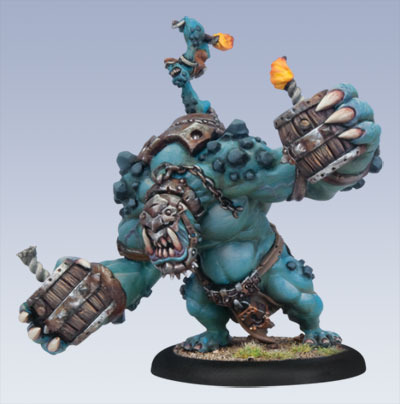
Dire Troll Bomber from the game Hordes (Privateer Press)
Mages and Wizards: The Common Wisdom in gaming used to be that the gun replaced the wizard. This partly has to do with the pedigree of RPGs and Fantasy wargaming. The wizard essentially too the place of the artillery in some of these games. Lately Fantasy has progressed beyond this. If a cannon is nasty, what about a magic cannon? Wizards can also do much more than provide direct fire-power. Think about the interactions between your magic system and your battlefield. One of the reasons I enjoyed Promise of Blood, is that Brian McClellan thinks this interaction through. Read it and see why… he has powder mages!
Gunpowder is explosive. If a mage can introduce even a small amount of fire to something at a decent range gunpowder warfare changes dramatically.
Enchanted bullets cannons, and guns, could be serious fun.
Enchanted armour could resist the weapons of the period, this would radically alter the battlefield making the charge a more dominant strategy and possibly creating something like a knight.
The tactics of this age are much more complex, thus the ability to summon fog, illusions, and even simple communications spells can really change the field. Swordsmen might still have a role if they can get to the enemy without being seen. Spying on the enemy with spells to learn a battle-plan is even more effective when deployments are so vital.
Defensive spells could allow cavalry to charge right into cannon fire, making protecting the artillery more important.
Healing magic could prolong engagement times and make breaking the line an arduous task.
In general it is not enough anymore to simply add a Fantasy element to Warfare without considering how it will effect the battlefield (unless that’s not the focus of your story). Modern fantasy readers are more astute and less forgiving. Think it through, discuss it with other authors and readers. It is a rewarding aspect of world building, and when done properly it creates awesome books. Seriously get writing your Napoleonic Fantasy world right now! I want to read it…


May 9, 2013
Dwarf Fortress, Art, and how I learned about Simulationism as a creation myth
I am mildly obsessed with Dwarf Fortress, a crazy little computer game that has been in development for over a decade. (LINK) I say mildly because I am not playing it right now, so I only think about it now and then. It is the sort of game that stays with you, and that you will likely pick up again and again or at least feel tempted to read about on the DF subreddit to see how it is progressing. It is opaque to outsiders, seeming at first glance like a harmless, but crazy cult obsessed with lava, kittens, and fun. It is however one of the most complex and interesting simulation games I have played. Players set parameters and create a world. The worlds terrain and population is procedurally generated and then run through a fully simulated history until it is ready to play. The history generated is so detailed and intricate that a subset of players just generates worlds to view the history and legends for interesting legends and events. The game is so detailed that great events show up again and again in artworks, another fantastic feature.
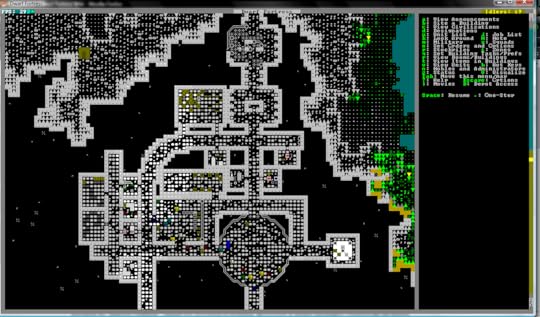
A single level of a fort without a complex tileset or 3d viewer.
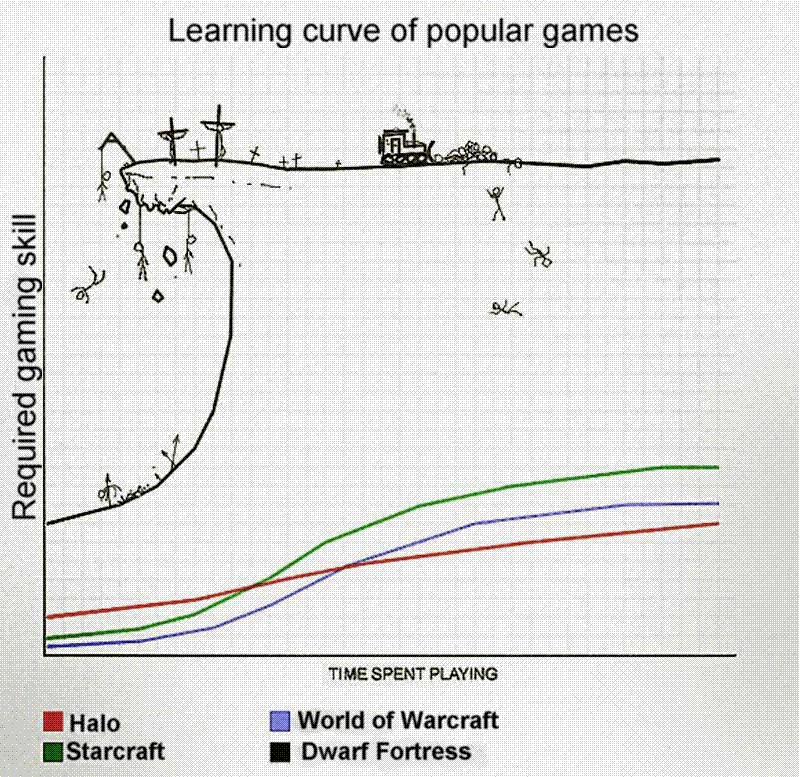
Dwarf Fortress is such a superb game that it has made it into the Museum of Modern Art, despite its relatively obscure (but fiendishly brilliant) following and lack of compelling graphics. This New Yorker piece does it some justice, but only after playing can you really begin to understand why people love this game. The UI is currently opaque to most beginners and the difficulty curve is notorious. Fortunately the community is amazingly helpful.
In Dwarf Fortress Mode you take seven Dwarves out into the wilderness build a new outpost for your civilization. You choose a spot on the map and give it a go. For most novices it barely matters where they choose to dig in, they’ll likely die from starvation, thirst, or have all their equipment stolen by giant keas and lose their fortress before the end of the first year. After a few tries or some good play, a player will survive long enough to get wiped out by ambushes, necromancers, floods, disease, or horrible/funny procedurally generated monsters called forgotten beasts. Veteran players who learn to savour the mad challenge of the game often choose the most difficult or “fun” spots for their forts. Places where it rains blood or the ground has that pet cemetery thing going on.
If your Fortress survives for a few years you will create an impressive, sprawling domain that gradually fills up with more and more dwarves. These dwarves all have a randomly generated personalities and your control over them is very limited, much like other sim games, but far more nuanced. They form attachments and their mood can effect the fortress more than you might think. You will be busy planning layouts, industries, a military ,and maybe even complex projects like a lava trap, some mad treasure room, or a grand mega-project. Meanwhile your dwarves will be getting into trouble, forming relationships, engaging in politics, doing stupid things with waterfalls and caves, searching for love and job satisfaction and so much more. It is layer after layer of complexity.
What makes it fun for me is the narrative that the simulation can create. I love the story of a good fortress. Tales like that of the fortress Bronzemurder, or massive, sprawling epics like that of Boatmurdered are what inspired me to try the game. Most of my Dwarves are rather boring and live short, brutish lives because of the hostile nature of the game’s universe. However, every now and then I find a Dwarf I like. A brilliant, fearless warrior, a cunning artisan, or an inspired inventor, that Dwarf seems like an Alexander or an Einstein. These great Dwarves seem to me to guide their fellows into a new age of prosperity or at least help them dig in against the grim darkness that is bearing down on them.
My favourite personal tale is of a relatively young fortress that dug deep into the ground, seeking magma for the best forge I could make (and other goodies). I encountered a system of caves, cleared them out with my lowly militia and set to farming spider silk for my industries. I made sure I was safe, walling off every way into the fort with trap doors and retractable bridges, traps, and deadfalls. A forgotten beast arrived, some long lost creature that resembled a twelve legged spider with wings made out of green glass. I set off some alarms and closed off the caverns, recalling all my dwarves to safety. Little did I know that one of the wall’s I’d ordered sealed off wasn’t done yet. The Green Glass beast made a beeline for this vulnerable point while I frantically tried to get a dwarf to erect a wall that would stop it from getting in.
Naturally the beast beat me to the punch. It scrambled into my tunnels, killing the Dwarf trying to put up the wall by spitting glass shards at him. The effect on the poor dwarf seemed to be like being hit by a shotgun blast at close range. The beast chased the remaining dwarves up into the great hall where it destroyed my loyal wardogs and faced off against the remains of my militia. The beats was quick, deadly, and hard to hurt. Within moments half of the militia was dead, dying, or incapacitated. I was watching the fight, waiting for the it to eliminate the last six, valiant dwarves. After a moment I realized that no one had died. Upon looking at the combat logs I realized that the dwarves were grappling the beast, hold down its deadly legs and shard spewing mouth. My militia captain emptied his crossbow into it while the others held it down. This proved ineffective so he bashed it with the crossbow when he ran out of ammo, eventually smashing it to a pulp. Two of the dwarves holding the beast down succumbed to their wounds shortly after (I wasn’t that good with hospitals at that point). I was amazed by that struggle, which took places over several days of game time, and the tenacity of the dwarves in defence of their hall and their more cowardly (sensible) brethren. I even wrote a poem about it and used the beast in my writing. I created superb tombs for those lost in the struggle, picked up and carried on. Later on the incident started showing up in the artworks of the fortress, reminding me of that awesome moment, over and over. Until that fortress fell, that is.
There is far more to the game than I could do justice to with what I am willing to write before dreams claim me. I could go on about the Fortress I made which got cut off from the mountainhomes (settlers stopped coming). It is also a constantly evolving game, only a third of the way to readiness as the creators deem it. Sitting there watching my Dwarves, trying to guide them through their tribulations and triumphs, did remind me of something I’d read before.
There is an idea floating around that if we are able to create a truly complex, lifelike simulation with independent actors and functioning systems then there is a high probability that reality could be a simulation of some sort. This makes for an interesting creation myth for a fantasy world. Instead of a benevolent god or nothing at all we have have a complex game set up and created by someone interested in observing it. This is a truly fascinating idea for fiction at the very least. Here are a few basic ideas.
1) A person who realized that they were in a simulation could discover the code, which could give them power, much like neo in the matrix.
2) Some of the sims could start a religion worshiping the game creator, creating new sources of inspiration and conflict.
3) The game creator could fall in love with the sim or something in it and thus try to insert themselves into the sim in some way.
4) The sims could become aware that the game creator is trying to” turn them off” and end the simulation, and might try to do something about it.
5) Could complex simulations become protected by laws. If the sims are considered sentient, feeling creatures might a benevolent society protect them from harmful events? If so would the bad elements of that benevolent society run “depraved” illegal sims?
Meaty ideas. Perhaps that is why DF is great food for narrative: it is thought provoking. Perhaps one day I will write a full tale based on a favoured fortress…


May 7, 2013
Teaser Tuesday… and my 100th Post!
“Names?” The Free Leagues clerk was strangely informal, even for a junior officer of the Deliberative. His attitude was akin to that of a man tallying grain stocks instead of taking the names of fighters for a league qualifier.
“Ravius Vergerus,” said Ravius, teeth gleaming in the sun as he grinned.
The clerk, deftly recording this, suddenly looked up at Ravius, irritated and expectant, before Gavin could utter his own name.
Ravius paused for effect, drawing it out. The clerk’s stylus hovered impatiently above his tablet, involuntarily still. “Arena name: Ravishing Rude Ravius.”
The clerk frowned, unable to tell if the Gladiator had forgotten or was merely jesting at her expense. This robbed him of his chance to be superior and he quickly turned to Gavin.
“Gavin Orphanus,” said Gavin evenly. “Lionfang.”
The clerk paused, gazing at the information in the crystal of his link tablet.
“I see,” he said. “You’re both Gladiators, ranked six… Faction Champions, albeit from a small town in the south… Decent records… Still in good standing with the Reds. I see no problems here, honoured Gladiators. Do you wish to join the Free Leagues?”
“We do,” Gavin answered, cutting off any chance for Ravius to exercise his wit. They’d stood outside in the rain and mud for several hours for this very reason, but the clerk still needed their official acquiescence.
“Agreed,” said Ravius.
They both touched their thumbs to the clerk’s link to finalize their agreement.
The Free Leagues are a sort of Gladiator’s limbo where fighters who aren’t happy with their prospects in the Faction leagues try to build a name for themselves. The freedom appeals to Gavin.
And a little something extra since this is my 100th post.
Gavin turned down two more passages, going right whenever he was faced with a choice, before he came to another wide clearing. He detected faint musky odour. He took two steps into it before instinct screamed at him to stop. He whirled around as the spike hound that had been trailing behind him attacked. The Gladiator’s lunge caught the beast in the air. The Gladiator’s aim was precise and creature’s own momentum drove the spear through it. Gavin let go of the spear and sidestepped the body as it crashed into the brush walls, where it twitched in its death throes. He barely had time to draw his short sword before the others were on him.
The next few moments were a confusion of snapping jaws, gnashing fangs, and desperate footwork. Powerful, spiny bodies darting at him from multiple angles. A heavy form barrelled into him. He twisted to minimize the impact, then sent the beast sprawling with a kick. A powerful clawed paw swiped at his shield. Gavin turned and raked the offending limb with the device’s razor edge. The Gladiator was able to keep on his feet. Fending off the two remaining hounds by backing down a tunnel.
This fight takes place in a maze. One of the Chosen is using Gavin to test a new match venue. Of course, like anything in the Domains there are multiple layers of meaning in this test…


May 5, 2013
Battle Tactics: How Fantasy Elements Can Change Medieval Warfare
I have a similar post on Classical Warfare: LINK
I am not a the biggest fan of the middle-ages these days. I love that that fantasy fiction is branching out into other periods. As a kid I was all about Knights, Crusades, and Castles but these days I realize that the Medieval period were a pretty tough time for Western Civilization; the rest of the world had much more interesting time of things; Islamic Civilizations were flourishing, the Mongols and Vikings were making an impact, China was lofty and mighty, and Japan was getting very interesting. Nonetheless, no matter how much I try to distance myself from that period, there is an undeniable appeal to the middles ages. I enjoy a wondrous tale with Castles and Knights as much as any other form, but I do grow tired of the elementary mistakes that some authors make when they add Fantasy elements into their battle scenes.
Take fortifications as an example. The castles of the middle ages were made to ward off assault by anything and everything that could be brought against them. However, Fantasy elements change the field dramatically. What if necromancy is commonly used in warfare in your world? A castle will have to change to ward off ghosts and attack by incorporeal entities. Perhaps the walls are lined with lead, have a prayer sealed in each stone, or runes written on the bricks to keep them out. The graveyards and refuse pits will look very different if your enemy can raise the dead to fight for them (just ask any Dwarf Fortress player). A moat is not much of an obstacle to some kids of zombie attack. I like it when an author put some effort into considering the effects of the more common Fantasy elements on their world. Castles were ubiquitous because they were pretty damned effective.
I’ll start off by detailing the more common features and tactics of Medieval warfare. This is very, very general and covers a big period of time.
The Knights
Knights are a staple of Fantasy. Trained from a young age to fight on foot and from horseback they are the pinnacle of combat at the time.
Cavalry Warfare dominated the middle ages. Many tacticians at the time felt that the Knight’s charge was an unbeatable tactic (not true. really, but it was the dominant tactic).
Knights wore expensive custom fitted armour that gave them a huge advantage over the majority of soldiers of the day. Even early Chain Hauberks provided superb protection and later suits of armour were almost impenetrable. Scholars still argue about how good plate armour was, but even those arguments range from really effective to crazy effective. All you need to know is that it could stop a lance strike and most arrows would deflect right off a cunningly angled suit. However, the weight of the armour meant that all but the hardiest of wearers would tire quickly if they had to fight on foot.
A Knight’s Horses are of singular importance. A good horse had to be well-trained, since being thrown in the middle of a battle could be very bad. As the weight of armour grew, bigger horses were needed. Eventually even the horses were heavily armoured. At the height of the middle ages there were many different breeds and types of horse, all used for different purposes. Feed for horses was a logistical concern as well.
Due to the expense of the armour, horses, and proper weapons Knights were relatively rare. Battle descriptions at the time listed them separately from soldiers.
Knights were an aristocratic warrior class, much like modern view of the Spartans or the Samurai. We often look down on them these days, but a properly trained Knight would have been fighting since a young age and expert in the use of horse, armour (yes, using armour is a skill), and multiple weapons. They were pretty serious business.
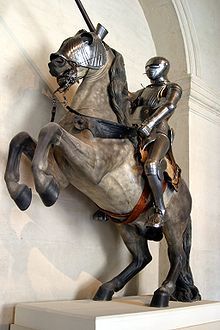
Swordproof. Imagine how modern warfare would change if soldiers were as bullet resistant as armoured vehicles.
Castles
Castles are another staple of the middle ages. Many of the most impressive of them were nearly impregnable, vulnerable mostly to treachery or starvation. At the time secular power was far more based around force and loyalty, which made control of territory based around what you could hold through strength of arms (big generalization). Castles and strongholds were the focal point of this system. They required that an invader stop and attack them, or risk having their supply lines attacked if they bypassed the castle. Attacking the castle took time, which would allow the defending power to muster a force to counter the invader.
The science of fortification advanced throughout the middle ages and even beyond (I’ll talk about Vauban and the Star Forts when I cover later periods)
They were often built in places where building siege engines was impractical, and nobody likes dragging a trebuchet around or trying to find ammo for the things. Even if an enemy did manage to get one in place, rubble filled walls and sally ports could frustrate their use.
Gate mazes, Barbicans, Moats, Murder Holes, and Machicolations are just some of the crazy defences that made attacking a well stocked castle a tough proposition.
Castles were bloody expensive (including maintenance), and took a long time to build. Many were improved over lifetimes. The inheritance of a strong castle was an issue of tremendous importance.
Castles also acted as the muster point for footmen.
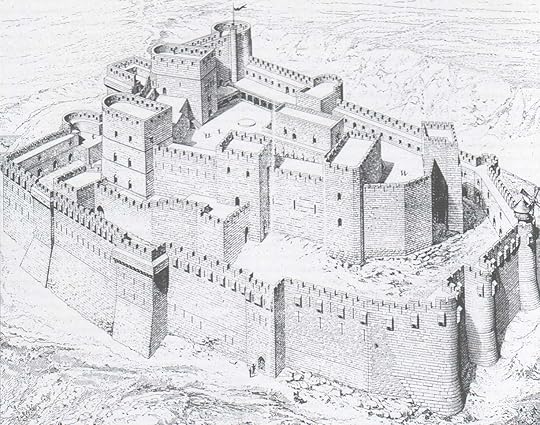
Krak de Chevaliers. You won’t have fun storming this castle…
Footmen, Archers, Mercenaries, and others forces
Professional Armies, like the Legions were a thing of the past during most of the middle ages. The Dark Ages had resulted in a serious decentralization of power, at least secular power. Each lord was responsible for bringing his own troops to battle. Some free yeomen had to be able to equip themselves and fight, but this was rarer. Archers were somewhat useful for breaking up a charge and more useful for hurting enemy footmen, but it was cannons and the centralization of power not the Welsh Longbow or the Crossbow that ended Knighthood.
Footmen were armed and armoured according to the standards of their lord. Polearms and spears were common since they helped unhorse a knight or opposing Cavalry. Despite this the battle between Knight and footmen was extremely unequal at the best of times.
Levies were often little more than fodder who would try to finish off/capture unhorsed knights.
Archers were mostly useless against a well equipped Knight on the field. Specialty archers/crossbowmen found some success, but these were rarer (It is also a matter of great debate). Archers were always vital to siege warfare.
Professional footmen and specialist troops found in mercenary companies, papal armies, and fighting for rich lords were much more effective. Some of these could even stand up to a charge when in proper formation. Later in the period centralization of power would put these footmen would put these footmen on a more even footing with Knights with better equipment and training.
Skirmishers still acted as an excellent screen, when used.
Cavalry units other than knights were less common, but still used.
Tactics in the Medieval Period
Tactics in the medieval period were a bloody mess. The decentralized nature of power meant that drill and training were reserved for the Knights and those who could afford mercenaries, veteran footmen, and the very very wealthy lords who could field sizable forces. This bring your own approach made for a rather chaotic battlefield.
In open battle one could expect a charge by knights, sometimes supported by heavy cavalry. The real danger would be opposing knights for the most part. Being unhorsed left a knight in a bad position due to the weight of armour. They weren’t helpless, just actually vulnerable to mass attack by footmen or any attack by another knight. The charge would mow down any footmen it encountered, unless they were well trained and equipped. Archers might give one side an advantage here by breaking formations or maybe downing a few knights.
More intelligent commanders often held the Knights in reserve instead of opening with them. Hitting an opposing group of knights while they were bogged down with footmen was a favoured tactic.
Battles tended to take place in the open. Knights kinda sucked in forests.
Siege Warfare was an entirely different matter. Knights were far more vulnerable. Archers were more effective. Often the attacker just starved the defender out, but if a tough castle needed to be taken and treachery was not an option it got real ugly real fast.
Borders were much more fluid, and front-lines were almost unheard of.
Being able to cut an enemy armies supply train could lead to their defeat before the battle even started. Foraging was possible, but living off the land was not the best option unless there was a town that could be plundered.
There is a great deal more complexity to it than that, and a fair bit of academic controversy over how effective certain tactics and arms really were, but it gives a decent overview of the nature of warfare in this period. Enough at any rate to see what the introduction of some fantasy elements will do to a medieval world.
Mounts, Magical Equipment, and the Knight
Knights were outfitted with the best arms and armour. Period.. The more powerful the knight, the better their equipment. Can’t afford the gear? You might be out of the club. In a Fantasy setting this gets very interesting.
If enchantment is possible, Knights will enchant weapons and armour. Depending on the rarity of magical arms this might further stratify the Knightly caste with those who are able to afford enchantments or have access to an enchanter having an advantage over their peers.
If armour can be enchanted or made from materials that can resist more advanced missile weapons it could extend the age of chivalry significantly.
Just like armour and weapons Knights will have the best mounts they can get. Different mounts can change the face of medieval warfare. If your Knights ride Griffons a fall will be more lethal and castle defences will have to incorporate some war of repelling/resisting aerial assaults. Unusual mounts require different foods and thus change the nature of the society that provides their needs. Dragons might be brilliant mounts with the fire-breathing and the flying, but all that meat has to come from somewhere… and what if they are particular to say, people?
The nature of Knightly power rested in being the best. Once other forms of combatants could challenge them, they vanished from the field.
Knights with magic or personal enchantments become very interesting. David Farland’s Runelords series has a great take on a knightly system where the dominant class borrows the strength of others, creating super-human knights. Increased strength allows a knight to wear more armour and carry heavier weapons.
Opposing Tactics
Armoured Giants or trained ogre footmen could put an end to the knightly order (or create a new one I suppose) if used frequently. If Knights aren’t the pinnacle combatant on the field they become too expensive to be useful.
Fantasy Horde tactics are not that effective against Knights. (The Mongols were a horde, but they used very intelligent tactics) Poorly equipped and trained orcs would not fare that much better against Knights even with their superior strength and toughness. They would need to be able to form up and use pikes to stand against a charge or use some of the tactics that the Scots used against the English armies. Tolkien is quite right to have the Rohirim run roughshod over the Orcs on the plains before Minas Tirith.
Orcish knights on the other hand…
Terrain plays a big factor in Knightly Dominance. Knights are less effective in forests, swamps, and cities.
Magic and the Nature of Feudal Power
Wizards change medieval warfare. If wizards can use spells that can get through armour at a rance and are common enough to be used in warfare, the age of Knighthood is likely over (unless your knights have some form of defence against magic).
Fortifications become less useful if they can’t stop a wizard.
If magic is hereditary and powerful then wizards will likely replace Knights at the top of the feudal food chain. This is something that annoys me to no end in Fantasy fiction. Feudalism is based on inheritance of power. In theory the aristocrats were a finer breed, but in truth their power was in wealth, weapons, training, and castles. If magic is hereditary and powerful then it becomes the new basis for feudalism, unless some other factor prevents it (and don’t say religion, or I’ll say divine kingship). The same is true for any form of hereditary magic power such as a mystic birthright that makes a family stronger. Unless the Knights have some sort of trump card they become a lesser order that is too expensive to maintain. I have serious problem with Fantasy novels that portrays magic as both powerful and hereditary, and still have non-magical knights ruling over society. Unless something is limiting the wizards their power would dictate that they become the centre of the feudal structure or at least a competing power.
There are a host of other Fantasy elements that change the structure of Medieval Warfare, the best approach is to sit down and consider what impacts a new element will have on the dominant assets (knights and castles) and tactics of the day. Often these details can make for exciting battles in your game or novel that will resonate with readers, and perhaps even lead to some truly interesting world building.


May 2, 2013
Consent, Tradition, Gay Marriage, and Female Characters in Medieval Fantasy Settings
One of the bits I really enjoy about Inglourious Bastards and Django Unchained is that Tarantino really demonstrates that he knows when to set aside historical accuracy, when to keep it close , and when to throw it off of a building. Sure World War II didn’t quite end like that in the real world, but we can fantasize, right? Keep that in mind…
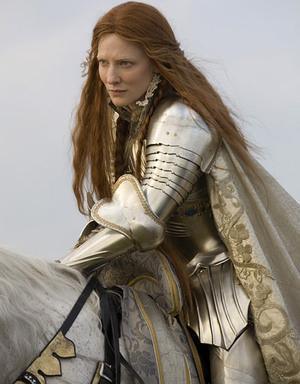
Because I like the Armour.
I’ve been reading T.H White’s The Once and Future King (spoiler warning). It is superb; I found the Sword and the Stone slightly tough to get through, but the rest has been absolutely brilliant. His Guinevere is interesting, and very relevant to my thoughts here. White sees Guinevere as an tempestuous child of privilege who grows into a brilliant woman who is confined by the role society sets on her, and she accepts for love of Arthur; her love of Lancelot is a form of relief from the burdens this duty: she lives vicariously through him. In White’s version of the tale everyone in Camelot knows that Lancelot and Guinevere are having an affair, even Arthur, and it is only when Mordred and company force the issue, using the law against Arthur, that it becomes a serious problem.
White’s version of the Arthurian Tale is quite faithful to Mallory, but focuses primarily on the characters of Arthur, Lancelot, and Guinevere. He does not deviate greatly from the traditional roles. Guinevere is given to Arthur as a bride at her Father’s behest. She has little choice but to follow that role, and when she considers breaking away from that role as a mature woman she chooses not to because she also loves Arthur and believes in his dream. Tradition binds her, but it is her choice to follow that tradition when she is at the height of her power. Very interesting, and nuanced.
Unlike the aristocratic alliances of the middle ages and Arthurian myth, modern notions of love and sexuality are based around consent. I often hear pundits decry that we are living in an age of immorality and permissiveness, where every form of “perversion” will gradually become acceptable. This is particularly grating in the gay marriage discussion, where I have been forced to listen to the argument that if we allow Gay Marriage, then it opens the door for bestiality and pedophilia! This is a nonsense argument that ignores the idea of consent which is at the heart of how we view sex and marriage. Gay Marriage is consistent within our laws because it involves a relationship between two consenting adults. This is not the case with bestiality or pedophilia. Interestingly as consent has become the basis of marriage, the legal age of marriage and sexual activity has actually gone up in comparison to non consent based system. You don’t see too many child-brides when consent is the primary factor.
In a Fantasy setting the laws are based around whatever the writer wants them to be. It seems wasteful to have a medieval attitude towards women, unless you are writing historical fantasy, or going the way of George R.R. Martin and using the ugliness of that system to fuel a medieval bonfire of the vanities. Cersei is White’s Guinevere in reverse, in many ways. The main difference is how she chooses to deal with the situation that is forced on her. It is an interesting comparison, but best left to a better thinker. If you need that tension, historical tradition certainly provides it. If you don’t, why bother?
If you make the rules in your setting, why separate the roles of the sexes at all? Your potential audience as a fantasy writer is full of both men and women. I guarantee a few of your female readers have dreamt of being Knights and a few of your male readers are far more interested in princely fashions than swords and armour. I see it all the time in gaming, and certainly in discussions about gender roles in books. Here are a few ways to approach changing gender roles differently in a medieval fantasy setting.
1) Role Reversal: I have to admit this is one of my favourites. Ever since encountering the matriarchal power structure of the Drow in D&D I’ve had a soft spot for fiction that puts women at the top of the power structure, including as the dominant warrior class.
2) Modern Gender Attitudes: It is bad to impose modern value judgments on historical situations. Fantasy is not history, however, so I see no reason that we cannot have the modern notions toward gender equality in medieval Fantasy setting. This approach allows for the widest variety of characters and greatest appeal to modern readers. It does lose out on the tension created by gender roles, but if you don’t want to explore those in depth, its not really much of a loss. This is the approach I use in Bloodlust, where the women are on even terms with the men.
3) Fully Re-created Gender Roles: For authors who want to get into the nuts and bolts of their Fantasy societies, we can really go crazy. I’m always minded of the Gate to Women’s Country by Sheri S Tepper, one of my favorite books, in this case. As a Fantasy writer or game designer you can create whatever roles fit the story you want to tell. You can have men and women live in separate societies, coming together only for procreation. You can rigidly define medieval style traditional Gender Roles, but make your own. The Stormlight Archives is an interesting example of this with men taking up the Knightly Arts while women are Scholars and Scientists (although men can be priests…)
Of course, just because the society you create defines gender roles one way doesn’t mean that your characters should always follow them. Sometimes it pays to break the rule’s you’ve created. After all for every story about a Guinevere or Cleopatra choosing to work within the role that their tradition places on them there is a Joan of Arc or an Aria Stark who chooses to reject that tradition and follow her own path…


April 30, 2013
Teaser Tuesday
Gavin felt a glimmer of power. The blade of Silver Rose’s dagger absorbed the blood, hungrily. The elf licked his lips, which seemed quite red of a sudden, and Gavin noticed his sharp canines seemed to grow in prominence. Bloodthirst was something he’d not faced on the fighting grounds. He knew Gladiators who studied the Vampiric schools could use blood to heal and power their magic. He’d not been expecting a blood-drinking blade, however.
Vampires successfully sued for citizenship early in the history Domains. They argued, quite effectively, that they were far less of a danger than the Gifted and were willing to curb their appetites and abide by binding oaths. They proved to be model citizens for the most part, and prospered greatly. True Vampires cannot develop the Gift, beyond some small skill with necromantic and blood magics. However, a Gifted who accepts a Vampire’s embrace develops some of the Vampire’s characteristics. Gavin could sense Silver Rose drawing power from the blood that his sword drunk. He wished he had more time to study the process, he could see that it was unlike many of the methods of Channelling taught to the young Gifted in the Domains.
The Channelling was unusual, but the spell pattern was familiar to Gavin: Razorwind.
A few thoughts on this:
I don’t think the middle of combat is the best place for a block of text talking about the role of Vampires in the Domains. I’m definitely moving the middle paragraph. It might work better as a break, but will likely get moved to the intro description of Silver Rose.
The Great Games are over a thousand years old. In that time anything present in the Domains and subjugated areas that could offer an advantage in the arena has been exploited and turned into a school. I expect their are quite a few schools based on common Fantasy tropes as well as more unusual ones of my own invention. This fits with the general theme of the Domains. They needed to exploit and use everything just to survive the reckoning and this has become part of their culture. The likely recycle like crazy. Hmmm.
The weapon allows silver rose to ingest the blood as if he is drawing it out with his fangs. I wonder if it allows him to taste it as well? Lots of interesting ideas there.
One of the main characters from Bloodlust: A Gladiator’s Tale actually learns this school in book 2. Any guesses?


April 28, 2013
Classic Characters: Fafhrd and the Grey Mouser
Fafhrd said, “Our motives for being here seem identical.”
“Seem? Surely must be!” the Mouser answered curtly, fiercely eyeing this potential new foe, who was taller by a head than the tall thief.
“You said?”
“I said, ‘Seem? Surely, must be!’”
“How civilized of you!” Fafhrd commented in pleased tones.
“Civilized?” the Mouser demanded suspiciously, gripping his dirk tighter.
“Take care, in the eye of action, exactly what’s said,” Fafhrd explained. Without letting the Mouser out of his vision, he glanced down. His gaze traveled from the belt and pouch of the one fallen thief to those of the other. Then he looked up at the Mouser with a broad, ingenuous smile.
“Sixty-sixty?” he suggested. [The meeting of the perhaps he best duo in all of fantasy, Fafhrd and the Grey-Mouser, who are both robbing the same thieves using the same plan. To say that this is the beginning of a beautiful friendship is an understatement. From Ill met in Lankhmar]
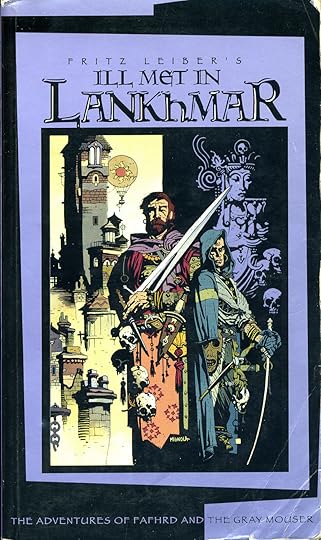
My Dynamic Duo…
When Fritz Lieber wrote about the Theive’s Guild and Slayer’s Brotherhood in Lankhmar he apparently meant them as kind of humorous and cool. He was certainly not trying to reference to anything historical or create a metaphor pregnant with hidden meaning. I think he would likely be amused at how tropeish (is this a word?) bands of thieves and assassins are in modern fantasy.
Fafhrd and the Grey Mouser are the dynamic duo of fantasy. Fantasy readers can still feel their influences in modern works, even if they’ve read anything about them. Fafhrd is a giant of a man, a northern barbarian, who travels to the city of Lankhmar seeking adventure and intellectual stimulation. Unlike most barbarians he is inordinately smart, well-spoken, and enjoys culture — most of the time. His smaller partner, the Grey-Mouser is is all wiry grace and shadow; pretty much the archetype of the modern assassin hero, deadly, swift, smart, with some magic on the side. He is set apart from his modern Grimdark exterior by the fact that underneath his cynical exterior, he is a pretty decent guy. Mouser is also the more impulsive of the two, usually.
Most of their adventures take place in Lankhmar, one of the truly great cities of modern fantasy, almost a character unto itself and worthy of a later blog post. Lankhmar is decadent and deadly, sprawling and shadowy, cultured and crowded. The two meet when they simultaneously rob the same thieves, who just robbed a gem merchant. Being free agents in a city with powerful and territorial guilds they are initially suspicious of each other, but instead of fighting they banter and discover a kindred spirit in the other. The collected tales are, in truth, more about their friendship and personal growth than the plot of the various short stories they appear in.
As heroes go, they don’t seem like much initially. They seem to few cares beyond good times, witty banter, wonderful women, and adventure. They are thieves and sellswords because Lankhmar is not a very nice place, and these are the only professions available in such a place that allow them freedom. The tone of the stories is often witty, but also Grim. Shortly after their initial meeting, their secret hideaway is discovered by the guild that they robbed and their wonderful, interesting girlfriends are gruesomely killed as a warning. This kicks the story into swashbuckling mode and the two invade the guild to exact bloody vengeance. It is a complex heady mix that is held together by a writing style that is both fun and utterly without pretension.
Here are a few of the things that I think mark these two characters as important for modern Fantasy:
1) Urban and urbane: Both Fafhrd and the Grey Mouser have a strong relationship with the city. They love culture. They seek new experiences. They want to lose themselves in taverns and crowded streets. At times they hate the city but they always seem to get drawn back in. More importantly, with their wildly different backgrounds they are brought together because of the city, which is an important part of modern fantasy both as a trope and social commentary. They are more worldly and cynical, like most city dwellers, than more pastoral fantasy characters.
2) A focus on character: The Tales of Fafhrd and the Grey Mouser are entirely character driven. The underlying focus, other than crazy cool fun, is always on the interaction between the characters. What ties the tales together is the sense of the two characters evolving and their lifelong friendship.
3) An awareness, and love, of Fantasy tropes: Thieves guilds, strange religions, crazy mage advisers save the world plots, giant spiders, crazy magic, cults, ghosts, weird races, and comic book crossovers! Fritz Lieber lovingly pokes fun at all of the Fantasy tropes of his time. This is a very modern trait, and one that many authors after him pick up on. Fantasy is a little bit silly, and a little bit crazy, and thus easy to make fun of. However Lieber’s stories do so in a way that really shows his deep affection for the genre and paves the way for Geek Chic.
4) A sense of play: The banter in these tales remains some of the best. Cheeky and funny, they demonstrate that Fantasy can be both funny and playful without losing its sense of wonder.
5) Comradeship: Buddy Fantasy? Hell yes. One of the strongest aspects of these works is the sense of friendship, of a real relationship to another human being the main driver instead of a quest, ideology, fate, or plot-line. This is something I wish we saw more of. Few authors develop friendships over the course of a work with this kind of sensitivity towards the negative and positive aspects of the ties that bind very different people.
I can’t recommend these works enough. Mike Mignola even did a Graphic Novel version of Ill Met in Lankhmar. If you haven’t read them and are in the mood for a fun romp with a touch of dark humour, do yourself a favour and read these!


April 25, 2013
The Cable News, Manufactured Heroism, Torture, and the importance of Grimdark
Despite a sharp decline in the United States’ violent crime rate since the mid-1990s, the majority of Americans continue to believe the nation’s crime problem is getting worse, as they have for most of the past decade. Currently, 68% say there is more crime in the U.S. than there was a year ago, 17% say less, and 8% volunteer that crime is unchanged. 2011 Gallup Poll
This skirts the edge of politics, but is mostly concerned with a certain type of Fantasy literature. We live in age when we are constantly barraged with signs of danger. Colour coded alerts, fears of terrorism, threats of war, and the idea that anything we type on the internet is recorded and sifted through for signs of trouble. Doom of some sort is constantly just around the corner. Scandals are everywhere. It gets tiresome, really.
The primary perpetrators of this hyperactive, hyperbolic atmosphere of constant worry are without any shadow of a doubt the media; especially the twenty-four hour cable news channels. Its the ratings, you see. The news is, in theory, supposed to report on and analyze current events so that the public can make informed decisions about the world. Sounds nice, doesn’t it? Unfortunately 24Hr cable news needs to compete with programs that are actually designed to entertain. This is actually quite a daunting task. Think about it, how exactly is a news program going to compete with the next Episode or Dr Who or Game of Thrones? What if nothing of broad interest is going on?
The solution for these media titans is to partly to fall back on the tried and true methodology of the worst type of newspapers. Offering a combination of scandal, righteous indignation, and downright fear-mongering to create a sense that the viewer will miss something of vital importance if they watch something else. This emotive appeal is quite effective at drawing in viewers and it has slowly spread throughout the industry. I have read of people complaining about family members who remain glued to their favourite news station for hours at a time; I wouldn’t be surprised if it can cause some sort of disorder.
The North American media often blame video games and other art forms for the violence that permeates our society. Politics aside, this is oil-dipped coal calling the kettle black. Cable news thrives on violence and sex, relying on them to create the sense of threat and scandal that drives their industry. Cable news is often graphically violent these days, ironically warning viewers in the same way the video games industry does. Even when it is not the language is divisive and vitriolic, and the warning of eminent doom are constant.
The 24Hr cables news channels want us to feel. The easiest way to do get us to feel is to feed us a steady dose of righteous anger, fear, outrage, and occasional titillation. Eventually we become hooked on the emotional highs and lows that they provide. It ensures a healthy rating and lots of money from advertisers. 24Hr news channels, like most TV stations, make most of their money from selling their audience.
This is where torture and manufactured heroism come in.
Torture and the Media
Torture is something that has resurfaced in the last decade or so. It was once universally reviled, but a certain school of ruthless pragmatists have made the case for its use in the War on Terror. Leaving the politics of this aside (which is difficult), it is easy to see how this paradigm shift permeated the modern conscience. The Media, led by the 24hr hour news channels, were the primary vehicles for the dissemination of the idea that torture is now acceptable, or if not acceptable it is now the new reality and we can’t do anything about it.
What surprised me was the lack of substantive discussion about torture on these channels. The problem with this media model is that it does not allow for any real rational discussion. The panels have to maintain that emotional appeal or they lose ratings. The case against torture is passionate, but it lacks the visceral appeal of the case for torture, at least until more victims made the news. If it were a truly rational discussion, Torture would face much greater opposition: we got rid of it for a reason.
Grimdark often features torture because it is topical, and Fantasy fiction is a relatively safe space for us to explore our feelings about such ugly things. The best Grimdark discusses the merits and flaws of torture in a far more rational and thought provoking way than the news.
Manufactured Heroism
Despite its “now grittier than ever!” approach to current events, some of the new news Channels are obsessed with creating heroes. Heroes have a strong emotional appeal; the offer that much needed release after the endless slog of anger, fear, and indignation. Finally, here is someone we can believe in!
The problem with heroes is that they are rare, and not nearly as exciting as the news wants them to be. I have seen several attempts at manufacturing heroes by news Channels, sometimes politically motivated, sometimes just for ratings. These false heroes will fall apart under scrutiny, which just feeds the cycle unfortunately. I’m sure you can think of examples. Giving mine would be too political for this blog and would likely sidetrack the discussion.
Grimdark has picked up on the ideas of Manufactured Heroism and run with it. The cynical attitude that leads an organization to attempt to create a heroic figure is absolutely worthy of fiction. The exploration of the human failures of people who are mighty and powerful has always been a staple of literature, and Grimdark carries on the more cynical explorations of that subject with great success.
Grimdark, while it is often the subject of the news, is really Fantasy’s way of commenting on the atmosphere that the 24Hr news channels, among others, have created. Politicians and newsmen have rejected rational principles in favour of ruthless pragmatism; Grimdark reflects this with its shadowy worlds and moral ambiguity. The constant sense of doom and scandal that the the news uses to compete with entertainment programs is reflected in the cynical characters and visceral violence of the genre. Good Grimdark is thus finely attuned Fiction that is popular because it reflects the tenor of our times, and how many people feel about the world that is presented to us. I would argue that Grimdark is the sandbox where many Fantasy writers go to play with the complex issues of the war on terror, modern politics, false heroism, and the negative aspects of the trickle down economy. This makes it very important to the genre.