
C.P.D. Harris's Blog, page 71
October 6, 2013
Grimdark, Grit, Uncertainty, Investment, and I, Claudius
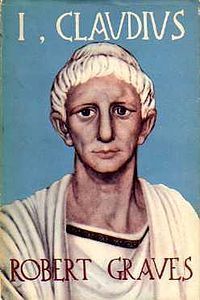
The picture is based on a Roman sculpture. The Roman sculptors were not especially flattering.
Much ado has been made about a style of Fantasy called grimdark this year. While the original term is now useg in gaming as a descriptor or even a badge of honour, some critics used the term as a pejorative to describe gritty authors whose work they don’t like and thus tried to smear. Naturally this backfired, since those authors had a well established readership who like their books and thus felt pretty secure against petty attacks like that. Plus if you don’t like gritty, don’t read authors who are known and advertised as such 
In the wake of these criticisms, however, we were left with a very interesting discussion about grimdark fantasy. I have posted many of the articles by Joe Abercrombie, Sam Sykes, and Mark Lawrence, and others elsewhere on my blog. I also had the privilege to attended an author’s panel at Gencon this year, moderated by Brian Sanderson, where they attempted to define grimdark and discuss what people loved about that sort of book. Brian was an excellent moderator, in case you were wondering, but kept to his role, asking questions and adding details for the most part (I do wonder if he is thinking of trying a grimdark or dark fantasy series on the side though) . Lucy A. Snyder had the most cogent commentary out of all of the panelists, and really impressed me with her points about fear, risk, and unheroic people against horrifying odds.
I would have been content to leave the grimdark discussion be. It is a difficult sub-genre to pin down, and is best used to describe a style successfully adopted a handful of skilled authors (Many have tried, but few seem to get it right). Also I figured after three or four blog posts I’d milked the subject to death, right? Then my lovely and brilliant girlfriend handed me a book called I, Claudius.
Claudius was a Roman Emperor of the Julio-Claudian dynasty (Lived 10 BC to 54 AD, became emperor in 43 AD). He was cripple with serious infirmities who was thought to be unfit to rule and widely mocked. Historians often overlooked the seemingly weak Claudius, but recent scholarship has shown him to be a superbly effective emperor who survived a brutal dynasty. He even managed to survive and succeed his infamous nephew, the mad and utterly debauched Caligula. That he managed to survive to the age of sixty three is quite miraculous; Caligula was killed at twenty-eight, and Claudius’ successor , Nero was driven to commit suicide at 30. It is a rather amazing bit of history that such a man could live for so long and even become emperor in a time when poison, coup, and assassination ruled Rome.
I, Claudius is a brilliant bot of historical fiction, written as the personal memoir of Claudius and recounting the trials and tribulations of the early empire and the vicious, vicious infighting in the Julio-Claudian empire during and after Augustus’ death. The author, Robert Graves, posits that Livia, the wife of Augustus was a deadly woman who ruled through poison and intrigue and plotted to secure her position and keep the right children on course for the throne. The machinations of the various characters are vicious, brutal, and utterly Machiavellian. Half way through, I was struck with a thought: what if George RR Martin, or Joe Abercrombie had written something like this? And that got me thinking about grimdark again.
Despite the extraordinarily harsh subject matter (it is hard to get grittier than Caligula, and if you do I’m not sure I want to read it…), I, Claudius is not grimdark in my mind. It is written in an autobiographical style, with Claudius looking back on his life. Thus as nearly everyone Claudius knows and loves is systematically murdered by ruthless bastards he hates the blow seems cushioned despite the enormous number of sympathetic characters getting offed. We know Claudius survives, and we know that he triumph in the end without being too tarnished. The writing style is more factual, and leaves out the gritty details. In addition because it is historical fiction, we pretty much know the constraints that the plot has to operate within. By comparing I, Claudius to modern grimdark I was able to deduce a series of characteristics that I think define the sub-genre pretty well. I’ll start with the three that made me think I, Claudius was grimdark (in green) and end with the three that it seemed to lack (in red).
Flawed characters: In I Claudius, the villains and the heroes are defined by their flaws. Claudius succeeds by using his infirmity to make him seem like less of a threat, the very last priority on the hit list. He is a weak man in a world of beefcake nobles, whose only real weapon is his mind. He reminds me a lot of a certain dwarf in Game of Thrones in this regard. Grimdark characters are complex, very human, and very flawed. Those that succeed tend to be cunning or outright brilliant.
Machiavellian Power Plays: In grimdark gaining power and holding onto power is a dangerous game. I, Claudius has this in spades. Cynical characters often have a tremendous advantage over more noble characters and a knife in the back is often far more effective than brute force.
Sex and Violence: Almost all grimdark has sex (exception: Space Marines) and the sub-genre is well known for both bodycount and brutality. I, Claudius has tons of both, including discussions of adultery and impotence, sexual humiliation, and so many nice people getting murdered while the cunning make their way to power.
Gritty and Graphic: Grimdark is very descriptive. It does not shy away from blood, the smell of death, or the bulging eyes of a boy king who is about to die from poison. I, Claudius, while grim and brutal, is written in a looking backward, academic style that lacks the graphic nature that I think defines the sub-genre. Treading the fine line between descriptively gritty and pointlessly grotesque is what I think makes a great grimdark author.
Investment: This year we were treated to the wonderful spectacle of everyone who had never read Game of Thrones, but watched the show suffer the shock of the Red Wedding. The collective outcry was impressive but also instructive. The lesson is this: if you care about the characters who are killed and have followed them for some time, it can have far more impact than offing them at the beginning of the book/show. Investment matters.
Uncertainty: Because it is historical fiction, we know how the story of Claudius and many of his friends turns out. This lessens the impact more than a little. Good grimdark authors are very good at keeping the audience guessing. No character is safe, and the ending isn’t always happy.



October 3, 2013
Causality in Fantasy Story-building
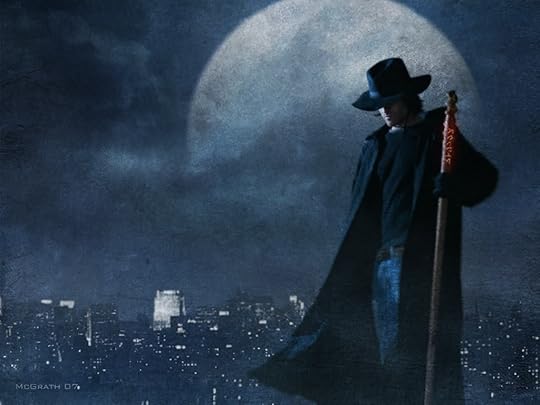
Dresden Files: You dipped your fantasy story in my mystery story… and man was it awesome!
I love Jim Butcher’s Dresden Files series. Not exactly a risky opinion these days, I know. However is an excellent illustration of my topic, partly because it acts as a bridge between Fantasy and that most causal of genres: the detective story. Jim Butcher is essentially a magical crime solver. His magic, the l world he lives in, and the situations he finds himself in are based in fancy and myth and yet the way that the protagonist works his way through the story is reminiscent of a classic police or detective procedural. Harry Dresden may be a powerful wizard, but his main weapon is his brain, his ability to follow clues, and when all else fails — his stubborn insistence on following chain of causality no matter how brutal the path it leads him down.
Procedurals, detective stories, mysteries, and many other great novels of the modern era are all about linking that chain of events that leads the protagonist to the killer, helps solve a great mystery, or exposes a great wrong to the harsh light of reason. Part of the satisfaction of watching shows like Law and Order or CSI is in watching those links get made, bit by bit, even if we already know who perpetrated the crime. It is formulaic, but endlessly effective. Even subverting this idea is exceptionally effective; one could argue that the story of Ned Stark in A Game of Thrones is partly that of a man of reason in a time when reason is vastly less important than position. In this fashion George RR Martin neatly subverts not only the idea of the Chosen one, but also the idea of the detective story, all in one go. Tough act to follow.
The protagonist does not have to be rational. In fact, lately we seem to prefer irrational, or deeply flawed crime solvers as a way of breaking the old formula of tough hard-bitten detectives with a soft spot for the dames. The chain of causality in this type of story does have to be rational, however, or it breaks the enjoyment of the reader far beyond simply subverting expectations. I’m sure a master writer can pull it off, but that is beside the point.
The basic narrative drivers of Fantasy have generally been quests, prophecies, great cycles, tragedy, Chosen Ones, or even just a desire for adventure. The causality driven narrative, be it a mystery, an investigation, or even a revealing glimpse at the grim mechanics of power that underlie an epic conflict, offer new possibilities for authors to exploit. The success of a causal narrative is in each link in the chain of events being logically satisfying and in the trials and revelations that the protagonist goes through to make the link. Naturally when the final link is made, something big should happen. Here are a few examples of archetypal Fantasy tales done up as causal narratives.
1) The Necromancer’s Bane: An unkillable necromancer has arisen to terrorize the kingdom. In most fantasy stories this would require that the heroes find some wise guide figure who can tell them how to kill the necromancer and then go on a quest to acquire the item, spell, or person than they need. The action is in the journey. In a more causal version of the tale, the heroes would have to study the black arts themselves and attempt to understand the necromancer’s powers. Once they reach an understanding of how to achieve the same unkillable state, which pretty much writes an interesting book in itself if your characters are fun, they can then move on to studying and understanding the necromancer and finally confronting him. A less grim version of the tale could be a military procedural wherein the heroes use their tactical acumen to analyze the necromancers capabilities, neutralize his forces, and then come up with a plan to defeat him without killing him. This sort of story presents a problem to be solved, generally a Fantastic/Magical problem and then follows the characters on the step by step solution.
2) Who Murdered the King?: A Fantasy world provides just as much fodder for a classic murder mystery as any other setting. In this case an important personage has been found dead and the protagonist has been called forth to solve the crime or is the only person who realizes that the wrong person has been accused. Magic provides plenty of opportunities and plenty of pitfalls in a murder mystery. Spells and magical abilities can lead to some creative capers, but the author must be very careful to use magic consistently and in such a way that the reader can guess how it has been used in the murder without prompting. This often requires a very detailed or familiar magic system with set rules, or a priori exposure to magic in the narrative. It is important not to make magic so powerful that it allows the protagonist to skip links in the chain of events. A spell that allowed the detective to speak to the dead and get a description of the murderer would make for a rather short mystery, for example.
3) The Mystery of the Fantastic: By far my favorite Fantasy twist on procedural narratives of any kind is the old x-files style formula of supernatural beings who have disguised their predations as normal seeming crimes. In this case the protagonists are people with special knowledge or dogged curiosity who see through the clever disguise and go about uncovering what sort of monsters are at work and exposing or confronting them. This can further feed into either #1 or #2 for a longer procedural. The Witcher games are an excellent example of this with the protagonist uncovering what sort of monster did what, and then researching how to kill said beast.


October 1, 2013
Teaser Tuesday
In one hand, the Executioner bore a large wickedly curved sickle and in other other a full sized headsman’s axe. Darius knew that even a man his size would have likely have trouble wielding such a weapon in a fight. Gladiators used the Gift to enhance their bodies, and Fiona’s muscles were like steel cables, far stronger than any normal person could be. Her armaments were made of exotic materials, custom made by master smiths and enchanted with potent runes and Darius, who admired craftsmanship, took in the details reverently.
Rose was impressed. Naturally, her Favourite Gladiatrix was Red Scorpion, who wore light armour and carried three swords.
In the end I decided to go with a new Gladiator, a protege of one of the characters from the books, but someone whose main actions thus far occur in the short story. Mostly this reflects a desire to entertain old fan with something new, but it also makes it easier for me to fit the story into the continuum.


September 24, 2013
Teaser Tuesday
First off: I’m taking a holiday this weekend, so my next two blogging days (Thursday and Sunday) are likely a wash.
On a more interesting note, I’m hoping to release my short story, Bloodlust: The Great Games next month, so I’m starting up with the teasers again. People seemed to enjoy them last time. Here is a little taste:
“Yes,” said Rose. “I’m a Red sir, through and through, just like my dad!”
Feet shoulder width apart, in a fighting pose that she had seen Sadira use, Rose began to chant:
“We’ll never wail! We’ll never cry!
We’ll never fail! We’ll never die!
So raise that Red banner up high!
Because we’re Red, hear our war-cry!”
Rose’s cheer drew the attention of the surrounding fans, and by the second repetition everyone around had joined in. She felt exalted, baptized in pride as hundreds of voices took up the call that she had begun.
Still a little rough, but I like it. There is a certain poetry to the rough incantations that we invoke in our arenas. I want to bring that to life to the Great Games. The cheer is based on one used by English soccer fans. It is amazing the sort of tools and information that one can find on the internet with just a few keystrokes, I even found a Rhyming dictionary!
Those of you who read my original post about the short story might notice that I decided to go with a girl as the secondary character instead of a boy. Points for you for remembering. It makes for a better story because it adds another wrinkle of complexity to the relationships.


September 22, 2013
Battle Tactics: Power Armour, Drones, and Techno-Feudalism.
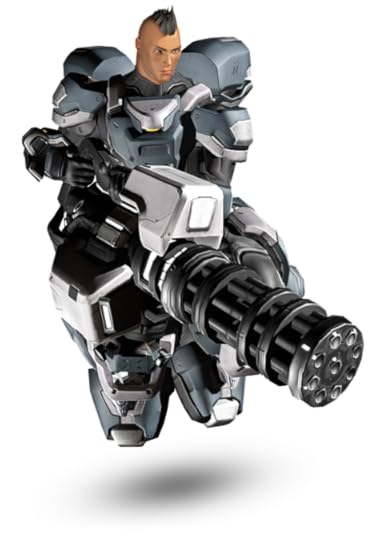
Astrek Rhino from Firefall… I can only assume the head is holographic or protected by a forcefield
A pair of my dear friends got me into a free to play game called Firefall last week. Although the computer I currently use is badly in need of an overhaul (which is incoming  ) it can smoothly play this free-to-play/open beta game on minimum settings. I enjoy the frantic pace, running around in cool power armour exploring and fighting off the enemies of humanity. The game is fun and you should check it out if you like that sort of thing, but more importantly it led me to this evenings topic: a discussion about battle tactics in Futuristic Fantasy.
Futuristic Fantasy is stuff like Star Wars, Warhammer 40k, and Starship Troopers. These worlds do not make a serious attempt to follow scientific rules or even extrapolate current trends or ideas. Instead they use technology as a part of the background setting for the story they want to tell, often in a fantastic fashion. Guns replace swords, power armour replaces plate mail, psionics/the Force replace magic, aliens replace orcs, and huge mutant beasts replace dragons. I love this kind of setting, since it often incorporates progressive ideas like spaceships, cities, and modern political ideas. Some fans of science fiction frown upon these sort of works, but genre purism is almost irrelevant to many readers these days.
In my other battle tactics posts I discuss how Fantasy elements could change classical and medieval battles. With Futuristic Fantasy I am not dealing with a historical set of tactics as a base, which makes it even more creative. As always the idea is not necessarily to be realistic, but rather to be internally consistent and entertaining. Without further ado, I’d like to offer some thoughts on common tropes in Futuristic Fantasy and how I think they could change combat.
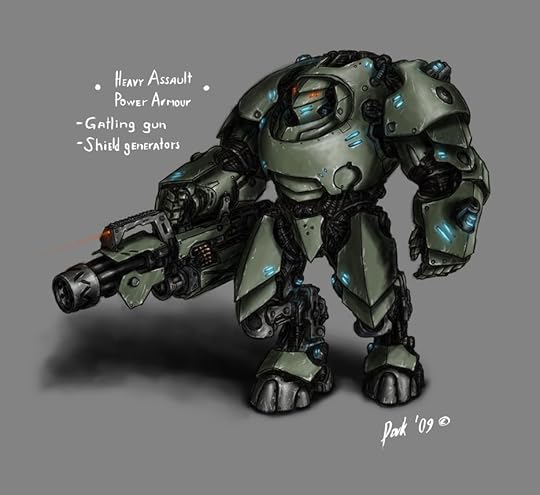
Power Armour by DarkLostSoul86 from deviant art.
Power Armour: From Tony Stark to 40K, power armour is a suit of protective armour that gifts the user with greater physical prowess and often incorporates advanced weapons systems. Power armour can be a mechanized suit or a biological organism that the wearer puts on. I limit power armour to roughly man sized suits, anything bigger might qualify as a mech.
Increased Protection: Just how good is your power armour at protecting the wearer? some suits might be more of an exo-skeleton that increases the wearers other attributes instead of offering protection against attacks, but most power armour is portrayed as being very resistant to whatever the conventional infantry weapons of the time are, similar to plate-mail in the middle ages, or an LGV these days. This level of protection makes the wearer a walking tank of sorts and elevates them above combatants who do not have access to power armour themselves.
Increased Mobility: Does the suit offer faster travel? Power armour frequently allows the user to move far more swiftly than a regular foot-soldier. Booster jets, limited flight, deployable wheels, sonic gliders, and so on. Mobility is of great importance in warfare, allowing the wearer to react to threats and opportunities more quickly. Mobility is also a form of defence: moving targets are harder to hit and keeping out of your enemy’s range/reach is quite effective. If your power armour incorporates boosters or gliding, it may allow for specialized air drops. Often forms of mobility allow for new forms of assault as well, a fully sealed suit allows for amphibious assaults for example.
Weaponry: Greater strength allows the wearer to carry more impressive weaponry, however some weapons might be mounted on the suit. An automated point defence system to shoot down incoming munitions or attack critters that get to close might be nice. Reinforced gauntlets for punching might make for some incredible power armour martial arts. Lots of options here.
Drones: I feel that advanced power armour should have some sort of drone assistance (see below)
Sensors: The value of onboard sensors and communication are often underestimated. If the wearer can sense the enemy better than they can sense him, then he has a tremendous advantage. The same goes for communication, targeting assistance computers and a host of other possibilities.
Rarity: How rare is it? If power armour is the norm and every soldier has a suit, it presents a very different setting than if it is a lost technology handed down from from generation to generation.
Counter-Tactics: Necessity is the mother of invention. Soldiers in World War II came up with a number of interesting ways to cripple and destroy enemy tanks with makeshift devices. If power armour is a factor in your battles then enemies will have to have some way of dealing with it. A massive metal suit invites all sorts of weaight based traps, such as a covered pit that a man can walk across but a suited solider cannot. Anti-armour weapons are another possibility as are devices that mess with sensors and programs.
Logistics: Remember to think about fuel, ammunition, and what happens when these things break down. Exotic fuels lead to unusual economies. Five hundred pounds of armour could be a terrible liability when it runs out of power,..
Drones and AI: An area that I feel most action-based Futuristic fantasy games and writers are deficient in is automation. Drones are a good example of this. Every time I see or read a book about war in the future that does not have drones of some sort in it, I feel compelled to ask, why not? The ability to send out a little remote controlled or automated drone to spy or snipe at ones enemies removes risk and provides a definite advantage.
Combat Drones: Combat drones are a reality now. They allow for action against enemies at a remote distance. Less risk to the drone pilot and well as the bonus of creation a craft that does not need to have a cockpit. Entire battles where all the combatants are drones (either remote or AI controlled) might make for very interesting reading, not to mention the extremely sensitive discussion about using robotic craft to attack civilians.
Personal Drones: Foot-soldiers with locally controlled drone assistants could be another way to envision the future of warfare, Imagine a power-armoured space knight with a squad of drone assistants providing her with intelligence, targeting, fire support, and so on.
Techno-Feudalism: Techno-Feudalism is a futuristic setting where high technology is in the hands of a select few. Perhaps the setting has undergone a period of regression, and elements have been lost or perhaps the highest tier of technology is too expensive to see mass use or simple kept in the hands of the elite. Technology is power, after all. In a techno-feudal setting power-armoured knights might dominate the battlefield against lesser foes or fight valiantly against foes that would easily overwhelm conventional troops. Techno-Feudalism also offers the writer an excuse to leave out technology that would change the story in ways that he or she does not like, don’t want to explain why your “future” setting doesn’t have drones or AI? — they were lost in the great crash…
Techno-feudalism offers another combination with a common fantasy idea, that idea lost greatness that seems to pervade many fantasy settings. The age of wonders and such. It is an interesting setting idea and one I will post about in greater detail later on.
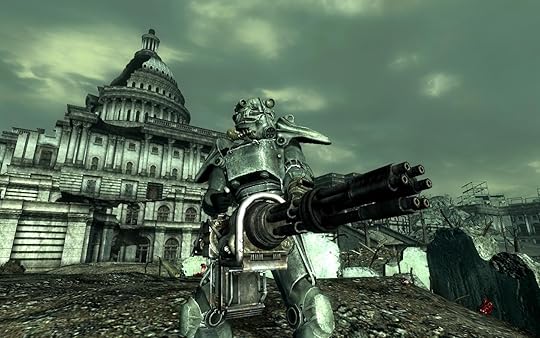
Brotherhood of Steel Power Armour from Fallout, a little gritter…


September 19, 2013
Modern Fantasy: Mercenary Characters (an Example)
This is a follow up to a previous post. In order to better illustrate the post I am going to create a fantasy mercenary company on the fly. Dwarves popped into my mind, followed closely by Dwarf Fortress. I’ll start there.
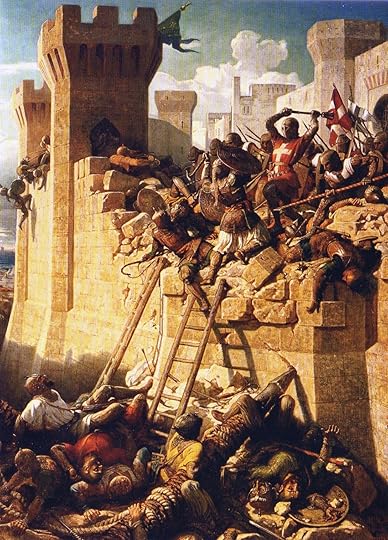
Siege Warfare. The sort of thing our company specializes in…
The Wandering Hearth: A Mercenary Company
Two Hundred Years ago a great Dwarven Fortress came under attack and was nearly destroyed. In the aftermatch, the King’s eldest son had the gall to suggest that the traditional ways were failing and that that the people needed to find new ways to combat their enemies or perish. This breach of etiquette shocked many, and influential people began to question prince Ironheart’s fitness to rule. However, the prince had many friends among the younger dwarves. The King took a pragmatic approach: he decided to send Prince Ironheart forth to found a new colony. The expedition would either succeed and bring a new land under Dwarven rule, or it would fail and show that the Prince was indeed inept. It seemed like a wise decision at the time.
Prince Ironheart, however, was as ambitious as he was charismatic. He led his company to the very gates of Old Mithras, thought lost after the Dragon Balsmog attacked long ago. Unfortunately the Dragon was still in the old ruin, woke and set upon the dwarves. Ironheart fell, valiantly defending his people from the Dragon’s wrath. His wife, the Dwarf who became known as “Sapphire” in the nine kingdoms of men led her people back to the old lands, braving many dangers, only to find the gates closed to them.
Without a home to call their own, the band of Dwarves turned to mercenary work. Constant travel had already hardened the band, and the mercenary profession was considered honourable in their kingdom. Their knowledge of mining and stonework made allowed them to make a fortune as siege specialists in the constant border disputes between petty barons and rival dynasties in the nine kingdoms. They took the name The Wandering Hearth, signifying that they had no home but with the company. “Sappire” proved a better leader than her husband, leading the band through many successes and weathering a few disasters. Her Grandchildren lead the company now, formed up of Dwarves, Humans, and even a few orcs.
The Characters
“Ruby” Ironheart: Ruby is the current leader of The Wandering Hearth. She is relatively new to the position, but has won the respect of several of the captains with an astute series of postings in the Middle Kingdoms border wars. Ruby is even tempered, but cultivates the reputation of being tempestuous outside of her inner circle, a lie aided by her red hair and a nose that has been broken once too often. Ruby has long term plans, she wants to modernize the Hearth and then she wants to somehow acquire a castle to act as a base of operations for the band… even marriage to a human is acceptable if it furthers her goals.
Pug Ironheart: Pug is named after his father’s favourite dog. Suits him just fine. His father was a great man, those rumours of him being not right in the head after a mishap with a powder keg are the product of jealous hearts, Pug resents Ruby’s position as leader of the company, but supports her because of his deep sense of family honour. Pug has fought in over fifty battles and has the scars to prove it. He is a vicious fighter, a superb sapper, and is popular with his men, but sadly for Pug he does not have a head for sums or long term strategy. He would do anything to get back to the old Kingdoms.
“Bolt”, Vashtuth: Vashtuth is a massive Orc. Some claim he is half-ogre or even half-giant, but in truth both his parents were orcs who were captured when fighting against the Wandering Hearth, and allowed to live and work for their freedom. Vashtuth grew up in the company and followed his parents example, The other free orcs in the company now follow his lead. Vashtuth is Ruby’s right hand man and whip. He is rightly feared for his skill with a Dwarven Arbalest, a monstrous crossbow that he can fire faster and better than anyone alive. Vashtuth resents and detests “uncivilized” orcs, to the point where it causes problems.
“Silver”: Silver is a stunning woman of noble bearing. Ruby’s mother found her in a fishing village and paid for fer to learn how to act like a Nine Kingdoms noblewoman. Silver pretends to be a former noble who has thrown her lot in with the Wandering Hearth. She helps attract the sort of client who is only comfortable with dealing with other “blue-bloods”. Silver is skimming as much money as she can from her clients, ostensibly so she can leave the company and retire, but really because she has come to love duplicity and playing games with other people’s trust. She does not steel from the company directly, but her schemes could get them into trouble.
“Bells” Tinira Vandere: Tinira is a winter elf witch. She is on the run from her people and the company provides ample shelter in a far-away land. Bells as she is called in the company is a skilled magic-user who uses weather magic to create and predict favourable fighting conditions for the company and her alchemical lore to furnish them with potions and poisons. Her honesty about her own limits makes her both invaluable and reliable. She seems demure, but actually has a nasty streak a mile wide. She has poisoned several mercenaries that she dislikes, but has covered her tracks so far. (The same sort of thing got her in trouble back home.)
“Broom” Orvin Dulak: Broom got his nickname from his spectacular facial hair. He leads the Black Lancers, a century of heavy horse that serves in the Wandering Hearth. Broom is a real man’s man with a heroic demeanor. He is fearless and follows orders well. One of the best century leaders,”Broom is one of the few people who is well regarded by everyone in the company. However, he is deeply ashamed of his criminal past and tries to cover it up any way he can.
“Ham, Beans, and Shiv”: Two burly Dwarves and a surly human, Ham, Beans, and Shiv are veterans of the Wandering Hearths line infantry. They are doughty fighters but famous for their grumbling and their near mutinous laziness outside of combat. They enjoy chess, drinking, and avoiding work and have a cheerfully psychotic approach to the business of slaughter. They come alive during battle and despite their gruff exteriors have risked their lives for each other on numerous occasions. Currently Shiv is taking an interest in Silver, and is saving up money to buy her something nice…
Siege Warfare makes for interesting action scenes and I think we have a decent enough mix of characters and personalities to work into several short tales or a longer work.


September 15, 2013
Modern Fantasy: Mercenary Characters
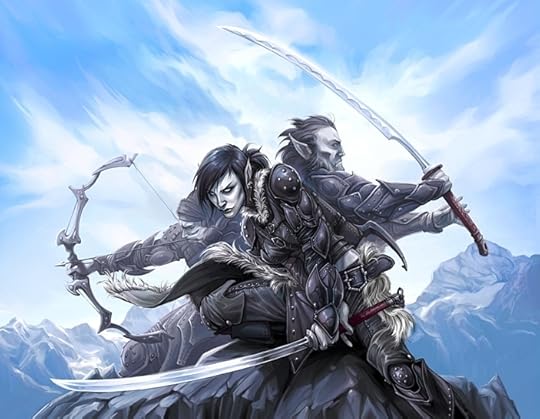
One of the mercenary units from Warmachine: A band of Nyss whose homeland was destroyed by Everblight.
This post was brought on by my enjoyment of of the new edition of Shadowrun, which I played my second session of yesterday, the Mercenaries faction book for Warmachine, and a little bit of the old Jagged Alliance 2 game (with mods!). These are all games that are centered around the idea of people who do dangerous, often violent, things for money. Mercenaries are an interesting character type, and one that is showing up in Fantasy Fiction more and more often.
Simply put, Mercenaries are interesting. They are a very specific kind of lowlife that work for the elite of society. They fight for money, and most mercenaries are decidedly anti-heroic; after all you can’t spend it if you are dead, right?
The adventurers in most tabletop RPGs are at least partly motivated by financial gain, the treasure they can haul forth from dungeons and questing. Some games, like Shadowrun, codify this to the extent that the player characters are actually contracted to do a specific job and payment for successful completion of that task is the main reward. It adds an interesting feel to the game. We can all relate to being hired and making money, which helps players settle into the more fantastic elements of the game without having to situate themselves within a world that does not have these elements.
Mercenaries are common in Modern Fantasy. Glen Cook’s The Black Company is my favourite Fantasy Mercenary saga. It is grim and gritty, but has an excellent sense of humour and is not at all excessive. The structure of a mercenary company allows for a rotating cast of colourful characters while still maintaining a singular theme. Mercenary stories can be short, involving a single small job, like a pair of warriors hired to hunt down a vampire or truly epic in length following a grand company in the sweep of a great war. Conan is another favorite mercenary of mine, although of a different sort.
Here are a few specific reasons I think mercenaries are worth considering as protagonists.
Business, not Glory: Modern readers are not exceptionally warlike. Even our soldiers would prefer to be peace-keepers and peace-makers more often than not. It is harder for a writer to sell war as a heroic endeavor to such an audience, especially without throwing any sense of nuance out the window. Characters that fight for “good” or some other black and white ideology will seem unrealistic, larger than life, or heroic, which can be limiting. However treating war like a business instead of some grand crusade makes it more acceptable to those readers who view warfare with more jaded eyes. It simply fits better with the modern view of conflict.
Professionalism above Ideology: Mercenaries have a built-in reason for accepting dangerous, unpalatable work: it is what they do for a living. While a writer has to work hard to explain why the naive farmboy, turned swordsman has ended up storming a castle it is much easier to explain why a mercenary is involved in the fight, at least on the surface. The closest most mercenary characters get to ideology, other than a desire for freedom and money, is professionalism. A professional does the job they are hired to do well and takes pride in doing so. Perhaps, with the economy being what it is these days, professionalism is as enviable as it is desired. In addition, the commitment to the contract above all means that Mercenaries often work for the “evil” side, which opens up a whole new set of writing possibilities (and is also kind of relatable these days
).The Job Idea: Jobs are something most modern readers understand well. Being a Knight is not a job, and neither is a peasant. These are as much social classes as vocations, and are far more secure and unchanging than many of us can understand or relate to. A Mercenary is doing a job, and generally being paid for it. This is a very comfortable starting point for a modern reader, especially when the mercenary is either looking for a big payday, or trying to claw his or her way out of the gutter.
Freeks, Miscreants, Outcasts, and Rebels: Every mercenary has his or her own reasons for doing what they do. Their character can often be summed up nicely by answering a single question — why did they decide that the mercenary life is for them? Obviously greed and desperation are decent answers, but many are attracted to the idea of fighting for coin out of a lust for blood, a sense of adventure, or being unable to fit in anywhere else in society. Mercenaries are united by their desire to get the job done, survive and get paid, but beyond that they often highly individualistic. A writer can feel free to populate his mercenary company with all sorts of characters, including some who might be truly heroic. This chance to create a group of interesting people forced to work together really works well for games and stories, especially since most mercenaries are primarily self motivated instead of being dedicated to a grand cause, which helps create tension, conflict, and odd friendships. The diversity of talents helps create variety too.
The Glamour and the Horror: Mercenary stories often involve copious quantities of blood, mud, and dirty money. Mercenaries work for those who can afford their services. Few mercenary companies will fight for terrible wages, so that often limits the pool of potential employers to the very wealthy. A mercenary story thus often involves a glimpse of opulence and power: Emperors, Kings, and Merchant Lords who can afford the expense. This contrasts brilliantly with the grim way that most mercenaries engage in conflict, with an emphasis on ruthless efficiency over any other concerns. This offers the reader a unique bridge between the people who create and benefit from a conflict to those who fight in it. One can see both the spoils and the viciousness very well…
Mercenaries are a flexible character element that can be used for most modern fantasies, from gritty tales of deeply broken anti-heroes who seek wealth through violence to more redemptive stories of hidden idealism among the grim veterans of war.
If violence wasn’t your last resort, you failed to resort to enough of it. The Seventy Maxims of Maximally Effective Mercenaries, Howard Tayler


September 12, 2013
Classic Characters: No one listens to Cassandra
Yet, mad with zeal, and blinded with our fate,
We haul along the horse in solemn state;
Then place the dire portent within the tow’r.
Cassandra cried, and curs’d th’ unhappy hour;
Foretold our fate; but, by the god’s decree,
All heard, and none believ’d the prophecy.”
(Aeneid 2.323, Dryden translation)

Cassandra as Troy burns.
Cassandra is the daughter of King Priam of Troy in the Iliad cycles. She was wise, pious, well educated, and of royal blood. Her beauty was said to be second only to Helen’s. She has the ability to see (or hear in some versions) the future, a gift from Apollo. Unfortunately the Greek Gods are notoriously fickle with their gifts (beware of Gods bearing gifts?), and she is later spurned and cursed such that no one believes the future she tells. It is a tragic tale within a tragedy as Cassandra foretells and is ignored, time and time again, driven to despair and madness, helpless to to prevent or even communicate what she has seen.
I often wonder if Paul Krugman, for example, feels the same way. While plenty of people read and heed the words of someone who correctly predicted the 2008 crash and the failure of of austerity, even more choose to ignore him. Those in power, in particular seem deaf to people like the Nobel Prize winning economist, despite his track record. Compare him to the pundits who most often criticize him, and see what they said about the crash and austerity. Interestingly, despite the pundits being demonstrably wrong, more people listen to them; I believe it is because they are creating a more compelling narrative, telling the people what they want to hear and reinforcing current beliefs.
Cassandra, like most characters in Greek Tragedy, is a complex metaphor. On the surface level she is cursed by the gods, a grim warning of the eventual fate of all her house and the city of her people. On a more complex level she is an example of the type of farsighted person who warns others about alarming situations and disasters before they happen. We have a tendency to ignore these people, especially those who don’t phrase their predictions in a palatable fashion.
Nobody likes a pessimist, especially when they are right.
Cassandra was second only to Helen in beauty, notably having curly red hair. This too, is complex if one wishes to delve deep. Troy was a fair state, second only to the Greeks in power. Instead of listening to Cassandra and surviving, Paris chose to steal Helen. Among other things, this represents Troy over-reaching its place by challenging the Greeks, and thus inviting war and doom. Cassandra represents truth and is very beautiful, but Helen represents reckless ambition and is even more beautiful. There is a definite message there. Nobody likes to listen to the truth when it tells them to settled for second best.
A key illustration of how the people of Troy reacted to Cassandras predictions is the famed tale of the Trojan Horse, the ploy used by the Greeks to Win the War.
After ten years of War the Greeks both sides are worn out and desperately want to win.
The Greeks decide to fake giving up, hoping to lure the Trojans into bringing a large wooden horse left as a sacrifice that has been hollowed out and filled with Troops inside their city.
The Greeks sail the rest of their ships out of sight.
The Trojans discover the wooden horse and bring it into their city.
Cassandra (and Laocoon) both correctly warn that the Horse is a ruse. Virgil (?) even has one of them knock on it, demonstrating that it sounds hollow and a strange rustling can be heard within.
Instead of heeding the warning, or checking to see if Cassandra is correct the Trojans throw a massive party, get really drunk, and don’t even bother posting a guard on the horse. The Greeks within get out and open the gates for their fellows accomplishing in one night what they failed to do in ten years of battle.
A surface reading of the account has the Gods meddling with the Trojans perceptions to bring about the doom of Troy. However, the Greek Gods often serve as a metaphor for the follies of men, and a deeper reading shows a struggle between faith and desire on one side and pragmatism and evidence on the other. Cassandra is willing to test her Hypothesis. The people of Troy are not. They want the war to be over, and so they willfully turn a blind eye to the danger presented by the horse and do not even bother to try to prove Cassandra wrong. They even ignore the sound argument that Odysseus is well known for his cunning and trickery. Much like stock market pundits in 2008, who wanted to believe that the bull market will last and ignored all of the mounting evidence to the contrary, the Trojans ignored the warnings that they did not want to hear.
In some versions of the tale they even ignore the scraping sound of armour coming from the horse.
In the end Cassandra Cassandra outlives Troy. She is taken back to Greece by Agamemnon, who then also fails to heed her warnings and suffers an ugly fate because if it. Interestingly Cassandra never stops trying to use her gift, despite the frustration and madness, until her bitter end after Agamemnon’s death. She was taken for her beauty as a spoil of war, but much like the lost Trojans the arrogant war-chief of the Greeks failed to see her true value and ignored her warnings. Again, even if he did not believe them he could have tested them. (Odysseus, a different Homeric character, frequently tested his beliefs — take his cautious return to Ithaca as an example.)
Cassandra represents the harsh truth that no one wants to hear. We all like to think we would know the truth if it were uttered, but we need to be ready to test our cherished beliefs, lest they turn out to be full of unpleasant surprises.


September 8, 2013
Fantasy Villains: Cults
“The second is the structure and source of cults. They have always haunted me, and I wanted to explore the fundamental notion of giving up responsibility to an outside power.” Katherine Dunn
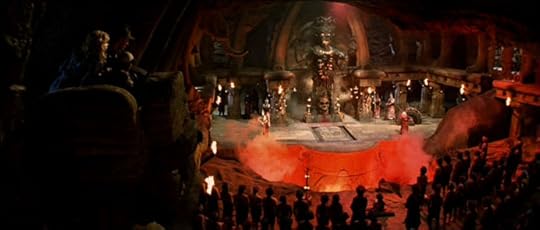
Indiana Jones and the Temple of Doom: Can your cult do better?
One of my favourite use of a cult in a work of Fiction lately is in Margaret Atwood’s The Year of the Flood, the second book of the MaddAdam trilogy (which is now apparently finished, don’t spoil book three for me!) God’s Gardeners, the cult in question, is the organization that serves as the common background for the main characters of that work. I remember the local indy book shop, The Bookshelf, having a reading at one of the downtown churches. The people organizing the reading acted as if they were members of the Gardeners, using the phrases and ceremonies that Atwood described in her novel. It was quite a production, with quite a few members of the audience going along with it. Part of the joy of that book is a serious but relaxed look at the attractions of cults, sects, and monastic life; it is not as hard-hitting as Atwood can be, at least on the surface.
In Fantasy, strange cults are a common antagonist. The combination of fanaticism and mysticism makes for a fearful foe, both monstrous and human at the same time. Cultists, while not as popular as zombies these days, do offer much of the same spice. Detailing the fantastic rituals and mad temples of the cult allows the writer to go wild playing with symbols, icons, and ceremonies. Cults are flexible as a story element. The cult can be benign, mistaken, or truly villainous. Benign cults might have useful information that the protagonists need, requiring them to pretend to be true believers. The evil at the heart of a villainous cult can be human, or even monstrous.
Here are the key attributes of a fantasy cult:
Public Purpose: How does the cult describe itself to outsiders and potential recruits. Most cult members will believe that the public purpose of the cult is its true purpose — fervently.
Secret Purpose: The real reason the cult exists. If your cult is ultimately benign, then its actual purpose is probably pretty close to the public mission statement or not blatantly illegal. If the cult is villainous then the secret purpose is likely something nasty that the cult will go to great lengths to keep to itself and only lets members of the inner circle know. The true purpose of the cult will gradually be revealed to the faithful as they progress through its mysteries, or if the inner circle has use for them.
Beliefs: What does the cult believe? Most cults are spiritual in nature or heretical offshoots of larger religions. Some are a pseudo-scientific. A club or fraternity with too much power and indoctrination could easily blur the lines into becoming cultish. Most cults are centered around some great revelation, an all encompassing path to truth that sets the believer free if followed correctly. Cult belief systems tend to be less complex because they avoid debate with outsiders and have a shorter history. The core belief can be quite ugly, as long as what is presented to the public is compelling. (We will remake the earth into a paradise… through Cthulhu!)
Symbols: Cults are often into symbols and iconography. This is an area to get creative. Does your cult have a secret symbol? do they have temples full of bizarre statues? are they austere. Are their symbols only apparent as mannerisms?
Indoctrination: How does the cult recruit new members? How are they taught the beliefs of the cult? Brainwashing, ritualistic sex, captivity, and drugs are all common to modern cults and make for great trappings of a villainous organization.
Rituals: Rituals are the bread and butter of such organizations. From chants and songs, to ceremonies and catechisms, every cult has its rituals.
The Leadership: Cults are often based around a Charismatic leader. If the cult is villainous then the leader will likely be the first place the protagonists will look to as the source of whatever rot is at the heart of the organization.
Who Cares?: Finally what exactly is the cult doing that gets the attention of the protagonists? is a relative taken and indoctrinated? is the cult close to bringing back the elder gods to consume mankind? Are they raising a zombie plague? are they a front for a league of vampires? If the cult is villainous, make sure the reader knows they are truly nasty.
Here are some more specific examples:
Demons and Devils: There’s something to be said for the classics. Demon worshiping cults are not unknown in the real world. In Fantasy fiction however the author can have them actually commune with infernal powers, perhaps seeking to bring their masters to the mortal realm.
Doomsday Cults: A doomsday cult can be benign if they just gather to discuss a particular end to the world. Chine Mieville’s Kraken is my favourite work of this nature. A villainous doomsday cult actively works to bring about doomsday, in the hopes of gaining power after the world is “remade”. Often combined with elder gods.
Elder Gods: Lovecraft is the undisputed king of weird fictional cults. Most of them want to gain power from the Elder Gods, ancient monstrosities of unfathomable power who don’t really seem to like people. The Elder Gods are generally portrayed as sleeping, dreaming, or busy and bringing the world to their attention is bad. Often when the cult invokes these beings it backfires on them, and everyone else.
Sacrifice: Older religions placed a great deal of faith in the power of sacrifice, both of animals and of people. Perhaps a fantasy cult could truly gain power from blood and death. In a fantasy world with blood magic a cult with sacrificial practices could merely be a front for a powerful and charismatic blood mage.
Splinter Cults: Splinter cults begin as factions from other cults or religions. They are often antagonistic towards the parent group.
Transformation: Cults often seek out those who want to start a new life. The promise of transformation is a great lure. In this care however, the transformation that is bestowed is not metaphorical. Werewolves, vampires, and possession work well with this idea. I love the idea of a nature cult that is actually a front for werewolves.
Cults make for great enemies, and can also fill in more benign spiritual niches in your world-building. In Fantasy the most important part of creating a cult is how that cult relates to the elements of magic and the supernatural in your world. Magic can make the strangest beliefs real, or real enough to engender belief. Peeling back the layers of intrigue and indoctrination, framed with exotic rituals and strange symbols, can be great fun for readers, especially if you manage to make the final layer of that inner circle truly interesting.


September 6, 2013
Zombies in Fantasy
Zombies are the bacon of genre fiction.
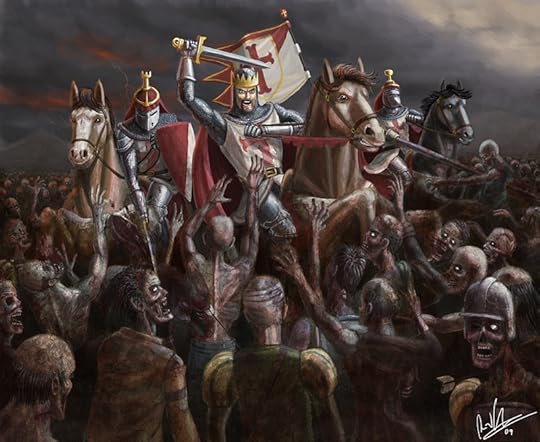
Knights vs Zombies. Lazy Zombies…
While I was attending a short panel on Dark Fantasy at Gencon this year, the subject of Zombies came up. The undead, including zombies, have long been a staple of Fantasy fiction; with the popularity of zombies showing little signs of abating I expect to see them in more works.
In my two Bloodlust books Zombies (called the stitched), are frequent fodder for the arena. They have several advantage in this regard: they are relatively cheap, especially since the rest of the industry is great at providing corpses (I just wrote that O.o); they are versatile, providing different levels of challenge with artifice/magic add-ons and different bits; and they are easy to control through necromantic magic. I also hint that zombies have their own fans, which is a bit of a shout out to the various zombie walks that I’ve seen. I even discuss the idea of Zombie labour, something I may explore further in future bookss.
Honestly I’m not sure why Zombies are so popular. I don’t really consider myself a huge zombie fan (I don’t have a zombie apocalypse plan, for example), and yet I will watch almost any Zombie movie that comes out without hesitation. Zombies are an extremely versatile story ingredient, a term that I do not use lightly. If you think of a story like a good sandwich (don’t ask me why), the zombie can
Bread: The zombie apocalypse makes for a great background for almost any tale. Want to tell an epic war story? Have your kingdom invaded by huge hordes of zombies! Want to tell a claustrophobic tale of the breakdown of social norms in a crisis situation? how about people trapped in an inn surrounded by zombies? You can tell a story about the folly of delving too deep into dark lore with the tale of the necromancer who unleashes the zombie plague or you can write an ultra heroic tale of saving the world from the undead menace.
Meat: While zombies are often a key ingredient in world-building, they can also fill a more direct role in the story. The trauma of seeing loved one return to life as a zombie is perhaps the best example of zombies providing a lovely dramatic moment.
Garnish: Zombies are great for action scenes. They are messy, they are mindlessly violent, and no one really feels any sympathy for them. Zombie based action allows us to indulge our lower impulses in a guilt free fashion.
Condiment: Zombies can be added to just about any already existing story. I’m not only thinking Pride and Prejudice and Zombies, here. You could use zombies to spice up your wilderness survival tale or add an interesting twist to your detective story.
In Fantasy worlds zombies can provide the same sort of spice that they do to horror and post-apocalyptic settings, however there are several additional factors to consider.
Lack of Guns: One of the major advantages that people have over zombies in more modern settings are guns. Few versions of zombies are able to use weapons, let alone guns. Guns gives survivors a definite advantage over the undead, at least until they run out of ammunition. In most fantasy settings guns are out of the question. Without modern weaponry things look even more grim in a standard zombie apocalypse situation.
Lack of People: On the other hand in a primarily rural world, a zombie plague can be less frightening. In most zombie fiction those bitten by a zombie become a zombie, this is frightening in an urban sprawl where one comes into contact with thousands of strangers daily and human contact is unavoidable and intrusive. It is an entirely different kind of story in a medieval rural setting where strangers are instantly noteworthy and your nearest neighbors live miles away.
Castles: Industrial warfare made castles obsolete, but they would actually be quite effective against most forms of zombies. Stone walls can withstand any attempt at damage and zombies would have difficulty scaling them, especially with a good moat. Castles that are designed to withstand long sieges would thus provide a formidable bulwark against the undead menace. Feudal societies were structured around such buildings, with hundreds in Europe alone. This would perhaps be the great equalizer for for the guns.
Formation Based Warfare: Strength based warfare is a staple of pre-modern times. A disciplined army could hold of many times their own number with a strong formation. Perhaps this could be translated into a method of fighting zombies in a fantasy world. Hey I’d watch The 300 with zombies…
Zombie monsters: Of course in a fantasy world there are a whole host of extra creatures that could be infected. Your castle wall might work well against human zombies, but what about zombie giants?
Magic of Mass Destruction: Spell-casters could be a potent force against a horde of zombies. A fireball could kill some undead, especially if it thrown from the safety of a castle wall where burning zombies can’t reach you. Holy magic would no doubt prove even more effective in some stories with mighty Paladins driving back the dead with strength of faith. Magic weapons enchanted against the dead would also be of tremendous value.
Necromancy: Naturally the number one question about a setting with magic and zombies in it, is the role of necromancy. A horde of Zombies is scary enough. A horde of Zombies under the control of an evil necromancer is capable of overcoming obstacles that require some cunning. An army that is absolutely obedient and does not need food is an excellent asset. Of course the necromancer becomes the personality behind the zombies, which humanizes them somewhat. Breaking the necromancer’s control would be an excellent story goal.
Zombies work as well for fantasy as they do in most other genres. The key difference is to understand how the differences in world-building and magic will change the nature of everyone’s favourite menace….



