
C.P.D. Harris's Blog, page 69
December 3, 2013
Teaser Tuesday
Bloodlust: The Great Games will release later this month (probably around the 20th of Dec)
I’m still looking for a beta readers who will do reviews for me, if anyone is interested. Last minute input is also reasonable, since it is only 10,000 words.
Here is a shot of the final cover.

Another great cover by mr Dan Barclay
I’m pretty damned happy with this. It took a fair bit of work on Dan’s part, mostly because I completely forgot about the need for a cover until lat minute.
The best part about the image is that it remains striking at small size, which is rather important on Amazon.
amazon size


December 1, 2013
Battle Tactics: Military Organization in the Domains 1
It is easier to find men who will volunteer to die, than to find those who are willing to endure pain with patience. – Julius Caesar (attr)

When I think of the Legions, I think of these two guys from the Rome series.
As I write Warbound: The Shield Maiden I find my self in unfamiliar territory. The action in my previous two Domains of the Chosen books, Bloodlust: A Gladiator’s Tale and Bloodlust: Will to Power took place in the confines of the arenas of the Krassian Empire, but the Warbound books follow the Legions, and much of the action takes place on battlefields in and around the Domains.
The first big battle is chaotic and does not delves too deeply into the tactics of the Legions. It involves a desperate battle against a fleet of pirates. It tends to focus on the actions of two characters, both of them Warbound, and mostly serves to whet the reader’s appetite and develop a character or two.
I’m also somewhat shy about detailing the training of the Legions. Vintia, one of the perspective characters for Warbound: The Shield Maiden, spends much of her time out of camp for various reasons and is unable to join in the training sessions with her cohort. I do detail a mock battle, but even that is focused on the actions and emotions of a handful of characters (which is what most people want to read) and does not delve into the strategy and tactics of the world.
Today, while finishing up the first draft of the pirate battle, I realized I was shying away from writing about the tactics and organizations of the Legions. After some careful thought, I realized why. As an avid gamer, when I created Bloodlust, I also created a little RPG to play with my friends. This allowed me to detail the various aspects of the games, from Gladiator training and arena life to crowd appeals and faction match points progressions, and see how others reacted to them. When gaming players tend to find flaws in both settings and systems fairly quickly, which helps flesh out something as unusual as the arena’s of Krass. Sadly, I have not had time to create a war game to explore the ideas of mass battles in the Domains, and even if I had my game group only meets once a month for some Shadowrun these days.
Instead I will mostly develop the ideas in writing. Having a blog allows me to expose the ideas to my readers and get feedback that way.
Here are the basic elements of the Legions that I have to work with.
Roman Influences: I love classical history and the basic presentation of the Legions is very similar to the Roman Legion. As you see, I use much of the terminology, which keeps with the extended classical feeling that I am trying to invoke with Krass itself. It is a good starting point.
Magic!: The most important new element to consider is magic. How will the Legions use magic to aid them? How will they counter the magic of the enemy?
Steampunk Elements: Almost in spite of myself, I added steampunk elements to the Bloodlust series. This includes mechanical automatons, spike throwers, flame cannons, powder based cannons, and many other devices which have potential battlefield applications.
Mixed Genders: I don’t think the idea of mixing genders in battle is especially controversial in Fantasy fiction these days (Women still face resistance in assuming combat roles in many places in the real world, mind you) and does not really present any conceptual problems. In the early, desperate days of the Domains only a fool would turn down brave women willing to fight the horrors of the Reckoning; the Legions thus have a long tradition of service from all genders.
Fantasy Races: The Legions are multi-racial. This presents slightly more difficulty then mixed genders. Two Legionnaires of wildly divergent sizes, like an ogre and a quickling simply cannot lock shields. It presents an interesting set of problems that I never expected: most cohesive fantasy armies tend to be made up of units of a single race. I’m still trying to wrap my head around the organizational aspects without relegating every non human phenotype to an auxilliary formation — formation warfare relies on direct physical teamwork where the differences between an Armodon and a Shadow elf are key.
The Warbound: The Warbound themselves are another factor. These former Gladiators have been retrained and re-equipped to join the Legions, where their skills with the more destructive aspects of magic can be put to use serving the Domains. The Warbound serve the Legions directly, without much interference from the Deliberative. This requires a set of mechanisms for control as well as a whole new set of tactics. How is having a supernaturally strong warrior with the ability to cast fireballs or a font of healing going to change the way the Legions fight?
The Enemies of the Domains: Part of taking the action and the story beyond the borders of the Domains is a chance to see other cultures and enemies up close. How these potential enemies fight will have a great influence on Legion Tactics. Imagine battles against the odd, graceful, magic eating Wirn, or the shape-shifting, spirit empowered Pale.
Basic Legion Organization
The Legion: The Legion is commanded by a Legate, who is advised by a Strategos. Each Legion is made up of 10 Cohorts and several support groups.
The Cohort: Each Cohort is commanded by the Senior Centurion and is made up of Six Centuries. The Cohorts are identified by number, but often adopt formal nicknames and banner heraldry. The First Cohort is made up of the largest, strongest veterans and is commanded by a Senior Centurion, called the first Shield. The First Shield advises the Legate, and outranks all other centurions.
The Century: Each Century is commanded by a Centurion, a Legionnaire with at least two decades of fighting experience.
File: The file is a semi-formal grouping based on the position when the Century assumes basic 10×10 parade formation. The file is led by a senior Legionnaire called the Decurion, or the File Leader Files are informally called tents, since the file will share a single tent on march.
The Eleventh Cohort, Ninth Legion: The Engineers of the Ninth Legion are organized into their own Cohort. These are sappers, siege engineers, and artillerists who started out as Legionnaires and thus know how to put up a fight. Fighting engineers are considered a necessity in long distance operations. The Ninth Legion has several additional cohorts assigned to it when it was reformed to join the Bright Company. It does however lack cannon fodder forces like automatons and undead, which are unreliable in places which have not been cleansed of wild magic.
Basic Legionnaire Weaponry
Lorica: The Legionnaires of the Domains are equipped with armour similar in design to the Lorica that we associate with the Roman Legions. However, the Lorica of the Domains is made from steel alloys and treated with magic through a process known as spell-forging. The early days of the Reckoning required that the Domains pack as much power into a single Legionnaire as possible, and thus arms and armour are of excellent quality.
Scutum: The Legionnaires use a shield that is entirely made out of a specially treated laminate, edged with tough steel alloy and spellforged to resist magic and the elements. The shield is even higher quality than the armour, and allows the Legions of the Domains to put up a shield wall that can withstand cinematic levels of abuse from unusual sources.
Gladius and Pilum: Despite years of weapons advances the Legions stick with simple short swords and spears as their weapons of choice. The old dual javelins, thrown to break up massed charges of beastmen have been replaced with a single sturdy spear that can be used for close fighting or planted to ward off cavalry and large beasts. The spear is backed up by a sturdy short sword which excels up close. The Krassian short sword is a little shorter than a Roman Gladius, but balanced to chop as well as thrust. It is often used for construction (like a Machete — for jungle campaigns in the trials) and is exceptionally sturdy.
Specialist Weapons: several men in every century carry specialist weapons like spike throwers, weapon created by Artificers that acts very much like a rapid firing crossbow with a pressurized air component. Spike throwers can use a variety of munitions. Grenadiers are common as well, breaking formations far effectively than javelin volleys. Other unusual arms include flamethrowers, elemental enchanted weapons to deal with exceptionally tough monsters, and so on.


November 28, 2013
Nomads 7
Link to the first nomads, link to last week’s chapter.
Sending the seeker ahead was almost a moot point.
Triumph was right, I knew it. Taking the ‘walnut’ brain bug down had been way too easy. Scourge directing intelligences very rarely showed themselves, let alone exposed themselves to a previously noted sniper.
“Sun,” I said over coms. “You need to get out of there, don’t panic, jump — don’t walk down. Now.”
“Acknow…. fuuuuuuuuuu,” Sunspear shouted in alarm as she leapt from the tower. I watched in horror as a pair of stalkers jumped after her, scything claws poised to strike. My heart seemed to stop. The stalkers closed, but Sunspear shot upwards, using her suit’s thrusters, and the stalker’s shot harmlessly under her, unable to change their momentum.
I set tactical to red, indicating an ambush, we were in deep trouble. Multiple contacts appeared near Quake and Nova almost as soon as I’d sounded the alarm. I heard weapons fire from that direction, the steady hiss of a streamer cannon, and the thrumming of a pulse beamer. Targets appeared in our vicinity. I saw movement at the end of the street, rippers and leapers, digging their way out of the rubble. Blaster bolts and Beams leapt from our position, scorching and melting insectoid forms. Triumph fired his mag rifle in controlled bursts, picking out the more dangerous forms, downing one every time he pulled the trigger. I envied him them, that calm under fire, the intuition.
A mortar drone boomed from behind me. Things were not looking good for Quake and Nova on tactical. Sunspear was on the tower again, on the roof this time. Her vitals were good: small miracles.
Malificent was firing at something coming in from behind us. Multiple contacts all around us, a noose of scourge forms tightening.
The scourge crawled over the broken bodies of their dead. It was an ugly sight. I’ve always felt that the bugs were more like drones than people, fearless in the face of death. Also shiny. The line of bugs got closer, closer, close enough for Shrike and Scorch to fire. I felt the heat of a flamer behind me. Saw the first wave in front of us disappear in a spray of broken bodies as the frag cannon erased them from existence.
A dropship from the Falcon appeared on tactical, our air support, finally. I marked targets. Explosions followed. Quake went status black on tactical, his position marked by a question mark. Nova moved a few units, and then she too went black. I cursed, lashing out with my tri-beam. I wanted to go to them, to help or to vent my rage upon their killers. But my own situation was dire.
The scourge were close now. The leapers started jumping at us. Triumph shot three out the air. A fourth hit him. Shrike’s razor drone cut it down before it could hurt him. We were getting overwhelmed. Shields were going down as hand to hand was joined. Bugs were everywhere. Leapers swarmed over Malificent and Scorch. They swatted at them, crushing the scourge forms with massive fists. My last blaster drone succumbed, I set it to detonate, but the explosion never came.
Rage flowed through me. The bunker. This was all about the bunker. I shouted, a battle-cry for myself, unheard through coms, and ploughed my way into the bugs. The paladin is all shield and armour and I fired my tri-beam as I ran. Leapers were all over me, and a pair of rippers clawed at my shields. Behind me my squad fought desperately, taking advantage of that momentary respite. My last seeker, the one I had sent ahead, I now willed it high in the air swiveling to look at the bunker. I saw a bipedal form surrounded by brutish looking Scourge hauling the Cryopod out. I marked the one I didn’t recognize, just before my drone went black, knocked out of the sky by some leaper or spitter.
“Sunspear!” I shouted over coms. A beam of white light shot down from the sky. I backhanded a ripper, sending it skittering. The whole horde seemed to shiver, as the organization of the directing intelligence failed. That momentary confusion was our last chance. I fired my tri-beam until the barrels glowed white, stomping bugs with the Paladin’s massive boots, as I killed, giving in to mad berserk rage. I let anger guide me then, venting my frustration over the deaths of good men and women on a mission gone bad. No salvage was worth the death of friends. I killed and I killed, and when the bugs started moving again I did not let it stop me.
“Raven!” Shrike voice cut through the red haze. I forced myself to be calm. Tactical was up. Most of the drones were down. Triumph, Sphinx, Shrike, Scorch, and Malificent were still online. I was actually status black on the display: my shields were almost flat, my armour had three critical punctures, and my vital signs were erratic. I flickered over to red as my suits systems started to take control. Quake and Nova remained down. I sent the seeker over to make sure, even though I knew they could not have survived. It was my fault. I should have sent another man with them. I resolved to resign after this mission. Triumph would make a better squad leader.
Sunspear was in the Green on her tower. Her visuals showed the remaining bugs backing off. I watched with satisfaction as she cut down the four robust looking scourge forms with beams of light from on high, while they struggled to carry the cryopod.
A second ship, a shuttle appeared on tactical.
“Okay Nomads,” I said. “Time to gather our dead, take our treasure, and get the hell off this rock. Stay sharp.”
My seeker found Nova and Quake, yards apart, surrounded by their fallen foes. I wish I could say they looked peaceful in death.


November 26, 2013
Teaser Tuesday
Here is a little teaser from Bloodlust: The Great Games (on sale around Christmas — or you can get a free copy for input/review if you ask me now. I’m looking to avoid getting the one star driveby treatment again)
Melia was conflicted about their nine year old daughter going to the arena. The Great Games were the very soul of patriotism and culture throughout the Empire, and almost all parents who could afford to brought their children on a regular basis. But the violence and the bloodshed had never sat well with Melia. Perhaps it was because she had been raised in a small town, with less early exposure to the Arena. The Games meant so much to Darius though.
One of the concepts I touch on in Bloodlust: The Great Games is how culture and tradition can redefine what we see as acceptable. We can barely imagine it, but it is quite likely that children watched the Gladiatorial games in Rome at some periods, certainly the younger emperors were known to have a taste for the games.
Melia is an interesting character, but she barely appears in the story. It will be interesting to see what people think of her.
And since I am at it, here is a little bit from Warbound: The Shield Maiden (which is due next July). Very rough, ETC ETC. Warbound takes place in the same world as Bloodlust, but focuses on the Legions instead of the arena.
“Try to look scared Bosh,” said the First Shield beside him. “Logistics crewmen don’t drool at the prospect of being raided.”
“Don’t matter, Arturo,” said Bosh, savouring the frown that his insolence purchased from the First Shield. Ol’ Arturo would hardly punish him with a fight looming, and Bosh hardly cared about what happened afterwards. “Them son’s o’ whores see red now. Any one of ‘em breaks off or shows caution and the others will brand them cowards and hunt them down after. The blood is in the water and the sharks are in a frenzy, lads.”
Bosh thumped his chest. The First Shield shook his head but said nothing.
The shark metaphor and the idea of purchasing a frown need polishing, but you get the gist, I’m sure.


November 24, 2013
The Protagonist: Freedom to Act
While reading about Toronto’s Mad Mayor in preparation for last week’s post, I came across a number of expressions of support for the beleaguered mayor that seemed nonsensical at first:
I like Rob Ford because he does whatever he wants. He does not let what other people think get in his way. He thumbs his nose at the downtown elites.

Freedom to Act is why we often idolize criminals.
or as Bill Maher puts it “I love this guy Rob Ford because he sticks his fingers back in people’s faces and says, ‘What, you don’t do anything?’”
This sentiment is easy to dismiss as irrational, entrenched partisan support for a populist conservative. However, as a writer, I wonder exactly what draws people to a figure like Ford; a man so unfit for public office that his whole time as mayor seems like a joke, at least until I realized that he has a real, solid core of supporters that could grow and ensure his re-election. It reminded me of something I read in one of Joseph Campbell’s works. Let us move away from Ford, who is a false hero if anything, substitute other figures who are well known for their vices as well as their qualities as protagonists.
I like Alexander the Great because he does whatever he wants. He does not let what other people think get in his way. He’s not afraid of the Persian Empire.
Alexander the Great is possibly the greatest living example of a heroic figure. However, despite his accomplishments he often comes off as flawed — a bloodthirsty drama queen more concerned with his own divinity/posterity than creating something lasting. He certainly does what he wants, and definitely sticks it to the man — the vast Persian Empire to be precise. Interestingly when he starts to get cozy with the remains of the Persian Empire, adopting eastern imperial customs, his greek soldiers begin to have doubts.
I like Conan the Barbarian because he does whatever he wants. He drinks, he carouses, he fights, and he does not care what others think. He shows up all those weak, civilized men.
Conan the Barbarian is a fictional character. He is a an uncouth brute whose love for money, drink, and women constantly leads him into a cycle of thievery and violence until he builds up enough of a reputation to become a king. His dislike of civilization (the elites in this case) is presented as a kind of virtue. Conan wanders aimlessly in his pursuit of bling and babes and the only “good” that he does is incidental, the destruction of monsters, corrupt cults, and overbearing civilizations that get in his way. He is almost presented as a force of nature.
Another, more complex character that I constantly hear this kind of admiration attached to is Walter White, the broken chemistry teacher turned ruthless meth dealer from Breaking Bad. Walter is the protagonist of the show, a man that the viewers have great sympathy for because he overcomes tough circumstances and goes on to build a life. He shows toughness and resolve, and intelligence (the hallmark of a modern hero) as he does so. But as many have pointed out, despite being the protagonist he ultimately descends into pretty evil territory. None other than George RR Martin called him out as a monster, which is quite impressive given Mr Martin’s skills at creating memorable villains and flawed heroes.
Rob Ford, Alexander the Great, Conan the Barbarian, Walter White. What do these men, and people like them have in common as protagonists? What can they teach aspiring writers about the very idea of the protagonist? Why do some people admire them?
The answer is simple: Freedom to Act.
Each one of these characters, real or fictional, is seen as heroic on some level because they are able to act when others do not. Rob Ford drinks, smokes crack, associates with gang members openly, and lies (among other things) but resists any attempts to remove him from his job and seems to revel in the attention his bad behavior brings. Some people admire him for the ability to “live the life” and still maintain a hold on power. Meanwhile most people would have been buried by just one of the revelations that hound Ford. Hell most people go to jail if they are caught using crack, just once. Ford remains free and active, striking back at his critics, for now. Alexander marched his troops across the known world, founding cities, destroying decadent empires and testing his luck at every opportunity. He often acted in strange and dramatic fashion, descending into bloodlust or mad acts of bravado, but came off unscathed (except that last time). He challenged the very gods at times, and seemed to win. Even now he is admired for his boundless ambition and his willingness to act upon it. Even the responsibility of his position as a leader did not seem to weigh him down as it did others. Conan the Barbarian, the uncivilized man in a land of decadent civilizations, is also a man of action. He does what he wants and will fight anyone who tries to stop him. Walter White, a far more modern man, finds himself facing a bitter, pointless end and decides to fight back, casting off the chains of lawful conduct and descending into a criminal underworld where only the ruthless survive and prosper.
These protagonists all do things that some people want to do, and even more occasionally fantasize about doing, with little thought for what the rest of their societies think of them — they are free to act, and ultimately the hero is defined by their descent into the realm of action (badly paraphrased Campbell) and is often at odds with the rest of society while they are in the process of acting. They bring change, and change is always unwelcome to some. Even Alexander, a mighty king far above the common man, had his own elites to contend with. Of course that narrative can be used to drive any fantasy story, or good genre fiction, and especially a tale where the protagonist is a villain or a false hero.
In brief, freedom to act, to do what others cannot do, to take on the monoliths of morality, law, and conventional behaviour is very compelling in a protagonist. This is especially true when this character’s freedom causes them to butt heads with the elite of their world; perhaps that is why `the rogue, done good’ seems to be the quintessential modern hero and why every politician in north america runs as anti-establishment. Freedom to act, without regard for others: an idea both wondrous and terrifying.

Proof that some people will see freedom as heroism, even in the presence of undeniable evil.


November 21, 2013
Nomads 6
Last Weeks’s Episode can be found here.
A curtain of flame enveloped me, warnings flashed as my shields went critical. The Scourge forms shrieked as the boiled and burst. I raised my arm to protect the weakest parts of my armour; I did not want to get cooked. To my relief Malificent sent a support drone over to boost my shields. A moment later Scorch finished burning the Scourge forms off of me. The flames cleared, leaving only smoke and charred carapace.
“Dinner is served,” rumbled Scorch. Smoke wafted from the nozzle of his massive custom made incinerator. His nomad suit was a Goliath, larger and heavier than my Paladin. The Goliath was a workhorse nomad, like the medium Ares armour that Triumph wore, able to fill a variety of roles. Scorch and his wife Malificent both wore Goliaths; they worked as a team. She was specialized in long ranged attacks and support, he in short range firepower and defence. They were handy in a fight, a steady presence on the team.
“Try not to kill the man with your sense of humour, dear,” said Malificent, appearing from behind Scorch. She carried a beamer in one hand and a gauss weapon in the other.
“Much obliged,” I said. I was already scanning tactical. Everyone was nearby, safe and sound, except Sunspear who remained hidden in her perch. Through her I could see that the remaining Wallbreaker had given up on chasing Triumph and was grinding against the bunker, trying to break in. For a moment I debated letting it break down the bunker unmolested. Was it really worth the risk to my team to gather up that cryopod? I had no idea what sort of Scourge reinforcements were on the way and there was a directing intelligence on the field.
Through tactical I could see the the bugs were digging in around the bunker. It would be tough to break through with them in defensive positions. Having a bead on a Ripper at a distance is one thing, having it leap on you from close quarters is another. Still, that Cryopod was a major find, and I’m not one to abandon anyone to grim fate if I can avoid it.
“Boss,” said Sphinx. “The big one is acting wierd, shouldn’t it be pounding a little harder?”
Sphinx was right the Wallbreaker was merely pushing against the bunker instead of battering it with its massive pulverizing forelimbs. It looked to me like it was trying to gently peal the roof off. I thought about the action for a moment. There could only be one reason; it did not want to damage what was inside the bunker. I was immediately sorry we’d left.
“Good eye Sphinx,” I said. I laid out my plan on tactical, highlighting positions and tactics. We would sweep towards the bunker and get close enough to make a rapid assault. My plan hinged on the bugs being more interested in the cryopod than us. So far that seemed to be the case.
We crept forward. Quake and Nova, who were already on the opposite flank, circled a little closer to the bunker so that we could catch them in a crossfire without any chance of friendly fire. Sunspear remained at her perch. Sphinx and Triumph moved outward while Shrike, Scorch, Malificent, and Myself took up position behind a weathered wall half a click from the bugs. Contact was minimal, but the bugs had to know were were here. Their detection system consisted of tiny insects that were hard to spot. they made no move to assault us.
“Should I drop a mortar round on the big one?” asked Malificent over coms, her target appearing in tactical.
“Negative,” I said. “A this point there is a good chance you might damage the cryopod.”
“What are we waiting for?” asked Sphinx.
Before I could answer there came a sound of shrieking metal. Glancing through Sunspear’s visuals I saw that the Wallbreaker was folding back the bunker’s roof. The metal was cutting into the huge Scourge form, but it did not seem to notice. I gave the ready sign on tactical.
Suddenly a walnut appeared on tactical with a query from Sunspear. “Walnuts” are the most common form of directing intelligence in the scourge, so named because they appear to be little more that a rough armoured shell resembling a nut from a tree in the homeworld gardens on the fleet mothership. The inside of the shell is a highly developed brain.
“Fire,” I said, answering Sunspear’s query and giving the attack signal at the same time. Two mortar drones and a missle drone behind me fire.
I saw a beam flash from Sunspear’s perch. The walnut went red on tactical; a likely kill. I felt sweet elation pour into me as I moved forward, sending my blaster drone high into the air to rain fire on the Wallbreaker. It was rare to get the drop on a directing intelligence, even a Walnut. Maybe we would get a commendation. Savage glee filled me as I sighted a spitter emerging from its burrow and blasted a hole in it with my tri-beam. We had this. A little vengeance for the fallen, Leopard and many others. Tactical lit up with casualties, all of them bugs.
Two hundred metres from the bunker Triumph flashed a warning. We halted, taking up defensive positions. Behind me long range drones kept firing, smashing the Wallbreaker.
“This is too easy,” said Triumph. My first instinct was to yell at him, but I had a nagging feeling he was right. I signaled the team to stop advancing while we blasted the Wallbreaker from a distance and finished off any bugs that remained visible.
Eventually the massive scourge form toppled and I sent my remaining scanner drone forward.


November 17, 2013
Rob Ford, Moltar, Sauron, Tough Guys, Populism, and Evil
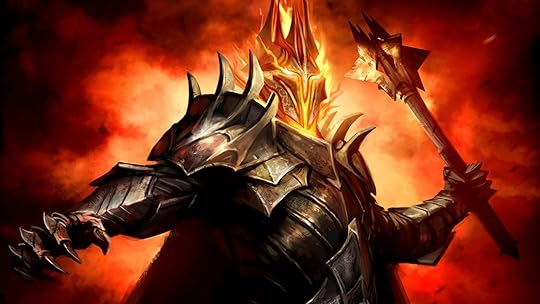
When faced with overwhelming attacks from Elves and Men, Sauron stood firm and thus his people followed him…
Toronto is the largest city in Canada, it is about an hour from Guelph, the small city where I live. Toronto is one of North America’s biggest urban areas, with a population of 3.5 million (~10% of Canada), or 5.5 million if you count the amalgamated areas, the suburbs that fall under city council. Toronto is a city on the verge of becoming a truly great city, with vibrant multinational communities, relatively low taxes, with strong arts and business attractions that that are the envy of many urban areas. Toronto is in the news quite a bit lately, albeit for all the wrong reasons. The mayor of Toronto, Rob Ford, has admitted to purchasing and using crack cocaine on at least one occasion recently and even driving while drunk. Oh and his longtime friend and driver, a suspected drug-dealer, is in trouble for extortion. And several people the mayor has been photographed with are gang members who’ve met with bad ends lately. The list goes on, with new revelations almost weekly, and an ongoing police investigation that is being drowned out by the sheer insanity of the mayor’s actions.
For many of us, who have been paying attention to Toronto politics or Rob Ford in general, this does not come as a shock. The man has a long history of run-ins with the police for substance abuse. On the surface a few problems on record every decade might seem minor, but consider how many serious addicts manage to stay off the radar until they break down and how many are caught and jailed immediately. His verbal record as a councilor for his ward of the city is no better, with bizarre tirades against cyclists and lefties, flirtations with racism and homophobia, a shocking ignorance of aids, and a rather ironic zero tolerance policy towards drug users. To anyone outside of his party who was paying attention Ford looked like trouble. Mind you, that’s not enough to condemn the man.
Moltar is a character that I introduced in my book Bloodlust: A Gladiator’s Tale. Chosen Moltar is presented as very similar to Sauron from Tokien’s middle earth, an ominous figure of wrath and ruin ensconced in black armour and residing in a Mordor like Domain. Unlike Sauron, he is not a direct enemy of the protagonists, he is an “evil” that resides in their society. Modern Fantasy is not content with faceless badguys, however, so as I moved through the series and into Bloodlust: Will to Power, I humanized Moltar a little. I wanted to show his perspective, so that the reader could see how Moltar is a reflection of how power allows ruthlessness and reasonable expediency to give birth to brutality. I also wanted to make a more understandable, realistic villain, someone who real people would follow.
The most surprising part of the Rob Ford story is just how ardent his supporters are. Here we have a real-life man who is cartoonish in his behaviour and the cycle of lying, apologizing only when caught, and then asserting that his issues are not a problem. And yet while his general public support is shrinking, his core admirers are becoming more and more agitated, firing off letters criticizing the “left wing media”. Here are a few of the arguments I have seen put forward in defence of mayor Ford at a time when most other politicians would be facing serious questions from everyone about what he was doing smoking crack and getting crunk while coaching high school football (yes, he is so well supported that “think of the children” is actually being shied away from.)
But other politicians have admitted to smoking marijuana, how is him being forced to admit smoking crack cocaine any different?
He apologized for smoking crack cocaine, can’t we move on?
No other politician has ever faced this kind of media assault!
He wasn’t lying, they just asked the questions incorrectly!
Lots of great leaders have substance abuse problems!
He’s been such a good mayor that we should overlook his issues.
The condemnation of Ford transcends the political spectrum at this point. People forget that many of his enemies on city council are conservatives who rode into power with him and were subsequently alienated. And yet the defences roll on and on, out of control. I suspect they will continue, never shrinking beyond that vital core, until he is accused of doing something monstrous.
This got me thinking about Moltar again. A populist leader, like Ford, presents themselves as a heroic figure. These days it is always the humble everyman taking on the corrupt elites, a political David and Goliath story so compelling that almost every party tries to invoke it in out elections these days. Moltar is now less cartoonish than Ford, and the idea of him acting as a kind of tough guy populist in my books is very appealing. Tolkien made it clear is subsequent writings that he viewed Sauron in a similar light. The harsh truth is that some people, people who can be very nice to start off with, do throw their support behind figures who create a compelling narrative. We don’t have to look back too far in history to see a time when this was a real problem. Whether men like Rob Ford and Silvio Berlusconi, rich men in the guise of populists, are an echo or harbinger is a matter for a political blog.
What Rob Ford’s supporters demonstrate is that good people can often be lured into supporting what appears, to a rational outside observer, to be an obvious evil. He has been caught lying time and again, but they seek excuses for him and support him even harder because they are convinced that he is a good, if flawed, man. This is not a rational analysis, it is faith based politics (I’m not talking religion, though Doug Ford, Rob’s brother did compare his persecution to Jesus being crucified… honestly, you can’t make this up.)
This is an interesting lesson to learn for a writer. A one dimensional populist villain is possible in real life. The key is to demonstrate how that character convinces people to follow him. If you take the reader on the same journey that the populist takes his followers on, you might be able to create a truly resonant experience, as well as offer deep commentary on the problems of narrative driven politics. Just don’t become the next L. Ron Hubbard as you do so please.
Another takeway from the Ford scandals that is useful for writers is how much people admire toughness and endurance. Many of the most die-hard supporters of the Mayor look up to him because he refuses to back down in face of overwhelming pressure for him to quit. It doesn’t matter how much damage his refusal to quit does, what matters is the courage he is showing by sticking to his guns and not backing down. This is a useful thought for defining both heroes and villains.
PS: I have complete control over comments on the blog, don’t even think about it 


November 14, 2013
Nomads 5
Last week’s episode can be found here.
A solid streak of light flashed from my tri-beam into the nearest Wallbreaker, blackening the chitin where it hit. The shot did little damage, but hit a nerve cluster, causing the massive scourge form to rear up. Wallbreakers are dangerous because inexperienced Nomads often expend all their time trying to bring the Behemoths down, ignoring the more dangerous but more delicate creatures that took shelter around it. I knew better, years of experience and training taught me what worked.
Shrike and Sphinx were ready. Before the Wallbreaker could re-position, they attacked. Frag cannon shells burst with a boom, showering the area in ultra dense micro-fleshettes that tore through the smaller forms in a hail of bug gore. Bright blaster bolts rent smoking holes in others as Sphinx and several drones took aim. Inhuman shrieks rent the air, mixing with the sounds of chitinous scuttling and weapon’s fire.
The Wallbreakers kept coming. The bunker would withstand their attacks initially, but I wasn’t sure how long it would hold up. We started aiming for their feet hoping to slow them down, a standard tactic. The Scourge countered by sending smaller forms ahead to screen their massive legs, a definite sign of the presence of a brain, one of the various forms of directing intelligence. We needed a better plan; by the book wasn’t going to cut it today.
One of the massive creatures veered suddenly, the right side of it’s head erupting as Triumph popped out from a nearby building and shot it, point blank. The Wallbreaker went berserk as it recovered, slamming into the building. Cracks appeared in the wall as Triumph launched himself into the air. The Wallbreaker bellowed and heaved, then the building collapsed. I kept firing at the other two, scorching them with light. Triumph vitals showed as steady.
A stalker took out one of my blaster drones, appearing suddenly and taking it from behind. The scourge form knew where to strike to bring down a drone with speed and I could not help but admire the grace and skill of my enemy as I directed my remaining drone to swivel and fire a burst into it. I made no mistakes, cutting the stalker down with a short burst and then directing my drone to move to safer ground before it resumed firing.
The two remaining Wallbreakers reached the bunker while their fellow chased Triumph. They slammed into the armoured walls as we poured fire into them. The whole place shook with the impact, but nothing fell. Shrike tossed an incendiary through the port. Fire washed over the front of the bunker. Smaller creatures shrieked. The bunker shook again. Metal groaned this time.
I could think of better ways to die than being crushed under a collapsing building and stomped flat by a giant bug. I’d prefer to leave an intact corpse, at least.
I gave the order to drop stunners and fall back. Nomads communicate through signals, relayed by local coms — beats the hell out of shouting, trust me. I shouldered through the bunker door, tossing a stunner in front of me. There was a flash of light like a supernova and a sound like a thousand sheets of metal being torn in half all at once. The effect made me slight nauseous and half-blinded me, even though nomads have flash and noise filtration. I’m told that the stunners have a scent component as well, the equivalent of white noise to olfactory organs. Whatever it was, the stunners were worse for the bugs than for us. We cleared the building and ran, gaining half a second at least.
The Wallbreakers did not pursue. Other forms skittered past us. Sphinx dropped back behind us, eject a cloud of noxious gas. Most of the bugs that hit the cloud started moving erratically and went into spasms within a few steps. Some did not. I downed two with well placed shots with my blaster drone as they leapt at her. I missed the third.
“Fuck,” she yelled, into coms. We all turned, seeming in slow motion. A flash of light from the shy struck the bug, a leaper, just before it struck her. Sunspear, from a tower fifteen hundred meters away. Shrike grabbed Sphinx before she could lose her balance and we all turned and continued running. I silently wished we’d brought an ordinance pack with us. More stunners would have done the trick I’m sure.
Sunspear signaled us. A route appeared on tactical. There was a path that would lead the bugs right into the killzone that Malificent and Scorch were using. Those two were already dug in and seemed to be doing well with the rest of the squad guarding their flanks. I signaled affirmative and we urged Shrike and Sphinx to move ahead of me. Their suits were much faster than mine, they could cover me as I ran.
The Paladin is not a fast Nomad suit. The bugs closed on me. A leaper glanced of my shields. A blaster bolt from a nearby ruin splattered it. Ripper, slower than most of the pursuit forms were trying to anticipate my movements and flank. Triumph and Sunspear sniped at those. I hurtled forward, smashing through rubble when I could, making use of choke points to slow down my pursuers, but mostly relying on my shields. But the thing about the scourge is you just can’t shake them.
And so by the time I made it to the killzone they were on me. Leapers were ramming into me, deflecting off my shields with a fizz and pop. Rippers were getting close. Blaster shots and Frag booms could be heard but they didn’t seem to be thinning my assailants. I wonder if they noticed the steaming mounds of scourge dead all around us? I staggered as the attacks increased. They were swarming: I couldn’t last.
Just then Scorch lit up on tactical nearby.
“Do it,” I said.
And fire washed over everything.


November 12, 2013
Teaser Tuesday
I’m still working on the cover of Bloodlust: The Great Games, a short story I am going to release sometime soon. Here are a few rough mockups from Dan Barclay that I thought I would share…
[image error]
Instead of a woodcut technique Dan is trying something new… and shiny. Note the outline of a sickle underneath the axe.
[image error]
Original mockup of the details of the axe. Not bad.
[image error]
This is a second mockup of the axe done after Dan became more familiar with the character.


November 10, 2013
Thoughts on the Intersection of Expediency and Brutality
Expediency: the quality of being convenient and practical despite possibly being improper or immoral; convenience. (Oxford Online Dictionary)
Brutal: 1. cruel; vicious; savage 2. extremely honest or coarse in speech or manner 3. harsh; severe; extreme. (Reference.com)

Some people consider this the best way to get information.
Torture and murder. If we were to travel back a few decades and propose to a hypothetical reader that modern Fantasy would produce protagonists that are a) well loved and b) engage in some fairly heinous acts I suspect that they might be somewhat incredulous (as well as curious, to a good reader incredulity is often a challenge). Expediency is at the fore of many a fantasy these days and when it intersects with violence it creates an especially volatile narrative.
This volatility at the intersection of expediency and brutality is not a bad thing. Ruthless decisions in the name of practicality, security, and realism are a fact of modern life for many readers. A depressed job market leads companies to pay employees as little as possible because they can to maintain competitive advantage. Fear of terrorism allows politicians to openly engage in torture and surveillance, using the excuse of a dangerous, but ill-defined enemy to gather extraordinary powers to themselves. A reader who pays attention to the nightly news, and is not seeking escapism in their fiction, is very much at home with this kind of rationalized ruthlessness and might find fiction that lacks it unrealistic.
This violence in the name of pragmatism is also fascinating and topical subject for a protagonist to have to deal with. Flawed characters are almost always more interesting, and few situations introduce flaws more quickly than having to rationalize and deal with the outcomes of violence. Perhaps your protagonist is a Gladiator who kills crazed Beastmen for the entertainment of screaming fight fans. How would a protagonist who cherishes life rationalize that and what would it do to them? Answering these questions in a satisfying manner is one of the few devices that can make a well written action scene even more engaging.
Since the modern protagonist is above all, rational (not necessarily reasonable or sensible) they tend to put practicality above morality. The assassin is the quintessential hero of modern fantasy. Certainly this is because modern readers wanted something a little different from the tales of knights and nobles (At least until George RR Martin started telling ‘em) in pastoral settings. It also has to do with urban themes — shadowy roguish types are much better suited to city environments after all. However I would argue that much of this popularity is because the assassin is the character that lives at the intersection of expediency and brutality. The assassin kills for money. The expediency engaged is the client’s in this case, who hires the assassin to do the dirty work in order to gain some kind of advantage or satisfaction. This allows the writer to comment on the motivations and practices of the assassin as well as the client, and frequently the target (a good assassin observes first). Neither the assassin nor the client are forced to take responsibility for their actions, unless something goes wrong. This something that goes wrong and the chaos it brings to the rationalized ruthlessness of the assassin’s world could be the start of many a great story.
Violence in the name of direct, visceral survival, another modern favourite does not touch the reader in the same way. There is a huge difference between a man forced to commit ugly acts or die immediately and someone who chooses to kill or torture in the name of expediency, no matter how it the act is justified. As I discussed in a recent blog post about the survival dynamic, having to make ugly choices when faced with immediate and certain death, such as a rampaging horde of zombies, escapes morality. While those who cynically engage in murder and torture often invoke the survival dynamic as a justification, they are rarely under immediate and overwhelming threat. With zombies this is often demonstrated by the execution of an innocent because they ‘might turn’. This is also born out by examining the broader context in history. The Nazis were probably the greatest threat western democracies have ever faced in open warfare, but they did not merit an open embrace of torture for interrogation purposes.
Much of what we term Grimdark fantasy embraces this ruthless pragmatism, but the best of this literature grapples with the brutality in the tradition of older writers like Dickens and Victor Hugo. These writers were all very gritty and willing to show ugly the ugly consequences of expediency (Think of Fantine selling her teeth). Modern audiences are drawn in by the action and snappy pacing of a fantasy novel where the protagonist makes these kinds of ruthless decisions and in the best of them can see the consequences of a world where that is the prevailing philosophy.
There are some downsides. Interestingly, expediency falls short in most descriptions of warfare. Expediency and brutality in as a strategy in warfare reached its zenith in World War One, where attrition was the dominant strategy in the trenches. Manoeuvre and innovation were mostly discarded by high commands that viewed battles like a modern accountant views a balance sheet. While this view of warfare still prevails in the media and political circles, military theory has moved beyond it. The second World War demonstrated that tactics and strategy mattered far more than grinding out attrition, which can be seen all the more clearly in battles like Stalingrad where ham-handed politicians took the strategic initiative away from commanders and returned to that style of fighting. Clean victories were won through brilliance, while a lack of a plan led to attrition style warfare. This is echoed in writing where attrition style warfare serves best as a serious commentary on the horrors of war and the massive grinding interests that push it, but does not really make for any other compelling, well paced war story. It is tough to write about war as an interesting subject full of brilliant ideas and stratagems without seeming overly jingoistic and embracing warfare. And it is equally tough to write about the horrors of war with exciting action scenes that draw the reader in. Much more expedient to examine the consequences of brutality with assassins, really.



