
Michael Lopp's Blog, page 49
November 25, 2013
The Cost of Remote
There’s a tremendous feeling of freedom when you abandon the shackles of a specific location.
Remote is a fact of life in software engineering. We don’t have enough engineers + demand is incredibly high = engineers can dictate terms about where they want to live.
The author really wants remote to work and, in my opinion, is going to make remote work and that’s a fine thing, but how do we quantify the productive gain or loss in a remote situation? Yes, there are fewer interruptions and you can work at your own pace, but how does casual socialization improve your work? In that moment when you’re stumped in the office, how do you quantify the value created by walking to the kitchen to get a cup a coffee where you find Frank who is lingering and happens to randomly have the precise answer to your problem?
There are many notable projects that are completely distributed – it does work – but at what cost? Other than Yahoo, who has evaluated remote workers and decided this isn’t going to work?


November 21, 2013
Silence and Chaos
This is the problem with open-office layouts: It assumes that everyone’s time belongs to everyone else. It doesn’t. We are here to work together, sure, but most of the time, we actually work alone. That’s what work is: It is a vacillation between collaboration and solitary exploration. One isn’t useful without the other. When we are working in a group–literally when we sit around a table brainstorming, or when we are having a conversation–we don’t pretend we’re alone. That would just be weird and awkward. So when we’re alone, let’s not pretend we’re in a group.
Having been in this industry for multiple decades, I can say with confidence that the current open office mania is a fad. At Borland, we built an office for every single engineer. At Netscape, it was open space – same with the start-up you’ve never heard. At Apple, it depended on your building and the available space, but in general managers had offices with a door. At the current gig, it’s a mix with the open space religion gaining steam. Again.
As an easily distractible person, I believe the company is getting higher value out of me when there are less distractions. It doesn’t matter if I had headphones on, I am compulsively aware of what is going on around me – there’s this little voice narrating everything. This doesn’t mean I need an office all the time. I need a office when I’m having a private conversation which is a lot of the time in my current role. I need an office when I need to think hard which isn’t as often as I’d like.
Still, some of my favorite moments of the day is when I stumble on serendipity – when I’m sitting in a big open space and a random conversation from a random person alerts me to a random piece of data I would have never discovered ensconced behind my office door.
It’s not cost or space efficient, but I think the answer to the question “Open space or office door?” is “Both.” Everyone should have equal access to productive silence and serendipitous chaos.
Tear It Down
When I do speaking gigs, I open with a few questions to get to know the audience. I’m looking for a couple of key demographic numbers to gauge how much to focus on and tune different themes in any given talk. I ask:
How many self-identified Apple people? (Typography jokes = ok.)
How many engineers? (Programming jokes = ok.)
How many MBAs in the audience? (Spreadsheet ridicule = ok.)
Lastly, if the talk has anything to do with leadership, I ask, “How many of you are managers?” Then I ask, “How many of you are leaders?” Confused looks… some of the same folks raise their hands and some don’t. It’s a trick question that quickly and non-linearly asks, “Would you rather be managed or be led?”
Bright People with a Dream
There are three basic roles for leaders, and whether it’s just you and Frank in a garage or 1500 of you, it’s important that you understand this model so that you can tear it down. This is a descriptive, not prescriptive model that is intended to explain how the different types of leadership evolve and stratify over time. It describes the high-level responsibilities of these different leaders, and how these different roles might (or might not) communicate with each other.
DISCLAIMER: As a means of easily explaining these roles, I’m going to express them hierarchically from an org chart perspective. There are entrepreneurial folks out there who are going to shake their fingers vigorously in my general direction, saying, “Keep our orgs flat! Titles are toxic! Why are you forcing bureaucratic power trips on me!”
These folks haven’t seen shit. It’s a good thing – the lack of preconceived notions keeps them mentally and entrepreneurially limber – but they haven’t seen shit. They don’t understand how groups of people organize, nor have they ever attempted to build something with more than a handful of individuals. They have an intense belief in the power of the individual. This is their bias because this is who they are: a handful of bright people with a dream.
I deeply believe in the power of the individual, but I also believe that in order to build epic shit at scale, a colorful tapestry of talent and degrees of experience is essential. And when I say colorful, I mean people who often don’t get along precisely because of this diversity.
To you finger wavers, I helpfully suggest: just read to the end. Because I’m going to help you tear it down.
Three Leaders
There are three leaders. I’m going to describe these three archetypes in a hypothetical large company, but I believe aspects of them exist in all groups of people working together on a collective goal. These leaders are:
The Lead
The Lead of Leads
The Director
The Lead is at the beginning of their career of not doing the work, but leading the work. These recently minted leaders are leaving the day-to-day job of being hands-on with the work and now they’re becoming hands-on with their team. The focus of The Lead is the team – this is their entire world.
In this role, The Lead is still intimately aware of how the work is done because they were very recently doing it. This knowledge makes them valuable mentors for their team as well as credible representatives of the team to the rest of the company. They can effectively describe the work to others and they understand how to measure the work because this is their domain and the team is their people.
The Lead is tactical, but is showing the first glimmers of strategy. They are beginning to understand the power of delegation and they are still wrestling with the idea that they have authority. What is familiar to them is the work and the types of people doing the work. When a situation arises relative to these areas, The Lead acts authoritatively and quickly because they understand deeply. However, they are also beginning to understand that there are different domains out there with different rules, and a new aspect of their role is interfacing with these foreign elements. The Lead begins to see there is a larger game board with additional pieces and new rules. One of these new pieces is…
The Lead of Leads’ obvious defining characteristic is that they are responsible for multiple leads, but it’s not the most important characteristic. In my experience, the Leads of Leads are running the company. I’ll explain…
As these folks are usually responsible for multiple teams, this role often means that the Lead of Leads no longer has any hands-on responsibility. They have true distance from the day-to-day work. This is fine because they have a set of Leads who are credible and effective because they are intensely focused on their individual teams. With this effective relationship in place, the Lead of Leads can focus not on a team, but on all of them. It sounds hard – it is hard – but it’s the Lead of Leads’ job.
If a Lead’s focus is downward on their team, a Lead of Leads’ focus is across the company. They worry both about the health of their teams as well as the health of other teams where they have dependencies, or, perhaps, just an interest. In this worry, they discover and build a profile of the health of the portions of the company they can see and they share it with their Leads, other Leads of Leads, and Directors. In doing this job well, they provide essential communications connective tissue by which information is discovered and acted on.
The Leads of Leads are switch hitters. Their day is equal parts tactics and strategy. While they have developed true distance from the day to day work, they still know how the work is done and can have an informed opinion about tactics relative to the work. They also have a more complete picture of the state of the company, which enables them to make better decisions and define better strategy. They see the complete game board. They see all the pieces so they can be credible strategists. Sometimes.
The slightly obscured secret that you may not know is that the Leads of Leads are running the company. That’s right – all those fancy Directors running around looking important and emitting those pithy one-liners on productivity – they are dependent on the Leads of Leads to make sure the work actually gets done. This is not to suggest that the Director role isn’t essential, as we’ll see in a moment, but these Leads of Leads, these folks who are ridiculed for being “middle management”, they are the people and process machinery that keeps the machine running efficiently.
An unfortunate aside on middle management. This piece describes an idyllic leadership situation where everyone understands their role, communicates flawlessly and selflessly, and information moves smoothly around the organization. This situation has never existed in the history of ever. There’s a good chance you’re on a team or in a company where these roles landed long, long ago, and there’s an equally probable chance that you call the Lead of Leads folks “middle management” with a grimace on your face.
I know those folks. They are not leaders; they are the definition of shit management. You’re grimacing because they can’t lead – they’re too busy managing. They either lost touch with the Directors (and now lack essential strategic data) and/or with their Leads (and now lack essential tactical data), so they’ve become uninformed, inept, political buffoons who own teams, products, or processes not because they are qualified, but because someone long ago (and long gone) decided they should.
These managers are aware enough to understand that they are on their lonely island of political buffoonery and they’re devoting an inordinate amount of time to protecting this lonely, ineffective island. Energy they should be spending building bridges either to the folks doing the work or the folks who have the vision. If you’re buying my thesis that the Leads of Leads are running the company then you’ll understand why a poor Lead of Leads has the ability to significantly damage the health of your company quietly and invisibly. Detecting and fixing this horrific management situation is the job of our last archetype: The Director.
The Director’s primary focus is outward. The Director’s job is to figure out how the company fits into and interacts with the rest of the world. Yes, the Director is often the face of the company, but, more importantly, they are the interface between the company and the world. They are the curator of the vision because they understand the game board is really just one game board sitting in a world of infinite game boards. Ideally, they are purely strategic. It’s likely they are strong tactically, but they lead with compelling strategy, not efficient tactics. In my experience, Directors tend to be viewed as being a little nuts and explaining why is one of the reasons I wanted to write this piece. See, pure strategy doesn’t look or feel anything like raw tactics.
Have you had this meeting? The Director (or CEO/SVP/VP – all the same, really) shows up for a meeting and gives an impressive 20-minute talk regarding the future. It feels good, the person in charge showing up and spending time with the team. It sounds good, the words are right and they are appropriately inspirational. They furiously and passionately wave their hands, but as you and your team stream back to your desks, you wonder “How does all the hand-waving apply to me? It sounded great, but, well, so what?”
There are a couple of potential scenarios here. Either your Director is giving you an impressive line of important-sounding bullshit, or perhaps they are speaking strategically and either can’t or won’t translate that strategy for your team. The bad news is that it’s really hard to tell the difference between crazy batshit insane and crazy batshit inspired.
The good news is that for crazy batshit inspired, in a healthy team, there are qualified Lead of Leads capable of translating for the Director, because remember that the Lead of Leads has a foot on both sides of the fence. They equally speak Lead and Director. These two archetypes need each other. Sure, it’d be great if your Director could descend out of her high earth orbit, but she’s great there – she thrives there just like this Lead of Lead thrives on translating her vision into action.
For crazy batshit insane, I have no good news.
Keep the Sub-Minions in Line
Let’s recap. There are these crazy Directors at the top and they have the real power because they dictate all the strategy, mostly to these Lead of Leads types who are running the show but don’t want anyone to know it. These Leads of Leads don’t actually own anything; they just tell all the Leads and their minions what to do. The Leads, well, the Leads are just glorified minions who are mostly qualified to keep the sub-minions in line.
In reality, I’m saying none of that, but I’m pretty sure that some statement in the prior 2000 or so words about these three archetypes has pissed you off. Much of what you hate about my archetypes is likely a result of people abusing their roles at your expense. You’ve had a bad Lead who doesn’t communicate; you’ve suffered at the hands of crap middle management; or perhaps your CEO is legit batshit crazy insane. I’m sorry – that sucks – but there are humans who thrive beautifully as these different archetypes, and sometimes they do this naturally and with no experience.
There are humans who thrive in the Lead of Leads role. They have this stunning ability to gather and maintain a tremendous amount of state about a great many people and projects in their heads and they do this seemingly effortlessly. There are engineers who blossom as they step into a Lead position. Yes, we lost a full time coder, but he’s suddenly doing what he did as a coder with seven engineers. He’s a force multiplier as a Lead. It’s his goddamned mission in life.
There is no actual hierarchy in the the roles I described. You might have applied one in your head because you think that is how business is structured. While it works for some companies, I’m increasingly coming to believe the way to build a healthy team in this millennium is as flat as possible. Where flat doesn’t mean everyone is equal in ability; but that we value those interesting differences in ability and experience equally. In a time when we in the high tech industry are actively questioning the value of structured leadership, I enthusiastically say, “Bring it.” In my opinion, there is no more qualified a demographic than engineers to measure the value of leadership structures and to consequently tear them down if they have no obvious value.
See, when I speak, when I ask “How many of you are leaders?” I want to the whole room to raise their hands because I know leadership comes from everywhere.
November 18, 2013
R.I.P. Things
I’ve used Things longer than any other productivity system; this weekend I threw it away.
Things had its chance. I was initially enamored with it because the application forced very little religion on me and also easily adapted to my different productivity experiments I wanted to develop. The interface was simple, the application was stable, and, again, it stayed out of my way so I could focus on doing the work rather than worrying about doing the work.
I stuck with Things for the many years it lacked a credible sync strategy. Yes, I threw my Things database into Dropbox until the inevitable collision occurred by having two versions of the application running on different machines. Data corruption is usually grounds for immediate application deletion, but, again, Things integrated easily into my day, I knew all all the keyboard commands, so I went back to running a single instance.
The issue that pushed me over the edge had nothing to do with functionality or stability, but stagnation. I was performing my morning scrub on Things when I realized that nothing much had changed in Things UI in, well, years. Part of me has been fine with this lack of change because I don’t need my productivity system to do much more than capture a task, allow me to easily categorize and prioritize tasks, make it easy to search and filter them, and do all this work frictionlessly. “Things does these things well,” I thought to myself, “I don’t need anything else.”
Or do I? How can I trust that I’m using the state of the art in productivity systems when I’m using an application that took over two years to land sync I could easily use? What other innovations are they struggling to land in the application? Why hasn’t the artwork changed in forever? What is that smell? That smell is stagnation.
Over the course of the weekend, I moved everything I’m tracking into Asana. I’ve been using Asana on and off for a year. It’s added a little more friction and a little more religion to my task tracking process, but it’s also done something Things hasn’t done in years – it’s new bevy of functionality has me asking one of my favorite engineering questions, “How can I do this better?”
November 15, 2013
Fix Your Boring Slides
Sticking with our Keynote theme for the week, Andy has solid and usable advice for building your non-boring slide deck. One thing I would add is to create a test slide at the beginning of your deck which contains the following:
A border which represents the expected resolution of your slides,
A set of colored objects which you know,
Text formatted in the fonts you use in your deck, and,
A big circle.
Something like this:
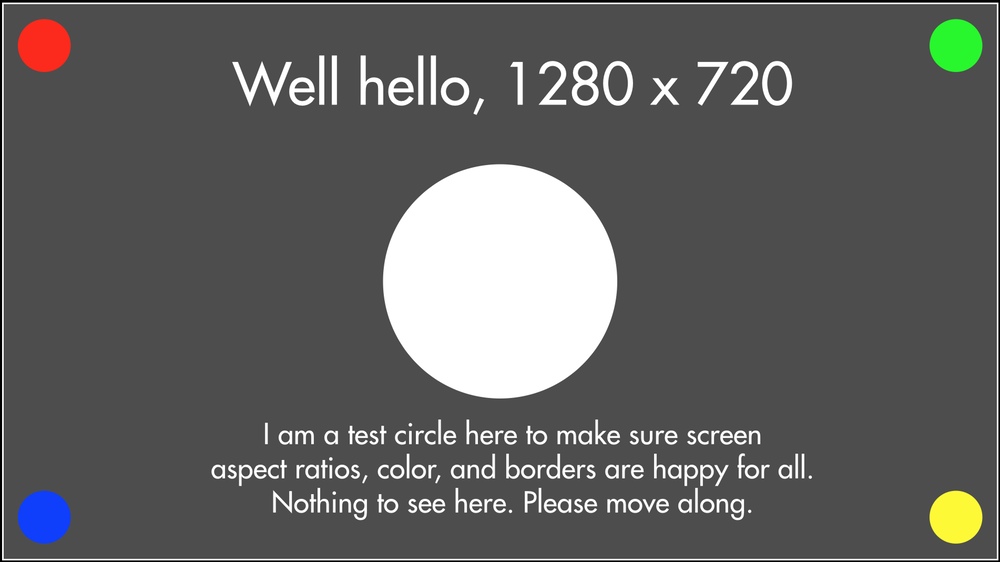
The reason for this slide is so that when you’re doing that inevitable run through of your deck, you can easily answer the questions:
Is all of the usable space on your slides being displayed correctly.
Do the colors look right?
Are your fonts loaded correctly?
Is the aspect ratio correct on your slides? (Hint: if the circle isn’t a circle, it’s not)
UPDATE: Here’s an awesome fork by Tim Brown in Keynote.
November 14, 2013
Why Founders Don’t Sell
In posing a real threat to Facebook, Snapchat proved that it may have that one elusive thing that no money can buy: the ability to change how people behave, to become central to their relationships with one another, to re-architect human contact, to be masters of the human domain.
Best analysis of Snapchat’s rejection of the Facebook bid that I’ve seen.
Rands in RSS
As I mentioned in the launch post, there are now two RSS feeds for Rands. One feed contains every single post that I throw up here which includes a new type I called Excerpts – you’re reading an Excerpt right now. I’m still getting a feel for these posts, but my intent is they will:
Be short.
Add original commentary – they won’t be simple links or quotes to other articles.
More frequent than the long form posts.
If you’re reading this in a RSS-reader, you are already subscribed to Everything. Welcome. If you’d like to remove Excerpts from your content, you can subscribe to the Long Form feed.
November 13, 2013
Desk or Garage Design?
As I’ve written before, I am a comfortable power user of Keynote. My entire presentation development workflow exists inside of Keynote through the use of the outline view, presentation notes, and a bevy of stickies to remind me “need funny image here”.
It took work and patience to build the ideal workflow. I needed to discover that I could have multiple palettes open for heavy formatting at speed. I needed to wait until Keynote provided a practice mode for presentations. And I needed to fully understand the value of a well-architected set of master slides.
I love Keynote. Prior to Keynote 6, I’ve been fond of saying that if you want to see an Apple product dripping with Steve Jobs’ influence, take a look at Keynote.
A Couple Kinds of Simple
The story I’m telling myself about the Keynote 6 redesign (and I’m assuming all of iWork; I only use Keynote, but the applications share common user interface frameworks) is that a very smart person who is a User Experience Expert was given carte blanche to redesign the interaction flows within Keynote with the goal of simplifying the experience.
They and their team did a lot of research. They became experts in how different people accomplished different tasks inside of Keynote, and when they felt they had enough research, they asked themselves, “Where can we simplify?”
I’m wondering about their definition of simple. There’s the simplification where you clean your desk. The clutter on your desk is bugging you, so you decide to clean it up. This small act of simplification gives you the pleasant illusion that the world contains less chaos and you can suddenly magically focus on the task that you were procrastinating on while you were cleaning your desk.
The other version of simplification is harder. This is the simplification where you spend the weekend rearranging your garage. This process still involves tidying, but its primarily goal is to answer the question: “How am I going to get work done more efficiently?” You look at all your tools, you remember recent projects and what was hard and what was easy, and using these thoughts you embark on a weekend-long quest of simplification where the goal is improved efficiency.
At a glance when I compare Keynote 6 followed by its predecessor in my full Rands presentation design mode, the question is: “Were they cleaning the desk or the garage?”
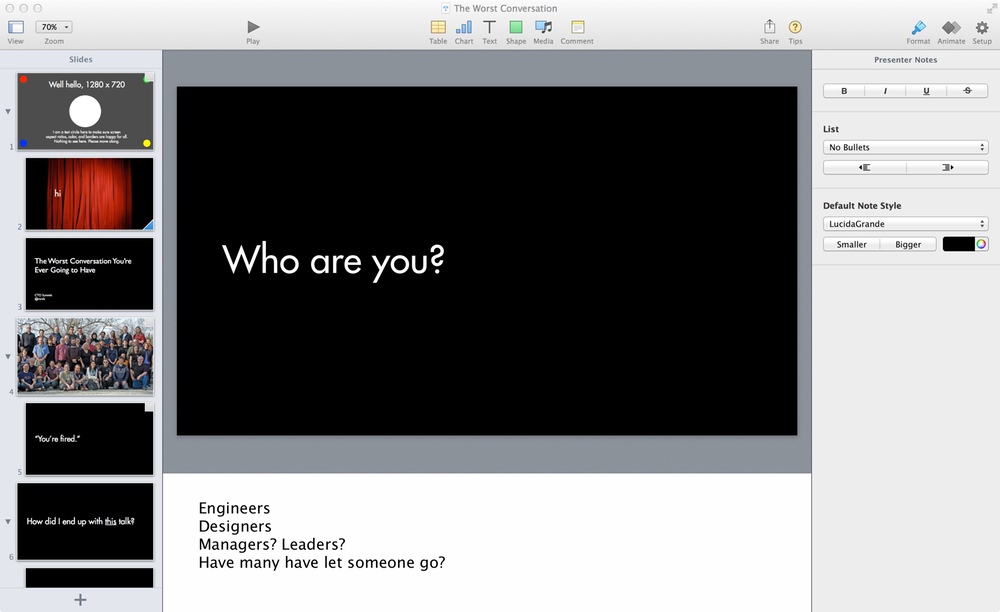
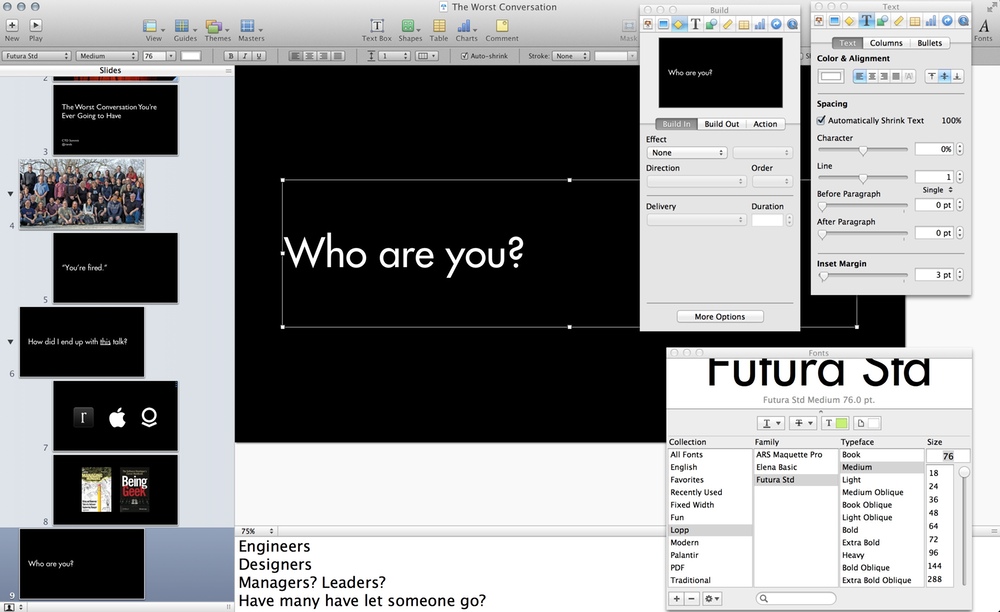
First, the folks who are claiming that Keynote 6 has been dumbed down are looking at the application, not using it. They see the absence of familiar clutter and the removal of features as a sign that it was a shallow desk cleaning, not a deep garage redesign. I’ve worked with Keynote 6 enough to experience the redesign intent… I feel someone is trying to make my Keynote life easier. Master guides (finally), context aware embedded palettes, and styles – these are features I need and will use every single day.
It’s too early to say this definitively, but from my initial work my impression is that I will be able to move faster in the new version. But that doesn’t mean I’m still not concerned.
Absence and Direction
For software consumed by humans, there are three broad categories:
Consumer software. Think iTunes. Think iPhoto. Any normal human can use it to get the task done. No training. No manuals.
Pro software. Think Final Cut Pro X. Logic Pro X. To get significant value out of the software, you must spend time learning it. While you might be able to plunk plunk plunk along, the software is not designed for average human beings.
Prosumer software. Somewhere in the middle. Think Lightroom. Think Aperture. Maybe Photoshop. The average human being can get immediate value out of using the software, but as you continue to use it, you discover there is a whole world of other features hiding under the surface. Unlike Pro software’s deliberately hostile learning curve, Prosumer software’s learning curve is inviting – you may never need the advanced features of the package, but you are likely going to be exposed to them as part of your casual usage.
The removal of significant features is strange, but my hope is that any important feature will return. Apple is known for big bang releases, and along with the release of Keynote 6, they were also announcing the iPad Air, the iPad Mini, and upgraded MacBook Pros. Launching all of these products in the same amount of time is a project management nightmare. My guess is that the answer to the question: “Do we delay the release so we can have Smart Builds?” is: “Suck it up, Smart Builds.”
However, the missing features do fit into the category of advanced or prosumer features, and while I understand why they were prioritized last, the question remains: “Is Keynote a consumer or prosumer application?”
As an avid user, I desperately want it to be prosumer because a prosumer application grows with you. The more you ask of it, the more the application reveals well-designed complexity.
Fact: There are far more people out there who are just looking to throw together a presentation. They’re going to use a default template with standard typography. Maybe they’ll throw in an animation, but probably not. 45 minutes later and they’re blissfully done and gratefully not using PowerPoint.
These folks are likely going to be happy with Keynote 6, especially now that it’s free and there are far more of those folks out there than of me. For me, presentation design is a multi-day affair where I sweat each slide. I have an opinion about each animation and how long it should last. I have developed and designed my own master slide deck. I will kern if kerning is required.
I understand that Keynote 6 is a big investment in the consumer and that is a sensible place to invest, but if subsequent releases don’t invest in the users who legitimately design inside of the application, I’m going back to the garage to find a tool that grows with me.
November 12, 2013
The Problem With Peak
It seems that Peak has a lot of potential, but the team working on it should take all this into consideration. I’m sure that they mean well and, in an ideal world, people will take the metrics as they are – possibly flawed outputs of a complex process aimed at creating value for the company. […]
Except we’re not in a perfect world.
Managers will abuse it, employees will game it.
We engineers like to measure things. In a world full of chaos and confusing humans, the ability to measure a thing gives us both a comfortable course of action as well a delicious delicious data. I believe there is a huge opportunity for applications like Peak to derive insight from the various tools we engineers use to build, but I treat mechanized derived insight with extreme skepticism. It’s rarely a reason to take decisive action and usually a reason to start asking more questions.
November 9, 2013
$578M Worth Of Sapphire for Apple
The hardness of sapphire will make it resistance to ‘flaw initiation’ (aka starting to scratch) and its ‘toughness’ is how it resists fracture once a flaw has begun (cracking altogether). This strength doesn’t come without a bit of cost, Hall notes. “The density of Gorilla Glass is 2.54 g/cm3 while sapphire is 3.98 g/cm3. Given equal-sized pieces, Gorilla Glass will always be lighter.”
The counter-point to the greater weight is that Apple could use thinner pieces of sapphire due to its greater strength overall. This would result in weight and thickness reduction, which is something Apple is very conscious about. You may have noticed that the latest iPad Air was reduced in thickness in part due to its use of thinner glass and IGZO display panels.
Michael Lopp's Blog

- Michael Lopp's profile
- 144 followers

