
Michael Lopp's Blog, page 51
July 14, 2013
Entropy Crushers
When it was five of you sitting the same room, it was easy. When someone needed to know something, they stood up in the middle of the room and asked, "Who broke the build?" When a decision needed to be made, you looked up at Phil and said, "Phil, this needs to scale from day one, right?" and Phil nodded. In a nod, you defined the entirety of your product performance plan. When someone was struggling or was blocked, you could tell because they were swearing profusely at the monitor - directly across from you.
I should help him.
But now it's 105 of you. You're spread out over two floors of the building, you're working on two products, and you're approaching the dreaded moment where you don't know the name of someone on your team. This is the first of many warnings that the team needs to evolve.
I want to make the argument that it's time for project managers.
WHOA WHOA WAIT RANDS WHOOOAAAAAAAAA. We've got a self-starter engineering culture, we're flat, and we're not about to dilute that culture with... project managers.
I've run into this response a lot. When I hear this knee-jerk reaction I hear the following:
Most engineers don't know what a project manager does, and if they do, they usually don't know what a good one looks like.
Crap project managers have ruined the reputation of the gig.
By suggesting you don't need project managers, you're saying that you, an engineer, want to do this work and my question is, "Do you or do you not want to be an engineer?"
The Project Rules
First, some definition. Project manager, product manager, and program manager. Let's clear that up. A project manager is responsible for shipping a product, whereas a product manager is responsible for making sure the right product is shipped. A program manager is an uber-mutated combination of both that usually shows up to handle multiple interrelated projects like, say, an operating system. Different companies use the names differently, but for this article, project = ship the product, product = ship the right product, and program = ship many interrelated products, usually at the same time. Got it?
Second, a rule: the addition of each new person on your team increases the cost of each of the following:
Communication. How much effort is required to get Idea A and make sure it travels to all the necessary people?
Decisions. How quickly can a group of people best choose Path A or Path B?
Error Correction. How long does it take to detect and fix when something is going wrong?
Think of it like this: when it was five of you and one of you wanted to do a new feature, how'd it happen? Well, you did it. You wrote the feature in the morning, tested it after lunch, and then checked it in before dinner. The update to the team that a new feature landed was the check-in notification sitting in everyone's inbox and the silent nods as they read the check-in... Sweet, we needed that feature.
How does it happen now?
After the latest release, there's a feature review meeting where the team sits down and scrubs JIRA and comes up with feature nominations. Then they vote internally, and then they vote with the business development team. After those votes are counted, we do a prioritization pass before we send the list to the VP of Engineering, Phil, who takes the list and prioritizes it against his vision for the product. That takes two days and, invariably, we argue about prioritization.
Now we've got an initial list, but who is going to do the work? ASSIGNMENT MEETING! More debate about who should do what. Further arguments occur because there are cool features and not-cool features and features must be assigned carefully to fairly dish out the coolness. Sweet, features have been assigned, but first, we have to write a feature spec, which will then need to be vetted with the rest of the team to make sure we're writing the right feature. I would like to point out that a single line of code has yet to be written and I'm already exhausted.
Take a look at the work in the prior paragraphs. If you're a lead on a growing team, you have your unique version of this process, and to me, a huge chunk of this work is for the project manager. You already have a project manager and it's you. You're a full-time engineering manager, you're the leader of the people, and you're also a project manager. My guess is that on a growing team you're likely doing at least one of those jobs half-assed. Which means you're officially part of the problem.
A good project manager is one who elegantly and deftly handles information. They know what structured meetings need to exist to gather information; they artfully understand how to gather additional essential information in the hallways; and they instinctively manage to move that gathered information to the right people and the right teams at the right time.
There are humans who are really good at this. They thrive on it. Engineers have difficulty believing this - it's the same issue they have with managers. They see these strange humans focusing furiously and scurrying hither and yon and they wonder, "What are they actually building?" They're right. Project managers don't write code, they don't test the use cases, and they're not designing the interface. You know what a good project manager does? They are chaos destroying machines, and each new person you bring onto your team, each dependency you create, adds hard to measure entropy to your team. A good project manager thrives on measuring, controlling, and crushing entropy.
You did this easily when you were a team of five, but if you're going to succeed at 105, what was done organically now needs to be done mechanically.
The Project Concerns
I've heard a litany of concerns about the introduction of project managers. My response is a good starting point to understand who I believe the role fits on the team:
I am worried about project managers influencing product direction. Two points here: first, remember you're no longer in a world where everyone is doing everything. You miss the world because it made you agile, but you're just too big. You need role definition and that means being clear with everyone: Bob owns this, Frank owns that, Percy owns the other thing. What does "own" mean, Rands? Glad you asked.
To me, ownership means that a person is responsible for all decisions for the thing. They are accountable. At Apple, we called them Directly Responsible Individuals. You will likely call them something else. In this world of delicious new ownership, a good project manager owns the execution of the machine that makes sure everything is getting done. It's no more or less important than any other role, but it's essential to starting a project, understanding the health of that project, and deciding when you're done.
Second point: what kind of douchebag manager doesn't want every single person on the team to have an opinion about the product? Good project managers have a unique insight into the health of the project because it's their job to have visibility into the entire machine. It seems like they would have an informed opinion regarding the product.
I am worried about losing insight into what is going on. Tough news. As I've already mentioned, this is already happening as you add each new person to the team with the new set of opinions, values, and experience. An effective project manager instinctively creates artifacts of insight. It's their first question when arriving on the scene: "What... the fuck is going on here?" Your first conversation with your new project manager sounds like this: "I want to be able to measure X, Y, and Z and I'd like to be able to measure them on a weekly basis." The project manager will take this request and do their damnedest to find that data (and the people creating that data), efficiently mechanize its collection, and eventually present you the artifact. Given the chaos factor on your team, the work necessary to build this artifact varies wildly, but if you haven't seen a draft of any valuable artifact in two to three months, something is wrong.
There is no crap work on my team. This is a concern raised by someone who doesn't understand the role of a project manager or has been burned by crap project management. It was probably this meeting: you were sitting there meeting with the entire team where a project manager showed a Gantt chart on the wall and presented a partially informed opinion as fact. "We are three months from shipping." Everyone thinks, but does not say, "Bullshit." This partially informed person rambles for another 30 minutes, the meeting completes, everyone shuffles out, and the reputation of project managers as shovelers of bullshit is furthered. This was a crap meeting based on crap work.
There are a couple of memorable screw-ups in this meeting. First, you've got the a poorly defined artifact. Gantt charts are great at showing the order of operations for building software, but in the never in history of ever have they effectively been used to measure when to ship that software. Second, you've got the whole team staring at this useless artifact and the person presenting it - both of which are losing credibility by the second.
One of the easiest ways to screw up the landing of project managers on a team is not to be painfully aware of what you need out of the role. The way I've seen this screwed up is when the guy in charge says, "Well, this looks bad. You know, at Apple, we had engineering project managers. We should have engineering project managers. Go hire them."
Incorrect approach. You are not and never will be Apple. What your team, and your culture, needs out of a project manager is entirely dependent on the people, the team, the culture, the projects, and this moment in time. Top down declarations of necessity without deep understanding of the situation within the team are a terrific way to set up a new role for failure. The arrival of project managers (or whatever you end up calling them) needs to coincide with a clear and present danger to the product or the team. They are here to help with X because if we don't solve X, we are screwed.
I am worried that process nerds like project managers are going to kill creativity and innovation on my team. This isn't actually the issue that folks fear. What they're really saying is that they don't want to give up control, and again, I think this comes from prior awful interactions with project managers. See, the reputation of a project manager grows over time because of their penchant for knowing, well, everything. It can be intoxicating being the only person who knows you have the best assessment of the situation among the chaos, the person that everyone goes to because you have the information. There are project managers who go crazy with this power and become political. They become information brokers, which means they're precisely the opposite of the job. They're using information to control rather than to illuminate. My advice: fire these people as quickly as possible.
A good project manager's job is to decrease chaos by increasing clarity. I understand that chaos can be an essential ingredient in creative, but I guarantee you -- I promise you -- even with the best project manager on board, you still get to run around like a crazy person because the sky always unexpectedly falls. Chaos in a complex system is a guarantee.
The Question
As a lead, you have three jobs: people, process, and product, and you get to choose how to invest in each of those roles. As a demographic, you're likely best at product followed by process, and finally, by people. What's weird is that you seem to be spending all of your time working on the people part of the gig, right? You should hire a great people lead, right? Maybe, but perhaps the situation is that you're constantly talking with the people because the process piece is broken. You're serving as a person who moves information so that we're all on the same page, so that the people are happy and efficient. Do you love this job? Probably not.
My question remains: do you or do you not want to be an engineer? If this is what you love, even as a lead, this where you should spend your time. You're never going to code like you did when you were an individual contributor, but your company and your team will get disproportionate value from the work you do that best approximates engineering.
As with any evolutionary change on your team, you need to be paranoid. Each new role, like each new person, has a unique ability to affect the culture in ways that you'll never predict. You need to carefully design around your specific pain, but once you hire and land the first person, you also need to pay careful attention for unintended side effects. The irony of the arrival of crap project managers is that you're effectively punishing inefficiency with useless bureaucracy, which, wait for it, creates more inefficiency.
A great project manager is rare, but so is any great hire. However, my guess is that you want to be an engineer. You want to focus on the satisfying act of building, and I think you'd be crazy not to viciously protect this time.


June 24, 2013
Is the Sky Blue?
The world is full of bullshit right now. Perhaps it's always been full of bullshit, but I'm sitting here right now and I feel that we - as a species - have taken the bullshit to an entirely new level. Strongly held beliefs are based on the flimsy opinions delivered by totally unqualified sham journalists who are more interested in the size of the audience their stories attract rather than the quality of the facts that support the story.
As an idealistic engineer, I believe that we should be able to source all facts. If you tell me that the sky is blue, there should be a convenient way for me to say, "Well, that's an interesting theory, but can you definitively prove to me that the sky is, in fact, blue?" You would respond by providing me a URL to a site (or something), ideally several, which definitively and incontrovertibly explain how the sky is blue. I'm not talking about a Wikipedia link or a Quora article, I'm talking about a well-sourced thing, a universally agreed-upon thing that once and forever clearly defines: yes, the sky is blue.
It turns out this is really hard.
In academic papers, there are no less than three types of citation styles used to "to uphold intellectual honesty (or avoiding plagiarism), to attribute prior or unoriginal work and ideas to the correct sources, to allow the reader to determine independently whether the referenced material supports the author's argument in the claimed way, and to help the reader gauge the strength and validity of the material the author has used." As you read that definition, you'll note that nowhere does it state that a citation's purpose is determine whether said fact is or is not bullshit. A citation's purpose is to help the reader gauge strength and validity of an argument, to compare other important ideas, and help the reader to form a judgement.
Does this mean we are doomed because of bullshit? No, not if we read.
As I read that definition of citations, I realized that much of what a citation intends to do your brain already does if you provide a steady flow of well formed ideas. When you read any sort of book, you're exposing yourself to a world of ideas that are decidedly not yours. You'll love some, you'll forget many, but, most importantly, your brain will diligently and automatically parse these thoughts, characters, ideas, scenarios, facts, fictions, and wit safely away in your mind so that you, as a reader, can form a judgment of the world in the book. But also, most importantly, the world around you.
I really want the planet to read more, so, once again, I'm offering the Rands in Repose benefit t-shirt.
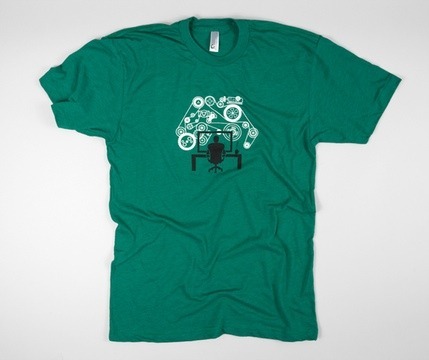
This is a reprint of a popular logo designed by Victoria Wang. This updated shirt sports the Rands logo on the back and is printed on a gorgeous vintage green American Apparel t-shirt. If green isn't you're color, I still have the handsome red shirt available from the previous drive.
As with all previous shirts, 100% of the proceeds from each shirt go to First Book, a nonprofit organization with the mission to give children from low-income families not just the opportunity to read and to own their first new books, but also learn to form their own judgements built with their own knowledge and ideas that they find in books.
May 28, 2013
Triggers
Mad. Furious. Instantaneous rage. I’m not proud to admit it, but there is a short list of seemingly inconsequential events that give me blind, piercing rage.
It’s an embarrassing list that I cannot fully share, but here’s a few:
When a single key on my keyboard is slowly failing.
When you chew with your mouth open (and I can hear it).
When I lose my wallet in my own house, in my own room.
I told you they were trivial, but I didn’t tell you the depth of the rage I experience because it completes my embarrassment. If I sit here carefully and clearly explaining that when you chew with your mouth open (and I can hear it) that I sincerely want to lean across the table and punch you in the mouth, I realize this is batshit insane. You can be assured that I’ve never actually slugged a single human, but this doesn’t change my internal reaction or my point.
Every human has a handful of triggers.
It’s beyond my ability to explain how these triggers are built, but if you can’t yet relate, remember the last time you accidentally hit your head on a kitchen cabinet while your significant other watched. You noticed two things: first, it hurt — bad. Second, when your significant other asked, “Oh no, are you ok?” your instinct was to scream, “NO, I AM NOT OK, I JUST HIT MY HEAD AND IT HURT.” You want to lash out at the person who is caring about your well being.
After years of professional self-reflection, I am sure of three things regarding triggers:
For non-kitchen cabinet pain-based triggers, their origin is non-obvious. The key on my keyboard not working is not disproportionately enraging me not just because of the hindered productivity. The root cause of my fury is far more complicated, sinister, and deeply buried in the back of my head.
Our mental wiring is far from perfect.
I would likely benefit from professional therapy.
You have triggers. They are delightfully, privately, and weirdly yours. I don’t need to know them, but as a person who hangs with other people I need you to feel and remember the sensitivity you feel in the middle of a trigger — the instant mindlessness. The blind rage. The lack of rational faculties.
Can you feel it?
Good. Let’s talk about how to communicate with your team.
The Big Three
There are three situations that can easily trigger members of your team.They involve: title, compensation, and location. That’s right. The title on a business card, the amount of money someone receives, and where they sit. In my career as a leader of humans, I have spent an inordinate amount of time cleaning up where a lead has underestimated the trigger impact of a seemingly unimportant discussion regarding title, compensation, and location.
I call these the Big Three and the Big Three are part of a handful of objective measures and goals a person can achieve that are well known, easy to compare, and understood by the whole team. The Big Three, right or wrong, have accreted unexpected status; they’ve become disproportionately highly valued. They’ve become a yardstick by which a person measures success. This is why something seemingly as simple as office relocations become a multiple meeting clusterfuck. It’s not just that they care where they sit; it’s that they believe there is measurable status applied to where they sit.
There is a single universal realization that occurs in conversations about the Big Three, and it’s a doozy: In a moment, I understand that the world values me drastically differently than I expected.
Drastically Different Than Expected
“Frank, we had a really good quarter. We shipped the update, we’re solidly into the next major release and I’d like to give you a $5k raise.”
“I quit.”
Wait, what?
First, before you try to untangle anything, before you try to handle the situation, before you screw this up further, repeat after me: trigger. Frank just metaphorically hit his head on the corner of the kitchen cabinet and just about any proactive action on your part will result in him lashing out further. While we sit here waiting for Frank’s next move, some advice:
Understand that judgment is temporarily impaired by triggers. Just like The Disaster, judgement is way off not just at the moment of the trigger, but for some time. Unlike the kitchen cabinet scenario, chances are, as we’ll talk about more in a moment, Frank saw part of this coming. This doesn’t decrease the intensity of the trigger, but it does increase the duration, because he’s been chewing on this trigger for a while. When I know someone has been triggered, I don’t trust their judgment regarding much of anything: they’ve been triggered.
Understand that while facts, data, and conversation will eventually be helpful, in a trigger situation time is the only initial cure. There’s value in talking through the situation in the moment, but, again, faulty wiring. They’re furious — perhaps for valid reasons — and until the fury passes, it’s less a conversation than a very important vent.
Wait for Frank. It’s not always the best advice, but when I stumble on a trigger, I usually wait — sometimes a long time — for Frank to say something. In my mind, I’m watching him standing there, rubbing where he hit his head, shouting, “YOU KNOW THAT FUCKING HURT.” Too often I have jumped in with some helpful advice only to have it twisted and thrown back in my face because Frank was triggered.
Right, it’s been 37 seconds and Frank has just said something disarming that acknowledges the magnitude of his reaction. Now, you can start mentally triaging. How in the world is a $5k raise a reason for quitting? Here’s the cheat sheet. Do you remember when Frank was hired two years ago and you brought him in on the high side of the salary recommendations? You forgot that, right? Yeah, you also didn’t notice his subtle disappointment to the $5k raise last year. You didn’t expect him to talk to several members of the team regarding their raises, which were $10k. Of course, he didn’t ask about base salary, which is much lower than his. Frank’s trigger is based on over a year of build-up where he believed he’s being under-compensated, when the reality is that he’s the highest paid engineer on the team.
Reflecting on the many triggers I’ve encountered in my professional career, the situation is always that the story the person was telling themselves was drastically different than the one I, their lead, was suddenly telling them. It’s never a complete surprise because they’ve been picking up on subtle clues about the story leading up to the conversation, but hearing me say it makes it real, and having it involve quantifiable status-based topics like a title, an office, and a raise makes it that much more real.
You Can’t Be Too Paranoid
The Big Three are certainly not the only trigger scenarios out there, but they are a knowable set. I approach all conversations regarding the Big Three as if I were walking through a minefield where there is only one map and it was drawn by me — when I was drunk. It’s certainly useful to have this map, but I remain suspect.
You cannot be too paranoid going into these conversations. You can’t reflect too much. How has every conversation regarding compensation gone with this person? What were their reactions? What questions did they ask? Have they ever said anything about title? What? When? How often? You’re about to alter the story they’ve been telling themselves, so as best you can you need to understand their story — not yours.
Is it a fair change? There are far too many local variables to make this advice that useful, but in considering the change that you are describing to this person, do you fully believe that it’s reasonable, fair, consistent, and understandable? Can you completely tell the story with no niggling concerns in the back of your head? Would everyone on the team agree that this person has earned this title? Does this seating layout acknowledge how this team feels about offices? Does this compensation change reflect your company’s compensation philosophy?
Remember, it’s a minefield because we, as an industry, have fucked up these conversations — a lot. Crap managers who award titles because they like someone, offices because of title rather than ability or need, compensation based on following the broadest guidelines provided by HR rather than taking the time to understand the complete compensation picture. It’s a minefield because they’re expecting us to screw it up because that’s what we usually do.
A First Line of Defense
Healthy paranoia and prior experience in delivering these types of messages will improve your ability to deliver level-setting information. However, even with all this preparation, you’re still going to stumble on triggers. It’s unavoidable.
To talk about triggers, I had to reduce the trigger scenarios down to the knowable Big Three because we’ll likely never know why someone talking with their mouth full causes me unbridled rage. It’s also not your problem that I have this trigger. It’s mine and it’s up to me to stand up when you’re mash-mash-mashing your food and telling me about your trip to Guatemala and say, “Excuse me for a moment, I must rage elsewhere”.
In order to handle triggers in the workplace, you must first own your trigger weirdness. Acknowledging your faulty mental wiring can serve as a best first line of defense - it gives you solid trigger appreciation. Humans are messy and will blow up, but your job is suspend judgement, keep quiet, and give them time to cool down. It’s not your job to fix the trigger, it’s your job to first get them through the trigger weirdness and then to figure out how to close the kitchen cabinet door so they don’t hit their head again.
Triggers
Mad. Furious. Instantaneous rage. I'm not proud to admit it, but there is a short list of seemingly inconsequential events that give me blind, piercing rage.
It's an embarrassing list that I cannot fully share, but here's a few:
When a single key on my keyboard is slowly failing.
When you chew with your mouth open (and I can hear it).
When I lose my wallet in my own house, in my own room.
I told you they were trivial, but I didn't tell you the depth of the rage I experience because it completes my embarrassment. If I sit here carefully and clearly explaining that when you chew with your mouth open (and I can hear it) that I sincerely want to lean across the table and punch you in the mouth, I realize this is batshit insane. You can be assured that I've never actually slugged a single human, but this doesn't change my internal reaction or my point.
Every human has a handful of triggers.
It's beyond my ability to explain how these triggers are built, but if you can't yet relate, remember the last time you accidentally hit your head on a kitchen cabinet while your significant other watched. You noticed two things: first, it hurt -- bad. Second, when your significant other asked, "Oh no, are you ok?" your instinct was to scream, "NO, I AM NOT OK, I JUST HIT MY HEAD AND IT HURT." You want to lash out at the person who is caring about your well being.
After years of professional self-reflection, I am sure of three things regarding triggers:
For non-kitchen cabinet pain-based triggers, their origin is non-obvious. The key on my keyboard not working is not disproportionately enraging me not just because of the hindered productivity. The root cause of my fury is far more complicated, sinister, and deeply buried in the back of my head.
Our mental wiring is far from perfect.
I would likely benefit from professional therapy.
You have triggers. They are delightfully, privately, and weirdly yours. I don't need to know them, but as a person who hangs with other people I need you to feel and remember the sensitivity you feel in the middle of a trigger -- the instant mindlessness. The blind rage. The lack of rational faculties.
Can you feel it?
Good. Let's talk about how to communicate with your team.
The Big Three
There are three situations that can easily trigger members of your team.They involve: title, compensation, and location. That's right. The title on a business card, the amount of money someone receives, and where they sit. In my career as a leader of humans, I have spent an inordinate amount of time cleaning up where a lead has underestimated the trigger impact of a seemingly unimportant discussion regarding title, compensation, and location.
I call these the Big Three and the Big Three are part of a handful of objective measures and goals a person can achieve that are well known, easy to compare, and understood by the whole team. The Big Three, right or wrong, have accreted unexpected status; they've become disproportionately highly valued. They've become a yardstick by which a person measures success. This is why something seemingly as simple as office relocations become a multiple meeting clusterfuck. It's not just that they care where they sit; it's that they believe there is measurable status applied to where they sit.
There is a single universal realization that occurs in conversations about the Big Three, and it's a doozy: In a moment, I understand that the world values me drastically differently than I expected.
Drastically Different Than Expected
"Frank, we had a really good quarter. We shipped the update, we're solidly into the next major release and I'd like to give you a $5k raise."
"I quit."
Wait, what?
First, before you try to untangle anything, before you try to handle the situation, before you screw this up further, repeat after me: trigger. Frank just metaphorically hit his head on the corner of the kitchen cabinet and just about any proactive action on your part will result in him lashing out further. While we sit here waiting for Frank's next move, some advice:
Understand that judgment is temporarily impaired by triggers. Just like The Disaster, judgement is way off not just at the moment of the trigger, but for some time. Unlike the kitchen cabinet scenario, chances are, as we'll talk about more in a moment, Frank saw part of this coming. This doesn't decrease the intensity of the trigger, but it does increase the duration, because he's been chewing on this trigger for a while. When I know someone has been triggered, I don't trust their judgment regarding much of anything: they've been triggered.
Understand that while facts, data, and conversation will eventually be helpful, in a trigger situation time is the only initial cure. There's value in talking through the situation in the moment, but, again, faulty wiring. They're furious -- perhaps for valid reasons -- and until the fury passes, it's less a conversation than a very important vent.
Wait for Frank. It's not always the best advice, but when I stumble on a trigger, I usually wait -- sometimes a long time -- for Frank to say something. In my mind, I'm watching him standing there, rubbing where he hit his head, shouting, "YOU KNOW THAT FUCKING HURT." Too often I have jumped in with some helpful advice only to have it twisted and thrown back in my face because Frank was triggered.
Right, it's been 37 seconds and Frank has just said something disarming that acknowledges the magnitude of his reaction. Now, you can start mentally triaging. How in the world is a $5k raise a reason for quitting? Here's the cheat sheet. Do you remember when Frank was hired two years ago and you brought him in on the high side of the salary recommendations? You forgot that, right? Yeah, you also didn't notice his subtle disappointment to the $5k raise last year. You didn't expect him to talk to several members of the team regarding their raises, which were $10k. Of course, he didn't ask about base salary, which is much lower than his. Frank's trigger is based on over a year of build-up where he believed he's being under-compensated, when the reality is that he's the highest paid engineer on the team.
Reflecting on the many triggers I've encountered in my professional career, the situation is always that the story the person was telling themselves was drastically different than the one I, their lead, was suddenly telling them. It's never a complete surprise because they've been picking up on subtle clues about the story leading up to the conversation, but hearing me say it makes it real, and having it involve quantifiable status-based topics like a title, an office, and a raise makes it that much more real.
You Can't Be Too Paranoid
The Big Three are certainly not the only trigger scenarios out there, but they are a knowable set. I approach all conversations regarding the Big Three as if I were walking through a minefield where there is only one map and it was drawn by me -- when I was drunk. It's certainly useful to have this map, but I remain suspect.
You cannot be too paranoid going into these conversations. You can't reflect too much. How has every conversation regarding compensation gone with this person? What were their reactions? What questions did they ask? Have they ever said anything about title? What? When? How often? You're about to alter the story they've been telling themselves, so as best you can you need to understand their story -- not yours.
Is it a fair change? There are far too many local variables to make this advice that useful, but in considering the change that you are describing to this person, do you fully believe that it's reasonable, fair, consistent, and understandable? Can you completely tell the story with no niggling concerns in the back of your head? Would everyone on the team agree that this person has earned this title? Does this seating layout acknowledge how this team feels about offices? Does this compensation change reflect your company's compensation philosophy?
Remember, it's a minefield because we, as an industry, have fucked up these conversations -- a lot. Crap managers who award titles because they like someone, offices because of title rather than ability or need, compensation based on following the broadest guidelines provided by HR rather than taking the time to understand the complete compensation picture. It's a minefield because they're expecting us to screw it up because that's what we usually do.
A First Line of Defense
Healthy paranoia and prior experience in delivering these types of messages will improve your ability to deliver level-setting information. However, even with all this preparation, you're still going to stumble on triggers. It's unavoidable.
To talk about triggers, I had to reduce the trigger scenarios down to the knowable Big Three because we'll likely never know why someone talking with their mouth full causes me unbridled rage. It's also not your problem that I have this trigger. It's mine and it's up to me stand up when you're mash-mash-mashing your food and telling me about your trip to Guatemala and say, "Excuse me for a moment, I must rage elsewhere".
In order to handle triggers in the workplace, you must first own your trigger weirdness. Acknowledging your faulty mental wiring can serve as a best first line of defense - it gives you solid trigger appreciation. Humans are messy and will blow up, but your job is suspend judgement, keep quiet, and give them time to cool down. It's not your job to fix the trigger, it's your job to first get them through the trigger weirdness and then to figure out how to close the kitchen cabinet door so they don't hit their head again.
May 19, 2013
Unknowable
Each year, the race to get a ticket for WWDC is on. Even with early warning, the window of ticket availability shrinks with every passing year. 2013 being no different: 2 minutes.
Capping the number of tickets is a classic Apple move: we're going to create a sense of exclusivity by creating an artificial constraint. Moscone Center is huge. Apple could blink and triple the size of the event, but I can't think of the last time the ticket ceiling at WWDC went up. 5000 attendees - that's it.
WWDC is a great event. I've been going for years without a ticket and I still have amazing nights spending time with dear friends debating the state of Apple. Logic would dictate that increasing the number of tickets would increase the "product": the army of foaming-at-the-mouth fanboys'n'girls who, I believe, are one of the best (and cheapest?) organic marketing assets in the industry.
Nope. 5000. That's it.
This type of constraint reeks of Steve Jobs. The rumor at Apple was that Steve capped many of the teams in Cupertino. Mac OS X and Marketing Communications being two successful teams that had their headcount capped. During the 2000s, while Apple was gaining traction across the planet, the team responsible for getting the word out, Marketing Communications ("MarCom"), was allegedly capped at 100 heads. The reasoning I heard was that Steve wanted to keep the teams feeling small, but, more importantly, I think he wanted to keep them knowable.
Of course, with the amount of work they had to produce supporting WWDCs, MacWorlds, product launches, and all the other advertising, they relied on expensive external vendors to do the bulk of the heavy lifting. While back in Cupertino, the 100 represented a small, well-understood group where I believe Steve could not only easily understand every single story being told by Apple, but, more importantly, the 100 could know each other.
When you talk about change or optimum team sizes, Dunbar's number is usually thrown down as scientific evidence of something you already know in your bones. Shit gets weird somewhere between 100 and 200 people. You can no longer keep the individual state of each of the other people in your team or company in your head. Which means communication becomes more taxing. Rather than walking up to Fred and saying, "What's up?" you cautiously walk up to a person you don't know and sheepishly ask, "Yeah... who are you?"
What was easy becomes hard. What used to be maintained in your head now involves an extra email or an additional meeting. What was familiar becomes unfamiliar and frustrating. Culture is diluted, communication becomes taxed, and people start saying, "I remember when..."
Capping the headcount of a team necessary to shaping the story of an increasingly successful company seems counter-intuitive. We're doing well, we should invest more. This type of thinking puts a big discount on the taxes associated with rapid team growth with, in my opinion, being able to easily discern what is going on in a team of people being number one.
Apple's MarCom department being capped at 100 achieved two very different objectives. First, it made the work the team was doing knowable - you could discern who was doing what because there just weren't that many full-time people. This allowed for dictatorial control that has given Apple clear and consistently messaging. Second, the constraint meant that every single person counted. While I never worked on the team, I'm certain they were much quicker in dealing with low performers because you could still discern the difference one additional high performing person would make. While this could certainly be viewed as a constant threat of being fired, it could also make for a high performing team.
The effects of capping WWDC tickets are different because you're talking about a larger population, but some of the effects are the same. Each year, WWDC is held in Moscone West. You know that the big Apple logo will be emblazoned on the side of the building. You know the names of the conference rooms, you know where the snacks will be. But, for me, I know who will be there. I end up in the same bars with the same dear friends and we get foamy at the mouth about Apple because we feel like we know it.
The cap on WWDC tickets means it won't go the way of SXSW - a wildly successful conference that has grown consistently since its inception. I used to go every year until one late night we looked around a huge sea of strangers and decided that we no longer knew this conference. The experience had become diluted. It had become unfamiliar, full of strangers, and unknowable.
April 21, 2013
I Choose Superman
My family has a disproportionate love of Superman and I never quite understood why until recently.
When I say disproportionate love, I mean manic crazy love. My sister took a tape recorder into Superman II, recorded the whole damned thing, and then transcribed the entire movie via a typewriter. Why? So she could read the transcript of the movie she just saw.
I followed her madness by clipping Superman II ads out of any newspaper I could find and placing them carefully into a photo album. Black and white, low resolution ads. All the same, carefully curated in a photo album so I could remember what it felt like to watch those movies.
Clearly we both had too much time on our hands.
Superman has suffered since those first two movies. The latter movies were awful. We had high hopes for Superman Returns, but the essential story was left on the editing room floor. Meanwhile there were the critiques of Superman the character, that he's boringly one dimensional. An invulnerable and totally moral character. He's perfect; he can do no wrong. He's not a realistic reflection of us mortal humans and therefore an unattainable idea.
Meanwhile, Batman. Yes, pathos and dysfunction. That's a hero. Look at him - he's that close to killing The Joker. He thinks about it because even though he's a strategic fictional genius, he's kinda fucked up. AND WAIT DID HE JUST KISS CATWOMAN? See, Batman has good days and bad days... just like you and I. I love Batman. While he remains a hyperbolic exaggeration of our ability, if you shoot him, it hurts, and we can relate to hurting. Does Superman ever feel pain?
I better understood what Superman meant when I watched the most recent and final trailer for Man of Steel. When Lois Lane asks him what the S stands for, he says, "It's not an S. On my world, it means hope."

When a twisted someone believes that they are delivering an important message by blowing up innocents in a city that is a cradle of our liberty, I choose hope. I choose unrealistic and unbounded hope. I choose Superman.
Superman is a story. It's a great story. It's an unrealistic story full of fantastic elements that appeal to our desire to be intensely good humans, to perform amazing feats of strength, and to live forever. These stories, while unrealistic, give us direction, they temporarily relieve our burdens, and they give us an ambitious plan forward.
Perhaps the biggest critique you can make of Superman is that because he makes it look so easy with the flying and the invulnerability that doing the impossible is somehow easy or even achievable. It's big. It's over the top. It's unrealistic and no one human can ever complete the feats of a single Superman. But it's not the individual feats of Superman we care about, it's that we, as a group of humans, working together, can do anything, even though it's never easy.
My family loves Superman because he is an unrealistic and impossible creature. We know that. We know he sets an impossible bar, but we need that bar because that is how we dream big, that is how we aspire to something great, and that is why we choose hope.
April 6, 2013
An Introduction to You
Hello, New Person. It's great to meet you. We've been waiting awhile for you to come here and now that you're here, we're pumped. It's going to be so much better with you here because we've built up impossible expectations in our heads regarding what you can do. Don't worry - we're not going to tell you this because we've got this crazy unique culture where we want you to figure it out all on your lonesome..The journey's the adventure, right?
You'll make mistakes. That's cool, you're in the Bright and Shiny phase of our relationship where you can do no wrong. I mean it, you can't be blamed for screwing up because you're the New Person and you don't know any better. It's our fault, really, because we probably didn't give you the right context or point you at the right wiki page. In fact, it's cool that you made that mistake because failure is how you learn, and boy oh boy, you're sure learning a lot.
. . .
Hello Not-So-New Person. Well, it's been a month and, well, we're really disappointed in you. We think we may have made a mistake.
You remember those expectations we had of you? The impossibly high ones that we never told you about, but mostly just felt? Yeah, they were way off. In fact, our opinions of your ability appear to be way off. You appear to be just a regular old disappointing human. Those mistakes you keep making? We don't know if you're not getting it or what. Most folks have figured it out by now. Figured what out, you ask? You know, the undefinable but very important 'it' that everyone else knows, but can't explain it. You not getting 'it' is worrying us.
This is the Fall from Grace phase, Not-So-New Person. We're disappointed, and the degree of our disappointment is proportionate to our previous impossible and unspoken expectations. We're sad. We're talking to others about your massive failure because we're pretty sure we're going to need to let you go, and talking to others whose unreasonable unspoken expectations were not being met either makes us feel better about the horrible mistake that is you.
Don't worry. We're going to stick with our longstanding policy of not telling you this because you've still got a little Bright and Shiny, but mostly because we're incapable of articulating our disappointment. We're also a little worried that some of your hyperbolic and unmeasurable failure might rub off on us.
. . .
Hello Person. It's been three months and you're just fine. You've arrived at the final phase of Steady State.
Whew.
We're not sure what we were thinking just a few weeks ago when we were whispering about firing you. You're solid. We've seen you fail and we've seen you succeed. We better understand where your superpower lies. We've stopped thinking of you as a tentative work in progress and now we're just working.
We're sorry.
We're sorry because of everything we didn't say in those first three months of highs and lows. In our enthusiasm, we forget that humans are slow to trust. We forget that we build respect by watching both successes and failures for weeks... for months.
We are in an incredible hurry building important things and have no time for nuance. We're impatient. We're busy. We want everything to move faster, so we make huge, comforting assumptions and slap easy to understand labels on complex concepts.
You are a complex concept. No matter how hard we try to bucket you, there you are, being something we've never seen before.
We're sorry mostly because we always forget these aspects of human nature and each time a New Person, a New Team, or a New Idea arrives, we humans repeat this painful three-month cycle of highly energetic exaggerated expectations, a confusing fall from grace, and a final discovery of comfortable understanding of that which is uniquely you.
Thanks for staying.
March 27, 2013
Regular Audio Human
I'm a rookie when it comes to listening to music, and chances are, so are you. Like me, you're just fine using whatever headphones were supplied with your smartphone. You know there are better headphones out there, but you think, "What's the point? I can hear the music just fine."
You can, but there are vastly better headphones out there.
For this piece, I'm going to compare three different types of headphones at three different price points. This makes an apples-to-apples comparison tricky to make, but the point of this piece is not to fully explore the world of headphones, but rather to begin to understand how the headphones world is built.
I deliberately did not research all of the attributes that make or break a good set of headphones. There are legions of audiophiles who will angrily shake their fingers at my lack of due diligence, and I'm eagerly waiting to hear their feedback and criticism. But my requirements for a good set of headphones have little to do with whether the headphones are based on a moving coil or electrostatic driver. My requirements are simple: I want to listen to my music as it was intended to be heard with a minimum of fuss anywhere on the planet.
You may not know much about the state of the art in headphones, but you are intimately familiar with hearing. This is an article for folks who like to hear.
The Hardware, The Tests, and a Great Song
For my selection of headphones, I wanted to test the Apple-supplied earbuds against both a high-end in-ear selection as as well as a set of full-sized headphones. For the full-sized headphones, I asked Marco for his recommendation, since he's obsessed a lot more about headphones. He suggested the Sennheiser HD 380 Pro (~$170.00). For in-ear, I went to Twitter for recommendations, and the good people at Klipsch provided me with a pair of their X10i model, which retail for around $349.00.
For the song, I chose Titanium by David Guetta and featuring Sia, which is, first, a great song, but also features thumping bass accompanied by Sia's bold and raging vocals that test the high end of the sound spectrum. I listened to the song on each of the three headphones in two different locations. The first location was a half-full bar at an airport. There was light to medium ambient noise from nearby conversations, as well as soul crushing techno-elevator music descending from the ceiling. The second location was at 32k feet over Greenland in the bubble of a 747 - heavy continuous white noise.
I chose these two test locations because they are where I need my headphones the most: when I'm traveling and when there is a lot of noise. Any headphones I use need to contend with the noise of traveling. Yes, I use my headphones at home, but not a lot. See, there is a wife and kids in the house, and while they're cool with my playing of video games, they are not cool with the way that any good headphones completely remove me from the Planet Earth.
For each set of headphones, I listened to Titanium a few times in each location. For different parts of the song, I'd often swap back and forth between the different headphones to hear precise differences. What I've captured are my thoughts about each set of headphones relative to sound and noise reduction as well as comfort, convenience, and quirks.
Apple EarPods, in-ear ($29.00, but included with iPhone, iPads, and iPods)

The sound quality of the Apple EarPods is fine, and by fine I mean until you spend any sort of money on your headphones. Both of the headphones below have instantly recognizable superior sound quality. Both in the bar and especially on the airplane, I found myself turning the volume up on my MacBook to ~ 75% of the maximum to get what I consider full sound with the EarPods. The same volume level for both the Klipsch and the Sennheiser was blaring; I had to turn it down.
Apple claims there is noise reduction in this latest generation of the headphones, and I believe them, but for my test cases -- the bar and the airplane -- all of the external sound was dulling the sound of the song, and again, giving me the impression that I needed to keep turning the sound up.
Apple's headphones are well designed. One of my favorite features is that because of their distinct shape and molding, you can tell left from right purely by feel. Each time I put on my other headphones, I'm compulsively checking the earbud, looking for that L or R. With the Apple headphones, it's an effortless process. For me, the EarPods are tied with the Klipsch for comfort. They fit snugly and firmly in my ears and I just forget about them for hours. No issues.
One of the quirks of the Apple in-ear headphones is one of its more useful features - I can hear what's going on around me. Both the Klipsch and the Sennheiser almost completely remove all external sound, which means when Frank the bartender looks me straight in the eye and asks me if I want another round, I give him a blank stare - I can't hear a thing. Apple headphones are my go-to headphones when I'm on the go and need to maintain situational awareness.
Klipsch, X10i, in-ear ($349.00)

The first indication of the vastly superior sound of the X10is is the fact that when I swap from EarPods, I have to turn the sound down - way down. This is a function of the seal the headphones make with your ear, which I'll talk about in a moment, but once you've got the right volume, you're in for a treat. The sound of the X10is is transcendent and complete. Your music will completely and wholly fill your head. Big huge bass, crisp highs, and simple, complete sound, but it comes with a cost.
The beauty of the Klipsch is the seal that it makes with the inside of your ear. It's at that point that the crystal clear sound comes pouring into your ear, but this seal is problematic. First, the seal between the plastic ear buds and the skin of your ears not only seals sound in, it also creates a perfect medium for sound to travel through any part of the headphone assembly. Sitting here right now in the back of a car heading to the airport, all I need to do to remember what type of headphones I'm wearing is shake my head. As the cables hanging from my ears drag across the wool coat I'm wearing, the scratching sound races up the cords with perfect, annoying fidelity. If I happen to be eating peanuts while wearing these headphones, I hear the death cry of each and every peanut I consume.
Additionally, the Klipsch earbuds make you intimately aware of a part of your body that you, perhaps, would prefer to take for granted: your inner ear. I'm certain that it is for very good evolutionary reasons that my body produces ear wax. I would thank billions of years of evolution that have given me this strategic waxy advantage, but I would prefer to take ear wax for granted. I've been using my Klipsch headphones steadily for several weeks, and in the last week I've noticed the sound in my right ear degrading. The issue? Yeah, ear wax. A quick cleaning with a Klipsch-provided cleaning tool and we're hunky dory, but for roughly 18.5 seconds I'm sitting there contending with... ear wax. This unavoidable ear wax tax is an annoying price to pay for both the sound quality and convenience of the Klipsch headphones.
Lastly, with the by far best sound quality of the three headphones, one of the more frustrating minor quirks of the the X10is is the cord quality - I constantly have to untangle them. I carefully wrap up the cord each time I'm done, but upon removal from my pouch, it's tangled. Apple allegedly partially solved for the tangle problem, but my impression is all the science involved is - wait for it - making the cords thicker, and therefore stiffer, which is harder to tangle. As I've been constantly pulling both of the headphones out of my travel pouch, I can confirm that Apple's headphones tangle less and the acoustically superior Klipsch headphones feel cheaper because they're tangled.
Sennheiser HD 380 Pro, over-ear ($199.95)

Like the Klipsches, the Sennheisers are a huge step above the Apple headphones in terms of sound quality. It's a shocking comparison that you should try at least once to understand how much sound you're missing. Compared to the X10is, the sound quality of the Sennheisers is slightly inferior. Audiophiles likely have dictionaries full of sound-specific words to describe the quality, but all I have is crispness. After jumping back and forth between each headphone on the same part of the song a half-dozen times, the Sennheisers are really good, but lack the crispness of the X10is - I feel like I'm hearing more of the song with the x10is. The same goes for the bass; the Klipsch bass is rounder and deeper than the Sennheiser.
In terms of noise reduction, there's a world of difference between the Apple and Sennheiser headphones, but again, the Klipsch has superior noise reduction. It's not clear to me whether this is a function of the electronics or the design the headphones. I have the same thought about the Klipsch seal. Are they better simply because of the complete seal they make? How much of the noise reduction is actual electronics? I can give the Sennheisers a noise-reducing boost simply by pressing the headphones harder against my head.
One of my favorite conveniences of the Sennheisers is really a quirk. The 1.5 inches that each headphone provides is a surprisingly convenient headrest on long haul flights.
I'm serious.
Many airlines provide head support in the form of fold-out head supports on both sides of your headrest, but the problem is that even with the pads folded completely forward, your head has a lot of room to bounce around. While I'm certain this wasn't a design goal for Sennheiser, their headphones do a splendid job of filling that space. They hold my head at a comfortable angle and allow me to sleep better. Combined with the simple muffling provided by the headphones, I often sleep with headphones on but with no music at all.
While they are an unexpected sleep aid, the Sennheisers are not at all convenient. They're a huge travel accessory only made larger by their traveling case, which I recommend using on trips. Here's why: I'm on my third set of Sennheisers because I tossed the first two in a fit of rage. I'd been lugging them around the world without the case, because they do fold flat, and once you've wrapped the cord around them, they're compact-ish. Problem is, the plug is exposed, and if that plug is bent, sound on one of your headphones gets spotty. You have to twist the plug just right to get everything to work. And another tip: attempting to re-bend the plug does not work. There are easier ways to protect the plug, but after having spent three hours on a transcontinental flight holding the plug just right I'm protecting the headphones in the supplied case, which makes the headphones the size of a late 80s mobile CD player.
Apples to Apples
I am a regular audio human. I've have no significant demands of my headphones. This article takes a very high level approach to looking at headphones, and I know there is much more to learn. While the lessons above might be broad, I'm eager to learn more. Again, it's tricky to compare the three sets of headphones listed above, but I can finish by answering a few questions:
Can I just get by with the Apple EarPods? Yes, even with the blaring white noise of an airplane, the Apple headphones are just fine. They work. You can hear your music. You could also learn to write in dirt using just your fingers on paper you found on the street. My point: if you're obsessing about your pens, backpacks, and notebooks, why wouldn't you obsess about your headphones? A single comparison to any other headphones will show you what you're missing.
Are the ginormous Sennheisers ever worth it? It seems to be fashionable to be walking around with huge headphones hanging around your neck. I think this is a fashion statement, not an auditory statement. I'm sure these headphones are good, but each time I see someone walking through the airport with their massive headphones, I think of every single moment that they have to contend with their bulk. The Sennheisers' long cord and high degree of comfort do make them my go-to home setup, but that's only when the kids and wife aren't home. I've had Sennheisers for a while, and in a world where they were the only higher end headphones I knew about, I would've been very happy.
Would I ever pay $350 for headphones? If you asked this before I started this article, I would have laughed in your face. $100? Maybe. $200? Probably not. $350. Never. It wasn't until I did the headphones to headphones comparison on the same song at the same time that I realized the stunning sound quality of the x10is. I sat at the bar listening to Titanium for the 18th time. I just finished with the Sennheisers, placed the Klipsches on for the first time, started the song and said, "Holy shit." I might've yelled it, but I didn't know because I couldn't hear a thing.
March 19, 2013
Titles are Toxic
You have a job and it has a name. A name of convenience. It exists so that when someone asks, "What do you do?" you can simply say, "I am a software engineer" rather than saying, "Well, there are these things called computers and computers run software and humans write software and I am one of those humans".
Chances are, you also have a title. It was given to you when you first arrived at your fine company and you probably didn't think about it. You argued for more salary or more stock, but the title was just there -- Sr. Software Engineer 2. You didn't think about where the title came from or the fact that it defined your compensation and promotion path for the duration of your stay with the company.
You didn't think a lot about title because you didn't really have a choice. The decision to create titles happened long before you were there, but you still need to understand why titles are toxic.
On the Origin of Titles
When a company is small, everyone does a little bit of everything, so titles make no sense. My first title at Netscape was "Bitsifter". Sure, there were some titles, but they were titles of convenience so external parties could apply their antiquated title frameworks to folks on our team during meetings. "Oh, I see, you're the VP of Product... how very impressive."
The unspoken agreement was that these titles were necessary to map to a dimwitted external reality where someone would look at a business card and apply an immediate judgement on ability based on title. It's absurd when you think about it - the fact that I'd hand you a business card that read "VP" and you'd leap to the immediate assumption: "Since his title is VP, he must be important. I should be talking to him". I understand this is how a lot of the world works, but it's precisely this type of reasoning that makes titles toxic. They didn't start out toxic. They started out as a means to give folks a path towards growth.
The Leadership Path
When your company gets a little larger, when the team has been on board for more than a few years, you need to give folks a growth path. There are two paths that need definition. I'm going to define these relative to software engineering, but my gut feeling is that these paths are similar for many types of jobs.
The first track created is the lead or management track, and this shows up first organically out of necessity because there are too many of you. At 25 people you could keep everyone on the same page because each person was able to maintain state with each other person. The leadership track shows up so that communication and decisions can be sensibly organized.
This is a major development for a growing company because this might be the first title arriving. Lead or manager, whatever you call it, the question is the same: is it a job or a title? A job is a well-defined thing that has a clear and easy to understand set of responsibilities. A title often has neither.
A good way to explain this is to imagine the poor use of titles in Toxic Title Douchebag World. In this imaginary world, the first five hires after the founders have given themselves impressive sounding titles. VP of Business Development or Director of Advanced Technology. If you're employee #34 and someone is walking around the building calling themselves the SVP of Platform Engineering, you might be in Toxic Title Douchebag World.
I'm not suggesting that this is not an accomplished person. I'm not saying that they don't have a wealth of experience or fantastic ideas, but never in my life have I ever stared at a fancy title and immediately understood the person's value. It took time. I spent time with those people -- we debated, we discussed, we disagreed -- and only then did I decide: "This guy... he really knows his stuff. I have much to learn." In Toxic Title Douchebag World, titles are designed to document the value of an individual sans proof. They are designed to create an unnecessary social hierarchy based on ego.
When that first title shows up for your first leader, ask yourself: does this title reflect a job I consider to be real and of obvious value? If the answer is anything other than a resounding yes, your titles might be toxic.
The People Path
Let's say you've avoided Toxic Title Douchebag World when the leadership titles landed. Let's make the big assumption that everyone sees leadership jobs as equivalent to any other jobs. Congratulations. There's more opportunity for toxicity forthcoming.
The second growth path that needs to be defined is harder than the leadership path because of the inherent difficulty in defining the jobs. The forcing function for leadership was driven by a need to improve efficiency, communication, and accountability. The forcing function for the People Path is growth.
You likely didn't define the Leadership Path out of a need to grow your people; you did it to scale your company. The fact that this new job is seen as a promotion is a happy byproduct of the job's existence. Problem is, the majority of your company is never going to be managers, but they want to grow, too.
This is where a critical mistake is usually made. The folks who successfully landed the lead title think, "Well, when we needed leaders we called them leads, so why don't we create new titles for folks to give them the same sense of promotion and advancement."
No no no no and no. To understand how this breaks down, let's head back to Toxic Title Douchebag World.
In this world, our SVP of Talent looks at his 119 employes and 17 leads and thinks, "Well, the folks who are the most cranky are the engineers who have been here the longest, so I'll do what I did at my former company -- I'll create titles: Associate Engineer, Engineer, Senior Engineer, Staff Engineer, and Architect."
By themselves, these titles are not completely toxic. It's the process by which the SVP of Talent assigns these titles. Here are a few samples of his increasingly flawed reasoning:
He creates a stack ranking of employees based on years of tenure and last year's performance rating.
He draws lines on this list to create groups. Where does he draws these lines? Well, it's based on his mood.
With this group done, he passes it on to the leads who he thinks will have good opinions about the groups, but in reality will mostly share his opinion without question.
If you don't have blinding teeth-grinding rage after reading those three bullets, I'll put you over the edge. This isn't really Toxic Title Douchebag World: this is your world. This grim, poorly defined decision process has heralded the arrival of a lot of title systems that you're living with right now.
Now, those who designed and deployed titles don't intend to do harm. They are, hopefully, intending to build a rational system for growth, but what they don't account for is that...
You are a Beautiful Snowflake
How do you compare two engineers with equivalent years of experience? Comparing their years on the job is an easy empirical comparison and it's not a crazy assumption that someone with more years on the job has more refined skills. But can you quantitatively measure those skills? No.
Phil and Felix both have four years of experience. Both have worked on the same team and the same project, but Phil works so much better with people, whereas Felix is happier hiding in the shadows and working on well sequestered projects. Felix is world-class at measuring performance, whereas it appears Phil doesn't really know how to add. However, Phil is a steady, leveling voice during times of crisis where your impression is that Felix wouldn't mind if it all burned to the ground.
You need both of these guys, but there is no one title which describes both of them. Phil's title should be Humble Math-Addled Keeper of the Peace whereas Felix would be The Dark Lord of Performance and Snark. Their jobs are clearly as engineers, but defining a single title is a slippery exercise in comparing two things that are incomparable.
The main problem with systems of titles is that people are erratic, chaotic messes who learn at different paces and in different ways. They can be good at or terrible at completely different things, even while doing more or less the same job. A title has no business attempting to capture the seemingly infinite ways by which individuals evolve. They are imprecise frameworks used to measure the masses. To allow leadership to bucket individuals into convenient chunks so they can award compensation and measure seniority while also serving as labels that are somehow expected to give us an idea about expected ability. This is an impossibly tall order and at the root of title toxicity.
When Felix learns that he's a Senior Engineer and Phil is a Staff Engineer, he loses his shit. Why? Because he perceives his value as performance engineer extraordinaire as significantly more valuable than Phil's value as a guy who just gets along with people. Titles place an absolute professional value on individuals, where the reality is that you are a collection of skills of varying ability. Some are your super power, some are your Achilles heels, and none are clearly defined by a title.
R.I.P. Business Cards, Resumes, and Titles
Business cards are dead. Yes, I feel bad when I'm at a conference and someone hands me their gorgeous business card and looks expectantly for mine. Sorry, I don't have one. Well, I do. You're looking at it right now. It doesn't fit in your wallet, but it saves a little bit of a tree and has vastly more information than a business card.
Resumes, in their current form, I hope, are not far behind. It's convenient to have a brief overview of someone's career when we sit down to interview, but more often than not, when I'm interviewing you, I'm searching Google for more substance. Do you have any sort of digital footprint? A weblog? A GitHub repository? It's these types of artifacts that give me the beginning of insight into who you are. It's by no means a complete picture, but it's far more revealing than a bunch of tweets stitched together in a resume.
Titles, I believe, are an artifact of the same age that gave us business cards and resumes. They came from a time when information was scarce. When there was no other way to discover who you were other than what you shared via a resume. Where the title of Senior Software Engineer was intended to define your entire career to date.
This is one of those frustrating articles where I gnash my teeth furiously about a problem, but don't offer a concrete solution because I haven't solved for this problem and I'm wondering if anyone else has. I believe there is a glimmer of a good idea regarding gauging and annoucing ability in ideas like Open Badges but the burden of progress is a two-way street.
For a leader of humans, it's your responsibility to push your folks into uncomfortable situations where they'll learn, document, and recognize their accomplishments, and help them recover from the failures as quickly as possible.
For the individual, it's about continually finding new jobs. In my career, I've been a student, a QA engineer, an engineer, a manager, and a writer. Each job is a path I've chosen. I've had much support along the way, but, more importantly, I've never been content to be complacent, nor ever believed there weren't more jobs to be discovered, and always knowing that I'm more than a title.
February 21, 2013
The Long Thought
When I do a talk, I introduce myself as "Rands. That guy who sounds like a fortune cookie on Twitter." I relay this introduction with a mixture of joy and sadness.
For me, the joy arrives when I successfully distill a complex thought down to fit the 140-character restraint of Twitter. These blurbs can easily come off as platitudes, but my hope is that there is wisdom packed among the words. The sadness comes from the words that are missing and the fact that tweets aren't really designed to become conversations.
When I observe how I consume information, I've become increasingly aware of how little actual deep information I'm consuming. Each morning, I launch a series of tab groups (News, Nerds, Apple, Games, Hockey) in my browser, and as I read each of the front pages in these groups, I'm basically reading tweets -- the short headlines that describe what occurred. Sometimes I'll drill down on an article, but again, if I carefully consider my reading of them, my eyes dart from headline to headline without truly consuming and digesting the words.
I am learning something. The article I'm lightly consuming has become bookmarked in my head, and if it comes up in casual conversation later in the day, I can vigorously nod and say, "Yes, yes, I read that". But I haven't really. I noted the shortest version of it; I can quote the simplest version of it. I have a facade of the story and the illusion of knowledge.
I miss long thoughts.
Everyone
When my friend Jeff Atwood contacted me last year after he departed StackOverflow, and told me he was going to reinvent forum software, my reaction was likely similar to yours. Forum software... what a fucking mess. Thing is, I remember what forum software was supposed to be because I am willing to date myself and declare that I remember when forum software was high signal. I remember BBSes.
A bajillion years ago, pre-mainstream Internet, forum software was the primary means of communication on BBS systems. You dialed up on a modem, logged into a BBS, and you read message boards, which were the primitive precursor to forum software. Initially, there were no likes, avatars, conversation threads, or reputation. In fact, we believed we were innovating when we got the cursor to spin.
The discourse on these message boards was not complex. I vaguely remember writing a three-paragraph review of the most recent Journey album and my hazy assumption is that there were more exclamation points than words. We hid behind fake names, but were defining the simple rules of communication among a digital population. Add something to the conversation. Stay on topic. Don't be a jerk.
More importantly, we were having a discussion. You logged in each time to see what someone else had said about what you said. Yes, there were early versions of griefers and trolls, but there were also healthy discussions about that particular message board's subject, accompanied by a distinct sense of smallness.
And then everyone showed up.
It was a good thing -- the everyone -- but message boards, which were now becoming known as forums, were not built for Everyone.
Everyone is a lot. It's the people who care about what they say and those who don't give a shit. It's the ones who carefully choose every word and people who find joy only in finding flaws. There are those who can't punctuate and those who don't care to spell. ALL CAPS showed up then and we learned how to abuse signatures, typefaces, and color.
Forums didn't keep up. Forums didn't evolve. They were built on the concept that a handful of system operators maintained the peace and kept the discussion focused, but there were just too many people with too many conflicting agendas. No one was interested in moving to the state of the art of forum software because the signal had degraded to noise. No one wants a platform to deliver more noise.
Forum software receded to the dark edges of the Internet where, mostly hidden, the conversation could continue... quietly. Dedicated users would carefully police these dark corners where a conversation could occur. Meanwhile, the core ideas of forum software evolved as the construct of comment systems, but the software that represented groups of conversational threads languished.
Rebuilding the Fabric of the Internet
Our current communication constructs make us intellectually lazy. It's too easy to blurt out what you're thinking on Twitter and Facebook and then forget you said anything at all. It serves a specific purpose -- sharing status or fortune cookie wisdom -- but what if your thought is bigger than that? What if your thought is half-baked and in need of additional eyeballs? Where do you go to have an actual productive debate on the Internet? Start a blog... great... add some friends, write some content, and have it out in the comments.
The problem with comments is that they've evolved alongside the social constructs of Twitter and Facebook where a comment is little more than a sometimes lengthy status update. See, I have an idea and it's long and it's half-done. I need you to comment on paragraphs 3, 4, and 8. I'm also curious what everyone else has to say so I'll keep coming back for days as new conversations arrive and I continue to evolve my core idea. Maybe I'll branch a juicy part of it and that'll be a whole new thread.
A discussion is a living, breathing thing, like code, and we need a sophisticated set of tools that both manage the conversation and also stay the hell out of the way. Simple works if your thought is short. What we need is a tool that works with the long thought.
The Long Thought
The lesson I learned building product at Borland, Netscape, Apple, and Palantir is that ideas improve with eyeballs. I understand that what makes a team strong is its ability to communicate, share, and iterate on its ideas. Inside of companies, we spend hundreds of thousands of dollars on software that enables us to share and iterate on ideas. Outside of that firewall, it's a chaotic fucking mess where it often appears that the state of the art for discussion is... wait for it... email lists.
Elsewhere, social software has evolved. We've learned about the powerful feedback mechanisms of a Like, a +1, and a new follower. We understand that a well-defined digital reputation is a task an individual will work hard to build and maintain. We know the complexity of the interface will greatly affect the likelihood of whether a human will choose to participate in that community. All of these lessons need to be considered relative to forum software, which is my favorite part of Discourse's mission: "We're on a five-year mission to improve the Internet..."
I think the current state of Discourse is quite good, but it's going to take years -- years of discourse -- to make the software world-class. Discourse will use Discourse and discourse to improve Discourse. Say that five times fast.
Discourse (and now is a good time to say that I happily serve on the board at the company) is a total reboot of forum software, which I believe is an essential unit of communication on the Internet, and, I hope, a worthy home for long thoughts.
Michael Lopp's Blog

- Michael Lopp's profile
- 144 followers

