
Marina Gorbis's Blog, page 1310
March 12, 2015
When an Employee Quits and You Didn’t See It Coming

It’s Friday afternoon and one of your employees asks for a private meeting. Before you even close the door, she tells you she’s found another job and is leaving the company. Once you get over the shock, how should you respond? How do you cover her responsibilities? And how do you make sure that the rest of your team isn’t overburdened when she leaves?
What the Experts Say
Unexpected resignations present big challenges for leaders, especially those unaccustomed to dealing with them. “It’s probably a frustration you haven’t had for a while — and if you’re a relatively new manager, you might not have ever experienced this before,” says Priscilla Claman, the president of Career Strategies, a Boston-based consulting firm and a contributor to the HBR Guide to Getting the Right Job. Abrupt employee departures are especially hard on the psyche. If you’ve grown to really rely on that person, “you may feel deserted and alone,” says Anat Lechner, a clinical associate professor of management and organizations at NYU Stern. “You’re left psychologically and practically without a point person.” Here are some tips to help you manage the separation and make the transition as smooth as possible.
Know the protocol
It’s important to first understand your company’s HR procedures for handling these situations. At some organizations, policy dictates that the moment a person offers a resignation “you cut their employee ID card in half, call security, and escort them out of the office,” says Claman. At others, people are required to work out a notice period — typically two weeks — stipulated in their employment contract. Two weeks is common, but if the employee is leaving for an internal position, “there is often some flexibility to negotiate for a slightly longer lead time,” says Claman Although you can always ask the employee to stay longer, “don’t expect flexibility,” Claman says. “They probably already have a start date at their other company.” Besides, she says, when an employee blindsides you, “you need to ask yourself: do I want this person here anymore?”
Don’t emote
Once the news is delivered, Claman advises “muting your inner response of: What? Why? You didn’t tell me!” Instead, she says, “breathe” and “even if you’re upset” do your best to engage in a “warm and friendly conversation about [the person’s] future plans.” In the modern workplace, “people come and go over and over again so it’s important to maintain relationships,” she explains. If your interactions with the employee have been difficult and you sense hostility in the departure — in other words, he can’t wait to leave — you need to “figure out what can be salvaged,” says Lechner. She recommends saying something like, “I appreciate the contributions you’ve made and I understand that you’ve had a tough time here. For the sake of your reputation and mine, let’s take the high road.” She adds, “Do things right so there’s no bad blood.”
Further Reading
What High Performers Want at Work
Talent Management Article
Karie Willyerd
Left untended, they will seek alternative opportunities that provide more challenges, growth, and rewards.
Save
Share
Ask for a rationale
It’s still important, however, to try to “understand the why” behind the employee’s decision, says Lechner. “Very often you can do nothing about it,” she acknowledges. Sometimes the person simply got a better offer and her mind is made up. But, occasionally, you can discover new information that “will help you construct a solution.” You may, for instance, learn that she’s resigning for personal reasons: Her spouse is being transferred to a new city or she needs more time to care for an aging parent. In these circumstances, you could offer alternatives. Perhaps she can work remotely or take an unpaid leave of absence. “You can make the suggestions because the employee might not have thought about it before,” Lechner says.
Consider a counter offer — or not
Whether or not to make a counter offer comes down to “how critical this person is to you and how much of a disruption their absence will cause,” says Lechner. But both experts caution that counter offers are often counter-productive. “It’s like being on the verge of divorce and then reconciling,” says Claman. “Once the other person has gone through the thought process of leaving, it’s hard to fully trust them again.” A better strategy is to “retain a relationship” with the departing employee and then “re-recruit them in a year,” she adds. “Say: ‘We’ve missed you. And we would love to have you back.’”
Collaborate and communicate
You can’t control how others react to the news, but you can control how it gets communicated. Claman suggests collaborating with your exiting employee on how to best present the departure. “Say, ‘Let’s talk about what you’re going to say and what I’m going to say.’” Does the employee prefer to tell others one-on-one? Would you — the boss — like to make an announcement at an interdepartmental meeting? Should the news circulate via email? Be honest and open when communicating the departure to other stakeholders, says Lechner. Explain the circumstance in plain language and assure them “you are working hard to find a suitable replacement and doing your best to make the transition as smooth as possible,” she says.
Transfer knowledge
Now you have some difficult decisions to make about how to divvy up responsibilities while you’re short-staffed. Acknowledge that your team will have a “workload problem” for a time and that people are likely to “feel overburdened,” but also use the departure as an opportunity to “talk to employees about their careers and opportunities for growth,” says Claman. “Say, ‘Frank is leaving. I want to talk about what that means for you. Is there something that Frank does that you have an interest in learning or trying?’” Then, during the exiting employee’s notice period, set up an “extensive shadowing mechanism” so that those taking over his responsibilities can absorb what they need to, Lechner advises. The biggest challenge is transferring “the sticky knowledge — the things an employee knows that can’t necessarily be shown on an Excel spreadsheet,” she adds. For this, you need to negotiate continued communication with the person “so you can tap their knowledge either by email or phone when problems arise.”
Make a hiring plan
Claman recommends coordinating with HR to formally list a job opening as soon as possible. “This helps people on your team understand that this is temporary,” she says. Ask employees for input on what skills, experience and qualities they would like to find in the new hire. Perhaps they know people — inside or outside the company — who would be a good fit. Or an internal promotion might be in order, says Claman. “This could be a chance for someone to expand and grow” into the role. Lechner also recommends reconsidering your team configuration. “Ideally you should operate at some level of overcapacity so that when you lose an employee, you don’t need to panic,” she says. “This little bit of redundancy doesn’t need to cost you more — think about whether you could hire two part-time people instead of one fulltime person.”
Have a party
On the employee’s last day, it’s important to gather your team to “thank the person who’s leaving and wish them well,” says Claman. It doesn’t have to be a big party; “it could be coffee and donuts in the conference room.” But the act of celebration is key. After all, “it’s not only about the person who is leaving. It’s also about the people who are staying,” she says. “You are rewarding the people for whom it’s going to be a difficult few weeks.” Failing to acknowledge an employee’s departure and his or her contributions sends a bad message to your team, adds Lechner. “The subtext is that employees are a plug-and-play resource”: here one day, gone the next. She continues, “It’s important to humanize the work relationship.”
Then take time to reflect
Good managers should never be “truly surprised” when an employee announces she is leaving, says Claman. “As manager, you need to be aware of people’s interests and needs. You should know what they want to do. And you should be able to tell when someone is tired of her job, has aged out of it, is not engaged, or has life changes afoot — like a move or a spouse transfer — that make a resignation likely, she says. If this news did indeed blindside you, “it is incumbent on you to start having more contact with your team so that you know what they want for their future” and can predict or prevent these situations going forward.
Principles to Remember:
Do
Immediately develop a hiring plan to replace the employee
Frame the resignation as an opportunity for remaining team members to take on new responsibilities and learn new things
Publicly acknowledge the employee’s departure and his contributions to the team
Don’t
Take the resignation personally; instead, retain your relationship with the employee by engaging in a friendly conversation about future plans
Try to counter-offer unless it’s absolutely necessary — you’ll have more success if you wait a year and then try to recruit them back
Be blindsided again. Make an effort to talk to your team about their professional interests and needs
Case Study #1: Be creative and accommodating about knowledge transfer
When Kenneth Jennings, the CEO of Mr. Rekey Locksmith, a residential and commercial locksmith service, found out that his top finance person — we’ll call her Louise — had accepted a new job, his mind reeled. “You put a lot of trust in your employees and so when they walk out without much notice, it’s a bit of shock,” he says.
Once the surprise wore off, Ken relaxed. “You have to remember in these situations that you’re dealing with people. I want people to be happy, and I want them to have opportunities to move up in their lives,” he says.
With a warm and friendly attitude, he congratulated Louise on her new job and asked what drew her to the new company. “I probed a little on what they were offering that we couldn’t. It was a little like an exit interview; her answers gave me insights into what I need to do to retain people.”
Louise was under pressure to start at her new company as soon as possible, but Ken explained that he needed her help in bridging the transition. As a compromise, she worked part-time for both companies for two weeks and agreed to make herself available should questions arise after her departure.
Ken made a companywide announcement about Louise’s resignation. “I wanted to open the lines of communication right away so that everyone would think: What do I need from this person before her departure?”
He also immediately began looking for a replacement. He even asked Louise if she knew of anyone who would be a good fit for the job in front of his whole team. “I wanted everyone to know that we are all engaged in looking for a replacement,” he explains.
Case Study #2: Preserve professional relationships — even long after the resignation
René Banglesdorf, the CEO and co-founder of Charlie Bravo Aviation, an Austin-based company that buys and sells private jets and helicopters, was taken completely aback when her executive assistant resigned after only six months in the job.
Julie* told René she was leaving the company for her dream job in the fashion industry. Outwardly, René took the news well. “I didn’t want to react negatively. I told her I was happy for her and asked when her last day would be,” she says. But the news was a blow. Julie handled everything from scheduling travel to creating market reports for the eight-person company. “Her leaving meant that all that work would be on my shoulders,” René says.
Previously, she asked resigning employees to leave immediately so as not to dent morale, but she asked Julie to work during her two-week notice period mainly because she “needed her to keep doing everything she had been doing,” she says. During this time, René got in touch with a former Charlie Bravo employee, Mary*, who had left the company on excellent terms a few years earlier. The two women had stayed friendly on Facebook and recently bumped into each other. René knew Mary was looking for a new role.
“She knew our company and she knew our culture,” René says. The day after Julie left, Mary took over her job. “It worked out amazingly well,” says René. “When I was younger, I took it personally when people resigned. I don’t do that anymore. From a professional standpoint, it’s so important to maintain relationships because you never know when you might need that person in the future.”
* Not their real names


[image error]


The Challenges Facing E-Commerce Start-ups in Africa

Africa’s recent economic growth rates and rising youth population have meant more and more entrepreneurs are looking there for potential business opportunities. The typical strategy is to introduce new companies by recreating foreign business models on the continent. But for e-commerce start-ups, it’s not that easy.
Look at my own experience. In 2010, my company created an app store. We then built a large, local app store that provided a platform to reach African users, since Google Play had some restrictions in place. We followed that with a crowdfunding platform and even opened an e-commerce website selling electronics design kits via partnerships with U.S. giants Altera and Microchip. While the online businesses had flashes of success, we quickly realized that the path to profitability would be long and tortuous, requiring a constant injection of capital. In the end, we closed them.
We were not alone. Old local giants like the e-commerce business Kalahari, the advertising firm InMobi, and e-classified site Mocality retrenched, reorganized, or closed down. In closing some of their e-commerce properties, Naspers, a media and internet empire, noted that it was a “sad day for e-commerce” in Africa and cited “unprofitability” as a reason.
The reality of internet business in Africa deviates from what is obtainable in Western world. The optimism about Africa clouds some obvious challenges any operator in the continent will confront. The following factors are the key reasons the African internet business ecosystem — especially e-commerce — is not very profitable:
Distrust: Rich Africans have yet to embrace online shopping, due to online fraud. In Nigeria, for example, where phishing is common, people are skeptical about putting their credentials online. Without attracting the best spenders, the sector will continue to serve primarily college students and a younger population. Some of the companies offer cash-on-delivery to mitigate this challenge.
Cost of broadband: Africa enjoys tremendous growth in mobile internet which is the popular means for people to access the web. While using Facebook may be free on some telecom networks, watching a three-hour educational piece of content on Coursera or MIT edX will require a $50 prepaid internet expense in Congo. With the high cost of bandwidth, video-based internet businesses in Africa struggle; the market leader, Irokotv, relies on the diasporas for most of its revenue.
Logistics: Amazon.com and eBay are great companies that depend on the U.S. postal system to serve their customers. I sell my own books online in U.S.; once a buyer makes payment, I drop the book off at the post office to close the transaction. In Africa, it’s more complicated with nonfunctioning postal systems. Online businesses operate delivery motorbikes, which increase the cost of doing business there.
African open market: In Africa, there are “markets” everywhere, starting with the security guards who run stores in front of their masters’ mansions. There are open markets, supermarkets, and even unemployed youth selling things at traffic stops in major cities. An e-commerce company must beat these entities on prices to be competitive. Because nearly all e-commerce firms are formalized for access to the banking system, they pay taxes. In Rwanda, an 18% VAT can put an online business at a disadvantage when the informal competitors do not collect same.
Fragmented markets: For all the efforts to make Africa appear as one market, it is not. A company has to set up country-specific sites because of barriers from cross-border payments, languages, cultural differences, and other factors. This affects economies of scale and impacts efficient allocation of capital with duplication of resources across the region.
Literacy rates: Even if all the infrastructure and integration issues are fixed, illiterate citizens may be unable to participate directly on e-commerce sites that require reading and writing skills. Chad, Niger, and Burkina Faso, for example, have literary rates less than 30%. Without investing in the education of these citizens, the pool of potential customers for web entrepreneurs is greatly reduced.
There are some companies attempting to tackle these issues. Take Jumia, a leading online retailer in Nigeria that sells everything from home goods to mobile phones to health and beauty supplies. Founded in 2012 with connection to the German Samwer brothers, which specialize in cloning American web businesses in Europe and elsewhere, it has more than 1,500 staff. It raised $150 million in new funding on a valuation of $555 million last November. Jumia is not alone; there are web firms like Konga, Olx, and Souq with millions of dollars in funding operating in Africa.
The problem, though, is that while Jumia and others may be successful by market share, they are still not profitable. According to Rocket Internet’s 2014 public listing, Jumia had $28 million in net revenues, with $32 million in losses.
Any startup with few millions of dollars in funding can jump in preeminence in the region because Africa has a poor pool of companies. There are 3,186 companies in the continent (in all sectors) with revenue of above $50 million. So when a firm raises $100 million, it can beat anyone for market share because there are so few companies — especially in the web sector — that can challenge it. But then the company is required to seed a sector in a place with low internet adoption and high illiteracy rates with most of the customers fragmented and out of reach. The result is lack of scale and that affects profitability.
E-commerce in Africa could be very profitable; it will just take time and effort. Leaders of the continent must understand that besides launching websites, there are many elements entrepreneurs need to be profitably successful. These include more integration of the disparate African economies; investing in infrastructures like postal system, broadband, and transportation networks; setting up a pan-African system to prosecute fraud and improve business trust in African internet; and most importantly, improving literacy rates. To make the web work for business, African leaders need to focus less on how to improve the number of total domains registered and instead fix the physical business ecosystem which they continue to neglect in order to unleash the wealth-creating powers of the web in Africa.
The internet is redesigning commerce and will continue to reshape industrial sectors. Africa cannot afford to avoid participating in the opportunities the internet is enabling through expansion of markets. But entrepreneurs — particularly those in web-based businesses — need to realize the hurdles they’ll have to overcome in order to be both successful and profitable in the continent before they jump in.
[image error]
Teach Someone to Prioritize Using Psychological Distance

You may be tempted to write off some team members as never being able to manage themselves. They may be great at execution, but the level of handholding they need about what actually has to get done is frustrating. It would be ideal if there were a way to get everyone on a work team to be thinking about the big picture. Ultimately, we want anyone on a team to be able to prioritize appropriately for the many inevitable moments and decisions when their managers simply can’t be around.
To coach these people to prioritize better, help them take a step back to see the bigger picture. Stepping back is more than just a turn of phrase, in this case. We want to create something called “psychological distance.”
Creating psychological distance can be accomplished in four ways. All four have the same consequences of elevating someone’s thinking to bigger picture, more abstract concerns. They all allow a person to get out of the weeds. You can create psychological distance by doing any of the following:
Imagine physical distance
Imagine separation in time
Imagine it is not you involved, but a stranger
Imagine the outcome is uncertain
Brain scientists have found that the more distance we imagine, the less activity we see in regions of the brain associated with thinking about ourselves, and the more activity we see in regions of the brain connected with abstract thinking and thinking about other people. From this, neuroscience supports what psychologists had theorized – that the more metaphoric forms of distance (e.g. social distance) may be just as important to the idea of psychological distance as the more tangible forms of distance (e.g. physical).
In practice, it might look something like this. Suppose you have a team member who coordinates marketing events. He may be great with the detail stuff, like printing a schedule, making sure materials and AV are ready, and that catering arrives. But he may routinely miss things like thinking about what key influencers or stakeholders might need to know about the event. He might fail to anticipate some of the needs of the team because of not thinking about the big picture – where the event fits within the organization’s goals, and how it is relevant to different people in the organization.
Before the next event, coach him to imagine the event with one or more of the forms of psychological distance. For example, ask him to imagine the event were happening in another country, in a year’s time, that someone else he doesn’t know were coordinating it, or that it is only a proposed hypothetical event.
The coordinator should be more likely to see the abstract, bigger picture, issues when taking one or more of these perspectives. He is more likely to recognize that success would mean things like using the event to connect people in the organization with key influencers, to position the organization as an industry leader, to nurture the organization’s network, and so on.
He may, as a result, consider seating core team members near key influencers. He may reach out to more people internally who need to know about the event in order to prepare or get it on their schedules, and see how he can help. In short, his bigger picture focus, can actually help him keep things from falling through the cracks, because he is more likely to see what matters and thus be able to prioritize the right tasks.
Recognizing these aims for the event are critical to the event coordinator seeing what really needs prioritizing. Key to prioritizing is seeing the big picture aims in a situation and working accordingly. With psychological distance, the event coordinator is more likely to think about what will make the event a success for the organization and not just a success in terms of completing what was specifically asked of him.
Before you write people off as being incapable of seeing the forest for the trees, take advantage of these psychological tools to build a workforce with the ability to prioritize.
[image error]
The Throwback Sexism of Kleiner Perkins

The high-profile gender discrimination lawsuit by Ellen Pao against the venture capital firm Kleiner Perkins is being discussed as if it’s emblematic of gender bias in tech. And in some ways, it is.
Pao’s attorney has argued that women were held to different standards from men. And that women were asked to do the “office housework”—such as being asked to take notes at a meeting, when taking notes precluded them from meaningful participation. The evidence presented so far also suggests that women at the firm do walk a tightrope between being seen as too passive and too harsh. Moreover, she claims, she was denied opportunities because she was pregnant. That’s three out of the four basic patterns of subtle bias I’ve identified in my research on professional women. Not bad for a day’s work.
But Pao v. Kleiner Perkins is not just about the kind of subtle stereotyping that’s common at many large tech companies. Much of what Pao describes is something quite different: an atmosphere straight from the blatant bias playbook.
Blatant bias is the kind of gender bias commonplace in the 1990s, when there’s an intensely masculine work culture where women are under pressure to be “one of the guys.” Robin Ely’s 1995 study of law firms found that “the women who are going to become partner here are going to be women who act pretty much like men,” to quote one woman interviewed. Pao was told, in a friendly way, that “you had to be one of the guys to be successful.” Yet women walk a fine line: “There’s nothing men hate more—especially men in power—than a woman who is [too much] like a man,” noted another. Women were expected to mix the masculine and the feminine in a very specific way: “the powerful men desired and reinforced expressions of sexuality from their female subordinates,” notes Ely. Women made partner by “pandering to men,” flirting and behaving in sexual ways in an atmosphere in which one male partner joked that the female associate who would make partner was “the one with the biggest tits.”
The Kleiner Perkins described by Pao fits this description. She reports being pressured into a sexual relationship with a male partner, Ajit Nazre. Another female partner whom Nazre pressured to have sex with him, Trae Vassallo, told an investigator hired by the firm that Nazre was “preying on female partners” and that she was constantly fending off his advances, in just the kind of sexualized atmosphere Ely’s 20-year-old study described. (Kleiner Perkins ultimately fired Nazre.) Another male partner told Pao she should be flattered by Nazre’s attention. A third gave her a sexually explicit book as a present for Valentine’s Day and invited her out to dinner, saying his wife was out of town. Other partners, on a business trip with Pao, discussed with a portfolio CEO and co-investor their delightful time with porn stars at the Playboy mansion, their sexual partner preferences, and more — “an adult cable show that involved sexual acts, they were discussing the Victoria’s Secret runway show, they were discussing older men they knew who were dating younger women, and they had a comment on Marissa Mayer being hot so Dan would let her on his board,” to quote Pao’s testimony. It all sounds more like the Anita Hill hearings or the Tailhook scandal than a modern-day lesson in subtle stereotyping.
The Ely study also found that, in 1990s law firms, men and women were seen as radically different—men as hyper-masculine; women as hyper-feminine. This dynamic helps explain the Kleiner Perkins dinner where women allegedly were excluded on the grounds they would “kill the buzz,” an all-male ski trip, and why a male partner was given the payoff for a project on which Pao did the lion’s share of the work because “he needed a win,” as another male partner explained. When wins are seen as the measure of a man, they may be seen as optional for women, who don’t need to prove their “portfolios” are bigger. Defenders of Kleiner Perkins have pointed out that 20 percent of its senior partners are female in an industry where the average is 6 percent. But how do we know if this is really progress, or if it’s just 90s-style tokenism? We can follow the money. Men’s dominance at Kleiner Perkins is evidenced by the fact that men earn five times as much as women, according to testimony by its CFO.
When a firm is so male dominated, women are under pressure to declare their loyalty. Studies have found that women who experience discrimination early in their careers tend to distance themselves from other women. Consider the classic Marissa Mayer quote when she was labeled a “Goo-girl” in the days when very few women were at Google — “I’m not a girl at Google, I’m a geek at Google.” Note how adeptly she distanced herself from the out-group (girls) and aligned herself with the in-group (geeks). In this kind of atmosphere, women who advocate for women don’t tend to fare well; Pao’s mentor described her as having “a female chip on her shoulder.” And women who break ranks are treated very harshly—as Pao has been. I do not fault an employer for defending itself in court, but what really jumped out at me from Kleiner Perkins’ legal papers was its decision to transcribe the break-up texts in which Pao expressed her expletive-laden fury at Nazre for lying about being separated from his wife. How is this relevant? The “hell hath no fury like a woman scorned” defense perhaps? Kleiner Perkins’ attitude reflects the kind of loyalty tax characteristic of Blatant Bias 1.0: women inside the velvet rope are required to side with the men—those who don’t are belittled and attacked.
When we discuss the allegations in Ellen Pao’s lawsuit as emblematic of the implicit biases holding Silicon Valley back today, the risk is that other companies will conclude they don’t have a problem at all, because they don’t have the kind of problems Pao described at Kleiner Perkins. In fact, different parts of the Valley have different types of problems. Video gaming, some tech start-ups, and venture capital do often suffer from the kind of blatant bias described in this lawsuit. At other companies, though, the problem is subtle stereotyping, which has different causes and requires different solutions. Silicon Valley firms will have to address both problems to staunch the flood of women out of tech.
[image error]
Research: We’re Not Very Self-Aware, Especially at Work

If you’ve participated in a training or development program in the past two decades, chances are you took an assessment designed to increase self-awareness. While you may have discovered your “type,” “profile,” or “style,” it probably did little to make you a more effective leader or team member.
Put simply, self-awareness is understanding who we are and how we are similar to or different from others. One key facet is self-knowledge – how we see our various personality traits, values, attitudes, and behaviors. But another aspect is being aware of how consistent (or inconsistent) our self-view is compared to an external appraisal – how other people see us or against objective data. The latter is essential for transforming self-knowledge beyond mere personal introspection into accurate self-awareness.
Yet in talent development practice, companies spend millions of dollars and countless hours every year on self-reported assessments that only target self-knowledge. The core problem is that we’re notoriously poor judges of our own capabilities. A 2014 study of 22 meta-analyses (containing over 357,000 people) found an average correlation of .29 between self-evaluations and objective assessments (a correlation of 1.0 would indicate total accuracy). And the correlation was even lower for work-related skills. So my self-reported profile may suggest that I see myself as a persuasive speaker – but tell that to the audience who just fell asleep.
The punch line is that with no external data, the results of self-knowledge assessments are presumed to be accurate, when instead they may reinforce inaccurate perceptions of ourselves. The net result can be harmful to development and performance and, as we observed, the effectiveness of teams.
For teams to perform effectively, each member must possess a combination of technical and interpersonal skills and constantly adjust their contributions to meet the team’s needs. Correctly understanding one’s capabilities relative to others is therefore paramount.
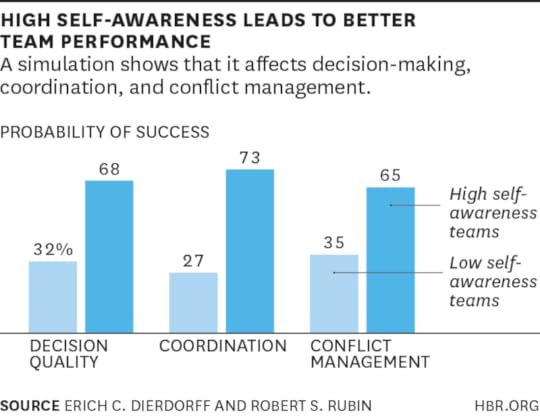
To illustrate, we recently collected data from an executive development program at a Fortune 10 company. With 58 teams and more than 300 leaders performing in a dynamic and competitive business simulation, we tested the extent to which accurate self-awareness was related to team effectiveness, which was evaluated across a number of business metrics like market share, ROA, customer awareness, productivity, and so forth. Levels of team coordination and conflict management were also assessed. And what we found was striking.
First, when individuals were less self-aware (i.e., there was a large gap between the assessments of their own behavioral contributions and the assessments of their team members), the teams substantially suffered. In fact, teams with less self-aware individuals made worse decisions, engaged in less coordination, and showed less conflict management. These findings held even when we controlled for teams’ overall levels of teamwork.
Second, the most damaging situation occurred when teams were comprised of significant over-raters (i.e., individuals who thought they were contributing more than their team members thought they were). Just being surrounded by teammates of low self-awareness (or a bunch of over-raters) cut the chances of team success in half.
It’s clear that talent development interventions need to go beyond self-knowledge to be effective. So what should leaders and talent development professionals do? We see three tactics that can help people build accurate self-awareness.
Use self-awareness tools that are linked to performance. It’s no secret that many of the most popular developmental assessments used for gaining self-knowledge, such as the MBTI, DiSC, The Birkman Method, and The Core Values Index, woefully lack evidence linking their results to actual learning or job performance. Whatever instrument, exercise, or intervention you use must capture and deliver results that truly predict something of value. Use external benchmarks: measure how someone’s self-view compares to others’ views and measure how assessments directly relate to outcomes like increased learning and job performance.
Create a line-of-sight between self-awareness and personal job success. A wealth of research shows that when individuals see learning as valuable to their careers, they’re more motivated to learn and apply new skills to their roles. This means that we must directly communicate why the capabilities on which individuals are receiving feedback are actually relevant. Don’t assume that individuals already recognize the need for accurate self-awareness: substantial research shows that those most in need of improvement are the most unaware.
Teach self-development skills in addition to self-awareness. Acquiring accurate self-awareness is only the beginning – true personal development builds the capacity to take action. Most talent development efforts unfortunately fall short of teaching self-development skills, leaving behind a “knowing-doing gap.”
Research shows that multiple strategies can be brought to bear. For example, self-management training can help people plan, apply, monitor, and adjust their newly learned competencies. And by reinforcing that mistakes are natural to any learning process, error management training encourages deeper learning and the transfer of that learning back to one’s job. At the very least, demonstrate how imperfect self-views block the way to real and lasting behavioral change.
Will Rogers rightly once quipped, “It isn’t what we don’t know that gives us trouble, it’s what we know that ain’t so.” It’s time for talent development professionals to focus their development resources on the forms of self-awareness that matter most.
[image error]
The Tools You Need to Make Every Meeting More Productive

Meetings may seem like the ultimate hold-out against the digitization of working life: after all, what’s more analog than talking directly with another person? Even though the core work of a meeting — listening to and connecting with other people — hasn’t changed, there are lots of ways technology can make that work easier and more effective. Given how much of our working lives we spend in meetings, building a digital meeting toolkit is one of the smartest investments you can make in tech-savvy productivity. Here are the tools you need:
Before your meeting
Find a group meeting time with Doodle, which lets you poll the various people who are part of your meeting, and find a time that works for everyone. You’ll get the best results if you hook it up to your own calendar (so you only offer people options that actually work for you) and if you set expectations by explaining you’re using Doodle to find the time that works for as many people as possible…even if you can’t find one that works for everyone.
Quickly schedule one-on-one meetings so the process of finding a time doesn’t consume more time than the meeting itself. Use Google appointment slots or Calendly to set up times when you’re available for calls or meetings, and when you want to take a meeting, share the link to your open slots. I don’t recommend sharing that link publicly unless you really want to take meetings with anyone who books a time in your calendar.
Need a place to meet? On-demand services like Liquidspace or Desks Near Me give you lots of options for finding a meeting space, even when you’re on the road. You can book weekly, daily or even by the hour. (Find a longer list of options here.)
Further Reading
Running Meetings (20-Minute Manager Series)
Managing People Book
12.95
Add to Cart
Save
Share
If you’re booking a call with someone in another time zone, make sure you’re actually booking the same time into your calendars. Send an actual calendar invitation, rather than just agreeing on a time via email, and as long you as your calendaring app has built-in time zone support (almost all of them do), you can avoid making a mistake. And use Every Time Zone to figure out what the time zone difference actually is, so you don’t invite someone to a 4 a.m. meeting.
During your meeting
Take notes in Evernote or another dedicated digital notebook application. Taking good, searchable notes makes meetings much more valuable, and the right note-taking tool will make it easy for you to file your meeting notes with the project or topics they relate to. Best of all, if you use the Evernote mobile app to snap pictures of your meeting whiteboard or flip charts, optical character recognition makes those handwritten notes searchable, too.
Share note-taking with Google Docs. Share note-taking duties with your colleagues by taking real-time collaborative notes in a Google Doc. Since Google Docs updates in more-or-less real time, you’ll be able to see and contribute to each other’s notes as long as you have an Internet connection. (Be sure to copy the meeting notes in Evernote afterwards, if that’s where you like to keep all your project notes.) That means you and your team can take notes collaboratively, so that if one person’s talking, the other person records what’s being said. This is a particularly nifty trick if you’re working with one or more colleagues on a client meeting or a meeting with another team, because you have a kind of psychic link — you can suggest ideas to one another alongside the notes you’re taking on the meeting. And if you don’t have an Internet connection, but you and your colleagues all work on Macs, you can use the fab SubEthaEdit to collaborate with even less lag than you get on Google Docs, simply by creating a computer-to-computer network.
Bring a reference screen for reference materials. The one down-side of digital note taking is that if you need to refer to a document during your meeting, you have to flip back and forth between your note-taking application and your reference document. That’s why I always carry my iPad; I use the application GoodReader to store any PDFs or documents I might need to look at during a meeting. And because GoodReader is hooked up to my DropBox account, I can always access a document I need to have open, even if I didn’t think to pre-load it in GoodReader.
Collaborate with mind mapping. I’m a huge fan of mind mapping: diagraming ideas and information visually, using something that looks like a tree or flowchart. While some people actually take their meeting notes in mind map form (been there, done that, reverted to text), I find mind maps most useful when I’m part of a group discussion where we need to capture and organize ideas together. My two favorite mind-mapping apps for meetings are MindMeister (very flexible and powerful) and Popplet (less expensive, a little easier to use, less flexible). If you’re using mind mapping in a face-to-face meeting you can simply hook a projector up to one computer, but the real-time collaboration support in these apps mean they’re great for collaborating during real-time virtual meetings, too.
While all the tools I mention above are useful in both face-to-face and virtual meetings, there are a few extra tools I’d recommend for people conducting virtual or phone meetings.
Share screens faster with Join.me. I’ve tried GoToMeeting, WebEx, Google Hangouts and Skype. They all work some (or even most) of the time. But the only bullet-proof screensharing tool I’ve used is Join.me. It works for me every time (knock on wood!), and because it’s so fast to set up a meeting and share a link, it works even if I’m already mid-call when I realize I need to share my screen.
Choose a backchannel. If you’re doing a client or prospect call with colleagues who are in another office or location, keep yourselves in sync by choosing an instant messaging backchannel before your meeting begins. There’s nothing worse than needing to send your co-presenter an urgent note…but discovering you have to wait for him to read his email so he can see it. Your backchannel can be Skype, Lync, MSN, Apple Messages or Gmail Chat — any messaging application works, as long as it has desktop support (so you’re not trying to type urgent messages into your phone) and you have connected to your colleague before the meeting begins. (Send a test message just to be sure.) Even if you’re using a virtual meeting application that supports private messaging, I recommend using a separate app as your backchannel so you don’t accidentally share your message with the client.
Record crucial phone meetings. If you’re participating in a phone meeting and aren’t in a position to take notes (or can’t type fast enough), consider recording your call for future reference. TapeACall, which is available for both iPhone and Android, makes it really easy: just install the app and then conference the TapeACall number into your call. (Note that in many jurisdictions it’s illegal to tape a call unless everyone consents.)
Set up these tools on your computer and mobile devices, and you’ll be better equipped to make the most of your meetings. Far from distracting you from your work and colleagues, this is one place technology can help you reconnect with them — by making the time you spend together as valuable as possible.
[image error]
March 11, 2015
Let Your Customers Segment Themselves by What They’re Willing to Pay

The late Sir Colin Marshall, when he was CEO and chairman at British Airways (BA), knew that success in his business came down to superior value capture. In a 1995 interview with HBR, he summed up the opportunity brilliantly: “You’re always going to be faced with the fact that the great majority of people will buy on price. But even for a seeming commodity such as air travel, an element of the traveling public is willing to pay a slight premium for superior service …. In our case, we’re talking about an average of 5%. On our revenues of £5 billion, however, that 5% translates into an extra £250 million, or $400 million, a year.”
If you’re out to capture more value, one surefire tactic is to figure out a way to charge different prices to customers with different willingness-to-pay (WTP). Economists sometimes call this “price discrimination,” which sounds bad since discriminating against people is generally illegal, not to mention immoral. However, most of us encounter forms of price discrimination frequently that don’t bother us. For example, who begrudges the discounts afforded to senior citizens and students? (Well, all right, I have occasionally felt a tinge as I see my retired neighbors driving much more expensive cars than mine.)
But charging different customers different prices for the same or a similar product or service is tricky for reasons having nothing to do with ethics. First: it is not easy to identify and group customers according to their willingness to pay. Second: if you have different prices in the market for a similar product, there is no preventing your well-heeled customers from taking advantage of the lower prices, too. Often, a marketer will try to scoop up sales from more price-sensitive shoppers (without cutting margins for its best customers) by launching a second, lower-end “fighter brand.” But customers are smart, and this often invites another serious problem – indeed called by one of the scariest terms in the management vocabulary: cannibalization.
There is an elegant solution to this problem, which I call “self-segmented fencing.” It consists of two parts: (1) Customers reveal their willingness-to-pay through self-segmenting, which is to say they themselves choose either the high- or low-price offer; and (2) Arbitrage is then prevented through effective fencing – that is, customers with high willingness-to-pay are fenced off from the low-price offer.
A fabulous example of this strategy is couponing. Grocers could simply offer the same attractive price to everyone, but instead they invite customers to present coupons to cashiers in order to get discounts on certain products during certain time periods. Why is this beautiful? Because many shoppers can’t be bothered to search for, collect, and redeem coupons. Therefore, they effectively choose to pay full price. Frugal shoppers and families living on small budgets are more likely to make the opposite choice, self-selecting to participate in the lower-price offer by using coupons and even shopping specifically for products that are on sale. In this example, the coupon is the “fence” to identify the segments and discriminate the price.
Once you understand fencing, you see fences everywhere. Famous fashion and sporting goods brands, for example, fence premium buyers by putting 50 or 100 kilometers between their flagship stores in the city and the outlet strips where they sell previous and even current-season models for huge discounts. And, back to Sir Colin’s business, fencing goes on left and right with airplane seats. It’s hardly a random occurrence when a roundtrip price comes up much cheaper and there is a Sunday between the outgoing and incoming flight. That fences off the majority of business travelers, even (or especially) if they fly economy class. Another fencing mechanism is tickets with no flexibility for canceling and rescheduling flights. (If you are like some clever participants in seminars I’ve taught, the thought might be occurring to you that a fully refundable ticket is really a different offering than a nonrefundable ticket, and therefore, doesn’t constitute fencing but simply selling different products at different prices. It’s a valid point, but given that the price difference is sometimes over 400%, it is certainly not based on cost considerations. What the airlines want to do is fill underutilized planes with cheap tickets that are unattractive to high-paying customers.)
Once you begin to see the elegant workings of self-segmented fencing all around you, you might begin to see opportunities to use it in your business. If different customers are willing to pay different prices by choosing, for example, to pop into your flagship store or trek all the way out to the outlets, why not let them? However, because there is never a free lunch, this strategy requires a very good understanding of what customers really want and how segments differ from one another. The bigger picture here is, of course, that value-based pricing always requires a solid and sophisticated understanding of what customers value
Finally, remember that fences are most powerful if they give even as they take away. Premium customers should enjoy at least one important attribute that the low-price-seekers don’t get. The grass should never look much greener on the other side of the fence.
[image error]
Avoiding Decision Paralysis in the Face of Uncertainty

The best leaders know how to keep moving forward in ambiguous situations. Whether it’s a shifting industry or a PR emergency, they’re expected to make decisions even in extremely uncertain circumstances.
For instance, when Brian Cornell took over as CEO of Target last year, he inherited several unresolved situations. The retailer was managing the aftermath of a major security breach, trying to improve its omnichannel experience, and facing questions about its troubled Canada division. Cornell has already made several tough decisions, from pulling out of Canada to announcing major layoffs.
Any leader facing high levels of ambiguity needs to do two apparently paradoxical things: First, get comfortable with the idea of not having all the answers, and second, take steps to reduce the uncertainty.
1. Get comfortable with the unknown.
Instead of feeling comfortable with the unknown, humans crave information that will make the ambiguous less so. The problem is that seeking more information sometimes feels like forward movement, when in reality, we’re delaying taking action because the information we need doesn’t exist or is so hard to find that we won’t get it in time.
Business leaders must recognize this instinct and overcome it. It takes courage to walk into a situation knowing you won’t be able to judge your decisions until you’ve succeeded or failed. Develop enough self-knowledge to know whether you have a natural tendency to overanalyze or seek perfection. If so, set limits on yourself. Determine that you’ll gather as much information as you can in one week before making a decision, or restrict yourself to consulting no more than four people before acting.
Researchers have studied how people in high-risk professions, such as firefighting, deal with uncertainty, and formed the theory of “organizing ambiguity.” They found that leaders who successfully navigate uncertain situations are able to properly contextualize their circumstances — or in their words, “make effective sense of the hazards within dangerous contexts such that they avoid catastrophic mistakes.” This lets them take action while recognizing that variables are changing and adjustments may be needed if their assumptions prove incorrect. When you face dilemmas calmly using a balance of information and instinct, you make better decisions that fit the changing conditions.
You can also look for how uncertainty works to your advantage in creating a new future, and help people around you see that ambiguity can unlock potential. For example, ambiguity can create discomfort and make us explore options that we may not have considered just months before. Netflix has used the uncertainty of changing market conditions to explore options that may have once seemed unthinkable. In its earlier days, the company was vulnerable to content licensing partnerships, unpredictable viewer tastes, and even the U.S. Postal Service. Out of this uncertainty came Netflix’s decisions to stream content online and create content itself, using analytics to better predict what its customers wanted to watch. The success of shows like “House of Cards” and “Orange Is the New Black” suggests that its experiment is working.
2. Reduce uncertainty where you can.
There are rarely “right” answers in business. But making a decision — even if it’s deemed imperfect later — has the benefit of reducing uncertainty for the rest of your company or team. For example, consider Brian Cornell again. The numbers showed that Target Canada wouldn’t be profitable until 2021. He based his decision to pull out of Canada on information applied to the future, not previous patterns or expectations, reducing uncertainty for his company. Is that the right decision or the wrong one? We won’t know for some time — but in the meantime, Target now has a clearer sense of its priorities.
Cornell’s method in that example – considering the ways that a current situation deviates from past experiences or patterns — is one of several things leaders can do to derail old habits and eliminate subjective decision-making tendencies. Ask what’s different about the circumstances you’re in now, as well as which players have changed or introduced new elements.
Effective leaders also consider multiple perspectives when they’re in uncharted waters, by encouraging collaboration, input, and new ideas. Be inclusive, and rely less on hierarchy and more on relevant experience. Above all, avoid the “I have all the answers” trap. It’s important to know when your expertise helps and when it’s creating a blind spot.
Finally, an incremental approach can reduce uncertainty while avoiding the risks that come with making a big, sweeping decision. Create a series of short-term plans that can evolve as the situation becomes clearer. You’ll likely need a long-term financial plan, but keep your operational plan more fluid, adjusting it with new information. Regularly ask your team, “What have we learned that must change our plans in the next three months?” Again, think of Netflix. Their efforts to reduce the uncertainties in their business model didn’t always run smoothly — the brief existence of Qwikster is reminder enough of that — but their incremental approach allowed them to reduce their overall level of strategic uncertainty while avoiding taking on too much risk.
You can’t wait to have all the information before acting, and you can’t wait for the perfect conditions to set your course. Instead, take the initiative to actively manage uncertainty.
[image error]
How Self-Service Kiosks Are Changing Customer Behavior

Soon, you may be able to walk into a McDonalds, tap your order on a “Create Your Taste” touch screen, and receive a burger adjusted to your specifications. Avacado and shaved parmesan on your sandwich? No problem.
McDonalds isn’t the first fast food chain to consider giving customers more control over their orders using technology (though there’s a fair amount of debate about whether customization is really the best way forward for the struggling company). Many of its competitors have been experimenting with self-service apps and kiosks, finding that when customers use them, they tend to spend more money. Taco Bell recently announced that orders made via their new digital app are 20% pricier than those taken by human cashiers, largely because people select additional ingredients. Chili’s, after installing self-service tablets, reported a similar increase in dessert orders. Cinemark theater’s new self-service kiosks have “had concession spending per person climb for 32 straight quarters.”
So why the uptick? I talked with Ryan Buell, an assistant professor at the Harvard Business School, who studies the intersection of operations and customer behavior. It turns out that self-service technologies can pretty dramatically change what people do and how they act – though the research is hardly clear-cut on it being the best option for all businesses. An edited version of our conversation is below.
HBR: What’s going on here? Why are these in-store apps boosting sales?
Buell: There’s actually been some research on this, and some pretty cool examples have emerged.
To start, four researchers at the Rotman School of Management, Duke’s Fuqua School of Business, and the National University of Singapore did a study where they found that, when a liquor store changed from face-to-face to self-service, the market share of difficult-to-pronounce items increased 8.4%. The researchers concluded that consumers might fear being misunderstood or appearing unsophisticated in front of the clerks. Changing to self-service removed the social friction.
Another interesting example they looked into was a pizza chain that introduced online ordering. The customers who were ordering online ordered food with 3% more calories, and also gave 14% more [special] instructions compared with the average purchase over the phone. They concluded that customers’ desire to avoid negative judgment of their eating habits drove the change.
You mentioned McDonald’s. They’ve been experimenting with kiosks for a while. At one store, 10 or so years ago, they found that the average check size was a dollar higher — a 30% increase at the time. And they found that 20% of customers who didn’t initially order a drink would buy one when it was offered. Kiosks, of course, never forget to upsell.
In addition to all of this, there is some research from 2011 showing that a seven second reduction in service times in fast food restaurants can increase the company’s market share by 1% to 3%.
It seems like sort of a win-win, both for companies that want to make more money and for customers who feel more comfortable without that social friction. But are there any downsides?
Yes, there are a bunch of downsides.
Dennis Campbell, Frances Frei, and I have done some research looking at self-service technologies, in banks in particular. Customers’ overall satisfaction with the bank fell as the proportion of their total interactions shifted away from face-to-face channels and toward using ATMs.
I take great pleasure in visiting my local bank branch for quarters every weekend, but I’m not even sure I know why.
I think one reason could be that automation sometimes obscures the work that’s being done for us. When we’re interacting with a person, we can see what’s being done to create value for us.
A lot of the technologies are designed to basically obscure that work from customers. In order to make them feel comfortable using an automated technology, we try to make it look as easy and fast and seamless as possible. And in doing that, we strip away the customer’s view of the effort that is going on behind the scenes. When customers aren’t able to see that effort, they appreciate the service that’s being delivered less, and they value the service less as a consequence.
Some self-service technologies are able to buck this trend. Kayak.com is a good example. While it’s searching for flights, it shows you the work that it’s doing behind the scenes to find you the perfect itinerary. After you enter your preferred travel details and click submit, you see the different websites that it’s searching and a running tally of the best rates found so far. Michael Norton and I found that when a website, like Kayak, shows a customer the work it is engaging in on their behalf, customers mind waiting for the service less, and they value the service more.
What factors should companies weigh when they’re thinking about introducing this sort of self-service?
When companies take employees out of the equation, they’re essentially expecting the customer to take on a greater share of the work. And so the design of the technology matters a lot. Some self-service technologies can be delightful to use and others can be very challenging.
An example of one that’s often challenging is the self-service checkout. Stores are essentially asking customers who weren’t trained to do this work to take on the task. But then they added a bunch of sensors and fraud detection mechanisms that make the job more difficult than it would have been for an employee in the first place.
Essentially, there are three things that we think determines when a customer will willingly engage in self-service. First, customers have to know what’s expected of them. Second, they have to be capable of doing what’s expected of them. Finally, and this is one where a lot of companies fall off the rails, they have to see the value of expending the extra effort in order for it to be something that they would willingly engage in.
In the end, what are the things that humans can just do better than apps or kiosks?
Technology lacks flexibility. When we’re interacting with a person and we’re having trouble understanding something, the person can adjust to us. If we’re having a misunderstanding, they can help clarify it. Technology really can’t do either of these things.
A person has the ability to delight us or disappoint us. It’s really hard for a technology to ever delight, however, because it’s standardized and is built on a set of rules. But it is possible for technologies to disappoint us.
If you think about an ATM, it seems like it’s out of order one out of every 10 times you visit it. But it’s not that case that one out of every 10 interactions you have with the ATM machine delights you.
Are there cases where companies can actually lose money with self-service?
There’s an assumption that it’s cheaper to serve a customer through a self-service technology. But that’s not always true.
Dennis Campbell and Frances Frei did some research a number of years ago, looking at banks that introduced online banking. And they found this really interesting pattern, which was that when a customer would switch over to online banking, they began to reduce their use of a more costly self-service channel. They were less likely to use the ATM machine. Great, right? They were also less likely to call in and use automated response, too, which is marginally more expensive than online banking.
But here’s the kicker: They also began increasing their use of more costly delivery channels. They came into the branch more, and they started using the call center more, which was actually more expensive. So the tradeoff wasn’t a favorable one.
Piling on top of all of this was an overall increase in transaction volume. And so the net effect of this on a per customer basis was that it actually cost more money to serve the customer.
Do you think the service industry is headed in a much more automated direction in general?
I honestly don’t. Automation will play an important role in interactions that can afford to be transactional rather than relational — especially for interactions optimized around speed and efficiency.
But we’re deeply social animals. And there’s lots and lots of behavioral research that shows that social connections are important to our wellbeing and our mental health, that when we talk to people, we’re happier.
If you think about the places where we’re truly loyal, these are often places where we’ve had the opportunity to develop a relationship, right? So when you walk into a Starbucks you frequent, the baristas will know you by name and they’ll know what drink you want. You feel important. You feel special. Their job is more meaningful because they get to interact with you. Your transaction is more meaningful, because you get to interact with them.
[image error]
The Right Way to End a Meeting

A common complaint among managers is that the conversations they have with employees aren’t producing results: “We keep talking about the same issue over and over, but nothing seems to ever happen!” That’s because most managers are missing a vital skill: the ability to deliberately close a conversation. If you end a conversation well, it will improve each and every interaction you have, ultimately creating impact.
Meetings are really just a series of conversations — an opportunity to clarify issues, set direction, sharpen focus, and move objectives forward. To maximize their impact, you need to actively design the conversation. While the overall approach is straightforward – and may seem like basic stuff — not enough managers are actually doing this in practice:
Set up each conversation so everyone knows the intended outcomes and how to participate.
Manage the conversation rigorously so the discussion stays on track and everyone is engaged.
Close the conversation to ensure alignment, clarity on next steps, and awareness for the value created.
In my 35 years of experience as a corporate trainer, I’ve found that closure is more often than not the missing link between meetings and impact. Without it, things can be left unsaid, unchallenged, unclear, and/or uncommitted. Each agenda item should be considered incomplete unless it is wrapped up in a thoughtful, deliberate way.
I recently worked with a university president who requested that I come in to help with some leadership training. When I asked why the training was needed, he told me how he had been working with a group of faculty members who were trying to restart a journalism school that had been disbanded many years before due to budget cuts. In the initial meeting, the president promised he would do everything he could to support their efforts.
You and Your Team
Meetings
How to make them more productive.
But now, two years after convening and chartering the group, no visible progress had been made. The president felt it was because of a leadership gap, but I offered a different perspective. I told him, “You don’t have a journalism school because you didn’t close that first meeting properly, and you didn’t follow up. If you had wrapped up that first meeting more thoroughly and then met with that group every two weeks, you would probably have what you wanted today.” It really is that simple.
To deliberately close a conversation, consider these 5 essential tasks:
Check for completion: If you move to the next topic too quickly, people will either cycle back to the current topic later or they will leave the meeting unclear or misaligned. You should ask: “Is there anything else someone needs to say or ask before we change topics or adjourn the meeting?” If the university president had asked this question and waited patiently, lingering concerns or questions might have arisen and been dealt with right off the bat.
Check for alignment: If someone can’t live with the decisions being made in the meeting, or the potential outcome of those decisions, you need to ask that person what it would take to get him or her on board. People prefer to be united with the group, and if they aren’t, there’s a reason behind it that needs to be surfaced. Asking the question, “Is everyone OK with where we ended up?” will surface questions or concerns so they can be resolved as soon as possible.
Agree on next steps: Getting firm, clear commitments is the primary way to ensure progress between meetings. In order for a conversation to lead to action, specific commitments must be made. Progress depends on clearly stating what you will do by when and asking others to do the same. To maintain the momentum of any project, nail down specific commitments and deadlines, and then follow up often. The question here is: “What exactly will we do by our next meeting to ensure progress?” In the example of the journalism school, nothing happened because there was never an action plan agreed upon with next steps, firm timelines, and individual responsibilities clearly defined.
Reflect on the value of what you accomplished: This is one of the most powerful acknowledgment and appreciation tools. People rarely state the value created by a conversation, and therefore lose a wonderful opportunity to validate both the conversation and the individuals in it. Here’s an example:
Let’s say you’re the university president from the example above, listening to several faculty presentations for the new journalism school. After the first presentation, you say, “That was good.” What if, instead, you said: “Let me tell you the five things I’m taking away from your presentation.” Which do you think has more impact?
Check for acknowledgements: Did anyone contribute to the conversation in a way that needs to be highlighted? While you don’t want to use acknowledgement and appreciation so frequently that it becomes a commodity with no value, at times someone’s questions or remarks do help provide the tipping point that turns an ordinary conversation into and extraordinary one – and that’s worth acknowledging.
Imagine the impact if the university president had taken the time to use these last two elements – sharing the value he was taking away from the meeting and acknowledging a few of the participants. Doing so would have reinforced the conversations that occurred, supported the people in the meeting, and encouraged everyone’s desire to produce the expected results.
As a manager, you should consider improving your meeting skills to be a top priority. Not only will it make you a more respected leader, but your staff members will become more engaged participants, as well. Try spending the next three weeks working on closing every conversation in a deliberate, thoughtful way. You’ll be surprised to see an immediate impact on how and when things get done.
[image error]
Marina Gorbis's Blog

- Marina Gorbis's profile
- 3 followers

