
Marina Gorbis's Blog, page 1294
May 8, 2015
Strategies for Crowdsourcing Your Job Search

Careers are very personal things. Most people choose their paths, and make decisions along the way, based on their own thinking and counsel from family, friends, teachers, close colleagues, and mentors. While self-reflection and the gathering of advice from one’s immediate circle can be useful, I’d like to suggest a more modern approach. Organizations are increasingly using the wisdom of crowds to drive their strategy, innovation, and marketing initiatives. Why shouldn’t you use similar strategies for your job search? Here are four ways to do it right:
Explore your passions. One of the best stories I discovered in researching my book, Mindsharing, was that of a 28-year-old woman from Tel Aviv who had grown frustrated by the unpredictable and temporary nature of her television programming job. She decided it was time for a career change and began to brainstorm ideas on her own, seeking advice from friends, and even meeting with a jobs counselor. But her breakthrough came when she posted an appeal on Facebook asking if any of her contacts would be willing to take her to their places of work for a day. Many said yes, and she took five people up on the offer. During each visit, she envisioned herself in that job, industry, or organization — but in the end she realized that none of them excited her as much as her current profession. Crowdsourcing helped her figure out she should stay put. For others, it might spark or invigorate new passions.
If you’re uncomfortable being so transparent about your career thinking, I recommend this section of Quora, a website designed to let people ask and answer questions anonymously. This is a place to ask people about any industry or function you’re considering. But remember — if you want to stay anonymous that usually means refraining from identifying yourself or referencing the specific companies you’re courting. Sometimes saying too much can seriously backfire.
Get inside information. Corporate salaries, interview procedures, employee satisfaction levels used to be well-guarded secrets. Not anymore. Websites such as Glassdoor gives you an amazing inside look at jobs and companies, helping you determine what it’s really like to work at various places in different roles. Want to know what interview questions you’re likely to get asked at Apple? How much middle managers make at American Express in various cities around the world? Or what the vacation policy is like at McKinsey? The crowd can tell you.
Perfect your resume. The internet is awash with resources on this topic. Perhaps my favorite destination for crowd-sourced advice is the résumés area on Reddit. Here are some threads: “Trying to get a job in Web development, would love your merciless critique on this résumé!”; “I can bullshit my way through anything. How can I put this on my résumé?”; “Should I list “good problem-solving skills” on my résumé?” Reddit users rate the responses so the most useful usually appear at the top. For example, the last question listed above got 17 responses,the most popular of which advised the resume-writer to include details on work experiences in which he or she solved problems, rather than listing it as a generic skill. Quora’s CV section is another useful resource. The question “What’s the best way to get your resume noticed?” has more than 200 answers. On other websites, such as Craigslist or Fiverr, you can find people who will not just offer advice but also physically edit your résumé or design your business card or website. Here’s a short video on many of the sites mentioned above.
Build your experience. If lack of experience has become a stumbling block in your career, you can use the crowd to gain it. Tell your LinkedIn contacts, Facebook friends, and Twitter followers that you’re looking to build skills in a particular area and ask if anyone can help. Volunteer to work as an intern or apprentice. Answer relevant help-wanted requests on sites like Craiglist or Fiverr and post your own help-offered ads.
In my early days at Microsoft, I instinctively turned to the crowd for advice. Before planning any new product launch, I would write about it on my blog (this was before Facebook or Twitter) and ask for ideas. The responses were always creative and I implemented the best of the bunch. Thanks to the advance of social media, these methods — what I’ve come to call mindsharing — can now be used in any arena of life. But they are particularly helpful when it comes to making smart career decisions.


Recovering from an Emotional Outburst at Work

It happens — we all get emotional at work. You might scream, or cry, or pound the table and stamp your feet. This is not ideal office behavior, of course, and there are ramifications to these outbursts, but they don’t have to be career-killers either. If you take a close look at what happened, why you acted the way you did, and take steps to remedy the situation, you can turn an outburst into an opportunity.
Some people are more prone to tantrums at work, especially those who lack the emotional skills to process feelings as they’re occurring. These people tend to fall into two categories: those who suppress their emotions and those who ruminate on them.
If you suppress emotions, you “sit on them” and try to pretend they just don’t exist. You might feel frustrated, undermined, or put out by a colleague, and instead of addressing it or even recognizing that’s what you’re feeling, you ignore it. These people often think, “Sure, I’m upset but I’m just going to get on with the project.” And then they plow forward.
This might be your emotional orientation because you’re task-focused, or you don’t believe emotions belong at work. But research shows that the effort of constantly pushing emotions aside or ignoring them, takes up cognitive resources. And in experiments people who suppress emotion are worse at problem solving skills, task completion, and interpersonal relationships. In the long run this style also predicts lower well-being. The irony is that often people put aside emotions because they think it will help them get on with their work when in fact, it hinders their ability to be effective.
The second group of people who are prone to emotional outburst are those who ruminate, or do what I call, “sit in emotions.” If this is you, you are more likely to go over and over a situation in your mind, thinking, “I was undermined, I’ve been wronged, I’ve been mistreated.” You become so consumed with what you’re feeling that you can’t move on to solving the problem. Dwelling on your emotions this way makes it difficult for you to take others’ perspectives and increases the chances you’ll lash out if someone challenges you.
While these two emotional styles — suppressing and ruminating — look completely different, they both deplete cognitive and emotional resources and result in the same poor outcomes in terms of problem solving, interpersonal relationships and wellbeing.
Further Reading

HBR’s 10 Must Reads on Emotional Intelligence
Emotional Intelligence Book
24.95
Add to Cart
Save
Share
Once you’ve recognized that one of these styles is at the root of your behavior, the trick is to not fall prey to it again. If it’s your tendency to suppress, you’re going to want to ignore your tantrum and move on. If you are prone to ruminating, you’re going to want to overthink your outburst and beat yourself up about it.
Instead, treat your outburst for what it is: data. A key emotional intelligence skill is being able to manage your emotion, but you can’t manage what you can’t recognize and understand. So first, be open to emotions. What was I feeling here? Emotions are signals, beacons that show you that you care about something.
To recognize your emotions, you have to be able to differentiate between feelings — sadness, anger, frustration. In many work environments, people suffer from what psychologists call alexithymia — a dispositional difficulty in accurately labeling and expressing what they’re feeling. These people tend to be vague about their emotions. So a manager will say to herself, for example, “Gee, I yelled because I was really stressed out.” But that gives her no information about what was really going on. After all, there’s a world of difference between being “stressed out” and being disappointed or put upon or feeling betrayed. There’s a strong body of research that shows the ability to be differentiated in labeling feelings will protect you from having outbursts in the future and will improve your relationships.
Once you’ve recognized the emotion — fear, disappointment, anger —your next step is to understand what exactly caused it. Why is it that I reacted in this particular way? What was happening in this situation that I found upsetting? What values of mine may have been transgressed or challenged? For example, maybe you lost it and screamed at a colleague when you found out that your project was cut. If you dig deeper you may find that it wasn’t exactly about the project but rather how the decision was made; that you didn’t feel it was made fairly.
The research on emotions shows that there are general triggers that you should be aware of. When your outburst is anger — yelling, stomping feet — it’s typically because you’re frustrated or feel thwarted. You’ve been stopped from doing something that’s important to you. When you feel sadness or cry, it’s usually because of a loss. Acting out on anxiety is prompted by a sense of threat. It’s helpful to think about these universal triggers, and then ask, what is it specifically that was important to me in this situation?
Once you’ve recognized how you feel, and why you feel it, you can focus on what to do to make things better — to manage the situation. It goes without saying that you should apologize if you yelled or lost your cool, but that’s not enough. Your goal isn’t just to repair the relationship, but to strengthen it.
After you’ve calmed down, and you return to your team the following day or week, instead of saying, “Gee, I’m so sorry about what I did; now let’s move on,” address what really happened for you. You might say something like, “I got really mad and I’m not proud of my behavior. I’ve been thinking long and hard about what it was that I found so upsetting and I’ve realized that my sense of fairness was challenged because of how the defunding decisions were made.”
There’s research that shows that when you appropriately disclose your emotions in this way, people are more likely to treat you with compassion and forgiveness than if you had just offered an apology. From there you start a shared conversation about what’s important to each of you and how you can work better together.
No one wants to earn a reputation as a crier or a screamer at work. Instead of running and hiding or wallowing in self-pity when you’ve lost it, bring a good dose of compassion and curiosity to the situation. To be kind and compassionate towards yourself –- especially in the moments you are least proud of –is not the same as letting yourself off the hook. In fact, studies show that people who are self-compassionate are much more likely to hold themselves to high standards and work to make things right. And treating yourself that way is more likely to inspire others to do the same.

Case Study: After a Crisis, Who Should Take the Fall?

The four weeks since hackers had attacked his company had been the most stressful of Jake Santini’s career. Sitting at his kitchen table after another long day of meetings and interviews, the CEO read the e-mail from his board chair again, this time out loud to his wife, Fleura:
“It’s the strong feeling of the board that someone needs to be held publicly responsible for what happened. While we’re confident that the issue has been handled, we feel this is a critical step in making amends with our customers and restoring our image in the public eye.”
The board chair, Carly Elliot, had been a director at SimplePay, an Austin-based mobile-payment processor, since its days as a start-up. She and Jake had always worked well together, so he was a little taken aback that she was sending an e-mail about something so sensitive rather than calling him.
Editors’ Note: This fictionalized case study will appear in a forthcoming issue of Harvard Business Review, along with commentary from experts and readers. If you’d like your comment to be considered for publication, please be sure to include your full name, company or university affiliation and email address.
Fleura shook her head. “When she says, ‘someone,’ does she mean you?”
“I don’t know. When the hack first happened, she made it clear that she didn’t want me to resign,” Jake said.
“She just wants someone to,” Fleura said, yawning. He felt bad about keeping her up—she had to catch a plane early the next morning—but she’d insisted on staying up a few more minutes and talking it through.
“Whether or not you have a job next week matters to me,” she said, only half joking. “Seriously, why is Carly blowing this out of proportion? This isn’t a Target situation.”
She was right. Although SimplePay processed millions of credit card transactions a day through an app that enabled merchants to accept payments by tablet or phone, the hackers had infiltrated just one database, which held only consumers’ e-mail addresses. They hadn’t gotten financial details or any other identifiers.
Still, it had been an alarming security breach.
The company had been forced to take its system down for 42 hours, notify all 10 million affected consumers, and issue a public apology. Tech bloggers had jumped all over the story; many speculated that SimplePay had begun to slow its hiring and scrimp on security investments in an effort to spiff up its balance sheet for a potential IPO. Some of that was true. The plan was to go public next year, and Jake and his CFO had been trying to cut costs, but they had mostly spared the IT group. They knew that technology (and the staff to support it) was the company’s bread and butter. His head of PR, Michelle Perez, had issued statements to that effect but had trouble controlling the story.
Twitter trolls had piled on, mocking SimplePay for taking nearly two days to recover from a simple hack, but Jake’s CIO, Jesse Gladstone, insisted that his team needed that much time to fully patch the vulnerability and close any access the hackers had. The IT group had been working around the clock ever since to locate and fix any other potential holes and implement new security measures.
“She’s making a big deal of it because it was serious,” Jake said.
“I know that,” Fleura said. “But insisting on a scapegoat seems over the top. If she doesn’t want you out, who is she talking about then? Jesse?”
Jake cringed. The idea of asking his CIO to leave under these circumstances was untenable. Besides, he was proud of how Jesse and everyone else at SimplePay had handled the situation. Perhaps the response had been a bit slow, but they’d all done the best they could with the team they had and the money available.
“Chances are that Carly’s just the designated messenger for the rest of the board. I’m sure someone else is behind this,” Jake said.
“Like Theo,” Fleura said, getting up from the table. Ever since Theo Conrad, a prominent tech investor, had joined the board, he’d been a thorn in Jake’s side, challenging him on all but the most routine decisions. At the most recent emergency board meeting, he wouldn’t stop harping on the fact that 30% of SimplePay’s customers hadn’t used the app since the hack.
“They simply don’t trust us anymore,” he’d said. “And Wall Street won’t either unless we’re completely clear about what we’re changing to make sure this never happens again.”
Jake turned from his laptop to watch Fleura as she headed upstairs. “Say something else,” he called after her. “Theo’s name can’t be the last thing I hear tonight.”
“Try to get some rest, honey,” she said from the stairs.
Jake smiled but knew he probably wouldn’t.
It’s All Under Control Now
The next morning, Jake met Michelle and Jesse at Bouldin Creek Cafe at 7:30 am.
“You don’t look good, Jake,” Michelle said when she sat down. “It’s time to start sleeping again. The worst is behind us.”
“I’m afraid that might not be the case,” he said, stirring two packs of sugar into his double caffè macchiato. “We’re not yet back to our prehack transaction numbers, and new customer acquisitions have all but halted. I know it’s only been a month, and things were slow before the breach, but we need to get things back on track soon.”
“As far as PR goes, we’ve got it under control now,” Michelle said. She ticked off all the things the company had done right since the breach: immediately contacting people whose information had been compromised and presenting a clear, consistent message to customers, social media, and the press. Michelle had recommended that the company apologize but focus on the hackers as the ones responsible. Within the organization, she’d also started to downplay the severity of the breach, but Jake had told her to stop. He worried that the sentiment was leaking into her external messaging. “We just can’t forget that this was a big deal, Michelle,” he said.
“Of course, it was,” Michelle responded. “But I really think it’s almost over. My phone isn’t constantly beeping at me anymore. And Kara Swisher told me yesterday that, in one sense, we should think of the hack as a badge of honor. We’re now big enough to be considered an attractive target.”
She smiled; Jake and Jesse didn’t.
“And Jesse’s on top of security,” she continued. “We’ve got the ‘latest, and most comprehensive, data security measures.’ Right?”
“We’re getting there,” the CIO answered, staring into his coffee. Jesse had been sleeping at the office. He was a perfectionist, which made him good at his job, but in the wake of this crisis, his insistence on getting everything just right was stalling their response. While Jake and Michelle were chomping at the bit to promote the new security upgrades—a hasty yet significant and necessary investment—Jesse was still in testing mode.
“When will the new features be up and running?” Jake asked.
“We need another day or two,” Jesse answered.
“Perfect,” Michelle said, a forced cheerfulness in her voice. “We can issue the release by the end of the week and include an update on the FBI investigation, too. And then our sales team can start to work their magic, and we can get back to business as usual. We’ve got an IPO to prepare for, after all.”
Jake wondered if that was why the board was pushing so hard for a resignation: Wall Street needed a pat ending to SimplePay’s hacking story before the company could embark on a road show.
Heads Must Roll
“I’m sorry that so much of this is playing out over e-mail,” Carly said to Jake when they met at her office later that afternoon. “I know this isn’t easy.” She explained that a significant majority of the board members felt that a public gesture was necessary to demonstrate how seriously SimplePay took the breach.
“But we’ve done that. We explained exactly what happened and how we’re responding.”
“It’s that last part that the board is concerned about. What changes are we making to ensure that our customers trust us completely again? At Target, the CIO and then the CEO resigned. When TJX had its breach in 2007, it was a director and an SVP. They’ve set the precedent. We need to do something similar so that we can put this episode behind us. SimplePay is—was—the market leader in the mobile-pay space because of its reputation for being reliable and secure. Our success is based on trust. This incident has completely eroded that.”
She wasn’t wrong. The customer service department had been flooded with questions about security, and although the company had expected some level of merchant attrition, defections had been much greater than expected. And they weren’t tapering off.
Carly pulled out her phone. “Did you see the study from this group, Interactions, that Theo sent around last night? ‘Twelve percent of customers say they would stop shopping at a retailer that had a security breach; about 36% say they would be less frequent patrons. About 85% of shoppers who have had their personal information stolen say they tell others about the incident; 34% complain on social media, and 20% comment directly on the company’s website.’”
“And all that goes away if we fire someone?” Jake asked, getting annoyed. “That’s not what happened with Target. Their stock dropped 3% the week that Steinhafel resigned.”
“They acted too late. He should’ve left much sooner. Besides, the shares have now jumped 30% under the new CEO, to all-time highs. Everyone loves a fresh start after a disaster—analysts, pundits, customers,” Carly responded.
“But that’s not always necessary. Look at Zendesk, LivingSocial. They survived hacks without firing anyone.”
“But our business isn’t recovering. We need to make a statement—not just new technology, new people.”
“So heads must roll?” Jake asked.
“Just one head.”
“Well, then, it should be me,” Jake said, unsure that he believed what he was saying. “We’ve got a strong team in place. I leave, the statement is made, loud and clear, and then you all can get things back in order in time for the IPO.”
“It doesn’t have to be you,” Carly responded.
“If not me, then who?” Jake asked.
She told him that Jesse’s name had come up first; after all, it was his systems that had been breached and his team that had been so slow to get the service back online. As a leader, Jesse had been a bit shaky under all the pressure. But a few board members had also pointed to Michelle; had she immediately grasped the severity of the situation and gotten out well ahead of the story, trust in SimplePay might not have dipped so low.
“How would firing Michelle help fix anything? She may have not handled this perfectly, but letting her go won’t allay any customer concerns. And you know as well as I do that Jesse isn’t fully to blame for the situation. No IT team can predict every vulnerability or patch every hole. He did his job as best he could.”
“Listen, you’ve been a great leader, sticking up for them all along, even when they didn’t deserve it,” Carly said. “But the board has made up its mind. Someone’s got to go.”
Take One For the Team?
Jake typed the letter out on his phone.
Please rest assured that this decision was not easy, but in light of recent events, I have decided that my stepping down is in the best interest of SimplePay and its customers.
While I cannot take any personal responsibility for this incident, it happened on my watch. As the company’s CEO, I am ultimately responsible and thus resign from my position, effective immediately—mostly because the board is making me do it.
He pressed send, and 20 seconds later his phone rang. It was Fleura, calling from her hotel room in San Francisco.
“Why in the world are you up at midnight writing a fake resignation letter?” she asked. “I do love the last line, though. If only every shamed CEO admitted that the board made him do it. But seriously, honey, you’re not resigning, are you? You love your job.”
This was true. At the helm of SimplePay, Jake was happier than he’d ever been, and he certainly didn’t want to give up the opportunity to lead his first IPO. But he couldn’t imagine making anyone else the scapegoat.
“How did it feel typing it out?”
“Terrible,” he admitted. “I’m not ready to go, but maybe I have to take one for the team.”
Question: Should Jake resign?
Please remember to leave your full name, company or university affiliation and email address.

Sales Teams Need More (and Better) Coaching

On the ride back from Redwood City to San Francisco, my manager John and I hardly said a word to each other. We’d just left the headquarters of Oracle, and one of my worst sales calls ever. During the meeting, I had done my best to identify specific objectives the company might have that would benefit from our sales- and leadership-training programs. I talked about the problem of decreasing employee turnover, how fostering teamwork encourages cross-selling, the challenge of improving new-product launches. Nothing resonated. I tried to discuss the impact of current market conditions, like competitive pressures on margins, and the specific circumstances created by a recent acquisition, to probe for an opportunity to bring value. I even described similar client circumstances to illustrate the kinds of results we had achieved. I was met with no interest. Zip, zilch, nada.
To break the deafening silence, I said to John, “Can you just tell me what the hell went wrong in there, or are you going to lead me through some laborious process of self-discovery?”
We both laughed, and then we had a very useful conversation. I knew how he coached, and it was extremely valuable on most days. We would dissect each interaction together. He would typically ask me what I thought was effective, and we’d discuss what the client had responded to best. Then we’d talk about what could have gone better, and he’d highlight skills to improve. The discussions were always focused on how I could further develop my abilities and meet my goals.
John Rovens was a terrific coach, and he invested a significant amount of time in my development as a sales professional. By the end of 1998, my third year in sales, I was the number 2 salesperson worldwide in the division of the Fortune 500 company we both worked for. I quickly became proficient at creating value in selling in large part because of the culture of coaching John created in our office.
We hear constantly about the importance and value of coaching, especially in sales. But, the reality I have observed while working with hundreds of organizations is that a true culture of coaching rarely exists. In a survey I conducted few years ago with a sales team in a Fortune 500 telecom company, I found an interesting contrast. Leaders reported that they spent a considerable amount of time coaching their direct reports and scored themselves high on their efforts– on average, just shy of the 80th percentile. Direct reports responded by saying that they’d received little to no coaching from their leaders and scored them low — on average around just the 38th percentile.
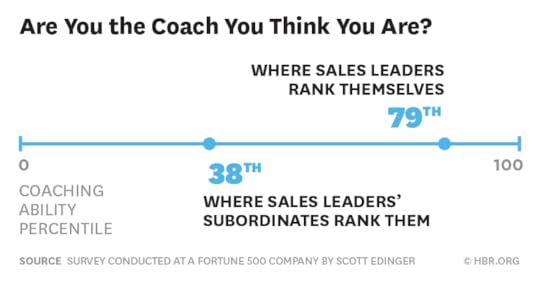
Then the leaders criticized their direct reports for being a bunch of ungrateful complainers. In their minds, these leaders had devoted all kinds of time to coaching.
But in reality that simply wasn’t so.
My observation is that in most cases, the further you go up the chain from managers, to directors, to VPs, the more sales leaders ask for help from their direct reports to do their own jobs, rather than investing time in improving the performance of their people.
Maybe a manager will spend time coaching his direct reports. But a manager getting coached by a director? Or a director being coached by a VP for sales? That almost never happens. Instead, time for coaching to improve future performance is increasingly crowded out by time spent tracking and scrutinizing past results – that is, time spent requesting forecasts, reviewing pipelines together, revising forecasts, and pushing to close more deals in this quarter.
That may be necessary (well, that’s a whole different subject really), but if you want to improve the capability of your sales organization, rather than just keep track of it, coaching is the most powerful lever you have. And, creating a culture of coaching is your best bet. Here is how:
Establish uniform expectations. Everyone, from the executive vice president of sales down to the frontline sales manager, needs to share the same definition of what good coaching is. Good coaching includes observation and feedback, certainly, but also strategy development, creating opportunities for practice, and even detailed help in meeting preparation. John Rovens had a specific development goal for each of the members on our team. He himself was also coached by his boss, our regional vice president, to help him become a more effective coach. Setting expectations for coaching is a strategic imperative that the CEO and executive committee leaders must drive. You can’t simply declare “There shall be a coaching culture” or delegate its development to the VP of sales or HR. The decision to create a coaching culture must be done in the context of a broader corporate goal — a growth strategy to increase revenue, perhaps, or a need to speed the time it takes new salespeople to become productive, or a desire to decrease costly sales turnover.
Highlight the exemplars and use them to spread your best practices. In any sales organization, everyone knows who the best sellers are. Frequently they are top producers, but not every one of them always exhibits the behavior you may want to foster. Look for the great sellers throughout the business who are doing the work in the way you want to see everyone working, and use them as role models, even if they’re not atop the revenue leader board. As it happened, during my first 18 months in sales, my assigned mentor was the top rep in our company the prior year. His name was Steve Lunz, and I had the chance to accompany him on many sales calls during my first 18 months with the firm and through him see how our company succeeded with clients. He showed me how to reach truly mutually beneficial agreements with clients, and I paid careful attention to how he did it. In exchange, I took notes and helped with follow-up and with the subsequent engagements.
Provide rewards to those who engage in coaching and consequences for those who opt out. Coaching should not be viewed as extra credit or something to do if you have time on your hands. If it’s a priority for you to develop sales talent in your business, reward those who coach well just as you would any other key responsibility — with recognition, compensation, and promotion. Otherwise you’ll end up denying some of your developing talent the support they’re entitled to, the support required to grow your business. This is likely to require a mind-set shift for some. For those who don’t manage it, place them in a job where developing others isn’t important. There are a lot of people promoted into sales management and leadership roles who have great strength in selling but really don’t have an interest in coaching. Let them sell.
Before you suggest that this seems like a lot of work, I’ll concede the point. Coaching is a lot of work. But it needn’t take extra time if you consider the scope of activities sales leaders currently engage in. Take an honest look at the volume of effort your sales organization devotes to reporting, inspection, and scrutinizing results versus the time spent actively engaging in improving results. Create a coaching culture, and your leaders will spend considerably more energy on the latter.

May 7, 2015
A Partial Defense of Our Obsession with Short-Term Earnings

Here’s a conundrum: On the one hand, there’s a consensus among thoughtful business leaders that too many companies are sacrificing long-term growth on the altar of smooth, reliable short-term earnings. On the other hand, most large sample studies in the accounting literature show something different: firms that manage their earnings perform better than firms that don’t (and not just in the short term).
HBS professor Rebecca Henderson, along with Hazhir Rahmandad of Virginia Tech and Nelson Repenning of MIT, set out to explore that apparent contradiction. I spoke with Professor Henderson about their research. What follows is an edited version of our conversation.
HBR: What got you interested in what impact short-term earnings management has on long-term performance?
Henderson: To answer that, I need to tell you about two different research interests.
For years I’ve done micro-focused research on R&D investments inside firms. One of my co-authors on the paper, Nelson Repenning, has done a lot of work on investments in manufacturing improvements. What we both observed is a chronic inability to invest now for payback later.
The 2005 refinery disaster at BP’s Texas City is an example of what can happen when these investments get neglected. Fifteen people killed, 170 injured – it was terrible. What happened is very well documented: they kept running down the maintenance budget, pushing their operating budget to make their numbers.
Insight Center
The New Ways to Compete
Sponsored by Accenture
Strategies for staying ahead.
Meanwhile, I had a lot friends and colleagues saying, “The capital markets are a huge problem.” I got curious about that partly because I’m involved in a reimagining-capitalism project. My colleague Clayton Rose and I set out to discover whether the capital markets really are a problem, and we just couldn’t find much — or any — any evidence that this was true. You can’t find it in the accounting literature. One way to think about it is at the country level. Germany and Japan are both much more long-term focused than the U.S., the capital markets are much stickier. Do the firms do better? No. They don’t do worse, but they don’t do better.
So how did you and your co-authors square that circle?
One big issue is whether you communicate successfully to the markets. If you’re Amazon, Disney, some of the pharmaceuticals…the markets support their huge long-term investments because they can see where the investments will lead. If they don’t understand your long-term plans, or they don’t trust you to deliver on them – the markets are going to say, I don’t think so.
And in the case of a company on the edge, that might be all right. Sometimes the capital markets are right not to trust a company’s promises about the future.
But you do see companies neglecting investments that they should be making. If that can’t be blamed on the capital markets, what can it be blamed on?
A couple of things. First, there is some sloppy thinking going on. Managers may think that the capital markets are the problem. But the fact that you have to make your quarterly earnings does not mean that you have to run the firm with short-term metrics and move people around constantly. Those are decoupled decisions. There are firms that make their quarterly numbers and continue to invest in the future, using more flexible, qualitative metrics for those investments. It can be done.
Second, you need leaders who know, in a very subtle way, when too much is being cut. If you go back to BP and consider then-CEO John Browne – he did an extraordinary job building that company. But he was an exploration guy. He didn’t really know the refinery business. He didn’t know what could be cut, and what couldn’t, in the refinery business. And the refineries that didn’t have disasters? Their managers, when pushed to make unwise cuts, said, “We’re not doing that.”
Is there a cultural issue inside companies keeping them from getting the balance right?
I think so – people do get moved around too much, so that the managers don’t know the business they’re in charge of in a subtle, nuanced way.
But also, it’s just so easy to cut investments in training, safety, R&D, because the problems don’t show up right away. You cut a little, you’re fine. A little more, still fine. But then one day you don’t have anything in your product pipeline.
I see a small example of this in R&D. It’s fashionable to put your engineers onto solving customer problems. And it works out beautifully at first: you have all these very smart people on the factory floors, solving problems, making customers happy. It’s great. But then one day you realize you’ve de-skilled your product engineers because they’re no longer inventing new things.
This isn’t a simple story, is it?
No, it’s quite nuanced. But maybe the simple takeaway is this: so long as you’re in good shape, earnings management is harmless. But if you’re really close to the edge, managing earnings can be disastrous because you cut too deeply and get into a vicious, downward spiral.

Why We Pretend to Be Workaholics
Erin Reid of Boston University on why men (but not women) feign long working hours. For more, read her article, “Why Some Men Pretend to Work 80-Hour Weeks.”

The Technology Trends That Matter to Sales Teams

The convergence of mobile, analytics, context-rich systems, and the cloud, together with an explosion of information, is transforming sales, and enabling buyers and salespeople to engage with each other in more effective and efficient ways. Recently, information technology research and advisory company Gartner compiled a list of top 10 strategic technology trends. At least five of these trends have significant implications for sales forces, including:
1. Computing everywhere. Through the proliferation of mobile devices, buyers and salespeople can reach each other anywhere and anytime.
2. Advanced, pervasive, invisible analytics. By layering analytics seamlessly on top of linked data on customers, sales activities, and salespeople, companies can deliver the right decision assistance to the right salespeople and customers at the right time.
3. Context rich systems. Data and analytical insights can be tailored and targeted for the specific situations faced by customers and company personnel. The extreme customization aligns perfectly with how salespeople think and work.
4. Cloud Computing and 5. Software Defined Infrastructure: These enable fast deployment and at-will scaling of systems to keep up with ever-changing business, customer, and sales force needs.
Consider three examples.
A telecom company developed a collaborative filtering model, similar in concept to predictive algorithms used by companies such as Netflix and Amazon, to help key account salespeople. The model used advanced analytics to make specific recommendations about which products and services to offer to each customer based on analysis of past purchases within that account, as well as purchases in other accounts with a similar profile (i.e. “data doubles”). The model also forecasted the size of the opportunity and the likelihood of purchase at each account. This information improved marketing campaign targeting, as well as sales force targeting. Through a mobile app, salespeople could get the information when and where they needed it. Cloud computing and a software defined infrastructure enabled the system to seamlessly keep up with ever-changing sales force and customer needs. The data and technology enabled the sales force to better understand customer needs and target the right products for the right customers, driving stronger uptake of new product lines and improving the realization of cross-selling and up-selling opportunities.
In the pharmaceutical industry, technology is transforming the sales process. A few decades ago, pharmaceutical companies promoted their products almost entirely through personal contact by salespeople with physicians. In 2014, almost half of all physicians put significant restrictions on the time they would spend with salespeople, and approximately two-thirds said they prefer to get information through digital methods. Consequently, pharmaceutical companies now look beyond the sales force to reach physicians. Computing everywhere and context rich systems allow pharmaceutical companies to get the right product information to the right salespeople and physicians at the right time, using communication channels that include email, social media, microsites, online video, and mobile apps.
In the financial services industry, a company had an outbound inside sales team that sold credit and lending products to small businesses. The company examined millions of phone records and listened to dozens of calls to identify ways to improve customer targeting and sales process execution. Using advanced, pervasive, and invisible analytics, the company performed tests, quickly producing simple, but breakthrough insights. First, by focusing on just 7 of the14 target industries, salespeople could increase profits by 16%. Second, by shifting calls to the right time of day, salespeople could triple the probability of a sale and increase profits by 20%. Third, by using specific consultative sales techniques employed by top performers, salespeople could further enhance their effectiveness and performance.
Interestingly, the use of technology to improve sales processes is not new. The first “traveling salesmen” used the railroad and then the automobile to broaden their geographic reach. Subsequent generations of salespeople have embraced innovations such as telephones, computers, and cell phones to build stronger customer connections. As today’s technology trends continue to have an impact, and as new trends emerge, sales forces must constantly and creatively adopt and adapt new technologies to improve sales processes and better serve customers.

May 6, 2015
What Big Companies Get Wrong About Innovation Metrics

Kenneth Andersson
The fear of getting Netflix-ed or Uber-ized is spurring big companies to dial up their investment in innovation. Companies as diverse as AIG, Disney, and Intuit have been building innovation teams, launching “accelerator” programs to attract promising startups, and giving employees seed funding to test out new ideas with real customers.
But as investment increases, many companies are struggling with a challenging question: how do you know whether your chosen innovation strategy is actually bearing fruit?
Beneath that question is a very real worry. If this new crop of Chief Innovation Officers, company-bred venture capitalists, and creative catalysts can’t prove that they’re moving the needle on things that actually matter to their employer, their jobs will almost certainly evaporate.
When my publication, Innovation Leader, surveyed 198 senior innovation executives late last year, in partnership with the consulting firm Innosight, we found them using two different kinds of measures.
One type is what we call “activity” metrics, which show that you’re busy stoking the boilers of innovation. Some examples: how many employees have been trained in “lean startup” methodology, or how many new product ideas are currently being researched. Two-thirds of our respondents, for instance, said that they were tracking the number of projects in their development pipeline.
The other type of metric, an “impact” metric, shows that the ship is actually going somewhere. Market share, cost reductions, and profit margins of new businesses are examples of impact metrics. The most widely used metric among our respondents, for instance, was revenue being generated by new products or services over the course of their first few years in the market. Sixty-nine percent of respondents said they’re gathering that data.
The five most commonly used metrics were:
Revenue generated by new products
Number of projects in the innovation pipeline
Stage-gate specific metrics, i.e. projects moving from one
stage to the next
P&L impact or other financial impact
Number of ideas generated
The perfect innovation metric is elusive, and interviews with executives after the survey highlighted five ways that most measurement efforts go wrong.
Alignment can take a while. The first was the difficulty in creating a set of metrics that are aligned with what senior leadership actually cares about. It may be entry into a new geographic market, or the creation of a service revenue stream in a predominantly product-driven company. But innovation executives who had been in the role for two or more years almost universally said that they have moved away from more generic activity measures — like how many people had participated in a company crowdsourcing initiative — and toward more specific impact measures that matter to the CEO or COO.
Patience is a rarity. In businesses with billion-dollar bottom lines, it’s nearly impossible to create significant ripples in a year or two. Many of the startups now disrupting major industries like hospitality or media had four or five years to figure out what opportunity was actually worth pursuing, and build a working mechanism for attracting customers. After all, their survival hinged on figuring out how to make things click. (Netflix, for instance, got started in 1997, and introduced streaming a decade later.)
Large public companies can be more capricious. “The challenge everyone will face is patience,” says Adam Yaeger, Innovation Director at $9 billion insurance firm Assurant. “It takes a lot longer to hit that hockey stick [of growth] when you are building something from scratch,” rather than trying to layer incremental revenue onto an existing business. No matter what innovation measures a company decides to track, two or three years of data collection may not be enough to determine the real impact.
Failure isn’t fun to measure. Investors in new ventures acknowledge that most will fail, and corporate innovation leaders realize that most of their explorations and tests will lead to dead ends. But most established business units in a company have evolved to avoid failure, not “celebrate it,” as many Chief Innovation Officers like to exhort. Tracking dollars put into start-up partnerships that go kaput, or a new Apple Watch app that gets downloaded by two dozen people, doesn’t make you a superstar in most organizations. Core to the work of innovation, however, are edgy explorations and high-risk tests.
Hershey executive Deborah Arcoleo says she is interested in developing metrics related to what her team at the Advanced Innovation Center of Excellence has learned from its collaborations and experiments — one of which focuses on 3D printing with chocolate. “As you conduct learning experiments, the amount that you know goes up so the amount that you don’t know goes down,” Arcoleo says. “Then you feel more comfortable starting to invest a little bit more.” Putting a number on that understanding of new markets and technologies — whether it makes sense for one’s employer to enter them, and how — is difficult.
The vision thing. It can be easy to count the number of innovation workshops held at company outposts around the world, or tally revenues from add-on services developed by an innovation group and then handed over to the sales force. But white-sheet-of-paper innovation efforts are fundamentally different from growing and optimizing existing lines of business. Apple founder Steve Jobs famously didn’t believe in focus grouping new products, and when Starbucks founder Howard Schultz wanted to create a totally novel coffee-buying and drinking experience, he didn’t order up market research. The result? Products like the iPad and Starbucks’ new Reserve Roastery and Tasting Room in Seattle, a prototype for future Starbucks flagship stores.
Companies that aspire to be true innovators need to remember the role of vision and gut instinct, says Jason Berns, senior director of innovation at the athletic apparel company Under Armour. “Is there good revenue potential for what you’re working on, will it affect the business? That’s a group assessment,” Berns says. “How big could this be? Somebody needs to have a vision.” As an example, Berns brings up the company’s SpeedForm running shoes, which have interiors made using some of the same technology that produces bras, eliminating the interior seams that cause discomfort.
Measuring too much. There’s a danger that measurement sucks up resources better devoted to cultivating and testing new ideas. “A lot of large companies are highly analytical,” says Mona Vernon, vice president of the data innovation lab at Thomson Reuters, the financial media company. “They find real comfort with reports and governance. Which means that you can spend all your energy measuring stuff if you’re not careful.”
The writer E.B. White once compared attempts to analyze humor to dissecting a frog in a biology class: “Few people are interested, and the frog dies of it.” While the corporate impulse for dashboards and scorecards can’t be eliminated entirely — nor should it — there may be an inverse correlation between the intensity of a company’s obsession with measuring innovation and the breakthroughs it generates.
If they hope for their roles to endure and have an impact on their employer, corporate innovation executives need to develop a set of metrics that demonstrate a return-on-investment to senior leadership and business unit leaders. But they also need to develop the relationships — and at times fight — to have the resources and white space that allow them to incubate high-risk, potentially high-impact projects.

Learning the Language of Indirectness

Imagine the following situation: It’s March 15th, and Mark, an American manager, is arranging a date for the installation of a powerful new computing system for a Japanese company. With the help of his colleagues, Mark has set a date at the end of the month, and communicates the date to his Japanese counterparts. Mark immediately receives a note back from the Japanese company thanking him profusely for selecting the date and mentioning how eager they are to get the installation in place. Pleased, Mark saves the email and moves on to the next item on his agenda. The next day, however, Mark is completely surprised to receive a frantic call from his boss about how upset the Japanese company is about the installation date and how they need to get the installation completed more quickly to avoid losing the client entirely.
One of the greatest — and subtlest — challenges in global business is managing differences in communication style. In the United States, for example, we typically value directness. We admire straight shooters, tell people to “stop beating around the bush” or “get to the point,” and don’t expect to read between the lines. As a general rule, it’s up to the speaker to be clear and to convey all of the information that is needed in a succinct, digestible form. Those who stray from this template by meandering or providing excessive background and tangential details are perceived as unorganized or unprepared; those who reply with subtle hints and references may be viewed as sneaky or obtuse.
We are so accustomed to this style that it can be both surprising and confusing when others deviate from it. Yet, that is exactly what happens when working with people from other less direct cultures such as in the example above. Japanese people, for example, are very careful with the way that they communicate, especially when it comes to information that could be potentially “face threatening.” As a result, people will often express things in far more indirect terms than someone in the United States or other direct cultures such as Germany or Switzerland would be accustomed to. This is especially the case in a group setting, with people one does not know particularly well, and with people who are senior or in more powerful positions. The ability to read between the lines and communicate information that is subtle but still gets the message across is a highly prized characteristic in Japanese culture.
This, of course, creates a challenge for managers who are leading or participating on international teams with people from less direct cultures such as Japan, China, or Korea. When topics are discussed and decisions are made in a dialogue that spans styles and may take place virtually, how can they engage effectively?
One critical piece of advice is to remember that when you’re communicating with someone from a less direct culture, you can’t take everything you hear at face value. In the example above, the Japanese company said they were “eager” to get the installation in place. To an American ear, that might mean that they’re looking forward to the appointed date at the end of the month. To a Japanese-trained ear, however, that statement of eagerness means that they are quite anxious to start as soon as possible and ideally would like the date to be moved up. Of course, due to cultural norms about the indirectness of communication, they can’t necessarily come out and say this as directly as an American would expect.
A second tip is to always be on the lookout for the difference between the actual message you hear and the “meta-message.” In other words, what are the many ways to interpret this message? In this case, the Japanese manager could mean that they are happy with the selected date and will proceed as suggested. Or it could mean that they’d like the installation to take place a little earlier, maybe by a few days or a week. Alternatively, it could mean that the Japanese company is incredibly anxious to get the installation done imminently, with no time to waste. As someone from a direct culture, you don’t necessarily know the actual degree of urgency, and so that’s where a third tip comes into play: the use of probes.
It’s critical to send out probes — or additional communication that enables you to hopefully gather more information about the true meaning and intent of their communication. For example, in the case above, an American manager could write back, thank them for their message, and confirm that the date works on their end, asking if they would prefer a different date. Now, if this were two direct cultures communicating, the answer might be a big, “Yes, an earlier date would be great,” perhaps in all caps or with an exclamation point. But in Japan, the message again would likely be a bit subtler, something like, “Of course, we don’t want to inconvenience you, but if possible, that would be helpful to us.” Then, as a manager from a direct culture, you’d need to again filter that through your understanding of indirectness — that by stating that it could be helpful to them, the company is being quite clear (in their own way) that they’d like a quicker installation.
Learning the new language of indirectness isn’t all that different from learning another language, like English, French, or Japanese. It takes time, practice, and patience. And, yes, you may make a mistake or two. But the quicker you can master this language — in all its subtleties — the better equipped you’ll be to do business in all arenas of the global stage.

The Time to Think About the 3D-Printed Future Is Now

3-D printing, or additive manufacturing, is likely to revolutionize business in the next several years. Often dismissed in the popular mindset as a tool for home-based “makers” of toys and trinkets, the technology is gaining momentum in large-scale industry. Already it has moved well beyond prototyping and, as I explain in a new HBR article, it will increasingly be used to produce high-volume parts and products in several industries.
Since I prepared that article, new developments have only strengthened the case for a 3-D future – and heightened the urgency for management teams to adjust their strategies. Impressive next-generation technologies are overcoming the last generation’s drawbacks while adding new capabilities. This progress will speed up adoption and propel more experimentation and practical application. What was a niche technique is morphing into a broad-based movement driven by multiple technologies and many kinds of companies.
Many of the new developments have to do with broadening the science underpinning additive manufacturing. Early generations drew from physics and engineering. The new technologies are expanding the playbook into chemistry. Continuous light interface production, or CLIP, uses chemical reactions to better control the transformation of liquids into solids. Instead of slowly putting down a layer of material and then curing it, CLIP creates a monolithic product in what is essentially a continuous process. CLIP greatly speeds up production and boosts the material strength of the final product by cutting down on the problems created by layers. The inventors, who publicly announced this new approach in March, say they were inspired by the film “Terminator 2” – specifically the scene where a robot reshapes itself after having melted into a puddle.
Another promising development is multi-jet fusion. This technology starts with a plastic or metal powder, but instead of solidifying the powder with a laser, it uses chemicals sprayed from 30,000 tiny nozzles at a rate of 350 million dots per second. These chemicals speed the shaping and hardening of the powder by a UV lamp. But importantly, in the future, the chemicals can also change the powdered material’s properties – adding color, elasticity, bacteria-resistance, hardness, and texture to the final product. And because the high-tech nozzles spray so quickly and precisely, the curing takes only a tenth of the time of existing 3D processes. Typical of next generation advances, it integrates a number of techniques that had been used separately.
Even more intriguing, though probably still years away, is what MIT calls 4-D printing, where the fourth dimension is time. These are objects embedded with “memory materials” that react to light or heat to form new shapes after delivery to the consumer. Imagine a piece of furniture that arrives flat, but then reshapes itself into a chair when exposed to sunlight.
And these are just the general-purpose technologies. Also emerging is xerographic micro-assembly, which promises to greatly improve computer chip manufacture by implanting components of chips with electrical charges and putting them in a highly conductive fluid. Electrical fields can then assemble these “chiplets” into full chips with greater capabilities and fewer defects than conventional chip production. Likewise in bio-printing, researchers are adding magnetic nanoparticles to living cells and then using magnetic fields to assemble the cells into artificial tumors and functioning tissues.
Big players are involved now in pushing additive manufacturing to the next level. Early phases of 3D printing involved startup companies with investments in the low seven digits. Stratasys and 3D Systems grew into industry leaders with approximately $1 billion in revenues each. Now we’re seeing much bigger stakes. Hewlett-Packard developed multi-jet fusion, leveraging its expertise in printer head technology to leapfrog the industry. CLIP comes from a startup, Carbon3D, but one with $40 million in funding from a VC group led by mainstay Sequoia Capital. MIT is investing heavily in 4-D printing. Xerox, which invented xerographic micro-assembly, had been testing the waters with an investment in startup 3D Systems. Once it saw the potential, it launched a major internal program leveraging many facets of its electronics expertise as well.
These organizations are putting their reputations as well as major capital investments on the line, and have a lot to lose if these technologies turn out to be vaporware. Carbon3D promises to release its first commercial printer by December of this year, while HP has a target date of January 2016.
The market is taking these claims seriously, as well. Both 3D Systems and Stratasys have seen their stock prices slide in recent months, in part because the market is worried about the next generation of technologies and the resources that giants like HP are putting behind them. Realizing they can’t spend like the giants, the early leaders have started shifting their R&D away from hardware and moving toward software, services, and consulting. The 3D printing ecosystem is still very much in flux.
In the midst of all this change, new strategies are required. Even if some of these new technologies fail to pan out, there’s so much activity going on, so much money and creativity now being applied, that we can safely expect the pace of additive manufacturing to pick up. That has two major implications for strategists. One is that timelines based on earlier generations of additive manufacturing may be too conservative. If the new technologies dramatically boost the speed and strength of 3D printing, then adoption rates will jump. The cost advantage of conventional “subtractive” manufacturing will disappear sooner than expected. The new capabilities to customize products will also be highly attractive. Digital platforms that coordinate 3D printing ecosystems will emerge sooner. Instead of moving incrementally to adopt 3D techniques into their organization, companies may need to pick up the pace.
Second, strategists will have to consider not only which technology to run with, but also whether to collaborate with these next generation pioneers. By partnering with, say, HP or Carbon3D, companies stand to gain earlier access. But they may also increase the risk if their chosen technology fails to meet its promise on schedule. Working with current 3D technologies, such as extrusion-, stereolithographic- and sintering-based methods has better odds but a smaller payoff. Such decisions could lead to internal strife between converts to each camp. Companies could invest in both, but then they face the challenge of timing the switch over to the next generation, and the complexity of transitioning people and the organization from one to another, as well as the specter of writing off investments before they have been recaptured.
All of this is on top of the new level of complexity that 3D printing has brought to manufacturing generally. What’s the proper mix of traditional “subtractive” methods with the new additive approaches. How much risk should a firm take on now, versus what’s the risk if you wait? And all of this raises the possibility of reshoring some operations, affecting established relationships with host governments and local unions.
Strategists, fasten your seat belts for a fun but bumpy ride. Here’s where you show what you’re made of.

Marina Gorbis's Blog

- Marina Gorbis's profile
- 3 followers

