L.E. Henderson's Blog, page 9
December 8, 2016
Writing by the Light of a Different Star
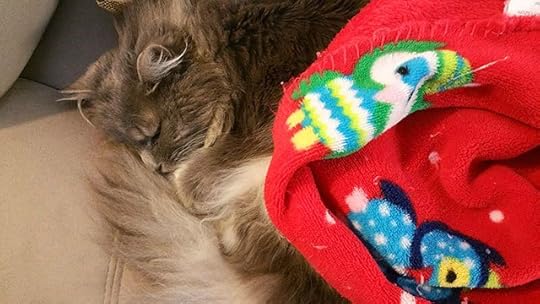
I am moving to Pompano Beach this month. Good thing I do not have a “real” job to quit.
The awesome thing about being a novelist is we are infinitely portable. Fling us across the globe and we will write just the same, continuing to spin words into imaginary worlds as if nothing has changed.
Ship me off to a planet on another solar system, and I will happily write by the light of another star. I sometimes feel like I travel through life inside a word bubble, or an imaginary space ship, that goes wherever I go.
My needs are minimal. I can write in a shack, a prison cell, a closet, or a luxury apartment, I really only need a box to sleep and write in. Aside from that, I require a pen, a notebook, a functioning brain, and a cat.
Though cats may be dispensable to some writers, it is hard for me to imagine writing without one.
My cat curbs my impulse to leave my computer. When she is in my lap, disturbing her slumber by getting up feels rude. Since I am trapped, I sometimes end up writing far longer than I otherwise would. However, if I ever move to another planet, I suppose any sufficiently adorable, lap-seeking extraterrestrial creature will do.
For now, I am not going to another planet, but this month I am moving my brain (and my cat) to a city in South Florida where my husband has gotten a new job. Pompano Beach is about four hours away from where I live now. For the first time, I will be living on the coast, and instead of dreading the move as I might have at one point, I cannot wait to get there – a new experience, a new adventure, a new source of inspiration.
As a general rule, I hate change, but when I moved to Ocala, Florida four years ago, I had a revelation about going to new places. I had been attached to my home in South Carolina and dreaded leaving, but when I got to Ocala and started to write again, I realized that I had not really left home. I had taken it with me. As long as I had a notebook, my memories, and a pen, it did not matter where I lived.
To me, home was a place I could be myself, a refuge from the bustling and clamorous world, a place where I could shed my mask, a stable center like the eye of a hurricane in the midst of relentless, turbulent change.
Writing was like that – my stability, my island of sanity, a way to organize scraps of experience into something meaningful, and I could do it anywhere.
The same was true not just with geographic transfers, but with jarring life experiences such as the death of someone close or depressions or other crises.
For me, writing is not just a job, but a coping mechanism. No matter how awful an experience is, there is always a detached part of me looking on, my writing self, trying to figure out how I can use my experience to inspire my next story.
That being said, my physical surroundings have not affected my writing as much as I would have expected. Before moving to Ocala, Florida, I had imagined that my writing would become shaped by beaches, lakes, palm trees, marshes and aquatic birds.
In fact, when I first got here, I went around taking photographs of everything I saw from the lake in front of my apartment to the ubiquitous lizards that scurried across the sidewalks. I was constantly searching for ways to incorporate these details into stories.
However, most of my time has not been spent outdoors staring at pretty lakes, but in my “box,” writing on my laptop with my cat. Most of my stories have nothing to do with Florida, and I have yet to write a story with a lizard or an alligator in it.
Most of what I have written could have been written anywhere, including most of my stories in my three published anthologies. My novel Paw was inspired by the video game Skyrim. Even my blog posts have barely mentioned Florida; most have been about what I think about most: writing.
Still, I am eager to see if living on the coast will awaken my imagination in new ways. In the meantime I have to pack – fast.
I am looking forward to new experiences that I can turn into stories. What will I learn? What insights will I gain? Good thing I will have a notebook, a pen, and a laptop.
And of course, a cat. Every writer, whether they know it or not, needs a cat.
If you enjoyed this post you might like my other writing. Take a moment and sign up for my free starter library. Click here. Also my story collection “Remembering the Future” is available for purchase on Amazon.
The post Writing by the Light of a Different Star appeared first on PASSIONATE REASON.


November 30, 2016
Why I Prefer Process to “Inspiration”

For too much of my life I had the impression that writing was something that happened to you because the gods of inspiration had chosen you, not something that you did.
The result was helpless frustration. I sought ways to make my elusive moments of inspiration visit me more often. I wanted to know how to trick, entrap, and seduce them into being my servants, not coy and elusive ghosts.
The culture of writing fueled my obsession with mystical phenomena like talent and inspiration, but there was too little mention of a greater power which is entirely controllable: process.
My writing improved dramatically once I began to treat writing as a multi-step process, and not something I had to get right the first time. Not only did my new approach make my work more enjoyable; the quality of my work became more consistent, and when I was pleased with my writing, I wanted to write even more.
I had spent my life trying to plan, create my content, and determine my presentation all in a single stroke of a pen. When I began to concentrate on doing one task at a time, writing felt almost effortless – no fairy dust required.
Writing is not magic, regardless of how it sometimes feels. Richard Dawkins in his book The Magic of Reality says magic, as commonly defined, is moving from simplicity to complexity, disorder to intricate design, without any steps in between. A genie can blink a monkey into existence fully formed.
In nature, that does not happen. It took billions of years for a single cell to reach the complexity of a human. Many thousands of incremental genetic mutations had to occur, and to persist they had to be conducive to survival.
The writing process is similar. Like a monkey, great writing is not likely to be blinked into existence. When a passage of a novel dazzles me, when I marvel at how much the author knows about a particular subject, when the perfect metaphor sets off shockwaves in my brain, when I am in awe of an emotion perfectly conveyed, I suspect it is due to a good, multi-stage process layered beneath the flashy surface.
Experience-wise, a reliable, multi-stage process produces the same effortless flow, and even fun, that inspiration is supposed to bring. Process does not encumber; it relieves. Without having to plan, create, and edit all at once, my mind is free to roam. Thus, I can explore my story at leisure instead of panicking because I have no idea what to do next.
With a process I always know what to do next. In fact, writing sometimes feels almost too easy, like cheating. In an episode of The Simpsons, Bart begins to study hard and becomes a straight A student. When his sister asks him how it felt to have studied for a test before taking one, he says, “It was just like cheating – only with my mind.” Separating writing into discrete stages delivers a similar feeling, even though on the surface it looks harder and more complex than the way writers author books in movies.
I have never seen a writer in a movie planning a novel in a spiral notebook; the writer is either grinding his teeth because he is blocked or typing furiously, as if there is never a moment of doubt about where to go next.
However, in writing, the direct path is not necessarily easier.
What has made my writing easier is erecting a clear divide between deciding what I want to say and how I want to say it. Specifically, I want to separate the creative planning and rough draft stages from the tasks of revision, editing, and polishing.
While planning sounds tight and cerebral, it can actually be loose and relaxing. I use a process called clustering. I have always found plot outlines to be too linear and constricting. Clustering it is not linear at all, but radial.
The radial model removes pressure from my imagination. I can focus on creating without having to commit to any specific order. I begin my planning by selecting a theme, topic, or mood I want to explore.
To cluster, I represent one of them as an evocative word or phrase. For example I might write the word “cruelty” and circle it as my nucleus; then I would draw lines radiating from the nuclear word “cruelty.” At their endpoints I would write new free-associated words which would become new centers, related words such as “darkness,” “evil,” “morality,” or “guilt.”
The associations can be illogical or even random. They often trigger personal associations from childhood, like bullies or my first encounter with death. I write “bullying” or “death” and keep drawing lines from the new central words and attaching new words until I end up with a complex-looking map.
As my mind furiously searches for patterns in the apparent chaos, a direction will almost always emerge, a story I want to tell, a poem I have to write, or an insight I long to explore. The shift from uncertainty to a clear direction often feels euphoric.
Clustering is the easiest part of my process because my mind does not even register it as “writing,” so the inner voice that sometimes criticizes me when I write looks the other way.
Despite how easy clustering is, it is the most powerful technique I know for generating ideas; it also means that when I begin to write my rough draft, I am not creating something from nothing, which for me is the most anxiety-inducing aspect of writing.
If I do start to feel lost or “stuck” while penning my rough draft, I can always refer to my map of clustered words for ideas, so that it is easy to keep my hand moving. That is a good thing because keeping my hand moving is really the only rule I have for writing rough drafts.
Some writers only view a rough draft as a first draft, whereas I view it as an entirely separate species of writing.
Thus, some writers try to get their first draft as close to perfect as they can on the first try; then they go back and correct the grammar. Other writers revise agonizingly as they go, trying to perfect each paragraph before proceeding to the next.
That is how I tried writing for many years, and only ended up frustrated. It was a huge relief when I finally learned to keep the rough draft stage entirely distinct from the editing. To make the separation physical, I always pen my rough drafts in a cheap spiral notebook, whereas I revise them on my laptop.
Writing in a notebook with a pen signals my brain that anything goes, including trite phrases, sentence fragments, mangled grammar, and dull prose. With a pen it is difficult to make changes, and that works in my favor by removing the temptation to fuss over wording.
Next I type my hand-written rough draft, making changes as I go. Since I already know my content I am free to focus exclusively on how to say what I want to say. Again, it is far easier to focus on that one task than it is to fret over content creation and presentation at once. Sometimes “block” is just a word for trying to do too many creative tasks at the same time.
Even unskilled beginners can benefit from breaking the writing process into small steps. If you already know your content, you are free to experiment with aspects of presentation such as rhythm, sentence length, and metaphor; that is, you can focus fully on how best to say what you want to say.
A great advantage of using a multi-step process is it keeps writing moving at all times. I never panic or get stuck. I always know what the next step is, and that contributes to the experience of flow, a state where time seems to stand still and I am fully immersed in what I am doing.
Of course, every writer is different. My goal is not to sell my specific process as the best in the world, but to illustrate how each step of the writing process becomes far easier when you focus on it alone. There is no wrong way to cluster, so it is easy. Writing a rough draft is also easy because anything goes, including triteness, botched grammar, and silliness.
Even if I lose concentration, I can always refer to my clustered words to get my hand moving along the page again. Typing my rough draft is also easy, too; once I am on the computer, I cannot help but make changes if I see something wrong; it feels instinctual, automatic, and effortless.
Writing becomes most difficult at the very end, when I am getting my imaginary world ready for readers to come inside and look around. However, the final polish is also the most gratifying stage because my writing is more likely to flatter me due to all the steps I have put into it.
It is when I try to skip steps that writing becomes daunting and difficult, when I try to conform to the one-step model of writing that most people seem to accept – which looks like a shortcut but which is actually the most inefficient path.
I prefer the lazy, meandering back roads to the straight but crowded highway. Many writing shortcuts are not really shortcuts at all, but paths to hair-pulling frustration. For me, the “long way” features the most scenic views and the most enjoyable trip, while leading to the most exciting destination.
If you enjoyed this post you might like my other writing. Take a moment and sign up for my free starter library. Click here. Also my story collection “Remembering the Future” is available for purchase on Amazon.
The post Why I Prefer Process to “Inspiration” appeared first on PASSIONATE REASON.
November 14, 2016
How to Surprise Readers with the Familiar
No writer wants to hear that his story is “predictable.” It one of the worst criticisms you can give a writer. It suggests tedium and dullness. At the same time writers are told that characters should be consistent, that they should never lurch from the rules that govern their personalities – in other words, characters should be somewhat predictable; otherwise, their life-like illusion breaks down.
A simple example is Cookie Monster. Cookie Monster is about as predictable as a character can get. He loves cookies, he always loves cookies, and the farther Cookie Monster is willing to go in pursuit of cookies, the more lovable he is. No one wants to see Cookie Monster drop cookies for cauliflower – unless in the end he realizes the error of his ways and comes home to his true nature: Cookie! Om, nom, nom, nom!
Cookie Monster is predictable in motive, but he is not dull. He is endlessly creative when it comes to finding new and unpredictable ways to appreciate cookies.
The same is true in serious fiction. Characters that do surprising things will only be believable if what they do fits with their overall personality structure. I want my characters to be complex enough to throw readers for a loop, yet predictable enough for readers to form expectations. When I grasp a story well enough to form expectations, I am fully engaged.
If I make predictions about what a character will do in a situation, at least part of the time I want to be right. If a character I know to be obsessive-compulsive sees a crooked picture hanging on the wall, I predict that he will not be able to rest until he straightens it; when I am right, I feel rewarded.
But suppose my OCD character walks by the picture without stopping. I am intrigued. Is he violating the rules of his psyche? Maybe not. Maybe he is at a formal gathering where he is trying not to appear OCD. Afraid of calling attention to himself, he sweats and fidgets, unable to get the crooked picture out of his mind, yet he tries to appear composed. When he can no longer endure the tension, he runs to the picture and straightens it. Thus, I am rewarded. I was right after all, just not exactly in the way I expected.
His behavior reminds me of something old about him, yet teaches me something new: the character has the willpower to resist his OCD to a point, even if it means suffering, but he cannot sustain his restraint indefinitely.
Aside from letting me make predictions, a character who repeats certain actions over and over seems real to me, because people I have encounter in real life have patterns. A character with an annoying habit of munching ice cubes whole while wreaking dental havoc seems alive.
When reading, what I seek is a paradox: a familiar surprise. For example, when you read a murder mystery, the criminal will never be a person the author has never mentioned. She will not introduce a line-up of characters, describe their backgrounds and alibis, and then at the end of the novel say, “Ha ha, I tricked you! It was none of them. The true culprit was some dude named Bob I never mentioned. Surprise!” What makes the ending satisfying is that the surprise is also familiar.
A familiar surprise challenges my mind because it is the interaction of two opposing processes: recognizing the old while absorbing startling new information that turns my original assumptions upside down. The two processes conjoined forge a satisfying and memorable experience, a synaptic flash, an awesome jolt that sends chills down the back of my neck and makes my hair stand on end: The real killer was Peggy, the baby sitter? Really? I would have never guessed, but I should have. Of course, it was her.
Even without being surprised, I like being reminded of what a writer has previously told me. If the writer tells me that a character loves Cracker Jacks, then it is satisfying to see the character frequently indulging in Cracker Jack hedonism at odd moments, perhaps stopping to grab a pack while running from a zombie in a super-market.
However, a jolting surprise without recognition is trickier to pull off.
Have you ever seen a movie or read a book that has so many plot twists, it gives you whiplash? Plot twists without an adequate foundation to prepare readers seem faked. Plot twists only work if the writer has laid enough groundwork or given enough clues for readers to make sound predictions. When a plot lurch happens, I need something to ground me in the action, a clue, something to recognize. Otherwise, I feel locked out of the drama and, as a result, I find the story unsatisfying.
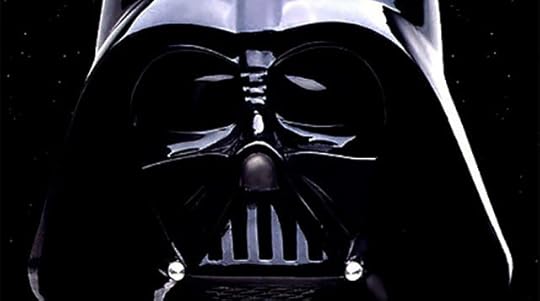
Aside from clues, foreshadowing prepares readers for a future moment of recognition. The writer provides symbolic hints of big events looming on the horizon. A great example of foreshadowing is the scene in The Empire Strikes Back where Luke enters a cave on Degobah and has a vision of meeting Darth Vader there; Luke removes the mask of the Dark Lord, and it is his own face he sees.
This scene brilliantly foreshadows the climactic battle scene in which the real Darth Vader tells Luke, “I am your father.” By then, the vision at Degobah has paved the way for the dramatic revelation that turns the story upside down.
Not only is Luke related to Darth Vader by blood; Luke discovers that evil has a human face and that the darkness is not confined to Darth Vader; it is inside Luke himself. Luke has a choice: he can fight it or succumb to it. The previous vision on Degobah charges the scene – and the situation – with the resonance of a familiar surprise.
Surprise is a dynamic staple of fiction writing, but not any surprise will do. Readers need solid ground to stand on as the capricious winds blow, a stable pattern, a sturdy bridge leading to a place where the familiar meets the strange.
If you enjoyed this post you might like my other writing. Take a moment and sign up for my free starter library. Click here. Also my story collection “Remembering the Future” is available for purchase on Amazon.
The post How to Surprise Readers with the Familiar appeared first on PASSIONATE REASON.
November 3, 2016
What Makes Writing Universal?

Writing is the next best thing to telepathy. It makes up for something we lack in nature: the ability to truly feel what it is like to be another person.
Sympathy aside, everything I experience, I ultimately experience alone. This will always be true. No one else will ever literally feel my pain, my bliss, my disappointments, or my triumphs, just as I will never know exactly what it feels like to be someone else. But by reading, maybe I can come close.
When reading, I draw on personal frames of reference to understand other viewpoints. All is Quiet on the Western Front gave me a horrifying sense of what it felt like to be a German soldier during World War I. The Slave Narrative of Frederick Douglas triggered in me personal feelings of injustice as the author showed me what it was like to be an American slave before the Civil War.
How is this experience transfer possible? I was not alive when slavery was legal, and I have never been to Europe or enlisted in an army. However, there are times I have felt trapped and times I have felt afraid. I also know what it feels like to experience loss, to feel helpless, to be angry at cruel people.
In other words, I have frames of reference that are practically universal to the human experience.
Not that they are literally universal, but at the risk of extraterrestrial disapproval, I will use the word anyway to refer to experiences most humans share.
Experience transfer through writing is possible, in part, because humans are incredibly similar, despite the fact that we define ourselves by our differences. James Russel Lowell said, “Whatever you may be sure of, be sure of this – that you are dreadfully like other people.”
It is an uncomfortable thought; there are so many people I would rather not be like. But there is truth here.
Genetically we are 99.9 per cent alike. We draw from the same emotional palette. We love and we hate, feel jealousy and rage. We occupy the same planet, see the same sun, and gaze at the same moon. We feel heat and cold, hunger and thirst.
No matter how uniquely intricate our lives appear, the fact remains: some aspects of the human experience are so common, they persist over millennia. That is why I can read books by writers on the other side of the globe and still relate to their stories, even if their culture and language is radically different from my own.
You would think that the more universal writing is, the more commercially in demand it would be, since common frames of reference affect how much a reader can relate to a story. However, the opposite sometimes appears to be true. Literature that focuses on exploring what is common to the human situation is set apart by the label “literary fiction” as opposed to commercial fiction, which exists primarily to entertain.
Thus, writing that should be easiest to relate to is packaged as something remote, unpopular, an exotic acquired taste, an oddity reserved for a small elite group of highly educated citizens. But the human situation belongs to everyone.
Besides, the line between “literary” and “commercial fiction” is blurry. A romance novel can potentially say as much about the human condition as fiction designated as literary, although it might do so by accident.
I wonder, though, why fiction devoted to exploring universals would not be considered entertaining or especially sellable.
When I was an adolescent, I read for many reasons. Sometimes I read to escape into another world. I read for drama and suspense. I read to become acquainted with interesting characters.
But I especially read to feel understood. I loved the passages that moved me to say, Yes, exactly! That is what it feels like to love and hate someone at the same time. This is what it feels like to roller skate or swim in the ocean or experience an awful family vacation. This is what it feels like to be lonely. This is what I have thought and felt, yet have been unable to put into words.
Sometimes a writer would admit something I was ashamed to tell anyone; all at once the burden would lift with the thought, I am not alone after all, and the secret really stops being embarrassing once you say it.
I read to compare my experiences with that of others; in other words, I read.for universal truths embedded in specific situations I could relate to. For me that was entertaining, whereas fiction with fake happy endings tended to depress me.
But how do writers achieve stories that resonate with universality?
Years ago, I read a book called Writing the Wave. In it I encountered an interesting way to wed the personal to the universal in writing. The author presented a drawing of a butterfly.
Next, she asked the reader to write on the first wing a one-sentence summary of a personal experience, say, the death of a grandparent. The next step was to think of a news event, say a devastating natural disaster like an earthquake, and write “earthquake” on the other wing.
The butterfly represents a balance between the personal experience and the large-scale event, the single loss of a family member multiplied a thousand-fold by a natural disaster. The next assignment was to write a story incorporating both wings of the butterfly, drawing emotions from the personal loss to make descriptions of the news event powerfully moving, rather than abstract and sterile.
There are other possibilities. On the first wing, you might write “police violence against ethnic or racial minorities.” On the other wing you might write, “The time I was bullied.”
The technique breathes emotional life into abstract reports and expands personal experiences into universal ones. Though I never literally write on butterfly drawings anymore, the image often comes back to me when I write.
It contains the important lesson that no matter how unique, quirky, and bizarre my experience is, there is probably something universal about it, something most anyone could relate to, if I took the trouble to find it.
The universal manifests in specific ways, and as a writer I want to do what the poet William Blake suggested: to see “the universe in a grain of sand and a heaven in a wild flower.”
I read for the same reason: to find the universal in the specific. Stories that create a balance between the two are the kind of stories I remember best, the kind I go back and reread, and the kind I want to write.
If you enjoyed this post you might like my other writing. Take a moment and sign up for my free starter library. Click here. Also my story collection “Remembering the Future” is available for purchase on Amazon.
The post What Makes Writing Universal? appeared first on PASSIONATE REASON.
October 19, 2016
The Anatomy of an Epiphany

Sometimes I have the thought, “I have lost my way.” It always alarms me. It suggests that at some point in my life I must have had a WAY so perfect that if I had only continued to follow it without straying, it would have led to eternal bliss, infinite wisdom, or enlightenment.
At times I may have the thought when it is not really called for, when I am only having a bad day. But there have been times in my life when I really did lose my way, times when I moved away from who I really was and toward some alien substitute which left me desperately unfulfilled and confused.
The first time I lost my way, I was a chronically confused nine-year-old who had been repeatedly teased for being shy.
At nine I decided, “I have to change. I need to become someone else, or I will never be happy.” This was not just a passing thought, but a burning conviction, fueled by years of glares, snubs, and rebukes, and the way people spoke the word “shy,” as if it was a grave character defect that would doom me to a life of friendless misery.
At the time my need to change seemed like more than a belief; it seemed obvious, like the sky being blue. I had to change. I had to change the way I needed to eat, the way I needed to breathe, the way I needed warmth in winter. So I identified the kids everyone seemed to admire and tried my best to imitate them. I wondered, what was it? Was it the way they stood, the way they spoke, the way they smiled?
Mainly, though, I tried to “talk more,” which is what everyone, including parents and teachers had been urging me to do since kindergarten. Other than that, I had no idea what qualities made kids likable to other kids.
In kindergarten I had gone into my first day of school with a simple belief: If you are nice to people, people will be nice to you. Reality made a mockery of this notion; at my school it was the bullies everyone seemed to admire, the ones who only ever seemed to laugh when they were laughing at someone.
I was constantly looking for clues to the magic. I tried imitating kids everyone liked without knowing if what I was imitating was the true source of the magic: the style of dress, a way of speaking, a charming glance, a way of laughing.
I tried to talk when I did not feel like talking, to wear clothes that looked like the kind others wore whether I personally liked the style of dress or not. But I was a poor imitator, and because I did not know why – or if – what I was imitating “worked,” my experiment fizzled. In fact, it led to my appearing weirder than I ever had been before, and feeling even more lost.
My experiment culminated in a school-wide sixth grade bullying experience that shattered any aspirations of being popular. I switched to a strict Christian school for three years to get away from the bullies. A severe adolescent depression followed, which was mixed up with religious confusion fueled by fundamentalist teachers who convinced me that having certain thoughts was evil.
Three years later, after I had mostly gotten over the bullying trauma, something incredible happened: The clouds broke. A path appeared. Light glimmered in the distance, and I found my way.
It was around the same time I discarded my religious beliefs, freeing myself from the neurotic self-blame my teachers had instilled. At that time, nothing seemed too sacred to question, and I had a radical idea, not just about religion, but about shyness.
It was that being shy was not wrong. I made a decision: I was going to be as shy as I chose, shockingly “in-your-face,” and unapologetically shy. Plus, I would wear whatever shoes I wanted and listen to whatever music I pleased. I decided to stop sun-bathing. Sun-bathing was boring and stupid. Why was being pale so bad anyway? So what if I seemed weird? I would be weird on purpose. At least weird was not boring, as long as I was genuinely weird and not weird because I was trying too hard to be like others.
The way I felt was the emotional equivalent of hearing music in a video game when you have leveled up or opened a well-hidden chest. Congratulations! You have unlocked the first part of the puzzle, you have defeated the End-of-Level Boss. You may proceed to level 2!
My depression lifted. No longer fixated on being liked, I became interested in the world. I felt a surge of hope that amounted to reassurance that had found my way.
Or at least a stretch of sidewalk. I did not completely stop caring what others thought. I decided to make straight A’s. Emotionally it was a step up. Unlike trying to be liked by other kids, my grades could be controlled.
At the same time my identity became entangled with “being smart.” I became a perfectionist where my grades were concerned, a trait which set the stage for losing my way again many years later.
It happened in 2001. This story is one I tell myself again and again because I never want to forget it, not even for a day. This time I lost my way not socially, but creatively.
Since childhood I had yearned to be a writer, and teachers had constantly praised my stories. As an adult I had self-published my first novel and dreamed of being prolific.
However, a manic episode that led to my bipolar disorder diagnosis changed everything. I went on a mood-stabilizing medication that drained me of energy and rendered creative activity impossible to enjoy.
Mired in depression, I could see no way out of my situation. I hated everything I wrote. I imagined critics standing behind my chair as I typed saying things like, “self-indulgent,” cloying,” “shoddily constructed” or “trite” – imaginary intellectuals judging me on the one aspect of myself I clung to as part of my identity: my ability to think.
Writing felt like placing my palm on a hot stove and trying to hold it there for as long as I could; every time I wrote, I could count on my mood to crash. For a time, I gave up altogether. For years I felt certain I would never be able to enjoy writing again.
However, my writing aspirations were like a fly infestation. They kept coming back, and swatting them never solved my problem for long. My dad would bring me old essays I had written, fling them into my lap, and say, “Look at this. Look at what you wrote. You are being wasted.”
Eventually, I had to try again because my writing was too much a part of me not to. A guidance counselor in college had once said to me “Writing is your soul.” He was right. For me, existing without writing was not really living.
I went back to my computer. With gritted teeth, I tried again. I forced myself to throw down words whether I liked them or not. It was more emotionally painful than anything I had ever done. One day I closed my laptop in frustration, feeling totally beaten and on the verge of quitting forever.
I desperately tried to remember what I had once loved about writing, and the question took me on a mental trek back to my childhood, to a time when writing had always been fun. Despite my social floundering, I had not feared critics then. I had written to make myself happy; no one had ever forced me to write my creepy vampire stories. What had happened?
I had come full circle. Here it was again, the same issue of wanting to please that had gotten me into trouble as a child, only this time the crowd I wanted to please was not popular kids but imaginary critics with big vocabularies. I remembered a time before I had become a straight A student, a time when as a kid, I had scorned rules and written whatever I liked. While my childhood had been far from blissful, my writing had been the exception.
As I remembered, I found my way. I found it by giving up, but not on writing. I gave up on writing to please critics, whether real or imaginary, professional or amateur.
I decided I would write the way I had as a kid, without regard for rules or “authorities.” I jailed my imaginary critics and stopped reading how-to-write articles. Maybe I would never make a living writing, but if I was going to write, I was going to enjoy it. I stopped forcing myself to write for a set number of hours and instead made a goal of writing a sentence a day, although I almost always wanted to write more.
Everything I have written since went back to that moment when I found my way. But again, I had not found the whole way, because on some days I still feel lost.
When I say to myself “I have lost my way,” what do I really mean? I mean I am worried I have lost perspective, become more fixated on the opinions of others than the writing itself, become addicted to praise and terrified of criticism. It means I am driven by anxiety, reacting, not acting, fleeing discomfort instead of moving toward what I truly want and love.
My old “epiphanies” were good but they were incomplete. In some ways they were never fully realized.
I am never blocked, yet I still find myself wanting to please sometimes. When people praise my writing, I want the praise to continue. And, as much as I hate to admit it, there is an insecure 12-year-old inside me that, despite her painful early lessons, would still like to be popular.
While I am writing, I focus on what I like, but right after I publish a book or a blog, I feel anxious that it will not be well-received. I have never fully conquered the aspects of my nature that have tripped me up in the past. I know myself better than I used to, but in the end, I am still just me.
At moments of insecurity, I yearn for a new “epiphany.” I want to level up. I want to once again shed exhausted old fears and leave them behind to go to someplace new.
I find myself obsessing about the times before when I “found my way” and realize they had common elements. Each time I suffered because I had strayed too far from myself in an effort to please. I reached a moment of full-fledged despair. The world as I knew it collapsed, and I had to let go of something I thought I needed that was actually holding me back.
On some days I feel like I am closing in on a new insight that scurries out of sight as soon as I spot it, and I wonder if there is anything I might be clinging to that I need to let go of, like an irrational fear that is creating barriers to “finding my way.”
But maybe no one ever finds their way once and for all. Life is not a straight and narrow path; it has curving roads and undulating hills, not to mention sinkholes and ditches. Maybe losing your way is as vital as finding it, an under-appreciated leg of the journey where the real learning lies, the match that lights the lantern that reveals the unexpected path, the turn that changes everything.
If you enjoyed this post you might like my other writing. Take a moment and sign up for my free starter library. Click here. Also my story collection “Remembering the Future” is available for purchase on Amazon.
The post The Anatomy of an Epiphany appeared first on PASSIONATE REASON.
October 12, 2016
Just Released “The Age of Erring and Other Tales”
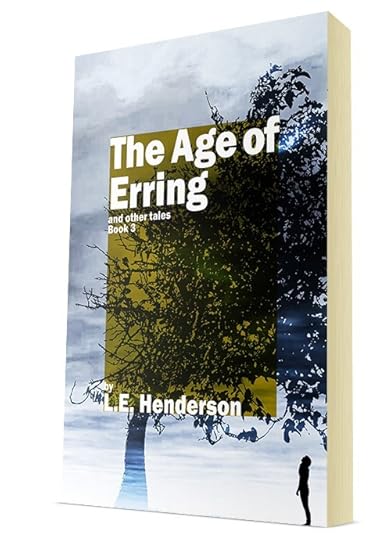
My short story “The Age of Erring” would not behave.
I had ordered it to be a short story, but it tried to become a novel. I wrote at least 50 pages with no end in sight until I realized that the story was mushrooming out of my control. To contain the explosion, I reduced it to about ten pages. In the end I was happy with it, but it took me so long to write that it delayed publication of my new story collection by almost two months.
The collection, which I released last week, is The Age of Erring and Other Tales.
My new collection represents a lot of experimenting. Its stories vary widely from one another in voice, style, genre, and content – a commercial no-no in traditional publishing, which prizes uniformity and editorial consistency.
My book features androids in need of therapy, a mysterious world-wide writer disappearance, a planet whose moon is falling, a flight on an aircraft that never stops for fuel, a parable about planets that dream they are people, and a creation tale that traces the history of a single individual back to the Big Bang.
Of all my anthologies, I worked the hardest on this one. That is because I was unsatisfied with some of the stories I had published on my blog. To publish them in a book, I extensively edited many of my old stories, even rewriting some of them, while also supplying additional content.
As excited as I am about releasing my third collection, I will have to set my story-writing aside for a while because the attempted mutiny by my story “The Age of Erring” made me realize that I want to write novels again. Fortunately my stories have given me many concepts to novelize.
I like novels. While short stories allow for reckless experimentation and conceptual diversity, novels allow more depth. They allow for an intricacy and a mimicry of real life that is hard to achieve in a short narrative.
I have written three novels already, my first being Thief of Hades which I self-published in 2001.
My second, soon to be released, is The Ghosts of Chimera, a psychological fantasy adventure about an adolescent boy who ventures into a parallel universe in search of the ghost of his younger brother.
Though I am scaling back my short story writing for now, I am not about to stop writing them altogether. They allow an exhilarating sense of creative freedom that I love. In The Age of Erring and Other Tales, I made the most of it. I hope my stories convey the fascination and fun I experienced in writing them.
By the way, I have included a video in this post in which I talk about my new collection and where I get my story ideas. I will be making more videos, but mainly I will be working on my fourth novel.
It will be nice not to have to wrestle with my new novel the way I did with my short story “The Age of Erring.” I have told my current work-in-progress that it can be as long as it pleases, and it made contented Wookie vocalizations to signify approval. I was glad. When writing, it is always good to have a Wookie on your side.
The post Just Released “The Age of Erring and Other Tales” appeared first on PASSIONATE REASON.
October 5, 2016
Beyond Beauty: The Real Purpose of Character Descriptions

In everyday conversation, when someone asks you to describe someone you know, you probably do not say, “She has a penetrating gaze, pale, delicate fingers, and a regal posture.” What do you say?
You probably tell whether a person is short or tall, young or old, skinny or overweight. You might tell the color and length of their hair and their eye color.
All of it usually adds up to an answer to the question, “Are they hot?” Particularly if the person in question is a girl, a question likely to come up is, “Is she pretty?”
What this says about our culture is a subject for another blog post. The point I want to make is that, in writing fiction, the purpose of character descriptions is different than the conversational goal of determining if someone is good-looking or not.
That is not to say beauty should never be mentioned, especially if a character uses the power of beauty to drive the story forward, but describing a person as attractive is a means to an end, not an end in itself – and this was confusing to me as a child when all of my female characters looked like super-models as I indulged fantasies of being the svelte, flaxen-haired creatures I described. In general, I described characters has having long or short hair, blue eyes or brown eyes. They were not people; they were dolls, and my descriptions were dull.
So, if the point of character descriptions is not to indicate attractiveness, what is it?
As with many questions about writing, there is more than one legitimate answer. But generally speaking, the goal of character descriptions is to provide subtle clues to how a character has behaved in the past and how she is likely to behave in the future. In particular, how is she likely to behave if confronted with a crisis?
To offer an analogy taken from biology, when you look at a lion at rest, his physical form still provides clues to his function. He has sharp claws that are able to rend the flesh of his prey, sharp eyes that can spot moving quarry, and sharp teeth optimized for tearing flesh. He also has powerful legs designed for chasing fast prey.
If I am informed enough to interpret the clues, his physical appearance alone tells me what he has probably done in the past and what he is likely to do in the future; that is, he is a formidable and efficient killing machine.
If his ear is torn, that tells me even more about his past. I might not know exactly how he lost part of his ear, but the detail shows me he has experienced trauma and makes me wonder what it was. The detail of the torn ear reveals past experiences and actions that presage future action.
Good character descriptions do the same. We describe “form” to give readers a clue to how a character will function in the story.
The most telling descriptions indicate choices a character makes, some of them unconscious like posture or habitual gestures and others that indicate conscious preferences, such as style of dress.
You can use visual details to provide subtle hints that address relevant questions: In a crisis, will my character behave impulsively or thoughtfully? Will he plunge into danger or will he retreat? Is he prone to aggression or will he opt for diplomacy? Is he reckless or is he prudent?
Giving clues to future action through character descriptions is an art, and it is part of what makes writing so challenging. Doing it well requires consciously observing real people and noticing their postures, facial lineaments, habitual expressions, styles of dress, and manner of walking; these are some of the many ways characters communicate personality and hint at past experiences that may have shaped them.
How do these qualities affect how readers perceive a character? Sometimes it is self-evident. A character who constantly slouches is not the same character as one who holds herself upright at all times. Slouching as a general rule suggests laziness. Straight posture indicates confidence and strength of will, although, given human complexity, there are bound to be exceptions.
Likewise, a character who always wears a black turtleneck is not the same character as someone who typically wears pink, frilly, lacy outfits. A character who piles on jewelry is not the same character as one who wears no jewelry.
Showing personality traits through description fulfills another important story purpose. It individualizes characters; it makes a character distinct in the mind of the readers, setting her apart from all the other characters. Facial tics, a habit of drumming fingers on a hard surface, a tendency to munch ice cubes whole, a twitching eyelid, a habit of wearing only green clothing are all examples.
Individualizing characters is a worthy goal in itself. Distinguishing details make characters easy for readers to imagine and remember. They breathe life into a character, because so many people in real life have quirks, unusual mannerisms, or irritating habits that set them apart.
However, if these traits also presage future actions, so much the better; in that case, you are accomplishing two goals at once. For example, a character who wears loads of jewelry may be a status seeker, someone who primarily wants to be seen and admired. There are other reasons someone might wear a lot of jewelry, so supporting clues will be needed to establish a status-seeking tendency such as a habit of disparaging the poor.
Combined with other relevant clues, heavy jewelry indicates a motive, which creates expectations about how a character will behave.
Why does creating expectations matter? Because an expectant reader is not a passive reader; a reader who feels like he knows a character well enough to make predictions is fully engaged; he will want to stick around to see if his predictions come true.
An excellent example of creating expectations is the portrayal of the athlete Phineas in the novel A Separate Peace as he contemplates jumping from a dangerously tall tree.
“What I like best about this tree,” he said in that voice of his, the equivalent in sound of a hypnotist’s eyes, “what I like is that it’s such a cinch!” He opened his green eyes wider and gave us his maniac look, and only the smirk on his wide mouth with its droll, slightly protruding upper lip reassured us that he wasn’t completely goofy.”
The “maniac look” shows a reckless attraction to danger, even though he is not clinically insane; his hypnotic voice indicates his power to influence others. Both presage the ultimately fatal accident around which the who story pivots.
There is a final point I should mention: If you introduce a character with a physical description, make sure it carries over into future scenes where the character is active. If you tell the reader that a character has facial tics during moments of stress, be sure to include facial tics when you present your character acting in a stressful situation. If you go into detail about a character having stormy, restless blue-grey eyes, return to this detail. Carry it over into future scenes. It is not necessary to mention it every time, but if you never mention it again, observant readers will sense a discontinuity; thus, the character will seem fragmented and unreal.
For a character to be recognizable and believable, she must be consistent. This means there needs to be continuity between what the writer tells the readers and the actions that follow. This is because static descriptions are not really static. Like sleeping lions, they are potentially dynamic.
They show a character poised for action. Physical descriptions reveal a form that predicts a function, no less than the dagger-like teeth of a lion predicts danger for its prey – as miles from its den, a lamb is sleeping, unaware that its fate is bound to another far away.
If you enjoyed this post you might like my other writing. Take a moment and sign up for my free starter library. Click here. Also my story collection “Remembering the Future” is available for purchase on Amazon.
The post Beyond Beauty: The Real Purpose of Character Descriptions appeared first on PASSIONATE REASON.
September 23, 2016
Choose Mystery Over Information Overload
I used to write my novels defensively. I was terrified of there being any page where the reader might possibly be confused at any moment, so I would try to cram in as many explanations in as short of a space as possible: my terminology, the history of my world, cultural idiosyncrasies, and geography, for starters.
I wanted to show readers I had done my homework, that I had created a sensible world, that I had fortified it on every side with unassailable logic. As a result I felt less like a fiction writer than a graduate student defending a doctoral thesis.
I forgot that I was not on trial, and that my primary goal was to make readers feel. Information does not need to be rushed, and information not directly related to the story can be omitted altogether.
When I learned to relax, I was able to take more control of my writing, giving thought not only to what appeared in my novel, but also to where and how I would allow my information to unfold.
It is okay to know more about your world and characters than the readers do. Unless the information is necessary to the story, it is fine to know, but not say, that a character grew up in a foster home, or even that your world was founded by an alien race of giant insectoids.
Incomplete pictures mystify. Imagine a painting of say, a cat that is taking up more space than the frame of a canvas allows, revealing only part of its face or part of its tail. The painting intrigues because it invites viewers to imagine the hidden details outside the frame. The same principle works with fiction.
The information you leave out may manifest as subtle cues that give your world and its characters extra layers of dimension, perhaps taking the form of the mysterious insect statuary scattered along the desert floor or the secretly orphaned character who feels like she does not truly belong anywhere; as long as there are no plot holes, not everything needs explaining.
For fantasy writers like me this is particularly important to remember because extensive world-building creates the danger of overloading readers with arcane information all in one place, leading to jumbled writing that causes eyes to glaze over.
This is especially true if I have not yet given readers a good reason to be interested in my elaborate caste system, alien culture, or unusual form of government. To keep readers turning pages, I want to present information about my world in a way that has some bearing on the conflicts of the present moment.
By far, the hardest part of writing my second fantasy novel was trying to parcel out the voluminous information about my world in manageable doses. In my first draft, the glut of made-up terms I had been so proud of creating congested my narrative so much, it was hard for even me to read.
It became clear that laying out the history, mores, and rules of magic all at once through dialogue and exposition was not going to work.
I came across as a teacher saying to my readers, “Okay, class, Listen up. This is what you will need to know on the pop quiz that I will be giving you at the end of class. Take careful notes and remember everything I am saying, or you will be totally lost in the next chapter.”
This is fine for professors to do, but as a novelist I want to entice, not just educate readers about my imaginary world.
I revised my novel trying to make what was exceedingly difficult appear simple, to make the rules, history, and layout of my world easy to digest. I tried to drop information in a more gradual – and ideally natural – way that would not bring my story to a halt. I incorporated information during action scenes wherever I could, since action engages the imagination more than dryly presented factoids.
Engaging the imagination of the readers is what transforms dry words on a page into a story; in the process, my story becomes more than it is. Readers do more than just translate; they create my story along with me, imagining possibilities that may have never even occurred to me while writing.
Dramatic story action does not just deliver answers; it creates questions. Suppose, for example, I have a lengthy passage of exposition about a race of immortal beings and a long, convoluted history of how they got that way.
I could describe it all within the first few chapters, but there is another way. Suppose I create a dramatic action scene in which a fireman is struggling to put out a hotel fire, knowing there is a baby inside.
He goes inside, fighting through the flames, getting burned, coughing, and despairing that he will find the baby dead; instead he finds a baby girl who is lying on her back in the middle of the flames, cooing happily, her clothes and blankets all burned away, as she reaches for the flame tips like they are amusing toys.
Which is better? Presenting the history of my immortals before or after the fire scene? The advantage of waiting to explain the mythology about immortals after the fire scene is that by then the reader is more than ready for the information, having already wondered: How did the baby survive a fire undamaged?
Exposition can work as a vehicle for laying out the mythology of the immortals, but there is a more dramatic alternative. Revealing pivotal information during an action scene can add depth to the scene while also bringing the information to life.
Who can forget the Star Wars revelation that exploded during a fight scene between Luke Skywalker and Darth Vader where Darth Vader says: “I am your father”?
What if Luke’s aunt or uncle had simply told him in the beginning that Darth Vader was his father? The information might have been interesting, but it would not have struck with the force of a light saber to the head, provoking such fierce resistance that Luke lets go of the structure he is clinging to and plunges into free fall.
An important goal of fiction writing is to create an experience that makes readers feel as well as understand.
Sometimes this requires restraint. Great fiction writers are not just information dispensers, but skilled illusionists, magicians who are able to create dazzling effects with words, directing and misdirecting, withholding information, offering clues, and building suspense until the final dramatic flourish when the hidden rabbit comes out of the hat.
The art of writing lies not just in what happens but how and when. The magic is not just in the trick itself but also in the delivery, the conscious control of lights and shadows, the veil of smoke, the flash of mirrors.
If you enjoyed this post you might like my other writing. Take a moment and sign up for my free starter library. Click here. Also my new novel “Remembering the Future” is available for purchase on Amazon.
The post Choose Mystery Over Information Overload appeared first on PASSIONATE REASON.
September 15, 2016
In Writing, Should You “Kill Your Darlings”?

A famous quote of advice by author Stephen King is “Kill your darlings, even when it breaks your egocentric little heart, kill your darlings.”
In other words, cut passages of writing, even the ones you love, if cutting them benefits the story as a whole. Cutting superfluous text can help writers achieve a leaner, more focused, and more interesting narrative.
When I first read “kill your darlings,” I did not like the advice, not at all. I was fine with cutting passages I considered truly abominable, but parting with passages I loved and had worked hard on felt like cutting off my arm. If a passage worked on any level, I was reluctant to let it go.
This was partly due to under-confidence. I thought I needed to preserve any impressive-sounding text I had written as proof to myself and others that I could write well. I was unaware of how much I was limiting my artistic freedom by clinging to mini-masterpieces that derailed or weakened my overall artistic objective.
Everything changed for me when I was asked to write a eulogy for a memorial service held in honor of a neighbor who had unexpectedly died. He had also been a good friend and an excellent writer. He had written an intelligent and humorous weekly column for the local newspaper. I had met him when I was a college student and an aspiring writer, and I had admired his soaring prose, honesty, and probing insights. He was the first friend I had ever had that I considered a “real writer.”
I missed him a lot, and I wanted to capture who he was in my eulogy, and “almost right” was not going to be good enough.
I wanted to get the portrait exactly right to the point that it became an obsession. I wanted to describe how I had met him, his personality, his humor, his intelligence, and the conversations we had had about writing and literature.
I wrote ten pages and cut nine. I added more text to the one page that had survived my purge, and began cutting again. I repeated the process again and again. I am not sure how many times I hacked my prose, but each time I did, I did it without the slightest hesitation. Maybe it was because the eulogy was not about me. I had a purpose, and anything that undermined or failed to serve that purpose did not belong in my piece and had to go. In the end I was left with only one page that represented the best of all I had written, and it was remarkable to me how much better it was than before I had made cuts.
I read my eulogy at the memorial service. Afterward, three people came up to me and told me that my speech had moved them. Weeks later the wife of the writer told me that some of the audience had told her after the service that, in capturing the personality and virtues of my friend, I had “nailed it.”
The feedback meant a lot to me, partly because at the time I was just beginning to recover from an insidious case of block that had lasted over three years.
The response to my eulogy was a powerful lesson that I carried over into my other writing. The ability to let go of my writing, good or bad, turned out to be a wonderfully liberating practice that turned writing into a conscious and deliberate act.
Before, I had held sacred any writing that had seemed to “write itself.” I had been hesitant to tamper with any passage that “the muse” had bestowed upon me on those rare high-energy writing days when “something took over” and everything flowed perfectly.
This attitude had made me a slave of random luck or imaginary forces outside my control. Cutting text meant consciously chiseling away at excess content in order to release the form of the story inside, the story that I wanted to see exist.
After the memorial service I made cutting text a routine part of my writing process. Nothing I had written was sacred, including text I loved but which did not belong.
Whenever my ego complained about my cutting witty dialogue or an interesting metaphor, I would transfer the text I had cut into a “scrap heap” file I had created on my computer. I felt a lot better about putting my “darlings” in jail than killing them, and there have been many times I was glad the text I had cut still existed, because sometimes I do need to bring it back.
Unfortunately, some writers have turned “kill your darlings” into an inexorable rule with the underlying belief that shorter is always better. However, stories have different space requirements, and there have been times when I have over-edited and cut so much of my text that I drained the soul from my prose.
One way I try to avoid that is to focus on what I like instead of what I dislike. When editing, I set my draft in bold lettering, then go through and change everything I want to keep into standard lettering. Then I cut away everything in bold lettering – the excess. When I do that, I really do feel like a sculptor with a chisel.
Cutting text for leaner prose is not a rule, but a powerful technique, a tool of the craft like a saw or a power drill. The tool, no matter how effective it is, is not the boss of me. I can keep whatever text I want to keep. No rule can substitute for intuitive artistic judgment.
However, cutting superfluous text can produce slick results. At times it has made the difference between writing that rambled on without purpose and writing with sharp focus; between an amorphous story and one with a clearly defined shape; between a dull story and an interesting story; between owning my writing and my writing owning me.
If you enjoyed this post you might like my other writing. Take a moment and sign up for my free starter library. Click here. Also my new novel “Remembering the Future” is available for purchase on Amazon.
The post In Writing, Should You “Kill Your Darlings”? appeared first on PASSIONATE REASON.
September 8, 2016
Suffering: The Rocket Fuel of Story Telling

When I first began writing fiction, my characters tended to be too passive. Horrible things happened to them, but they never knew exactly what to do. When they did react, they reacted too little.
A student in my college creative writing class had the same problem. His story began with a father losing his toddler son to a senseless murder. The next scene skipped forward a couple of years without ever showing how the father reacted emotionally to this harrowing event. The father, adrift, focused on other things. The father only occasionally thought back vaguely to the “bad years,” with parsimonious allusions to the shattering event that must have transformed his life.
To say that the author wasted an opportunity is an understatement. When characters suffer emotionally, readers sympathize, and sympathy builds an emotional bond between characters and readers.
Sympathy aside, suffering is motivational fuel. Suffering characters act. They cannot help but act. The student in my creative writing class had not just wasted energy. He had motivational rocket fuel, but instead of using it, he had figuratively stored it away in his garage.
Not only did he waste energy. By separating the character from his traumatic ordeal, he prevented the character from seeming three dimensional and real. A suffering character may not do the right thing or the rational thing but he will do something.
The father could have started a support group or tracked down the murderer in a vigilante quest for revenge. He might have become a raging alcoholic. Instead the character remained adrift like a sailboat without any wind, but there was no reason that the sailboat should not have been surging forward at a breakneck pace.
But does a character really need to be active to be interesting? The popular fantasy author Brandon Sanderson said that active characters are irresistible to readers. According to him, that is one reason that a villain can add so much energy to a story. Villains tend to make big moves. They murder. The betray. They bully. They manipulate. They tell outrageous lies. We may not like them, but we cannot help but respond to them, especially if they are plausibly drawn.
What motivates a villain? What turns an Anakin Skywalker into a Darth Vader? One prompt is being tormented by nightmares in which his wife Amidala dies in childbirth. Anakin solidifies his turn to the dark side after he helplessly watches his mother die. What causes Othello in the play by William Shakespeare to murder his wife? He erroneously believes she has cheated and suffers from painful jealousy.
Active heroes or protagonists are also compelling. They make hard decisions. They may lie for a good cause or break the law or rescue a kid from a burning house while disfiguring themselves with burns in the process.
Some characters – and people – are naturally more active than others, but that is not the whole truth. Even ordinarily passive characters have the potential to be active if the dramatic heat is turned up high enough.
What makes a passive character active? What makes real people go out of their way to influence the world around them even if it means instigating conflict, annoying the hell out of others, or overcoming incredible obstacles?
Characters who will endure the fires of hell or try to move mountains in order to accomplish a goal are usually the characters who have suffered horribly – and the more they have suffered, the more driven they are to make changes.
Anyone who is alive and conscious cannot help but react to terrible pain. When I stub my toe, I cannot remain impassive. If someone is with me when it happens they will probably hear me gasp or curse. I will lean toward my injury. I will close my eyelids tight. Emotional pain can be every bit as excruciating, and like physical pain it cries out for remedy.
Suffering — whether in the past or present – is the key to creating characters who move stories forward in big ways, and how they move it forward is depends upon what kind of person they are.
Some characters are already burdened with a traumatic past when they take the stage, such as detective Clarice Starling in Silence of the Lambs. She. interrogates the serial killer Hannibal Lecter in order to predict the moves of another serial killer that she is trying to stop.
The desire to stop a serial killer from murdering innocent people is a compelling enough motive in itself to carry a story, but beneath the surface of a detective just doing her job is a deeper and more poignant motivation.
Hannibal questions Clarice in return for answering her questions and uncovers the devastating childhood experience in which she was forced to watch lambs being slaughtered and despite her desperate efforts to save one of them, they all died. Her motive to save innocent victims is not just professional. It is personal. Dramatically speaking, that makes all the difference between ordinary gasoline and rocket fuel.
What is true in fiction is often true in real life. I rarely move forward when I am happy. When everything is going well, I cling to my safe routines and avoid trying anything new.
It is during the moments of destabilization triggered by suffering that I grasp into unknown places in a quest for balance, that I reach out for a branch, something, anything to break my fall. I long for homeostasis, regularity, a new harmony – and if the old harmony is gone, I have no choice but to move forward even if I would ordinarily prefer to do nothing.
It is important to remember, in both writing and living, that no experience needs to be wasted, and that pain, whether physical or emotional, means movement – and that how we move determines who we are, and who we will become.
If you enjoyed this post you might like my other writing. Take a moment and sign up for my free starter library. Click here. Also my new novel “Remembering the Future” is available for purchase on Amazon.
The post Suffering: The Rocket Fuel of Story Telling appeared first on PASSIONATE REASON.