Father Elisha's Blog, page 8
May 2, 2025
Resurrection 3: The Living Bread (Western 2025)

 The Spiritual Mysteries of the Divine Calendar: May 4–10, 2025
The resurrection of Jesus Christ is the cornerstone of our faith, and therefore the Season of Resurrection carries magnificent importance in our journey of spiritual growth. “And if Christ is not risen, your faith is futile; you are still in your sins! Then also those who have fallen asleep in Christ have perished. If in this life only we have hope in Christ, we are of all men the most pitiable.” (1 Cor. 15:17–19) Without the resurrection, our faith is without purpose. This week, we will explore how the grace of resurrection works within us as the living bread.
The grace of resurrection impacts our relationship with Jesus by lifting our attention from the materialistic and earthly realm to the spiritual and heavenly, through the Holy Spirit. Everything becomes different. The resurrection of Jesus renews us, and its impacts on our lives grows stronger each year. “Therefore we do not lose heart. Even though our outward man is perishing, yet the inward man is being renewed day by day” (2 Cor. 4:16).
This Season is the crown of our annual spiritual journey with God, and the outcomes of the previous Seasons of Salvation impacts these days. The Early Fathers call Great Lent the spring of the spiritual life, so we might say that the Season of Resurrection is the summer. After the secluded wilderness of Lent and the intensity of the streets of Jerusalem during Holy Week, Christ’s resurrection completely alters our course toward the heavenly places. There, we can partake in the glory of the resurrected Lord Jesus and be fed by the mystical living bread. What glorious and joyous forty days!
From Horizontal to VerticalWe are not talking about the topics of the resurrection of Jesus and the living bread in a general sense—“I shall not die, but live, and declare the works of the Lord” (Ps. 118:17)—but in these weeks we follow the Holy Spirit’s unfolding of the grace of resurrection that we received on the Feast of Feasts (Pascha).
The Holy Spirit longs not only to reveal the glory of God to us, but also for that glory to dwell in us when Jesus Christ is formed in our inner man. “My little children, for whom I labor in birth again until Christ is formed in you” (Gal. 4:19). Once Jesus is formed within us, the glory follows, for the glory rests only on God. “He [the Spirit] will glorify Me, for He will take of what is Mine and declare it to you” (John 16:14). “I am the Lord, that is My name; and My glory I will not give to another” (Isa. 42:8).
The Sunday Gospels of this Season help us understand how to shift the perspective of our daily lives from horizontal to vertical. We move the focus of our faith to a higher sphere, the heavenly places, which are the key to the Season of Resurrection.
Do Not Cling to Me
God became a man not only to live with us, but He took on human nature so that He could transfer His divinity to us. St. Athanasius of Alexandria (296-373) said: “He, indeed, assumed humanity that we might become [partake of] God. He manifested Himself by means of a body in order that we might perceive the Mind of the unseen Father. He endured shame from men that we might inherit immortality.” (On the Incarnation, page 93–94, public domain.)
Our goal is not to cling to Jesus as the Incarnated God-Man, but as the Resurrected and Glorified God-Man. Mary Magdalene wanted to cling to Jesus after the Resurrection as she always had done, but Jesus told her: “Do not cling to Me, for I have not yet ascended to My Father; but go to My brethren and say to them, ‘I am ascending to My Father and your Father, and to My God and your God’” (John 20:17).
Jesus told Mary to ascend in the Spirit with Him into the heavenly places before she clung to Him. “They are not of the world, just as I am not of the world” (John 17:16). The journey of ascension is a difficult journey, but the more we follow Christ and separate ourselves from the spirit of the world (1 John 2:15–17)—the more we consecrate ourselves—the more we ascend in the Spirit and experience the fullness of our life in the Risen and Glorified Christ. “Therefore come out from among them and be separate, says the Lord. Do not touch what is unclean, and I will receive you. I will be a Father to you, and you shall be My sons and daughters, says the Lord Almighty” (2 Cor. 6:17–18).
The Risen Lord
Since the beginning of the Divine Calendar in late August / beginning of September, the Holy Spirit has been preparing us for the graces of the Resurrection and the Ascension. This is when the specific area in our soul that God wants to redeem this year receives its replacement, changing the old man with the new. Therefore, the Divine Calendar gives us fifty days to celebrate and receive this work of grace before the Season of Pentecost begins—forty days to focus on the grace of the Resurrection and another ten with the grace of the Ascension.
Jesus appeared to His disciples in a strange way during these forty days until His ascension. He appeared first as a normal man (a gardener or a fellow traveler), and His disciples didn’t recognize Him. Then Jesus revealed Himself as the Risen God-Man and the disciples recognized Jesus as the Messiah, but then He disappeared before their eyes.
During Great Lent, we met Jesus as the fasting Bridegroom, weak but victorious. Now we encounter Him as the Risen Lord of Glory. “Jesus Christ is the same yesterday, today, and forever” (Heb. 13:8), yet He appears to us differently in this Season—and He asks us to be different, like Him. The resurrection of the Lord gives us grace to replace the old with the new.
The New Battle
We struggled during Lent against the old human nature that resisted the grace of the Incarnation that we received at Christmas. The cross completed this battle with the old man, yet there is still a battle to complete in the Season of Resurrection. Since the cross defeated the old man inside us, we can now reclaim our abode in the heavenly places. “And raised us up together, and made us sit together in the heavenly places in Christ Jesus” (Eph. 2:6). “For we do not wrestle against flesh and blood, but against principalities, against powers, against the rulers of the darkness of this age, against spiritual hosts of wickedness in the heavenly places” (Eph. 6:12).
But this battle is different compared to the wilderness of Lent because we have a unique power available from the resurrected Christ. “Finally, my brethren, be strong in the Lord and in the power of His might” (Eph. 6:10).
During the fifty days of the Resurrection and the Ascension, we have access to the power of the grace of resurrection (the two angles we talked about last Sunday). The two angles of the Resurrection: one working from the inside (Eph. 1:15–20) and one working from the outside (Ps. 107:14–16). We can’t see any visible signs of the Resurrection yet because the grace works within, in our inner man, as the Resurrection lifted us to the heavenly places in Christ. We won’t find the work of the grace of resurrection here in the earthly realm until the last “trumpet will sound, and the dead will be raised incorruptible, and we shall be changed” (1 Cor. 15:52b).
Looking Back
What we have talked about here might sound unusual and hard to grasp, but it is normal that we can’t recognize this work of the Holy Spirit until after we have journeyed through the Sundays of the Resurrection. Towards the end, it becomes clearer.
On the previous Sunday (Thomas Sunday), God wanted to make the resurrection of Christ our personal resurrection. The Holy Spirit wanted to give us a constantly renewing faith—the living faith—to remove any doubt that something new and great had entered our lives. The grace we received on Resurrection Sunday (Pascha) and during Bright Week (first week after Pascha) helps us recognize Jesus in a completely new way—just as Thomas knew Jesus as His Risen Lord after putting his finger into Christ’s wounds.
Photo by Evi Radauscher on Unsplash
Sunday Gospel: John 6:35–45 (NKJV)And Jesus said to them, “I am the bread of life. He who comes to Me shall never hunger, and he who believes in Me shall never thirst. 36 But I said to you that you have seen Me and yet do not believe. 37 All that the Father gives Me will come to Me, and the one who comes to Me I will by no means cast out. 38 For I have come down from heaven, not to do My own will, but the will of Him who sent Me. 39 This is the will of the Father who sent Me, that of all He has given Me I should lose nothing, but should raise it up at the last day. 40 And this is the will of Him who sent Me, that everyone who sees the Son and believes in Him may have everlasting life; and I will raise him up at the last day.”
41 The Jews then complained about Him, because He said, “I am the bread which came down from heaven.” 42 And they said, “Is not this Jesus, the son of Joseph, whose father and mother we know? How is it then that He says, ‘I have come down from heaven’?”
43 Jesus therefore answered and said to them, “Do not murmur among yourselves. 44 No one can come to Me unless the Father who sent Me draws him; and I will raise him up at the last day. 45 It is written in the prophets, ‘And they shall all be taught by God.’ Therefore everyone who has heard and learned from the Father comes to Me.
The Living Bread
Three times in this week’s Sunday Gospel we see the phrase “come down from heaven” (verses 38, 41, & 42). Jesus is the bread from Heaven. He is not from here, and this truth offended people. This passage reminds us where Jesus came from, but why did He use the symbol of being the living bread—bread that can be eaten?
This is difficult to understand. How can we eat Jesus, the Living Bread from Heaven? But this is so important for our faith. Regularly, we need to change our understanding from an earthly way of thinking (based on our intellect) to a higher nature of understanding, transcending the intellect through faith.
Let us look at the two travelers toward Emmaus, Luke and Cleopas, in Luke, Chapter 24. These men had good hearts that were ignited when Jesus spoke to them (Luke 24:32), but their understanding remained on an earthly level. Jesus appeared as a natural man until He disappeared supernaturally, taking them from an earthly understanding to the heavenly.
Explaining from “Moses and all the Prophets, He expounded to them in all the Scriptures the things concerning Himself” (Luke 24:27), but still they didn’t understand it was Jesus talking. However, their hearts were ignited and burned. “And they said to one another, ‘Did not our heart burn within us while He talked with us on the road, and while He opened the Scriptures to us?’” (Luke 24:32)
Jesus said a few verses earlier: “O foolish ones, and slow of heart to believe in all that the prophets have spoken!” (Luke 24:25) On an earthly level, they couldn’t believe beyond what was plainly written in the Scriptures. Their hearts burnt with love in the presence of God, but God desired more from His resurrection.
Remembering the Living Bread
In Luke 24:26–27, we read: “‘Ought not the Christ to have suffered these things and to enter into His glory?’ And beginning at Moses and all the Prophets, He expounded to them in all the Scriptures the things concerning Himself.”
“Then they drew near to the village where they were going, and He indicated that He would have gone farther. But they constrained Him, saying, ‘Abide with us, for it is toward evening, and the day is far spent.’ And He went in to stay with them” (Luke 24:28–29).
And Luke 24:30–31: “Now it came to pass, as He sat at the table with them, that He took bread, blessed and broke it, [now they remembered Jesus instituting the Eucharist on Covenant Thursday] and gave it to them. Then their eyes were opened and they knew Him; and He vanished from their sight.” The two disciples remembered what Jesus had said: “And as they were eating, Jesus took bread, blessed and broke it, and gave it to the disciples and said, ‘Take, eat; this is My body’” (Matt. 26:26).
Recognizing the Living Bread
When they broke the bread—which is Christ Himself—He opened their eyes. This means they moved from the earthly to the heavenly. Their inner eyes opened, and they suddenly understood everything—and they recognized the resurrected Jesus, the living Bread. They had been with Jesus for hours, even with burning hearts, but until now, they hadn’t recognized Him. Their inner eyes were closed, and they only saw with their earthly eyes (of the old man) and not with the heavenly eyes of the new human nature.
Then Jesus disappeared, and we read verses 32–35: “And they said to one another, ‘Did not our heart burn within us while He talked with us on the road, and while He opened the Scriptures to us?’ So they rose up that very hour and returned to Jerusalem, and found the eleven and those who were with them gathered together, saying, ‘The Lord is risen indeed, and has appeared to Simon!’ And they told about the things that had happened on the road, and how He was known to them in the breaking of bread.”
…and how He was known to them in the breaking of bread.
Opening Our Eyes
How can we open our inner eyes to recognize the Risen Christ and the work of the Resurrection? After we received the living faith, the Divine Calendar tells us Jesus is the Bread of Life. We need to eat the Living Bread to open our eyes to the heavenly places. Verse 35: “I am the bread of life. He who comes to Me shall never hunger, and he who believes in Me shall never thirst.”
Jesus established this mystery with the disciples on Covenant Thursday before He sacrificed Himself on the cross. Jesus is the living Bread we can eat, and He nourishes us. “And as they were eating, Jesus took bread, blessed and broke it, and gave it to the disciples and said, ‘Take, eat; this is My body’” (Matt. 26:26). “I am the bread of life. He who comes to Me shall never hunger, and he who believes in Me shall never thirst” (John 6:35).
Jesus repeated this mystery with His disciples during the forty days between His resurrection and ascension.
Luke and Cleopas in Luke 24:30: “Now it came to pass, as He sat at the table with them, that He took bread, blessed and broke it, and gave it to them.”By the Sea of Tiberias with Peter and the disciples in John 21:13: “Jesus then came and took the bread and gave it to them, and likewise the fish.”How can we eat Jesus, the Living Bread?
Eating the Living Bread
“So He humbled you, allowed you to hunger, and fed you with manna which you did not know nor did your fathers know, that He might make you know that man shall not live by bread alone; but man lives by every word that proceeds from the mouth of the Lord” (Deut. 8:3). “But He answered and said, ‘It is written, “Man shall not live by bread alone, but by every word that proceeds from the mouth of God”’” (Matt. 4:4).
Jesus Christ is the Word of God. “And the Word became flesh and dwelt among us, and we beheld His glory, the glory as of the only begotten of the Father, full of grace and truth” (John 1:14).
Therefore, we can eat the Living Bread in two primary ways:
Spiritually eating the Word of GodWhen our eyes are opened to know the Resurrected ChristSpiritually Eating the Word of God: The Bible as the Living Bread
We can eat the Word of God by reading it in a distinct way and by partaking in the sacrament of the Eucharist.
The Desert Fathers didn’t always have the sacrament of the Eucharist available as they lived far out in the desert, so they read the Bible mystically every day. Mystical reading means reading the Bible with our spirits, primarily, not with our minds, in a spirit of worship. This means reading sizeable portions of the Bible, without stopping to analyze or study, at a rather high pace. Some monastics even adds prostrations along the way to honor the Word. The desert worshippers read especially the four Gospels this way, because they contain the testimony of the Incarnated Word of God, the Living Bread.
We read in John 6:63 that the words of God are spirit and life: “It is the Spirit who gives life; the flesh profits nothing. The words that I speak to you are spirit, and they are life.” Therefore, our spirits—not the mind—needs to be the stomach when we want to eat the Word of God as the Living Bread. “Your words were found, and I ate them, and Your word was to me the joy and rejoicing of my heart” (Jer. 15:16a). The heart refers to the spirit.
“Then I took the little book out of the angel’s hand and ate it, and it was as sweet as honey in my mouth. But when I had eaten it, my stomach became bitter” (Rev. 10:10). In Greek, the stomach figuratively means the heart and the spirit.
Spiritually Eating the Word of God: The Impact of the Living Bread
As we said, Jesus is the Word of God, so when we eat the Word of God through mystical reading, we eat Jesus as the Living Bread. This approach to our spiritual life changes our way of thinking, because the more we eat the Living Bread, the more our spirit grows, matures, and develops the faculties of the new man. The Season of Resurrection helps us transform our way of thinking about living as a Christian. We move from living in the earthly realm to the heavenly.
When we eat the Word of God—when we break the Living Bread—our inner eyes open and we receive the victory of the resurrected Christ. We become one with Christ in the heavenly places.
“If then you were raised with Christ, seek those things which are above, where Christ is, sitting at the right hand of God. Set your mind on things above, not on things on the earth. For you died, and your life is hidden with Christ in God” (Col. 3:1–3).
Spiritually Eating the Word of God: The Inversion of the Living Bread
When we complete our battle in the heavenly places, aided by eating the Word of God, an unexpected thing might happen. What used to be our weakness and struggle, through the grace of resurrection, suddenly become our strength and a blessing for others. The replacement of the old man with the new in the heavenly places becomes like an inversion.
What used to be a cause of death becomes a source of life through the completed work of the grace of resurrection. This is the mystery of the work of the Resurrection and not something earthly logic can explain. This is the heavenly work of Jesus Christ.
1 Cor. 11:23–24: “…took bread; and when He had given thanks, He broke it and said, ‘Take, eat; this is My body…’” Jesus died on the cross. He gave His body and the bread was broken. But through His resurrection from the dead, this broken bread imparts the infinite power of the resurrection and the life of Jesus Christ. The death of Jesus became the wellspring of eternal life, the ultimate inversion.
When Our Eyes Are Opened to Know the Resurrected Christ
The Living Bread, Jesus Christ, is the only thing that satisfies the groaning areas of our soul. This area is starving, and we offered fleeting satisfactions with other things but Jesus. We need mystical food to satisfy this famished area of the soul, and that is the Bread of Life, the Resurrected Lord Jesus Christ. When we eat the Word of God, this area receives satisfaction and fulfillment. The resurrection of Jesus is a source of complete contentment.
Let us return to Luke and Cleopas and see how they shared what had happened with the eleven disciples.
“Now it came to pass, as He sat at the table with them, that He took bread, blessed and broke it, and gave it to them. Then their eyes were opened and they knew Him; and He vanished from their sight. […] And they told about the things that had happened on the road, and how He was known to them in the breaking of bread” (Luke 24: 30, 31, 35).
The resurrection makes everything different. We are no longer afraid of death or of being broken. How can we not be afraid of this? “I am the resurrection and the life. He who believes in Me, though he may die, he shall live. And whoever lives and believes in Me shall never die. Do you believe this?” (John 11:25–26)
The Living Bread Satisfies Us and Makes Us Fearless
When we eat Jesus as the Word of God or as bread and wine, everything becomes different. Suddenly, we are able to be broken for Jesus’ sake and for others, just as Jesus broke Himself before His disciples. “For whoever desires to save his life will lose it, but whoever loses his life for My sake and the gospel’s will save it” (Mark 8:35).
Jesus made Himself known to the disciples in the breaking of bread and opened their eyes. The grace of resurrection does the same within us. When we eat the Living Bread, the Holy Spirit open our eyes to a most glorious mystery: Life is always present within me, and this resurrection life manifests itself when I experience death—but a different type of death. When I feel broken, resurrection life mystically radiates from me. Therefore, I no longer fear death or fear being broken, because eternal life is within me and flows from me when I’m broken, performing miracles inside and around me.
“Jesus said to her, ‘I am the resurrection and the life. He who believes in Me, though he may die, he shall live. And whoever lives and believes in Me shall never die. Do you believe this?’” (John 11:25–26)
We experience that death no longer leads to death, because we celebrated the death of death during Holy Week. Now, life flows out from this death because of the resurrection of Jesus Christ. Before we understood the work of resurrection, everything was earthly. But Jesus resurrected, gave Himself as the Living Bread to eat spiritually, and now we must be brave and overcome our weaknesses.
Christ is Risen!Indeed He is Risen!Great is mystery of this Sunday, but resurrection means the end of death. “I am the living bread which came down from heaven. If anyone eats of this bread, he will live forever; and the bread that I shall give is My flesh, which I shall give for the life of the world” (John 6:51)
“And Jesus said to them, ‘I am the bread of life” (John 6:35).
Let us pray that we understand how the Lord wants us to eat the Word of God and receive the grace of the Living Bread, so that the Holy Spirit opens our eyes to the workings of His resurrection within us.
“That the God of our Lord Jesus Christ, the Father of glory, may give to you the spirit of wisdom and revelation in the knowledge of Him, the eyes of your understanding being enlightened; that you may know what is the hope of His calling, what are the riches of the glory of His inheritance in the saints, and what is the exceeding greatness of His power toward us who believe, according to the working of His mighty power which He worked in Christ when He raised Him from the dead and seated Him at His right hand in the heavenly places” (Eph. 1:17–20).
Thank you again for taking the time to go deeper into the mysteries of the Season of Resurrection. It is immensely rich, and as the years go by, we are able to comprehend more and more. It is my privilege to travel together with you.
Since the Season of Resurrection is not a season of fasting but of feasting, it might be helpful to review what we previously discussed regarding How Do I Feast?
Join the Journey Through the Seasons of Salvation
Join us on this weekly journey through the Seasons of Salvation as we walk in the footsteps of Jesus Christ through the seasons of His life. Sign up below (in the footer) to receive insights into the Divine Calendar and be the first to know about new updates. We’d be honored to have you with us.
Save Your Prayer Card on Your Smartphone
Photo by Nathan Dumlao on Unsplash
The post Resurrection 3: The Living Bread (Western 2025) first appeared on Father Elisha: Let me take you on an intriguing journey..


April 25, 2025
Resurrection 2 (Western & Eastern): Thomas Sunday: Believing in the Grace of Resurrection 2025
 The Spiritual Mysteries of the Divine Calendar: April 27 – May 3, 2025
Before we uncover what the theme of this Sunday, often called Thomas Sunday, means for our lives, let us first look at how the grace of resurrection works within and around us from two angles.
The Grace of Resurrection: Two AnglesAs with the Incarnation, the Resurrection of Jesus Christ is the most glorious and impactful event God has performed for mankind. In the Resurrection of Jesus, we find an unending fountain of renewed strength and grace. The grace of resurrection enables us to become more like Jesus and follow Him, no matter how hopeless we feel. Even if parts of our lives seemed to have died, Jesus can revive us.
“I am the resurrection and the life. He who believes in Me, though he may die, he shall live. And whoever lives and believes in Me shall never die. Do you believe this?” (John 11:25–26) Jesus said this before His own resurrection and before He raised Lazarus from the dead.
During His days in the flesh, Jesus completed the acts of salvation for our sake. His divinity clearly shines through His acts as a human being in the Incarnation, Transfiguration, Crucifixion, Resurrection, Ascension, and all the miracles He performed.
Jesus died as a human on the cross with His divinity united to His human spirit. The human spirit of Jesus descended into Hades and preached to those who had been dead since the time of Abel (Gen. 4:8–10). “For to this end Christ died and rose and lived again, that He might be Lord of both the dead and the living” (Rom. 14:9).
When Jesus rose from the dead, He raised mankind with Himself. One of the oldest and most important icons in church history is the Icon of the Resurrection of the Lord. It depicts Jesus being risen from the dead while holding Adam with His right hand and Eve with His left. The raising of Adam and Eve implies that what happened to them also happened to you and me. We were dead, but God raised us from the dead by the grace of Resurrection.
The first perspective on the grace of resurrection we see in Ephesians 1:15–20 and the second in Psalm 107:14–16. In these two passages, we see different aspects of the resurrection of Christ. Paul speaks about the action and effect of the resurrection happening within us—and he can’t express himself forcefully enough. The second passage from Psalms talks about an outward and manifested action when Jesus broke the chains of death and brought us out of the darkness of Hades.
Ephesians 1:15–20: First Angle on the Grace of Resurrection.
Let us look at the first angle from Ephesians 1:15–20. The Apostle Paul prays for the Christians in Ephesus to know Jesus Christ with a specific type of spirit: the spirit of wisdom and revelation. Then Paul writes about the resurrection of Christ. The great Apostle, with a tongue of gold, is in wonder and can’t express what he tries to communicate about the grace of resurrection.
“Therefore I also, after I heard of your faith in the Lord Jesus and your love for all the saints, do not cease to give thanks for you, making mention of you in my prayers: that the God of our Lord Jesus Christ, the Father of glory, may give to you the spirit of wisdom and revelation in the knowledge of Him, the eyes of your understanding being enlightened; that you may know what is the hope of His calling, what are the riches of the glory of His inheritance in the saints, and what is the exceeding greatness of His power toward us who believe, according to the working of His mighty power which He worked in Christ when He raised Him from the dead and seated Him at His right hand in the heavenly places.”
Paul wrestles to find words to describe the mighty effect that the resurrection of Jesus has on us: “…what are the riches of the glory of His inheritance in the saints, and what is the exceeding greatness of His power toward us who believe, according to the working of His mighty power which He worked in Christ when He raised Him from the dead…”
(If you’re interested, here are some additional comments on verse 19.)
Psalm 107:14–16: Second Angle on the Grace of Resurrection
The second angle on the grace of resurrection we find in Psalm 107:14-16: “He brought them out of darkness and the shadow of death, and broke their chains in pieces. Oh, that men would give thanks to the Lord for His goodness, and for His wonderful works to the children of men! For He has broken the gates of bronze, and cut the bars of iron in two.”
This passage describes how Jesus broke the prison of Hades and the domain of death, and how He released those who had been waiting for the coming Messiah since the time of Abel.
What Do These Two Angles Mean?
These two passages speak about two parts of our lives the resurrection of Jesus Christ impacts. The grace of resurrection influences our inner man, something hidden and unseen, and the other effect is something that becomes manifest, clearly seen.
We have two types of inner lives: one that we are aware of, clearly observable through our behavior, mindset, and motives, and another that hides from our awareness. This second (hidden) type of inner life was the main arena of the battle during Lent.
This second type of inner life intermingles with the deep roots of our old man, the fallen human nature, and most of us are unaware of what happens in these yet-to-be sanctified parts of our souls. But the glorious good news is that, right now, the grace of resurrection works in this fallen, hidden inner life of the old man.
It is important to know that our old man died with Christ on the cross and is defeated. However, the Holy Spirit wants to release that victory into the hidden areas of our souls, and that is the primary activity of the grace of resurrection.
“For if we have been united together in the likeness of His death, certainly we also shall be in the likeness of His resurrection, knowing this, that our old man was crucified with Him, that the body of sin might be done away with, that we should no longer be slaves of sin” (Rom. 6:5–6). “For I know that in me (that is, in my flesh) nothing good dwells; for to will is present with me, but how to perform what is good I do not find. For the good that I will to do, I do not do; but the evil I will not to do, that I practice. Now if I do what I will not to do, it is no longer I who do it, but sin that dwells in me. […] O wretched man that I am! Who will deliver me from this body of death? I thank God—through Jesus Christ our Lord!” (Rom. 7:18–20, 24–25a)

Photo by Mohamed Nohassi on Unsplash
The Hidden Inner Work of the Grace of ResurrectionWhat is the source of this resurrection that takes place in the hidden death of the soul? It is Jesus’ own secret resurrection from the dead—no one knew the exact moment of His resurrection. But after He arose there was an earthquake, and the angels rolled away the stone from the tomb and told the good news to the myrrh-bearing women.
When the first witnesses of the Resurrection arrived, Jesus had already risen in secret. Then Jesus rebuked His disciples when they didn’t believe the testimonies of Mary Magdalene and Peter. Jesus only appeared to select people because He wanted us to believe in His resurrection not only as an external event, but an event within us, hidden from our eyes.
Besides giving evidence that He indeed was risen, Jesus only appeared to those who had special needs. Most people, like the beloved disciple John’s first encounter with the Resurrection, only “saw and believed.” “Then the other disciple [John], who came to the tomb first, went in also; and he saw and believed” (John 20:8).
“Blessed are those who have not seen and yet have believed” (John 20:29).
Jesus wants to assure us that the grace of resurrection works inside us. Yes, the day will come, at “the twinkling of an eye, at the last trumpet. For the trumpet will sound, and the dead will be raised incorruptible, and we shall be changed. For this corruptible must put on incorruption, and this mortal must put on immortality” (1 Cor. 15:52–53). The day will come when we will physically rise from the earth with new glorified bodies, like Jesus’ body, but until then, Jesus wants to assure us that the grace of resurrection is far from dormant. We simply need to believe it.
As we already discussed, we have two types of inner lives. One is obvious, displayed through our personality and easy to know. But the other inner life hides and is the major source of our agony and sorrow. We rarely understand what happens in this part of us—where do these bad thoughts and behaviors come from? This was the battlefield of Great Lent, as the Holy Spirit helped us discover the deep things we didn’t know about ourselves, but now we see the grace of resurrection enter to do its miracles.
Jesus gently reveals these hidden areas during Lent, and maybe we recently discovered what we needed to repent of, but then, all of a sudden, Great Lent ended. Then Jesus gave us the grace to follow Him, close to His heart, during His journey in Jerusalem towards the cross in Holy Week. Last week, He gave us the grace of His glorious resurrection—but we still can’t forget this thing we realized we must turn from.
This struggle described above expresses genuine repentance that rises from deep within. It proves that the grace of resurrection is already working in our hidden inner life.
Jesus, through the grace of resurrection, takes hold of us to lift this part of our inner lives from our inner grave to the heavenly places (the key to the Season of Resurrection) that we talked about last time. The replacement is happening. Jesus grabbed our hidden source of misery deep within and resurrected it into the heavens where He installs the new man in its place.
“But God, who is rich in mercy, because of His great love with which He loved us, even when we were dead in trespasses, made us alive together with Christ (by grace you have been saved), and raised us up together, and made us sit together in the heavenly places in Christ Jesus” (Eph. 2:4–6).
This is how Jesus meets us in this Season of Salvation: Jesus takes hold of us with His incredible power—as Paul wrote, with “the exceeding greatness of His power toward us who believe, according to the working of His mighty power which He worked in Christ when He raised Him from the dead” (Eph. 1:19-20).
Each year, this spiritual work of the grace of resurrection goes deeper and deeper as we pass through the Seasons of Salvation, consciously aware and praying into these mysterious acts of the Holy Spirit, doing our best to cooperate with Him. During our first year through the Divine Calendar, we might not see big change right away, but after some months we will notice something feels different.
Next year, the work of the grace of resurrection will be even greater until it completely restores this specific part of our inner lives to the image of Christ. As the years go by and we journey through the Divine Calendar instituted by the spiritual fathers of the church through the inspiration of the Holy Spirit, we become different. We become more Christlike. “My little children, for whom I labor in birth again until Christ is formed in you” (Gal. 4:19).
The Visible Work of the Grace of Resurrection
Jesus will not only give us a hidden resurrection. We will discover another manifested resurrection in this specific area of our lives. Our thoughts and behavior suddenly change because we understand their origin.
We received revelation during Lent and Holy Week, and then the grace of resurrection provides even more understanding and a hidden transformative power. This hidden power manifest “and broke [our] chains in pieces” and “the gates of bronze, and cut the bars of iron in two” (Ps. 107:14,16). Within us, many links of a heavy chain broke, and we can see that, after a while, the chain will snap. The result is true transformation that does not fade away. Usually, this happens at a high frequency at the start of the Christian walk, then the process seems to slow down, but only because it works deeper—and sometimes we are to blame for the slowing down as well…
This is what it means to “work out your own salvation with fear and trembling; for it is God who works in you both to will and to do for His good pleasure” (Phil. 2:12c–13). And we can rejoice because God “is able to do exceedingly abundantly above all that we ask or think, according to the power that works in us” (Eph. 3:20).
Overview of the Season of Resurrection
Our goal with the Sunday Gospels and these talks is to inspire synergism between us and the Holy Spirit to build up our inner man (the new man) piece-by-piece. The cross of Christ put to death the old man and we are in great need of healing. Through the grace of resurrection, heavenly parts must replace the earthly, fallen parts of our inner man to construct the new man. “And that you put on the new man which was created according to God, in true righteousness and holiness” (Eph. 4:24).
Each Sunday of the Season of Resurrection contains a theme related to the resurrection of Jesus. These themes unfold this building process of our new man in the heavenly places.
Building Our New Man: Unfolding the Mysteries of the Grace of Resurrection:
First Sunday: The Feast of Resurrection (Holy Pascha): Resurrection and Life (John 1:1–17)
Second Sunday (today): Thomas Sunday / Antipascha: The Living Faith (John 20:19–31)
During the coming weeks, we will cover:
The Living Bread (John 6:35–45)The Living Water (John 4:1–42)The Living Light, The Living Word (John 12:35–50)The Living Way (John 14:1–11)On May 29 is the Feast of Ascension, and the Season of Ascension lasts ten days until the Season of Pentecost.
Journeying through these weeks causes our inner man to grow, and the Holy Spirit fills this newly expanded space on the Feast of Pentecost, the fiftieth day after the Feast of the Resurrection.
Let us now turn to the Sunday Gospel of Thomas Sunday, the second Sunday of the Resurrection Season.
Sunday Gospel: John 20:19–31 (NKJV)
Then, the same day at evening, being the first day of the week, when the doors were shut where the disciples were assembled, for fear of the Jews, Jesus came and stood in the midst, and said to them, “Peace be with you.” 20 When He had said this, He showed them His hands and His side. Then the disciples were glad when they saw the Lord.
21 So Jesus said to them again, “Peace to you! As the Father has sent Me, I also send you.” 22 And when He had said this, He breathed on them, and said to them, “Receive the Holy Spirit. 23 If you forgive the sins of any, they are forgiven them; if you retain the sins of any, they are retained.”
24 Now Thomas, called the Twin, one of the twelve, was not with them when Jesus came. 25 The other disciples therefore said to him, “We have seen the Lord.” So he said to them, “Unless I see in His hands the print of the nails, and put my finger into the print of the nails, and put my hand into His side, I will not believe.”
26 And after eight days His disciples were again inside, and Thomas with them. Jesus came, the doors being shut, and stood in the midst, and said, “Peace to you!” 27 Then He said to Thomas, “Reach your finger here, and look at My hands; and reach your hand here, and put it into My side. Do not be unbelieving, but believing.”
28 And Thomas answered and said to Him, “My Lord and my God!” 29 Jesus said to him, “Thomas, because you have seen Me, you have believed. Blessed are those who have not seen and yet have believed.”
30 And truly Jesus did many other signs in the presence of His disciples, which are not written in this book; 31 but these are written that you may believe that Jesus is the Christ, the Son of God, and that believing you may have life in His name.
Thomas Sunday: Feeling Left Behind
For forty days, Jesus appeared to His disciples. “The former account I made, O Theophilus, of all that Jesus began both to do and teach, until the day in which He was taken up, after He through the Holy Spirit had given commandments to the apostles whom He had chosen, to whom He also presented Himself alive after His suffering by many infallible proofs, being seen by them during forty days and speaking of the things pertaining to the kingdom of God” (Acts 1:1–3).
And so we embark on our forty-day expedition through the Season of Resurrection in the heavenly places—even though it sounds lofty.
The Divine Calendar wants us to know two things: 1. Christ is risen. 2. He is not here. “He is not here; for He is risen, as He said. Come, see the place where the Lord lay” (Matt. 28:6). If we want to receive more of the grace of resurrection, we must remind ourself of the heavenly realm.
Jesus did not appear to the Apostle Thomas right away—even though, knowing Thomas, Jesus knew the Apostle needed to see Him like the others did. Jesus appeared when all the disciples were together, except for Thomas.
In verse 24, we read: “Now Thomas, called the Twin, one of the twelve, was not with them when Jesus came.” This troubled Thomas terribly, because he loved Jesus so much. Thomas wanted to be close to Him. When Jesus wanted to raise Lazarus from the dead, the disciples objected because the Jews wanted to stone Him—except for Thomas: “The disciples said to Him, ‘Rabbi, lately the Jews sought to stone You, and are You going there again? […] Then Thomas, who is called the Twin, said to his fellow disciples, ‘Let us also go, that we may die with Him’” (John 11:8,16).
When the disciples told Thomas they had seen Jesus, they shocked him. He wanted to see his risen Lord with his own eyes. Verse 25 reads: “The other disciples therefore said to him, ‘We have seen the Lord.’ So he said to them, ‘Unless I see in His hands the print of the nails, and put my finger into the print of the nails, and put my hand into His side, I will not believe.’”
Thomas wanted Jesus to appear to him as well. He remained in this troubled state of mind until the Sunday after the Resurrection, which is today.
In verses 26–28, we read: “And after eight days His disciples were again inside, and Thomas with them. Jesus came, the doors being shut, and stood in the midst, and said, ‘Peace to you!’ Then He said to Thomas, ‘Reach your finger here, and look at My hands; and reach your hand here, and put it into My side. Do not be unbelieving, but believing.’ And Thomas answered and said to Him, ‘My Lord and my God!’”
During the Feast of the Resurrection, something important happened to us. We received an incomprehensible amount of grace. “And of His fullness we have all received, and grace for grace” (John 1:16). During the upcoming weeks, the Sunday Gospels of the Divine Calendar help us understand the grace of resurrection and what actually happened on the Feast of Feasts.
The message to us on this second Sunday is: Jesus has risen for you—and for you in particular. He resurrected not only for the believers in every nation. He rose uniquely for you.
If we try to remember what happened to us in the previous Seasons of Salvation—it is easy for the intensity of Lent and Holy Week to blur what God did in the Season of the Kingdom of God and the Season of Incarnation—we know God sees a much bigger picture when He looks at our lives.
Jesus tells us this Sunday that we need Him specifically and individually. We can place ourselves in the shoes of Thomas. There is a personal resurrection for us as well. On this Thomas Sunday, we must believe that the grace of resurrection works within us as well.
After such events like Holy Week and the Resurrection, we usually try to analyze and figure out what happened. But when Thomas Sunday comes, we sense something has happened, but we need Jesus to remind us and make it plain.
Building Our New Man: Unfolding the Mysteries of the Grace of ResurrectionThe Living Faith
Jesus encountered Apostle Thomas—and the rest of us—on this Sunday to give us this specific gift: a renewed type of faith. A living faith. “And whoever lives and believes in Me shall never die. Do you believe this?” (John 11:26)
This is a pulsating faith that renews day after day, drawing energy from the resurrection of Jesus, our new well of salvation. It is a divine charge embedded in our faith-muscle that seems to pump new life into our faith. We can see past previously immovable obstacles and find the strength to “walk by faith, not by sight” (2 Cor. 5:7).
But the devil will not leave us alone just because we have finished Lent and Holy Week. It is said that only humans waste time. The devil and his demons waste no time. “Be sober, be vigilant; because your adversary the devil walks about like a roaring lion, seeking whom he may devour. Resist him, steadfast in the faith…” (1 Pet. 5:8–9a)
The Season of Resurrection contains spiritual battles as well, because our spirits are in the heavens during these forty days of the Resurrection—and the spiritual warfare can be severe. “For we do not wrestle against flesh and blood, but against principalities, against powers, against the rulers of the darkness of this age, against spiritual hosts of wickedness in the heavenly places” (Eph. 6:12).
The Season of Resurrection is not equal to resting—even though it is a season of feasting—because the Resurrection is equal to the heavens. The devil wants to take us down from the heavenly places and tie us to the earth. So let us continue, be strong and resolute in Christ, drawing from the grace of resurrection.
The grace from this new living faith enables us to continue through the Season of Resurrection and face whatever the enemy puts in our way. The enemy wants to plant his deception in our minds that there is no resurrection happening inside of us.
But with grace from Thomas Sunday of the living faith, we agree with the Holy Spirit and know that something has happened inside, even though we don’t understand the details yet. The fountain of the grace of resurrection renews this type of living faith every day, and we are going to need it.
Jesus delayed His appearance to Thomas for one week after His resurrection. The Lord knew that many people—not only Thomas—would need the grace of the living faith of the Resurrection. Therefore, the risen Christ wants to appear before every one of us in a unique way—mostly unseen, but just as real.
Christ is Risen!
Indeed He is Risen!
Concluding the Grace of ResurrectionThank you again for taking the time to read and journey with me through the Season of Resurrection. Let us pray for the grace of the living faith to keep us advancing unhindered these weeks. As always, it is a privilege to be on this mystical expedition with you.
Since the Season of Resurrection is not a season of fasting but of feasting, it might be helpful to review what we previously discussed regarding How Do I Feast?
Join the Journey Through the Seasons of Salvation
Join us on this weekly journey through the Seasons of Salvation as we walk in the footsteps of Jesus Christ through the key seasons of His life. Sign up below (in the footer) to receive this year’s Divine Calendar, which introduces the Seasons of Salvation and guides you on the journey ahead. As a welcome gift, you’ll also receive my young adult novel, The Legend of the Divine Calendar, delivered straight to your inbox.
Visit the Seasons of Salvation blog for insights into the coming week, posted every Saturday. We’d be honored to have you join us.
Save Your Prayer Card on Your Smartphone
Photo by Erik Karits on Unsplash
The post Resurrection 2 (Western & Eastern): Thomas Sunday: Believing in the Grace of Resurrection 2025 first appeared on Father Elisha: Let me take you on an intriguing journey..
Resurrection 2: Thomas Sunday: Believing in the Grace of Resurrection (Western & Eastern 2025)
The Spiritual Mysteries of the Divine Calendar: April 27 – May 3, 2025Before we uncover what the theme of this Sunday, often called Thomas Sunday, means for our lives, let us first look at how the grace of resurrection works within and around us from two angles.
The Grace of Resurrection: Two AnglesAs with the Incarnation, the Resurrection of Jesus Christ is the most glorious and impactful event God has performed for mankind. In the Resurrection of Jesus, we find an unending fountain of renewed strength and grace. The grace of resurrection enables us to become more like Jesus and follow Him, no matter how hopeless we feel. Even if parts of our lives seemed to have died, Jesus can revive us.
“I am the resurrection and the life. He who believes in Me, though he may die, he shall live. And whoever lives and believes in Me shall never die. Do you believe this?” (John 11:25–26) Jesus said this before His own resurrection and before He raised Lazarus from the dead.
During His days in the flesh, Jesus completed the acts of salvation for our sake. His divinity clearly shines through His acts as a human being in the Incarnation, Transfiguration, Crucifixion, Resurrection, Ascension, and all the miracles He performed.
Jesus died as a human on the cross with His divinity united to His human spirit. The human spirit of Jesus descended into Hades and preached to those who had been dead since the time of Abel (Gen. 4:8–10). “For to this end Christ died and rose and lived again, that He might be Lord of both the dead and the living” (Rom. 14:9).
When Jesus rose from the dead, He raised mankind with Himself. One of the oldest and most important icons in church history is the Icon of the Resurrection of the Lord. It depicts Jesus being risen from the dead while holding Adam with His right hand and Eve with His left. The raising of Adam and Eve implies that what happened to them also happened to you and me. We were dead, but God raised us from the dead by the grace of Resurrection.
The first perspective on the grace of resurrection we see in Ephesians 1:15–20 and the second in Psalm 107:14–16. In these two passages, we see different aspects of the resurrection of Christ. Paul speaks about the action and effect of the resurrection happening within us—and he can’t express himself forcefully enough. The second passage from Psalms talks about an outward and manifested action when Jesus broke the chains of death and brought us out of the darkness of Hades.
Ephesians 1:15–20: First Angle on the Grace of Resurrection.
Let us look at the first angle from Ephesians 1:15–20. The Apostle Paul prays for the Christians in Ephesus to know Jesus Christ with a specific type of spirit: the spirit of wisdom and revelation. Then Paul writes about the resurrection of Christ. The great Apostle, with a tongue of gold, is in wonder and can’t express what he tries to communicate about the grace of resurrection.
“Therefore I also, after I heard of your faith in the Lord Jesus and your love for all the saints, do not cease to give thanks for you, making mention of you in my prayers: that the God of our Lord Jesus Christ, the Father of glory, may give to you the spirit of wisdom and revelation in the knowledge of Him, the eyes of your understanding being enlightened; that you may know what is the hope of His calling, what are the riches of the glory of His inheritance in the saints, and what is the exceeding greatness of His power toward us who believe, according to the working of His mighty power which He worked in Christ when He raised Him from the dead and seated Him at His right hand in the heavenly places.”
Paul wrestles to find words to describe the mighty effect that the resurrection of Jesus has on us: “…what are the riches of the glory of His inheritance in the saints, and what is the exceeding greatness of His power toward us who believe, according to the working of His mighty power which He worked in Christ when He raised Him from the dead…”
(If you’re interested, here are some additional comments on verse 19.)
Psalm 107:14–16: Second Angle on the Grace of Resurrection
The second angle on the grace of resurrection we find in Psalm 107:14-16: “He brought them out of darkness and the shadow of death, and broke their chains in pieces. Oh, that men would give thanks to the Lord for His goodness, and for His wonderful works to the children of men! For He has broken the gates of bronze, and cut the bars of iron in two.”
This passage describes how Jesus broke the prison of Hades and the domain of death, and how He released those who had been waiting for the coming Messiah since the time of Abel.
What Do These Two Angles Mean?
These two passages speak about two parts of our lives the resurrection of Jesus Christ impacts. The grace of resurrection influences our inner man, something hidden and unseen, and the other effect is something that becomes manifest, clearly seen.
We have two types of inner lives: one that we are aware of, clearly observable through our behavior, mindset, and motives, and another that hides from our awareness. This second (hidden) type of inner life was the main arena of the battle during Lent.
This second type of inner life intermingles with the deep roots of our old man, the fallen human nature, and most of us are unaware of what happens in these yet-to-be sanctified parts of our souls. But the glorious good news is that, right now, the grace of resurrection works in this fallen, hidden inner life of the old man.
It is important to know that our old man died with Christ on the cross and is defeated. However, the Holy Spirit wants to release that victory into the hidden areas of our souls, and that is the primary activity of the grace of resurrection.
“For if we have been united together in the likeness of His death, certainly we also shall be in the likeness of His resurrection, knowing this, that our old man was crucified with Him, that the body of sin might be done away with, that we should no longer be slaves of sin” (Rom. 6:5–6). “For I know that in me (that is, in my flesh) nothing good dwells; for to will is present with me, but how to perform what is good I do not find. For the good that I will to do, I do not do; but the evil I will not to do, that I practice. Now if I do what I will not to do, it is no longer I who do it, but sin that dwells in me. […] O wretched man that I am! Who will deliver me from this body of death? I thank God—through Jesus Christ our Lord!” (Rom. 7:18–20, 24–25a)
Photo by Mohamed Nohassi on Unsplash
The Hidden Inner Work of the Grace of ResurrectionWhat is the source of this resurrection that takes place in the hidden death of the soul? It is Jesus’ own secret resurrection from the dead—no one knew the exact moment of His resurrection. But after He arose there was an earthquake, and the angels rolled away the stone from the tomb and told the good news to the myrrh-bearing women.
When the first witnesses of the Resurrection arrived, Jesus had already risen in secret. Then Jesus rebuked His disciples when they didn’t believe the testimonies of Mary Magdalene and Peter. Jesus only appeared to select people because He wanted us to believe in His resurrection not only as an external event, but an event within us, hidden from our eyes.
Besides giving evidence that He indeed was risen, Jesus only appeared to those who had special needs. Most people, like the beloved disciple John’s first encounter with the Resurrection, only “saw and believed.” “Then the other disciple [John], who came to the tomb first, went in also; and he saw and believed” (John 20:8).
“Blessed are those who have not seen and yet have believed” (John 20:29).
Jesus wants to assure us that the grace of resurrection works inside us. Yes, the day will come, at “the twinkling of an eye, at the last trumpet. For the trumpet will sound, and the dead will be raised incorruptible, and we shall be changed. For this corruptible must put on incorruption, and this mortal must put on immortality” (1 Cor. 15:52–53). The day will come when we will physically rise from the earth with new glorified bodies, like Jesus’ body, but until then, Jesus wants to assure us that the grace of resurrection is far from dormant. We simply need to believe it.
As we already discussed, we have two types of inner lives. One is obvious, displayed through our personality and easy to know. But the other inner life hides and is the major source of our agony and sorrow. We rarely understand what happens in this part of us—where do these bad thoughts and behaviors come from? This was the battlefield of Great Lent, as the Holy Spirit helped us discover the deep things we didn’t know about ourselves, but now we see the grace of resurrection enter to do its miracles.
Jesus gently reveals these hidden areas during Lent, and maybe we recently discovered what we needed to repent of, but then, all of a sudden, Great Lent ended. Then Jesus gave us the grace to follow Him, close to His heart, during His journey in Jerusalem towards the cross in Holy Week. Last week, He gave us the grace of His glorious resurrection—but we still can’t forget this thing we realized we must turn from.
This struggle described above expresses genuine repentance that rises from deep within. It proves that the grace of resurrection is already working in our hidden inner life.
Jesus, through the grace of resurrection, takes hold of us to lift this part of our inner lives from our inner grave to the heavenly places (the key to the Season of Resurrection) that we talked about last time. The replacement is happening. Jesus grabbed our hidden source of misery deep within and resurrected it into the heavens where He installs the new man in its place.
“But God, who is rich in mercy, because of His great love with which He loved us, even when we were dead in trespasses, made us alive together with Christ (by grace you have been saved), and raised us up together, and made us sit together in the heavenly places in Christ Jesus” (Eph. 2:4–6).
This is how Jesus meets us in this Season of Salvation: Jesus takes hold of us with His incredible power—as Paul wrote, with “the exceeding greatness of His power toward us who believe, according to the working of His mighty power which He worked in Christ when He raised Him from the dead” (Eph. 1:19-20).
Each year, this spiritual work of the grace of resurrection goes deeper and deeper as we pass through the Seasons of Salvation, consciously aware and praying into these mysterious acts of the Holy Spirit, doing our best to cooperate with Him. During our first year through the Divine Calendar, we might not see big change right away, but after some months we will notice something feels different.
Next year, the work of the grace of resurrection will be even greater until it completely restores this specific part of our inner lives to the image of Christ. As the years go by and we journey through the Divine Calendar instituted by the spiritual fathers of the church through the inspiration of the Holy Spirit, we become different. We become more Christlike. “My little children, for whom I labor in birth again until Christ is formed in you” (Gal. 4:19).
The Visible Work of the Grace of Resurrection
Jesus will not only give us a hidden resurrection. We will discover another manifested resurrection in this specific area of our lives. Our thoughts and behavior suddenly change because we understand their origin.
We received revelation during Lent and Holy Week, and then the grace of resurrection provides even more understanding and a hidden transformative power. This hidden power manifest “and broke [our] chains in pieces” and “the gates of bronze, and cut the bars of iron in two” (Ps. 107:14,16). Within us, many links of a heavy chain broke, and we can see that, after a while, the chain will snap. The result is true transformation that does not fade away. Usually, this happens at a high frequency at the start of the Christian walk, then the process seems to slow down, but only because it works deeper—and sometimes we are to blame for the slowing down as well…
This is what it means to “work out your own salvation with fear and trembling; for it is God who works in you both to will and to do for His good pleasure” (Phil. 2:12c–13). And we can rejoice because God “is able to do exceedingly abundantly above all that we ask or think, according to the power that works in us” (Eph. 3:20).
Overview of the Season of Resurrection
Our goal with the Sunday Gospels and these talks is to inspire synergism between us and the Holy Spirit to build up our inner man (the new man) piece-by-piece. The cross of Christ put to death the old man and we are in great need of healing. Through the grace of resurrection, heavenly parts must replace the earthly, fallen parts of our inner man to construct the new man. “And that you put on the new man which was created according to God, in true righteousness and holiness” (Eph. 4:24).
Each Sunday of the Season of Resurrection contains a theme related to the resurrection of Jesus. These themes unfold this building process of our new man in the heavenly places.
Building Our New Man: Unfolding the Mysteries of the Grace of Resurrection:
First Sunday: The Feast of Resurrection (Holy Pascha): Resurrection and Life (John 1:1–17)
Second Sunday (today): Thomas Sunday / Antipascha: The Living Faith (John 20:19–31)
During the coming weeks, we will cover:
The Living Bread (John 6:35–45)The Living Water (John 4:1–42)The Living Light, The Living Word (John 12:35–50)The Living Way (John 14:1–11)On May 29 is the Feast of Ascension, and the Season of Ascension lasts ten days until the Season of Pentecost.
Journeying through these weeks causes our inner man to grow, and the Holy Spirit fills this newly expanded space on the Feast of Pentecost, the fiftieth day after the Feast of the Resurrection.
Let us now turn to the Sunday Gospel of Thomas Sunday, the second Sunday of the Resurrection Season.
Sunday Gospel: John 20:19–31 (NKJV)
Then, the same day at evening, being the first day of the week, when the doors were shut where the disciples were assembled, for fear of the Jews, Jesus came and stood in the midst, and said to them, “Peace be with you.” 20 When He had said this, He showed them His hands and His side. Then the disciples were glad when they saw the Lord.
21 So Jesus said to them again, “Peace to you! As the Father has sent Me, I also send you.” 22 And when He had said this, He breathed on them, and said to them, “Receive the Holy Spirit. 23 If you forgive the sins of any, they are forgiven them; if you retain the sins of any, they are retained.”
24 Now Thomas, called the Twin, one of the twelve, was not with them when Jesus came. 25 The other disciples therefore said to him, “We have seen the Lord.” So he said to them, “Unless I see in His hands the print of the nails, and put my finger into the print of the nails, and put my hand into His side, I will not believe.”
26 And after eight days His disciples were again inside, and Thomas with them. Jesus came, the doors being shut, and stood in the midst, and said, “Peace to you!” 27 Then He said to Thomas, “Reach your finger here, and look at My hands; and reach your hand here, and put it into My side. Do not be unbelieving, but believing.”
28 And Thomas answered and said to Him, “My Lord and my God!” 29 Jesus said to him, “Thomas, because you have seen Me, you have believed. Blessed are those who have not seen and yet have believed.”
30 And truly Jesus did many other signs in the presence of His disciples, which are not written in this book; 31 but these are written that you may believe that Jesus is the Christ, the Son of God, and that believing you may have life in His name.
Thomas Sunday: Feeling Left Behind
For forty days, Jesus appeared to His disciples. “The former account I made, O Theophilus, of all that Jesus began both to do and teach, until the day in which He was taken up, after He through the Holy Spirit had given commandments to the apostles whom He had chosen, to whom He also presented Himself alive after His suffering by many infallible proofs, being seen by them during forty days and speaking of the things pertaining to the kingdom of God” (Acts 1:1–3).
And so we embark on our forty-day expedition through the Season of Resurrection in the heavenly places—even though it sounds lofty.
The Divine Calendar wants us to know two things: 1. Christ is risen. 2. He is not here. “He is not here; for He is risen, as He said. Come, see the place where the Lord lay” (Matt. 28:6). If we want to receive more of the grace of resurrection, we must remind ourself of the heavenly realm.
Jesus did not appear to the Apostle Thomas right away—even though, knowing Thomas, Jesus knew the Apostle needed to see Him like the others did. Jesus appeared when all the disciples were together, except for Thomas.
In verse 24, we read: “Now Thomas, called the Twin, one of the twelve, was not with them when Jesus came.” This troubled Thomas terribly, because he loved Jesus so much. Thomas wanted to be close to Him. When Jesus wanted to raise Lazarus from the dead, the disciples objected because the Jews wanted to stone Him—except for Thomas: “The disciples said to Him, ‘Rabbi, lately the Jews sought to stone You, and are You going there again? […] Then Thomas, who is called the Twin, said to his fellow disciples, ‘Let us also go, that we may die with Him’” (John 11:8,16).
When the disciples told Thomas they had seen Jesus, they shocked him. He wanted to see his risen Lord with his own eyes. Verse 25 reads: “The other disciples therefore said to him, ‘We have seen the Lord.’ So he said to them, ‘Unless I see in His hands the print of the nails, and put my finger into the print of the nails, and put my hand into His side, I will not believe.’”
Thomas wanted Jesus to appear to him as well. He remained in this troubled state of mind until the Sunday after the Resurrection, which is today.
In verses 26–28, we read: “And after eight days His disciples were again inside, and Thomas with them. Jesus came, the doors being shut, and stood in the midst, and said, ‘Peace to you!’ Then He said to Thomas, ‘Reach your finger here, and look at My hands; and reach your hand here, and put it into My side. Do not be unbelieving, but believing.’ And Thomas answered and said to Him, ‘My Lord and my God!’”
During the Feast of the Resurrection, something important happened to us. We received an incomprehensible amount of grace. “And of His fullness we have all received, and grace for grace” (John 1:16). During the upcoming weeks, the Sunday Gospels of the Divine Calendar help us understand the grace of resurrection and what actually happened on the Feast of Feasts.
The message to us on this second Sunday is: Jesus has risen for you—and for you in particular. He resurrected not only for the believers in every nation. He rose uniquely for you.
If we try to remember what happened to us in the previous Seasons of Salvation—it is easy for the intensity of Lent and Holy Week to blur what God did in the Season of the Kingdom of God and the Season of Incarnation—we know God sees a much bigger picture when He looks at our lives.
Jesus tells us this Sunday that we need Him specifically and individually. We can place ourselves in the shoes of Thomas. There is a personal resurrection for us as well. On this Thomas Sunday, we must believe that the grace of resurrection works within us as well.
After such events like Holy Week and the Resurrection, we usually try to analyze and figure out what happened. But when Thomas Sunday comes, we sense something has happened, but we need Jesus to remind us and make it plain.
Building Our New Man: Unfolding the Mysteries of the Grace of ResurrectionThe Living Faith
Jesus encountered Apostle Thomas—and the rest of us—on this Sunday to give us this specific gift: a renewed type of faith. A living faith. “And whoever lives and believes in Me shall never die. Do you believe this?” (John 11:26)
This is a pulsating faith that renews day after day, drawing energy from the resurrection of Jesus, our new well of salvation. It is a divine charge embedded in our faith-muscle that seems to pump new life into our faith. We can see past previously immovable obstacles and find the strength to “walk by faith, not by sight” (2 Cor. 5:7).
But the devil will not leave us alone just because we have finished Lent and Holy Week. It is said that only humans waste time. The devil and his demons waste no time. “Be sober, be vigilant; because your adversary the devil walks about like a roaring lion, seeking whom he may devour. Resist him, steadfast in the faith…” (1 Pet. 5:8–9a)
The Season of Resurrection contains spiritual battles as well, because our spirits are in the heavens during these forty days of the Resurrection—and the spiritual warfare can be severe. “For we do not wrestle against flesh and blood, but against principalities, against powers, against the rulers of the darkness of this age, against spiritual hosts of wickedness in the heavenly places” (Eph. 6:12).
The Season of Resurrection is not equal to resting—even though it is a season of feasting—because the Resurrection is equal to the heavens. The devil wants to take us down from the heavenly places and tie us to the earth. So let us continue, be strong and resolute in Christ, drawing from the grace of resurrection.
The grace from this new living faith enables us to continue through the Season of Resurrection and face whatever the enemy puts in our way. The enemy wants to plant his deception in our minds that there is no resurrection happening inside of us.
But with grace from Thomas Sunday of the living faith, we agree with the Holy Spirit and know that something has happened inside, even though we don’t understand the details yet. The fountain of the grace of resurrection renews this type of living faith every day, and we are going to need it.
Jesus delayed His appearance to Thomas for one week after His resurrection. The Lord knew that many people—not only Thomas—would need the grace of the living faith of the Resurrection. Therefore, the risen Christ wants to appear before every one of us in a unique way—mostly unseen, but just as real.
Christ is Risen!
Indeed He is Risen!
Thank you again for taking the time to read and journey with me through the Season of Resurrection. Let us pray for the grace of the living faith to keep us advancing unhindered these weeks. As always, it is a privilege to be on this mystical expedition with you.
Since the Season of Resurrection is not a season of fasting but of feasting, it might be helpful to review what we previously discussed regarding How Do I Feast?
Join the Journey Through the Seasons of Salvation
Join us on this weekly journey through the Seasons of Salvation as we walk in the footsteps of Jesus Christ through the seasons of His life. Sign up below (in the footer) to receive insights into the Divine Calendar and be the first to know about new updates. We’d be honored to have you with us.
Save Your Prayer Card on Your Smartphone
Photo by Erik Karits on Unsplash
The post Resurrection 2: Thomas Sunday: Believing in the Grace of Resurrection (Western & Eastern 2025) first appeared on Father Elisha: Let me take you on an intriguing journey..
April 18, 2025
Resurrection 1 (Western & Eastern): Holy Week Part 2: Christ is Risen! 2025
The Spiritual Mysteries of the Divine Calendar: April 20–26, 2025As is the tradition in many traditional churches on the Feast of the Resurrection of the Lord, let us begin with the Paschal Homily by St. John Chrysostom (347–407):
If any man be devout and love God, let him enjoy this fair and radiant triumphal feast. If any man be a wise servant, let him rejoicing enter into the joy of his Lord. If any have labored long in fasting, let him now receive his recompense. If any have wrought from the first hour, let him today receive his just reward. If any have come at the third hour, let him with thankfulness keep the feast. If any have arrived at the sixth hour, let him have no misgivings; because he shall in nowise be deprived thereof. If any have delayed until the ninth hour, let him draw near, fearing nothing. If any have tarried even until the eleventh hour, let him, also, be not alarmed at his tardiness; for the Lord, who is jealous of his honor, will accept the last even as the first; He gives rest unto him who comes at the eleventh hour, even as unto him who has wrought from the first hour.
And He shows mercy upon the last, and cares for the first; and to the one He gives, and upon the other He bestows gifts. And He both accepts the deeds, and welcomes the intention, and honors the acts and praises the offering. Wherefore, enter you all into the joy of your Lord; and receive your reward, both the first, and likewise the second. You rich and poor together, hold high festival. You sober and you heedless, honor the day. Rejoice today, both you who have fasted and you who have disregarded the fast. The table is full-laden; feast ye all sumptuously. The calf is fatted; let no one go hungry away.
Enjoy ye all the feast of faith: Receive ye all the riches of loving-kindness. Let no one bewail his poverty, for the universal kingdom has been revealed. Let no one weep for his iniquities, for pardon has shown forth from the grave. Let no one fear death, for the Savior’s death has set us free. He that was held prisoner of it has annihilated it. By descending into Hell, He made Hell captive. He embittered it when it tasted of His flesh. And Isaiah, foretelling this, did cry: Hell, said he, was embittered, when it encountered Thee in the lower regions. It was embittered, for it was abolished. It was embittered, for it was mocked. It was embittered, for it was slain. It was embittered, for it was overthrown. It was embittered, for it was fettered in chains. It took a body, and met God face to face. It took earth, and encountered Heaven. It took that which was seen, and fell upon the unseen.
O Death, where is your sting? O Hell, where is your victory? Christ is risen, and you are overthrown. Christ is risen, and the demons are fallen. Christ is risen, and the angels rejoice. Christ is risen, and life reigns. Christ is risen, and not one dead remains in the grave. For Christ, being risen from the dead, is become the first fruits of those who have fallen asleep. To Him be glory and dominion unto ages of ages. Amen.
Sunday Resurrection Gospel for Western churches: John 20:1–18 (NKJV)Now the first day of the week Mary Magdalene went to the tomb early, while it was still dark, and saw that the stone had been taken away from the tomb. 2 Then she ran and came to Simon Peter, and to the other disciple, whom Jesus loved, and said to them, “They have taken away the Lord out of the tomb, and we do not know where they have laid Him.”
3 Peter therefore went out, and the other disciple, and were going to the tomb. 4 So they both ran together, and the other disciple outran Peter and came to the tomb first. 5 And he, stooping down and looking in, saw the linen cloths lying there; yet he did not go in. 6 Then Simon Peter came, following him, and went into the tomb; and he saw the linen cloths lying there, 7 and the handkerchief that had been around His head, not lying with the linen cloths, but folded together in a place by itself. 8 Then the other disciple, who came to the tomb first, went in also; and he saw and believed. 9 For as yet they did not know the Scripture, that He must rise again from the dead. 10 Then the disciples went away again to their own homes.
11 But Mary stood outside by the tomb weeping, and as she wept she stooped down and looked into the tomb. 12 And she saw two angels in white sitting, one at the head and the other at the feet, where the body of Jesus had lain. 13 Then they said to her, “Woman, why are you weeping?” She said to them, “Because they have taken away my Lord, and I do not know where they have laid Him.”
14 Now when she had said this, she turned around and saw Jesus standing there, and did not know that it was Jesus. 15 Jesus said to her, “Woman, why are you weeping? Whom are you seeking?” She, supposing Him to be the gardener, said to Him, “Sir, if You have carried Him away, tell me where You have laid Him, and I will take Him away.” 16 Jesus said to her, “Mary!” She turned and said to Him, “Rabboni!” (which is to say, Teacher).
17 Jesus said to her, “Do not cling to Me, for I have not yet ascended to My Father; but go to My brethren and say to them, ‘I am ascending to My Father and your Father, and to My God and your God.’ ” 18 Mary Magdalene came and told the disciples that she had seen the Lord, and that He had spoken these things to her.
Sunday Resurrection Gospel for Eastern churches: John 1:1–17 (NKJV)
In the beginning was the Word, and the Word was with God, and the Word was God. 2 He was in the beginning with God. 3 All things were made through Him, and without Him nothing was made that was made. 4 In Him was life, and the life was the light of men. 5 And the light shines in the darkness, and the darkness did not comprehend it.
6 There was a man sent from God, whose name was John. 7 This man came for a witness, to bear witness of the Light, that all through him might believe. 8 He was not that Light, but was sent to bear witness of that Light. 9 That was the true Light which gives light to every man coming into the world.
10 He was in the world, and the world was made through Him, and the world did not know Him. 11 He came to His own, and His own did not receive Him. 12 But as many as received Him, to them He gave the right to become children of God, to those who believe in His name: 13 who were born, not of blood, nor of the will of the flesh, nor of the will of man, but of God. 14 And the Word became flesh and dwelt among us, and we beheld His glory, the glory as of the only begotten of the Father, full of grace and truth.
15 John bore witness of Him and cried out, saying, “This was He of whom I said, ‘He who comes after me is preferred before me, for He was before me.’ ” 16 And of His fullness we have all received, and grace for grace. 17 For the law was given through Moses, but grace and truth came through Jesus Christ.
Photo by Bruno van der Kraan on Unsplash
The Resurrection: Death Is Not The End“So when Jesus had received the sour wine, He said, ‘It is finished!’ And bowing His head, He gave up His spirit” (John 19:30). “Therefore My Father loves Me, because I lay down My life that I may take it again. No one takes it from Me, but I lay it down of Myself. I have power to lay it down, and I have power to take it again” (John 10:17–18). Jesus “went and preached to the spirits in prison, who formerly were disobedient” (1 Pet. 3:19b–20a).
Abel was the first human soul to descend into the kingdom of death, Hades, the prison for departed souls (Abel is often depicted in Orthodox Resurrection icons). God said to Cain, Abel’s brother and murderer: “The voice of your brother’s blood cries out to Me from the ground” (Gen. 4:10).
Ever since Abel, millions of human souls joined him in Hades, but… as Abraham, Moses, David, the Righteous Joseph, and the beheaded John the Baptist entered this prison, the rumors spread:
“God is coming. He will send His Messiah. He will deliver us.”
“The Messiah has come, and His name is Jesus.”
“Repent, for the Kingdom of Heaven is at hand.”
Death, in its blind arrogance, thought it had defeated God by killing Jesus. But Jesus used death to defeat death—He turned its tactic against itself. “The wages of sin is death” (Rom. 6:23), but since Jesus “committed no sin, nor was deceit found in His mouth” (1 Pet. 2:22), Hades, by opening its ugly mouth to receive Jesus’ soul, violated its own principle of existence. Since Death received the one Man it could not hold, all its power shattered.
Jesus, in Heaven’s glory, lit up Hades after He gave up His spirit on the cross. “Those who sat in darkness and in the shadow of death, bound in affliction and irons … He brought them out of darkness and the shadow of death, and broke their chains in pieces. … For He has broken the gates of bronze, and cut the bars of iron in two” (Ps. 107:10, 14, 16).
Jesus conquered Satan and Death itself. Satan could no longer maintain the authority (symbolized as keys) over the earth that the serpent robbed from Adam and Eve in the Garden of Eden. Jesus tore up the prison cells of Hades, shatter the chains that would drag us all down there, and grabbed the hands of all those who waited and trusted in Him—including the thief on the cross—and brought them all home to Paradise.
“And Jesus said to him, ‘Assuredly, I say to you, today you will be with Me in Paradise’” (Luke 23:43).
“And Jesus came and spoke to them, saying, ‘All authority has been given to Me in heaven and on earth’” (Matt. 28:18). “Do not be afraid; I am the First and the Last. I am He who lives, and was dead, and behold, I am alive forevermore. Amen. And I have the keys of Hades and of Death” (Rev. 1:17c–18).
After Jesus emptied Hades from millions of souls who awaited and trusted in the Messiah, He brought them past the ancient sword—a cherub—that guarded the path to Eden (now, the heavenly Paradise). “So He drove out the man; and He placed cherubim at the east of the garden of Eden, and a flaming sword which turned every way, to guard the way to the tree of life” (Gen. 3:24).
A conversation began between the angels and the fallen angels outside the gate to the heavenly Paradise: “Lift up your heads, O you gates! And be lifted up, you everlasting doors! And the King of glory shall come in. Who is this King of glory? The Lord strong and mighty, The Lord mighty in battle. Lift up your heads, O you gates! Lift up, you everlasting doors! And the King of glory shall come in. Who is this King of glory? The Lord of hosts, He is the King of glory” (Ps. 24:7–10).
At last, Jesus brought the Father’s beloved children home: “For it was fitting for Him, for whom are all things and by whom are all things, in bringing many sons to glory, to make the captain of their salvation perfect through sufferings. … ‘Here am I and the children whom God has given Me’” (Heb. 2:10,13b).
The account above is the unseen resurrection. Then came Sunday morning and the seen resurrection: “She, supposing Him [Jesus] to be the gardener, said to Him, ‘Sir, if You have carried Him away, tell me where You have laid Him, and I will take Him away.’ Jesus said to her, ‘Mary!’ She turned and said to Him, ‘Rabboni!’ (which is to say, Teacher)” (John 20:15b–16).
The grave was empty and Jesus appeared to His disciples, alive and well. Christ is Risen! Indeed, He is Risen!” Blessed Feast of the Resurrection!
The physical resurrection of Jesus Christ is one of the best documented events in human history. The evidence for the resurrection of Jesus—even if we exclude the Biblical accounts—is overwhelming. Every historian, unless suppressed by political propaganda or biased by personal opinions, will agree that there was a man named Jesus that physically rose from the dead in the Roman-occupied Israel 2000 years ago. The evidence outside the Bible is tremendous, and when we add the Biblical accounts, the resurrection of Jesus is a matter of fact.
(If of interest, in this interview with Lee Strobel, the former investigative journalist and legal editor for the Chicago Tribune, and later the author of The Case of Christ, Lee explores the evidence he uncovered for the resurrection of Jesus.)
What does this mean? It means history is exactly that: His Story. Death is no longer the end. Death is the gate into our eternal existence through faith in the death and resurrection of Jesus.
“Inasmuch then as the children have partaken of flesh and blood, He Himself likewise shared in the same, that through death He might destroy him who had the power of death, that is, the devil, and release those who through fear of death were all their lifetime subject to bondage” (Heb. 2:14–15).
If Jesus rose from the dead, then Jesus is God. If Jesus is God, everything He said is true. And Jesus said: “I am the way, the truth, and the life. No one comes to the Father except through Me” (John 14:6).
After a long journey through the Season of Crucifixion and the greatest fast of the liturgical year, the Great Lent, we arrived at Holy Week. In Jerusalem, we walked with Jesus day-by-day and hour-by-hour, to Golgotha. There, on the Cross, Jesus died in the flesh—and we in Him. But today, on the third day, Jesus rose from the dead—and so did we in Him! “For if we have been united together in the likeness of His death, certainly we also shall be in the likeness of His resurrection” (Rom. 6:5).
The myrrh-bearing women and the disciples declared the tomb empty! Christ is risen from the dead! For the next forty days, the believers in the traditional churches greet one another: “Christ is Risen!” “Indeed, He is Risen!” Or in Greek: “Christos Anesti!” “Alithos Anesti!”
The next Season of Salvation in the Divine Calendar is the Season of Resurrection. For the next forty days, the Calendar focuses on the effect of the Resurrection of Jesus Christ. For as long as we fasted in Lent, so long will we linger and feast in the resurrection’s mystery to comprehend and receive its grace. If you wonder what this day was all about, don’t worry. We have the next six weeks to unpack the mystery of the resurrection. (At the bottom of this post, you’ll find: “On A Practical Note: How Do I Feast?”)
On the fortieth day of the Season of Resurrection, we will arrive at the Feast of the Ascension, and the following ten days the Calendar celebrates both the Resurrection and the Ascension. On the fiftieth day after Holy Pascha (Easter Sunday), we arrive at the Feast of Pentecost.
As we’ve seen throughout this series, every Season of Salvation has a key. When we turn the key (apply its meaning to our life during the Season) we enter the Season’s spiritual atmosphere, meaning: the Holy Spirit leads our spirit into fellowship with Jesus when He passed through the event of the Season. Then Jesus’ salvation act impacts our inner man, and the new man within grows. “Till we all come to the unity of the faith and of the knowledge of the Son of God, to a perfect man, to the measure of the stature of the fullness of Christ” (Eph. 4:13).
The spiritual atmosphere is linked to the location of the act of salvation, and this allows us to enter the infinite riches and mysteries of the specific Season because we draw near to Jesus when the event happened. “Therefore with joy you will draw water from the wells of salvation” (Isa. 12:3). “And of His fullness we have all received, and grace for grace” (John 1:16).
The key to Great Lent was the Wilderness. This spiritual atmosphere allowed us to fellowship with the fasting Christ in the wilderness of the Jordan. In the Feast of the Meeting of the Lord in the Temple, the key was the Temple, and so we met with the Lord as He was consecrated to His Father on our behalf as the firstborn Son. In the Feast of Nativity (Christmas), the key was the Manger, as we met with the Child placed in the manger in Bethlehem.
The key to Holy Week was Jerusalem, as we followed Jesus moment by moment, and hour by hour, through the events that took place in the city of God. Since Jerusalem is a spiritual image of our hearts, or spirits—the deepest part of us—we sought intimate fellowship with the heart of Jesus.
All these keys are materialistic. They are concrete and tangible locations or objects: the Wilderness, the Manger, the Temple, and so on.
The spiritual atmosphere of the Resurrection Season is different. The key to the Season of Resurrection is the Heavenly Places or the Heavens. But how can we relate to this?
“Which He worked in Christ when He raised Him from the dead and seated Him at His right hand in the heavenly places, far above all principality and power and might and dominion, and every name that is named, not only in this age but also in that which is to come” (Eph. 1:20-21). “And raised us up together, and made us sit together in the heavenly places in Christ Jesus” (Eph. 2:6).
“If then you were raised with Christ, seek those things which are above, where Christ is, sitting at the right hand of God. Set your mind on things above, not on things on the earth. For you died, and your life is hidden with Christ in God. When Christ who is our life appears, then you also will appear with Him in glory” (Col. 3:1–4).
The grace of the resurrection works in and through us in manifold ways. A key word to understand the grace of resurrection is replacement. It works mainly within us, and when completed, it manifests on the outside. The grace of resurrection takes an earthly part of us, the old man / the fallen human nature, and replaces it with the new divine-human nature in Christ, the new man.
“Therefore, if anyone is in Christ, he is a new creation; old things have passed away; behold, all things have become new” (2 Cor. 5:17). “That you put off, concerning your former conduct, the old man which grows corrupt according to the deceitful lusts, and be renewed in the spirit of your mind, and that you put on the new man which was created according to God, in true righteousness and holiness” (Eph. 4:22–24).
A subtle yet massive change is happening which we cannot understand with our current minds because the new man is unknown to us—it has not been part of our human nature and life experience until this point.
This is a practical process of accepting the divine nature that is stored inside the grace of the Incarnation, the seed of the divine-human life of Jesus Christ. This seed entered our inner man and triggered a great battle in our souls—the struggle we began facing during Great Lent. We will complete a different facet of this battle during this season. Yes, the Resurrection Season isn’t the time to loosen our vigilance.
The Early Fathers, through the Divine Calendar, made us seek refuge and victory in the fasting Jesus in the wilderness. Jesus finally vanquished sin and death on the cross and God raised Him from the dead. Now, Jesus is installing the divine members instead of the earthly members within us. Jesus installs the divine nature instead of the old nature in our souls, making our inner man grow.
How do we cooperate with the Holy Spirit in this process of replacement? “If then you were raised with Christ, seek those things which are above, where Christ is, sitting at the right hand of God. Set your mind on things above, not on things on the earth” (Col. 3:1–2).
We need to seek those things above, something utterly different from our normal thinking and experiences. The Divine Calendar helps us understand the atmosphere of the resurrection. The atmosphere of the wilderness was the atmosphere around Jesus when He fasted and prayed—seclusion, praying to the Father, stillness, battling the enemy’s temptations, and so on.
But now, what is the atmosphere that contains the grace of Jesus’ resurrection? Jesus is replacing the earthly things with the heavenly, and He is not doing this our way—the human way—but through His heavenly ways. Jesus is doing His resurrection work in our lives in the heavenly places, where the grace of the resurrection seated us.
In the heavenly places, Jesus replaces, piece by piece, the specific part of our soul that God has focused on redeeming since the Season of the Kingdom of God. This is especially evident during the Sundays of the Resurrection Season.
Since we are coming out of Lent with a greater focus on spiritual disciplines, our challenge is to avoid releasing all restraint and eating three chocolates cakes while watching three movies every day, simply because we fasted from these things during Lent. We need to give our bodies more rest in the Season of Resurrection, but we need to practice self-control and balance.
A word of wisdom from the spiritual fathers of the church: It is more difficult to end a fast well than maintaining it.
Actually, the Early Fathers found grace to spend more hours in prayer and worship during the night in the Resurrection Season than during Lent. They ate well—not fasting like during Lent—but the grace of resurrection worked powerfully, so they resisted the weaknesses of the old nature while Jesus replaced it with the new man.
Jesus calls us to the glorious atmosphere of the heavens through the grace of the resurrection. He raised us up with Himself to replace the darkened part in ourselves with His likeness. The key verse for the Season of Resurrection is: “And raised us up together, and made us sit together in the heavenly places in Christ Jesus” (Eph. 2:6).
The spiritual atmosphere of these forty days of the resurrection is not here on earth, so this isn’t a fasting season, but a feasting season. Fasting is an external discipline we apply here on earth—but our resurrection happens in the heavens. The upcoming Sundays will show us how to feast and worship in the heavens instead of applying fasting down here on earth.
“But the hour is coming, and now is, when the true worshipers will worship the Father in spirit and truth; for the Father is seeking such to worship Him. God is Spirit, and those who worship Him must worship in spirit and truth” (John 4:23–24).
Especially on the upcoming Sundays during this Season, the grace of resurrection overflows from Heaven as Jesus continues His work in us. The resurrection actually happens in the heavens, so let us turn the faces of our inner man upwards.
The first week after the Feast of Resurrection is called the Bright Week. It is a mystical extension of Holy Pascha (Easter Sunday). In each day of this first week, the spiritual heavens are open like the Feast day itself. We can treat this week as one long Easter celebration. Let us seek times to continue to pray and worship like we did on the Feast itself.
After this week, the well of Resurrection remains open in a special way until Pentecost. However, after Bright Week, it slowly requires more effort to reenter if we fall out of the spiritual atmosphere of the Heavenly Places—the key for this Season—such as if we, for example, catch up on all the YouTube videos we missed during Lent.
The Early Fathers used to maintain stillness in the Season of Resurrection as well. Except for fasting, they advised Christians not to abruptly abandon the routines they had established during Great Lent and Holy Week. A helping guideline is to avoid reacting to our newly formed Lent-habits by compensating with an opposite extreme.
If a believer used to have a fasting lifestyle, the spiritual fathers advised the believers not to return to that regular pattern of fasting until after the Bright Week. Depending on the church tradition, some would not fast until the Feast of Ascension, while others gradually returned to their normal fasting patterns after Bright Week.
During the Season of Resurrection, the Bible reading focuses on the Gospel of John and the Letter to the Romans—and especially the passages and Gospel-accounts related to the resurrection. The Gospel of John is the heavenly Gospel, as it focuses on the divinity of Christ. The Epistle to the Romans speaks of what happens when our old nature is being turned into the new man by the death and resurrection of Christ.
If you have signed up to receive weekly inspiration (see the footer below), you can download this year’s Divine Calendar from those emails. On page 14, you will find the Daily Readings from Easter to Pentecost.
During Holy Week, we could follow the Hourly Readings to be close to Jesus and minister to His heart during the trials in Jerusalem. This next set of daily readings connects us with the grace of resurrection while moving toward Pentecost. Then we will be more prepared to receive the gift of the Holy Spirit as well. May they be a blessing for you and an inspiration for your personal prayers.
Concluding the ResurrectionI wish you a blessed Holy Pascha and a joyful entrance into the Season of Resurrection. Let us pray for the grace to find our way into the heavenly places—abstract or confusing as they may seem—yet the Holy Spirt is faithful and will show us how simple it actually is. Again, we will discover what this means over the next five Sundays. Thank you for taking the time to read.
Join the Journey Through the Seasons of Salvation
Join us on this weekly journey through the Seasons of Salvation as we walk in the footsteps of Jesus Christ through the key seasons of His life. Sign up below (in the footer) to receive this year’s Divine Calendar, which introduces the Seasons of Salvation and guides you on the journey ahead. As a welcome gift, you’ll also receive my young adult novel, The Legend of the Divine Calendar, delivered straight to your inbox.
Visit the Seasons of Salvation blog for insights into the coming week, posted every Saturday. We’d be honored to have you join us.
On a Practical Note: How Do I Feast?Fasting might be easier for us to understand since we know it involves practical acts like restricting food and drink, reading more in the Bible, praying, practicing quietness, performing acts of charity, reconciling with others, and engaging in deeper repentance. But how do we feast?
Below are some practical suggestions, but they do not mean you should do them all. They are only recommendations. It is important that you keep the day light-footed—be easily moved by the inspirations the Holy Spirit gives. It is a feast day. Let us celebrate Jesus Christ, our King!
Attending Church Services
Most churches have a service on a feast day and attending is important. If we have the chance to gather with the local body of believers, it is the most effective way to receive the grace from a feast. Fellowship in worship attracts the Holy Spirit, as He often operates in community, which keeps us under the outpouring of grace on the feast day. If it is not possible, the Holy Spirit still faithfully gives as much as we can steward.
“In whom you also are being built together for a dwelling place of God in the Spirit” (Eph. 2:22). “For where two or three are gathered together in My name, I am there in the midst of them” (Matt. 18:20). “As they ministered to the Lord and fasted, the Holy Spirit said, ‘Now separate to Me Barnabas and Saul for the work to which I have called them.’ Then, having fasted and prayed, and laid hands on them, they sent them away” (Acts 13:2–3). “Behold, how good and how pleasant it is for brethren to dwell together in unity! It is like the precious oil upon the head, running down on the beard, the beard of Aaron, running down on the edge of his garments” (Ps. 133:1–2). Notice that the oil—the anointing of the Holy Spirit—is poured on unity.
Receiving Holy Communion
In most churches, the Eucharist is a central part of the church services on feast days. Through the grace of resurrection, we seek the mystery of replacement to form Jesus Christ in our inner man—the new man. Holy Communion is the most powerful channel to receive the grace of the feast. Then, when the Holy Spirit unveils the Sunday Gospel, or the Gospel for the Feast, we understand what this grace will do in our lives.
“He who eats My flesh and drinks My blood abides in Me, and I in him. As the living Father sent Me, and I live because of the Father, so he who feeds on Me will live because of Me” (John 6:56–57). “Now on the first day of the week, when the disciples came together to break bread, Paul, ready to depart the next day, spoke to them and continued his message until midnight” (Acts 20:7). “And they continued steadfastly in the apostles’ doctrine and fellowship, in the breaking of bread, and in prayers […] So continuing daily with one accord in the temple, and breaking bread from house to house, they ate their food with gladness and simplicity of heart, praising God and having favor with all the people. And the Lord added to the church daily those who were being saved” (Acts 2:42, 46–47).
Don’t Fast
Maybe this sounds obvious, but we shouldn’t fast on feast days simply because there’s no grace to fast. It is a celebration. But losing self-control is no better; fasting would be a better alternative. Simply, live the day without feeling any tension from activities you would normally do on a fasting day.
“Go, eat your bread with joy, and drink your wine with a merry heart; for God has already accepted your works. Let your garments always be white, and let your head lack no oil” (Eccl. 9:7–8). “For the kingdom of God is not eating and drinking, but righteousness and peace and joy in the Holy Spirit” (Rom. 14:17). “He who observes the day, observes it to the Lord; and he who does not observe the day, to the Lord he does not observe it. He who eats, eats to the Lord, for he gives God thanks; and he who does not eat, to the Lord he does not eat, and gives God thanks” (Rom. 14:6).
Worship and Thanksgiving
Let our hearts sing to the Lord and give Him thanks for what He has done for us. He’s so good, so worthy, and so gracious. If there is any day to sing, either with others or (perhaps best) on our own, it is on a feast day. Praise and thanksgiving open our spirits like a beautiful flower that captures Jesus’ attention.
“But be filled with the Spirit, speaking to one another in psalms and hymns and spiritual songs, singing and making melody in your heart to the Lord, giving thanks always for all things to God the Father in the name of our Lord Jesus Christ” (Eph. 5:18b–20). “O my dove, in the clefts of the rock, in the secret places of the cliff, let me see your face, let me hear your voice; for your voice is sweet, and your face is lovely” (Song of Songs 2:14).
Meditation on the Appointed Scripture Passages.
Slowly and prayerfully, we can read one or more verses repeatedly in a quiet voice. This helps us go dive deep into the Scriptures and receive the grace of the passage.
“My eyes are awake through the night watches, that I may meditate on Your word” (Ps. 119: 148). “Blessed is the man who walks not in the counsel of the ungodly, nor stands in the path of sinners, nor sits in the seat of the scornful; but his delight is in the law of the Lord, and in His law he meditates day and night” (Ps. 1:1–2).
Spontaneous Prayer
It is good to express our hearts to the Lord freely. It is usually helpful after some of the other spiritual activities mentioned above, as they prepare and inspire our spirits. Our prayer then becomes prophetic, and listening to our own prayers may surprise us.
“But you, when you pray, go into your room, and when you have shut your door, pray to your Father who is in the secret place; and your Father who sees in secret will reward you openly” (Matt. 6:6).
Regarding “feeling something”
It is helpful to know that we should avoid judging our experience of a feast based solely on the level of the soul—a feeling, a new thought, or a mental vision. We don’t refer to a visible feast, but spiritual communion with Jesus which the Holy Spirit facilitates, primarily transcending the level of the soul and its senses.
Our soul, and even our body, can experience the spiritual realm, but most of the time we experience the spiritual realm by faith. “For we walk by faith, not by sight” (2 Cor. 5:7). “For the kingdom of God is not eating and drinking, but righteousness and peace and joy in the Holy Spirit” (Rom. 14:17). “Now faith is the substance of things hoped for, the evidence of things not seen” (Heb. 11:1).
Even if we did our best with fasting and praying, following the landmarks of the Sunday Gospels, we might still feel absolutely nothing different once the feast has passed. A major feast can sometimes feel like a big anticlimax—especially during the first few years of journeying through the Seasons of Salvation. Please, do not be disappointed or despair.
And even if we did our best and longed for the grace of the Feast, we may still feel the Feast passed with no change. But rest assured: our spirits have received the grace of the Feast. It is subtle. Weeks and months later—even years—we realize we have changed. How did that happen? When did it start? It was those feasts when we felt we failed to receive the grace. “The hands of Zerubbabel have laid the foundation of this temple; His hands shall also finish it. Then you will know that the Lord of hosts has sent Me to you. For who has despised the day of small things?” (Zech. 4:9–10a)
“These all died in faith, not having received the promises, but having seen them afar off were assured of them, embraced them and confessed that they were strangers and pilgrims on the earth” (Heb. 11:13).
Make Your Day Different
Give your day to the Lord and see where He takes you. After all, it is He whom we celebrate.
Save Your Prayer Card on Your Smartphone
Photo by Mikel Mirjane on Unsplash
The post Resurrection 1 (Western & Eastern): Holy Week Part 2: Christ is Risen! 2025 first appeared on Father Elisha: Let me take you on an intriguing journey..
Resurrection 1: Holy Week Part 2: Christ is Risen! (Western & Eastern 2025)
The Spiritual Mysteries of the Divine Calendar: April 20–26, 2025As is the tradition in many traditional churches on the Feast of the Resurrection of the Lord, let us begin with the Paschal Homily by St. John Chrysostom (347–407):
If any man be devout and love God, let him enjoy this fair and radiant triumphal feast. If any man be a wise servant, let him rejoicing enter into the joy of his Lord. If any have labored long in fasting, let him now receive his recompense. If any have wrought from the first hour, let him today receive his just reward. If any have come at the third hour, let him with thankfulness keep the feast. If any have arrived at the sixth hour, let him have no misgivings; because he shall in nowise be deprived thereof. If any have delayed until the ninth hour, let him draw near, fearing nothing. If any have tarried even until the eleventh hour, let him, also, be not alarmed at his tardiness; for the Lord, who is jealous of his honor, will accept the last even as the first; He gives rest unto him who comes at the eleventh hour, even as unto him who has wrought from the first hour.
And He shows mercy upon the last, and cares for the first; and to the one He gives, and upon the other He bestows gifts. And He both accepts the deeds, and welcomes the intention, and honors the acts and praises the offering. Wherefore, enter you all into the joy of your Lord; and receive your reward, both the first, and likewise the second. You rich and poor together, hold high festival. You sober and you heedless, honor the day. Rejoice today, both you who have fasted and you who have disregarded the fast. The table is full-laden; feast ye all sumptuously. The calf is fatted; let no one go hungry away.
Enjoy ye all the feast of faith: Receive ye all the riches of loving-kindness. Let no one bewail his poverty, for the universal kingdom has been revealed. Let no one weep for his iniquities, for pardon has shown forth from the grave. Let no one fear death, for the Savior’s death has set us free. He that was held prisoner of it has annihilated it. By descending into Hell, He made Hell captive. He embittered it when it tasted of His flesh. And Isaiah, foretelling this, did cry: Hell, said he, was embittered, when it encountered Thee in the lower regions. It was embittered, for it was abolished. It was embittered, for it was mocked. It was embittered, for it was slain. It was embittered, for it was overthrown. It was embittered, for it was fettered in chains. It took a body, and met God face to face. It took earth, and encountered Heaven. It took that which was seen, and fell upon the unseen.
O Death, where is your sting? O Hell, where is your victory? Christ is risen, and you are overthrown. Christ is risen, and the demons are fallen. Christ is risen, and the angels rejoice. Christ is risen, and life reigns. Christ is risen, and not one dead remains in the grave. For Christ, being risen from the dead, is become the first fruits of those who have fallen asleep. To Him be glory and dominion unto ages of ages. Amen.
Sunday Resurrection Gospel for Western churches: John 20:1–18 (NKJV)Now the first day of the week Mary Magdalene went to the tomb early, while it was still dark, and saw that the stone had been taken away from the tomb. 2 Then she ran and came to Simon Peter, and to the other disciple, whom Jesus loved, and said to them, “They have taken away the Lord out of the tomb, and we do not know where they have laid Him.”
3 Peter therefore went out, and the other disciple, and were going to the tomb. 4 So they both ran together, and the other disciple outran Peter and came to the tomb first. 5 And he, stooping down and looking in, saw the linen cloths lying there; yet he did not go in. 6 Then Simon Peter came, following him, and went into the tomb; and he saw the linen cloths lying there, 7 and the handkerchief that had been around His head, not lying with the linen cloths, but folded together in a place by itself. 8 Then the other disciple, who came to the tomb first, went in also; and he saw and believed. 9 For as yet they did not know the Scripture, that He must rise again from the dead. 10 Then the disciples went away again to their own homes.
11 But Mary stood outside by the tomb weeping, and as she wept she stooped down and looked into the tomb. 12 And she saw two angels in white sitting, one at the head and the other at the feet, where the body of Jesus had lain. 13 Then they said to her, “Woman, why are you weeping?” She said to them, “Because they have taken away my Lord, and I do not know where they have laid Him.”
14 Now when she had said this, she turned around and saw Jesus standing there, and did not know that it was Jesus. 15 Jesus said to her, “Woman, why are you weeping? Whom are you seeking?” She, supposing Him to be the gardener, said to Him, “Sir, if You have carried Him away, tell me where You have laid Him, and I will take Him away.” 16 Jesus said to her, “Mary!” She turned and said to Him, “Rabboni!” (which is to say, Teacher).
17 Jesus said to her, “Do not cling to Me, for I have not yet ascended to My Father; but go to My brethren and say to them, ‘I am ascending to My Father and your Father, and to My God and your God.’ ” 18 Mary Magdalene came and told the disciples that she had seen the Lord, and that He had spoken these things to her.
Sunday Resurrection Gospel for Eastern churches: John 1:1–17 (NKJV)
In the beginning was the Word, and the Word was with God, and the Word was God. 2 He was in the beginning with God. 3 All things were made through Him, and without Him nothing was made that was made. 4 In Him was life, and the life was the light of men. 5 And the light shines in the darkness, and the darkness did not comprehend it.
6 There was a man sent from God, whose name was John. 7 This man came for a witness, to bear witness of the Light, that all through him might believe. 8 He was not that Light, but was sent to bear witness of that Light. 9 That was the true Light which gives light to every man coming into the world.
10 He was in the world, and the world was made through Him, and the world did not know Him. 11 He came to His own, and His own did not receive Him. 12 But as many as received Him, to them He gave the right to become children of God, to those who believe in His name: 13 who were born, not of blood, nor of the will of the flesh, nor of the will of man, but of God. 14 And the Word became flesh and dwelt among us, and we beheld His glory, the glory as of the only begotten of the Father, full of grace and truth.
15 John bore witness of Him and cried out, saying, “This was He of whom I said, ‘He who comes after me is preferred before me, for He was before me.’ ” 16 And of His fullness we have all received, and grace for grace. 17 For the law was given through Moses, but grace and truth came through Jesus Christ.
Photo by Bruno van der Kraan on Unsplash
The Resurrection: Death Is Not The End“So when Jesus had received the sour wine, He said, ‘It is finished!’ And bowing His head, He gave up His spirit” (John 19:30). “Therefore My Father loves Me, because I lay down My life that I may take it again. No one takes it from Me, but I lay it down of Myself. I have power to lay it down, and I have power to take it again” (John 10:17–18). Jesus “went and preached to the spirits in prison, who formerly were disobedient” (1 Pet. 3:19b–20a).
Abel was the first human soul to descend into the kingdom of death, Hades, the prison for departed souls (Abel is often depicted in Orthodox Resurrection icons). God said to Cain, Abel’s brother and murderer: “The voice of your brother’s blood cries out to Me from the ground” (Gen. 4:10).
Ever since Abel, millions of human souls joined him in Hades, but… as Abraham, Moses, David, the Righteous Joseph, and the beheaded John the Baptist entered this prison, the rumors spread:
“God is coming. He will send His Messiah. He will deliver us.”
“The Messiah has come, and His name is Jesus.”
“Repent, for the Kingdom of Heaven is at hand.”
Death, in its blind arrogance, thought it had defeated God by killing Jesus. But Jesus used death to defeat death—He turned its tactic against itself. “The wages of sin is death” (Rom. 6:23), but since Jesus “committed no sin, nor was deceit found in His mouth” (1 Pet. 2:22), Hades, by opening its ugly mouth to receive Jesus’ soul, violated its own principle of existence. Since Death received the one Man it could not hold, all its power shattered.
Jesus, in Heaven’s glory, lit up Hades after He gave up His spirit on the cross. “Those who sat in darkness and in the shadow of death, bound in affliction and irons … He brought them out of darkness and the shadow of death, and broke their chains in pieces. … For He has broken the gates of bronze, and cut the bars of iron in two” (Ps. 107:10, 14, 16).
Jesus conquered Satan and Death itself. Satan could no longer maintain the authority (symbolized as keys) over the earth that the serpent robbed from Adam and Eve in the Garden of Eden. Jesus tore up the prison cells of Hades, shatter the chains that would drag us all down there, and grabbed the hands of all those who waited and trusted in Him—including the thief on the cross—and brought them all home to Paradise.
“And Jesus said to him, ‘Assuredly, I say to you, today you will be with Me in Paradise’” (Luke 23:43).
“And Jesus came and spoke to them, saying, ‘All authority has been given to Me in heaven and on earth’” (Matt. 28:18). “Do not be afraid; I am the First and the Last. I am He who lives, and was dead, and behold, I am alive forevermore. Amen. And I have the keys of Hades and of Death” (Rev. 1:17c–18).
After Jesus emptied Hades from millions of souls who awaited and trusted in the Messiah, He brought them past the ancient sword—a cherub—that guarded the path to Eden (now, the heavenly Paradise). “So He drove out the man; and He placed cherubim at the east of the garden of Eden, and a flaming sword which turned every way, to guard the way to the tree of life” (Gen. 3:24).
A conversation began between the angles and the fallen angels outside the gate to the heavenly Paradise: “Lift up your heads, O you gates! And be lifted up, you everlasting doors! And the King of glory shall come in. Who is this King of glory? The Lord strong and mighty, The Lord mighty in battle. Lift up your heads, O you gates! Lift up, you everlasting doors! And the King of glory shall come in. Who is this King of glory? The Lord of hosts, He is the King of glory” (Ps. 24:7–10).
At last, Jesus brought the Father’s beloved children home: “For it was fitting for Him, for whom are all things and by whom are all things, in bringing many sons to glory, to make the captain of their salvation perfect through sufferings. … ‘Here am I and the children whom God has given Me’” (Heb. 2:10,13b).
The Resurrection: The Unseen and the Seen
The account above is the unseen resurrection. Then came Sunday morning and the seen resurrection: “She, supposing Him [Jesus] to be the gardener, said to Him, ‘Sir, if You have carried Him away, tell me where You have laid Him, and I will take Him away.’ Jesus said to her, ‘Mary!’ She turned and said to Him, ‘Rabboni!’ (which is to say, Teacher)” (John 20:15b–16).
The grave was empty and Jesus appeared to His disciples, alive and well. Christ is Risen! Indeed, He is Risen!” Blessed Feast of the Resurrection!
The physical resurrection of Jesus Christ is one of the best documented events in human history. The evidence for the resurrection of Jesus—even if we exclude the Biblical accounts—is overwhelming. Every historian, unless suppressed by political propaganda or biased by personal opinions, will agree that there was a man named Jesus that physically rose from the dead in the Roman-occupied Israel 2000 years ago. The evidence outside the Bible is tremendous, and when we add the Biblical accounts, the resurrection of Jesus is a matter of fact.
(If of interest, in this interview with Lee Strobel, the former investigative journalist and legal editor for the Chicago Tribune, and later the author of The Case of Christ, Lee explores the evidence he uncovered for the resurrection of Jesus.)
What does this mean? It means history is exactly that: His Story. Death is no longer the end. Death is the gate into our eternal existence through faith in the death and resurrection of Jesus.
“Inasmuch then as the children have partaken of flesh and blood, He Himself likewise shared in the same, that through death He might destroy him who had the power of death, that is, the devil, and release those who through fear of death were all their lifetime subject to bondage” (Heb. 2:14–15).
If Jesus rose from the dead, then Jesus is God. If Jesus is God, everything He said is true. And Jesus said: “I am the way, the truth, and the life. No one comes to the Father except through Me” (John 14:6).
Introducing the Season of Resurrection
After a long journey through the Season of Crucifixion and the greatest fast of the liturgical year, the Great Lent, we arrived at Holy Week. In Jerusalem, we walked with Jesus day-by-day and hour-by-hour, to Golgotha. There, on the Cross, Jesus died in the flesh—and we in Him. But today, on the third day, Jesus rose from the dead—and so did we in Him! “For if we have been united together in the likeness of His death, certainly we also shall be in the likeness of His resurrection” (Rom. 6:5).
The myrrh-bearing women and the disciples declared the tomb empty! Christ is risen from the dead! For the next forty days, the believers in the traditional churches greet one another: “Christ is Risen!” “Indeed, He is Risen!” Or in Greek: “Christos Anesti!” “Alithos Anesti!”
The next Season of Salvation in the Divine Calendar is the Season of Resurrection. For the next forty days, the Calendar focuses on the effect of the Resurrection of Jesus Christ. For as long as we fasted in Lent, so long will we linger and feast in the resurrection’s mystery to comprehend and receive its grace. If you wonder what this day was all about, don’t worry. We have the next six weeks to unpack the mystery of the resurrection. (At the bottom of this post, you’ll find: “On A Practical Note: How Do I Feast?”)
On the fortieth day of the Season of Resurrection, we will arrive at the Feast of the Ascension, and the following ten days the Calendar celebrates both the Resurrection and the Ascension. On the fiftieth day after Holy Pascha (Easter Sunday), we arrive at the Feast of Pentecost.
The Key to the Season of Resurrection.
As we’ve seen throughout this series, every Season of Salvation has a key. When we turn the key (apply its meaning to our life during the Season) we enter the Season’s spiritual atmosphere, meaning: the Holy Spirit leads our spirit into fellowship with Jesus when He passed through the event of the Season. Then Jesus’ salvation act impacts our inner man, and the new man within grows. “Till we all come to the unity of the faith and of the knowledge of the Son of God, to a perfect man, to the measure of the stature of the fullness of Christ” (Eph. 4:13).
The spiritual atmosphere is linked to the location of the act of salvation, and this allows us to enter the infinite riches and mysteries of the specific Season because we draw near to Jesus when the event happened. “Therefore with joy you will draw water from the wells of salvation” (Isa. 12:3). “And of His fullness we have all received, and grace for grace” (John 1:16).
The key to Great Lent was the Wilderness. This spiritual atmosphere allowed us to fellowship with the fasting Christ in the wilderness of the Jordan. In the Feast of the Meeting of the Lord in the Temple, the key was the Temple, and so we met with the Lord as He was consecrated to His Father on our behalf as the firstborn Son. In the Feast of Nativity (Christmas), the key was the Manger, as we met with the Child placed in the manger in Bethlehem.
The key to Holy Week was Jerusalem, as we followed Jesus moment by moment, and hour by hour, through the events that took place in the city of God. Since Jerusalem is a spiritual image of our hearts, or spirits—the deepest part of us—we sought intimate fellowship with the heart of Jesus.
All these keys are materialistic. They are concrete and tangible locations or objects: the Wilderness, the Manger, the Temple, and so on.
The spiritual atmosphere of the Resurrection Season is different. The key to the Season of Resurrection is the Heavenly Places or the Heavens. But how can we relate to this?
“Which He worked in Christ when He raised Him from the dead and seated Him at His right hand in the heavenly places, far above all principality and power and might and dominion, and every name that is named, not only in this age but also in that which is to come” (Eph. 1:20-21). “And raised us up together, and made us sit together in the heavenly places in Christ Jesus” (Eph. 2:6).
“If then you were raised with Christ, seek those things which are above, where Christ is, sitting at the right hand of God. Set your mind on things above, not on things on the earth. For you died, and your life is hidden with Christ in God. When Christ who is our life appears, then you also will appear with Him in glory” (Col. 3:1–4).
The Replacement
The grace of the resurrection works in and through us in manifold ways. A key word to understand the grace of resurrection is replacement. It works mainly within us, and when completed, it manifests on the outside. The grace of resurrection takes an earthly part of us, the old man / the fallen human nature, and replaces it with the new divine-human nature in Christ, the new man.
“Therefore, if anyone is in Christ, he is a new creation; old things have passed away; behold, all things have become new” (2 Cor. 5:17). “That you put off, concerning your former conduct, the old man which grows corrupt according to the deceitful lusts, and be renewed in the spirit of your mind, and that you put on the new man which was created according to God, in true righteousness and holiness” (Eph. 4:22–24).
A subtle yet massive change is happening which we cannot understand with our current minds because the new man is unknown to us—it has not been part of our human nature and life experience until this point.
This is a practical process of accepting the divine nature that is stored inside the grace of the Incarnation, the seed of the divine-human life of Jesus Christ. This seed entered our inner man and triggered a great battle in our souls—the struggle we began facing during Great Lent. We will complete a different facet of this battle during this season. Yes, the Resurrection Season isn’t the time to loosen our vigilance.
The Early Fathers, through the Divine Calendar, made us seek refuge and victory in the fasting Jesus in the wilderness. Jesus finally vanquished sin and death on the cross and God raised Him from the dead. Now, Jesus is installing the divine members instead of the earthly members within us. Jesus installs the divine nature instead of the old nature in our souls, making our inner man grow.
How do we cooperate with the Holy Spirit in this process of replacement? “If then you were raised with Christ, seek those things which are above, where Christ is, sitting at the right hand of God. Set your mind on things above, not on things on the earth” (Col. 3:1–2).
We need to seek those things above, something utterly different from our normal thinking and experiences. The Divine Calendar helps us understand the atmosphere of the resurrection. The atmosphere of the wilderness was the atmosphere around Jesus when He fasted and prayed—seclusion, praying to the Father, stillness, battling the enemy’s temptations, and so on.
But now, what is the atmosphere that contains the grace of Jesus’ resurrection? Jesus is replacing the earthly things with the heavenly, and He is not doing this our way—the human way—but through His heavenly ways. Jesus is doing His resurrection work in our lives in the heavenly places, where the grace of the resurrection seated us.
In the heavenly places, Jesus replaces, piece by piece, the specific part of our soul that God has focused on redeeming since the Season of the Kingdom of God. This is especially evident during the Sundays of the Resurrection Season.
Transitioning Well into the Mysteries of the Resurrection
Since we are coming out of Lent with a greater focus on spiritual disciplines, our challenge is to avoid releasing all restraint and eating three chocolates cakes while watching three movies every day, simply because we fasted from these things during Lent. We need to give our bodies more rest in the Season of Resurrection, but we need to practice self-control and balance.
A word of wisdom from the spiritual fathers of the church: It is more difficult to end a fast well than maintaining it.
Actually, the Early Fathers found grace to spend more hours in prayer and worship during the night in the Resurrection Season than during Lent. They ate well—not fasting like during Lent—but the grace of resurrection worked powerfully, so they resisted the weaknesses of the old nature while Jesus replaced it with the new man.
Jesus calls us to the glorious atmosphere of the heavens through the grace of the resurrection. He raised us up with Himself to replace the darkened part in ourselves with His likeness. The key verse for the Season of Resurrection is: “And raised us up together, and made us sit together in the heavenly places in Christ Jesus” (Eph. 2:6).
The spiritual atmosphere of these forty days of the resurrection is not here on earth, so this isn’t a fasting season, but a feasting season. Fasting is an external discipline we apply here on earth—but our resurrection happens in the heavens. The upcoming Sundays will show us how to feast and worship in the heavens instead of applying fasting down here on earth.
“But the hour is coming, and now is, when the true worshipers will worship the Father in spirit and truth; for the Father is seeking such to worship Him. God is Spirit, and those who worship Him must worship in spirit and truth” (John 4:23–24).
Especially on the upcoming Sundays during this Season, the grace of resurrection overflows from Heaven as Jesus continues His work in us. The resurrection actually happens in the heavens, so let us turn the faces of our inner man upwards.
Bright Week and Practical Points
The first week after the Feast of Resurrection is called the Bright Week. It is a mystical extension of Holy Pascha (Easter Sunday). In each day of this first week, the spiritual heavens are open like the Feast day itself. We can treat this week as one long Easter celebration. Let us seek times to continue to pray and worship like we did on the Feast itself.
After this week, the well of Resurrection remains open in a special way until Pentecost. However, after Bright Week, it slowly requires more effort to reenter if we fall out of the spiritual atmosphere of the Heavenly Places—the key for this Season—such as if we, for example, catch up on all the YouTube videos we missed during Lent.
The Early Fathers used to maintain stillness in the Season of Resurrection as well. Except for fasting, they advised Christians not to abruptly abandon the routines they had established during Great Lent and Holy Week. A helping guideline is to avoid reacting to our newly formed Lent-habits by compensating with an opposite extreme.
If a believer used to have a fasting lifestyle, the spiritual fathers advised the believers not to return to that regular pattern of fasting until after the Bright Week. Depending on the church tradition, some would not fast until the Feast of Ascension, while others gradually returned to their normal fasting patterns after Bright Week.
During the Season of Resurrection, the Bible reading focuses on the Gospel of John and the Letter to the Romans—and especially the passages and Gospel-accounts related to the resurrection. The Gospel of John is the heavenly Gospel, as it focuses on the divinity of Christ. The Epistle to the Romans speaks of what happens when our old nature is being turned into the new man by the death and resurrection of Christ.
Daily Resurrection Gospel Readings from Easter to Pentecost
If you have signed up to receive weekly inspiration (see the footer below), you can download this year’s Divine Calendar from those emails. On page 14, you will find the Daily Readings from Easter to Pentecost.
During Holy Week, we could follow the Hourly Readings to be close to Jesus and minister to His heart during the trials in Jerusalem. This next set of daily readings connects us with the grace of resurrection while moving toward Pentecost. Then we will be more prepared to receive the gift of the Holy Spirit as well. May they be a blessing for you and an inspiration for your personal prayers.
I wish you a blessed Holy Pascha and a joyful entrance into the Season of Resurrection. Let us pray for the grace to find our way into the heavenly places—abstract or confusing as they may seem—yet the Holy Spirt is faithful and will show us how simple it actually is. Again, we will discover what this means over the next five Sundays. Thank you for taking the time to read.
Join the Journey Through the Seasons of Salvation
Join us on this weekly journey through the Seasons of Salvation as we walk in the footsteps of Jesus Christ through the seasons of His life. Sign up below (in the footer) to receive insights into the Divine Calendar and be the first to know about new updates. We’d be honored to have you with us.
On a Practical Note: How Do I Feast?Fasting might be easier for us to understand since we know it involves practical acts like restricting food and drink, reading more in the Bible, praying, practicing quietness, performing acts of charity, reconciling with others, and engaging in deeper repentance. But how do we feast?
Below are some practical suggestions, but they do not mean you should do them all. They are only recommendations. It is important that you keep the day light-footed—be easily moved by the inspirations the Holy Spirit gives. It is a feast day. Let us celebrate Jesus Christ, our King!
Attending Church Services
Most churches have a service on a feast day and attending is important. If we have the chance to gather with the local body of believers, it is the most effective way to receive the grace from a feast. Fellowship in worship attracts the Holy Spirit, as He often operates in community, which keeps us under the outpouring of grace on the feast day. If it is not possible, the Holy Spirit still faithfully gives as much as we can steward.
“In whom you also are being built together for a dwelling place of God in the Spirit” (Eph. 2:22). “For where two or three are gathered together in My name, I am there in the midst of them” (Matt. 18:20). “As they ministered to the Lord and fasted, the Holy Spirit said, ‘Now separate to Me Barnabas and Saul for the work to which I have called them.’ Then, having fasted and prayed, and laid hands on them, they sent them away” (Acts 13:2–3). “Behold, how good and how pleasant it is for brethren to dwell together in unity! It is like the precious oil upon the head, running down on the beard, the beard of Aaron, running down on the edge of his garments” (Ps. 133:1–2). Notice that the oil—the anointing of the Holy Spirit—is poured on unity.
Receiving Holy Communion
In most churches, the Eucharist is a central part of the church services on feast days. Through the grace of resurrection, we seek the mystery of replacement to form Jesus Christ in our inner man—the new man. Holy Communion is the most powerful channel to receive the grace of the feast. Then, when the Holy Spirit unveils the Sunday Gospel, or the Gospel for the Feast, we understand what this grace will do in our lives.
“He who eats My flesh and drinks My blood abides in Me, and I in him. As the living Father sent Me, and I live because of the Father, so he who feeds on Me will live because of Me” (John 6:56–57). “Now on the first day of the week, when the disciples came together to break bread, Paul, ready to depart the next day, spoke to them and continued his message until midnight” (Acts 20:7). “And they continued steadfastly in the apostles’ doctrine and fellowship, in the breaking of bread, and in prayers […] So continuing daily with one accord in the temple, and breaking bread from house to house, they ate their food with gladness and simplicity of heart, praising God and having favor with all the people. And the Lord added to the church daily those who were being saved” (Acts 2:42, 46–47).
Don’t Fast
Maybe this sounds obvious, but we shouldn’t fast on feast days simply because there’s no grace to fast. It is a celebration. But losing self-control is no better; fasting would be a better alternative. Simply, live the day without feeling any tension from activities you would normally do on a fasting day.
“Go, eat your bread with joy, and drink your wine with a merry heart; for God has already accepted your works. Let your garments always be white, and let your head lack no oil” (Eccl. 9:7–8). “For the kingdom of God is not eating and drinking, but righteousness and peace and joy in the Holy Spirit” (Rom. 14:17). “He who observes the day, observes it to the Lord; and he who does not observe the day, to the Lord he does not observe it. He who eats, eats to the Lord, for he gives God thanks; and he who does not eat, to the Lord he does not eat, and gives God thanks” (Rom. 14:6).
Worship and Thanksgiving
Let our hearts sing to the Lord and give Him thanks for what He has done for us. He’s so good, so worthy, and so gracious. If there is any day to sing, either with others or (perhaps best) on our own, it is on a feast day. Praise and thanksgiving open our spirits like a beautiful flower that captures Jesus’ attention.
“But be filled with the Spirit, speaking to one another in psalms and hymns and spiritual songs, singing and making melody in your heart to the Lord, giving thanks always for all things to God the Father in the name of our Lord Jesus Christ” (Eph. 5:18b–20). “O my dove, in the clefts of the rock, in the secret places of the cliff, let me see your face, let me hear your voice; for your voice is sweet, and your face is lovely” (Song of Songs 2:14).
Meditation on the Appointed Scripture Passages.
Slowly and prayerfully, we can read one or more verses repeatedly in a quiet voice. This helps us go dive deep into the Scriptures and receive the grace of the passage.
“My eyes are awake through the night watches, that I may meditate on Your word” (Ps. 119: 148). “Blessed is the man who walks not in the counsel of the ungodly, nor stands in the path of sinners, nor sits in the seat of the scornful; but his delight is in the law of the Lord, and in His law he meditates day and night” (Ps. 1:1–2).
Spontaneous Prayer
It is good to express our hearts to the Lord freely. It is usually helpful after some of the other spiritual activities mentioned above, as they prepare and inspire our spirits. Our prayer then becomes prophetic, and listening to our own prayers may surprise us.
“But you, when you pray, go into your room, and when you have shut your door, pray to your Father who is in the secret place; and your Father who sees in secret will reward you openly” (Matt. 6:6).
Regarding “feeling something”
It is helpful to know that we should avoid judging our experience of a feast based solely on the level of the soul—a feeling, a new thought, or a mental vision. We don’t refer to a visible feast, but spiritual communion with Jesus which the Holy Spirit facilitates, primarily transcending the level of the soul and its senses.
Our soul, and even our body, can experience the spiritual realm, but most of the time we experience the spiritual realm by faith. “For we walk by faith, not by sight” (2 Cor. 5:7). “For the kingdom of God is not eating and drinking, but righteousness and peace and joy in the Holy Spirit” (Rom. 14:17). “Now faith is the substance of things hoped for, the evidence of things not seen” (Heb. 11:1).
Even if we did our best with fasting and praying, following the landmarks of the Sunday Gospels, we might still feel absolutely nothing different once the feast has passed. A major feast can sometimes feel like a big anticlimax—especially during the first few years of journeying through the Seasons of Salvation. Please, do not be disappointed or despair.
And even if we did our best and longed for the grace of the Feast, we may still feel the Feast passed with no change. But rest assured: our spirits have received the grace of the Feast. It is subtle. Weeks and months later—even years—we realize we have changed. How did that happen? When did it start? It was those feasts when we felt we failed to receive the grace. “The hands of Zerubbabel have laid the foundation of this temple; His hands shall also finish it. Then you will know that the Lord of hosts has sent Me to you. For who has despised the day of small things?” (Zech. 4:9–10a)
“These all died in faith, not having received the promises, but having seen them afar off were assured of them, embraced them and confessed that they were strangers and pilgrims on the earth” (Heb. 11:13).
Make Your Day Different
Give your day to the Lord and see where He takes you. After all, it is He whom we celebrate.
Save Your Prayer Card on Your Smartphone
Photo by Mikel Mirjane on Unsplash
The post Resurrection 1: Holy Week Part 2: Christ is Risen! (Western & Eastern 2025) first appeared on Father Elisha: Let me take you on an intriguing journey..
April 11, 2025
Crucifixion 8 (Western & Eastern): Holy Week Part 1: Last Day of Lent — Bright Saturday 2025
 The Spiritual Mysteries of the Divine Calendar: April 13–19, 2025
Welcome to Holy Week. Well done, good and faithful servant of the Lord. Let us begin by reading from Isaiah 62: “For Zion’s sake I will not hold My peace, and for Jerusalem’s sake I will not rest, […] And as the bridegroom rejoices over the bride, so shall your God rejoice over you” (Isaiah 62:1a, 5b [NKJV]).
The Orthodox churches call Monday through Wednesday of Holy Week the Bridegroom Days, and the icon of Christ the Bridegroom stands at the center of the church. Tradition considers Holy Week (Palm Sunday–Easter Sunday) as the journey into the bridal chamber. Jerusalem, the location of this week’s events, is also spiritually synonymous with the human spirit (or the heart)—the deepest and most sacred part of man.
We will see Jesus praised as King, rejected, betrayed as a criminal, crucified on the cross, placed in the tomb, and finally raised from the dead—all for the sake of His deep love for man, meaning you and me. Christ the Bridegroom will save His Bride, and not even death will get in His way. Therefore, Holy Week also bears the name Passion Week.
The desert worshipers said that the grace the Holy Spirit pour into our inner man during one week of Lent, we find in a single day of Holy Week. If we missed every opportunity to pray, read, and repent during the forty days of Lent, we can get all that we missed during this week. The Holy Week is the climax and absolute highlight of the Divine Calendar, ending with the Feast of Feast: The Resurrection of our Lord Jesus Christ (Easter/Pascha). We will talk about Easter and introduce the next Season of Salvation, the Season of Resurrection, in next week’s post when we are just one day away from this glorious Feast.
The Key to Holy WeekLike the Wilderness was the key to enter the spiritual atmosphere of Lent, so Jerusalem is the key to enter the rich atmosphere of Holy Week.
“Now it came to pass, when the time had come for Him to be received up, that He steadfastly set His face to go to Jerusalem” (Luke 9:51).
The Greek word prosopon translated “face” also means “person” and “presence.” Jesus directed His heart toward Jerusalem, and nothing could stop His steadfast determination. Therefore, in Jerusalem, we find a deep relationship with the heart of Jesus. The key to enter the spiritual atmosphere of Holy Week is the mystery of seeking deep communion with the heart of Jesus Christ.
In Jerusalem, we see Jesus in His humility and firmness, in His humanity and divinity, and in His passion for His Bride. In Jerusalem, Jesus will both be a Lamb and a King, therefore Jesus directs His heart toward Jerusalem—let us do the same. “Yet I have chosen Jerusalem, that My name may be there…” (2 Chron. 6:6) “For he who touches you [Zion/Jerusalem] touches the apple of His eye” (Zech. 2:8b).
Overview of Holy Week
The Spiritual Fathers of the church sometimes refers to Great Lent as a journey into the spiritual Holy Place, while Holy Week leads us into the Holy of Holies because of Jesus’ sacrifice. “Therefore, brethren, having boldness to enter the Holiest by the blood of Jesus, by a new and living way which He consecrated for us, through the veil, that is, His flesh” (Heb. 10:19–20).
Some churches include Holy Week in the forty fasting days of Lent, while others fast Holy Week in addition to the forty days.
Transition days from the Wilderness to Jerusalem:
Friday before Palm Sunday (often the fortieth fasting day)Lazarus SaturdayHoly Week / Passion Week / Easter Week:
Palm SundayHoly Monday (Day 1 of the Bridegroom)Holy Tuesday (Day 2 of the Bridegroom)Holy Wednesday (Day 3 of the Bridegroom)Covenant ThursdayGood FridayBright SaturdayEaster / Holy Pascha / Resurrection Sunday (next week’s post)The goal of these days is walking with Jesus, hour by hour, and minister to our beloved Savior as He gets ready to sacrifice Himself to save us and seal our eternity with Him. “Father, I desire that they also whom You gave Me may be with Me where I am, that they may behold My glory which You have given Me” (John 17:24). Like we said, every day of this week is full of grace, and everything Jesus went through was for our salvation and sanctification, that we may become more like Him. “And of His fullness we have all received, and grace for grace” (John 1:16).
At the end of this post, you’ll find a card with the Hourly Gospel Readings for this week. You may want to download it as your roadmap through the streets of Jerusalem during Holy Week.
On a practical note for those who would like to fast:
Most traditional churches continue the fasting pattern of Great Lent all the way to Easter Sunday. On Lazarus Saturday, Palm Sunday (Feast day), and Covenant Thursday (Feast day), they usually have all the meals, but keep a vegan diet. Many believers also increased their prayers and Bible reading this week. It is an old tradition to read the entire New Testament during Holy Week. To protect ourselves from the trap of pushing to impress our ego, others, or even God, it might be helpful to review: How do I fast during Great Lent?
Photo by Wesley Tingey on Unsplash
Friday before Palm SundayAs we mentioned last week, it’s encouraging to know that the Eastern Church includes a service with a prayer for healing called the Sacrament of Holy Unction, either on the Friday before Palm Sunday or the evening of Holy Wednesday.
During the forty days of Lent, we may have battled the temptations and weaknesses of the old man, but especially on this Friday, the Holy Spirit wants to heal the wounds from the struggles in the wilderness.
The grace of healing that the Holy Spirit wants to minister this Friday not only heals the part of our inner man God is focusing on restoring this year, but the grace of the Unction also sets us apart and prepares us to go deeper with Jesus throughout Holy Week. The Holy Spirit’s goal is complete redemption of this specific part of our soul through His death and resurrection. This Unction puts a seal on the work He did in us during Lent to protect it until it reaches completion.
Let us pray this Friday (or Holy Wednesday) that we receive this healing from the Holy Spirit, and that it sets us apart and illumines our path, so we’re ready to walk with Jesus into Jerusalem.
Lazarus Saturday
During the last two Sundays of Lent, we sought the Holy Spirit to understand the depth of our old man, which tries to bury the grace of the Incarnation we received during the Feast of the Nativity (Christmas). This Saturday shows the most dramatic demonstration of Jesus being “the resurrection and the life” (John 11:25) by raising a man from the dead who was already decomposing, for there was “a stench, for he has been dead four days” (John 11:39).
Before Holy Week begins, the Holy Spirit, through the Divine Calendar, wants to assure us that even if sin paralyzed our inner life for thirty-eight years (John 5:1–18) or blinded us all our life (John 9)—and even if it reeks of death—Jesus will still cry “with a loud voice, ‘Lazarus, come forth!’ And he who had died came out…” (John 11:43b–44a). Jesus called Lazarus out of the tomb about six months before Jesus entered Jerusalem on Palm Sunday.
Six months after Jesus called Lazarus to life, during this very Saturday before Palm Sunday, we read: “Then, six days before the Passover, Jesus came to Bethany, where Lazarus was who had been dead, whom He had raised from the dead. There they made Him a supper; and Martha served, but Lazarus was one of those who sat at the table with Him” (John 12:1–2).
As Jesus was about to enter Jerusalem, He sought anyone who truly understood His heart. Most of the people believed the Messiah would overthrow the Roman occupant and establish the Kingdom of Israel, yet this won’t happen until He defeats Antichrist’s army that will surround Jerusalem at His Second Coming (Rev. 19:19–21). Was there anyone who understood that Jesus would first overthrow the occupant of sin and death in the human heart? Was there anyone present who would give the right response to what He was about to do for us? Jesus didn’t seek palm leaves, but…
“Then Mary took a pound of very costly oil of spikenard, anointed the feet of Jesus, and wiped His feet with her hair. And the house was filled with the fragrance of the oil […] But Jesus said, ‘Let her alone; she has kept this for the day of My burial. For the poor you have with you always, but Me you do not have always’” (John 12:3, 7–8).
Are we able to understand the heart of Jesus before He enters Jerusalem? Do we hear His invitation to go deep into His heart during Holy Week and truly know Him? Mary, even though she couldn’t know all that was about to happen, still understood the movement in the heart of Jesus this Saturday. Let us pray today that we understand Jesus’ heart for what He is about to accomplish and His heart toward us in this season of our lives.
Palm Sunday
Our journey through Holy Week continues, and we read from John 12:12–13: “The next day a great multitude that had come to the feast, when they heard that Jesus was coming to Jerusalem, took branches of palm trees and went out to meet Him, and cried out: ‘Hosanna! Blessed is He who comes in the name of the Lord! The King of Israel!’”
As Jesus drew near the city, He wept over Jerusalem (Luke 19:42–44), and as we know, Jesus entered Jerusalem on a donkey in a royal procession. (We will talk more about this point at the end when we summarize a spiritual lesson of Holy Week.)
After the triumphal entry, Jesus entered the temple (the heart of Jerusalem) and observed how it had become a den of thieves. He is burdened because Jerusalem has become the city that murdered the prophets. “O Jerusalem, Jerusalem, the one who kills the prophets and stones those who are sent to her!” (Matt. 23:37) The city was no longer how the praises and songs described it, and Jerusalem had lost its purpose in God’s great salvation plan. Jesus wept over the city that the song praised: “Out of Zion, the perfection of beauty, God will shine forth.” (Ps. 50:2)
His day ended with departing for Bethany to spend the night. Jesus found comfort in Bethany, so He used to lodge there. Perhaps Mary’s expression of love by anointing His feet with the spikenard (John 12:3) attracted Him to seek comfort where they understood Him?
Let us pray for the grace to receive Jesus more deeply into our lives and that we may understand what He desires to find within us. May we offer our hearts to Jesus.
Holy Monday
As Holy Week continues, we will now gain the most benefit from following the Hourly Readings at the bottom of this post. Below are short overviews of each day’s events.
“Now in the morning, as He returned to the city, He was hungry. And seeing a fig tree by the road, He came to it and found nothing on it but leaves, and said to it, ‘Let no fruit grow on you ever again.’ Immediately the fig tree withered away” (Matt. 21:18–19).
Jesus left Bethany, and as He approached Jerusalem, He cursed the fig tree. Then Jesus entered the temple and cleansed it from thieves and chased out those who made business in the temple. After this, He returned to Bethany for the night.
As Jesus entered the inner Jerusalem of our hearts on Palm Sunday (Isa. 57:15; Matt. 5:35; John 14:23), in what condition will He find it? Jesus is zealous for our heart’s consecration, and He will clear out the impurities that don’t belong there. “Or do you not know that your body is the temple of the Holy Spirit who is in you, whom you have from God, and you are not your own? For you were bought at a price; therefore glorify God in your body and in your spirit, which are God’s” (1 Cor. 6:19–20). “Therefore, having these promises, beloved, let us cleanse ourselves from all filthiness of the flesh and spirit, perfecting holiness in the fear of God” (2 Cor. 7:1).
Today, we can pray for the grace to complete the cleansing of our hearts.
Holy Tuesday
Tuesday of Holy Week was a day of teaching parables from morning till evening. The day began with the disciples seeing the withered fig tree on their way to Jerusalem.
“And when the disciples saw it, they marveled, saying, ‘How did the fig tree wither away so soon?’ So Jesus answered and said to them, ‘Assuredly, I say to you, if you have faith and do not doubt, you will not only do what was done to the fig tree, but also if you say to this mountain, ‘Be removed and be cast into the sea,’ it will be done. And whatever things you ask in prayer, believing, you will receive” (Matt. 21:20–22).
Jesus taught the disciples about faith. Then He taught the parable of the vineyard and vinedressers, and the parable of the wedding feast.
May our hearts be open today to listen to what the Lord wants to teach us. May our faith not waver in what He can accomplish so that we’re “conformed to the image of His Son, that He might be the firstborn among many brethren” (Rom. 8:29). After our hearts were cleansed yesterday, let us pray for teachable spirits.
Holy Wednesday
On Wednesday of Holy Week, Jesus retreated to Bethany for the day. The Gospels are silent about this day, but Jesus made Himself ready for the cross, just as the Israelites kept the Passover lamb five days before they slaughtered it. “Speak to all the congregation of Israel, saying: ‘On the tenth of this month every man shall take for himself a lamb, according to the house of his father, a lamb for a household […] Now you shall keep it until the fourteenth day of the same month. Then the whole assembly of the congregation of Israel shall kill it at twilight” (Ex. 12:1–3, 6).
Jesus stayed in Bethany before He offered Himself as a sacrifice before the Father, and before He would offer Himself to the disciples the next day at the Last Supper at the institution of the Holy Eucharist. The day after that, He would offer Himself on the cross. Therefore, Jesus remained withdrawn.
Simultaneously, His enemies conspired against Him, and Judas planned to find a time to hand Jesus over to the guard.
If we’re able, let us withdraw and have some quiet time, praying that we may be ready for the upcoming death and resurrection in Christ. “That I may know Him and the power of His resurrection, and the fellowship of His sufferings, being conformed to His death, if, by any means, I may attain to the resurrection from the dead” (Phil. 3: 10–11).
Covenant Thursday
“So the disciples did as Jesus had directed them; and they prepared the Passover. When evening had come, He sat down with the twelve. Now as they were eating, He said, ‘Assuredly, I say to you, one of you will betray Me’” (Matt. 26:19–21).
On Thursday of Holy Week, Jesus celebrated the Jewish Passover with His disciples, washed their feet, and went to the Upper Room and instituted the Lord’s Supper. He stayed with them and taught about the Holy Spirit, as recorded in chapters 13–16 of the Gospel of John (note that the Upper Room is where the Holy Spirit later descended upon the disciples during Pentecost).
Jesus came down from the Upper Room around midnight and led the disciples toward the temple. Herod had made a monument of a vine in front of the temple as a symbol of the Jewish nation in order to please the Jews. Jesus went up to the vine and told His disciples: “I am the vine, you are the branches…” (John 15:5).
Church tradition says that Jesus entered the temple that midnight and prayed a common Jewish prayer on the Passover Eve. Then Jesus prayed His famous intercessory prayer recorded in John 17.
But earlier this day, “Jesus took bread, blessed and broke it, and gave it to the disciples and said, ‘Take, eat; this is My body.’ Then He took the cup, and gave thanks, and gave it to them, saying, ‘Drink from it, all of you. For this is My blood of the new covenant, which is shed for many for the remission of sins’” (Matt. 26:26–28). “He who eats My flesh and drinks My blood abides in Me, and I in him” (John 6:56).
We can summarize Thursday of Holy Week in one word: Abide. Let this be the focus of our prayer, “for if we have been united together in the likeness of His death, certainly we also shall be in the likeness of His resurrection” (Rom. 6:5).
This may also be a fitting day to watch The Passion Of The Christ.
Good Friday
Since the new Hebrew day begins at sundown (around 6 p.m.), it was Friday of Holy Week when “Jesus came with [His disciples] to a place called Gethsemane, and said to the disciples, ‘Sit here while I go and pray over there’” (Matt. 26:36).
Here, Jesus prayed and interceded until two or three in the morning, and “His sweat became like great drops of blood falling down to the ground” (Luke 22:44). The disciples kept falling asleep and Jesus woke them up. He prayed: “Father, if it is Your will, take this cup away from Me; nevertheless not My will, but Yours, be done” (Luke 22: 42).
In the early morning, Judas came with the soldiers to arrest Him. Around four or five a.m., Jesus went to the first trial (the religious trial), in the house of the high priest, Caiaphas. At eight o’clock, they brought Jesus into the civil trial in front of Herod and Pilate where He was condemned to death by crucifixion.
The Romans crucified Jesus at noon. Three hours later, three in the afternoon, “He said, ‘Father, into Your hands I commit My spirit.’ Having said this, He breathed His last” (Luke 23:46). Notice that Jesus didn’t permit death to stop His heartbeat until He allowed death to come. Jesus committed His spirit into the hands of His Father and died. Death never had any authority over Jesus, and it couldn’t take His soul to Hades before He allowed death to take Him there. Jesus is sovereign, also over the moment of His own death. “No one takes it from Me, but I lay it down of Myself. I have power to lay it down, and I have power to take it again. This command I have received from My Father” (John 10:18).
At sunset, Jesus’ closest friends, that remained by the cross, took Him down and buried Him at the twelfth hour, six in the afternoon.
“It is finished!” (John 19:30)
“For if we have been united together in the likeness of His death, certainly we also shall be in the likeness of His resurrection, knowing this, that our old man was crucified with Him, that the body of sin might be done away with, that we should no longer be slaves of sin. For he who has died has been freed from sin. Now if we died with Christ, we believe that we shall also live with Him, knowing that Christ, having been raised from the dead, dies no more. Death no longer has dominion over Him. For the death that He died, He died to sin once for all; but the life that He lives, He lives to God. Likewise you also, reckon yourselves to be dead indeed to sin, but alive to God in Christ Jesus our Lord” (Rom. 6:5–11).
The grace of crucifixion reaches its climax this day. Our main battle during the past weeks of the Overlapping period and Great Lent in this specific area of our lives has now reached its completion. Let us kneel before our Savior who defeated the old man in us—including the area that tried to hinder the grace of Incarnation we received during Christmas. (Even though other facets of this battle last until the end of this year’s Divine Calendar, we have received our victory today.)
Bright Saturday
In eastern theology, the resurrection of Christ begins straight after His death on the cross. On Bright Saturday of Holy Week, we celebrate that Jesus went down into Hades and brought Adam and Eve, and all their descendants who awaited the Messiah, up from Hades and back into Paradise.
“For Christ also suffered once for sins, the just for the unjust, that He might bring us to God, being put to death in the flesh but made alive by the Spirit, by whom also He went and preached to the spirits in prison” (1 Pet. 3:18–19).
“Then they cried out to the Lord in their trouble, and He saved them out of their distresses. He brought them out of darkness and the shadow of death, and broke their chains in pieces. […] For He has broken the gates of bronze, and cut the bars of iron in two” (Ps. 107:13–14, 16).
“And Jesus said to him, ‘Assuredly, I say to you, today you will be with Me in Paradise’” (Luke 23:43).
Bright Saturday is the time of the unseen resurrection. “And Jesus cried out again with a loud voice, and yielded up His spirit. Then, behold, the veil of the temple was torn in two from top to bottom; and the earth quaked, and the rocks were split, and the graves were opened; and many bodies of the saints who had fallen asleep were raised; and coming out of the graves after His resurrection, they went into the holy city and appeared to many” (Matt. 27:50–53).
The church traditionally reads the Book of Revelation this day, because this book reveals to us Christ in His risen humanity and glory. In addition, the church reads all the praises of the people of God in the Bible, because Hades had finally lost its grip on them and led them home to Paradise: The Song of Moses, the Praise of Jonah, the Praise of Zachariah the Priest, and so on.
Then, finally, the highlight of Holy Week is the seen resurrection on Resurrection Sunday (Holy Pascha). The tomb is declared empty. Christ is risen from the dead, and for the next forty days, the believers greet one another with “Christ is Risen!” and “Indeed, He is Risen!”
“Christos Anesti!”
“Alithos Anesti!”
A Message for Holy Week
We began Holy Week by entering Jerusalem, and it ends with departing from Jerusalem. “Therefore Jesus also, that He might sanctify the people with His own blood, suffered outside the gate” (Heb. 13:12).
Jesus entered as a King and came out as the Crucified One.
He entered as a King amidst praises, and He came out as the Crucified One, bearing the shame. Jesus entered as a King and came out carrying the wood of the cross.
It might be easy for us to fulfill the will of God when people praise us, but what when people curse us? Are we willing to be identified with Jesus in shame?
When He entered as a King, He fixed His eyes on His eternal purpose and not on the people praising Him. What was Jesus’ main purpose when He entered Jerusalem? The Cross. This was the will of His Father and the Son wanted to please Him. “And He who sent Me is with Me. The Father has not left Me alone, for I always do those things that please Him” (John 8:29).
Because Jesus carried the cross to please the Father, He did it with pleasure. “If it is Your will, take this cup away from Me; nevertheless not My will, but Yours, be done” (Luke 22:42). “For the joy that was set before Him endured the cross, despising the shame…” (Heb. 12:2)
Jesus had an eternal purpose set before Him and all the cheering did not influence Him. He knew He had to ascend the Cross to please His Father. This is what we need to learn from the Cross: Knowing the purpose so that we fulfill it and never deviating when circumstances change.
We can quickly lose our purpose because the voice of the world easily captivates our hearts. One may have a purpose to walk sincerely with the Lord. But soon we might face something similar to the cheering crowds on a smaller level. It may captivate our heart. Then we might reason that these two things do not contradict and we can have them both. Yet, after some time, we discover we have lost Christ and we’re left with the cheering crowds.
Then, after some more time, we even lose the cheering crowds. We eventually lose both. This is the temptation of the fallen city of Jerusalem. If we set before our eyes the goal of being a pleasure to the Father, the devil will always try to push us away through the temptations of the world: people, crowds, cheering, honor, deceit, confusion, and so on.
But the heart bound to the pleasure of the Father and the cross does not deviate from its purpose.
This is the purpose of Holy Week: Jesus looks at our hearts, desiring to reign. His pleasure is in our hearts. Christ draws nearer, step-by-step, desiring to enter our inner Jerusalem. He may be in our life, but He desires to be the King of our inner Jerusalem. He draws near us, saying: “Would you let Me reign over your heart?”
Hourly Readings for Holy Week
If you have signed up for the weekly inspirations (see footer below), you can download the Divine Calendar for this year. On page 13, you see the Hourly Readings for Holy Week.
These readings follow a chronological and mystical order of the events, and, for the most part, are assigned to the hour of the event itself. The readings are short and help us follow Jesus in His footsteps through His Passion. You have already read about what happens each day, but these readings allow the Holy Spirit to connect you with the Lord and bring you into the spiritual atmosphere of these events.
Used for centuries, these readings are a rich source of grace, helping us to be ready for the Crucifixion on Good Friday and the Resurrection on Holy Pascha (Easter). Please feel free to save the card below to your phone, and read, pray, and meditate on them as you journey in and out of Jerusalem with Jesus during Holy Week.
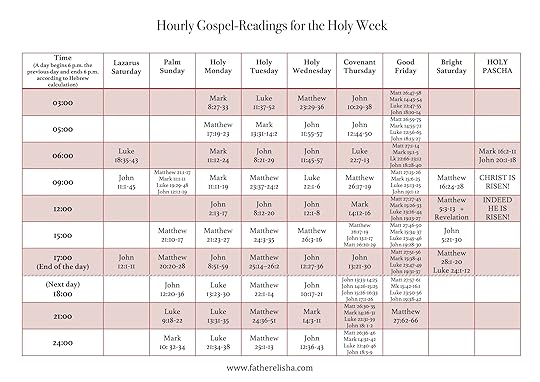 Concluding Holy Week Part 1
As you can see, Holy Week is the climax of the Divine Calendar. With this, I wish you a blessed journey into Jerusalem. Next time, we’ll complete the picture with the Resurrection, when all the world will cry: “Christ is Risen!”
Thank you for taking the time to read. It’s an honor to have journeyed together all the way up to Jerusalem.
Join the Journey Through the Seasons of Salvation
Join us on this weekly journey through the Seasons of Salvation as we walk in the footsteps of Jesus Christ through the key seasons of His life. Sign up below (in the footer) to receive this year’s Divine Calendar, which introduces the Seasons of Salvation and guides you on the journey ahead. As a welcome gift, you’ll also receive my young adult novel, The Legend of the Divine Calendar, delivered straight to your inbox.
Visit the Seasons of Salvation blog for insights into the coming week, posted every Saturday. We’d be honored to have you join us.
Save your Prayer Card on your Smartphone
Photo by Dimitri Kolpakov on Unsplash
The post Crucifixion 8 (Western & Eastern): Holy Week Part 1: Last Day of Lent — Bright Saturday 2025 first appeared on Father Elisha: Let me take you on an intriguing journey..
Crucifixion 8: Holy Week Part 1: Last Day of Lent — Bright Saturday (Western & Eastern 2025)
The Spiritual Mysteries of the Divine Calendar: April 13–19, 2025Welcome to Holy Week. Well done, good and faithful servant of the Lord. Let us begin by reading from Isaiah 62: “For Zion’s sake I will not hold My peace, and for Jerusalem’s sake I will not rest, […] And as the bridegroom rejoices over the bride, so shall your God rejoice over you” (Isaiah 62:1a, 5b [NKJV]).
The Orthodox churches call Monday through Wednesday of Holy Week the Bridegroom Days, and the icon of Christ the Bridegroom stands at the center of the church. Tradition considers Holy Week (Palm Sunday–Easter Sunday) as the journey into the bridal chamber. Jerusalem, the location of this week’s events, is also spiritually synonymous with the human spirit (or the heart)—the deepest and most sacred part of man.
We will see Jesus praised as King, rejected, betrayed as a criminal, crucified on the cross, placed in the tomb, and finally raised from the dead—all for the sake of His deep love for man, meaning you and me. Christ the Bridegroom will save His Bride, and not even death will get in His way. Therefore, Holy Week also bears the name Passion Week.
The desert worshipers said that the grace the Holy Spirit pour into our inner man during one week of Lent, we find in a single day of Holy Week. If we missed every opportunity to pray, read, and repent during the forty days of Lent, we can get all that we missed during this week. The Holy Week is the climax and absolute highlight of the Divine Calendar, ending with the Feast of Feast: The Resurrection of our Lord Jesus Christ (Easter/Pascha). We will talk about Easter and introduce the next Season of Salvation, the Season of Resurrection, in next week’s post when we are just one day away from this glorious Feast.
The Key to Holy WeekLike the Wilderness was the key to enter the spiritual atmosphere of Lent, so Jerusalem is the key to enter the rich atmosphere of Holy Week.
“Now it came to pass, when the time had come for Him to be received up, that He steadfastly set His face to go to Jerusalem” (Luke 9:51).
The Greek word prosopon translated “face” also means “person” and “presence.” Jesus directed His heart toward Jerusalem, and nothing could stop His steadfast determination. Therefore, in Jerusalem, we find a deep relationship with the heart of Jesus. The key to enter the spiritual atmosphere of Holy Week is the mystery of seeking deep communion with the heart of Jesus Christ.
In Jerusalem, we see Jesus in His humility and firmness, in His humanity and divinity, and in His passion for His Bride. In Jerusalem, Jesus will both be a Lamb and a King, therefore Jesus directs His heart toward Jerusalem—let us do the same. “Yet I have chosen Jerusalem, that My name may be there…” (2 Chron. 6:6) “For he who touches you [Zion/Jerusalem] touches the apple of His eye” (Zech. 2:8b).
Overview of Holy Week
The Spiritual Fathers of the church sometimes refers to Great Lent as a journey into the spiritual Holy Place, while Holy Week leads us into the Holy of Holies because of Jesus’ sacrifice. “Therefore, brethren, having boldness to enter the Holiest by the blood of Jesus, by a new and living way which He consecrated for us, through the veil, that is, His flesh” (Heb. 10:19–20).
Some churches include Holy Week in the forty fasting days of Lent, while others fast Holy Week in addition to the forty days.
Transition days from the Wilderness to Jerusalem:
Friday before Palm Sunday (often the fortieth fasting day)Lazarus SaturdayHoly Week / Passion Week / Easter Week:
Palm SundayHoly Monday (Day 1 of the Bridegroom)Holy Tuesday (Day 2 of the Bridegroom)Holy Wednesday (Day 3 of the Bridegroom)Covenant ThursdayGood FridayBright SaturdayEaster / Holy Pascha / Resurrection Sunday (next week’s post)The goal of these days is walking with Jesus, hour by hour, and minister to our beloved Savior as He gets ready to sacrifice Himself to save us and seal our eternity with Him. “Father, I desire that they also whom You gave Me may be with Me where I am, that they may behold My glory which You have given Me” (John 17:24). Like we said, every day of this week is full of grace, and everything Jesus went through was for our salvation and sanctification, that we may become more like Him. “And of His fullness we have all received, and grace for grace” (John 1:16).
At the end of this post, you’ll find a card with the Hourly Gospel Readings for this week. You may want to download it as your roadmap through the streets of Jerusalem during Holy Week.
On a practical note for those who would like to fast:
Most traditional churches continue the fasting pattern of Great Lent all the way to Easter Sunday. On Lazarus Saturday, Palm Sunday (Feast day), and Covenant Thursday (Feast day), they usually have all the meals, but keep a vegan diet. Many believers also increased their prayers and Bible reading this week. It is an old tradition to read the entire New Testament during Holy Week. To protect ourselves from the trap of pushing to impress our ego, others, or even God, it might be helpful to review: How do I fast during Great Lent?
Photo by Wesley Tingey on Unsplash
Friday before Palm SundayAs we mentioned last week, it’s encouraging to know that the Eastern Church includes a service with a prayer for healing called the Sacrament of Holy Unction, either on the Friday before Palm Sunday or the evening of Holy Wednesday.
During the forty days of Lent, we may have battled the temptations and weaknesses of the old man, but especially on this Friday, the Holy Spirit wants to heal the wounds from the struggles in the wilderness.
The grace of healing that the Holy Spirit wants to minister this Friday not only heals the part of our inner man God is focusing on restoring this year, but the grace of the Unction also sets us apart and prepares us to go deeper with Jesus throughout Holy Week. The Holy Spirit’s goal is complete redemption of this specific part of our soul through His death and resurrection. This Unction puts a seal on the work He did in us during Lent to protect it until it reaches completion.
Let us pray this Friday (or Holy Wednesday) that we receive this healing from the Holy Spirit, and that it sets us apart and illumines our path, so we’re ready to walk with Jesus into Jerusalem.
Lazarus Saturday
During the last two Sundays of Lent, we sought the Holy Spirit to understand the depth of our old man, which tries to bury the grace of the Incarnation we received during the Feast of the Nativity (Christmas). This Saturday shows the most dramatic demonstration of Jesus being “the resurrection and the life” (John 11:25) by raising a man from the dead who was already decomposing, for there was “a stench, for he has been dead four days” (John 11:39).
Before Holy Week begins, the Holy Spirit, through the Divine Calendar, wants to assure us that even if sin paralyzed our inner life for thirty-eight years (John 5:1–18) or blinded us all our life (John 9)—and even if it reeks of death—Jesus will still cry “with a loud voice, ‘Lazarus, come forth!’ And he who had died came out…” (John 11:43b–44a). Jesus called Lazarus out of the tomb about six months before Jesus entered Jerusalem on Palm Sunday.
Six months after Jesus called Lazarus to life, during this very Saturday before Palm Sunday, we read: “Then, six days before the Passover, Jesus came to Bethany, where Lazarus was who had been dead, whom He had raised from the dead. There they made Him a supper; and Martha served, but Lazarus was one of those who sat at the table with Him” (John 12:1–2).
As Jesus was about to enter Jerusalem, He sought anyone who truly understood His heart. Most of the people believed the Messiah would overthrow the Roman occupant and establish the Kingdom of Israel, yet this won’t happen until He defeats Antichrist’s army that will surround Jerusalem at His Second Coming (Rev. 19:19–21). Was there anyone who understood that Jesus would first overthrow the occupant of sin and death in the human heart? Was there anyone present who would give the right response to what He was about to do for us? Jesus didn’t seek palm leaves, but…
“Then Mary took a pound of very costly oil of spikenard, anointed the feet of Jesus, and wiped His feet with her hair. And the house was filled with the fragrance of the oil […] But Jesus said, ‘Let her alone; she has kept this for the day of My burial. For the poor you have with you always, but Me you do not have always’” (John 12:3, 7–8).
Are we able to understand the heart of Jesus before He enters Jerusalem? Do we hear His invitation to go deep into His heart during Holy Week and truly know Him? Mary, even though she couldn’t know all that was about to happen, still understood the movement in the heart of Jesus this Saturday. Let us pray today that we understand Jesus’ heart for what He is about to accomplish and His heart toward us in this season of our lives.
Palm Sunday
Our journey through Holy Week continues, and we read from John 12:12–13: “The next day a great multitude that had come to the feast, when they heard that Jesus was coming to Jerusalem, took branches of palm trees and went out to meet Him, and cried out: ‘Hosanna! Blessed is He who comes in the name of the Lord! The King of Israel!’”
As Jesus drew near the city, He wept over Jerusalem (Luke 19:42–44), and as we know, Jesus entered Jerusalem on a donkey in a royal procession. (We will talk more about this point at the end when we summarize a spiritual lesson of Holy Week.)
After the triumphal entry, Jesus entered the temple (the heart of Jerusalem) and observed how it had become a den of thieves. He is burdened because Jerusalem has become the city that murdered the prophets. “O Jerusalem, Jerusalem, the one who kills the prophets and stones those who are sent to her!” (Matt. 23:37) The city was no longer how the praises and songs described it, and Jerusalem had lost its purpose in God’s great salvation plan. Jesus wept over the city that the song praised: “Out of Zion, the perfection of beauty, God will shine forth.” (Ps. 50:2)
His day ended with departing for Bethany to spend the night. Jesus found comfort in Bethany, so He used to lodge there. Perhaps Mary’s expression of love by anointing His feet with the spikenard (John 12:3) attracted Him to seek comfort where they understood Him?
Let us pray for the grace to receive Jesus more deeply into our lives and that we may understand what He desires to find within us. May we offer our hearts to Jesus.
Holy Monday
As Holy Week continues, we will now gain the most benefit from following the Hourly Readings at the bottom of this post. Below are short overviews of each day’s events.
“Now in the morning, as He returned to the city, He was hungry. And seeing a fig tree by the road, He came to it and found nothing on it but leaves, and said to it, ‘Let no fruit grow on you ever again.’ Immediately the fig tree withered away” (Matt. 21:18–19).
Jesus left Bethany, and as He approached Jerusalem, He cursed the fig tree. Then Jesus entered the temple and cleansed it from thieves and chased out those who made business in the temple. After this, He returned to Bethany for the night.
As Jesus entered the inner Jerusalem of our hearts on Palm Sunday (Isa. 57:15; Matt. 5:35; John 14:23), in what condition will He find it? Jesus is zealous for our heart’s consecration, and He will clear out the impurities that don’t belong there. “Or do you not know that your body is the temple of the Holy Spirit who is in you, whom you have from God, and you are not your own? For you were bought at a price; therefore glorify God in your body and in your spirit, which are God’s” (1 Cor. 6:19–20). “Therefore, having these promises, beloved, let us cleanse ourselves from all filthiness of the flesh and spirit, perfecting holiness in the fear of God” (2 Cor. 7:1).
Today, we can pray for the grace to complete the cleansing of our hearts.
Holy Tuesday
Tuesday of Holy Week was a day of teaching parables from morning till evening. The day began with the disciples seeing the withered fig tree on their way to Jerusalem.
“And when the disciples saw it, they marveled, saying, ‘How did the fig tree wither away so soon?’ So Jesus answered and said to them, ‘Assuredly, I say to you, if you have faith and do not doubt, you will not only do what was done to the fig tree, but also if you say to this mountain, ‘Be removed and be cast into the sea,’ it will be done. And whatever things you ask in prayer, believing, you will receive” (Matt. 21:20–22).
Jesus taught the disciples about faith. Then He taught the parable of the vineyard and vinedressers, and the parable of the wedding feast.
May our hearts be open today to listen to what the Lord wants to teach us. May our faith not waver in what He can accomplish so that we’re “conformed to the image of His Son, that He might be the firstborn among many brethren” (Rom. 8:29). After our hearts were cleansed yesterday, let us pray for teachable spirits.
Holy Wednesday
On Wednesday of Holy Week, Jesus retreated to Bethany for the day. The Gospels are silent about this day, but Jesus made Himself ready for the cross, just as the Israelites kept the Passover lamb five days before they slaughtered it. “Speak to all the congregation of Israel, saying: ‘On the tenth of this month every man shall take for himself a lamb, according to the house of his father, a lamb for a household […] Now you shall keep it until the fourteenth day of the same month. Then the whole assembly of the congregation of Israel shall kill it at twilight” (Ex. 12:1–3, 6).
Jesus stayed in Bethany before He offered Himself as a sacrifice before the Father, and before He would offer Himself to the disciples the next day at the Last Supper at the institution of the Holy Eucharist. The day after that, He would offer Himself on the cross. Therefore, Jesus remained withdrawn.
Simultaneously, His enemies conspired against Him, and Judas planned to find a time to hand Jesus over to the guard.
If we’re able, let us withdraw and have some quiet time, praying that we may be ready for the upcoming death and resurrection in Christ. “That I may know Him and the power of His resurrection, and the fellowship of His sufferings, being conformed to His death, if, by any means, I may attain to the resurrection from the dead” (Phil. 3: 10–11).
Covenant Thursday
“So the disciples did as Jesus had directed them; and they prepared the Passover. When evening had come, He sat down with the twelve. Now as they were eating, He said, ‘Assuredly, I say to you, one of you will betray Me’” (Matt. 26:19–21).
On Thursday of Holy Week, Jesus celebrated the Jewish Passover with His disciples, washed their feet, and went to the Upper Room and instituted the Lord’s Supper. He stayed with them and taught about the Holy Spirit, as recorded in chapters 13–16 of the Gospel of John (note that the Upper Room is where the Holy Spirit later descended upon the disciples during Pentecost).
Jesus came down from the Upper Room around midnight and led the disciples toward the temple. Herod had made a monument of a vine in front of the temple as a symbol of the Jewish nation in order to please the Jews. Jesus went up to the vine and told His disciples: “I am the vine, you are the branches…” (John 15:5).
Church tradition says that Jesus entered the temple that midnight and prayed a common Jewish prayer on the Passover Eve. Then Jesus prayed His famous intercessory prayer recorded in John 17.
But earlier this day, “Jesus took bread, blessed and broke it, and gave it to the disciples and said, ‘Take, eat; this is My body.’ Then He took the cup, and gave thanks, and gave it to them, saying, ‘Drink from it, all of you. For this is My blood of the new covenant, which is shed for many for the remission of sins’” (Matt. 26:26–28). “He who eats My flesh and drinks My blood abides in Me, and I in him” (John 6:56).
We can summarize Thursday of Holy Week in one word: Abide. Let this be the focus of our prayer, “for if we have been united together in the likeness of His death, certainly we also shall be in the likeness of His resurrection” (Rom. 6:5).
This may also be a fitting day to watch The Passion Of The Christ.
Good Friday
Since the new Hebrew day begins at sundown (around 6 p.m.), it was Friday of Holy Week when “Jesus came with [His disciples] to a place called Gethsemane, and said to the disciples, ‘Sit here while I go and pray over there’” (Matt. 26:36).
Here, Jesus prayed and interceded until two or three in the morning, and “His sweat became like great drops of blood falling down to the ground” (Luke 22:44). The disciples kept falling asleep and Jesus woke them up. He prayed: “Father, if it is Your will, take this cup away from Me; nevertheless not My will, but Yours, be done” (Luke 22: 42).
In the early morning, Judas came with the soldiers to arrest Him. Around four or five a.m., Jesus went to the first trial (the religious trial), in the house of the high priest, Caiaphas. At eight o’clock, they brought Jesus into the civil trial in front of Herod and Pilate where He was condemned to death by crucifixion.
The Romans crucified Jesus at noon. Three hours later, three in the afternoon, “He said, ‘Father, into Your hands I commit My spirit.’ Having said this, He breathed His last” (Luke 23:46). Notice that Jesus didn’t permit death to stop His heartbeat until He allowed death to come. Jesus committed His spirit into the hands of His Father and died. Death never had any authority over Jesus, and it couldn’t take His soul to Hades before He allowed death to take Him there. Jesus is sovereign, also over the moment of His own death. “No one takes it from Me, but I lay it down of Myself. I have power to lay it down, and I have power to take it again. This command I have received from My Father” (John 10:18).
At sunset, Jesus’ closest friends, that remained by the cross, took Him down and buried Him at the twelfth hour, six in the afternoon.
“It is finished!” (John 19:30)
“For if we have been united together in the likeness of His death, certainly we also shall be in the likeness of His resurrection, knowing this, that our old man was crucified with Him, that the body of sin might be done away with, that we should no longer be slaves of sin. For he who has died has been freed from sin. Now if we died with Christ, we believe that we shall also live with Him, knowing that Christ, having been raised from the dead, dies no more. Death no longer has dominion over Him. For the death that He died, He died to sin once for all; but the life that He lives, He lives to God. Likewise you also, reckon yourselves to be dead indeed to sin, but alive to God in Christ Jesus our Lord” (Rom. 6:5–11).
The grace of crucifixion reaches its climax this day. Our main battle during the past weeks of the Overlapping period and Great Lent in this specific area of our lives has now reached its completion. Let us kneel before our Savior who defeated the old man in us—including the area that tried to hinder the grace of Incarnation we received during Christmas. (Even though other facets of this battle last until the end of this year’s Divine Calendar, we have received our victory today.)
Bright Saturday
In eastern theology, the resurrection of Christ begins straight after His death on the cross. On Bright Saturday of Holy Week, we celebrate that Jesus went down into Hades and brought Adam and Eve, and all their descendants who awaited the Messiah, up from Hades and back into Paradise.
“For Christ also suffered once for sins, the just for the unjust, that He might bring us to God, being put to death in the flesh but made alive by the Spirit, by whom also He went and preached to the spirits in prison” (1 Pet. 3:18–19).
“Then they cried out to the Lord in their trouble, and He saved them out of their distresses. He brought them out of darkness and the shadow of death, and broke their chains in pieces. […] For He has broken the gates of bronze, and cut the bars of iron in two” (Ps. 107:13–14, 16).
“And Jesus said to him, ‘Assuredly, I say to you, today you will be with Me in Paradise’” (Luke 23:43).
Bright Saturday is the time of the unseen resurrection. “And Jesus cried out again with a loud voice, and yielded up His spirit. Then, behold, the veil of the temple was torn in two from top to bottom; and the earth quaked, and the rocks were split, and the graves were opened; and many bodies of the saints who had fallen asleep were raised; and coming out of the graves after His resurrection, they went into the holy city and appeared to many” (Matt. 27:50–53).
The church traditionally reads the Book of Revelation this day, because this book reveals to us Christ in His risen humanity and glory. In addition, the church reads all the praises of the people of God in the Bible, because Hades had finally lost its grip on them and led them home to Paradise: The Song of Moses, the Praise of Jonah, the Praise of Zachariah the Priest, and so on.
Then, finally, the highlight of Holy Week is the seen resurrection on Resurrection Sunday (Holy Pascha). The tomb is declared empty. Christ is risen from the dead, and for the next forty days, the believers greet one another with “Christ is Risen!” and “Indeed, He is Risen!”
“Christos Anesti!”
“Alithos Anesti!”
A Message for Holy Week
We began Holy Week by entering Jerusalem, and it ends with departing from Jerusalem. “Therefore Jesus also, that He might sanctify the people with His own blood, suffered outside the gate” (Heb. 13:12).
Jesus entered as a King and came out as the Crucified One.
He entered as a King amidst praises, and He came out as the Crucified One, bearing the shame. Jesus entered as a King and came out carrying the wood of the cross.
It might be easy for us to fulfill the will of God when people praise us, but what when people curse us? Are we willing to be identified with Jesus in shame?
When He entered as a King, He fixed His eyes on His eternal purpose and not on the people praising Him. What was Jesus’ main purpose when He entered Jerusalem? The Cross. This was the will of His Father and the Son wanted to please Him. “And He who sent Me is with Me. The Father has not left Me alone, for I always do those things that please Him” (John 8:29).
Because Jesus carried the cross to please the Father, He did it with pleasure. “If it is Your will, take this cup away from Me; nevertheless not My will, but Yours, be done” (Luke 22:42). “For the joy that was set before Him endured the cross, despising the shame…” (Heb. 12:2)
Jesus had an eternal purpose set before Him and all the cheering did not influence Him. He knew He had to ascend the Cross to please His Father. This is what we need to learn from the Cross: Knowing the purpose so that we fulfill it and never deviating when circumstances change.
We can quickly lose our purpose because the voice of the world easily captivates our hearts. One may have a purpose to walk sincerely with the Lord. But soon we might face something similar to the cheering crowds on a smaller level. It may captivate our heart. Then we might reason that these two things do not contradict and we can have them both. Yet, after some time, we discover we have lost Christ and we’re left with the cheering crowds.
Then, after some more time, we even lose the cheering crowds. We eventually lose both. This is the temptation of the fallen city of Jerusalem. If we set before our eyes the goal of being a pleasure to the Father, the devil will always try to push us away through the temptations of the world: people, crowds, cheering, honor, deceit, confusion, and so on.
But the heart bound to the pleasure of the Father and the cross does not deviate from its purpose.
This is the purpose of Holy Week: Jesus looks at our hearts, desiring to reign. His pleasure is in our hearts. Christ draws nearer, step-by-step, desiring to enter our inner Jerusalem. He may be in our life, but He desires to be the King of our inner Jerusalem. He draws near us, saying: “Would you let Me reign over your heart?”
Hourly Readings for Holy Week
If you have signed up for the weekly inspirations (see footer below), you can download the Divine Calendar for this year. On page 13, you see the Hourly Readings for Holy Week.
These readings follow a chronological and mystical order of the events, and, for the most part, are assigned to the hour of the event itself. The readings are short and help us follow Jesus in His footsteps through His Passion. You have already read about what happens each day, but these readings allow the Holy Spirit to connect you with the Lord and bring you into the spiritual atmosphere of these events.
Used for centuries, these readings are a rich source of grace, helping us to be ready for the Crucifixion on Good Friday and the Resurrection on Holy Pascha (Easter). Please feel free to save the card below to your phone, and read, pray, and meditate on them as you journey in and out of Jerusalem with Jesus during Holy Week.
As you can see, Holy Week is the climax of the Divine Calendar. With this, I wish you a blessed journey into Jerusalem. Next time, we’ll complete the picture with the Resurrection, when all the world will cry: “Christ is Risen!”
Thank you for taking the time to read. It’s an honor to have journeyed together all the way up to Jerusalem.
Join the Journey Through the Seasons of Salvation
Join us on this journey through the Seasons of Salvation as we walk in the footsteps of Jesus Christ through the seasons of His life. Sign up below (in the footer) to receive insights into the Divine Calendar and be the first to know about new updates. We’d be honored to have you with us.
Save your Prayer Card on your Smartphone
Photo by Dimitri Kolpakov on Unsplash
The post Crucifixion 8: Holy Week Part 1: Last Day of Lent — Bright Saturday (Western & Eastern 2025) first appeared on Father Elisha: Let me take you on an intriguing journey..
April 4, 2025
Crucifixion 7: Fifth Sunday of Great Lent — Saint Mary of Egypt (Eastern 2025)
April 6–12
Sunday Gospel: Mark 10:32–45 (NKJV)
32 Now they were on the road, going up to Jerusalem, and Jesus was going before them; and they were amazed. And as they followed they were afraid. Then He took the twelve aside again and began to tell them the things that would happen to Him: 33 “Behold, we are going up to Jerusalem, and the Son of Man will be betrayed to the chief priests and to the scribes; and they will condemn Him to death and deliver Him to the Gentiles; 34 and they will mock Him, and scourge Him, and spit on Him, and kill Him. And the third day He will rise again.”
35 Then James and John, the sons of Zebedee, came to Him, saying, “Teacher, we want You to do for us whatever we ask.” 36 And He said to them, “What do you want Me to do for you?” 37 They said to Him, “Grant us that we may sit, one on Your right hand and the other on Your left, in Your glory.” 38 But Jesus said to them, “You do not know what you ask. Are you able to drink the cup that I drink, and be baptized with the baptism that I am baptized with?” 39 They said to Him, “We are able.”
So Jesus said to them, “You will indeed drink the cup that I drink, and with the baptism I am baptized with you will be baptized; 40 but to sit on My right hand and on My left is not Mine to give, but it is for those for whom it is prepared.”
41 And when the ten heard it, they began to be greatly displeased with James and John. 42 But Jesus called them to Himself and said to them, “You know that those who are considered rulers over the Gentiles lord it over them, and their great ones exercise authority over them. 43 Yet it shall not be so among you; but whoever desires to become great among you shall be your servant. 44 And whoever of you desires to be first shall be slave of all. 45 For even the Son of Man did not come to be served, but to serve, and to give His life a ransom for many.”
Sunday of Saint Mary of Egypt
The Sunday Gospels from the Adoration of the Cross (halfway through Great Lent) until the end of the fast directs us toward the cross.
In this Sunday Gospel we see James and John ask Jesus: “Grant us that we may sit, one on Your right hand and the other on Your left, in Your glory” (verse 37). They asked to sit on either side of Jesus, because they thought He would liberate Israel from the Roman occupant and establish the earthly kingdom of Israel. They sought an influential position in Christ’s reign over the earthly Israel.
But Jesus had been teaching humility, self-denial, and servanthood as true leadership. “And whoever exalts himself will be humbled, and he who humbles himself will be exalted” (Matt. 23:12).
In verses 43–45, we read: “Yet it shall not be so among you; but whoever desires to become great among you shall be your servant. And whoever of you desires to be first shall be slave of all. For even the Son of Man did not come to be served, but to serve, and to give His life a ransom for many.”
At the end of Jesus’ life, He faced two types of spiritual battle simultaneously. An external from the Pharisees and the Scribes who mobilized hostility against Him, and internally from the circle of His disciples. The enemy wants to destroy those who follow their call, both from the inside and outside. But the path of carrying the cross strengthens us to face both types of spiritual warfare.
This last Sunday of Lent before Palm Sunday is dedicated to Saint Mary of Egypt, and she shows us how to confront these spiritual battles. God led Saint Mary into the wilderness, even though she had no previous experience of life out there, yet she remained steadfast. She followed the path of the cross. What can we learn from her example?
The Complete Freedom in the Cross
Saint Mary led a deeply immoral life in the early years of her life. But one day, at the Feast of the Exultation of the Holy Cross (September), she approached the entrance of a church in Jerusalem. An invisible power kept her from entering, and she knew it was because of her sinful life. In her desperation, she went to a statue of the Virgin Mary, and she promised the Virgin if she could enter the church, she would renounce her old life.
This time, she was able to enter the church, and she bowed before the cross, repented, and left as a different person, free from sin and the spirit of the world. Saint Mary understood she had to enter the wilderness, and off she went, even though she didn’t know what to do. But her repentance was phenomenally sincere. Saint Mary of Egypt stayed true to her word and didn’t waver.
The cross grants total liberty and freedom from sin and the spirit of the world, but often we don’t receive this complete liberty. “But God forbid that I should boast except in the cross of our Lord Jesus Christ, by whom the world has been crucified to me, and I to the world” (Gal. 6:14). If Saint Mary didn’t receive this full freedom from the spirit of the world, she could never go to the wilderness and stay there more than one night. It shows that the power of a single encounter with the cross was enough the send Sant Mary into her new lifestyle in the wilderness for decades until her death.
The Heart of a Lion
Saint Mary of Egypt persevered in her call, even being in a harsh environment of cold, heat, no food or water, and the wild beasts. The enemy’s warfare aims to break our hearts and our steadfast faith, but if we endure, our hearts will grow stronger and broader until they become like the heart of a lion. “And even he who is valiant, whose heart is like the heart of a lion, will melt completely. For all Israel knows that your father is a mighty man, and those who are with him are valiant men” (2 Sam. 17:10).
When we face the warfare from the enemy, we might feel we’re melting in fear, but if we lift our hearts to God, the Holy Spirit pours new trust in Him that flushes out the fear. Either we look at ourselves and down to the Earth, or up to God and toward the help from the heavenly realm. If we look to God, He strengthens our hearts through these battles. We form a special relationship with God through these battles, and we see ourselves and God differently. We become men and women of God, living on the Earth, knowing that God works with us.
This shift of our heart’s direction from the earthly to the heavenly is not on the intellectual level, because it is faith that inspires our actions, often contrary to what our circumstances naturally would make us do. Saint Mary kept her eyes on the face of Jesus and the cross, and this was her secret to dwell in the wilderness. God strengthened her heart more and more until her heart became the heart of a lion.
Great Lent: A Season of Unfolding our Personal Calling
Throughout Great Lent, we have looked at how the Early Fathers viewed this fast as a season of victory, love, spiritual education and training, spiritual storing, and on this last Sunday of Great Lent, we will look at how the grace of Lent helps us unfold our personal calling.
When Jesus was baptized in the Jordan River, He received the anointing for His calling as the Messiah. But coming out of the wilderness, the power of the Spirit filled Jesus for His mission. Between receiving the anointing and being filled with the power of the Spirit, Jesus fasted in the wilderness. During His fast, His Heavenly Father taught Him the details about His calling and everything He would accomplish as the Messiah.
“Then Jesus returned in the power of the Spirit to Galilee, and news of Him went out through all the surrounding region. And He taught in their synagogues, being glorified by all” (Luke 4:14–15). Jesus began His public ministry just after He left the wilderness.
Great Lent is the season of unfolding God’s calling for us personally (while the Season of Pentecost makes us move into this call), and each year the Holy Spirit increasingly confirms and further reveals our calling.
There is a general call for the entire Body of Christ, such as the Two Great Commandments: “The first of all the commandments is: ‘Hear, O Israel, the Lord our God, the Lord is one. And you shall love the Lord your God with all your heart, with all your soul, with all your mind, and with all your strength.’ This is the first commandment. And the second, like it, is this: ‘You shall love your neighbor as yourself’” (Mark 12:29–31).
Another example is the Great Commission: “Go therefore and make disciples of all the nations, baptizing them in the name of the Father and of the Son and of the Holy Spirit, teaching them to observe all things that I have commanded you; and lo, I am with you always, even to the end of the age” (Matt. 28:19–20).
But God also has a specific task and role for all His children in His Kingdom; a personal calling which is extremely diverse and different from person to person. “Do not neglect the gift that is in you, which was given to you by prophecy with the laying on of the hands of the eldership” (1 Tim. 4:14). “Also I heard the voice of the Lord, saying: ‘Whom shall I send, and who will go for Us?’ Then I said, ‘Here am I! Send me’” (Isa. 6:8). “Peter, seeing him [the disciple John], said to Jesus, ‘But Lord, what about this man?’ Jesus said to him, ‘If I will that he remain till I come, what is that to you? You follow Me’” (John 21:21–22).
This fast contains many mysteries for our spiritual life, and perhaps the greatest one is our call as a Bride preparing herself to be united with her Bridegroom. “That He might sanctify and cleanse her with the washing of water by the word, that He might present her to Himself a glorious church, not having spot or wrinkle or any such thing, but that she should be holy and without blemish” (Eph. 5:26–27).
Driven by bridal love, the Bride knows how to find Jesus in the wilderness and fight a victorious battle against the devil. The Early Fathers would call Great Lent a season of sweet striving.
“Who is this coming out of the wilderness like pillars of smoke, perfumed with myrrh and frankincense, with all the merchant’s fragrant powders? Behold, it is Solomon’s couch, with sixty valiant men around it, of the valiant of Israel. They all hold swords, being expert in war. Every man has his sword on his thigh because of fear in the night” (Song of Solomon 3:6–8). “Who is this coming up from the wilderness, leaning upon her beloved?” (Song of Solomon 8:5a)
As Jesus received the specifics and power of the Spirit to start His public ministry directly after His forty-day fast, may the Holy Spirit strengthen us and unveil our individual roles in the Kingdom of God in this Season of Crucifixion.
We’re about to enter Holy Week, and the next post will guide us through these upcoming days into the Holy of Holies until we reach the Feast of Feasts, the glorious Holy Pascha. Make sure you don’t miss next week’s post, as it contains a roadmap with Hourly Readings through the events in Jerusalem, following Jesus in His Passion.
Thank you for taking the time to read and follow Christ in the wilderness of Great Lent. Let us pray for the grace to fully complete this year’s journey by looking toward God as Saint Mary did, and for the confirmation and unfolding of our personal calling.
It’s my honor to travel on this journey with you.
If helpful, you can review: How do I fast during Great Lent?
Save your Prayer Card on your Smartphone
Photo by Rita on Unsplash
The post Crucifixion 7: Fifth Sunday of Great Lent — Saint Mary of Egypt (Eastern 2025) first appeared on Father Elisha: Let me take you on an intriguing journey..
Crucifixion 7: Lent — Sunday of the Blind Man (Western 2025)
April 6–12
Healing at the End of Lent
We have walked with Jesus in the wilderness for five weeks (after one week of preparation), and we’re entering the last week of the fast. Friday will be the fortieth and last day of Great Lent. The following Lazarus Saturday and Palm Sunday lead us into the Holy Week, the week of Easter, the climax of the Divine Calendar. Holy Week is crowned with the Feast of Feasts, The Resurrection of Jesus, which sends us into the Season of Resurrection. We will cover Holy Week in the post published on that Friday, the last day of Lent.
The Eastern Churches include a service with prayer for healing called the Sacrament of Holy Unction, usually on Wednesday evening during Holy Week (some pray it on Friday, the last day of Lent). I mention it because as we move from the forty days of Lent and enter the last week of the Season of Crucifixion, the Holy Spirit wants to heal the wounds from the battle in the wilderness. This is comforting to know, as we move toward Jerusalem for the week of the Passion of Christ.
We have perhaps battled with temptations and sins that surfaced from our fallen human nature, tried to confess the deep roots of sin, and we might feel weary after forty days in the wild. But the Holy Spirit will minister healing to our souls during this upcoming transition. Let us keep this in our prayers as we move into the last week of Lent.
Highlights of Lent
The spiritual fathers of the church wrote much about the experience of fasting with Jesus during the forty days of Lent. Here follows some highlights taken from their spiritual wisdom and experience which summarize this fast.
The key to this season is the wilderness. For the Early Fathers and monastics, this was a literal experience of entering the wild, but the important spiritual effects of silence and seclusion we can receive in the city as well. The secluded quiet place, separated from the noise of the world, is the key that helps us enter the unique spiritual atmosphere of this season. In the spiritual wilderness, together with Jesus, we confess our temptations, strengthened by Him. Then we experience His victory from when He faced our battle, and He gives us His victory through the grace of the fast.This is the only fast in the Divine Calendar that Jesus Himself fasted. It’s our unique chance to encounter and get to know the fasting Jesus.Our repentance goes deep during this season because of the revelations from the Holy Spirit about the roots of our sins. When we experience revelatory repentance—different from normal repentance—the Holy Spirit works deep to crucify the fallen nature.Church fathers spoke about how Lent is an opportunity to return to the state of Paradise. As we grow in the experience of Christ’s victory over temptation and sin, we taste the freedom of the life in Eden. This is the sinless state. Even though our current fragile frame hinders us from remaining in this form, the Lent allows us to enter periods when grace fully sustains our body, soul, and spirit. We might taste the state of Paradise in brief moments, but the spiritual fathers of the church continued in this state for days.This Eden-state of overflowing grace makes us think about our physical death as a mere change of location because we entered the stream of eternal life. We feel whole, made complete. The Holy Spirit takes us even further into the presence of God, and the deep inner sadness in the human heart over losing paradise disappears. Then our hearts grow toward embracing all of creation.
The fathers of the church also describe Lent as the spring of our spiritual life. As we strive in the grace of God to restrict and put to death the fallen nature in our soul, the new life of the new man soon sprouts. In sweet fellowship with Jesus, we experience the renewal of our spiritual lives, just as spring prepares nature for summer.Church fathers refer to Lent as a spiritual storage. God has infinite grace available that He wants to give us in this season. Our ascetic efforts can’t compare to what God grants us through our weak attempts at increased prayer, fasting, and Bible reading. Like Joseph declared the need to store up grain for the upcoming years of drought in Egypt (Gen. 41:28–36), so we can store up spiritual blessing and grace that we will draw from throughout the entire year during periods of spiritual drought—without us even being aware of this happening.We can gain deeper understanding of our calling during this fast. Jesus received the anointing for His mission as the Messiah in His Baptism, but it was in the wilderness the Holy Spirit empowered Him (more under the last point), and The Father revealed details about His calling.Lent is a special opportunity to draw near to God the Father as we learn, through the Holy Spirit, about the prayers Jesus prayed to God, His Father, in the wilderness.Angels can minister to us while being in the wilderness (Matt. 4:11; Mark 1:13).This fast is a corporate and historical church fast that has a mystical and powerful impact on our world. We realign our lives with our brothers and sisters throughout history who fasted these weeks. This unified act within the global body of Christ awakens people’s consciences—people we may never know on this side of eternity. We might remember from the Book of Jonah how even an entire city repented and turned to God.And even though it might seem like the opposite is happening, this forty-day fast strengthens our spirits. Jesus entered the wilderness “being filled with the Holy Spirit” (Luke 4:1), but after His fast, Jesus “returned in the power of the Spirit to Galilee, and news of Him went out through all the surrounding region” (Luke 4:14). Like we said several weeks ago, only the Holy Spirit can lead us into the wilderness. And if we discern God’s purpose in leading us out there and we complete our repentance, we will come out of the wilderness with new spiritual strength and zeal. If we enter the mystery—the wilderness—of Lent, this fast catapults us into the Season of Resurrection. “And declared to be the Son of God with power according to the Spirit of holiness, by the resurrection from the dead” (Rom. 1:4).
Other Biblical Examples of the Wilderness
Jacob’s wilderness was his twenty years with Laban, awaiting the release of his bride. “I have been with you for twenty years now. Your sheep and goats have not miscarried, nor have I eaten rams from your flocks” (Gen. 31:38).
David’s wilderness lasted for seventeen years, including fleeing from his own son and engage in war against his own people.
Joseph’s wilderness continued for thirteen years (Gen. 37:2 & 41:46). He was a spoiled child, but spent many years in prison in Egypt. The wilderness can be cruel and tough, like a jail, and we can’t escape. But once we complete the needed inner change, we have fulfilled the ordained time in the unavoidable wilderness. Everyone is called to be changed. “For whom He foreknew, He also predestined to be conformed to the image of His Son….” (Rom. 8:29)
This can answer many of our questions. Our life is tough and sometimes it can look like as if God is not there. This is because God wants to lead us into the wilderness so that we might become different. Because of God’s love, He called us to become greater than what we are now—to be more like Jesus.
If we don’t want God, then He will leave us alone, but we will suffer more. The cause of this suffering is not from Him, but ourselves. The death inside and in the world creates our misery. But God became Man to give us His divine-human nature, and since we carry our old human nature, we need renewal sometimes—in the wilderness (we’ll talk more about how Christians still carry the old man).
A New Testament example of the wilderness we find in the Apostle Paul. After the Lord encountered Paul and transformed him profoundly, the Apostle didn’t preach right away. He also carried the old human nature that needed to be crucified. Similar to Moses, Apostle Paul spent about fourteen years in Arabia, Tarsus, and Damascus before being fully released into his calling.
Even the beloved disciple John, the only disciple by Jesus’ side during His crucifixion, spent years in exile on Patmos. The Apostle Paul (and the other apostles) spent much time in prisons. If the apostles spent much time in various wildernesses, we can be sure that we will encounter times when our Heavenly Father is passionate about restoring us.
In the wilderness, we face what’s buried deep within. We must not be afraid or think that God has left us. Apostle Paul’s own experience consoles us:
“I find then a law, that evil is present with me, the one who wills to do good. For I delight in the law of God according to the inward man. But I see another law in my members, warring against the law of my mind, and bringing me into captivity to the law of sin which is in my members. O wretched man that I am! Who will deliver me from this body of death? I thank God—through Jesus Christ our Lord! So then, with the mind I myself serve the law of God, but with the flesh the law of sin” (Rom. 7:21–25).
“For if you live according to the flesh you will die; but if by the Spirit you put to death the deeds of the body, you will live” (Rom. 8:13).
“Who shall separate us from the love of Christ? Shall tribulation, or distress, or persecution, or famine, or nakedness, or peril, or sword? As it is written: “For Your sake we are killed all day long; We are accounted as sheep for the slaughter.” Yet in all these things we are more than conquerors through Him who loved us. For I am persuaded that neither death nor life, nor angels nor principalities nor powers, nor things present nor things to come, nor height nor depth, nor any other created thing, shall be able to separate us from the love of God which is in Christ Jesus our Lord” (Rom. 8:35–39).
The Mindset to Finish Strong
Let us complete the journey through the wilderness with new understanding. Jesus’ baptism was the sign of the New Covenant—and so we also was baptized. Then we have to experience our own journeys of death and resurrection, which are the meaning of baptism. But Jesus did it first, and He is close to us. If we think we can conquer our fallen nature in our own might through our own ways, then the realization that we cannot will soon humble us. It is by the Spirit we put to death the deeds of the fallen flesh (Rom. 8:13).
In the wilderness, we realize how weak we are and how easily we’re defeated. But when we finish these battles, we rise with Christ’s power of resurrection.
“But what things were gain to me, these I have counted loss for Christ. Yet indeed I also count all things loss for the excellence of the knowledge of Christ Jesus my Lord, for whom I have suffered the loss of all things, and count them as rubbish, that I may gain Christ and be found in Him, not having my own righteousness, which is from the law, but that which is through faith in Christ, the righteousness which is from God by faith; that I may know Him and the power of His resurrection, and the fellowship of His sufferings, being conformed to His death, if, by any means, I may attain to the resurrection from the dead (Phil. 3:7–11).
Let us now turn to the Sunday Gospel.
Sunday Gospel: John 9:1–41 (NKJV)
Now as Jesus passed by, He saw a man who was blind from birth. 2 And His disciples asked Him, saying, “Rabbi, who sinned, this man or his parents, that he was born blind?” 3 Jesus answered, “Neither this man nor his parents sinned, but that the works of God should be revealed in him. 4 I must work the works of Him who sent Me while it is day; the night is coming when no one can work. 5 As long as I am in the world, I am the light of the world.”
6 When He had said these things, He spat on the ground and made clay with the saliva; and He anointed the eyes of the blind man with the clay. 7 And He said to him, “Go, wash in the pool of Siloam” (which is translated, Sent). So he went and washed, and came back seeing.
8 Therefore the neighbors and those who previously had seen that he was blind said, “Is not this he who sat and begged?” 9 Some said, “This is he.” Others said, “He is like him.” He said, “I am he.” 10 Therefore they said to him, “How were your eyes opened?” 11 He answered and said, “A Man called Jesus made clay and anointed my eyes and said to me, ‘Go to the pool of Siloam and wash.’ So I went and washed, and I received sight.” 12 Then they said to him, “Where is He?” He said, “I do not know.”
13 They brought him who formerly was blind to the Pharisees. 14 Now it was a Sabbath when Jesus made the clay and opened his eyes. 15 Then the Pharisees also asked him again how he had received his sight. He said to them, “He put clay on my eyes, and I washed, and I see.” 16 Therefore some of the Pharisees said, “This Man is not from God, because He does not keep the Sabbath.” Others said, “How can a man who is a sinner do such signs?” And there was a division among them.
17 They said to the blind man again, “What do you say about Him because He opened your eyes?” He said, “He is a prophet.” 18 But the Jews did not believe concerning him, that he had been blind and received his sight, until they called the parents of him who had received his sight. 19 And they asked them, saying, “Is this your son, who you say was born blind? How then does he now see?”
20 His parents answered them and said, “We know that this is our son, and that he was born blind; 21 but by what means he now sees we do not know, or who opened his eyes we do not know. He is of age; ask him. He will speak for himself.” 22 His parents said these things because they feared the Jews, for the Jews had agreed already that if anyone confessed that He was Christ, he would be put out of the synagogue. 23 Therefore his parents said, “He is of age; ask him.”
24 So they again called the man who was blind, and said to him, “Give God the glory! We know that this Man is a sinner.” 25 He answered and said, “Whether He is a sinner or not I do not know. One thing I know: that though I was blind, now I see.” 26 Then they said to him again, “What did He do to you? How did He open your eyes?” 27 He answered them, “I told you already, and you did not listen. Why do you want to hear it again? Do you also want to become His disciples?”
28 Then they reviled him and said, “You are His disciple, but we are Moses’ disciples. 29 We know that God spoke to Moses; as for this fellow, we do not know where He is from.” 30 The man answered and said to them, “Why, this is a marvelous thing, that you do not know where He is from; yet He has opened my eyes! 31 Now we know that God does not hear sinners; but if anyone is a worshiper of God and does His will, He hears him. 32 Since the world began it has been unheard of that anyone opened the eyes of one who was born blind. 33 If this Man were not from God, He could do nothing.” 34 They answered and said to him, “You were completely born in sins, and are you teaching us?” And they cast him out.
35 Jesus heard that they had cast him out; and when He had found him, He said to him, “Do you believe in the Son of God?” 36 He answered and said, “Who is He, Lord, that I may believe in Him?” 37 And Jesus said to him, “You have both seen Him and it is He who is talking with you.” 38 Then he said, “Lord, I believe!” And he worshiped Him.
39 And Jesus said, “For judgment I have come into this world, that those who do not see may see, and that those who see may be made blind.” 40 Then some of the Pharisees who were with Him heard these words, and said to Him, “Are we blind also?” 41 Jesus said to them, “If you were blind, you would have no sin; but now you say, ‘We see.’ Therefore your sin remains.
Sunday of the Blind Man
The last Sunday Gospel of Lent before we enter Jerusalem is the Gospel of John, Chapter 9, about the healing of the man born blind. We continue the theme of last week, the Sunday of the Paralyzed Man, with discovering the deep layers of our fallen human nature. This will prepare us for Holy Week so that the crucifixion of Jesus may work deep in our soul. His cross of death is for us the cross of life.
“Then Jesus said to His disciples, ‘If anyone desires to come after Me, let him deny himself, and take up his cross, and follow Me. For whoever desires to save his life will lose it, but whoever loses his life for My sake will find it’” (Matt. 16:24–25).
With the foundation of what we said above concerning battling our old man in the wilderness, it’s important to remind ourselves that even though we talk about our fallen human nature warring against us, we are still Christians, eternally adopted by our Heavenly Father into His Kingdom. We are justified by the blood of Jesus.
Actually, if we didn’t struggle with our fallen nature—which is amplified during Lent—that would be a worrying sign. If we just live our lives as we please with no restraint, ignoring our conscience or perhaps not even hearing its voice anymore, then we are on our way out of the salvation of God.
“And in that day the Lord God of hosts called for weeping and for mourning, for baldness and for girding with sackcloth. But instead, joy and gladness, slaying oxen and killing sheep, eating meat and drinking wine: ‘Let us eat and drink, for tomorrow we die!’ Then it was revealed in my hearing by the Lord of hosts, ‘Surely for this iniquity there will be no atonement for you, even to your death,’ says the Lord God of hosts” (Isa. 22:12–14).
But if we recognize we have sin in our lives, even just “subtle” sins such as anger, jealousy, judging thoughts—or not loving God and other people more than ourselves—and even better, if we struggle against those, then we’re on the right path. “And the tax collector, standing afar off, would not so much as raise his eyes to heaven, but beat his breast, saying, ‘God, be merciful to me a sinner!’ I tell you, this man went down to his house justified rather than the other” (Luke 18:13–14a).
So, as we continue following Jesus’ acts of salvation in this series of the Seasons of Salvation, it is good to remind ourselves now and then about this biblical truth. Christians, until fully sanctified, suffer an identity crisis. We are fish swimming upstream. We have two human natures opposed to each other in our souls. The new man (life in the Spirit and Christ in us) versus the old man (life in the flesh). This struggle with the old human natures proves we are Christians, and we are saved by grace.
As Christians, our old man was crucified with Jesus. “Knowing this, that our old man was crucified with Him, that the body of sin might be done away with, that we should no longer be slaves of sin” (Rom. 6:6). Yet, there are still thrones of sin that reigns in our soul. “Therefore do not let sin reign in your mortal body, that you should obey it in its lusts” (Rom. 6:12). These strongholds of sin take time to put to death, but the Season of Salvation helps us tremendously in this process.
Contrition
One of the Holy Spirit’s goals during Lent is to gently unveil the darkness in our soul that tries to drown the grace of Incarnation we received at Christmas. God does everything to help us, especially by leading us into contrition. The contrite heart feels pain over the sins God revealed. A contrite heart is heartbroken just by the thought of sinning against God or hurting people.
“The sacrifices of God are a broken spirit, a broken and a contrite heart—these, O God, You will not despise” (Isa. 51:17).
Contrition leads to illumination, and the experience of being enlightened grows from year to year as we pass through Lent. This illumination, which creates a sense of shame (not condemnation) over the area of our lives we’re heartbroken about, is the beginning of our healing.
That We May See
This is the Sunday of the Blind Man. Without physical eyes, we cannot see. But we also have a set of eyes inside us that see spiritual truths. Therefore, an area in our soul needs light—the illumination from contrition—and opened inner eyes before we can do anything.
We need light and internal spiritual sight from the grace of God. How can we get this? It is the grace of Lent that open our inner eyes. When God creates these inner eyes in an area of our soul, we have a completely new eyesight. This sight will remain with us even until next year, to see even deeper. We see everything with these fresh eyes and live our life in a new light (mindset).
“Then their eyes were opened and they knew Him; and He vanished from their sight. And they said to one another, ‘Did not our heart burn within us while He talked with us on the road, and while He opened the Scriptures to us?’” (Luke 24:31–32) “And He opened their understanding, that they might comprehend the Scriptures” (Luke 24:45). “The eyes of your understanding being enlightened; that you may know what is the hope of His calling, what are the riches of the glory of His inheritance in the saints” (Eph. 1:18).
Our contrition attracts the Holy Spirit who gives understanding, and Jesus gives His healing touch, opening our inner eyes. Now, we see God, others, and ourselves with fresh eyes. This healing touch of Jesus gives us a different perspective from an elevated angle. Then we joyfully say that we must work the works of Him who sent us.
Verses 4 and 5 of the Sunday Gospel says: “I must work the works of Him who sent Me while it is day; the night is coming when no one can work. As long as I am in the world, I am the light of the world.” If we continue to cling to Jesus, He will enlighten our inner eyes more and more, renewing our mindset.
“And be renewed in the spirit of your mind, and that you put on the new man which was created according to God, in true righteousness and holiness” (Eph. 4:23–24).
The main purpose of illumination is to see God differently. The man who was born blind had never seen Jesus, but he recognized Him later and knew He was the Incarnated God of Israel. So the blind man worshipped him.
We read in verses 35–38: “Jesus heard that they had cast him out; and when He had found him, He said to him, ‘Do you believe in the Son of God?’ He answered and said, ‘Who is He, Lord, that I may believe in Him?’ And Jesus said to him, ‘You have both seen Him and it is He who is talking with you.’ Then he said, ‘Lord, I believe!’ And he worshiped Him.”
Lastly, verse 39 says: “For judgment I have come into this world, that those who do not see may see, and that those who see may be made blind.” Jesus says that those who don’t want to confess that they can’t see will remain spiritually blind. We depend upon the touch of Jesus to enlighten our darkness.
“For You will light my lamp; The LORD my God will enlighten my darkness” (Ps. 18:28).
Once this darkened area of our soul receives this new illumination and vision from Jesus, this part immediately belongs to Him and no more to our old man. “I will no longer talk much with you, for the ruler of this world is coming, and he has nothing in Me” (John 14:30).
The grace of Jesus’ fast will finally defeat our fallen human nature.
Let us pray for the grace this week to receive the healing touch of Jesus for the opening of our inner eyes to see our life in truth. With our inner blindness healed, we walk in righteousness and holiness. “I am the light of the world. He who follows Me shall not walk in darkness, but have the light of life” (John 8:12).
Thank you for taking all this time to read. May God bless your last expedition in the wilderness. It is my joy to be out there together with you.
If helpful, you can review: How do I fast during Great Lent?
Save your Prayer Card on your Smartphone
Photo by Dmitry Ant on Unsplash
The post Crucifixion 7: Lent — Sunday of the Blind Man (Western 2025) first appeared on Father Elisha: Let me take you on an intriguing journey..
March 28, 2025
March 30 – April 5, 2025 (Eastern): Fourth Sunday of Great Lent: Saint John Climacus of the Ladder
Crucifixion Week 6
Sunday Gospel: Mark 9:17–31 (NKJV)
Then one of the crowd answered and said, “Teacher, I brought You my son, who has a mute spirit. 18 And wherever it seizes him, it throws him down; he foams at the mouth, gnashes his teeth, and becomes rigid. So I spoke to Your disciples, that they should cast it out, but they could not.”
19 He answered him and said, “O faithless generation, how long shall I be with you? How long shall I bear with you? Bring him to Me.” 20 Then they brought him to Him. And when he saw Him, immediately the spirit convulsed him, and he fell on the ground and wallowed, foaming at the mouth.
21 So He asked his father, “How long has this been happening to him?” And he said, “From childhood. 22 And often he has thrown him both into the fire and into the water to destroy him. But if You can do anything, have compassion on us and help us.” 23 Jesus said to him, “If you can believe, all things are possible to him who believes.” 24 Immediately the father of the child cried out and said with tears, “Lord, I believe; help my unbelief!”
25 When Jesus saw that the people came running together, He rebuked the unclean spirit, saying to it, “Deaf and dumb spirit, I command you, come out of him and enter him no more!” 26 Then the spirit cried out, convulsed him greatly, and came out of him. And he became as one dead, so that many said, “He is dead.” 27 But Jesus took him by the hand and lifted him up, and he arose.
28 And when He had come into the house, His disciples asked Him privately, “Why could we not cast it out?” 29 So He said to them, “This kind can come out by nothing but prayer and fasting.”
30 Then they departed from there and passed through Galilee, and He did not want anyone to know it. 31 For He taught His disciples and said to them, “The Son of Man is being betrayed into the hands of men, and they will kill Him. And after He is killed, He will rise the third day.”
Sunday of Saint John Climacus of the Ladder
The fast of Great Lent is a journey toward a goal we may have discovered at the beginning of the fast. As Adam lost Paradise, so we discover at the beginning of the fast how we lost the Garden of our original grace given to us through baptism at the beginning of our Christian walk. When Lent begins, the Holy Spirit draws our attention to that specific part of our soul that lost its state of Paradise. God wants to restore that area through the journey into the wilderness with Jesus and help us recover this lost garden. The goal of the fast is to restore the lost Paradise—which represents different things from person to person.
On the second Sunday (Sunday of St. Gregory Palamas), the gospel passage told us about the paralytic man. When we discover our lost garden at the beginning of the fast, we realize we’re paralyzed and unable to keep the commandments of God in this specific area.
Then came the Sunday of the Adoration of the Cross to renew our strength and receive new life to complete the fast. But also, the cross is here to declare Christ’s great salvation and grant healing of our paralysis. In the wilderness, we experience our heavenly citizenship (Phil. 3:20) more than usual as strangers in the world. As pilgrims, we have an enemy who constantly fights us.
“If the world hates you, you know that it hated Me before it hated you. If you were of the world, the world would love its own. Yet because you are not of the world, but I chose you out of the world, therefore the world hates you” (John 15:18–19).
Now we’re at the fourth Sunday, concluding the fourth week of the fast, and the Sunday Gospel tells about the healing of the demon-possessed boy.
Verse 22a reads: “And often he has thrown him both into the fire and into the water to destroy him.” The demon had thrown the boy into fire and water, constantly alternating from one extreme to the other. A demon might not possess us, but the evil one still seeks to push us from one extreme to the opposite extreme, directing our lives on reactions to our struggles rather than the steady course of the Word of God. “Your word is a lamp to my feet and a light to my path” (Ps. 119:105).
In verse 25, we read: “When Jesus saw that the people came running together, He rebuked the unclean spirit, saying to it, ‘Deaf and dumb spirit, I command you, come out of him and enter him no more!’” The demon made the boy deaf and mute, hindering him from listening and speaking. God created man to communicate through listening and speaking, but the demon cut off this basic human ability and isolated him. This is another way the enemy robs the state of paradise from us. The enemy might trick us into isolating our pain, making us avoid bringing it to God in prayer or to people in confession.
We read in verse 31: “For He taught His disciples and said to them, ‘The Son of Man is being betrayed into the hands of men, and they will kill Him. And after He is killed, He will rise the third day.’” The Sunday Gospel ends with a reference to Jesus’ death and resurrection. This is to strengthen us with the hope and reality of the coming resurrection—the Lent must end with life from death.
No matter how much struggle or conflict we experience, the struggle will end in resurrection. Not just the rising of our physical bodies at the end of this age, but after every conflict, we must believe there’s a smaller resurrection in our souls until the last resurrection. These experiences of rising from the dead in our battles restore life and create a piece of paradise within. Then, we need to turn from those things that made us lose our Garden. And this constant struggle of passing through death and resurrection, ascending toward the Heavenly Paradise in the Spirit, is what this week’s Saint highlights.
Saint John Climacus (579–649) wrote The Ladder of Divine Ascent for the monastic and celibate life, and he shows how to live in the ascetic battle as a continuous ascent. St. John Climacus was the abbot of Saint Catherine’s Monastery on Mount Sinai in the sixth century.
The Great Lent: A Season of Spiritual Storing
In the previous three weeks, we’ve looked into why the Early Fathers experienced the Lent to be a season of victory, a season of love, and a season of spiritual education and training. Let us look now at how they viewed this fast as a season of spiritual storing.
During Great Lent, we can receive grace that will fulfill our needs and equip us to face the battles with the enemy for the whole upcoming year. “And of His fullness we have all received, and grace for grace” (John 1:16). In this period, we can view our journey in the wilderness as a time of gathering and storing hidden invisible graces, just like Joseph instructed the storing up of grain during the seven years of plenty in order to be used during the seven years of famine (Gen. 41:25–57). Great Lent is our seven plentiful years that we will benefit from when we enter seasons of famine.
“Let Pharaoh do this, and let him appoint officers over the land, to collect one-fifth of the produce of the land of Egypt in the seven plentiful years. And let them gather all the food of those good years that are coming, and store up grain under the authority of Pharaoh, and let them keep food in the cities. Then that food shall be as a reserve for the land for the seven years of famine which shall be in the land of Egypt, that the land may not perish during the famine” (Gen. 41:34–36).
Jesus lived an ascetic life in the wilderness forty days among the wild beasts (Mark 1:13), exposed to rough weather, not eating or drinking, constantly being tempted by the devil, yet He left the wilderness “in the power of the Spirit to Galilee, and news of Him went out through all the surrounding region. And He taught in their synagogues, being glorified by all” (Luke 4:14–15). The victories Jesus stored up in the wilderness affected the rest of His earthly ministry as the Messiah.
Great Lent is a journey of discovery and we gather grace that will help us for an entire year until we return to the wilderness next year. We might taste the love of Jesus during the Lent in such a way that will anchor us to abide in Christ for the rest of the year. We might not think or pray about this constantly, but the reality of our abiding in Jesus will be there, carrying us through the upcoming days and the unknown trials.
Where did Jesus get His spiritual education of being triumphant over the devil? His Heavenly Father taught Him while the devil tempted Jesus in the wilderness. It is interesting to notice that only after Jesus returned from His fast does He perform miracles in public—it might have occurred previously, but certainly not to this extent, because then Jesus would have been well known before His messianic ministry. His fast in the wilderness was His Divine School of the Messiah, and what He learned and received impacted the next three and a half years.
“And they said, ‘Is not this Jesus, the son of Joseph, whose father and mother we know? How is it then that He says, “I have come down from heaven”?’” (John 6:42) “Philip found Nathanael and said to him, ‘We have found Him of whom Moses in the law, and also the prophets, wrote—Jesus of Nazareth, the son of Joseph.’ And Nathanael said to him, ‘Can anything good come out of Nazareth?’” (John 1:45–46a)
In the wilderness, we learn and gain the grace of how to battle with the devil, and we draw from this stored knowledge throughout the year with its unique strategy against the enemy’s tactics. We can store up spiritual gifts, graces, and experiences that remain all year until we return to Lent next year.
The Early Fathers call Great Lent the spring of the spiritual life. Spring follows winter and the flowers bloom. We’re in the season when life is about to sprout. But if we receive life here in the Great Lent, what kind of divine life did we receive in the season of Incarnation? The life we receive is the life of Jesus Christ—it is unlimited. We can receive from all the different phases of His life: His birth, His fasting, His resurrection, His ascension, and so on.
Let us pray and store up the grace we need for the upcoming year. The Holy Spirit trains us so we will be victorious over the enemy’s tactics and bring back the lost Garden of our soul.
As always, thank you for taking the time to read. May God bless and lead you in this second half of Great Lent.
If helpful, you can review: How do I fast during Great Lent?
Save your Prayer Card on your Smartphone
Photo by Xin on Unsplash
The post March 30 – April 5, 2025 (Eastern): Fourth Sunday of Great Lent: Saint John Climacus of the Ladder first appeared on Father Elisha: Let me take you on an intriguing journey..