Father Elisha's Blog, page 2
October 31, 2025
Kingdom of God 9 (Western): The Parable of the Sower — The Secret to Spiritual Growth

 The Spiritual Mysteries of the Divine Calendar: The Parable of the Sower — The Secret to Spiritual Growth ~ November 2–8, 2025 ~
 How marvelous that God sees our souls as His field (1 Cor. 3:9), where He sows His words—His truths—that mold and shape us into the men and women of God He created us to be. Just as a child grows into a mature person, God works within our inner being so that it may grow into the image of Christ in which we are made. We do not yet know what we shall be when our inner man reaches its full and mature state—one that will remain for eternity—but the Holy Spirit works constantly, sowing the Word of God so that we may grow toward the fullness of our being. Jesus told the Parable of the Sower to unveil these spiritual realities.
As we read in the first letter of John: “Beloved, now we are children of God; and it has not yet been revealed what we shall be, but we know that when He is revealed, we shall be like Him, for we shall see Him as He is” (1 John 3:2).
Growth Toward EternityAs we grow toward Christlikeness, experiencing the salvation of Jesus extending in the land of our souls, we are transformed. Ideally, those around us will notice a positive change in our lives as the years pass while we follow Jesus. Our relatively short earthly life, during which God matures us toward our eternal state, can be seen as the womb of our eternal life. When we pass through physical death, we are born into eternal life.
As we approach the conclusion of the first Season of Salvation in the Divine Calendar—the Season of the Kingdom of God—the Parable of the Sower reveals the mysteries of the final two weeks of this Season of Salvation.
The monastic spiritual giant Saint Macarius the Great wrote in his Fifty Homilies that we put off our outer man in death, and our inner man is made visible for all eternity. Yet the growth of our inner man, as God plants the seeds of the qualities of our eternal life into our souls, is not without challenges. This Sunday Gospel will take us deeper into these mysteries.
One thing is certain: God has a vision for our eternal life that far surpasses our earthly existence, even “a hundredfold” (Luke 8:8).
To Conclude This Season in a Word
We have arrived at the last two weeks of the first season in the Divine Calendar, and this week and the next repeat the same parable, but from different Gospels. The Holy Spirit seeks to capture our attention and highlight a key principle in the Kingdom of God. It can be summarized in one word. We will discover this word today and repeat it next week as well.
In the first two weeks, we saw the Kingdom of God in power—first through the announcement by John the Baptist, then through the arrival of the Heavenly King Himself. The following two weeks displayed the sad reality of the absence of the Kingdom of God in the lives of a man and a woman.
The previous four weeks led us on a gradual descent from the Kingdom toward its utter absence in death. We discovered four painful symptoms: inner paralysis, fruitless toil, inner blindness and muteness (which hinders our testimony and leads to despair), and the power of death. We can praise the Lord, because Jesus healed all these conditions—nothing was impossible for the power of His salvation.
In the concluding two weeks of this Season, the Holy Spirit wants to teach us the opposite journey: the ascent. What can we do if we find ourselves in one of these painful conditions? How do we avoid them? How can we prevent the void of God’s Kingdom from hindering our inner life, and how does the Kingdom extend within us, manifesting in our outer circumstances? This journey of ascent will be summarized in one word …
Our Journey Through the Divine Calendar
The Season of the Kingdom of God unfolds in four stages, and this is the distance we have traveled so far:
The Kingdom of God Declared in Power
Week 1: Building the Kingdom of God
Week 2: Recognizing Our Call to Repentance
The Absence of the Kingdom of God
Week 3: Zacchaeus and His Desire to See Jesus
Week 4: The Inner Vacuum and Mary’s Alabaster Flask
The Gradual Descent When We Lose the Vision of the Kingdom of God
Week 5: Healing the Paralytic and Our Inner Paralysis
Week 6: Jesus in the Boat and Fruitless Toil
Week 7: Repentance and Renewal — Moving from Despair to Hope
Week 8 (Last Week): The Kingdom of God and the Path to Overcome Death
The Ascent Toward Our Inheritance in the Kingdom of God (2 weeks)
This week and the next.
Let us turn to this week’s Sunday Gospel.

Photo by Joshua Earle on Unsplash
Sunday Gospel for the Parable of the Sower — The Secret to Spiritual Growth: Luke 8:4–15 (NKJV)And when a great multitude had gathered, and they had come to Him from every city, He spoke by a parable: 5 “A sower went out to sow his seed. And as he sowed, some fell by the wayside; and it was trampled down, and the birds of the air devoured it. 6 Some fell on rock; and as soon as it sprang up, it withered away because it lacked moisture. 7 And some fell among thorns, and the thorns sprang up with it and choked it. 8 But others fell on good ground, sprang up, and yielded a crop a hundredfold.” When He had said these things He cried, “He who has ears to hear, let him hear!”
The Purpose of Parables9 Then His disciples asked Him, saying, “What does this parable mean?”
10 And He said, “To you it has been given to know the mysteries of the kingdom of God, but to the rest it is given in parables, that ‘Seeing they may not see, and hearing they may not understand.’
The Parable of the Sower Explained11 “Now the parable is this: The seed is the word of God. 12 Those by the wayside are the ones who hear; then the devil comes and takes away the word out of their hearts, lest they should believe and be saved. 13 But the ones on the rock are those who, when they hear, receive the word with joy; and these have no root, who believe for a while and in time of temptation fall away. 14 Now the ones that fell among thorns are those who, when they have heard, go out and are choked with cares, riches, and pleasures of life, and bring no fruit to maturity.
15 But the ones that fell on the good ground are those who, having heard the word with a noble and good heart, keep it and bear fruit with patience.
A Teaching to a Disciple:Why Use a Parable?
In Luke 8:4–8, we read that Jesus taught “a great multitude [that] had gathered, and they had come to Him from every city.” He used a parable that all His listeners could relate to. Back then, farming was as universally familiar as the Internet is to us today—part of everyday life rather than a specialized skill. Jesus used a parable because, through natural imagery, the crowds could deduce spiritual truths according to their ability to comprehend.
We read in Luke 8:9–10 that Jesus explained why He used a different approach when teaching the masses compared to His inner circle of disciples (we will look more at this below).
And in Luke 8:11–15, Jesus teaches plainly “the mysteries of the kingdom of God” to His closest followers. He interprets what He hoped the masses would comprehend and gives His disciples the unveiled spiritual teaching about some mysteries in the Kingdom of God. We will examine this teaching below, as it displays the journey of ascent.
The Wise Sower of the Human Heart
Why does Jesus give different messages to different audiences? Is it because He does not want the crowds to understand what He reveals to His disciples? Verse 9–10 might sound that way, but that is not what Jesus is saying, nor does it reflect His character—“who desires all men to be saved and to come to the knowledge of the truth” (1 Tim. 2:4).
Verses 10 states: “And He said, ‘To you it has been given to know the mysteries of the kingdom of God, but to the rest it is given in parables, that “Seeing they may not see, and hearing they may not understand.”’”
Jesus taught the masses through parables—those who did not have the privilege of clinging to Him and receiving His spiritual light continuously, like the disciples—because if He had taught the spiritual mysteries plainly, the crowds might hear without truly understanding. “Seeing they may not see, and hearing they may not understand” was meant to prevent people from distancing themselves by thinking, Well, I don’t get this, so this can’t be for me.
Jesus is the wise Sower of truth in the human heart, and He always delivers tailored messages we can comprehend—so that seeing, we may see: “In Your light we see light” (Ps. 36:9b). And hearing, we may hear: “He who has ears to hear, let him hear!” (Luke 8:8).
The Parable of the Sower: The Ones Who Hear
In Luke 8:5, Jesus said to the multitudes: “A sower went out to sow his seed. And as he sowed, some fell by the wayside; and it was trampled down, and the birds of the air devoured it.” But in verses 11–12, He addressed the disciples: “Now the parable is this: The seed is the word of God. Those by the wayside are the ones who hear; then the devil comes and takes away the word out of their hearts, lest they should believe and be saved.”
When we attend spiritual meetings or church services, read or pray in our private devotional time, or interact with the Holy Spirit in any other way, we receive spiritual seeds in the land of our soul. These seeds are the words of God—truths with conditions and promises. If we nurture the seed, protect its growth, and obey it, we meet the conditions for the promises. The word then grows to fruition.
We read in Luke 8:12: “Those by the wayside are the ones who hear …” Sometimes we engage in spiritual activities but only mingle as those who hear. We may be physically present—hearing or reading words—without truly listening. It is as if we are present with another agenda rather than actually receiving what is offered. These are the ones who hear. Then the birds of forgetfulness come and devour whatever truth may have landed in our soul. When we leave this spiritual time, we have already forgotten what it was about.

Photo by Markus Spiske on Unsplash
The Parable of the Sower: When They HearIn Luke 8:6, Jesus teaches the multitudes: “Some fell on rock; and as soon as it sprang up, it withered away because it lacked moisture.” And He teaches the disciples in verse 13: “But the ones on the rock are those who, when they hear, receive the word with joy; and these have no root, who believe for a while and in time of temptation fall away.”
When we truly listen during a spiritual time—whether hearing a teacher, focusing on reading, or actively engaging in prayer and contemplation—we might receive the words of God with great joy. It becomes true, as verse 13 says: “when they hear, receive the word with joy.”
After passing the first challenge of listening and chasing away the birds of forgetfulness, our next challenge is to continue believing in times of temptation or contradictory experiences that seem to cancel the truth we so joyfully received in faith.
We overcome this second test of temptation or opposition through vigilance in watering the seed with prayer. By guarding the truth with regular prayer and believing in the promises, the seed will sprout, and the roots will grow. The deeper the roots grow, the more severe the drought of temptation and opposition they can withstand.
The Parable of the Sower: When They Have Heard
Jesus said to the multitudes in Luke 8:7: “And some fell among thorns, and the thorns sprang up with it and choked it.” And in verse 14, He said to the disciples: “Now the ones that fell among thorns are those who, when they have heard, go out and are choked with cares, riches, and pleasures of life, and bring no fruit to maturity.”
Some time passes after we have truly listened and chased away the birds of forgetfulness. We have vigilantly watered the implanted word with prayer during challenging seasons. Then we become among those who have heard.
But a third and final challenge arises before the word, with its promise, bears mature fruit. A sudden entanglement related to our earthly life—“cares, riches, and pleasures of life”—tests our priorities for the growth of the seed.
When this earthly distraction wins the competition for our focus, thorns shoot up around the seed to choke it. Because we no longer gaze upon the face of Christ as we once did—whose “face shone like the sun” (Matt. 17:2)—the light of Jesus is blocked by the shadow of the rising thorns. Yet if we remain alert and discern what is happening while maintaining our priorities, we reach the blessed and promised ground.
The Parable of the Sower: The Noble and Good Heart
In Luke 8:8, Jesus says to the multitudes: “But others fell on good ground, sprang up, and yielded a crop a hundredfold.” And in verse 15, He speaks to the disciples: “But the ones that fell on the good ground are those who, having heard the word with a noble and good heart, keep it and bear fruit with patience.”
If we pass the three challenges of forgetfulness, opposing circumstances, and alluring priorities, the seed of truth finds good ground. Here it springs up and bears more fruit than we could have expected.
Jesus describes the good soil as a noble and good heart. Noble in Greek means “beautiful,” “valuable,” “virtuous,” “fair,” “honest,” and “worthy.” It is a heart that has passed the test, entrusted by God with the blessings of His promise. Good in Greek means “beneficial,” “well,” and “good.”
Now we return to the word that summarizes this entire journey of ascent—visualized by conquering the three challenges above—and we find it in the last part of the Sunday Gospel: “… keep it and bear fruit with patience” (Luke 8:15).
The word patience in Greek carries the meaning of “cheerful,” “hopeful,” “endurance,” “patient waiting,” and ultimately, “constancy.” Constancy—faithfulness and steadfastness—is the spiritual principle that encapsulates our journey and struggle to avoid the absence of God’s Kingdom and to expand Christ’s reign in our soul.
Constancy in our spiritual life always produces fruit. Let us seek the grace to remain steadfast through oppositions, periods of dryness, and other worldly or tempting distractions. By making constancy the key principle in our spiritual life (and physical life), we experience true progress and growth.
Wisdom from the Desert
The Desert Fathers would say that small amounts done consistently bring more fruit than great amounts done inconsistently.
This is the spiritual battle waged against us: to shake us out of blessed consistency and consecration. Therefore, it is important to cultivate a realistic and manageable spiritual life that we can sustain, fitting our lifestyle and calling. If we exhaust ourselves with sudden spiritual inspiration that we cannot maintain, it will not benefit us in the long run—this is the wisdom of the Spiritual Doctors of the Egyptian desert.
Soon, we will enter the second Season in the Divine Calendar. If we take only one lesson from these first ten weeks, let it be this: Let us be constant in our spiritual life. If we maintain this blessed faithfulness year after year, we will witness the expansion of the Kingdom of God within and around us.
“My brethren, count it all joy when you fall into various trials, knowing that the testing of your faith produces patience. But let patience have its perfect work, that you may be perfect and complete, lacking nothing” (James 1:2–4).
Concluding the Parable of the Sower — The Secret to Spiritual GrowthAs always, it is a privilege for me that you have spent this time reading. I trust the Holy Spirit will help us, through the grace of these final two weeks of the Season of the Kingdom of God, to discover how we can establish this key principle of constancy in our daily walk with our Beloved, Jesus Christ.
Please leave a comment below—we’d love to hear your thoughts. If you found this post helpful, feel free to share it using the buttons at the top of the page.
Join the Journey Through the Seasons of SalvationJoin us on this weekly journey through the Seasons of Salvation as we walk in the footsteps of Jesus Christ through the key seasons of His life.
Sign up to receive this year’s Divine Calendar, which introduces the Seasons of Salvation and guides you through the journey ahead. As a welcome gift, you’ll also receive my young adult novel, The Legend of the Divine Calendar, delivered straight to your inbox.
Visit the Seasons of Salvation blog for insights into the coming week, posted every Saturday. We’d be honored to have you join us.
Save Your Prayer Card on Your Smartphone
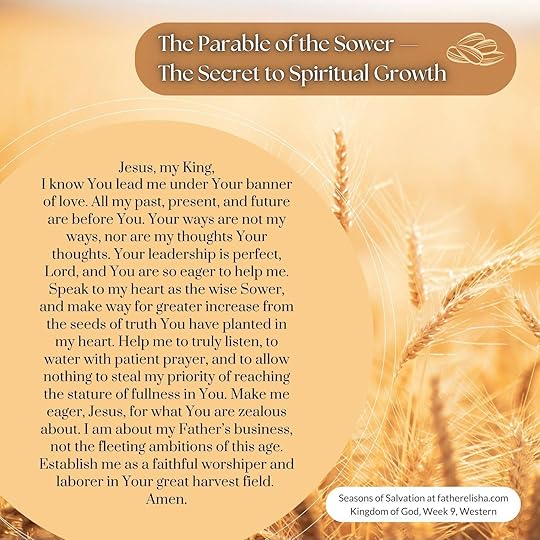
Photo by Vadim Paripa on Unsplash
The post Kingdom of God 9 (Western): The Parable of the Sower — The Secret to Spiritual Growth first appeared on Father Elisha: Let me take you on an intriguing journey..


October 24, 2025
Kingdom of God 8 (Eastern): The Rich Man and Lazarus — Unveiling Two Kingdoms
 The Spiritual Mysteries of the Divine Calendar: The Rich Man and Lazarus — Unveiling Two Kingdoms ~ October 26 – November 1, 2025 ~
 During the weeks of the first Season of Salvation in the Divine Calendar, the Holy Spirit draws our attention to a specific weakness that God seeks to redeem this year, releasing our feet to advance further in His plan. In this eighth week of the Season of the Kingdom of God, we explore the story of the Rich Man and Lazarus to uncover obstacles that hinder the expansion of God’s Kingdom within our souls.
The Previous Weeks of the Season of the Kingdom of GodTo help us reflect on our journey through this year’s Divine Calendar, here is the overview of the previous weeks in the Season of the Kingdom of God:
Week 1: The Church New Year (Indiction)
Week 2: Repentance — A Turn Toward What?
Week 3: Moving Out of the Box in Our Spiritual Life
Week 4: Fruitless Nights Without Jesus
Week 5: Overflowing to Fulfill the Commandment of Love
Week 6: The Widow of Nain: How Life Overcomes Death
Week 7 (Last Week): Spiritual Battles — Lessons from Jesus
However, if you attend an Eastern Old Calendar parish, this week would be Week 6. I believe you will find the post The Widow of Nain: How Life Overcomes Death especially evocative, even though it includes the Gospel reading for the New Calendar.
A Crucial Key
Let us begin by taking a practical look at the key to entering the mysteries and receiving the graces of the Season of the Kingdom of God: repentance.
Repentance is vital year-round—and it can even become a way of life, as illustrated by the tax collector who “standing afar off, would not so much as raise his eyes to heaven, but beat his breast, saying, ‘God, be merciful to me a sinner!’” (Luke 18:13).
The Fathers of the Church speak of acquiring the spirit of repentance. The Psalmist writes, “The sacrifices of God are a broken spirit, a broken and a contrite heart—these, O God, You will not despise” (Ps. 51:17).
The reason we seek humility is beautifully expressed in Isaiah 57:15: “For thus says the High and Lofty One Who inhabits eternity, whose name is Holy: ‘I dwell in the high and holy place, with him who has a contrite and humble spirit, to revive the spirit of the humble, and to revive the heart of the contrite ones.’”
To Settle Accounts at the End of the Day
How can we do this? At the end of each day, we can draw inspiration from an old monastic practice to “settle accounts” (Matt. 25:19). Before going to sleep, we may spend a few minutes asking the Holy Spirit to reveal anything that occurred during the day that grieved “the Holy Spirit of God” (Eph. 4:30). We do not need to painstakingly dissect every event, but simply be still and invite the Spirit to show any sins in deed, word, or thought.
If nothing immediately comes to mind—and often we can sense if something specific need attention even before we begin praying—we can reflect on the Two Great Commandments (Matt. 22:36–39). We examine how we may have failed to love God with all our being and our neighbor as ourselves. Often, beginning with these commandments brings to light other events we can confess before the Lord.
When we feel there is nothing more to confess, we thank Jesus for the forgiveness granted through His sacrifice. We then ask the Holy Spirit for the grace to fill us and help us avoid repeating the same sins. Finally, we try to find a Scripture that speaks to what we have confessed and pray it, declaring God’s truth over ourselves and the situations.
Summary of Reviewing Our Day with the Holy Spirit
To summarize this daily practice of settling accounts:
Ask the Holy Spirit to reveal anything we did or neglected to do that grieved Him.Confess our sins before Jesus and receive His forgiveness.Ask for the grace of the Holy Spirit to enable us to walk in righteousness and holiness.Seal the healing that accompanies confession by praying a relevant Scripture passage over our lives.If we follow up by going to confession in church, it is helpful to confess the main points we have been praying about during the daily settling of our spiritual accounts.
Let is now turn to the story of the Rich Man and Lazarus.

Photo by Cederic Vandenberghe on Unsplash
Sunday Gospel for the Rich Man and Lazarus: Luke 16:19–31 (NKJV)“There was a certain rich man who was clothed in purple and fine linen and fared sumptuously every day. 20 But there was a certain beggar named Lazarus, full of sores, who was laid at his gate, 21 desiring to be fed with the crumbs which fell from the rich man’s table. Moreover the dogs came and licked his sores. 22 So it was that the beggar died, and was carried by the angels to Abraham’s bosom. The rich man also died and was buried. 23 And being in torments in Hades, he lifted up his eyes and saw Abraham afar off, and Lazarus in his bosom.
24 “Then he cried and said, ‘Father Abraham, have mercy on me, and send Lazarus that he may dip the tip of his finger in water and cool my tongue; for I am tormented in this flame.’ 25 But Abraham said, ‘Son, remember that in your lifetime you received your good things, and likewise Lazarus evil things; but now he is comforted and you are tormented. 26 And besides all this, between us and you there is a great gulf fixed, so that those who want to pass from here to you cannot, nor can those from there pass to us.’
27 “Then he said, ‘I beg you therefore, father, that you would send him to my father’s house, 28 for I have five brothers, that he may testify to them, lest they also come to this place of torment.’ 29 Abraham said to him, ‘They have Moses and the prophets; let them hear them.’ 30 And he said, ‘No, father Abraham; but if one goes to them from the dead, they will repent.’ 31 But he said to him, ‘If they do not hear Moses and the prophets, neither will they be persuaded though one rise from the dead.’”
The Rich Man
We read in Luke 16:19: “There was a certain rich man who was clothed in purple and fine linen and fared sumptuously every day.”
In Jesus’ story of the rich man and Lazarus, we see two men living vastly different lives. One dwells securely in the kingdom of himself, while the other lives in the Kingdom of God. The rich man’s extravagant lifestyle reflects that “the rich man’s wealth is his strong city” (Prov. 10:15).
We know that money itself is not the root of all evil, “for the love of money is a root of all kinds of evil, for which some have strayed from the faith in their greediness” (1 Tim. 6:10). Jesus warns, “How hard it is for those who trust in riches to enter the kingdom of God! It is easier for a camel to go through the eye of a needle than for a rich man to enter the kingdom of God” (Mark 10:24b–25).
The Apostle Paul also instructs, “Command those who are rich in this present age not to be haughty, nor to trust in uncertain riches but in the living God, who gives us richly all things to enjoy” (1 Tim. 6:17).
Yet in this story, the rich man is placed at the center. Every verse, except verses 20–22, is told from his perspective. God seeks to reach the heart of this man by placing at his doorstep someone who lives a radically different life.
Lazarus
In Luke 16:20–21, we read: “But there was a certain beggar named Lazarus, full of sores, who was laid at his gate, desiring to be fed with the crumbs which fell from the rich man’s table. Moreover the dogs came and licked his sores.”
We know little about Lazarus, yet he is clearly in a miserable state of poverty and sickness. But why was he placed there? Jesus tells us that Lazarus longed to feed on the rich man’s crumbs. The general lessons from this story include the value of caring for the sick and poor, that God regards every person equally regardless of social status, and that God’s judgment at the end of our lives is just. Yet there is more to poor Lazarus that these lessons alone.
We read in Luke 16:22–23: “So it was that the beggar died, and was carried by the angels to Abraham’s bosom. The rich man also died and was buried. And being in torments in Hades, he lifted up his eyes and saw Abraham afar off, and Lazarus in his bosom.”
This reminds us that our adoption as children of God does not depend on earthly wealth. Modesty appears to be the safest path, as Proverbs teaches: “Give me neither poverty nor riches—feed me with the food allotted to me; lest I be full and deny You, and say, ‘Who is the Lord?’ Or lest I be poor and steal, and profane the name of my God” (Prov. 30:8b–9).

Photo by Drew Dau on Unsplash
Placing Our Security in ChristRiches can fuel our pride and love of power, while poverty can certainly humble us. Yet, in the right hands, wealth can serve the expansion of God’s Kingdom, and poverty caused by irresponsible living can hinder His plan for our lives.
The key is to place our security in Christ, as the Apostle Paul writes: “Not that I speak in regard to need, for I have learned in whatever state I am, to be content: I know how to be abased, and I know how to abound. Everywhere and in all things I have learned both to be full and to be hungry, both to abound and to suffer need. I can do all things through Christ who strengthens me” (Phil. 4:11–13).
The judgment of these two men’s lives reveals their relationship with God while they lived. The rich man seemed to trust in his own kingdom and cared little for the God of Israel. It even appears that he did not help Lazarus—even though the beggar lay at his gate—since Lazarus received “evil things” in his lifetime but is now “comforted” (verse 25).
Lazarus, this poor and suffering child of God, had been placed at the gate of the rich man for an unknown period of time before he was “carried by the angels to Abraham’s bosom” (verse 22). Clearly, he loved his God.
The Rich Man and Lazarus: Blinded by Riches
I believe the rich man must have noticed something was different about poor Lazarus. I envision Lazarus as a light version of Job, who—amid suffering—clearly demonstrated his reverent fear of God: “Shall we indeed accept good from God, and shall we not accept adversity?” (Job 2:10b).
Yet the testimony of Lazarus’s faith in God’s care did not impact the rich man. If this homeless man, suffering from sickness, trusted God in his poverty, how much more should the rich man have trusted God for his riches?
We read in Deuteronomy: “Then you say in your heart, ‘My power and the might of my hand have gained me this wealth.’ And you shall remember the Lord your God, for it is He who gives you power to get wealth” (Deut. 18:17–18a). The poor man’s life should have been an eye-opener for the rich man, showing him that his own kingdom blinded him to the true Kingdom of Heaven.
The Rich Man and Lazarus: The Brothers
At the end of the Sunday Gospel, we understand why the rich man never turned to God, even though he saw Lazarus each time he entered or left his mansion. We read in Luke 16:31: “But he said to him, ‘If they do not hear Moses and the prophets, neither will they be persuaded though one rise from the dead.’”
In his torment, the rich man pleaded with Abraham to send Lazarus to his five brothers, hoping that if Lazarus rose from the grave, they would believe. His request reveals something about Lazarus’s visible faith: “I beg you therefore, father, that you would send him to my father’s house, for I have five brothers, that he may testify to them, lest they also come to this place of torment” (Luke 16:27–28).
But Abraham replied that the brothers already had Moses and the prophets to instruct them about the Kingdom of God—and that these Scriptures bear a testimony as powerful as someone rising from the dead. The rich man’s five brothers—likely with the same mindset, since the rich man feared “they also come to this place of torment”—did not truly believe the Word of God, just as he had not.
The Rich Man and Lazarus: Good-Looking Disbelief
The rich man’s unbelief in the reign of God’s Kingdom over his life kept him excluded from it. Instead, he built an impressive and good-looking empire for himself, where he could reign as king.
Here lies the central lesson of this Sunday Gospel: when any part of our inner life is not surrendered to the Lordship of Christ, we grow self-sufficient, which eventually blinds us to the truth. This aesthetic unbelief keeps us unaware of how that part of our life might look if it were fully surrendered to God’s reign.
God may send a particular person or lead us into a recurring situation to reveal a testimony of faith we never truly considered. May the Holy Spirit help us uncover every trace of disbelief or beautifully disguised resistance to the Kingdom of God. And may we find joy in a deeper surrender to His loving leadership over our lives.
Concluding the Rich Man and Lazarus — Unveiling Two KingdomsI feel honored that you took the time to read. I pray that God may bless and lead you into a new week in the Season of the Kingdom of God.
Please leave a comment below—we’d love to hear your thoughts. If you found this post helpful, feel free to share it using the buttons at the top of the page.
Join the Journey Through the Seasons of SalvationJoin us on this weekly journey through the Seasons of Salvation as we walk in the footsteps of Jesus Christ through the key seasons of His life.
Sign up to receive this year’s Divine Calendar, which introduces the Seasons of Salvation and guides you through the journey ahead. As a welcome gift, you’ll also receive my young adult novel, The Legend of the Divine Calendar, delivered straight to your inbox.
Visit the Seasons of Salvation blog for insights into the coming week, posted every Saturday. We’d be honored to have you join us.
Save Your Prayer Card on Your Smartphone

Photo by Jusdevoyage on Unsplash
The post Kingdom of God 8 (Eastern): The Rich Man and Lazarus — Unveiling Two Kingdoms first appeared on Father Elisha: Let me take you on an intriguing journey..
Kingdom of God 8 (Western): The Kingdom of God and the Path to Overcome Death
The Spiritual Mysteries of the Divine Calendar: The Kingdom of God and the Path to Overcome Death ~ October 26 – November 1, 2025 ~ When an enemy knows its opponent is about to enter its most valuable territory, it sends its most intimidating weapon to scare the invader away and plant second thoughts about whether victory is possible. The enemy of our souls does the same. When he senses the Holy Spirit surrounding one of his darkened strongholds and preparing to enter, he unleashes his most cruel lies to make us doubt that God can truely answer our prayers or that the promises of the Kingdom of God can really change something in our lives or circumstances.
In this eighth week of the Season of the Kingdom of God in the Divine Calendar, we will look at how to overcome the fiercest power in the Kingdom of Darkness—the power of death.
Jesus at the GateWe see this pattern in this week’s Sunday Gospel, and what’s most touching is that Jesus responds to our wavering with compassion. As we read in the book of Hebrews: “For we do not have a High Priest who cannot sympathize with our weaknesses, but was in all points tempted as we are, yet without sin” (Heb. 4:15).
We see Jesus near the gate of the city of Nain. As the Son of God approaches with His testimony about the Kingdom of Heaven, the enemy of humanity brings out a coffin containing the deceased son of a despairing widow who has lost all hope. It is at the gate—the very entrance that will change the future of this city—that the coffin is paraded.
But the Sunday Gospel tells us not to lose hope or despair. When we are so close to entering our promise, the enemy will display our inadequacies before our eyes to make us draw back. Yet Jesus has compassion on us and says, “Do not weep […] Young man, I say to you, arise.” He exposes the enemy, reveals his deception, and enters the previously seized city within our soul.
Our Progress through the Divine Calendar
The Season of the Kingdom of God unfolds in stages, and this the distance we have journeyed so far:
The Kingdom of God Declared in Power
Week 1: Building the Kingdom of God
Week 2: Recognizing Our Call to Repentance
The Absence of the Kingdom of God
Week 3: Zacchaeus and His Desire to See Jesus
Week 4: The Inner Vacuum and Mary’s Alabaster Flask
The Gradual Descent When We Lose the Vision of the Kingdom of God (4 weeks)
Week 5: Healing the Paralytic and Our Inner Paralysis
Week 6: Jesus in the Boat and Fruitless Toil
Week 7 (Last Week): Repentance and Renewal — Moving from Despair to Hope
Toward the Fullness of Christ
God prepares us to work with Him to expand His Kingdom—first within us, and then through us to the world. To reach this goal, the Holy Spirit highlights a certain obstacle in our fallen human nature that hinders us from taking the next step He has ordained for us individually. The key to discovering this activity of the Spirit is daily repentance, which can take the form of reviewing our day with the Holy Spirit each evening.
What the Holy Spirit underlines during these first ten weeks of the Divine Calendar (the Season of the Kingdom of God) usually points to a specific deep root in our fallen nature that blocks our progress. During this liturgical year, God will focus on crucifying this root and renewing this part of our soul through resurrection into Christlikeness—the new man.
The Previous Three Levels of the Absence of the Kingdom of God
We have arrived at the last of the four weeks revealing the sad condition of the soul left in the absence of Christ’s lordship. “For indeed, the kingdom of God is within you” (Luke 17:21b).
Our lives in following Jesus are a continual process of reaching “the unity of the faith and of the knowledge of the Son of God, to a perfect man, to the measure of the stature of the fullness of Christ” (Eph. 4:13), because “both He who sanctifies and those who are being sanctified are all of one” (Heb. 2:22). We are “predestined to be conformed to the image of His Son, that He might be the firstborn among many brethren” (Rom. 8:29).
As we follow Jesus through the Seasons of Salvation, the Holy Spirit helps us to be “transformed into the same image from glory to glory” (2 Cor. 3:18). So far, we have discovered three levels of symptoms when our life is absent from the Kingdom of God.
First, it manifests as a sense of inner paralysis.
If this inner paralysis persists, the second level appears: all our work for God becomes exhausting toil that bears no fruit—unless God has hidden us for a future purpose.
If the light of God cannot reach this part of our soul, the darkness may thicken and turn into inner blindness and muteness, blocking our ability to testify about God’s work and leading us into the dreaded despair. We lose hope that God can change this part of us.
This week, we will uncover the darkest symptom of isolation from God’s Kingdom, after despair has taken full reign. Sobering, yes—but the light of the Kingdom of God shines all the brighter.

Photo by Nazrin Babashova on Unsplash
Sunday Gospel for the Kingdom of God and the Path to Overcome Death: Luke 7:11–17 (NKJV)Now it happened, the day after, that He went into a city called Nain; and many of His disciples went with Him, and a large crowd. 12 And when He came near the gate of the city, behold, a dead man was being carried out, the only son of his mother; and she was a widow. And a large crowd from the city was with her.
13 When the Lord saw her, He had compassion on her and said to her, “Do not weep.” 14 Then He came and touched the open coffin, and those who carried him stood still. And He said, “Young man, I say to you, arise.” 15 So he who was dead sat up and began to speak. And He presented him to his mother.
16 Then fear came upon all, and they glorified God, saying, “A great prophet has risen up among us”; and, “God has visited His people.” 17 And this report about Him went throughout all Judea and all the surrounding region.
Jesus Comes Close to Home
In Luke 7:11, we read: “Now it happened, the day after, that He went into a city called Nain; and many of His disciples went with Him, and a large crowd.”
Jesus comes toward Nain with crowds following Him. These people are neither paralyzed, nor suffering fruitlessness, nor trapped in despair that mutes their testimony about Him. They are drawn to Him by His teachings, His miracles, or the growing rumor of Him being the Messiah.
The city name Nain means “a home,” “habitation,” and “a pleasant place.” When Jesus draws near one of our inner Jerichos—confronting the self-elected government of His majesty, King Ego—things may occur that can confuse us if we do not realize what is happening.
Coming to the Surface
We read in Luke 7:12: “And when He came near the gate of the city, behold, a dead man was being carried out, the only son of his mother; and she was a widow. And a large crowd from the city was with her.”
When Jesus draws near the gate of the city—when He comes close to our weakness in His determined yet humble way—a despairing widow, who has lost all hope for her lineage to continue, comes to meet Him. She has no husband, and her only son has died, and so she despairs because her family line will end with her son. The first thing Jesus encounters from the city of Nain is this coffin of death.
When we experience a sudden manifestation of our fallen human nature—something that usually remains hidden—it is a sign that Jesus is drawing near the gate of our sinful nature. Such a confrontation with “the light of the world” (John 8:12) pushes our fallen nature to the surface, and we may suddenly notice or fall into sinful patterns in unusual ways. We might burst into anger, feel hopeless, or surrender to circumstances.
When the city of Nain carries out the coffin of death—when our fallen human nature rises to the surface—we are not to be afraid. Instead, we are to recognize that Jesus is near, ready to answer our prayers of repentance and proclaim the truths of God’s Word and His Kingdom over our lives.
The Fourth Symptom of the Absence of the Kingdom of God: Death
The fourth and last symptom of the soul left outside God’s Kingdom is this coffin—death. If despair grows and establishes deep roots, death will eventually reign in this part of our lives. This might sound strange since God has adopted us as His children through faith in Christ, but death might still reign in parts of our soul after being born again into the Kingdom of God.
The Apostle Paul writes: “Therefore, brethren, we are debtors—not to the flesh, to live according to the flesh. For if you live according to the flesh you will die; but if by the Spirit you put to death the deeds of the body, you will live” (Rom. 8:12–13). He also writes: “I say then: Walk in the Spirit, and you shall not fulfill the lust of the flesh. For the flesh lusts against the Spirit, and the Spirit against the flesh; and these are contrary to one another, so that you do not do the things that you wish” (Gal. 5: 16–17).
But the most accurate description we find in Romans:
“Now if I do what I will not to do, it is no longer I who do it, but sin that dwells in me. I find then a law, that evil is present with me, the one who wills to do good. For I delight in the law of God according to the inward man. But I see another law in my members, warring against the law of my mind, and bringing me into captivity to the law of sin which is in my members. O wretched man that I am! Who will deliver me from this body of death? I thank God—through Jesus Christ our Lord!” (Rom. 7:20–25).

Photo by Jack B on Unsplash
The Compassionate JesusWe read in Luke 7:13–14: “When the Lord saw her, He had compassion on her and said to her, ‘Do not weep.’ Then He came and touched the open coffin, and those who carried him stood still. And He said, ‘Young man, I say to you, arise.’”
Oh, the compassionate Jesus. When His divine presence invades the territory of our fallen human nature, forcing a certain manifestation of sin to the surface, He doesn’t do so to humiliate or condemn us.
This is the most magnificent side of our Beloved Savior. When we sin, Jesus does not condemn us—He covers us. The Evangelist John writes: “When Jesus had raised Himself up and saw no one but the woman, He said to her, ‘Woman, where are those accusers of yours? Has no one condemned you?’ She said, ‘No one, Lord.’ And Jesus said to her, ‘Neither do I condemn you; go and sin no more’” (John 8:10–11).
Touching the Coffin
This is the nature of Jesus in His first coming: “And if anyone hears My words and does not believe, I do not judge him; for I did not come to judge the world but to save the world” (John 12:47). Jesus feels compassion for the widow and says to her, “Do not weep.” This is the Jesus that surrounds the city of our fallen human nature. He has compassion on us, and when we confess our sins, He immediately comforts us and dries our tears. Jesus touches the coffin—the area of our soul—and says: “Young man, I say to you, arise.”
“Death is swallowed up in victory” (1 Cor. 15:54), and we may receive a foretaste of this victory even now if we perceive and respond to these surfacing sins. However, the final resurrection and the seal of the work of redemption—on a larger scale than we realize—come later in the Divine Calendar, perhaps even after several years of journeying through the Seasons of Salvation.
There is no hopeless condition nor siege of death within our soul that Jesus cannot redeem. We might have lost hope for change—even others might have given up on us—but Jesus never will.
An Everlasting Name in the Kingdom of God
In Luke 7:15, we see Jesus return the resurrected son to his mother. Jesus saved the widow’s inheritance—her lineage would go on. The prophet Isaiah speaks of the significance of our eternal inheritance:
“Thus says the Lord: ‘Keep justice, and do righteousness, for My salvation is about to come’ […] Do not let the son of the foreigner who has joined himself to the Lord speak, saying, ‘The Lord has utterly separated me from His people’; nor let the eunuch say, ‘Here I am, a dry tree.’ For thus says the Lord: ‘To the eunuchs who keep My Sabbaths, and choose what pleases Me, and hold fast My covenant, even to them I will give in My house and within My walls a place and a name better than that of sons and daughters; I will give them an everlasting name that shall not be cut off’” (Isa. 56:1–5).
The final verses of Luke 7:16–17 reveal the amazement of the people of Nain and how their testimony spread from Nain to Judea and beyond. As we have seen in the previous weeks, once a part of our soul receives the power of resurrection and comes under the Lordship of Jesus, the effect becomes visible to everyone around us. We witness how an inner extension of the Kingdom of God manifests outwardly. To our compassionate Jesus be all the glory.
When Jesus Returns
We see Jesus as the compassionate Savior, immediately covering our sins, in His first coming. But in His Second Coming, we will witness a different revelation of Jesus Christ. He remains the same as He was at His first coming, yet the damage of sin and death will have reached its limit. Jesus will soon return as a roaring Lion. He will ride a warhorse, fiercely bringing an end to all evil on the earth as a jealous Bridegroom. For those who still clench their fists at His face, His coming will be terrifying.
“The Lord shall go forth like a mighty man; He shall stir up His zeal like a man of war. He shall cry out, yes, shout aloud; He shall prevail against His enemies. ‘I have held My peace a long time, I have been still and restrained Myself. Now I will cry …’” (Isa. 42:13–14a).
Concluding the Kingdom of God and the Path to Overcome DeathThank you for taking the time to read and share this moment with me. The honor is truly mine. I pray the Lord will draw near and stir our spirits as we move toward the final two weeks of the first Season of Salvation in the Divine Calendar.
Please leave a comment below—we’d love to hear your thoughts. If you found this post helpful, feel free to share it using the buttons at the top of the page.
Join the Journey Through the Seasons of SalvationJoin us on this weekly journey through the Seasons of Salvation as we walk in the footsteps of Jesus Christ through the key seasons of His life.
Sign up to receive this year’s Divine Calendar, which introduces the Seasons of Salvation and guides you through the journey ahead. As a welcome gift, you’ll also receive my young adult novel, The Legend of the Divine Calendar, delivered straight to your inbox.
Visit the Seasons of Salvation blog for insights into the coming week, posted every Saturday. We’d be honored to have you join us.
Save Your Prayer Card on Your Smartphone
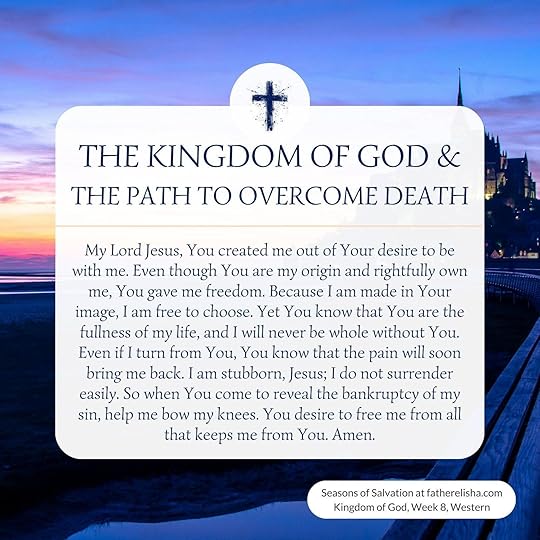
Photo by Frederic Paulussen on Unsplash
The post Kingdom of God 8 (Western): The Kingdom of God and the Path to Overcome Death first appeared on Father Elisha: Let me take you on an intriguing journey..
October 17, 2025
Kingdom of God 7 (Eastern): Spiritual Battles — Lessons from Jesus
The Spiritual Mysteries of the Divine Calendar: Spiritual Battles — Lessons from Jesus ~ October 19–25, 2025 ~ With just four weeks remaining in the Season of the Kingdom of God, the first Season of Salvation in the Divine Calendar, the Holy Spirit invites us into a greater vision for our lives. However, to enter this blessed vision, the reign of the Lord must extend in our souls. The more we allow God to sanctify us, the greater our external impact and testimony for His Kingdom will be. But this growth comes with spiritual battles, and this week, Jesus will teach us some significant and practical lessons.
God desires that we partner with Him in His work, and the Holy Spirit is revealing glimpses of that calling to our hearts during this first Season of Salvation. For this new calling to mature, we need to embrace the key of this Season: repentance.
Our Vision of God’s KingdomGod wants to help us see what hinders the expansion of our vision, and how to make it a reality. During the first season of the Divine Calendar, we often begin to recognize a weakness—a deep-rooted aspect of our fallen human nature—that resists this growth.
In the previous weeks, we have encountered several significant insights into these weaknesses. We have learned that God and His Kingdom are far greater than the narrow boxes we sometimes create with our convictions about how spiritual life works. We have discussed the futility of toiling in the night with no fruit, serving the Lord in our own way.
Two weeks ago, we saw how powerless we are to love our enemies unless we tap into God’s inexhaustible reservoirs of love and mercy. And last week, we reflected on the powerful truth that life overcomes death, as in the story of the Widow of Nain.
This week’s Sunday Gospel introduces a parable about something as simple as a farmer sowing seeds. Jesus explains that He tells this parable because the masses wouldn’t understand if He revealed the mysteries plainly. Ultimately, He shares the deeper meaning directly with His inner circle of disciples. Let’s delve into His teachings and uncover the message for this week.
The Past Weeks of the Season of the Kingdom of God
To help us reflect on our journey so far in this year’s Divine Calendar, here’s an overview of the previous weeks in the Season of the Kingdom of God:
Week 1: The Church New Year (Indiction)
Week 2: Repentance — A Turn Toward What?
Week 3: Moving Out of the Box in Our Spiritual Life
Week 4: Fruitless Nights Without Jesus
Week 5: Overflowing to Fulfill the Commandment of Love
Week 6 (Last Week): The Widow of Nain: How Life Overcomes Death
However, if you attend an Eastern Old Calendar parish, this week would be Week 5. I believe you will find the post Overflowing to Fulfill the Commandment of Love especially evocative, even though it includes the Gospel reading for the New Calendar.

Photo by Bud Helisson on Unsplash
Sunday Gospel for Spiritual Battles — Lessons from Jesus: Luke 8:5–15 (NKJV)5 “A sower went out to sow his seed. And as he sowed, some fell by the wayside; and it was trampled down, and the birds of the air devoured it. Some fell on rock; and as soon as it sprang up, it withered away because it lacked moisture. And some fell among thorns, and the thorns sprang up with it and choked it. But others fell on good ground, sprang up, and yielded a crop a hundredfold.” When He had said these things He cried, “He who has ears to hear, let him hear!”
9 Then His disciples asked Him, saying, “What does this parable mean?”
10 And He said, “To you it has been given to know the mysteries of the kingdom of God, but to the rest it is given in parables, that ‘Seeing they may not see, and hearing they may not understand.’
11 “Now the parable is this: The seed is the word of God. Those by the wayside are the ones who hear; then the devil comes and takes away the word out of their hearts, lest they should believe and be saved. But the ones on the rock are those who, when they hear, receive the word with joy; and these have no root, who believe for a while and in time of temptation fall away. Now the ones that fell among thorns are those who, when they have heard, go out and are choked with cares, riches, and pleasures of life, and bring no fruit to maturity.
15 But the ones that fell on the good ground are those who, having heard the word with a noble and good heart, keep it and bear fruit with patience.
Spiritual Battles I: The Birds
In Luke 8:5, we read: “A sower went out to sow his seed. And as he sowed, some fell by the wayside; and it was trampled down, and the birds of the air devoured it.”
A great crowd from many cities gathered around Jesus as He shared this parable. However, Jesus knew that the multitudes couldn’t fully grasp its deeper meaning. By telling a story, He hoped that they would understand later. We will explore this point further below.
The first seeds the sower sowed were unprotected, falling on the open wayside where the birds quickly devoured them.
When we leave a time of spiritual devotion—whether it’s reading the Word of God, studying the sayings and the lives of the Saints, or attending services and the Divine Liturgy—our souls often carry new divine seeds.
To prevent intrusive thoughts of unbelief (the birds) from either causing us to forget these truths or stirring the dust of doubt in our minds (Luke 8:12), a prayer about what we have read or heard can protect these seeds. If the seeds survive this first trial of being forgotten or dismissed by doubt, a new challenge will soon arise.
Spiritual Battles II: Lack of Moisture
We read in Luke 8:6: “Some fell on rock; and as soon as it sprang up, it withered away because it lacked moisture.” The seed that landed on rocky soil couldn’t absorb enough water to sustain its growth, and as a result, it withered away.
Our next challenge is to continue praying over what we have received, without being tempted to turn our focus elsewhere (Luke 8:13). If we don’t vigilantly pray over the truths we want to establish in our lives, the seeds God planted will wither—even if we have protected them from the birds of forgetfulness.
But if we pass this second test of endurance through prayer and hope, refusing to give in to distracting temptations, we will be ready for the third challenge.
Spiritual Battles III: The Thorns
Jesus said in Luke 8:7: “And some fell among thorns, and the thorns sprang up with it and choked it.” The thorns that grew alongside the seedlings quickly blocked out the sunlight, suffocating the young plants.
Once our spiritual enemy sees that we are vigilant in prayer—nurturing the seeds in our lives without distraction—a new temptation will arise to pull our attention away from our goal (Luke 8:14).
The Gospel of Mark (4:18–19) gives further insight: “Now these are the ones sown among thorns; they are the ones who hear the word, and the cares of this world, the deceitfulness of riches, and the desires for other things entering in choke the word, and it becomes unfruitful.”
Our ultimate test, after overcoming the birds of forgetfulness and the dryness from lack of vigilance, comes in the form of a sudden care related to our earthly life. This could be a temptation for wealth, status, or simply desiring something more than our spiritual goal.
If we give in to these desires, the thorns will block out the sunlight. Our focus will shift from the face of Jesus, shining “like the sun” (Matt. 17:2), to the distractions of earthly life, and the seed will wither away.
However, if we resist this tremendous temptation, we will reach the blessed, good soil.
Photo by Aaron Burden on Unsplash
The Reward of The Good SoilIn Luke 8:8, we read: “‘But others fell on good ground, sprang up, and yielded a crop a hundredfold.’ When He had said these things He cried, ‘He who has ears to hear, let him hear!’”
If we pass through all three trials, we will see not only the seed sprout but also bear fruit—often much greater than we initially expected—even a hundred times more. Jesus explains in Luke 8:15: “But the ones that fell on the good ground are those who, having heard the word with a noble and good heart, keep it and bear fruit with patience.”
Then Jesus says, “He who has ears to hear, let him hear!” (Mark 4:9)—meaning that those who understand these words should truly grasp their meaning. Some may only hear the natural story of a farmer striving for a good crop, but others will discern the deeper spiritual message about the three challenges we face in nurturing God’s Word to bear fruit in our lives.
The Mind of Christ
In Luke 8:9–10, we read: “Then His disciples asked Him, saying, ‘What does this parable mean?’ And He said, ‘To you it has been given to know the mysteries of the kingdom of God, but to the rest it is given in parables, that ‘Seeing they may not see, and hearing they may not understand.’”
At first glance, it may seem like Jesus doesn’t want the multitudes to see or understand, but that doesn’t align with His character. After all, Jesus declared, “The Son of Man has come to seek and to save that which was lost” (Luke 19:10).
Jesus wanted everyone to know the mysteries of the Kingdom of God. However, He understood that the crowds, who didn’t follow Him closely like His disciples, wouldn’t be able to grasp His message if He revealed the mysteries plainly—especially regarding the three challenges the Word of God faces in growing and bearing fruit.
Jesus knew that if He spoke directly, they would see but not truly perceive, and hear but not fully understand. This would only confuse and frustrate them, not bring them closer to the true meaning of God’s Kingdom. Therefore, He used parables, reserving the deeper meanings for His disciples later on. By tailoring His message this way, both the crowds and the disciples could grow in understanding at the right time.
Jesus is the wise Sower of truth, planting seeds of understanding in human hearts.
The crowds would come to understand His teachings when they realized His mission wasn’t about liberating Israel from Rome but about saving humanity from sin.
What Language Do We Understand?
The Apostle Paul writes, “These things we also speak, not in words which man’s wisdom teaches but which the Holy Spirit teaches, comparing spiritual things with spiritual. But the natural man does not receive the things of the Spirit of God, for they are foolishness to him; nor can he know them, because they are spiritually discerned. But he who is spiritual judges all things, yet he himself is rightly judged by no one. For ‘who has known the mind of the Lord that he may instruct Him?’ But we have the mind of Christ” (1 Cor. 2:13–16).
In this season, the Holy Spirit helps us distinguish between living under God’s reign or under the reign of our fallen human nature. When God reigns in our lives, we begin to view our circumstances not through “words which man’s wisdom teaches but which the Holy Spirit teaches, comparing spiritual things with spiritual.” But if we are living outside the fullness of God’s Kingdom, we can’t “receive the things of the Spirit of God, for they are foolishness to him; nor can he know them, because they are spiritually discerned.”
As believers, we all have areas of our lives that are still in need of growth. Through the grace of this Sunday Gospel, the Holy Spirit enables us to discern more about our deep-rooted weakness that God desires to redeem on our journey through the Divine Calendar this year.
Concluding the Spiritual Battles — Lessons from JesusAre we attuned to the language of the Holy Spirit?
Is He speaking through our circumstances and daily experiences? Do we only hear the natural message, or are we able to grasp the deeper, spiritual meaning? May the Holy Spirit teach us His spiritual language so we can fully understand what God is trying to say to us in this season.
It’s a blessing that you took the time to read. May the Holy Spirit draw near to us this week. God bless you.
Please leave a comment below—we’d love to hear your thoughts. If you found this post helpful, feel free to share it using the buttons at the top of the page.
Join the Journey Through the Seasons of SalvationJoin us on this weekly journey through the Seasons of Salvation as we walk in the footsteps of Jesus Christ through the key seasons of His life.
Sign up to receive this year’s Divine Calendar, which introduces the Seasons of Salvation and guides you through the journey ahead. As a welcome gift, you’ll also receive my young adult novel, The Legend of the Divine Calendar, delivered straight to your inbox.
Visit the Seasons of Salvation blog for insights into the coming week, posted every Saturday. We’d be honored to have you join us.
Save Your Prayer Card on Your Smartphone

Photo by Ricardo Gomez Angel on Unsplash
The post Kingdom of God 7 (Eastern): Spiritual Battles — Lessons from Jesus first appeared on Father Elisha: Let me take you on an intriguing journey..
Kingdom of God 7 (Western): Repentance and Renewal — Moving from Despair to Hope
The Spiritual Mysteries of the Divine Calendar: Repentance and Renewal — Moving from Despair to Hope ~ October 19–25, 2025 ~ The Kingdom of God is unshakable, because Jesus Christ is the solid foundation on which everything in this Kingdom stands. As the Apostle Paul writes, “For no other foundation can anyone lay than that which is laid, which is Jesus Christ” (1 Cor. 3:11). “Therefore, since we are receiving a kingdom which cannot be shaken …” (Heb. 12:28). Every time we turn toward this Kingdom — every time we respond to the Spirit’s call to repentance — we move from unstable ground built in darkness to the eternal foundations established in light.
As we enter the seventh week of the first Season of Salvation in the Divine Calendar—the Season of the Kingdom of God—we are reminded that repentance is the key to unlocking the mysteries of this Season and receive its blessings.
Repentance: Entering the Unshakable KingdomWhen the Kingdom of God expands, it shakes everything built on other foundations. This will culminate in a global manifestation at the Second Coming of Jesus. But for now, as “the kingdom of God is within” us (Luke 17:21), God is expanding His Kingdom in our souls. He challenges the foundations we have laid on our own. As Jesus said, “And the rain descended, the floods came, and the winds blew and beat on that house; and it did not fall, for it was founded on the rock” (Matt. 7:25).
This shaking also happens on the corporate level within the Church as God moves history toward the Second Coming. The Apostle Peter writes, “For the time has come for judgment to begin at the house of God; and if it begins with us first, what will be the end of those who do not obey the gospel of God?” (1 Pet. 4:17).
We will explore this week’s Sunday Gospel, where Jesus says, “But if I cast out demons by the Spirit of God, surely the kingdom of God has come upon you” (Matt. 12:28). When God’s Kingdom expands, evil strongholds crumble and demons flee.
We will also explore the next symptom of what the absence of God’s Kingdom looks like in our inner lives, and how Jesus brings restoration to the wounded areas of our souls.
From Inner Paralysis to Empty Fishing Nets to …
With four weeks remaining in the first Season of the Divine Calendar, the Holy Spirit continues to reveal how the soul experiences life under the reign of Jesus Christ versus life under the reign of His Majesty King Ego. We have entered a four-week subperiod that takes us on a gradual descent, exposing what happens when parts of our soul fall outside Christ’s reign. One example of this inner absence is the emotional need to be honored by others—loving “the praise of men more than the praise of God” (John 12:43).
Two weeks ago, we saw that the first symptom of a soul partly living outside God’s Kingdom is a sense of paralysis. We feel stuck—trapped in the same patterns, year after year, with no movement or sign of change.
Last week, we saw how that inner paralysis evolves into fruitless labor.
An important note here is sometimes we find that “in the shadow of His hand He has hidden Me, and made Me a polished shaft; in His quiver He has hidden Me” (Isa. 49:2). During these hidden times, we may see little or no outward fruit because God is working deeply within us. When God hides us, the key is patience and faithfulness.
“Though the fig tree may not blossom, nor fruit be on the vines; though the labor of the olive may fail, and the fields yield no food; though the flock may be cut off from the fold, and there be no herd in the stalls—yet I will rejoice in the Lord, I will joy in the God of my salvation” (Hab. 3:17–18).
Our Place in the Divine Calendar
The Season of the Kingdom of God unfolds in phases, and this is how far we have journeyed:
The Kingdom of God Declared in Power
Week 1: Building the Kingdom of God
Week 2: Recognizing Our Call to Repentance
The Absence of the Kingdom of God
Week 3: Zacchaeus and His Desire to See Jesus
Week 4: The Inner Vacuum and Mary’s Alabaster Flask
The Gradual Descent When We Lose the Vision of the Kingdom of God (4 weeks)
Week 5: Healing the Paralytic and Our Inner Paralysis
Week 6 (Last Week): Jesus in the Boat and Fruitless Toil
The key to discerning whether God has hidden us to prepare us for the future—or whether we are caught in fruitless toil due to the reign of King Ego—is the presence or absence of inner paralysis. When God hides us, we won’t feel stagnant. A river of life flows in our relationship with Jesus, even if no one on earth seems to know we exist.
But if we continue to toil with empty fishing nets, relying on our own wisdom and experience, this upcoming seventh week reveals the third level of symptoms from the absence of God’s Kingdom.

Photo by Marc Sendra Martorell on Unsplash
Sunday Gospel for Repentance and Renewal — Moving from Despair to Hope: Matthew 12:22–28 (NKJV)Then one was brought to Him who was demon-possessed, blind and mute; and He healed him, so that the blind and mute man both spoke and saw. 23 And all the multitudes were amazed and said, “Could this be the Son of David?”
24 Now when the Pharisees heard it they said, “This fellow does not cast out demons except by Beelzebub, the ruler of the demons.”
25 But Jesus knew their thoughts, and said to them: “Every kingdom divided against itself is brought to desolation, and every city or house divided against itself will not stand. 26 If Satan casts out Satan, he is divided against himself. How then will his kingdom stand? 27 And if I cast out demons by Beelzebub, by whom do your sons cast them out? Therefore they shall be your judges. 28 But if I cast out demons by the Spirit of God, surely the kingdom of God has come upon you.
Repentance and Strongholds
In Matthew 12:22, we read: “Then one was brought to Him who was demon-possessed, blind and mute; and He healed him, so that the blind and mute man both spoke and saw.”
The Holy Spirit unveils the grace He offers during this Sunday and the upcoming week, primarily through this opening verse. Jesus had just been in a synagogue where He healed a man’s withered hand on the Sabbath. When He perceived the Pharisees’ anger and their intent to kill Him, He withdrew—but the multitudes followed, and He healed them all.
Among them, people brought Jesus a man who was suffering severely. He was demon-possessed, blind, and mute—a devastating condition. But Jesus healed him completely. The man could speak and see again.
What is the significance of this in our context? These Gospel passages in the Divine Calendar highlight specific themes and spiritual principles that reveal the Holy Spirit’s work to form Christ in our inner man, year after year.
The man’s demonic possession does not imply that a demon lives wherever God’s Kingdom is absent in our soul. In fact, any child of God who confesses Christ receives the Holy Spirit in the innermost being (Psalm 51:6)—our spirit. If a demon occupied any ground in a believer’s soul, that evil spirit would be driven out immediately.
The Apostle Paul writes: “For what fellowship has righteousness with lawlessness? And what communion has light with darkness? And what accord has Christ with Belial? Or what part has a believer with an unbeliever? And what agreement has the temple of God with idols? For you are the temple of the living God” (2 Cor. 6:14b–16).
The Outer Sphere
Without intending to cause fear, Christians can still be influenced by evil spirits that cling to the outer sphere around the person. Individuals with deep emotional wounds, traumatic experiences, or generational involvement in occult practices may suffer from external evil strongholds. These strongholds can form a bond with a fallen part of the soul—even after a person has become a Christian.
In the Garden of Eden, the Holy Spirit used to fill the outer sphere surrounding the human being. But when humanity fell into sin, the Holy Spirit withdrew, and that external sphere became a vacuum evil spirits can occupy. These evil presences do not dwell inside the believer’s soul—a Christian cannot be possessed—but they can settle in the atmosphere around the person.
The Symptoms
The symptoms of demonic strongholds can manifest in overt bondages that compels one to act in certain ways, a sense that one’s thoughts are hijacked or relentltessly bombarded, or even uncontrollable worldly passions.
The best way to break free from such evil bondages is to pray regularly from the Psalms, perform prostrations (an act of worship and humility), and proclaim the blood of Jesus over oneself. If one remains faithful, the bond will break—even though it may take months, or even longer.
However, all of us encounter negative thoughts sent by demonic spirits. This is nothing to fear—simply ignore them and hold fast to the truth. As the Apostle Paul writes, “Above all, taking the shield of faith with which you will be able to quench all the fiery darts of the wicked one” (Eph. 6:16).
So, if evil thoughts are thrown at you, it doesn’t mean an evil spirit is camping in your backyard or hiding in your wardrobe. Simply ignore them. Even better, pray or act in the opposite direction of the evil thought.
In the Sunday Gospel, the man’s demonic possession illustrates how the dark absence of God’s Kingdom has captured his thoughts. The part of our soul ruled by King Ego cannot comprehend life in God’s Kingdom, except by His grace. The soul can hear about how God’s Kingdom works, but it cannot adopt those principles until the grace of God grants it a genuine experience.

Photo by Martika van Dierendonck on Unsplash
Blind and MuteLet’s read Matthew 12:22 again: “Then one was brought to Him who was demon-possessed, blind and mute; and He healed him, so that the blind and mute man both spoke and saw.”
This poor man couldn’t see or speak. He couldn’t witness the miraculous works of Jesus, express himself, or share any message about what was happening. In this way, we lose the ability to testify, which lead us into the third level of symptoms of the absence of God’s Kingdom.
If a part of our soul remains in paralysis and we continue to labor fruitlessly, we lose even the message we once carried and used to fish with. We become unable to testify to God’s work. Inner blindness and muteness prevent us from seeing His work in our lives and sharing it with others. We are driven into painful hopelessness: despair. This is dangerous because it stands in direct contrast to how Jesus called us to live.
The Third Symptom: Despair
The Evangelist Luke quotes Peter and John, “For we cannot but speak the things which we have seen and heard” (Acts 4:20). What they had seen Jesus do and heard Him say—both during His life and after His Ascension—was all they could talk about. The testimony of Jesus burned within them, just as Jeremiah expressed: “His word was in my heart like a burning fire shut up in my bones; I was weary of holding it back, and I could not” (Jer. 20:9).
Jesus often told those He healed, “See that you say nothing to anyone; but go your way, show yourself to the priest, and offer for your cleansing those things which Moses commanded, as a testimony to them” (Mark 1:44).
We give testimony not only through our words—sometimes a silent testimony speaks much louder. When we demonstrate through our lives that our faith is not just an opinion but a lifestyle, our silent witness speaks more powerfully than words.
When we are hindered from giving a testimony about God’s work—when we have lost hope and entered despair—we are far removed from Christ’s reign.
The spiritual giants of church history often spoke of the continuous remembrance of God, of practicing His presence, of having Jesus always before our eyes. This principle we find in several verses, but especially in 2 Corinthians 2:17: “For we are not, as so many, peddling the word of God; but as of sincerity, but as from God, we speak in the sight of God in Christ.” The last part of this verse is subtle, yet profound.
Born From Above
2 Corinthians 2:17 ends with “but as from God …”
In John 3:3, Jesus says, “… unless one is born again, he cannot see the kingdom of God.” The word “again” in Greek also means “from above.” A Christian is no longer just an earthly creature but a heavenly one. “Therefore, if anyone is in Christ, he is a new creation; old things have passed away; behold, all things have become new” (2 Cor. 5:17). “Therefore, holy brethren, partakers of the heavenly calling…” (Heb. 3:1). “For our citizenship is in heaven…” (Phil 3:20).
As Christians, we are born again from above. Therefore, Jesus said, “‘As the Father has sent Me, I also send you.’ And when He had said this, He breathed on them, and said to them, ‘Receive the Holy Spirit’” (John 20: 21b–22). We live “as from God” on earth. But there’s more.
Repentance: Entering the Sight of God
The final words of 2 Corinthians 2:17 read, “… we speak in the sight of God in Christ.”
Wherever we go and whatever we do, we should do it as though we are standing before God. We should speak to people and minister to them as if we are in His presence. Everything we do should be done before Him. This is why, in old icons depicting saints teaching others, the saints are often not looking at their disciples but upward. The Desert Fathers would say, Live as if only God were in the world.
To live with a constant view of Jesus—filled with awe of His beauty and majesty—requires healing all areas of our soul’s blindness and muteness. This is a high level of spirituality, but living before God as a channel of His greatness, declaring the testimony of how we see Jesus with our inner eyes, brings a powerful testimony of the Kingdom of God and the glory of the Heavenly King.
As the Psalmist says, “One thing I have desired of the Lord, that will I seek: That I may dwell in the house of the Lord all the days of my life, to behold the beauty of the Lord, and to inquire in His temple” (Ps. 27:4). “I have set the Lord always before me” (Ps. 16:8).
Nothing is Too Difficult for Jesus
Let’s read Matthew 12:22 one final time: “Then one was brought to Him who was demon-possessed, blind and mute; and He healed him, so that the blind and mute man both spoke and saw.” The last part of this verse says that Jesus “healed him, so that the blind and mute man both spoke and saw.” This man spoke immediately, with Jesus being the first person he ever saw.
Jesus can heal even if parts of our soul have fallen into despair. If we have lost all hope of God’s restoration, we may experience inner blindness and muteness. We can find ourselves unable to speak about “the things which we have seen and heard” (Acts 4:20).
But Jesus’ salvation is unlimited. He can bring this part of our life into the constant beholding of the beauty of the Lord. Then, people will confirm our testimony, asking, “Could this be the Son of David?” (Matt. 12:23).
Concluding Repentance and Renewal — Moving from Despair to HopeThank you for sharing this time together; it has been an honor. I pray the Holy Spirit will help us see how this week’s message of inner blindness, muteness, and despair reveals how God desires to work within us throughout this year’s Divine Calendar. May the radiating, joyous face of Jesus heal every wound in our souls.
May God bless your week.
Please leave a comment below—we’d love to hear your thoughts. If you found this post helpful, feel free to share it using the buttons at the top of the page.
Join the Journey Through the Seasons of SalvationJoin us on this weekly journey through the Seasons of Salvation as we walk in the footsteps of Jesus Christ through the key seasons of His life.
Sign up to receive this year’s Divine Calendar, which introduces the Seasons of Salvation and guides you through the journey ahead. As a welcome gift, you’ll also receive my young adult novel, The Legend of the Divine Calendar, delivered straight to your inbox.
Visit the Seasons of Salvation blog for insights into the coming week, posted every Saturday. We’d be honored to have you join us.
Save Your Prayer Card on Your Smartphone
Photo by Toby Robinson on Unsplash
The post Kingdom of God 7 (Western): Repentance and Renewal — Moving from Despair to Hope first appeared on Father Elisha: Let me take you on an intriguing journey..
October 10, 2025
Kingdom of God 6 (Eastern): The Widow of Nain: How Life Overcomes Death
The Spiritual Mysteries of the Divine Calendar: The Widow of Nain: How Life Overcomes Death ~ October 12–18, 2025 ~ We are born from above (John 3:3) and therefore give “thanks to the Father who has qualified us to be partakers of the inheritance of the saints in the light. He has delivered us from the power of darkness and conveyed us into the kingdom of the Son of His love” (Col. 1:12–13). This majestic verse shows how we have “been born again, not of corruptible seed but incorruptible” (1 Pet. 1:23), and our belonging and future—our inheritance—is in Heaven. In this sixth week of the first Season of Salvation in the Divine Calendar, we will see how powerfully life overcomes death in the story of the Widow of Nain.
We are now halfway through the Season of the Kingdom of God, and since the first week, the Holy Spirit has led us by the words of John the Baptist: “Repent, for the kingdom of heaven is at hand!” (Matt. 3:2). To remind us where we are in the Divine Calendar, here are the themes we have journeyed through so far:
The Season of the Kingdom of God
Week 1: The Church New Year (Indiction)
Week 2: Repentance — A Turn Toward What?
Week 3: Moving Out of the Box in Our Spiritual Life
Week 4: Fruitless Nights Without Jesus
Week 5 (Last Week): Overflowing to Fulfill the Commandment of Love
However, if you attend an Eastern Old Calendar parish, this is Week 4. I believe you will find the post Fruitless Nights Without Jesus meaningful, even though it includes the Gospel reading for the New Calendar.
Our InheritanceIn the future, our corruptible body “must put on incorruption, and this mortal must put on immortality” (1 Cor 15:53), and God will free our physical body from the effects of sin and death. In our current life, our soul is the battleground where the conflict rages between the Kingdom of Heaven and the realm of our fallen human nature.
Throughout the Divine Calendar, God desires to redeem a specific area of our soul by liberating it from the tyranny of sin and allowing the reign of Jesus Christ, the Heavenly King, to take hold.
During these weeks of the Season of the Kingdom of God, the Holy Spirit seeks to give us clear vision and understanding of what He wants to transform so that we can cooperate with Him during the upcoming Seasons of Salvation. We are laying the foundation in these weeks for the rest of the Divine Calendar—hence, this first season is quite long.
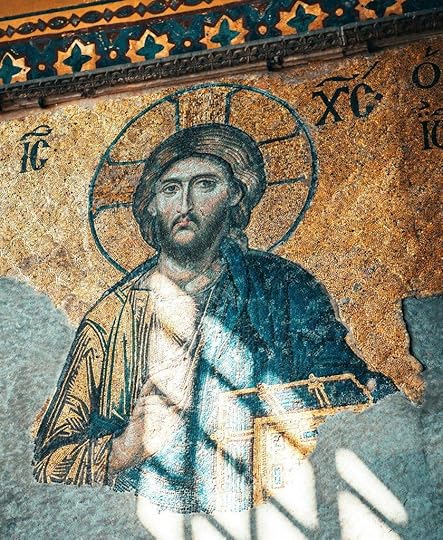
Photo by Raimond Klavins on Unsplash
Sunday Gospel for the Widow of Nain: Luke 7:11–16 (NKJV)Now it happened, the day after, that He went into a city called Nain; and many of His disciples went with Him, and a large crowd. 12 And when He came near the gate of the city, behold, a dead man was being carried out, the only son of his mother; and she was a widow. And a large crowd from the city was with her. 13 When the Lord saw her, He had compassion on her and said to her, “Do not weep.”
14 Then He came and touched the open coffin, and those who carried him stood still. And He said, “Young man, I say to you, arise.” 15 So he who was dead sat up and began to speak. And He presented him to his mother.
16 Then fear came upon all, and they glorified God, saying, “A great prophet has risen up among us”; and, “God has visited His people.”
The Image of Christ
We read in Luke 7:11: “Now it happened, the day after, that He went into a city called Nain; and many of His disciples went with Him, and a large crowd.”
Jesus enters Nain with a large group of followers, and we are about to witness an image of two opposing kingdoms: the Kingdom of Heaven and the fallen world. Not only Jesus’ disciples followed Him, but “a large crowd,” all impacted by His miraculous works, teaching, and even His reputation.
People were drawn to Jesus in an extraordinary way, seeing in Him the original image in which they were created. “He is the image of the invisible God, the firstborn over all creation” (Col. 1:15).
Jesus is the prototype of humanity, so His followers saw in Him the breathtakingly pure being they longed to be. The Son of God was the perfect mold of a human being, captivating the hearts of the humble. Christ’s words and presence touched humanity more deeply than anyone ever had before. He is truly “fairer than the sons of men” (Ps. 45:2).
Jesus’ crowd symbolizes the Kingdom of Heaven, with our inheritance—Jesus Christ—at the forefront. His life becomes ours. Jesus Himself and His Kingdom are our eternal reward, as we see in the Heavenly Wedding in Revelation 19 and in the writings of the Apostle Paul: “And if children, then heirs—heirs of God and joint heirs with Christ, if indeed we suffer with Him, that we may also be glorified together” (Rom. 8:17). “When Christ who is our life appears, then you also will appear with Him in glory” (Col. 3:4).

Photo by Ivan Bandura on Unsplash
Kingdom of this WorldThe name of the city Nain means “a home,” “a habitation,” and “a pleasant house.” In the next verse, we will witness the state of the fallen man’s home.
Luke 7:12 reads: “And when He came near the gate of the city, behold, a dead man was being carried out, the only son of his mother; and she was a widow. And a large crowd from the city was with her.”
If Jesus’ crowd symbolizes the Kingdom of Heaven, with the inheritance of Jesus at the forefront, then the crowd following the widow represents our fallen world, with the inheritance of her dead son leading the way.
It is a heartbreaking scene—this marks the end of the widow’s existence, as her name will not carry on to the next generation. Her husband is gone, and now her only son has died. This is the tragic state of fallen mankind: death is our inheritance, and our names will disappear. “For the wages of sin is death” (Rom. 6:23).
In this passage, we see two Kingdoms represented by two crowds—and they are about to meet. Death leads one crowd, and Jesus leads the other. This is an image of the battle within our soul.
The Widow of Nain: Life Overcomes Death
In Luke 7:13, we read: “When the Lord saw her, He had compassion on her and said to her, ‘Do not weep.’” In His compassion, Jesus comes to lift the widow from her hopeless state.
Then, in Luke 7:14, we read: “Then He came and touched the open coffin, and those who carried him stood still. And He said, ‘Young man, I say to you, arise.’” With the power of His words, Jesus calls the widow’s son back to life. Her inheritance is restored, and her name will continue.
One day, Jesus will speak these words to each and every one of us, “in a moment, in the twinkling of an eye, at the last trumpet. For the trumpet will sound, and the dead will be raised incorruptible, and we shall be changed” (1 Cor. 15:52).
Luke 7:15 reads: “So he who was dead sat up and began to speak. And He presented him to his mother.” The first thing the young man did after Jesus rose him from the dead was to speak. The response we read in verse 16: “Then fear came upon all, and they glorified God, saying, ‘A great prophet has risen up among us’; and, ‘God has visited His people.’”
The Widow of Nain: The Declaration
Few people in history share the experience of being raised from the dead. Of course, Jesus is the only one who rose from the dead by His own power. Others who were raised from the dead were called from the grave by Jesus and His resurrection power.
Lazarus (John 11) is the most famous example, but the widow’s son in Nain is another. What does this teach us about God’s work in our lives?
When the Kingdom of God extends within our souls, there is an immediate declaration. It is impossible to hide, because those around us notice the transformation. A previously fallen part of our soul suddenly begins to speak—not literally, but as a declaration that people notice. A part of our life that was never fulfilled suddenly comes to fruition. We become more whole, holy, and one step closer to who we were created to be.
May this encourage us, as we see the powerful effect the transformation of our souls has on our surroundings when the thrones of sin are torn down and the Kingdom of God extends. “For in Him we live and move and have our being” (Acts 17:28).
Concluding the Widow of NainIt’s an honor that you took the time to read this simple message. May it build faith and expectation in how powerful Christ’s salvation is when it extends within our souls. I pray the Holy Spirit continues to guide and strengthen you throughout this upcoming week.
Please leave a comment below—we’d love to hear your thoughts. If you found this post helpful, feel free to share it using the buttons at the top of the page.
Join the Journey Through the Seasons of SalvationJoin us on this weekly journey through the Seasons of Salvation as we walk in the footsteps of Jesus Christ through the key seasons of His life.
Sign up to receive this year’s Divine Calendar, which introduces the Seasons of Salvation and guides you through the journey ahead. As a welcome gift, you’ll also receive my young adult novel, The Legend of the Divine Calendar, delivered straight to your inbox.
Visit the Seasons of Salvation blog for insights into the coming week, posted every Saturday. We’d be honored to have you join us.
Save Your Prayer Card on Your Smartphone
Photo by Israel Palacio on Unsplash
The post Kingdom of God 6 (Eastern): The Widow of Nain: How Life Overcomes Death first appeared on Father Elisha: Let me take you on an intriguing journey..
Kingdom of God 6 (Western): Jesus in the Boat
The Spiritual Mysteries of the Divine Calendar: Jesus in the Boat ~ October 12–18, 2025 ~ Our greatest potential often lies in the areas of life where we face our most significant challenges. The way God designed us aligns perfectly with the unique life and role He has prepared for us in His Kingdom—a life that may still be unfolding. In this sixth week of the first Season of Salvation in the Divine Calendar, we will explore the story of Jesus in the boat with His disciples, and the contrast between having Jesus guide the boat of our lives versus when He does not.
God formed and fashioned us uniquely for His glory. As He spoke to Israel through the prophet Isaiah: “And He said to me, ‘You are My servant, O Israel, in whom I will be glorified.’ Then I said, ‘I have labored in vain, I have spent my strength for nothing and in vain; yet surely my just reward is with the Lord, and my work with my God’” (Isa. 49:3–4).
Since God has equipped us, revealed to us a certain way of life, and given us a purpose that fits each of us perfectly, this divine potential also comes with great struggle. However, perhaps we know what we are passionate about—what gives our lives meaning and engages us like nothing else. We feel this way because God has designed us in such a way that parts of life and the vision of the Kingdom of God resonate deeply within us.
Designed for Our PotentialIn these weeks, the Holy Spirit seeks to awaken the area of our potential so we can more clearly discern our original design—how God created us and what He created us for. The answers to these questions are as diverse as the people in the world, yet we can begin to understand how we are designed by the good ambitions that stir within us. A vision for a particular good work captures us because we are made for it.
However, due to the fall in the Garden of Eden, our greatest potential requires purification before we can fully comprehend it. During this first Season of Salvation, the Season of the Kingdom of God, the Holy Spirit highlights the areas of our lives that obscures our potential. This is God’s focus in His restorative work as we journey through this year’s Divine Calendar. It may not surprise us then, that the weaknesses limiting our potential in Christ are precisely the areas the enemy targets to hinder our spiritual growth.
As we read in this week’s Sunday Gospel, Jesus says to the fisherman Peter: “From now on you will catch men” (Luke 5:10).
Expanding God’s Reign in Our Soul
During the Season of the Kingdom of God, the Holy Spirit stirs a cry within us. He gives us a glimpse of what our lives could look like when God’s reign has expanded in our souls—and through that glimpse, we also identify the weakness hindering it.
Perhaps we know exactly what God seeks to change, or we may feel a subtle pull toward something new. Either way, we yearn to lay hold of something greater in God’s Kingdom—something we sense God is calling us to. As the Apostle Paul writes: “Not that I have already attained, or am already perfected; but I press on, that I may lay hold of that for which Christ Jesus has also laid hold of me” (Phil. 3:12).
Our Location in the Divine Calendar
To remind ourselves of the context of this week, the Season of the Kingdom of God unfolds in phases:
The Kingdom of God Declared in Power
Week 1: Building the Kingdom of God
Week 2: Recognizing Our Call to Repentance
The Absence of the Kingdom of God
Week 3: Zacchaeus and His Desire to See Jesus
Week 4: The Inner Vacuum and Mary’s Alabaster Flask
The Gradual Descent When We Lose the Vision of the Kingdom of God (4 weeks)
Week 5 (last week): Healing the Paralytic and Our Inner Paralysis
Last week began the four-week period of gradual descent, showing how our inner life can experience the loss of the vision of God’s Kingdom. Why focus on this somewhat somber descent? Because the Holy Spirit seeks to help us recognize the weakness hindering the blessed picture of our deeper life with Jesus.
We may discover a bondage that hinders our ability to live closer to Him or to enter the fulfillment of a promise God gave us long ago. This can lead to a personal revival—“times of refreshing may come from the presence of the Lord” (Acts 3:19).
In the previous week, we saw the first symptom of losing the vision of God’s Kingdom: inner paralysis. Perhaps we feel stuck, unable to move. But in God’s love, He sends people our way who, knowingly or unknowingly, bring us to the feet of Jesus through their love, words, or actions.
At the feet of Jesus, in repentance, we can take up our pallet and walk. When our inner paralysis is healed, others will immediately recognize that something has happened. This week, the Holy Spirit wants to help us understand the next level of symptoms.
Photo by Viswaprem Anbarasapandian on Unsplash
Sunday Gospel for Jesus in the Boat: Luke 5:1–11 (NKJV)So it was, as the multitude pressed about Him to hear the word of God, that He stood by the Lake of Gennesaret, 2 and saw two boats standing by the lake; but the fishermen had gone from them and were washing their nets. 3 Then He got into one of the boats, which was Simon’s, and asked him to put out a little from the land. And He sat down and taught the multitudes from the boat. 4 When He had stopped speaking, He said to Simon, “Launch out into the deep and let down your nets for a catch.”
5 But Simon answered and said to Him, “Master, we have toiled all night and caught nothing; nevertheless at Your word I will let down the net.” 6 And when they had done this, they caught a great number of fish, and their net was breaking. 7 So they signaled to their partners in the other boat to come and help them. And they came and filled both the boats, so that they began to sink. 8 When Simon Peter saw it, he fell down at Jesus’ knees, saying, “Depart from me, for I am a sinful man, O Lord!”
9 For he and all who were with him were astonished at the catch of fish which they had taken; 10 and so also were James and John, the sons of Zebedee, who were partners with Simon. And Jesus said to Simon, “Do not be afraid. From now on you will catch men.” 11 So when they had brought their boats to land, they forsook all and followed Him.
Kingdom Attraction
In Luke 5:1–2, we read: “So it was, as the multitude pressed about Him to hear the word of God, that He stood by the Lake of Gennesaret, and saw two boats standing by the lake; but the fishermen had gone from them and were washing their nets.”
At the beginning of this passage, we notice a stark contrast. Jesus quickly attracted the crowds. He gathered human hearts to Himself like a magnet, particularly drawing in the simple, the weak, and those overlooked by others.
The Apostle Paul writes: “For you see your calling, brethren, that not many wise according to the flesh, not many mighty, not many noble, are called. But God has chosen the foolish things of the world to put to shame the wise, and God has chosen the weak things of the world to put to shame the things which are mighty” (1 Cor. 1:26–27).
How freeing it is to know that we cannot impress Jesus with our achievements, skills, or knowledge. Jesus seeks who we truly are—and this is why people gathered around Him: they felt that He knew them inside out. That might sound intimidating, but remember, Jesus “did not come to judge the world but to save the world” (John 12:47).
The Skills of the Fishermen
Jesus is incomprehensibly merciful, and anyone who spoke with Him never feared misunderstandings—He knows, and He understands. In His tender mercies, Jesus seeks to help us out of the suffering we might unknowingly create for ourselves. As He said, “See, you have been made well. Sin no more, lest a worse thing come upon you” (John 5:14b).
But what about the fishermen? They were washing their nets, and verse 5 tells us they had “toiled all night and caught nothing.”
Like any good fishermen, they fished at night because the fish come to the surface to feed, and in the dark, the fish won’t see the nets. This method usually guarantees a good catch. Yet, somehow, that night, they caught nothing. This suggests that Jesus was already working in the surroundings to teach the fishermen—His future disciples—a crucial lesson. While Jesus would soon gather a massive catch of human souls, these fishermen caught not a single tilapia.
When Jesus Enters the Boat
Luke 5:3 reads: “Then He got into one of the boats, which was Simon’s, and asked him to put out a little from the land. And He sat down and taught the multitudes from the boat.”
When we labor hard with little fruit, Jesus is eager to enter our labor. There will be times when we know we are doing God’s work as He called us, and we simply need to practice faith, work consistently, and remain patient. This point cannot be emphasized enough, as the last two Sundays of the Season of the Kingdom of God focus on this very theme.
However, there will also be times when we have either started a work in our own timing or wisdom, or veered off course from a good start, causing our labor to yield little or no fruit. It is then that Jesus wants to enter.
We might become overly focused on our task or feel exhausted, causing us to fail to recognize Jesus standing on the shore, asking if He can enter. But when we notice Him trying to catch our attention and allow Him to enter, His actions will often surprise us. He will first show us what is truly important to Him—teaching the multitudes, in this case—and only then will He address our ministry of fishing.

Photo by Naja Bertolt Jensen on Unsplash
Jesus in the Boat: Confronting Our Own ConvictionWe read in Luke 5:4: “When He had stopped speaking, He said to Simon, ‘Launch out into the deep and let down your nets for a catch.’”
It would have been understandable if Simon replied: “Well, I appreciate that You’re trying to help, but You’re a carpenter, right? I think I’m the expert here. During the day, the fish go deep into the lake—and besides, they see our nets. No one gets a good catch in daylight. Believe me, I’ve grown up in this business. I don’t know what’s going on right now, but if we didn’t catch fish at night, we certainly won’t during the day.”
We often think we know how things work—we have experience, after all. And as spiritual people, we tend to think we understand what’s going on. “It’s all the devil’s work—he’s fighting us with full force.”
However, Psalm 127:1 reminds us: “Unless the Lord builds the house, they labor in vain who build it; unless the Lord guards the city, the watchman stays awake in vain.”
Then, in Luke 5:5, we read: “But Simon answered and said to Him, ‘Master, we have toiled all night and caught nothing; nevertheless at Your word I will let down the net.’”
But unlike many of us, Simon is humble in his exhaustion. He is wise enough to know—after listening to Christ teach the multitudes—that this man is no ordinary teacher. Simon obeys the Lord’s request.
Our battle is often the struggle to break out of a conviction shaped by human wisdom and experience. That conviction may have been born out of divine inspiration, but over time, we mastered the task and became subtly isolated in our independence.
Jesus in the Boat: From Empty to Breaking Nets
In Luke 5:6–7, we read: “And when they had done this, they caught a great number of fish, and their net was breaking. So they signaled to their partners in the other boat to come and help them. And they came and filled both the boats, so that they began to sink.”
The fishermen rowed into the deep with Jesus sitting among them, and soon discovered that this Rabbi not only had divine revelation but authority over creation. The presence of Jesus attracted the fish—against all common sense—and they caught an enormous number of fish in broad daylight.
With Jesus in the boat, different rules apply.
It is no longer about what our experience has taught us, but about what pleases the Lord. Jesus does what pleases His Father. He loves us immensely, and He desires that we love Him immensely. This divine economy of love surpasses all common sense.
“… and the pleasure of the Lord shall prosper in His hand” (Isa. 53:10).
Here is the second level of symptoms when the Kingdom of God is absent from a part of our soul. Even though Jesus purchased us with His blood, there are still areas where sin reigns. The Holy Spirit highlights specific areas during this Season of Salvation.
The Apostle Paul writes: “In Him you also trusted, after you heard the word of truth, the gospel of your salvation; in whom also, having believed, you were sealed with the Holy Spirit of promise, who is the guarantee of our inheritance until the redemption of the purchased possession, to the praise of His glory” (Eph. 1:13–14).
Fruitlessness Versus Jesus in the Boat
If a part of our soul remains paralyzed, that stagnant spiritual growth or enclosed area of influence (due to paralysis) brings less and less fruit until the nets are empty. We might do everything right according to our conviction of what worked in the past, but if we lose the vision of the Kingdom of God—if we don’t see Jesus waving on the shore—our labor will produce little fruit. “For without Me you can do nothing” (John 15:5).
This symptom might only affect one area of our lives, but it is most likely the area with the greatest potential—and the Lord is eager to replace the reign of “King Ego” with Himself.
As we mentioned earlier, there are phases when God tests our faithfulness and patience. May the Holy Spirit grant us the grace to discern His leading, and a conversation with a spiritual mentor can certainly help.
A helpful sign to recognize whether we are laboring in unhealthy independence or whether the Lord has hidden us in His quiver (Isa. 49:2) for a purpose yet to be revealed, is the presence of inner paralysis.
The prophet Isaiah writes: “And He has made My mouth like a sharp sword; in the shadow of His hand He has hidden Me, and made Me a polished shaft; in His quiver He has hidden Me. And He said to me, ‘You are My servant, O Israel, in whom I will be glorified.’ Then I said, ‘I have labored in vain, I have spent my strength for nothing and in vain; yet surely my just reward is with the Lord, and my work with my God’” (Isa. 49:2–4).
Jesus in the Boat: On Our Knees
Luke 5:8 reads: “When Simon Peter saw it, he fell down at Jesus’ knees, saying, ‘Depart from me, for I am a sinful man, O Lord!’”
The key to unlocking the Holy Spirit’s miraculous work this Season is repentance. Even if we don’t know what weakness Jesus wants to transform in us this year, reviewing our day with the Holy Spirit each evening and confessing our sins at His feet is a guaranteed way to be led in the right direction—even if it takes time for our minds to fully grasp the direction God is leading us.
When we experience Jesus in the boat with us and see His miraculous hand do what we know only He can do, we are humbled. “Or do you despise the riches of His goodness, forbearance, and longsuffering, not knowing that the goodness of God leads you to repentance?” (Rom. 2:4)
Let us conclude with what Jesus said in Luke 5:10, showing the redemption of the empty nets: “Do not be afraid. From now on you will catch men.”
God will take the very thing we once did so fruitlessly—whether a natural or spiritual gift, or an internal or external ability—and place it into a new context with Jesus at the center. When we experience this redemption, with Jesus working alongside us, we will produce much fruit. As Jesus said in John 15:8: “By this My Father is glorified, that you bear much fruit; so you will be My disciples.”
Concluding Jesus in the BoatMay the Holy Spirit guide us this week to recognize the nets that catch nothing, and may we find the courage to pray, asking the Lord to help us overcome any conviction that blinds us from seeing Jesus on the shore, eagerly signaling for us to invite Him into our boat.
It’s such a blessing that you took the time to read. I pray that Jesus leads us into another week of following Him faithfully. May God bless and reward you.
Please leave a comment below—we’d love to hear your thoughts. If you found this post helpful, feel free to share it using the buttons at the top of the page.
Join the Journey Through the Seasons of SalvationJoin us on this weekly journey through the Seasons of Salvation as we walk in the footsteps of Jesus Christ through the key seasons of His life.
Sign up to receive this year’s Divine Calendar, which introduces the Seasons of Salvation and guides you through the journey ahead. As a welcome gift, you’ll also receive my young adult novel, The Legend of the Divine Calendar, delivered straight to your inbox.
Visit the Seasons of Salvation blog for insights into the coming week, posted every Saturday. We’d be honored to have you join us.
Save Your Prayer Card on Your Smartphone
Photo by Jakob Owens on Unsplash
The post Kingdom of God 6 (Western): Jesus in the Boat first appeared on Father Elisha: Let me take you on an intriguing journey..
October 3, 2025
Kingdom of God 5 (Eastern): Overflowing to Fulfill the Commandment of Love
The Spiritual Mysteries of the Divine Calendar: Overflowing to Fulfill the Commandment of Love ~ October 5–11, 2025 ~ God wants to entrust us with more of His Kingdom, and so, in these weeks, He prepares our souls through deeper sanctification during the Seasons of Salvation. In the previous weeks of the Season of the Kingdom of God, we discovered the power of a new beginning, a clear vision of our invitation to a heavenly wedding and how this guides our repentance. We also sought to renew our comprehension of God’s ways, and last week, we saw how everything changes when Jesus enters the boat of our life. Now, we will turn to the boundless reservoirs of grace that allow us to fulfill the commandment of love.
The Holy Spirit desires to give us a sign that helps us locate a specific weak spot in our life that God wants to transform during this Divine Calendar. Several signs can point us to what the Holy Spirit puts His finger on in this season, but this week’s Sunday Gospel describes the grace that help us comprehend what God does in and around us.
However, if you attend an Eastern Old Calendar parish, this is Week 3 in the Season of the Kingdom of God. I believe you will appreciate the post Moving Out of the Box in Our Spiritual Life, even though it contains the Gospel reading for the New Calendar.
Uniting Our Days to Jesus’ DaysWe have followed Christ’s footsteps in the first weeks of the Divine Calendar, including a week celebrating The Nativity of the Virgin Mary and The Exaltation of the Cross. This Season focuses on the major theme of the Bible: the Kingdom of God.
Our goal is to unite the events of our days with the events in Jesus’ life, because everything Christ did was for our salvation. His birth, childhood, baptism, fasting in the wilderness, healing of the sick, every word He spoke, and every act He did are stored in His human nature—our new nature—as unlimited grace.
The early Christian tradition is to unite every day to Jesus Christ, because “of His fullness we have all received, and grace for grace” (John 1:16). Everything that happened in their days became an opportunity to receive from His divine-human nature. We try to follow Jesus in this way on our journey through the Seasons of Salvation, though on a smaller scale in comparison.
The Wells of Salvation
If sin abounds in our age, “grace abounded much more” (Rom. 5:20), and “with God nothing will be impossible” (Luke 1:37). When we enter the mysteries of these Seasons of Salvation by living our days with the spiritual keys, the Sunday Gospels, and praying into what resonates with us, we will receive transformative grace from the ancient wells of salvation.
The Prophet Isaiah writes: “Behold, God is my salvation, I will trust and not be afraid; ‘For Yah, the Lord, is my strength and song; He also has become my salvation.’ Therefore with joy you will draw water from the wells of salvation” (Isa. 12:2–3).
When we encounter the Lord in the Holy Sacraments, in the Divine Liturgy and the other services, and in our own spiritual devotion, we receive the grace of the Season of Salvation. We do not need to worry about “doing” this journey correctly. This is quite simple. If our heart longs for Jesus, and if we attend the services in our parishes as best as we can, and if we have private prayer time, expressing our heart to the Lover of mankind, then we are “doing it” perfectly.

Photo by Karsten Winegeart on Unsplash
The Sons of the Most HighIn this upcoming week’s Sunday Gospel passage (below), we will see Jesus desire that we stand out in the crowd—not with our physical appearance, but with our spirit, which enables us to live with a different attitude. Jesus highlights three times that sinners only do to others what they expect to receive. However, the Sons of the Most High love their “enemies, do good, and lend, hoping for nothing in return” (Luke 6:35).
What makes the Sons of the Most High stand out among the nations is doing good without expecting anything from those they help. But it is remarkable that Jesus says the Sons of the Most High actually receive a greater reward than the sinners receive.
The Sons expect nothing in return from the people they help, but the sinners expect the same in return, like a payment. However, even though the sinners receive from other people the same favor, the Sons receive their reward from God—which far exceeds the returning gift from men.
What are these blessings God gives His sons? They may not be material or immediate, but they are the far-exceeding riches in Christ (see Ephesians 1:3).
Sinners only see the reward related to our material life, but the sons see beyond this horizon, knowing their selfless service of others builds up even greater rewards than if they expected the same in return.
How can we live more like the Sons of the Most High, which we are by grace through faith? How can we find the capacity to love with a genuine expectation of receiving nothing in return? And how can we grow in such selfless love? Let us turn to the Sunday Gospel to find the answers.
Sunday Gospel for Overflowing to Fulfill the Commandment of Love: Luke 6:31–36 (NKJV)
“And just as you want men to do to you, you also do to them likewise. 32 But if you love those who love you, what credit is that to you? For even sinners love those who love them. 33 And if you do good to those who do good to you, what credit is that to you? For even sinners do the same. 34 And if you lend to those from whom you hope to receive back, what credit is that to you? For even sinners lend to sinners to receive as much back.
35 But love your enemies, do good, and lend, hoping for nothing in return; and your reward will be great, and you will be sons of the Most High. For He is kind to the unthankful and evil. 36 Therefore be merciful, just as your Father also is merciful.”
The Commandment of Love
In Luke 6:31, we read: “And just as you want men to do to you, you also do to them likewise.”
This is the second great commandment Jesus gave us: “You shall love your neighbor as yourself” (Matt. 22:39). There is a good reason Jesus gave the first great commandment before the second. The first is: “You shall love the Lord your God with all your heart, with all your soul, and with all your mind” (Matt. 22:37).
Our ability to keep the second commandment is directly proportional to how we keep the first—the more we love God, the more His love fills us, and the more He enables us to love others. “We love Him because He first loved us” (1 John 4:19).
Because of our fallen human nature, we cannot love our neighbor to such a degree as we love ourselves without first receiving love from God. “I am the vine, you are the branches. He who abides in Me, and I in him, bears much fruit; for without Me you can do nothing” (John 15:5).
Photo by Dmitri Zotov on Unsplash
The Commandment of Love: When They Don’t Love UsWe read in Luke 6:32–33: “But if you love those who love you, what credit is that to you? For even sinners love those who love them. And if you do good to those who do good to you, what credit is that to you? For even sinners do the same.”
In verse 31, notice how Jesus commands us to do toward others what we want them to do to us, before they act kindly toward us. We are to be proactive. As we want to be treated, so we shall do to those around us.
Now Jesus raises the bar. He commands us not only to love our neighbor as ourselves before they act kindly toward us, but Jesus identifies our neighbor as those who might not act kindly toward us at all. We should treat those who won’t return our love as we want them to treat us.
Jesus says in Luke 6:34: “And if you lend to those from whom you hope to receive back, what credit is that to you? For even sinners lend to sinners to receive as much back.” Jesus says we should love those we expect won’t return our love.
The Commandment of Love: Our Enemies
In Luke 6:35, Jesus says: “But love your enemies, do good, and lend, hoping for nothing in return; and your reward will be great, and you will be sons of the Most High. For He is kind to the unthankful and evil.”
Jesus makes it crystal clear. He commands us not only to love those who won’t return our love, but to love those who would act against us—to love our enemies. How can we find the inner capacity to love enemies? We need grace to do so. We might have heard the phrase “love your enemies” so often that we don’t realize it requires divine love within. Our enemy can really mean … our worst enemy. Someone who is impossible to love, humanly speaking.
The Greek word translated “enemy” is echthros, and it means “to hate,” “adversary,” “foe,” and it is even used to refer to Satan (see Matthew 13:25). How can we find the capacity to show love against such a tremendous antagonistic force, displayed in war, for example? Here comes the shocking answer. We can’t. “But Jesus looked at them and said to them, ‘With men this is impossible, but with God all things are possible’” (Matt. 19:26). But through God, we can.
Apostle Paul writes: “That Christ may dwell in your hearts through faith; that you, being rooted and grounded in love, may be able to comprehend with all the saints what is the width and length and depth and height—to know the love of Christ which passes knowledge; that you may be filled with all the fullness of God” (Eph. 3:17–19).
Boundless Reservoirs
God’s capacity to love is boundless. Our call is simply to be channels of this kind of love. In ourselves, we can’t find the strength to love our enemies, but when we come in contact with the love of God, we tap into an infinite reservoir of divine love. Jesus prays in John 17:26: “And I have declared to them Your name, and will declare it, that the love with which You loved Me may be in them, and I in them.”
How can God have such capacity to love? It is because God doesn’t know how to be any different: “Beloved, let us love one another, for love is of God; and everyone who loves is born of God and knows God. He who does not love does not know God, for God is love” (1 John 4:7–8).
In Luke 6:36, we read: “Therefore be merciful, just as your Father also is merciful.”
We are called to be like God. The only way that can happen before we receive our glorified bodies at the Second Coming of Jesus is for Christ’s Kingdom to reign in our soul. When Christ is formed in our inner man, “it is no longer I who live, but Christ lives in me” (Gal. 2:20). The Fathers of the Church speak about befriending grace or acquire the Holy Spirit. When we experience this seal of grace in our soul, Christ will reign, and we will reflect Him in this area of our life.
When Disconnected
When the Holy Spirit forms Christ in our soul (Gal. 4:19), He extends His Kingdom within us. If this happens in an area that reflects our ability to suffer insults, we can receive all kinds of degrading words into a well of compassion that swallows them. We can’t be offended, feel a need to answer back, or take revenge. We tap into the inexhaustible well of compassion in Christ’s nature formed in our soul. Our soul overflows with the grace of God, enabling us to act outside our fallen behaviors.
The opposite picture happens when the Kingdom of God is absent in a part of our soul, for example, related to our self-image. If we hear just one hint of a misunderstanding about something we have said or done, it drives us mad, and we need to explain that it was not like this or that, so people don’t think wrong of us. Then, we have little access to God’s endless reservoir of “the honor that comes from the only God” (John 5:44). Jesus said: “I do not receive honor from men. But I know you, that you do not have the love of God in you” (John 5:41–42).
If we are separated from the infinite reservoirs in God’s nature in an area of our life, we quickly find ourselves reacting forcefully with our own fallen character and nature. During the weeks of the Season of the Kingdom of God, one thing will most likely stand out. Let us take notice of this. It will help us as the Holy Spirit takes us deeper to discover a specific root in our fallen nature. He wants to transform our weakness into strength.
Concluding Overflowing to Fulfill the Commandment of LoveI hope this image of the immense grace in the ocean of God’s love will encourage us this week. It’s a joy for me that you set aside time to read. May God bless and lead you into another week, following Jesus on the ancient paths.
Please leave a comment below—we’d love to hear your thoughts. If you found this post helpful, feel free to share it using the buttons at the top of the page.
Join the Journey Through the Seasons of SalvationJoin us on this weekly journey through the Seasons of Salvation as we walk in the footsteps of Jesus Christ through the key seasons of His life.
Sign up to receive this year’s Divine Calendar, which introduces the Seasons of Salvation and guides you through the journey ahead. As a welcome gift, you’ll also receive my young adult novel, The Legend of the Divine Calendar, delivered straight to your inbox.
Visit the Seasons of Salvation blog for insights into the coming week, posted every Saturday. We’d be honored to have you join us.
Save Your Prayer Card on Your Smartphone
Photo by Dan Meyers on Unsplash
The post Kingdom of God 5 (Eastern): Overflowing to Fulfill the Commandment of Love first appeared on Father Elisha: Let me take you on an intriguing journey..
Kingdom of God 5 (Western): Healing the Paralytic and Our Inner Paralysis
The Spiritual Mysteries of the Divine Calendar: Healing the Paralytic and Our Inner Paralysis ~ October 5–11, 2025 ~ Jesus wants to secure every human soul in His Kingdom so that each of us may see His majesty and forever stand in awe of the kindness of our Heavenly Father toward us. In the Season of the Kingdom of God—the first Season of Salvation in the Divine Calendar—we have focused on Building the Kingdom of God, Recognizing Our Call to Repentance, Zacchaeus and His Desire to See Jesus and The Inner Vacuum and Mary’s Alabaster Flask. Today, we will look at Jesus healing the paralytic and what the Holy Spirit desires to do deep within us during these weeks.
Our Heavenly Father wants to unveil how delicately He works in our lives so that we may know how good He is, as we read in Ephesians 2:7: “That in the ages to come He might show the exceeding riches of His grace in His kindness toward us in Christ Jesus.”
So often, Jesus calls us by family terms like “son” and “brethren.” We can’t comprehend the affection Jesus has for us. But when He reminds us—not just in our minds, but in the depths of our being—that we belong to Him and His Kingdom, we taste that future state when all that is alien to God’s Kingdom is gone.
The image of God in us—which the enemy works so hard to distort, degrade, and destroy—is proof we belong to the Kingdom of God. No matter our nationality, gender, social status, skills and talents, preferences, and any other diversity of humanity, nothing can remove the image of God within us. Before God, we all have equal value.
Experiencing the Kingdom of GodWhen we hear Jesus speak words of spirit and life (John 6:63), and we believe and receive them, we experience His Kingdom. His words and teachings about the Kingdom blow away the gray blurs of pain, sadness, and bitterness that cover this fallen world.
When the sun of the countenance of Jesus shines on us, our worries, burdens, pains, fears, and every other reaction to this fallen world begin to vaporize. Our lifestyle changes, and we live as children of God.
We read in Philippians 2:14–16: “Do all things without complaining and disputing, that you may become blameless and harmless, children of God without fault in the midst of a crooked and perverse generation, among whom you shine as lights in the world, holding fast the word of life, so that I may rejoice in the day of Christ that I have not run in vain or labored in vain.”
In this week’s Sunday Gospel, we read: “And He preached the word to them. Then they came to Him, bringing a paralytic who was carried by four men” (Mark 2:2b–3).
It was the hearing of Jesus’ words and His teaching about the Kingdom of God that birthed faith in these men to bring their paralyzed friend to Jesus’ feet. They were fully convinced—proved by making a hole in the roof to get the paralytic to Jesus—that Jesus would restore their friend’s life. They were experiencing the Kingdom of God …

Photo by Dominik Kuhn on Unsplash
Identity CrisisThe two-and-a-half-month-long Season of the Kingdom of God helps us understand what part of our soul God wants “to be conformed to the image of His Son” (Rom. 8:29). We may already notice that the Holy Spirit is opening our eyes to a certain weakness deep within—something that has been crippling us. God wants to transform this weak spot into a glorious image by the end of the Divine Calendar. That is why the key word for this season is Repentance.
In this age of grace—between the first and second coming of the King of Heaven—we are all a work in progress. Yes, our faith in Jesus grants us entrance into His eternal Kingdom; He redeemed us by His death on the Cross. This work “is finished!” (John 19:29).
But parts of our soul still linger in the activities of our old human nature. “For the flesh lusts against the Spirit, and the Spirit against the flesh; and these are contrary to one another, so that you do not do the things that you wish” (Gal. 5:17).
We may experience a kind of identity crisis. We know we belong to Heaven—to the Kingdom of God—but parts of our lives still testify that we are quite earthly. The Holy Spirit wants to change this. Why? For sanctification knows no limit in this age of grace. And the further we dare to travel on the path of becoming more like Jesus in deed, word, and thought, the more powerful our testimony of the Kingdom of God becomes.
The Gradual Descent Begins: Healing the Paralytic
People notice when Christ is formed in a human soul—such a saint doesn’t need to say much to demonstrate the realities of the Kingdom of Heaven. As Paul says, “I have been crucified with Christ; it is no longer I who live, but Christ lives in me” (Gal. 2:20). Jesus Christ dwells in this soul—a “measure of the stature of the fullness of Christ” (Eph. 4:13)—and His literal presence mystically ministers to every soul interacting with this person in ways we can’t comprehend.
I’m sure you have encountered Christians—typically a faithful, elderly gem of a soul—who radiate such irresistible warmth, making you feel like you are melting in the person’s kindness. That is Jesus present in that person’s spirit.
So, we continue this season to “work out your own salvation with fear and trembling; for it is God who works in you both to will and to do for His good pleasure” (Phil. 2:12b–13). The first two weeks revealed the Kingdom of God through John the Baptist and Jesus Christ Himself. The following two weeks showed the absence of the Kingdom of God through Zacchaeus and the sinful woman Mary with the alabaster flask.
The next four weeks, starting today, take us on a gradual descent, showing what happens as we lose the vision of the Kingdom of God. This decline illustrates our soul’s experience of leaving the reign of the Kingdom. But we will also see Jesus’ redemption. We begin with the well-known story of Jesus healing the paralytic.
Sunday Gospel for Healing the Paralytic and Our Inner Paralysis: Mark 2:1–12 (NKJV)
And again He entered Capernaum after some days, and it was heard that He was in the house. 2 Immediately many gathered together, so that there was no longer room to receive them, not even near the door. And He preached the word to them. 3 Then they came to Him, bringing a paralytic who was carried by four men. 4 And when they could not come near Him because of the crowd, they uncovered the roof where He was. So when they had broken through, they let down the bed on which the paralytic was lying.
5 When Jesus saw their faith, He said to the paralytic, “Son, your sins are forgiven you.” 6 And some of the scribes were sitting there and reasoning in their hearts, 7 “Why does this Man speak blasphemies like this? Who can forgive sins but God alone?”
8 But immediately, when Jesus perceived in His spirit that they reasoned thus within themselves, He said to them, “Why do you reason about these things in your hearts? 9 Which is easier, to say to the paralytic, ‘Your sins are forgiven you,’ or to say, ‘Arise, take up your bed and walk’? 10 But that you may know that the Son of Man has power on earth to forgive sins”—He said to the paralytic, 11 “I say to you, arise, take up your bed, and go to your house.”
12 Immediately he arose, took up the bed, and went out in the presence of them all, so that all were amazed and glorified God, saying, “We never saw anything like this!”
Jesus is in Town
We read in Mark 2:1–2: “And again He entered Capernaum after some days, and it was heard that He was in the house. Immediately many gathered together, so that there was no longer room to receive them, not even near the door. And He preached the word to them.”
Jesus did not need much advertisement to gather people. People knew when Jesus was in town. Every person who encountered Him left transformed. They could not stop speaking about Him. It didn’t take long before “Jesus could no longer openly enter the city, but was outside in deserted places; and they came to Him from every direction” (Mark 1:45). Jesus looked past our fallenness, seeing us redeemed in His glory, and this radiating grace through His words and deeds attracted the crowds.
People quickly gathered around the house in Capernaum. They wanted to listen to Jesus, because His words were “spirit, and they are life” (John 6:63), and carried the Holy Spirit like “a fountain of water springing up into everlasting life” (John 4:14).
Mark 2:2 ends with: “And He preached the word to them.” What was this word He preached? It was about the Kingdom of God. Jesus presented parables, images, and direct teaching about the redeemed creation under God’s rule.
The Kingdom is where God’s reign wholly unites with human society, the animal kingdom, and even creation—everything in Heaven and on Earth becomes one. Jesus spoke about what we all long for: the end of this current age of pain and suffering and the eternal Kingdom of righteousness and glory.

Photo by David Billings on Unsplash
Inner ParalysisIn the crowd stood a group of four men, listening to Jesus’ message, but a fifth member lay at home on his pallet. The paralyzed man could not hear the words of the glorious Kingdom because he was stuck in his disability. This is the first manifestation when our soul loses its vision of the Kingdom of God: paralysis. We are stuck and can’t move forward or backward, imprisoned in ourselves.
It can be a mindset, an experience, a conviction, an emotional wound, or disbelief—a deep-rooted issue in our fallen nature that hinders us from progressing. It is a specific sin we might not even recognize because it has become a part of who we are. “I’m paralyzed in this area, and there’s nothing to do about it.”
Healing the Paralytic: Bond of Love
In Mark 2:3–4, we read: “Then they came to Him, bringing a paralytic who was carried by four men. And when they could not come near Him because of the crowd, they uncovered the roof where He was. So when they had broken through, they let down the bed on which the paralytic was lying.”
But this group of four men remembered their paralyzed friend and wanted to bring him to Jesus. Maybe Jesus had spoken about Isaiah 35, and how “the lame shall leap like a deer, and the tongue of the dumb sing. For waters shall burst forth in the wilderness, and streams in the desert” (Isa. 35:6)?
Jesus proved everything He said by giving humanity glimpses of the coming age. He came to heal “the brokenhearted, to proclaim liberty to the captives and recovery of sight to the blind, to set at liberty those who are oppressed” (Luke 4:18). As Paul writes: “For the kingdom of God is not in word but in power” (1 Cor. 4:20).
These men’s actions of getting their paralyzed friend onto the roof, breaking it open, and lowering him down with ropes before the feet of Jesus proved more than just their faith in Jesus’s ability to heal. What love they had for one another—nothing would hinder them from getting their friend to Jesus. Their paralyzed friend was a part of them, and if they didn’t have such care for one another, the paralyzed man would most likely have remained paralyzed. This shows us the importance and power of fellowship.
In the Midst of Them
In the end times, few will maintain their faith on their own unless God specifically calls them to seclusion. We need each other, because “where two or three are gathered together in My name, I am there in the midst of them” (Matt. 18:20).
As we seek to understand the weak spot in our soul that God wants to transform, it is crucial to interact with other believers. Our brothers and sisters in Christ bring us to the feet of Jesus when our paralysis hinders us from doing so on our own. If we are not called by God to live in solitude—a rare calling—few will preserve their faith through the hardships before Jesus’ Second Coming by intentionally isolating themselves from other believers.
Restoration
We read in Mark 2:5: “When Jesus saw their faith, He said to the paralytic, ‘Son, your sins are forgiven you.’”
Jesus can heal even what we think must follow us to the grave. There is no damage from sin or weakness in our fallen nature that He cannot restore. As for our inner paralysis, which hinders God’s plan from moving forward, we need to receive understanding of its root and bring our weakness before Jesus.
We see the picture from the previous weeks return: Jesus restoring the severely broken.
Our current focus is deep, revelatory repentance, and we will taste the complete redemption of this area in the coming weeks. Glimpses of our restoration make us hunger for its fullness as it unfolds during the coming Seasons of Salvation.
As we journey through the coming Seasons in the Divine Calendar and interact with God’s grace, the deep transformation of our weak spot takes place. In the Season of the Kingdom of God, we begin our repentance—understanding the absence of Jesus’s leadership—and seek God in prayer for our restoration, which will come with glory as Christ is formed in our inner man (Gal. 4:19).
Glorifying God
In Mark 2:10–12, we read: “‘But that you may know that the Son of Man has power on earth to forgive sins’—He said to the paralytic, ‘I say to you, arise, take up your bed, and go to your house.’ Immediately he arose, took up the bed, and went out in the presence of them all, so that all were amazed and glorified God, saying, ‘We never saw anything like this!’”
As we continue these weeks in repentance, and especially when God has fully redeemed our inner handicap, people will notice and know that God has acted in our life. The paralyzed man immediately arose at the word of Jesus—the grace of resurrection is awaiting us.
When this deadened part of our soul receives the stream of life from Christ’s resurrection, our weakness becomes our strength. We “take up our bed,” because “If you do well, will you not be accepted? And if you do not do well, sin lies at the door. And its desire is for you, but you should rule over it” (Gen. 4:7). We shall rule over sin, because “sin shall not have dominion over you, for you are not under law but under grace” (Rom. 6:14).
When we rise from our pallet—leaving behind our inner paralysis and status quo—in the presence of all, we will invisibly declare the working of God’s grace. Those who know us will be “amazed and glorified God, saying, ‘We never saw anything like this!’”
May you have a blessed week as we follow Jesus in His proclamation of the Kingdom of God.
Concluding Healing the Paralytic and Our Inner ParalysisI’m honored you took the time to read, and I pray that God may be merciful to us all, helping us each day to follow Jesus. Once again, it’s a joy to travel this journey together with you.
Please leave a comment below—we’d love to hear your thoughts. If you found this post helpful, feel free to share it using the buttons at the top of the page.
Join the Journey Through the Seasons of SalvationJoin us on this weekly journey through the Seasons of Salvation as we walk in the footsteps of Jesus Christ through the key seasons of His life.
Sign up to receive this year’s Divine Calendar, which introduces the Seasons of Salvation and guides you through the journey ahead. As a welcome gift, you’ll also receive my young adult novel, The Legend of the Divine Calendar, delivered straight to your inbox.
Visit the Seasons of Salvation blog for insights into the coming week, posted every Saturday. We’d be honored to have you join us.
Save Your Prayer Card on Your Smartphone
Photo by Anika Huizinga on Unsplash
The post Kingdom of God 5 (Western): Healing the Paralytic and Our Inner Paralysis first appeared on Father Elisha: Let me take you on an intriguing journey..
September 26, 2025
Kingdom of God 4 (Eastern): Fruitless Nights Without Jesus
The Spiritual Mysteries of the Divine Calendar: Fruitless Nights Without Jesus ~ September 28 – October 4, 2025 ~ God desires to work with us to expand His Kingdom in the world, even when “darkness shall cover the earth, and deep darkness the people” (Isa. 60:2). He wants to entrust us with more fruitful work “to the praise of His glory” (Eph. 1:12). But He has an even deeper yearning—though closely related—that we would know Him more, increase in love and worship, and “be conformed to the image of His Son” (Rom. 8:29). The more we grow in our devotion to God, the more we grow in repentance, and His Kingdom expands within our soul. What then shall we do when we experience seasons that seem nothing but fruitless?
The Season of the Kingdom of God: The Weeks Until NowWhen the first Season of Salvation in the Divine Calendar began, we reflected on the power of faith. In the second week, we explored the true vision of repentance and the desire to satisfy God’s thirst for our love—the fruit from the vineyard He entrusted to us. We considered what it means to live with our invitation to the Heavenly Wedding in hand, carefully tending our wedding garments, protecting them from the strains of a fallen world and the wear of spiritual lukewarmness.
Last week, we discussed how the Holy Spirit opens our eyes to comprehend God in new ways. He desires to break out of the box we subconsciously place Him in and to make our understanding of Him—and of His work in our lives and in the world—genuine and according to His plans for our generation.
By establishing a clearer vision of the Kingdom of Heaven—as a Heavenly Wedding drawing nearer—and by seeking to understand God’s new ways, we arrive at this fourth week with open hearts. The Sunday Gospel for this week reveals the contrast: what happens when we live outside the Kingdom of God.
However, if you attend an Eastern Old Calendar parish, this is the week of The Feast of the Exaltation of the Cross. I believe you will appreciate the reflection on this feast.
Expanding God’s Reign in Our Soul
Jesus said in Luke 17: “The kingdom of God does not come with observation; nor will they say, ‘See here!’ or ‘See there!’ For indeed, the kingdom of God is within you” (Luke 17:20b–21).
To make a lasting impact on the world, the Kingdom of God must first grow within our soul before any external transformation can take place. This is the foundation of the first Season of the Divine Calendar. During this time, we prepare the inner ground of our souls so that, when Pentecost arrives, the Holy Spirit can anoint us for a greater external work.
But first things first. Jesus said in John 15:4–5: “Abide in Me, and I in you. As the branch cannot bear fruit of itself, unless it abides in the vine, neither can you, unless you abide in Me. I am the vine, you are the branches. He who abides in Me, and I in him, bears much fruit; for without Me you can do nothing.”
What enables us to grow in repentance—the key to the Season of the Kingdom of God—is a renewed vision of Jesus and a deeper love for Him.
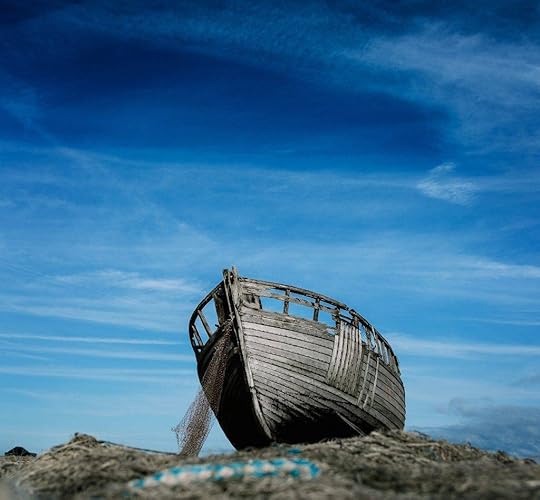
Photo by Alexander Andrews on Unsplash
Sunday Gospel for Fruitless Nights Without Jesus: Luke 5:1–11 (NKJV)So it was, as the multitude pressed about Him to hear the word of God, that He stood by the Lake of Gennesaret, 2 and saw two boats standing by the lake; but the fishermen had gone from them and were washing their nets. 3 Then He got into one of the boats, which was Simon’s, and asked him to put out a little from the land. And He sat down and taught the multitudes from the boat.
4 When He had stopped speaking, He said to Simon, “Launch out into the deep and let down your nets for a catch.”
5 But Simon answered and said to Him, “Master, we have toiled all night and caught nothing; nevertheless at Your word I will let down the net.” 6 And when they had done this, they caught a great number of fish, and their net was breaking. 7 So they signaled to their partners in the other boat to come and help them. And they came and filled both the boats, so that they began to sink. 8 When Simon Peter saw it, he fell down at Jesus’ knees, saying, “Depart from me, for I am a sinful man, O Lord!”
9 For he and all who were with him were astonished at the catch of fish which they had taken; 10 and so also were James and John, the sons of Zebedee, who were partners with Simon. And Jesus said to Simon, “Do not be afraid. From now on you will catch men.” 11 So when they had brought their boats to land, they forsook all and followed Him.
Missing Jesus
We read in Luke 5:1–2: “So it was, as the multitude pressed about Him to hear the word of God, that He stood by the Lake of Gennesaret, and saw two boats standing by the lake; but the fishermen had gone from them and were washing their nets.”
Jesus attracted the crowds. His personality was magnetic to hungry hearts. Even when He “was outside in deserted places; [people] came to Him from every direction” (Mark 1:45b). Multitudes pressed around Him to hear the word of God, believing He was the Messiah. But the fishermen were not among the crowd. They had been out on the lake since early morning, fishing. Yet their catch would not have been any less had they remained on land.
Their efforts bore little fruit because Jesus was not in the boat with them.
This happens in our lives as well. When we act in our own wisdom or strength, we produce only what our natural abilities can achieve. But our ways will not expand the Kingdom of God in our souls, nor will they have any lasting impact on the world around us.
Fruitless Nights or Fishing Jesus’ Way?
In Luke 5:3–4, we read: “Then He got into one of the boats, which was Simon’s, and asked him to put out a little from the land. And He sat down and taught the multitudes from the boat. When He had stopped speaking, He said to Simon, ‘Launch out into the deep and let down your nets for a catch.’”
Simon allowed Jesus to enter his boat, and Jesus used it to teach the people. When we surrender our lives and abilities for God’s purposes, we often discover that He works in ways we didn’t expect. We want the fish. “Come on, Jesus. I was out all night. I’m tired. Let’s just get the fish so my family can eat and I can go to bed.”
But when we offer ourselves to God, He often positions us to serve others—just not always in the way we imagined. “But seek first the kingdom of God and His righteousness, and all these things shall be added to you” (Matt 6:33).
Jesus is faithful. When we care for the needs of others, He always takes care of ours. “And he who waters will also be watered himself” (Prov. 11:25a). And as we just read in Luke 5:4: “When He had stopped speaking, He said to Simon, ‘Launch out into the deep and let down your nets for a catch.’”

Photo by Zoltan Tasi on Unsplash
Toil in the NightWe read in Luke 5:5: “But Simon answered and said to Him, ‘Master, we have toiled all night and caught nothing; nevertheless at Your word I will let down the net.’” This is what happens when we labor according to our own plans, without the presence of Jesus—toiling through the night, catching nothing. Many of us have experienced this kind of striving. It works for a while—until our patience wears thin and everything comes to a sudden halt.
This image of the boat fishing in vain through the night without Jesus is a picture of how parts of our souls can look. Even though we are born again by the Spirit and adopted as children of God, there are still areas within us that need to come under Christ’s reign. How can we recognize these places in our lives? It’s where we toil in the night—working hard but bearing little fruit.
In these weeks, the Holy Spirits helps us uncover these hidden places—areas still in darkness, untouched by the King’s leadership. But we also begin to hear His whispers, gently calling us to abandon our own ways and wisdom, and to follow God’s direction. His way may seem difficult—contrary to our past experiences or natural understanding—but we will find grace to say, “Nevertheless, at Your word I will let down the net.”
Fruitless Nights or On Our Knees?
In Luke 5:5–6, 8, we read: “But Simon answered and said to Him, ‘Master, we have toiled all night and caught nothing; nevertheless at Your word I will let down the net.’ 6 And when they had done this, they caught a great number of fish, and their net was breaking. […] 8 When Simon Peter saw it, he fell down at Jesus’ knees, saying, ‘Depart from me, for I am a sinful man, O Lord!’”
When we find the courage to obey God’s direction—especially when it runs contrary to our experience—we begin to see results that also defy our expectations. And when we witness God working through us, it brings us to our knees. We become acutely aware of how small we are, and how powerful God works when we surrender to His leadership. “And He said to me, ‘My grace is sufficient for you, for My strength is made perfect in weakness’” (2 Cor. 12:9).
Jesus said to Simon in Luke 5:10: “Do not be afraid. From now on you will catch men.” Before God extends His reign into certain areas of our soul, we often experience those parts as weaknesses—places we would rather hide or ignore. They might even embarrass us. But once God redeems them, those very weaknesses become strengths. What once brought us shame now becomes a testimony that glorifies God.
Concluding Fruitless Nights Without JesusLet us pray this week that the Holy Spirit opens our eyes to the areas in which we are still toiling all night and catching nothing. His desire is not to make us feel like failures, but to lead us into the process of repentance—the key to this Season of Salvation.
This process begins by embracing something that challenges our logic and prior understanding. But it ends with Jesus fully present in our boat—perhaps even before we reach the end of this year’s Divine Calendar.
I’m so grateful to share this time with you. Thank you for walking with me through the Seasons of Salvation. May God bless you and lead you into all that He has prepared for your life—both in this week and in this season.
Please leave a comment below—we’d love to hear your thoughts. If you found this post helpful, feel free to share it using the buttons at the top of the page.
Join the Journey Through the Seasons of SalvationJoin us on this weekly journey through the Seasons of Salvation as we walk in the footsteps of Jesus Christ through the key seasons of His life.
Sign up to receive this year’s Divine Calendar, which introduces the Seasons of Salvation and guides you through the journey ahead. As a welcome gift, you’ll also receive my young adult novel, The Legend of the Divine Calendar, delivered straight to your inbox.
Visit the Seasons of Salvation blog for insights into the coming week, posted every Saturday. We’d be honored to have you join us.
Save Your Prayer Card on Your Smartphone
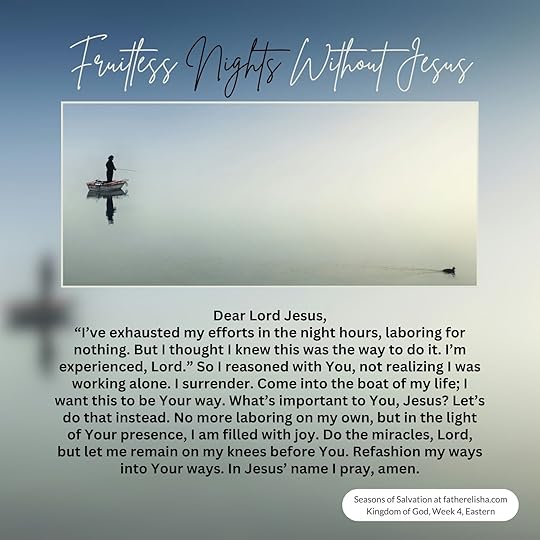
Photo by Johannes Plenio on Unsplash
The post Kingdom of God 4 (Eastern): Fruitless Nights Without Jesus first appeared on Father Elisha: Let me take you on an intriguing journey..