Father Elisha's Blog, page 3
September 26, 2025
Kingdom of God 4 (Western): The Inner Vacuum and Mary’s Alabaster Flask

 The Spiritual Mysteries of the Divine Calendar: The Inner Vacuum and Mary’s Alabaster Flask ~ September 28 – October 4, 2025 ~
 God helps us love Him more. In this first Season of the Divine Calendar, the key of repentance guides us to deepen our love for Him. It may sound contradictory, but the Holy Spirit seeks to highlight a part of our soul that is untouched by the Kingdom of God. In previous weeks, we talked about Building the Kingdom of God, then Recognizing Our Call to Repentance, and last week, we turned to Zacchaeus and His Desire to See Jesus. Today, we will look at a female parallel to Zacchaeus—the woman with the alabaster flask.
Jesus seeks to deepen our hearts’ response to Him. In this week’s Sunday Gospel, Jesus says: “There was a certain creditor who had two debtors. One owed five hundred denarii, and the other fifty. And when they had nothing with which to repay, he freely forgave them both. Tell Me, therefore, which of them will love him more?” (Luke 7:41–42).
When we get a renewed personal understanding of God’s mercy and His love toward us, our hearts respond in gratitude and devotion.
“But when the kindness and the love of God our Savior toward man appeared, not by works of righteousness which we have done, but according to His mercy He saved us…” (Titus 3:4–5).
A Blessed CycleWith the passage from Luke 7 in mind, we can say that God desires to help us see the amount of denarii we are indebted to Him. However, we run into our own bankruptcy—we have nothing to pay with. But then we comprehend, yet again, that Jesus paid our debt in full on the Cross, and our love for Jesus grows.
This deepened understanding of the goodness of God leads us to more repentance, because “… knowing that the goodness of God leads you to repentance” (Rom. 2:4).
The current Season of the Kingdom of God helps us uncover our debt, deepen our love as we see that, in His goodness, God has erased it, and leads us into repentance—only to uncover more of our debt. It is a blessed cycle of seeing our debt, receiving forgiveness, deepening our love, and entering new repentance toward discovering more of our debt.
The Throne in Our Soul
John the Baptist proclaimed in the first week of this Season: “Repent, for the kingdom of heaven is at hand!” (Matt. 3:2). In the second week, Jesus the King declared that the greatest commandments of the Kingdom are to love God with all our being and to love our neighbor as ourselves. These first two weeks declared the Kingdom of Heaven on the earth.
Jesus clarified, “the kingdom of God does not come with observation; nor will they say, ‘See here!’ or ‘See there!’ For indeed, the kingdom of God is within you” (Luke 17:20–21). The Greek word translated as within can mean both “inside” and “among.” How can we understand this if “the kingdom of God does not come with observation”?
Our heart—same as our spirit—is the throne of the Kingdom of God within, but Jesus desires to extend His domain into the land of our soul. When the Kingdom expands internally, it also extends around us through our obedience to our Heavenly Father.
The more we allow the Holy Spirit to continue sanctifying our souls and extending the Kingdom within, the more our external lives testify to the Kingdom of God, and our homes and ministries will manifest the authority of Christ’s Kingdom.

Photo by Lucas Mordzin on Unsplash
Completing the Picture of EmptinessLast week, we learned how the city of the self—our inner Jericho—limits the expansion of the Kingdom of God in our souls. The thrones of His Majesty, King Ego, must fall before God’s Kingdom can grow within and manifest outwardly. Both last week and this week focus on receiving revelation about what the absence of the Kingdom looks like internally—life under the dominion of King Ego.
The business of “vanity and grasping for the wind” (Eccl. 1:14) drives King Ego, and he whips his inhabitants to serve this unending economy. But as Jesus fills us with truth and eternal substance, the dominion of King Ego is exposed for what it is: an economy of emptiness.
Last week, we followed the story of a man—how he obeyed sin, loved the ways of the fallen world, and was brought low through his pride. This week, we turn to the absence of the Kingdom in a woman. Yet to encourage us, we also see her response—like Zacchaeus—in profound repentance and love for the King of Heaven, which is the key to this Season.
It is important to remember that both stories reflect a spiritual reality present in both men and women. And even though we speak of the absence of the Kingdom of God in certain parts of our souls, we remain children of God—forever His own—because of Christ’s death, resurrection, and the new covenant in His blood.
The absence of the Kingdom simply means the need for further sanctification, that we may become more Christlike. As Paul writes, “work out your own salvation with fear and trembling; for it is God who works in you both to will and to do for His good pleasure” (Phil. 2:12b–13).
Sunday Gospel for Mary’s Alabaster Flask: Luke 7:36–50 (NKJV)
Then one of the Pharisees asked Him to eat with him. And He went to the Pharisee’s house, and sat down to eat. 37 And behold, a woman in the city who was a sinner, when she knew that Jesus sat at the table in the Pharisee’s house, brought an alabaster flask of fragrant oil, 38 and stood at His feet behind Him weeping; and she began to wash His feet with her tears, and wiped them with the hair of her head; and she kissed His feet and anointed them with the fragrant oil.
39 Now when the Pharisee who had invited Him saw this, he spoke to himself, saying, “This Man, if He were a prophet, would know who and what manner of woman this is who is touching Him, for she is a sinner.”
40 And Jesus answered and said to him, “Simon, I have something to say to you.” So he said, “Teacher, say it.” 41 “There was a certain creditor who had two debtors. One owed five hundred denarii, and the other fifty. 42 And when they had nothing with which to repay, he freely forgave them both. Tell Me, therefore, which of them will love him more?” 43 Simon answered and said, “I suppose the one whom he forgave more.”
And He said to him, “You have rightly judged.” 44 Then He turned to the woman and said to Simon, “Do you see this woman? I entered your house; you gave Me no water for My feet, but she has washed My feet with her tears and wiped them with the hair of her head. 45 You gave Me no kiss, but this woman has not ceased to kiss My feet since the time I came in. 46 You did not anoint My head with oil, but this woman has anointed My feet with fragrant oil.
47 Therefore I say to you, her sins, which are many, are forgiven, for she loved much. But to whom little is forgiven, the same loves little.”
48 Then He said to her, “Your sins are forgiven.” 49 And those who sat at the table with Him began to say to themselves, “Who is this who even forgives sins?” 50 Then He said to the woman, “Your faith has saved you. Go in peace.”
Filling the Vacuum
In Luke 7:36–37a, we read: “Then one of the Pharisees asked Him to eat with him. And He went to the Pharisee’s house, and sat down to eat. And behold, a woman in the city who was a sinner, when she knew that Jesus sat at the table in the Pharisee’s house, brought an alabaster flask of fragrant oil.”
This woman (mostly likely Mary Magdalene) had led an immoral life. Yet her way of life reflected a condition present in every soul: an inner emptiness craving to be filled.
God created the human soul to be filled with His Spirit. In the Garden of Eden, the Spirit of God sustained the soul. He made us to be united with Him; the Creator never intended us to live or function apart from Him. In His Kingdom, God permeates and fills everything.
We hear the seraphim in eternity calling out to one another: “Holy, holy, holy is the Lord of hosts; the whole earth is full of His glory!” (Isa. 6:3b) And in Ephesians 4:10, it is written: “He who descended is also the One who ascended far above all the heavens, that He might fill all things.” Likewise, 1 Corinthians 15:28 echoes this truth: “Now when all things are made subject to Him, then the Son Himself will also be subject to Him who put all things under Him, that God may be all in all.”
The Craving
When mankind fell into sin in the Garden, and the Spirit lifted from man, the soul collapsed. Cracks and voids formed, and these areas of emptiness desperately cry out to be filled—driving humans to satisfy this vacuum with sinful passions, which are simply another form of emptiness.
Man, in this tragic state, cannot understand why nothing satisfies him. So he digs deeper in his attempts to fill the inner void. The craving emptiness is another picture of what the absence of the Kingdom of God looks like in our souls.
During these weeks, God gives grace to uncover vain cravings within us—so that we may repent and allow Him to fill those empty places. The replacement of hopeless craving with the satisfaction found in God—through repentance—will not be completed this week or even within this Season.
But we receive the grace to recognize and comprehend our inner emptiness. We can begin to pray and confess our need before God, trusting that His work in us will be completed during the Seasons of Salvation in the Divine Calendar.
After the third Season of Salvation—the Season of Crucifixion—God works to fully crucify these empty parts of our soul and release the life of the resurrection: “Christ in you, the hope of glory” (Col 1:27b).
But for now, let us begin by recognizing an emptiness we may never have seen before. This is the work of deep, revelatory repentance, as we mentioned last week.

Photo by Alexander Grey on Unsplash
Mary’s Complete RepentanceIn Luke 7:37b–38, we read: “when she knew that Jesus sat at the table in the Pharisee’s house, brought an alabaster flask of fragrant oil, and stood at His feet behind Him weeping; and she began to wash His feet with her tears, and wiped them with the hair of her head; and she kissed His feet and anointed them with the fragrant oil.”
Like Zacchaeus, who “sought to see who Jesus was” (Luke 19:3) and climbed a tree in desperation, Mary also radically changed her life—this was radical, complete repentance.
When she learned that Jesus was dining at a Pharisee’s house—a house full of people who knew her sinful past—she ignored the possibility of shame and rejection at the door. She couldn’t help herself. Mary had to see Jesus. He was the Messiah, the Redeemer who could save her. He was her only hope.
Perhaps she recalled the Psalm: “Out of the depths I have cried to You, O Lord; Lord, hear my voice! Let Your ears be attentive to the voice of my supplications. If You, Lord, should mark iniquities, O Lord, who could stand? But there is forgiveness with You, that You may be feared” (Ps. 130:1–4).
The little she knew about Jesus was enough—only He could make her whole.
The Alabaster Flask
She left her dwelling and “brought an alabaster flask of fragrant oil”—a very expensive perfume, probably purchased with most of her savings. After entering the house, she saw Jesus reclining at the table. She wept and “began to wash His feet with her tears.”
With tears of repentance, she cared for Jesus’ sore and dusty feet, because the Pharisee “gave Me no water for My feet.” The feet of Jesus are, as the prophet said, “the feet of him who brings good news, who proclaims peace, who brings glad tidings of good things, who proclaims salvation” (Isa 52:7).
Mary’s tears expressed two intense emotions in her heart: the pain knowing her sin, and the overwhelming gratitude for the salvation Jesus brought.
Mary “wiped [Jesus’ feet] with the hair of her head.” As Paul writes, “if a woman has long hair, it is a glory to her” (1 Cor. 11:15). Her hair symbolized her dignity. By drying Jesus’ feet with it, she expressed deep humility. Only His salvation could restore her dignity after her sinful past.
Then she “kissed His feet,” while the Pharisee “gave Me no kiss.” But, Jesus said, “her sins, which are many, are forgiven, for she loved much.”
Finally, she “anointed [His feet] with the fragrant oil,” whereas the Pharisee “did not anoint My head with oil.”
This oil represented the most precious thing she owned—and she spent it to meet Jesus’ need: His weary feet after a long walk. But more than that, this oil symbolized the outpouring of her soul. What once had been spent in pursuit of empty cravings was now poured out in love. Now, her deepest desire—the craving of her soul—had changed: she craved to minister to Jesus.
The Alabaster Flask: Knowing Jesus
This dramatic change in Mary’s inner life reveals not only the radical depth of her repentance but also the tremendous presence of Jesus—our indescribable Savior. Mary once had an intense craving to fill her inner emptiness. Now, that longing was transformed into a deep desire to serve Jesus—to care for His sore feet.
How astonishing is His presence—His mercy, His meekness, His humility—that He can convert the craving of the human soul!
This woman was most likely the same one whom Jesus rescued from being stoned, as recorded in John 8:3–11. Her knowledge of Jesus changed her life forever. She brought the alabaster flask to meet Him. His presence was enough. His love filled her yearning soul. And in response, she gave her whole being to minister to Him.
Jesus said it Himself: “Therefore I say to you, her sins, which are many, are forgiven, for she loved much” (Luke 7:47).
And in verse 50: “Then He said to the woman, ‘Your faith has saved you. Go in peace.’”
May we also receive fresh revelation of the utterly marvelous Jesus Christ during this Season of Salvation. A renewed experience of His presence is the grace we need to redirect—to repent from—the empty cravings of our souls.
This repentance is not the denial of our craving, but the surrender to the only One who can truly satisfy our being.
May Holy Spirit reveal Jesus to us—helping us turn from the futilely of filling our souls with emptiness, and instead, “know the love of Christ which passes knowledge; that you may be filled with all the fullness of God” (Eph. 3:19).
“And of His fullness we have all received, and grace for grace” (John 1:16).
Concluding the Inner Vacuum and Mary’s Alabaster FlaskThank you for taking the time to read. I pray the Lord will bless and guide us this week, leading us into His plans for this season of our lives. We all long to know Jesus more, and it is an honor to be on this journey together with you.
Please leave a comment below—we’d love to hear your thoughts. If you found this post helpful, feel free to share it using the buttons at the top of the page.
Join the Journey Through the Seasons of SalvationJoin us on this weekly journey through the Seasons of Salvation as we walk in the footsteps of Jesus Christ through the key seasons of His life.
Sign up to receive this year’s Divine Calendar, which introduces the Seasons of Salvation and guides you through the journey ahead. As a welcome gift, you’ll also receive my young adult novel, The Legend of the Divine Calendar, delivered straight to your inbox.
Visit the Seasons of Salvation blog for insights into the coming week, posted every Saturday. We’d be honored to have you join us.
Save Your Prayer Card on Your Smartphone
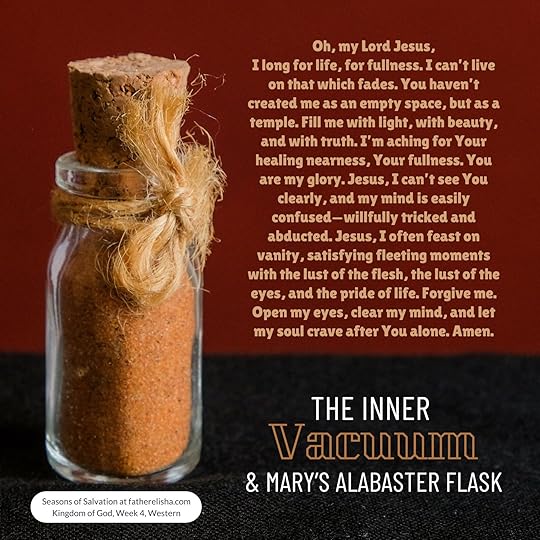
Photo by Emrullah Ses on Unsplash
The post Kingdom of God 4 (Western): The Inner Vacuum and Mary’s Alabaster Flask first appeared on Father Elisha: Let me take you on an intriguing journey..


September 19, 2025
Kingdom of God 3 (Eastern): Moving Out of the Box in Our Spiritual Life
 The Spiritual Mysteries of the Divine Calendar: Moving Out of the Box in Our Spiritual Life ~ September 21–27, 2025 ~
 We are in the first Season of Salvation in the Divine Calendar, which focuses on the Kingdom of God for two and a half months. The Holy Spirit draws our attention to what the Kingdom of God looks like, how to recognize its absence in a specific area of our soul, and how to prepare these areas for God’s redemptive work. First, we looked at The Church New Year (Indiction), then we discovered what Repentance truly is, and this week we are turning to how to grasp a new, unknown step in our spiritual life.
Also, last week, we celebrated two events closely linked to this Season, the Season of the Kingdom of God: The Nativity of the Virgin Mary and The Feast of the Exaltation of the Cross. Let us now continue our journey to draw even closer to the Lover of Mankind, Jesus Christ.
However, if you attend an Eastern Old Calendar parish, I believe you will enjoy these talks from Week 2 of the Season of the Kingdom of God: Repentance — A Turn Toward What? and The Feast of the Exaltation of the Cross.
The Season of the Kingdom of GodGod wants to move our lives forward in His plans—both our personal devotion to Him, our call to work in His Kingdom, and His plans to prepare ourselves and others for the Second Coming of Jesus.
During these weeks, we will taste a blessed state—a foretaste—a glimpse of what God wants to establish in our lives. We will discover a specific weakness that hinders this blessed glimpse we experience, but this darkened spot will be worked on by God throughout the seasons of Incarnation, Crucifixion, Resurrection, Ascension, and Pentecost.
During the first few journeys through the Divine Calendar in a focused way, these impressions usually appear subtly. But after a few years, we recognize the taste or spiritual atmosphere of the different Seasons of Salvation, and the unique enabling grace each Season provides. The Holy Spirit imparts the life Jesus lived into our inner man. We tap into the stream of Christ’s life. We live Jesus. As Saint Sophrony (1896–1993) titled his famous book, His Life Is Mine.
“I have been crucified with Christ; it is no longer I who live, but Christ lives in me; and the life which I now live in the flesh I live by faith in the Son of God, who loved me and gave Himself for me” (Gal. 2:20).
I believe that the more we stay faithful to this unique journey with Jesus, the more distinct each Season becomes, the more transforming the outcome, and the more we see one year laying the foundation for the next.
Let us now turn to this week’s Sunday Gospel.

Photo by Dmitry Ratushny on Unsplash
Sunday Gospel for Moving Out of the Box in Our Spiritual Life: Matthew 22:35–46 (NKJV)Then one of them, a lawyer, asked Him a question, testing Him, and saying, 36 “Teacher, which is the great commandment in the law?”
37 Jesus said to him, “‘You shall love the Lord your God with all your heart, with all your soul, and with all your mind.’ 38 This is the first and great commandment. 39 And the second is like it: ‘You shall love your neighbor as yourself.’ 40 On these two commandments hang all the Law and the Prophets.”
41 While the Pharisees were gathered together, Jesus asked them, 42 saying, “What do you think about the Christ? Whose Son is He?”
They said to Him, “The Son of David.”
43 He said to them, “How then does David in the Spirit call Him ‘Lord,’ saying: 44 ‘The Lord said to my Lord, “Sit at My right hand, till I make Your enemies Your footstool” ’?
45 If David then calls Him ‘Lord,’ how is He his Son?” 46 And no one was able to answer Him a word, nor from that day on did anyone dare question Him anymore.
Comprehending the Incomprehensible
We read in Matthew 22:35–36: “Then one of them, a lawyer, asked Him a question, testing Him, and saying, ‘Teacher, which is the great commandment in the law?’”
A Pharisee and an expert of the law tested Jesus—questioning whether He could be called Teacher. Clearly, he didn’t believe or know who he was talking to. Even though the rumor said Jesus was the Messiah, the man had to know for himself. He was spiritually blind. Jesus wanted to help him take another step on the journey of comprehending who He actually was.
Jesus answered in Matthew 22:37–40 that anyone could fulfill the commandments of the Law and the Prophets by keeping the two great commandments of loving God and loving one’s neighbor as oneself. We will look at this toward the end, but Jesus masterly answered the lawyer’s question.
Jesus Tests the Pharisees
Now Jesus turned to the Pharisees, testing them in return. “What do you think about the Christ? Whose Son is He?” (Matt. 22:42) Jesus underlined the problem: they couldn’t perceive who He was.
They recalled what God told King David after the king wanted to build God a house: “And your house and your kingdom shall be established forever before you. Your throne shall be established forever” (2 Sam. 7:16).
This promise remained with the Israelites, and they knew the great Prophet that Moses proclaimed, the Messiah (Deut. 18:15), would come from the genealogy of King David—which He did (Luke 3:23–31). The Archangel Gabriel announced to the Virgin Mary: “He will be great, and will be called the Son of the Highest; and the Lord God will give Him the throne of His father David.”
The Pharisees therefore answered, “The Son of David” (Matt. 22:42). But Jesus surprised them, saying, “How then does David in the Spirit call Him ‘Lord,’ saying: ‘The Lord said to my Lord, [emphasis added] Sit at My right hand, till I make Your enemies Your footstool’? If David then calls Him ‘Lord,’ how is He his Son?” (Matt. 22:43–45)
This answer stunned the Pharisees. “And no one was able to answer Him a word, nor from that day on did anyone dare question Him anymore” (Matt. 22:46).
This is as difficult for many to accept today as it was for them. Most can accept Jesus as a human, the Son of David, but He was also fully God—the Son of God. Today, we can formulate the Incarnation mystery, but for the Pharisees and lawyers to accept that the Man standing before them was also fully God was far beyond their ability to comprehend.

Photo by Roman Kirienko on Unsplash
Moving Out of the Box in Our Spiritual LifeSince we have heard many times that Jesus is fully God and fully man, we are used to this truth and can comprehend—or at least believe—this mystery. But before God revealed this reality about Himself, and before we could carefully and precisely express it as dogma, the Incarnation was as far beyond anyone’s experience as one could get.
A Pharisee might say: “Teacher, are you telling us that you, flesh and blood, eyes and ears, are the Living God, and ‘Lord of hosts, God of Israel, the One who dwells between the cherubim, […] God […] of all the kingdoms of the earth. [Who] made heaven and earth?’ (Isaiah 37:16) And you want us to believe it?!”
God is now challenging our former understanding and expectation of Who He is and how He acts—but on a much smaller scale. Sometimes we put God into a neat box with a golden bow, but if “heaven and the heaven of heavens cannot contain [Him]” (1 Kings 8:27), how much less can our concept of Who He is and how He deals with us and the world be all there is to God?
We read in Isaiah 55:8–9: “‘For My thoughts are not your thoughts, nor are your ways My ways,’ says the Lord. ‘For as the heavens are higher than the earth, so are My ways higher than your ways, and My thoughts than your thoughts.’”
May we seek the Lord’s grace this week to understand more of what He wants to show about His ways with us, His Kingdom, and the world.
The Way of Worship
What can we do to grasp and accept the exceptional? What did Jesus tell the Pharisees? He challenged them to accept that not only was He the Son of David in the earthly lineage, but He was also the Lord of David—the Son of God. “If David then calls Him ‘Lord,’ how is He his Son?” (Matt. 22:45)
Jesus told the lawyer that all the Laws and the Prophets hung on the commandments: “‘You shall love the Lord your God with all your heart, with all your soul, and with all your mind.’ This is the first and great commandment. And the second is like it: ‘You shall love your neighbor as yourself’” (Matt. 22:37–39).
If they would accept Him as the Lord of David, their worship of Him with all their heart, soul, and mind would make them channels of divine love, enabling them to love their neighbor as themselves. It is worship that enables us to comprehend what we previously could not understand about the Kingdom of God.
A Challenge for Our Spiritual Life
What does our life of worship look like? Do we need to slow our lives down? Has the business of everyday life captured our priorities? Was our worship more fervent or dedicated in the past? Do we need to remember to Whom we belong? Have we forgotten that God patiently waits for our conversation, our silence, our words of love?
We read in Luke 17:21: “The kingdom of God is within you.” What do we give our hearts to? We may remember what’s written in Proverbs 4:23: “Keep your heart with all diligence, for out of it spring the issues of life.”
Psalm 46:10 says: “Be still, and know that I am God.”
If we go for a hike in the forest, in the mountains, or out in the desert, have we noticed how calm everything is? How slow? Everything obeys the laws of God—the puffy white clouds, the rattling leaves between dancing rays of sunshine, and the desert flower. How do our lives compare to this? May we be able to move out of the box in our spiritual life and comprehend more of the incomprehensible God.
Concluding Moving Out of the Box in Our Spiritual LifeI’m so thankful to spend this time with you. Thank you for joining me on this journey through the Seasons of Salvation. May God bless you and lead you into all that He has in store for your life this week and in this season.
Please leave a comment below—we’d love to hear your thoughts. If you found this post helpful, feel free to share it using the buttons at the top of the page.
Join the Journey Through the Seasons of SalvationJoin us on this weekly journey through the Seasons of Salvation as we walk in the footsteps of Jesus Christ through the key seasons of His life.
Sign up to receive this year’s Divine Calendar, which introduces the Seasons of Salvation and guides you through the journey ahead. As a welcome gift, you’ll also receive my young adult novel, The Legend of the Divine Calendar, delivered straight to your inbox.
Visit the Seasons of Salvation blog for insights into the coming week, posted every Saturday. We’d be honored to have you join us.
Save Your Prayer Card on Your Smartphone
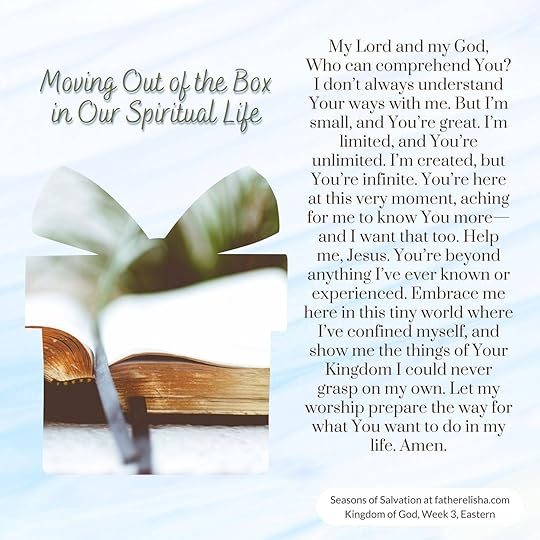
Photo by Ben White on Unsplash
The post Kingdom of God 3 (Eastern): Moving Out of the Box in Our Spiritual Life first appeared on Father Elisha: Let me take you on an intriguing journey..
Kingdom of God 3 (Western): Zacchaeus and His Desire to See Jesus
The Spiritual Mysteries of the Divine Calendar: Zacchaeus and His Desire to See Jesus ~ September 21–27, 2025 ~ The first Scripture passage in the Divine Calendar is Jesus’ announcement of Himself as the Messiah in the synagogue in Nazareth (Luke 4:14–30). Then Jesus continues the words of the Forerunner, John the Baptist, “Repent, for the kingdom of heaven is at hand!” (Matt. 3:2) by saying, “I am the King of the Kingdom of Heaven. I’m finally here. Follow me.” In this third week of the Season of the Kingdom of God, let us see how Zacchaeus responded to His message—and how this man’s extraordinary desire to see Jesus can impact our hearts as well.
Last week, we celebrated two events closely linked to this Season: The Nativity of the Virgin Mary and The Feast of the Exaltation of the Cross. We are now in the third week of the first Season of Salvation in the Divine Calendar, and we continue our quest to draw even closer to the Lover of Mankind, Jesus Christ.
The Lost InheritanceJesus came to win back the Kingdom that was lost in the Garden of Eden. God didn’t lose this Kingdom—as if the enemy stole it from His hands—but His children, the inhabitants of the Kingdom of God, freely left His Kingdom by listening to the words of the serpent instead of obeying the only commandment God had given: to love Him above all else, and thereby trust His command. Therefore, after the fall of man, God calls us to love Him, because those who love God keep His commandments: “If you love Me, keep My commandments (John 14:15).
Every person, no matter how hostile they may be toward God and His words, has a place in God’s Kingdom. However, they must still choose to return and reclaim their lost inheritance. “The Spirit Himself bears witness with our spirit that we are children of God, and if children, then heirs—heirs of God and joint heirs with Christ, if indeed we suffer with Him, that we may also be glorified together” (Rom. 8:16–17).
In today’s Sunday Gospel, we will read that Jesus said to Zacchaeus: “Today salvation has come to this house, because he also is a son of Abraham; for the Son of Man has come to seek and to save that which was lost” (Luke 19:9–10).
To Seek and to Save
Jesus is searching, looking, waiting for the slightest movement in the hearts of men toward Him. He constantly seeks, knocks, and waits patiently for a response of love. When we seek Jesus—because we want Him, need Him, or long for Him—He comes immediately. We might not feel it, but He is there.
Jesus is in our world, by the Holy Spirit, “to seek and to save that which was lost.” And He will not relent until His Father says that the time has come, and Jesus “Himself will descend from heaven with a shout, with the voice of an archangel, and with the trumpet of God. And the dead in Christ will rise first. Then we who are alive and remain shall be caught up together with them in the clouds to meet the Lord in the air. And thus we shall always be with the Lord” (1 Thess. 4: 16–17).
But until that day, Jesus is also seeking to extend His Kingdom within our souls. During the Season of the Kingdom of God, we may discover how the Holy Spirit brings to our attention certain areas of our lives that are still void of Christ’s kingship. And that is one of the central reasons we journey through the Seasons of Salvation: “for the Son of Man has come to seek and to save that which was lost” (Luke 19:10). That includes what is lost in our inner lives.
The Story So Far
In the first week of this Season, John the Baptist announced the Kingdom of God—but in a completely unexpected way for the people of Israel: through a baptism of repentance in the waters of the Jordan River. “John came baptizing in the wilderness and preaching a baptism of repentance for the remission of sins” (Mark 1:4).
This tells us that the Holy Spirit wants to help us understand God’s leadership in our lives in a way we have never known before—a true paradigm shift.
In the second week, the Sovereign King of Heaven rejoiced among us—declaring His joy in writing our names in Heaven through His work of salvation. John the Baptist and Jesus Christ unveiled the Kingdom of God in power at the beginning of Christ’s ministry.
In the next two weeks, we encounter the exact opposite: the emptiness of sin and the devastating effects of the absence of the Kingdom of God in our lives. This week, we will see this reality through the story of a man; next week, through the story of a woman. Yet both conditions reflect the human experience—male and female alike. And in both, we will witness their astonishing response of repentance and love.
Photo by Ivan Ulamec on Unsplash
Sunday Gospel for Zacchaeus and His Desire to See Jesus: Luke 19:1–10 (NKJV)Then Jesus entered and passed through Jericho. 2 Now behold, there was a man named Zacchaeus who was a chief tax collector, and he was rich. 3 And he sought to see who Jesus was, but could not because of the crowd, for he was of short stature. 4 So he ran ahead and climbed up into a sycamore tree to see Him, for He was going to pass that way.
5 And when Jesus came to the place, He looked up and saw him, and said to him, “Zacchaeus, make haste and come down, for today I must stay at your house.” 6 So he made haste and came down, and received Him joyfully. 7 But when they saw it, they all complained, saying, “He has gone to be a guest with a man who is a sinner.”
8 Then Zacchaeus stood and said to the Lord, “Look, Lord, I give half of my goods to the poor; and if I have taken anything from anyone by false accusation, I restore fourfold.”
9 And Jesus said to him, “Today salvation has come to this house, because he also is a son of Abraham; 10 for the Son of Man has come to seek and to save that which was lost.”
Jericho
We read in Luke 19:1: “Then Jesus entered and passed through Jericho.” In the Book of Joshua, chapter 6, we read how God called His people to march around Jericho once a day for six days. But on the seventh day, the priests were to blow seven shofars, the people were to shout, and the walls would crumble.
“So the people shouted when the priests blew the trumpets. And it happened when the people heard the sound of the trumpet, and the people shouted with a great shout, that the wall fell down flat. Then the people went up into the city, every man straight before him, and they took the city” (Joshua 6:20).
The Breath
Picture yourself among the forty thousand warriors (Joshua 4:13) on the seventh day. You’ve marched around Jericho six times, and now, on the seventh, with the blast of the shofars and the roar of the people surrounding you, the massive double stone walls—at least thirteen feet high—crumble before your feet. Imagine the boldness that rises within you, knowing that God is with you. The rocks fall at your feet by your breath—God is Sovereign! God is with us!
The meaning of Jericho in Hebrew includes “to blow,” “breath,” and “fragrance.” Even a single breath of obedience to God can cause walls to crumble. “What then shall we say to these things? If God is for us, who can be against us?” (Rom. 8:31)
Now “Jesus entered and passed through Jericho” (Luke 19:1). The early fathers teach that Jericho is symbolic of the fallen world, in contrast to Jerusalem, the city of God.
Ever since we accepted Jesus as our Lord and Savior, His sacrifice has justified us, His saving grace has entered our spirit, and He has adopted us as His children. However, our soul still holds small Jerichos that need to be conquered. These inner Jerichos in the land of the soul represent those places where the Kingdom of God is still absent. Who reigns in our inner Jericho? His majesty, king Ego.
Our Inner Jericho
In verse 2, we read: “Now behold, there was a man named Zacchaeus who was a chief tax collector, and he was rich.” Initially, Zacchaeus represents the image of man living in his inner Jericho. Zacchaeus was a Jew (verse 9), but a tax collector for the Romans. To the Israelites, he was seen as a traitor, working for the enemy. Not just any tax collector, but the chief tax collector. The first characteristic of our inner Jericho is the betrayal of the Kingdom of God through the obedience to sin.
Zacchaeus was rich, which likely implies that he extorted excessive taxes from his people for his own benefit. As we know, “the love of money is a root of all kinds of evil” (1 Tim. 6:10a). The love of money is another characteristic where the Kingdom of God is absent—an allegiance to the ways and plans (the economy) of the fallen world. “If anyone loves the world, the love of the Father is not in him” (1 John 2:15).
Then verse 3 reads: “for he was of short stature.” Symbolically, Zacchaeus had low self-esteem, which is often a veil for pride. His low stature actually symbolizes pride—pride that kept him from seeing Jesus. “And he sought to see who Jesus was, but could not because of the crowd, for he was of short stature.” We read in Proverbs 29:23: “A man’s pride will bring him low, but the humble in spirit will retain honor.”
The Absence of the Kingdom of God
This is what the absence of the Kingdom of God looks like: the attitudes of serving sin, the love of the world, and pride—all of these war against the Kingdom of God. It is a painful reality when the Holy Spirit opens our eyes to these aspects in our lives.
But as we have discussed before, let us not despair when the Holy Spirit reveals an inner Jericho in our soul. Instead, let us kneel before Jesus—who loves us immensely—and confess our sin.
The grace of repentance works deeply in this Season of Salvation, targeting specific roots within us. Whatever we do, let us not lose courage when we feel the reign of his majesty, king Ego. The Holy Spirit is leading us on a journey this Season and into the next (the Season of the Incarnation), preparing an empty throne for Jesus.
Photo by Mario La Pergola on Unsplash
The Repentance of ZacchaeusWe read in Luke 19:3: “And he sought to see who Jesus was, but could not because of the crowd, for he was of short stature.” What happened to Zacchaeus that made him leave his inner Jericho?
In this verse, we see Zacchaeus’s deep desire to seek Jesus. This remarkable man gives us great hope. As established above, Zacchaeus embodied the condition of living absent from the Kingdom of God, but in his desperate longing to see Jesus, he acted in the opposite spirit—with a spirit of humility and repentance. Zacchaeus carried a high calling—his name actually means “pure,” “transparent,” and “clean.”
In verse 4, we read: “So he ran ahead and climbed up into a sycamore tree to see Him, for He was going to pass that way.” In his uncontrollable desire to see Jesus, Zacchaeus disregarded the pride that had concealed his low self-esteem and climbed a tree. He couldn’t care less about what others thought of him—his self-forgetting was an act of repentance.
Zacchaeus Flees His Inner Jericho
After Jesus noticed Zacchaeus in the tree and, moved by the little man’s longing to see Him, the Son of God chose to visit his home. Then we read in verse 8: “Then Zacchaeus stood and said to the Lord, ‘Look, Lord, I give half of my goods to the poor; and if I have taken anything from anyone by false accusation, I restore fourfold.’”
Zacchaeus repented of his love of money and the world by giving away half of his wealth. Furthermore, he repented from his betrayal of the Kingdom of God—symbolized by his collaboration with the Roman occupiers—by restoring fourfold to those he had deceived.
This man fled from living in Jericho and entered the Kingdom of God with such resoluteness that Jesus proclaimed in the final verses: “And Jesus said to him, ‘Today salvation has come to this house, because he also is a son of Abraham; for the Son of Man has come to seek and to save that which was lost’” (Luke 19:9–10).
But the question remains: What caused Zacchaeus’s inner walls of Jericho to collapse? What enabled him to make such radical acts of repentance?
Zacchaeus Recognizes His King
Let us revisit Luke 19:3: “And he sought to see who Jesus was, but could not because of the crowd, for he was of short stature.” What caused Zacchaeus to depart from his inner Jericho? It was his recognition of Who this visiting Man truly was.
Zacchaeus knew that Jesus was the Messiah. Although he had betrayed his Jewish people, his Jewish faith remained intact. Like many others, he likely believed that Jesus would drive out the Romans and establish the earthly Messianic Kingdom. Perhaps Zacchaeus began to realize that serving the Romans was a bad idea, especially if the Messiah was coming to free Israel from their rule.
But there must be more to what caused Zacchaeus’s inner Jericho to collapse, allowing him to perform such extravagant acts of repentance—so powerful that Jesus declared: “Today I must stay at your house.” In Greek, the word must also means “necessary,” “binding,” and “need.”
Zacchaeus recognized the absolute authority of the Heavenly King. Whatever the Messiah commanded, it happened. Perhaps he recalled the shout of the warriors and the blast of the shofars that brought down the walls of Jericho. Either way, we read in Luke 19:1: “Jesus entered and passed through Jericho.” Just like that—no walls hindering him.
Tearing Down Our Walls Like Zacchaeus
The grace and prayer for this upcoming week is for the courage to identify the characteristics of our own inner Jericho, and for the grace of recognize who our King truly is.
Jesus can bring down the walls of our inner Jericho with a single breath from our mouths, or by walking around it in silence for seven days, or through whatever act of obedience He calls us to. It all begins with the key to this Season of Salvation: Repentance. May we, by the grace of God, truly comprehend Whom we serve.
These messages through the Divine Calendar may contain unfamiliar ideas and concepts. We should never believe anything we can’t confirm in the Word of God—so long as we maintain the humble attitude of a disciple, a learner. Don’t worry if you can’t fully grasp or apply everything at once. Take what resonates with you, and let that inspire your prayers this week. Your prayers—especially those based on the Sunday Gospel passage—will help settle that grace deeply within your soul.
Concluding Zacchaeus and His Desire to See JesusThank you for taking the time to read. May God reward and bless you richly as we continue into the third week of this Season of Salvation. It’s an honor to walk with you in the footsteps of Jesus Christ.
Please leave a comment below—we’d love to hear your thoughts. If you found this post helpful, feel free to share it using the buttons at the top of the page.
Join the Journey Through the Seasons of SalvationJoin us on this weekly journey through the Seasons of Salvation as we walk in the footsteps of Jesus Christ through the key seasons of His life.
Sign up to receive this year’s Divine Calendar, which introduces the Seasons of Salvation and guides you through the journey ahead. As a welcome gift, you’ll also receive my young adult novel, The Legend of the Divine Calendar, delivered straight to your inbox.
Visit the Seasons of Salvation blog for insights into the coming week, posted every Saturday. We’d be honored to have you join us.
Save Your Prayer Card on Your Smartphone
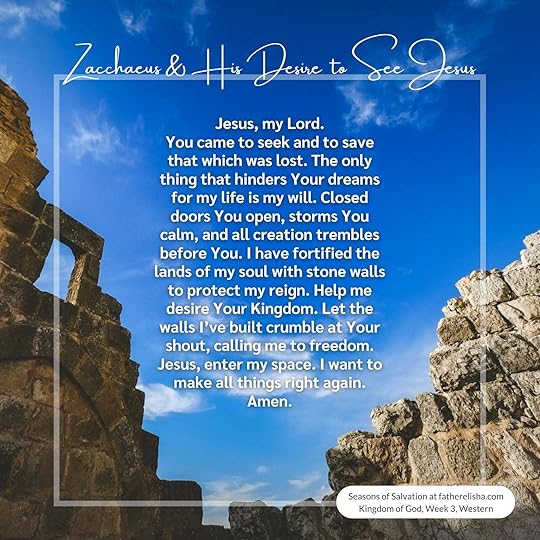
Photo by Francesco Ungaro on Unsplash
The post Kingdom of God 3 (Western): Zacchaeus and His Desire to See Jesus first appeared on Father Elisha: Let me take you on an intriguing journey..
September 12, 2025
Kingdom of God (Western and Eastern): The Feast of the Exaltation of the Cross
The Spiritual Mysteries of the Divine Calendar: The Feast of the Exaltation of the Cross ~ September 14 / September 27 (Eastern Old Calendar), 2025 ~ According to Church tradition, in A.D. 326, God moved Queen Helen, the mother of Emperor Constantine, to search for the actual cross of Jesus’s crucifixion. She traveled to Jerusalem, where a local Jew helped her locate Golgotha and the site where the wooden cross had supposedly been discarded—and she found it. On September 14 (September 27 on the Eastern Old Calendar), we celebrate the Feast of the Exaltation of the Cross, also called the Elevation of the Holy Cross.
Golgotha had become a pile of rubble, but Queen Helen organized a search. She discovered three wooden crosses, and according to tradition, she identified the true Cross of Christ by placing each one over a coffin containing a corpse. When the third cross was placed on the coffin, the dead man rose. (Some accounts tell of the healing of a dying woman instead of a resurrection.)
This feast commemorates the date when Queen Helen ordered the search for the Cross. One of the Gospel readings is John 6:35–46, a passage that resonates with one of the feast’s central themes—resurrection.
This feast also celebrates the return of the Cross to Jerusalem by Emperor Heraclius, after it had been recovered from the Persians in A.D. 628.
The Place of the Exaltation of the Cross in the Divine CalendarThe timing of the feast is significant, as it falls at the beginning of the first Season of Salvation in the Divine Calendar: the Season of the Kingdom of God. At the opening of the Divine Calendar, Jesus proclaimed He was the promised Messiah—therefore the Cross is elevated before us today.
During the second week of this Season, we reflected on having a complete vision of repentance and how it serves as the key to entering the mysteries of this Season of Salvation. The Cross is then placed before us as the source of our atonement.
Finally, just a few days ago, we celebrated the Nativity of the Virgin Mary. In that feast, we reflected on her quiet joy as she bore the cross of misunderstandings and judging eyes.
The Grace of the Cross Aids Our Repentance
From one of the assigned readings for the Exaltation of the Cross, we hear Jesus say in John 6:35: “I am the bread of life. He who comes to Me shall never hunger, and he who believes in Me shall never thirst.”
In John 6:39, Jesus continues: “This is the will of the Father who sent Me, that of all He has given Me I should lose nothing, but should raise it up at the last day.”
Then, in John 6:40: “And this is the will of Him who sent Me, that everyone who sees the Son and believes in Him may have everlasting life; and I will raise him up at the last day.”
Finally, in John 6:44, Jesus says: “No one can come to Me unless the Father who sent Me draws him; and I will raise him up at the last day.”
As God calls us to repentance in this Season of the Kingdom of God, we recognize our deep need for the grace of the Cross—grace that enables us to deny everything that resists genuine repentance. The grace of the Cross accomplishes this and much more. The work of the Cross releases the power of resurrection.
Therefore, we celebrate the finding of the Cross of Christ during this Season in order to receive its grace—grace that aids our repentance and releases the power of eternal life into our souls: “That I may know Him and the power of His resurrection, and the fellowship of His sufferings, being conformed to His death, if, by any means, I may attain to the resurrection from the dead” (Phil. 3:10–11).
The Western Gospel for the Exaltation of the Cross: John 6:35–46 (NKJV)And Jesus said to them, “I am the bread of life. He who comes to Me shall never hunger, and he who believes in Me shall never thirst. But I said to you that you have seen Me and yet do not believe. All that the Father gives Me will come to Me, and the one who comes to Me I will by no means cast out. For I have come down from heaven, not to do My own will, but the will of Him who sent Me.
39 This is the will of the Father who sent Me, that of all He has given Me I should lose nothing, but should raise it up at the last day. And this is the will of Him who sent Me, that everyone who sees the Son and believes in Him may have everlasting life; and I will raise him up at the last day.”
41 The Jews then complained about Him, because He said, “I am the bread which came down from heaven.” And they said, “Is not this Jesus, the son of Joseph, whose father and mother we know? How is it then that He says, ‘I have come down from heaven’?”
43 Jesus therefore answered and said to them, “Do not murmur among yourselves. No one can come to Me unless the Father who sent Me draws him; and I will raise him up at the last day. It is written in the prophets, ‘And they shall all be taught by God.’ Therefore everyone who has heard and learned from the Father comes to Me. Not that anyone has seen the Father, except He who is from God; He has seen the Father.
The Eastern Gospel for the Exaltation of the Cross (NKJV)John 19:6–116 Therefore, when the chief priests and officers saw Him, they cried out, saying, “Crucify Him, crucify Him!” Pilate said to them, “You take Him and crucify Him, for I find no fault in Him.” 7 The Jews answered him, “We have a law, and according to our law He ought to die, because He made Himself the Son of God.”
8 Therefore, when Pilate heard that saying, he was the more afraid, 9 and went again into the Praetorium, and said to Jesus, “Where are You from?” But Jesus gave him no answer. 10 Then Pilate said to Him, “Are You not speaking to me? Do You not know that I have power to crucify You, and power to release You?” 11 Jesus answered, “You could have no power at all against Me unless it had been given you from above. Therefore the one who delivered Me to you has the greater sin.”
John 19:13–20
13 When Pilate therefore heard that saying, he brought Jesus out and sat down in the judgment seat in a place that is called The Pavement, but in Hebrew, Gabbatha. 14 Now it was the Preparation Day of the Passover, and about the sixth hour. And he said to the Jews, “Behold your King!”
15 But they cried out, “Away with Him, away with Him! Crucify Him!” Pilate said to them, “Shall I crucify your King?” The chief priests answered, “We have no king but Caesar!” 16 Then he delivered Him to them to be crucified. Then they took Jesus and led Him away. 17 And He, bearing His cross, went out to a place called the Place of a Skull, which is called in Hebrew, Golgotha, 18 where they crucified Him, and two others with Him, one on either side, and Jesus in the center. 19 Now Pilate wrote a title and put it on the cross. And the writing was:
JESUS OF NAZARETH, THE KING OF THE JEWS.
20 Then many of the Jews read this title, for the place where Jesus was crucified was near the city; and it was written in Hebrew, Greek, and Latin.
John 19:25–28; 30–35
25 Now there stood by the cross of Jesus His mother, and His mother’s sister, Mary the wife of Clopas, and Mary Magdalene. 26 When Jesus therefore saw His mother, and the disciple whom He loved standing by, He said to His mother, “Woman, behold your son!” 27 Then He said to the disciple, “Behold your mother!” And from that hour that disciple took her to his own home. 28 After this, Jesus, knowing that all things were now accomplished, that the Scripture might be fulfilled, said, “I thirst!”
[…]
30 So when Jesus had received the sour wine, He said, “It is finished!” And bowing His head, He gave up His spirit.
31 Therefore, because it was the Preparation Day, that the bodies should not remain on the cross on the Sabbath (for that Sabbath was a high day), the Jews asked Pilate that their legs might be broken, and that they might be taken away.
32 Then the soldiers came and broke the legs of the first and of the other who was crucified with Him. 33 But when they came to Jesus and saw that He was already dead, they did not break His legs. 34 But one of the soldiers pierced His side with a spear, and immediately blood and water came out. 35 And he who has seen has testified, and his testimony is true; and he knows that he is telling the truth, so that you may believe.
Photo by Jon Tyson on Unsplash
Crucifying the Wisdom of the MindWe need the power of the Cross daily in our Christian life. But how do we actually receive this power? We need the grace of the Cross to crucify the wisdom of our earthly minds so that we can receive the wisdom from above:
“But the wisdom that is from above is first pure, then peaceable, gentle, willing to yield, full of mercy and good fruits, without partiality and without hypocrisy” (James 3:17).
Throughout the day, we often rely on our own wisdom to make decisions and set priorities. But what we actually need is the Holy Spirit to grant us wisdom from above. Because our lives are so often busy and noisy, we rarely give the Holy Spirit the space to help us or to speak. We need moments of stillness—quiet breaks in the day—so the Holy Spirit can come with His wisdom.
“‘Go out, and stand on the mountain before the Lord.’ And behold, the Lord passed by, and a great and strong wind tore into the mountains and broke the rocks in pieces before the Lord, but the Lord was not in the wind; and after the wind an earthquake, but the Lord was not in the earthquake; and after the earthquake a fire, but the Lord was not in the fire; and after the fire a still small voice” (1 King 19:11–12).
By forming the simple habit of whispering short prayers throughout the day—asking God for wisdom—we create space for Him to inspire our thoughts and give us insights that will amaze us. “If any of you lacks wisdom, let him ask of God, who gives to all liberally and without reproach, and it will be given to him” (James 1:5).
The Power of the Cross
Alongside the power of our minds, we also face strong fallen desires that influence our decisions in ways that oppose the inspired paths empowered by the Holy Spirit:
“These things I have spoken to you while being present with you. But the Helper, the Holy Spirit, whom the Father will send in My name, He will teach you all things, and bring to your remembrance all things that I said to you” (John 14:25–26). “Your word is a lamp to my feet and a light to my path” (Ps. 119:105).
The power of the Cross establishes our steps so that the confusing and deceiving winds of the enemy will not easily sway our will:
“For the message of the cross is foolishness to those who are perishing, but to us who are being saved it is the power of God. For it is written: ‘I will destroy the wisdom of the wise, and bring to nothing the understanding of the prudent’” (1 Cor. 1:18–19).
A practical note: We may not always think of it this way, but when we make the sign of the cross, we are declaring its power over our minds and souls. And if we do this consciously—believing in the power of the Cross—it will have an effect. The Cross is the source of our spiritual power, keeping us on the path of salvation.
Photo by Gyde Ru on Unsplash
The Protection of the CrossWe read in Galatians 6:14: “But God forbid that I should boast except in the cross of our Lord Jesus Christ, by whom the world has been crucified to me, and I to the world.” The cross forms a spiritual wall around us—protecting and separating us from the fallen world.
The spirit of the world (see 1 Corinthians 2:12; 1 John 2:15–17) carries a kind of bitterness that seeks to seep into our souls and embitter us. But when we trust in the power of the Cross—whether through prayer or by making the sign of the Cross—that bitterness is transformed into sweetness.
“Now when they came to Marah, they could not drink the waters of Marah, for they were bitter. Therefore the name of it was called Marah. And the people complained against Moses, saying, ‘What shall we drink?’ So he cried out to the Lord, and the Lord showed him a tree. When he cast it into the waters, the waters were made sweet” (Ex. 15:23).
The Victory of the Cross
Finally, when we seek the power of the Cross, it always leads us toward resurrection. If we keep asking for the wisdom from above instead of relying on the wisdom of our own minds; if we seek the power of the Cross to establish our steps against the misleading winds of the enemy—using the sign of the Cross; and if we pray and allow the Cross to form a wall of separation between us and the fallen world, shielding us from its bitterness—then the Cross will always lead us to resurrection.
The Cross is the source of our victory in every trial we face.
“That I may know Him and the power of His resurrection, and the fellowship of His sufferings, being conformed to His death, if, by any means, I may attain to the resurrection from the dead” (Phil. 3:10–11).
Blessed Feast of the Exaltation of the Cross!
Concluding the Feast of the Exaltation of the CrossLet us pray for the grace of the Cross to guide us in making inspired choices throughout each day. May this same grace strengthen us in this first Season of the Kingdom of God, as we prepare the soil of our souls—through repentance—for the Seasons of Salvation to come.
It is my honor to walk this journey with you.
If helpful, you can also review what we previously discussed regarding How Do I Feast?
Please leave a comment below—we’d love to hear your thoughts. If you found this post helpful, feel free to share it using the buttons at the top of the page.
Join the Journey Through the Seasons of SalvationJoin us on this weekly journey through the Seasons of Salvation as we walk in the footsteps of Jesus Christ through the key seasons of His life.
Sign up to receive this year’s Divine Calendar, which introduces the Seasons of Salvation and guides you through the journey ahead. As a welcome gift, you’ll also receive my young adult novel, The Legend of the Divine Calendar, delivered straight to your inbox.
Visit the Seasons of Salvation blog for insights into the coming week, posted every Saturday. We’d be honored to have you join us.
Photo by Theo Crazzolara on Unsplash
Other Recommended Scriptures For MeditationAlongside to the designated Gospel passages for the Feast of the Exaltation of the Cross, these Scriptures are great to read, meditate on, and pray with in order to receive the grace of the Feast:
The Exaltation of the Cross: Exodus 15:22–27 (NKJV)
So Moses brought Israel from the Red Sea; then they went out into the Wilderness of Shur. And they went three days in the wilderness and found no water. 23 Now when they came to Marah, they could not drink the waters of Marah, for they were bitter. Therefore the name of it was called Marah. 24 And the people complained against Moses, saying, “What shall we drink?” 25 So he cried out to the Lord, and the Lord showed him a tree. When he cast it into the waters, the waters were made sweet.
There He made a statute and an ordinance for them, and there He tested them, 26 and said, “If you diligently heed the voice of the Lord your God and do what is right in His sight, give ear to His commandments and keep all His statutes, I will put none of the diseases on you which I have brought on the Egyptians. For I am the Lord who heals you.”
27 Then they came to Elim, where there were twelve wells of water and seventy palm trees; so they camped there by the waters.
The Exaltation of the Cross: Proverbs 3:11–18 (NKJV)
My son, do not despise the chastening of the Lord, nor detest His correction; 12 For whom the Lord loves He corrects, just as a father the son in whom he delights.
13 Happy is the man who finds wisdom, and the man who gains understanding; 14 For her proceeds are better than the profits of silver, and her gain than fine gold. 15 She is more precious than rubies, and all the things you may desire cannot compare with her. 16 Length of days is in her right hand, in her left hand riches and honor. 17 Her ways are ways of pleasantness, and all her paths are peace. 18 She is a tree of life to those who take hold of her, and happy are all who retain her.
The Exaltation of the Cross: John 12:28–36 (NKJV)
Father, glorify Your name.” Then a voice came from heaven, saying, “I have both glorified it and will glorify it again.” 29 Therefore the people who stood by and heard it said that it had thundered. Others said, “An angel has spoken to Him.”
30 Jesus answered and said, “This voice did not come because of Me, but for your sake. 31 Now is the judgment of this world; now the ruler of this world will be cast out. 32 And I, if I am lifted up from the earth, will draw all peoples to Myself.” 33 This He said, signifying by what death He would die. 34 The people answered Him, “We have heard from the law that the Christ remains forever; and how can You say, ‘The Son of Man must be lifted up’? Who is this Son of Man?”
35 Then Jesus said to them, “A little while longer the light is with you. Walk while you have the light, lest darkness overtake you; he who walks in darkness does not know where he is going. 36 While you have the light, believe in the light, that you may become sons of light.” These things Jesus spoke, and departed, and was hidden from them.
The Exaltation of the Cross: 1 Corinthians 1:26–29 (NKJV)
For you see your calling, brethren, that not many wise according to the flesh, not many mighty, not many noble, are called. 27 But God has chosen the foolish things of the world to put to shame the wise, and God has chosen the weak things of the world to put to shame the things which are mighty; 28 and the base things of the world and the things which are despised God has chosen, and the things which are not, to bring to nothing the things that are, 29 that no flesh should glory in His presence.
The post Kingdom of God (Western and Eastern): The Feast of the Exaltation of the Cross first appeared on Father Elisha: Let me take you on an intriguing journey..
September 5, 2025
Kingdom of God 2 (Western and Eastern): The Nativity of the Virgin Mary
The Spiritual Mysteries of the Divine Calendar: The Nativity of the Virgin Mary ~ September 8 / September 21 (Eastern Old Calendar), 2025 ~ In this blog series through the Seasons of Salvation of the Divine Calendar, we marked the beginning of the liturgical year last week. We recently completed last year’s cycle of the Divine Calendar, which included the Dormition—the falling asleep of the Virgin Mary—in August. It is fitting that today, on the Feast of the Nativity of the Virgin Mary, we celebrate her birth to Anna and Joachim after a long period of childlessness.
The very words the Virgin Mary would later hear from Elizabeth apply to Joachim and Anna as well on this day: “Blessed is she who believed, for there will be a fulfillment of those things which were told her from the Lord” (Luke 1:45 [NKJV]).
The Beginning of Our SalvationThis feast marks the beginning of our salvation. God searched through the centuries for the perfect candidate for His incarnation. Humanity needed to offer God a fitting representative so that He could unite with us and enter our world as a man. “For the eyes of the Lord run to and fro throughout the whole earth, to show Himself strong on behalf of those whose heart is loyal to Him” (2 Chron. 16:9a).
This signifies that there is always a role for you and me to play in making the salvation of God a reality—both in our own lives and in the lives of others. We are all called to be channels of God’s grace.
The Virgin Mary’s birth is a joy for all mankind, for she was the chosen vessel from whom God took the body that would save us all. She accepted a tremendously difficult life—marked by misunderstandings, ridicule, and suffering—but if she hadn’t, how much longer would we have had to wait for Jesus entered our world?
This feast gives us a glimpse of what God desires to accomplish in our lives this year. Fittingly, it comes at the beginning of this Season of the Kingdom of God, which we discussed last week. Our task is to follow Mary’s example of faith: “Blessed is she who believed, for there will be a fulfillment of those things which were told her from the Lord” (Luke 1:45).
Gospel Passages for the Nativity of the Virgin Mary (NKJV)The Matins Gospel: Luke 1:39–49, 561:39 Now Mary arose in those days and went into the hill country with haste, to a city of Judah, 40 and entered the house of Zacharias and greeted Elizabeth. 41 And it happened, when Elizabeth heard the greeting of Mary, that the babe leaped in her womb; and Elizabeth was filled with the Holy Spirit.
42 Then she spoke out with a loud voice and said, “Blessed are you among women, and blessed is the fruit of your womb! 43 But why is this granted to me, that the mother of my Lord should come to me? 44 For indeed, as soon as the voice of your greeting sounded in my ears, the babe leaped in my womb for joy. 45 Blessed is she who believed, for there will be a fulfillment of those things which were told her from the Lord.”
46 And Mary said: “My soul magnifies the Lord, 47 and my spirit has rejoiced in God my Savior. 48 For He has regarded the lowly state of His maidservant; for behold, henceforth all generations will call me blessed. 49 For He who is mighty has done great things for me, and holy is His name. […] 56 And Mary remained with her about three months, and returned to her house.
The Liturgy Gospel: Luke 10:38–42; 11:27–28
10:38 Now it happened as they went that He entered a certain village; and a certain woman named Martha welcomed Him into her house. 39 And she had a sister called Mary, who also sat at Jesus’ feet and heard His word. 40 But Martha was distracted with much serving, and she approached Him and said, “Lord, do You not care that my sister has left me to serve alone? Therefore tell her to help me.”
41 And Jesus answered and said to her, “Martha, Martha, you are worried and troubled about many things. 42 But one thing is needed, and Mary has chosen that good part, which will not be taken away from her.”
11:27 And it happened, as He spoke these things, that a certain woman from the crowd raised her voice and said to Him, “Blessed is the womb that bore You, and the breasts which nursed You!” 28 But He said, “More than that, blessed are those who hear the word of God and keep it!”
Photo by Jasmin Ne on Unsplash
The Story of the Virgin Mary:Her Joy Before the IncarnationThis feast is a source of joy because it marks the beginning of the fulfillment of Genesis 3:15, where the Seed of the woman is foretold to defeat Satan and destroy his work: “And I will put enmity between you and the woman, and between your seed and her Seed; He shall bruise your head, and you shall bruise His heel.”
As we also read in 1 John 3:8: “… for the devil has sinned from the beginning. For this purpose the Son of God was manifested, that He might destroy the works of the devil.”
To enter into this joy, we must contemplate a part of the mystery of the Virgin Mary’s life—one this is highlighted in Philippians 2:5–11, especially verses 7–8: “but made Himself of no reputation, taking the form of a bondservant, and coming in the likeness of men. And being found in appearance as a man, He humbled Himself and became obedient to the point of death, even the death of the cross.”
Jesus emptied and constrained Himself into a human body, but the Virgin Mary participated in this same self-emptying when she said yes to the Archangel Gabriel and agreed to become the Mother of the Lord.
Joyful Days in the Temple
Little is written about the Virgin Mary in the Bible, but when we bring together all that is revealed, we can learn much from the journey of her life. She was a special child, chosen by God for His plan of salvation.
According to extra-biblical texts, Mary entered the Temple in Jerusalem at the age of three to live a life of worship. (We will explore this further during the Feast of the Entry of the Virgin Mary into the Temple in the next Season of Salvation).
Mary lived a joyful, consecrated life from a young age. After spending nine years in the Temple in Jerusalem, she was betrothed to her guardian Joseph and moved with him to Nazareth.
It was in Nazareth that the Archangel Gabriel visited her and announced the Incarnation that would take place through her. When Mary responded, “Behold the maidservant of the Lord! Let it be to me according to your word” (Luke 1:38), Jesus was conceived—“and the Word became flesh and dwelt among us” (John 1:14). In that moment, she was filled with the Holy Spirit and with joy.
Photo by Jonathan Dick on Unsplash
Joy After the IncarnationThe Virgin Mary always lived selflessly, and the moment she heard about Elizabeth’s pregnancy, she felt compelled to visit her relative immediately (Luke 1:39–40). When they met, both were filled with the Holy Spirit and joy, praising God (Luke 1:41–45).
At this point, Mary sang her famous praise recorded in Luke 1:46–55 (The Magnificat), beginning with: “My soul magnifies the Lord, and my spirit has rejoiced in God my Savior.” Cleary, she lived with overwhelming joy. Simple and innocent, she had a childlike faith. Mary’s concern was to serve Elizabeth, an elderly woman, so she stayed with her relative for three months (Luke 1:56). But she didn’t know what awaited her …
Trouble in Nazareth
After Mary returned to Nazareth—three months pregnant—it was obvious to those who saw her that she was with child. “… After His mother Mary was betrothed to Joseph, before they came together, she was found with child of the Holy Spirit” (Matt. 1:18). Everyone in Nazareth knew that she and Joseph were only betrothed, and the wedding ceremony had not yet taken place—yet here she was, visibly pregnant.
People drew their own conclusions about her three-month journey and judged her to be an adulteress. Obviously, Joseph was the first to face this painful situation, but an angel soon comforted his troubled heart.
“Then Joseph her husband, being a just man, and not wanting to make her a public example, was minded to put her away secretly. But while he thought about these things, behold, an angel of the Lord appeared to him in a dream, saying, ‘Joseph, son of David, do not be afraid to take to you Mary your wife, for that which is conceived in her is of the Holy Spirit. And she will bring forth a Son, and you shall call His name Jesus, for He will save His people from their sins’” (Matt. 1:19–21).
The angel solved Joseph’s problem by assuring him of Mary’s innocence, but what about Mary herself? Joseph believed the angel—being a godly man—but the entire village looked at them with suspicion, especially at the Virgin Mary.
Silent Joy in Shame
For the Virgin Mary, this was a moment of transformation. The simple and joyful young woman came to a profound realization: she would bear this shame for the rest of her life. In that moment, a mystical sword wounded her heart—which Simeon would later proclaim: “(yes, a sword will pierce through your own soul also), that the thoughts of many hearts may be revealed” (Luke 2:35).
The Virgin had no choice but to accept her situation. We read that Mary was silent and meditated on the words Jesus spoke. “… but His mother kept all these things in her heart” (Luke 2:51).
Before this transformation, Mary is portrayed as expressive, joyful, and spontaneous—acting freely and openly. But now, her words are few. She is mostly silent. (This may be one reason the Gospels mention her so little—because she chose silence.) Everyone questioned her, yet she had nothing to say. After all, who would believe her—or Joseph—if they claimed she was pregnant by the Holy Spirit?
The Virgin Mary knew this was her portion—to live in shame. Here, we see her sharing in Christ’s self-emptying, as described above in Philippians 2:7–8. We should not glorify her someone entirely beyond us, but rather take her life as an example of the cost of following Christ.
We, too, will have inner joy. But at some point, we will be called to bear shame in silence. Some may experience this more intensely than others, but in one way or another, we will all taste the life that the Virgin Mary lived.
The Virgin Mary’s Greatest Consolation and Salvation
Two thousand years ago, Nazareth was a small village of only 300–500 inhabitants, so the rumor of Mary’s supposed unfaithfulness would have spread quickly—even reaching the local synagogue. For years, Mary lived under the weight of judging and despising eyes, as people whispered: “There she is—the consecrated virgin from the Temple in Jerusalem. Look what happened to her. She’s a sinful woman now. Why hasn’t Joseph divorced her?” We can only imagine the voices that may have called for her to be stoned to death.
Her inner wound bled as she lived under this shame—but God consoled and protected her. She was bleeding within, shedding tears without, yet God was her comfort. Still, she quietly went about her day, soon caring for her Son, Jesus Christ—who would become her greatest consolation and salvation.
Have a blessed and a most joyful feast!
Concluding the Nativity of the Virgin MaryThank you for taking the time to read and for joining this new journey through the Divine Calendar. Let us pray for the grace of this feast—more of the inner joy of the Virgin Mary to carry us through any shame we may face while following Jesus Christ.
During this second week in the Season of the Kingdom of God, we are also uncovering the correct vision of deep repentance and the heavenly wedding—reflected in the blog posts for both Western and Eastern churches. You may find inspiration in those as well.
If helpful, you can also review what we previously discussed regarding How Do I Feast?
Please leave a comment below—we’d love to hear your thoughts. If you found this post helpful, feel free to share it using the buttons at the top of the page.
Join the Journey Through the Seasons of SalvationJoin us on this weekly journey through the Seasons of Salvation as we walk in the footsteps of Jesus Christ through the key seasons of His life.
Sign up to receive this year’s Divine Calendar, which introduces the Seasons of Salvation and guides you through the journey ahead. As a welcome gift, you’ll also receive my young adult novel, The Legend of the Divine Calendar, delivered straight to your inbox.
Visit the Seasons of Salvation blog for insights into the coming week, posted every Saturday. We’d be honored to have you join us.
Save Your Prayer Card on Your Smartphone
Photo by Kasia Sikorska on Unsplash
Other Recommended Scriptures For MeditationAlongside to the designated Gospel passages for the Nativity of the Virgin Mary, these Scriptures are great to read, meditate on, and pray with in order to receive the grace of the Feast:
The Nativity of the Virgin Mary: Genesis 28:10–17 (NKJV)
Now Jacob went out from Beersheba and went toward Haran. 11 So he came to a certain place and stayed there all night, because the sun had set. And he took one of the stones of that place and put it at his head, and he lay down in that place to sleep. 12 Then he dreamed, and behold, a ladder was set up on the earth, and its top reached to heaven; and there the angels of God were ascending and descending on it.
13 And behold, the Lord stood above it and said: “I am the Lord God of Abraham your father and the God of Isaac; the land on which you lie I will give to you and your descendants. 14 Also your descendants shall be as the dust of the earth; you shall spread abroad to the west and the east, to the north and the south; and in you and in your seed all the families of the earth shall be blessed. 15 Behold, I am with you and will keep you wherever you go, and will bring you back to this land; for I will not leave you until I have done what I have spoken to you.”
16 Then Jacob awoke from his sleep and said, “Surely the Lord is in this place, and I did not know it.” 17 And he was afraid and said, “How awesome is this place! This is none other than the house of God, and this is the gate of heaven!”
The Nativity of the Virgin Mary: Ezekiel 43:27-44:4 (NKJV)
When these days are over it shall be, on the eighth day and thereafter, that the priests shall offer your burnt offerings and your peace offerings on the altar; and I will accept you,’ says the Lord God.”
44 Then He brought me back to the outer gate of the sanctuary which faces toward the east, but it was shut. 2 And the Lord said to me, “This gate shall be shut; it shall not be opened, and no man shall enter by it, because the Lord God of Israel has entered by it; therefore it shall be shut. 3 As for the prince, because he is the prince, he may sit in it to eat bread before the Lord; he shall enter by way of the vestibule of the gateway, and go out the same way.”
4 Also He brought me by way of the north gate to the front of the temple; so I looked, and behold, the glory of the Lord filled the house of the Lord; and I fell on my face.
The Nativity of the Virgin Mary: Proverbs 9:1-11 (NKJV)
Wisdom has built her house, she has hewn out her seven pillars; 2 She has slaughtered her meat, she has mixed her wine, she has also furnished her table. 3 She has sent out her maidens, she cries out from the highest places of the city, 4 “Whoever is simple, let him turn in here!” As for him who lacks understanding, she says to him, 5 “Come, eat of my bread and drink of the wine I have mixed. 6 Forsake foolishness and live, and go in the way of understanding.
7 “He who corrects a scoffer gets shame for himself, and he who rebukes a wicked man only harms himself. 8 Do not correct a scoffer, lest he hate you; rebuke a wise man, and he will love you. 9 Give instruction to a wise man, and he will be still wiser; teach a just man, and he will increase in learning.
10 “The fear of the Lord is the beginning of wisdom, and the knowledge of the Holy One is understanding. 11 For by me your days will be multiplied, and years of life will be added to you.
The Nativity of the Virgin Mary: Philippians 2:5–11 (NKJV)
Let this mind be in you which was also in Christ Jesus, 6 who, being in the form of God, did not consider it robbery to be equal with God, 7 but made Himself of no reputation, taking the form of a bondservant, and coming in the likeness of men. 8 And being found in appearance as a man, He humbled Himself and became obedient to the point of death, even the death of the cross.
9 Therefore God also has highly exalted Him and given Him the name which is above every name, 10 that at the name of Jesus every knee should bow, of those in heaven, and of those on earth, and of those under the earth, 11 and that every tongue should confess that Jesus Christ is Lord, to the glory of God the Father.
The post Kingdom of God 2 (Western and Eastern): The Nativity of the Virgin Mary first appeared on Father Elisha: Let me take you on an intriguing journey..
Kingdom of God 2 (Eastern): Repentance — A Turn Toward What?
The Spiritual Mysteries of the Divine Calendar: Repentance — A Turn Toward What? ~ September 7–13, 2025 ~ Last week began a new cycle through the Seasons of Salvation in the Divine Calendar, and we looked at the significance of the Church New Year (Indiction) and the theme of faith for a new beginning in our lives. As we enter the second week of the Season of the Kingdom of God, we will continue to build on what we said last week concerning the key of repentance, and how this leads us into the mysteries of this Season. We will look at what we are turning from and what we are turning toward.
However, if you attend an Eastern Old Calendar parish, this week is Week 2 of the Season of the Second Coming. I believe you will be blessed by this post instead: Imitating Christ and the End of the Divine Calendar.
This week also includes a feast closely connected to the beginning of the Divine Calendar. On September 8 (September 21 in Old Calendar parishes), we celebrate the Nativity of the Virgin Mary. Don’t miss the blessings of this event.
The Heavenly WeddingThe Kingdom of God is moving toward one ultimate reality: the Wedding of the Lamb. “Let us be glad and rejoice and give Him glory, for the marriage of the Lamb has come, and His wife has made herself ready” (Rev. 19:7).
“And in this mountain the Lord of hosts will make for all people a feast of choice pieces, a feast of wines on the lees, of fat things full of marrow, of well-refined wines on the lees. And He will destroy on this mountain the surface of the covering cast over all people, and the veil that is spread over all nations. He will swallow up death forever, and the Lord God will wipe away tears from all faces; the rebuke of His people He will take away from all the earth; for the Lord has spoken” (Isa. 25:6–8).
This Heavenly Wedding is the consummation of history and will introduce the eternal phase of God’s creation—the new heavens and the new earth. In our current Season of the Kingdom of God, the Holy Spirit reveals areas of our lives that lack Christ’s reign. But once Jesus establishes His reign in these areas later in the Divine Calendar, in what direction will His leadership guide our lives? Jesus will lead us toward His Wedding.
Death Is Not the End
Saint Paul writes in Philippians 3:12: “Not that I have already attained, or am already perfected; but I press on, that I may lay hold of that for which Christ Jesus has also laid hold of me.”
The day will come—the Lord knows when, but thankfully we do not—when we won’t live to see tomorrow. But this is the revolutionary message of Christianity: death is not the end.
We are currently living in the womb of our eternal existence, and death is the birth into the fullness of life. The world says this is outrageous, but the historical evidence of the physical resurrection of Jesus Christ affirms this reality.
The Wedding Garments
In Matthew 22:2–3, we read: “The kingdom of heaven is like a certain king who arranged a marriage for his son, and sent out his servants to call those who were invited to the wedding; and they were not willing to come.”
As we reflect on our current in-between stage on the way to the fullness of life, do we consider our invitation to “the marriage of the Lamb” (Rev. 19:7)? Can we say that “His wife has made herself ready” (Rev. 19:7)?
We have been “granted to be arrayed in fine linen, clean and bright, for the fine linen is the righteous acts of the saints” (Rev. 19:8).
In the Season of the Kingdom of God, the Holy Spirit stirs us to examine ourselves—and the garments with which the Lord has clothed us:
“I clothed you in embroidered cloth and gave you sandals of badger skin; I clothed you with fine linen and covered you with silk. I adorned you with ornaments, put bracelets on your wrists, and a chain on your neck. And I put a jewel in your nose, earrings in your ears, and a beautiful crown on your head. Thus you were adorned with gold and silver, and your clothing was of fine linen, silk, and embroidered cloth. You ate pastry of fine flour, honey, and oil. You were exceedingly beautiful, and succeeded to royalty” (Ezekiel 16:10–13).
Revelatory Repentance
Let us be inspired to take care of our wedding garments, so Jesus “might present her to Himself a glorious church, not having spot or wrinkle or any such thing, but that she should be holy and without blemish” (Eph. 5:27). Spots on the wedding garment refer to interaction with the fallen world’s system (Ps. 51:7), and wrinkles to spiritual aging and the loss of the first youthful love for Jesus (Rev. 2:3–4). These are the things we want to turn away from.
As we journey through this first Season of Salvation, the Holy Spirit leads us into a different kind of repentance than during Great Lent. In Lent, our repentance is a direct response to the clash between the grace of the Incarnation that we receive in the upcoming Season of the Incarnation and our fallen human nature resisting it. Now, before the Season of the Incarnation, our repentance is a discovery of the areas where the grace of the Incarnation will come to restore.
The repentance of the Season of the Kingdom of God is especially revelatory. It unveils something we never knew. We may recognize the fruits that stem from this darkened part of our soul, but the root has remained hidden. During these first two and a half months of the Divine Calendar, we will discover this deep root—and it looks different for everyone.
Repentance: Cares of This World
In Matthew 22:5, those invited to the wedding “made light of it and went their ways, one to his own farm, another to his business.” This is something to contemplate, as the Holy Spirit perfectly transitions us from the season of consecrating our life and ministry (the two previous Seasons in the Divine Calendar) to the season of revelatory repentance (The Season of the Kingdom of God).
We know that “cares of this world, the deceitfulness of riches, and the desires for other things entering in choke the word, and it becomes unfruitful” (Mark 4:19).
Deep roots in our fallen human nature often take advantage of seemingly good activities and distract our gaze away from Heaven. The vision of our heavenly wedding is the point of reference toward which we are repenting. “Repent, for the kingdom of heaven is at hand!” (Matt. 3:1–2)
Ministry can be dangerous when it pulls our eyes down to the earth and we fail to lift our gaze back to Heaven. “If then you were raised with Christ, seek those things which are above, where Christ is, sitting at the right hand of God. Set your mind on things above, not on things on the earth” (Col. 3:1–2).
In Matthew 22:11–14, the King discovers a man at the wedding feast without wedding garments. Saint Augustine of Hippo (430 A.D.) writes: “He goes to the feast without a garment, who goes seeking his own, and not the Bridegroom’s honor” (Faust, XXII, 19).
To whom do we belong? To what Kingdom have we pledged our allegiance? What do our wedding garments look like?
May the Holy Spirit help us as we seek to uncover the root of sin that hinders our continued preparation to welcome our Heavenly King.

Photo by Lanty on Unsplash
Sunday Gospel for Repentance — A Turn Toward What? Matthew 21:33–42 (NKJV)“Hear another parable: There was a certain landowner who planted a vineyard and set a hedge around it, dug a winepress in it and built a tower. And he leased it to vinedressers and went into a far country.
34 Now when vintage-time drew near, he sent his servants to the vinedressers, that they might receive its fruit. 35 And the vinedressers took his servants, beat one, killed one, and stoned another. 36 Again he sent other servants, more than the first, and they did likewise to them. 37 Then last of all he sent his son to them, saying, ‘They will respect my son.’
38 But when the vinedressers saw the son, they said among themselves, ‘This is the heir. Come, let us kill him and seize his inheritance.’ 39 So they took him and cast him out of the vineyard and killed him.
40 “Therefore, when the owner of the vineyard comes, what will he do to those vinedressers?” 41 They said to Him, “He will destroy those wicked men miserably, and lease his vineyard to other vinedressers who will render to him the fruits in their seasons.”
42 Jesus said to them, “Have you never read in the Scriptures: ‘The stone which the builders rejected has become the chief cornerstone. This was the Lord’s doing, and it is marvelous in our eyes’?
The Bridegroom’s Vineyard
Let us read the tender passage from Isaiah 5:1–2a, 7a: “Now let me sing to my Well-beloved. A song of my Beloved regarding His vineyard: My Well-beloved has a vineyard on a very fruitful hill. He dug it up and cleared out its stones, and planted it with the choicest vine. He built a tower in its midst, and also made a winepress in it; So He expected it to bring forth good grapes, but it brought forth wild grapes […] For the vineyard of the Lord of hosts is the house of Israel, and the men of Judah are His pleasant plant.”
The Bridegroom God longs for the fruits of His people. We see clearly that the vineyard represents the people of Israel. But since God has grafted the Gentile nations into Israel (Rom. 11:16–18), we too are included in the Lord’s vineyard.
In this week’s Sunday Gospel—the Parable of the Wicked Vinedressers—we see the Lord seeking fruit from His vineyard. But “the vinedressers took his servants, beat one, killed one, and stoned another” (Matthew 21:35).
The Lord, in His pain, sends His own Son—trusting they will recognize Him. “But when the vinedressers saw the son, they said among themselves, ‘This is the heir. Come, let us kill him and seize his inheritance.’ So they took him and cast him out of the vineyard and killed him” (Matthew 21:38–39).
Jesus is telling a parable about how Israel treated the Lord’s prophets in the past—and what they would soon do to Him during the week of His passion. But what is the message for us at the very beginning of the new liturgical year?
The Fruit of Our Lives
At the beginning of the Divine Calendar, the Lord “planted a vineyard and set a hedge around it, dug a winepress in it and built a tower. And he leased it to vinedressers …” (Matthew 21:33). Those vinedressers are you and me.
The Lord desires to entrust us with a new field—first internally, in our souls, and then externally, in our relationships and ministries, which will unfold later in the Seasons of Salvation. May we pray and seek to grasp the vision of that new field God desires to lend us.
However, we are not yet ready to begin working in this field. But we may receive a glimpse—one that captivates our hearts with faith, expectation, and love for what the Lord has prepared.
Jesus is seeking the fruit of His vineyard—from you and me. But for this new fruit to grow, the field must first be prepared. That is where we are now, in the Season of the Kingdom of God.
We are in the phase of plowing and uprooting the weeds—a season of revelatory repentance.
When the Lord Then Comes …
When the Lord then comes at the end of the Divine Calendar, will we be ready to offer Him the fruit of our lives and ministries? What do things look like in our hearts right now? Have we forgotten that we are stewards? Have we placed our name and honor on the fruits of our lives—or have we claimed the harvest for ourselves?
Do we realize everything we do in spiritual life—whether prayer, fasting, or ministry—is by the grace of God? “Work out your own salvation with fear and trembling; for it is God who works in you both to will and to do for His good pleasure” (Phil. 2:12–13b).
We cannot even love God without His grace enabling us to love Him. “We love Him because He first loved us” (1 John 4:19).
As we read in John 15:4–5: “Abide in Me, and I in you. As the branch cannot bear fruit of itself, unless it abides in the vine, neither can you, unless you abide in Me. I am the vine, you are the branches. He who abides in Me, and I in him, bears much fruit; for without Me you can do nothing.”
Photo by Maja Petric on Unsplash
God’s ThirstWhat is the fruit that the Lord seeks from us? It can represent many things, but let us discover the essence—the juice—of this fruit.
We read in the Song of Solomon: “Let him kiss me with the kisses of his mouth—for your love is better than wine” (Song of Solomon 1:2). “He brought me to the banqueting house, and his banner over me was love” (Song of Solomon 2:4). A banqueting house is literally a house of wine.
We also read about wine in John 2:2–3: “Now both Jesus and His disciples were invited to the wedding. And when they ran out of wine, the mother of Jesus said to Him, ‘They have no wine.’”
It is clear from Scripture that wine symbolizes love and joy.
Then we see the Bridegroom Jesus on the Cross: “After this, Jesus, knowing that all things were now accomplished, that the Scripture might be fulfilled, said, ‘I thirst!’” (John 19:28)
Jesus is not speaking of physical thirst. He is no more asking for water than He asked for bread during His forty days of fasting in the wilderness (Luke 4:1–4).
On the Cross, Jesus is thirsting for the love of mankind—yours and mine.
Jesus came to conquer our hearts. We are His vineyard, and He thirsts for its fruit—our love for Him. Are we ready to prepare a new harvest of love for our Bridegroom? At the end of the Divine Calendar, we will be able to satisfy Him with the fruit of the new land He desires to entrust to us now, at the beginning.
These weeks of the Season of the Kingdom of God offer us the grace to discover that land.
Repentance: Our Lives Aren’t For Our Keeping
God made us in His image, and therefore He gave us free will. We are moral beings, free to choose what we desire. Yet our Heavenly Father, because He is good and righteous, “will render to each one according to his deeds” (Rom. 2:6).
Being made in the image of God also means we are relational beings. At the deepest core of our being, we are created to belong to Someone other than ourselves. Just as God lives and expresses Himself in the triune fellowship of the Father, the Son, and the Holy Spirit, so are we created with a deep need for communion in order to live as God intended.
If a person is isolated from both God (through unbelief) and from other people for an extended period, they will develop depression and anxiety, lose motivation, struggle with focus and decision-making—and even experience immune system issues and sleep disorders. Our physical and mental well-being deteriorates in isolation.
However, hermits—though they live in solitude—experience a profound fellowship with God that fulfills the relational need embedded in human nature. Their communion with Him becomes so real and sustaining that it replaces the natural need for human companionship.
Our lives aren’t for our keeping. We are meant to offer our lives to someone beyond ourselves. In the Season of the Kingdom of God, we seek to understand where Christ’s reign is still absent in our souls. We are trying to discover which parts of our lives we have not yet surrendered to Jesus. But if our lives must be given to someone outside ourselves—and we haven’t given them to Jesus—then to whom, or to what, have we given them?
The Mark 8:34–35 Repentance Guide
Let us reflect on the words of Jesus in Mark 8:35–36: “For whoever desires to save his life will lose it, but whoever loses his life for My sake and the gospel’s will save it. For what will it profit a man if he gains the whole world, and loses his own soul?”
Part 1
“For whoever desires to save his life will lose it …”
We cannot keep our lives for ourselves. Even if we try, we will eventually realize that we are offering ourselves to someone—or something—outside of us. There is always something we use to fill our need for fellowship. And ultimately, we will die. So if we must die, the real question is: what do we want to die for?
Part 2
“…but whoever loses his life for My sake and the gospel’s will save it.”
If we offer our lives to anything bound to this world, our lives will ultimately be lost—along with the world itself. But if we offer our lives to Jesus and the message of His Kingdom, we die immediately. We surrender our lives at that very moment.
“Now if we died with Christ, we believe that we shall also live with Him” (Rom. 6:8). But Jesus tasted death on our behalf so that our dying becomes the doorway to resurrection. And we shall no longer die. “Likewise you also, reckon yourselves to be dead indeed to sin, but alive to God in Christ Jesus our Lord” (Rom. 6:11).
Part 3
“For what will it profit a man if he gains the whole world, and loses his own soul?”
Since our life is not ours to keep, we must choose to give it either to the kingdom of this fallen, dark world—or to the Kingdom of God. Unfortunately, even when our spirit has chosen the Kingdom of God, other areas of our soul still cling to the wrong choice.
Bringing every part of our soul to surrender the “whole world”—by the grace of God—is a lifelong process of sanctification. But this Season of the Kingdom of God carries a special grace to help our soul let go of the world, and instead, lose its life in Jesus Christ.
“This is a faithful saying: ‘For if we died with Him, we shall also live with Him. If we endure, we shall also reign with Him’ (2 Tim. 2:11–12a).
Concluding Repentance — A Turn Toward What?Let us seek this week—by the grace of the Holy Spirit—to realign our lives toward the heavenly wedding. May we also gain deeper understanding of the areas of our soul that have been filled with the world, so that the grace of God may redeem them throughout the upcoming Seasons of Salvation.
Thank you for journeying with me—I deeply appreciate your time. Through the key of repentance, the Holy Spirit desires to help us turn toward Christ’s eternal Kingdom. May God bless your week as you follow Jesus into the days ahead.
Also, this week we celebrate the Nativity of the Virgin Mary—an event that beautifully complements the themes of the beginning of the Divine Calendar. I hope you are blessed as we celebrate this feast on September 8 (September 21 in Old Calendar parishes).
Please leave a comment below—we’d love to hear your thoughts. If you found this post helpful, feel free to share it using the buttons at the top of the page.
Join the Journey Through the Seasons of SalvationJoin us on this weekly journey through the Seasons of Salvation as we walk in the footsteps of Jesus Christ through the key seasons of His life.
Sign up to receive this year’s Divine Calendar, which introduces the Seasons of Salvation and guides you through the journey ahead. As a welcome gift, you’ll also receive my young adult novel, The Legend of the Divine Calendar, delivered straight to your inbox.
Visit the Seasons of Salvation blog for insights into the coming week, posted every Saturday. We’d be honored to have you join us.
Save Your Prayer Card on Your Smartphone

Photo by Justin Luebke on Unsplash
The post Kingdom of God 2 (Eastern): Repentance — A Turn Toward What? first appeared on Father Elisha: Let me take you on an intriguing journey..
Kingdom of God 2 (Western): Recognizing Our Call to Repentance
The Spiritual Mysteries of the Divine Calendar: Recognizing Our Call to Repentance ~ September 7–13, 2025 ~ The Holy Spirit uses our current Season of the Kingdom of God—lasting until mid-November—to help us identify a specific area in our lives that God wants to redeem during this year’s Divine Calendar. This involves embracing a call to repentance — but with the right perspective on what (or Whom) we are turning toward.
The Divine Calendar began last week with the theme of Building the Kingdom of God, focusing on the role model of this first Season of Salvation: John the Baptist. This second week of the Season of the Kingdom of God builds on the message of the Forerunner: “Repent, for the kingdom of heaven is at hand!” (Matt. 3:2 [NKJV])
Sensing the Call to RepentanceAs we discussed last week, repentance is the key to entering into the mysteries of the Season of the Kingdom of God and receive the grace this period offers. The Holy Spirit wants to help us discover whether our heart has become divided in any area. “Teach me Your way, O Lord; I will walk in Your truth; unite my heart to fear Your name” (Ps. 86:11).
We may encounter situations—or sense God speaking through his Word or during prayer—when we feel challenged to answer this question:
Is Jesus and His Kingdom the greatest desire in this specific area of my life that the Holy Spirit keeps bringing to my attention?
How do we naturally respond when this happens? Do we want to hold on to that area of our lives as if it were our own little kingdom project? Is this a place where our end goal reflects the ambitions of this world?
Or does every other desire serve the highest goal of giving Jesus all the glory when our sojourning in this world is complete?
Call to Repentance: Being Wholehearted
Our lives are like small branches grafted into the true vine of Jesus Christ (John 15:1–8). It is the eternal life of Jesus that flows unto us and makes us eternal, created beings. We all have a beginning—we do not have an eternal past like God—but in Jesus, we have no end, like God.
However, there may be parts of the small branch of our lives—a shoot, a twig, or even a single leaf—that we try to plant in the passing soil of this world, hoping it will grow into something great. The moment we lose sight of Jesus in that area, and forget our eternity with Him, our hearts begin to divide.
Let us enter this week by asking the Holy Spirit to search our hearts for any dividedness. He is faithful, and He will show us how to become wholehearted in any area He brings to our attention.
“Teach me Your way, O Lord; I will walk in Your truth; unite my heart to fear Your name. I will praise You, O Lord my God, with all my heart…” (Ps. 86:11–12).

Photo by Kyler Boone on Unsplash
A Bigger PictureThe two and a half months of the Season of the Kingdom of God follow a specific pattern. The first two weeks reveal the Kingdom of God in power—we’ll explore this more below. The following two Sundays show what happens to humanity and the world when we lose the vision of God’s Kingdom. The next four Sundays illustrate our gradual descent into misery and death as that vision fades. But the final two weeks offers us the key to maintaining a clear vision of the Kingdom of God.
On the first Sunday, we reflected on the words: “Assuredly, I say to you, among those born of women there has not risen one greater than John the Baptist; but he who is least in the kingdom of heaven is greater than he” (Matt. 11:11). No one comprehended the Kingdom of God better than the Forerunner of Christ—John the Baptist—and even his lifestyle preached his message: “Repent, for the kingdom of heaven is at hand!” (Matt. 3:2).
The message of John the Baptist helps us to discern where Jesus reigns as King in the land of our soul—and where our ego still holds the throne. Who reigns in our soul ultimately determine how we live, think, speak, and act—either guiding us into righteousness or leading us into sin. Therefore, we long for Jesus to extend His reign in every part of our soul.
True Vision of Repentance
God prepared His people to receive their Messiah through John the Baptist, who “baptized with a baptism of repentance, saying to the people that they should believe on Him who would come after him, that is, on Christ Jesus” (Acts. 19:4). Repentance can have a bitter taste when we have lost sight of God’s Kingdom—but its true goal is not for us to walk around in gloom.
Let us reclaim a clearer vision of the Kingdom of God. Repentance is about turning our eyes toward the realm where Jesus is enthroned—how His people are blessed and shaped by a new way of life. It is about realigning ourselves with our eternal identity and future state, leaving behind our earthly lifestyles. The blood of Jesus has redeemed us for something “eye has not seen, nor ear heard, nor have entered into the heart of man the things which God has prepared for those who love Him” (1 Cor. 2:9).
“Beloved, now we are children of God; and it has not yet been revealed what we shall be, but we know that when He is revealed, we shall be like Him, for we shall see Him as He is” (1 John 3:2).
Leaving Sadness and Darkness
Repentance is a practical act to “desire a better, that is, a heavenly country … for He has prepared a city …” (Heb 11:16). Do you remember how the keyword of the two previous Seasons of Salvation—which concluded the Divine Calendar—was the tabernacle, or tent? This reminds us that we are sojourners, and it motivates us to enter this current season of preparatory and revelatory repentance with our eyes fixed on the Kingdom of Heaven.
“Repent therefore and be converted, that your sins may be blotted out, so that times of refreshing may come from the presence of the Lord” (Act 3:19). We seek those times of refreshing that come only from His presence. A true vision of repentance is not one of remaining in sadness or darkness—it is about turning toward Jesus. In His presence, life becomes bright and beautiful—even though it will still include pain, though a different kind—as reflected in this week’s feast of the Nativity of the Virgin Mary.
Yes, it is painful to see any ugliness in our souls—but let us not stop there. That is the vision of our former, earthly life. Because the moment “we confess our sins, He is faithful and just to forgive us our sins and to cleanse us from all unrighteousness” (1 John 1:9).
God enters the darkness of our souls with His marvelous light, preparing to be enthroned even there. “Therefore, if anyone is in Christ, he is a new creation; old things have passed away; behold, all things have become new” (2 Cor. 5:17).
Deep Repentance
In these weeks, we may sense the Holy Spirit gently touching our hearts, whispering: “Do you remember, My beloved? Do you remember …?” He stirs in us a holy zeal for promises we have received—and a renewed resolution to live with our eyes set on the Kingdom of Heaven.
As we open ourselves to the Holy Spirit with a willingness to repent, He gently focuses on a particular area in our soul—a mindset, a habit, a chronic sin, an addiction—different for each one of us.
At first, we may not even know what this weakness is. We are blind to it. But during this Season, the Holy Spirit uses circumstances to open our eyes to something buried deep within our soul—something Jesus longs to redeem. That weak spot, which we have grace to uncover in this first Season of Salvation, is the very place God desire to heal and transform in the Seasons to come.
Let us now turn to the Gospel reading for the second Sunday in the Season of the Kingdom of God.
Photo by Jessica Yong on Unsplash
Sunday Gospel for Recognizing Our Call to Repentance: Luke 10:21–28 (NKJV)In that hour Jesus rejoiced in the Spirit and said, “I thank You, Father, Lord of heaven and earth, that You have hidden these things from the wise and prudent and revealed them to babes. Even so, Father, for so it seemed good in Your sight. 22 All things have been delivered to Me by My Father, and no one knows who the Son is except the Father, and who the Father is except the Son, and the one to whom the Son wills to reveal Him.”
23 Then He turned to His disciples and said privately, “Blessed are the eyes which see the things you see; 24 for I tell you that many prophets and kings have desired to see what you see, and have not seen it, and to hear what you hear, and have not heard it.”
25 And behold, a certain lawyer stood up and tested Him, saying, “Teacher, what shall I do to inherit eternal life?” 26 He said to him, “What is written in the law? What is your reading of it?”
27 So he answered and said, “ ‘You shall love the Lord your God with all your heart, with all your soul, with all your strength, and with all your mind,’ and ‘your neighbor as yourself.’ ” 28 And He said to him, “You have answered rightly; do this and you will live.”
Kingdom of Heaven Revealed
In the first week, John the Baptist announced that the Kingdom of Heaven had come. In this week’s Sunday Gospel, we see that the King of Heaven Himself is here. The Kingdom and the King—the Kingdom of Heaven revealed in power.
We read in Luke 10:21: “In that hour Jesus rejoiced in the Spirit and said, ‘I thank You, Father, Lord of heaven and earth, that You have hidden these things from the wise and prudent and revealed them to babes. Even so, Father, for so it seemed good in Your sight.’”
The Holy Trinity is present among us: the Son rejoicing in the Spirit, giving thanks to the Father. The King of Heaven is unmistakably in our midst.
What was hidden from the wise that made Jesus rejoice? In the verse just before our Gospel passage, Jesus tells his disciples: “but rather rejoice because your names are written in heaven” (Luke 10:20).
What makes Jesus rejoice—translated from a Greek word meaning “exceeding joy,” “exult,” “jump for joy”—is that our names are written in Heaven. They belong to Him. You belong to Jesus.
So the Son rejoices in the Spirit because He knows that everyone who places their trust in Him will “overcome the world” (1 John 5:4).
Jesus Reveals the Father and the Kingdom
In Luke 10:22, we read: “All things have been delivered to Me by My Father, and no one knows who the Son is except the Father, and who the Father is except the Son, and the one to whom the Son wills to reveal Him.”
Only Jesus knows the Father—and the Father has entrusted all things to Him. This means we cannot truly comprehend the Kingdom of God unless Jesus reveals it to us.
When we come before Jesus, on our knees telling him about our earthly life, He draws near to us—rejoicing and saying: “My son, My daughter, don’t be afraid. Look—this is my Father, and this is the Kingdom He has given to Me.” And Jesus fills our souls with His light.
Jesus says: “Rejoice with me, for I have found my sheep which was lost! I say to you that likewise there will be more joy in heaven over one sinner who repents than over ninety-nine just persons who need no repentance” (Luke 15:6b–7). I believe this applies not only to the first time we repent, but to every time we sincerely turn back to Him.
The End of Repentance
Toward the end of the Sunday Gospel, we read in Luke 10:27: “So he answered and said, ‘You shall love the Lord your God with all your heart, with all your soul, with all your strength, and with all your mind,’ and ‘your neighbor as yourself.’”
Jesus’ response to the lawyer who asked what he must do to inherit eternal life reveals what we are repenting toward. To love the Lord our God with all our heart, soul, strength, and mind is a blissful state—one we can scarcely comprehend in our current fragile human frame.
To love God with all our being means that Christ’s reign has extended to every part of us: our spirit (heart), soul, body (strength), and mind.
This is the angelic state—the end of repentance.
We see here that repentance is not a single act. It is a lifestyle. We will be repenting until our final breath. So let us let go of the bitter taste that sometimes clings to repentance when viewed through an earthly lens—and replace it with the sweetness that comes from a heavenly vision.
Call to Repentance: How Can We Do This?
A monastic practice—followed by Christians since the earliest centuries—is to “settle accounts” (Matt. 25:19). Before going to sleep, let us take a few minutes to ask the Holy Spirit to review the events of the day with us.
We may discover something we said, thought, or did—perhaps something that’s been quietly nudging at our conscience all day. It might be a conversation, a reaction, or even something that subtly captured our attention.
Let us confess it before the Lord as sin, find a Bible verse that speaks truth into the situation, and pray it out. Then, we thank Jesus for His forgiveness, receive the cleansing of His blood, and ask Him to redeem any harmful consequences—whether in relationships, within ourselves, or in any other area affected.
To complete our repentance, we continue to pray light and redemption over any damage our sin may have caused—knowing that God forgave us the moment we asked. We don’t need to confess the sin again. Yet, some consequences require persistence in prayer for full restoration.
Let us not be discouraged if we have to do this often—rather, let us be encouraged, for we are steadily clearing our vision of the Kingdom and the King.
Concluding Recognizing Our Call to RepentanceThank you for reading and walking this journey with me. You may find that some parts resonate more than others—and that’s okay. “Test all things; hold fast what is good” (1 Thess. 5:21). It’s truly an honor to share these posts with you—Jesus is so good, to both you and me.
Also, this week we celebrate the Nativity of the Virgin Mary—an event that beautifully complements what we’ve reflected on together. I hope you are blessed as we celebrate this feast on September 8.
Please leave a comment below—we’d love to hear your thoughts. If you found this post helpful, feel free to share it using the buttons at the top of the page.
Join the Journey Through the Seasons of SalvationJoin us on this weekly journey through the Seasons of Salvation as we walk in the footsteps of Jesus Christ through the key seasons of His life.
Sign up to receive this year’s Divine Calendar, which introduces the Seasons of Salvation and guides you through the journey ahead. As a welcome gift, you’ll also receive my young adult novel, The Legend of the Divine Calendar, delivered straight to your inbox.
Visit the Seasons of Salvation blog for insights into the coming week, posted every Saturday. We’d be honored to have you join us.
Save Your Prayer Card on Your Smartphone
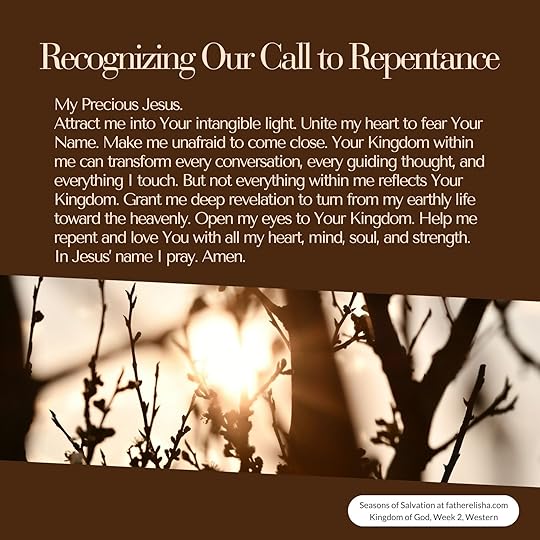
Photo by Cristina Coban on Unsplash
The post Kingdom of God 2 (Western): Recognizing Our Call to Repentance first appeared on Father Elisha: Let me take you on an intriguing journey..
August 29, 2025
Kingdom of God 1 (Eastern): The Church New Year (Indiction)
 The Spiritual Mysteries of the Divine Calendar: Indiction: The Church New Year ~ August 31 – September 6, 2025 ~
 God has gathered the spiritual harvest of our lives from the previous year with Him. Now, it is time to begin preparing for a new harvest in our lives as children of God. Following the crop year in ancient Israel, the first Season of Salvation in the Divine Calendar begins this week—during the end of August and the beginning of September—to starting building the Kingdom of God within and around us. This week is the Indiction — the start of a new Church year.
The early fathers of the Church, inspired by the Holy Spirit, mapped out the main events in the life of Jesus Christ as “seasons of salvation” in a liturgical calendar to help us be “transformed into the same image from glory to glory” (2. Cor 3:18).
On the day of the Liturgical New Year, the Divine Calendar lead us into the synagogue in Nazareth, where Jesus proclaimed Himself as the Messiah (Luke 4:16–22). The first Season of Salvation is the Season of the Kingdom of God, so the first day of our new journey through this ancient liturgical and mystical cycle leads us to the proclamation of the King Himself:
“The Spirit of the Lord is upon Me, because He has anointed Me to preach the gospel to the poor; He has sent Me to heal the brokenhearted, to proclaim liberty to the captives and recovery of sight to the blind, to set at liberty those who are oppressed; to proclaim the acceptable year of the Lord.”
However, if you attend an Eastern Old Calendar parish, this is Week 1 of the Season of the Second Coming: Jesus’ Return and Platforms of Deception.
Indiction: The New BeginningJesus is among us. He has come to save us—our great God and King, the Suffering Servant, and “a friend who sticks closer than a brother” (Prov. 18:24). Jesus reveals Himself among us as we embark on the new journey of this year’s Divine Calendar.
No matter how out of tune we might feel—Jesus is here.
No matter how weak or unfaithful we feel—Jesus is here.
No matter how fiery and anointed we feel, “leaping upon the mountains, skipping upon the hills” (Song of Solomon 2:8b)—Jesus is here.
The King is here, and therefore, His Kingdom has come. “From that time Jesus began to preach and to say, ‘Repent, for the kingdom of heaven is at hand’” (Matt. 4:17).
Jesus stretches out His hand to us all. Let us take hold of Him, and He will lead us on. If we feel drained or hesitant along the way, He will remain by our side, waiting for us to look up at His joyful face. He gives us strength. “Somebody touched Me, for I perceived power going out from Me” (Luke 8:46). “‘Not by might nor by power, but by My Spirit,’ says the Lord of hosts” (Zech. 4:6a).
Jesus offers a new start for everyone. The Divine Calendar begins with the greatest theme in the Bible: the Kingdom of God. The story of this Kingdom begins in the Garden of Eden and “ends” with the New Jerusalem. But in our age, “the kingdom of God does not come with observation; nor will they say, ‘See here!’ or ‘See there!’ For indeed, the kingdom of God is within you” (Luke 17:20b–21).
Indiction and The Spiritual Keys
The Holy Spirit’s goal for the next eleven weeks of this first Season is to reveal how astonishing the soul becomes when the Kingdom of God is established, how gloomy it is in His absence, and how we journey from a bleak image to a glorious one.
There are eight Season of Salvation in the Divine Calendar, and each Season has a key that helps us receive the grace and blessings associated with it. This key is a biblical theme—easy to keep before us—that reminds us of the Season we are in and how we can fully benefit from it. (Learn more about the Seasons of Salvation here.)
The key to entering the mysteries of this season is repentance. “From that time Jesus began to preach and to say, ‘Repent, for the kingdom of heaven is at hand’” (Matt. 4:17). By focusing on turning away from our old ways and turning to Jesus—repentance—we enter the spiritual atmosphere of this Season of Salvation.
“Spiritual atmosphere” simply means being close to where Jesus is during these weeks—in His proximity—as He teaches us about His Kingdom within us. As we are in Christ (Rom. 8:1), what happened to our Savior can directly impact our spiritual growth as we journey with Him through the Seasons of Salvation—the seasons of His life.

Photo by Andres Siimon on Unsplash
The Sunday Gospels of the Divine CalendarThe landmarks that guide us through each Season of Salvation are the assigned Gospel readings for each Sunday, alongside the fasts and feasts of the Church year. In most of these blog posts, we will focus on the Season of Salvation we are currently in and then unpack the Sunday Gospel for that week.
(You can read more about this in the Divine Calendar PDF, which you’ll receive when you sign up for this spiritual journey through the Divine Calendar.)
Sunday Gospel for Indiction: The Church New Year: Matthew 19:16–26 (NKJV)
Now behold, one came and said to Him, “Good Teacher, what good thing shall I do that I may have eternal life?” 17 So He said to him, “Why do you call Me good? No one is good but One, that is, God. But if you want to enter into life, keep the commandments.”
18 He said to Him, “Which ones?” Jesus said, “‘You shall not murder,’ ‘You shall not commit adultery,’ ‘You shall not steal,’ ‘You shall not bear false witness,’ 19 ‘Honor your father and your mother,’ and, ‘You shall love your neighbor as yourself.’ ”
20 The young man said to Him, “All these things I have kept from my youth. What do I still lack?” 21 Jesus said to him, “If you want to be perfect, go, sell what you have and give to the poor, and you will have treasure in heaven; and come, follow Me.” 22 But when the young man heard that saying, he went away sorrowful, for he had great possessions.
23 Then Jesus said to His disciples, “Assuredly, I say to you that it is hard for a rich man to enter the kingdom of heaven. 24 And again I say to you, it is easier for a camel to go through the eye of a needle than for a rich man to enter the kingdom of God.” 25 When His disciples heard it, they were greatly astonished, saying, “Who then can be saved?” 26 But Jesus looked at them and said to them, “With men this is impossible, but with God all things are possible.”
The Good Teacher
This Sunday Gospel is about Jesus’ meeting with the rich young ruler.
We read in Matthew 19:16–17: “Now behold, one came and said to Him, ‘Good Teacher, what good thing shall I do that I may have eternal life?’ So He said to him, ‘Why do you call Me good? No one is good but One, that is, God. But if you want to enter into life, keep the commandments.’”
The young man called Jesus “Teacher”—he didn’t see Him as the Messiah, the Savior—and asked what good thing he must do to have eternal life. I understand Jesus’ answer as: “If you call me Good, that means I’m God—but you don’t believe I am God.” Since the young man approached Jesus from his mind—“Good Teacher, what good thing shall I do”—Jesus gave him an answer directed toward his mind: “Keep the commandments.” That was the intellectual answer of what he had to do—the answer from the Teacher.
After Jesus listed six of the Ten Commandments, the young man replied: “All these things I have kept from my youth. What do I still lack?” This man didn’t view himself in the light of truth. If he were honest with himself, could he truly say he had broken none of those commandments?
We read in 1 John 1:8: “If we say that we have no sin, we deceive ourselves, and the truth is not in us.” And in Psalm 14:2–3: “The Lord looks down from heaven upon the children of men, to see if there are any who understand, who seek God. They have all turned aside, they have together become corrupt; there is none who does good, no, not one.”
Targeting the Heart
To help him experience the true nature of his heart, Jesus targeted his heart with His instruction: “If you want to be perfect, go, sell what you have and give to the poor, and you will have treasure in heaven; and come, follow Me. But when the young man heard that saying, he went away sorrowful, for he had great possessions” (Matthew 19:21–22).
Jesus revealed to him that “where your treasure is, there your heart will be also” (Matt. 6:21). The man’s sadness proved he had set his heart on his earthly riches. He didn’t see in the Good Teacher “the unsearchable riches of Christ” (Eph. 3:8), and that the Father “has blessed us with every spiritual blessing in the heavenly places in Christ” (Eph. 1:3).
Then Jesus showed us how impossible it is to inherit eternal life through our own works of righteousness. I believe Jesus intentionally offended the earth-centered mind when He said: “Assuredly, I say to you that it is hard for a rich man to enter the kingdom of heaven. And again I say to you, it is easier for a camel to go through the eye of a needle than for a rich man to enter the kingdom of God” (Matthew 19:23–24). That’s how impossible it is for man to enter God’s Kingdom by relying on his own resources.
At last, we read in Matthew 19:25–26: “When His disciples heard it, they were greatly astonished, saying, “Who then can be saved?” Then Jesus tells them, “With men this is impossible, but with God all things are possible.”
Trust in the Lord
We have just begun a new cycle through the Divine Calendar, and in this first Season of Salvation, the key to cooperating with the Holy Spirit’s deep work of sanctification in our souls is repentance. Of course, repentance is key all year long—but especially now, as it lays the foundation for the remaining seven Seasons of Salvation.
In Matthew 19:16–26, we see our need to become channels of God’s saving grace. In the final verse, Jesus said: “With men this is impossible, but with God all things are possible.”
The Greek word translated as “impossible” is dunatos, which means “powerful,” “capable,” “strong,” or “power.” It is the same word used in Virgin Mary’s Magnificat, translated “mighty:” “For He who is mighty has done great things for me, and holy is His name” (Luke 1:49).
Instead of approaching our need for deep sanctification with only our minds, let us turn to God with hearts full of faith—trusting that “with God all things are possible.” Our hearts—our spirits—can become channels for His power, because “the Lord your God in your midst, the Mighty One, will save” (Zeph. 3:17).
As we look ahead to the long journey through the Divine Calendar, let us rest in this truth from Proverbs 3:5: “Trust in the Lord with all your heart, and lean not on your own understanding.”

Photo by Markus Spiske on Unsplash
Faith That Moves Mountains“Faith as a mustard seed” is an expression we might have heard too many times. We find it in Matthew 17:20: “… I say to you, if you have faith as a mustard seed, you will say to this mountain, ‘Move from here to there,’ and it will move; and nothing will be impossible for you.”
The faith of a mustard seed moves mountains. Jesus chose this particular seed because it was familiar to everyone—a common, everyday seed. Though tiny, the mustard seed can grow into a small plant or into a bush twelve feet tall—or even taller.
How does the seed know what it will become?
Today, we know that every living organism—whether plant, animal, and human—is made of cells. Every cell contains DNA: commandments or words of genetic information that instruct the cell what to do. It’s mind-boggling—both biologically and spiritually speaking.
As British Oxford professor and mathematician John Lennox says, “We live in a word-based universe.”
And so we read in Acts 17:28: “For in Him we live and move and have our being, as also some of your own poets have said, ‘For we are also His offspring.’”
Biological Kingdoms
In the soil, the mustard seed cracks and dies so new life can sprout into a plant. The DNA commands each of the different cells of the mustard plant to do its role: to build root cells, leaf cells, flower cells, and so on. It is a majestic orchestra of synchronized, information-guided growth. This is how all biology works. Aren’t you grateful the cells in your fingernails know how to remain fingernail cells—and not, say, turn into eye-cells?
Everything living around us acts—strictly biologically speaking—under the command of DNA, which, as Christians, we believe God spoke into being. It makes perfect sense that “in the beginning was the Word” (John 1:1), and that “all things were made through Him” (John 1:3), and that “in Him was life” (John 1:4).
So, every living thing obeys the word of DNA, biologically speaking—building the kingdom of mustard seed cells. Every living thing follows the commands ordained by God—except human beings.
God blessed humans with His image, which includes the gift of free will. Love can only exist in freedom. And only love will empower our will to keep God’s commands. “If you love Me, keep My commandments” (John 14:15).
The universe moved along in perfect order—until we decided it was a better idea to eat from the forbidden tree in the Garden, thinking we knew better than God. That was the moment we stopped loving God—and we’ve been breaking His commandments ever since.
Pushing Through the Soil
Our disbelief in God’s word hindered us from following the divine command meant to guide the divine growth of our lives with Him. Yet, we are called to be partakers of the divine nature (2 Pet. 1:4).
At the start of the Season of the Kingdom of God, it is fitting to pray and ask the Lord to strengthen our resolve—not to quit the walk we have begun. We must hold fast to the words God has given us.
We read in Romans 5:3–5: “We also glory in tribulations, knowing that tribulation produces perseverance; and perseverance, character; and character, hope. Now hope does not disappoint.” And in James 1:2–4: “My brethren, count it all joy when you fall into various trials, knowing that the testing of your faith produces patience. But let patience have its perfect work, that you may be perfect and complete, lacking nothing.”
Like every mustard seed, Jesus had to die to release the life of resurrection in us. We are “born again, not of corruptible seed but incorruptible, through the word of God which lives and abides forever” (1 Peter 1:23).
When everything seems hopeless—and we feel like miserable failures and are sure this is the end of the end—does our muscle of faith behave like that little mustard seed?
Do we have the kind of faith that pushes through the hard soil of death we are facing, knowing that life and resurrection follow?
Do we have the faith that carry our circumstances, jobs, ministries, callings—and ultimately our physical lives—through death and into new life?
Indiction and the Word-Based Kingdom
At the beginning of the Divine Calendar, God prepares to expand His Kingdom within us—so He can entrust us with more of His external kingdom responsibilities toward the end of the liturgical year.
Just as the mustard seed knows how to become a mustard plant, so the Word of God becomes seed in the land of our souls, capable of growing into an outward expression of His Kingdom through us.
How can we cooperate with the Holy Spirit to prepare the ground for this growth in the weeks ahead?
As the cells of every living thing obey God’s Word—encoded as DNA—so we, in this Season, seek to realign our lives to the Words of God. The growth of God’s Kingdom within begins with turning to His Words and commandments—it begins with repentance.
We might catch a glorious glimpse of what this fresh growth will look like, and it will stir a deep longing and desire to reach it. We might quickly claim that word, impression, promise, or approaching opportunity. However, we are not yet ready to step into that glimpse. But the Seasons of Salvation ahead will prepare us to get there.
Let that glimpse captivate our hearts—with faith, with expectation, and with love for the Lord and what He has in store.
Concluding Indiction: The Church New YearI pray and hope these simple thoughts bless you as you follow Jesus into this new journey through the Seasons of Salvation. Thank you for investing your time in reading. May Jesus quench your deepest longings—and may you quench His.
Hope to see you next week as we uncover the mysteries of Week 2 in the Season of the Kingdom of God.
Thank you for being on this journey for another year.
Please leave a comment below—we’d love to hear your thoughts. If you found this post helpful, feel free to share it using the buttons at the top of the page.
Join the Journey Through the Seasons of SalvationJoin us on this weekly journey through the Seasons of Salvation as we walk in the footsteps of Jesus Christ through the key seasons of His life.
Sign up to receive this year’s Divine Calendar, which introduces the Seasons of Salvation and guides you through the journey ahead. As a welcome gift, you’ll also receive my young adult novel, The Legend of the Divine Calendar, delivered straight to your inbox.
Visit the Seasons of Salvation blog for insights into the coming week, posted every Saturday. We’d be honored to have you join us.
Save Your Prayer Card on Your Smartphone
Photo by Eilis Garvey on Unsplash
The post Kingdom of God 1 (Eastern): The Church New Year (Indiction) first appeared on Father Elisha: Let me take you on an intriguing journey..
Kingdom of God 1 (Western): Building the Kingdom of God
The Spiritual Mysteries of the Divine Calendar: Building the Kingdom of God ~ August 31 – September 6, 2025 ~ God has gathered the spiritual harvest of our lives from the previous year with Him. Now, it is time to begin preparing for a new harvest in our lives as children of God. Following the crop year in ancient Israel, the first Season of Salvation in the Divine Calendar begins this week—during the end of August and the beginning of September—to starting building the Kingdom of God within and around us.
The early fathers of the Church, inspired by the Holy Spirit, mapped out the main events in the life of Jesus Christ as “seasons of salvation” in a liturgical calendar to help us be “transformed into the same image from glory to glory” (2. Cor 3:18).
On the day of the Liturgical New Year, the Divine Calendar lead us into the synagogue in Nazareth, where Jesus proclaimed Himself as the Messiah (Luke 4:14–30). The first Season of Salvation is the Season of the Kingdom of God, so the first day of our new journey through this ancient liturgical and mystical cycle leads us to the proclamation of the King Himself.
“The Spirit of the Lord is upon Me, because He has anointed Me to preach the gospel to the poor; He has sent Me to heal the brokenhearted, to proclaim liberty to the captives and recovery of sight to the blind, to set at liberty those who are oppressed; to proclaim the acceptable year of the Lord” (Luke 4:18–19).
The New BeginningJesus is among us. He has come to save us—our great God and King, the Suffering Servant, and “a friend who sticks closer than a brother” (Prov. 18:24). Jesus reveals Himself among us as we embark on the new journey of this year’s Divine Calendar.
No matter how out of tune we might feel—Jesus is here.
No matter how weak or unfaithful we feel—Jesus is here.
No matter how fiery and anointed we feel, “leaping upon the mountains, skipping upon the hills” (Song of Solomon 2:8b)—Jesus is here.
The King is here, and therefore, His Kingdom has come. “From that time Jesus began to preach and to say, ‘Repent, for the kingdom of heaven is at hand’” (Matt. 4:17).
Jesus stretches out His hand to us all. Let us take hold of Him, and He will lead us on. If we feel drained or hesitant along the way, He will remain by our side, waiting for us to look up at His joyful face. He gives us strength. “Somebody touched Me, for I perceived power going out from Me” (Luke 8:46). “‘Not by might nor by power, but by My Spirit,’ says the Lord of hosts” (Zech. 4:6a).
Jesus offers a new start for everyone. The Divine Calendar begins with the greatest theme in the Bible: the Kingdom of God. The story of this Kingdom begins in the Garden of Eden and “ends” with the New Jerusalem. But in our age, “the kingdom of God does not come with observation; nor will they say, ‘See here!’ or ‘See there!’ For indeed, the kingdom of God is within you” (Luke 17:20b–21).
The Spiritual Keys
The Holy Spirit’s goal for the next eleven weeks of this first Season is to reveal how astonishing the soul becomes when the Kingdom of God is established, how gloomy it is in His absence, and how we journey from a bleak image to a glorious one.
There are eight Season of Salvation in the Divine Calendar, and each Season has a key that helps us receive the grace and blessings associated with it. This key is a biblical theme—easy to keep before us—that reminds us of the Season we are in and how we can fully benefit from it. (Learn more about the Seasons of Salvation here.)
The key to entering the mysteries of this season is repentance. “From that time Jesus began to preach and to say, ‘Repent, for the kingdom of heaven is at hand’” (Matt. 4:17). By focusing on turning away from our old ways and turning to Jesus—repentance—we enter the spiritual atmosphere of this Season of Salvation.
“Spiritual atmosphere” simply means being close to where Jesus is during these weeks—in His proximity—as He teaches us about His Kingdom within us. As we are in Christ (Rom. 8:1), what happened to our Savior can directly impact our spiritual growth as we journey with Him through the Seasons of Salvation—the seasons of His life.
Photo by Cherry Laithang on Unsplash
The Sunday Gospels of the Divine CalendarThe landmarks that guide us through each Season of Salvation are the assigned Gospel readings for each Sunday, alongside the fasts and feasts of the Church year. In most of these blog posts, we will focus on the Season of Salvation we are currently in and then unpack the Sunday Gospel for that week.
(You can read more about this in the Divine Calendar PDF, which you’ll receive when you sign up for this spiritual journey through the Divine Calendar.)
Sunday Gospel for Building the Kingdom of God: Luke 7:28–35 (NKJV)
“For I say to you, among those born of women there is not a greater prophet than John the Baptist; but he who is least in the kingdom of God is greater than he.”
29 And when all the people heard Him, even the tax collectors justified God, having been baptized with the baptism of John. 30 But the Pharisees and lawyers rejected the will of God for themselves, not having been baptized by him.
31 And the Lord said, “To what then shall I liken the men of this generation, and what are they like? 32 They are like children sitting in the marketplace and calling to one another, saying: ‘We played the flute for you, and you did not dance; we mourned to you, and you did not weep.’
33 For John the Baptist came neither eating bread nor drinking wine, and you say, ‘He has a demon.’ 34 The Son of Man has come eating and drinking, and you say, ‘Look, a glutton and a winebibber, a friend of tax collectors and sinners!’ 35 But wisdom is justified by all her children.”
Building the Kingdom Like John the Baptist
In Luke 7:28–29 we read: “For I say to you, among those born of women there is not a greater prophet than John the Baptist; but he who is least in the kingdom of God is greater than he.” Jesus said John the Baptist is the greatest prophet of all time. Why is that?
The Season of the Kingdom of God places the Forerunner before us as a role model during these weeks, because Jesus continued the very work John the Baptist began. Or, seen another way, John understood the mission of the Messiah and began preparing the way by doing that work himself. “He must increase, but I must decrease” (John 3:30).
John the Baptist began preaching the Messiah’s message before Jesus Himself began to preach.
The Forerunner: “In those days John the Baptist came preaching in the wilderness of Judea, and saying, ‘Repent, for the kingdom of heaven is at hand!’” (Matt. 3:1–2)The Messiah: “From that time Jesus began to preach and to say, ‘Repent, for the kingdom of heaven is at hand’” (Matt. 4:17).John the Baptist also ministered the Messiah’s ministry before Jesus did:
The Forerunner: “John answered them, saying, ‘I baptize with water, but there stands One among you whom you do not know’” (John 1:26)The Messiah: “After these things Jesus and His disciples came into the land of Judea, and there He remained with them and baptized” (John 3:22).Building the Kingdom, Aligned with God’s Vision
Jesus continued both the message and ministry of John the Baptist. This is yet another aspect of the greatness of the Forerunner: he was aligned with the purposes in the Kingdom of God, and Jesus built upon what John began.
For us, Jesus has laid the foundation. “For no other foundation can anyone lay than that which is laid, which is Jesus Christ” (1. Cor 3:11). Yet at the beginning of the Divine Calendar, there is a mystery that invites us to participate in the ongoing building of God’s Kingdom.
God calls us to enter His work just as John the Baptist did, so that our prayers and ministry may be made of “gold, silver, [and] precious stones” (1 Cor. 3:12)—materials Jesus can use to construct His eternal Kingdom. This is the great honor the Heavenly Father gives His children: He desires to complete the work that our lives begin when we are aligned with His vision for His Kingdom.
Photo by Josh Olalde on Unsplash
John the Baptist“For I say to you, among those born of women there is not a greater prophet than John the Baptist; but he who is least in the kingdom of God is greater than he” (Luke 7:28).
John the Baptist proclaimed the same message that Jesus taught, that Jesus’ disciples preached, and that you and I continue to testify about today. But John was the first to proclaim it—what a prophet and man of God! However, he who is least in the Kingdom—meaning the humbler—will be greater than John in the Kingdom of God.
But we can hardly grasp the humility of John the Baptist. He was “preaching a baptism of repentance for the remission of sins” (Luke 3:3), and he recognized Jesus as “the Lamb of God who takes away the sin of the world” (John 1:29), “the Bridegroom” (John 3:29), and the One who “is above all” (John 3:31).
The Humility of John the Baptist
Imagine your ministry is an ancient form of confession. Instead of listening to people confess their sins in a church, you immerse them in water as they confess their sins.
Then comes the Man you know is the Holy One—the Lamb whose blood will wash away your own sins—and the jealous Bridegroom who will destroy all the powers of evil with “the sword which proceeded from the mouth …” (Rev. 19:21).
Imagine, then, your task was to carry out your ministry of confession—for the Man you knew to be perfectly sinless. Would you dare place your hand on the head of the Most Holy One?
John the Baptist did—at Jesus’ words, “permit it to be so now, for thus it is fitting for us to fulfill all righteousness” (Matt. 3:15).
This was an unthinkable act for John—just as the approaching crucifixion of Jesus was unthinkable for the disciples. Yet, at Christ’s command, John obeyed immediately. Would we have been able to change our convictions in the very moment the Lord spoke? (This reminds us of the Virgin Mary’s immediate response to the Archangel Gabriel: “Behold the maidservant of the Lord! Let it be to me according to your word” [Luke 1:38].)
John understood the scandal of performing his “confession ministry” upon the sinless One—yet he obeyed. This is the measure of his humility.
This coming week, the doors of grace open wide, inviting us to humble our hearts and allow sincere contrition to be born within us. And so begins our journey into deep, revelatory repentance.
The Paradigm Shift
John the Baptist serves as a bridge, bringing God’s work in the Old Testament era into the New Testament’s age of grace. In the Old Covenant, the priests “when they go into the tabernacle of meeting, or when they come near the altar to minister, to burn an offering made by fire to the Lord, they shall wash with water, lest they die” (Ex. 30:20). No one could draw near to God or minister before Him without first being washed.
In the New Testament, our participation in the death and resurrection of Christ through faith—expressed in baptism—allows us to approach God. No longer a temporary, ceremonial outward washing, but an eternal inner cleansing “through the washing of regeneration and renewing of the Holy Spirit, whom He poured out on us abundantly through Jesus Christ our Savior, that having been justified by His grace we should become heirs according to the hope of eternal life” (Titus 5b–7).
John the Baptist proclaimed the new ways of God. If anyone deserves to bear the often-overused word “radical,” it’s John the Baptist. He called not only the priests (even though they did not come), but everyone—to wash not just their hands, but their whole being—through baptism in the Jordan River.
He baptized the people of Israel so that when Jesus died (entered the water) and rose (came up from the water), they would understand that the Messiah had washed away their sins. “Therefore we were buried with Him through baptism into death, that just as Christ was raised from the dead by the glory of the Father, even so we also should walk in newness of life” (Rom. 6:4).
Shaking the Status Quo
Now, we might know all of this, but we probably don’t realize what an earthquake it was in the mindset of the average Israelite—especially once they understood that God was behind it.
In this first Season of the Divine Calendar, God may begin to reveal glimpses of His work in our lives that shake our thinking just as deeply. These radical shifts—often challenging our experiences or convictions—call us to humility. They may come so unexpectedly that we reject them the first few times they appear.
Dancing and Weeping
We read in Luke 7:30: “But the Pharisees and lawyers rejected the will of God for themselves, not having been baptized by him.” The religious establishment in Israel couldn’t accept John’s baptism.
We may think we have no religious establishments in our lives—but there may be structures built up in our souls and minds that would surprise us. “Casting down arguments and every high thing that exalts itself against the knowledge of God, bringing every thought into captivity to the obedience of Christ” (2 Cor. 10:5).
The grace of repentance during this Season can clear the foundation for deep transformation in the year ahead through the Divine Calendar. Repentance is a mighty spiritual weapon. Our spiritual enemy cannot reach humility—and he fears it more than anything—because there is no humility in him.
In Luke 7:32–34, we read: “‘We played the flute for you, and you did not dance; we mourned to you, and you did not weep.’ For John the Baptist came neither eating bread nor drinking wine, and you say, ‘He has a demon.’ The Son of Man has come eating and drinking, and you say, ‘Look, a glutton and a winebibber, a friend of tax collectors and sinners!’”
There is a danger that we might hear the flute of the Holy Spirit—but not respond with a dance. We might feel His nudge to mourn over our sins in repentance—yet still hold back the tears. We may even condemn one thing as wrong in one moment, and when confronted with the opposite, condemn that too.
A real challenge is often our lack of response to the whispers of the Holy Spirit. But especially during this Season, the grace of repentance helps us respond with dancing and weeping.
Building the Kingdom: Our New Normal
The Sunday Gospel ends with Luke 7:35: “But wisdom is justified by all her children.” What does this mean?
It means that only those who enter and follow the ways of God are truly able to confirm their truth. It’s impossible to affirm something as being from God while remaining on the outside—so we judge and condemn instead. Only those who follow wisdom can recognize and affirm her, because they experience the life she releases. “Now therefore, listen to me, my children, for blessed are those who keep my ways” (Prov. 8:32).
To conclude, we will receive a greater capacity to repent—a fresh strength to humble our hearts toward true contrition—starting this week. The more we engage with the grace to repent, the more we will grasp the paradigm shift the Lord is introducing into our lives.
In the weeks ahead, we will see glimpses of what the Lord desires to establish as our new normal. But we cannot hold on to that newness just yet. When a glimpse comes—thank God for it, treasure it, write it down, pray into it, and keep it before your eyes. These glimpses will guide us through all the Seasons of this year’s Divine Calendar.
Concluding Building the Kingdom of GodThank you for reading and for being generous with your time. During this Season of the Kingdom of God, the Lord may do something unexpected in our lives. He wants to entrust us with more of His Kingdom.
Hope to see you next week as we uncover the mysteries of Week 2 in the Season of the Kingdom of God.
Thank you for being on this journey for another year.
Please leave a comment below—we’d love to hear your thoughts. If you found this post helpful, feel free to share it using the buttons at the top of the page.
Join the Journey Through the Seasons of SalvationJoin us on this weekly journey through the Seasons of Salvation as we walk in the footsteps of Jesus Christ through the key seasons of His life.
Sign up to receive this year’s Divine Calendar, which introduces the Seasons of Salvation and guides you through the journey ahead. As a welcome gift, you’ll also receive my young adult novel, The Legend of the Divine Calendar, delivered straight to your inbox.
Visit the Seasons of Salvation blog for insights into the coming week, posted every Saturday. We’d be honored to have you join us.
Save Your Prayer Card on Your Smartphone
Photo by Joshua Earle on Unsplash
The post Kingdom of God 1 (Western): Building the Kingdom of God first appeared on Father Elisha: Let me take you on an intriguing journey..
August 21, 2025
Second Coming 2 (Western & Eastern): The Beheading of John the Baptist: Mistaken for Jesus
 The Spiritual Mysteries of the Divine Calendar: The Beheading of John the Baptist ~ August 29 / September 11 (Eastern Old Calendar), 2025 ~
 During this final week of the Season of the Second Coming, which concludes this year’s cycle through the Divine Calendar, we focus on Imitating Christ. At the very end, we also commemorate the Beheading of John the Baptist.
As we said in our previous talk about this event:
It is worth remembering that the first Season of Salvation in the Divine Calendar begins by highlighting John the Baptist and his message of repentance. The liturgical year begins with the Forerunner’s call and concludes with his martyrdom—his entrance into the eternal kingdom he proclaimed.
After focusing on living in tents—as strangers and pilgrims in this world—and reflecting on the themes of the end times and eternity, we begin to resemble the martyrs a little more. We can die small deaths each day, because we belong to Heaven. We live for eternity and eternal purposes. This is how we follow in Christ’s footsteps: by carrying our cross, just as the great Forerunner did until the end.
Let us begin by reading the assigned Gospel passage.
Gospel of the Beheading of John the Baptist: Mark 6:14–30 (NKJV)Now King Herod heard of Him, for His name had become well known. And he said, “John the Baptist is risen from the dead, and therefore these powers are at work in him.” 15 Others said, “It is Elijah.”
And others said, “It is the Prophet, or like one of the prophets.”
16 But when Herod heard, he said, “This is John, whom I beheaded; he has been raised from the dead!” 17 For Herod himself had sent and laid hold of John, and bound him in prison for the sake of Herodias, his brother Philip’s wife; for he had married her. 18 Because John had said to Herod, “It is not lawful for you to have your brother’s wife.”
19 Therefore Herodias held it against him and wanted to kill him, but she could not; 20 for Herod feared John, knowing that he was a just and holy man, and he protected him. And when he heard him, he did many things, and heard him gladly.
The Beheading of John the Baptist
21 Then an opportune day came when Herod on his birthday gave a feast for his nobles, the high officers, and the chief men of Galilee. 22 And when Herodias’ daughter herself came in and danced, and pleased Herod and those who sat with him, the king said to the girl, “Ask me whatever you want, and I will give it to you.” 23 He also swore to her, “Whatever you ask me, I will give you, up to half my kingdom.”
24 So she went out and said to her mother, “What shall I ask?” And she said, “The head of John the Baptist!” 25 Immediately she came in with haste to the king and asked, saying, “I want you to give me at once the head of John the Baptist on a platter.”
26 And the king was exceedingly sorry; yet, because of the oaths and because of those who sat with him, he did not want to refuse her. 27 Immediately the king sent an executioner and commanded his head to be brought. And he went and beheaded him in prison, 28 brought his head on a platter, and gave it to the girl; and the girl gave it to her mother. 29 When his disciples heard of it, they came and took away his corpse and laid it in a tomb.
30 Then the apostles gathered to Jesus and told Him all things, both what they had done and what they had taught.

Photo by Randy Jacob on Unsplash
Our Role ModelThis day commemorates the beheading of John the Baptist, as told in Mark 6:14–30. Let us focus on verses 14–18:
“Now King Herod heard of Him, for His name had become well known. And he said, ‘John the Baptist is risen from the dead, and therefore these powers are at work in him.’ 15 Others said, ‘It is Elijah.’ And others said, ‘It is the Prophet, or like one of the prophets.’
16 But when Herod heard, he said, ‘This is John, whom I beheaded; he has been raised from the dead!’ 17 For Herod himself had sent and laid hold of John, and bound him in prison for the sake of Herodias, his brother Philip’s wife; for he had married her. 18 Because John had said to Herod, ‘It is not lawful for you to have your brother’s wife.’”
This feast reveals the remarkable person of John the Baptist. The great Forerunner is our role model for living a life of repentance, and in him, we see the extraordinary fruit of such a life.
Mistaken for Jesus
King Herod heard about a man named Jesus, who was walking “about the villages in a circuit, teaching” (Mark 6:6). His disciples went “out two by two, and [Jesus] gave them power over unclean spirits” (Mark 6:7). Upon hearing these rumors, Herod believed that this man—Jesus—was John the Baptist, risen from the dead after he had beheaded him.
That alone is remarkable. Imagine if, in our day, the government mistook the impact of our Christian lives for the works of Jesus Himself—believing He had returned. We are called to imitate Christ, but John the Baptist was actually mistaken for Jesus! And even more astonishing: John was dead. Yet, Herod still believed that Jesus was John, risen from the dead.
And what’s even more astonishing is this: “John performed no sign, but all the things that John spoke about this Man were true” (John 10:41). John the Baptist didn’t perform any miracles, yet the miracles Jesus performed convinced Herod that this man—Jesus—was John the Baptist.
Then people told Herod: “No, ‘It is Elijah.’ And others said, ‘It is the Prophet, or like one of the prophets.’ But when Herod heard, he said, ‘This is John, whom I beheaded; he has been raised from the dead!’” (Mark 6:15–16).
What an impression John the Baptist must have made on King Herod when he stood in Herod’s palace and “said to Herod, ‘It is not lawful for you to have your brother’s wife’” (verse 18). Once again, we see the impact of the Forerunner—so powerful that Herod became convinced that John had risen from the dead and was performing the very works that Jesus did.
A Life of Repentance
This impression John the Baptist left on those around him was the fruit of a life rooted in repentance. He didn’t perform a single miracle, yet he was mistaken for the Son of God. May we receive the grace of this feast to “work out your own salvation with fear and trembling” (Phil. 2:12), so that our repentance may produce in us a living testimony of Jesus Christ.
Repentance is, of course, the key that leads us directly into the first Season of the Divine Calendar: the Season of the Kingdom of God. “In those days John the Baptist came preaching in the wilderness of Judea, and saying, “Repent, for the kingdom of heaven is at hand!” (Matt. 3:1–2)
I hope you’ll join me on this journey as it begins—already this Sunday. You can learn more and sign up below.
Concluding the Beheading of John the BaptistThank you for joining this journey with Jesus through the Season of Salvation and the events that make up the story of our redemption. It’s an honor to walk this path alongside you.
If helpful, you can also review what we previously discussed regarding How Do I Feast?
Please leave a comment below—we’d love to hear your thoughts. If you found this post helpful, feel free to share it using the buttons at the top of the page.
Join the Journey Through the Seasons of SalvationJoin us on this weekly journey through the Seasons of Salvation as we walk in the footsteps of Jesus Christ through the key seasons of His life.
Sign up to receive this year’s Divine Calendar, which introduces the Seasons of Salvation and guides you through the journey ahead. As a welcome gift, you’ll also receive my young adult novel, The Legend of the Divine Calendar, delivered straight to your inbox.
Visit the Seasons of Salvation blog for insights into the coming week, posted every Saturday. We’d be honored to have you join us.
Photo by Josh Applegate on Unsplash
Other Recommended Scriptures For MeditationAlongside to the designated Gospel passages for the Beheading of John the Baptist, these Scriptures are great to read, meditate on, and pray with in order to receive the grace of the Feast:
Malachi 3:1–3 (NKJV)
“Behold, I send My messenger, and he will prepare the way before Me. And the Lord, whom you seek, will suddenly come to His temple, even the Messenger of the covenant, in whom you delight. Behold, He is coming,” says the Lord of hosts.
2 “But who can endure the day of His coming? And who can stand when He appears? For He is like a refiner’s fire and like launderers’ soap. 3 He will sit as a refiner and a purifier of silver; He will purify the sons of Levi, and purge them as gold and silver, that they may offer to the Lord an offering in righteousness.
The Beheading of John the Baptist: Matthew 14:1–13 (NKJV)
At that time Herod the tetrarch heard the report about Jesus 2 and said to his servants, “This is John the Baptist; he is risen from the dead, and therefore these powers are at work in him.” 3 For Herod had laid hold of John and bound him, and put him in prison for the sake of Herodias, his brother Philip’s wife. 4 Because John had said to him, “It is not lawful for you to have her.” 5 And although he wanted to put him to death, he feared the multitude, because they counted him as a prophet.
6 But when Herod’s birthday was celebrated, the daughter of Herodias danced before them and pleased Herod. 7 Therefore he promised with an oath to give her whatever she might ask. 8 So she, having been prompted by her mother, said, “Give me John the Baptist’s head here on a platter.”
9 And the king was sorry; nevertheless, because of the oaths and because of those who sat with him, he commanded it to be given to her. 10 So he sent and had John beheaded in prison. 11 And his head was brought on a platter and given to the girl, and she brought it to her mother. 12 Then his disciples came and took away the body and buried it, and went and told Jesus.
13 When Jesus heard it, He departed from there by boat to a deserted place by Himself.
Mark 2:18–22 (NKJV)
The disciples of John and of the Pharisees were fasting. Then they came and said to Him, “Why do the disciples of John and of the Pharisees fast, but Your disciples do not fast?”
19 And Jesus said to them, “Can the friends of the bridegroom fast while the bridegroom is with them? As long as they have the bridegroom with them they cannot fast. 20 But the days will come when the bridegroom will be taken away from them, and then they will fast in those days. 21 No one sews a piece of unshrunk cloth on an old garment; or else the new piece pulls away from the old, and the tear is made worse. 22 And no one puts new wine into old wineskins; or else the new wine bursts the wineskins, the wine is spilled, and the wineskins are ruined. But new wine must be put into new wineskins.”
Acts 13:25–33 (NKJV)
And as John was finishing his course, he said, ‘Who do you think I am? I am not He. But behold, there comes One after me, the sandals of whose feet I am not worthy to loose.’
26 “Men and brethren, sons of the family of Abraham, and those among you who fear God, to you the word of this salvation has been sent. 27 For those who dwell in Jerusalem, and their rulers, because they did not know Him, nor even the voices of the Prophets which are read every Sabbath, have fulfilled them in condemning Him. 28 And though they found no cause for death in Him, they asked Pilate that He should be put to death.
29 Now when they had fulfilled all that was written concerning Him, they took Him down from the tree and laid Him in a tomb. 30 But God raised Him from the dead. 31 He was seen for many days by those who came up with Him from Galilee to Jerusalem, who are His witnesses to the people. 32 And we declare to you glad tidings—that promise which was made to the fathers. 33 God has fulfilled this for us their children, in that He has raised up Jesus. As it is also written in the second Psalm: ‘You are My Son, today I have begotten You.’
The post Second Coming 2 (Western & Eastern): The Beheading of John the Baptist: Mistaken for Jesus first appeared on Father Elisha: Let me take you on an intriguing journey..