Father Elisha's Blog, page 5
July 25, 2025
Pentecost: Mission 5 (Western): God’s Harvest from Our Mission and the Dormition Fast

 The Spiritual Mysteries of the Divine Calendar: God’s Harvest of Our Mission and the Dormition Fast ~ July 27 – August 2, 2025 ~
 The end of the Season of Pentecost is here, and so we conclude the second half of this Season of Salvation—a five-week period focusing on God’s messengers and our individual calling. As we conclude the Season of Pentecost, the Dormition Fast will bring us into the final two Seasons of Salvation in the Divine Calendar.
But before we turn to the Dormition Fast, let us first conclude the current sixth season in the Divine Calendar.
This is the fifth and final week of the mission period, when the Holy Spirit reveals the characteristics of the ambassadors—the missionaries—of the Kingdom of God. The mission period began with the Feast of the Apostles.
In the first week, we examined What Is Our Mission? The second week focused on The Identity of the Missionary, and in the third week, we explored The Missionary’s Heavenly Resources. In the fourth week, we looked at The Missionary’s Greatest Spiritual Battle. Today, we conclude with God’s Harvest of Our Mission.
The End of the Season of PentecostOn August 1, we transition from the Season of Pentecost into the seventh Season of Salvation—the Season of Heavenly Participation—through a two-week fast called the Dormition Fast. Below, you will see how this short fast can bless you, even if you don’t actively participate in the fasting itself.
During the first half of this Season, the Divine Calendar focused on Getting to Know the Holy Spirit.
Then, over the past four weeks, the Holy Spirit has drawn our attention to the characteristics of a genuine servant of God. Let us briefly review the fundamental traits of God’s ministers from these recent weeks.
The Mission Weeks Leading Up to the Dormition FastFirst Week: God’s messengers know what God is about to do. He sends His workers ahead of Jesus to announce the coming of the Kingdom of God and what He is about to accomplish. “After these things the Lord appointed seventy others also, and sent them two by two before His face into every city and place where He Himself was about to go” (Luke 10:1 [NKJV]).Second Week: A servant of God has childlike trust in Him, with simple faith—not immature, but confident in their identity in Christ. “Therefore whoever humbles himself as this little child is the greatest in the kingdom of heaven” (Matt. 18:4).Third Week: God’s servants don’t evaluate their circumstances from a horizontal perspective, because they seek the Kingdom of God and His righteousness above all else. “With men this is impossible, but with God all things are possible” (Matt. 19:26). Also, God’s ministers trust in God’s resources. “But He said to them, ‘You give them something to eat.’ And they said, ‘We have no more than five loaves and two fish, unless we go and buy food for all these people’” (Luke 9:13).Fourth Week: The first three weeks laid the foundation for God’s minister to face the power of death and its destructive manifestations in people’s lives. Additionally, God’s ministers know how to glorify Him in all they do. Glorifying God breaks the power of death. “He cried with a loud voice, ‘Lazarus, come forth!’” (John 11:43).
As this week’s Sunday Gospel shows, the Season of Pentecost and the mission period conclude by evaluating our lives as workers in God’s vineyard and the fruits of our missions.
Sunday Gospel for God’s Harvest of Our Mission: Luke 20:9–19 (NKJV)Then He began to tell the people this parable: “A certain man planted a vineyard, leased it to vinedressers, and went into a far country for a long time. 10 Now at vintage-time he sent a servant to the vinedressers, that they might give him some of the fruit of the vineyard. But the vinedressers beat him and sent him away empty-handed.
11 Again he sent another servant; and they beat him also, treated him shamefully, and sent him away empty-handed. 12 And again he sent a third; and they wounded him also and cast him out.
13 “Then the owner of the vineyard said, ‘What shall I do? I will send my beloved son. Probably they will respect him when they see him.’ 14 But when the vinedressers saw him, they reasoned among themselves, saying, ‘This is the heir. Come, let us kill him, that the inheritance may be ours.’
15 So they cast him out of the vineyard and killed him. Therefore what will the owner of the vineyard do to them? 16 He will come and destroy those vinedressers and give the vineyard to others.” And when they heard it they said, “Certainly not!”
17 Then He looked at them and said, “What then is this that is written: ‘The stone which the builders rejected has become the chief cornerstone’? 18 Whoever falls on that stone will be broken; but on whomever it falls, it will grind him to powder.”
19 And the chief priests and the scribes that very hour sought to lay hands on Him, but they feared the people—for they knew He had spoken this parable against them.

Photo by Boudewijn Boer on Unsplash
Evaluating Our MissionGod compares Himself to a vintner who desires fruit from His vineyard. He hires vinedressers to work while He travels to a faraway country. But when He sends His servants to collect the fruit, the vinedressers kill them.
Not only do the vinedressers forget the owner leased the land to them for a purpose, but they try to seize the entire vineyard by killing the owner’s son. They envy the son’s inheritance and desire the glory for themselves. “For he knew that they had handed Him over because of envy” (Matt. 27:18).
Even though this parable historically refers to how the people of Israel killed the Lord’s prophets—culminating in the religious establishment’s betrayal of the Son of God, handing Him over to be crucified by the Romans—we can also place ourselves within this parable. Prophetically, the work in the vineyard represents our responsibilities in the Kingdom of God.
We read in Matthew’s account of the parable: “Therefore I say to you, the kingdom of God will be taken from you and given to a nation bearing the fruits of it” (Matt. 21:43). This parable, therefore, also speaks to us as Christians—those whom God has entrusted with the responsibility of caring for His vineyard.
“Now let me sing to my Well-beloved a song of my Beloved regarding His vineyard: My Well-beloved has a vineyard on a very fruitful hill. He dug it up and cleared out its stones, and planted it with the choicest vine. He built a tower in its midst, and also made a winepress in it; so He expected it to bring forth good grapes, but it brought forth wild grapes […] For the vineyard of the Lord of hosts is the house of Israel” (Isa. 5:1–2, 7a).
The Fruit of This Year’s Harvest
How well do we take care of our vineyards? Do they bear fruit we can offer the Owner? The end of the Season of Pentecost leaves us with these probing questions:
Do the grapevines God entrusted to us bear fruit? Do we know what kind of fruit He expects? And do we have something to offer God as we approach the end of this year’s Divine Calendar?
We are in the Season of Pentecost—the season of offering the fruit of this year’s harvest.
We have passed through the Seasons of Salvation—plowing, weeding, and pruning during times of fasting and repentance, and watering, fertilizing, and reaping during times of feasting. Has the divine seed of Christ we received in the Season of Incarnation grown and borne fruit in our lives?
How have our lives changed since September, during the Season of the Kingdom of God? Back then, we caught a few glimpses of what God wanted to lead us toward, but we felt that something stood in the way. The graces from the Seasons of Salvation have brought this blockage down—or even demolished it entirely. How can we move forward and allow the formation of Christ in our inner man to have an external effect on our sphere of influence?
This week, the Holy Spirit gives us grace to help evaluate what our personal vineyard looks like. Let us be encouraged, because “neither he who plants is anything, nor he who waters, but God who gives the increase. Now he who plants and he who waters are one, and each one will receive his own reward according to his own labor” (1 Cor. 3:7–8).
The Missionary’s Vineyard: The Fruit God Seeks
What is the fruit God seeks from our personal vineyards? The vineyard God has entrusted to each of us looks different, depending on the responsibilities He has given us in His Kingdom. As we discussed at the beginning of the mission period, our assignment doesn’t only mean becoming a traditional cross-cultural evangelist. Our mission develops throughout our lives and can include anything—from intercession to work as a molecular biologist, seeking a cure for cancer through God’s creative inspiration.
God expects our vineyard to bring “forth good grapes” (Isa. 5:2). This is the fruit Jesus thirsted for when He hung on the cross. “After this, Jesus, knowing that all things were now accomplished, that the Scripture might be fulfilled, said, ‘I thirst!’ Now a vessel full of sour wine was sitting there; and they filled a sponge with sour wine, put it on hyssop, and put it to His mouth” (John 19:28–29).
However, they offered him sour fruits instead. “Why then, when I expected it to bring forth good grapes, did it bring forth wild grapes?” (Isa. 5:4b)
The first miracle Jesus performed was turning water into wine at a wedding. “When the master of the feast had tasted the water that was made wine, and did not know where it came from…” (John 2:9) Wine is a symbol of love.
Our Heavenly Father is the vinedresser, and Jesus is the true vine. “I am the true vine, and My Father is the vinedresser […] I am the vine, you are the branches. He who abides in Me, and I in him, bears much fruit; for without Me you can do nothing” (John 15:1, 5).
The Fruit We Produce
If we abide in Christ—and Christ is the vine—what fruit do we produce? Grapes, a symbol of love. We produce love. “As the Father loved Me, I also have loved you; abide in My love. If you keep My commandments, you will abide in My love, just as I have kept My Father’s commandments and abide in His love” (John 15:9–10). “A new commandment I give to you, that you love one another; as I have loved you, that you also love one another” (John 13:34).
The fruit God seeks to reap from our lives toward the end of the Divine Calendar is love—love toward Him and love toward others. If we have love, our vineyard is in good shape. If we don’t have love, we become like those vinedressers who envy glory for themselves rather than glorifying God. They seek an inheritance for their own names instead of being co-heirs with Christ.
“I remember you, the kindness of your youth, the love of your betrothal, when you went after Me in the wilderness, in a land not sown. Israel was holiness to the Lord, the first fruits of His increase” (Isa. 2:2b–3a).
Let us ask the Holy Spirit to reveal the condition of our vineyard. May we find fresh fruit to offer our merciful Lord, who loved us “to the end” (John 13:1).

Photo by Meghna R on Unsplash
The Dormition Fast: August 1–14The Season of Pentecost ends with the theme of offering God the fruit of His grace at work in our lives. “And now abide faith, hope, love, these three; but the greatest of these is love” (1 Cor. 13:13).
The Divine Calendar returns to the theme of bridal love toward the end of its annual journey—the same theme running through Lent and Holy Week, the center of the liturgical year. We will explore why later, but the theme of the Bride resumes with the Dormition Fast, starting August 1.
This two-week fast centers on the theme of consecration—setting ourselves apart for the Lord—and concludes with the Feast of the Dormition of the Virgin Mary on August 15. The Divine Calendar dedicates this feast to the event in Church history when the Mother of Jesus fell asleep and was received into Heaven. We will explore this on the feast day itself.
Origin
Originally, the Divine Calendar contained the three fasts we have journeyed through so far: the Nativity Fast (Incarnation Fast), Great Lent, and the Fast of the Apostles (the Fast of the Holy Spirit).
However, the monastics of the early centuries sought an additional fast dedicated to consecration. Over time, this monastic fast spread, and eventually, the broader Christian community embraced it as well.
Role Model
Traditionally, the Mother of Jesus, the Virgin Mary, has captured the attention of many. Though fully human like the rest of us, Mary was exceptionally humble, and her servanthood was utterly extraordinary. Her response to God in love, adoration, faith, and obedience was so unique that God chose her to be the gate through which His Son entered the world. Jesus took on our human nature through her.
The Virgin Mary was also our role model during the Nativity Fast. “Behold the maidservant of the Lord! Let it be to me according to your word” (Luke 1:38). Traditionally, the Church holds up Mary’s life as an example for us all. The Divine Calendar encourages us to believe that the grace of this fast can transform our lives, increasing our love, trust, and surrender to God.
We seek to have Christ formed in our inner man (Gal. 4:19); therefore, looking at the life of the Virgin Mary, who received the Son of God physically, strengthens us. Although Scripture is relatively silent about her, the little we do know tells us much. The Divine Calendar reminds us we are all called to be like the Virgin Mary. Her example of worship, prayer, and servanthood was not meant to be unique to her, but to be lived out in our own lives.
Below are some practical points on how to observe the Dormition Fast.
Concluding God’s Harvest of Our Mission and the Dormition FastThank you so much for taking the time to read and journey with us. Together, let’s discover how the Holy Spirit gently guides us to reflect on our lives and the fruit growing in our own vineyards. May God richly bless you this week as you walk closely with Christ through the seasons of His life.
Please leave a comment below—we’d love to hear your thoughts. If you found this post helpful, feel free to share it using the buttons at the top of the page.
Join the Journey Through the Seasons of SalvationJoin us on this weekly journey through the Seasons of Salvation as we walk in the footsteps of Jesus Christ through the key seasons of His life.
Sign up to receive this year’s Divine Calendar, which introduces the Seasons of Salvation and guides you through the journey ahead. As a welcome gift, you’ll also receive my young adult novel, The Legend of the Divine Calendar, delivered straight to your inbox.
Visit the Seasons of Salvation blog for insights into the coming week, posted every Saturday. We’d be honored to have you join us.
Save Your Prayer Card on Your Smartphone
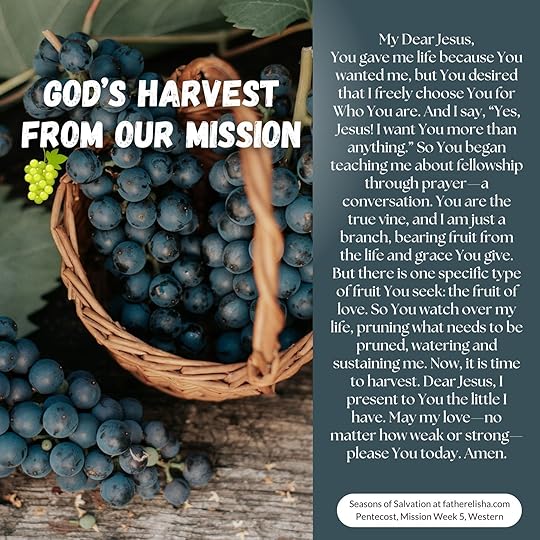
Photo by Maria Ziolkowska on Unsplash
How Do I Observe the Dormition Fast?August 1–14I. Fasting during the Dormition Fast
Jesus said, “Moreover, when you fast, do not be like the hypocrites” (Matt. 6:16). Jesus didn’t say if you fast, but when. Fasting has a long tradition in all parts of Christianity.
Fasting doesn’t earn us anything, nor do we prove ourselves before God as being worthy to receive His grace. “He who eats, eats to the Lord, for he gives God thanks; and he who does not eat, to the Lord he does not eat, and gives God thanks. […] Therefore, whether we live or die, we are the Lord’s” (Rom. 14:6, 8b).
The heart of this fast is to deepen the consecration of our hearts as the Bride of Christ and to be ready for His Second Coming as a sign to the nations. “That He might sanctify and cleanse her with the washing of water by the word, that He might present her to Himself a glorious church, not having spot or wrinkle or any such thing, but that she should be holy and without blemish” (Eph. 5:26–27).
Fasting will not impress God. Instead, it constricts our fallen human nature and releases our spirit to more easily receive impressions and grace from the Holy Spirit. Fasting simply helps us to focus and tune in on the work of the Holy Spirit, so the grace He brings from Jesus’ life enters our souls and into “a noble and good heart” (Luke 8:15).
Traditional View of Fasting
Many view fasting as abstaining from food or drink for a day or longer. However, the traditional way of fasting is a fasting lifestyle. We choose not to eat dairy products and meat for a period.
A vegan diet three times a day is still fasting. Even though we eat, we restrict the instinct of our fallen human nature by not eating as we normally do. This voluntary restriction will, even after a few days, produce spiritual vigilance as if we didn’t eat at all for a day or two.
If you have experience with fasting, and maybe already have a fasting lifestyle, you simply increase what you normally do during the Dormition Fast. Maybe postpone your first meal until 10 a.m., depending on how God’s grace sustains your fasting. If you have been fasting regularly for over five years, you may extend your fast until noon or even 3 p.m. on some weekdays.
We maintain the fasting diet during the weekend, but we do not postpone any meals on Saturdays and Sundays. So, if you eat breakfast at 10 a.m. from Monday through Friday, you would have your breakfast as normal during the weekend.
The main reason for reducing the fast on the weekend is to celebrate the grace of Resurrection on Sunday and create a break in the rhythm of fasting. Each Monday then becomes a fresh start—a renewed offering of sacrifice through fasting. This pattern helps prevent fasting from becoming habitual or stagnant.
The goal of fasting is not to impress God or ourselves, but restriction, emptying, and repentance, and hence welcoming the Holy Spirit. “As they ministered to the Lord and fasted, the Holy Spirit said…” (Acts 13:2a)
Final Comments
Fasting is like tightening a spiritual belt around our waist—one that carries new equipment to help us remain spiritually alert.
Fasting allows us to receive the grace of consecration differently—not because God rewards our fasting by giving more grace, but because we are preparing our souls to receive what is already available during this Fast. God offers us the same grace whether or not we fast, but our capacity to receive increases through the discipline of fasting.
“Then the Lord spoke to Moses, saying, ‘Consecrate to Me all the firstborn, whatever opens the womb among the children of Israel, both of man and beast; it is Mine’” (Ex. 13:1–2).
Will we lose in the end then if we do not fast? Not necessarily. God is God. He can defeat our fallen human nature whether or not we fast, but… “Blessed are those who hunger and thirst for righteousness, for they shall be filled” (Matt. 5:6). And “without faith it is impossible to please Him, for he who comes to God must believe that He is, and that He is a rewarder of those who diligently seek Him” (Heb. 11:6).
Lastly, a warning for every eager soul: Never fast beyond what grace allows. If we push ourselves—often because we want to impress ourselves or feel good about our achievements—our fasting will have the opposite effect.
Unbalanced fasting actually blocks our spirit rather than releasing it. This happens because the power of the flesh (our ego) drives exaggerated fasting, which fuels our pride instead of opening us to the Holy Spirit, who inspires humility and contrition.
II. Prayer during the Dormition Fast
Fasting frees up time to nourish our inner man through prayer and Bible reading. When we fast, let us replace our meal with prayer. It is helpful to use Scriptures about consecration (such as Psalm 45) as a starting point for our prayers. Combining prayer with the Word of God focuses our mind and spirit, unlocks prophetic inspiration, and strengthens our inner man.
III. Bible Reading during the Dormition Fast
During the Dormition Fast, it is beneficial to slightly increase our daily Bible reading in order to fill ourselves with the Word of God—just as the Virgin Mary sings in her praise: “He has filled the hungry with good things” (Luke 1:53).
IV. The Role of Giving in the Dormition Fast
Selfless acts of giving our time, energy, abilities, and finances to help others support the battle against the old human nature within our souls. These acts of mercy and love put to death our ego and bless the world with the love of Christ.
V. The Dormition Fast and Silence
Silence means more than simply not talking. While we still need to communicate, we can choose to engage in less unnecessary conversation and spend less time on media in order to increase our sensitivity to the voice of the Holy Spirit.
If we have the time and opportunity, setting aside moments in a private space for literal silence can lead us into deep, interior, and wordless prayer.
VI. Repentance and the Dormition Fast
Last but not least, all the spiritual practices listed above stir the Holy Spirit to lead us into deep, revelatory repentance—and repentance is actually more important than fasting. Repentance is our strongest weapon in the battle against our fallen human nature, because “if we confess our sins, He is faithful and just to forgive us our sins and to cleanse us from all unrighteousness” (1 John 1:9).
A helpful practice we mentioned during the Incarnation Fast is to “settle accounts” at the end of the day. Before going to sleep, we can spend a few minutes in prayer and ask the Holy Spirit to review the day with us.
Then we confess whatever stirs our conscience, receive forgiveness under the Blood of Jesus, read and pray a Scripture verse that communicates the opposite truth of the sin, and finally ask for God’s guidance to complete the repentance by taking any needed steps to repair the damaged caused.
If we notice our old self revealing itself during the day, it’s good to repent immediately, if possible. Even a simple mental prayer—like the Jesus Prayer: “Lord Jesus Christ, Son of God, have mercy on me, a sinner”—welcomes the Holy Spirit when prayed with focus and love for the name of Jesus.
“For thus says the High and Lofty One Who inhabits eternity, whose name is Holy: ‘I dwell in the high and holy place, with him who has a contrite and humble spirit, to revive the spirit of the humble, and to revive the heart of the contrite ones’” (Isa. 57:15).
These six pillars—fasting, prayer, Bible reading, giving, silence, and repentance—help us grow immensely as the consecrated Bride of Christ.
The post Pentecost: Mission 5 (Western): God’s Harvest from Our Mission and the Dormition Fast first appeared on Father Elisha: Let me take you on an intriguing journey..


July 18, 2025
Pentecost: Mission 4 (Eastern: New) / Mission 2 (Eastern: Old): The Groundbreaking Message of Jesus
 The Spiritual Mysteries of the Divine Calendar: The Groundbreaking Message of Jesus ~ July 20–26, 2025 ~
 We are in the second half of the Season of Pentecost, focusing on God’s ministers and our individual calling. During five weeks in the Divine Calendar, the Holy Spirit reveals the characteristics of the ambassadors—the missionaries—of the Kingdom of God, starting with the Feast of the Apostles. In the first week, we focused on What Is Our Mission? The second week explored Living Under God’s Authority, and the third week turned to How To Win Our Battles as missionaries. This week, we turn our attention to the groundbreaking message of Jesus Christ.
The Message of Jesus Is Carried Through Self-SacrificeIn these weeks, the Holy Spirit helps us take another step toward understanding what it means to be a minister of God.
The essence of our ministry, according to a healthy and biblical perspective, is self-sacrifice. “Just as the Son of Man did not come to be served, but to serve, and to give His life a ransom for many” (Matt. 20:28). It was Jesus’ death that unleashed eternal life for all His followers. In a similar way, when we experience sacrifice in order to remain obedient to God in our ministry, the people we serve receive the grace of Christ.
Our ministry is an extension of ourselves, and the quality of our spiritual life directly affects our ministry’s ability to bear lasting fruit to the glory of our Heavenly Father. “I am the vine, you are the branches. He who abides in Me, and I in him, bears much fruit; for without Me you can do nothing” (John 15:5).
Love Reveals the Message of Jesus
Following this journey through the Seasons of Salvation is to walk the ancient path of sanctification, paved by the Christians of the first centuries. The deeper the Holy Spirit’s work of sanctification goes in our lives, the more fruitful our ministry becomes. It doesn’t necessarily mean signs and wonders will follow us wherever we go—though that may happen—but that people change around us, and that is our goal. Our ministry is, above all, a ministry of love—to love God with all our being and our neighbor as ourselves (Matt. 22:37–40).
In recent weeks, the Sunday Gospel passages highlighted key qualifications for God’s ministers. This upcoming Sunday Gospel reveals another aspect of the power behind the message God has given His messengers.
Sunday Gospel for the Message of Jesus: Matthew 9:1–8 (NKJV)
So He got into a boat, crossed over, and came to His own city. 2 Then behold, they brought to Him a paralytic lying on a bed. When Jesus saw their faith, He said to the paralytic, “Son, be of good cheer; your sins are forgiven you.”
3 And at once some of the scribes said within themselves, “This Man blasphemes!”
4 But Jesus, knowing their thoughts, said, “Why do you think evil in your hearts? 5 For which is easier, to say, ‘Your sins are forgiven you,’ or to say, ‘Arise and walk’? 6 But that you may know that the Son of Man has power on earth to forgive sins”—then He said to the paralytic, “Arise, take up your bed, and go to your house.” 7 And he arose and departed to his house.
8 Now when the multitudes saw it, they marveled and glorified God, who had given such power to men.

Photo by Casey Horner on Unsplash
Revealing the Glory of GodThe Holy Spirit trains us to develop the characteristics of God’s laborers. “Therefore pray the Lord of the harvest to send out laborers into His harvest” (Matt. 9:38). He sends us into the harvest field of our family, our neighborhood, our sphere of professional influence, the nations—or even from our prayer closet.
Jesus desires to glorify His Father through His miraculous works. The Sunday Gospel ends with: “Now when the multitudes saw it, they marveled and glorified God, who had given such power to men” (verse 8).
Before raising Lazarus—who had been dead for four days—He said: “This sickness is not unto death, but for the glory of God, that the Son of God may be glorified through it” (John 11:4). Jesus reaffirmed His motivation to Martha in John 11:40: “Jesus said to her, ‘Did I not say to you that if you would believe you would see the glory of God?’”
Jesus desires to glorify the Father. “‘Now My soul is troubled, and what shall I say? “Father, save Me from this hour”? But for this purpose I came to this hour. Father, glorify Your name.’ Then a voice came from heaven, saying, ‘I have both glorified it and will glorify it again’” (John 12:27–28).
The Message of Jesus Manifests the Father’s Will
When Jesus performed a miracle, He was carrying out the will of the Father. This was Jesus’ motivation: He revealed the Father’s will so that the world would know who He is. Jesus worked tirelessly so that all might know God and the desire of the Father’s heart—to forgive our sins, restore us, and redeem all of creation from the fall of man in the beginning.
“The Spirit of the Lord is upon Me, because He has anointed Me to preach the gospel to the poor; He has sent Me to heal the brokenhearted, to proclaim liberty to the captives and recovery of sight to the blind, to set at liberty those who are oppressed; to proclaim the acceptable year of the Lord” (Luke 4:18–19).
Jesus wanted to manifest the will of the Father before our eyes. “Father, I thank You that You have heard Me. And I know that You always hear Me, but because of the people who are standing by I said this, that they may believe that You sent Me” (John 11:41b–42).
“In Him we have redemption through His blood, the forgiveness of sins, according to the riches of His grace which He made to abound toward us in all wisdom and prudence, having made known to us the mystery of His will, according to His good pleasure which He purposed in Himself, that in the dispensation of the fullness of the times He might gather together in one all things in Christ” (Eph. 1:7–10a).
The Accompanying Signs
The Holy Spirit wants us to know the will of the Father so we can proclaim it through the mission He gives us.
When we believe we know what the Father wants to say to our children before a new semester at school; when we trust we understand what the Father wants our colleagues to see in us at work; when we think we grasp what the Father desires to say and do in our church or ministry group—then comes the big test: Will God support our step of faith by revealing His glory? Not as a shining cloud, but through changed hearts—another step closer to becoming His temple.
When our children stand firm in their faith after a day at school; when our colleagues ask us on Monday morning why we are peaceful while others struggle; or when awakened brotherly love in our church causes newcomers to marvel—we glorify God through our steps of faith, aligned with His will. God confirms our work with His hand.
This is a defining characteristic of the Lord’s laborers: knowing the will of the Father and acting on it—manifesting the Father’s will for His glory. May God open our eyes and ears this week to understand His purpose in the work ahead of us.
“I have found David the son of Jesse, a man after My own heart, who will do all My will” (Acts 13:22b). “And they went out and preached everywhere, the Lord working with them and confirming the word through the accompanying signs. Amen” (Mark 16:20).

Photo by Diego Moreno on Unsplash
The Groundbreaking Message of JesusVerse 2 of the Sunday Gospel reads: “Then behold, they brought to Him a paralytic lying on a bed. When Jesus saw their faith, He said to the paralytic, ‘Son, be of good cheer; your sins are forgiven you.’”
The obvious need of the paralytic is to “arise and walk” (verse 5), but Jesus performed the miracle only after noticing the doubting thoughts of the scribes (verse 3–4). Does that mean that if the scribes hadn’t been present, Jesus would simply have said, “Son, be of good cheer; your sins are forgiven you,” and left it at that? If Jesus didn’t need to demonstrate “that the Son of Man has power on earth to forgive sins” (verse 6), would He still have healed the paralytic?
We can’t know for sure, but this highlights the magnitude of the revolutionary message Jesus gave to us, His messengers. “In Him we have redemption through His blood, the forgiveness of sins, according to the riches of His grace” (Eph. 1:7). The greatest joy that carries us through any circumstance or difficulty—even if we believe we will remain paralyzed for the rest of our lives—is that Jesus grants us the forgiveness of our sins.
The joy of knowing God has forgiven us is the most powerful message a human being can receive, and it can carry us through any conceivable trial—because it flings open to door to our blissful eternity.
A danger is that we think we know this. But if we truly appreciated that God has forgiven our sins, we would endure anything that comes our way. That’s the message God gave His ministers. We don’t need intellectual or practical qualifications to “preach among the Gentiles the unsearchable riches of Christ” (Eph. 3:8).
The Message of Jesus Moves Hearts
Our message is simple, costly, and utterly groundbreaking—it raises even the dead. “For you see your calling, brethren, that not many wise according to the flesh, not many mighty, not many noble, are called. But God has chosen the foolish things of the world to put to shame the wise, and God has chosen the weak things of the world to put to shame the things which are mighty; and the base things of the world and the things which are despised God has chosen, and the things which are not, to bring to nothing the things that are” (1 Cor. 1:26–28).
Jesus told the apostles, after they returned from their first mission trip and performed miracles in His name: “Nevertheless do not rejoice in this, that the spirits are subject to you, but rather rejoice because your names are written in heaven” (Luke 10:20).
Let us look again at verse 2 of the Sunday Gospel: “Then behold, they brought to Him a paralytic lying on a bed. When Jesus saw their faith, He said to the paralytic, ‘Son, be of good cheer; your sins are forgiven you.’”
As Jesus saw the faith of the men who carried the paralyzed man—and the faith of the paralyzed man himself—He declared the forgiveness of sins. “When Jesus saw their faith, He said to the paralytic…” Imagine how the faith of the paralyzed man’s friends must also have touched the bedridden man. Luke 5:19 says: “And when they could not find how they might bring him in, because of the crowd, they went up on the housetop and let him down with his bed through the tiling into the midst before Jesus.”
A Cloud of Witnesses
The faith of these men literally carried the paralyzed man to the feet of Jesus. What friends he had! And we also have such friends. “Therefore we also, since we are surrounded by so great a cloud of witnesses, let us lay aside every weight, and the sin which so easily ensnares us, and let us run with endurance the race that is set before us, looking unto Jesus, the author and finisher of our faith” (Heb. 12:1–2a).
We are surrounded by the life stories of the Saints, and they surround us through their intercessions for us and the world. They have not forgotten this world—because Jesus, their King, certainly has not. We can look to this “cloud of witnesses” to strengthen our faith, and then fix our gaze on Jesus and the joy set before us. Then we turn again to the Saints for inspiration, before returning our eyes to Jesus.
This Sunday Gospel encourages us to have confidence in how the message of the Gospel can bring unbreakable joy to any suffering person. We can also look to the “cloud of witnesses” to strengthen our participation in the heavenly life.
Concluding the Groundbreaking Message of JesusThank you for sharing this time with me. It’s my privilege to have you on this journey with me. Let us pray for the grace this week to know the will of the Father, so that we may glorify Him through our mission and experience the joy contained in the message we bring.
Please leave a comment below—we’d love to hear your thoughts. If you found this post helpful, feel free to share it using the buttons at the top of the page.
Join the Journey Through the Seasons of SalvationJoin us on this weekly journey through the Seasons of Salvation as we walk in the footsteps of Jesus Christ through the key seasons of His life.
Sign up to receive this year’s Divine Calendar, which introduces the Seasons of Salvation and guides you through the journey ahead. As a welcome gift, you’ll also receive my young adult novel, The Legend of the Divine Calendar, delivered straight to your inbox.
Visit the Seasons of Salvation blog for insights into the coming week, posted every Saturday. We’d be honored to have you join us.
Save Your Prayer Card on Your Smartphone

Photo by Patrick Hendry on Unsplash
The post Pentecost: Mission 4 (Eastern: New) / Mission 2 (Eastern: Old): The Groundbreaking Message of Jesus first appeared on Father Elisha: Let me take you on an intriguing journey..
Pentecost: Mission 4 (Western): The Missionary’s Greatest Spiritual Battle
The Spiritual Mysteries of the Divine Calendar: The Missionary’s Greatest Spiritual Battle ~ July 20–26, 2025 ~ We are currently in the second half of the Season of Pentecost, focusing on God’s messengers and our individual calling. Over five weeks, the Holy Spirit reveals the characteristics of the ambassadors—the missionaries—of the Kingdom of God, beginning with the Feast of the Apostles. In the first week, we examined What Is Our Mission? The second week focused on The Identity of the Missionary, and in the third week, we explored The Missionary’s Heavenly Resources. This week, we turn to the Missionary’s Greatest Spiritual Battle.
Self-Sacrifice as the Greatest Spiritual BattleIn these weeks, the Holy Spirit helps us take another step toward understanding what it means to be a minister of God.
The essence of our ministry, according to a healthy and biblical perspective, is self-sacrifice. “Just as the Son of Man did not come to be served, but to serve, and to give His life a ransom for many” (Matt. 20:28). It was Jesus’ death that unleashed eternal life for all His followers. In a similar way, when we experience sacrifice in order to remain obedient to God in our ministry, the people we serve receive the grace of Christ.
Our ministry is an extension of ourselves, and the quality of our spiritual life directly affects our ministry’s ability to bear lasting fruit to the glory of our Heavenly Father. “I am the vine, you are the branches. He who abides in Me, and I in him, bears much fruit; for without Me you can do nothing” (John 15:5).
The Greatest Spiritual Battle
Following this journey through the Seasons of Salvation is to walk the ancient path of sanctification, paved by the Christians of the first centuries. The deeper the Holy Spirit’s work of sanctification goes in our lives, the more fruitful our ministry becomes. It doesn’t necessarily mean signs and wonders will follow us wherever we go—though that may happen—but that people change around us, and that is our goal. Our ministry is, above all, a ministry of love—to love God with all our being and our neighbor as ourselves (Matt. 22:37–40).
In the past three weeks, the Sunday Gospel passages highlighted key qualifications for God’s ministers—such as being ambassadors for Christ, taking part in the ministry of reconciliation, being sent from Heaven to Earth, ministering where Jesus Himself is about to come, embodying childlike simplicity, and trusting in God’s infinite resources.
This week’s Sunday Gospel recounts the raising of Lazarus from the dead and highlights the ultimate test and greatest confrontation for God’s servants—you and me. When people suffer from areas of their lives being in a state of death—even decaying from untreated wounds, traumatic experiences, suicidal thoughts, curses, or demonic bondage—we cannot minister to them in our own strength or resources.
Let us read the Sunday Gospel and witness the grace that overcomes our greatest spiritual battle.

Photo by Barry Weatherall on Unsplash
Sunday Gospel for the Missionary’s Greatest Spiritual Battle: John 11:1–45 (NKJV)Now a certain man was sick, Lazarus of Bethany, the town of Mary and her sister Martha. 2 It was that Mary who anointed the Lord with fragrant oil and wiped His feet with her hair, whose brother Lazarus was sick. 3 Therefore the sisters sent to Him, saying, “Lord, behold, he whom You love is sick.”
4 When Jesus heard that, He said, “This sickness is not unto death, but for the glory of God, that the Son of God may be glorified through it.” 5 Now Jesus loved Martha and her sister and Lazarus. 6 So, when He heard that he was sick, He stayed two more days in the place where He was. 7 Then after this He said to the disciples, “Let us go to Judea again.”
8 The disciples said to Him, “Rabbi, lately the Jews sought to stone You, and are You going there again?” 9 Jesus answered, “Are there not twelve hours in the day? If anyone walks in the day, he does not stumble, because he sees the light of this world. 10 But if one walks in the night, he stumbles, because the light is not in him.” 11 These things He said, and after that He said to them, “Our friend Lazarus sleeps, but I go that I may wake him up.”
12 Then His disciples said, “Lord, if he sleeps he will get well.” 13 However, Jesus spoke of his death, but they thought that He was speaking about taking rest in sleep. 14 Then Jesus said to them plainly, “Lazarus is dead. 15 And I am glad for your sakes that I was not there, that you may believe. Nevertheless let us go to him.” 16 Then Thomas, who is called the Twin, said to his fellow disciples, “Let us also go, that we may die with Him.”
17 So when Jesus came, He found that he had already been in the tomb four days. 18 Now Bethany was near Jerusalem, about two miles away. 19 And many of the Jews had joined the women around Martha and Mary, to comfort them concerning their brother. 20 Then Martha, as soon as she heard that Jesus was coming, went and met Him, but Mary was sitting in the house.
21 Now Martha said to Jesus, “Lord, if You had been here, my brother would not have died. 22 But even now I know that whatever You ask of God, God will give You.” 23 Jesus said to her, “Your brother will rise again.” 24 Martha said to Him, “I know that he will rise again in the resurrection at the last day.”
25 Jesus said to her, “I am the resurrection and the life. He who believes in Me, though he may die, he shall live. 26 And whoever lives and believes in Me shall never die. Do you believe this?” 27 She said to Him, “Yes, Lord, I believe that You are the Christ, the Son of God, who is to come into the world.”
28 And when she had said these things, she went her way and secretly called Mary her sister, saying, “The Teacher has come and is calling for you.” 29 As soon as she heard that, she arose quickly and came to Him. 30 Now Jesus had not yet come into the town, but was in the place where Martha met Him. 31 Then the Jews who were with her in the house, and comforting her, when they saw that Mary rose up quickly and went out, followed her, saying, “She is going to the tomb to weep there.”
32 Then, when Mary came where Jesus was, and saw Him, she fell down at His feet, saying to Him, “Lord, if You had been here, my brother would not have died.” 33 Therefore, when Jesus saw her weeping, and the Jews who came with her weeping, He groaned in the spirit and was troubled. 34 And He said, “Where have you laid him?” They said to Him, “Lord, come and see.”
35 Jesus wept. 36 Then the Jews said, “See how He loved him!” 37 And some of them said, “Could not this Man, who opened the eyes of the blind, also have kept this man from dying?” 38 Then Jesus, again groaning in Himself, came to the tomb. It was a cave, and a stone lay against it. 39 Jesus said, “Take away the stone.” Martha, the sister of him who was dead, said to Him, “Lord, by this time there is a stench, for he has been dead four days.”
40 Jesus said to her, “Did I not say to you that if you would believe you would see the glory of God?” 41 Then they took away the stone from the place where the dead man was lying. And Jesus lifted up His eyes and said, “Father, I thank You that You have heard Me. 42 And I know that You always hear Me, but because of the people who are standing by I said this, that they may believe that You sent Me.”
43 Now when He had said these things, He cried with a loud voice, “Lazarus, come forth!” 44 And he who had died came out bound hand and foot with graveclothes, and his face was wrapped with a cloth. Jesus said to them, “Loose him, and let him go.” 45 Then many of the Jews who had come to Mary, and had seen the things Jesus did, believed in Him.
Greatest Spiritual Battle: Decaying Lives
To minister to people whose lives are spiritually decaying, we must know—deep in our core—that Jesus has sent us before His face (Mission Week 1), understand our identity as co-heirs with Christ (Mission Week 2), and minister from the resources of the Kingdom of God (Mission Week 3). These points build upon what we said above regarding the need for deep sanctification.
We read in Isaiah 52:11: “Depart! Depart! Go out from there, touch no unclean thing; go out from the midst of her, be clean, you who bear the vessels of the Lord.” Also in 2 Corinthians 6:16–18, we read: “And what agreement has the temple of God with idols? For you are the temple of the living God. As God has said: ‘I will dwell in them and walk among them. I will be their God, And they shall be My people.’ Therefore ‘Come out from among them and be separate, says the Lord. Do not touch what is unclean, and I will receive you. I will be a Father to you, and you shall be My sons and daughters, says the Lord Almighty.’”
Jesus said in verse 25 of the Sunday Gospel: “I am the resurrection and the life. He who believes in Me, though he may die, he shall live.” As God’s servants, we have received redemption from the wells of salvation, and the Gift of gifts—the Holy Spirit—dwells within us. When we know that “I have been crucified with Christ; it is no longer I who live, but Christ lives in me”(Gal. 2:20), not even death can lay hold of the souls we are called to minster to.
Greatest Spiritual Battle: Restoring Lives
It may take time, but eventually, those we minister to—who suffer under the strongholds of death’s power—will experience that Jesus is the resurrection and the life.
“‘Death is swallowed up in victory. O Death, where is your sting? O Hades, where is your victory?’ The sting of death is sin, and the strength of sin is the law. But thanks be to God, who gives us the victory through our Lord Jesus Christ. Therefore, my beloved brethren, be steadfast, immovable, always abounding in the work of the Lord, knowing that your labor is not in vain in the Lord” (1 Cor. 15:54b–58).
God calls us, His servants, to raise the dead and restore their lives from this decay. In these weeks, the Holy Spirit offers grace to birth in us a deeper desire for sanctification—and to help us discern where God is calling us to minister, to know our identity and our resources, and finally, to confront the power of death at work in people’s lives.

Photo by Ante Gudelj on Unsplash
Revealing the Glory of GodThe Holy Spirit trains us to develop the characteristics of God’s laborers. “Therefore pray the Lord of the harvest to send out laborers into His harvest” (Matt. 9:38). He sends us into the harvest field of our family, our neighborhood, our sphere of professional influence, the nations—or even from our prayer closet.
Jesus desires to glorify His Father through His miraculous works. Before raising Lazarus—who had been dead for four days—He said: “This sickness is not unto death, but for the glory of God, that the Son of God may be glorified through it” (John 11:4). Jesus reaffirmed His motivation to Martha in verse 40 of the Sunday Gospel: “Jesus said to her, ‘Did I not say to you that if you would believe you would see the glory of God?’”
Jesus desires to glorify the Father. “‘Now My soul is troubled, and what shall I say? “Father, save Me from this hour”? But for this purpose I came to this hour. Father, glorify Your name.’ Then a voice came from heaven, saying, ‘I have both glorified it and will glorify it again’” (John 12:27–28).
Manifesting the Father’s Will
When Jesus performed a miracle, He was carrying out the will of the Father. This was Jesus’ motivation: He revealed the Father’s will so that the world would know who He is. Jesus worked tirelessly so that all might know God and the desire of the Father’s heart—to forgive our sins, restore us, and redeem all of creation from the fall of man in the beginning.
“The Spirit of the Lord is upon Me, because He has anointed Me to preach the gospel to the poor; He has sent Me to heal the brokenhearted, to proclaim liberty to the captives and recovery of sight to the blind, to set at liberty those who are oppressed; to proclaim the acceptable year of the Lord” (Luke 4:18–19).
Jesus wanted to manifest the will of the Father before our eyes. “Father, I thank You that You have heard Me. And I know that You always hear Me, but because of the people who are standing by I said this, that they may believe that You sent Me” (John 11:41b–42).
“In Him we have redemption through His blood, the forgiveness of sins, according to the riches of His grace which He made to abound toward us in all wisdom and prudence, having made known to us the mystery of His will, according to His good pleasure which He purposed in Himself, that in the dispensation of the fullness of the times He might gather together in one all things in Christ” (Eph. 1:7–10a).
The Accompanying Signs
The Holy Spirit wants us to know the will of the Father so we can proclaim it through the mission He gives us.
When we believe we know what the Father wants to say to our children before a new semester at school; when we trust we understand what the Father wants our colleagues to see in us at work; when we think we grasp what the Father desires to say and do in our church or ministry group—then comes the big test: Will God support our step of faith by revealing His glory? Not as a shining cloud, but through changed hearts—another step closer to becoming His temple.
When our children stand firm in their faith after a day at school; when our colleagues ask us on Monday morning why we are peaceful while others struggle; or when awakened brotherly love in our church causes newcomers to marvel—we glorify God through our steps of faith, aligned with His will. God confirms our work with His hand.
This is a defining characteristic of the Lord’s laborers: knowing the will of the Father and acting on it—manifesting the Father’s will for His glory. May God open our eyes and ears this week to understand His purpose in the work ahead of us.
“I have found David the son of Jesse, a man after My own heart, who will do all My will” (Acts 13:22b). “And they went out and preached everywhere, the Lord working with them and confirming the word through the accompanying signs. Amen” (Mark 16:20).
Concluding the Missionary’s Greatest Spiritual BattleThank you for spending this time with me. It’s a privilege to have you on this journey. Let us pray for the grace this week to recognize our next step in deepening our sanctification and to be equipped to face our greatest spiritual battle. Let us also pray that we may know the will of the Father, so we can glorify Him through our personal missions.
May God bless you and draw near to you this week.
Please leave a comment below—we’d love to hear your thoughts. If you found this post helpful, feel free to share it using the buttons at the top of the page.
Join the Journey Through the Seasons of SalvationJoin us on this weekly journey through the Seasons of Salvation as we walk in the footsteps of Jesus Christ through the key seasons of His life.
Sign up to receive this year’s Divine Calendar, which introduces the Seasons of Salvation and guides you through the journey ahead. As a welcome gift, you’ll also receive my young adult novel, The Legend of the Divine Calendar, delivered straight to your inbox.
Visit the Seasons of Salvation blog for insights into the coming week, posted every Saturday. We’d be honored to have you join us.
Save Your Prayer Card on Your Smartphone
Photo by Miguel Alcantara on Unsplash
The post Pentecost: Mission 4 (Western): The Missionary’s Greatest Spiritual Battle first appeared on Father Elisha: Let me take you on an intriguing journey..
July 11, 2025
Pentecost: Mission 3 (Eastern: New) / Mission 1 (Eastern: Old): How to Win Our Battles
The Spiritual Mysteries of the Divine Calendar: How to Win Our Battles ~ July 13–19, 2025 ~ After focusing on Our Relationship with the Holy Spirit in the first half of the Season of Pentecost, the current second half centers on our mission and God’s ministers. For five weeks, the Holy Spirit unveils the characteristics of the ambassadors—the missionaries—of the Kingdom of God, beginning with the Feast of the Apostles. In the first week, we explored What Is Our Mission? The second week focused on Living Under God’s Authority. Today, in the third week, we turn to how we can win our battles as missionaries.
The Characteristics of God’s ServantsFor the past two weeks, we have been exploring the characteristics of God’s ministers:
Given the ministry of reconciliation (2 Cor. 5:18–20).Called as ambassadors for Christ (2 Cor. 5:18–20).United through brotherly love as one new man (Eph. 2:15).Entrusted with a message—not only about what Jesus accomplished to redeem humanity, but also to mystically impart knowledge of the Person of Jesus (Gal. 1:11–12).Sent from Heaven to Earth—therefore, all believers are missionaries.Sent before the face of Jesus (Luke 10:1); He confirms our work through signs and wonders (Mark 16:20), because He is about to visit the places to which we are sent.Eyes focused on the Master we serve, who fills us with light and free us from the burdens and cares of this life (Matt. 6:22–23).Understanding the Lordship of Christ by living under the authority of God, while walking in relationship with Him through synergy with the Holy Spirit (Matt. 8:8–9).In this week’s Sunday Gospel, we see the dynamics of God’s servants—through the “wisdom and revelation in the knowledge of Him” (Eph. 1:17)—in how Jesus fights spiritual battles.
Sunday Gospel for How to Win Our Battles: Matthew 8:28–9:1 (NKJV)
When He had come to the other side, to the country of the Gergesenes, there met Him two demon-possessed men, coming out of the tombs, exceedingly fierce, so that no one could pass that way. 29 And suddenly they cried out, saying, “What have we to do with You, Jesus, You Son of God? Have You come here to torment us before the time?”
30 Now a good way off from them there was a herd of many swine feeding. 31 So the demons begged Him, saying, “If You cast us out, permit us to go away into the herd of swine.” 32 And He said to them, “Go.” So when they had come out, they went into the herd of swine. And suddenly the whole herd of swine ran violently down the steep place into the sea, and perished in the water.
33 Then those who kept them fled; and they went away into the city and told everything, including what had happened to the demon-possessed men. 34 And behold, the whole city came out to meet Jesus. And when they saw Him, they begged Him to depart from their region. 9:1 So He got into a boat, crossed over, and came to His own city.

Photo by Johannes Plenio on Unsplash
How to Face the Storm and Win Our BattlesAs Jesus entered the land of the Gergesenes, the evil power ruling that land confronted Him: “What have we to do with You, Jesus, You Son of God? Have You come here to torment us before the time?” (verse 29). Whenever God calls His well-trained servants to expand His Kingdom, there is always a clash with the evil power ruling the area before they enter it.
The sin of this land was the inhabitant’s involvement in swine breeding (verse 30), as pigs were considered unclean animals by the Jews. The people of Gergesenes rebelled against and rejected the customs of God’s people. “Also the swine is unclean for you, because it has cloven hooves, yet does not chew the cud; you shall not eat their flesh or touch their dead carcasses” (Deut. 14:8).
But the confrontation begins even before God’s servant sets foot on the new land or enters the new sphere of influence. To understand this, let us look at what happened just before this Sunday Gospel.
Win Our Battles: The Great Tempest
In Matthew 8:23–25, we read: “Now when He got into a boat, His disciples followed Him. And suddenly a great tempest arose on the sea, so that the boat was covered with the waves. But He was asleep. Then His disciples came to Him and awoke Him, saying, ‘Lord, save us! We are perishing!’”
After the Father told Jesus to go to the land of Gergesenes, Jesus crossed the Sea of Galilee. However, the evil powers in that foreign land saw the Son of God approaching and immediately began the battle. “And suddenly a great tempest arose on the sea, so that the boat was covered with the waves.”
We read about what Jesus did in Matthew 8:26–27: “But He said to them, ‘Why are you fearful, O you of little faith?’ Then He arose and rebuked the winds and the sea, and there was a great calm. So the men marveled, saying, ‘Who can this be, that even the winds and the sea obey Him?’”
Jesus rebuked the winds and the sea. It sounds as if Jesus is rebuking a personality in or behind the winds and the sea—which is exactly what He did.
We read this account in Mark 4:39: “Then He arose and rebuked the wind, and said to the sea, ‘Peace, be still!’ And the wind ceased and there was a great calm.” Jesus completed His battle in the heavenly places against the evil power governing the land of Gergesenes before He arrived on the shore.
Kings and Priests in Christ
This is how God’s servants need to approach the battles of their mission: God’s ministers must complete a work of priestly worship and intercession in the heavenly places before entering a new land or sphere of influence.
But it is extremely important to understand that this can only happen according to our own spiritual stature. We should not begin rebuking the spirit of Islam over Somalia before going there. If we do, we will soon regret it when that spirit tests the integrity of our lives.
The battle to overthrow principalities and powers over nations (Eph. 6:12–13) belongs to the angels, but our consecrated lives, worship, and intercession aid the angelic battle, protecting us and helping us stand against their evil influence.
A key spiritual rule to live by is that we reign as kings in Christ on Earth just as much as we live as priests in Christ in the heavenly places. Our priestly role—worship and intercession—directly influences our kingly function—authority—in the land or sphere of our calling and mission.
In this Sunday Gospel, it is interesting to note that Jesus sent the swine into the lake—the location where He had already defeated the spirit of the land during the storm (verses 31–32).
Photo by Sylvain Brison on Unsplash
Win Our Battles: Knowing What Battle To PickWe might have expected the inhabitants of the city to gather around Jesus, rejoicing, since He had expelled the demons haunting their land. But swine breeding was the major source of income for this area, so Jesus became a threat to them.
We read in verse 34 of the Sunday Gospel: “And behold, the whole city came out to meet Jesus. And when they saw Him, they begged Him to depart from their region.”
But Jesus knew He had completed His role. This village wasn’t ready to receive the message of the Kingdom yet, so instead of pressing on, Jesus withdrew. We read in the final verse of the Sunday Gospel: “So He got into a boat, crossed over, and came to His own city.”
Sometimes, the Father won’t allow us to complete a certain work the way we want to. He knows the perfect timing to reach a soul with the message of the Kingdom of God. As we read in Acts 16:7: “After they had come to Mysia, they tried to go into Bithynia, but the Spirit did not permit them.”
This week, the Holy Spirit seeks to teach us about the dynamics of waging our battles as priests in Christ before doing any work as kings in Christ. “But you are a chosen generation, a royal priesthood, a holy nation, His own special people, that you may proclaim the praises of Him who called you out of darkness into His marvelous light” (1 Pet. 2:9).
The Holy Spirit also wants to teach us more about discerning which battle to fight, according to God’s plan. “Therefore I run thus: not with uncertainty. Thus I fight: not as one who beats the air” (1 Cor. 9:26).
Concluding How to Win Our BattlesThese are two other key qualities for the ministers of God. May God help us see how we can apply them in our own lives.
Thank you for joining me on this journey through the Seasons of Salvation. May the Holy Spirit grant us grace and teach us how to face our battles. God bless you in this new week as you follow Christ through the Seasons of His life.
Please leave a comment below—we’d love to hear your thoughts. If you found this post helpful, feel free to share it using the buttons at the top of the page.
Join the Journey Through the Seasons of SalvationJoin us on this weekly journey through the Seasons of Salvation as we walk in the footsteps of Jesus Christ through the key seasons of His life.
Sign up to receive this year’s Divine Calendar, which introduces the Seasons of Salvation and guides you through the journey ahead. As a welcome gift, you’ll also receive my young adult novel, The Legend of the Divine Calendar, delivered straight to your inbox.
Visit the Seasons of Salvation blog for insights into the coming week, posted every Saturday. We’d be honored to have you join us.
Save Your Prayer Card on Your Smartphone
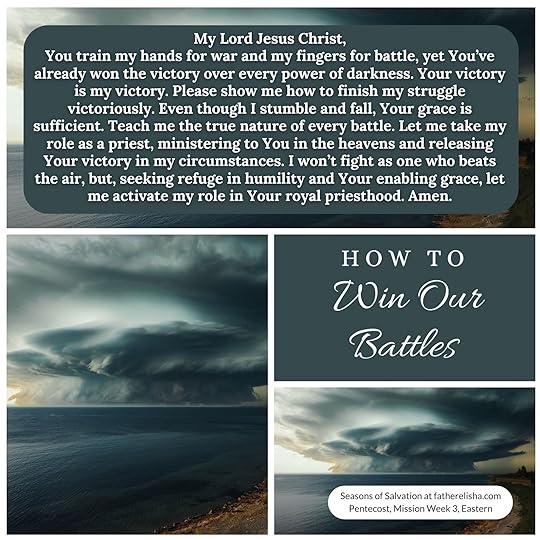
Photo by Nikolay Hristov on Unsplash
The post Pentecost: Mission 3 (Eastern: New) / Mission 1 (Eastern: Old): How to Win Our Battles first appeared on Father Elisha: Let me take you on an intriguing journey..
Pentecost: Mission 3 (Western): The Missionary’s Heavenly Resources
The Spiritual Mysteries of the Divine Calendar: The Missionary’s Heavenly Resources ~ July 13–19, 2025 ~ After focusing on the Person of the Holy Spirit in the first half of the Season of Pentecost, the current second half centers on our mission and God’s messengers. For five weeks, the Holy Spirit unveils the characteristics of the ambassadors—the missionaries—of the Kingdom of God, beginning with the Feast of the Apostles. In the first week, we explored What Is Our Mission? Last week focused on The Identity of the Missionary. Today, in the third week, we turn to the missionary’s heavenly resources.
The Messenger’s CharacteristicsFor the past two weeks, we have looked at the characteristics of the servants of God:
Given the ministry of reconciliation (2 Cor. 5:18–20).Called as ambassadors for Christ (2 Cor. 5:18–20).United through brotherly love as one new man (Eph. 2:15).Entrusted with a message—not only about what Jesus accomplished to redeem humanity, but also to mystically impart knowledge of the Person of Jesus (Gal. 1:11–12).Sent from Heaven to Earth—therefore, all believers are missionaries.Sent before the face of Jesus (Luke 10:1); He confirms our work through signs and wonders (Mark 16:20), because He is about to visit the places to which we are sent.Marked by childlike trust and simplicity—not immaturity, but innocence.Let us turn to this week’s Gospel.
Sunday Gospel for the Missionary’s Heavenly Resources: Luke 9:10–17 (NKJV)
And the apostles, when they had returned, told Him all that they had done. Then He took them and went aside privately into a deserted place belonging to the city called Bethsaida. 11 But when the multitudes knew it, they followed Him; and He received them and spoke to them about the kingdom of God, and healed those who had need of healing.
12 When the day began to wear away, the twelve came and said to Him, “Send the multitude away, that they may go into the surrounding towns and country, and lodge and get provisions; for we are in a deserted place here.”
13 But He said to them, “You give them something to eat.” And they said, “We have no more than five loaves and two fish, unless we go and buy food for all these people.” 14 For there were about five thousand men.
Then He said to His disciples, “Make them sit down in groups of fifty.” 15 And they did so, and made them all sit down. 16 Then He took the five loaves and the two fish, and looking up to heaven, He blessed and broke them, and gave them to the disciples to set before the multitude. 17 So they all ate and were filled, and twelve baskets of the leftover fragments were taken up by them.

Photo by Nate Rayfield on Unsplash
The Missionary’s Heavenly ResourcesIn verse 11, we read: “But when the multitudes knew it, they followed Him; and He received them and spoke to them about the kingdom of God, and healed those who had need of healing.” Jesus had taken His twelve apostles “aside privately into a deserted place” (verse 10) to restore their strength after sending them out to preach and heal the sick in the villages.
But when the multitude from Bethsaida pressed in on them, Jesus didn’t say, “Sorry, folks, I need to take care of My disciples—I’m quite busy, and they’re exhausted.” Instead, He received them, taught them, and healed them. His vast heart embraced them, and He saw each individual as equally important, caring deeply for every single one.
While the apostles rested, Jesus “spoke to them about the kingdom of God.” He confirmed the truth of His message by demonstrating the reality of the coming Kingdom. By healing the sick—since there will be no sickness in the Kingdom of God—He gave them a foretaste of its power.
Paul writes in 1 Corinthians 2:4: “And my speech and my preaching were not with persuasive words of human wisdom, but in demonstration of the Spirit and of power.”
For Jesus, the Kingdom of God is the reality in which He lives—He is the King Himself—and He allowed those around Him to taste its heavenly resources. The Kingdom of God is marked by overflowing abundance and infinite reserves. In contrast, “the ruler of this world” (John 14:30) governs through debt and the illusion of scarcity, manipulating people through needs and desires.
The Infinite Heavenly Resources
Since Jesus knew His Father and did only what the Father told Him, He released glimpses of eternity—along with its heavenly resources—to break the darkness of scarcity and needs, and to demonstrate the Kingdom of God.
We, together with the apostles—as ambassadors and messengers of that same Kingdom—sometimes fall into the trap of letting the realm we look to for our resources determine our progress. We either trust in the natural kingdom of this world, with its anxieties, needs, hunger, and thirst, or we look to the Kingdom marked by peace, abundance, satisfaction, and fulfillment.
Verse 12 reveals which kingdom the apostles were drawing their resources from—even though they had just returned from preaching about the Kingdom of God and healing the sick: “When the day began to wear away, the twelve came and said to Him, ‘Send the multitude away, that they may go into the surrounding towns and country, and lodge and get provisions; for we are in a deserted place here.’”
We have been raised in this fallen world, and its economy of debt and need—finances are just a small part—has become our way of life. It is deeply engraved in us. That is why the Holy Spirit must train the servants of God—you and me—to exercise faith in the resources of the Kingdom of God.
As messengers, our resources are infinite. Therefore, we will not argue or panic when Jesus says to us: “You give them something to eat” (verse 13).

Photo by Michael Ali on Unsplash
Heavenly Resources for Fishers of MenJesus fulfilled the promise He made to the disciples in Matthew 4:19—“Follow Me, and I will make you fishers of men”—as the apostles returned from their first mission without Him. They had preached the gospel and healed many, going from town after town. “So they departed and went through the towns, preaching the gospel and healing everywhere” (Luke 9:6).
Now, Jesus took them aside to give them rest near the city of Bethsaida—“fishing house” in Greek.
But the rumor that Jesus was the life and light of men (John 1:4) spread quickly, emptying the villages as multitudes gathered around Him. While the twelve apostles caught their breath, Jesus cared for the crowds.
Then the twelve came to Jesus and said, “Eh, Yeshua—it’s getting late, and these crowds are getting hungry …” And we know the story—how Jesus multiplied the five loaves and two fish to feed the multitude.
First Offer Our Resources
The apostles faced a crowd of probably twenty thousand people, and Jesus told them, “You give them something to eat” (verse 13). We face the same challenge today, as the Holy Spirit prepares to send us in this season. A vast sea of needs stretches before us—spiritual darkness, overwhelming confusion, violence, and cruel injustice. How can we possibly impact such a multitude?
The first thing we can do is to bring our five loaves and two fish to Jesus. What we offer might be the gift of hospitality, teaching, caring for children, mercy ministry to the homeless, prayer and intercession, evangelism, or influence through professional platforms or social media—whatever ability we have to serve God’s Kingdom, let us offer it to Jesus.
If we first surrender it into His hands and ask for His purification, blessing, and multiplication, we will be surprised by how the Holy Spirit anoints our gift.
Receive Heavenly Resources for Our Group of Fifty
But what then? There is still an ocean of troubled souls out there. Just a drive through our nearest city center on a Saturday night can drain the courage of even the most valiant vision. What do we do in such times of overwhelming need?
Jesus said in verse 14 of the Sunday Gospel: “Make them sit down in groups of fifty.” This is our treasure for the week. What is our group of fifty? It is not necessarily an exact number, but a portion of the sea of need we can reach through our friendships, prayers, and ministry.
We need to identify our nearby “group of fifty” and place what we have before them. This is where it all begins.
From our local group of fifty, Jesus will multiply our work. He will use our fifty to reach another fifty, and then they will reach another fifty, and another. Years—or even decades—down the road, the domino effect may have reached twenty thousand.
Faithfulness to our group of fifty is an important key. Let us not allow the multitude of twenty thousand around us to overwhelm or paralyze us. “He who is faithful in what is least is faithful also in much” (Luke 16:10). “His lord said to him, ‘Well done, good and faithful servant; you were faithful over a few things, I will make you ruler over many things’” (Matt. 25:21).
These weeks, the Holy Spirit is teaching us what it means to be ministers in God’s Kingdom. He wants us to understand more about our local group of fifty and, through His infilling and anointing, equip us to reach out.
I wish you a blessed week of mission with the Holy Spirit.
Concluding the Missionary’s Heavenly ResourcesThank you for taking the time to read and journey with me through the Seasons of Salvation. Let us pray this week for greater trust in the heavenly resources of the Kingdom of God. Let us remain alert when situations come our way to train us in this area. God bless you and be with us all.
Please leave a comment below—we’d love to hear your thoughts. If you found this post helpful, feel free to share it using the buttons at the top of the page.
Join the Journey Through the Seasons of SalvationJoin us on this weekly journey through the Seasons of Salvation as we walk in the footsteps of Jesus Christ through the key seasons of His life.
Sign up to receive this year’s Divine Calendar, which introduces the Seasons of Salvation and guides you through the journey ahead. As a welcome gift, you’ll also receive my young adult novel, The Legend of the Divine Calendar, delivered straight to your inbox.
Visit the Seasons of Salvation blog for insights into the coming week, posted every Saturday. We’d be honored to have you join us.
Save Your Prayer Card on Your Smartphone
Photo by Ben Michel on Unsplash
The post Pentecost: Mission 3 (Western): The Missionary’s Heavenly Resources first appeared on Father Elisha: Let me take you on an intriguing journey..
July 4, 2025
Pentecost: Mission 2 (Eastern: New) / Pentecost 5 (Eastern: Old): Living Under God’s Authority
The Spiritual Mysteries of the Divine Calendar: Living Under God’s Authority ~ July 6–12, 2025 ~ We are currently in the second half of the Season of Pentecost, focusing on our mission and the characteristics of the missionary. For five weeks, the Holy Spirit seeks to unveil the features of the ambassadors—the messengers—of the Kingdom of God, beginning with the Feast of the Apostles. In the first week, we looked at What Is Our Mission? The second week of the Mission period focuses on living under God’s authority.
After focusing on our Relationship with the Holy Spirit in the first half of the Season of Pentecost, the Divine Calendar now turns to the ministers of God—you and me. He calls us to carry a message to our generation.
“Now all things are of God, who has reconciled us to Himself through Jesus Christ, and has given us the ministry of reconciliation, that is, that God was in Christ reconciling the world to Himself, not imputing their trespasses to them, and has committed to us the word of reconciliation. Now then, we are ambassadors for Christ, as though God were pleading through us: we implore you on Christ’s behalf, be reconciled to God” (2 Cor. 5:18–20).
Characteristics of Living Under God’s AuthorityThe Feast of the Apostles, with the central theme of brotherly love, launched us into this season. To enter the ministry of reconciliation, we must endeavor to live a life of unity, as the former persecutor of the Church (the Apostle Paul) and the first leader of the Church (the Apostle Peter) demonstrated.
Last week, we also looked at the message of the Gospel itself, highlighting the importance of recognizing that our message is a mystical impartation of the Person of Jesus to others. Who Jesus is and what He did are inseparable, yet we often emphasize one aspect more than the other. “But I make known to you, brethren, that the gospel which was preached by me is not according to man. For I neither received it from man, nor was I taught it, but it came through the revelation of Jesus Christ” (Gal. 1:11–12).
In the previous week, we explored what our mission can be. Our mission doesn’t have to match the traditional image of a missionary risking their life, paddling through the rivers of the Amazon Rainforest to reach indigenous people groups. Primarily, the word “apostle” (from Greek, meaning delegate, commissioner, messenger, or one who is sent) refers to someone sent from Heaven to Earth—as an ambassador for the Kingdom of God. That means every Christian is, in a general sense, an apostle: a sent one. However, there is also a specific calling to be an apostle with a distinct anointing (see the Church offices in Ephesians 4:11–12).
Sent from Above
“So Jesus said to them again, ‘Peace to you! As the Father has sent Me, I also send you’” (John 20:21).
“Yet because you are not of the world, but I chose you out of the world, therefore the world hates you” (John 15:19b).
“Do not marvel that I said to you, ‘You must be born again’” (John 3:7). In Greek, “again” also means from above.
Just as the Father sent Jesus into the world to complete His mission and return to His homeland, so the Father has sent us from above to fulfill our mission and return to our heavenly home.
“I have glorified You on the earth. I have finished the work which You have given Me to do” (John 17:4). This means you can be a missionary right where you live. It also means your mission may change through the different phases of your life.
Living Under God’s Authority: Before His Face
In Luke 10:1, we find the key characteristic of the missionary: “After these things the Lord appointed seventy others also, and sent them two by two before His face into every city and place where He Himself was about to go.” As ambassadors of Christ, the Holy Spirit wants to help us discern where Jesus is turning His face—and send us in that direction, before the face of Jesus. This is where we want to go.
Even though there are many good things we could do, we want to discover the perfect task God has prepared specifically for us. “For we are His workmanship, created in Christ Jesus for good works, which God prepared beforehand that we should walk in them” (Eph. 2:10).
Jesus looks toward those prepared works, and we want to move in that direction. Our task becomes announcing that Jesus is coming—and He will confirm our words in His own way. “And heal the sick there, and say to them, ‘The kingdom of God has come near to you’” (Luke 10:9).
God’s ministers seek to live under the blessing of Jesus’ countenance. “The Lord bless you and keep you; the Lord make His face shine upon you, and be gracious to you; the Lord lift up His countenance upon you, and give you peace” (Num. 6:24–26).
“For we are not, as so many, peddling the word of God; but as of sincerity, but as from God, we speak in the sight of God in Christ” (2 Cor. 2:17).

Photo by Markus Spiske on Unsplash
Sunday Gospel for Living Under God’s Authority: Matthew 8:5–13 (NKJV)Now when Jesus had entered Capernaum, a centurion came to Him, pleading with Him, 6 saying, “Lord, my servant is lying at home paralyzed, dreadfully tormented.” 7 And Jesus said to him, “I will come and heal him.”
8 The centurion answered and said, “Lord, I am not worthy that You should come under my roof. But only speak a word, and my servant will be healed. 9 For I also am a man under authority, having soldiers under me. And I say to this one, ‘Go,’ and he goes; and to another, ‘Come,’ and he comes; and to my servant, ‘Do this,’ and he does it.”
10 When Jesus heard it, He marveled, and said to those who followed, “Assuredly, I say to you, I have not found such great faith, not even in Israel! 11 And I say to you that many will come from east and west, and sit down with Abraham, Isaac, and Jacob in the kingdom of heaven. 12 But the sons of the kingdom will be cast out into outer darkness. There will be weeping and gnashing of teeth.” 13 Then Jesus said to the centurion, “Go your way; and as you have believed, so let it be done for you.” And his servant was healed that same hour.
The Centurion Lived Under God’s Authority
In this upcoming week’s Sunday Gospel, the centurion hears Jesus say the amazing words: “I will come and heal him” (verse 7). Imagine—the Son of God, the Lord of the Universe, wants to come to your house. What a blessing! And He will heal your servant.
It seems obvious how the centurion would respond to such a heavenly opportunity. Yet he answered, “Lord, I am not worthy that You should come under my roof. But only speak a word, and my servant will be healed” (verse 8). We can hardly believe he said no—but he did, didn’t he?
The centurion was a humble man—he knew he was far from perfect. He also truly loved his neighbor as himself, showing deep compassion for his servant. But most strikingly, the centurion had the faith of a child. He believed that if Jesus simply said the words “be healed,” God would heal his servant. And Jesus honored the centurion because of his great faith: “Assuredly, I say to you, I have not found such great faith, not even in Israel” (verse 10).
Living Under God’s Authority: Sonship
Extraordinary faith characterized the apostles and the men of God throughout history, and the Holy Spirit desires to increase our faith as well. Where can we find such grace? “For you did not receive the spirit of bondage again to fear, but you received the Spirit of adoption by whom we cry out, ‘Abba, Father’” (Romans 8:15).
The Holy Spirit is the Spirit of adoption, enabling us to pray with childlike simplicity—as the centurion did when he demonstrated his complete trust in the Heavenly Father to answer Jesus’ prayer.
Let us ask the Holy Spirit this week—the One who adopts us into the Heavenly family—for the grace to pray with the assurance of the centurion, a true son of God. It won’t help to simply state or pretend we have the centurion’s complete trust. Such prayers and acts of faith are the work of the Holy Spirit. Let us ask the Spirit of God to impart more of the grace of sonship.
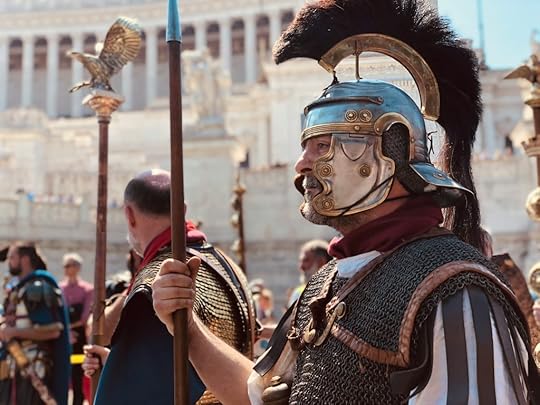
Photo by Maria Dolores Vazquez on Unsplash
Living Under God’s AuthorityA centurion was an officer in the Roman army who commanded a unit of eighty to one hundred soldiers, known as a century. Centurions were highly experienced men with exceptional leadership skills. The officer who came to Jesus understood military hierarchy and authority. He knew his place in the chain of command—with senior officers above him and soldiers and servants below—all under the authority of the Emperor at the very top.
In verse 9 of the Sunday Gospel, we read: “For I also am a man under authority, having soldiers under me. And I say to this one, ‘Go,’ and he goes; and to another, ‘Come,’ and he comes; and to my servant, ‘Do this,’ and he does it.”
But this centurion was special—more than just a good leader—because he showed deep compassion for his servant. He recognized who the true Emperor of Life was: The King of kings and the Lord of lords (Rev. 19:16).
He said to Jesus in verse 6, “Lord, my servant is lying at home paralyzed, dreadfully tormented.” He addressed Jesus as Lord. The centurion recognized a man under authority when he saw one—or rather, the centurion recognized the One who holds authority over every human life.
Here is the lesson for the ministers of God—you and me. How deeply do we recognize authority? Do we truly believe God has all authority over every human life and all of creation? Or do we believe it only when everything is going our way? Are we able to abide in and rest under God’s authority? The Holy Spirit desires to establish the ministers of God as those who live under His authority.
Synergism with the Holy Spirit
But God is not simply a great Commander-in-Chief or Admiral—He is a Father. The spiritual fathers of the Church speak of our synergism with the Holy Spirit. The will of God the Father is always good, and He knows best; therefore, we must always seek to live under our Heavenly Father’s authority.
Yet God created us as morally free agents. He doesn’t want puppets He can control, but a relationship of love with His children.
Synergism is the way the Holy Spirit, after revealing the will of the Father, waits for our free response. If we partly obey our Father’s will, He is patient and continues to work with us in love—but we miss the fullness of His blessing. If we reject our Father’s will, it often leads to sin. But if we love to do our Father’s will—voluntarily, from the heart—we begin to experience “the unsearchable riches of Christ” (Eph. 3:8).
“‘But what do you think? A man had two sons, and he came to the first and said, “Son, go, work today in my vineyard.” He answered and said, “I will not,” but afterward he regretted it and went. Then he came to the second and said likewise. And he answered and said, “I go, sir,” but he did not go. Which of the two did the will of his father?’ They said to Him, ‘The first’” (Matt. 21:28–31).
Synergism is this interaction—like a dance—between the Holy Spirit and our free will.
Living Under God’s Authority: The Lordship of Christ
We read in Romans 8:26–28:
“Likewise the Spirit also helps in our weaknesses. For we do not know what we should pray for as we ought, but the Spirit Himself makes intercession for us with groanings which cannot be uttered. Now He [God the Father] who searches the hearts knows what the mind of the Spirit is, because He makes intercession for the saints according to the will of God. And we know that all things work together for good to those who love God, to those who are the called according to His purpose.”
Are we able to recognize Who holds all authority in our ever-changing surroundings? Are we able to place ourselves in the chain of command—as men and women under authority—yet in a relationship of love, expressed through our synergism with the Holy Spirit?
As ministers of God in training, the Holy Spirit is giving grace in these weeks to lead us into a deeper life under the Lordship of Christ.
Glory be to the Holy Trinity.
Concluding Living Under God’s AuthorityAgain, thank you for taking the time to read. It is truly an honor and a blessing for me. Let us pray for the grace of comprehending sonship and the Lordship of Christ in a new and deeper way. May Jesus bless you with His closeness this week.
Please leave a comment below—we’d love to hear your thoughts. If you found this post helpful, feel free to share it using the buttons at the top of the page.
Join the Journey Through the Seasons of SalvationJoin us on this weekly journey through the Seasons of Salvation as we walk in the footsteps of Jesus Christ through the key seasons of His life.
Sign up to receive this year’s Divine Calendar, which introduces the Seasons of Salvation and guides you through the journey ahead. As a welcome gift, you’ll also receive my young adult novel, The Legend of the Divine Calendar, delivered straight to your inbox.
Visit the Seasons of Salvation blog for insights into the coming week, posted every Saturday. We’d be honored to have you join us.
Save Your Prayer Card on Your Smartphone
Photo by Un Liu on Unsplash
The post Pentecost: Mission 2 (Eastern: New) / Pentecost 5 (Eastern: Old): Living Under God’s Authority first appeared on Father Elisha: Let me take you on an intriguing journey..
Pentecost: Mission 2 (Western): The Identity of the Missionary
The Spiritual Mysteries of the Divine Calendar: The Identity of the Missionary ~ July 6–12, 2025 ~ We are currently in the second half of the Season of Pentecost, focusing on our mission and the characteristics of the missionary. For five weeks, the Holy Spirit seeks to unveil the features of the ambassadors—the messengers—of the Kingdom of God, beginning with the Feast of the Apostles. In the first week, we looked at What Is Our Mission? The second week of the Mission period focuses on the identity of the missionary.
After focusing on the Person of the Holy Spirit in the first half of the Season of Pentecost, the Divine Calendar now turns to the ministers of God—you and me. He calls us to carry a message to our generation.
“Now all things are of God, who has reconciled us to Himself through Jesus Christ, and has given us the ministry of reconciliation, that is, that God was in Christ reconciling the world to Himself, not imputing their trespasses to them, and has committed to us the word of reconciliation. Now then, we are ambassadors for Christ, as though God were pleading through us: we implore you on Christ’s behalf, be reconciled to God” (2 Cor. 5:18–20).
Characteristics and Identity of the MissionaryThe Feast of the Apostles, with the central theme of brotherly love, launched us into this season. To enter the ministry of reconciliation, we must endeavor to live a life of unity, as the former persecutor of the Church (the Apostle Paul) and the first leader of the Church (the Apostle Peter) demonstrated.
Last week, we also looked at the message of the Gospel itself, highlighting the importance of recognizing that our message is a mystical impartation of the Person of Jesus to others. Who Jesus is and what He did are inseparable, yet we often emphasize one aspect more than the other. “But I make known to you, brethren, that the gospel which was preached by me is not according to man. For I neither received it from man, nor was I taught it, but it came through the revelation of Jesus Christ” (Gal. 1:11–12).
In the previous week, we explored what our mission can be. Our mission doesn’t have to match the traditional image of a missionary risking their life, paddling through the rivers of the Amazon Rainforest to reach indigenous people groups. Primarily, the word “apostle” (from Greek, meaning delegate, commissioner, messenger, or one who is sent) refers to someone sent from Heaven to Earth—as an ambassador for the Kingdom of God. That means every Christian is, in a general sense, an apostle: a sent one. However, there is also a specific calling to be an apostle with a distinct anointing (see the Church offices in Ephesians 4:11–12).
Sent from Above
“So Jesus said to them again, ‘Peace to you! As the Father has sent Me, I also send you’” (John 20:21).
“Yet because you are not of the world, but I chose you out of the world, therefore the world hates you” (John 15:19b).
“Do not marvel that I said to you, ‘You must be born again’” (John 3:7). In Greek, “again” also means from above.
Just as the Father sent Jesus into the world to complete His mission and return to His homeland, so the Father has sent us from above to fulfill our mission and return to our heavenly home.
“I have glorified You on the earth. I have finished the work which You have given Me to do” (John 17:4). This means you can be a missionary right where you live. It also means your mission may change through the different phases of your life.
Photo by Lydia Matzal on Unsplash
The Identity of the Missionary: Before His FaceIn Luke 10:1, we find the key characteristic of the missionary: “After these things the Lord appointed seventy others also, and sent them two by two before His face into every city and place where He Himself was about to go.” As ambassadors of Christ, the Holy Spirit wants to help us discern where Jesus is turning His face—and send us in that direction, before the face of Jesus. This is where we want to go.
Even though there are many good things we could do, we want to discover the perfect task God has prepared specifically for us. “For we are His workmanship, created in Christ Jesus for good works, which God prepared beforehand that we should walk in them” (Eph. 2:10).
Jesus looks toward those prepared works, and we want to move in that direction. Our task becomes announcing that Jesus is coming—and He will confirm our words in His own way. “And heal the sick there, and say to them, ‘The kingdom of God has come near to you’” (Luke 10:9).
God’s ministers seek to live under the blessing of Jesus’ countenance. “The Lord bless you and keep you; the Lord make His face shine upon you, and be gracious to you; the Lord lift up His countenance upon you, and give you peace” (Num. 6:24–26).
“For we are not, as so many, peddling the word of God; but as of sincerity, but as from God, we speak in the sight of God in Christ” (2 Cor. 2:17).
Sunday Gospel for the Identity of the Missionary: Matthew 18:1–9 (NKJV)
At that time the disciples came to Jesus, saying, “Who then is greatest in the kingdom of heaven?”
2 Then Jesus called a little child to Him, set him in the midst of them, 3 and said, “Assuredly, I say to you, unless you are converted and become as little children, you will by no means enter the kingdom of heaven. 4 Therefore whoever humbles himself as this little child is the greatest in the kingdom of heaven. 5 Whoever receives one little child like this in My name receives Me.
6 “But whoever causes one of these little ones who believe in Me to sin, it would be better for him if a millstone were hung around his neck, and he were drowned in the depth of the sea. 7 Woe to the world because of offenses! For offenses must come, but woe to that man by whom the offense comes!
8 “If your hand or foot causes you to sin, cut it off and cast it from you. It is better for you to enter into life lame or maimed, rather than having two hands or two feet, to be cast into the everlasting fire. 9 And if your eye causes you to sin, pluck it out and cast it from you. It is better for you to enter into life with one eye, rather than having two eyes, to be cast into hell fire.

Photo by Zach Lezniewicz on Unsplash
The Identity of the MissionaryIn this week’s Sunday Gospel, Jesus draws our attention to what is exalted in the Kingdom of Heaven: the simplicity of a child.
We read in verses 1–4: “At that time the disciples came to Jesus, saying, ‘Who then is greatest in the kingdom of heaven?’ Then Jesus called a little child to Him, set him in the midst of them, and said, ‘Assuredly, I say to you, unless you are converted and become as little children, you will by no means enter the kingdom of heaven. Therefore whoever humbles himself as this little child is the greatest in the kingdom of heaven.’”
The complete trust and security a child has in their father and mother is a model for a minister of God. “Do not call anyone on earth your father; for One is your Father, He who is in heaven” (Matt. 23:9).
God the Father is the source of the missionary’s security and trust. “Therefore humble yourselves under the mighty hand of God, that He may exalt you in due time, casting all your care upon Him, for He cares for you” (1 Pet. 5:7).
The home of a child is their parents’ home, and in the same way, Heaven is the home of God’s messengers. “But now they desire a better, that is, a heavenly country. Therefore God is not ashamed to be called their God, for He has prepared a city for them” (Heb. 11:16). “In My Father’s house are many mansions; if it were not so, I would have told you. I go to prepare a place for you” (John 14:2).
Not Immaturity, but Innocence
Children live in their homes as if everything belongs to them. In the same way, the ministers of God are heirs of the world together with Christ. “The Spirit Himself bears witness with our spirit that we are children of God, and if children, then heirs—heirs of God and joint heirs with Christ, if indeed we suffer with Him, that we may also be glorified together” (Rom. 8:16–17).
A child has unshaken faith in their parents, forgives easily, and lives with the security that their parents will protect them. If we reflect these characteristics in our relationship with the Holy Trinity, we live a life considered great in the Kingdom of Heaven. “And the glory which You gave Me I have given them, that they may be one just as We are one” (John 17:22).
But how can we possibly do this? We often struggle with our own wisdom, experience, and sense of independence. Yet this is exactly what the grace of the Holy Spirit desires to form in us this week—childlike simplicity. Not immaturity, but innocence.
Let us be attentive to what is happening around us and listen for the still, small voice of the Holy Spirit in our circumstances. Let us pray that God’s Spirit enables us to live with greater childlike simplicity in our relationship with Him. This will prepare and qualify us for the mission Jesus desires to entrust us.
Our mission might be a renewal of a former calling, a further unfolding of a current assignment, or a completely new commissioning from Him.
Have a blessed week with the Holy Spirit as you discover childlike sincerity.
Glory be to the Holy Trinity.
Concluding the Identity of the MissionaryThank you for being on this journey through the Seasons of Salvation. It’s been my honor and joy to travel alongside you. May the simplicity of a child inspire our prayers this week.
Please leave a comment below—we’d love to hear your thoughts. If you found this post helpful, feel free to share it using the buttons at the top of the page.
Join the Journey Through the Seasons of SalvationJoin us on this weekly journey through the Seasons of Salvation as we walk in the footsteps of Jesus Christ through the key seasons of His life.
Sign up to receive this year’s Divine Calendar, which introduces the Seasons of Salvation and guides you through the journey ahead. As a welcome gift, you’ll also receive my young adult novel, The Legend of the Divine Calendar, delivered straight to your inbox.
Visit the Seasons of Salvation blog for insights into the coming week, posted every Saturday. We’d be honored to have you join us.
Save Your Prayer Card on Your Smartphone
Photo by Raditya Putranto on Unsplash
The post Pentecost: Mission 2 (Western): The Identity of the Missionary first appeared on Father Elisha: Let me take you on an intriguing journey..
June 27, 2025
Pentecost: Mission 1 (Eastern: New) / Pentecost 4 (Eastern: Old): What Is Our Mission?
The Spiritual Mysteries of the Divine Calendar: What Is Our Mission? ~ June 29–July 5, 2025 ~ After the Feast of Pentecost and the Apostle’s Fast, we have passed through the first phase of the Season of Pentecost, which focuses on the Person of the Holy Spirit. We concluded this third fast in the Divine Calendar with the Feast of the Apostles Peter and Paul on June 29 (New Calendar parishes) / July 12 (Old Calendar parishes). Now, the Season of Pentecost draws our attention to the questions: How can we be God’s messengers? And what is our mission?
“But we have this treasure in earthen vessels, that the excellence of the power may be of God and not of us” (2 Cor. 4:7). The grace of brotherly love and the undeniable testimony of the new man (Eph. 2:15)—the graces of the Feast of the Apostles—launch us into the footsteps of the apostles.
Nothing brings a stronger testimony of Jesus Christ to the world than when two enemies embrace each other. What politics can never solve—the fallen condition of the human heart—only Jesus can, when “the love of God has been poured out in our hearts by the Holy Spirit who was given to us” (Rom. 5:5).
This period, focusing on our mission—the second half phase of the Season of Pentecost—builds upon the foundation of the previous weeks: the treasure of the Holy Spirit we carry in our earthen vessels and the demonstration of brotherly love as the one new man.
What Is Our Mission? Two FoundationsLet us read two verses about the one new man:
“… so as to create in Himself one new man from the two, thus making peace, and that He might reconcile them both to God in one body through the cross, thereby putting to death the enmity. And He came and preached peace to you who were afar off and to those who were near. For through Him we both have access by one Spirit to the Father” (Eph. 2:15–18).
“A new commandment I give to you, that you love one another; as I have loved you, that you also love one another. By this all will know that you are My disciples, if you have love for one another” (John 13:34–35).
With these two graces—our deepened fellowship with the Holy Spirit and brotherly love—we now enter, for the next five weeks, the part of this Season of Salvation that focuses on our mission. The Season of Pentecost ends in August, just a few days before the Feast of the Transfiguration of the Lord.
The Divine Calendar draws our attention to the messengers of the Gospel, and the Feast of the Apostles has already begun this theme by focusing on the message itself. Do we preach the Gospel of Jesus Christ, or a gospel adapted to our times? As we remember from the Feast, no one taught the Apostle Paul the Gospel.
“For I neither received it from man, nor was I taught it, but it came through the revelation of Jesus Christ” (Gal. 1:12). It was his encounter with Jesus Christ—knowing His person—that imparted the Gospel to Paul.
Why Are There Two Phases in the Season of Pentecost?
The Gospel, at its core, is who Jesus is and what He has done to redeem us into His Kingdom. We often focus on the latter, but it is equally important to tell people about the most captivating human being ever to walk the face of the earth—and what He is like.
The Holy Spirit loves to reach into the hearts of those around us with a genuine revelation of the Person of Jesus. This is the task of the Holy Spirit: “He will glorify Me, for He will take of what is Mine and declare it to you” (John 16:14).
“Then those who feared the Lord spoke to one another, and the Lord listened and heard them; so a book of remembrance was written before Him for those who fear the Lord and who meditate on His name” (Mal. 3:16).
We needed these first weeks of the Season of Pentecost to focus on the Person of the Holy Spirit, because through a deepened fellowship with Him, we can give a true witness of the Person of Jesus Christ.
“And my speech and my preaching were not with persuasive words of human wisdom, but in demonstration of the Spirit and of power, that your faith should not be in the wisdom of men but in the power of God” (1 Cor. 2:4–5).
“The grace of the Lord Jesus Christ, and the love of God, and the communion of the Holy Spirit be with you all. Amen” (2 Cor. 13:14).
The Key
The key to entering the spiritual atmosphere of this period—focused on our mission—and to receiving grace is still the Upper Room. It remains the key to the entire Season of Pentecost.
“And when they had entered, they went up into the upper room where they were staying […] These all continued with one accord in prayer and supplication, with the women and Mary the mother of Jesus, and with His brothers” (Acts 1:13–14).
When we gather in worship and prayer, the Holy Spirit imparts the grace and mysteries of this Season of Salvation, which He gradually reveals to our minds.

Photo by Zac Durant on Unsplash
What Is Our Mission?But what is our mission? God has a unique assignment for each of us in His Kingdom. “And we know that all things work together for good to those who love God, to those who are the called according to His purpose” (Rom. 8:28).
He equips us differently for every season. “But the manifestation of the Spirit is given to each one for the profit of all … But one and the same Spirit works all these things, distributing to each one individually as He wills” (1 Cor. 12:6, 11).
The Goal of Our Individual Missions
We find the goal of our individual missions in one or more of the following:
Making disciples of all nations: “And Jesus came and spoke to them, saying, ‘All authority has been given to Me in heaven and on earth. Go therefore and make disciples of all the nations, baptizing them in the name of the Father and of the Son and of the Holy Spirit, teaching them to observe all things that I have commanded you; and lo, I am with you always, even to the end of the age.’ Amen” (Matt. 28:18–20).Building up and equipping the Church toward maturity: “And He Himself gave some to be apostles, some prophets, some evangelists, and some pastors and teachers, for the equipping of the saints for the work of ministry, for the edifying of the body of Christ, till we all come to the unity of the faith and of the knowledge of the Son of God, to a perfect man, to the measure of the stature of the fullness of Christ” (Eph. 4:11–13).Preparing the Church for the second coming of Jesus Christ (the final Season of Salvation in the Divine Calendar): “That He might sanctify and cleanse her with the washing of water by the word, that He might present her to Himself a glorious church, not having spot or wrinkle or any such thing, but that she should be holy and without blemish” (Eph. 5:26–27). “Let us be glad and rejoice and give Him glory, for the marriage of the Lamb has come, and His wife has made herself ready” (Rev. 19:7).What Is My Mission?
These points represent vast tasks, but God’s assignment for each of us fits into at least one of these three. During different phases of our lives, it may simply mean leading a righteous life as a student, raising our children in the faith, helping our local church, serving the Kingdom of God through our profession, or any of the many other assignments God trains and leads us toward.
So, when we talk about our mission these weeks, don’t think it only means being sent as a missionary to the jungles of Madagascar—unless that is what God is leading you toward. At this point in our lives, our mission might be in our prayer closet, in our homes, or in our neighborhoods.
Or perhaps, if we don’t have a prayer closet, setting aside a small, sacred space in our home could be the beginning of our mission.
Sunday Gospel for What Is Our Mission? Matthew 6:22–33 (NKJV)
“The lamp of the body is the eye. If therefore your eye is good, your whole body will be full of light. 23 But if your eye is bad, your whole body will be full of darkness. If therefore the light that is in you is darkness, how great is that darkness!
24 “No one can serve two masters; for either he will hate the one and love the other, or else he will be loyal to the one and despise the other. You cannot serve God and mammon.
25 “Therefore I say to you, do not worry about your life, what you will eat or what you will drink; nor about your body, what you will put on. Is not life more than food and the body more than clothing?
26 Look at the birds of the air, for they neither sow nor reap nor gather into barns; yet your heavenly Father feeds them. Are you not of more value than they? 27 Which of you by worrying can add one cubit to his stature?
28 “So why do you worry about clothing? Consider the lilies of the field, how they grow: they neither toil nor spin; 29 and yet I say to you that even Solomon in all his glory was not arrayed like one of these. 30 Now if God so clothes the grass of the field, which today is, and tomorrow is thrown into the oven, will He not much more clothe you, O you of little faith?
31 “Therefore do not worry, saying, ‘What shall we eat?’ or ‘What shall we drink?’ or ‘What shall we wear?’ 32 For after all these things the Gentiles seek. For your heavenly Father knows that you need all these things. 33 But seek first the kingdom of God and His righteousness, and all these things shall be added to you.

Photo by Alexandru Tudorache on Unsplash
The Master We ServeThis week’s Sunday Gospel, Matthew 6:22–33, begins by asking what master we set our eyes on (verses 22–23).
Jesus is “life, and the life was the light of men” (John 1:4). If our “eye is good,” we look to God to meet all our needs as His messengers. When we constantly fix our eyes on the “light of men,” we will “shine as lights in the world” (Phil. 2:15), and our “whole body will be full of light” (Matt. 6:22).
If “the ruler of this world” (John 14:30) and mammon attracts our eyes through anxieties and lack of faith (verse 30), then our “eye is bad,” and our “whole body will be full of darkness” (verse 23).
“No one can serve two masters; for either he will hate the one and love the other, or else he will be loyal to the one and despise the other. You cannot serve God and mammon” (verse 24).
The Holy Spirit trains the servants of God these weeks to “consider the lilies of the field, how they grow: they neither toil nor spin; and yet I say to you that even Solomon in all his glory was not arrayed like one of these” (verses 28–29).
The flowers of the field open only for the sun—they close in the darkness—and as the lilies display their beauty to their heavenly Creator, they grow without toiling nor spinning. God’s messengers need this gaze upon the face of Jesus, with full assurance that He cares for the needs of our physical life. After all, “which of you by worrying can add one cubit to his stature?” (verse 27).
Good Eyes
If we look to mammon—having our eyes darkened—we become like those who do not know God the Father. “Therefore do not worry, saying, ‘What shall we eat?’ or ‘What shall we drink?’ or ‘What shall we wear?’ For after all these things the Gentiles seek. For your heavenly Father knows that you need all these things” (verses 31–32).
The Holy Spirit trains His messengers to know, deeply and truly, the Master they serve. God’s servants must not distract themselves by looking to the ways and economy (plans) of this world—mammon—to meet their needs, for that darkens the eyes.
Instead, God trains His servants to have good eyes, fixed on Jesus for every need. (Of course, this doesn’t mean we should quit our jobs; rather, it means we recognize that “it is He who gives you power to get wealth” [Deut. 8:18].)
“Then He called His twelve disciples together and gave them power and authority over all demons, and to cure diseases. He sent them to preach the kingdom of God and to heal the sick. And He said to them, ‘Take nothing for the journey, neither staffs nor bag nor bread nor money; and do not have two tunics apiece’” (Luke 9:1–3).
Let us pray this week for the grace to truly know the Master we serve, so that physical needs won’t hinder our obedience as ambassadors for Christ. “But seek first the kingdom of God and His righteousness, and all these things shall be added to you” (verse 33).
Concluding What Is Our Mission?Thank you for taking the time to read. It’s my honor to be on this journey together with you. May the Holy Spirit be close to you in the upcoming week as we focus on our individual missions.
Please leave a comment below—we’d love to hear your thoughts. If you found this post helpful, feel free to share it using the buttons at the top of the page.
Join the Journey Through the Seasons of SalvationJoin us on this weekly journey through the Seasons of Salvation as we walk in the footsteps of Jesus Christ through the key seasons of His life.
Sign up to receive this year’s Divine Calendar, which introduces the Seasons of Salvation and guides you through the journey ahead. As a welcome gift, you’ll also receive my young adult novel, The Legend of the Divine Calendar, delivered straight to your inbox.
Visit the Seasons of Salvation blog for insights into the coming week, posted every Saturday. We’d be honored to have you join us.
Save Your Prayer Card on Your Smartphone
Photo by Neom on Unsplash
The post Pentecost: Mission 1 (Eastern: New) / Pentecost 4 (Eastern: Old): What Is Our Mission? first appeared on Father Elisha: Let me take you on an intriguing journey..
Pentecost (Western & Eastern): The Feast of the Apostles (Apostles Peter and Paul)
 The Spiritual Mysteries of the Divine Calendar: The Feast of the Apostles ~ June 29 / July 12 (Eastern: Old Calendar), 2025 ~
 The Feast of the Apostles Peter and Paul ushers us into a period in the Divine Calendar that focuses on our mission—the second half of the Season of Pentecost. The focus shifts from learning about the Holy Spirit and His work of sealing Christ’s salvation within us to learning about the qualities of a servant of God.
Ever since the Feast of Pentecost, we have been learning about the mysteries behind the Fast of the Holy Spirit (the Apostles’ Fast). During the weeks of this fast, we saw how the Holy Spirit desired to deepen His relationship with us and to teach us about prayer and other principles to help us overcome our trials. Now, the Feast of the Apostles marks the end of this third fast in the Divine Calendar.
This feast commemorates the martyrdom of the Apostles Peter and Paul in Rome. Both were martyred on this date—June 29 on the new calendar (July 12 on the old calendar)—though not in the same year. The major theme of this feast, and the grace it imparts, is brotherly love. (If you search for the icon of the Feast of the Apostles, you’ll see the two apostles embracing one another.)
The Feast of the Apostles and Brotherly LoveWe read in Galatians 2:7: “But on the contrary, when they saw that the gospel for the uncircumcised had been committed to me [Paul], as the gospel for the circumcised was to Peter.” These great founding leaders of the Church represent our call to the Great Commission, “… for the Jew first and also for the Greek” (Rom. 1:16).
These two men, despite being extremely different, worked closely together through the bond of brotherly love. One was a simple fisherman; the other, a Pharisee taught at the feet of Gamaliel—the first leader of the Church and her former fiercest persecutor. Their companionship displays the transformative power of the gospel of Jesus.
In today’s world, it’s easy to find people groups who hate each other. But when members of those same groups worship together in a local church—treating one another like family—it powerfully displays the truth and transformative power of the Gospel like nothing else. “By this all will know that you are My disciples, if you have love for one another” (John 13:35).
The brotherhood between the Apostles Peter and Paul is a striking example. “For I am not ashamed of the gospel of Christ, for it is the power of God to salvation for everyone who believes, for the Jew first and also for the Greek” (Rom. 1:16).
Who Do You Say That I Am?
In the Eastern Gospel passage below, Jesus asks who people say He is. Many listened to the judgements of others. “Hmm … maybe he is John the Baptist? No, he’s Elijah. No, haven’t you heard? He’s one of the prophets of old.”
But Jesus asks Peter: “‘But who do you say that I am?’ Simon Peter answered and said, ‘You are the Christ, the Son of the living God.’ Jesus answered and said to him, ‘Blessed are you, Simon Bar-Jonah, for flesh and blood has not revealed this to you, but My Father who is in heaven’” (Matt. 16:15–17).
What do we say about Jesus? Do we proclaim a gospel with Jesus as described by others, or do we proclaim Jesus as our Father in Heaven has revealed Him? In the coming weeks, the Holy Spirit will help us understand more about what a genuine minister of God is like, and we begin with the message itself. Do we proclaim a popular, tailored Jesus who fits our times, or do we proclaim Jesus as revealed to us by the Father?
How do we receive this kind of revelation from the Father? It’s not that difficult. The Gospels show us who Jesus is. Do we proclaim a message about Jesus as He is revealed in the Gospels?

Photo by Toa Heftiba on Unsplash
Gospel of the Feast of the Apostles: Matthew 10:1–15 (NKJV)And when He had called His twelve disciples to Him, He gave them power over unclean spirits, to cast them out, and to heal all kinds of sickness and all kinds of disease.
2 Now the names of the twelve apostles are these: first, Simon, who is called Peter, and Andrew his brother; James the son of Zebedee, and John his brother; 3 Philip and Bartholomew; Thomas and Matthew the tax collector; James the son of Alphaeus, and Lebbaeus, whose surname was Thaddaeus; 4 Simon the Cananite, and Judas Iscariot, who also betrayed Him.
5 These twelve Jesus sent out and commanded them, saying: “Do not go into the way of the Gentiles, and do not enter a city of the Samaritans. 6 But go rather to the lost sheep of the house of Israel. 7 And as you go, preach, saying, ‘The kingdom of heaven is at hand.’
8 Heal the sick, cleanse the lepers, raise the dead, cast out demons. Freely you have received, freely give. 9 Provide neither gold nor silver nor copper in your money belts, 10 nor bag for your journey, nor two tunics, nor sandals, nor staffs; for a worker is worthy of his food.
11 “Now whatever city or town you enter, inquire who in it is worthy, and stay there till you go out. 12 And when you go into a household, greet it. 13 If the household is worthy, let your peace come upon it. But if it is not worthy, let your peace return to you.
14 And whoever will not receive you nor hear your words, when you depart from that house or city, shake off the dust from your feet. 15 Assuredly, I say to you, it will be more tolerable for the land of Sodom and Gomorrah in the day of judgment than for that city!
Gospel of the Feast of the Apostles: Matthew 16:13–19 (NKJV)When Jesus came into the region of Caesarea Philippi, He asked His disciples, saying, “Who do men say that I, the Son of Man, am?”
14 So they said, “Some say John the Baptist, some Elijah, and others Jeremiah or one of the prophets.” 15 He said to them, “But who do you say that I am?” 16 Simon Peter answered and said, “You are the Christ, the Son of the living God.”
17 Jesus answered and said to him, “Blessed are you, Simon Bar-Jonah, for flesh and blood has not revealed this to you, but My Father who is in heaven. 18 And I also say to you that you are Peter, and on this rock I will build My church, and the gates of Hades shall not prevail against it. 19 And I will give you the keys of the kingdom of heaven, and whatever you bind on earth will be bound in heaven, and whatever you loose on earth will be loosed in heaven.”
The Feast of the Apostles and the Gospel MessageWhat about Apostle Paul? How did he receive the gospel message? If there is any person in Church history who had a genuine revelation about the gospel of Christ, it is this apostle.
“But I make known to you, brethren, that the gospel which was preached by me is not according to man. For I neither received it from man, nor was I taught it, but it came through the revelation of Jesus Christ” (Gal. 1:11–12).
No one taught the Apostle Paul the message he would later preach and write in his epistles. It was by revelation—through an encounter with the Person of Jesus, even seeing Him—that Apostle Paul came to know the gospel he proclaimed.
No teacher or evangelist gave him this message. It was Christ Himself who imparted it. And through Apostle Paul’s words, that same message has been passed on to us. The more we know Jesus and what He has accomplished for us, the more clearly we will understand the gospel message.
For Future Generations
Both Apostles Peter and Paul received the Gospel through divine revelation—a living encounter with the Person of God. No wonder their preaching had power! It wasn’t a repetition of others’ words or a step-by-step formula, but a genuine revelation of God.
The Holy Spirit intended for the truths of the Gospel to be written down for future generations, so that no false gospels or revelations would lead Christians astray.
We see Peter writing about Paul in his second epistle: “[A]nd consider that the longsuffering of our Lord is salvation—as also our beloved brother Paul, according to the wisdom given to him, has written to you, as also in all his epistles, speaking in them of these things, in which are some things hard to understand, which untaught and unstable people twist to their own destruction, as they do also the rest of the Scriptures” (2 Pet. 3:15–16).

Photo by Marie Bellando Mitjans on Unsplash
The Feast of the Apostles and Living Out the New ManLike most human beings, the two apostles also had their clashes. Paul writes: “Now when Peter had come to Antioch, I withstood him to his face, because he was to be blamed […] But when I saw that they were not straightforward about the truth of the gospel, I said to Peter before them all, ‘If you, being a Jew, live in the manner of Gentiles and not as the Jews, why do you compel Gentiles to live as Jews?’” (Gal. 2:11, 13–14)
But we know the Apostle Peter didn’t remain bitter—he later affirmed the Apostle Paul’s teaching, calling him “our beloved brother Paul,” as we just read in the passage from Second Peter above (2 Pet. 3:15–16). They lived out the one new man—the new human nature we receive from Jesus.
“There is neither Jew nor Greek, there is neither slave nor free, there is neither male nor female; for you are all one in Christ Jesus” (Gal. 3:28).
“Therefore, if anyone is in Christ, he is a new creation; old things have passed away; behold, all things have become new” (2 Cor. 5:17).
“Therefore we were buried with Him through baptism into death, that just as Christ was raised from the dead by the glory of the Father, even so we also should walk in newness of life” (Rom 6:4).
“For He Himself is our peace, who has made both one, and has broken down the middle wall of separation, having abolished in His flesh the enmity, that is, the law of commandments contained in ordinances, so as to create in Himself one new man from the two, thus making peace, and that He might reconcile them both to God in one body through the cross, thereby putting to death the enmity” (Eph. 2:14–16).
The Grace from the Feast of the Apostles
The grace from the Feast of the Apostles is the genuine sign of the Gospel: the one new man. The Holy Spirit wants to help us forgive, let go of bitterness, stop blaming ourselves, and move forward in brotherly love—no longer spiraling downward in shame.
How could the Apostles live in such a way? The divine presence of Jesus was always with them: “… and lo, I am with you always, even to the end of the age” (Matt. 28:20b). “And they went out and preached everywhere, the Lord working with them and confirming the word through the accompanying signs” (Mark 16:20).
The Apostle Paul writes: “And my speech and my preaching were not with persuasive words of human wisdom, but in demonstration of the Spirit and of power, that your faith should not be in the wisdom of men but in the power of God” (1 Cor. 2:4–5).
Let us meditate on the Gospel and the Person of Christ, so that we may experience the nearness of Jesus more deeply and hear Him say: “Blessed are you, [your name here], for flesh and blood has not revealed this to you, but My Father who is in heaven” (Matt. 16:17).
Concluding The Feast of the ApostlesLet us ask, on the Feast of the Apostles, that the Holy Spirit grant us a deeper revelation of Jesus Christ during this second half of the Season of Pentecost, as we focus on our mission. Then we can speak of Jesus in a way that causes Him to knock on others’ hearts—because we first opened ours to Him and allowed Him to teach us about Himself.
It is my honor to be on this journey through the Divine Calendar with you.
Blessed feast—in the spirit of brotherly love.
Please leave a comment below—we’d love to hear your thoughts. If you found this post helpful, feel free to share it using the buttons at the top of the page.
Join the Journey Through the Seasons of SalvationJoin us on this weekly journey through the Seasons of Salvation as we walk in the footsteps of Jesus Christ through the key seasons of His life.
Sign up to receive this year’s Divine Calendar, which introduces the Seasons of Salvation and guides you through the journey ahead. As a welcome gift, you’ll also receive my young adult novel, The Legend of the Divine Calendar, delivered straight to your inbox.
Visit the Seasons of Salvation blog for insights into the coming week, posted every Saturday. We’d be honored to have you join us.
Save Your Prayer Card on Your Smartphone
Photo by Juan Pablo Rodriguez on Unsplash
The post Pentecost (Western & Eastern): The Feast of the Apostles (Apostles Peter and Paul) first appeared on Father Elisha: Let me take you on an intriguing journey..
June 20, 2025
Pentecost (Western & Eastern): The Feast of the Nativity of John the Baptist
The Spiritual Mysteries of the Divine Calendar: The Feast of the Nativity of John the Baptist ~ June 24 / July 7 (Eastern: Old Calendar), 2025 ~ Exactly six months before Christmas, the traditional churches celebrate the Nativity of John the Baptist (his birth), because he was six months older than Jesus. “Now indeed, Elizabeth your relative has also conceived a son in her old age; and this is now the sixth month for her who was called barren” (Luke 1:36).
The Gospel passage for this lesser feast is the well-known account of the birth of the great Forerunner and Prophet John the Baptist in Luke chapter 1, including the part about his parents: “But they had no child, because Elizabeth was barren, and they were both well advanced in years” (Luke 1:7).
However, we will look at the other three passages—the Vesper readings—related to this feast, to see more clearly the grace given to us through this event.
The first reading is from Genesis 17:15–17, and the surrounding verses, telling of Abraham and Sarah and the promise of a child in their old age.The second reading is from Judges 13:2–8 and the verses that follow, recounting the birth of Samson after his parents experienced a period of barrenness.The third reading is from Isaiah 40:1 and additional verses, including the well-known prophecy connected to St. John the Baptist: “The voice of one crying in the wilderness: ‘Prepare the way of the Lord; make straight in the desert a highway for our God’” (Isa. 40:3).These three passages offer signs that help us understand how the Nativity of John the Baptist speaks to our lives today.
The Nativity of John the Baptist: The Genesis Passage (Gen. 17:15–17ff.)If someone stays spiritually barren for a long time, that doesn’t mean that person has done something wrong and that God is upset, but God has a specific purpose with this barrenness. If we are able to refrain from accusing God when we encounter difficult circumstances, and instead recognize that He has a purpose in them, it can transform the way we move forward in our relationship with Him.
There is a kind of faith that takes us beyond our natural abilities, and this is one of the graces the Holy Spirit desires to give us at this feast.

Photo by Neom on Unsplash
The Nativity of John the Baptist: The Judges Passage (Judg. 13:2–8ff.)Even though the passage about Samson shares similarities with the story of Abraham, Sarah, and Isaac, it offers something distinct. Unlike Abraham and Sarah, Samson’s parents were still young when they faced barrenness.
We read about the angel that came to Samson’s mother: “And the Angel of the Lord appeared to the woman and said to her, ‘Indeed now, you are barren and have borne no children, but you shall conceive and bear a son. Now therefore, please be careful not to drink wine or similar drink, and not to eat anything unclean’” (Judg. 13:3–4). The angel tells her to keep God’s commandments, implying that the people had abandoned them.
When we break the commandments, we give the enemy an opportunity to attack and place a curse—symbolized by barrenness—that can hinder our lives and circumstances. This feast contains the grace to help us turn back to the straight ways of the Lord, breaking any curse the enemy may have placed in our surroundings.
The Nativity of John the Baptist: The Isaiah Passage (Isa. 40:1ff.)
In Isaiah 40:1–4, we read: “‘Comfort, yes, comfort My people!’ Says your God. ‘Speak comfort to Jerusalem, and cry out to her, that her warfare is ended, that her iniquity is pardoned; for she has received from the Lord’s hand double for all her sins.’ The voice of one crying in the wilderness: ‘Prepare the way of the Lord; make straight in the desert a highway for our God. Every valley shall be exalted and every mountain and hill brought low; the crooked places shall be made straight and the rough places smooth.’”
God wants to comfort His people, so He sent a prophet—the Forerunner John the Baptist—already “filled with the Holy Spirit, even from his mother’s womb” (Luke 1:15b). This passage also shows that without the prophetic voice (symbolized by the Forerunner), our ways quickly become crooked and uneven, rising in pride and descending into low self-esteem.
When our paths are not straight, we perceive mountains we cannot overcome and lose the faith that transcends our limitations, allowing the enemy to place his curses around us.
God never acts crookedly, but because of our own crooked ways, we fall into the trap of seeing God as unfair toward us. Yet this feast offers the grace to perceive God’s dealings with us as they truly are.
Concluding The Feast of the Nativity of John the BaptistMay these three graces from this minor feast of the Nativity of John the Baptist help us in our walk with Jesus as we soon enter the second half of the sixth Season of Salvation—the Season of Pentecost:
Faith that takes us beyond our natural abilities.A straightening of our ways so we keep God’s commandments, breaking any curse affecting us.A straightening of our ways to perceive God’s dealings with us as they truly are.Please leave a comment below—we’d love to hear your thoughts. If you found this post helpful, feel free to share it using the buttons at the top of the page.
Join the Journey Through the Seasons of SalvationJoin us on this weekly journey through the Seasons of Salvation as we walk in the footsteps of Jesus Christ through the key seasons of His life.
Sign up to receive this year’s Divine Calendar, which introduces the Seasons of Salvation and guides you through the journey ahead. As a welcome gift, you’ll also receive my young adult novel, The Legend of the Divine Calendar, delivered straight to your inbox.
Visit the Seasons of Salvation blog for insights into the coming week, posted every Saturday. We’d be honored to have you join us.
Photo by Tyler Wanlass on Unsplash
Gospel of the Feast of the Nativity of John the Baptist (Luke 1:1–25, 57–69, 76, 80, NKJV)Inasmuch as many have taken in hand to set in order a narrative of those things which have been fulfilled among us, 2 just as those who from the beginning were eyewitnesses and ministers of the word delivered them to us, 3 it seemed good to me also, having had perfect understanding of all things from the very first, to write to you an orderly account, most excellent Theophilus, 4 that you may know the certainty of those things in which you were instructed.
5 There was in the days of Herod, the king of Judea, a certain priest named Zacharias, of the division of Abijah. His wife was of the daughters of Aaron, and her name was Elizabeth. 6 And they were both righteous before God, walking in all the commandments and ordinances of the Lord blameless. 7 But they had no child, because Elizabeth was barren, and they were both well advanced in years.
8 So it was, that while he was serving as priest before God in the order of his division, 9 according to the custom of the priesthood, his lot fell to burn incense when he went into the temple of the Lord. 10 And the whole multitude of the people was praying outside at the hour of incense. 11 Then an angel of the Lord appeared to him, standing on the right side of the altar of incense. 12 And when Zacharias saw him, he was troubled, and fear fell upon him.
13 But the angel said to him, “Do not be afraid, Zacharias, for your prayer is heard; and your wife Elizabeth will bear you a son, and you shall call his name John. 14 And you will have joy and gladness, and many will rejoice at his birth. 15 For he will be great in the sight of the Lord, and shall drink neither wine nor strong drink. He will also be filled with the Holy Spirit, even from his mother’s womb. 16 And he will turn many of the children of Israel to the Lord their God. 17 He will also go before Him in the spirit and power of Elijah, ‘to turn the hearts of the fathers to the children,’ and the disobedient to the wisdom of the just, to make ready a people prepared for the Lord.”
18 And Zacharias said to the angel, “How shall I know this? For I am an old man, and my wife is well advanced in years.”
19 And the angel answered and said to him, “I am Gabriel, who stands in the presence of God, and was sent to speak to you and bring you these glad tidings. 20 But behold, you will be mute and not able to speak until the day these things take place, because you did not believe my words which will be fulfilled in their own time.”
21 And the people waited for Zacharias, and marveled that he lingered so long in the temple. 22 But when he came out, he could not speak to them; and they perceived that he had seen a vision in the temple, for he beckoned to them and remained speechless.
23 So it was, as soon as the days of his service were completed, that he departed to his own house. 24 Now after those days his wife Elizabeth conceived; and she hid herself five months, saying, 25 “Thus the Lord has dealt with me, in the days when He looked on me, to take away my reproach among people.”
(…)
57 Now Elizabeth’s full time came for her to be delivered, and she brought forth a son. 58 When her neighbors and relatives heard how the Lord had shown great mercy to her, they rejoiced with her.
59 So it was, on the eighth day, that they came to circumcise the child; and they would have called him by the name of his father, Zacharias. 60 His mother answered and said, “No; he shall be called John.”
61 But they said to her, “There is no one among your relatives who is called by this name.” 62 So they made signs to his father—what he would have him called.
63 And he asked for a writing tablet, and wrote, saying, “His name is John.” So they all marveled. 64 Immediately his mouth was opened and his tongue loosed, and he spoke, praising God. 65 Then fear came on all who dwelt around them; and all these sayings were discussed throughout all the hill country of Judea. 66 And all those who heard them kept them in their hearts, saying, “What kind of child will this be?” And the hand of the Lord was with him.
67 Now his father Zacharias was filled with the Holy Spirit, and prophesied, saying: 68 “Blessed is the Lord God of Israel, for He has visited and redeemed His people, 69 and has raised up a horn of salvation for us in the house of His servant David.
(…)
76 “And you, child, will be called the prophet of the Highest; for you will go before the face of the Lord to prepare His ways,
(…)
80 So the child grew and became strong in spirit, and was in the deserts till the day of his manifestation to Israel.
Blessed Feast!
The post Pentecost (Western & Eastern): The Feast of the Nativity of John the Baptist first appeared on Father Elisha: Let me take you on an intriguing journey..