Father Elisha's Blog, page 7
May 16, 2025
Resurrection 5 (Eastern): The Samaritan Woman and the Living Water

 The Spiritual Mysteries of the Divine Calendar: The Soul of the Samaritan Woman ~ May 18–24, 2025 ~
 As the Sundays of the Resurrection draw us closer to the outpouring of the Holy Spirit at Pentecost, this Sunday of the Samaritan Woman presents us again with the theme of thirst. This encounter reminds us of our own deep spiritual thirst for the Holy Spirit, as we journey further into the mysteries of the Resurrection during these special weeks.
Sunday Gospel of the Samaritan Woman: John 4:5–42 (NKJV)5 So He came to a city of Samaria which is called Sychar, near the plot of ground that Jacob gave to his son Joseph. 6 Now Jacob’s well was there. Jesus therefore, being wearied from His journey, sat thus by the well. It was about the sixth hour.
7 A woman of Samaria came to draw water. Jesus said to her, “Give Me a drink.” 8 For His disciples had gone away into the city to buy food. 9 Then the woman of Samaria said to Him, “How is it that You, being a Jew, ask a drink from me, a Samaritan woman?” For Jews have no dealings with Samaritans.
10 Jesus answered and said to her, “If you knew the gift of God, and who it is who says to you, ‘Give Me a drink,’ you would have asked Him, and He would have given you living water.” 11 The woman said to Him, “Sir, You have nothing to draw with, and the well is deep. Where then do You get that living water? 12 Are You greater than our father Jacob, who gave us the well, and drank from it himself, as well as his sons and his livestock?”
13 Jesus answered and said to her, “Whoever drinks of this water will thirst again, 14 but whoever drinks of the water that I shall give him will never thirst. But the water that I shall give him will become in him a fountain of water springing up into everlasting life.” 15 The woman said to Him, “Sir, give me this water, that I may not thirst, nor come here to draw.”
16 Jesus said to her, “Go, call your husband, and come here.” 17 The woman answered and said, “I have no husband.” Jesus said to her, “You have well said, ‘I have no husband,’ 18 for you have had five husbands, and the one whom you now have is not your husband; in that you spoke truly.” 19 The woman said to Him, “Sir, I perceive that You are a prophet. 20 Our fathers worshiped on this mountain, and you Jews say that in Jerusalem is the place where one ought to worship.”
21 Jesus said to her, “Woman, believe Me, the hour is coming when you will neither on this mountain, nor in Jerusalem, worship the Father. 22 You worship what you do not know; we know what we worship, for salvation is of the Jews. 23 But the hour is coming, and now is, when the true worshipers will worship the Father in spirit and truth; for the Father is seeking such to worship Him. 24 God is Spirit, and those who worship Him must worship in spirit and truth.” 25 The woman said to Him, “I know that Messiah is coming” (who is called Christ). “When He comes, He will tell us all things.” 26 Jesus said to her, “I who speak to you am He.”
27 And at this point His disciples came, and they marveled that He talked with a woman; yet no one said, “What do You seek?” or, “Why are You talking with her?”
28 The woman then left her waterpot, went her way into the city, and said to the men, 29 “Come, see a Man who told me all things that I ever did. Could this be the Christ?” 30 Then they went out of the city and came to Him.
31 In the meantime His disciples urged Him, saying, “Rabbi, eat.” 32 But He said to them, “I have food to eat of which you do not know.” 33 Therefore the disciples said to one another, “Has anyone brought Him anything to eat?”
34 Jesus said to them, “My food is to do the will of Him who sent Me, and to finish His work. 35 Do you not say, ‘There are still four months and then comes the harvest’? Behold, I say to you, lift up your eyes and look at the fields, for they are already white for harvest! 36 And he who reaps receives wages, and gathers fruit for eternal life, that both he who sows and he who reaps may rejoice together. 37 For in this the saying is true: ‘One sows and another reaps.’ 38 I sent you to reap that for which you have not labored; others have labored, and you have entered into their labors.”
39 And many of the Samaritans of that city believed in Him because of the word of the woman who testified, “He told me all that I ever did.” 40 So when the Samaritans had come to Him, they urged Him to stay with them; and He stayed there two days. 41 And many more believed because of His own word. 42 Then they said to the woman, “Now we believe, not because of what you said, for we ourselves have heard Him and we know that this is indeed the Christ, the Savior of the world.”
Sunday Of The Samaritan WomanWe read in verse 10: “Jesus answered and said to her, ‘If you knew the gift of God, and who it is who says to you, “Give Me a drink,” you would have asked Him, and He would have given you living water.’”
And in verse 14: “But whoever drinks of the water that I shall give him will never thirst. But the water that I shall give him will become in him a fountain of water springing up into everlasting life.”
The water Jesus offers is the promise of the Holy Spirit. “For I will pour water on him who is thirsty, and floods on the dry ground; I will pour My Spirit on your descendants, and My blessing on your offspring” (Isa. 44:3).

Photo by Jonny Gios on Unsplash
Building Our New Man: Unfolding the Mysteries of the Grace of Resurrection:The Living Water (John 4:5–42 NKJV)On the Sunday after Pascha we received the grace of the living faith (Thomas Sunday). The third Sunday (The Myrrh-bearing Women), we received the living bread. Last week, on the Sunday of the Paralytic, we reflected on the grace of straightening our ways—of aligning our lives with the way Jesus lived. This fifth Sunday of the Season of Resurrection, the Holy Spirit offers us living water. What is the difference between the Bread of Life and the Water of Life? And why does the Divine Calendar lead our attention toward receiving living faith?
Living faith is a faith that is renewed daily—different from yesterday—and it helps us face the challenges that are new every day. Living bread is the bread from Heaven that nourishes us and opens our eyes to move from the earthly to the heavenly life.
Jesus said to the Samaritan woman: “If you knew the gift of God, and who it is who says to you, ‘Give Me a drink,’ you would have asked Him, and He would have given you living water” (John 4:10). And we continue quoting from John 4:13–14: “Jesus answered and said to her, ‘Whoever drinks of this water will thirst again, but whoever drinks of the water that I shall give him will never thirst. But the water that I shall give him will become in him a fountain of water springing up into everlasting life…’” The Samaritan woman replied, according to her understanding: “Sir, give me this water, that I may not thirst, nor come here to draw” (John 4:15).
Thirst for the Living Water
We thirst for many things every day. This thirsting comes from the area of our soul God works to restore throughout the Seasons of Salvation this year. Because of the lack of spiritual water—the living water—this part of our soul has shrunk. This shrinking of the soul makes us thirst for other things, but only the living water quenches our thirst. Our thirsting makes us feel small, and we seem to lose ourselves and our true identity.
We don’t want anyone to touch these shrunken areas because they make us feel weak, vulnerable, and as an unfortunate sinner. But the grace of resurrection that we received on Easter Sunday (Pascha) brought living water to this area. The living water restores our souls to their original form, making them bloom for the glory of God.
This living water revives us. It is God’s gift and He makes us long for more. Jesus said in John 4:14 to the Samaritan woman: “But whoever drinks of the water that I shall give him will never thirst. But the water that I shall give him will become in him a fountain of water springing up into everlasting life.”
How to Drink the Living Water
We drink the living water through a pure life and by worshipping in spirit and truth (verse 24). Also, we see that the Samaritan woman was wholehearted and confessed all the bad things she had done.
“The woman answered and said, ‘I have no husband.’ Jesus said to her, ‘You have well said, “I have no husband,” for you have had five husbands, and the one whom you now have is not your husband; in that you spoke truly.’ The woman said to Him, ‘Sir, I perceive that You are a prophet’” (verses 17–19).
Because of Jesus’ tender way of exposing her sins, she did not deny what Jesus revealed about her life. The Samaritan woman even confessed her sins in her town, as we read in verses 28–29: “The woman then left her waterpot, went her way into the city, and said to the men, ‘Come, see a Man who told me all things that I ever did. Could this be the Christ?’”
The Samaritan woman spoke with Jesus about worship, and Jesus said: “God is Spirit, and those who worship Him must worship in spirit and truth” (verse 24). We can sense that our worship feels different during the Season of Resurrection than at other times of the year. The well of resurrection is an open spring of everlasting life and renewal. From this spring flows living water—different from the living water we drink in the other Seasons of Salvation.
How to Drink the Living Water: Knowing our Thirst
“And of His fullness we have all received, and grace for grace” (John 1:16). “Therefore with joy you will draw water from the wells of salvation” (Isa. 12:3). “From there they went to Beer, which is the well where the Lord said to Moses, ‘Gather the people together, and I will give them water.’ Then Israel sang this song: ‘Spring up, O well! All of you sing to it—’” (Num. 21:16–17)
In verse 14, Jesus said to the Samaritan woman: “… But the water that I shall give him will become in him a fountain of water springing up into everlasting life.” When we worship God during the Season of Resurrection—through the Word of God, our prayers, and singing—we are actually drinking the living water. And because we are so thirsty—whether we realize it or not—if we worship more and more, we fill the shrunken areas of our souls.
Jesus said to the Samaritan woman in verses 23–24: “But the hour is coming, and now is, when the true worshipers will worship the Father in spirit and truth; for the Father is seeking such to worship Him. God is Spirit, and those who worship Him must worship in spirit and truth.”
The grace of resurrection allows us to know ourselves more deeply. We find ourselves in the light of the resurrection of Christ. When we compare ourselves to the power of the resurrected life in Christ, we realize how weak and dependent we are on the grace of resurrection. But we are not afraid of our weaknesses anymore. Remember what we talked about last week? Resurrection life shines through our cracks and the grace of resurrection inverts our weaknesses into strengths.
“For you see your calling, brethren, that not many wise according to the flesh, not many mighty, not many noble, are called. But God has chosen the foolish things of the world to put to shame the wise, and God has chosen the weak things of the world to put to shame the things which are mighty” (1 Cor. 1:26–27).

Photo by Noppadon Manadee on Unsplash
Heavenly NutritionIn this Season of Salvation, it is good to read the Bible (eating the Word of God), to be watered through prayer and worship, and to drink the living water. Jesus said to the Samaritan woman: “If you knew the gift of God, and who it is who says to you, ‘Give Me a drink,’ you would have asked Him, and He would have given you living water” (verse 10).
The grace from these two Sundays of the Living Bread and the Living Water helps us comprehend what happens in our inner man. We experience the grace of resurrection replacing our old earthy nature with the new heavenly nature. The grace of resurrection is the ladder that allows us to go up to Heaven without earthly efforts—we are not in a fasting season, but a season of feasting in the Spirit.
If we practice our living faith, eat the living bread, and drink the living water, our inner man receives heavenly nutrition that builds the resurrected divine-human nature of Christ into us. This happens in the heavenly places (the key of this Season of Salvation, see Ephesians 2:6), and the grace of resurrection takes us there.
“[A]nd have put on the new man who is renewed in knowledge according to the image of Him who created him” (Col. 3:10).
The Water Bottle
If we remove the cap of an empty plastic bottle, we can easily squeeze and deform its shape. Then we can put the cap back on and the bottle remains in this deformed shape. The bottle remains squeezed and small. This illustrates what has happened with certain areas of our souls.
But if we remove the cap and fill the bottle with water, it expands and returns to its original shape. The plastic pops as the bottle reshapes. This is exactly what happens with our souls when we drink the living water from the grace of resurrection.
Shame is the symptom of the shrinking of the soul. When we discover a shrunken area, and especially if it happens in front of people, we feel ashamed. But the grace of resurrection restores these areas that are hungry, thirsty, shrunken, and unsatisfied, restoring our dignity as children of God. “And be renewed in the spirit of your mind, and that you put on the new man which was created according to God, in true righteousness and holiness” (Eph. 4:23–24).
Christ is Risen!
Indeed He is Risen!
Concluding the Sunday of the Samaritan WomanIt’s my privilege to journey with you through the Season of Resurrection. I pray that you may be blessed during this special time and drink deeply of the living water from the fountain Christ offers us. May the grace of this Sunday stretch the shrunken parts of our souls and deepen our spiritual thirst for the Holy Spirit.
Since the Season of Resurrection is not a season of fasting but of feasting, it might be helpful to review what we previously discussed regarding How Do I Feast?
Please leave a comment below—we’d love to hear your thoughts. If you found this post helpful, feel free to share it using the buttons at the top of the page.
Join the Journey Through the Seasons of SalvationJoin us on this weekly journey through the Seasons of Salvation as we walk in the footsteps of Jesus Christ through the key seasons of His life.
Sign up to receive this year’s Divine Calendar, which introduces the Seasons of Salvation and guides you through the journey ahead. As a welcome gift, you’ll also receive my young adult novel, The Legend of the Divine Calendar, delivered straight to your inbox.
Visit the Seasons of Salvation blog for insights into the coming week, posted every Saturday. We’d be honored to have you join us.
Save Your Prayer Card on Your Smartphone
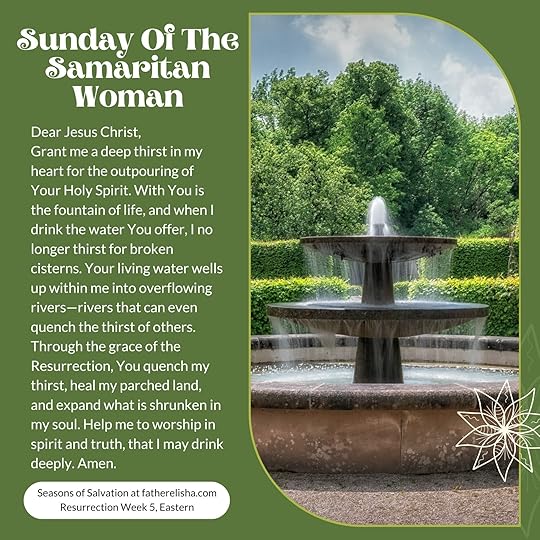
Photo by Peter Herrmann on Unsplash
The post Resurrection 5 (Eastern): The Samaritan Woman and the Living Water first appeared on Father Elisha: Let me take you on an intriguing journey..


Resurrection 5 (Eastern): The Samaritan Woman and the Living Water 2025

 The Spiritual Mysteries of the Divine Calendar: May 18–24, 2025 ~
 As the Sundays of the Resurrection draw us closer to the outpouring of the Holy Spirit at Pentecost, this Sunday of the Samaritan Woman presents us again with the theme of thirst. This encounter reminds us of our own deep spiritual thirst for the Holy Spirit, as we journey further into the mysteries of the Resurrection during these special weeks.
Sunday Gospel: John 4:5–42 (NKJV)5 So He came to a city of Samaria which is called Sychar, near the plot of ground that Jacob gave to his son Joseph. 6 Now Jacob’s well was there. Jesus therefore, being wearied from His journey, sat thus by the well. It was about the sixth hour.
7 A woman of Samaria came to draw water. Jesus said to her, “Give Me a drink.” 8 For His disciples had gone away into the city to buy food. 9 Then the woman of Samaria said to Him, “How is it that You, being a Jew, ask a drink from me, a Samaritan woman?” For Jews have no dealings with Samaritans.
10 Jesus answered and said to her, “If you knew the gift of God, and who it is who says to you, ‘Give Me a drink,’ you would have asked Him, and He would have given you living water.” 11 The woman said to Him, “Sir, You have nothing to draw with, and the well is deep. Where then do You get that living water? 12 Are You greater than our father Jacob, who gave us the well, and drank from it himself, as well as his sons and his livestock?”
13 Jesus answered and said to her, “Whoever drinks of this water will thirst again, 14 but whoever drinks of the water that I shall give him will never thirst. But the water that I shall give him will become in him a fountain of water springing up into everlasting life.” 15 The woman said to Him, “Sir, give me this water, that I may not thirst, nor come here to draw.”
16 Jesus said to her, “Go, call your husband, and come here.” 17 The woman answered and said, “I have no husband.” Jesus said to her, “You have well said, ‘I have no husband,’ 18 for you have had five husbands, and the one whom you now have is not your husband; in that you spoke truly.” 19 The woman said to Him, “Sir, I perceive that You are a prophet. 20 Our fathers worshiped on this mountain, and you Jews say that in Jerusalem is the place where one ought to worship.”
21 Jesus said to her, “Woman, believe Me, the hour is coming when you will neither on this mountain, nor in Jerusalem, worship the Father. 22 You worship what you do not know; we know what we worship, for salvation is of the Jews. 23 But the hour is coming, and now is, when the true worshipers will worship the Father in spirit and truth; for the Father is seeking such to worship Him. 24 God is Spirit, and those who worship Him must worship in spirit and truth.” 25 The woman said to Him, “I know that Messiah is coming” (who is called Christ). “When He comes, He will tell us all things.” 26 Jesus said to her, “I who speak to you am He.”
27 And at this point His disciples came, and they marveled that He talked with a woman; yet no one said, “What do You seek?” or, “Why are You talking with her?”
28 The woman then left her waterpot, went her way into the city, and said to the men, 29 “Come, see a Man who told me all things that I ever did. Could this be the Christ?” 30 Then they went out of the city and came to Him.
31 In the meantime His disciples urged Him, saying, “Rabbi, eat.” 32 But He said to them, “I have food to eat of which you do not know.” 33 Therefore the disciples said to one another, “Has anyone brought Him anything to eat?”
34 Jesus said to them, “My food is to do the will of Him who sent Me, and to finish His work. 35 Do you not say, ‘There are still four months and then comes the harvest’? Behold, I say to you, lift up your eyes and look at the fields, for they are already white for harvest! 36 And he who reaps receives wages, and gathers fruit for eternal life, that both he who sows and he who reaps may rejoice together. 37 For in this the saying is true: ‘One sows and another reaps.’ 38 I sent you to reap that for which you have not labored; others have labored, and you have entered into their labors.”
39 And many of the Samaritans of that city believed in Him because of the word of the woman who testified, “He told me all that I ever did.” 40 So when the Samaritans had come to Him, they urged Him to stay with them; and He stayed there two days. 41 And many more believed because of His own word. 42 Then they said to the woman, “Now we believe, not because of what you said, for we ourselves have heard Him and we know that this is indeed the Christ, the Savior of the world.”
Sunday Of The Samaritan WomanWe read in verse 10: “Jesus answered and said to her, ‘If you knew the gift of God, and who it is who says to you, “Give Me a drink,” you would have asked Him, and He would have given you living water.’”
And in verse 14: “But whoever drinks of the water that I shall give him will never thirst. But the water that I shall give him will become in him a fountain of water springing up into everlasting life.”
The water Jesus offers is the promise of the Holy Spirit. “For I will pour water on him who is thirsty, and floods on the dry ground; I will pour My Spirit on your descendants, and My blessing on your offspring” (Isa. 44:3).

Photo by Jonny Gios on Unsplash
Building Our New Man: Unfolding the Mysteries of the Grace of Resurrection:The Living Water (John 4:5–42 NKJV)On the Sunday after Pascha we received the grace of the living faith (Thomas Sunday). The third Sunday (The Myrrh-bearing Women), we received the living bread. Last week, on the Sunday of the Paralytic, we reflected on the grace of straightening our ways—of aligning our lives with the way Jesus lived. This fifth Sunday of the Season of Resurrection, the Holy Spirit offers us living water. What is the difference between the Bread of Life and the Water of Life? And why does the Divine Calendar lead our attention toward receiving living faith?
Living faith is a faith that is renewed daily—different from yesterday—and it helps us face the challenges that are new every day. Living bread is the bread from Heaven that nourishes us and opens our eyes to move from the earthly to the heavenly life.
Jesus said to the Samaritan woman: “If you knew the gift of God, and who it is who says to you, ‘Give Me a drink,’ you would have asked Him, and He would have given you living water” (John 4:10). And we continue quoting from John 4:13–14: “Jesus answered and said to her, ‘Whoever drinks of this water will thirst again, but whoever drinks of the water that I shall give him will never thirst. But the water that I shall give him will become in him a fountain of water springing up into everlasting life…’” The Samaritan woman replied, according to her understanding: “Sir, give me this water, that I may not thirst, nor come here to draw” (John 4:15).
Thirst for the Living Water
We thirst for many things every day. This thirsting comes from the area of our soul God works to restore throughout the Seasons of Salvation this year. Because of the lack of spiritual water—the living water—this part of our soul has shrunk. This shrinking of the soul makes us thirst for other things, but only the living water quenches our thirst. Our thirsting makes us feel small, and we seem to lose ourselves and our true identity.
We don’t want anyone to touch these shrunken areas because they make us feel weak, vulnerable, and as an unfortunate sinner. But the grace of resurrection that we received on Easter Sunday (Pascha) brought living water to this area. The living water restores our souls to their original form, making them bloom for the glory of God.
This living water revives us. It is God’s gift and He makes us long for more. Jesus said in John 4:14 to the Samaritan woman: “But whoever drinks of the water that I shall give him will never thirst. But the water that I shall give him will become in him a fountain of water springing up into everlasting life.”
How to Drink the Living Water
We drink the living water through a pure life and by worshipping in spirit and truth (verse 24). Also, we see that the Samaritan woman was wholehearted and confessed all the bad things she had done.
“The woman answered and said, ‘I have no husband.’ Jesus said to her, ‘You have well said, “I have no husband,” for you have had five husbands, and the one whom you now have is not your husband; in that you spoke truly.’ The woman said to Him, ‘Sir, I perceive that You are a prophet’” (verses 17–19).
Because of Jesus’ tender way of exposing her sins, she did not deny what Jesus revealed about her life. The Samaritan woman even confessed her sins in her town, as we read in verses 28–29: “The woman then left her waterpot, went her way into the city, and said to the men, ‘Come, see a Man who told me all things that I ever did. Could this be the Christ?’”
The Samaritan woman spoke with Jesus about worship, and Jesus said: “God is Spirit, and those who worship Him must worship in spirit and truth” (verse 24). We can sense that our worship feels different during the Season of Resurrection than at other times of the year. The well of resurrection is an open spring of everlasting life and renewal. From this spring flows living water—different from the living water we drink in the other Seasons of Salvation.
How to Drink the Living Water: Knowing our Thirst
“And of His fullness we have all received, and grace for grace” (John 1:16). “Therefore with joy you will draw water from the wells of salvation” (Isa. 12:3). “From there they went to Beer, which is the well where the Lord said to Moses, ‘Gather the people together, and I will give them water.’ Then Israel sang this song: ‘Spring up, O well! All of you sing to it—’” (Num. 21:16–17)
In verse 14, Jesus said to the Samaritan woman: “… But the water that I shall give him will become in him a fountain of water springing up into everlasting life.” When we worship God during the Season of Resurrection—through the Word of God, our prayers, and singing—we are actually drinking the living water. And because we are so thirsty—whether we realize it or not—if we worship more and more, we fill the shrunken areas of our souls.
Jesus said to the Samaritan woman in verses 23–24: “But the hour is coming, and now is, when the true worshipers will worship the Father in spirit and truth; for the Father is seeking such to worship Him. God is Spirit, and those who worship Him must worship in spirit and truth.”
The grace of resurrection allows us to know ourselves more deeply. We find ourselves in the light of the resurrection of Christ. When we compare ourselves to the power of the resurrected life in Christ, we realize how weak and dependent we are on the grace of resurrection. But we are not afraid of our weaknesses anymore. Remember what we talked about last week? Resurrection life shines through our cracks and the grace of resurrection inverts our weaknesses into strengths.
“For you see your calling, brethren, that not many wise according to the flesh, not many mighty, not many noble, are called. But God has chosen the foolish things of the world to put to shame the wise, and God has chosen the weak things of the world to put to shame the things which are mighty” (1 Cor. 1:26–27).

Photo by Noppadon Manadee on Unsplash
Heavenly NutritionIn this Season of Salvation, it is good to read the Bible (eating the Word of God), to be watered through prayer and worship, and to drink the living water. Jesus said to the Samaritan woman: “If you knew the gift of God, and who it is who says to you, ‘Give Me a drink,’ you would have asked Him, and He would have given you living water” (verse 10).
The grace from these two Sundays of the Living Bread and the Living Water helps us comprehend what happens in our inner man. We experience the grace of resurrection replacing our old earthy nature with the new heavenly nature. The grace of resurrection is the ladder that allows us to go up to Heaven without earthly efforts—we are not in a fasting season, but a season of feasting in the Spirit.
If we practice our living faith, eat the living bread, and drink the living water, our inner man receives heavenly nutrition that builds the resurrected divine-human nature of Christ into us. This happens in the heavenly places (the key of this Season of Salvation, see Ephesians 2:6), and the grace of resurrection takes us there.
“[A]nd have put on the new man who is renewed in knowledge according to the image of Him who created him” (Col. 3:10).
The Water Bottle
If we remove the cap of an empty plastic bottle, we can easily squeeze and deform its shape. Then we can put the cap back on and the bottle remains in this deformed shape. The bottle remains squeezed and small. This illustrates what has happened with certain areas of our souls.
But if we remove the cap and fill the bottle with water, it expands and returns to its original shape. The plastic pops as the bottle reshapes. This is exactly what happens with our souls when we drink the living water from the grace of resurrection.
Shame is the symptom of the shrinking of the soul. When we discover a shrunken area, and especially if it happens in front of people, we feel ashamed. But the grace of resurrection restores these areas that are hungry, thirsty, shrunken, and unsatisfied, restoring our dignity as children of God. “And be renewed in the spirit of your mind, and that you put on the new man which was created according to God, in true righteousness and holiness” (Eph. 4:23–24).
Christ is Risen!
Indeed He is Risen!
Concluding the Sunday of the Samaritan WomanIt’s my privilege to journey with you through the Season of Resurrection. I pray that you may be blessed during this special time and drink deeply of the living water from the fountain Christ offers us. May the grace of this Sunday stretch the shrunken parts of our souls and deepen our spiritual thirst for the Holy Spirit.
Since the Season of Resurrection is not a season of fasting but of feasting, it might be helpful to review what we previously discussed regarding How Do I Feast?
Join the Journey Through the Seasons of Salvation
Join us on this weekly journey through the Seasons of Salvation as we walk in the footsteps of Jesus Christ through the key seasons of His life. Sign up below (in the footer) to receive this year’s Divine Calendar, which introduces the Seasons of Salvation and guides you on the journey ahead. As a welcome gift, you’ll also receive my young adult novel, The Legend of the Divine Calendar, delivered straight to your inbox.
Visit the Seasons of Salvation blog for insights into the coming week, posted every Saturday. We’d be honored to have you join us.
Save Your Prayer Card on Your Smartphone
Photo by Peter Herrmann on Unsplash
The post Resurrection 5 (Eastern): The Samaritan Woman and the Living Water 2025 first appeared on Father Elisha: Let me take you on an intriguing journey..
Resurrection 5 (Western): The Light of Life: Jesus, the Living Word
 The Spiritual Mysteries of the Divine Calendar: The Light of Life ~ May 18–24, 2025 ~
 The beautiful journey through the Season of Resurrection contains manifold mysteries. As we have seen in the previous weeks, the grace flowing from the resurrection of Jesus Christ powerfully impacts our lives through visible changes that emerge from within. But this grace also works invisibly in our souls—and in our position in Christ in the heavenly places, which is the key to this season. “And raised us up together and made us sit together in the heavenly places in Christ Jesus” (Eph. 2:6). But the Light of Life, Jesus Christ, also gives us the grace to comprehend what is happening deep within the layers of our souls.
The grace given to us by the Holy Spirit on Resurrection Sunday (Pascha) continues to unfold in our lives week after week, even if we don’t recognize the Spirit’s activity. “As each one has received a gift, minister it to one another, as good stewards of the manifold grace of God” (1 Pet. 4:10).
We need this hidden work of the grace of the resurrection, so the unknown parts in our inner man resurrect and become known to us as the new man. “And that you put on the new man which was created according to God, in true righteousness and holiness” (Eph. 4:24).
The State of ParadiseAs Christians, we’re not called to be an earthly people, but without the Resurrection of Christ that is what we are. “For our citizenship is in heaven, from which we also eagerly wait for the Savior, the Lord Jesus Christ” (Phil. 3:20). After God created Adam, “the Lord God planted a garden eastward in Eden, and there He put the man whom He had formed” (Gen. 2:8). Since the beginning of the Season of Crucifixion and the fast of Lent, we have spoken of the journey back to the state of Paradise—a foretaste of full communion with the Holy Trinity.
We scratch the surface of the state of Paradise during Lent, but in the Season of Resurrection we taste our new resurrected humanity in the Risen Christ. “And as we have borne the image of the man of dust, we shall also bear the image of the heavenly Man” (1 Cor. 15:49).
The Light of Life: Comprehending the Resurrection of Jesus Christ
We need the grace of the Resurrection to transform us at every level of our being. The early fathers of the church, through the Divine Calendar, guide us through the longest feasting period. For forty days we exercise our living faith (John 20:29), eat the Bread of Life that came down from Heaven (John 6:33), drink from the spring of resurrection (John 4:14), and on the fortieth day we arrive the Feast of the Ascension of Jesus Christ.
“… all that Jesus began both to do and teach, until the day in which He was taken up, after He through the Holy Spirit had given commandments to the apostles whom He had chosen, to whom He also presented Himself alive after His suffering by many infallible proofs, being seen by them during forty days and speaking of the things pertaining to the kingdom of God” (Acts 1:1–3).
During these days, it is helpful to focus on the Resurrection of Jesus Christ in worship and prayer. Our resurrection is in Him. During the three days Jesus lay in the grave, He freed all the souls in Hades from when God sealed off Paradise until He gave up His spirit on the cross. His resurrection from the dead is an immensely powerful action. No one witnessed the exact moment when the heart of Jesus began to beat and He opened His eyes, drew His breath, and left the grave clothes behind. But soon after, the angels removed the rock from the tomb and He appeared to Mary Magdalene.
This action that redirected the course of history is so rich that we need forty days to celebrate, study, and meditate to comprehend the Resurrection. We need the Light of Life to shine.
Sundays of Restoration
The Sundays of the Season of Resurrection work together to help restore our inner man, who needs strengthening after the journey with Jesus Christ through the Lenten wilderness—especially in the area of the soul that God highlighted during the Season of the Kingdom of God. Our soul needs heavenly nutrition before the Holy Spirit can build the new man in us.
The first Sunday after the Resurrection, the Sunday of the Living Faith, renewed our faith and stirred it to remain fresh. This happens when we continuously believe that Jesus rose personally for each and every one of us—just as Jesus personalized the revelation of the Resurrection for the Apostle Thomas.
On the third Sunday of the Season of Resurrection, the Sunday of the Living Bread, we talked about Jesus as the Bread of Life. “I am the bread of life. He who comes to Me shall never hunger, and he who believes in Me shall never thirst” (John 6:35). When we partake in the sacrament of Holy Communion or read the Bible, we receive a unique nourishment during this season. The stomach of our inner man growls, and the bread and wine we receive or the words we read, truly satisfy us. Only the Word of God, Jesus Christ, satisfies these famished areas.
Last week, the Sunday of the Living Water, Jesus offered the Water of Life to the Samaritan Woman. He satisfied the thirst no man could quench. When our souls can’t find the true water God created it to drink, our souls shrink like a squeezed water bottle. But as we drink the Living Water, the grace of resurrection restores the shape and volume of our souls.
The Sunday the Living Light: the Light of Life
Unknown for most of us, our talents and gifts hide in these deep shrunken parts of our souls, and if we tried to operate in these gifts while shrunken, we would find ourselves unable. “I am a shy person, so I can’t do this and that…” This area of the souls thirsted for Living Water—any other water only made it smaller and more thirsty. “For My people have committed two evils: They have forsaken Me, the fountain of living waters, and hewn themselves cisterns—broken cisterns that can hold no water” (Jer. 2:13).
Now we have arrived at the fifth Sunday in the Season of Resurrection, and we need the Light of Life to shine into the deep layers of our souls.
Sunday Gospel: John 12:35–50 (NKJV)Then Jesus said to them, “A little while longer the light is with you. Walk while you have the light, lest darkness overtake you; he who walks in darkness does not know where he is going. 36 While you have the light, believe in the light, that you may become sons of light.” These things Jesus spoke, and departed, and was hidden from them.
37 But although He had done so many signs before them, they did not believe in Him, 38 that the word of Isaiah the prophet might be fulfilled, which he spoke: “Lord, who has believed our report? And to whom has the arm of the Lord been revealed?” 39 Therefore they could not believe, because Isaiah said again: 40 “He has blinded their eyes and hardened their hearts, lest they should see with their eyes, lest they should understand with their hearts and turn, so that I should heal them.”
41 These things Isaiah said when he saw His glory and spoke of Him. 42 Nevertheless even among the rulers many believed in Him, but because of the Pharisees they did not confess Him, lest they should be put out of the synagogue; 43 for they loved the praise of men more than the praise of God.
44 Then Jesus cried out and said, “He who believes in Me, believes not in Me but in Him who sent Me. 45 And he who sees Me sees Him who sent Me. 46 I have come as a light into the world, that whoever believes in Me should not abide in darkness. 47 And if anyone hears My words and does not believe, I do not judge him; for I did not come to judge the world but to save the world. 48 He who rejects Me, and does not receive My words, has that which judges him—the word that I have spoken will judge him in the last day. 49 For I have not spoken on My own authority; but the Father who sent Me gave Me a command, what I should say and what I should speak. 50 And I know that His command is everlasting life. Therefore, whatever I speak, just as the Father has told Me, so I speak.”
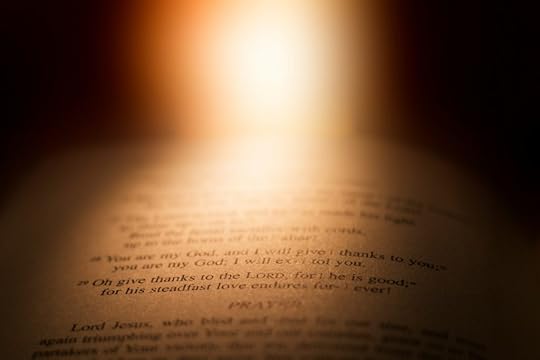
Photo by John Canada on Unsplash
The Living Light & The Living Word“Your word is a lamp to my feet and a light to my path.” (Ps. 119:105)
This Sunday Gospel (John 12:35–50) is the longest passage in the New Testament where Jesus speaks about Himself as the Light.
In addition to this passage, we can read John 3:19–21: “And this is the condemnation, that the light has come into the world, and men loved darkness rather than light, because their deeds were evil. For everyone practicing evil hates the light and does not come to the light, lest his deeds should be exposed. But he who does the truth comes to the light, that his deeds may be clearly seen, that they have been done in God.”
Also, John 8:12: “Then Jesus spoke to them again, saying, ‘I am the light of the world. He who follows Me shall not walk in darkness, but have the light of life.’” Therefore, the theme of this Sunday is the Living Light, the Living Word of God, Jesus Christ.
This passage speaks about Jesus as the light. We also see the words of John 8:12 “… He who follows Me shall not walk in darkness …” repeated twice in today’s Sunday Gospel (verses 35 and 46). However, in John 8:12, we see these words added: “… but have the light of life.”
The Light of Life Versus the Darkness
We may never fully know how delicately the grace of resurrection works in our lives. Yet through the grace of this Sunday, we receive more light—and understanding—about how God is resurrecting the specific area of our souls that He has chosen to redeem during this year’s cycle of the Divine Calendar.
The darkened spot in our life that we formerly knew through its manifested weaknesses has now changed. We are more or less aware that this area simply needs heavenly nutrition through the grace of resurrection—the Living Bread to satisfy, and the Living Water to expand and nullify shame. We may have realized how this darkness actually spread more darkness to other parts of our inner man. We need to Light of Life to counteract this.
This darkness comprises three major layers, and the grace of resurrection helps us understand ourselves so we can counteract these levels. The resurrection of Jesus sends the Light of Life, Jesus Christ Himself, into our soul, a gentle power of healing light. This unique light reveals Jesus, the Holy Trinity, and even ourselves. Suddenly, we understand what actually happened in this specific area in our inner man, and what our need is.
Unfortunately, darkness from the old man lingers within us, and the work of the enemy and his evil powers always happens in the darkness. Once the grace of resurrection births the new nature of Christ—the new man—in a part of our soul, the enemy flees because the resurrection of Jesus defeated the enemy and the power of death.
Scripture References
“This is the message which we have heard from Him and declare to you, that God is light and in Him is no darkness at all. If we say that we have fellowship with Him, and walk in darkness, we lie and do not practice the truth … If we say that we have no sin, we deceive ourselves, and the truth is not in us. If we confess our sins, He is faithful and just to forgive us our sins and to cleanse us from all unrighteousness” (1 John 1:5–6, 8–9).
“Again, a new commandment I write to you, which thing is true in Him and in you, because the darkness is passing away, and the true light is already shining. He who says he is in the light, and hates his brother, is in darkness until now. He who loves his brother abides in the light, and there is no cause for stumbling in him. But he who hates his brother is in darkness and walks in darkness, and does not know where he is going, because the darkness has blinded his eyes” (1 John 2:8–11).
“To open their eyes, in order to turn them from darkness to light, and from the power of Satan to God, that they may receive forgiveness of sins and an inheritance among those who are sanctified by faith in Me” (Acts 26:18). “Giving thanks to the Father who has qualified us to be partakers of the inheritance of the saints in the light. He has delivered us from the power of darkness and conveyed us into the kingdom of the Son of His love” (Col. 1:12–13). “And have no fellowship with the unfruitful works of darkness, but rather expose them” (Eph. 5:11).
The Three Layers of Darkness
All the activity of the old man within is darkness, and it works through darkness under the protective umbrella of darkness. In this season, God enlightens us to discover this darkness, and the Light of Life pierces the main clusters of darkness. Jesus, the Living Word and the Light of Life, wants to deal with the source that kept darkness present within us.
How to recognize the three major levels of darkness:
Blindness and Disbelief in the Signs of GodCompromising our Relationship with GodDarkness Leading to Condemnation and JudgmentFirst Level of Darkness: Blindness and Disbelief in the Signs of God
In verses 35–37 of the Sunday Gospel, we read: “Then Jesus said to them, ‘A little while longer the light is with you. Walk while you have the light, lest darkness overtake you; he who walks in darkness does not know where he is going. While you have the light, believe in the light, that you may become sons of light.’ These things Jesus spoke, and departed, and was hidden from them. But although He had done so many signs before them, they did not believe in Him.”
This first depth of darkness centers around ourselves, and how we cannot understand ourselves or God. Many times, God speaks directly with clear signs through our circumstances, but because of this type of darkness, we can’t recognize God’s voice.
A wise man said if God opened our eyes to see what He does with us, even for a single day, it would shock us to see all the miracles surrounding us every day. We would know so much more about God’s character, and our faith in Him would change dramatically. The Light of Life can startle us.
The activity of the enemy preserves the darkness in the human soul. This darkness is not like a tangible substance we can feel or touch. The Bible means by darkness the opposite of light. Darkness cannot recognize or be reconciled with light; it is completely oblivious to it. “In Him was life, and the life was the light of men. And the light shines in the darkness, and the darkness did not comprehend it” (John 1:4–5).
The Power in the Light of Life
Darkness can’t recognize the light, even if God revealed miracles all the day. It is blind to light and truth. “And this is the condemnation, that the light has come into the world, and men loved darkness rather than light, because their deeds were evil. For everyone practicing evil hates the light and does not come to the light, lest his deeds should be exposed” (John 3:19–20).
The darkness prevents us to know Jesus, but the light of resurrection, the Light of Life, assures us of what Jesus can do through His power. We receive fresh energy of faith that God can do everything in our lives, our circumstances, our ministries, and our circles of influence, if we pray with the power of Christ’s resurrection. “[A]nd what is the exceeding greatness of His power toward us who believe, according to the working of His mighty power which He worked in Christ when He raised Him from the dead …” (Eph. 1:19–20).
Because of the darkness, these areas of our lives struggle to believe that God is who He says He is—the Light of the world (John 8:12). He protects us, enables us to fulfill our calling, and opens every necessary door. Our minds may know about God’s power, but we often lack the strength to live out what we believe.
We can’t understand the nature of the darkness unless the Light of Life exposes it. The devil wants to destroy us, keep us in darkness, and ultimately kill us, but Christ seeks to resurrect everything the devil has accomplished in our souls. “The thief does not come except to steal, and to kill, and to destroy. I have come that they may have life, and that they may have it more abundantly” (John 10:10).

Photo by Ariel on Unsplash
Second Level of Darkness: Compromising our Relationship with GodWe read in verses 42–43 in today’s Sunday Gospel: “Nevertheless even among the rulers many believed in Him, but because of the Pharisees they did not confess Him, lest they should be put out of the synagogue; for they loved the praise of men more than the praise of God.”
The first layer of darkness concerned ourselves, and what we believe God can do. “Lord, I believe; help my unbelief!” (Mark 9:24) The second level of darkness is between us and other people. This darkness keeps us away from God and hinders our progress in the spiritual life.
Often we don’t understand each other, and we fear the opinion of others more than we should at the expense of honoring God. If we are pleasing the people around us, are we also pleasing Jesus? “For do I now persuade men, or God? Or do I seek to please men? For if I still pleased men, I would not be a bondservant of Christ” (Gal. 1:10).
Sometimes we don’t understand how to remain loyal to God while loving others. We can achieve this if we humble ourselves beneath the other, without making a relationship only based on emotional needs to nurture our souls with self-esteem and so on—it is a broken cistern (Jer. 2:13). In a strictly soulish relationship where God’s position is secondary or excluded, we prioritize it higher than our relationship with God. It means we love this relationship more than we love God, and neither His Word nor His voice holds authority over it.
The Light of Life Sets God First
This second level of darkness makes us compromise our relationship with God to gain an emotional or material benefit from another person. We seek a person to fill the weakness in our soul—a weakness the grace of resurrection seeks to heal through the Light of Life.
Several good rulers among the Pharisees believed in Jesus. They realized Jesus was the Messiah, but fear made them confess their conviction about Jesus as the Messiah in secret. Fearing what the other rulers in the synagogue would say, they reasoned: “We must be wise and not offend anybody…”
We often don’t understand what we do because of this darkness. But when the Feast of Resurrection comes—and extends into these forty days—the Light of Life enters and sets everything in its proper place. We realize what is horribly wrong in our lives and what priorities we have turned upside down or inside out. The Light of Life awakens us, and the grace of resurrection gives us the power to put everything in order.
Sometimes we sense that we’re doing something wrong, but we don’t understand how we keep falling into these same mistakes—or how to break free from them. This happens because we lack the Light of Life to confront these weaknesses in a wise and balanced way. How can we put God first in everything? We simply don’t know how—unless the light of the Resurrection exposes and drives out this second kind of darkness.
Third Level of Darkness: Darkness Leading to Condemnation and Judgment
Verses 44–46 of today’s Sunday Gospel reads: “Then Jesus cried out and said, ‘He who believes in Me, believes not in Me but in Him who sent Me. And he who sees Me sees Him who sent Me. I have come as a light into the world, that whoever believes in Me should not abide in darkness [“but have the light of life,” John 8:12 added].’” And verse 47: “And if anyone hears My words and does not believe, I do not judge him; for I did not come to judge the world but to save the world.”
We might wonder why Jesus said He did not come to judge the world, when He said in John 5:22: “For the Father judges no one, but has committed all judgment to the Son.” Jesus actually said that He did “not come to judge the world but to save the world.”
We read in John 8:10–12a: “When Jesus had raised Himself up and saw no one but the woman, He said to her, ‘Woman, where are those accusers of yours? Has no one condemned you?’ She said, ‘No one, Lord.’ And Jesus said to her, ‘Neither do I condemn you; go and sin no more.’ Then Jesus spoke to them again, saying, ‘I am the light of the world …’”
Let us look at one of the last verses of this week’s Sunday Gospel: “He who rejects Me, and does not receive My words, has that which judges him—the word that I have spoken will judge him in the last day” (verse 48).
Jesus will not judge any person on the Day of Judgment, but the words He has spoken will. “Now out of His mouth goes a sharp sword, that with it He should strike the nations” (Rev. 19:15)
The Word I Have Spoken
What does this mean? Jesus only spoke the words of the Father (John 12:29), which our conscience bears witness is the truth (Rom 2:15–16). Jesus is the Light of Life and the Living Word. He came to save every person by declaring the words of the Father—which direct the internal judgment of our conscience—and proclaiming the gospel of forgiveness for our sins.
Every person will stand before Jesus, believers and unbelievers, at different points during Christ’s second coming. The Light of Jesus will uncover the darkness that each person has not accepted to be exposed (meaning the person knows about this darkness but has not repented) during the totality of the person’s life.
Our inner man will stand before our Creator and everything will be exposed before the sight of God. The person outside of the new covenant in the blood of Christ will realize and agree without self-justification: “I am condemned. Jesus is not condemning me, because He is perfect and wrapped in brilliant light, but His light and my conscience condemns me. I am convicted.”
For those covered under the blood of Christ, Jesus atoned for our darkness. But if we consciously do works of darkness, unwilling to repent our entire life, we play a dangerous game with our salvation and eternity, and we will suffer loss when our life passes through the cleansing fire.
Scripture References
“And have no fellowship with the unfruitful works of darkness, but rather expose them. For it is shameful even to speak of those things which are done by them in secret. But all things that are exposed are made manifest by the light, for whatever makes manifest is light. Therefore He says: ‘Awake, you who sleep, arise from the dead, and Christ will give you light’” (Eph. 5:11–14).
“Each one’s work will become clear; for the Day will declare it, because it will be revealed by fire; and the fire will test each one’s work, of what sort it is. If anyone’s work which he has built on it endures, he will receive a reward. If anyone’s work is burned, he will suffer loss; but he himself will be saved, yet so as through fire” (1 Cor. 3:13–15).
“For God so loved the world that He gave His only begotten Son, that whoever believes in Him should not perish but have everlasting life. For God did not send His Son into the world to condemn the world, but that the world through Him might be saved” (John 3:16–17).
“He who believes in Him is not condemned; but he who does not believe is condemned already, because he has not believed in the name of the only begotten Son of God. And this is the condemnation, that the light has come into the world, and men loved darkness rather than light, because their deeds were evil. For everyone practicing evil hates the light and does not come to the light, lest his deeds should be exposed. But he who does the truth comes to the light, that his deeds may be clearly seen, that they have been done in God” (John 3:18–21).
In essence, we condemn ourselves when we refuse to enter the light of God’s Word for the entirety of our lives. Jesus has no need to condemn those who refuse to repent and come to Him in faith, for they will condemn themselves before the Great White Throne.
The Light of Life and Everlasting Life
This third level of darkness is a critical type of darkness in our souls, and it is characterized by not knowing Jesus at all. We will experience, if we willfully sin and refuse to repent (turning to Jesus) as a lifestyle, that the enemy will condemn us and God will allow judgement to enter our life. God doesn’t send judgment to His adopted children to destroy, but to restore. Judgement is God’s last remedy after continuous and gradually severe warnings.
The third level of darkness means that we are not willing to repent. It is an area in our life we are fully aware of, yet we persist in sinning. “In the name of our Lord Jesus Christ, when you are gathered together, along with my spirit, with the power of our Lord Jesus Christ, deliver such a one to Satan for the destruction of the flesh, that his spirit may be saved in the day of the Lord Jesus” (1 Cor. 5:4–5).
These words may seem harsh, but when God sees that we are still turning away from Him after many warnings, He may allow disaster to come upon us. This does not mean that every personal tragedy is the result of unrepented sin. But it does mean that if we persist in sinning over a significant period of time, catastrophe may come.
This is the same kind of darkness as not believing in Jesus as Lord, God, and Savior. “But even if our gospel is veiled, it is veiled to those who are perishing, whose minds the god of this age has blinded, who do not believe, lest the light of the gospel of the glory of Christ, who is the image of God, should shine on them” (2 Cor. 4:3–4).
Praise Jesus for His Precious Blood
This darkness leaves condemnation on the shoulder of the unbeliever until Judgment if the person doesn’t turn to Jesus. We can’t escape the light of the Resurrection. And we reject the reality of the resurrection of Jesus, the Light of Life will follow us, engulf us, and expose everything on the last day. A soul that is willing to repent when God exposes any hidden darkness is turned with open arms toward Jesus. But a soul that refuses to repent has its back turned toward Jesus, our Savior—who stands with open arms.
Praise Jesus for His precious Blood and how He has written our names in the Book of Life (Rev. 3:5; 20:12–15). And even though our souls may contain darkness that we have not uncovered when we stand before His glorious throne, still His sacrifice on the cross is sufficient.
Let us conclude with the last verses of today’s Sunday Gospel, verses 49–50: “For I have not spoken on My own authority; but the Father who sent Me gave Me a command, what I should say and what I should speak. And I know that His command [the word granting light] is everlasting life [light linked with life]. Therefore, whatever I speak, just as the Father has told Me, so I speak.”
Christ is Risen!
Indeed He is Risen!
Concluding the Light of Life: Jesus, the Living WordLet us pray for the grace of the Light of Life to pierce every level of darkness, bringing it to our attention, so that we may nourish these areas of our lives through the Living Bread and Living Water—Holy Communion, His Word, prayer, and worship.
Thank you for taking the time to read. It’s my honor to journey together with you.
Since the Season of Resurrection is not a season of fasting but of feasting, it might be helpful to review what we previously discussed regarding How Do I Feast?
Please leave a comment below—we’d love to hear your thoughts. If you found this post helpful, feel free to share it using the buttons at the top of the page.
Join the Journey Through the Seasons of SalvationJoin us on this weekly journey through the Seasons of Salvation as we walk in the footsteps of Jesus Christ through the key seasons of His life.
Sign up to receive this year’s Divine Calendar, which introduces the Seasons of Salvation and guides you through the journey ahead. As a welcome gift, you’ll also receive my young adult novel, The Legend of the Divine Calendar, delivered straight to your inbox.
Visit the Seasons of Salvation blog for insights into the coming week, posted every Saturday. We’d be honored to have you join us.
Save Your Prayer Card on Your Smartphone
Photo by Daniele Franchi on Unsplash
The post Resurrection 5 (Western): The Light of Life: Jesus, the Living Word first appeared on Father Elisha: Let me take you on an intriguing journey..
Resurrection 5 (Western): The Light of Life: Jesus, the Living Word 2025
 The Spiritual Mysteries of the Divine Calendar: May 18–24, 2025 ~
 The beautiful journey through the Season of Resurrection contains manifold mysteries. As we have seen in the previous weeks, the grace flowing from the resurrection of Jesus Christ powerfully impacts our lives through visible changes that emerge from within. But this grace also works invisibly in our souls—and in our position in Christ in the heavenly places, which is the key to this season. “And raised us up together and made us sit together in the heavenly places in Christ Jesus” (Eph. 2:6). But the Light of Life, Jesus Christ, also gives us the grace to comprehend what is happening deep within the layers of our souls.
The grace given to us by the Holy Spirit on Resurrection Sunday (Pascha) continues to unfold in our lives week after week, even if we don’t recognize the Spirit’s activity. “As each one has received a gift, minister it to one another, as good stewards of the manifold grace of God” (1 Pet. 4:10).
We need this hidden work of the grace of the resurrection, so the unknown parts in our inner man resurrect and become known to us as the new man. “And that you put on the new man which was created according to God, in true righteousness and holiness” (Eph. 4:24).
The State of ParadiseAs Christians, we’re not called to be an earthly people, but without the Resurrection of Christ that is what we are. “For our citizenship is in heaven, from which we also eagerly wait for the Savior, the Lord Jesus Christ” (Phil. 3:20). After God created Adam, “the Lord God planted a garden eastward in Eden, and there He put the man whom He had formed” (Gen. 2:8). Since the beginning of the Season of Crucifixion and the fast of Lent, we have spoken of the journey back to the state of Paradise—a foretaste of full communion with the Holy Trinity.
We scratch the surface of the state of Paradise during Lent, but in the Season of Resurrection we taste our new resurrected humanity in the Risen Christ. “And as we have borne the image of the man of dust, we shall also bear the image of the heavenly Man” (1 Cor. 15:49).
The Light of Life: Comprehending the Resurrection of Jesus Christ
We need the grace of the Resurrection to transform us at every level of our being. The early fathers of the church, through the Divine Calendar, guide us through the longest feasting period. For forty days we exercise our living faith (John 20:29), eat the Bread of Life that came down from Heaven (John 6:33), drink from the spring of resurrection (John 4:14), and on the fortieth day we arrive the Feast of the Ascension of Jesus Christ.
“… all that Jesus began both to do and teach, until the day in which He was taken up, after He through the Holy Spirit had given commandments to the apostles whom He had chosen, to whom He also presented Himself alive after His suffering by many infallible proofs, being seen by them during forty days and speaking of the things pertaining to the kingdom of God” (Acts 1:1–3).
During these days, it is helpful to focus on the Resurrection of Jesus Christ in worship and prayer. Our resurrection is in Him. During the three days Jesus lay in the grave, He freed all the souls in Hades from when God sealed off Paradise until He gave up His spirit on the cross. His resurrection from the dead is an immensely powerful action. No one witnessed the exact moment when the heart of Jesus began to beat and He opened His eyes, drew His breath, and left the grave clothes behind. But soon after, the angels removed the rock from the tomb and He appeared to Mary Magdalene.
This action that redirected the course of history is so rich that we need forty days to celebrate, study, and meditate to comprehend the Resurrection. We need the Light of Life to shine.
Sundays of Restoration
The Sundays of the Season of Resurrection work together to help restore our inner man, who needs strengthening after the journey with Jesus Christ through the Lenten wilderness—especially in the area of the soul that God highlighted during the Season of the Kingdom of God. Our soul needs heavenly nutrition before the Holy Spirit can build the new man in us.
The first Sunday after the Resurrection, the Sunday of the Living Faith, renewed our faith and stirred it to remain fresh. This happens when we continuously believe that Jesus rose personally for each and every one of us—just as Jesus personalized the revelation of the Resurrection for the Apostle Thomas.
On the third Sunday of the Season of Resurrection, the Sunday of the Living Bread, we talked about Jesus as the Bread of Life. “I am the bread of life. He who comes to Me shall never hunger, and he who believes in Me shall never thirst” (John 6:35). When we partake in the sacrament of Holy Communion or read the Bible, we receive a unique nourishment during this season. The stomach of our inner man growls, and the bread and wine we receive or the words we read, truly satisfy us. Only the Word of God, Jesus Christ, satisfies these famished areas.
Last week, the Sunday of the Living Water, Jesus offered the Water of Life to the Samaritan Woman. He satisfied the thirst no man could quench. When our souls can’t find the true water God created it to drink, our souls shrink like a squeezed water bottle. But as we drink the Living Water, the grace of resurrection restores the shape and volume of our souls.
The Sunday the Living Light: the Light of Life
Unknown for most of us, our talents and gifts hide in these deep shrunken parts of our souls, and if we tried to operate in these gifts while shrunken, we would find ourselves unable. “I am a shy person, so I can’t do this and that…” This area of the souls thirsted for Living Water—any other water only made it smaller and more thirsty. “For My people have committed two evils: They have forsaken Me, the fountain of living waters, and hewn themselves cisterns—broken cisterns that can hold no water” (Jer. 2:13).
Now we have arrived at the fifth Sunday in the Season of Resurrection, and we need the Light of Life to shine into the deep layers of our souls.
Sunday Gospel: John 12:35–50 (NKJV)Then Jesus said to them, “A little while longer the light is with you. Walk while you have the light, lest darkness overtake you; he who walks in darkness does not know where he is going. 36 While you have the light, believe in the light, that you may become sons of light.” These things Jesus spoke, and departed, and was hidden from them.
37 But although He had done so many signs before them, they did not believe in Him, 38 that the word of Isaiah the prophet might be fulfilled, which he spoke: “Lord, who has believed our report? And to whom has the arm of the Lord been revealed?” 39 Therefore they could not believe, because Isaiah said again: 40 “He has blinded their eyes and hardened their hearts, lest they should see with their eyes, lest they should understand with their hearts and turn, so that I should heal them.”
41 These things Isaiah said when he saw His glory and spoke of Him. 42 Nevertheless even among the rulers many believed in Him, but because of the Pharisees they did not confess Him, lest they should be put out of the synagogue; 43 for they loved the praise of men more than the praise of God.
44 Then Jesus cried out and said, “He who believes in Me, believes not in Me but in Him who sent Me. 45 And he who sees Me sees Him who sent Me. 46 I have come as a light into the world, that whoever believes in Me should not abide in darkness. 47 And if anyone hears My words and does not believe, I do not judge him; for I did not come to judge the world but to save the world. 48 He who rejects Me, and does not receive My words, has that which judges him—the word that I have spoken will judge him in the last day. 49 For I have not spoken on My own authority; but the Father who sent Me gave Me a command, what I should say and what I should speak. 50 And I know that His command is everlasting life. Therefore, whatever I speak, just as the Father has told Me, so I speak.”
Photo by John Canada on Unsplash
The Living Light & The Living Word“Your word is a lamp to my feet and a light to my path.” (Ps. 119:105)
This Sunday Gospel (John 12:35–50) is the longest passage in the New Testament where Jesus speaks about Himself as the Light.
In addition to this passage, we can read John 3:19–21: “And this is the condemnation, that the light has come into the world, and men loved darkness rather than light, because their deeds were evil. For everyone practicing evil hates the light and does not come to the light, lest his deeds should be exposed. But he who does the truth comes to the light, that his deeds may be clearly seen, that they have been done in God.”
Also, John 8:12: “Then Jesus spoke to them again, saying, ‘I am the light of the world. He who follows Me shall not walk in darkness, but have the light of life.’” Therefore, the theme of this Sunday is the Living Light, the Living Word of God, Jesus Christ.
This passage speaks about Jesus as the light. We also see the words of John 8:12 “… He who follows Me shall not walk in darkness …” repeated twice in today’s Sunday Gospel (verses 35 and 46). However, in John 8:12, we see these words added: “… but have the light of life.”
The Light of Life Versus the Darkness
We may never fully know how delicately the grace of resurrection works in our lives. Yet through the grace of this Sunday, we receive more light—and understanding—about how God is resurrecting the specific area of our souls that He has chosen to redeem during this year’s cycle of the Divine Calendar.
The darkened spot in our life that we formerly knew through its manifested weaknesses has now changed. We are more or less aware that this area simply needs heavenly nutrition through the grace of resurrection—the Living Bread to satisfy, and the Living Water to expand and nullify shame. We may have realized how this darkness actually spread more darkness to other parts of our inner man. We need to Light of Life to counteract this.
This darkness comprises three major layers, and the grace of resurrection helps us understand ourselves so we can counteract these levels. The resurrection of Jesus sends the Light of Life, Jesus Christ Himself, into our soul, a gentle power of healing light. This unique light reveals Jesus, the Holy Trinity, and even ourselves. Suddenly, we understand what actually happened in this specific area in our inner man, and what our need is.
Unfortunately, darkness from the old man lingers within us, and the work of the enemy and his evil powers always happens in the darkness. Once the grace of resurrection births the new nature of Christ—the new man—in a part of our soul, the enemy flees because the resurrection of Jesus defeated the enemy and the power of death.
“This is the message which we have heard from Him and declare to you, that God is light and in Him is no darkness at all. If we say that we have fellowship with Him, and walk in darkness, we lie and do not practice the truth … If we say that we have no sin, we deceive ourselves, and the truth is not in us. If we confess our sins, He is faithful and just to forgive us our sins and to cleanse us from all unrighteousness” (1 John 1:5–6, 8–9).
“Again, a new commandment I write to you, which thing is true in Him and in you, because the darkness is passing away, and the true light is already shining. He who says he is in the light, and hates his brother, is in darkness until now. He who loves his brother abides in the light, and there is no cause for stumbling in him. But he who hates his brother is in darkness and walks in darkness, and does not know where he is going, because the darkness has blinded his eyes” (1 John 2:8–11).
“To open their eyes, in order to turn them from darkness to light, and from the power of Satan to God, that they may receive forgiveness of sins and an inheritance among those who are sanctified by faith in Me” (Acts 26:18). “Giving thanks to the Father who has qualified us to be partakers of the inheritance of the saints in the light. He has delivered us from the power of darkness and conveyed us into the kingdom of the Son of His love” (Col. 1:12–13). “And have no fellowship with the unfruitful works of darkness, but rather expose them” (Eph. 5:11).
The Three Layers of Darkness
All the activity of the old man within is darkness, and it works through darkness under the protective umbrella of darkness. In this season, God enlightens us to discover this darkness, and the Light of Life pierces the main clusters of darkness. Jesus, the Living Word and the Light of Life, wants to deal with the source that kept darkness present within us.
How to recognize the three major levels of darkness:
Blindness and Disbelief in the Signs of GodCompromising our Relationship with GodDarkness Leading to Condemnation and JudgmentFirst Level of Darkness: Blindness and Disbelief in the Signs of God
In verses 35–37 of the Sunday Gospel, we read: “Then Jesus said to them, ‘A little while longer the light is with you. Walk while you have the light, lest darkness overtake you; he who walks in darkness does not know where he is going. While you have the light, believe in the light, that you may become sons of light.’ These things Jesus spoke, and departed, and was hidden from them. But although He had done so many signs before them, they did not believe in Him.”
This first depth of darkness centers around ourselves, and how we cannot understand ourselves or God. Many times, God speaks directly with clear signs through our circumstances, but because of this type of darkness, we can’t recognize God’s voice.
A wise man said if God opened our eyes to see what He does with us, even for a single day, it would shock us to see all the miracles surrounding us every day. We would know so much more about God’s character, and our faith in Him would change dramatically. The Light of Life can startle us.
The activity of the enemy preserves the darkness in the human soul. This darkness is not like a tangible substance we can feel or touch. The Bible means by darkness the opposite of light. Darkness cannot recognize or be reconciled with light; it is completely oblivious to it. “In Him was life, and the life was the light of men. And the light shines in the darkness, and the darkness did not comprehend it” (John 1:4–5).
The Power in the Light of Life
Darkness can’t recognize the light, even if God revealed miracles all the day. It is blind to light and truth. “And this is the condemnation, that the light has come into the world, and men loved darkness rather than light, because their deeds were evil. For everyone practicing evil hates the light and does not come to the light, lest his deeds should be exposed” (John 3:19–20).
The darkness prevents us to know Jesus, but the light of resurrection, the Light of Life, assures us of what Jesus can do through His power. We receive fresh energy of faith that God can do everything in our lives, our circumstances, our ministries, and our circles of influence, if we pray with the power of Christ’s resurrection. “[A]nd what is the exceeding greatness of His power toward us who believe, according to the working of His mighty power which He worked in Christ when He raised Him from the dead …” (Eph. 1:19–20).
Because of the darkness, these areas of our lives struggle to believe that God is who He says He is—the Light of the world (John 8:12). He protects us, enables us to fulfill our calling, and opens every necessary door. Our minds may know about God’s power, but we often lack the strength to live out what we believe.
We can’t understand the nature of the darkness unless the Light of Life exposes it. The devil wants to destroy us, keep us in darkness, and ultimately kill us, but Christ seeks to resurrect everything the devil has accomplished in our souls. “The thief does not come except to steal, and to kill, and to destroy. I have come that they may have life, and that they may have it more abundantly” (John 10:10).

Photo by Ariel on Unsplash
Second Level of Darkness: Compromising our Relationship with GodWe read in verses 42–43 in today’s Sunday Gospel: “Nevertheless even among the rulers many believed in Him, but because of the Pharisees they did not confess Him, lest they should be put out of the synagogue; for they loved the praise of men more than the praise of God.”
The first layer of darkness concerned ourselves, and what we believe God can do. “Lord, I believe; help my unbelief!” (Mark 9:24) The second level of darkness is between us and other people. This darkness keeps us away from God and hinders our progress in the spiritual life.
Often we don’t understand each other, and we fear the opinion of others more than we should at the expense of honoring God. If we are pleasing the people around us, are we also pleasing Jesus? “For do I now persuade men, or God? Or do I seek to please men? For if I still pleased men, I would not be a bondservant of Christ” (Gal. 1:10).
Sometimes we don’t understand how to remain loyal to God while loving others. We can achieve this if we humble ourselves beneath the other, without making a relationship only based on emotional needs to nurture our souls with self-esteem and so on—it is a broken cistern (Jer. 2:13). In a strictly soulish relationship where God’s position is secondary or excluded, we prioritize it higher than our relationship with God. It means we love this relationship more than we love God, and neither His Word nor His voice holds authority over it.
The Light of Life Sets God First
This second level of darkness makes us compromise our relationship with God to gain an emotional or material benefit from another person. We seek a person to fill the weakness in our soul—a weakness the grace of resurrection seeks to heal through the Light of Life.
Several good rulers among the Pharisees believed in Jesus. They realized Jesus was the Messiah, but fear made them confess their conviction about Jesus as the Messiah in secret. Fearing what the other rulers in the synagogue would say, they reasoned: “We must be wise and not offend anybody…”
We often don’t understand what we do because of this darkness. But when the Feast of Resurrection comes—and extends into these forty days—the Light of Life enters and sets everything in its proper place. We realize what is horribly wrong in our lives and what priorities we have turned upside down or inside out. The Light of Life awakens us, and the grace of resurrection gives us the power to put everything in order.
Sometimes we sense that we’re doing something wrong, but we don’t understand how we keep falling into these same mistakes—or how to break free from them. This happens because we lack the Light of Life to confront these weaknesses in a wise and balanced way. How can we put God first in everything? We simply don’t know how—unless the light of the Resurrection exposes and drives out this second kind of darkness.
Third Level of Darkness: Darkness Leading to Condemnation and Judgment
Verses 44–46 of today’s Sunday Gospel reads: “Then Jesus cried out and said, ‘He who believes in Me, believes not in Me but in Him who sent Me. And he who sees Me sees Him who sent Me. I have come as a light into the world, that whoever believes in Me should not abide in darkness [“but have the light of life,” John 8:12 added].’” And verse 47: “And if anyone hears My words and does not believe, I do not judge him; for I did not come to judge the world but to save the world.”
We might wonder why Jesus said He did not come to judge the world, when He said in John 5:22: “For the Father judges no one, but has committed all judgment to the Son.” Jesus actually said that He did “not come to judge the world but to save the world.”
We read in John 8:10–12a: “When Jesus had raised Himself up and saw no one but the woman, He said to her, ‘Woman, where are those accusers of yours? Has no one condemned you?’ She said, ‘No one, Lord.’ And Jesus said to her, ‘Neither do I condemn you; go and sin no more.’ Then Jesus spoke to them again, saying, ‘I am the light of the world …’”
Let us look at one of the last verses of this week’s Sunday Gospel: “He who rejects Me, and does not receive My words, has that which judges him—the word that I have spoken will judge him in the last day” (verse 48).
Jesus will not judge any person on the Day of Judgment, but the words He has spoken will. “Now out of His mouth goes a sharp sword, that with it He should strike the nations” (Rev. 19:15)
The Word I Have Spoken
What does this mean? Jesus only spoke the words of the Father (John 12:29), which our conscience bears witness is the truth (Rom 2:15–16). Jesus is the Light of Life and the Living Word. He came to save every person by declaring the words of the Father—which direct the internal judgment of our conscience—and proclaiming the gospel of forgiveness for our sins.
Every person will stand before Jesus, believers and unbelievers, at different points during Christ’s second coming. The Light of Jesus will uncover the darkness that each person has not accepted to be exposed (meaning the person knows about this darkness but has not repented) during the totality of the person’s life.
Our inner man will stand before our Creator and everything will be exposed before the sight of God. The person outside of the new covenant in the blood of Christ will realize and agree without self-justification: “I am condemned. Jesus is not condemning me, because He is perfect and wrapped in brilliant light, but His light and my conscience condemns me. I am convicted.”
For those covered under the blood of Christ, Jesus atoned for our darkness. But if we consciously do works of darkness, unwilling to repent our entire life, we play a dangerous game with our salvation and eternity, and we will suffer loss when our life passes through the cleansing fire.
“And have no fellowship with the unfruitful works of darkness, but rather expose them. For it is shameful even to speak of those things which are done by them in secret. But all things that are exposed are made manifest by the light, for whatever makes manifest is light. Therefore He says: ‘Awake, you who sleep, arise from the dead, and Christ will give you light’” (Eph. 5:11–14).
“Each one’s work will become clear; for the Day will declare it, because it will be revealed by fire; and the fire will test each one’s work, of what sort it is. If anyone’s work which he has built on it endures, he will receive a reward. If anyone’s work is burned, he will suffer loss; but he himself will be saved, yet so as through fire” (1 Cor. 3:13–15).
“For God so loved the world that He gave His only begotten Son, that whoever believes in Him should not perish but have everlasting life. For God did not send His Son into the world to condemn the world, but that the world through Him might be saved” (John 3:16–17).
“He who believes in Him is not condemned; but he who does not believe is condemned already, because he has not believed in the name of the only begotten Son of God. And this is the condemnation, that the light has come into the world, and men loved darkness rather than light, because their deeds were evil. For everyone practicing evil hates the light and does not come to the light, lest his deeds should be exposed. But he who does the truth comes to the light, that his deeds may be clearly seen, that they have been done in God” (John 3:18–21).
In essence, we condemn ourselves when we refuse to enter the light of God’s Word for the entirety of our lives. Jesus has no need to condemn those who refuse to repent and come to Him in faith, for they will condemn themselves before the Great White Throne.
The Light of Life and Everlasting Life
This third level of darkness is a critical type of darkness in our souls, and it is characterized by not knowing Jesus at all. We will experience, if we willfully sin and refuse to repent (turning to Jesus) as a lifestyle, that the enemy will condemn us and God will allow judgement to enter our life. God doesn’t send judgment to His adopted children to destroy, but to restore. Judgement is God’s last remedy after continuous and gradually severe warnings.
The third level of darkness means that we are not willing to repent. It is an area in our life we are fully aware of, yet we persist in sinning. “In the name of our Lord Jesus Christ, when you are gathered together, along with my spirit, with the power of our Lord Jesus Christ, deliver such a one to Satan for the destruction of the flesh, that his spirit may be saved in the day of the Lord Jesus” (1 Cor. 5:4–5).
These words may seem harsh, but when God sees that we are still turning away from Him after many warnings, He may allow disaster to come upon us. This does not mean that every personal tragedy is the result of unrepented sin. But it does mean that if we persist in sinning over a significant period of time, catastrophe may come.
This is the same kind of darkness as not believing in Jesus as Lord, God, and Savior. “But even if our gospel is veiled, it is veiled to those who are perishing, whose minds the god of this age has blinded, who do not believe, lest the light of the gospel of the glory of Christ, who is the image of God, should shine on them” (2 Cor. 4:3–4).
This darkness leaves condemnation on the shoulder of the unbeliever until Judgment if the person doesn’t turn to Jesus. We can’t escape the light of the Resurrection. And we reject the reality of the resurrection of Jesus, the Light of Life will follow us, engulf us, and expose everything on the last day. A soul that is willing to repent when God exposes any hidden darkness is turned with open arms toward Jesus. But a soul that refuses to repent has its back turned toward Jesus, our Savior—who stands with open arms.
Praise Jesus for His precious Blood and how He has written our names in the Book of Life (Rev. 3:5; 20:12–15). And even though our souls may contain darkness that we have not uncovered when we stand before His glorious throne, still His sacrifice on the cross is sufficient.
Let us conclude with the last verses of today’s Sunday Gospel, verses 49–50: “For I have not spoken on My own authority; but the Father who sent Me gave Me a command, what I should say and what I should speak. And I know that His command [the word granting light] is everlasting life [light linked with life]. Therefore, whatever I speak, just as the Father has told Me, so I speak.”
Christ is Risen!
Indeed He is Risen!
Concluding the Light of Life: Jesus, the Living WordLet us pray for the grace of the Light of Life to pierce every level of darkness, bringing it to our attention, so that we may nourish these areas of our lives through the Living Bread and Living Water—Holy Communion, His Word, prayer, and worship.
Thank you for taking the time to read. It’s my honor to journey together with you.
Since the Season of Resurrection is not a season of fasting but of feasting, it might be helpful to review what we previously discussed regarding How Do I Feast?
Join the Journey Through the Seasons of Salvation
Join us on this weekly journey through the Seasons of Salvation as we walk in the footsteps of Jesus Christ through the key seasons of His life. Sign up below (in the footer) to receive this year’s Divine Calendar, which introduces the Seasons of Salvation and guides you on the journey ahead. As a welcome gift, you’ll also receive my young adult novel, The Legend of the Divine Calendar, delivered straight to your inbox.
Visit the Seasons of Salvation blog for insights into the coming week, posted every Saturday. We’d be honored to have you join us.
Save Your Prayer Card on Your Smartphone
Photo by Daniele Franchi on Unsplash
The post Resurrection 5 (Western): The Light of Life: Jesus, the Living Word 2025 first appeared on Father Elisha: Let me take you on an intriguing journey..
May 9, 2025
The Feast of Mid-Pentecost (Western & Eastern) 2025
The Spiritual Mysteries of the Divine Calendar: May 14, 2025This Wednesday is the twenty-fifth day of the Holy 50 days between Easter (Pascha) and Pentecost. We are halfway, and we celebrate the Feast of Mid-Pentecost. The Divine Calendar considers the fifty days following Resurrection Sunday an extended feast of the Resurrection of Christ, leading up to Pentecost and the sending of the Holy Spirit.
The Church pauses on this day to celebrate what happened “in the middle of the feast” (John 7:14—some commentaries by the church fathers). The Feast of Mid-Pentecost lays the foundation for a change when Jesus increasingly draws our attention to God the Father and His relationship with Him.
The Divine Calendar also directs our attention toward the enlightenment that comes from Jesus’ teaching on the Feast of Mid-Pentecost. The teaching of Jesus Christ is dramatically different compared to any other influential human being. Christ’s teaching comes from Heaven, astounding His listeners as they experienced life entering their hearts through His words and doctrine.
Gospel of the Feast of Mid-Pentecost: John 7:14–30 (NKJV)Now about the middle of the feast Jesus went up into the temple and taught. 15 And the Jews marveled, saying, “How does this Man know letters, having never studied?” 16 Jesus answered them and said, “My doctrine is not Mine, but His who sent Me. 17 If anyone wills to do His will, he shall know concerning the doctrine, whether it is from God or whether I speak on My own authority. 18 He who speaks from himself seeks his own glory; but He who seeks the glory of the One who sent Him is true, and no unrighteousness is in Him. 19 Did not Moses give you the law, yet none of you keeps the law? Why do you seek to kill Me?”
20 The people answered and said, “You have a demon. Who is seeking to kill You?” 21 Jesus answered and said to them, “I did one work, and you all marvel. 22 Moses therefore gave you circumcision (not that it is from Moses, but from the fathers), and you circumcise a man on the Sabbath. 23 If a man receives circumcision on the Sabbath, so that the law of Moses should not be broken, are you angry with Me because I made a man completely well on the Sabbath? 24 Do not judge according to appearance, but judge with righteous judgment.”
25 Now some of them from Jerusalem said, “Is this not He whom they seek to kill? 26 But look! He speaks boldly, and they say nothing to Him. Do the rulers know indeed that this is truly the Christ? 27 However, we know where this Man is from; but when the Christ comes, no one knows where He is from.”
28 Then Jesus cried out, as He taught in the temple, saying, “You both know Me, and you know where I am from; and I have not come of Myself, but He who sent Me is true, whom you do not know. 29 But I know Him, for I am from Him, and He sent Me.” 30 Therefore they sought to take Him; but no one laid a hand on Him, because His hour had not yet come.
Two Graces from the Feast of Mid-Pentecost:
Through the Feast of Mid-Pentecost, we receive grace to:
know the will of God the Fatherbe enlightened by teaching from HeavenOn this twenty-fifth day of the Season of Resurrection, the gospel of the Feast of Mid-Pentecost declares Jesus Christ as a living light and His words and teaching as living words that bring life. The feast also prepares us for the Ascension of Jesus Christ, because we can barely comprehend the greatness of this approaching event.
Jesus told His disciples to wait in the upper room (where Jesus established the New Covenant and the Sacrament of Holy Communion in Luke 22:12–20) and wait for the Promise of the Father, the Holy Spirit. They spent ten days after His Ascension, worshipping in spirit and truth, so the majestic realities of the Ascension of Jesus Christ would gradually settle in their lives. (We will look more into the mysteries of the Ascension and Pentecost when we arrive at these grand feasts.)
“Behold, I send the Promise of My Father upon you; but tarry in the city of Jerusalem until you are endued with power from on high” (Luke 24:49). “And being assembled together with them, He commanded them not to depart from Jerusalem, but to wait for the Promise of the Father” (Acts 1:4).
The Feast of Mid-Pentecost: Worship in Spirit and Truth
What does it practically mean to “worship in spirit and truth” (John 4:23–24)? It means learning to discern when we “pray in the flesh,” using our fleshly spiritual mind (our intellectual knowledge about spiritual things), and how to allow the Holy Spirit guide our prayer instead of our spiritual knowledge.
Worship in spirit and truth means to pray with the Word of God, so our prayer is birthed from Biblical truth. With practice, the words of our prayers become Scriptures composed together by the Holy Spirit in an inspired way, revealing the voice and mysteries of God through our prayer. The prayer becomes prophetic when we worship in spirit and truth. So, during this Feast of Mid-Pentecost, let us seek such an experience of prayer.
Photo by Diana Polekhina on Unsplash
Knowing the Will of God the FatherThe Feast of Mid-Pentecost unveils Jesus’ relationship with His Father, and the Holy Spirit continues to unfold this relationship until Christ appears before the Father in Heaven in His ascension. The first three verses of the gospel of the Feast are about Jesus’ doctrine and how it’s different to the doctrine of the Scribes.
After these three verses, Jesus draws their attention to God, His Father. Verse 18: “He who speaks from himself seeks his own glory; but He who seeks the glory of the One who sent Him is true, and no unrighteousness is in Him.” Also, in verse 17 we read: “If anyone wills to do His will, he shall know concerning the doctrine, whether it is from God or whether I speak on My own authority.”
Jesus came to do the will of the Father, and His teaching was not from Himself, but from the Father. He did not seek the glory of Himself, but the glory of the One who sent Him. The rest of this gospel passage speaks about Jesus’ relationship with His Father. We can find a place in Christ that deepens our fellowship with the Father. “Believe Me that I am in the Father and the Father in Me, or else believe Me for the sake of the works themselves” (John 14:11).
We need to follow Jesus’ example to enter our heavenly position in the Father. So what is the way Jesus walked? It was doing the will of the Father.
Doing the Will of God the Father
Through the grace of the Feast of Mid-Pentecost, this becomes both easy and difficult—easy because it does not require a certain level of sanctification on our part, only obedience; difficult because few seek the glory of the Father (verse 18). No one can continuously deny what he or she wants and only perform the will of the Father. Doing the will of the Father is hard because we first need to seek it, understand it, and then do it. But the grace from the Feast of Mid-Pentecost gives us light to understand.
“Then Jesus spoke to them again, saying, ‘I am the light of the world. He who follows Me shall not walk in darkness, but have the light of life’” (John 8:12). The grace of resurrection grants us a specific light (knowledge) about the will of the Father concerning our life.
The Divine Calendar through the Feast of Mid-Pentecost, draws our attention to Jesus’ relationship with His Father so we can know more about the Holy Trinity. We talked about this at the beginning of the Season of the Kingdom of God. God calls us to be partakers with the Holy Trinity, both in work and love. We can go deeper in our place with the Father and the Son, because soon it is Pentecost, and the Holy Spirit seeks to fill us anew.
The Divine Calendar places special focus on the three Persons of the Holy Trinity.
July–September: Our partaking with the Holy Trinity (the end and the beginning of the Divine Calendar).November–April/May: God, the Son from the Season of Incarnation to The Feast of Mid-Pentecost.April/May–June: God, the Father from the Feast of Mid-Pentecost until Pentecost.May–July: God, the Holy Spirit from Pentecost until the end of the Fast of the Holy Spirit (the Apostle’s Fast).Our relationship with the Father is based upon the ascension of Jesus Christ. Jesus united His body to humanity, and as we shall see in the Feast of Ascension, we also ascended with Jesus to be with our Heavenly Father. “Jesus said to her, ‘Do not cling to Me, for I have not yet ascended to My Father; but go to My brethren and say to them, “I am ascending to My Father and your Father, and to My God and your God”’” (John 20:17).
The Enlightening Teaching from Heaven
In verses 14–18 in the gospel of the Feast of Mid-Pentecost, we read: “Now about the middle of the feast Jesus went up into the temple and taught. And the Jews marveled, saying, ‘How does this Man know letters, having never studied?’ Jesus answered them and said, ‘My doctrine is not Mine, but His who sent Me. If anyone wills to do His will, he shall know concerning the doctrine, whether it is from God or whether I speak on My own authority. He who speaks from himself seeks his own glory; but He who seeks the glory of the One who sent Him is true, and no unrighteousness is in Him.’”
All the Jews marveled at Jesus’ doctrine. Jesus unveiled the Old Testament through His teaching, and His words carried authority. “And so it was, when Jesus had ended these sayings, that the people were astonished at His teaching, for He taught them as one having authority, and not as the scribes” (Matt. 7:28–29). “Then He went down to Capernaum, a city of Galilee, and was teaching them on the Sabbaths. And they were astonished at His teaching, for His word was with authority” (Luke 4:31–32).
The teaching of Jesus enlightened the minds and hearts of those who accepted that His words came from Heaven. “What then if you should see the Son of Man ascend where He was before? It is the Spirit who gives life; the flesh profits nothing. The words that I speak to you are spirit, and they are life” (John 6:62–63). “For I have not spoken on My own authority; but the Father who sent Me gave Me a command, what I should say and what I should speak” (John 12:49).
How could Jesus know His doctrine when He did not “know letters, having never studied” (verse 15)? Because Jesus didn’t come up with His teaching on His own, but He received it from His Heavenly Father. In this Feast of Mid-Pentecost, let us pray with faith and read the Scriptures to receive personal illumination from our Heavenly Father.
Alternative Gospel Passage for the Feast of Mid-Pentecost
Some churches celebrate the Feast of Mid-Pentecost with a similar gospel-passage (Luke 2:40–52), which recounts how Jesus, at twelve years old, taught in the temple in Jerusalem. Joseph and the Virgin Mary had celebrated the Feast of Passover in Jerusalem and were on their way back to Nazareth. When they had not seen Jesus for three days and had searched for Him, they finally found Him in the temple.
“Now so it was that after three days they found Him in the temple, sitting in the midst of the teachers, both listening to them and asking them questions. And all who heard Him were astonished at His understanding and answers” (Luke 2:46–47).
The Feast of Mid-Pentecost emphasizes that Jesus Christ’s teaching brings unique enlightenment, even from the beginning of His incarnation. “Then Jesus spoke to them again, saying, ‘I am the light of the world. He who follows Me shall not walk in darkness, but have the light of life’” (John 8:12).
The grace of resurrection is a source of divine light, and our inner man needs this light of life desperately (John 1:4). Even if just a small beam shines on our hearts, it transforms our understanding about our relationship with Jesus and His Father, about ourselves, our past, our current circumstances, our future, our strengths and weaknesses—we see it all differently.
We do not feel ashamed in the light of the resurrection, as the grace reveals that the Almighty One resurrected for us. Jesus the Conqueror, the Might One, who conquered death for us in His divine-human nature, passes onto us His victory so we become conquerors as well.
Blessed Feast!
Concluding the Feast of Mid-PentecostLet us pray for the grace of knowing our place with the Father through Jesus Christ, and that the light of the grace of resurrection changes the way we see ourselves, how we look at God, and the world.
Thank you for taking the time to read. May the Feast of Mid-Pentecost encourage and bless you, as Ascension Day and Pentecost come into view. It is my joy to journey with you through the Seasons of Salvation.
Since the Season of Resurrection is not a season of fasting but of feasting, it might be helpful to review what we previously discussed regarding How Do I Feast?
Join the Journey Through the Seasons of Salvation
Join us on this weekly journey through the Seasons of Salvation as we walk in the footsteps of Jesus Christ through the key seasons of His life. Sign up below (in the footer) to receive this year’s Divine Calendar, which introduces the Seasons of Salvation and guides you on the journey ahead. As a welcome gift, you’ll also receive my young adult novel, The Legend of the Divine Calendar, delivered straight to your inbox.
Visit the Seasons of Salvation blog for insights into the coming week, posted every Saturday. We’d be honored to have you join us.
Photo by Victoria Strukovskaya on Unsplash
The post The Feast of Mid-Pentecost (Western & Eastern) 2025 first appeared on Father Elisha: Let me take you on an intriguing journey..
Resurrection 4 (Eastern): The Paralytic and the Living Way 2025
The Spiritual Mysteries of the Divine Calendar: May 11–17, 2025A dominant theme during the Season of Resurrection is creating a real thirst for Jesus, which prepares our souls for the new pouring of the Holy Spirit on the day of Pentecost. In the three Sundays leading up to the Feast of Ascension, we see water featured in the Sunday Gospels. Let us look at the Gospel for the Sunday of the Paralytic and observe the role that water plays in this account.
Sunday Gospel: John 5:1–15 (NKJV)After this there was a feast of the Jews, and Jesus went up to Jerusalem. 2 Now there is in Jerusalem by the Sheep Gate a pool, which is called in Hebrew, Bethesda, having five porches. 3 In these lay a great multitude of sick people, blind, lame, paralyzed, waiting for the moving of the water. 4 For an angel went down at a certain time into the pool and stirred up the water; then whoever stepped in first, after the stirring of the water, was made well of whatever disease he had. 5 Now a certain man was there who had an infirmity thirty-eight years. 6 When Jesus saw him lying there, and knew that he already had been in that condition a long time, He said to him, “Do you want to be made well?”
7 The sick man answered Him, “Sir, I have no man to put me into the pool when the water is stirred up; but while I am coming, another steps down before me.” 8 Jesus said to him, “Rise, take up your bed and walk.” 9 And immediately the man was made well, took up his bed, and walked.
And that day was the Sabbath. 10 The Jews therefore said to him who was cured, “It is the Sabbath; it is not lawful for you to carry your bed.” 11 He answered them, “He who made me well said to me, ‘Take up your bed and walk.’ ”
12 Then they asked him, “Who is the Man who said to you, ‘Take up your bed and walk’?” 13 But the one who was healed did not know who it was, for Jesus had withdrawn, a multitude being in that place. 14 Afterward Jesus found him in the temple, and said to him, “See, you have been made well. Sin no more, lest a worse thing come upon you.” 15 The man departed and told the Jews that it was Jesus who had made him well.
Sunday Of The Paralytic
We read in verse 1–2: “After this there was a feast of the Jews, and Jesus went up to Jerusalem. Now there is in Jerusalem by the Sheep Gate a pool, which is called in Hebrew, Bethesda, having five porches.” The pool of Bethesda—meaning house of kindness and mercy—is, of course, a pool of water. Many spiritual fathers of the church hold that this is the Feast of Pentecost according to the Old Testament.
“Count fifty days to the day after the seventh Sabbath; then you shall offer a new grain offering to the Lord. … And you shall proclaim on the same day that it is a holy convocation to you. You shall do no customary work on it. It shall be a statute forever in all your dwellings throughout your generations” (Lev. 23:16, 21). “And you shall observe the Feast of Weeks, of the firstfruits of wheat harvest, and the Feast of Ingathering at the year’s end” (Ex. 34:22).
Therefore, this passage brings us back to the theme of thirsting for the water of the Holy Spirit, that He may fill our inner man and enable us to walk a path we have not walked before.
In verse 3, we read: “In these lay a great multitude of sick people, blind, lame, paralyzed, waiting for the moving of the water.” Just as the paralytic man did, we too are waiting for the movement of the waters of the Spirit, being made ready to receive it on the Feast of Pentecost.
Let us look at the path that the grace of Resurrection wants to lead us onto—a living way we have not walked before.

Photo by Vladislav Babienko on Unsplash
Building Our New Man: Unfolding the Mysteries of the Grace of Resurrection:The Living Way (John 14:1–11)“Let not your heart be troubled; you believe in God, believe also in Me. 2 In My Father’s house are many mansions; if it were not so, I would have told you. I go to prepare a place for you. 3 And if I go and prepare a place for you, I will come again and receive you to Myself; that where I am, there you may be also. 4 And where I go you know, and the way you know.”
5 Thomas said to Him, “Lord, we do not know where You are going, and how can we know the way?” 6 Jesus said to him, “I am the way, the truth, and the life. No one comes to the Father except through Me. 7 “If you had known Me, you would have known My Father also; and from now on you know Him and have seen Him.” 8 Philip said to Him, “Lord, show us the Father, and it is sufficient for us.”
9 Jesus said to him, “Have I been with you so long, and yet you have not known Me, Philip? He who has seen Me has seen the Father; so how can you say, ‘Show us the Father’? 10 Do you not believe that I am in the Father, and the Father in Me? The words that I speak to you I do not speak on My own authority; but the Father who dwells in Me does the works. 11 Believe Me that I am in the Father and the Father in Me, or else believe Me for the sake of the works themselves.
The Paralytic and the Living Way: Believe
After Thomas Sunday, we find the topic of faith and believing in Jesus Christ in the passages we are studying about the mystery of the Resurrection.
Thomas Sunday (The Living Faith): “Jesus said to him, ‘Thomas, because you have seen Me, you have believed. Blessed are those who have not seen and yet have believed’” (John 20:29).Sunday of the Myrrh-bearing Women (The Living Bread): “And Jesus said to them, ‘I am the bread of life. He who comes to Me shall never hunger, and he who believes in Me shall never thirst’” (John 6:35).Sunday of the Paralytic (The Living Way): “Let not your heart be troubled; you believe in God, believe also in Me. … Jesus said to him, ‘I am the way’” (John 14:1,6).To believe accompanies every action of the Resurrection as the Divine Calendar reveals its workings throughout the Season of Resurrection. From now it is even more necessary to have faith and believe because the focus of these passages about the mystery of the Resurrection pull us more and more up into the heavens, the key to this Season of Salvation. As the paralytic, we begin to believe that we will rise and walk—something so unknown to us.
The Paralytic and the Living Way: The Way to God the Father
Bread and water are the necessities for life, and the Resurrection is essentially life and light. “In Him was life, and the life was the light of men” (John 1:4).
Accompanied with the life and light of Jesus Christ, we need the living faith. If we receive these three major facets of the grace of the Resurrection—life, light, and faith—the Holy Spirit leads us on the way, a Living Way, that leads to the Father.
“Therefore, brethren, having boldness to enter the Holiest by the blood of Jesus, by a new and living way which He consecrated for us, through the veil, that is, His flesh” (Heb. 10:19–20).
“…where I am, there you may be also. And where I go you know, and the way you know” (John 14:3b–4).
In the reference above, Jesus talks about three things:
Where I am, you will be. The disciples might ask: “Are you leaving us, Jesus? How can we be where you are?”Where I go you know. They might ask again: “So, we know where you are going? Where is it?”And the way you know. They might ask: “Really, Lord, when did you show is the way? We can’t remember.”In John 14:5–6, we read: “Thomas said to Him, ‘Lord, we do not know where You are going, and how can we know the way?’ Jesus said to him, ‘I am the way, the truth, and the life. No one comes to the Father except through Me.’”
We quote this passage often, but it contains deep mysteries that are difficult to understand. Starting from the Feast of Mid-Pentecost this Wednesday, Jesus speaks about His Father.
We begin this mystical journey today, and will only focus on two things Jesus said, because this topic unfolds further in the Feast of the Ascension.
Jesus said: “I am the way.”Jesus said: “I am the truth.” The Paralytic and the Living Way: “I am the way”In John 14:6a, Jesus said to Thomas: “I am the way, the truth, and the life.” Jesus Himself is what connects the way, the truth, and the life. This passage of John 14:1–11 talks about the Way of Life or the Living Way.
Jesus is the way. He is the way that leads to Himself. His lifestyle—Jesus’ way of life—leads us to the place where He is so that we may be with Him. “Father, I desire that they also whom You gave Me may be with Me where I am” (John 17:24a).
Jesus is also the only way to the Father. “Do you not believe that I am in the Father, and the Father in Me?” (John 14:10) “No one comes to the Father except through Me” (John 14:6b).
So, we know Jesus sits on the throne in Heaven. “But this Man, after He had offered one sacrifice for sins forever, sat down at the right hand of God” (Heb. 10:12–13). And we also know that the way to Him is to imitate Jesus, to love Him, and to keep His commandments. “Jesus answered and said to him, ‘If anyone loves Me, he will keep My word; and My Father will love him, and We will come to him and make Our home with him’” (John 14:23).
The Paralytic and the Living Way: Knowing our Ways
But something is unclear—there is something our intellectual mind can’t fully understand. We can perceive these words by Jesus in two ways: a direct meaning and an indirect meaning.
The direct meaning is that Jesus is our way and without faith in Him, knowing Him, and believing in His resurrection from the dead, we cannot reach Jesus, or the Father, or receive the Holy Spirit. This is the truth, and we know this. Jesus is our truth. Jesus is our life.
But there is another perspective on the effects of the resurrection of Jesus that helps us see another dimension behind these words. The indirect meaning is that these words cast light upon our ways. How does our ways look like? And how far away are we from Him? Let us not stop with discovering the distance between our way and His ways, but let us make our ways as His ways. Jesus said: “I am the way.” Are our ways straight like His? Are they as clear as His?
Make His Paths Straight
Let us look at the specific area in our souls that God works to redeem throughout this year’s cycle of Seasons of Salvation. This area of the soul—both hungry, thirsty, and darkened—looks crooked and not straight like Jesus’ way of life. “Behold, I send My messenger before Your face, who will prepare Your way before You. The voice of one crying in the wilderness: ‘Prepare the way of the Lord; make His paths straight’” (Mark 1:2b–3).
We rarely notice the crooked things within us and their source. This is because we lack a righteous way of living. Righteousness means a straight way. Even though we have received Christ’s righteousness by grace, we suffer and make our ways crooked when we don’t live out the grace we received.
“Yet indeed I also count all things loss for the excellence of the knowledge of Christ Jesus my Lord, for whom I have suffered the loss of all things, and count them as rubbish, that I may gain Christ and be found in Him, not having my own righteousness, which is from the law, but that which is through faith in Christ, the righteousness which is from God by faith; that I may know Him and the power of His resurrection…” (Phil. 3:8–10a)
Jesus is our righteousness. “But of Him you are in Christ Jesus, who became for us wisdom from God—and righteousness and sanctification and redemption” (1 Cor. 1:30). “It shall be imputed to us who believe in Him who raised up Jesus our Lord from the dead, who was delivered up because of our offenses, and was raised because of our justification” (Rom. 4:24b–25). (The Greek word dikaiosis translated “justification” comes from a word meaning to “be righteous.”)
Straightening Our Crooked Ways
The grace of the Resurrection brings to our attention the ways in our lives that differ from the ways of Christ, and the grace of resurrection can straighten our way. To make our ways like Jesus’ living way is something we try to do for the entirety of our lives. Our ways refer to our manner of behavior, repeated habits, priorities, and how we handle everything related to our life.
We might know people that are exceptional examples. Some might say they are close to perfection, but there is still something this person does, even just related to a small part of daily life, that is different compared to the proper righteous way of Jesus Christ.
This shouldn’t depress or discourage us, because every human being suffers from the crooked ways because of the fall of man—the fall Jesus resurrected us from. Year by year, God points to a specific part of our souls related to our behavior and personality. We already felt Jesus drew our attention to this place of our souls during Great Lent and He encountered us there. Jesus was with us during Holy Week. And now, in the Season of Resurrection, God works on our way of dealing with things, our way of understanding, and our way of reacting to things.
This work of straightening our crooked ways is important, because God’s way differs from our ways. “Let the wicked forsake his way, and the unrighteous man his thoughts; let him return to the Lord, and He will have mercy on him; and to our God, for He will abundantly pardon. ‘For My thoughts are not your thoughts, nor are your ways My ways,’ says the Lord. ‘For as the heavens are higher than the earth, so are My ways higher than your ways, and My thoughts than your thoughts’” (Isa. 55:7–9).
Jesus is the way, and we seek to straighten our ways to become more like His. The most humble and Christlike person might still deal with finances, or administrative things—or driving on the road—in a way different to the straight and true way of Jesus. Everyone is still on their journey to become more like Christ.
The grace of the Resurrection shows us the way of Jesus Christ, so that it may become our way to Him. We can receive from His ways. The Holy Spirit can open and enlighten our eyes to see our lifestyle in a different light—we receive grace to discern.
We need the pattern of the life Jesus paved for us to be before our eyes. Sometimes we compare ourselves with other men and women of God, but Jesus is our role model—always and in all ways.
Jesus said: “I am the truth.”
Jesus said to Thomas: “I am the way, the truth, and the life” (John 14:6a).
The Son of God connected this saying of Him being the way with the truth. He is the truth—outside of Him, there is no truth. Many things can be good, but not the full truth—false, not genuine. As Jesus exposes our unrighteousness in the light of His righteous ways, we discover lies, what is artificial, counterfeits, and what is mixed—things that are not the full truth. But Jesus is the way and the truth and the life.
Through the resurrection of Jesus, we discover what is not true regarding our ways, customs, and habits. “‘For this cause I was born, and for this cause I have come into the world, that I should bear witness to the truth. Everyone who is of the truth hears My voice.’ Pilate said to Him, ‘What is truth?’” (John 18:37c–38a)
The remaining verses 7–11 of John 14 speaks about the Father. That leads us directly into the Feast of Mid-Pentecost this Wednesday.
Christ is Risen!
Indeed He is Risen!
Concluding the Sunday of the ParalyticAgain, it is my honor to be on this journey through the Seasons of Salvation with you. May this week be a blessing as we seek the grace to thirst for the coming pouring of the Holy Spirit on Pentecost, and the grace to make our ways more like Jesus’ way of life.
Also, this Wednesday is the Feast of Mid-Pentecost—you don’t want to miss this wonderful milestone.
Since the Season of Resurrection is not a season of fasting but of feasting, it might be helpful to review what we previously discussed regarding How Do I Feast?
Join the Journey Through the Seasons of Salvation
Join us on this weekly journey through the Seasons of Salvation as we walk in the footsteps of Jesus Christ through the key seasons of His life. Sign up below (in the footer) to receive this year’s Divine Calendar, which introduces the Seasons of Salvation and guides you on the journey ahead. As a welcome gift, you’ll also receive my young adult novel, The Legend of the Divine Calendar, delivered straight to your inbox.
Visit the Seasons of Salvation blog for insights into the coming week, posted every Saturday. We’d be honored to have you join us.
Save Your Prayer Card on Your Smartphone
Photo by Hans Moerman on Unsplash
The post Resurrection 4 (Eastern): The Paralytic and the Living Way 2025 first appeared on Father Elisha: Let me take you on an intriguing journey..
Resurrection 4 (Western): The Living Water 2025
The Spiritual Mysteries of the Divine Calendar: May 11–17, 2025The Season of Resurrection repeats the passage of the Samaritan Woman (John 4:1–42) from the fifth Sunday of Lent, but presents it with a new perspective on the Living Water.
The Living WaterOn the first Sunday after Easter (Pascha) we received the grace of the living faith. Last Sunday we received the living bread. On this Sunday, the Holy Spirit offers us the living water. What is the difference between the Bread of Life and the Water of Life? And why does the Divine Calendar lead our attention toward receiving living faith?
Living faith is a faith that is renewed daily—different from yesterday—and it helps us face the challenges that are new every day. Living bread is the bread from Heaven that nourishes us and opens our eyes to move from the earthly to the heavenly life.
“If you knew the gift of God, and who it is who says to you, ‘Give Me a drink,’ you would have asked Him, and He would have given you living water” (John 4:10). And we continue quoting from John 4:13–14: “Jesus answered and said to her, ‘Whoever drinks of this water will thirst again, but whoever drinks of the water that I shall give him will never thirst. But the water that I shall give him will become in him a fountain of water springing up into everlasting life…’” The Samaritan woman replied, according to her understanding: “Sir, give me this water, that I may not thirst, nor come here to draw” (John 4:15).
Thirst for the Living Water
We thirst for many things every day. This thirsting comes from the area of our soul God works to restore throughout the Seasons of Salvation this year. Because of the lack of spiritual water—the living water—this part of our soul has shrunk. This shrinking of the soul makes us thirst for other things, but only the living water quenches our thirst. Our thirsting makes us feel small, and we seem to lose ourselves and our true identity.
We don’t want anyone to touch these shrunken areas because they make us feel weak, vulnerable, and as an unfortunate sinner. But the grace of resurrection that we received on Easter Sunday (Pascha) brought living water to this area. The living water restores our souls to their original form, making them bloom for the glory of God.
This living water revives us. It is God’s gift and He makes us long for more. Jesus said in John 4:14: “But whoever drinks of the water that I shall give him will never thirst. But the water that I shall give him will become in him a fountain of water springing up into everlasting life.”
Sunday Gospel: John 4:1–42 (NKJV)Therefore, when the Lord knew that the Pharisees had heard that Jesus made and baptized more disciples than John 2 (though Jesus Himself did not baptize, but His disciples), 3 He left Judea and departed again to Galilee. 4 But He needed to go through Samaria.
5 So He came to a city of Samaria which is called Sychar, near the plot of ground that Jacob gave to his son Joseph. 6 Now Jacob’s well was there. Jesus therefore, being wearied from His journey, sat thus by the well. It was about the sixth hour.
7 A woman of Samaria came to draw water. Jesus said to her, “Give Me a drink.” 8 For His disciples had gone away into the city to buy food. 9 Then the woman of Samaria said to Him, “How is it that You, being a Jew, ask a drink from me, a Samaritan woman?” For Jews have no dealings with Samaritans.
10 Jesus answered and said to her, “If you knew the gift of God, and who it is who says to you, ‘Give Me a drink,’ you would have asked Him, and He would have given you living water.” 11 The woman said to Him, “Sir, You have nothing to draw with, and the well is deep. Where then do You get that living water? 12 Are You greater than our father Jacob, who gave us the well, and drank from it himself, as well as his sons and his livestock?”
13 Jesus answered and said to her, “Whoever drinks of this water will thirst again, 14 but whoever drinks of the water that I shall give him will never thirst. But the water that I shall give him will become in him a fountain of water springing up into everlasting life.” 15 The woman said to Him, “Sir, give me this water, that I may not thirst, nor come here to draw.”
16 Jesus said to her, “Go, call your husband, and come here.” 17 The woman answered and said, “I have no husband.” Jesus said to her, “You have well said, ‘I have no husband,’ 18 for you have had five husbands, and the one whom you now have is not your husband; in that you spoke truly.” 19 The woman said to Him, “Sir, I perceive that You are a prophet. 20 Our fathers worshiped on this mountain, and you Jews say that in Jerusalem is the place where one ought to worship.”
21 Jesus said to her, “Woman, believe Me, the hour is coming when you will neither on this mountain, nor in Jerusalem, worship the Father. 22 You worship what you do not know; we know what we worship, for salvation is of the Jews. 23 But the hour is coming, and now is, when the true worshipers will worship the Father in spirit and truth; for the Father is seeking such to worship Him. 24 God is Spirit, and those who worship Him must worship in spirit and truth.” 25 The woman said to Him, “I know that Messiah is coming” (who is called Christ). “When He comes, He will tell us all things.” 26 Jesus said to her, “I who speak to you am He.”
27 And at this point His disciples came, and they marveled that He talked with a woman; yet no one said, “What do You seek?” or, “Why are You talking with her?”
28 The woman then left her waterpot, went her way into the city, and said to the men, 29 “Come, see a Man who told me all things that I ever did. Could this be the Christ?” 30 Then they went out of the city and came to Him.
31 In the meantime His disciples urged Him, saying, “Rabbi, eat.” 32 But He said to them, “I have food to eat of which you do not know.” 33 Therefore the disciples said to one another, “Has anyone brought Him anything to eat?”
34 Jesus said to them, “My food is to do the will of Him who sent Me, and to finish His work. 35 Do you not say, ‘There are still four months and then comes the harvest’? Behold, I say to you, lift up your eyes and look at the fields, for they are already white for harvest! 36 And he who reaps receives wages, and gathers fruit for eternal life, that both he who sows and he who reaps may rejoice together. 37 For in this the saying is true: ‘One sows and another reaps.’ 38 I sent you to reap that for which you have not labored; others have labored, and you have entered into their labors.”
39 And many of the Samaritans of that city believed in Him because of the word of the woman who testified, “He told me all that I ever did.” 40 So when the Samaritans had come to Him, they urged Him to stay with them; and He stayed there two days. 41 And many more believed because of His own word. 42 Then they said to the woman, “Now we believe, not because of what you said, for we ourselves have heard Him and we know that this is indeed the Christ, the Savior of the world.”

Photo by Eberhard Grossgasteiger on Unsplash
How to Drink the Living WaterWe drink the living water through a pure life and by worshipping in spirit and truth (verse 24). Also, we see that the Samaritan woman was wholehearted and confessed all the bad things she had done.
“The woman answered and said, ‘I have no husband.’ Jesus said to her, ‘You have well said, “I have no husband,” for you have had five husbands, and the one whom you now have is not your husband; in that you spoke truly.’ The woman said to Him, ‘Sir, I perceive that You are a prophet’” (verses 17–19).
Because of Jesus’ tender way of exposing her sins, she did not deny what Jesus revealed about her life. The Samaritan woman even confessed her sins in her town, as we read in verses 28–29: “The woman then left her waterpot, went her way into the city, and said to the men, ‘Come, see a Man who told me all things that I ever did. Could this be the Christ?’”
The Samaritan woman spoke with Jesus about worship, and Jesus said: “God is Spirit, and those who worship Him must worship in spirit and truth” (verse 24). We can sense that our worship feels different during the Season of Resurrection than at other times of the year. The well of resurrection is an open spring of everlasting life and renewal. From this spring flows living water—different from the living water we drink in the other Seasons of Salvation.
How to Drink the Living Water: Knowing our Thirst
“And of His fullness we have all received, and grace for grace” (John 1:16). “Therefore with joy you will draw water from the wells of salvation” (Isa. 12:3). “From there they went to Beer, which is the well where the Lord said to Moses, ‘Gather the people together, and I will give them water.’ Then Israel sang this song: ‘Spring up, O well! All of you sing to it—’” (Num. 21:16–17)
In verse 14, Jesus said to the Samaritan woman: “… But the water that I shall give him will become in him a fountain of water springing up into everlasting life.” When we worship God during the Season of Resurrection—through the Word of God, our prayers, and singing—we are actually drinking the living water. And because we are so thirsty—whether we realize it or not—if we worship more and more, we fill the shrunken areas of our souls.
Jesus said in verses 23–24: “But the hour is coming, and now is, when the true worshipers will worship the Father in spirit and truth; for the Father is seeking such to worship Him. God is Spirit, and those who worship Him must worship in spirit and truth.”
The grace of resurrection allows us to know ourselves more deeply. We find ourselves in the light of the resurrection of Christ. When we compare ourselves to the power of the resurrected life in Christ, we realize how weak and dependent we are on the grace of resurrection. But we are not afraid of our weaknesses anymore. Remember what we talked about last week? Resurrection life shines through our cracks and the grace of resurrection inverts our weaknesses into strengths.
“For you see your calling, brethren, that not many wise according to the flesh, not many mighty, not many noble, are called. But God has chosen the foolish things of the world to put to shame the wise, and God has chosen the weak things of the world to put to shame the things which are mighty” (1 Cor. 1:26–27).
Heavenly Nutrition
In this Season of Salvation, it is good to read the Bible (eating the Word of God), to be watered through prayer and worship, and to drink the living water. Jesus said in verse 10: “If you knew the gift of God, and who it is who says to you, ‘Give Me a drink,’ you would have asked Him, and He would have given you living water.”
The grace from these two Sundays of the Living Bread and the Living Water helps us comprehend what happens in our inner man. We experience the grace of resurrection replacing our old earthy nature with the new heavenly nature. The grace of resurrection is the ladder that allows us to go up to Heaven without earthly efforts—we are not in a fasting season, but a season of feasting in the Spirit.
If we practice our living faith, eat the living bread, and drink the living water, our inner man receives heavenly nutrition that builds the resurrected divine-human nature of Christ into us. This happens in the heavenly places (the key of this Season of Salvation, see Ephesians 2:6), and the grace of resurrection takes us there.
“[A]nd have put on the new man who is renewed in knowledge according to the image of Him who created him” (Col. 3:10).
The Water Bottle
If we remove the cap of an empty plastic bottle, we can easily squeeze and deform its shape. Then we can put the cap back on and the bottle remains in this deformed shape. The bottle remains squeezed and small. This illustrates what has happened with certain areas of our souls.
But if we remove the cap and fill the bottle with water, it expands and returns to its original shape. The plastic pops as the bottle reshapes. This is exactly what happens with our souls when we drink the living water from the grace of resurrection.
Shame is the symptom of the shrinking of the soul. When we discover a shrunken area, and especially if it happens in front of people, we feel ashamed. But the grace of resurrection restores these areas that are hungry, thirsty, shrunken, and unsatisfied, restoring our dignity as children of God. “And be renewed in the spirit of your mind, and that you put on the new man which was created according to God, in true righteousness and holiness” (Eph. 4:23–24).
Christ is Risen!
Indeed He is Risen!
Concluding the Living WaterLet us pray this week for the grace of the living water. Let us drink deeply through worship and prayer, so that any shrunken areas in our souls may gradually regain their original form. Thank you for taking the time to read. May God bless you in this new week of the glorious Resurrection season.
Also, this Wednesday is the Feast of Mid-Pentecost—you don’t want to miss this wonderful milestone.
Since the Season of Resurrection is not a season of fasting but of feasting, it might be helpful to review what we previously discussed regarding How Do I Feast?
Join the Journey Through the Seasons of Salvation
Join us on this weekly journey through the Seasons of Salvation as we walk in the footsteps of Jesus Christ through the key seasons of His life. Sign up below (in the footer) to receive this year’s Divine Calendar, which introduces the Seasons of Salvation and guides you on the journey ahead. As a welcome gift, you’ll also receive my young adult novel, The Legend of the Divine Calendar, delivered straight to your inbox.
Visit the Seasons of Salvation blog for insights into the coming week, posted every Saturday. We’d be honored to have you join us.
Save Your Prayer Card on Your Smartphone
Photo by Moss on Unsplash
The post Resurrection 4 (Western): The Living Water 2025 first appeared on Father Elisha: Let me take you on an intriguing journey..
May 2, 2025
Resurrection 3 (Eastern): The Bread of Life and the Sunday of the Myrrh-Bearing Women 2025
The Spiritual Mysteries of the Divine Calendar: May 4–10, 2025The resurrection of Jesus Christ is the cornerstone of our faith, and therefore the Season of Resurrection carries magnificent importance in our journey of spiritual growth. “And if Christ is not risen, your faith is futile; you are still in your sins! Then also those who have fallen asleep in Christ have perished. If in this life only we have hope in Christ, we are of all men the most pitiable.” (1 Cor. 15:17–19) Without the resurrection, our faith is without purpose. This week, we will explore how the grace of resurrection works within us as the Bread of Life.
The grace of resurrection impacts our relationship with Jesus by lifting our attention from the materialistic and earthly realm to the spiritual and heavenly, through the Holy Spirit. Everything becomes different. The resurrection of Jesus renews us, and its impacts on our lives grows stronger each year. “Therefore we do not lose heart. Even though our outward man is perishing, yet the inward man is being renewed day by day” (2 Cor. 4:16).
This Season is the crown of our annual spiritual journey with God, and the outcomes of the previous Seasons of Salvation impacts these days. The Early Fathers call Great Lent the spring of the spiritual life, so we might say that the Season of Resurrection is the summer. After the secluded wilderness of Lent and the intensity of the streets of Jerusalem during Holy Week, Christ’s resurrection completely alters our course toward the heavenly places. There, we can partake in the glory of the resurrected Lord Jesus and be fed by the mystical living bread. What glorious and joyous forty days!
From Horizontal to VerticalWe are not talking about the topics of the resurrection of Jesus and the living bread in a general sense—“I shall not die, but live, and declare the works of the Lord” (Ps. 118:17)—but in these weeks we follow the Holy Spirit’s unfolding of the grace of resurrection that we received on the Feast of Feasts (Pascha).
The Holy Spirit longs not only to reveal the glory of God to us, but also for that glory to dwell in us when Jesus Christ is formed in our inner man. “My little children, for whom I labor in birth again until Christ is formed in you” (Gal. 4:19). Once Jesus is formed within us, the glory follows, for the glory rests only on God. “He [the Spirit] will glorify Me, for He will take of what is Mine and declare it to you” (John 16:14). “I am the Lord, that is My name; and My glory I will not give to another” (Isa. 42:8).
The Sunday Gospels of this Season help us understand how to shift the perspective of our daily lives from horizontal to vertical. We move the focus of our faith to a higher sphere, the heavenly places, which are the key to the Season of Resurrection.
Do Not Cling to Me
God became a man not only to live with us, but He took on human nature so that He could transfer His divinity to us. St. Athanasius of Alexandria (296-373) said: “He, indeed, assumed humanity that we might become [partake of] God. He manifested Himself by means of a body in order that we might perceive the Mind of the unseen Father. He endured shame from men that we might inherit immortality.” (On the Incarnation, page 93–94, public domain.)
Our goal is not to cling to Jesus as the Incarnated God-Man, but as the Resurrected and Glorified God-Man. Mary Magdalene wanted to cling to Jesus after the Resurrection as she always had done, but Jesus told her: “Do not cling to Me, for I have not yet ascended to My Father; but go to My brethren and say to them, ‘I am ascending to My Father and your Father, and to My God and your God’” (John 20:17).
Jesus told Mary to ascend in the Spirit with Him into the heavenly places before she clung to Him. “They are not of the world, just as I am not of the world” (John 17:16). The journey of ascension is a difficult journey, but the more we follow Christ and separate ourselves from the spirit of the world (1 John 2:15–17)—the more we consecrate ourselves—the more we ascend in the Spirit and experience the fullness of our life in the Risen and Glorified Christ. “Therefore come out from among them and be separate, says the Lord. Do not touch what is unclean, and I will receive you. I will be a Father to you, and you shall be My sons and daughters, says the Lord Almighty” (2 Cor. 6:17–18).
The Risen Lord
Since the beginning of the Divine Calendar in late August / beginning of September, the Holy Spirit has been preparing us for the graces of the Resurrection and the Ascension. This is when the specific area in our soul that God wants to redeem this year receives its replacement, changing the old man with the new. Therefore, the Divine Calendar gives us fifty days to celebrate and receive this work of grace before the Season of Pentecost begins—forty days to focus on the grace of the Resurrection and another ten with the grace of the Ascension.
Jesus appeared to His disciples in a strange way during these forty days until His ascension. He appeared first as a normal man (a gardener or a fellow traveler), and His disciples didn’t recognize Him. Then Jesus revealed Himself as the Risen God-Man and the disciples recognized Jesus as the Messiah, but then He disappeared before their eyes.
During Great Lent, we met Jesus as the fasting Bridegroom, weak but victorious. Now we encounter Him as the Risen Lord of Glory. “Jesus Christ is the same yesterday, today, and forever” (Heb. 13:8), yet He appears to us differently in this Season—and He asks us to be different, like Him. The resurrection of the Lord gives us grace to replace the old with the new.
The New Battle
We struggled during Lent against the old human nature that resisted the grace of the Incarnation that we received at Christmas. The cross completed this battle with the old man, yet there is still a battle to complete in the Season of Resurrection. Since the cross defeated the old man inside us, we can now reclaim our abode in the heavenly places. “And raised us up together, and made us sit together in the heavenly places in Christ Jesus” (Eph. 2:6). “For we do not wrestle against flesh and blood, but against principalities, against powers, against the rulers of the darkness of this age, against spiritual hosts of wickedness in the heavenly places” (Eph. 6:12).
But this battle is different compared to the wilderness of Lent because we have a unique power available from the resurrected Christ. “Finally, my brethren, be strong in the Lord and in the power of His might” (Eph. 6:10).
During the fifty days of the Resurrection and the Ascension, we have access to the power of the grace of resurrection (the two angles we talked about last Sunday). The two angles of the Resurrection: one working from the inside (Eph. 1:15–20) and one working from the outside (Ps. 107:14–16). We can’t see any visible signs of the Resurrection yet because the grace works within, in our inner man, as the Resurrection lifted us to the heavenly places in Christ. We won’t find the work of the grace of resurrection here in the earthly realm until the last “trumpet will sound, and the dead will be raised incorruptible, and we shall be changed” (1 Cor. 15:52b).
Looking Back
What we have talked about here might sound unusual and hard to grasp, but it is normal that we can’t recognize this work of the Holy Spirit until after we have journeyed through the Sundays of the Resurrection. Towards the end, it becomes clearer.
On the previous Sunday (Thomas Sunday), God wanted to make the resurrection of Christ our personal resurrection. The Holy Spirit wanted to give us a constantly renewing faith—the living faith—to remove any doubt that something new and great had entered our lives. The grace we received on Resurrection Sunday (Pascha) and during Bright Week (first week after Pascha) helps us recognize Jesus in a completely new way—just as Thomas knew Jesus as His Risen Lord after putting his finger into Christ’s wounds.
Building Our New Man: Unfolding the Mysteries of the Grace of Resurrection:The Living Bread (John 6:35–45)And Jesus said to them, “I am the bread of life. He who comes to Me shall never hunger, and he who believes in Me shall never thirst. 36 But I said to you that you have seen Me and yet do not believe. 37 All that the Father gives Me will come to Me, and the one who comes to Me I will by no means cast out. 38 For I have come down from heaven, not to do My own will, but the will of Him who sent Me. 39 This is the will of the Father who sent Me, that of all He has given Me I should lose nothing, but should raise it up at the last day. 40 And this is the will of Him who sent Me, that everyone who sees the Son and believes in Him may have everlasting life; and I will raise him up at the last day.”
41 The Jews then complained about Him, because He said, “I am the bread which came down from heaven.” 42 And they said, “Is not this Jesus, the son of Joseph, whose father and mother we know? How is it then that He says, ‘I have come down from heaven’?”
43 Jesus therefore answered and said to them, “Do not murmur among yourselves. 44 No one can come to Me unless the Father who sent Me draws him; and I will raise him up at the last day. 45 It is written in the prophets, ‘And they shall all be taught by God.’ Therefore everyone who has heard and learned from the Father comes to Me.
The Living Bread
Three times in this week’s Sunday Gospel we see the phrase “come down from heaven” (verses 38, 41, & 42). Jesus is the bread from Heaven. He is not from here, and this truth offended people. This passage reminds us where Jesus came from, but why did He use the symbol of being the living bread—bread that can be eaten?
This is difficult to understand. How can we eat Jesus, the Living Bread from Heaven? But this is so important for our faith. Regularly, we need to change our understanding from an earthly way of thinking (based on our intellect) to a higher nature of understanding, transcending the intellect through faith.
Let us look at the two travelers toward Emmaus, Luke and Cleopas, in Luke, Chapter 24. These men had good hearts that were ignited when Jesus spoke to them (Luke 24:32), but their understanding remained on an earthly level. Jesus appeared as a natural man until He disappeared supernaturally, taking them from an earthly understanding to the heavenly.
Explaining from “Moses and all the Prophets, He expounded to them in all the Scriptures the things concerning Himself” (Luke 24:27), but still they didn’t understand it was Jesus talking. However, their hearts were ignited and burned. “And they said to one another, ‘Did not our heart burn within us while He talked with us on the road, and while He opened the Scriptures to us?’” (Luke 24:32)
Jesus said a few verses earlier: “O foolish ones, and slow of heart to believe in all that the prophets have spoken!” (Luke 24:25) On an earthly level, they couldn’t believe beyond what was plainly written in the Scriptures. Their hearts burnt with love in the presence of God, but God desired more from His resurrection.
Remembering the Living Bread
In Luke 24:26–27, we read: “‘Ought not the Christ to have suffered these things and to enter into His glory?’ And beginning at Moses and all the Prophets, He expounded to them in all the Scriptures the things concerning Himself.”
“Then they drew near to the village where they were going, and He indicated that He would have gone farther. But they constrained Him, saying, ‘Abide with us, for it is toward evening, and the day is far spent.’ And He went in to stay with them” (Luke 24:28–29).
And Luke 24:30–31: “Now it came to pass, as He sat at the table with them, that He took bread, blessed and broke it, [now they remembered Jesus instituting the Eucharist on Covenant Thursday] and gave it to them. Then their eyes were opened and they knew Him; and He vanished from their sight.” The two disciples remembered what Jesus had said: “And as they were eating, Jesus took bread, blessed and broke it, and gave it to the disciples and said, ‘Take, eat; this is My body’” (Matt. 26:26).
Recognizing the Living Bread
When they broke the bread—which is Christ Himself—He opened their eyes. This means they moved from the earthly to the heavenly. Their inner eyes opened, and they suddenly understood everything—and they recognized the resurrected Jesus, the living Bread. They had been with Jesus for hours, even with burning hearts, but until now, they hadn’t recognized Him. Their inner eyes were closed, and they only saw with their earthly eyes (of the old man) and not with the heavenly eyes of the new human nature.
Then Jesus disappeared, and we read verses 32–35: “And they said to one another, ‘Did not our heart burn within us while He talked with us on the road, and while He opened the Scriptures to us?’ So they rose up that very hour and returned to Jerusalem, and found the eleven and those who were with them gathered together, saying, ‘The Lord is risen indeed, and has appeared to Simon!’ And they told about the things that had happened on the road, and how He was known to them in the breaking of bread.”
…and how He was known to them in the breaking of bread.
Opening Our Eyes
How can we open our inner eyes to recognize the Risen Christ and the work of the Resurrection? After we received the living faith, the Divine Calendar tells us Jesus is the Bread of Life. We need to eat the Living Bread to open our eyes to the heavenly places. Verse 35: “I am the bread of life. He who comes to Me shall never hunger, and he who believes in Me shall never thirst.”
Jesus established this mystery with the disciples on Covenant Thursday before He sacrificed Himself on the cross. Jesus is the living Bread we can eat, and He nourishes us. “And as they were eating, Jesus took bread, blessed and broke it, and gave it to the disciples and said, ‘Take, eat; this is My body’” (Matt. 26:26). “I am the bread of life. He who comes to Me shall never hunger, and he who believes in Me shall never thirst” (John 6:35).
Jesus repeated this mystery with His disciples during the forty days between His resurrection and ascension.
Luke and Cleopas in Luke 24:30: “Now it came to pass, as He sat at the table with them, that He took bread, blessed and broke it, and gave it to them.”By the Sea of Tiberias with Peter and the disciples in John 21:13: “Jesus then came and took the bread and gave it to them, and likewise the fish.”How can we eat Jesus, the Living Bread?
Eating the Living Bread
“So He humbled you, allowed you to hunger, and fed you with manna which you did not know nor did your fathers know, that He might make you know that man shall not live by bread alone; but man lives by every word that proceeds from the mouth of the Lord” (Deut. 8:3). “But He answered and said, ‘It is written, “Man shall not live by bread alone, but by every word that proceeds from the mouth of God”’” (Matt. 4:4).
Jesus Christ is the Word of God. “And the Word became flesh and dwelt among us, and we beheld His glory, the glory as of the only begotten of the Father, full of grace and truth” (John 1:14).
Therefore, we can eat the Living Bread in two primary ways:
Spiritually eating the Word of GodWhen our eyes are opened to know the Resurrected ChristSpiritually Eating the Word of God: The Bible as the Living Bread
We can eat the Word of God by reading it in a distinct way and by partaking in the sacrament of the Eucharist.
The Desert Fathers didn’t always have the sacrament of the Eucharist available as they lived far out in the desert, so they read the Bible mystically every day. Mystical reading means reading the Bible with our spirits, primarily, not with our minds, in a spirit of worship. This means reading sizeable portions of the Bible, without stopping to analyze or study, at a rather high pace. Some monastics even adds prostrations along the way to honor the Word. The desert worshippers read especially the four Gospels this way, because they contain the testimony of the Incarnated Word of God, the Living Bread.
We read in John 6:63 that the words of God are spirit and life: “It is the Spirit who gives life; the flesh profits nothing. The words that I speak to you are spirit, and they are life.” Therefore, our spirits—not the mind—needs to be the stomach when we want to eat the Word of God as the Living Bread. “Your words were found, and I ate them, and Your word was to me the joy and rejoicing of my heart” (Jer. 15:16a). The heart refers to the spirit.
“Then I took the little book out of the angel’s hand and ate it, and it was as sweet as honey in my mouth. But when I had eaten it, my stomach became bitter” (Rev. 10:10). In Greek, the stomach figuratively means the heart and the spirit.
Spiritually Eating the Word of God: The Impact of the Living Bread
As we said, Jesus is the Word of God, so when we eat the Word of God through mystical reading, we eat Jesus as the Living Bread. This approach to our spiritual life changes our way of thinking, because the more we eat the Living Bread, the more our spirit grows, matures, and develops the faculties of the new man. The Season of Resurrection helps us transform our way of thinking about living as a Christian. We move from living in the earthly realm to the heavenly.
When we eat the Word of God—when we break the Living Bread—our inner eyes open and we receive the victory of the resurrected Christ. We become one with Christ in the heavenly places.
“If then you were raised with Christ, seek those things which are above, where Christ is, sitting at the right hand of God. Set your mind on things above, not on things on the earth. For you died, and your life is hidden with Christ in God” (Col. 3:1–3).
Spiritually Eating the Word of God: The Inversion of the Living Bread
When we complete our battle in the heavenly places, aided by eating the Word of God, an unexpected thing might happen. What used to be our weakness and struggle, through the grace of resurrection, suddenly become our strength and a blessing for others. The replacement of the old man with the new in the heavenly places becomes like an inversion.
What used to be a cause of death becomes a source of life through the completed work of the grace of resurrection. This is the mystery of the work of the Resurrection and not something earthly logic can explain. This is the heavenly work of Jesus Christ.
1 Cor. 11:23–24: “…took bread; and when He had given thanks, He broke it and said, ‘Take, eat; this is My body…’” Jesus died on the cross. He gave His body and the bread was broken. But through His resurrection from the dead, this broken bread imparts the infinite power of the resurrection and the life of Jesus Christ. The death of Jesus became the wellspring of eternal life, the ultimate inversion.
When Our Eyes Are Opened to Know the Resurrected Christ
The Living Bread, Jesus Christ, is the only thing that satisfies the groaning areas of our soul. This area is starving, and we offered fleeting satisfactions with other things but Jesus. We need mystical food to satisfy this famished area of the soul, and that is the Bread of Life, the Resurrected Lord Jesus Christ. When we eat the Word of God, this area receives satisfaction and fulfillment. The resurrection of Jesus is a source of complete contentment.
Let us return to Luke and Cleopas and see how they shared what had happened with the eleven disciples.
“Now it came to pass, as He sat at the table with them, that He took bread, blessed and broke it, and gave it to them. Then their eyes were opened and they knew Him; and He vanished from their sight. […] And they told about the things that had happened on the road, and how He was known to them in the breaking of bread” (Luke 24: 30, 31, 35).
The resurrection makes everything different. We are no longer afraid of death or of being broken. How can we not be afraid of this? “I am the resurrection and the life. He who believes in Me, though he may die, he shall live. And whoever lives and believes in Me shall never die. Do you believe this?” (John 11:25–26)
The Living Bread Satisfies Us and Makes Us Fearless
When we eat Jesus as the Word of God or as bread and wine, everything becomes different. Suddenly, we are able to be broken for Jesus’ sake and for others, just as Jesus broke Himself before His disciples. “For whoever desires to save his life will lose it, but whoever loses his life for My sake and the gospel’s will save it” (Mark 8:35).
Jesus made Himself known to the disciples in the breaking of bread and opened their eyes. The grace of resurrection does the same within us. When we eat the Living Bread, the Holy Spirit open our eyes to a most glorious mystery: Life is always present within me, and this resurrection life manifests itself when I experience death—but a different type of death. When I feel broken, resurrection life mystically radiates from me. Therefore, I no longer fear death or fear being broken, because eternal life is within me and flows from me when I’m broken, performing miracles inside and around me.
“Jesus said to her, ‘I am the resurrection and the life. He who believes in Me, though he may die, he shall live. And whoever lives and believes in Me shall never die. Do you believe this?’” (John 11:25–26)
We experience that death no longer leads to death, because we celebrated the death of death during Holy Week. Now, life flows out from this death because of the resurrection of Jesus Christ. Before we understood the work of resurrection, everything was earthly. But Jesus resurrected, gave Himself as the Living Bread to eat spiritually, and now we must be brave and overcome our weaknesses.

Photo by Jessica Ruscello on Unsplash
Sunday Gospel: Mark 15:45–16:8 (NKJV)So when he found out from the centurion, he granted the body to Joseph. 46 Then he bought fine linen, took Him down, and wrapped Him in the linen. And he laid Him in a tomb which had been hewn out of the rock, and rolled a stone against the door of the tomb. 47 And Mary Magdalene and Mary the mother of Joses observed where He was laid.
16:1 Now when the Sabbath was past, Mary Magdalene, Mary the mother of James, and Salome bought spices, that they might come and anoint Him. 2 Very early in the morning, on the first day of the week, they came to the tomb when the sun had risen. 3 And they said among themselves, “Who will roll away the stone from the door of the tomb for us?” 4 But when they looked up, they saw that the stone had been rolled away—for it was very large. 5 And entering the tomb, they saw a young man clothed in a long white robe sitting on the right side; and they were alarmed.
6 But he said to them, “Do not be alarmed. You seek Jesus of Nazareth, who was crucified. He is risen! He is not here. See the place where they laid Him. 7 But go, tell His disciples—and Peter—that He is going before you into Galilee; there you will see Him, as He said to you.” 8 So they went out quickly and fled from the tomb, for they trembled and were amazed. And they said nothing to anyone, for they were afraid.
The Thirst for the Holy Spirit
If we take a broader look on these Sundays of the Season of Resurrection, they connect the two grand feasts of Pascha and Pentecost. This means, even from the first Sunday of Resurrection, it helps us to put the Feast of Pentecost before our eyes as we pass through this Season of Salvation.
As we pass through these Sundays of Resurrection, our goal is also to develop deep spiritual thirst for the pouring of the Holy Spirit. This thirst creates a space in our inner man that the Holy Spirit can fill on the Feast of Pentecost. “Now hope does not disappoint, because the love of God has been poured out in our hearts by the Holy Spirit who was given to us” (Rom. 5:5).
Certainly, we are delving deep into the mysteries of the Resurrection these Sundays, but let us not forget where we are heading. May a deep thirst for the Holy Spirit lead us forward.
Sunday Of The Myrrh-bearing Women
The first three Sundays of the Season of Resurrection (Pascha, Thomas Sunday, and the Sunday of the Myrrh-bearing Women) have one major theme connecting them: receiving the divinity of the resurrected Jesus Christ. But the spiritual lesson in the Sunday of the Myrrh-bearing Woman is: What hinders us from receiving the grace of resurrection and the glorious divine nature of Jesus?
Our emotions can block the faith we need to receive the grace of resurrection. For Apostle Thomas (the previous Sunday), his problem was feeling left behind and doubting, needing to see the resurrected Jesus with his own eyes. “Jesus said to him, ‘Thomas, because you have seen Me, you have believed. Blessed are those who have not seen and yet have believed’” (John 20:29). The Lord dealt with his problem by allowing the Apostle to touch His wounds. “And Thomas answered and said to Him, ‘My Lord and my God!’” (John 20:28)
The Myrrh-bearing women, diligent and fervent, cannot move their thoughts beyond Jesus lying in the tomb. They couldn’t move beyond their current understanding. Sometimes our emotions enclose us, or our circumstances imprison us, hindering us from moving toward the resurrected Christ. The living Lord overcomes any circumstance we feel trapped in.
Let us therefore also pray for the enablement to think beyond and above our current circumstances, not hindered by any emotion, because the grace of resurrection lifts us to the heavenly places in Christ. “And raised us up together, and made us sit together in the heavenly places in Christ Jesus” (Eph. 2:6).
Christ is Risen!
Indeed He is Risen!
Concluding the Bread of LifeThank you for taking the time to read. It is my great privilege to journey with you. Let us pray for the grace to overcome our emotional hindrances and eat the Living Bread, the Word of God, so we can see the resurrected Jesus Christ and be conformed to His glorious image.
Since the Season of Resurrection is not a season of fasting but of feasting, it might be helpful to review what we previously discussed regarding How Do I Feast?
Join the Journey Through the Seasons of Salvation
Join us on this weekly journey through the Seasons of Salvation as we walk in the footsteps of Jesus Christ through the key seasons of His life. Sign up below (in the footer) to receive this year’s Divine Calendar, which introduces the Seasons of Salvation and guides you on the journey ahead. As a welcome gift, you’ll also receive my young adult novel, The Legend of the Divine Calendar, delivered straight to your inbox.
Visit the Seasons of Salvation blog for insights into the coming week, posted every Saturday. We’d be honored to have you join us.
Save Your Prayer Card on Your Smartphone
Photo by Luca on Unsplash
The post Resurrection 3 (Eastern): The Bread of Life and the Sunday of the Myrrh-Bearing Women 2025 first appeared on Father Elisha: Let me take you on an intriguing journey..
Resurrection 3: The Bread of Life and the Sunday of the Myrrh-Bearing Women (Eastern 2025)
The Spiritual Mysteries of the Divine Calendar: May 4–10, 2025The resurrection of Jesus Christ is the cornerstone of our faith, and therefore the Season of Resurrection carries magnificent importance in our journey of spiritual growth. “And if Christ is not risen, your faith is futile; you are still in your sins! Then also those who have fallen asleep in Christ have perished. If in this life only we have hope in Christ, we are of all men the most pitiable.” (1 Cor. 15:17–19) Without the resurrection, our faith is without purpose. This week, we will explore how the grace of resurrection works within us as the Bread of Life.
The grace of resurrection impacts our relationship with Jesus by lifting our attention from the materialistic and earthly realm to the spiritual and heavenly, through the Holy Spirit. Everything becomes different. The resurrection of Jesus renews us, and its impacts on our lives grows stronger each year. “Therefore we do not lose heart. Even though our outward man is perishing, yet the inward man is being renewed day by day” (2 Cor. 4:16).
This Season is the crown of our annual spiritual journey with God, and the outcomes of the previous Seasons of Salvation impacts these days. The Early Fathers call Great Lent the spring of the spiritual life, so we might say that the Season of Resurrection is the summer. After the secluded wilderness of Lent and the intensity of the streets of Jerusalem during Holy Week, Christ’s resurrection completely alters our course toward the heavenly places. There, we can partake in the glory of the resurrected Lord Jesus and be fed by the mystical living bread. What glorious and joyous forty days!
From Horizontal to VerticalWe are not talking about the topics of the resurrection of Jesus and the living bread in a general sense—“I shall not die, but live, and declare the works of the Lord” (Ps. 118:17)—but in these weeks we follow the Holy Spirit’s unfolding of the grace of resurrection that we received on the Feast of Feasts (Pascha).
The Holy Spirit longs not only to reveal the glory of God to us, but also for that glory to dwell in us when Jesus Christ is formed in our inner man. “My little children, for whom I labor in birth again until Christ is formed in you” (Gal. 4:19). Once Jesus is formed within us, the glory follows, for the glory rests only on God. “He [the Spirit] will glorify Me, for He will take of what is Mine and declare it to you” (John 16:14). “I am the Lord, that is My name; and My glory I will not give to another” (Isa. 42:8).
The Sunday Gospels of this Season help us understand how to shift the perspective of our daily lives from horizontal to vertical. We move the focus of our faith to a higher sphere, the heavenly places, which are the key to the Season of Resurrection.
Do Not Cling to Me
God became a man not only to live with us, but He took on human nature so that He could transfer His divinity to us. St. Athanasius of Alexandria (296-373) said: “He, indeed, assumed humanity that we might become [partake of] God. He manifested Himself by means of a body in order that we might perceive the Mind of the unseen Father. He endured shame from men that we might inherit immortality.” (On the Incarnation, page 93–94, public domain.)
Our goal is not to cling to Jesus as the Incarnated God-Man, but as the Resurrected and Glorified God-Man. Mary Magdalene wanted to cling to Jesus after the Resurrection as she always had done, but Jesus told her: “Do not cling to Me, for I have not yet ascended to My Father; but go to My brethren and say to them, ‘I am ascending to My Father and your Father, and to My God and your God’” (John 20:17).
Jesus told Mary to ascend in the Spirit with Him into the heavenly places before she clung to Him. “They are not of the world, just as I am not of the world” (John 17:16). The journey of ascension is a difficult journey, but the more we follow Christ and separate ourselves from the spirit of the world (1 John 2:15–17)—the more we consecrate ourselves—the more we ascend in the Spirit and experience the fullness of our life in the Risen and Glorified Christ. “Therefore come out from among them and be separate, says the Lord. Do not touch what is unclean, and I will receive you. I will be a Father to you, and you shall be My sons and daughters, says the Lord Almighty” (2 Cor. 6:17–18).
The Risen Lord
Since the beginning of the Divine Calendar in late August / beginning of September, the Holy Spirit has been preparing us for the graces of the Resurrection and the Ascension. This is when the specific area in our soul that God wants to redeem this year receives its replacement, changing the old man with the new. Therefore, the Divine Calendar gives us fifty days to celebrate and receive this work of grace before the Season of Pentecost begins—forty days to focus on the grace of the Resurrection and another ten with the grace of the Ascension.
Jesus appeared to His disciples in a strange way during these forty days until His ascension. He appeared first as a normal man (a gardener or a fellow traveler), and His disciples didn’t recognize Him. Then Jesus revealed Himself as the Risen God-Man and the disciples recognized Jesus as the Messiah, but then He disappeared before their eyes.
During Great Lent, we met Jesus as the fasting Bridegroom, weak but victorious. Now we encounter Him as the Risen Lord of Glory. “Jesus Christ is the same yesterday, today, and forever” (Heb. 13:8), yet He appears to us differently in this Season—and He asks us to be different, like Him. The resurrection of the Lord gives us grace to replace the old with the new.
The New Battle
We struggled during Lent against the old human nature that resisted the grace of the Incarnation that we received at Christmas. The cross completed this battle with the old man, yet there is still a battle to complete in the Season of Resurrection. Since the cross defeated the old man inside us, we can now reclaim our abode in the heavenly places. “And raised us up together, and made us sit together in the heavenly places in Christ Jesus” (Eph. 2:6). “For we do not wrestle against flesh and blood, but against principalities, against powers, against the rulers of the darkness of this age, against spiritual hosts of wickedness in the heavenly places” (Eph. 6:12).
But this battle is different compared to the wilderness of Lent because we have a unique power available from the resurrected Christ. “Finally, my brethren, be strong in the Lord and in the power of His might” (Eph. 6:10).
During the fifty days of the Resurrection and the Ascension, we have access to the power of the grace of resurrection (the two angles we talked about last Sunday). The two angles of the Resurrection: one working from the inside (Eph. 1:15–20) and one working from the outside (Ps. 107:14–16). We can’t see any visible signs of the Resurrection yet because the grace works within, in our inner man, as the Resurrection lifted us to the heavenly places in Christ. We won’t find the work of the grace of resurrection here in the earthly realm until the last “trumpet will sound, and the dead will be raised incorruptible, and we shall be changed” (1 Cor. 15:52b).
Looking Back
What we have talked about here might sound unusual and hard to grasp, but it is normal that we can’t recognize this work of the Holy Spirit until after we have journeyed through the Sundays of the Resurrection. Towards the end, it becomes clearer.
On the previous Sunday (Thomas Sunday), God wanted to make the resurrection of Christ our personal resurrection. The Holy Spirit wanted to give us a constantly renewing faith—the living faith—to remove any doubt that something new and great had entered our lives. The grace we received on Resurrection Sunday (Pascha) and during Bright Week (first week after Pascha) helps us recognize Jesus in a completely new way—just as Thomas knew Jesus as His Risen Lord after putting his finger into Christ’s wounds.
Building Our New Man: Unfolding the Mysteries of the Grace of Resurrection:The Living Bread (John 6:35–45)And Jesus said to them, “I am the bread of life. He who comes to Me shall never hunger, and he who believes in Me shall never thirst. 36 But I said to you that you have seen Me and yet do not believe. 37 All that the Father gives Me will come to Me, and the one who comes to Me I will by no means cast out. 38 For I have come down from heaven, not to do My own will, but the will of Him who sent Me. 39 This is the will of the Father who sent Me, that of all He has given Me I should lose nothing, but should raise it up at the last day. 40 And this is the will of Him who sent Me, that everyone who sees the Son and believes in Him may have everlasting life; and I will raise him up at the last day.”
41 The Jews then complained about Him, because He said, “I am the bread which came down from heaven.” 42 And they said, “Is not this Jesus, the son of Joseph, whose father and mother we know? How is it then that He says, ‘I have come down from heaven’?”
43 Jesus therefore answered and said to them, “Do not murmur among yourselves. 44 No one can come to Me unless the Father who sent Me draws him; and I will raise him up at the last day. 45 It is written in the prophets, ‘And they shall all be taught by God.’ Therefore everyone who has heard and learned from the Father comes to Me.
The Living Bread
Three times in this week’s Sunday Gospel we see the phrase “come down from heaven” (verses 38, 41, & 42). Jesus is the bread from Heaven. He is not from here, and this truth offended people. This passage reminds us where Jesus came from, but why did He use the symbol of being the living bread—bread that can be eaten?
This is difficult to understand. How can we eat Jesus, the Living Bread from Heaven? But this is so important for our faith. Regularly, we need to change our understanding from an earthly way of thinking (based on our intellect) to a higher nature of understanding, transcending the intellect through faith.
Let us look at the two travelers toward Emmaus, Luke and Cleopas, in Luke, Chapter 24. These men had good hearts that were ignited when Jesus spoke to them (Luke 24:32), but their understanding remained on an earthly level. Jesus appeared as a natural man until He disappeared supernaturally, taking them from an earthly understanding to the heavenly.
Explaining from “Moses and all the Prophets, He expounded to them in all the Scriptures the things concerning Himself” (Luke 24:27), but still they didn’t understand it was Jesus talking. However, their hearts were ignited and burned. “And they said to one another, ‘Did not our heart burn within us while He talked with us on the road, and while He opened the Scriptures to us?’” (Luke 24:32)
Jesus said a few verses earlier: “O foolish ones, and slow of heart to believe in all that the prophets have spoken!” (Luke 24:25) On an earthly level, they couldn’t believe beyond what was plainly written in the Scriptures. Their hearts burnt with love in the presence of God, but God desired more from His resurrection.
Remembering the Living Bread
In Luke 24:26–27, we read: “‘Ought not the Christ to have suffered these things and to enter into His glory?’ And beginning at Moses and all the Prophets, He expounded to them in all the Scriptures the things concerning Himself.”
“Then they drew near to the village where they were going, and He indicated that He would have gone farther. But they constrained Him, saying, ‘Abide with us, for it is toward evening, and the day is far spent.’ And He went in to stay with them” (Luke 24:28–29).
And Luke 24:30–31: “Now it came to pass, as He sat at the table with them, that He took bread, blessed and broke it, [now they remembered Jesus instituting the Eucharist on Covenant Thursday] and gave it to them. Then their eyes were opened and they knew Him; and He vanished from their sight.” The two disciples remembered what Jesus had said: “And as they were eating, Jesus took bread, blessed and broke it, and gave it to the disciples and said, ‘Take, eat; this is My body’” (Matt. 26:26).
Recognizing the Living Bread
When they broke the bread—which is Christ Himself—He opened their eyes. This means they moved from the earthly to the heavenly. Their inner eyes opened, and they suddenly understood everything—and they recognized the resurrected Jesus, the living Bread. They had been with Jesus for hours, even with burning hearts, but until now, they hadn’t recognized Him. Their inner eyes were closed, and they only saw with their earthly eyes (of the old man) and not with the heavenly eyes of the new human nature.
Then Jesus disappeared, and we read verses 32–35: “And they said to one another, ‘Did not our heart burn within us while He talked with us on the road, and while He opened the Scriptures to us?’ So they rose up that very hour and returned to Jerusalem, and found the eleven and those who were with them gathered together, saying, ‘The Lord is risen indeed, and has appeared to Simon!’ And they told about the things that had happened on the road, and how He was known to them in the breaking of bread.”
…and how He was known to them in the breaking of bread.
Opening Our Eyes
How can we open our inner eyes to recognize the Risen Christ and the work of the Resurrection? After we received the living faith, the Divine Calendar tells us Jesus is the Bread of Life. We need to eat the Living Bread to open our eyes to the heavenly places. Verse 35: “I am the bread of life. He who comes to Me shall never hunger, and he who believes in Me shall never thirst.”
Jesus established this mystery with the disciples on Covenant Thursday before He sacrificed Himself on the cross. Jesus is the living Bread we can eat, and He nourishes us. “And as they were eating, Jesus took bread, blessed and broke it, and gave it to the disciples and said, ‘Take, eat; this is My body’” (Matt. 26:26). “I am the bread of life. He who comes to Me shall never hunger, and he who believes in Me shall never thirst” (John 6:35).
Jesus repeated this mystery with His disciples during the forty days between His resurrection and ascension.
Luke and Cleopas in Luke 24:30: “Now it came to pass, as He sat at the table with them, that He took bread, blessed and broke it, and gave it to them.”By the Sea of Tiberias with Peter and the disciples in John 21:13: “Jesus then came and took the bread and gave it to them, and likewise the fish.”How can we eat Jesus, the Living Bread?
Eating the Living Bread
“So He humbled you, allowed you to hunger, and fed you with manna which you did not know nor did your fathers know, that He might make you know that man shall not live by bread alone; but man lives by every word that proceeds from the mouth of the Lord” (Deut. 8:3). “But He answered and said, ‘It is written, “Man shall not live by bread alone, but by every word that proceeds from the mouth of God”’” (Matt. 4:4).
Jesus Christ is the Word of God. “And the Word became flesh and dwelt among us, and we beheld His glory, the glory as of the only begotten of the Father, full of grace and truth” (John 1:14).
Therefore, we can eat the Living Bread in two primary ways:
Spiritually eating the Word of GodWhen our eyes are opened to know the Resurrected ChristSpiritually Eating the Word of God: The Bible as the Living Bread
We can eat the Word of God by reading it in a distinct way and by partaking in the sacrament of the Eucharist.
The Desert Fathers didn’t always have the sacrament of the Eucharist available as they lived far out in the desert, so they read the Bible mystically every day. Mystical reading means reading the Bible with our spirits, primarily, not with our minds, in a spirit of worship. This means reading sizeable portions of the Bible, without stopping to analyze or study, at a rather high pace. Some monastics even adds prostrations along the way to honor the Word. The desert worshippers read especially the four Gospels this way, because they contain the testimony of the Incarnated Word of God, the Living Bread.
We read in John 6:63 that the words of God are spirit and life: “It is the Spirit who gives life; the flesh profits nothing. The words that I speak to you are spirit, and they are life.” Therefore, our spirits—not the mind—needs to be the stomach when we want to eat the Word of God as the Living Bread. “Your words were found, and I ate them, and Your word was to me the joy and rejoicing of my heart” (Jer. 15:16a). The heart refers to the spirit.
“Then I took the little book out of the angel’s hand and ate it, and it was as sweet as honey in my mouth. But when I had eaten it, my stomach became bitter” (Rev. 10:10). In Greek, the stomach figuratively means the heart and the spirit.
Spiritually Eating the Word of God: The Impact of the Living Bread
As we said, Jesus is the Word of God, so when we eat the Word of God through mystical reading, we eat Jesus as the Living Bread. This approach to our spiritual life changes our way of thinking, because the more we eat the Living Bread, the more our spirit grows, matures, and develops the faculties of the new man. The Season of Resurrection helps us transform our way of thinking about living as a Christian. We move from living in the earthly realm to the heavenly.
When we eat the Word of God—when we break the Living Bread—our inner eyes open and we receive the victory of the resurrected Christ. We become one with Christ in the heavenly places.
“If then you were raised with Christ, seek those things which are above, where Christ is, sitting at the right hand of God. Set your mind on things above, not on things on the earth. For you died, and your life is hidden with Christ in God” (Col. 3:1–3).
Spiritually Eating the Word of God: The Inversion of the Living Bread
When we complete our battle in the heavenly places, aided by eating the Word of God, an unexpected thing might happen. What used to be our weakness and struggle, through the grace of resurrection, suddenly become our strength and a blessing for others. The replacement of the old man with the new in the heavenly places becomes like an inversion.
What used to be a cause of death becomes a source of life through the completed work of the grace of resurrection. This is the mystery of the work of the Resurrection and not something earthly logic can explain. This is the heavenly work of Jesus Christ.
1 Cor. 11:23–24: “…took bread; and when He had given thanks, He broke it and said, ‘Take, eat; this is My body…’” Jesus died on the cross. He gave His body and the bread was broken. But through His resurrection from the dead, this broken bread imparts the infinite power of the resurrection and the life of Jesus Christ. The death of Jesus became the wellspring of eternal life, the ultimate inversion.
When Our Eyes Are Opened to Know the Resurrected Christ
The Living Bread, Jesus Christ, is the only thing that satisfies the groaning areas of our soul. This area is starving, and we offered fleeting satisfactions with other things but Jesus. We need mystical food to satisfy this famished area of the soul, and that is the Bread of Life, the Resurrected Lord Jesus Christ. When we eat the Word of God, this area receives satisfaction and fulfillment. The resurrection of Jesus is a source of complete contentment.
Let us return to Luke and Cleopas and see how they shared what had happened with the eleven disciples.
“Now it came to pass, as He sat at the table with them, that He took bread, blessed and broke it, and gave it to them. Then their eyes were opened and they knew Him; and He vanished from their sight. […] And they told about the things that had happened on the road, and how He was known to them in the breaking of bread” (Luke 24: 30, 31, 35).
The resurrection makes everything different. We are no longer afraid of death or of being broken. How can we not be afraid of this? “I am the resurrection and the life. He who believes in Me, though he may die, he shall live. And whoever lives and believes in Me shall never die. Do you believe this?” (John 11:25–26)
The Living Bread Satisfies Us and Makes Us Fearless
When we eat Jesus as the Word of God or as bread and wine, everything becomes different. Suddenly, we are able to be broken for Jesus’ sake and for others, just as Jesus broke Himself before His disciples. “For whoever desires to save his life will lose it, but whoever loses his life for My sake and the gospel’s will save it” (Mark 8:35).
Jesus made Himself known to the disciples in the breaking of bread and opened their eyes. The grace of resurrection does the same within us. When we eat the Living Bread, the Holy Spirit open our eyes to a most glorious mystery: Life is always present within me, and this resurrection life manifests itself when I experience death—but a different type of death. When I feel broken, resurrection life mystically radiates from me. Therefore, I no longer fear death or fear being broken, because eternal life is within me and flows from me when I’m broken, performing miracles inside and around me.
“Jesus said to her, ‘I am the resurrection and the life. He who believes in Me, though he may die, he shall live. And whoever lives and believes in Me shall never die. Do you believe this?’” (John 11:25–26)
We experience that death no longer leads to death, because we celebrated the death of death during Holy Week. Now, life flows out from this death because of the resurrection of Jesus Christ. Before we understood the work of resurrection, everything was earthly. But Jesus resurrected, gave Himself as the Living Bread to eat spiritually, and now we must be brave and overcome our weaknesses.
Photo by Jessica Ruscello on Unsplash
Sunday Gospel: Mark 15:45–16:8 (NKJV)So when he found out from the centurion, he granted the body to Joseph. 46 Then he bought fine linen, took Him down, and wrapped Him in the linen. And he laid Him in a tomb which had been hewn out of the rock, and rolled a stone against the door of the tomb. 47 And Mary Magdalene and Mary the mother of Joses observed where He was laid.
16:1 Now when the Sabbath was past, Mary Magdalene, Mary the mother of James, and Salome bought spices, that they might come and anoint Him. 2 Very early in the morning, on the first day of the week, they came to the tomb when the sun had risen. 3 And they said among themselves, “Who will roll away the stone from the door of the tomb for us?” 4 But when they looked up, they saw that the stone had been rolled away—for it was very large. 5 And entering the tomb, they saw a young man clothed in a long white robe sitting on the right side; and they were alarmed.
6 But he said to them, “Do not be alarmed. You seek Jesus of Nazareth, who was crucified. He is risen! He is not here. See the place where they laid Him. 7 But go, tell His disciples—and Peter—that He is going before you into Galilee; there you will see Him, as He said to you.” 8 So they went out quickly and fled from the tomb, for they trembled and were amazed. And they said nothing to anyone, for they were afraid.
The Thirst for the Holy Spirit
If we take a broader look on these Sundays of the Season of Resurrection, they connect the two grand feasts of Pascha and Pentecost. This means, even from the first Sunday of Resurrection, it helps us to put the Feast of Pentecost before our eyes as we pass through this Season of Salvation.
As we pass through these Sundays of Resurrection, our goal is also to develop deep spiritual thirst for the pouring of the Holy Spirit. This thirst creates a space in our inner man that the Holy Spirit can fill on the Feast of Pentecost. “Now hope does not disappoint, because the love of God has been poured out in our hearts by the Holy Spirit who was given to us” (Rom. 5:5).
Certainly, we are delving deep into the mysteries of the Resurrection these Sundays, but let us not forget where we are heading. May a deep thirst for the Holy Spirit lead us forward.
Sunday Of The Myrrh-bearing Women
The first three Sundays of the Season of Resurrection (Pascha, Thomas Sunday, and the Sunday of the Myrrh-bearing Women) have one major theme connecting them: receiving the divinity of the resurrected Jesus Christ. But the spiritual lesson in the Sunday of the Myrrh-bearing Woman is: What hinders us from receiving the grace of resurrection and the glorious divine nature of Jesus?
Our emotions can block the faith we need to receive the grace of resurrection. For Apostle Thomas (the previous Sunday), his problem was feeling left behind and doubting, needing to see the resurrected Jesus with his own eyes. “Jesus said to him, ‘Thomas, because you have seen Me, you have believed. Blessed are those who have not seen and yet have believed’” (John 20:29). The Lord dealt with his problem by allowing the Apostle to touch His wounds. “And Thomas answered and said to Him, ‘My Lord and my God!’” (John 20:28)
The Myrrh-bearing women, diligent and fervent, cannot move their thoughts beyond Jesus lying in the tomb. They couldn’t move beyond their current understanding. Sometimes our emotions enclose us, or our circumstances imprison us, hindering us from moving toward the resurrected Christ. The living Lord overcomes any circumstance we feel trapped in.
Let us therefore also pray for the enablement to think beyond and above our current circumstances, not hindered by any emotion, because the grace of resurrection lifts us to the heavenly places in Christ. “And raised us up together, and made us sit together in the heavenly places in Christ Jesus” (Eph. 2:6).
Christ is Risen!
Indeed He is Risen!
Thank you for taking the time to read. It is my great privilege to journey with you. Let us pray for the grace to overcome our emotional hindrances and eat the Living Bread, the Word of God, so we can see the resurrected Jesus Christ and be conformed to His glorious image.
Since the Season of Resurrection is not a season of fasting but of feasting, it might be helpful to review what we previously discussed regarding How Do I Feast?
Join the Journey Through the Seasons of Salvation
Join us on this weekly journey through the Seasons of Salvation as we walk in the footsteps of Jesus Christ through the seasons of His life. Sign up below (in the footer) to receive insights into the Divine Calendar and be the first to know about new updates. We’d be honored to have you with us.
Save Your Prayer Card on Your Smartphone
Photo by Luca on Unsplash
The post Resurrection 3: The Bread of Life and the Sunday of the Myrrh-Bearing Women (Eastern 2025) first appeared on Father Elisha: Let me take you on an intriguing journey..
Resurrection 3 (Western): The Living Bread 2025
The Spiritual Mysteries of the Divine Calendar: May 4–10, 2025The resurrection of Jesus Christ is the cornerstone of our faith, and therefore the Season of Resurrection carries magnificent importance in our journey of spiritual growth. “And if Christ is not risen, your faith is futile; you are still in your sins! Then also those who have fallen asleep in Christ have perished. If in this life only we have hope in Christ, we are of all men the most pitiable.” (1 Cor. 15:17–19) Without the resurrection, our faith is without purpose. This week, we will explore how the grace of resurrection works within us as the living bread.
The grace of resurrection impacts our relationship with Jesus by lifting our attention from the materialistic and earthly realm to the spiritual and heavenly, through the Holy Spirit. Everything becomes different. The resurrection of Jesus renews us, and its impacts on our lives grows stronger each year. “Therefore we do not lose heart. Even though our outward man is perishing, yet the inward man is being renewed day by day” (2 Cor. 4:16).
This Season is the crown of our annual spiritual journey with God, and the outcomes of the previous Seasons of Salvation impacts these days. The Early Fathers call Great Lent the spring of the spiritual life, so we might say that the Season of Resurrection is the summer. After the secluded wilderness of Lent and the intensity of the streets of Jerusalem during Holy Week, Christ’s resurrection completely alters our course toward the heavenly places. There, we can partake in the glory of the resurrected Lord Jesus and be fed by the mystical living bread. What glorious and joyous forty days!
From Horizontal to VerticalWe are not talking about the topics of the resurrection of Jesus and the living bread in a general sense—“I shall not die, but live, and declare the works of the Lord” (Ps. 118:17)—but in these weeks we follow the Holy Spirit’s unfolding of the grace of resurrection that we received on the Feast of Feasts (Pascha).
The Holy Spirit longs not only to reveal the glory of God to us, but also for that glory to dwell in us when Jesus Christ is formed in our inner man. “My little children, for whom I labor in birth again until Christ is formed in you” (Gal. 4:19). Once Jesus is formed within us, the glory follows, for the glory rests only on God. “He [the Spirit] will glorify Me, for He will take of what is Mine and declare it to you” (John 16:14). “I am the Lord, that is My name; and My glory I will not give to another” (Isa. 42:8).
The Sunday Gospels of this Season help us understand how to shift the perspective of our daily lives from horizontal to vertical. We move the focus of our faith to a higher sphere, the heavenly places, which are the key to the Season of Resurrection.
Do Not Cling to Me
God became a man not only to live with us, but He took on human nature so that He could transfer His divinity to us. St. Athanasius of Alexandria (296-373) said: “He, indeed, assumed humanity that we might become [partake of] God. He manifested Himself by means of a body in order that we might perceive the Mind of the unseen Father. He endured shame from men that we might inherit immortality.” (On the Incarnation, page 93–94, public domain.)
Our goal is not to cling to Jesus as the Incarnated God-Man, but as the Resurrected and Glorified God-Man. Mary Magdalene wanted to cling to Jesus after the Resurrection as she always had done, but Jesus told her: “Do not cling to Me, for I have not yet ascended to My Father; but go to My brethren and say to them, ‘I am ascending to My Father and your Father, and to My God and your God’” (John 20:17).
Jesus told Mary to ascend in the Spirit with Him into the heavenly places before she clung to Him. “They are not of the world, just as I am not of the world” (John 17:16). The journey of ascension is a difficult journey, but the more we follow Christ and separate ourselves from the spirit of the world (1 John 2:15–17)—the more we consecrate ourselves—the more we ascend in the Spirit and experience the fullness of our life in the Risen and Glorified Christ. “Therefore come out from among them and be separate, says the Lord. Do not touch what is unclean, and I will receive you. I will be a Father to you, and you shall be My sons and daughters, says the Lord Almighty” (2 Cor. 6:17–18).
The Risen Lord
Since the beginning of the Divine Calendar in late August / beginning of September, the Holy Spirit has been preparing us for the graces of the Resurrection and the Ascension. This is when the specific area in our soul that God wants to redeem this year receives its replacement, changing the old man with the new. Therefore, the Divine Calendar gives us fifty days to celebrate and receive this work of grace before the Season of Pentecost begins—forty days to focus on the grace of the Resurrection and another ten with the grace of the Ascension.
Jesus appeared to His disciples in a strange way during these forty days until His ascension. He appeared first as a normal man (a gardener or a fellow traveler), and His disciples didn’t recognize Him. Then Jesus revealed Himself as the Risen God-Man and the disciples recognized Jesus as the Messiah, but then He disappeared before their eyes.
During Great Lent, we met Jesus as the fasting Bridegroom, weak but victorious. Now we encounter Him as the Risen Lord of Glory. “Jesus Christ is the same yesterday, today, and forever” (Heb. 13:8), yet He appears to us differently in this Season—and He asks us to be different, like Him. The resurrection of the Lord gives us grace to replace the old with the new.
The New Battle
We struggled during Lent against the old human nature that resisted the grace of the Incarnation that we received at Christmas. The cross completed this battle with the old man, yet there is still a battle to complete in the Season of Resurrection. Since the cross defeated the old man inside us, we can now reclaim our abode in the heavenly places. “And raised us up together, and made us sit together in the heavenly places in Christ Jesus” (Eph. 2:6). “For we do not wrestle against flesh and blood, but against principalities, against powers, against the rulers of the darkness of this age, against spiritual hosts of wickedness in the heavenly places” (Eph. 6:12).
But this battle is different compared to the wilderness of Lent because we have a unique power available from the resurrected Christ. “Finally, my brethren, be strong in the Lord and in the power of His might” (Eph. 6:10).
During the fifty days of the Resurrection and the Ascension, we have access to the power of the grace of resurrection (the two angles we talked about last Sunday). The two angles of the Resurrection: one working from the inside (Eph. 1:15–20) and one working from the outside (Ps. 107:14–16). We can’t see any visible signs of the Resurrection yet because the grace works within, in our inner man, as the Resurrection lifted us to the heavenly places in Christ. We won’t find the work of the grace of resurrection here in the earthly realm until the last “trumpet will sound, and the dead will be raised incorruptible, and we shall be changed” (1 Cor. 15:52b).
Looking Back
What we have talked about here might sound unusual and hard to grasp, but it is normal that we can’t recognize this work of the Holy Spirit until after we have journeyed through the Sundays of the Resurrection. Towards the end, it becomes clearer.
On the previous Sunday (Thomas Sunday), God wanted to make the resurrection of Christ our personal resurrection. The Holy Spirit wanted to give us a constantly renewing faith—the living faith—to remove any doubt that something new and great had entered our lives. The grace we received on Resurrection Sunday (Pascha) and during Bright Week (first week after Pascha) helps us recognize Jesus in a completely new way—just as Thomas knew Jesus as His Risen Lord after putting his finger into Christ’s wounds.
Photo by Evi Radauscher on Unsplash
Sunday Gospel: John 6:35–45 (NKJV)And Jesus said to them, “I am the bread of life. He who comes to Me shall never hunger, and he who believes in Me shall never thirst. 36 But I said to you that you have seen Me and yet do not believe. 37 All that the Father gives Me will come to Me, and the one who comes to Me I will by no means cast out. 38 For I have come down from heaven, not to do My own will, but the will of Him who sent Me. 39 This is the will of the Father who sent Me, that of all He has given Me I should lose nothing, but should raise it up at the last day. 40 And this is the will of Him who sent Me, that everyone who sees the Son and believes in Him may have everlasting life; and I will raise him up at the last day.”
41 The Jews then complained about Him, because He said, “I am the bread which came down from heaven.” 42 And they said, “Is not this Jesus, the son of Joseph, whose father and mother we know? How is it then that He says, ‘I have come down from heaven’?”
43 Jesus therefore answered and said to them, “Do not murmur among yourselves. 44 No one can come to Me unless the Father who sent Me draws him; and I will raise him up at the last day. 45 It is written in the prophets, ‘And they shall all be taught by God.’ Therefore everyone who has heard and learned from the Father comes to Me.
The Living Bread
Three times in this week’s Sunday Gospel we see the phrase “come down from heaven” (verses 38, 41, & 42). Jesus is the bread from Heaven. He is not from here, and this truth offended people. This passage reminds us where Jesus came from, but why did He use the symbol of being the living bread—bread that can be eaten?
This is difficult to understand. How can we eat Jesus, the Living Bread from Heaven? But this is so important for our faith. Regularly, we need to change our understanding from an earthly way of thinking (based on our intellect) to a higher nature of understanding, transcending the intellect through faith.
Let us look at the two travelers toward Emmaus, Luke and Cleopas, in Luke, Chapter 24. These men had good hearts that were ignited when Jesus spoke to them (Luke 24:32), but their understanding remained on an earthly level. Jesus appeared as a natural man until He disappeared supernaturally, taking them from an earthly understanding to the heavenly.
Explaining from “Moses and all the Prophets, He expounded to them in all the Scriptures the things concerning Himself” (Luke 24:27), but still they didn’t understand it was Jesus talking. However, their hearts were ignited and burned. “And they said to one another, ‘Did not our heart burn within us while He talked with us on the road, and while He opened the Scriptures to us?’” (Luke 24:32)
Jesus said a few verses earlier: “O foolish ones, and slow of heart to believe in all that the prophets have spoken!” (Luke 24:25) On an earthly level, they couldn’t believe beyond what was plainly written in the Scriptures. Their hearts burnt with love in the presence of God, but God desired more from His resurrection.
Remembering the Living Bread
In Luke 24:26–27, we read: “‘Ought not the Christ to have suffered these things and to enter into His glory?’ And beginning at Moses and all the Prophets, He expounded to them in all the Scriptures the things concerning Himself.”
“Then they drew near to the village where they were going, and He indicated that He would have gone farther. But they constrained Him, saying, ‘Abide with us, for it is toward evening, and the day is far spent.’ And He went in to stay with them” (Luke 24:28–29).
And Luke 24:30–31: “Now it came to pass, as He sat at the table with them, that He took bread, blessed and broke it, [now they remembered Jesus instituting the Eucharist on Covenant Thursday] and gave it to them. Then their eyes were opened and they knew Him; and He vanished from their sight.” The two disciples remembered what Jesus had said: “And as they were eating, Jesus took bread, blessed and broke it, and gave it to the disciples and said, ‘Take, eat; this is My body’” (Matt. 26:26).
Recognizing the Living Bread
When they broke the bread—which is Christ Himself—He opened their eyes. This means they moved from the earthly to the heavenly. Their inner eyes opened, and they suddenly understood everything—and they recognized the resurrected Jesus, the living Bread. They had been with Jesus for hours, even with burning hearts, but until now, they hadn’t recognized Him. Their inner eyes were closed, and they only saw with their earthly eyes (of the old man) and not with the heavenly eyes of the new human nature.
Then Jesus disappeared, and we read verses 32–35: “And they said to one another, ‘Did not our heart burn within us while He talked with us on the road, and while He opened the Scriptures to us?’ So they rose up that very hour and returned to Jerusalem, and found the eleven and those who were with them gathered together, saying, ‘The Lord is risen indeed, and has appeared to Simon!’ And they told about the things that had happened on the road, and how He was known to them in the breaking of bread.”
…and how He was known to them in the breaking of bread.
Opening Our Eyes
How can we open our inner eyes to recognize the Risen Christ and the work of the Resurrection? After we received the living faith, the Divine Calendar tells us Jesus is the Bread of Life. We need to eat the Living Bread to open our eyes to the heavenly places. Verse 35: “I am the bread of life. He who comes to Me shall never hunger, and he who believes in Me shall never thirst.”
Jesus established this mystery with the disciples on Covenant Thursday before He sacrificed Himself on the cross. Jesus is the living Bread we can eat, and He nourishes us. “And as they were eating, Jesus took bread, blessed and broke it, and gave it to the disciples and said, ‘Take, eat; this is My body’” (Matt. 26:26). “I am the bread of life. He who comes to Me shall never hunger, and he who believes in Me shall never thirst” (John 6:35).
Jesus repeated this mystery with His disciples during the forty days between His resurrection and ascension.
Luke and Cleopas in Luke 24:30: “Now it came to pass, as He sat at the table with them, that He took bread, blessed and broke it, and gave it to them.”By the Sea of Tiberias with Peter and the disciples in John 21:13: “Jesus then came and took the bread and gave it to them, and likewise the fish.”How can we eat Jesus, the Living Bread?
Eating the Living Bread
“So He humbled you, allowed you to hunger, and fed you with manna which you did not know nor did your fathers know, that He might make you know that man shall not live by bread alone; but man lives by every word that proceeds from the mouth of the Lord” (Deut. 8:3). “But He answered and said, ‘It is written, “Man shall not live by bread alone, but by every word that proceeds from the mouth of God”’” (Matt. 4:4).
Jesus Christ is the Word of God. “And the Word became flesh and dwelt among us, and we beheld His glory, the glory as of the only begotten of the Father, full of grace and truth” (John 1:14).
Therefore, we can eat the Living Bread in two primary ways:
Spiritually eating the Word of GodWhen our eyes are opened to know the Resurrected ChristSpiritually Eating the Word of God: The Bible as the Living Bread
We can eat the Word of God by reading it in a distinct way and by partaking in the sacrament of the Eucharist.
The Desert Fathers didn’t always have the sacrament of the Eucharist available as they lived far out in the desert, so they read the Bible mystically every day. Mystical reading means reading the Bible with our spirits, primarily, not with our minds, in a spirit of worship. This means reading sizeable portions of the Bible, without stopping to analyze or study, at a rather high pace. Some monastics even adds prostrations along the way to honor the Word. The desert worshippers read especially the four Gospels this way, because they contain the testimony of the Incarnated Word of God, the Living Bread.
We read in John 6:63 that the words of God are spirit and life: “It is the Spirit who gives life; the flesh profits nothing. The words that I speak to you are spirit, and they are life.” Therefore, our spirits—not the mind—needs to be the stomach when we want to eat the Word of God as the Living Bread. “Your words were found, and I ate them, and Your word was to me the joy and rejoicing of my heart” (Jer. 15:16a). The heart refers to the spirit.
“Then I took the little book out of the angel’s hand and ate it, and it was as sweet as honey in my mouth. But when I had eaten it, my stomach became bitter” (Rev. 10:10). In Greek, the stomach figuratively means the heart and the spirit.
Spiritually Eating the Word of God: The Impact of the Living Bread
As we said, Jesus is the Word of God, so when we eat the Word of God through mystical reading, we eat Jesus as the Living Bread. This approach to our spiritual life changes our way of thinking, because the more we eat the Living Bread, the more our spirit grows, matures, and develops the faculties of the new man. The Season of Resurrection helps us transform our way of thinking about living as a Christian. We move from living in the earthly realm to the heavenly.
When we eat the Word of God—when we break the Living Bread—our inner eyes open and we receive the victory of the resurrected Christ. We become one with Christ in the heavenly places.
“If then you were raised with Christ, seek those things which are above, where Christ is, sitting at the right hand of God. Set your mind on things above, not on things on the earth. For you died, and your life is hidden with Christ in God” (Col. 3:1–3).
Spiritually Eating the Word of God: The Inversion of the Living Bread
When we complete our battle in the heavenly places, aided by eating the Word of God, an unexpected thing might happen. What used to be our weakness and struggle, through the grace of resurrection, suddenly become our strength and a blessing for others. The replacement of the old man with the new in the heavenly places becomes like an inversion.
What used to be a cause of death becomes a source of life through the completed work of the grace of resurrection. This is the mystery of the work of the Resurrection and not something earthly logic can explain. This is the heavenly work of Jesus Christ.
1 Cor. 11:23–24: “…took bread; and when He had given thanks, He broke it and said, ‘Take, eat; this is My body…’” Jesus died on the cross. He gave His body and the bread was broken. But through His resurrection from the dead, this broken bread imparts the infinite power of the resurrection and the life of Jesus Christ. The death of Jesus became the wellspring of eternal life, the ultimate inversion.
When Our Eyes Are Opened to Know the Resurrected Christ
The Living Bread, Jesus Christ, is the only thing that satisfies the groaning areas of our soul. This area is starving, and we offered fleeting satisfactions with other things but Jesus. We need mystical food to satisfy this famished area of the soul, and that is the Bread of Life, the Resurrected Lord Jesus Christ. When we eat the Word of God, this area receives satisfaction and fulfillment. The resurrection of Jesus is a source of complete contentment.
Let us return to Luke and Cleopas and see how they shared what had happened with the eleven disciples.
“Now it came to pass, as He sat at the table with them, that He took bread, blessed and broke it, and gave it to them. Then their eyes were opened and they knew Him; and He vanished from their sight. […] And they told about the things that had happened on the road, and how He was known to them in the breaking of bread” (Luke 24: 30, 31, 35).
The resurrection makes everything different. We are no longer afraid of death or of being broken. How can we not be afraid of this? “I am the resurrection and the life. He who believes in Me, though he may die, he shall live. And whoever lives and believes in Me shall never die. Do you believe this?” (John 11:25–26)
The Living Bread Satisfies Us and Makes Us Fearless
When we eat Jesus as the Word of God or as bread and wine, everything becomes different. Suddenly, we are able to be broken for Jesus’ sake and for others, just as Jesus broke Himself before His disciples. “For whoever desires to save his life will lose it, but whoever loses his life for My sake and the gospel’s will save it” (Mark 8:35).
Jesus made Himself known to the disciples in the breaking of bread and opened their eyes. The grace of resurrection does the same within us. When we eat the Living Bread, the Holy Spirit open our eyes to a most glorious mystery: Life is always present within me, and this resurrection life manifests itself when I experience death—but a different type of death. When I feel broken, resurrection life mystically radiates from me. Therefore, I no longer fear death or fear being broken, because eternal life is within me and flows from me when I’m broken, performing miracles inside and around me.
“Jesus said to her, ‘I am the resurrection and the life. He who believes in Me, though he may die, he shall live. And whoever lives and believes in Me shall never die. Do you believe this?’” (John 11:25–26)
We experience that death no longer leads to death, because we celebrated the death of death during Holy Week. Now, life flows out from this death because of the resurrection of Jesus Christ. Before we understood the work of resurrection, everything was earthly. But Jesus resurrected, gave Himself as the Living Bread to eat spiritually, and now we must be brave and overcome our weaknesses.
Concluding the Living BreadChrist is Risen!
Indeed He is Risen!
Great is mystery of this Sunday, but resurrection means the end of death. “I am the living bread which came down from heaven. If anyone eats of this bread, he will live forever; and the bread that I shall give is My flesh, which I shall give for the life of the world” (John 6:51)
“And Jesus said to them, ‘I am the bread of life” (John 6:35).
Let us pray that we understand how the Lord wants us to eat the Word of God and receive the grace of the Living Bread, so that the Holy Spirit opens our eyes to the workings of His resurrection within us.
“That the God of our Lord Jesus Christ, the Father of glory, may give to you the spirit of wisdom and revelation in the knowledge of Him, the eyes of your understanding being enlightened; that you may know what is the hope of His calling, what are the riches of the glory of His inheritance in the saints, and what is the exceeding greatness of His power toward us who believe, according to the working of His mighty power which He worked in Christ when He raised Him from the dead and seated Him at His right hand in the heavenly places” (Eph. 1:17–20).
Thank you again for taking the time to go deeper into the mysteries of the Season of Resurrection. It is immensely rich, and as the years go by, we are able to comprehend more and more. It is my privilege to travel together with you.
Since the Season of Resurrection is not a season of fasting but of feasting, it might be helpful to review what we previously discussed regarding How Do I Feast?
Join the Journey Through the Seasons of Salvation
Join us on this weekly journey through the Seasons of Salvation as we walk in the footsteps of Jesus Christ through the key seasons of His life. Sign up below (in the footer) to receive this year’s Divine Calendar, which introduces the Seasons of Salvation and guides you on the journey ahead. As a welcome gift, you’ll also receive my young adult novel, The Legend of the Divine Calendar, delivered straight to your inbox.
Visit the Seasons of Salvation blog for insights into the coming week, posted every Saturday. We’d be honored to have you join us.
Save Your Prayer Card on Your Smartphone
Photo by Nathan Dumlao on Unsplash
The post Resurrection 3 (Western): The Living Bread 2025 first appeared on Father Elisha: Let me take you on an intriguing journey..