Father Elisha's Blog, page 10
February 21, 2025
February 23 – March 1, 2025 (Eastern): Sunday of the Last Judgement

Crucifixion Week 1

The Fasts in The Divine Calendar
There are four fasts in the Divine Calendar, and each of them serves the purpose of receiving the grace of the related feasting period. Without preparing through a fast, the grace of the feast quickly lands in our soul, but “the cares of this world, the deceitfulness of riches, and the desires for other things entering in choke the word, and it becomes unfruitful” (Mark 4:19). In addition, each fast has a specific purpose related to the act of salvation that Christ fulfilled.
First fast: The Incarnation Fast / The Nativity Fast (November–December).
General preparation: for the Incarnation Feasts.Specific preparation: to empty a space in the land of our soul for the grace of Incarnation, currently occupied by the fallen human nature, the old man. This reminds us of Jesus’ own self-emptying when He entered our world as a Man. “Who, being in the form of God, did not consider it robbery to be equal with God, but made Himself of no reputation, taking the form of a bondservant, and coming in the likeness of men” (Phil. 2:6–7).Second fast: The Great Lent (or simply Lent) (February–April).
General preparation: For the Feast of Feasts, the Resurrection of Jesus Christ (Pascha), and the following fifty joyous days of the Season of Resurrection and Season of Ascension.Specific preparation: An encounter with the fasting Jesus Christ, the Bridegroom, that we may follow Him in His passion up on the cross in the Holy Week. The grace of Jesus’ fast and His crucifixion finally puts to death the fallen human nature surrounding the grace of Incarnation. “That I may know Him and the power of His resurrection, and the fellowship of His sufferings, being conformed to His death, if, by any means, I may attain to the resurrection from the dead” (Phil. 3:10–11).Third fast: The Fast of the Holy Spirit / The Apostles Fast (May–July)
General preparation: for the grace/Gift of Pentecost (the new infilling of the Holy Spirit) to settle in our inner man.Specific preparation: To deepen our fellowship with the Holy Spirit. “And those who are Christ’s have crucified the flesh with its passions and desires. If we live in the Spirit, let us also walk in the Spirit” (Gal. 5:24–25). To allow the Holy Spirit to put a seal of completion/protection of His work of redemption until this point. “In Him you also trusted, after you heard the word of truth, the gospel of your salvation; in whom also, having believed, you were sealed with the Holy Spirit of promise, who is the guarantee of our inheritance until the redemption of the purchased possession, to the praise of His glory” (Eph. 1:13–14). To defeat the enemy’s attempts at reclaiming the area of our soul he just lost. “Be sober, be vigilant; because your adversary the devil walks about like a roaring lion, seeking whom he may devour” (1 Pet. 5:8).Fourth fast: The Fast of Virgin Mary / The Dormition Fast (July–August)
General preparation: consecration for the Second Coming of Jesus through the Season of Heavenly Participation and the Season of the Second Coming.Specific preparation: To deepen our consecration by living as a pilgrim and stranger in the world. “Listen, O daughter, Consider and incline your ear; Forget your own people also, and your father’s house; So the King will greatly desire your beauty” (Ps. 45:10–11a). To prepare our bridal garments as a Bride of Christ at Jesus’ Second Coming, and prepare the world for his Kingdom. “But we know that when He is revealed, we shall be like Him, for we shall see Him as He is. And everyone who has this hope in Him purifies himself, just as He is pure” (1 John 3:2b–3).The Lent is all about seeking an encounter with the fasting Jesus in the wilderness and remain in deep fellowship with him. Through the mystery of Incarnation, every single act Jesus did in the flesh was on our behalf. Christ’s acts are eternal and we can receive grace from them today.
In the wilderness, Jesus conquered every temptation of the devil that wants to capture humanity in sin. Jesus overcame the fallen human nature in the wilderness, and His victories were won for our sake—Christ did not fast because He needed it for Himself.
The Context of The Great Lent
Let us make a quick review of the Divine Calendar so far. In the first Season of the Kingdom of God, the Holy Spirit highlighted a specific area in our soul that He wanted to restore. This darkened area is a part of the fallen human nature and relates to the next step of the formation of Christ in our inner man.
“Till we all come to the unity of the faith and of the knowledge of the Son of God, to a perfect man, to the measure of the stature of the fullness of Christ” (Eph. 4:13). “My little children, for whom I labor in birth again until Christ is formed in you” (Gal. 4:19).
As our inner man grows, so does our external sphere of influence, reflecting how God releases us more into the work of His Kingdom. In the first Season of Salvation, the Holy Spirit highlighted an area in our soul that lacked the presence of the King Himself.
In the second season, the Season of Incarnation, the Holy Spirit first prepared the specific fallen area of our soul (during the Nativity Fast) for the cure: the divine nature of Jesus Christ. “By which have been given to us exceedingly great and precious promises, that through these you may be partakers of the divine nature, having escaped the corruption that is in the world through lust” (2 Pet. 1:4).
During the Incarnation Feasts, we received the rich grace of Incarnation. The person of Christ came to our inner man in the potential of a little divine seed. This seed caused a small inner earthquake. Even though just a seed, the grace changed us during those weeks of feasting.
During the third Season of Salvation, the Season of Crucifixion, the Holy Spirit seeks to put to death the fallen nature encircling this divine seed in the land of our soul. “For if you live according to the flesh you will die; but if by the Spirit you put to death the deeds of the body, you will live (Rom. 8:13). This will enable the seed of Incarnation to open up, grow, and receive a seal (an anointing) of completion through the upcoming seasons of Resurrection, Ascension, and Pentecost.
To give another picture of what is happening, we can say that the grace of Incarnation brought to the surface a hidden part of our inner man. However, the fallen human nature has intermingled with this part of our soul. Therefore, we suddenly battle old patterns of sin and temptations we thought were long gone.
This is the Season that deals with our fallen human nature through the grace of the Spirit. Originally, the Lent started directly after the Feast of Theophany/Epiphany, because the Holy Spirit led Jesus into the wilderness directly after John the Baptist had baptized Him. “Immediately the Spirit drove Him into the wilderness” (Mark 1:12).
But as the years went by, the Fathers of the Church saw the need for preparation before the grand feast of the resurrection of Jesus during the Easter week / the Holy Week. Therefore, they moved Lent to the weeks before Easter/Pascha.
Sunday Gospel: Matthew 25:31–46 (NKJV)
“When the Son of Man comes in His glory, and all the holy angels with Him, then He will sit on the throne of His glory. 32 All the nations will be gathered before Him, and He will separate them one from another, as a shepherd divides his sheep from the goats. 33 And He will set the sheep on His right hand, but the goats on the left. 34 Then the King will say to those on His right hand, ‘Come, you blessed of My Father, inherit the kingdom prepared for you from the foundation of the world: 35 for I was hungry and you gave Me food; I was thirsty and you gave Me drink; I was a stranger and you took Me in; 36 I was naked and you clothed Me; I was sick and you visited Me; I was in prison and you came to Me.’
37 “Then the righteous will answer Him, saying, ‘Lord, when did we see You hungry and feed You, or thirsty and give You drink? 38 When did we see You a stranger and take You in, or naked and clothe You? 39 Or when did we see You sick, or in prison, and come to You?’ 40 And the King will answer and say to them, ‘Assuredly, I say to you, inasmuch as you did it to one of the least of these My brethren, you did it to Me.’
41 “Then He will also say to those on the left hand, ‘Depart from Me, you cursed, into the everlasting fire prepared for the devil and his angels: 42 for I was hungry and you gave Me no food; I was thirsty and you gave Me no drink; 43 I was a stranger and you did not take Me in, naked and you did not clothe Me, sick and in prison and you did not visit Me.’
44 “Then they also will answer Him, saying, ‘Lord, when did we see You hungry or thirsty or a stranger or naked or sick or in prison, and did not minister to You?’ 45 Then He will answer them, saying, ‘Assuredly, I say to you, inasmuch as you did not do it to one of the least of these, you did not do it to Me.’ 46 And these will go away into everlasting punishment, but the righteous into eternal life.”
Sunday of the Last Judgement
We’re about to enter the last pre-Lenten week, introduced by the Sunday of the Last Judgement. In the Sunday Gospel, Jesus tells about how He will judge the nations before His open reign on the earth. The passage instills a certain fear in us, making us ask: “Lord, when did we see You hungry and feed You, or thirsty and give You drink? When did we see You a stranger and take You in, or naked and clothe You? Or when did we see You sick, or in prison, and come to You?” (Verses 37–39) Jesus replied: “And the King will answer and say to them, ‘Assuredly, I say to you, inasmuch as you did it to one of the least of these My brethren, you did it to Me’” (verse 40).
Who are these brethren, and how often do we show our love when they come our way? In the next passage about the goats, Jesus doesn’t say “My brethren.” “Then He will answer them, saying, ‘Assuredly, I say to you, inasmuch as you did not do it to one of the least of these, you did not do it to Me.’” (Verse 45)
It is clear Jesus identifies Himself with every person He died for. After all, “the first of all the commandments is: ‘Hear, O Israel, the Lord our God, the Lord is one. And you shall love the Lord your God with all your heart, with all your soul, with all your mind, and with all your strength.’ This is the first commandment. And the second, like it, is this: ‘You shall love your neighbor as yourself.’ There is no other commandment greater than these” (Mark 12:29–31).
The Sunday of the Last Judgement makes us measure ourselves with this commandment: “By this all will know that you are My disciples, if you have love for one another” (John 13:35).
We probably know the famous passage from Isaiah 58 about what kind of fasting God takes pleasure in. We notice here most of the points Jesus mentioned in the Sunday Gospel:
“Is this not the fast that I have chosen: To loose the bonds of wickedness, to undo the heavy burdens, to let the oppressed go free, and that you break every yoke? Is it not to share your bread with the hungry, and that you bring to your house the poor who are cast out; when you see the naked, that you cover him, and not hide yourself from your own flesh? Then your light shall break forth like the morning, your healing shall spring forth speedily, and your righteousness shall go before you; the glory of the Lord shall be your rear guard. Then you shall call, and the Lord will answer; You shall cry, and He will say, ‘Here I am.’”
“If you take away the yoke from your midst, the pointing of the finger, and speaking wickedness, if you extend your soul to the hungry and satisfy the afflicted soul, then your light shall dawn in the darkness, and your darkness shall be as the noonday. The Lord will guide you continually, and satisfy your soul in drought, and strengthen your bones; you shall be like a watered garden, and like a spring of water, whose waters do not fail” (Isa. 58:6–11).
We see Isaiah 58 also mentions forgiveness, abuse of power, false accusations, and evil talking. But we also notice the overflowing of blessings God gives those who uphold righteousness in their fast: illumination, healing, progress of plans, protection, answer to prayer, nearness to God, guidance, excess when in need, strength in sickness, and fruitful ministry that refreshes others.
This Sunday of the Last Judgment saves us from falling into the trap of thinking the goal of the Lent is a change of diet. Apart from what we have talked about in the previous Sundays in the Overlapping period, what’s more important in the Lent than fasting is repentance. If we measure our lives up to Isaiah 58, do we fall short? This can help us as we’re about to embark on our forty-day fast, crowned with the Holy Week.
You Did It To Me
While the world drowns in unrighteousness, hatred, and divisions, let us embrace repentance towards righteousness, love of our neighbor, and unity. This passage of the Last Judgment might sound frightening, but let us remember that “hope does not disappoint, because the love of God has been poured out in our hearts by the Holy Spirit who was given to us” (Rom. 5:5).
In ourselves, we don’t find the strength to love our neighbor as Jesus asks us to do this Sunday. But the Holy Spirit enables us to love. And the Holy Spirit enables us to love, because God loved us first. “In this is love, not that we loved God, but that He loved us and sent His Son to be the propitiation for our sins. Beloved, if God so loved us, we also ought to love one another” (1 John 4:10–11).
“For I am persuaded that neither death nor life, nor angels nor principalities nor powers, nor things present nor things to come, nor height nor depth, nor any other created thing, shall be able to separate us from the love of God which is in Christ Jesus our Lord” (Rom. 8:38–39). “All that the Father gives Me will come to Me, and the one who comes to Me I will by no means cast out” (John 6:37).
Let us strive this Lent for the grace to love. Love and unity are the exact opposite of the direction the world is heading. “But above all these things put on love, which is the bond of perfection. And let the peace of God rule in your hearts, to which also you were called in one body; and be thankful” (Col. 3:14–15).
Verse 40: “Assuredly, I say to you, inasmuch as you did it to one of the least of these My brethren, you did it to Me.”
Let us pray this week for the grace to love “one of the least of these,” and that the Holy Spirit may pour the love of the Father into our hearts. Every person out there is His child, and Jesus loves them so deeply that He personally receives any acts of kindness shown to them.
It’s my honor you’re on this journey together with me. Thank you for taking the time to read. The Great Lent begins on Monday, March 3, and below are six practical pillars for maintaining a forty-day fast.
How Do I Fast in the Great Lent?
I. Fasting
As we said before the Incarnation Fast, Jesus said, “Moreover, when you fast, do not be like the hypocrites” (Matt. 6:16). Jesus didn’t say if you fast, but when. Fasting has a long tradition in all parts of Christianity.
Fasting doesn’t earn us anything, nor do we prove ourselves before God as being worthy to receive His grace. “He who eats, eats to the Lord, for he gives God thanks; and he who does not eat, to the Lord he does not eat, and gives God thanks. […] Therefore, whether we live or die, we are the Lord’s” (Rom. 14:6, 8b).
Fasting will not impress God. Instead, it constricts our fallen human nature and releases our spirit to easier receive from the Holy Spirit. Fasting simply helps us to focus and tune in on the work of the Holy Spirit, so the grace He brings from Jesus’ life enters our souls and into “a noble and good heart” (Luke 8:15).
Many view fasting as abstaining from food or drink for a day or longer. However, the traditional way of fasting is a fasting lifestyle. We choose to not eat dairy products and meats for a period. A vegan diet three times a day is still fasting. Even though we eat, we restrict the instinct of our fallen human nature by not eating as we normally do. This voluntary restriction will, even after a few days, produce spiritual vigilance as if we didn’t eat at all for a day or two.
If you have experience with fasting, and maybe already have a fasting lifestyle, you simply increase what you normally do during the Great Lent. Maybe postpone your first meal until 10 a.m. or noon, depending on how God’s grace sustains your fasting. If you’ve been fasting regularly for more than five years, you could increase your fast to three or five in the afternoon on some weekdays.
We maintain the fasting diet during the weekend, but we do not postpone any meals during Saturdays and Sundays. So, if you eat breakfast at 10 a.m. from Monday through Friday, you would have your breakfast as normal during the weekend. The main reason is to celebrate the grace of resurrection on Sundays, and create a break in the rhythm of fasting. Each Monday becomes a fresh start and another sacrifice of fasting. This helps avoid a habitual and stagnant fasting experience.
The goal of fasting is not to impress God or ourselves, but restriction, emptying, and repentance. (We’ll talk more about this during the weeks of the Lent.) It is as if we tighten a spiritual belt around our waist during the fasting period that carries new equipment to sustain spiritual alertness. This type of fasting allows us to receive the grace of Crucifixion and Resurrection differently. Remember, God offers us the same grace no matter if we fast or not, but our preparedness to receive increases after a period of fasting.
“That I may know Him and the power of His resurrection, and the fellowship of His sufferings, being conformed to His death, if, by any means, I may attain to the resurrection from the dead” (Phil. 3:10–11).
Will we lose in the end then, if we don’t fast? Not necessarily. God is God. He can defeat our fallen human nature whether we fast or not, but… “Blessed are those who hunger and thirst for righteousness, for they shall be filled” (Matt. 5:6). And “without faith it is impossible to please Him, for he who comes to God must believe that He is, and that He is a rewarder of those who diligently seek Him” (Heb. 11:6).
Lastly, a warning for every eager soul: Never fast more than grace allows. If we push ourself—often because we want to impress ourself or feel good about our achievements—the fasting will have the opposite effect. Unbalanced fasting actually blocks our spirit rather than releasing it. This is because the power of the flesh (our ego) drives exaggerated fasting, fueling our pride instead of being open to the Spirit.
II. Prayer
Fasting releases time to feed our inner man through prayer and Bible reading. When we fast, let us replace our meal with prayer. It is helpful to use the Daily Readings in the Divine Calendar file as a starting point for our prayers. Combining prayers with the Word of God focuses them, unlocks the prophetic inspiration, and builds our inner man.
III. Bible Reading
During the Great Lent, we increase our Bible reading to fill ourselves with the Word of God, since Jesus defeated Satan in the wilderness by quoting the Word of God. Also, “man shall not live by bread alone, but by every word that proceeds from the mouth of God” (Matt. 4:4). There is a tradition of reading the entire Bible during the Great Lent. If you want to try, you need to set aside about two hours each day to read the entire Bible during the fast.
IV. Giving
Selfless acts of giving our time, energy, abilities, and finances to help others assist the battle against the old human nature in our souls. These acts of mercy and love puts to death our ego, and bless the world with the love of Christ.
V. Silence
The key to enter the spiritual atmosphere of the Wilderness, where we find the fasting Jesus, often turns and opens the door quickly when we add silence to our day. Silence means not only not talking. We still need to communicate, but we can engage in less unnecessary talking, less media and social activities, postpone significant maintenance projects that we can do before or after the Lent, etc. If we have the time and possibility, adding times in a private space with literal silence can lead us into rich interior and wordless prayers.
VI. Repentance
Last, but not least, all these spiritual practices listed above stir the Holy Spirit to lead us into deep revelatory repentance—and repentance is actually more important than fasting. Repentance is our strongest weapon in our battle against our fallen human nature, because “if we confess our sins, He is faithful and just to forgive us our sins and to cleanse us from all unrighteousness” (1 John 1:9).
A good practice that we mentioned during the Incarnation Fast is to “settle accounts” at the end of the day. Before going to sleep, we may spend some minutes in prayer and ask the Holy Spirit to review our day. Then we confess what nudges in our conscience, receive the forgiveness under the Blood of Jesus, read and pray a Scripture verse that communicate the opposite truth of the sin, and lastly, ask for God’s guidance to complete the repentance by doing anything to restore any damage caused by the sin.
Next to this, if we feel we bump into our old man during the day, it is good to repent right away if we can. Even if our only opportunity is to say a mental prayer, like the Jesus Prayer: “Lord Jesus Christ, Son of God, have mercy on me, a sinner.”
These six pillars—fasting, prayer, Bible reading, giving, silence, and most importantly, repentance—move us swiftly into fellowship with the fasting Jesus, our Bridegroom King.
Save your Prayer Card on your Smartphone
Photo by Patrick Hendry on Unsplash
The post February 23 – March 1, 2025 (Eastern): Sunday of the Last Judgement first appeared on Father Elisha: Let me take you on an intriguing journey..


February 23 – March 1, 2025 (Western): In the Secret Place

Crucifixion Week 1
Leaning
“I opened for my beloved, but my beloved had turned away and was gone. My heart leaped up when he spoke. I sought him, but I could not find him; I called him, but he gave me no answer.” (Song of Solomon 5:6). The Bride—the human soul—is calling for her Bridegroom, Jesus Christ. Her cry echoes what the Holy Spirit established in us during the past three weeks (the period of Overlapping)—where did Jesus go?
The Bride runs through the streets, seeking her Beloved. “I charge you, O daughters of Jerusalem, if you find my beloved, that you tell him I am lovesick!” (Song of Solomon 5:8) At last, outside the city wall, in the secluded gardens, she finds Him. There she remains with her Bridegroom. Until finally, one day, a relative in the city asks: “Who is this coming up from the wilderness, leaning upon her beloved?” (Song of Solomon 8:5)
The spiritual journey, from painfully calling for the Bridegroom until returning from the wilderness and leaning upon Him as a transformed soul, poetically and prophetically describes the purpose of the upcoming eight weeks known as the Season of Crucifixion.
Notice that the relative—one who knew the Bride—asks when she returns from the wilderness, “Who is this?” This shows the transformative power of being secluded with the Bridegroom. The soul “with unveiled face, beholding as in a mirror the glory of the Lord, are being transformed into the same image from glory to glory, just as by the Spirit of the Lord” (2 Cor. 3:18).
We will talk about many aspects of fasting, the wilderness, and the temptations of the enemy, spiritual battles, and spiritual disciplines these weeks, but may the narrative above be our view of this Season. The greatest fast in the Divine Calendar is a profound, secluded journey with Jesus, the Bridegroom. Let us not replace that perspective with all the spiritual activities related to the Lent. Let’s start this third Season of Salvation with a clear view of its deepest purpose.
Introducing the Season of Crucifixion: The Wilderness
Directly after John baptized Jesus, “Jesus was led up by the Spirit into the wilderness to be tempted by the devil. And when He had fasted forty days and forty nights, afterward He was hungry” (Matt. 4:1–2).
“Immediately the Spirit drove Him into the wilderness. And He was there in the wilderness forty days, tempted by Satan, and was with the wild beasts; and the angels ministered to Him” (Mark 1:12–13).
“Then Jesus, being filled with the Holy Spirit, returned from the Jordan and was led by the Spirit into the wilderness, being tempted for forty days by the devil. And in those days He ate nothing, and afterward, when they had ended, He was hungry” (Luke 4:1–2).
The key to this spiritual season is the Wilderness. The secluded place, separated from the noise of the world, is the key that takes us into the unique spiritual atmosphere. Far out in the wilderness (spiritually speaking), with Jesus, we will confess our temptations and experience victory over them.
Of the four fasts in the Divine Calendar, the Great Lent is the only one Jesus Himself fasted. In the Holy Spirit, we fellowship with the fasting Jesus, as He conquers every weakness and temptation in our fallen human nature on our behalf. Jesus didn’t need to defeat the enemy or our sinful nature for His own sake. He accomplished it for us so that we—through Him—can receive the victories from His fasting in the wilderness.
Introducing the Season of Crucifixion: The Seasons
In the first Season of Salvation, the Season of the Kingdom of God, the Holy Spirit located a spot in our soul absent from Christ’s reign. That weakened and darkened spot, belonging to the old man, God wants to redeem and transform during this year’s Divine Calendar.
In the Season of Incarnation, the Holy Spirit first aided us in emptying this darkened spot from the reign of his majesty king Ego. Then, at Christmas, we received the grace of Incarnation—a divine seed of Jesus’ divine-human nature, the new man—into this darkened spot. An initial transformation, however subtle, took place within us through the remaining Incarnation Feasts.
Now, in the Season of Crucifixion, the old man surrounding the land of our soul where the grace of Incarnation arrived, seeks to choke the gift we received. Our old human nature goes to war against the Incarnation grace, because if this divine seed grows further—through the grace of the Resurrection, the fourth Season of Salvation—the old man will lose.
“Has then what is good become death to me? Certainly not! But sin, that it might appear sin, was producing death in me through what is good, so that sin through the commandment might become exceedingly sinful. […] For what I am doing, I do not understand. For what I will to do, that I do not practice; but what I hate, that I do. […] For I delight in the law of God according to the inward man. But I see another law in my members, warring against the law of my mind, and bringing me into captivity to the law of sin which is in my members. O wretched man that I am! Who will deliver me from this body of death? I thank God—through Jesus Christ our Lord!” (Rom. 7:13,15, 22–25a)
Therefore, the Holy Spirit leads us into the wilderness to encounter the fasting Jesus, so the victory He won over the fallen human nature crucifies our old man. The coming Resurrection season moves the grace of Incarnation into fruition. If all this sounds complicated, do not worry. We will walk through this all the way into early summer.
Introducing the Season of Crucifixion: The Weeks
This eight-week Season comprises three parts: the Preparatory Week (this first week), the Fast of the Great Lent (following six weeks) and the crown of the Holy Week / the Passion Week, which ends with Easter/Pascha.
If you signed up for this spiritual journey, you receive weekly emails where you can download the Divine Calendar for 2024–25. On page 12, you will find the Daily Gospel Readings for each day throughout this Season.
Until now, the Divine Calendar offered us Sunday Gospels, but the spiritual riches of the Season of Crucifixion and Resurrection are so rich, the Fathers of the Church, under inspiration of the Holy Spirit, assigned unique Daily Gospel Readings from now until Pentecost. They can serve as springboards for personal prayer.
On page 13 of the file, the Divine Calendar intensifies even more by giving Hourly Readings during the Holy Week. Lastly, on page 14, you’ll see the Daily Reading for the Season of Resurrection. I hope they will bless you as signposts for what the Holy Spirit does in your life these upcoming seasons. (We will talk more about the Holy Week readings when we get there.)
This Monday begins the Preparatory Week. Not all church traditions include this week prior to the Great Lent, but I’ve included it on our journey. If you want to take advantage of this week, we begin fasting already this Monday. If you want to wait until the traditional start of the Lent (Ash Wednesday, March 5), please do so. Also, if you can’t take part in the fasting, you can still journey through this Season of Crucifixion. At the end of this post comes six practical points on how to fast in the Lent.
The purpose of the Preparatory Week is to enter the rhythm of the fast, meaning more silence, bible reading, fasting, and so on, so that we have a flying start on the wings of the Spirit on the first day of the Lent in the first week of March. Whatever you choose, choose it with joy.
Sunday Gospel: Matthew 6:1–18 (NKJV)
“Take heed that you do not do your charitable deeds before men, to be seen by them. Otherwise you have no reward from your Father in heaven. 2 Therefore, when you do a charitable deed, do not sound a trumpet before you as the hypocrites do in the synagogues and in the streets, that they may have glory from men. Assuredly, I say to you, they have their reward. 3 But when you do a charitable deed, do not let your left hand know what your right hand is doing, 4 that your charitable deed may be in secret; and your Father who sees in secret will Himself reward you openly.
5 “And when you pray, you shall not be like the hypocrites. For they love to pray standing in the synagogues and on the corners of the streets, that they may be seen by men. Assuredly, I say to you, they have their reward. 6 But you, when you pray, go into your room, and when you have shut your door, pray to your Father who is in the secret place; and your Father who sees in secret will reward you openly. 7 And when you pray, do not use vain repetitions as the heathen do. For they think that they will be heard for their many words. 8 “Therefore do not be like them. For your Father knows the things you have need of before you ask Him. 9 In this manner, therefore, pray:
Our Father in heaven, Hallowed be Your name. 10 Your kingdom come. Your will be done on earth as it is in heaven. 11 Give us this day our daily bread. 12 And forgive us our debts, As we forgive our debtors. 13 And do not lead us into temptation, But deliver us from the evil one. For Yours is the kingdom and the power and the glory forever. Amen.
14 “For if you forgive men their trespasses, your heavenly Father will also forgive you. 15 But if you do not forgive men their trespasses, neither will your Father forgive your trespasses. 16 “Moreover, when you fast, do not be like the hypocrites, with a sad countenance. For they disfigure their faces that they may appear to men to be fasting. Assuredly, I say to you, they have their reward. 17 But you, when you fast, anoint your head and wash your face, 18 so that you do not appear to men to be fasting, but to your Father who is in the secret place; and your Father who sees in secret will reward you openly.
In the Secret Place
In the Sunday Gospel for the Preparatory Week, we noticed the passage repeats some specific phrases.
Verse 4: “That your charitable deed may be in secret; and your Father who sees in secret will Himself reward you openly.”
Verse 6: “[…] pray to your Father who is in the secret place; and your Father who sees in secret will reward you openly.”
Verse 18: “[…] but to your Father who is in the secret place; and your Father who sees in secret will reward you openly.”
The word secret repeats six times. What does this mean? The direct meaning is to avoid pride, and to pray, fast, and give alms humbly. We should keep these acts hidden to avoid becoming hypocritical. But what is the deeper meaning behind these phrases? “These things we also speak, not in words which man’s wisdom teaches but which the Holy Spirit teaches, comparing spiritual things with spiritual” (1 Cor. 2:13).
Why does the Church give us this passage in this Season, emphasizing the words secret and openly? Since we’re created in the image of God, our being comprises unlimited and numerable layers. “Both the inward thought and the heart of man are deep” (Ps. 64:6c).
As persons, we express ourselves through our behavior, our psychological reactions, our thinking, our desires, our instincts, and our spiritual perception—some expressed externally and some internally. But this is not the totality of our human makeup.
Man has infinite layers because we’re created with the capacity to host the infinite and unlimited God (1 Cor. 6:19). What’s deep within guides our outward expressions. The source of the human being is the heart (the spirit) where both all the good (Prov. 4:23) and bad (Matt. 15:19) originates. The actual source of our being hides in the secret place. “Rather let it be the hidden person of the heart, with the incorruptible beauty of a gentle and quiet spirit, which is very precious in the sight of God” (1 Pet. 3:4).
Now we’re called to go into the quietness and seclusion of the wilderness with Jesus Christ. Only He knows us more than we know ourselves—our deep secret layers. When we encounter Jesus in this Season, He reveals our true selves to us.
There are unknown things inside us that make us struggle with God, ourselves, and others around us. Surface-expressions of sins can seem impossible to get rid of because they have deep roots in the unknown layers of the soul.
St. Anthony the Great (251–356) supposedly said: “Do not focus on the branches, rather pray and ask God to reveal the roots which might differ totally from the branches.” There might be a branch of exaggerated speech, while the root is actually fear. Also, the root might be different from the noticeable branches.
The fast of the Lent is a battle between two hidden parts within: our old man and our new man; the man according to the flesh and the man according to the Spirit. “For those who live according to the flesh set their minds on the things of the flesh, but those who live according to the Spirit, the things of the Spirit” (Rom. 8:5). “Do not lie to one another, since you have put off the old man with his deeds, and have put on the new man who is renewed in knowledge according to the image of Him who created him” (Col. 3:9–10).
Jesus conquered the enemy during His time in the wilderness. When we go with God into the deep, secret layers of our soul and enter this internal battle, the grace of Jesus’ victory changes our old man into the new man through the grace of the Resurrection.
The visible on the outside—our behavior, thinking, reaction—changes completely after this victory from the fasting Jesus. This becomes how God rewards us openly. It is visible for all to see, but God did this internal work in the secret place of the Lent.
Thankfully, God has given us many weeks until we reach the climax of the Divine Calendar, the Holy Week, followed by the seasons of feasting, the Season of Resurrection. Don’t let all this overwhelm you. Together, we will walk through this during several months.
Let us pray for the grace this week to find our entrance into our personal wilderness, and that we may comprehend what the Holy Spirit means when He calls us to the secret place.
It’s my great honor to offer a glimpse into the perfect work of salvation of our Lord Jesus Christ. Let us keep our focus on the Bride’s journey to be with the Bridegroom and lean on her Beloved. Thank you for reading—it’s an honor that you took the time.
How Do I Fast in the Great Lent?
I. Fasting
As we said before the Incarnation Fast, Jesus said, “Moreover, when you fast, do not be like the hypocrites” (Matt. 6:16). Jesus didn’t say if you fast, but when. Fasting has a long tradition in all parts of Christianity.
Fasting doesn’t earn us anything, nor do we prove ourselves before God as being worthy to receive His grace. “He who eats, eats to the Lord, for he gives God thanks; and he who does not eat, to the Lord he does not eat, and gives God thanks. […] Therefore, whether we live or die, we are the Lord’s” (Rom. 14:6, 8b).
Fasting will not impress God. Instead, it constricts our fallen human nature and releases our spirit to easier receive from the Holy Spirit. Fasting simply helps us to focus and tune in on the work of the Holy Spirit, so the grace He brings from Jesus’ life enters our souls and into “a noble and good heart” (Luke 8:15).
Many view fasting as abstaining from food or drink for a day or longer. However, the traditional way of fasting is a fasting lifestyle. We choose to not eat dairy products and meats for a period. A vegan diet three times a day is still fasting. Even though we eat, we restrict the instinct of our fallen human nature by not eating as we normally do. This voluntary restriction will, even after a few days, produce spiritual vigilance as if we didn’t eat at all for a day or two.
If you have experience with fasting, and maybe already have a fasting lifestyle, you simply increase what you normally do during the Great Lent. Maybe postpone your first meal until 10 a.m. or noon, depending on how God’s grace sustains your fasting. If you’ve been fasting regularly for more than five years, you could increase your fast to three or five in the afternoon on some weekdays.
We maintain the fasting diet during the weekend, but we do not postpone any meals during Saturdays and Sundays. So, if you eat breakfast at 10 a.m. from Monday through Friday, you would have your breakfast as normal during the weekend. The main reason is to celebrate the grace of resurrection on Sundays, and create a break in the rhythm of fasting. Each Monday becomes a fresh start and another sacrifice of fasting. This helps avoid a habitual and stagnant fasting experience.
The goal of fasting is not to impress God or ourselves, but restriction, emptying, and repentance. (We’ll talk more about this during the weeks of the Lent.) It is as if we tighten a spiritual belt around our waist during the fasting period that carries new equipment to sustain spiritual alertness. This type of fasting allows us to receive the grace of Crucifixion and Resurrection differently. Remember, God offers us the same grace no matter if we fast or not, but our preparedness to receive increases after a period of fasting.
“That I may know Him and the power of His resurrection, and the fellowship of His sufferings, being conformed to His death, if, by any means, I may attain to the resurrection from the dead” (Phil. 3:10–11).
Will we lose in the end then, if we don’t fast? Not necessarily. God is God. He can defeat our fallen human nature whether we fast or not, but… “Blessed are those who hunger and thirst for righteousness, for they shall be filled” (Matt. 5:6). And “without faith it is impossible to please Him, for he who comes to God must believe that He is, and that He is a rewarder of those who diligently seek Him” (Heb. 11:6).
Lastly, a warning for every eager soul: Never fast more than grace allows. If we push ourself—often because we want to impress ourself or feel good about our achievements—the fasting will have the opposite effect. Unbalanced fasting actually blocks our spirit rather than releasing it. This is because the power of the flesh (our ego) drives exaggerated fasting, fueling our pride instead of being open to the Spirit.
II. Prayer
Fasting releases time to feed our inner man through prayer and Bible reading. When we fast, let us replace our meal with prayer. It is helpful to use the Daily Readings in the Divine Calendar file as a starting point for our prayers. Combining prayers with the Word of God focuses them, unlocks the prophetic inspiration, and builds our inner man.
III. Bible Reading
During the Great Lent, we increase our Bible reading to fill ourselves with the Word of God, since Jesus defeated Satan in the wilderness by quoting the Word of God. Also, “man shall not live by bread alone, but by every word that proceeds from the mouth of God” (Matt. 4:4). There is a tradition of reading the entire Bible during the Great Lent. If you want to try, you need to set aside about two hours each day to read the entire Bible during the fast.
IV. Giving
Selfless acts of giving our time, energy, abilities, and finances to help others assist the battle against the old human nature in our souls. These acts of mercy and love puts to death our ego, and bless the world with the love of Christ.
V. Silence
The key to enter the spiritual atmosphere of the Wilderness, where we find the fasting Jesus, often turns and opens the door quickly when we add silence to our day. Silence means not only not talking. We still need to communicate, but we can engage in less unnecessary talking, less media and social activities, postpone significant maintenance projects that we can do before or after the Lent, etc. If we have the time and possibility, adding times in a private space with literal silence can lead us into rich interior and wordless prayers.
VI. Repentance
Last, but not least, all these spiritual practices listed above stir the Holy Spirit to lead us into deep revelatory repentance—and repentance is actually more important than fasting. Repentance is our strongest weapon in our battle against our fallen human nature, because “if we confess our sins, He is faithful and just to forgive us our sins and to cleanse us from all unrighteousness” (1 John 1:9).
A good practice that we mentioned during the Incarnation Fast is to “settle accounts” at the end of the day. Before going to sleep, we may spend some minutes in prayer and ask the Holy Spirit to review our day. Then we confess what nudges in our conscience, receive the forgiveness under the Blood of Jesus, read and pray a Scripture verse that communicate the opposite truth of the sin, and lastly, ask for God’s guidance to complete the repentance by doing anything to restore any damage caused by the sin.
Next to this, if we feel we bump into our old man during the day, it is good to repent right away if we can. Even if our only opportunity is to say a mental prayer, like the Jesus Prayer: “Lord Jesus Christ, Son of God, have mercy on me, a sinner.”
These six pillars—fasting, prayer, Bible reading, giving, silence, and most importantly, repentance—move us swiftly into fellowship with the fasting Jesus, our Bridegroom King.
Save your Prayer Card on your Smartphone
Photo by Fiona Smallwood on Unsplash
The post February 23 – March 1, 2025 (Western): In the Secret Place first appeared on Father Elisha: Let me take you on an intriguing journey..
February 14, 2025
February 16–22, 2025 (Eastern): Hope of Deep Transformation
Incarnation/Crucifixion Overlapping Week 3
Sunday of the Prodigal Son
In last week’s opening of the pre-Lenten Sundays with the Sunday of the Pharisee and Tax Collector, we saw two dramatically different dispositions of the human heart. The Pharisee’s focus was directed toward himself, presenting his righteous deeds before God as the content of his prayers. But the tax collector reached out to God in humility, pained over his need for grace to live pleasing to God. The first disposition needed nothing from God, and the second needed all the mercy God would grant him—a hunger for the grace of God.
This weekend is the Sunday of the Prodigal Son, and we’ll see desperate hunger. But first a deceptive hunger that—at a moment of deep repentance—leads to hunger for the father’s mercy.
After we have looked at the Sunday Gospel, we’ll conclude our discussion of John 6 and the overlapping period of the Incarnation and Crucifixion.
Sunday Gospel: Luke 15:11–32 (NKJV)
Then He said: “A certain man had two sons. 12 And the younger of them said to his father, ‘Father, give me the portion of goods that falls to me.’ So he divided to them his livelihood. 13 And not many days after, the younger son gathered all together, journeyed to a far country, and there wasted his possessions with prodigal living. 14 But when he had spent all, there arose a severe famine in that land, and he began to be in want. 15 Then he went and joined himself to a citizen of that country, and he sent him into his fields to feed swine. 16 And he would gladly have filled his stomach with the pods that the swine ate, and no one gave him anything.
17 “But when he came to himself, he said, ‘How many of my father’s hired servants have bread enough and to spare, and I perish with hunger! 18 I will arise and go to my father, and will say to him, “Father, I have sinned against heaven and before you, 19 and I am no longer worthy to be called your son. Make me like one of your hired servants.” ’
20 “And he arose and came to his father. But when he was still a great way off, his father saw him and had compassion, and ran and fell on his neck and kissed him. 21 And the son said to him, ‘Father, I have sinned against heaven and in your sight, and am no longer worthy to be called your son.’
22 “But the father said to his servants, ‘Bring out the best robe and put it on him, and put a ring on his hand and sandals on his feet. 23 And bring the fatted calf here and kill it, and let us eat and be merry; 24 for this my son was dead and is alive again; he was lost and is found.’ And they began to be merry.
25 “Now his older son was in the field. And as he came and drew near to the house, he heard music and dancing. 26 So he called one of the servants and asked what these things meant. 27 And he said to him, ‘Your brother has come, and because he has received him safe and sound, your father has killed the fatted calf.’
28 “But he was angry and would not go in. Therefore his father came out and pleaded with him. 29 So he answered and said to his father, ‘Lo, these many years I have been serving you; I never transgressed your commandment at any time; and yet you never gave me a young goat, that I might make merry with my friends. 30 But as soon as this son of yours came, who has devoured your livelihood with harlots, you killed the fatted calf for him.’
31 “And he said to him, ‘Son, you are always with me, and all that I have is yours. 32 It was right that we should make merry and be glad, for your brother was dead and is alive again, and was lost and is found.’”
A Long Life In Sin
In verses 11–13, we read: “Then He said: ‘A certain man had two sons. And the younger of them said to his father, “Father, give me the portion of goods that falls to me.” So he divided to them his livelihood. And not many days after, the younger son gathered all together, journeyed to a far country, and there wasted his possessions with prodigal living.’”
The prodigal thought the way to happiness was to follow his heart’s desires. Little did he know he couldn’t trust his heart. “For out of the heart proceed evil thoughts, murders, adulteries, fornications, thefts, false witness, blasphemies. These are the things which defile a man…” (Matt. 15:19–20) The only thing that could guide his heart was the Word of Truth: “How can a young man cleanse his way? By taking heed according to Your word” (Ps. 119:9).
After receiving the inheritance his father had written in his testament—meaning, to the son, the father was dead—he journeyed to a far country and squandered all his possessions in a sinful life. To spend all that money would take quite some time. This young man, hungering for fulfillment, searched in all the wrong places—and for a long time. Verse 14 begins with: “But when he had spent all…” But even a long life of sin is not beyond Jesus’ reach.
His Suffering
We read in verses 14–16: “But when he had spent all, there arose a severe famine in that land, and he began to be in want. Then he went and joined himself to a citizen of that country, and he sent him into his fields to feed swine. And he would gladly have filled his stomach with the pods that the swine ate, and no one gave him anything.”
Sin is its own punishment. After wasting all his money, he really needed the money he had spent. A severe famine hit the land, and he couldn’t buy anything—especially with sky-rocketing prices. A swine breeder had a job for him, and the prodigal began feeding swine. But because of the famine, all his meals were at his own expense, so the swine’s food threatened more and more as an option.
Not only had the sinful life in luxury robbed the prodigal’s soul of happiness, but now he faced the additional suffering of his material poverty. His entire being suffered the treacherous consequences of sin.
Men (males) usually seek to be free. Living with no restrictions under any other persons—or Persons—is often what men pursue. We see this in the prodigal son. Yet, this freedom can end in bondages and poverty (as we see with the prodigal son) when we forget the words of Jesus: “If you abide in My word, you are My disciples indeed. And you shall know the truth, and the truth shall make you free” (John 8:31b–32).
Hope of Deep Transformation
Verses 17–18a reads: “But when he came to himself, he said, ‘How many of my father’s hired servants have bread enough and to spare, and I perish with hunger! I will arise and go to my father…’”
The young man “came to himself.” All the suffering awakened him to think about his home. The reality of his mistake crashed on top of him. The life he had thought would bring happiness was destroying him. But he remembered how his father had loved him his entire life. He never went to bed hungry. A new hope lit up his darkness. Life back home would be nothing less than a transformation of his existence. This assurance cultivated enough strength for the prodigal to arise and leave this life of famine.
In verses 18–19, we read: “I will arise and go to my father, and will say to him, ‘Father, I have sinned against heaven and before you, and I am no longer worthy to be called your son. Make me like one of your hired servants.’”
His Original Design
Verses 20–22: “And he arose and came to his father. But when he was still a great way off, his father saw him and had compassion, and ran and fell on his neck and kissed him. And the son said to him, ‘Father, I have sinned against heaven and in your sight, and am no longer worthy to be called your son.’ But the father said to his servants, ‘Bring out the best robe and put it on him, and put a ring on his hand and sandals on his feet.’”
Once the prodigal experienced the mercy of his father’s embrace, as if the son had never left in the first place, the prodigal encountered his true inheritance. The wealth he inherited was not his true inheritance—because all that was long gone—his true inheritance was sonship.
The mercy of his father proved he could never squander his true inheritance. In the core of his being, the prodigal got to know his father’s mercy. He would always be a son, worthy of the father’s love.
Fulfillment
We read in verses 23–24: “‘And bring the fatted calf here and kill it, and let us eat and be merry; for this my son was dead and is alive again; he was lost and is found.’ And they began to be merry.”
Finally, reconciled with his father, the young man found the fulfillment he had been searching for. The prodigal had discovered a truth his older brother had not: sonship, not his craving for freedom or the pleasures of life, made him whole (ref. verses 25–32). Here, he found true freedom.
The Path of Humility
During the prodigal’s lowest moments, what enabled him to leave his life in the darkness and move toward the light? “I will arise and go to my father, and will say to him, ‘Father, I have sinned against heaven and before you, and I am no longer worthy to be called your son. Make me like one of your hired servants’” (Verses 18–19). The choice to humble himself became his greatest moment. He decided in his heart, even before he had met his father, that he had sinned and was not even worthy of being called a son.
“And he arose and came to his father. But when he was still a great way off, his father saw him and had compassion, and ran and fell on his neck and kissed him” (verse 20). The young man met the mercy of the father even before he had the chance to say what he had decided in his heart (verse 21). Here we see how quickly God responds to our repentance.
Let us pray this week for the grace to continue humbling our hearts, as the Holy Spirit prepares us to enter into Great Lent.
John 6: The Story So Far
This week is our last look at John chapter 6 and how this chapter relates to the current period of the overlapping period of the Incarnation and Redemption cycles of the Divine Calendar.
In the first Overlapping week, we looked at John 6:22–27 and how Jesus suddenly felt distant—where did Jesus go? Last week, in John 6:5–14, we discovered how to overcome our challenges through thanksgiving, breaking, and distribution.
Therefore, to locate Jesus, we need to thank God for the new challenge we find ourselves in. When we do, we present our lives as a sacrifice for Him—“that you present your bodies a living sacrifice, holy, acceptable to God, which is your reasonable service” (Rom. 12:1b). This begins with us praying something like: “Lord, wherever You’ve gone, I’m willing to go there, even if it means a sacrifice.” We present to Jesus the little we have and trust restfully in God’s blessing and multiplication. He will make our contribution sufficient to meet the challenge ahead.
In this third and final week, we’ll look at John 6:27–46. It provides us with final motivation and grace to move forward into the new place where Jesus awaits us.
John 6:27–46: Give Us This Bread
“Do not labor for the food which perishes, but for the food which endures to everlasting life, which the Son of Man will give you, because God the Father has set His seal on Him.” 28 Then they said to Him, “What shall we do, that we may work the works of God?” 29 Jesus answered and said to them, “This is the work of God, that you believe in Him whom He sent.” 30 Therefore they said to Him, “What sign will You perform then, that we may see it and believe You? What work will You do? 31 Our fathers ate the manna in the desert; as it is written, ‘He gave them bread from heaven to eat.’”
32 Then Jesus said to them, “Most assuredly, I say to you, Moses did not give you the bread from heaven, but My Father gives you the true bread from heaven. 33 For the bread of God is He who comes down from heaven and gives life to the world.”
34 Then they said to Him, “Lord, give us this bread always.”
35 And Jesus said to them, “I am the bread of life. He who comes to Me shall never hunger, and he who believes in Me shall never thirst. 36 But I said to you that you have seen Me and yet do not believe. 37 All that the Father gives Me will come to Me, and the one who comes to Me I will by no means cast out. 38 For I have come down from heaven, not to do My own will, but the will of Him who sent Me. 39 This is the will of the Father who sent Me, that of all He has given Me I should lose nothing, but should raise it up at the last day. 40 And this is the will of Him who sent Me, that everyone who sees the Son and believes in Him may have everlasting life; and I will raise him up at the last day.”
41 The Jews then complained about Him, because He said, “I am the bread which came down from heaven.” 42 And they said, “Is not this Jesus, the son of Joseph, whose father and mother we know? How is it then that He says, ‘I have come down from heaven’?”
43 Jesus therefore answered and said to them, “Do not murmur among yourselves. 44 No one can come to Me unless the Father who sent Me draws him; and I will raise him up at the last day. 45 It is written in the prophets, ‘And they shall all be taught by God.’ Therefore everyone who has heard and learned from the Father comes to Me. 46 Not that anyone has seen the Father, except He who is from God; He has seen the Father.”
Our True Food
Jesus spoke to a group of people that had crossed the Lake of Tiberias, looking for Jesus, “not because you saw the signs, but because you ate of the loaves and were filled” (John 6:26).
“My Father gives you the true bread from heaven. For the bread of God is He who comes down from heaven and gives life to the world” (John 6:32–33). Jesus is the true bread that comes down from Heaven.
This reminds of what He said earlier: “Do not labor for the food which perishes, but for the food which endures to everlasting life, which the Son of Man will give you, because God the Father has set His seal on Him” (verse 27). Our true food is Jesus Christ Himself, not the material blessings, physical healings, signs and wonders—while not undermining these blessings—that comes from Him.
Jesus came to give Himself as our food.
Our bodies need physical food to supply energy, provide nutrition for growth and repair, maintaining metabolism, and keep our cells functioning to build our bodies. We know this type of food well. Our soul also needs food, like intellectual stimulation from study and reading and emotional support. Finally, our spirit needs spiritual food from activities such as Bible reading, prayer, and meditation on the Word of God.
But there’s spiritual food that sustains body, soul, and spirit, and that is “the true bread from heaven,” Jesus Christ. How can this be? There are many accounts throughout church history of Saints who transcended bodily limitations through fasting from food and drink, yet they shone brightly.
“But Jesus answered him, saying, ‘It is written, “Man shall not live by bread alone, but by every word of God”’” (Luke 4:4).
Even though we might not fast like some of the Desert Fathers, who fasted literally forty days from food and water during Lent, we may still experience a small degree of this divine support during Great Lent. When we enter the fellowship with the fasting Jesus, we receive grace from His human nature, who endured a forty-day fast. Jesus’ fasting enables our body, soul, and spirit to be fully content for longer periods than usual with no other types of food.
When We Find Him
This grace that upholds our weak human nature is Jesus, the Bread of Life, and we receive this food when we find deep communion with Him in the wilderness of the Lent. Our goal is to be with Jesus. And when we find Him, the fellowship enables us to fast.
If we hunger to find the fasting Jesus in the wilderness, He will give us the true food. And this food is unlike any other food, as He sustains our entire being. We find ourselves completely content. Even though we might not fast like the Desert Fathers, we will still experience this mystery in a smaller portion. We enter a special fellowship with the fasting Jesus.
“And Jesus said to them, ‘I am the bread of life. He who comes to Me shall never hunger, and he who believes in Me shall never thirst’” (John 6:35). This is a radical call. The majority that sought Jesus left after He declared His body as food and His blood as drink. “From that time many of His disciples went back and walked with Him no more” (John 6:66).
“No one can come to Me unless the Father who sent Me draws him; and I will raise him up at the last day. It is written in the prophets, ‘And they shall all be taught by God.’ Therefore everyone who has heard and learned from the Father comes to Me” (John 6:44–45).
Let us pray this week that we receive the grace to be drawn by the Father toward His Son Jesus in the wilderness. During the last Incarnation Feast, we encountered the Father when Jesus was presented before Him in the temple. Let us seek the Father to guide our hearts and stir our hunger for true food, because this blessed hunger is the grace that allows us to find Jesus, fasting on our behalf.
“Blessed are those who hunger and thirst for righteousness, for they shall be filled” (Matt. 5:6).
As always, it’s a privilege you took the time to read. May God bless you, as we’re only two weeks away from the beginning of the Great Lent (March 18).
Save your Prayer Card on your Smartphone
Photo by Redcharlie on Unsplash
The post February 16–22, 2025 (Eastern): Hope of Deep Transformation first appeared on Father Elisha: Let me take you on an intriguing journey..
February 16–22, 2025 (Western): When We Find Him
Incarnation/Crucifixion Overlapping Week 3
The Story So Far
This week is our last look at John chapter 6 and how this chapter relates to the current period of the overlapping period of the Incarnation and Redemption cycles of the Divine Calendar.
In the first Overlapping week, we looked at John 6:22–27 and how Jesus suddenly felt distant—where did Jesus go? Last week, in John 6:5–14, we discovered how to overcome our challenges through thanksgiving, breaking, and distribution.
Therefore, to locate Jesus, we need to thank God for the new challenge we find ourselves in. When we do, we present our lives as a sacrifice for Him—“that you present your bodies a living sacrifice, holy, acceptable to God, which is your reasonable service” (Rom. 12:1b). This begins with us praying something like: “Lord, wherever You’ve gone, I’m willing to go there, even if it means a sacrifice.” We present to Jesus the little we have and trust restfully in God’s blessing and multiplication. He will make our contribution sufficient to meet the challenge ahead.
In this third and final week, we’ll look at John 6:27–46. It provides us with final motivation and grace to move forward into the new place where Jesus awaits us.
Sunday Gospel: John 6:27–46 (NKJV): Give Us This Bread
“Do not labor for the food which perishes, but for the food which endures to everlasting life, which the Son of Man will give you, because God the Father has set His seal on Him.” 28 Then they said to Him, “What shall we do, that we may work the works of God?” 29 Jesus answered and said to them, “This is the work of God, that you believe in Him whom He sent.” 30 Therefore they said to Him, “What sign will You perform then, that we may see it and believe You? What work will You do? 31 Our fathers ate the manna in the desert; as it is written, ‘He gave them bread from heaven to eat.’”
32 Then Jesus said to them, “Most assuredly, I say to you, Moses did not give you the bread from heaven, but My Father gives you the true bread from heaven. 33 For the bread of God is He who comes down from heaven and gives life to the world.”
34 Then they said to Him, “Lord, give us this bread always.”
35 And Jesus said to them, “I am the bread of life. He who comes to Me shall never hunger, and he who believes in Me shall never thirst. 36 But I said to you that you have seen Me and yet do not believe. 37 All that the Father gives Me will come to Me, and the one who comes to Me I will by no means cast out. 38 For I have come down from heaven, not to do My own will, but the will of Him who sent Me. 39 This is the will of the Father who sent Me, that of all He has given Me I should lose nothing, but should raise it up at the last day. 40 And this is the will of Him who sent Me, that everyone who sees the Son and believes in Him may have everlasting life; and I will raise him up at the last day.”
41 The Jews then complained about Him, because He said, “I am the bread which came down from heaven.” 42 And they said, “Is not this Jesus, the son of Joseph, whose father and mother we know? How is it then that He says, ‘I have come down from heaven’?”
43 Jesus therefore answered and said to them, “Do not murmur among yourselves. 44 No one can come to Me unless the Father who sent Me draws him; and I will raise him up at the last day. 45 It is written in the prophets, ‘And they shall all be taught by God.’ Therefore everyone who has heard and learned from the Father comes to Me. 46 Not that anyone has seen the Father, except He who is from God; He has seen the Father.”
Our True Food
Jesus spoke to a group of people that had crossed the Lake of Tiberias, looking for Jesus, “not because you saw the signs, but because you ate of the loaves and were filled” (John 6:26).
“My Father gives you the true bread from heaven. For the bread of God is He who comes down from heaven and gives life to the world” (John 6:32–33). Jesus is the true bread that comes down from Heaven.
This reminds of what He said earlier: “Do not labor for the food which perishes, but for the food which endures to everlasting life, which the Son of Man will give you, because God the Father has set His seal on Him” (verse 27). Our true food is Jesus Christ Himself, not the material blessings, physical healings, signs and wonders—while not undermining these blessings—that comes from Him.
Jesus came to give Himself as our food.
Our bodies need physical food to supply energy, provide nutrition for growth and repair, maintaining metabolism, and keep our cells functioning to build our bodies. We know this type of food well. Our soul also needs food, like intellectual stimulation from study and reading and emotional support. Finally, our spirit needs spiritual food from activities such as Bible reading, prayer, and meditation on the Word of God.
But there’s spiritual food that sustains body, soul, and spirit, and that is “the true bread from heaven,” Jesus Christ. How can this be? There are many accounts throughout church history of men and women of God who transcended bodily limitations through fasting from food and drink, yet they shone brightly.
“But Jesus answered him, saying, ‘It is written, “Man shall not live by bread alone, but by every word of God”’” (Luke 4:4).
Even though we might not fast like some of the Desert Fathers, who fasted literally forty days from food and water during Lent, we may still experience a small degree of this divine support during Great Lent. When we enter the fellowship with the fasting Jesus, we receive grace from His human nature, who endured a forty-day fast. Jesus’ fasting enables our body, soul, and spirit to be fully content for longer periods than usual with no other types of food.
When We Find Him
This grace that upholds our weak human nature is Jesus, the Bread of Life, and we receive this food when we find deep communion with Him in the wilderness of the Lent. Our goal is to be with Jesus. And when we find Him, the fellowship enables us to fast.
If we hunger to find the fasting Jesus in the wilderness, He will give us the true food. And this food is unlike any other food, as He sustains our entire being. We find ourselves completely content. Even though we might not fast like the Desert Fathers, we will still experience this mystery in a smaller portion. We enter a special fellowship with the fasting Jesus.
“And Jesus said to them, ‘I am the bread of life. He who comes to Me shall never hunger, and he who believes in Me shall never thirst’” (John 6:35). This is a radical call. The majority that sought Jesus left after He declared His body as food and His blood as drink. “From that time many of His disciples went back and walked with Him no more” (John 6:66).
“No one can come to Me unless the Father who sent Me draws him; and I will raise him up at the last day. It is written in the prophets, ‘And they shall all be taught by God.’ Therefore everyone who has heard and learned from the Father comes to Me” (John 6:44–45).
Let us pray this week that we receive the grace to be drawn by the Father toward His Son Jesus in the wilderness. During the last Incarnation Feast, we encountered the Father when Jesus was presented before Him in the temple. Let us seek the Father to guide our hearts and stir our hunger for true food, because this blessed hunger is the grace that allows us to find Jesus, fasting on our behalf.
“Blessed are those who hunger and thirst for righteousness, for they shall be filled” (Matt. 5:6).
Thank you for taking the time to read. It’s my joy to travel together with you. Next time, we’ll talk about the Preparatory Week before Great Lent begins in first week of March. May this Lent be a rich journey for us all as Jesus transforms us into His glorious image. Amen.
Save your Prayer Card on your Smartphone
Photo by Lucas Chizzali on Unsplash
The post February 16–22, 2025 (Western): When We Find Him first appeared on Father Elisha: Let me take you on an intriguing journey..
February 7, 2025
February 9–15, 2025 (Eastern): Removing the Cover-Ups
Incarnation/Crucifixion Overlapping Week 2
To Everything There Is a Season
“To everything there is a season, a time for every purpose under heaven” (Eccles. 3:1). We are moving from the Season of Incarnation toward the Season of Crucifixion, starting with Great Lent on Ash Wednesday, March 5, in the West and Monday, March 3, in the East. This period of transition—the Overlapping of the two Seasons of Salvation—gives us three weeks this year to look into John 6 and what Jesus can teach us about transitions.
We began last week already. If you missed it, it might be helpful to review that first talk about Seeking Him. (This talk followed last week’s talk about Zacchaeus Sunday.) This week, we’ll look at some passages prior to last week’s talk about John 6:22–27. Then, during the third and final Overlapping week, we’ll look at the passages that follow last week’s talk (John 6:27–46).
But before we return to John chapter 6, let us also look at the Pre-Lenten Sundays.
Pre-Lent
We have arrived at the four-Sunday Pre-Lenten period. We are still moving from Incarnation to Crucifixion, but in the coming Sundays, we also follow the Triodion, the liturgical services of Great Lent.
The first Pre-Lenten Sunday focuses on Jesus’ parable about the Publican and the Pharisee. Next comes the Sunday of the Prodigal Son, followed by the Sunday of the Last Judgment, and finally the Sunday of Forgiveness and the Expulsion of Adam and Eve from Paradise, which occurs the day before Lent begins.
Sunday Gospel: Luke 18:10–14 (NKJV)
“Two men went up to the temple to pray, one a Pharisee and the other a tax collector. 11 The Pharisee stood and prayed thus with himself, ‘God, I thank You that I am not like other men—extortioners, unjust, adulterers, or even as this tax collector. 12 I fast twice a week; I give tithes of all that I possess.’ 13 And the tax collector, standing afar off, would not so much as raise his eyes to heaven, but beat his breast, saying, ‘God, be merciful to me a sinner!’ 14 I tell you, this man went down to his house justified rather than the other; for everyone who exalts himself will be humbled, and he who humbles himself will be exalted.”
Removing the Cover-Ups
This Sunday of the Publican and the Pharisee helps us uncover hidden attitudes in our hearts. The Holy Spirit uses what we discover in these Pre-Lenten Sundays to lead us into Great Lent, the period of fasting with Jesus in the wilderness. Out there, the grace of God will help us defeat the fallen human nature that opposes the grace of the Incarnation, which we received during the Feast of the Nativity of our Lord.
In verses 10–11, we read: “Two men went up to the temple to pray, one a Pharisee and the other a tax collector. The Pharisee stood and prayed thus with himself, ‘God, I thank You that I am not like other men—extortioners, unjust, adulterers, or even as this tax collector.”
Two deeply different men go to the Temple to pray. Both are Jews, as they probably entered the inner courts of the Temple. The Pharisee represents a cover-up of the actual condition of the human heart. The Publican (a tax collector) comes with the same burden as Zacchaeus from last week, as the Publican is viewed as a traitor among his own people, serving the Roman occupiers. However, in contrast to the Pharisee, the Publican confesses the true condition of his own heart.
Before the Pharisee started his prayer of self-justification, taking pride in his religious practices, Jesus said: “The Pharisee stood and prayed thus with himself…” He was praying with himself. He directed his heart toward himself, not toward God, in his prayer. The Pharisee exalts his own righteousness, painting a perfect picture of a prideful heart. He uses his religious practices as a cover-up to numb his conscience and avoid the painful truth: “The heart is deceitful above all things, and desperately wicked; who can know it?” (Jer. 17:9)
Jesus said in verse 13: “And the tax collector, standing afar off, would not so much as raise his eyes to heaven, but beat his breast, saying, ‘God, be merciful to me a sinner!’” The Publican’s prayer was different. Not only did he direct his heart toward God, but he “would not so much as raise his eyes to heaven” because of the pain of knowing his sin. His prayer was honest. Instead of listing all his achievements, he beat his chest and asked God for mercy.
There are two things happening at the same time in the Publican’s heart: He was in pain, his sin burdening his heart, and he felt unworthy of coming before God. But he also came to the Temple to pray, so he knew God welcomed him with open arms. He knew the mercy of God deeply and didn’t shrink back in fear. He feared God, but he wasn’t afraid that God would condemn him.
“The fear of the Lord is the beginning of wisdom, and the knowledge of the Holy One is understanding” (Prov. 9:10). “There is therefore now no condemnation to those who are in Christ Jesus, who do not walk according to the flesh, but according to the Spirit” (Rom. 8:1).
Lastly, verse 14 summarizes the heart attitude we should seek as we approach the beginning of Lent: “I tell you, this man went down to his house justified rather than the other; for everyone who exalts himself will be humbled, and he who humbles himself will be exalted.”
This week, let us pray for the grace to uncover any cover-ups of the true condition of our hearts. May our confidence in the God of Mercy attract us to Him in prayer, while we beat our chests, “saying, God, be merciful to me a sinner” (verse 13).
Let us now turn to John chapter 6.
John 6:5–14 (NKJV)
Then Jesus lifted up His eyes, and seeing a great multitude coming toward Him, He said to Philip, “Where shall we buy bread, that these may eat?” 6 But this He said to test him, for He Himself knew what He would do.
7 Philip answered Him, “Two hundred denarii worth of bread is not sufficient for them, that every one of them may have a little.” 8 One of His disciples, Andrew, Simon Peter’s brother, said to Him, 9 “There is a lad here who has five barley loaves and two small fish, but what are they among so many?”
10 Then Jesus said, “Make the people sit down.” Now there was much grass in the place. So the men sat down, in number about five thousand. 11 And Jesus took the loaves, and when He had given thanks He distributed them to the disciples, and the disciples to those sitting down; and likewise of the fish, as much as they wanted. 12 So when they were filled, He said to His disciples, “Gather up the fragments that remain, so that nothing is lost.” 13 Therefore they gathered them up, and filled twelve baskets with the fragments of the five barley loaves which were left over by those who had eaten. 14 Then those men, when they had seen the sign that Jesus did, said, “This is truly the Prophet who is to come into the world.”
Evaluating Our Situation
Last week, we looked at John 6:22–27, where the people sought after Jesus. However, they did not seek to be with Him, but to be satisfied by the signs He performed. We talked about how “God the Father has set His seal on Him” (John 6:27), and not on the spiritual food. The first signpost to guide us through these weeks of Overlapping is seeking Jesus for the sake of being with Him, not just for the things He can do in our circumstances.
In verses 5–7 of this week’s Sunday Gospel, we read: “Then Jesus lifted up His eyes, and seeing a great multitude coming toward Him, He said to Philip, ‘Where shall we buy bread, that these may eat?’ But this He said to test him, for He Himself knew what He would do. Philip answered Him, ‘Two hundred denarii worth of bread is not sufficient for them, that every one of them may have a little.’”
Before Jesus performed the miracle of feeding the five thousand, He tested Philip to see how he evaluated the situation—through eyes of faith or through his own resources. His disciple replied that the amount of money they had—probably less than two hundred denarii—could never supply enough bread for such an immense crowd. Philip evaluated his circumstances based on his own resources, something we often do without noticing. It’s the natural way of life in the world we are raised in—a world fallen from God with inverted principles compared to the Kingdom of Heaven.
We read in verses 8–9: “One of His disciples, Andrew, Simon Peter’s brother, said to Him, ‘There is a lad here who has five barley loaves and two small fish, but what are they among so many?’”
When Andrew brought a little boy, offering five loaves and two fish, he was closer to understanding what Jesus desired to teach His disciples about this situation. But Andrew, looking at the little resources the boy offered Jesus, remained doubtful. “What are they among so many”?
However, the boy offered the response Jesus was looking for. No matter how little the boy had to face the massive challenge ahead, he offered Jesus the little he had, trusting that He could take care of the crowd.
Jesus received three responses:
Solve the challenge ourselves through our own resources—impossible.Solve the challenge by offering our resources to Jesus, but doubting it will work—a situation partially solved, but falling short. Mark 11:24 says, “Therefore I say to you, whatever things you ask when you pray, believe that you receive them, and you will have them.”Finally, solve the challenge by offering our resources to Jesus with faith that He will do what is necessary.After these responses, Jesus taught them what to do when facing vast challenges.
Thanksgiving, Breaking, & Distributing
Verses 10–11 reads: “Then Jesus said, ‘Make the people sit down.’ Now there was much grass in the place. So the men sat down, in number about five thousand. And Jesus took the loaves, and when He had given thanks He distributed them to the disciples, and the disciples to those sitting down; and likewise of the fish, as much as they wanted.”
Jesus asked the crowd to sit. We need to trust that God is in control of our challenges and circumstances. We might feel small and inadequate to face the test, but Jesus can tell the crowd before us to sit. God is in control.
Before doing anything, Jesus gave thanks. Whatever threatening situation we face during these weeks of transition, let us start by thanking God for it. “Giving thanks always for all things to God the Father in the name of our Lord Jesus Christ” (Eph. 5:20). When we thank God for our challenges, we tell the crowd before us to sit. Thanksgiving welcomes the challenge into our lives as if from God’s hand. And if it is from God’s hand, then the entire situation will be determined by His hand as well. Thanksgiving is a way to surrender our challenges to God.
We read in verse 11: “And Jesus took the loaves, and when He had given thanks He distributed them to the disciples.” Before Jesus could distribute the five loaves to the twelve disciples, He had to break the bread. Then the multiplication of the bread began in their baskets. This means that, before God intervenes in our challenge, there is breaking taking place.
Breaking will always include an aspect of sacrifice. The handling of the trial ahead—even after surrendering it into God’s hands through thanksgiving—requires a measure of sacrifice on our part. It can take many forms, but usually, it involves believing and acting on something that goes against a conviction that needs adjustment or confronts a certain lie we believe. This act of sacrificing ourselves—the breaking of ourselves—is part of God’s purpose in sending this challenge along our path.
“When Solomon had finished praying, fire came down from heaven and consumed the burnt offering and the sacrifices; and the glory of the Lord filled the temple” (2 Chron. 7:1). “I beseech you therefore, brethren, by the mercies of God, that you present your bodies a living sacrifice, holy, acceptable to God, which is your reasonable service” (Rom. 12:1).
At last, Jesus “distributed [the bread] to the disciples.” God distributes after we’ve completed the breaking. The distribution resolves our challenge despite our limited resources. It could be the fruit of ministry, an answer to prayer, or an unforeseen chain of events that God orchestrated. “So when they were filled…” (verse 12)
After passing through thanksgiving, breaking, and distributing, we can discover one final point from this week’s look at John chapter 6:
“… He said to His disciples, ‘Gather up the fragments that remain, so that nothing is lost’” (Verse 12). Jesus made the disciples gather the fragments after the distribution. The Messiah wanted the disciples to never forget the outcome of the challenge that had appeared impossible to overcome. He made them carry a basket each, containing the leftovers—every basket holding more than what they had started with. As they left the mountain, they carried the weight and saw before their eyes the outcome of offering their resources to Jesus in faith and trust.
Let us pray for the grace to approach these weeks with steadfastness in trading our talents, and for the grace to surrender our challenges into God’s hands.
Thanksgiving, breaking, and distributing—we will get there.
It’s my joy, as always, to travel with you through the Seasons of Salvation. Thank you for taking the time to read. May you find rest and strength in the providence of God this week.
Save your Prayer Card on your Smartphone
Photo by James Coleman on Unsplash
The post February 9–15, 2025 (Eastern): Removing the Cover-Ups first appeared on Father Elisha: Let me take you on an intriguing journey..
February 9–15, 2025 (Western): Evaluating Our Situation
Incarnation/Crucifixion Overlapping Week 2
To Everything There Is a Season
“To everything there is a season, a time for every purpose under heaven” (Eccles. 3:1). We are moving from the Season of Incarnation toward the Season of Crucifixion, starting with Great Lent on Ash Wednesday, March 5, in the West and Monday, March 3, in the East. This period of transition—the Overlapping of the two Seasons of Salvation—gives us three weeks this year to look into John 6 and what Jesus can teach us about transitions.
We began last week already (if you noticed the bonus post at the bottom of the Presentation Feast talk). If you missed it, it might be helpful to review that first talk about Seeking Him.
This week, we’ll look at some passages prior to last week’s talk about John 6:22–27. Then, during the third and final Overlapping week, we’ll look at the passages that follow last week’s talk (John 6:27–46). If you follow the Divine Calendar file for this year, you’ll notice I’ve moved the Overlapping passages one week earlier on the Western Calendar. While planning the year, I didn’t think we would be able to do both the Presentation Feast and the first week of Overlapping on the same Sunday—but we did.
Sunday Gospel: John 6:5–14 (NKJV)
Then Jesus lifted up His eyes, and seeing a great multitude coming toward Him, He said to Philip, “Where shall we buy bread, that these may eat?” 6 But this He said to test him, for He Himself knew what He would do.
7 Philip answered Him, “Two hundred denarii worth of bread is not sufficient for them, that every one of them may have a little.” 8 One of His disciples, Andrew, Simon Peter’s brother, said to Him, 9 “There is a lad here who has five barley loaves and two small fish, but what are they among so many?”
10 Then Jesus said, “Make the people sit down.” Now there was much grass in the place. So the men sat down, in number about five thousand. 11 And Jesus took the loaves, and when He had given thanks He distributed them to the disciples, and the disciples to those sitting down; and likewise of the fish, as much as they wanted. 12 So when they were filled, He said to His disciples, “Gather up the fragments that remain, so that nothing is lost.” 13 Therefore they gathered them up, and filled twelve baskets with the fragments of the five barley loaves which were left over by those who had eaten. 14 Then those men, when they had seen the sign that Jesus did, said, “This is truly the Prophet who is to come into the world.”
Evaluating Our Situation
Last week, we looked at John 6:22–27, where the people sought after Jesus. However, they did not seek to be with Him, but to be satisfied by the signs He performed. We talked about how “God the Father has set His seal on Him” (John 6:27), and not on the spiritual food. The first signpost to guide us through these weeks of Overlapping is seeking Jesus for the sake of being with Him, not just for the things He can do in our circumstances.
In verses 5–7 of this week’s Sunday Gospel, we read: “Then Jesus lifted up His eyes, and seeing a great multitude coming toward Him, He said to Philip, ‘Where shall we buy bread, that these may eat?’ But this He said to test him, for He Himself knew what He would do. Philip answered Him, ‘Two hundred denarii worth of bread is not sufficient for them, that every one of them may have a little.’”
Before Jesus performed the miracle of feeding the five thousand, He tested Philip to see how he evaluated the situation—through eyes of faith or through his own resources. His disciple replied that the amount of money they had—probably less than two hundred denarii—could never supply enough bread for such an immense crowd. Philip evaluated his circumstances based on his own resources, something we often do without noticing. It’s the natural way of life in the world we are raised in—a world fallen from God with inverted principles compared to the Kingdom of Heaven.
We read in verses 8–9: “One of His disciples, Andrew, Simon Peter’s brother, said to Him, ‘There is a lad here who has five barley loaves and two small fish, but what are they among so many?’”
When Andrew brought a little boy, offering five loaves and two fish, he was closer to understanding what Jesus desired to teach His disciples about this situation. But Andrew, looking at the little resources the boy offered Jesus, remained doubtful. “What are they among so many”?
However, the boy offered the response Jesus was looking for. No matter how little the boy had to face the massive challenge ahead, he offered Jesus the little he had, trusting that He could take care of the crowd.
Jesus received three responses:
Solve the challenge ourselves through our own resources—impossible.Solve the challenge by offering our resources to Jesus, but doubting it will work—a situation partially solved, but falling short. Mark 11:24 says, “Therefore I say to you, whatever things you ask when you pray, believe that you receive them, and you will have them.”Finally, solve the challenge by offering our resources to Jesus with faith that He will do what is necessary.After these responses, Jesus taught them what to do when facing vast challenges.
Thanksgiving, Breaking, & Distributing
Verses 10–11 reads: “Then Jesus said, ‘Make the people sit down.’ Now there was much grass in the place. So the men sat down, in number about five thousand. And Jesus took the loaves, and when He had given thanks He distributed them to the disciples, and the disciples to those sitting down; and likewise of the fish, as much as they wanted.”
Jesus asked the crowd to sit. We need to trust that God is in control of our challenges and circumstances. We might feel small and inadequate to face the test, but Jesus can tell the crowd before us to sit. God is in control.
Before doing anything, Jesus gave thanks. Whatever threatening situation we face during these weeks of transition, let us start by thanking God for it. “Giving thanks always for all things to God the Father in the name of our Lord Jesus Christ” (Eph. 5:20). When we thank God for our challenges, we tell the crowd before us to sit. Thanksgiving welcomes the challenge into our lives as if from God’s hand. And if it is from God’s hand, then the entire situation will be determined by His hand as well. Thanksgiving is a way to surrender our challenges to God.
We read in verse 11: “And Jesus took the loaves, and when He had given thanks He distributed them to the disciples.” Before Jesus could distribute the five loaves to the twelve disciples, He had to break the bread. Then the multiplication of the bread began in their baskets. This means that, before God intervenes in our challenge, there is breaking taking place.
Breaking will always include an aspect of sacrifice. The handling of the trial ahead—even after surrendering it into God’s hands through thanksgiving—requires a measure of sacrifice on our part. It can take many forms, but usually, it involves believing and acting on something that goes against a conviction that needs adjustment or confronts a certain lie we believe. This act of sacrificing ourselves—the breaking of ourselves—is part of God’s purpose in sending this challenge along our path.
“When Solomon had finished praying, fire came down from heaven and consumed the burnt offering and the sacrifices; and the glory of the Lord filled the temple” (2 Chron. 7:1). “I beseech you therefore, brethren, by the mercies of God, that you present your bodies a living sacrifice, holy, acceptable to God, which is your reasonable service” (Rom. 12:1).
At last, Jesus “distributed [the bread] to the disciples.” God distributes after we’ve completed the breaking. The distribution resolves our challenge despite our limited resources. It could be the fruit of ministry, an answer to prayer, or an unforeseen chain of events that God orchestrated. “So when they were filled…” (verse 12)
After passing through thanksgiving, breaking, and distributing, we can discover one final point from this week’s look at John chapter 6:
“… He said to His disciples, ‘Gather up the fragments that remain, so that nothing is lost’” (Verse 12). Jesus made the disciples gather the fragments after the distribution. The Messiah wanted the disciples to never forget the outcome of the challenge that had appeared impossible to overcome. He made them carry a basket each, containing the leftovers—every basket holding more than what they had started with. As they left the mountain, they carried the weight and saw before their eyes the outcome of offering their resources to Jesus in faith and trust.
Let us pray for the grace to approach these weeks with steadfastness in trading our talents, and for the grace to surrender our challenges into God’s hands.
Thanksgiving, breaking, and distributing—we will get there.
It is a privilege for me to walk with you through the Seasons of Salvation. Thank you for taking the time to read. May God be close to you and help you get into position for the third Season of Salvation.
Save your Prayer Card on your Smartphone
Photo by Valentin Betancur on Unsplash
The post February 9–15, 2025 (Western): Evaluating Our Situation first appeared on Father Elisha: Let me take you on an intriguing journey..
January 31, 2025
February 2–8, 2025 (Western & Eastern): Seeking Him
Incarnation/Crucifixion Overlapping Week 1
Eastern Sunday Gospel (Zacchaeus Sunday ): Luke 19:1–10 (NKJV)
Then Jesus entered and passed through Jericho. 2 Now behold, there was a man named Zacchaeus who was a chief tax collector, and he was rich. 3 And he sought to see who Jesus was, but could not because of the crowd, for he was of short stature. 4 So he ran ahead and climbed up into a sycamore tree to see Him, for He was going to pass that way. 5 And when Jesus came to the place, He looked up and saw him, and said to him, “Zacchaeus, make haste and come down, for today I must stay at your house.” 6 So he made haste and came down, and received Him joyfully. 7 But when they saw it, they all complained, saying, “He has gone to be a guest with a man who is a sinner.”
8 Then Zacchaeus stood and said to the Lord, “Look, Lord, I give half of my goods to the poor; and if I have taken anything from anyone by false accusation, I restore fourfold.”
9 And Jesus said to him, “Today salvation has come to this house, because he also is a son of Abraham; 10 for the Son of Man has come to seek and to save that which was lost.”
New and Old Calendar Aligns until Pentecost
This weekend is Zacchaeus Sunday, the introduction to the last week before the Lenten Triodion begins. From this week and all the way until Pentecost, both the New and Old Calendar Parishes follow the same readings. What a joy to travel together for a while.
On this iconic Sunday, let us take a closer look at what happens with Zacchaeus as we transition from the Season of Incarnation to the Season of Crucifixion. (The Great Lent is still four weeks away, starting Monday, March 3, in the entire global church.)
All In
In verses 1–2, we read: “Then Jesus entered and passed through Jericho. Now behold, there was a man named Zacchaeus who was a chief tax collector, and he was rich.”
Zacchaeus was all in, even though being a Jew that worked for the Roman occupant. Since he climbed to the rank of chief tax collector, it proves he was diligent in what he committed himself to. He had a lot of skills, and he directed all the energies of his soul toward one direction. Obviously, he couldn’t care less what others thought about him. Whatever goals he had placed before him, he was all in.
Verse 3 reads: “And he sought to see who Jesus was, but could not because of the crowd, for he was of short stature.” Suddenly, we’re told Zacchaeus “sought to see who Jesus was.” Something he had heard about Jesus caught his interest. But more than his interest. As we shall see, Zacchaeus will despise his former role as a chief tax collector once he meets Jesus.
What happened inside Zacchaeus since he “sought to see who Jesus was”? The Greek word translated “sought” is also translated into “desired,” “requested,” “enquire,” “going about,” and “required” in other New Testament passages. Why did Zacchaeus so wholeheartedly seek to see Jesus, even to the point that he eagerly sacrificed his former role as chief tax collector?
This man had an incredible hunger driving him. He tried to fill this hunger with riches and attention as a controversial figure. But when he heard about Jesus, Zacchaeus began soul-searching: This life as a chief tax collector did not satisfy his deepest hunger. He had to see who Jesus was.
On The Run Again
We read in verse 4: “So he ran ahead and climbed up into a sycamore tree to see Him, for He was going to pass that way.” Being a man driven by a desperate hunger for fulfillment, he ran ahead. And as usual, being all in with whatever he engaged himself with, he didn’t bother what the people in Jericho would say about Him if he climbed a tree. He had to see Jesus. So he ran ahead.
Verse 5: “And when Jesus came to the place, He looked up and saw him, and said to him, ‘Zacchaeus, make haste and come down, for today I must stay at your house.’” Jesus immediately felt Zacchaeus’ desperate hunger for truth and fulfillment. He asked this energized little man to hurry and come down. So he ran again.
Verse 6 reads: “So he made haste and came down, and received Him joyfully.” Quickly, he got down from the tree and showed Jesus the way to his home. Verse 7 says: “But when they saw it, they all complained, saying, ‘He has gone to be a guest with a man who is a sinner.’” But Zacchaeus couldn’t care less—he was all in. And he discovered that the opinion of others didn’t bother Jesus either.
In verse 8, we read: “Then Zacchaeus stood and said to the Lord, ‘Look, Lord, I give half of my goods to the poor; and if I have taken anything from anyone by false accusation, I restore fourfold.’” The presence of Jesus was all Zacchaeus needed to fulfill his deepest desire. This Rabbi was more than a Man. This was the Messiah, and He satisfied his deepest hunger.
Zacchaeus, being all in, would immediately abandon his former career and follow Jesus. The first things he had to do were to make things right by deep repentance from his former life. Only Jesus was before him. He knew he had to return what he had stolen, and then he would give half of his wealth to the poor. So he was on the run again.
“Many waters cannot quench love, nor can the floods drown it. If a man would give for love all the wealth of his house, it would be utterly despised” (Song of Solomon 8:7).
To discover more about the mysteries of this Overlapping period, the talk under the Western banner below further unpacks this.
Incarnation/Crucifixion Overlapping Week 1
Overlapping Sunday Gospel: John 6:22–27 (NKJV)
On the following day, when the people who were standing on the other side of the sea saw that there was no other boat there, except that one which His disciples had entered, and that Jesus had not entered the boat with His disciples, but His disciples had gone away alone— 23 however, other boats came from Tiberias, near the place where they ate bread after the Lord had given thanks— 24 when the people therefore saw that Jesus was not there, nor His disciples, they also got into boats and came to Capernaum, seeking Jesus. 25 And when they found Him on the other side of the sea, they said to Him, “Rabbi, when did You come here?”
26 Jesus answered them and said, “Most assuredly, I say to you, you seek Me, not because you saw the signs, but because you ate of the loaves and were filled. 27 Do not labor for the food which perishes, but for the food which endures to everlasting life, which the Son of Man will give you, because God the Father has set His seal on Him.”
Getting Ourselves Ready
Forty days after Jesus was born, his parents presented Him to God in the Temple in Jerusalem (Luke 2:22–24). Today, February 2, we are forty days after the Feast of Nativity, and we celebrate the last Incarnation Feast called the Presentation of the Lord in the Temple. This feast concludes the Season of Incarnation.
Simultaneously this Sunday, we enter the period of transition between the Season of Incarnation and Season of Crucifixion, lasting three week this year.
This period of Overlapping between the second and third Season of Salvation in the Divine Calendar helps us to make this shift. But why do we need time to transition? Can’t we jump straight into the Season of Crucifixion after celebrating the last Incarnation Feast?
The Weeks of Overlapping
God’s calendar differs from ours. “‘For My thoughts are not your thoughts, nor are your ways My ways,’ says the Lord. ‘For as the heavens are higher than the earth, so are My ways higher than your ways, and My thoughts than your thoughts’” (Isa. 55:8–9). We live in a generation when all information and any services lie at our fingertips, instantly accessible. We are both the instant-coffee generation and the microwave-generation, but the fourth fruit of the Spirit is patience. “But the fruit of the Spirit is love, joy, peace, patience…” (Gal. 5:22 ESV)
We want our needs met immediately and changes completed instantly. However, the Early Fathers of the Church—as spiritual doctors—knew the spiritual life was just like any living thing on earth. It grows slowly and tenderly while the environment influences the process.
In the Parable of the Sower Jesus spoke about how the Word of God grows like a seed, and how the quality of the soil determines its growth (Matt. 13:3–23). We read, pray, fast, go to church, and serve people selflessly, yet while we do all these good things, it is God, not our activities, that matures our inner man. “I planted, Apollos watered, but God gave the increase. So then neither he who plants is anything, nor he who waters, but God who gives the increase” (1 Cor. 3:6–7). “Till we all come to the unity of the faith and of the knowledge of the Son of God, to a perfect man, to the measure of the stature of the fullness of Christ” (Eph. 4:13).
How we practice our spiritual life determines our growth, but through this lifestyle we simply give room for the Holy Spirit to root up weeds, plow, sow new seeds, diligently water, and make sure no weeds shade the sun. Finally, the harvest is ready, and those around us can’t help but notice our transformation.
Similarly, our spiritual disciplines set up spotlights around a new construction field, gather the building materials, and search for the building contractor. Yet, God, the Contractor, gets the engineers to draw the plans, the cement trucks to pour into the foundations, mobilize the carpenters, plumbers, and electricians, and assigns their work. At last, when the building is ready and Jesus moves in, our external life changes.
“Now he who plants and he who waters are one, and each one will receive his own reward according to his own labor. For we are God’s fellow workers; you are God’s field, you are God’s building” (1 Cor. 3:8–9). “In whom the whole building, being fitted together, grows into a holy temple in the Lord, in whom you also are being built together for a dwelling place of God in the Spirit” (Eph. 2:21–22).
The Crown of Creation
Even though we know inner change takes time, we often seek instant results. We don’t realize how delicate our inner life is. We know well the verse in Psalm 139:14: “I will praise You, for I am fearfully and wonderfully made; Marvelous are Your works, and that my soul knows very well.” We can’t comprehend the love and care God put into creating us. Our makeup as free, conscious beings with both physical and spiritual faculties is only one aspect of the crown of God’s creation.
When God made us in His Image, He knew He would enter this creation Himself one day. That means God made sure the human being could contain His infinite Self. This truth might set off a couple of mental fuses. “…For you are the temple of the living God. As God has said: ‘I will dwell in them and walk among them. I will be their God, and they shall be My people’” (2 Cor. 6:16). Since we, as human beings, are living temples, how incomprehensibly intricate must our soul and spirit be? “Do you not know that you are the temple of God and that the Spirit of God dwells in you? If anyone defiles the temple of God, God will destroy him. For the temple of God is holy, which temple you are” (1 Cor. 3:16–17).
John Chapter 6: Transition
Like we said last week, if we zoom out to take a broad look at the Divine Calendar, we see two major cycles: Incarnation (the first two Seasons of Salvation) and Redemption (the remaining six Seasons of Salvation).
The Incarnation cycle—when God became Man—implies our unification with the divine nature in Jesus Christ. “By which have been given to us exceedingly great and precious promises, that through these you may be partakers of the divine nature, having escaped the corruption that is in the world through lust” (2 Pet. 1:4). This is our focus during the Season of the Kingdom of God, where we identify the area in our soul where the old man still reigns. Then, during the twelve weeks of the Season of Incarnation, we receive the cure: the divine nature in Jesus.
The Redemption cycle—Jesus’s work of redemption—implies the crucifixion of our old human nature and resurrection into the new. “That I may know Him and the power of His resurrection, and the fellowship of His sufferings, being conformed to His death, if, by any means, I may attain to the resurrection from the dead” (Phil. 3:10–11). This becomes our focus during the Season of Crucifixion, beginning with the Great Lent, and lasting until the end of the Season of Pentecost. It is during this time that we defeat the old man’s reign in the specific area of our souls, allowing our new nature contained in the grace of Incarnation to be enthroned in our souls. (The Divine Calendar concludes with two Seasons related to our redemption: our place among the Heavenly creation and the Second Coming of Jesus.)
As we need to adjust when we move to another country, so our inner life needs time to adapt as we move from the cycle of Incarnation into the cycle of Redemption. A key word for these weeks before the Season of Crucifixion is transition. Therefore, during the Overlapping, we will look at a familiar passage in John, Chapter 6, when the disciples went through an experience of transition.
Before we entered the Incarnation Season two and a half months ago, we prepared ourselves for ten weeks through the Season of the Kingdom of God. We tried to identify a specific spot in our life where God wanted to restore His reign during this year’s Divine Calendar. Then followed the forty-day Incarnation Fast, and we focused on emptying this area of our soul from the prestigious reign of king Ego. Finally, we entered the Incarnation Feasts.
The week of Overlapping positions us to enter the Season of Crucifixion, which again makes us ready for the season of feasting: the Season of Resurrection. “A time to weep, and a time to laugh; A time to mourn, and a time to dance” (Eccles. 3:4).
Where Has Jesus Gone?
In John 6:1–21, Jesus fed the five thousand with five loaves and two fish. When the crowd wanted to make Jesus king, He withdrew to the mountain, and He remained there for so long his disciples got antsy. The disciples crossed Lake Tiberias and returned home to Capernaum. But Jesus walked on the water and met His disciples, and they all arrived His hometown.
This week’s Sunday Gospel starts with John 6:22: “On the following day, when the people who were standing on the other side of the sea saw that there was no other boat there, except that one which His disciples had entered, and that Jesus had not entered the boat with His disciples, but His disciples had gone away alone.” The crowd of the five thousand wondered where Jesus had gone, since they didn’t see Him when His disciples entered their boats.
We read in John 6:23–24: “however, other boats came from Tiberias, near the place where they ate bread after the Lord had given thanks—when the people therefore saw that Jesus was not there, nor His disciples, they also got into boats and came to Capernaum, seeking Jesus.” The rumors of the multiplication miracle had spread, and more people joined the crowd. They went to Capernaum, seeking Jesus.
This is the major feature of this period of Overlapping. After we’ve been feasting on the grace of Incarnation, receiving the divine-human life of Jesus Christ into our inner man as a little seed, Jesus has been close to us. We might not have recognized this during the feasting, but during the weeks of Overlapping, we will. “Where did Jesus go?” we will probably ask ourselves. “He was so close. He was right here, just now… What happened?”
Jesus is on a mission—He was anointed as the Messiah during the Feast of Theophany—and He makes sure we know He’s on the move. So, where are you now, Jesus? That’s our question during the Overlapping. “I charge you, O daughters of Jerusalem, if you find my beloved, that you tell him I am lovesick!” (Song of Solomon 5:8)
John 6:25–27 reads: “And when they found Him on the other side of the sea, they said to Him, ‘Rabbi, when did You come here?’ Jesus answered them and said, ‘Most assuredly, I say to you, you seek Me, not because you saw the signs, but because you ate of the loaves and were filled. Do not labor for the food which perishes, but for the food which endures to everlasting life, which the Son of Man will give you, because God the Father has set His seal on Him.’”
During the Incarnation Feasts, the Holy Spirit fed us with rich spiritual food. Jesus Christ entered our inner man as a divine seed of Life, which illumined us through the grace of Theophany. “In Him was life, and the life was the light of men” (John 1:4). Jesus nourished us with His beautiful Self without us realizing it, but now, we feel as though Jesus has suddenly moved away.
We might crave for past blessed experiences of Him. Perhaps we repeat what worked so well last month, but somehow, we feel disconnected now. When Jesus blesses us with Himself—for Jesus Himself is the greatest blessing we can ever receive and experience—we can get stuck in the way we prayed or read or whatever we did that blessed us. But suddenly, Jesus moved. That same way of prayer or worship “doesn’t work” as it did a few weeks ago.
Seeking Jesus
Jesus said: “Most assuredly, I say to you, you seek Me, not because you saw the signs [that He is the Messiah], but because you ate of the loaves and were filled.” Yes, we might get stuck seeking experiences after a rich season of feasting. Jesus asks us to “labor […] for the food which endures to everlasting life, which the Son of Man will give you…” Yes. Isn’t that what we’re doing? We’re praying or silently meditating on the Bible verses and themes related to the Incarnation Feasts. God really blessed us. But what does Jesus say? “…because God the Father has set His seal on Him.”
God the Father set His seal on Jesus, not on the spiritual food. Did you notice the difference? It says, “God the Father has set His seal on Him,” not “on it”—the spiritual food. We need to seek Jesus for who He is, not the blessing from Him. Yes, when we come to Him, He blesses us with life and life in abundance, but His Person, not an experience, is our goal.
John 6:27 says: “Do not labor for the food which perishes, but for the food which endures to everlasting life, which the Son of Man will give you, because God the Father has set His seal on Him.” Let us seek the Son of Man. God has set His seal on Him, and not on the spiritual food His Son gives.
This week, we might feel this transition and ask ourselves: Where did Jesus go? Jesus climbed up on the mountain, and we—His disciples—got antsy. Let us pray for the grace of a renewed search after the Son of Man. Let us find Him wherever He might have gone.
As always, it’s an honor for me to travel with you. It’s my privilege you took the time to read. Let us continue to pray for the grace of a new hunger for the true food only Jesus gives. As we slowly make our way toward the Great Lent, may our hunger for a deeper life with God fuel our fasting.
Save your Prayer Card on your Smartphone
Photo by Janko Ferlic on Unsplash
The post February 2–8, 2025 (Western & Eastern): Seeking Him first appeared on Father Elisha: Let me take you on an intriguing journey..
February 2 / February 15, 2025 (Eastern Old Calendar): Presentation of the Lord: Meeting The Father
Incarnation/Crucifixion Overlapping Week 1:
The Feast of The Presentation of the Lord in the Temple
Gospel of the Feast: Luke 2:21–40 (NKJV)
And when eight days were completed for the circumcision of the Child, His name was called Jesus, the name given by the angel before He was conceived in the womb.
22 Now when the days of her purification according to the law of Moses were completed, they brought Him to Jerusalem to present Him to the Lord 23 (as it is written in the law of the Lord, “Every male who opens the womb shall be called holy to the Lord”), 24 and to offer a sacrifice according to what is said in the law of the Lord, “A pair of turtledoves or two young pigeons.”
25 And behold, there was a man in Jerusalem whose name was Simeon, and this man was just and devout, waiting for the Consolation of Israel, and the Holy Spirit was upon him. 26 And it had been revealed to him by the Holy Spirit that he would not see death before he had seen the Lord’s Christ. 27 So he came by the Spirit into the temple. And when the parents brought in the Child Jesus, to do for Him according to the custom of the law, 28 he took Him up in his arms and blessed God and said:
29 “Lord, now You are letting Your servant depart in peace, according to Your word; 30 For my eyes have seen Your salvation 31 which You have prepared before the face of all peoples, 32 a light to bring revelation to the Gentiles, and the glory of Your people Israel.”
33 And Joseph and His mother marveled at those things which were spoken of Him. 34 Then Simeon blessed them, and said to Mary His mother, “Behold, this Child is destined for the fall and rising of many in Israel, and for a sign which will be spoken against 35 (yes, a sword will pierce through your own soul also), that the thoughts of many hearts may be revealed.”
36 Now there was one, Anna, a prophetess, the daughter of Phanuel, of the tribe of Asher. She was of a great age, and had lived with a husband seven years from her virginity; 37 and this woman was a widow of about eighty-four years, who did not depart from the temple, but served God with fastings and prayers night and day. 38 And coming in that instant she gave thanks to the Lord, and spoke of Him to all those who looked for redemption in Jerusalem.
39 So when they had performed all things according to the law of the Lord, they returned to Galilee, to their own city, Nazareth. 40 And the Child grew and became strong in spirit, filled with wisdom; and the grace of God was upon Him.
The Presentation of the Lord in the Temple
At Christmas, we celebrated that “the Word became flesh and dwelt among us” (John 1:14). When Jesus was only forty days old, His parents brought Him to the priests in the temple, since every firstborn was to be presented with a sacrifice. “And they brought Him to Jerusalem to present Him to the Lord (as it is written in the law of the Lord, ‘Every male who opens the womb shall be called holy to the Lord’), and to offer a sacrifice according to what is said in the law of the Lord, ‘A pair of turtledoves or two young pigeons’” (Luke 2:22b–24). This event, forty days after Christmas, concludes the Season of Incarnation.
The Incarnation Feasts began with the birth of God-in-the-flesh. He tabernacled among us (root meaning of “dwelt” in Greek—John 1:14). And these feasts end with Jesus entering the temple in Jerusalem, God’s dwelling in the economy of the Old Testament. As we passed through the Feast of Circumcision, Jesus entered the Old Covenant to fulfill and introduce the New Covenant. At the Feast of Theophany, God declared, “You are My beloved Son; in You I am well pleased” (Luke 3:22), and established baptism as the sign of the New Covenant. Now, at the end of this series of feasts, Jesus transfers the temple of the Old Covenant into the economy of the New Testament. Jesus declares His human nature as the true temple of the Living God. Jesus offers to the Father the temple of our bodies, that God may no longer dwell in a temple of stone, but inside men—starting with Himself.
“Jesus answered and said to them, ‘Destroy this temple, and in three days I will raise it up.’ Then the Jews said, ‘It has taken forty-six years to build this temple, and will You raise it up in three days?’ But He was speaking of the temple of His body” (John 2:19–21). “However, the Most High does not dwell in temples made with hands, as the prophet says: ‘Heaven is My throne, and earth is My footstool. What house will you build for Me? says the Lord, or what is the place of My rest? Has My hand not made all these things?’” (Acts 7:48–50) “Or do you think that the Scripture says in vain, ‘The Spirit who dwells in us yearns jealously’”? (James 4:5)
We can never build a house to host God, even though David touched a string in God’s heart when he wanted to build Him a house (1 King 8:17–18), and so God dwelt in the Temple in Jerusalem that his son Solomon built. But God had made a house for Himself with His own hands. He made you and me in His own Image, so He could dwell inside us. We are His home. God seeks to find rest in our hearts. “If anyone loves Me, he will keep My word; and My Father will love him, and We will come to him and make Our home with him” (John 14:23).
Jesus, through this feast, declared the beginning of the shift from God’s house of stone to the house of the human heart, starting with Himself. God fulfilled this change at Pentecost, when Heaven poured the Holy Spirit and filled the hearts of men. Jesus was zealous for the Temple in Jerusalem because it prefigured God’s plan for the human heart.
“And he said to them, ‘Why were you looking for me? Did you not know that I must be in my Father’s house?’” (Luke 2:49 ESV) “And He said to those who sold doves, ‘Take these things away! Do not make My Father’s house a house of merchandise!’ Then His disciples remembered that it was written, ‘Zeal for Your house has eaten Me up’” (John 2:16–17). “Then He taught, saying to them, ‘Is it not written, “My house shall be called a house of prayer for all nations”? But you have made it a “den of thieves”’” (Mark 11:17).
In the year AD 70, the Romans destroyed the Temple in Jerusalem, and there has been no temple in Jerusalem since.
The Name of the Feast
This feast carries many names. In verse 22, we read “they brought Him to Jerusalem to present Him to the Lord.” Hence the name, the Presentation of the Lord in the Temple. In Numbers 8:15, we read: “After that the Levites shall go in to service the tabernacle of meeting…” So many call this feast the Meeting of the Lord in the Temple. As we shall see, this feast is a meeting between God the Father and His Son. The Entry of Jesus Christ into the Temple is yet another name.
This feast visualizes God’s purpose for the Incarnation: to unite Himself with human nature and restore mankind to its original image, so that He could fill us, the redeemed, as living temples—just like in the Garden of Eden.
Blessed Feast!
Simeon: Your Servant Depart in Peace
In verses 25–35 in the Gospel of the Feast, we read about Simeon, “and this man was just and devout, waiting for the Consolation of Israel, and the Holy Spirit was upon him. And it had been revealed to him by the Holy Spirit that he would not see death before he had seen the Lord’s Christ” (verses 25–26).
According to church history, Simeon’s exceptional story is marked with deep consecration. Between fifty and sixty years old, he set himself apart for prayer after becoming one of the seventy Jewish scholars who translated the Old Testament from Hebrew to Greek (the Septuagint). However, this translation happened in Alexandria, Egypt, in the third and second century before Jesus was born. That makes Simeon around 350 years old when he held Baby Jesus in his arms. How can this be?
While Simeon worked on translating the book of the Prophet Isaiah, he came to verse 7:14: “Behold, the virgin shall conceive and bear a Son, and shall call His name Immanuel.” Simeon thought “virgin” had to be inaccurate, so he wanted to write “woman.” But every time his pen broke. After several broken pens, an angel appeared and held his hand, saying, “You shall see these words fulfilled. You shall not die until you behold Christ the Lord, born of a pure and spotless Virgin.”
God was faithful to His promise to Simeon, who waited three centuries before the fulfillment came. That makes us read Simeon’s famous words with fresh eyes: “Lord, now You are letting Your servant depart in peace, according to Your word; For my eyes have seen Your salvation which You have prepared before the face of all peoples, a light to bring revelation to the Gentiles, and the glory of Your people Israel” (verses 29–32).
God kept Simeon alive and that proves the old man believed in His promises and didn’t lose faith after waiting for hundreds of years. The story of Simeon is one of deep consecration.
Anna the Prophetess
We read about another godly person in verses 36–38: “Anna, a prophetess,” had been in the temple for over sixty years, serving “God with fasting and prayers night and day” (verse 37) after she became a widow. Another deeply consecrated heart. When she entered and saw forty-day-old Jesus, “she gave thanks to the Lord, and spoke of Him to all those who looked for redemption in Jerusalem” (verse 38).
Anna awaited the promised Messiah, and when she saw the Virgin Mary, Joseph, and the Babe, she knew this was her Savior. She spoke about Jesus to everyone who sought for redemption in Jerusalem. Her immediate recognition of the Messiah showed she had been waiting with faith. Her lifestyle speaks of her commitment to love and serve God.
Consecrating The Firstborn
God commanded the Israelites to consecrate every firstborn male to Him as a remembrance of when God brought them out of Egypt. Through this consecration, the people remembered that “by strength of hand the Lord brought us out of Egypt” (Ex. 13:16).
“Then the Lord spoke to Moses, saying, ‘Consecrate to Me all the firstborn, whatever opens the womb among the children of Israel, both of man and beast; it is Mine.’ […] ‘And it shall be, when the Lord brings you into the land of the Canaanites, as He swore to you and your fathers, and gives it to you, […] And all the firstborn of man among your sons you shall redeem. […] So it shall be, when your son asks you in time to come, saying, “What is this?” that you shall say to him, “By strength of hand the Lord brought us out of Egypt, out of the house of bondage. And it came to pass, when Pharaoh was stubborn about letting us go, that the Lord killed all the firstborn in the land of Egypt, both the firstborn of man and the firstborn of beast. Therefore I sacrifice to the Lord all males that open the womb, but all the firstborn of my sons I redeem.” It shall be as a sign on your hand and as frontlets between your eyes, for by strength of hand the Lord brought us out of Egypt’” (Ex. 13:1–2, 11, 13b, 14–16).
God originally planned to consecrate the firstborn of all twelve tribes for ministry in the tabernacle. But after the people worshipped the golden calf while Moses was on Mount Sinai, only the tribe of Levi proved their zeal for God, qualifying the entire tribe for service in the tabernacle.
“Now when Moses saw that the people were unrestrained (for Aaron had not restrained them, to their shame among their enemies), then Moses stood in the entrance of the camp, and said, ‘Whoever is on the Lord’s side—come to me!’ And all the sons of Levi gathered themselves together to him” (Ex. 32:25–26).
Instead of consecrating the firstborn of all the twelve tribes for the service in the tabernacle, God consecrated the entire tribe of Levi. We see God’s jealousy for those consecrated to Him, as He asks for a gift of redemption, making up for the reduced number of consecrated souls. Notice also how often God says “Mine” in the two following passages:
Numbers 3:45c–48: “The Levites shall be Mine: I am the Lord. And for the redemption of the two hundred and seventy-three of the firstborn of the children of Israel, who are more than the number of the Levites, you shall take five shekels for each one individually; you shall take them in the currency of the shekel of the sanctuary, the shekel of twenty gerahs. And you shall give the money, with which the excess number of them is redeemed, to Aaron and his sons.”
Numbers 3:11–13: “Then the Lord spoke to Moses, saying: ‘Now behold, I Myself have taken the Levites from among the children of Israel instead of every firstborn who opens the womb among the children of Israel. Therefore the Levites shall be Mine, because all the firstborn are Mine. On the day that I struck all the firstborn in the land of Egypt, I sanctified to Myself all the firstborn in Israel, both man and beast. They shall be Mine: I am the Lord.’”
We see God’s zeal for those consecrated to Him through His detailed accounting of consecrated souls and His eagerness in claiming ownership over them.
“Take heed to yourselves, lest you forget the covenant of the Lord your God which He made with you, and make for yourselves a carved image in the form of anything which the Lord your God has forbidden you. For the Lord your God is a consuming fire, a jealous God” (Deut. 4:23–24).
Jesus, being the firstborn, was presented into the Temple and consecrated to God His Father. In Jesus, The Son presents us to the Father, consecrating us in Himself. In Christ, we enter God’s zeal for His consecrated souls. Terrifying? Yes. But a privilege—because we also receive mercy.
“But you are a chosen generation, a royal priesthood, a holy nation, His own special people, that you may proclaim the praises of Him who called you out of darkness into His marvelous light; who once were not a people but are now the people of God, who had not obtained mercy but now have obtained mercy (1 Pet. 2:9–10).
We present ourselves to God through our spiritual service of obedience to Him. We don’t serve in a physical tabernacle as the Levites did, but we offer our bodies in service of extending God’s Kingdom in the world through worship, prayer, our ministry, and so on. “I beseech you therefore, brethren, by the mercies of God, that you present your bodies a living sacrifice, holy, acceptable to God, which is your reasonable service. And do not be conformed to this world, but be transformed by the renewing of your mind, that you may prove what is that good and acceptable and perfect will of God” (Rom. 12:1–2).
The Key to the Feast
The keyword to enter the mystery of this feast is the Temple. In the Temple, God sanctifies and consecrates. It is the place set apart for the ministry unto the Lord. God wants us to be His temple and to meet us, just as Jesus Christ met with His Father in the Temple.
The Temple is the place of holiness, sanctification, worship, revelation, and of angels. Jesus, through the Holy Spirit, brings us into the Temple in Jerusalem.
The Presentation is also a feast of consecration (since the Feast of the Presentation follows the Lord’s circumcision). May this atmosphere grant us the grace to renew our consecration.
Meeting The Father
For most of the upcoming Season of Crucifixion, we remain with Jesus far out in the wilderness. Out there, Jesus is alone with His Father while battling the enemy. This feast grants us a mystical foretaste of how we will experience this fast of the wilderness, the Lent. Jesus met the Father in the Temple, and also during His forty-day seclusion with the Father in the wilderness. In this feast, the Holy Spirit lets us peek into our upcoming personal journey through the Lent.
We need to be alone with the Father to learn more about Him, about the ways of the enemy, and about ourselves, before starting a new mission (remember the anointing we received during the weeks of Theophany). By setting ourselves apart, leaving everything behind, and entering the Temple of God to meet God The Father in solitude, we receive some of this new understanding.
This feast has another beautiful meaning: it is a gate to enter the Temple of God, which also means the Heart of God. “And behold, I propose to build a house for the name of the Lord my God, as the Lord spoke to my father David, saying, ‘Your son, whom I will set on your throne in your place, he shall build the house for My name’” (1 Kings 5:5).
Let us seek the grace from this final Incarnation Feast to renew our consecration and meet the Father in the Temple in Jerusalem—in Christ—and in the temple of our spirits. Let us approach the Father’s Heart so that we may be ready to enter the approaching secluded wilderness.
Thank you for taking the time to read and for completing the journey through the second Season of Salvation. I pray for God’s blessing upon us as we move toward the Season of Crucifixion. It’s truly an honor to travel with you.
If it’s helpful, you can review what we previously said about “How Do I Feast?”
Also, if you would like to learn more about the first Sunday of the period of Overlapping seasons, don’t miss these posts:
Overlapping Week 1 (Western Churches)Overlapping Week 1 (Eastern New Calendar Parishes)Other Recommended Scriptures For Meditation
Alongside to the designated Gospel passage, these Scriptures are great to read, meditate on, and pray with in order to receive the grace of the Feast:
Exodus 13:1–2, 11–16 (NKJV): Then the Lord spoke to Moses, saying, 2 “Consecrate to Me all the firstborn, whatever opens the womb among the children of Israel, both of man and beast; it is Mine.” […] “And it shall be, when the Lord brings you into the land of the Canaanites, as He swore to you and your fathers, and gives it to you, 12 that you shall set apart to the Lord all that open the womb, that is, every firstborn that comes from an animal which you have; the males shall be the Lord’s. 13 But every firstborn of a donkey you shall redeem with a lamb; and if you will not redeem it, then you shall break its neck. And all the firstborn of man among your sons you shall redeem.
14 So it shall be, when your son asks you in time to come, saying, ‘What is this?’ that you shall say to him, ‘By strength of hand the Lord brought us out of Egypt, out of the house of bondage. 15 And it came to pass, when Pharaoh was stubborn about letting us go, that the Lord killed all the firstborn in the land of Egypt, both the firstborn of man and the firstborn of beast. Therefore I sacrifice to the Lord all males that open the womb, but all the firstborn of my sons I redeem.’ 16 It shall be as a sign on your hand and as frontlets between your eyes, for by strength of hand the Lord brought us out of Egypt.”
Numbers 8:14–19 (NKJV): Thus you shall separate the Levites from among the children of Israel, and the Levites shall be Mine. 15 After that the Levites shall go in to service the tabernacle of meeting. So you shall cleanse them and offer them like a wave offering. 16 For they are wholly given to Me from among the children of Israel; I have taken them for Myself instead of all who open the womb, the firstborn of all the children of Israel. 17 For all the firstborn among the children of Israel are Mine, both man and beast; on the day that I struck all the firstborn in the land of Egypt I sanctified them to Myself.
18 I have taken the Levites instead of all the firstborn of the children of Israel. 19 And I have given the Levites as a gift to Aaron and his sons from among the children of Israel, to do the work for the children of Israel in the tabernacle of meeting, and to make atonement for the children of Israel, that there be no plague among the children of Israel when the children of Israel come near the sanctuary.”
Isaiah 6:1–8 (NKJV): In the year that King Uzziah died, I saw the Lord sitting on a throne, high and lifted up, and the train of His robe filled the temple. 2 Above it stood seraphim; each one had six wings: with two he covered his face, with two he covered his feet, and with two he flew. 3 And one cried to another and said:
“Holy, holy, holy is the Lord of hosts; The whole earth is full of His glory!” 4 And the posts of the door were shaken by the voice of him who cried out, and the house was filled with smoke. 5 So I said: “Woe is me, for I am undone! Because I am a man of unclean lips, and I dwell in the midst of a people of unclean lips; For my eyes have seen the King, The Lord of hosts.”
6 Then one of the seraphim flew to me, having in his hand a live coal which he had taken with the tongs from the altar. 7 And he touched my mouth with it, and said: “Behold, this has touched your lips; Your iniquity is taken away, and your sin purged.” 8 Also I heard the voice of the Lord, saying: “Whom shall I send, and who will go for Us?” Then I said, “Here am I! Send me.”
2 Corinthians 6:14–7:1 (NKJV): Do not be unequally yoked together with unbelievers. For what fellowship has righteousness with lawlessness? And what communion has light with darkness? 15 And what accord has Christ with Belial? Or what part has a believer with an unbeliever? 16 And what agreement has the temple of God with idols? For you are the temple of the living God. As God has said:
“I will dwell in them and walk among them. I will be their God, and they shall be My people.” 17 Therefore “Come out from among them and be separate, says the Lord. Do not touch what is unclean, and I will receive you.” 18 “I will be a Father to you, and you shall be My sons and daughters, says the Lord Almighty.”
7:1 Therefore, having these promises, beloved, let us cleanse ourselves from all filthiness of the flesh and spirit, perfecting holiness in the fear of God.
Hebrews 7:7–17 (NKJV): Now beyond all contradiction the lesser is blessed by the better. 8 Here mortal men receive tithes, but there he receives them, of whom it is witnessed that he lives. 9 Even Levi, who receives tithes, paid tithes through Abraham, so to speak, 10 for he was still in the loins of his father when Melchizedek met him.
11 Therefore, if perfection were through the Levitical priesthood (for under it the people received the law), what further need was there that another priest should rise according to the order of Melchizedek, and not be called according to the order of Aaron? 12 For the priesthood being changed, of necessity there is also a change of the law. 13 For He of whom these things are spoken belongs to another tribe, from which no man has officiated at the altar.
14 For it is evident that our Lord arose from Judah, of which tribe Moses spoke nothing concerning priesthood. 15 And it is yet far more evident if, in the likeness of Melchizedek, there arises another priest 16 who has come, not according to the law of a fleshly commandment, but according to the power of an endless life. 17 For He testifies: “You are a priest forever according to the order of Melchizedek.”
Save your Prayer Card on your Smartphone
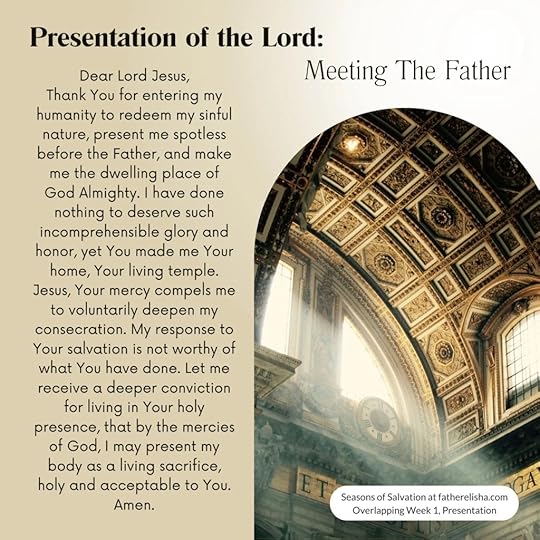
Photo by Chad Greiter on Unsplash
The post February 2 / February 15, 2025 (Eastern Old Calendar): Presentation of the Lord: Meeting The Father first appeared on Father Elisha: Let me take you on an intriguing journey..
January 24, 2025
January 26 – February 1, 2025 (Eastern): Knowing Why We Are Called
The Incarnation Feasts Week 6
Theophany and The End of The Season of Incarnation
God made you and me as living temples on earth, reflecting God to our world. “For you are the temple of the living God” (2 Cor. 6:16). This is God’s vision for our earthly life, but how can we perceive this—even through our eyes of faith? “For You have made him a little lower than the angels, and You have crowned him with glory and honor” (Ps. 8:5). As the grace of Incarnation works in our life year after year, we increasingly comprehend and experience this truth.
After the Fall, Jesus was the firstborn of mankind’s original image—a human unstained by sin and death. Here comes the good news of the Gospel: God promised to give Jesus many brethren. “For whom He foreknew, He also predestined to be conformed to the image of His Son, that He might be the firstborn among many brethren” (Rom. 8:29). Those brothers of Jesus are you and me. “Go and tell My brethren to go to Galilee…” (Matt. 28:10)
The Son of God was also the Son of Man. Jesus Christ was fully God and fully Man. “And the Word became flesh and dwelt among us” (John 1:14). There was no confusion or reduction in the two natures, and they were united as one. “For it pleased the Father that in Him all the fullness should dwell” (Col. 1:19).
That means it pleases the Father that our human nature—the part we’re familiar with, for better or worse—fully unites with the divine nature. “And the glory which You gave Me I have given them, that they may be one just as We are one” (John 17:22). “Jesus answered them, ‘Is it not written in your law, “I said, You are gods”’”? (John 10:34)
(Notice it says “gods” and not “Gods,” referring to the exclusivity of God’s essence, which eternally belongs to Him and is inaccessible to us.)
In the beginning, we lost the divine nature when we fell into sin. Therefore, we have an enormous need to understand the abundant life that comes when divinity unites with our human nature. “I have come that they may have life, and that they may have it more abundantly.” (John 10:10b).
God made it as easy as possible for us: He Himself became human. Jesus showed us by His living example how we are meant to live. Watching Jesus, imitating Him, and worshipping Him are the greatest things we can occupy ourselves with during our short earthly existence. The Apostle Paul writes: “Imitate me, just as I also imitate Christ” (1 Cor. 11:1).
Jesus is our role model and the original form of our existence. We are rightly called Christians—Christ-like people—or, at least, we desire to become more like Jesus. “Not that I have already attained, or am already perfected; but I press on, that I may lay hold of that for which Christ Jesus has also laid hold of me” (Phil. 3:12).
The Season of Incarnation ends after these three weeks’ focus on Theophany and concludes with the Feast of the Presentation of the Lord into the Temple on February 2 (February 15 on the Easter Old Calendar). Illumination, the major theme of the current weeks following Theophany, is our deeper comprehension of our entrance into Jesus’ divine nature—what we lost in the fall. Illumination is the heavenly wisdom (James 3:17) of our heavenly calling (Heb. 3:1) as heavenly citizens (Phil 3:20). “Therefore, holy brethren, partakers of the heavenly calling…” (Heb. 3:1)
“Grace and peace be multiplied to you in the knowledge of God and of Jesus our Lord, as His divine power has given to us all things that pertain to life and godliness, through the knowledge of Him [illumination] who called us by glory and virtue, by which have been given to us exceedingly great and precious promises, that through these you may be partakers of the divine nature…” (2 Pet. 1:2–4)
Knowing the Grace of Incarnation
Since the divine nature is completely foreign to us—like a two-dimensional cartoon entering a three-dimensional world—illumination is an act God does within us. It does not primarily stem from intellectual learning. It is a gift from God. Increased inner light helps us understand how the grace of Incarnation (which we received at Christmas) unfolds and transforms our life.
Illumination leads to a deeper abiding in Jesus. We live closer to Him, and His life flows more deeply into our souls. “My little children, for whom I labor in birth again until Christ is formed in you” (Gal. 4:19). “I have been crucified with Christ; it is no longer I who live, but Christ lives in me; and the life which I now live in the flesh I live by faith in the Son of God, who loved me and gave Himself for me” (Gal. 2:20).
The grace of Incarnation entered our spirits for the first time, known as the grace of salvation, when we became Christians. “For the grace of God that brings salvation has appeared to all men” (Titus 2:11). But we probably all know that we still have the potential to become more like Jesus.
So, we say with Apostle Paul: “Brethren, I do not count myself to have apprehended; but one thing I do, forgetting those things which are behind and reaching forward to those things which are ahead, I press toward the goal for the prize of the upward call of God in Christ Jesus” (Phil. 3:13–14).
The Holy Spirit, through the Early Fathers of the church, established this Divine Calendar in such a way that after discovering the contrast between our life and the Kingdom of God during the first Season, we focus on the Incarnation for about twelve weeks. We began with the six-week Incarnation Fast (the Nativity fast) to empty and prepare a space for the grace of Incarnation that we received in the first Incarnation Feast—the Nativity, Christmas.
Then follow four to six weeks during which the Incarnation grace is gradually unfolded through three more feasts. This week we end the talks about the grace of Theophany, and next week comes the concluding Incarnation Feast of the Presentation in the Temple.
Overlapping Incarnation and Redemption Cycles
If we zoom out to take a broad look at the Divine Calendar, we see two major cycles: Incarnation (the first two Seasons of Salvation) and Redemption (the remaining six Seasons of Salvation).
The Incarnation cycle—when God became Man—implies our unification with the divine nature in Jesus Christ. “By which have been given to us exceedingly great and precious promises, that through these you may be partakers of the divine nature, having escaped the corruption that is in the world through lust” (2 Pet. 1:4). This is our focus during the Season of the Kingdom of God, where we identify the area in our soul where the old man still reigns. Then, during the twelve weeks of the Season of Incarnation, we receive the cure: the divine nature in Jesus.
The Redemption cycle—Jesus’s work of redemption—implies the crucifixion of our old human nature and resurrection into the new. “That I may know Him and the power of His resurrection, and the fellowship of His sufferings, being conformed to His death, if, by any means, I may attain to the resurrection from the dead” (Phil. 3:10–11). This becomes our focus during the Season of Crucifixion, beginning with the Great Lent, and lasting until the end of the Season of Pentecost. It is during this time that we defeat the old man’s reign in the specific area of our souls, allowing our new nature contained in the grace of Incarnation to be enthroned in our souls. The Divine Calendar concludes with two Seasons related to our redemption: our place among the Heavenly creation and the Second Coming of Jesus.
But every year, these two cycles overlap for a few weeks, known as the Overlapping of Incarnation and Redemption. After the last Incarnation Feast and before the beginning of the third Season of Salvation, the Season of Crucifixion, comes these weeks of Overlapping. We will talk more about these weeks as we pass through them in February.
If this sounds confusing, don’t worry. You will understand the practical implications as we journey through these weeks. Jesus has completed a marvelous work of salvation for us. Not only did He make a way for our sins to be forgiven and grant us entrance into Heaven, but the divine human nature we see in Jesus Christ can become our living experience. We can be Christians—Christ-bearers—in the truest sense of the word.
Leaving the Jordan River
In the first week of Theophany, we looked at our entrance into the Jordan River through humility and Jesus as the Lamb of God. Last week, we stood in the River and talked about illumination. We noticed that, through illumination, John the Baptist declared Jesus as the Bridegroom (John 3:29). In this third and final week of Theophany, we will leave the Jordan and talk about being sent. We see Jesus as the Messiah—the Anointed One.
“When He had been baptized, Jesus came up immediately from the water; and behold, the heavens were opened to Him, and He saw the Spirit of God descending like a dove and alighting upon Him (Matt. 3:16). “And immediately, coming up from the water, He saw the heavens parting and the Spirit descending upon Him like a dove” (Mark 1:10). “And the Holy Spirit descended in bodily form like a dove upon Him, and a voice came from heaven which said, ‘You are My beloved Son; in You I am well pleased’” (Luke 3:22). “…Upon whom you see the Spirit descending, and remaining on Him, this is He who baptizes with the Holy Spirit” (John 1:33).
In the Jordan River, Jesus received the anointing as the Messiah so He could begin His public ministry. The Holy Spirit was always with Jesus: “But why is this granted to me, that the mother of my Lord should come to me? For indeed, as soon as the voice of your greeting sounded in my ears, the babe leaped in my womb for joy” (Luke 1:43–44). Jesus filled and anointed John the Baptist with the Holy Spirit, while still in their mothers’ wombs, through the voice of the Virgin Mary. But it was not until John the Baptist reached the end of his ministry and baptized Jesus that the stage was ready for the Messiah to start His mission.
As the Holy Spirit descended and remained on Him (John 1:33), the Father anointed His Son for the work as the Savior of the world. “There shall come forth a Rod from the stem of Jesse, and a Branch shall grow out of his roots. The Spirit of the Lord shall rest upon Him, the Spirit of wisdom and understanding, the Spirit of counsel and might, the Spirit of knowledge and of the fear of the Lord” (Isa. 11:1–2).
As Jesus stepped out of the River, filled with the Holy Spirit, He went into the wilderness to conquer the enemy and all his temptations. “Then Jesus, being filled with the Holy Spirit, returned from the Jordan and was led by the Spirit into the wilderness” (Luke 4:1). After the fasting in the wilderness (the theme of the Season of Crucifixion), Jesus began His public ministry in the synagogue of Nazareth and proclaimed himself as the Messiah. “Then He closed the book, and gave it back to the attendant and sat down. And the eyes of all who were in the synagogue were fixed on Him. And He began to say to them, ‘Today this Scripture is fulfilled in your hearing’” (Luke 4:20–21).
We don’t see Jesus performing any public signs and miracles as the Messiah until after His baptism. In His baptism, Jesus received anointing for the work ahead.
The baptism sent Jesus into His mission. In the Gospel of Mark, the verse after the scene of Theophany reads: “Immediately the Spirit drove Him into the wilderness” (Mark 1:12). The Greek ekballo translated drove means “to eject,” “cast forth,” “drive out,” “thrust out,” and “send out.” It implies a force that drives. The same Greek word is used in Luke 10:2: “Then He said to them, ‘The harvest truly is great, but the laborers are few; therefore pray the Lord of the harvest to send out [ekballo] laborers into His harvest.”
The Holy Spirit’s anointing and sending equip and lead Jesus into His role as the Messiah—meaning “the Anointed One.”
The Pentecost of Theophany
A danger with talking about “the Seasons of Salvation” is compartmentalizing how the Holy Spirit works in our life. One horror story is a theology student who corrected another for saying “Christ is risen” outside the season of Easter.
Our spiritual life is a genuine relationship with Jesus Christ, the most alive and fascinating Person we will ever know. When we talk about receiving the grace of Incarnation, the grace of the Circumcision, the grace of Theophany, and so on—cycles and seasons—we mean a transplantation of the divine-human life that Jesus Christ lived on earth, based on our communion with Him. It is not a spiritual science, or a do-this-and-you’ll-get-that exercise.
The Holy Spirit takes from the divine-human life that Jesus lived two millennia ago and plants it into our inner man while we share our life with Him. Most of the time, we don’t even notice when it happens until after. “And of His fullness we have all received, and grace for grace” (John 1:16). If we live with the Person Jesus, we can’t help but be transformed. “But we all, with unveiled face, beholding as in a mirror the glory of the Lord, are being transformed into the same image from glory to glory, just as by the Spirit of the Lord” (2 Cor. 3:18).
That being said, because God loves us so tremendously and wants to bless us more than we seek to be blessed (Ps. 23:6), He responds to our mechanical and disconnected spiritual life as well.
Also, we experience movements of the Holy Spirit during the Incarnation cycle that reflect Seasons of Salvation in the Redemption cycle. For example, we might experience a certain crucifixion and inner death as we enter the Jordan, or a small resurrection as we receive the illumination from above. And this week, we might feel a small Pentecost as God renews our anointing. But these inner stirrings and changes we experience now will be magnified and completed by the Holy Spirt during the Seasons in the Redemption cycle.
As we leave Theophany, the Holy Spirit seeks to give a tiny taste of what Jesus experienced when He was anointed and sent into His mission. We are in Christ, and the acts Jesus did He didn’t do for Himself, but on our behalf. Jesus didn’t need to be anointed, or to fast and let Satan tempt Him in the wilderness, but we needed His victory. Jesus did everything on our behalf, because we needed His acts as a spiritual credit uploaded to our spiritual bank account—known as grace.
We might suddenly experience the release of our feet, or some circumstances finally change, or we somehow feel different inside, which allows us to live in a way we’re not used to, or we act on something we haven’t done previously. This change comes from the anointing that Jesus received in the Jordan River, and it comes to us as a renewal of our anointing. The Season of Pentecost will bring more clarity, confirmation, and change about this move of God, but the grace of Theophany includes this anointing and sending forth into the mission God has for us.
Sunday Gospel: Matthew 22:1–14 (NKJV)
And Jesus answered and spoke to them again by parables and said: 2 “The kingdom of heaven is like a certain king who arranged a marriage for his son, 3 and sent out his servants to call those who were invited to the wedding; and they were not willing to come. 4 Again, he sent out other servants, saying, ‘Tell those who are invited, “See, I have prepared my dinner; my oxen and fatted cattle are killed, and all things are ready. Come to the wedding.” ’ 5 But they made light of it and went their ways, one to his own farm, another to his business. 6 And the rest seized his servants, treated them spitefully, and killed them. 7 But when the king heard about it, he was furious. And he sent out his armies, destroyed those murderers, and burned up their city. 8 Then he said to his servants, ‘The wedding is ready, but those who were invited were not worthy. 9 Therefore go into the highways, and as many as you find, invite to the wedding.’ 10 So those servants went out into the highways and gathered together all whom they found, both bad and good. And the wedding hall was filled with guests.
11 “But when the king came in to see the guests, he saw a man there who did not have on a wedding garment. 12 So he said to him, ‘Friend, how did you come in here without a wedding garment?’ And he was speechless. 13 Then the king said to the servants, ‘Bind him hand and foot, take him away, and cast him into outer darkness; there will be weeping and gnashing of teeth.’
14 “For many are called, but few are chosen.”
Knowing Why We Are Called
This week’s Sunday Gospel of the parable of the wedding feast is primarily understood as being God’s call to Israel of letting go of earthly distractions and respond to the message of the Messiah. If they didn’t, the Romans would burn Jerusalem and the temple (which happened in 70 A.D.), and the same message would go out to the Gentile nations, emphasizing on taking care of one’s wedding garments.
In our context of the Feast of Theophany, we’ll only focus on the general reason people didn’t respond to the invitation.
In verse 5, we read: “But they made light of it and went their ways, one to his own farm, another to his business.” Verse 11: “But when the king came in to see the guests, he saw a man there who did not have on a wedding garment.” And last, verse 14: “For many are called, but few are chosen.”
The general problem repeats both for the Israelites and the Gentile guests. Everyone was called, but most of the Israelites “made light of it,” and some of the Gentiles didn’t put on a wedding garment. They were all invited, but few knew why there were invited. If only the Israelites would have understood that the Messiah came to establish His kingdom first spiritually within them, as a Bride for the Bridegroom, before externally (Luke 17:21; Acts 1:6–8), they would not have “made light of it.” Similarly, if the Gentile nations believed God called them to be the Bride in the marriage supper of the Lamb, they would have put on wedding garments.
Everyone was called, but few knew why they were called. “For many are called, but few are chosen” (verse 14). Only those who knew why there were called were chosen. Those who knew this was a wedding invitation not only showed up, but they wore wedding clothes to join the celebration.
As the Father anoints Jesus and sends Him into His mission as the Messiah, the grace of Theophany gives more understanding of why God called us. We want to be both called and chosen, and the renewal of our anointing helps us with this. The grace of this third Incarnation Feast increases the light inside us to understand our lives in this new light. We also understand the world in a new light. Putting these together changes the way we live.
Let us pray this week the Holy Spirit may renew our anointing and grant deeper understanding of why God called us to follow Jesus Christ.
Thank you for taking the time to read and follow Jesus throughout these weeks of His baptism. It’s my privilege and joy to journey with you.
Save your Prayer Card on your Smartphone
Photo by Patrick Fore on Unsplash
The post January 26 – February 1, 2025 (Eastern): Knowing Why We Are Called first appeared on Father Elisha: Let me take you on an intriguing journey..
January 26 – February 1, 2025 (Western): Seeing What We Have Never Known
The Incarnation Feasts Week 6
Theophany and The End of The Season of Incarnation
God made you and me as living temples on earth, reflecting God to our world. “For you are the temple of the living God” (2 Cor. 6:16). This is God’s vision for our earthly life, but how can we perceive this—even through our eyes of faith? “For You have made him a little lower than the angels, and You have crowned him with glory and honor” (Ps. 8:5). As the grace of Incarnation works in our life year after year, we increasingly comprehend and experience this truth.
After the Fall, Jesus was the firstborn of mankind’s original image—a human unstained by sin and death. Here comes the good news of the Gospel: God promised to give Jesus many brethren. “For whom He foreknew, He also predestined to be conformed to the image of His Son, that He might be the firstborn among many brethren” (Rom. 8:29). Those brothers of Jesus are you and me. “Go and tell My brethren to go to Galilee…” (Matt. 28:10)
The Son of God was also the Son of Man. Jesus Christ was fully God and fully Man. “And the Word became flesh and dwelt among us” (John 1:14). There was no confusion or reduction in the two natures, and they were united as one. “For it pleased the Father that in Him all the fullness should dwell” (Col. 1:19).
That means it pleases the Father that our human nature—the part we’re familiar with, for better or worse—fully unites with the divine nature. “And the glory which You gave Me I have given them, that they may be one just as We are one” (John 17:22). “Jesus answered them, ‘Is it not written in your law, “I said, You are gods”’”? (John 10:34)
(Notice it says “gods” and not “Gods,” referring to the exclusivity of God’s essence, which eternally belongs to Him and is inaccessible to us.)
In the beginning, we lost the divine nature when we fell into sin. Therefore, we have an enormous need to understand the abundant life that comes when divinity unites with our human nature. “I have come that they may have life, and that they may have it more abundantly.” (John 10:10b).
God made it as easy as possible for us: He Himself became human. Jesus showed us by His living example how we are meant to live. Watching Jesus, imitating Him, and worshipping Him are the greatest things we can occupy ourselves with during our short earthly existence. The Apostle Paul writes: “Imitate me, just as I also imitate Christ” (1 Cor. 11:1).
Jesus is our role model and the original form of our existence. We are rightly called Christians—Christ-like people—or, at least, we desire to become more like Jesus. “Not that I have already attained, or am already perfected; but I press on, that I may lay hold of that for which Christ Jesus has also laid hold of me” (Phil. 3:12).
The Season of Incarnation ends after these three weeks’ focus on Theophany and concludes with the Feast of the Presentation of the Lord into the Temple on February 2 (February 15 on the Easter Old Calendar). Illumination, the major theme of the current weeks following Theophany, is our deeper comprehension of our entrance into Jesus’ divine nature—what we lost in the fall. Illumination is the heavenly wisdom (James 3:17) of our heavenly calling (Heb. 3:1) as heavenly citizens (Phil 3:20). “Therefore, holy brethren, partakers of the heavenly calling…” (Heb. 3:1)
“Grace and peace be multiplied to you in the knowledge of God and of Jesus our Lord, as His divine power has given to us all things that pertain to life and godliness, through the knowledge of Him [illumination] who called us by glory and virtue, by which have been given to us exceedingly great and precious promises, that through these you may be partakers of the divine nature…” (2 Pet. 1:2–4)
Knowing the Grace of Incarnation
Since the divine nature is completely foreign to us—like a two-dimensional cartoon entering a three-dimensional world—illumination is an act God does within us. It does not primarily stem from intellectual learning. It is a gift from God. Increased inner light helps us understand how the grace of Incarnation (which we received at Christmas) unfolds and transforms our life.
Illumination leads to a deeper abiding in Jesus. We live closer to Him, and His life flows more deeply into our souls. “My little children, for whom I labor in birth again until Christ is formed in you” (Gal. 4:19). “I have been crucified with Christ; it is no longer I who live, but Christ lives in me; and the life which I now live in the flesh I live by faith in the Son of God, who loved me and gave Himself for me” (Gal. 2:20).
The grace of Incarnation entered our spirits for the first time, known as the grace of salvation, when we became Christians. “For the grace of God that brings salvation has appeared to all men” (Titus 2:11). But we probably all know that we still have the potential to become more like Jesus.
So, we say with Apostle Paul: “Brethren, I do not count myself to have apprehended; but one thing I do, forgetting those things which are behind and reaching forward to those things which are ahead, I press toward the goal for the prize of the upward call of God in Christ Jesus” (Phil. 3:13–14).
The Holy Spirit, through the Early Fathers of the church, established this Divine Calendar in such a way that after discovering the contrast between our life and the Kingdom of God during the first Season, we focus on the Incarnation for about twelve weeks. We began with the six-week Incarnation Fast (the Nativity fast) to empty and prepare a space for the grace of Incarnation that we received in the first Incarnation Feast—the Nativity, Christmas.
Then follow four to six weeks during which the Incarnation grace is gradually unfolded through three more feasts. This week we end the talks about the grace of Theophany, and next week comes the concluding Incarnation Feast of the Presentation in the Temple.
Overlapping Incarnation and Redemption Cycles
If we zoom out to take a broad look at the Divine Calendar, we see two major cycles: Incarnation (the first two Seasons of Salvation) and Redemption (the remaining six Seasons of Salvation).
The Incarnation cycle—when God became Man—implies our unification with the divine nature in Jesus Christ. “By which have been given to us exceedingly great and precious promises, that through these you may be partakers of the divine nature, having escaped the corruption that is in the world through lust” (2 Pet. 1:4). This is our focus during the Season of the Kingdom of God, where we identify the area in our soul where the old man still reigns. Then, during the twelve weeks of the Season of Incarnation, we receive the cure: the divine nature in Jesus.
The Redemption cycle—Jesus’s work of redemption—implies the crucifixion of our old human nature and resurrection into the new. “That I may know Him and the power of His resurrection, and the fellowship of His sufferings, being conformed to His death, if, by any means, I may attain to the resurrection from the dead” (Phil. 3:10–11). This becomes our focus during the Season of Crucifixion, beginning with the Great Lent, and lasting until the end of the Season of Pentecost. It is during this time that we defeat the old man’s reign in the specific area of our souls, allowing our new nature contained in the grace of Incarnation to be enthroned in our souls. The Divine Calendar concludes with two Seasons related to our redemption: our place among the Heavenly creation and the Second Coming of Jesus.
But every year, these two cycles overlap for a few weeks, known as the Overlapping of Incarnation and Redemption. After the last Incarnation Feast and before the beginning of the third Season of Salvation, the Season of Crucifixion, comes these weeks of Overlapping. We will talk more about these weeks as we pass through them in February.
If this sounds confusing, don’t worry. You will understand the practical implications as we journey through these weeks. Jesus has completed a marvelous work of salvation for us. Not only did He make a way for our sins to be forgiven and grant us entrance into Heaven, but the divine human nature we see in Jesus Christ can become our living experience. We can be Christians—Christ-bearers—in the truest sense of the word.
Leaving the Jordan River
In the first week of Theophany, we looked at our entrance into the Jordan River through humility and Jesus as the Lamb of God. Last week, we stood in the River and talked about illumination. We noticed that, through illumination, John the Baptist declared Jesus as the Bridegroom (John 3:29). In this third and final week of Theophany, we will leave the Jordan and talk about being sent. We see Jesus as the Messiah—the Anointed One.
“When He had been baptized, Jesus came up immediately from the water; and behold, the heavens were opened to Him, and He saw the Spirit of God descending like a dove and alighting upon Him (Matt. 3:16). “And immediately, coming up from the water, He saw the heavens parting and the Spirit descending upon Him like a dove” (Mark 1:10). “And the Holy Spirit descended in bodily form like a dove upon Him, and a voice came from heaven which said, ‘You are My beloved Son; in You I am well pleased’” (Luke 3:22). “…Upon whom you see the Spirit descending, and remaining on Him, this is He who baptizes with the Holy Spirit” (John 1:33).
In the Jordan River, Jesus received the anointing as the Messiah so He could begin His public ministry. The Holy Spirit was always with Jesus: “But why is this granted to me, that the mother of my Lord should come to me? For indeed, as soon as the voice of your greeting sounded in my ears, the babe leaped in my womb for joy” (Luke 1:43–44). Jesus filled and anointed John the Baptist with the Holy Spirit, while still in their mothers’ wombs, through the voice of the Virgin Mary. But it was not until John the Baptist reached the end of his ministry and baptized Jesus that the stage was ready for the Messiah to start His mission.
As the Holy Spirit descended and remained on Him (John 1:33), the Father anointed His Son for the work as the Savior of the world. “There shall come forth a Rod from the stem of Jesse, and a Branch shall grow out of his roots. The Spirit of the Lord shall rest upon Him, the Spirit of wisdom and understanding, the Spirit of counsel and might, the Spirit of knowledge and of the fear of the Lord” (Isa. 11:1–2).
As Jesus stepped out of the River, filled with the Holy Spirit, He went into the wilderness to conquer the enemy and all his temptations. “Then Jesus, being filled with the Holy Spirit, returned from the Jordan and was led by the Spirit into the wilderness” (Luke 4:1). After the fasting in the wilderness (the theme of the Season of Crucifixion), Jesus began His public ministry in the synagogue of Nazareth and proclaimed himself as the Messiah. “Then He closed the book, and gave it back to the attendant and sat down. And the eyes of all who were in the synagogue were fixed on Him. And He began to say to them, ‘Today this Scripture is fulfilled in your hearing’” (Luke 4:20–21).
We don’t see Jesus performing any public signs and miracles as the Messiah until after His baptism. In His baptism, Jesus received anointing for the work ahead.
The baptism sent Jesus into His mission. In the Gospel of Mark, the verse after the scene of Theophany reads: “Immediately the Spirit drove Him into the wilderness” (Mark 1:12). The Greek ekballo translated drove means “to eject,” “cast forth,” “drive out,” “thrust out,” and “send out.” It implies a force that drives. The same Greek word is used in Luke 10:2: “Then He said to them, ‘The harvest truly is great, but the laborers are few; therefore pray the Lord of the harvest to send out [ekballo] laborers into His harvest.”
The Holy Spirit’s anointing and sending equip and lead Jesus into His role as the Messiah—meaning “the Anointed One.”
The Pentecost of Theophany
A danger with talking about “the Seasons of Salvation” is compartmentalizing how the Holy Spirit works in our life. One horror story is a theology student who corrected another for saying “Christ is risen” outside the season of Easter.
Our spiritual life is a genuine relationship with Jesus Christ, the most alive and fascinating Person we will ever know. When we talk about receiving the grace of Incarnation, the grace of the Circumcision, the grace of Theophany, and so on—cycles and seasons—we mean a transplantation of the divine-human life that Jesus Christ lived on earth, based on our communion with Him. It is not a spiritual science, or a do-this-and-you’ll-get-that exercise.
The Holy Spirit takes from the divine-human life that Jesus lived two millennia ago and plants it into our inner man while we share our life with Him. Most of the time, we don’t even notice when it happens until after. “And of His fullness we have all received, and grace for grace” (John 1:16). If we live with the Person Jesus, we can’t help but be transformed. “But we all, with unveiled face, beholding as in a mirror the glory of the Lord, are being transformed into the same image from glory to glory, just as by the Spirit of the Lord” (2 Cor. 3:18).
That being said, because God loves us so tremendously and wants to bless us more than we seek to be blessed (Ps. 23:6), He responds to our mechanical and disconnected spiritual life as well.
Also, we experience movements of the Holy Spirit during the Incarnation cycle that reflect Seasons of Salvation in the Redemption cycle. For example, we might experience a certain crucifixion and inner death as we enter the Jordan, or a small resurrection as we receive the illumination from above. And this week, we might feel a small Pentecost as God renews our anointing. But these inner stirrings and changes we experience now will be magnified and completed by the Holy Spirt during the Seasons in the Redemption cycle.
As we leave Theophany, the Holy Spirit seeks to give a tiny taste of what Jesus experienced when He was anointed and sent into His mission. We are in Christ, and the acts Jesus did He didn’t do for Himself, but on our behalf. Jesus didn’t need to be anointed, or to fast and let Satan tempt Him in the wilderness, but we needed His victory. Jesus did everything on our behalf, because we needed His acts as a spiritual credit uploaded to our spiritual bank account—known as grace.
We might suddenly experience the release of our feet, or some circumstances finally change, or we somehow feel different inside, which allows us to live in a way we’re not used to, or we act on something we haven’t done previously. This change comes from the anointing that Jesus received in the Jordan River, and it comes to us as a renewal of our anointing. The Season of Pentecost will bring more clarity, confirmation, and change about this move of God, but the grace of Theophany includes this anointing and sending forth into the mission God has for us.
Sunday Gospel: John 9:1–38 (NKJV)
Now as Jesus passed by, He saw a man who was blind from birth. 2 And His disciples asked Him, saying, “Rabbi, who sinned, this man or his parents, that he was born blind?”
3 Jesus answered, “Neither this man nor his parents sinned, but that the works of God should be revealed in him. 4 I must work the works of Him who sent Me while it is day; the night is coming when no one can work. 5 As long as I am in the world, I am the light of the world.”
6 When He had said these things, He spat on the ground and made clay with the saliva; and He anointed the eyes of the blind man with the clay. 7 And He said to him, “Go, wash in the pool of Siloam” (which is translated, Sent). So he went and washed, and came back seeing.
8 Therefore the neighbors and those who previously had seen that he was blind said, “Is not this he who sat and begged?” 9 Some said, “This is he.” Others said, “He is like him.” He said, “I am he.” 10 Therefore they said to him, “How were your eyes opened?” 11 He answered and said, “A Man called Jesus made clay and anointed my eyes and said to me, ‘Go to the pool of Siloam and wash.’ So I went and washed, and I received sight.” 12 Then they said to him, “Where is He?” He said, “I do not know.”
13 They brought him who formerly was blind to the Pharisees. 14 Now it was a Sabbath when Jesus made the clay and opened his eyes. 15 Then the Pharisees also asked him again how he had received his sight. He said to them, “He put clay on my eyes, and I washed, and I see.” 16 Therefore some of the Pharisees said, “This Man is not from God, because He does not keep the Sabbath.” Others said, “How can a man who is a sinner do such signs?” And there was a division among them.
17 They said to the blind man again, “What do you say about Him because He opened your eyes?” He said, “He is a prophet.” 18 But the Jews did not believe concerning him, that he had been blind and received his sight, until they called the parents of him who had received his sight. 19 And they asked them, saying, “Is this your son, who you say was born blind? How then does he now see?”
20 His parents answered them and said, “We know that this is our son, and that he was born blind; 21 but by what means he now sees we do not know, or who opened his eyes we do not know. He is of age; ask him. He will speak for himself.” 22 His parents said these things because they feared the Jews, for the Jews had agreed already that if anyone confessed that He was Christ, he would be put out of the synagogue. 23 Therefore his parents said, “He is of age; ask him.”
24 So they again called the man who was blind, and said to him, “Give God the glory! We know that this Man is a sinner.” 25 He answered and said, “Whether He is a sinner or not I do not know. One thing I know: that though I was blind, now I see.”
26 Then they said to him again, “What did He do to you? How did He open your eyes?” 27 He answered them, “I told you already, and you did not listen. Why do you want to hear it again? Do you also want to become His disciples?” 28 Then they reviled him and said, “You are His disciple, but we are Moses’ disciples. 29 We know that God spoke to Moses; as for this fellow, we do not know where He is from.”
30 The man answered and said to them, “Why, this is a marvelous thing, that you do not know where He is from; yet He has opened my eyes! 31 Now we know that God does not hear sinners; but if anyone is a worshiper of God and does His will, He hears him. 32 Since the world began it has been unheard of that anyone opened the eyes of one who was born blind. 33 If this Man were not from God, He could do nothing.” 34 They answered and said to him, “You were completely born in sins, and are you teaching us?” And they cast him out.
35 Jesus heard that they had cast him out; and when He had found him, He said to him, “Do you believe in the Son of God?” 36 He answered and said, “Who is He, Lord, that I may believe in Him?” 37 And Jesus said to him, “You have both seen Him and it is He who is talking with you.” 38 Then he said, “Lord, I believe!” And he worshiped Him.
Anointed For a Mission
This week’s Sunday Gospel from John 9 demonstrates how illumination leads in being sent.
The disciples asked Jesus why a man was blind from birth. “Jesus answered, ‘Neither this man nor his parents sinned, but that the works of God should be revealed in him’” (verse 3). An inner theophany awaited this blind man. He would experience a new understanding of God within. This illumination would catalyze a radical change in his way of life.
We read in verses 6–7: “When He had said these things, He spat on the ground and made clay with the saliva; and He anointed the eyes of the blind man with the clay. And He said to him, ‘Go, wash in the pool of Siloam’ (which is translated, Sent). So he went and washed, and came back seeing.”
Jesus anointed the man’s eyes with clay and told him to go and wash in the pool of Siloam, and this washing—his Jordan River experience—sent the blind man into his mission of testifying about the miracle. We notice that the blind man don’t know how Jesus looks like at that first meeting, being blind. The man didn’t physically see Jesus until after his mission to the religious establishment in verses 13–34.
When the Pharisees questioned the previously blind man, we can see the anointing working. He was bold in his testimony, confronted the Pharisees in humility, and showed great wisdom in his answers. We get the feeling he’s a different person.
We read in verses 30–34: “The man answered and said to them, ‘Why, this is a marvelous thing, that you do not know where He is from; yet He has opened my eyes! Now we know that God does not hear sinners; but if anyone is a worshiper of God and does His will, He hears him. Since the world began it has been unheard of that anyone opened the eyes of one who was born blind. If this Man were not from God, He could do nothing.’ They answered and said to him, ‘You were completely born in sins, and are you teaching us?’ And they cast him out.”
Seeing What We Have Never Known
But what was the illumination this man received that made him go to the pool in the first place? That event clearly changed the blind man’s way of life. We can identify his mission as testifying to the religious establishment of the recreation of his eyes—implying a deeper spiritual message (John 9:39–41). But what was the preceding illumination that changed his understanding of God and the anointing that equipped him? Let’s look at the beautiful moment when the blind man can physically see Him who gave him eyes.
Verses 35–38: “Jesus heard that they had cast him out; and when He had found him, He said to him, ‘Do you believe in the Son of God?’ He answered and said, ‘Who is He, Lord, that I may believe in Him?’ And Jesus said to him, ‘You have both seen Him and it is He who is talking with you.’ Then he said, ‘Lord, I believe!’ And he worshiped Him.”
Jesus’ answer holds the key: “You have both seen Him and it is He who is talking with you.” Jesus said to the blind man that he had seen Him once before—He was One who had talked to him.
Notice that Jesus said the blind had seen Him once before. But the man was blind. So Jesus did not refer to seeing Him physically, but with the eyes of faith. “For we walk by faith, not by sight” (2 Cor. 5:7). “Blessed are those who have not seen and yet have believed” (John 20:29). What happened when Jesus met him? What was this man’s inner theophany?
“He spat on the ground and made clay with the saliva; and He anointed the eyes of the blind man with the clay. And He said to him, ‘Go, wash in the pool of Siloam’” (verses 6b–7a). As a Jew, this man knew well that “the Lord God formed man of the dust of the ground, and breathed into his nostrils the breath of life; and man became a living being” (Gen. 2:7). Receiving mud smeared on his eyes, the blind man would think either of two things: either this man is a lunatic, or this man must be from God (verses 17, 33). The blind man’s obedience to Jesus’ words “Go, wash in the pool of Siloam,” proved which of the two. And indeed, he went, believing God would create new eyes from the dust smeared on his eyes.
Even though he was physically blind, his inner eyes saw God before him. He believed Jesus was sent from God, a prophet (verse 17). When Jesus “anointed the eyes of the blind man with the clay,” the blind man’s faith released the anointing. He believed a man from God stood before him that could grant him a sense he had never known. This became his theophany. Then, as he experienced the miracle and could see for the first time in his life, God sent him to testify to the Pharisees about the miracle.
Through the grace of Theophany, we are anointed to see what we could never see before. When the inner light increases in our soul, an invisible light shines on our surroundings, making us look differently at ourselves, others, our life with God, our circumstances, and our calling. A new light shines from within, transforming us. Like with a new set of inner binoculars, we see a greater context around us.
Just as Jesus gave sight to the man who had never known it, sending him with boldness, humility, and wisdom on his mission to the religious establishment, so the grace of Theophany grants us the ability to see our lives in a light we have never known. Truly, we have been illumined.
Let us pray for the grace of the renewal of our anointing, that slowly but surely our way of life may harmonize with our unique callings. May God bless you as we approach the final Incarnation Feast.
Save your Prayer Card on your Smartphone
Photo by Matt LaVasseur on Unsplash
The post January 26 – February 1, 2025 (Western): Seeing What We Have Never Known first appeared on Father Elisha: Let me take you on an intriguing journey..