Father Elisha's Blog, page 12
December 20, 2024
December 25, 2024 / January 7, 2025 (Eastern Old Calendar): Christmas, The Nativity of our Lord Jesus Christ


Incarnation Feasts Week 1:
Christmas / The Nativity
Gospel of the Feast: Matthew 2:1–12 (NKJV)
Now after Jesus was born in Bethlehem of Judea in the days of Herod the king, behold, wise men from the East came to Jerusalem, 2 saying, “Where is He who has been born King of the Jews? For we have seen His star in the East and have come to worship Him.”
3 When Herod the king heard this, he was troubled, and all Jerusalem with him. 4 And when he had gathered all the chief priests and scribes of the people together, he inquired of them where the Christ was to be born.
5 So they said to him, “In Bethlehem of Judea, for thus it is written by the prophet: 6 ‘But you, Bethlehem, in the land of Judah, are not the least among the rulers of Judah; for out of you shall come a Ruler who will shepherd My people Israel.’”
7 Then Herod, when he had secretly called the wise men, determined from them what time the star appeared. 8 And he sent them to Bethlehem and said, “Go and search carefully for the young Child, and when you have found Him, bring back word to me, that I may come and worship Him also.”
9 When they heard the king, they departed; and behold, the star which they had seen in the East went before them, till it came and stood over where the young Child was. 10 When they saw the star, they rejoiced with exceedingly great joy. 11 And when they had come into the house, they saw the young Child with Mary His mother, and fell down and worshiped Him. And when they had opened their treasures, they presented gifts to Him: gold, frankincense, and myrrh. 12 Then, being divinely warned in a dream that they should not return to Herod, they departed for their own country another way.
The Incarnation Feasts
We barely dare to breathe as we bend our necks to enter the cave in Bethlehem. Thankfully, our fasting and self-emptying enabled us to bow low enough. The smells and sounds tell of animals nearby. The cold stone touches our fingertips as we move deeper into the moist cave. Finally, next to an open fire, stands a hay-filled manger. Two tiny hands and feet reach above the wooden casket. Two glowing faces, the Virgin Mary and the Righteous Joseph, bend over. Their facial expressions testify to what we heard from the shepherd moments ago: “Glory to God in the highest, and on earth peace, goodwill toward men” (Luke 2:14).
I’ll leave it up to your imagination whether Baby Jesus cried a lot, lying on an itchy blanket among the pinching hay in the chilly air, but this is how we find God, the Creator of the Universe. So vulnerable. So helpless. So utterly surrendered to the mercy of His parents. Even though God chose exceptional parents for Himself, and we know Jesus could pray to His Heavenly Father, and He would provide Jesus “with more than twelve legions of angels” (Matt. 26:53), still, there He lies, with a silent (my opinion), beaming face.
For the next six weeks, we will celebrate four events in Jesus’ life related to the mystery of His Incarnation. On December 25 (January 7 on the Old Calendar), we celebrate the birth of Jesus Christ. One week later, we commemorate the Circumcision of the Lord. Few days after, we celebrate Theophany/Epiphany. Last, at the beginning of February, we gather around the Presentation of Jesus Christ in the Temple of Jerusalem. This concluding feast happens forty days after His birth and wraps up the second Season of Salvation in the Divine Calendar.
The Key of The Nativity of The Lord
Each Incarnation Feast has its key to help us comprehend and interact with the mystery of the event, and the key of the Nativity is the empty manger. “And she brought forth her firstborn Son, and wrapped Him in swaddling cloths, and laid Him in a manger, because there was no room for them in the inn” (Luke 2:7).
Through the previous forty-day fast, our practical keyword has been emptying. Now we add manger, “a trough or open box in a stable designed to hold feed or fodder for livestock” (Merriam-Webster). The manger is an unfathomable replacement of the Throne of Glory in Heaven, where “seraphim; each one had six wings: with two he covered his face, with two he covered his feet, and with two he flew. And one cried to another and said: ‘Holy, holy, holy is the Lord of hosts; the whole earth is full of His glory!’” (Isa. 6:2)
The scene of Christ in the manger display the key from the Incarnation Fast overwhelmingly convincingly. “Let this mind be in you which was also in Christ Jesus, who, being in the form of God, did not consider it robbery to be equal with God, but made Himself of no reputation, taking the form of a bondservant, and coming in the likeness of men” (Phil. 2:5–7). Jesus made himself of no reputation indeed, trading His throne with a food container for cattle, horses, and sheep. It certainly inspires humility.
How do we enter the mystery of this feast? By contemplating on the empty manger Baby Jesus chose as His bed, His resting place. Humility leads to an overwhelming peace between Heaven and Earth. Let us approach Jesus in prayer these days with awe and fear of the humility of God. As always, but especially during Christmas, let us act tenderly and be meek as we approach God in prayer, Bible reading, silence, and in our everyday conversations with Him.
Remember, in these days, the Holy Spirit mystically takes our spirit into this scene in actuality. We’ll be in the cave’s atmosphere. Baby Jesus is right there. Again, not as daydreaming or mental images, but as a transcending spiritual reality. We’ll experience Isaiah 57:15, and receive the grace of Incarnation:
“For thus says the High and Lofty One Who inhabits eternity, whose name is Holy: ‘I dwell in the high and holy place, with him who has a contrite and humble spirit, to revive the spirit of the humble, and to revive the heart of the contrite ones.’”
The Feast of Light
The Nativity of the Lord is the Feast of Light. “And behold, an angel of the Lord stood before them, and the glory of the Lord shone around them, and they were greatly afraid” (Luke 2:9). And from the previous Sunday Gospel: “Through the tender mercy of our God, with which the Dayspring from on high has visited us; to give light to those who sit in darkness and the shadow of death, to guide our feet into the way of peace” (Luke 1:78–79).
There are two forms of spiritual light.
The Light of Life: “In Him was life, and the life was the light of men” (John 1:4). “Then Jesus spoke to them again, saying, ‘I am the light of the world. He who follows Me shall not walk in darkness, but have the light of life’” (John 8:12).The Light of Knowledge: “That the God of our Lord Jesus Christ, the Father of glory, may give to you the spirit of wisdom and revelation in the knowledge of Him, the eyes of your understanding being enlightened…” (Eph. 1:17–18b)What is the difference?
The Light of Life
The Light of Life is “the Dayspring from on high” and “the light of the world.” It is a manifestation of life itself, the life that comes from God. “In Him [Jesus] was life….” This is not a light we can see or comprehend with the mind (not visual or intellectual). The light of life is the light that “has come into the world, and men loved darkness rather than light, because their deeds were evil” (John 3:19).
As we approach the Child Jesus through our prayers and feasting (we’ll talk more about how to feast—not fast—at the end) and we receive the grace of His Incarnation, this grace soon opens up in our soul and shines His life within us. “For with You is the fountain of life; in Your light we see light” (Ps. 36:9).
When this happens, both during this feast and on other occasions, people notice. Have you ever experienced some faces that seem to shine? It’s not a visible light, but somehow, this Christian brother or sister has a certain glow. That’s the light of life. That’s the light of the Incarnation grace we’ll receive these days, whether people notice or not.
We could talk much about prioritizing this light above the light of knowledge, as it contains immense spiritual strength, joy, and influence on the surroundings, but that topic we must save for the Season of Pentecost, the Lord willing. But the light of life is crucial for the divine nature of Jesus to grow within. Also, when the light of life shines from our spirit into our mind, it illumines the mind and we experience “a revelation” or an “sudden inspiration.” We discover new depths in the Word of God and understands new truths about the Kingdom. It is the knowledge that comes from the light of life that bears with it the capacity—the grace—to act on that knowledge. If we receive knowledge, but don’t find the inner strength to obey the new revelation, we’ve received the second form of light:
The Light of Knowledge
This light is also a gift from God, but it is different from the light of life because of where it comes. While the Holy Spirit directs the light of life to our spirits, He sends the light of knowledge to our minds to illumine our understanding. We shouldn’t neglect this second form of light, as it gives crucial understanding about God and His Kingdom, but the light of knowledge doesn’t carry within it the grace—the capacity—that is needed to apply that knowledge.
The light of knowledge is the light of truth. This form of light is intellectual, and we need it to comprehend the first form, the light of life. “Oh, send out Your light and Your truth! Let them lead me; let them bring me to Your holy hill and to Your tabernacle” (Ps. 43:3).
“If we say that we have fellowship with Him, and walk in darkness, we lie and do not practice the truth. But if we walk in the light as He is in the light…” (1 John 1:6–7a) “But he who does the truth comes to the light, that his deeds may be clearly seen, that they have been done in God” (John 3:21).
During a feast, we may also experience receiving the light of knowledge, especially regarding the event we celebrate. The Holy Spirit wants us to comprehend deeper truths, inspiring us to chase the light of life so that we can live out the truth.
So, should we prioritize this gift of light if we want to impact our world? “For behold, the darkness shall cover the earth, and deep darkness the people; but the Lord will arise over you [meaning Zion, which is also an image of your spirit], and His glory will be seen upon you. The Gentiles shall come to your light, and kings to the brightness of your rising” (Isa. 60:2–3).
We Have Come To Worship Him
Let us look at one aspect of the Gospel passage for this Feast: the visit of the wise men from the East. These foreigners asked the people in Jerusalem: “Where is He who has been born King of the Jews? For we have seen His star in the East and have come to worship Him” (verse 2).
A star led them to Bethlehem and to the place the Virgin Mary and Joseph stayed with the Child Jesus. “And when they had come into the house, they saw the young Child with Mary His mother, and fell down and worshiped Him. And when they had opened their treasures, they presented gifts to Him: gold, frankincense, and myrrh” (verse 11).
The entrance of God into our world in His uttermost humility resulted in worship from Heaven (Luke 2:13–14) and Earth. Deep reverence and love motivated these (probably Persian) men—perhaps not even Jewish, even though they knew the Jewish Scriptures. They traveled all this way to offer their gifts, the prophetic signs of the calling of the Messiah, but even more… the greatest gift they offered Immanuel, God with us, was their hearts, their worship. That is why God became incarnate, to set us free from the tyranny of sin and death and win the worship of our hearts.
We might feel a new stirring to worship God these days. The Holy Spirit inspires us, starting already during the Incarnation Fast, to worship Jesus.
This inner move of recommitting, deepening, or returning to pure worship of our God-made-flesh is the practical way to mystically draw near the manger in Bethlehem, as we’ve been prepared through our self-emptying fast. The closer we approach the humble manger with Baby Jesus, the more our hearts surrender in worship and adoration. It’s a natural spiritual reaction. When the Holy Spirit leads us nearer to God, our spirits naturally worship. We pour ourselves out before Jesus and He fills us with His love.
The Lord needs us now more than ever not only to continue our worship and intercessions, but also to intensify them. As the darkness covers the Earth and controversies hit the different branches of the church, consecration and a life of worship is the most powerful way to counteract the accumulating darkness.
Let us surrender before the only One who is worthy. Come, let us adore Him. Together with the wise men, we also have come to worship Him.
You might want to stop reading here and pray before continuing. What follows are practical suggestions for how to feast—not fast.
On A Practical Note: How Do I Feast?
Fasting might be easier for us to understand, since we know it implies practical acts like restriction of food and drink, more Bible reading, prayer, quietness, acts of charity, reconciliation with others, and deeper repentance. But how do we feast?
Below are some practical points, but they do not mean you should do them all. It’s important that you make the day light-footed—be easily moved by the inspirations the Holy Spirit gives. It’s a feast day. Let us celebrate Jesus Christ, our King!
Some suggestions:
Attending Church Services
Usually, there should be a church service on a feast day, and attending is important. If we have the chance to gather with the local body of believers, it’s the most effective way to receive the grace from a feast. Fellowship attracts the Holy Spirit, since He often operates in fellowship, and you step under the pouring of the grace from the feast day. If it’s not possible, the Holy Spirit still faithfully gives as much as we can steward.
“In whom you also are being built together for a dwelling place of God in the Spirit” (Eph. 2:22). “For where two or three are gathered together in My name, I am there in the midst of them” (Matt. 18:20). “As they ministered to the Lord and fasted, the Holy Spirit said, ‘Now separate to Me Barnabas and Saul for the work to which I have called them.’ Then, having fasted and prayed, and laid hands on them, they sent them away” (Acts 13:2–3). “Behold, how good and how pleasant it is for brethren to dwell together in unity! It is like the precious oil upon the head, running down on the beard, the beard of Aaron, running down on the edge of his garments” (Ps. 133:1–2). Notice the oil—the anointing of the Holy Spirit is poured on unity.
Receiving Holy Communion
In most churches, the Eucharist is a central part of the church service on the feast day. We know by now the significance of receiving the body and blood of Christ in relation to the mystery of Incarnation. We seek the very grace from this mystery to form Jesus Christ in our inner man, so the Holy Spirit imparts Christ’s divine nature to us. But in every feast, not just the Incarnation Feasts, Holy Communion is the most powerful channel to receive the grace of the feast. Then, when the Holy Spirit unveils the Sunday Gospel or Gospel of the Feast to our hearts, we understand what this grace will do in our life.
“He who eats My flesh and drinks My blood abides in Me, and I in him. As the living Father sent Me, and I live because of the Father, so he who feeds on Me will live because of Me” (John 6:56–57). “Now on the first day of the week, when the disciples came together to break bread, Paul, ready to depart the next day, spoke to them and continued his message until midnight” (Acts 20:7). “And they continued steadfastly in the apostles’ doctrine and fellowship, in the breaking of bread, and in prayers […] So continuing daily with one accord in the temple, and breaking bread from house to house, they ate their food with gladness and simplicity of heart, praising God and having favor with all the people. And the Lord added to the church daily those who were being saved” (Acts 2:42, 46–47).
Don’t Fast
Maybe this sounds obvious, but we shouldn’t fast on feast days simply because there’s no grace to fast. It’s a celebration. Now, losing self-control is no better; fasting would be a better alternative. Simply live the day without any feelings of tension from activities you would typically do on a fasting day.
“Go, eat your bread with joy, and drink your wine with a merry heart; for God has already accepted your works. Let your garments always be white, and let your head lack no oil” (Eccl. 9:7–8). “For the kingdom of God is not eating and drinking, but righteousness and peace and joy in the Holy Spirit” (Rom. 14:17). “He who observes the day, observes it to the Lord; and he who does not observe the day, to the Lord he does not observe it. He who eats, eats to the Lord, for he gives God thanks; and he who does not eat, to the Lord he does not eat, and gives God thanks” (Rom. 14:6).
Worship and Thanksgiving
Let your heart sing to the Lord and give Him thanks for what He has done for you. He’s so good, so worthy, so gracious. If there’s any day to sing, either with others or (perhaps best) on your own, it’s on a feast day. Praise and thanksgiving open your spirit like a beautiful flower that captures Jesus’ attention.
“But be filled with the Spirit, speaking to one another in psalms and hymns and spiritual songs, singing and making melody in your heart to the Lord, giving thanks always for all things to God the Father in the name of our Lord Jesus Christ” (Eph. 5:18b–20). “O my dove, in the clefts of the rock, in the secret places of the cliff, let me see your face, let me hear your voice; for your voice is sweet, and your face is lovely” (Song of Songs 2:14).
Meditation on the Appointed Scripture Passages.
Slowly and prayerfully, read a verse or a few verses repeatedly in a whispering voice. This helps us go deep into the Scriptures and receive the grace of the passage.
“My eyes are awake through the night watches, that I may meditate on Your word” (Ps. 119: 148). “Blessed is the man who walks not in the counsel of the ungodly, nor stands in the path of sinners, nor sits in the seat of the scornful; but his delight is in the law of the Lord, and in His law he meditates day and night” (Ps. 1:1–2).
Spontaneous Prayer
It is good to express our hearts to the Lord freely. It is usually helpful to do this after some of the other spiritual activities mentioned above, as they prepare and inspire our spirits. Our prayer then becomes prophetic in nature, and listening to our own prayers may surprise us.
“But you, when you pray, go into your room, and when you have shut your door, pray to your Father who is in the secret place; and your Father who sees in secret will reward you openly” (Matt. 6:6).
Regarding “feeling something”
We talked about this in the first week of Advent, but it is worthy to repeat here. It’s important we don’t judge our experience of a feast on the level of the soul—a feeling, a new thought, or a vivid mental vision. We don’t refer to a visible feast, but a spiritual communion with Jesus which the Holy Spirit facilitates, primarily transcending the level of the soul.
Our soul and even our body can experience the spiritual realm, but most of the time, we experience the spiritual realm by faith. “For we walk by faith, not by sight” (2 Cor. 5:7). “For the kingdom of God is not eating and drinking, but righteousness and peace and joy in the Holy Spirit” (Rom. 14:17).
The Feast has come, and perhaps we have done our best to fast and pray according to the landmarks of the Sunday Gospels, yet we might feel absolutely nothing. A major feast can sometimes feel like a big anticlimax—especially during the first few years of journeying through the Seasons of Salvation. Please, do not be disappointed or despair.
If we did our best and our hearts long for the grace of the Feast, we may still feel the Feast come and go. But rest assured: our spirits received the grace of the Feast. It is subtle. Weeks and months later—even years—we realize we’ve changed. How did that happen? When did it start? It was those feasts when we felt we failed to receive the grace.
“These all died in faith, not having received the promises, but having seen them afar off were assured of them, embraced them and confessed that they were strangers and pilgrims on the earth” (Heb. 11:13).
Make Your Day Different
Give your day to the Lord and see where He takes you. After all, it is He whom we celebrate.
With this, I wish you a blessed Christmas celebration. Thank you for being a part of this journey. I hope to pass through the coming six weeks of feasting together, unveiling more of the grace of the Incarnation that we receive during these days.
Christ is born!
Glorify Him!
Save your Prayer Card on your Smartphone
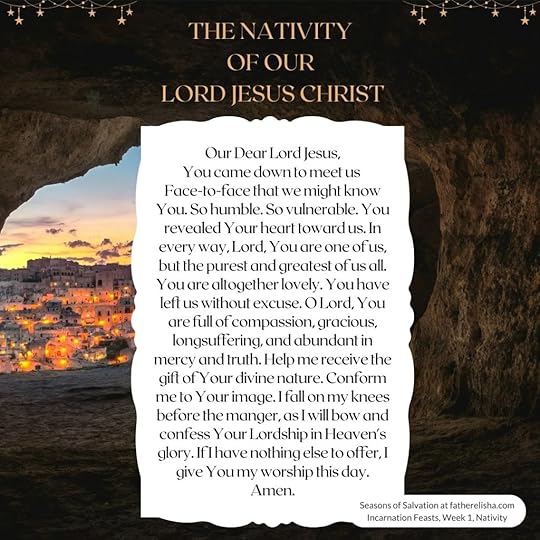
Photo by Luca Micheli on Unsplash
The post December 25, 2024 / January 7, 2025 (Eastern Old Calendar): Christmas, The Nativity of our Lord Jesus Christ first appeared on Father Elisha: Let me take you on an intriguing journey..


December 22–28, 2024 (Eastern): Advent IV: God With Us
January 5–11 (Old Calendar)
The Incarnation Fast: Week 6
Concluding The Incarnation Fast: Our Role
About six weeks ago (forty days back), we set out with the goal of following Christ’s example of making ourselves “of no reputation” (Phil. 2:7). The Greek word kenoo translated as “made Himself of no reputation” means “to make empty.” Maybe we managed to pass through these forty days more alert when opportunities came our way to put our rightful privileges, honor, and prestige aside. Together with a simpler diet, possibly even skipping breakfast some days each week, the Holy Spirit used our tiny efforts to empty and make ready a specific spot in the land of our souls.
Ready for what?
The empty manger we prepared in our soul during the Incarnation Fast will receive the Light of the World, Jesus Christ, during the Feast of the Nativity. Through the help of the Holy Spirit, we have cleared the spot absent of Christ’s reign from its self-appointed glory. As Jesus mystically incarnates in this area of our soul, He will establish His rule and we will see lasting change, slowly but surely. It’s a mystical transformation inside-out. Jesus comes as a divine seed into our soul, gradually forming His very own human nature as we journey through the Seasons of Salvation, and we enter our inheritance of the new man (Eph. 2:15) by experiencing it. It starts subtly, but it is eternal salvation.
“And the Word became flesh and dwelt among us, and we beheld His glory, the glory as of the only begotten of the Father, full of grace and truth” (John 1:14). Jesus is “full of grace and truth.” Yes, “of His fullness we have all received, and grace for grace” (John 1:16). Jesus is fullness of grace, and we have all received “grace for grace.” It is the Word that became flesh that contains this fullness and riches of grace. Jesus’ human nature, through the Holy Spirit, is our treasure vault. As we receive the nature of “the last Adam” (1 Cor. 15:45) through the mystery of Incarnation, Christ’s fullness unfolds and changes us.
God adopted us as His children based on our faith in Christ’s death and resurrection. That never changes unless we consciously betray Christ and refuse to repent until the end. We experience the transformative power of the fullness of grace in Christ’s own humanity through small incarnation miracles within, year after year. We are privileged to know about God’s work of salvation so we can comprehend what God does to form Christ within (Gal. 4:19) from season to season, “till we all come to the unity of the faith and of the knowledge of the Son of God, to a perfect man, to the measure of the stature of the fullness of Christ” (Eph. 4:13). “For in Him dwells all the fullness of the Godhead bodily; and you are complete in Him, who is the head of all principality and power” (Col. 2:9–10).
Concluding The Incarnation Fast: Grace
It’s important we know to our core that our justified position in Jesus Christ comes solely from His death and resurrection, and never from our ability to cooperate with the Holy Spirit to form Christ in our inner man. “Much more then, having now been justified by His blood, we shall be saved from wrath through Him” (Rom. 5:9). “That no flesh should glory in His presence. But of Him you are in Christ Jesus, who became for us wisdom from God—and righteousness and sanctification and redemption—that, as it is written, ‘He who glories, let him glory in the Lord’” (1 Cor. 1:29–31).
But it would be absurd to think that securing our entrance into Christ’s eternal Kingdom is all that there is to our spiritual life—as if we sit down, look at our watch, and wait for our heart to stop beating so we can enter Heaven. When we enter the Christian life through faith, and participate in the life in the Church, we embark on the journey of love “to be conformed to the image of [Jesus Christ]” (Rom. 8:29), chasing the likeness of God (Gen. 1:26), to live in “the communion of the Holy Spirit” (2 Cor. 13:14), simply because “blessed are those who hunger and thirst for righteousness, for they shall be filled” (Matt. 5:6).
Apostle Paul summarizes this beautifully: “Brethren, I do not count myself to have apprehended; but one thing I do, forgetting those things which are behind and reaching forward to those things which are ahead, I press toward the goal for the prize of the upward call of God in Christ Jesus” (Phil. 3:13–14).
“Therefore, my beloved, as you have always obeyed, not as in my presence only, but now much more in my absence, work out your own salvation with fear and trembling; for it is God who works in you both to will and to do for His good pleasure” (Phil. 2:12–13).
This is the focus of this last Sunday of Advent. It is God who works miracles inside of us—not our fasting, the words we pray, how much we bow, or the amount of church services we attend. We are utterly helpless. Only God’s Spirit responding to our fasting, our words, our bowing, our taking part in church sacraments, transfers to us the human nature of Jesus. We can’t claim a work of grace as our own achievement. Grace will forever be unmerited favor—receiving what we don’t deserve. Apostle Paul says it as definitively as it can get: “But by the grace of God I am what I am” (1 Cor. 15:10).
Estranged From Life
The Feast of the Nativity of the Lord is all about receiving divine (spiritual) life. “In Him was life, and the life was the light of men” (John 1:4). The activity of this Life isn’t limited to regenerating unbelievers into Christians (to be born again, John 3:3), but enables further growth toward Christlikeness.
After the fall into sin in the Garden of Eden, mankind became utterly helpless, unable to restore its position as children of God. The fall not only cut our communion with God and our place in His Kingdom, but sin and death entered the fabric of our human nature and completely alienated us from the divine life, the divine human nature.
“For we have previously charged both Jews and Greeks that they are all under sin. As it is written: ‘There is none righteous, no, not one; there is none who understands; there is none who seeks after God. They have all turned aside; they have together become unprofitable; there is none who does good, no, not one’” (Rom. 3:9b–12). We are utterly powerless to assimilate to divine life. Even if we sought divine life with all our might, without the presence of grace—the very life Jesus lived—we try to fly to the moon by flapping our hands with them handcuffed on our backs.
It will be “easier for a camel to go through the eye of a needle than for…” (Matt. 19:24) sinful man to gain divine life. And we have all “sinned and fall short of the glory of God” (Rom. 3:23). “‘…Who then can be saved?’ But Jesus looked at them and said to them, ‘With men this is impossible, but with God all things are possible’” (Matt. 19:25–26).
The Covenants
When God began His plan to redeem mankind back to Himself, He used covenants. Even though a detailed study would highlight more than five main covenants in the Bible, to keep it simple, we’ll focus on these five main covenants in God’s redemption plan:
The covenant with Noah to never flood the earth again:“Thus I establish My covenant with you: Never again shall all flesh be cut off by the waters of the flood; never again shall there be a flood to destroy the earth” (Gen. 9:11).
A covenant with Abram to become a great people, God’s own people:“On the same day the Lord made a covenant with Abram, saying: ‘To your descendants I have given this land, from the river of Egypt to the great river, the River Euphrates…’” (Gen. 15:18).
The Old Covenant: A covenant with Moses and the people of Israel, Abram’s descendants, of being a holy nation:“‘Now therefore, if you will indeed obey My voice and keep My covenant, then you shall be a special treasure to Me above all people; for all the earth is Mine. And you shall be to Me a kingdom of priests and a holy nation.’ These are the words which you shall speak to the children of Israel” (Ex. 19:5–6).
A covenant with King David that a son after him would always sit on the throne of the Kingdom of Israel, the first phase of the great people God promised Abram:“My covenant I will not break, nor alter the word that has gone out of My lips. Once I have sworn by My holiness; I will not lie to David: His seed shall endure forever, and his throne as the sun before Me” (Ps. 89:34–36).
“When your days are fulfilled and you rest with your fathers, I will set up your seed after you, who will come from your body, and I will establish his kingdom. He shall build a house for My name, and I will establish the throne of his kingdom forever […] And your house and your kingdom shall be established forever before you. Your throne shall be established forever” (2 Sam. 7:12–13, 16).
The New Covenant in the Messiah, Jesus Christ, for Israel and all gentile nations, granting forgiveness of sins and grace to live out the divine life.“Behold, the days are coming, says the Lord, when I will make a new covenant with the house of Israel and with the house of Judah—not according to the covenant that I made with their fathers in the day that I took them by the hand to lead them out of the land of Egypt, My covenant which they broke, though I was a husband to them, says the Lord. But this is the covenant that I will make with the house of Israel after those days, says the Lord: I will put My law in their minds, and write it on their hearts; and I will be their God, and they shall be My people. No more shall every man teach his neighbor, and every man his brother, saying, ‘Know the Lord,’ for they all shall know Me, from the least of them to the greatest of them, says the Lord. For I will forgive their iniquity, and their sin I will remember no more.” (Jer. 31:31–34)
“Therefore, holy brethren, partakers of the heavenly calling, consider the Apostle and High Priest of our confession, Christ Jesus.” (Heb. 3:1)
Why so many covenants?
God needed a people through whom He could birth His Messiah (first four covenants), but sin made man too unstable to carry out God’s call. Therefore, God carried out His plan in stages and strengthened fallen mankind through covenants, all while masterfully preparing the perfect moment in history to bring the Messiah onto the scene.
Soon after the fall, “the Lord saw that the wickedness of man was great in the earth, and that every intent of the thoughts of his heart was only evil continually […] But Noah found grace in the eyes of the Lord” (Gen. 6:5,8). After the flood destroyed the wicked families of mankind, Noah became a new start. God repeated His commandment to Adam: “So God blessed Noah and his sons, and said to them: ‘Be fruitful and multiply, and fill the earth’” (Gen. 9:1).
After mankind repopulated, God found the man who believed God’s plan, Abram. After Abram believed God, “and He accounted it to him for righteousness” (Gen. 15:6), his faith carried God’s promise to Isaac, Jacob, and eventually to Moses.
The time came to lead the descendants of Abram, or Abraham, into their call, and God used the prophet Moses to give the Old Covenant of the Law and the Commandments to Israel. God sought to make for Himself a kingdom of priests and a holy nation.
The Lord searched for the bloodline to birth the Messiah, the King of Israel. “For the eyes of the Lord run to and fro throughout the whole earth, to show Himself strong on behalf of those whose heart is loyal to Him” (2 Chron. 16:9). At last, God “found David the son of Jesse, a man after My own heart, who will do all My will” (Acts 13:22).
Finally, “Jacob begot Joseph the husband of Mary, of whom was born Jesus who is called Christ” (Matt. 1:16).
The Purpose Of The Covenants
The problem with the first four covenants was man’s weak and sinful nature, unable to conform to divine life. God was on one side of the covenant, promising blessings, if man on the other side kept the conditions of the covenant. But, because of man’s weakness, man broke the conditions for the covenants again and again.
Therefore, with the last covenant, the New Covenant, everything changed. How exactly? The mystery of the Incarnation. Through Jesus Christ, God stands on both sides of the covenant. Jesus Christ, fully man, kept all the conditions of the Old Covenant, because He was also fully God and the origin of divine life.
The Incarnation makes all things possible with God. Jesus, as a fellow human with us, kept all the conditions of God’s covenant with man. All the blessings released in Jesus and in His name come from His fulfillment of what we could not because of the weakness of the fallen human nature. In Jesus, we access all the blessings of God’s covenant with man. But there is even more.
Through the grace of the Incarnation, we can partake in Jesus’ human nature. That blessed human life, in union with divine life, can be born in us as well. We can taste, here and now, the blessed life Jesus lived, but the fullness comes once we lay down this body and pass through our own physical death and resurrection.
“I have been crucified with Christ; it is no longer I who live, but Christ lives in me; and the life which I now live in the flesh I live by faith in the Son of God, who loved me and gave Himself for me. I do not set aside the grace of God; for if righteousness comes through the law, then Christ died in vain” (Gal. 2:20–21).
Where does the Incarnation Fast take us, if we follow its mysteries faithfully year after year? Slowly, it makes us able to partake in the divine nature of Jesus Christ. “Grace and peace be multiplied to you in the knowledge of God and of Jesus our Lord, as His divine power has given to us all things that pertain to life and godliness, through the knowledge of Him who called us by glory and virtue, by which have been given to us exceedingly great and precious promises, that through these you may be partakers of the divine nature, having escaped the corruption that is in the world through lust” (2 Pet. 1:2–4).
Sunday Gospel: Matthew 1:1–25 (NKJV)
The book of the genealogy of Jesus Christ, the Son of David, the Son of Abraham:
2 Abraham begot Isaac, Isaac begot Jacob, and Jacob begot Judah and his brothers. 3 Judah begot Perez and Zerah by Tamar, Perez begot Hezron, and Hezron begot Ram. 4 Ram begot Amminadab, Amminadab begot Nahshon, and Nahshon begot Salmon. 5 Salmon begot Boaz by Rahab, Boaz begot Obed by Ruth, Obed begot Jesse, 6 and Jesse begot David the king.
David the king begot Solomon by her who had been the wife of Uriah. 7 Solomon begot Rehoboam, Rehoboam begot Abijah, and Abijah begot Asa. 8 Asa begot Jehoshaphat, Jehoshaphat begot Joram, and Joram begot Uzziah. 9 Uzziah begot Jotham, Jotham begot Ahaz, and Ahaz begot Hezekiah. 10 Hezekiah begot Manasseh, Manasseh begot Amon, and Amon begot Josiah. 11 Josiah begot Jeconiah and his brothers about the time they were carried away to Babylon.
12 And after they were brought to Babylon, Jeconiah begot Shealtiel, and Shealtiel begot Zerubbabel. 13 Zerubbabel begot Abiud, Abiud begot Eliakim, and Eliakim begot Azor. 14 Azor begot Zadok, Zadok begot Achim, and Achim begot Eliud. 15 Eliud begot Eleazar, Eleazar begot Matthan, and Matthan begot Jacob. 16 And Jacob begot Joseph the husband of Mary, of whom was born Jesus who is called Christ.
17 So all the generations from Abraham to David are fourteen generations, from David until the captivity in Babylon are fourteen generations, and from the captivity in Babylon until the Christ are fourteen generations.
18 Now the birth of Jesus Christ was as follows: After His mother Mary was betrothed to Joseph, before they came together, she was found with child of the Holy Spirit. 19 Then Joseph her husband, being a just man, and not wanting to make her a public example, was minded to put her away secretly. 20 But while he thought about these things, behold, an angel of the Lord appeared to him in a dream, saying, “Joseph, son of David, do not be afraid to take to you Mary your wife, for that which is conceived in her is of the Holy Spirit. 21 And she will bring forth a Son, and you shall call His name Jesus, for He will save His people from their sins.”
22 So all this was done that it might be fulfilled which was spoken by the Lord through the prophet, saying: 23 “Behold, the virgin shall be with child, and bear a Son, and they shall call His name Immanuel,” which is translated, “God with us.”
24 Then Joseph, being aroused from sleep, did as the angel of the Lord commanded him and took to him his wife, 25 and did not know her till she had brought forth her firstborn Son. And he called His name Jesus.
The Great Countdown
Our Sunday Gospel is the entire chapter one of the Evangelist Matthew, but we’ll focus on the genealogy. It begins with Abraham, the man God chose as the father of His people and the father of our faith. “And he believed in the Lord, and He accounted it to him for righteousness” (Gen. 15:6).
The Epistle of Saint James adds that Abraham became the friend of God. “And the Scripture was fulfilled which says, ‘Abraham believed God, and it was accounted to him for righteousness.’ And he was called the friend of God” (James 2:23). But even as a righteous man and a friend of God, Abraham still died. The effect of sin still became the end of Abraham’s life.
The genealogy continues to list generations with renowned men of God. Yet, it shows clear stains of sin and ultimately death. We notice how the genealogy indirectly tells of David’s adultery and murder: “David the king begot Solomon by her who had been the wife of Uriah” (verse 6).
As the great countdown toward the birth of the Messiah, God can’t wait to end the slavery of sin and death in His beloved creation. At the end of the countdown: “And Jacob begot Joseph, the husband of Mary, of whom was born Jesus who is called Christ” (verse 16). Here, the genealogy ends—in Christ, man shall no longer die. Jesus will atone for our sin and defeat death.
The genealogy starts with Abraham entering the covenant with God, triggering the salvation plan countdown. God said to Abram: “I am Almighty God; walk before Me and be blameless” (Gen. 17:1). Then God gave him the name Abraham and the sign of the covenant. To walk before God blamelessly was God’s longing for man since Adam fell, but it wasn’t until Jesus was born that God fulfilled His deep desire.
God With Us
In John 11:25–26, we read: “Jesus said to her, ‘I am the resurrection and the life. He who believes in Me, though he may die, he shall live. And whoever lives and believes in Me shall never die. Do you believe this?’”
In Christ, we shall no longer die. Our body may die, but our inner man will rise to our Heavenly Father, no longer a captive of Hades, and at the last trumpet (1 Cor. 15:52) our physical body will follow.
God says to Jeremiah about the New Covenant: “No more shall every man teach his neighbor, and every man his brother, saying, ‘Know the Lord,’ for they all shall know Me, from the least of them to the greatest of them, says the Lord. For I will forgive their iniquity, and their sin I will remember no more” (Jer. 31:34). Then Jesus prays: “And this is eternal life, that they may know You, the only true God, and Jesus Christ whom You have sent” (John 17:3). The countdown ticks until God finally can grant man eternal life through knowing God.
Another point we don’t appreciate enough is what the angel told Joseph in his dream: “‘Behold, the virgin shall be with child, and bear a Son, and they shall call His name Immanuel,’ which is translated, ‘God with us’” (verse 23). Since we know the Gospels and the Christmas story by looking back at history, we really don’t grasp the magnitude of “God with us.”
The most humble display of the Nativity of Jesus Christ is a heaven-tearing, groundbreaking, and hell-shaking reality that we still can’t comprehend because of the mystery of the Incarnation—God with us.
God, never ceasing to be God, comes to us as one hundred percent man. Oh, the holy joy, boldness, and shouts of victory this should birth in us! God is with us. “What then shall we say to these things? If God is for us, who can be against us?” (Rom. 8:31)
May God grant us the ability to comprehend the magnitude of the birth of Jesus Christ in the humble scene in the cave of Bethlehem. Let’s pray God gives us the grace to empty ourselves before Him, so we joyously can welcome our Savior and King. Thank you for taking the time to read. It’s a pleasure we can travel together.
Christ comes from Heaven!
Receive Him!
Save your Prayer Card on your Smartphone
Photo by Edwin Chen on Unsplash
The post December 22–28, 2024 (Eastern): Advent IV: God With Us first appeared on Father Elisha: Let me take you on an intriguing journey..
December 22–28, 2024 (Western): Advent IV: Coming Before God
The Incarnation Fast: Week 6
Concluding The Incarnation Fast: Our Role
About six weeks ago (forty days back), we set out with the goal of following Christ’s example of making ourselves “of no reputation” (Phil. 2:7). The Greek word kenoo translated as “made Himself of no reputation” means “to make empty.” Maybe we managed to pass through these forty days more alert when opportunities came our way to put our rightful privileges, honor, and prestige aside. Together with a simpler diet, possibly even skipping breakfast some days each week, the Holy Spirit used our tiny efforts to empty and make ready a specific spot in the land of our souls.
Ready for what?
The empty manger we prepared in our soul during the Incarnation Fast will receive the Light of the World, Jesus Christ, during the Feast of the Nativity. Through the help of the Holy Spirit, we have cleared the spot absent of Christ’s reign from its self-appointed glory. As Jesus mystically incarnates in this area of our soul, He will establish His rule and we will see lasting change, slowly but surely. It’s a mystical transformation inside-out. Jesus comes as a divine seed into our soul, gradually forming His very own human nature as we journey through the Seasons of Salvation, and we enter our inheritance of the new man (Eph. 2:15) by experiencing it. It starts subtly, but it is eternal salvation.
“And the Word became flesh and dwelt among us, and we beheld His glory, the glory as of the only begotten of the Father, full of grace and truth” (John 1:14). Jesus is “full of grace and truth.” Yes, “of His fullness we have all received, and grace for grace” (John 1:16). Jesus is fullness of grace, and we have all received “grace for grace.” It is the Word that became flesh that contains this fullness and riches of grace. Jesus’ human nature, through the Holy Spirit, is our treasure vault. As we receive the nature of “the last Adam” (1 Cor. 15:45) through the mystery of Incarnation, Christ’s fullness unfolds and changes us.
God adopted us as His children based on our faith in Christ’s death and resurrection. That never changes unless we consciously betray Christ and refuse to repent until the end. We experience the transformative power of the fullness of grace in Christ’s own humanity through small incarnation miracles within, year after year. We are privileged to know about God’s work of salvation so we can comprehend what God does to form Christ within (Gal. 4:19) from season to season, “till we all come to the unity of the faith and of the knowledge of the Son of God, to a perfect man, to the measure of the stature of the fullness of Christ” (Eph. 4:13). “For in Him dwells all the fullness of the Godhead bodily; and you are complete in Him, who is the head of all principality and power” (Col. 2:9–10).
Concluding The Incarnation Fast: Grace
It’s important we know to our core that our justified position in Jesus Christ comes solely from His death and resurrection, and never from our ability to cooperate with the Holy Spirit to form Christ in our inner man. “Much more then, having now been justified by His blood, we shall be saved from wrath through Him” (Rom. 5:9). “That no flesh should glory in His presence. But of Him you are in Christ Jesus, who became for us wisdom from God—and righteousness and sanctification and redemption—that, as it is written, ‘He who glories, let him glory in the Lord’” (1 Cor. 1:29–31).
But it would be absurd to think that securing our entrance into Christ’s eternal Kingdom is all that there is to our spiritual life—as if we sit down, look at our watch, and wait for our heart to stop beating so we can enter Heaven. When we enter the Christian life through faith, and participate in the life in the Church, we embark on the journey of love “to be conformed to the image of [Jesus Christ]” (Rom. 8:29), chasing the likeness of God (Gen. 1:26), to live in “the communion of the Holy Spirit” (2 Cor. 13:14), simply because “blessed are those who hunger and thirst for righteousness, for they shall be filled” (Matt. 5:6).
Apostle Paul summarizes this beautifully: “Brethren, I do not count myself to have apprehended; but one thing I do, forgetting those things which are behind and reaching forward to those things which are ahead, I press toward the goal for the prize of the upward call of God in Christ Jesus” (Phil. 3:13–14).
“Therefore, my beloved, as you have always obeyed, not as in my presence only, but now much more in my absence, work out your own salvation with fear and trembling; for it is God who works in you both to will and to do for His good pleasure” (Phil. 2:12–13).
This is the focus of this last Sunday of Advent. It is God who works miracles inside of us—not our fasting, the words we pray, how much we bow, or the amount of church services we attend. We are utterly helpless. Only God’s Spirit responding to our fasting, our words, our bowing, our taking part in church sacraments, transfers to us the human nature of Jesus. We can’t claim a work of grace as our own achievement. Grace will forever be unmerited favor—receiving what we don’t deserve. Apostle Paul says it as definitively as it can get: “But by the grace of God I am what I am” (1 Cor. 15:10).
Estranged From Life
The Feast of the Nativity of the Lord is all about receiving divine (spiritual) life. “In Him was life, and the life was the light of men” (John 1:4). The activity of this Life isn’t limited to regenerating unbelievers into Christians (to be born again, John 3:3), but enables further growth toward Christlikeness.
After the fall into sin in the Garden of Eden, mankind became utterly helpless, unable to restore its position as children of God. The fall not only cut our communion with God and our place in His Kingdom, but sin and death entered the fabric of our human nature and completely alienated us from the divine life, the divine human nature.
“For we have previously charged both Jews and Greeks that they are all under sin. As it is written: ‘There is none righteous, no, not one; there is none who understands; there is none who seeks after God. They have all turned aside; they have together become unprofitable; there is none who does good, no, not one’” (Rom. 3:9b–12). We are utterly powerless to assimilate to divine life. Even if we sought divine life with all our might, without the presence of grace—the very life Jesus lived—we try to fly to the moon by flapping our hands with them handcuffed on our backs.
It will be “easier for a camel to go through the eye of a needle than for…” (Matt. 19:24) sinful man to gain divine life. And we have all “sinned and fall short of the glory of God” (Rom. 3:23). “‘…Who then can be saved?’ But Jesus looked at them and said to them, ‘With men this is impossible, but with God all things are possible’” (Matt. 19:25–26).
The Covenants
When God began His plan to redeem mankind back to Himself, He used covenants. Even though a detailed study would highlight more than five main covenants in the Bible, to keep it simple, we’ll focus on these five main covenants in God’s redemption plan:
The covenant with Noah to never flood the earth again:“Thus I establish My covenant with you: Never again shall all flesh be cut off by the waters of the flood; never again shall there be a flood to destroy the earth” (Gen. 9:11).
A covenant with Abram to become a great people, God’s own people:“On the same day the Lord made a covenant with Abram, saying: ‘To your descendants I have given this land, from the river of Egypt to the great river, the River Euphrates…’” (Gen. 15:18).
The Old Covenant: A covenant with Moses and the people of Israel, Abram’s descendants, of being a holy nation:“‘Now therefore, if you will indeed obey My voice and keep My covenant, then you shall be a special treasure to Me above all people; for all the earth is Mine. And you shall be to Me a kingdom of priests and a holy nation.’ These are the words which you shall speak to the children of Israel” (Ex. 19:5–6).
A covenant with King David that a son after him would always sit on the throne of the Kingdom of Israel, the first phase of the great people God promised Abram:“My covenant I will not break, nor alter the word that has gone out of My lips. Once I have sworn by My holiness; I will not lie to David: His seed shall endure forever, and his throne as the sun before Me” (Ps. 89:34–36).
“When your days are fulfilled and you rest with your fathers, I will set up your seed after you, who will come from your body, and I will establish his kingdom. He shall build a house for My name, and I will establish the throne of his kingdom forever […] And your house and your kingdom shall be established forever before you. Your throne shall be established forever” (2 Sam. 7:12–13, 16).
The New Covenant in the Messiah, Jesus Christ, for Israel and all gentile nations, granting forgiveness of sins and grace to live out the divine life.“Behold, the days are coming, says the Lord, when I will make a new covenant with the house of Israel and with the house of Judah—not according to the covenant that I made with their fathers in the day that I took them by the hand to lead them out of the land of Egypt, My covenant which they broke, though I was a husband to them, says the Lord. But this is the covenant that I will make with the house of Israel after those days, says the Lord: I will put My law in their minds, and write it on their hearts; and I will be their God, and they shall be My people. No more shall every man teach his neighbor, and every man his brother, saying, ‘Know the Lord,’ for they all shall know Me, from the least of them to the greatest of them, says the Lord. For I will forgive their iniquity, and their sin I will remember no more.” (Jer. 31:31–34)
“Therefore, holy brethren, partakers of the heavenly calling, consider the Apostle and High Priest of our confession, Christ Jesus.” (Heb. 3:1)
Why So Many Covenants?
God needed a people through whom He could birth His Messiah (first four covenants), but sin made man too unstable to carry out God’s call. Therefore, God carried out His plan in stages and strengthened fallen mankind through covenants, all while masterfully preparing the perfect moment in history to bring the Messiah onto the scene.
Soon after the fall, “the Lord saw that the wickedness of man was great in the earth, and that every intent of the thoughts of his heart was only evil continually […] But Noah found grace in the eyes of the Lord” (Gen. 6:5,8). After the flood destroyed the wicked families of mankind, Noah became a new start. God repeated His commandment to Adam: “So God blessed Noah and his sons, and said to them: ‘Be fruitful and multiply, and fill the earth’” (Gen. 9:1).
After mankind repopulated, God found the man who believed God’s plan, Abram. After Abram believed God, “and He accounted it to him for righteousness” (Gen. 15:6), his faith carried God’s promise to Isaac, Jacob, and eventually to Moses.
The time came to lead the descendants of Abram, or Abraham, into their call, and God used the prophet Moses to give the Old Covenant of the Law and the Commandments to Israel. God sought to make for Himself a kingdom of priests and a holy nation.
The Lord searched for the bloodline to birth the Messiah, the King of Israel. “For the eyes of the Lord run to and fro throughout the whole earth, to show Himself strong on behalf of those whose heart is loyal to Him” (2 Chron. 16:9). At last, God “found David the son of Jesse, a man after My own heart, who will do all My will” (Acts 13:22).
Finally, “Jacob begot Joseph the husband of Mary, of whom was born Jesus who is called Christ” (Matt. 1:16).
The Purpose Of The Covenants
The problem with the first four covenants was man’s weak and sinful nature, unable to conform to divine life. God was on one side of the covenant, promising blessings, if man on the other side kept the conditions of the covenant. But, because of man’s weakness, man broke the conditions for the covenants again and again.
Therefore, with the last covenant, the New Covenant, everything changed. How exactly? The mystery of the Incarnation. Through Jesus Christ, God stands on both sides of the covenant. Jesus Christ, fully man, kept all the conditions of the Old Covenant, because He was also fully God and the origin of divine life.
The Incarnation makes all things possible with God. Jesus, as a fellow human with us, kept all the conditions of God’s covenant with man. All the blessings released in Jesus and in His name come from His fulfillment of what we could not because of the weakness of the fallen human nature. In Jesus, we access all the blessings of God’s covenant with man. But there is even more.
Through the grace of the Incarnation, we can partake in Jesus’ human nature. That blessed human life, in union with divine life, can be born in us as well. We can taste, here and now, the blessed life Jesus lived, but the fullness comes once we lay down this body and pass through our own physical death and resurrection.
“I have been crucified with Christ; it is no longer I who live, but Christ lives in me; and the life which I now live in the flesh I live by faith in the Son of God, who loved me and gave Himself for me. I do not set aside the grace of God; for if righteousness comes through the law, then Christ died in vain” (Gal. 2:20–21).
Where does the Incarnation Fast take us, if we follow its mysteries faithfully year after year? Slowly, it makes us able to partake in the divine nature of Jesus Christ. “Grace and peace be multiplied to you in the knowledge of God and of Jesus our Lord, as His divine power has given to us all things that pertain to life and godliness, through the knowledge of Him who called us by glory and virtue, by which have been given to us exceedingly great and precious promises, that through these you may be partakers of the divine nature, having escaped the corruption that is in the world through lust” (2 Pet. 1:2–4).
Sunday Gospel: Luke 1:57–80 (NKJV)
Now Elizabeth’s full time came for her to be delivered, and she brought forth a son. 58 When her neighbors and relatives heard how the Lord had shown great mercy to her, they rejoiced with her. 59 So it was, on the eighth day, that they came to circumcise the child; and they would have called him by the name of his father, Zacharias. 60 His mother answered and said, “No; he shall be called John.”
61 But they said to her, “There is no one among your relatives who is called by this name.” 62 So they made signs to his father—what he would have him called. 63 And he asked for a writing tablet, and wrote, saying, “His name is John.” So they all marveled. 64 Immediately his mouth was opened and his tongue loosed, and he spoke, praising God. 65 Then fear came on all who dwelt around them; and all these sayings were discussed throughout all the hill country of Judea. 66 And all those who heard them kept them in their hearts, saying, “What kind of child will this be?” And the hand of the Lord was with him. 67 Now his father Zacharias was filled with the Holy Spirit, and prophesied, saying:
68 “Blessed is the Lord God of Israel, for He has visited and redeemed His people, 69 and has raised up a horn of salvation for us in the house of His servant David, 70 as He spoke by the mouth of His holy prophets, who have been since the world began, 71 that we should be saved from our enemies and from the hand of all who hate us, 72 to perform the mercy promised to our fathers and to remember His holy covenant, 73 the oath which He swore to our father Abraham: 74 To grant us that we, being delivered from the hand of our enemies, might serve Him without fear, 75 in holiness and righteousness before Him all the days of our life.
76 “And you, child, will be called the prophet of the Highest; for you will go before the face of the Lord to prepare His ways, 77 to give knowledge of salvation to His people by the remission of their sins, 78 through the tender mercy of our God, with which the Dayspring from on high has visited us; 79 to give light to those who sit in darkness and the shadow of death, to guide our feet into the way of peace.”
80 So the child grew and became strong in spirit, and was in the deserts till the day of his manifestation to Israel.
The Praise of Zacharias
Let us conclude our four-part journey through chapter one of the Gospel of Luke with this Sunday Gospel about the birth of John the Baptist. God ends Zacharias’ muteness, resulting in his prophecy about the salvation of mankind and the role of his son. God allows Zacharias to proclaim how He will answer Zacharias’s aching prayer for Israel, as we studied in the first part of this series (See “What was Zacharias’ Prayer?”).
We read in verses 59–60: “So it was, on the eighth day, that they came to circumcise the child; and they would have called him by the name of his father, Zacharias. His mother answered and said, ‘No; he shall be called John.’”
John comes from the two Hebrew words yehôvâh (the Lord, God) and chânan (to favor, bestow, grant). The name typically means “God is gracious.” But chânan also means the heartfelt act of bending or stooping in kindness to an inferior. It describes God’s merciful act of reaching down to us, showing pity, and granting something out of His compassion.
Right after Elizabeth declared the name of John the Baptist, the people looked to Zacharias, still mute, for confirmation. “And he asked for a writing tablet, and wrote, saying, ‘His name is John.’ So they all marveled. Immediately his mouth was opened and his tongue loosed, and he spoke, praising God” (verses 63–64).
Like we discovered in the first week of Advent, the silence of Zacharias was a prophetic sign of the period of silent waiting from the last Old Testament prophet Malachi until the coming of the Messiah. Zacharias’ sudden praise, after naming his son John, declared the silent waiting was over. God will fulfill what the Old Testament prophets prophesied concerning the first coming of the Messiah.
God is bending down from Heaven to be gracious to mankind. God’s gracious mercy is about to be revealed.
Zacharias begins to prophesy about the salvation of God (verses 68–75), its blessings through the Forerunner of the Messiah (verses 76–77), and about the Messiah’s motivations (verses 78–79). We’ll end by looking at verses 74–75.
Coming Before God
“To grant us that we, being delivered from the hand of our enemies, might serve Him without fear, in holiness and righteousness before Him all the days of our life” (verses 74–75).
This is the center of God’s plan of salvation, and what He wants to achieve by sending His Son into the world as a Man.
“Delivered from the hand of our enemies…:” Our true enemy, Satan and his evil demons, ceaselessly torment mankind into self-destruction. “For we do not wrestle against flesh and blood, but against principalities, against powers, against the rulers of the darkness of this age, against spiritual hosts of wickedness in the heavenly places” (Eph. 6:12).
The weapon of the Kingdom of darkness is tempting our fallen human nature with sin. Our free will, which so easily falls into this snare, agrees to temptations and act upon them. This applies not only to obvious sins but also when accepting envy, negative thoughts, fears, and every other symptom of our fallen human condition.
Sin seeks to be repeated so it can build a throne in the soul, increasing its authority over our lives. Our weak nature, next to the manipulation of evil spirits, work against us. However, they can never overrule our will, but since the will is easily overcome—when not supported by grace—man sin.
This tyranny Jesus ended. God delivered us from the hand of our enemies—whether spiritual or our own sinful choices. “For sin shall not have dominion over you, for you are not under law but under grace” (Rom. 6:14).
Verses 74–75 reads: “…might serve Him without fear, in holiness and righteousness before Him all the days of our life.” Instead of looking at this phrase word-for-word, let us look at the desire in the heart of God concerning the covenants because the verse prior says: “The oath which He swore to our father Abraham” (Luke 1:73).
Just before God gives Abram the name Abraham and the sign of the covenant (circumcision), God said to Abram: “I am Almighty God; walk before Me and be blameless” (Gen. 17:1). “Walk before me…,” do we hear God’s longing to be reunited with his old friend, Adam? Oh, how God desire us to be holy and righteous so we can survive His glorious presence.
Before God gave Moses the ten commandments and the conditions for the Old Covenant, God said to him: “Now therefore, if you will indeed obey My voice and keep My covenant, then you shall be a special treasure to Me above all people; for all the earth is Mine. And you shall be to Me a kingdom of priests and a holy nation” (Ex. 19:5–6a). God wants us as His own special treasure, a kingdom of priests and a holy nation.
These deep desires in the heart of God, when He speaks to Abram and Moses, echo through Zacharias’ prophecy about the Messiah’s salvation: “To grant us that we, being delivered from the hand of our enemies, might serve Him without fear, in holiness and righteousness before Him all the days of our life” (verses 74–75).
As we enter the Feast of the Nativity of our Lord, we come before God. He bent down to us—He emptied Himself to come—to implant the life of Jesus in us through the mystery of His Incarnation. The grace of Incarnation, as it lands in our soul and unfolds, grants “us that we, being delivered from the hand of our enemies, might serve Him without fear, in holiness and righteousness before Him all the days of our life.”
This reality of our salvation fills our souls with joy, knowing that God will enable us to do what we cannot—even if we desired it with all our being. The seed of the divine life planted in our soul over the days of the Nativity celebration, and unfolded in the following Incarnation feasts, makes us taste the blessed rest of the seventh day and the rest in God. We experience the very humanity of Jesus Christ.
May we pray and seek the blessed life of Jesus to be implanted and grow in our souls, that we may praise God with the heavenly host: “Glory to God in the highest, and on earth peace, goodwill toward men!” (Luke 2:14)
Let us pray for the grace to come before God, closer than we’re used to, calming our minds with inner stillness. Let us seek to appear before our Heavenly Father and answer His deep longing. Let Jesus enter our lives this week. Adore and receive Him.
Thank you for taking the time to read. It’s an honor that you’re part of this journey.
Christ comes from Heaven!
Receive Him!
Save your Prayer Card on your Smartphone
Photo by Jessica Fadel on Unsplash
The post December 22–28, 2024 (Western): Advent IV: Coming Before God first appeared on Father Elisha: Let me take you on an intriguing journey..
December 13, 2024
December 15–21, 2024 (Eastern): Advent III: When the Incarnation Mystery Is Fulfilled
December 29 – January 4 (Old Calendar)
The Incarnation Fast: Week 5
The Seventh Day
In the beginning in the Garden of Eden, “God saw everything that He had made, and indeed it was very good” (Gen. 1:31). God had formed man from the dust of the ground “and breathed into his nostrils the breath of life; and man became a living being” (Gen. 2:7).
Adam experienced the beginning of the seventh day of creation. “And on the seventh day God ended His work which He had done, and He rested on the seventh day from all His work which He had done. Then God blessed the seventh day and sanctified it, because in it He rested from all His work which God had created and made” (Gen. 2:2–3).
After the unfathomable work of preparing a home for humanity, the crown of creation came to life before His eyes. The Almighty enjoyed watching Adam, speaking with him, explore the Garden with him, showing him how to care for creation, and sustaining him. “Rejoicing in His inhabited world, and my delight was with the sons of men” (Prov. 8:31).
We can’t fathom the heavenly life Adam enjoyed with God, marked with the characteristic of the seventh day: Rest. “For we who have believed do enter that rest, as He has said: ‘So I swore in My wrath, “They shall not enter My rest,”’ although the works were finished from the foundation of the world” (Heb. 4:3).
One of the consequences of the fall was losing God’s rest. Man’s stewardship of the Garden was carried out in blessed rest. After the fall sin cursed the ground, and work became exhausting toil. “Cursed is the ground for your sake; in toil you shall eat of it all the days of your life” (Gen. 3:17).
But before the fall into sin and death, God rested with Adam and dwelt with him continuously. “And they heard the sound of the Lord God walking in the garden in the cool of the day […]” (Gen. 3:8). Adam and Eve recognized the sound of God walking in the garden because they often walked together.
God Seeks Rest Among Men
God’s Spirit rested with man and made him whole. Continuously overflowing with the glory of God, man was simple and innocent, like the angels. But when man fell into sin, this blessed state of rest disappeared from Adam and Eve. Suddenly, they experienced fear, anxiety, and shame, completely foreign to their being. This deep vacuum, which God had previously filled, was invaded by wounds, needs, cravings, confusion, and spiritual darkness. We lost the blessing of the seventh day.
“And the Lord said, ‘My Spirit shall not strive with man forever, for he is indeed flesh; yet his days shall be one hundred and twenty years.’ […] Then the Lord saw that the wickedness of man was great in the earth, and that every intent of the thoughts of his heart was only evil continually” (Gen. 6:3,5).
But God began His great rescue plan, and its final stage is our upcoming celebration, the Incarnation of the Son of God. “Thus says the Lord: ‘Heaven is My throne, and earth is My footstool. Where is the house that you will build Me? And where is the place of My rest?’” (Isa. 66:1)
God searched for a place of rest among His creation. First, a tabernacle in the desert. “My Presence will go with you, and I will give you rest” (Ex. 33:13). Then a temple in Jerusalem. God said to King David: “Behold, a son shall be born to you, who shall be a man of rest; and I will give him rest from all his enemies all around. His name shall be Solomon, for I will give peace and quietness to Israel in his days. He shall build a house for My name, and he shall be My son, and I will be his Father; and I will establish the throne of his kingdom over Israel forever’” (1 Chron. 22:9–10).
The Word Tabernacled
Finally, when Jesus Christ—the Prince of Peace (Isa. 9:6)—entered our world, the original image of Adam returned. God told St. John the Baptist: “‘Upon whom you see the Spirit descending, and remaining on Him, this is He who baptizes with the Holy Spirit.’ And I have seen and testified that this is the Son of God” (John 1:33). The Holy Spirit found rest in Jesus. Until this point, the Holy Spirit only came upon God’s servants for certain periods as an anointing for a specific purpose. Now, the Holy Spirit found a dwelling place.
John 1:14, who summarizes the mystery of the Incarnation, begins with: “And the Word became flesh and dwelt among us.” The Greek word translated “dwelt” is skenoo, which means “to tent,” “to encamp,” “to occupy,” “to reside.” It means that “the Word became flesh and tabernacled among us and we beheld His glory, the glory as of the only begotten of the Father, full of grace and truth” (John 1:14).
In Jesus we behold the glory of God, just as “the cloud covered the tabernacle of meeting, and the glory of the Lord filled the tabernacle. And Moses was not able to enter the tabernacle of meeting, because the cloud rested above it, and the glory of the Lord filled the tabernacle” (Ex. 40:34).
Finally, in Jesus Christ, God found rest among us. And those who come to Christ will gradually reenter the state of Eden, and “the peace of God, which surpasses all understanding, will guard your hearts and minds through Christ Jesus” (Phil. 4:7). “For the Son of Man is Lord even of the Sabbath” (Matt. 12:8).
“There remains therefore a rest for the people of God. For he who has entered His rest has himself also ceased from his works as God did from His. Let us therefore be diligent to enter that rest…” (Heb. 4:9–11a). “Blessed are the peacemakers, for they shall be called sons of God” (Matt. 5:9). “For unto us a Child is born, unto us a Son is given … and His name will be called … Prince of Peace” (Isa 9:6). And all the heavenly host praised God on Christmas day: “Glory to God in the highest, and on earth peace, goodwill toward men!” (Luke 2:14). “For He Himself is our peace…” (Eph. 2:14).
Through the mystery of the Incarnation, God stands with open arms to receive mankind into His rest. The day will come when “Jesus shall judge between the nations, and rebuke many people; They shall beat their swords into plowshares, and their spears into pruning hooks; nation shall not lift up sword against nation, neither shall they learn war anymore” (Isa. 2:4). Jesus will end all wars. “He shall speak peace to the nations; His dominion shall be ‘from sea to sea, and from the River to the ends of the earth’” (Zach. 9:10c).
Still The Seventh Day
We’re still in God’s seventh day, because there’s no “evening and the morning” phrase for the seventh day in Genesis 2. But we know Jesus is “the Bright and Morning Star” (Rev. 22:16), and He is “the Dayspring from on high [which] has visited us” (Luke 1:78). “But to you who fear My name the Sun of Righteousness shall arise with healing in His wings” (Mal. 4:2a).
What a contrast between God’s seventh day of rest—which even creation testifies to—and man’s state of turbulence. We can leave a warzone of utter human tragedy and travel to a distant forest or mountain top. There we’ll witness God’s seventh day: The calm rattling of leaves, the tinkling of the brook massaging pebbles, white clouds draping the valleys with their shadows and sunrays sailing with the wind. And when night falls, the majestic Milky Way off its display with shooting stars. What a world of difference between the unrest of the human heart and the rest of God.
On Christmas Day, we welcome Jesus Christ, whom the Father will “reconcile all things to Himself, by Him, whether things on earth or things in heaven, having made peace through the blood of His cross” (Col. 1:20).
We see the promise to the entire creation of entering God’s rest ultimately fulfilled when the eighth day begins and God creates again: “Now I saw a new heaven and a new earth, for the first heaven and the first earth had passed away. Also there was no more sea. […] And I heard a loud voice from heaven saying, ‘Behold, the tabernacle of God is with men, and He will dwell with them, and they shall be His people. God Himself will be with them and be their God’” (Rev. 21:1, 3).
Fullness
“For it pleased the Father that in Him all the fullness should dwell” (Col. 1:19). This fulness of God is the gift of the incarnation that we receive during the Incarnation Feasts as a little divine seed of Jesus’ divine-human nature. This is what Apostle Paul prays, that we “may be able to comprehend with all the saints what is the width and length and depth and height—to know the love of Christ which passes knowledge; that you may be filled with all the fullness of God” (Eph. 3:18–19). This is demonstrated to the world through the Church, “which is His body, the fullness of Him who fills all in all” (Eph. 1:23).
The grace of Incarnation that lands in our soul grows into the person of Christ, where all the fullness of God dwells. The gift we receive during the Incarnation Feasts is so rich we need at least four feasts to unpack what happens. Christmas, the Nativity of the Lord, is only the first Feasts we pass through during the six weeks after the Incarnation Fast.
May our hunger for the grace of fulness motivate us to enter the fifth week of the Incarnation Fast. Soon, we have fasted for forty days, and if you feel you haven’t really started, it’s never too late. The key for this upcoming week is still voluntary emptying of ourselves from our honor and status to increase hunger for the fullness of the human nature given to us in Jesus.
Emptying happens when we choose a simpler diet, typically vegan, and other ways of humbling ourselves. God may place us in situations where He invites us to unite with Jesus when His Son “made Himself of no reputation” (Phil. 2:7).
Sunday Gospel: Luke 14:16–24 (NKJV)
Then He said to him, “A certain man gave a great supper and invited many, 17 and sent his servant at supper time to say to those who were invited, ‘Come, for all things are now ready.’ 18 But they all with one accord began to make excuses. The first said to him, ‘I have bought a piece of ground, and I must go and see it. I ask you to have me excused.’ 19 And another said, ‘I have bought five yoke of oxen, and I am going to test them. I ask you to have me excused.’ 20 Still another said, ‘I have married a wife, and therefore I cannot come.’
21 So that servant came and reported these things to his master. Then the master of the house, being angry, said to his servant, ‘Go out quickly into the streets and lanes of the city, and bring in here the poor and the maimed and the lame and the blind.’ 22 And the servant said, ‘Master, it is done as you commanded, and still there is room.’ 23 Then the master said to the servant, ‘Go out into the highways and hedges, and compel them to come in, that my house may be filled. 24 For I say to you that none of those men who were invited shall taste my supper.’ ”
The Great Supper
The Sunday Gospel for the upcoming week gives an image of the Father’s call to humanity by sending His Son to us. We’ll only focus on the first two verses: “Then He said to him, ‘A certain man gave a great supper and invited many, and sent his servant at supper time to say to those who were invited, “Come, for all things are now ready”’” (verses 16–17).
It is sabbath—the day of rest, which we just highlighted—and Jesus “went into the house of one of the rulers of the Pharisees to eat bread” (Luke 14:1). Jesus tells this parable in response to one who said to Him: “Blessed is he who shall eat bread in the kingdom of God!” (Luke 14:15)
The “certain man” Jesus talks about is our Heavenly Father.
The “great supper” is the grand celebration after Jesus has returned to Earth. “Blessed are those who are called to the marriage supper of the Lamb!” (Rev. 19:9) “And in this mountain the Lord of hosts will make for all people a feast of choice pieces, a feast of wines on the lees, of fat things full of marrow, of well-refined wines on the lees” (Isa. 25:6).
Those many invited are mankind, starting with the people of Israel. “For I am not ashamed of the gospel of Christ, for it is the power of God to salvation for everyone who believes, for the Jew first and also for the Greek” (Rom. 1:16).
Our Feast Is Prepared
“His servants” are both the prophets to the people of Israel, and the Church to the nations. What is our message to the world as we approach the Nativity? “Come, for all things are now ready.”
“In Him was life, and the life was the light of men” (John 1:4). As we celebrate the Nativity of the Lord, we celebrate “that which was from the beginning, which we have heard, which we have seen with our eyes, which we have looked upon, and our hands have handled, concerning the Word of life—the life was manifested, and we have seen, and bear witness, and declare to you that eternal life which was with the Father and was manifested to us” (1 John 1:1–2).
As this Life comes to us as a Man—“the Word became flesh and dwelt among us” (John 1:14), Jesus declared that “I am the bread of life” (John 6:35). Jesus was incarnated to give His life. “… and the bread that I shall give is My flesh, which I shall give for the life of the world” (John 6:51).
When the Incarnation Mystery Is Fulfilled
The expression of the Incarnation culminated in the Eucharist. “And as they were eating, Jesus took bread, blessed and broke it, and gave it to the disciples and said, ‘Take, eat; this is My body.’ Then He took the cup, and gave thanks, and gave it to them, saying, ‘Drink from it, all of you. For this is My blood of the new covenant, which is shed for many for the remission of sins’” (Matt. 26:26–28). If the Incarnation had never happened, we wouldn’t have any Holy Sacrament to celebrate, nor would we mystically receive the divine life of Jesus Christ.
But it is easy to overlook the next verse: “But I say to you, I will not drink of this fruit of the vine from now on until that day when I drink it new with you in My Father’s kingdom.” The Eucharist is the foretaste of the wedding supper of the Lamb after Christ has returned. Therefore, every time we receive Holy Communion, we mystically enter the holy bridal union with God.
The Incarnation began with the Nativity of the Lord, proclaimed throughout the following ages through the mystery of the Eucharist. The Incarnation is fulfilled in the future marriage supper of the Lamb.
This is our message to the world. This is what we are inviting mankind to join in celebrating during the Incarnation Feasts: responding to the Heavenly Father’s invitation to partake in the body and blood of Christ and become one with God.
“And the Spirit and the bride say, ‘Come!’ And let him who hears say, ‘Come!’” […] (Rev. 22:17)
May our expectation increase this week, as we seek the grace to empty ourselves of our honor, that we may “seek the honor that comes from the only God” (John 5:44). May we obtain grace this week to eagerly expect and hunger for the Life that is coming. God invites us all.
Thank you for taking the time to read and journey with me into the third week of Advent. It is such a joy that you are taking part in this expedition, following the footsteps of our Lord Jesus Christ.
Save your Prayer Card on your Smartphone
Photo by Nathan Dumlao on Unsplash
The post December 15–21, 2024 (Eastern): Advent III: When the Incarnation Mystery Is Fulfilled first appeared on Father Elisha: Let me take you on an intriguing journey..
December 15–21, 2024 (Western): Advent III: Knowing The Will Of God
The Incarnation Fast: Week 5
Promises Fulfilled
Our waiting is soon over. Jesus is coming. Only one and a half weeks until Christmas.
Elizabeth joyfully says to the Mother of the Lord: “Blessed is she who believed, for there will be a fulfillment of those things which were told her from the Lord” (Luke 1:45). The Virgin Mary was blessed because she believed the promises of the Lord. She knew God was faithful to bring to pass what He had said.
But apart from her becoming the Mother of the Lord, what were “those things which were told her from the Lord”? The Archangel Gabriel declared “those things” in Luke 1:32–33:
“He will be great, and will be called the Son of the Highest.” Jesus will be called the Son of God.“The Lord God will give Him the throne of His father David.” Jesus will be a King.“And He will reign over the house of Jacob forever.” Jesus will lead the nation of Israel.“And of His kingdom there will be no end.” Jesus’ reign will know no limits in time or space.But the Virgin Mary only saw two of these promises fulfilled. John the Baptist “testified that this is the Son of God” (John 1:34), and even Pontius Pilate came to realize Jesus was a king. “Pilate therefore said to Him, ‘Are You a king then?’ Jesus answered, ‘You say rightly that I am a king. For this cause I was born, and for this cause I have come into the world…’” (John 18:37)
However, the Mother of Jesus didn’t live to see “the kingdoms of this world have become the kingdoms of our Lord and of His Christ, and He shall reign forever and ever!” (Rev. 11:15)
This is our privilege: to live in a time of history when we await the fulfillment of the second half of the promises the Archangel Gabriel gave to Mary. And blessed are we who believe in the return of Jesus as King on Earth. We have a hope no other worldview has: a truly righteous and good King who will “make all things new” (Rev. 21:5).
Blessed Advent—blessed expectant waiting for the arrival of God’s promises to you.
The Seventh Day
In the beginning in the Garden of Eden, “God saw everything that He had made, and indeed it was very good” (Gen. 1:31). God had formed man from the dust of the ground “and breathed into his nostrils the breath of life; and man became a living being” (Gen. 2:7).
Adam experienced the beginning of the seventh day of creation. “And on the seventh day God ended His work which He had done, and He rested on the seventh day from all His work which He had done. Then God blessed the seventh day and sanctified it, because in it He rested from all His work which God had created and made” (Gen. 2:2–3).
After the unfathomable work of preparing a home for humanity, the crown of creation came to life before His eyes. The Almighty enjoyed watching Adam, speaking with him, explore the Garden with him, showing him how to care for creation, and sustaining him. “Rejoicing in His inhabited world, and my delight was with the sons of men” (Prov. 8:31).
We can’t fathom the heavenly life Adam enjoyed with God, marked with the characteristic of the seventh day: Rest. “For we who have believed do enter that rest, as He has said: ‘So I swore in My wrath, “They shall not enter My rest,”’ although the works were finished from the foundation of the world” (Heb. 4:3).
One of the consequences of the fall was losing God’s rest. Man’s stewardship of the Garden was carried out in blessed rest. After the fall sin cursed the ground, and work became exhausting toil. “Cursed is the ground for your sake; in toil you shall eat of it all the days of your life” (Gen. 3:17).
But before the fall into sin and death, God rested with Adam and dwelt with him continuously. “And they heard the sound of the Lord God walking in the garden in the cool of the day […]” (Gen. 3:8). Adam and Eve recognized the sound of God walking in the garden because they often walked together.
God Seeks Rest Among Men
God’s Spirit rested with man and made him whole. Continuously overflowing with the glory of God, man was simple and innocent, like the angels. But when man fell into sin, this blessed state of rest disappeared from Adam and Eve. Suddenly, they experienced fear, anxiety, and shame, completely foreign to their being. This deep vacuum, which God had previously filled, was invaded by wounds, needs, cravings, confusion, and spiritual darkness. We lost the blessing of the seventh day.
“And the Lord said, ‘My Spirit shall not strive with man forever, for he is indeed flesh; yet his days shall be one hundred and twenty years.’ […] Then the Lord saw that the wickedness of man was great in the earth, and that every intent of the thoughts of his heart was only evil continually” (Gen. 6:3,5).
But God began His great rescue plan, and its final stage is our upcoming celebration, the Incarnation of the Son of God. “Thus says the Lord: ‘Heaven is My throne, and earth is My footstool. Where is the house that you will build Me? And where is the place of My rest?’” (Isa. 66:1)
God searched for a place of rest among His creation. First, a tabernacle in the desert. “My Presence will go with you, and I will give you rest” (Ex. 33:13). Then a temple in Jerusalem. God said to King David: “Behold, a son shall be born to you, who shall be a man of rest; and I will give him rest from all his enemies all around. His name shall be Solomon, for I will give peace and quietness to Israel in his days. He shall build a house for My name, and he shall be My son, and I will be his Father; and I will establish the throne of his kingdom over Israel forever’” (1 Chron. 22:9–10).
The Word Tabernacled
Finally, when Jesus Christ—the Prince of Peace (Isa. 9:6)—entered our world, the original image of Adam returned. God told John the Baptist: “‘Upon whom you see the Spirit descending, and remaining on Him, this is He who baptizes with the Holy Spirit.’ And I have seen and testified that this is the Son of God” (John 1:33). The Holy Spirit found rest in Jesus. Until this point, the Holy Spirit only came upon God’s servants for certain periods as an anointing for a specific purpose. Now, the Holy Spirit found a dwelling place.
John 1:14, who summarizes the mystery of the Incarnation, begins with: “And the Word became flesh and dwelt among us.” The Greek word translated “dwelt” is skenoo, which means “to tent,” “to encamp,” “to occupy,” “to reside.” It means that “the Word became flesh and tabernacled among us and we beheld His glory, the glory as of the only begotten of the Father, full of grace and truth” (John 1:14).
In Jesus we behold the glory of God, just as “the cloud covered the tabernacle of meeting, and the glory of the Lord filled the tabernacle. And Moses was not able to enter the tabernacle of meeting, because the cloud rested above it, and the glory of the Lord filled the tabernacle” (Ex. 40:34).
Finally, in Jesus Christ, God found rest among us. And those who come to Christ will gradually reenter the state of Eden, and “the peace of God, which surpasses all understanding, will guard your hearts and minds through Christ Jesus” (Phil. 4:7). “For the Son of Man is Lord even of the Sabbath” (Matt. 12:8).
“There remains therefore a rest for the people of God. For he who has entered His rest has himself also ceased from his works as God did from His. Let us therefore be diligent to enter that rest…” (Heb. 4:9–11a). “Blessed are the peacemakers, for they shall be called sons of God” (Matt. 5:9). “For unto us a Child is born, unto us a Son is given … and His name will be called … Prince of Peace” (Isa 9:6). And all the heavenly host praised God on Christmas day: “Glory to God in the highest, and on earth peace, goodwill toward men!” (Luke 2:14). “For He Himself is our peace…” (Eph. 2:14).
Through the mystery of the Incarnation, God stands with open arms to receive mankind into His rest. The day will come when “Jesus shall judge between the nations, and rebuke many people; They shall beat their swords into plowshares, and their spears into pruning hooks; nation shall not lift up sword against nation, neither shall they learn war anymore” (Isa. 2:4). Jesus will end all wars. “He shall speak peace to the nations; His dominion shall be ‘from sea to sea, and from the River to the ends of the earth’” (Zach. 9:10c).
Still The Seventh Day
We’re still in God’s seventh day, because there’s no “evening and the morning” phrase for the seventh day in Genesis 2. But we know Jesus is “the Bright and Morning Star” (Rev. 22:16), and He is “the Dayspring from on high [which] has visited us” (Luke 1:78). “But to you who fear My name the Sun of Righteousness shall arise with healing in His wings” (Mal. 4:2a).
What a contrast between God’s seventh day of rest—which even creation testifies to—and man’s state of turbulence. We can leave a warzone of utter human tragedy and travel to a distant forest or mountain top. There we’ll witness God’s seventh day: The calm rattling of leaves, the tinkling of the brook massaging pebbles, white clouds draping the valleys with their shadows and sunrays sailing with the wind. And when night falls, the majestic Milky Way off its display with shooting stars. What a world of difference between the unrest of the human heart and the rest of God.
On Christmas Day, we welcome Jesus Christ, whom the Father will “reconcile all things to Himself, by Him, whether things on earth or things in heaven, having made peace through the blood of His cross” (Col. 1:20).
We see the promise to the entire creation of entering God’s rest ultimately fulfilled when the eighth day begins and God creates again: “Now I saw a new heaven and a new earth, for the first heaven and the first earth had passed away. Also there was no more sea. […] And I heard a loud voice from heaven saying, ‘Behold, the tabernacle of God is with men, and He will dwell with them, and they shall be His people. God Himself will be with them and be their God’” (Rev. 21:1, 3).
Fullness
“For it pleased the Father that in Him all the fullness should dwell” (Col. 1:19). This fulness of God is the gift of the incarnation that we receive during the Incarnation Feasts as a little divine seed of Jesus’ divine-human nature. This is what Apostle Paul prays, that we “may be able to comprehend with all the saints what is the width and length and depth and height—to know the love of Christ which passes knowledge; that you may be filled with all the fullness of God” (Eph. 3:18–19). This is demonstrated to the world through the Church, “which is His body, the fullness of Him who fills all in all” (Eph. 1:23).
The grace of Incarnation that lands in our soul grows into the person of Christ, where all the fullness of God dwells. The gift we receive during the Incarnation Feasts is so rich we need at least four feasts to unpack what happens. Christmas, the Nativity of the Lord, is only the first Feasts we pass through during the six weeks after the Incarnation Fast.
May our hunger for the grace of fulness motivate us to enter the fifth week of the Incarnation Fast. Soon, we have fasted for forty days, and if you feel you haven’t really started, it’s never too late. The key for this upcoming week is still voluntary emptying of ourselves from our honor and status to increase hunger for the fullness of the human nature given to us in Jesus.
Emptying happens when we choose a simpler diet, typically vegan, and other ways of humbling ourselves. God may place us in situations where He invites us to unite with Jesus when His Son “made Himself of no reputation” (Phil. 2:7).
Sunday Gospel: Luke 1:39–56 (NKJV)
Now Mary arose in those days and went into the hill country with haste, to a city of Judah, 40 and entered the house of Zacharias and greeted Elizabeth. 41 And it happened, when Elizabeth heard the greeting of Mary, that the babe leaped in her womb; and Elizabeth was filled with the Holy Spirit. 42 Then she spoke out with a loud voice and said, “Blessed are you among women, and blessed is the fruit of your womb! 43 But why is this granted to me, that the mother of my Lord should come to me? 44 For indeed, as soon as the voice of your greeting sounded in my ears, the babe leaped in my womb for joy. 45 Blessed is she who believed, for there will be a fulfillment of those things which were told her from the Lord.”
46 And Mary said: “My soul magnifies the Lord, 47 And my spirit has rejoiced in God my Savior. 48 For He has regarded the lowly state of His maidservant; For behold, henceforth all generations will call me blessed. 49 For He who is mighty has done great things for me, and holy is His name. 50 And His mercy is on those who fear Him from generation to generation. 51 He has shown strength with His arm; He has scattered the proud in the imagination of their hearts. 52 He has put down the mighty from their thrones, and exalted the lowly. 53 He has filled the hungry with good things, and the rich He has sent away empty. 54 He has helped His servant Israel, in remembrance of His mercy, 55 As He spoke to our fathers, to Abraham and to his seed forever.”
56 And Mary remained with her about three months, and returned to her house.
The Moment The Incarnation Began
The Sunday Gospel this weekend for the upcoming week is the third part of our journey through the Gospel of Luke, Chapter One.
Last week ended with Mary saying, “‘Behold the maidservant of the Lord! Let it be to me according to your word.’ And the angel departed from her” (Luke 1:38). When she declared to Archangel Gabriel, “Let it be,” the angel’s annunciation turned into fulfillment. Gabriel told Mary in Luke 1:35: “The Holy Spirit will come upon you, and the power of the Highest will overshadow you.” This happened once Mary gave herself to God’s call for her life as “the mother of the Lord” (verse 43).
At the miraculous conception, the moment when the mystery of the Incarnation began (verse 38), God the Son entered the womb of the Virgin. “Let it be to me according to your word” was when “the Word became flesh” (John 1:14). Liturgical texts in the Orthodox Church describe the Virgin Mary as “made more spacious than the heavens,” because she “contains the uncontainable God.”
What happened to Mary after Jesus physically entered her life (similar to how we receive Him spiritually—like we talked about last week)? What are the immediate effects of the grace of Incarnation? In the previous season of the Kingdom of God, we focused on identifying the area of our soul void of Christ’s reign.
Now it’s fitting to ask: What are the immediate changes when the fulness of God, as a little divine seed, begins to fill the absence of His Kingdom within us? Of course, Mary experienced this much more intensely than we will during the Incarnation Feasts, but later, we can still recognize a parallel when we look back on this season of feasts.
Promises Fulfilled: Knowing The Will Of God
In verses 39–40, we read: “Now Mary arose in those days and went into the hill country with haste, to a city of Judah, and entered the house of Zacharias and greeted Elizabeth.” Soon after Archangel Gabriel left and Mary became the Theotokos—Greek for “she who bears God”—she traveled with haste to her relative Elizabeth. We can almost feel the eagerness in her haste to see her relative, who also awaits a child. Mary wanted to help her—a servant at heart—but this inner drive was not her own.
As Mary is filled with the Holy Spirit—“The Holy Spirit will come upon you” (Luke 1:35)—she naturally fulfilled the will of God. “But he who is joined to the Lord is one spirit with Him” (1 Cor. 6:17). Mary’s will became prophetic. She naturally knew what God wanted, because her heart and the Lord were one. She didn’t need visions or audible voices because she knew Him.
“But this is the covenant that I will make with the house of Israel after those days, says the Lord: I will put My law in their minds, and write it on their hearts; and I will be their God, and they shall be My people. No more shall every man teach his neighbor, and every man his brother, saying, ‘Know the Lord,’ for they all shall know Me, from the least of them to the greatest of them, says the Lord” (Jer. 31:33–34).
This is not knowing about God, or simply believing in Him. “Even the demons believe—and tremble!” (James 2:19) This is about the “eternal life, that they may know You, the only true God, and Jesus Christ whom You have sent” (John 17:3). Mary knew God—she soon carried His beating heart—so this knowing of God and naturally doing His will is one immediate effect of the grace of the Incarnation. This doesn’t mean our will becomes prophetic like Mary’s, but we will receive a sharpened sense—a new instinct—of what pleases God.
We won’t necessarily go to people and share prophetic messages, but God may use us to answer other people’s prayers. Our words carry more of the presence of God—grace and truth, spirit and life.
We see this even more powerfully in verses 41–45. When Mary greeted her relative, the Holy Spirit filled Elizabeth, and she said: “Blessed are you among women, and blessed is the fruit of your womb! But why is this granted to me, that the mother of my Lord should come to me? For indeed, as soon as the voice of your greeting sounded in my ears, the babe leaped in my womb for joy.”
The Holy Spirit resting on Jesus in Mary’s womb anointed Mary’s words to such a degree that a simple “Shalom!” was enough to fulfill Archangel Gabriel’s prophecy to Zacharias about John the Baptist in Luke 1:15: “He will also be filled with the Holy Spirit, even from his mother’s womb.”
The Holy Spirit passed from Jesus to Mary to negative 6-month’s-old, John the Baptist. Jesus anoints John for the call as His Forerunner while both of them are in their mother’s wombs. Mary probably didn’t realize the magnitude of what her urgent need to visit Elizabeth would lead to, but being full of the Holy Spirit, her simple, selfless desire to serve her pregnant relative became a colossal prophetic event.
Promises Fulfilled: Righteousness
Verses 46–55 are Mary’s praise, often called the Magnificat. Her soul “magnifies the Lord.” Her song reveals her deep knowledge of the Scriptures, but also how the Holy Spirit filled and inspired her.
She based her praise on the prayer of Hannah, the mother of Prophet Samuel, in 1 Sam. 2:1–10. Hannah had vowed to God: “O Lord of hosts, if You will indeed look on the affliction of Your maidservant and remember me, and not forget Your maidservant, but will give Your maidservant a male child, then I will give him to the Lord all the days of his life, and no razor shall come upon his head” (1 Sam. 1:11).
When the time came to lead her son Samuel to the house of the Lord, Hannah said her prayer. “‘For this child I prayed, and the Lord has granted me my petition which I asked of Him. Therefore I also have lent him to the Lord; as long as he lives he shall be lent to the Lord.’ So they worshiped the Lord there” (1 Sam. 1:27–28). Hannah’s prayer highlights God’s righteousness in all His dealings with men.
Mary, by repeating Hannah’s prayer, confirms that her Child belongs to the Lord. I’m sure every mother would see the depth of Mary’s humility and consecration by such wholehearted surrender of her unborn Child. And as Hannah’s prayer highlighted, Jesus’ scepter is the “scepter of righteousness” (Ps. 45:6b), and He “became for us wisdom from God—and righteousness and sanctification and redemption” (1 Cor. 1:30), and by His “obedience many will be made righteous” (Rom. 5:19). “Righteousness and justice are the foundation of Your throne” (Ps. 89:14).
Another immediate fruit of the Incarnation is a strengthened sense of righteousness. We increasingly desire to live more upright before God and men, as Apostle Paul says: “This being so, I myself always strive to have a conscience without offense toward God and men” (Acts. 24:16).
Promises Fulfilled: Joy
The opening exclamation of the Magnificat beautifully shows Mary’s utter joy. She pours out her being in worship before God, as she says: “My soul magnifies the Lord, and my spirit has rejoiced in God my Savior.” The rest of her song vibrate with this joy as she praises God for His mercy toward her (48–49), how everyone who fears the Lord will experience the same mercy she experienced (50), how He is mighty to disperse the plans of men that work against His counsel (51), how the Lord won’t let unrighteousness pass without judgement (52–53), and last but not least, how God remains faithful to the people of Israel until the end of time (54–55).
This deep inner joy is another immediate gift from the grace of Incarnation. The emotion is only one of this deep joy’s manifestations. This joy renews our inner strength to keep on following Jesus no matter our circumstances. “[…] for the joy of the Lord is your strength” (Neh. 8:10).
Joy is one of the gifts of the Holy Spirit—the first after love: “But the fruit of the Spirit is love, joy…” (Gal. 5:22). This inner joy is also a key characteristic to recognize the reign of the Kingdom of God. “For the kingdom of God is not eating and drinking, but righteousness and peace and joy in the Holy Spirit” (Rom. 14:17).
During the coming six weeks of the Incarnation Feasts, may we receive and experience—even a fraction—of the joy Mary expresses in her song.
These three immediate fruits of the Incarnation grace: fulfilling the will of God, desiring righteousness in our surroundings, and inner joy, is what the shepherds experience in the angels’ praise that night in the fields outside Jerusalem: “Glory to God in the highest (joy), and on earth peace (righteousness), goodwill toward men (unified will)!” (Luke 2:14)
May this motivate us in the remainder of the Incarnation Fast as we seek the grace to empty ourselves of ourselves, in order to be filled with Jesus. Thank you again for taking the time to read. I pray the Lord may bless you in this third week of Advent. It’s a privilege to travel with you.
Save your Prayer Card on your Smartphone
Photo by Evgeni Tcherkasski on Unsplash
The post December 15–21, 2024 (Western): Advent III: Knowing The Will Of God first appeared on Father Elisha: Let me take you on an intriguing journey..
December 6, 2024
December 8–14, 2024 (Eastern): Advent II: The Gift of gifts
December 22–28 (Old Calendar)
The Incarnation Fast: Week 4
Those from Whom it is Prepared
When the mother of two of Jesus’ disciples realized He indeed was the Messiah, she didn’t want her privileged access to the King of the Universe to pass her by. And who can blame her? Imagine we spent day after day with Jesus, God Almighty, in human form. Probably, at some point, we would approach the King of Kings. “So, Master, I’ve been thinking about something…”
“She said to Him, ‘Grant that these two sons of mine may sit, one on Your right hand and the other on the left, in Your kingdom’ (Matt. 20:21). Jesus answered after asking if they knew the cost of this request: “[…] but to sit on My right hand and on My left is not Mine to give, but it is for those for whom it is prepared by My Father” (Matt. 20:23). So, whom has the Father prepared to sit at Jesus’ right hand and left? Moses? Abraham? Or perhaps the Apostle Paul? How about John the Beloved, who was the only disciple at Jesus’ side during the crucifixion?
In the first Season of Salvation (the Season of the Kingdom of God), the Divine Calendar presents St. John the Baptist as the symbol and role model for that first period. The Forerunner announced the coming of the Kingdom of God. “Assuredly, I say to you, among those born of women there has not risen one greater than John the Baptist; but he who is least in the kingdom of heaven is greater than he” (Matt. 11:11).
Who is the symbol and role model for the second season, the Season of Incarnation? It is she who received the announcement of the Heavenly King, the Virgin Mary, the Mother of Jesus Christ. We will look into why below, but her famous words, “Behold the maidservant of the Lord! Let it be to me according to your word” (Luke 1:38) demonstrate her extravagant humility.
If you see an icon with both the Lord, St. John the Baptist, and the Virgin Mary, most likely you’ll see the Virgin on Jesus’ right and the Forerunner on Jesus’ left. Also, these are the common positions on the iconostasis in Orthodox Churches.
Linking the Old and New Testament
Virgin Mary, the mother of Jesus Christ, is our role model for the Incarnation Fast and Feasts because God chose her to bring God the Son into our world. The Incarnation happened in her womb. “The Holy Spirit will come upon you, and the power of the Highest will overshadow you” (Luke 1:35).
The spiritual language of the Old Testament is a physical language. The people of Israel sacrificed a real lamb each Passover. “Pick out and take lambs for yourselves according to your families, and kill the Passover lamb” (Ex. 12:21). Physical incense burned in the temple as part of worship. “And when Aaron lights the lamps at twilight, he shall burn incense on it, a perpetual incense before the Lord throughout your generations” (Ex. 30:8). The temple where God dwelt was built of stones, wood, metals, fabrics, and an impressive amount of precious materials.
The language of the New Testament is a spiritual language. Jesus Christ is now our Passover Lamb. “The next day John saw Jesus coming toward him, and said, ‘Behold! The Lamb of God who takes away the sin of the world!’” (John 1:29) Incense is our prayers ascending before God’s throne. “And the smoke of the incense, with the prayers of the saints, ascended before God from the angel’s hand” (Rev. 8:4). And we have become the temple of God. “For you are the temple of the living God” (2 Cor. 6:16).
Therefore, the Old Testament language becomes the shadow of the realities spoken about in the New Testament. “For the law, having a shadow of the good things to come, and not the very image of the things […]” (Heb. 10:1).
When exactly did this transition occur? During the life of Virgin Mary. She received Jesus Christ physically. The Incarnation was a material event for her. But she was also arguably the first believer in Jesus Christ as the Messiah. She was the first Christian—even though that term of the followers of The Way (Acts 9:2) came much later (Acts 11:26).
But she also received the Holy Spirit during Pentecost. “These all continued with one accord in prayer and supplication, with the women and Mary the mother of Jesus, and with His brothers.” (Acts 1:14). Virgin Mary also experienced the spiritual formation of the person of Christ in her inner man (Gal. 4:19; 2:20)—the spiritual Incarnation. The Mother of the Lord links and transitions the economy of the Old Testament into the New. God chose her as being worthy of the physical Incarnation, but later, after her Son completed His work of Salvation, she also experienced the spiritual Incarnation.
As amazing and thrilling as it sounds, Jesus dwells in our spirits in an increasing manner as we mature as Christians. The more Jesus sanctifies and extends His reign in the land of our souls, the more we experience “it is no longer I who live, but Christ lives in me” (Gal. 2:20). The fruits and gifts of the Spirit increase, the sense of being the constant dwelling of God intensifies, and we experience Someone walking before us, ordaining our everyday life according to Heaven’s agenda.
The Seed of the Woman
We find the first prophecy of Virgin Mary in Genesis 3:15: “And I will put enmity between you and the woman, and between your seed and her Seed; He shall bruise your head, and you shall bruise His heel.” The capital Seed is the Messiah, therefore “her” is not women in general, but the mother of the Seed.
After the fall of man in the Garden of Eden, “the eyes of the Lord run to and fro throughout the whole earth, to show Himself strong on behalf of those whose heart is loyal to Him” (2 Chron. 16:9). God had made man His target. “[…] What have I done to You, O watcher of men? Why have You set me as Your target […]” (Job 7:20). Before creation, God planned to enter the world as a fellow human being to save us from our fall into sin and death. “All who dwell on the earth will worship him, whose names have not been written in the Book of Life of the Lamb slain from the foundation of the world” (Rev. 13:8).
After God had chosen a people for Himself through whom He could be born, the prophet Isaiah said: “Behold, the virgin shall conceive and bear a Son, and shall call His name Immanuel” (Isa. 7:14). Around the same time, the prophet Micah confirmed: “The One to be Ruler in Israel, whose goings forth are from of old, from everlasting. Therefore He shall give them up, until the time that she who is in labor has given birth” (Micah 5:2b–3a).
God searched the hearts of the Israelites, one generation after another, until the perfect point in history arrived. After God had masterfully orchestrated the Messiah’s arrival on the human scene to have maximum impact on humanity, He sent Archangel Gabriel.
“Now in the sixth month the angel Gabriel was sent by God to a city of Galilee named Nazareth, to a virgin betrothed to a man whose name was Joseph, of the house of David. The virgin’s name was Mary. And having come in, the angel said to her, ‘Rejoice, highly favored one, the Lord is with you; blessed are you among women!’” (Luke 1:26–28)
“But when the fullness of the time had come, God sent forth His Son, born of a woman, born under the law, to redeem those who were under the law, that we might receive the adoption as sons” (Gal. 4:4–5). The life of Virgin Mary and her wholehearted devotion to Jesus makes her our role model in the Incarnation Fast and Feasts. The love for God that blazed in her heart attracted the Son of God to be incarnated through her. We want to learn from her so the spiritual Incarnation may happen in our inner man, year after year.
The Bride of God
We can say that the Virgin Mary was the first follower of Jesus Christ, but she’s also the role model for the Church in the end-times. The mature church is called the Bride of Christ. “Let us be glad and rejoice and give Him glory, for the marriage of the Lamb has come, and His wife has made herself ready. And to her it was granted to be arrayed in fine linen, clean and bright, for the fine linen is the righteous acts of the saints” (Rev. 19:7–8). The bridal garments distinguish the Bride of Christ. Her dress is marked by radiant righteousness and bridal love, the first love (Rev. 2:4–5). “That He might present her to Himself a glorious church, not having spot or wrinkle or any such thing, but that she should be holy and without blemish” (Eph. 5:27).
Bridal love is a big topic, but if there’s any person in the New Testament embodying those traits, it’s the Virgin Mary. Not only being among the first Christians, but Mary is the role model for the Christians at the end of time.
“Listen, O daughter, consider and incline your ear; forget your own people also, and your father’s house; so the King will greatly desire your beauty; because He is your Lord, worship Him” (Verses 10–11). “The royal daughter is all glorious within the palace; her clothing is woven with gold. She shall be brought to the King in robes of many colors; the virgins, her companions who follow her, shall be brought to You. With gladness and rejoicing they shall be brought; they shall enter the King’s palace” (Verses 13–15).
May we pay attention to how Mother of the Lord lived during the weeks of Advent and the Incarnation Fast. Her life, however extremely advanced, is not unreachable. The Holy Spirit wants to give us grace to follow her life’s example. Let us pray with the Mother of Jesus Christ until Christmas: “Behold the maidservant [or servant] of the Lord! Let it be to me according to your word” (Luke 1:38).
Sunday Gospel: Luke 17:12–19 (NKJV)
Then as He entered a certain village, there met Him ten men who were lepers, who stood afar off. 13 And they lifted up their voices and said, “Jesus, Master, have mercy on us!”
14 So when He saw them, He said to them, “Go, show yourselves to the priests.” And so it was that as they went, they were cleansed.
15 And one of them, when he saw that he was healed, returned, and with a loud voice glorified God, 16 and fell down on his face at His feet, giving Him thanks. And he was a Samaritan.
17 So Jesus answered and said, “Were there not ten cleansed? But where are the nine? 18 Were there not any found who returned to give glory to God except this foreigner?” 19 And He said to him, “Arise, go your way. Your faith has made you well.”
The High Priest
This Sunday Gospel challenges us to renew our understanding of Heaven’s gift: Jesus Christ. We need to be awakened anew to the miracle of the Incarnation of the Son of God. The festal traditions around Christmas might numb our sensitivity to truly appreciate what’s about to happen.
Verses 12–14 read: “Then as He entered a certain village, there met Him ten men who were lepers, who stood afar off. And they lifted up their voices and said, ‘Jesus, Master, have mercy on us!’ So when He saw them, He said to them, ‘Go, show yourselves to the priests.’ And so it was that as they went, they were cleansed.”
The Law of Moses required ten leprous men to live “outside the camp” (Lev. 13:46). Only the priest could pronounce the men free from leprosy after detailed examination. The leprosy symbolizes how sin has infected humanity and only our “great High Priest who has passed through the heavens, Jesus the Son of God” (Heb. 4:14) can pronounce us clean from sin.
But Jesus is asking the men to go to the priests in Jerusalem for an inspection. They all went, in good faith, knowing this was the words of the Messiah, a man who had performed many miracles. Even before they arrived at the temple, their obedience in faith to Christ’s word cleansed them of their leprosy.
One out of Ten
But in verses 15–16, we read: “And one of them, when he saw that he was healed, returned, and with a loud voice glorified God, and fell down on his face at His feet, giving Him thanks. And he was a Samaritan.” From the comment about only the Samaritan returning, we understand the other nine probably were Israelites.
Verse 17–19: “So Jesus answered and said, ‘Were there not ten cleansed? But where are the nine? Were there not any found who returned to give glory to God except this foreigner?’ And He said to him, ‘Arise, go your way. Your faith has made you well.’”
All ten men experienced the miraculous healing, but only the foreigner, the Samaritan, returned to thank God. Why didn’t the other Israelites return? Probably they got so consumed by their healing they went to family and friends to resume their life. They forgot the Giver—even though they were Israelites, brought up with the expectation of the coming Messiah. But when He was finally there, they didn’t seek Him, but got consumed with all the blessings that occurred around Him.
The Gift of gifts
Since we’re in the Incarnation Fast with the keyword emptying our self from honor and glory, this response of the nine men shows a danger of filling ourselves with the good things that surround the Feast of Nativity. We must not forget everything we have is a gift from God, and that the Gift of gifts is His Son. “For who makes you differ from another? And what do you have that you did not receive? Now if you did indeed receive it, why do you boast as if you had not received it?” (1 Cor. 4:7)
As it is just over two weeks left of the Nativity Fast, let us seek Jesus, thanking Him for everything we have received—and for the greatest gift of all: Himself. May not all the other joys that accompany these upcoming festal days distract us from receiving Him.
Thank you we could spend this time together. I pray the second week of Advent may bring us yet another step closer to Bethlehem in the Spirit.
Save your Prayer Card on your Smartphone
Photo by Monika Stawowy on Unsplash
The post December 8–14, 2024 (Eastern): Advent II: The Gift of gifts first appeared on Father Elisha: Let me take you on an intriguing journey..
December 8–14, 2024 (Western): Advent II: Let It Be
The Incarnation Fast: Week 4
Those from Whom it is Prepared
When the mother of two of Jesus’ disciples realized He indeed was the Messiah, she didn’t want her privileged access to the King of the Universe to pass her by. And who can blame her? Imagine we spent day after day with Jesus, God Almighty, in human form. Probably, at some point, we would approach the King of Kings. “So, Master, I’ve been thinking about something…”
“She said to Him, ‘Grant that these two sons of mine may sit, one on Your right hand and the other on the left, in Your kingdom’ (Matt. 20:21). Jesus answered after asking if they knew the cost of this request: “[…] but to sit on My right hand and on My left is not Mine to give, but it is for those for whom it is prepared by My Father” (Matt. 20:23). So, whom has the Father prepared to sit at Jesus’ right hand and left? Moses? Abraham? Or perhaps the Apostle Paul? How about John the Beloved, who was the only disciple at Jesus’ side during the crucifixion?
In the first Season of Salvation (the Season of the Kingdom of God), the Divine Calendar presents John the Baptist as the symbol and role model for that first period. The Forerunner announced the coming of the Kingdom of God. “Assuredly, I say to you, among those born of women there has not risen one greater than John the Baptist; but he who is least in the kingdom of heaven is greater than he” (Matt. 11:11).
Who is the symbol and role model for the second season, the Season of Incarnation? It is she who received the announcement of the Heavenly King, the Virgin Mary, the Mother of Jesus Christ. We will look into why below, but her famous words, “Behold the maidservant of the Lord! Let it be to me according to your word” (Luke 1:38) demonstrate her extravagant humility.
If you see an icon with both the Lord, John the Baptist, and the Virgin Mary, most likely you’ll see the Virgin on Jesus’ right and the Forerunner on Jesus’ left. Also, these are the common positions on the iconostasis in Orthodox Churches.
Linking the Old and New Testament
Virgin Mary, the mother of Jesus Christ, is our role model for the Incarnation Fast and Feasts because God chose her to bring God the Son into our world. The Incarnation happened in her womb. “The Holy Spirit will come upon you, and the power of the Highest will overshadow you” (Luke 1:35).
The spiritual language of the Old Testament is a physical language. The people of Israel sacrificed a real lamb each Passover. “Pick out and take lambs for yourselves according to your families, and kill the Passover lamb” (Ex. 12:21). Physical incense burned in the temple as part of worship. “And when Aaron lights the lamps at twilight, he shall burn incense on it, a perpetual incense before the Lord throughout your generations” (Ex. 30:8). The temple where God dwelt was built of stones, wood, metals, fabrics, and an impressive amount of precious materials.
The language of the New Testament is a spiritual language. Jesus Christ is now our Passover Lamb. “The next day John saw Jesus coming toward him, and said, ‘Behold! The Lamb of God who takes away the sin of the world!’” (John 1:29) Incense is our prayers ascending before God’s throne. “And the smoke of the incense, with the prayers of the saints, ascended before God from the angel’s hand” (Rev. 8:4). And we have become the temple of God. “For you are the temple of the living God” (2 Cor. 6:16).
Therefore, the Old Testament language becomes the shadow of the realities spoken about in the New Testament. “For the law, having a shadow of the good things to come, and not the very image of the things […]” (Heb. 10:1).
When exactly did this transition occur? During the life of Virgin Mary. She received Jesus Christ physically. The Incarnation was a material event for her. But she was also arguably the first believer in Jesus Christ as the Messiah. She was the first Christian—even though that term of the followers of The Way (Acts 9:2) came much later (Acts 11:26).
But she also received the Holy Spirit during Pentecost. “These all continued with one accord in prayer and supplication, with the women and Mary the mother of Jesus, and with His brothers.” (Acts 1:14). Virgin Mary also experienced the spiritual formation of the person of Christ in her inner man (Gal. 4:19; 2:20)—the spiritual Incarnation. The Mother of the Lord links and transitions the economy of the Old Testament into the New. God chose her as being worthy of the physical Incarnation, but later, after her Son completed His work of Salvation, she also experienced the spiritual Incarnation.
As amazing and thrilling as it sounds, Jesus dwells in our spirits in an increasing manner as we mature as Christians. The more Jesus sanctifies and extends His reign in the land of our souls, the more we experience “it is no longer I who live, but Christ lives in me” (Gal. 2:20). The fruits and gifts of the Spirit increase, the sense of being the constant dwelling of God intensifies, and we experience Someone walking before us, ordaining our everyday life according to Heaven’s agenda.
The Seed of the Woman
We find the first prophecy of Virgin Mary in Genesis 3:15: “And I will put enmity between you and the woman, and between your seed and her Seed; He shall bruise your head, and you shall bruise His heel.” The capital Seed is the Messiah, therefore “her” is not women in general, but the mother of the Seed.
After the fall of man in the Garden of Eden, “the eyes of the Lord run to and fro throughout the whole earth, to show Himself strong on behalf of those whose heart is loyal to Him” (2 Chron. 16:9). God had made man His target. “[…] What have I done to You, O watcher of men? Why have You set me as Your target […]” (Job 7:20). Before creation, God planned to enter the world as a fellow human being to save us from our fall into sin and death. “All who dwell on the earth will worship him, whose names have not been written in the Book of Life of the Lamb slain from the foundation of the world” (Rev. 13:8).
After God had chosen a people for Himself through whom He could be born, the prophet Isaiah said: “Behold, the virgin shall conceive and bear a Son, and shall call His name Immanuel” (Isa. 7:14). Around the same time, the prophet Micah confirmed: “The One to be Ruler in Israel, whose goings forth are from of old, from everlasting. Therefore He shall give them up, until the time that she who is in labor has given birth” (Micah 5:2b–3a).
God searched the hearts of the Israelites, one generation after another, until the perfect point in history arrived. After God had masterfully orchestrated the Messiah’s arrival on the human scene to have maximum impact on humanity, He sent Archangel Gabriel.
“Now in the sixth month the angel Gabriel was sent by God to a city of Galilee named Nazareth, to a virgin betrothed to a man whose name was Joseph, of the house of David. The virgin’s name was Mary. And having come in, the angel said to her, ‘Rejoice, highly favored one, the Lord is with you; blessed are you among women!’” (Luke 1:26–28)
“But when the fullness of the time had come, God sent forth His Son, born of a woman, born under the law, to redeem those who were under the law, that we might receive the adoption as sons” (Gal. 4:4–5). The life of Virgin Mary and her wholehearted devotion to Jesus makes her our role model in the Incarnation Fast and Feasts. The love for God that blazed in her heart attracted the Son of God to be incarnated through her. We want to learn from her so the spiritual Incarnation may happen in our inner man, year after year.
The Bride of God
We can say that the Virgin Mary was the first follower of Jesus Christ, but she’s also the role model for the Church in the end-times. The mature church is called the Bride of Christ. “Let us be glad and rejoice and give Him glory, for the marriage of the Lamb has come, and His wife has made herself ready. And to her it was granted to be arrayed in fine linen, clean and bright, for the fine linen is the righteous acts of the saints” (Rev. 19:7–8). The bridal garments distinguish the Bride of Christ. Her dress is marked by radiant righteousness and bridal love, the first love (Rev. 2:4–5). “That He might present her to Himself a glorious church, not having spot or wrinkle or any such thing, but that she should be holy and without blemish” (Eph. 5:27).
Bridal love is a big topic, but if there’s any person in the New Testament embodying those traits, it’s the Virgin Mary. Not only being among the first Christians, but Mary is the role model for the Christians at the end of time.
“Listen, O daughter, consider and incline your ear; forget your own people also, and your father’s house; so the King will greatly desire your beauty; because He is your Lord, worship Him” (Verses 10–11). “The royal daughter is all glorious within the palace; her clothing is woven with gold. She shall be brought to the King in robes of many colors; the virgins, her companions who follow her, shall be brought to You. With gladness and rejoicing they shall be brought; they shall enter the King’s palace” (Verses 13–15).
May we pay attention to how Mother of the Lord lived during the weeks of Advent and the Incarnation Fast. Her life, however extremely advanced, is not unreachable. The Holy Spirit wants to give us grace to follow her life’s example. Let us pray with the Mother of Jesus Christ until Christmas: “Behold the maidservant [or servant] of the Lord! Let it be to me according to your word” (Luke 1:38).
Sunday Gospel: Luke 1:26–38 (NKJV)
Now in the sixth month the angel Gabriel was sent by God to a city of Galilee named Nazareth, 27 to a virgin betrothed to a man whose name was Joseph, of the house of David. The virgin’s name was Mary. 28 And having come in, the angel said to her, “Rejoice, highly favored one, the Lord is with you; blessed are you among women!”
29 But when she saw him, she was troubled at his saying, and considered what manner of greeting this was. 30 Then the angel said to her, “Do not be afraid, Mary, for you have found favor with God. 31 And behold, you will conceive in your womb and bring forth a Son, and shall call His name Jesus. 32 He will be great, and will be called the Son of the Highest; and the Lord God will give Him the throne of His father David. 33 And He will reign over the house of Jacob forever, and of His kingdom there will be no end.”
34 Then Mary said to the angel, “How can this be, since I do not know a man?”
35 And the angel answered and said to her, “The Holy Spirit will come upon you, and the power of the Highest will overshadow you; therefore, also, that Holy One who is to be born will be called the Son of God. 36 Now indeed, Elizabeth your relative has also conceived a son in her old age; and this is now the sixth month for her who was called barren. 37 For with God nothing will be impossible.”
38 Then Mary said, “Behold the maidservant of the Lord! Let it be to me according to your word.” And the angel departed from her.
“Troubled at his Saying.”
This Sunday’s gospel passage is the second part of our four-part journey through chapter one of Luke. Let us zoom in on the reactions of the Virgin Mary to understand her mysteries better. We want to pray with these truths to receive the grace of her bridal heart.
Verses 28–30: “And having come in, the angel said to her, ‘Rejoice, highly favored one, the Lord is with you; blessed are you among women!’ But when she saw him, she was troubled at his saying, and considered what manner of greeting this was. Then the angel said to her, ‘Do not be afraid, Mary, for you have found favor with God.’”
We might think her reaction is like that of Zacharias, who—puzzled how the Lord would answer his prayers for the salvation of Israel—replied to the same angel: “How shall I know this? For I am an old man, and my wife is well advanced in years” (Luke 1:18). But Mary’s trouble isn’t in her disbelief.
The Greek word translated “troubled” means thoroughly disturb or agitate. It was the angel’s words of praise about her that troubled Mary: “highly favored one,” “the Lord is with you” and “blessed are you among women.” Being a student of the Scriptures, she knew Proverbs 16:18: “Pride goes before destruction, and a haughty spirit before a fall.” A humble soul as hers would never accept such words, because the humbler the soul, the more unworthy and sinful it views itself.
It’s a paradox, but the Bride display this in the Song of Songs: “I am dark, but lovely, O daughters of Jerusalem […] Do not look upon me, because I am dark, because the sun has tanned me” (Song of Solomon 1:5–6; the “sun” refers to the wilderness of sin).
The virgin wanted to be sure this angel was a servant of the Lord. So Gabriel replied: “Do not be afraid, Mary, for you have found favor with God. And behold, you will conceive in your womb and bring forth a Son, and shall call His name Jesus” (Verses 30–31).
The Mother of Jesus shows us the importance of “not to think of himself more highly than he ought to think, but to think soberly, as God has dealt to each one a measure of faith” (Rom. 12:3). “Do not set your mind on high things, but associate with the humble” (Rom. 12:16). The Virgin Mary had meditated on the Psalms, including Psalm 138:6: “Though the Lord is on high, yet He regards the lowly; but the proud He knows from afar.” And Psalm 51:17: “The sacrifices of God are a broken spirit, a broken and a contrite heart—these, O God, You will not despise.”
The keyword for the Incarnation Fast is emptying ourselves from our honor and glory, and Mary’s response of being troubled by praise is the disposition we also seek. Not false humility—which is concealed pride—but recognizing everything we have is a gift from God, thanking Him. “For who makes you differ from another? And what do you have that you did not receive? Now if you did indeed receive it, why do you boast as if you had not received it?” (1 Cor. 4:7)
“How Can This Be?”
Verses 32–34 reads: “‘He will be great, and will be called the Son of the Highest; and the Lord God will give Him the throne of His father David. And He will reign over the house of Jacob forever, and of His kingdom there will be no end.’ Then Mary said to the angel, ‘How can this be, since I do not know a man?’”
This might also sound like an expression of unbelief. How can this be? But why would she ask this question, when verse 27 says: “to a virgin betrothed to a man whose name was Joseph”? If Mary and Joseph were a betrothed couple, the angel’s words about a future child would not be hard to accept. But they were a consecrated couple.
Tradition describes Joseph as a godly young man—not as an old man, as many depictions portray him—because the grace of consecration can set a person wholly aside for God. Both Mary and Joseph lived a strictly consecrated life, and God called them to such a life. This was God’s plan to raise Jesus with both a mother and father figure.
When Mary asks Gabriel: “How can this be, since I do not know a man?” She means: “How can this be, since I will not end my chastity?” The angel explains how this conception will take place: “The Holy Spirit will come upon you, and the power of the Highest will overshadow you; therefore, also, that Holy One who is to be born will be called the Son of God” (verse 35). Gabriel even revealed another parallel miracle to confirm God’s working hands: “Now indeed, Elizabeth your relative has also conceived a son in her old age; and this is now the sixth month for her who was called barren. For with God nothing will be impossible” (verses 36–37).
Our prayer here is the Virgin Mary’s absolute consecrated heart. She wholly belongs to God, and not to any man. Such a radical lifestyle makes her fully available to God’s work.
“Let It Be”
In verses 37–38, we read: “‘For with God nothing will be impossible.’ Then Mary said, ‘Behold the maidservant of the Lord! Let it be to me according to your word.’ And the angel departed from her.” This is perhaps the most famous quote of the Mother of the Lord, and it reveals her astonishing humility.
The priest Zacharias was an old man “both righteous before God, walking in all the commandments and ordinances of the Lord blameless” (Luke 1:6), and had lived multiple lifetimes compared to Mary. Yet, he didn’t find the humility to believe the Lord would answer his prayers for Israel through his son, John the Baptist. Mary, probably only at fourteen, simply stated: I belong to God. Let Him do what pleases Him.
Gabriel told Zacharias that God would answer his prayer through his son. An unexpected prayer answer for the priest, but mighty figures like the Prophet Elijah and King David gave him a framework to understand what a man of God could accomplish. But Mary had no such framework. There was no concept for her to understand the Incarnation of God—God becoming flesh. We can comprehend it, because we look back on history. But Mary, even though she awaited the Messiah, still accepted Gabriel’s words as the law of her life, showing her extraordinary trust in God. Her humility is beyond comparison, except to her Son’s.
“He will be great, and will be called the Son of the Highest; and the Lord God will give Him the throne of His father David. And He will reign over the house of Jacob forever, and of His kingdom there will be no end” (Verses 32–33). “That Holy One who is to be born will be called the Son of God” (Verse 35). Mary didn’t stutter any but-what-about’s. She simply said: “Behold the maidservant of the Lord! Let it be to me according to your word.”
The last prayer point that we bring into the second week of Advent is Mary’s humility and instantaneous obedience. Such complete trust in God allows Him to entrust us with His most Beloved Son. “But we have this treasure in earthen vessels, that the excellence of the power may be of God and not of us” (2 Cor. 4:7).
Let us seek the grace in the Virgin Mary’s life, as we draw nearer the end of the Incarnation Fast, that Christ may be enthroned on our humility.
Deflecting all honor to God, thanking Him for all our abilities and gifts.An absolutely consecrated heart.Radical humility and instant obedience.“For thus says the High and Lofty One Who inhabits eternity, whose name is Holy: ‘I dwell in the high and holy place, with him who has a contrite and humble spirit, to revive the spirit of the humble, and to revive the heart of the contrite ones’” (Isa. 57:15).
Thank you for taking the time to read and be a part of this journey through the Seasons of Salvation. I pray we all fall deeper and deeper in love with our Savior these weeks.
Save your Prayer Card on your Smartphone
Photo by Marek Studzinski on Unsplash
The post December 8–14, 2024 (Western): Advent II: Let It Be first appeared on Father Elisha: Let me take you on an intriguing journey..
November 29, 2024
December 1–7, 2024 (Eastern): Advent I: Impossible Possibilities
December 15–21 (Old Calendar)
The Incarnation Fast: Week 3
The Word Became Flesh
We can summarize the mystery of the Incarnation in John 1:14: “And the Word became flesh and dwelt among us, and we beheld His glory, the glory as of the only begotten of the Father, full of grace and truth.”
“And the Word was God,” (John 1:1) and He became flesh. Jesus revealed God through the example of His life. No matter where Jesus was or what He did, He declared God. “No one has seen God at any time. The only begotten Son, who is in the bosom of the Father, He has declared Him” (John 1:18). Jesus, God in human form, was the brightness of the Father’s “glory and the express image of His person” (Heb. 1:3).
Why did God become man, which we now prepare to celebrate during this fasting season? God became man so we could know Him through a fellow human being, Jesus Christ, and see what a human being was created to be, and, eventually “be conformed to the image of [Jesus], that He might be the firstborn among many brethren” (Rom. 8:29).
Jesus = The Image of God
In first week of the Nativity Fast, we saw how sin shattered the image of God in man (Gen. 3:3,10). Also, we talked about how the unshattered and original image of God was revealed in our world through Jesus Christ. “He is the image of the invisible God, the firstborn over all creation” (Col 1:15). This is God’s gift in the Incarnation Season, especially during the Feasts: The life of Jesus enters our soul as a divine seed, which grows and restores the image of God. The Holy Spirit completes this seed’s transformation of our soul into the likeness of Jesus Christ (Gal. 4:19), throughout the Seasons of Salvation, year after year.
Last week, we discovered how the key to enter this spiritual season is the emptying of our honor and prestige through hunger for true fulfillment. What more can we learn about this wholeness we’re currently preparing to receive? Let’s go deeper into this gift.
Fullness
The image of God displays our fullness. It is the fullness of human existence and experience.
“That He would grant you, according to the riches of His glory, to be strengthened with might through His Spirit in the inner man, that Christ may dwell in your hearts through faith; that you, being rooted and grounded in love, may be able to comprehend with all the saints what is the width and length and depth and height—to know the love of Christ which passes knowledge; that you may be filled with all the fullness of God (Eph. 3:16–19). “Till we all come to the unity of the faith and of the knowledge of the Son of God, to a perfect man, to the measure of the stature of the fullness of Christ” (Eph. 4:13).
Man and God unite. “But he who is joined to the Lord is one spirit with Him” (1 Cor. 6:17). Just like Jesus and the Father are one, so shall we be united with God. “That they all may be one, as You, Father, are in Me, and I in You; that they also may be one in Us…” (John 17:21).
When Mankind Reaches Fullness
“Then God said, ‘Let Us make man in Our image, according to Our likeness’” (Gen 1:26a). This twenty-sixths verse of the Bible is so revolutionary we hardly realize it.
In these weeks of the fast, we seek to comprehend the gift we’ll receive during the Incarnation Feasts. Our hungering to receive the spiritual seed of Jesus’ divine-human nature is the best motivation during our weeks of preparation and fasting. Let us look at Genesis 1:26, phrase-by-phrase.
“Then God said”
The Hebrew word for God in “Then God said…” is Elohiym, which is plural of eloahh “a deity” or “the deity.” It is significant that Elohiym means “a plural deity” or “gods.” The Bible unveils this later as the Holy Trinity. 1 John 5:7 gives us a clear revelation of the Holy Trinity: “For there are three that bear witness in heaven: the Father, the Word, and the Holy Spirit; and these three are one.”
“Let Us”
The Holy Trinity is involved in the speaking act that created man. “…Let Us…” (capital “U”). We see God the Father: “For He spoke, and it was done; He commanded, and it stood fast” (Ps. 33:9). And God the Son in Proverbs 8:30–31: “Then I was beside Him as a master craftsman; and I was daily His delight, rejoicing always before Him, rejoicing in His inhabited world, and my delight was with the sons of men.” Finally the Holy Spirit: “You send forth Your Spirit, they are created; and You renew the face of the earth” (Ps. 104:30).
“Make Man”
The word “man” in “…make man…” is the Hebrew adam. This does not mean a male, as we see in the next verse, but it means a human being and mankind: “So God created man in His own image; in the image of God He created him; male and female He created them.” So when the Holy Trinity made man in Their image, it refers to an individual of humanity, a human being, a person, as well as mankind as a species.
This is significant because all of mankind is represented in this one human being. It does not say, “make mankind” as a multitude of individuals. Nor does it say “make a man” meaning a male or female. “Make man” means humanity in one human being.
This mirrors the Holy Trinity: Three Persons in one Divine Essence. When Elohiym made man in Their image, man was made to be a multitude of individuals sharing the same humanity. This fullness of a human being, carrying the whole of humanity in his/her heart, is theologically called a hypostasis.
Hypostasis means person, but the fullness of a person. I don’t want to sound harsh, but we can say neither of us is fully human, nor a complete person. We lost this in the fall into sin in the beginning. However, Jesus came through the Incarnation to restore the full personhood of the human being, the hypostatic principle within us.
To understand this, Apostle Paul describes the Church—the redeemed mankind—as a body. “For by one Spirit we were all baptized into one body—whether Jews or Greeks, whether slaves or free—and have all been made to drink into one Spirit. For in fact the body is not one member but many […] And if one member suffers, all the members suffer with it; or if one member is honored, all the members rejoice with it. Now you are the body of Christ, and members individually” (1 Cor. 12: 13–14, 26–27).
The redeemed mankind, the Church, display the hypostatic principle. If you cut your finger, every other member of your body reacts. That’s how closely God created mankind as individuals sharing one human nature. If one of us suffers, all of us should feel it. “Rejoice with those who rejoice, and weep with those who weep” (Rom. 12:15).
In this age, we can only experience this to a tiny degree, but after our physical resurrection, this unity between us will become a reality. See how far humanity has fallen from God’ original design for the world. Sin shattered the image of the Holy Trinity in the human race.
Christ said the greatest commandments of all are: “You shall love the Lord your God with all your heart, with all your soul, and with all your mind. This is the first and great commandment. And the second is like it: You shall love your neighbor as yourself” (Mark 22:37–39). Do you see how “your neighbor as yourself” reflects the hypostatic principle in mankind?
Jesus prayed to the Father “that they all may be one, as You, Father, are in Me, and I in You; that they also may be one in Us” (John 17:21). Therefore, Jesus taught us the revolutionary words: “Love your enemies” (Matt. 5:44), because even our enemies are members of our shared human nature.
As each Person of the Holy Trinity is fulfilled in the fellowship of the other two, so every one of us will be fulfilled in the fellowship of the one human race of all ages, saturated in the presence of God. This is the picture of humanity after Christ’s return and the resurrection of our glorified bodies. God will overflow within every human being, and through the fellowship of humanity, we will know God in ways we can’t comprehend. This is what the image of God looks like when God redeems humanity.
This Christmas, we only receive a tiny seed of this divine-human nature revealed in Jesus Christ. But when unfolded, through the Seasons of Salvation, it can make us love our neighbor and God a bit more. The salvation of Christ makes us a bit more human—in the genuine sense of the word—each year.
This does not mean that we lose our personhood—the members are still unique—but it means our uniqueness will no longer collide with that of others. Instead, the bond of love between individuals of redeemed mankind will invite the fullness of God to fill us as one shining city of gold, silver, and precious stones. “In whom the whole building, being fitted together, grows into a holy temple in the Lord, in whom you also are being built together for a dwelling place of God in the Spirit” (Eph. 2:21–22). “[The New Jerusalem] having the glory of God. Her light was like a most precious stone, like a jasper stone, clear as crystal” (Rev. 21:11).
A relevant sidenote: In the end times, we will see the spirit of the antichrist replace the image of God with the image of the beast in an unprecedented rate. That’s the goal of the spirit of the antichrist, as it increasingly reveals its ugly head in the coming years. “And he [the false prophet] deceives those who dwell on the earth by those signs which he was granted to do in the sight of the beast, telling those who dwell on the earth to make an image to the beast who was wounded by the sword and lived. He was granted power to give breath to the image of the beast, that the image of the beast should both speak and cause as many as would not worship the image of the beast to be killed” (Rev. 13:14–15).
This worship of the beast imprints its image on the human soul. I don’t think this takes the form of a physical idol in the beginning, but it’s the wholehearted embrace of the antichristian spirit in all its forms. But the day will come when the antichrist will demand to be worshipped, and the image of the beast makes way for the human soul to bow before Satan incarnate.
I think it’s clear in the news that humans can act like beasts, as if humans have lost what it means to be human. The beastly nature is manifesting more and more violently. So, let’s seek to be “conformed to the image of His Son, that He might be the firstborn among many brethren” (Rom. 8:29). Our very existence can become an act of intercession, because the image of God shines brighter within like a mended mirror directed toward the Heavenly King.
“…in Our image, according to Our likeness”
There are different views about these terms at the end of Genesis 1:26a, but:
The image of God: This is our unique spiritual nature that allows us to have communion with God. The animal kingdom is full of creatures with souls, but humans alone have spirits. Our spiritual nature is that which unites us to God, and therefore we resemble God. Every human being is made in the image of God. Our human makeup shows parallel traits with God, such as morality, compassion, love, creativity, symbolism, and abstract concept like beauty and purpose. These are all reflections of God imprinted on every human being.The likeness of God: This is our process of growing in the attributes given in God’s image, even gaining additional ones. Our transformation into Christlikeness (Gal. 4:19) is growing the likeness of God.Therefore, the image of God is given by grace when we’re brought into this world. The likeness of God is attained by grace through our cooperation with the Holy Spirit throughout a life of faith, starting with us coming to faith in Jesus Christ. “My little children, for whom I labor in birth again until Christ is formed in you” (Gal. 4:19)—“Our likeness” (Gen 1:26a).
As we grow in spiritual virtues and the fruits of the Holy Spirit, we attain the likeness of God. Journeying through the Season of Salvation can indeed be part of this process.
You are gods
Now, with this thorough foundation above, we can conclude with a controversial verse that some misinterpret. Psalm 82:6: “I said, ‘You are gods, and all of you are children of the Most High.’” Then Jesus says in John 10:34: “Is it not written in your law, ‘I said, “You are gods”’”? Jesus calls us gods (small letter g). Jesus confirms our divine nature. Yes, we are being redeemed as a divine-human race. We will become true children of God—gods.
But some confuse the essence of God with the nature of God. The essence of God is the unreachable part of God we will never see or touch. We will never become “Gods” (capital G), as some Christian sects teach. These sects confuse this and say we will become “a God” and create worlds of our own. This is, of course, not true and highly unbiblical.
But we will fully partake in God’s divine nature. We will become gods, meaning “as many as are led by the Spirit of God, these are sons of God” (Rom. 8:14). We will never share in God’s essence—not even in eternity. “‘I am the First and I am the Last; besides Me there is no God” (Isa. 44:6b). But we will unite with God’s divine nature—Christ will incarnate in us, and we will become like Him. “By which have been given to us exceedingly great and precious promises, that through these you may be partakers of the divine nature…” (2 Pet. 1:4).
Let us now enter a new phase of the Incarnation Fast, and may the Holy Spirit, by His grace, birth a genuine hunger for the Word to become flesh (John 1:14) in us.
Advent
This Sunday is the first Sunday of Advent. We find the meaning of advent in the Bible, but not the word. The first known usage of “advent” was in the 12th century, and it’s a Latin word meaning “arrival,” “appearance,” and “to arrive.”
These four Sundays before Christmas create an expectation for the arrival of the Logos, when “the Word became flesh and dwelt among us” (John 1:14). This eager expectation for the coming of the Lord—the advent of Jesus—has three perspectives.
The Historical Advent
“Therefore the Lord Himself will give you a sign: Behold, the virgin shall conceive and bear a Son, and shall call His name Immanuel” (Isa. 7:14). “Now after Jesus was born in Bethlehem of Judea in the days of Herod the king, behold, wise men from the East came to Jerusalem, saying, “Where is He who has been born King of the Jews?” (Matt. 2:1–2)
This is the most common perspective of the coming of the Lord. At Christmas, we remember the historical event when the Virgin Mary “brought forth her firstborn Son, and wrapped Him in swaddling cloths, and laid Him in a manger” (Luke 2:7). But if our celebration stops here, we lose the spiritual riches the Christians of the first centuries experienced.
Even though decorations, deep cleaning, gifts, and Christmas carols are part of the celebration, they shouldn’t become what we celebrate or objects of nostalgia. They should simply help focus our minds and stir our spirits toward the second perspective of Advent.
The Spiritual Advent
“No more shall every man teach his neighbor, and every man his brother, saying, ‘Know the Lord,’ for they all shall know Me” (Jer. 31:34). “For it is the God who commanded light to shine out of darkness, who has shone in our hearts to give the light of the knowledge of the glory of God in the face of Jesus Christ” (2 Cor. 4:6).
The early church focused on the spiritual advent of Christ into our inner man. This is also what we’re trying to do through the Seasons of Salvation. In the Spirit, the Holy Spirit can take us as eyewitnesses to the birth of Jesus. This reality, often not recognized by our mind or emotions, is possible because every act in Jesus’ life are eternal acts.
The early fathers had the conviction that the Holy Spirit was the eyewitness of every event in Jesus’ life. They took this understanding from John 16:7: “Nevertheless I tell you the truth. It is to your advantage that I go away; for if I do not go away, the Helper will not come to you; but if I depart, I will send Him to you.” The Greek word “Helper” is parakletos, which means an “intercessor”, “consoler”, “advocate” and “comforter.”
The Holy Spirit is the advocate, speaking on our behalf. That implies an eyewitness, and since the angel told Virgin Mary that “the Holy Spirit will come upon you, and the power of the Highest will overshadow you” (Luke 1:35), the Holy Spirit was with Jesus from the moment of the miraculous conception (see also Luke 1:41). It is incorrect that the Holy Spirit didn’t come upon Jesus until His baptism in the river Jordan. The Holy Spirit never departed from the Son of God when He entered our world.
With the Holy Spirit as an eyewitness to everything that happened with Jesus, the Spirit allows us to share in His witness. This is, of course, always available. But during a feast, the spiritual heavens open for us to draw nearer the event of the feast in ways we normally can’t.
We actually know this from personal experience. We experience the forgiveness coming from bowing before the crucified Lord when we confess our sins. How can Jesus, hanging on the cross in Jerusalem two thousand years ago, clear our conscience in an authentic experience? It’s the spiritual principle of Christ’s eternal acts of salvation. The Holy Spirit allows us to come in contact with every act Jesus performed. It’s the same with the Incarnation Feasts. The Holy Spirit allows our spirit to interact with a historical event in Jesus’ life, even though it happened two millennia ago in the Middle East.
We know time ceases to exist in the spiritual realm. In the Holy Spirit, past, present, and future are continuously here and now. “He indeed was foreordained before the foundation of the world, but was manifest in these last times for you” (1 Pet. 1:20). “All who dwell on the earth will worship him, whose names have not been written in the Book of Life of the Lamb slain from the foundation of the world” (Rev. 13:8).
The clearing of our conscience from the guilt of sin is undeniable proof that Jesus is not only a historical figure but also God in the flesh.
The more we experience this second form of the advent of Jesus—His spiritual incarnation in our inner man—the more alert we become for the third perspective of Advent.
The Second Advent
“But we know that when He is revealed, we shall be like Him, for we shall see Him as He is. And everyone who has this hope in Him purifies himself, just as He is pure” (1 John 3:2b–3). “And do this, knowing the time, that now it is high time to awake out of sleep; for now our salvation is nearer than when we first believed. The night is far spent, the day is at hand” (Rom. 13:11–12a).
“Watch therefore, for you do not know what hour your Lord is coming. But know this, that if the master of the house had known what hour the thief would come, he would have watched and not allowed his house to be broken into. Therefore you also be ready, for the Son of Man is coming at an hour you do not expect” (Matt. 24:42–44).
The weeks of Advent stir our longing for the second coming of Jesus. The more we get to know Him, and the more the Holy Spirit form Christ in our inner man (Gal. 4:19), our longing for His second advent grows. “And the Spirit and the bride say, ‘Come!’” (Rev. 22:17)
These four weeks of countdown to Christmas connect us with the eight Season of Salvation, The Second Coming, at the very end of the Divine Calendar. Jesus is “the Alpha and the Omega, the Beginning and the End” (Rev. 21:6), so the First and Second advent of Jesus builds an expectation to see Jesus face-to-face. “But we know that when He is revealed, we shall be like Him, for we shall see Him as He is” (1 John 3:2).
Let us turn to the first Sunday Gospel of the Advent.
Sunday Gospel: Luke 18:18–27 (NKJV)
Now a certain ruler asked Him, saying, “Good Teacher, what shall I do to inherit eternal life?”
19 So Jesus said to him, “Why do you call Me good? No one is good but One, that is, God. 20 You know the commandments: ‘Do not commit adultery,’ ‘Do not murder,’ ‘Do not steal,’ ‘Do not bear false witness,’ ‘Honor your father and your mother.’ ” 21 And he said, “All these things I have kept from my youth.”
22 So when Jesus heard these things, He said to him, “You still lack one thing. Sell all that you have and distribute to the poor, and you will have treasure in heaven; and come, follow Me.” 23 But when he heard this, he became very sorrowful, for he was very rich.
24 And when Jesus saw that he became very sorrowful, He said, “How hard it is for those who have riches to enter the kingdom of God! 25 For it is easier for a camel to go through the eye of a needle than for a rich man to enter the kingdom of God.” 26 And those who heard it said, “Who then can be saved?” 27 But He said, “The things which are impossible with men are possible with God.”
Something’s Missing
As we approach the Feast of Nativity, our expectation for the advent of Jesus deepens more and more. When at the manger in Bethlehem on Christmas day, the Holy Spirit has created an inner confidence that the Lord has come and things have changed. As we talked about, we might feel nothing with the senses of our soul, but it is just as real. “It is the Spirit who gives life; the flesh profits nothing. The words that I speak to you are spirit, and they are life” (John 6:63). Notice that the words Jesus speaks are not emotions and thoughts, but spirit and life.
The Sunday Gospel of the first week of Advent is the familiar story of the Rich Young Ruler. He asked Jesus, “What shall I do to inherit eternal life?” His question reveals that he feels something is missing. He feels insecure about having gained the promise of eternal life. If he wasn’t, he wouldn’t ask this question.
Jesus tells him to keep the commandments to enter into life and lists five. The young man answers: “All these things I have kept from my youth.” Apparently, he is a righteous person, striving to keep the commandments of God. Nevertheless, he feels something is lacking. He cannot be sure if his righteous living granted him eternal life.
Hindering Our Emptying
This is a significant revelation. We can strive to lead a good life and do all the right things, still we feel incapable of reaching what we desire. After all our best attempts to follow Christ’s commandments, we feel unable to reach an awareness of being blessed. Somehow, something is still missing.
Verses 22–23: “So when Jesus heard these things, He said to him, ‘You still lack one thing. Sell all that you have and distribute to the poor, and you will have treasure in heaven; and come, follow Me.’ But when he heard this, he became very sorrowful, for he was very rich.” Jesus showed the rich young ruler exactly what was missing. This young man’s deep struggle was his love for wealth, and to change the earthly treasure of his heart with the heavenly seemed beyond him, so “he became very sorrowful.”
Jesus confirms to His disciples that if this man clings to his love for wealth, entering the Kingdom of God would be harder than for a “camel to go through the eye of a needle” (verse 25). The young man was unaware that his love for wealth prevented him from keeping the commandments until Jesus revealed this to him.
In these days of the Nativity Fast, we may experience the Holy Spirit opening our eyes to something we haven’t realized, which hinders the emptying of our self. We simply feel something is missing in our life with the Lord. May the Holy Spirit assist us in uncovering the hidden treasures we hesitate to give up.
Impossible Possibilities
Jesus shocks his disciples with the comparison of the camel. “And those who heard it said, ‘Who then can be saved?’ But He said, ‘The things which are impossible with men are possible with God’” (Verses 26–27). But Jesus also comforts them. What is impossible for us in our own strength is possible with God. “‘Not by might nor by power, but by My Spirit,’ says the Lord of hosts” (Zech. 4:6b).
This is how we may feel when God opens our eyes to our hidden earthly treasure. We know this Incarnation Fast focus on the emptying of the self to be filled with the Person of Jesus. The Holy Spirit purposefully turns on the light in treasure vaults we didn’t realize we were guarding. These hidden treasures gave us the feeling of something missing. We feel this emptiness because that’s the essence of these earthly treasures. Only when our eyes open to them do we get protective over them, guarding our emptiness masqueraded as a treasure.
But “the things which are impossible with men are possible with God.” When we resist or feel unable to surrender a certain treasure to God—a plan for our future, a conviction, a false security, platform of prestige, financial security, and everything that builds up our ego—we are not to despair. With God, through the grace of the Incarnation, He will replace this treasure with a truth in Jesus Christ.
A question to ask ourselves in this first week of Advent is: What’s my impossibility? What is impossible for me to deal with, to change, to believe, or to surrender? Dare we believe: “The things which are impossible with men are possible with God”? We’ll find grace this Advent to let go. And when we do, we’ll be amazed at how whole Jesus makes us.
God is becoming Man, the most impossible event conceivable. He can make our impossibilities possibilities.
Thank you for spending all this time reading about entering Advent with a spiritual perspective. It’s my joy to be on this journey with you. God bless you.
Save your Prayer Card on your Smartphone
Photo by Romain Virtuel on Unsplash
The post December 1–7, 2024 (Eastern): Advent I: Impossible Possibilities first appeared on Father Elisha: Let me take you on an intriguing journey..
December 1–7, 2024 (Western): Advent I: Silent Expectation
The Incarnation Fast: Week 3
The Word Became Flesh
We can summarize the mystery of the Incarnation in John 1:14: “And the Word became flesh and dwelt among us, and we beheld His glory, the glory as of the only begotten of the Father, full of grace and truth.”
“And the Word was God,” (John 1:1) and He became flesh. Jesus revealed God through the example of His life. No matter where Jesus was or what He did, He declared God. “No one has seen God at any time. The only begotten Son, who is in the bosom of the Father, He has declared Him” (John 1:18). Jesus, God in human form, was the brightness of the Father’s “glory and the express image of His person” (Heb. 1:3).
Why did God become man, which we now prepare to celebrate during this fasting season? God became man so we could know Him through a fellow human being, Jesus Christ, and see what a human being was created to be, and, eventually “be conformed to the image of [Jesus], that He might be the firstborn among many brethren” (Rom. 8:29).
Jesus = The Image of God
In first week of the Nativity Fast, we saw how sin shattered the image of God in man (Gen. 3:3,10). Also, we talked about how the unshattered and original image of God was revealed in our world through Jesus Christ. “He is the image of the invisible God, the firstborn over all creation” (Col 1:15). This is God’s gift in the Incarnation Season, especially during the Feasts: The life of Jesus enters our soul as a divine seed, which grows and restores the image of God. The Holy Spirit completes this seed’s transformation of our soul into the likeness of Jesus Christ (Gal. 4:19), throughout the Seasons of Salvation, year after year.
Last week, we discovered how the key to enter this spiritual season is the emptying of our honor and prestige through hunger for true fulfillment. What more can we learn about this wholeness we’re currently preparing to receive? Let’s go deeper into this gift.
Fullness
The image of God displays our fullness. It is the fullness of human existence and experience.
“That He would grant you, according to the riches of His glory, to be strengthened with might through His Spirit in the inner man, that Christ may dwell in your hearts through faith; that you, being rooted and grounded in love, may be able to comprehend with all the saints what is the width and length and depth and height—to know the love of Christ which passes knowledge; that you may be filled with all the fullness of God (Eph. 3:16–19). “Till we all come to the unity of the faith and of the knowledge of the Son of God, to a perfect man, to the measure of the stature of the fullness of Christ” (Eph. 4:13).
Man and God unite. “But he who is joined to the Lord is one spirit with Him” (1 Cor. 6:17). Just like Jesus and the Father are one, so shall we be united with God. “That they all may be one, as You, Father, are in Me, and I in You; that they also may be one in Us…” (John 17:21).
When Mankind Reaches Fullness
“Then God said, ‘Let Us make man in Our image, according to Our likeness’” (Gen 1:26a). This twenty-sixths verse of the Bible is so revolutionary we hardly realize it.
In these weeks of the fast, we seek to comprehend the gift we’ll receive during the Incarnation Feasts. Our hungering to receive the spiritual seed of Jesus’ divine-human nature is the best motivation during our weeks of preparation and fasting. Let us look at Genesis 1:26, phrase-by-phrase.
“Then God said”
The Hebrew word for God in “Then God said…” is Elohiym, which is plural of eloahh “a deity” or “the deity.” It is significant that Elohiym means “a plural deity” or “gods.” The Bible unveils this later as the Holy Trinity. 1 John 5:7 gives us a clear revelation of the Holy Trinity: “For there are three that bear witness in heaven: the Father, the Word, and the Holy Spirit; and these three are one.”
“Let Us”
The Holy Trinity is involved in the speaking act that created man. “…Let Us…” (capital “U”). We see God the Father: “For He spoke, and it was done; He commanded, and it stood fast” (Ps. 33:9). And God the Son in Proverbs 8:30–31: “Then I was beside Him as a master craftsman; and I was daily His delight, rejoicing always before Him, rejoicing in His inhabited world, and my delight was with the sons of men.” Finally the Holy Spirit: “You send forth Your Spirit, they are created; and You renew the face of the earth” (Ps. 104:30).
“Make Man”
The word “man” in “…make man…” is the Hebrew adam. This does not mean a male, as we see in the next verse, but it means a human being and mankind: “So God created man in His own image; in the image of God He created him; male and female He created them.” So when the Holy Trinity made man in Their image, it refers to an individual of humanity, a human being, a person, as well as mankind as a species.
This is significant because all of mankind is represented in this one human being. It does not say, “make mankind” as a multitude of individuals. Nor does it say “make a man” meaning a male or female. “Make man” means humanity in one human being.
This mirrors the Holy Trinity: Three Persons in one Divine Essence. When Elohiym made man in Their image, man was made to be a multitude of individuals sharing the same humanity. This fullness of a human being, carrying the whole of humanity in his/her heart, is theologically called a hypostasis.
Hypostasis means person, but the fullness of a person. I don’t want to sound harsh, but we can say neither of us is fully human, nor a complete person. We lost this in the fall into sin in the beginning. However, Jesus came through the Incarnation to restore the full personhood of the human being, the hypostatic principle within us.
To understand this, Apostle Paul describes the Church—the redeemed mankind—as a body. “For by one Spirit we were all baptized into one body—whether Jews or Greeks, whether slaves or free—and have all been made to drink into one Spirit. For in fact the body is not one member but many […] And if one member suffers, all the members suffer with it; or if one member is honored, all the members rejoice with it. Now you are the body of Christ, and members individually” (1 Cor. 12: 13–14, 26–27).
The redeemed mankind, the Church, display the hypostatic principle. If you cut your finger, every other member of your body reacts. That’s how closely God created mankind as individuals sharing one human nature. If one of us suffers, all of us should feel it. “Rejoice with those who rejoice, and weep with those who weep” (Rom. 12:15).
In this age, we can only experience this to a tiny degree, but after our physical resurrection, this unity between us will become a reality. See how far humanity has fallen from God’ original design for the world. Sin shattered the image of the Holy Trinity in the human race.
Christ said the greatest commandments of all are: “You shall love the Lord your God with all your heart, with all your soul, and with all your mind. This is the first and great commandment. And the second is like it: You shall love your neighbor as yourself” (Mark 22:37–39). Do you see how “your neighbor as yourself” reflects the hypostatic principle in mankind?
Jesus prayed to the Father “that they all may be one, as You, Father, are in Me, and I in You; that they also may be one in Us” (John 17:21). Therefore, Jesus taught us the revolutionary words: “Love your enemies” (Matt. 5:44), because even our enemies are members of our shared human nature.
As each Person of the Holy Trinity is fulfilled in the fellowship of the other two, so every one of us will be fulfilled in the fellowship of the one human race of all ages, saturated in the presence of God. This is the picture of humanity after Christ’s return and the resurrection of our glorified bodies. God will overflow within every human being, and through the fellowship of humanity, we will know God in ways we can’t comprehend. This is what the image of God looks like when God redeems humanity.
This Christmas, we only receive a tiny seed of this divine-human nature revealed in Jesus Christ. But when unfolded, through the Seasons of Salvation, it can make us love our neighbor and God a bit more. The salvation of Christ makes us a bit more human—in the genuine sense of the word—each year.
This does not mean that we lose our personhood—the members are still unique—but it means our uniqueness will no longer collide with that of others. Instead, the bond of love between individuals of redeemed mankind will invite the fullness of God to fill us as one shining city of gold, silver, and precious stones. “In whom the whole building, being fitted together, grows into a holy temple in the Lord, in whom you also are being built together for a dwelling place of God in the Spirit” (Eph. 2:21–22). “[The New Jerusalem] having the glory of God. Her light was like a most precious stone, like a jasper stone, clear as crystal” (Rev. 21:11).
A relevant sidenote: In the end times, we will see the spirit of the antichrist replace the image of God with the image of the beast in an unprecedented rate. That’s the goal of the spirit of the antichrist, as it increasingly reveals its ugly head in the coming years. “And he [the false prophet] deceives those who dwell on the earth by those signs which he was granted to do in the sight of the beast, telling those who dwell on the earth to make an image to the beast who was wounded by the sword and lived. He was granted power to give breath to the image of the beast, that the image of the beast should both speak and cause as many as would not worship the image of the beast to be killed” (Rev. 13:14–15).
This worship of the beast imprints its image on the human soul. I don’t think this takes the form of a physical idol in the beginning, but it’s the wholehearted embrace of the antichristian spirit in all its forms. But the day will come when the antichrist will demand to be worshipped, and the image of the beast makes way for the human soul to bow before Satan incarnate.
I think it’s clear in the news that humans can act like beasts, as if humans have lost what it means to be human. The beastly nature is manifesting more and more violently. So, let’s seek to be “conformed to the image of His Son, that He might be the firstborn among many brethren” (Rom. 8:29). Our very existence can become an act of intercession, because the image of God shines brighter within like a mended mirror directed toward the Heavenly King.
“…in Our image, according to Our likeness”
There are different views about these terms at the end of Genesis 1:26a, but:
The image of God: This is our unique spiritual nature that allows us to have communion with God. The animal kingdom is full of creatures with souls, but humans alone have spirits. Our spiritual nature is that which unites us to God, and therefore we resemble God. Every human being is made in the image of God. Our human makeup shows parallel traits with God, such as morality, compassion, love, creativity, symbolism, and abstract concept like beauty and purpose. These are all reflections of God imprinted on every human being.The likeness of God: This is our process of growing in the attributes given in God’s image, even gaining additional ones. Our transformation into Christlikeness (Gal. 4:19) is growing the likeness of God.Therefore, the image of God is given by grace when we’re brought into this world. The likeness of God is attained by grace through our cooperation with the Holy Spirit throughout a life of faith, starting with us coming to faith in Jesus Christ. “My little children, for whom I labor in birth again until Christ is formed in you” (Gal. 4:19)—“Our likeness” (Gen 1:26a).
As we grow in spiritual virtues and the fruits of the Holy Spirit, we attain the likeness of God. Journeying through the Season of Salvation can indeed be part of this process.
You are gods
Now, with this thorough foundation above, we can conclude with a controversial verse that some misinterpret. Psalm 82:6: “I said, ‘You are gods, and all of you are children of the Most High.’” Then Jesus says in John 10:34: “Is it not written in your law, ‘I said, “You are gods”’”? Jesus calls us gods (small letter g). Jesus confirms our divine nature. Yes, we are being redeemed as a divine-human race. We will become true children of God—gods.
But some confuse the essence of God with the nature of God. The essence of God is the unreachable part of God we will never see or touch. We will never become “Gods” (capital G), as some Christian sects teach. These sects confuse this and say we will become “a God” and create worlds of our own. This is, of course, not true and highly unbiblical.
But we will fully partake in God’s divine nature. We will become gods, meaning “as many as are led by the Spirit of God, these are sons of God” (Rom. 8:14). We will never share in God’s essence—not even in eternity. “‘I am the First and I am the Last; besides Me there is no God” (Isa. 44:6b). But we will unite with God’s divine nature—Christ will incarnate in us, and we will become like Him. “By which have been given to us exceedingly great and precious promises, that through these you may be partakers of the divine nature…” (2 Pet. 1:4).
Let us now enter a new phase of the Incarnation Fast, and may the Holy Spirit, by His grace, birth a genuine hunger for the Word to become flesh (John 1:14) in us.
Advent
This Sunday is the first Sunday of Advent. We find the meaning of advent in the Bible, but not the word. The first known usage of “advent” was in the 12th century, and it’s a Latin word meaning “arrival,” “appearance,” and “to arrive.”
These four Sundays before Christmas create an expectation for the arrival of the Logos, when “the Word became flesh and dwelt among us” (John 1:14). This eager expectation for the coming of the Lord—the advent of Jesus—has three perspectives.
The Historical Advent
“Therefore the Lord Himself will give you a sign: Behold, the virgin shall conceive and bear a Son, and shall call His name Immanuel” (Isa. 7:14). “Now after Jesus was born in Bethlehem of Judea in the days of Herod the king, behold, wise men from the East came to Jerusalem, saying, “Where is He who has been born King of the Jews?” (Matt. 2:1–2)
This is the most common perspective of the coming of the Lord. At Christmas, we remember the historical event when the Virgin Mary “brought forth her firstborn Son, and wrapped Him in swaddling cloths, and laid Him in a manger” (Luke 2:7). But if our celebration stops here, we lose the spiritual riches the Christians of the first centuries experienced.
Even though decorations, deep cleaning, gifts, and Christmas carols are part of the celebration, they shouldn’t become what we celebrate or objects of nostalgia. They should simply help focus our minds and stir our spirits toward the second perspective of Advent.
The Spiritual Advent
“No more shall every man teach his neighbor, and every man his brother, saying, ‘Know the Lord,’ for they all shall know Me” (Jer. 31:34). “For it is the God who commanded light to shine out of darkness, who has shone in our hearts to give the light of the knowledge of the glory of God in the face of Jesus Christ” (2 Cor. 4:6).
The early church focused on the spiritual advent of Christ into our inner man. This is also what we’re trying to do through the Seasons of Salvation. In the Spirit, the Holy Spirit can take us as eyewitnesses to the birth of Jesus. This reality, often not recognized by our mind or emotions, is possible because every act in Jesus’ life are eternal acts.
The early fathers had the conviction that the Holy Spirit was the eyewitness of every event in Jesus’ life. They took this understanding from John 16:7: “Nevertheless I tell you the truth. It is to your advantage that I go away; for if I do not go away, the Helper will not come to you; but if I depart, I will send Him to you.” The Greek word “Helper” is parakletos, which means an “intercessor”, “consoler”, “advocate” and “comforter.”
The Holy Spirit is the advocate, speaking on our behalf. That implies an eyewitness, and since the angel told Virgin Mary that “the Holy Spirit will come upon you, and the power of the Highest will overshadow you” (Luke 1:35), the Holy Spirit was with Jesus from the moment of the miraculous conception (see also Luke 1:41). It is incorrect that the Holy Spirit didn’t come upon Jesus until His baptism in the river Jordan. The Holy Spirit never departed from the Son of God when He entered our world.
With the Holy Spirit as an eyewitness to everything that happened with Jesus, the Spirit allows us to share in His witness. This is, of course, always available. But during a feast, the spiritual heavens open for us to draw nearer the event of the feast in ways we normally can’t.
We actually know this from personal experience. We experience the forgiveness coming from bowing before the crucified Lord when we confess our sins. How can Jesus, hanging on the cross in Jerusalem two thousand years ago, clear our conscience in an authentic experience? It’s the spiritual principle of Christ’s eternal acts of salvation. The Holy Spirit allows us to come in contact with every act Jesus performed. It’s the same with the Incarnation Feasts. The Holy Spirit allows our spirit to interact with a historical event in Jesus’ life, even though it happened two millennia ago in the Middle East.
We know time ceases to exist in the spiritual realm. In the Holy Spirit, past, present, and future are continuously here and now. “He indeed was foreordained before the foundation of the world, but was manifest in these last times for you” (1 Pet. 1:20). “All who dwell on the earth will worship him, whose names have not been written in the Book of Life of the Lamb slain from the foundation of the world” (Rev. 13:8).
The clearing of our conscience from the guilt of sin is undeniable proof that Jesus is not only a historical figure but also God in the flesh.
The more we experience this second form of the advent of Jesus—His spiritual incarnation in our inner man—the more alert we become for the third perspective of Advent.
The Second Advent
“But we know that when He is revealed, we shall be like Him, for we shall see Him as He is. And everyone who has this hope in Him purifies himself, just as He is pure” (1 John 3:2b–3). “And do this, knowing the time, that now it is high time to awake out of sleep; for now our salvation is nearer than when we first believed. The night is far spent, the day is at hand” (Rom. 13:11–12a).
“Watch therefore, for you do not know what hour your Lord is coming. But know this, that if the master of the house had known what hour the thief would come, he would have watched and not allowed his house to be broken into. Therefore you also be ready, for the Son of Man is coming at an hour you do not expect” (Matt. 24:42–44).
The weeks of Advent stir our longing for the second coming of Jesus. The more we get to know Him, and the more the Holy Spirit form Christ in our inner man (Gal. 4:19), our longing for His second advent grows. “And the Spirit and the bride say, ‘Come!’” (Rev. 22:17)
These four weeks of countdown to Christmas connect us with the eight Season of Salvation, The Second Coming, at the very end of the Divine Calendar. Jesus is “the Alpha and the Omega, the Beginning and the End” (Rev. 21:6), so the First and Second advent of Jesus builds an expectation to see Jesus face-to-face. “But we know that when He is revealed, we shall be like Him, for we shall see Him as He is” (1 John 3:2).
Luke Chapter One
The spiritual fathers of the Church ordained a special journey for the Advent Sunday Gospels through Luke, chapter one. The goal of these last four Sunday Gospels of the Incarnation Fast is to inspire a growing longing and childlike expectation for Jesus’ coming.
Jesus is coming. He’s coming soon! Let us clean our houses, prepare our souls, and celebrate with our loved ones, so Jesus feels welcomed when He comes. “For where two or three are gathered together in My name, I am there in the midst of them” (Matt. 18:20).
If our President or Monarch would visit our home, we would have gone an extra mile in preparing our house (at least if you’re happy with him…). How much more when the King of kings has announced His coming on Christmas Day. Let us live in this period of Advent with simple childlike faith and expectation. “Behold, I stand at the door and knock. If anyone hears My voice and opens the door, I will come in to him and dine with him, and he with Me” (Rev. 3:20).
Sunday Gospel: Luke 1:1–25 (NKJV)
Inasmuch as many have taken in hand to set in order a narrative of those things which have been fulfilled among us, 2 just as those who from the beginning were eyewitnesses and ministers of the word delivered them to us, 3 it seemed good to me also, having had perfect understanding of all things from the very first, to write to you an orderly account, most excellent Theophilus, 4 that you may know the certainty of those things in which you were instructed.
5 There was in the days of Herod, the king of Judea, a certain priest named Zacharias, of the division of Abijah. His wife was of the daughters of Aaron, and her name was Elizabeth. 6 And they were both righteous before God, walking in all the commandments and ordinances of the Lord blameless. 7 But they had no child, because Elizabeth was barren, and they were both well advanced in years.
8 So it was, that while he was serving as priest before God in the order of his division, 9 according to the custom of the priesthood, his lot fell to burn incense when he went into the temple of the Lord. 10 And the whole multitude of the people was praying outside at the hour of incense. 11 Then an angel of the Lord appeared to him, standing on the right side of the altar of incense. 12 And when Zacharias saw him, he was troubled, and fear fell upon him.
13 But the angel said to him, “Do not be afraid, Zacharias, for your prayer is heard; and your wife Elizabeth will bear you a son, and you shall call his name John. 14 And you will have joy and gladness, and many will rejoice at his birth. 15 For he will be great in the sight of the Lord, and shall drink neither wine nor strong drink. He will also be filled with the Holy Spirit, even from his mother’s womb. 16 And he will turn many of the children of Israel to the Lord their God. 17 He will also go before Him in the spirit and power of Elijah, ‘to turn the hearts of the fathers to the children,’ and the disobedient to the wisdom of the just, to make ready a people prepared for the Lord.”
18 And Zacharias said to the angel, “How shall I know this? For I am an old man, and my wife is well advanced in years.” 19 And the angel answered and said to him, “I am Gabriel, who stands in the presence of God, and was sent to speak to you and bring you these glad tidings. 20 But behold, you will be mute and not able to speak until the day these things take place, because you did not believe my words which will be fulfilled in their own time.”
21 And the people waited for Zacharias, and marveled that he lingered so long in the temple. 22 But when he came out, he could not speak to them; and they perceived that he had seen a vision in the temple, for he beckoned to them and remained speechless.
23 So it was, as soon as the days of his service were completed, that he departed to his own house. 24 Now after those days his wife Elizabeth conceived; and she hid herself five months, saying, 25 “Thus the Lord has dealt with me, in the days when He looked on me, to take away my reproach among people.”
What was Zacharias’s Prayer?
Let’s begin with verse 6 of this coming week’s Sunday Gospel: “And they were both righteous before God, walking in all the commandments and ordinances of the Lord blameless.” The priest Zacharias and his wife Elizabeth were God-fearing people. They loved the God of Israel and strived to keep His commandments. But now they’ve reached an old age and were still childless.
As the narrative continues, Zacharias enters the temple in Jerusalem to burn incense. Most likely, he prayed his personal prayers as well. What did he pray for?
Verses 11–13: “Then an angel of the Lord appeared to him, standing on the right side of the altar of incense. And when Zacharias saw him, he was troubled, and fear fell upon him. But the angel said to him, ‘Do not be afraid, Zacharias, for your prayer is heard; and your wife Elizabeth will bear you a son, and you shall call his name John.’”
It may seem like he prayed for a son, and that God answered his prayer. But did he really?
We know Zacharias and Elizabeth “were both righteous before God, walking in all the commandments and ordinances of the Lord blameless.” What prayers did they carry on their heart now at an old age? Did they seek an heir for themselves? Was their own legacy the pressing issue for this couple? Or was it the salvation of Israel?
Could it be that the prayers that welled out of this godly couple were for the people of Israel, and that God would send His promised Messiah? After all, Zacharias was a priest, ordained to serve God on behalf of the people.
Instead of being concerned with Elizabeth’s barrenness, could the burden on Zacharias’s heart be that God would “turn many of the children of Israel to the Lord their God” (verse 16)? “‘To turn the hearts of the fathers to the children,’ and the disobedient to the wisdom of the just” (verse 17)? And that God would “make ready a people prepared for the Lord” (verse 17)? Doesn’t this sound like the prayers of a man who was righteous and blameless before God?
The Unexpected Answer
Verse 13: “But the angel said to him, ‘Do not be afraid, Zacharias, for your prayer is heard; and your wife Elizabeth will bear you a son, and you shall call his name John.’” If the salvation of Israel was Zacharias’ continuous prayer, how would this man react to the angel telling him God would give him a son? It would definitely puzzle him. Not exactly what he prayed for.
But the angel told him his son will be his “joy and gladness, and many will rejoice at his birth. For he will be great in the sight of the Lord, and shall drink neither wine nor strong drink. He will also be filled with the Holy Spirit, even from his mother’s womb” (verses 14–15). His son would be a mighty tool in the Lord’s hand to go before the Messiah “in the spirit and power of Elijah, ‘to turn the hearts of the fathers to the children,’ and the disobedient to the wisdom of the just, to make ready a people prepared for the Lord” (verse 17).
Zacharias’ son was his joy and gladness because John the Baptist would fulfill many of his father’s deepest prayers. But the way God answered his prayers for the salvation of Israel clearly surprised the priest. He had not expected a child at his age. “And Zacharias said to the angel, ‘How shall I know this? For I am an old man, and my wife is well advanced in years’” (Verse 18). He had prayed so earnestly, but when the answer came, it was different from his expectation.
“And the angel answered and said to him, ‘I am Gabriel, who stands in the presence of God, and was sent to speak to you and bring you these glad tidings. But behold, you will be mute and not able to speak until the day these things take place, because you did not believe my words which will be fulfilled in their own time’” (Verses 19–20).
If Zacharias was “righteous before God, walking in all the commandments and ordinances of the Lord blameless,” and if he was deeply praying for a son at his old age, he wouldn’t have responded with disbelief when the answer came—knowing so well the stories of Abraham and Sarah. But if God answered the prayer for the salvation of Israel by promising him a son, that would clearly be an unexpected answer he needed to process. Zacharias struggled with the way the Lord answered his prayer.
Silent Expectation
God silenced Zacharias, but not solely as a consequence of his disbelief. The muteness made him a sign of the silence of the prophets of the Old Testament until the coming of the Promised Messiah.
The final words of the last Old Testament, Prophet Malachi, were the very prayer on Zacharias’s heart which John the Baptist would walk in: “Behold, I will send you Elijah the prophet before the coming of the great and dreadful day of the Lord. And he will turn the hearts of the fathers to the children, and the hearts of the children to their fathers, lest I come and strike the earth with a curse” (Mal. 4:5–6). After these words, the prophets are silent until the last prophet before Jesus, John the Baptist.
The muteness of Zacharias is a proclamation of the silent waiting until the Messiah’s advent. “For all the prophets and the law prophesied until John. And if you are willing to receive it, he is Elijah who is to come” (Matt. 11:13–14).
Verses 23–25: “So it was, as soon as the days of his service were completed, that he departed to his own house. Now after those days his wife Elizabeth conceived; and she hid herself five months, saying, ‘Thus the Lord has dealt with me, in the days when He looked on me, to take away my reproach among people.’” Even Elizabeth withdrew to hide the obvious observation she expected a child.
What is the message and grace for us in this first week of Advent? It’s the silent waiting of Zacharias and Elizabeth, deeply knowing with peaceful confidence that the Lord is about to fulfill His promise to us. We shall see on the fourth Sunday of Advent Zacharias declaring the name the angel announced to him. “His name is John” (Luke 1:63). In his silence, the assurance of the angel’s message that God would answer his prayer through his son got deeper and deeper hold.
“Be still, and know that I am God; I will be exalted among the nations, I will be exalted in the earth!” (Ps. 46:10) “For thus says the Lord God, the Holy One of Israel: ‘In returning and rest you shall be saved; In quietness and confidence shall be your strength’” (Isa. 30:15).
God commanded Joshua that the priests and his men of war should walk around Jericho’s wall without shouting “or make any noise with your voice, nor shall a word proceed out of your mouth, until the day I say to you, ‘Shout!’” (Josh. 6:10) This hindered words of disbelief to break the faith of others.
The Lord also silenced Zacharias to prevent him from draining other’s faith, including his wife’s. The fact he turned mute supernaturally was a powerful sign that God would answer this couple’s prayers for Israel through a son, the Forerunner of the Messiah.
Let us approach the Incarnation Feasts with peaceful confidence and silent assurance that the Holy Spirit indeed will impart to us the divine seed of Christ to our inner man. The grace of this inner stillness helps us immensely to counteract the loud chaos of the world’s materialistic celebration of Rudolph the Reindeer and Father Christmas. The Father’s greatest gift to us is His Son. Let us welcome our Savior with silent expectation.
Thank you for spending all this time reading this long blog post. It’s a privilege for me that you joined this journey. May the Lord bless you this first Sunday and week of Advent.
Save your Prayer Card on your Smartphone
Photo by Anne Nygard on Unsplash
The post December 1–7, 2024 (Western): Advent I: Silent Expectation first appeared on Father Elisha: Let me take you on an intriguing journey..
November 22, 2024
November 24–30, 2024 (Eastern): The Return of Our Dignity
December 8–14 (Old Calendar)
The Incarnation Fast: Week 2
Restarting History
The Nativity Fast, also called the Incarnation Fast, began November 15, and the first Sunday of Advent is only one week ahead. We are counting down to the most revolutionary event in human history. This incident reset our calendar. In the Hebrew tradition, mankind’s calendar counts the years since the creation of the world. Now, with the coming of God in the flesh, Jesus Christ, we are back to year 0. We no longer count the years from the creation of the world, but from the beginning of the recreation of mankind, the creation of the new man in Jesus Christ.
No other event in history ever became the reference point to everything that happens. Perhaps, the only other event that will challenge AD (Anno Domini, meaning “In the year of our Lord) and BC (Before Christ) is the second coming of Jesus Christ. Maybe the return of Christ will introduce SC (Second Coming)?
The beginning of Christ’s Incarnation on Christmas day—actually, nine months earlier, during the miraculous conception in the Virgin Mary—marked the start of God’s work to abolish “in His flesh the enmity, that is, the law of commandments contained in ordinances, so as to create in Himself one new man from the two, thus making peace.” (Eph. 2:15) “And the Word became flesh and dwelt among us,” (John 1:14) an event of infinite mysteries and implications.
The creation of the one new man in Jesus Christ was declared finished on the Cross—“It is finished!” (John 19:30). Then in Christ’s Resurrection, Christ’s body proved to be our victory over death—“and declared to be the Son of God with power according to the Spirit of holiness, by the resurrection from the dead” (Rom. 1:4). And this new human nature became ours through Jesus’ Ascension and the pouring of the Holy Spirit at Pentecost (we will go deep into this in the spring).
“He breathed on them, and said to them, “Receive the Holy Spirit” (John 20:22). “And the Lord God formed man of the dust of the ground, and breathed into his nostrils the breath of life; and man became a living being” (Gen. 2:7). “It is sown a natural body, it is raised a spiritual body. There is a natural body, and there is a spiritual body. And so it is written, ‘The first man Adam became a living being.’ The last Adam became a life-giving spirit. […] The first man was of the earth, made of dust; the second Man is the Lord from heaven. As was the man of dust, so also are those who are made of dust; and as is the heavenly Man, so also are those who are heavenly. And as we have borne the image of the man of dust, we shall also bear the image of the heavenly Man” (1 Cor. 15:44–45, 47–49).
God putting on a human body is the beginning of our salvation. Without the Incarnation—without God the Son walking among us as a human being—there’s no Easter. So, like we studied in depth last week, the Incarnation is the beginning of Christ’s work of salvation.
The Key to the Season of the Incarnation Fast
Each Season of Salvation may pass unnoticed if we’re not entering the spiritual atmosphere of the season. How do we enter the atmosphere? By turning the key.
The key to the Season of the Kingdom of God was repentance. Through seeking the Holy Spirit to search the depth of our soul to identify the absence of Christ’s Lordship and the reign of his majesty, king Ego. We also tasted or saw glimpses of what God wants to establish as our new (super)normal, but also felt what hindered its fulfillment.
In the coming Feasts of the Incarnation, we’ll receive the very life of Christ’s new human nature right in the middle of this area void of Christ’s Lordship. As we repented to the best of our ability during the previous season, we entered the atmosphere of these two colliding kingdoms in our soul. If you felt that was difficult, even to comprehend, great job! Repentance is a battle, especially with ourselves, so if we struggled to experience this in the previous season, that means we battled. That battle laid the foundation for the six-week period we entered last week.
Now, our repentance gets a different focus. It used to be identifying the absence of the Kingdom of God within. During the Nativity Fast, our repentance is all about emptying this part of the lifestyle under the reign of his majesty king Ego.
“Let this mind be in you which was also in Christ Jesus, who, being in the form of God, did not consider it robbery to be equal with God, but made Himself of no reputation, taking the form of a bondservant, and coming in the likeness of men” (Phil. 2:5–7). This is the verse for the Fast of Incarnation, and it contains the key.
“…made Himself of no reputation” in Greek is kenoo, which means “to make empty.” This is where the theological term “kenosis” comes from. This is the unfathomable humility of the Son of God. When God became man, Jesus relinquished his divine attributes.
During the Incarnation, Jesus emptied himself from His divine splendor and looked just like a beautiful baby boy. And before the resurrection, Jesus unveiled His divine nature most profoundly during the Transfiguration, when “His face shone like the sun, and His clothes became as white as the light” (Matt. 17:2). Therefore, as Jesus emptied Himself of His divine radiance when entering our world, so the Holy Spirit asks us to prepare ourselves by emptying ourselves of personal glory and radiance.
The key to enter this season is Emptying. What does it mean to empty ourselves of our glory and radiance? It probably doesn’t need much explanation, because this is how the reign of his majesty king Ego manifest in our life. This does not refer to the self-emptying of our consciousness in the understanding of New Age spirituality and eastern religions. We are talking about being emptied so that we can be filled with Jesus Christ.
“Let this mind be in you which was also in Christ Jesus…” (Phil. 2:5). The emptying of the Incarnation Fast is a voluntary humbling of ourselves motivated by longing to be filled with Jesus’s divine-human nature and receive the glory that comes from God. “He who humbles himself will be exalted” (Luke 14:11b), and “how can you believe, who receive honor from one another, and do not seek the honor that comes from the only God?” (John 5:44)
It’s important we understand that for the absolute majority of us, this is not a ridiculing of ourselves in front of others—even though a very few actually enter such a call (1 Cor. 4:10)—but putting ourselves last, and God and others before us. We don’t seek attention through acts of self-emptying, “so that you do not appear to men to be fasting, but to your Father who is in the secret place; and your Father who sees in secret will reward you openly” (Matt. 6:18). If we have this mind which was also in Christ Jesus of emptying ourselves of our status, we turn the key and enter the mystical atmosphere of the Incarnation Fast.
How Can I Do This Practically?
Let’s pick up the thread we began last week concerning fasting. By voluntarily changing our diet, simplifying it these forty days, we automatically turn the key to this season. This voluntary restriction of our desires enhances both our self-control and self-denial, and helps us release the inspiration of the Holy Spirit within. Therefore, one practical way to empty ourselves is by joining the Christians who have fasted for centuries and millennia during these forty days before Christmas.
Why does the culture of the world pressure us with the exact opposite in the season of Christmas? Why does the way the world celebrates Christmas come down to a materialistic and gluttonous feast? Well, now we know… The enemy does everything he can before Christmas to fill mankind (certainly physically…), drowning the Holy Spirit’s call to empty ourselves to receive Christ, the King.
“For all that is in the world—the lust of the flesh, the lust of the eyes, and the pride of life—is not of the Father but is of the world” (1 John 2:16). Remember that in the Garden of Eden, the serpent made Eve realize “the tree was good for food, that it was pleasant to the eyes, and a tree desirable to make one wise, she took of its fruit and ate” (Gen. 3:6). But we know the truth, as Jesus said: “For My flesh is food indeed, and My blood is drink indeed. He who eats My flesh and drinks My blood abides in Me, and I in him” (John 6:55–56).
Another practical way to enter this fast is by praying and asking God for opportunities to empty ourselves. Now, this is a bold prayer, but if you pray it, don’t be afraid. God will answer it—make no mistake. But God is unfathomably compassionate, and because He knows us much better than we know ourselves, He allows no temptation to overtake us “except such as is common to man; but God is faithful, who will not allow you to be tempted beyond what you are able, but with the temptation will also make the way of escape, that you may be able to bear it” (1 Cor. 10:13). We never need to be afraid, but know that God loves these prayers.
Therefore, how we practically turn the key and enter the atmosphere varies from person to person. But for all of us, the emptying relates to the area of our soul where his majesty king Ego reigned and where the grace of Christ will arrive during the Incarnation Feasts.
These six weeks sharpen the preparation for the dethroning of the self and the extension of Christ’s reign in the soul. In the previous Season of Salvation we began identifying the area, but now we zoom in to empty a space for Christ to come.
The key for the six weeks after the fast, the Incarnation Feasts, is therefore the Empty Manger. Our soul is not just an empty space, but prepared to receive the divine seed of Jesus Christ’s human nature, the new creation.
The Upward Direction of Fasting
Another way to practice this fast is a slight increase of our—consistent—devotion to Jesus. When we fast or do acts of self-emptying, we restrict the activity of our fallen human nature. These are inward acts. But there are also the upward activities of stirring and releasing our spirit. That happens increasingly these weeks when we read the Word of God, pray, silently meditate on Scriptures, worship, and do on. This upward direction of fasting keeps the inward restrictions of the flesh in balance, for the grace to maintain a healthy fast comes from our devotion to Jesus.
If we increase our efforts in restricting the flesh, we must equally increase our efforts in stirring the spirit. Practically speaking, if we skip breakfast every Wednesday and Friday during this fast, we don’t spend that time on Social Media, homework, and so one. Rather, we fast from a meal so we can read, pray, or do other forms of worship. When these two directions of fasting go hand in hand, we enter the atmosphere of the Nativity Fast.
Sunday Gospel: Luke 13:10–17 (NKJV)
Now He was teaching in one of the synagogues on the Sabbath. 11 And behold, there was a woman who had a spirit of infirmity eighteen years, and was bent over and could in no way raise herself up. 12 But when Jesus saw her, He called her to Him and said to her, “Woman, you are loosed from your infirmity.” 13 And He laid His hands on her, and immediately she was made straight, and glorified God.
14 But the ruler of the synagogue answered with indignation, because Jesus had healed on the Sabbath; and he said to the crowd, “There are six days on which men ought to work; therefore come and be healed on them, and not on the Sabbath day.”
15 The Lord then answered him and said, “Hypocrite! Does not each one of you on the Sabbath loose his ox or donkey from the stall, and lead it away to water it? 16 So ought not this woman, being a daughter of Abraham, whom Satan has bound—think of it—for eighteen years, be loosed from this bond on the Sabbath?” 17 And when He said these things, all His adversaries were put to shame; and all the multitude rejoiced for all the glorious things that were done by Him.
Bent
This upcoming week’s Gospel tells another side of what the grace of Incarnation will do when it unfolds in our soul. We’re given this passage to motivate our last week of fasting before we enter the Advent period of the Nativity Fast. By setting the blessing of the coming Incarnation Feasts before us, not only will our fasting have the correct motivation, but we lay the foundation for having sincere prayers when the feast day arrives.
When we celebrate a feast, but don’t know how to pray and interact with the grace from the feast, we might lose understanding of what we receive and the grace is buried in our soul. But if we talk about the grace of the feast during the Incarnation Fast, the Holy Spirit can suddenly remind us of these spiritual concepts we’re exploring these weeks.
While Jesus was teaching in a synagogue on a Sabbath, “there was a woman who had a spirit of infirmity eighteen years, and was bent over and could in no way raise herself up” (verse 11). This poor, suffering lady had been walking physically bent for years. She could not straighten herself. Her constant gaze toward the earth shows the condition of our soul when Jesus is out of view. The soul looking to the earth can only comprehend the logic of the earth, and seeks to satisfy the hunger only with what grows from it.
When a part of our soul suffers from being bent toward earth, we’re blind from heavenly realities. It is the condition after we lost our crown of “glory and honor” (Ps. 8:5). But we were made “a little lower than the angels” (Ps. 8:5), and our gaze should be upwards.
But Jesus sees this suffering woman and says: “Woman, you are loosed from your infirmity” (verse 12).
The Return of Our Dignity
Verse 13: “And He laid His hands on her, and immediately she was made straight, and glorified God.” The hand of Jesus straightened the woman, and she immediately glorified God. “If then you were raised with Christ, seek those things which are above, where Christ is, sitting at the right hand of God. Set your mind on things above, not on things on the earth” (Col. 3:1–2).
This is what the grace of Incarnation does with our souls. It hands us the dignity of the true humanity of Christ. We’re made in the image of God, and “fearfully and wonderfully made” (Ps. 139:14). God returns our dignity through the Incarnation of God. Yes, we are equally valuable, made in the image of God, but the Incarnation allows us to grow in the likeness of God, enabling us to live according to our grandeur as children of the Most High.
It is a true honor for me you are a part of this journey. Thank you for taking the time to read. I pray this contribution may bless you as we travel another week into the Season of Incarnation.
Save your Prayer Card on your Smartphone
Photo by Church of the King on Unsplash
The post November 24–30, 2024 (Eastern): The Return of Our Dignity first appeared on Father Elisha: Let me take you on an intriguing journey..