Father Elisha's Blog, page 4
August 21, 2025
Second Coming 2 (Western & Eastern): Imitating Christ and the End of the Divine Calendar
 The Spiritual Mysteries of the Divine Calendar: Imitating Christ and the End of the Divine Calendar ~ August 24–30, 2025 ~
 At last, we have reached the end of our journey with Jesus through the Seasons of Salvation in the Divine Calendar. We are now in the eighth and final Season—the two-week long Season of the Second Coming. Last week, we discussed the Return of Jesus and the Parable of the Fig Tree, including how the nation of Israel relates to the prophetic clock. Today, we conclude this Season and this year’s cycle through the Divine Calendar by reflecting on the topic of imitating Christ in the turbulent end times.
But there is no need to despair about this being the end of the series. As you will see below, your story with Jesus continues in next year’s cycle.
Also, during this final week of the Divine Calendar, we highlight a minor commemoration. Don’t miss the post on the Feast of the Beheading of John the Baptist.
We recently completed the Dormition Fast—the fast of consecration—and gained deeper insight into our heavenly participation with the unseen Church in heaven. Through the Feast of Transfiguration, the key of the tent—or tabernacle—motivated us to live as strangers on earth, reminding us that we are a heavenly people. But there’s one more element we need to add to completed our annual spiritual journey: we are here on earth to prepare for the Second Coming of Jesus Christ and for our eternal life.
If you attend an Eastern Old Calendar parish, I believe you will enjoy this talk from Week 2 of Heavenly Participation on the New Calendar: Fulfilling God’s Will.
The End of the Divine Calendar: Living with UrgencyThe landmarks of the final two Sundays are Jesus’ end-time speeches in Mark 13:3–37 and Matthew 24:3–35. The repetition of Jesus’ teaching about the end times highlights their importance. A similar repetition occurred earlier at the conclusion of the Season of the Kingdom of God (the Parable of the Sower), emphasizing the vital principle of perseverance and steadfastness in our spiritual lives.
In this Season focused on the end times, the repetition conveys a sense of urgency. We need this kind of insistence in our spiritual lives to remain alert and sober. “And do this, knowing the time, that now it is high time to awake out of sleep; for now our salvation is nearer than when we first believed. The night is far spent, the day is at hand” (Rom. 13:11–12a).
The journey of our spiritual lives also passes through many trials. To help us overcome them, we need to remember that our inheritance in Jesus is indescribable, unsearchable, and awaiting to be fully revealed at His coming.
“When Christ who is our life appears, then you also will appear with Him in glory” (Col. 3:4). “Beloved, now we are children of God; and it has not yet been revealed what we shall be, but we know that when He is revealed, we shall be like Him, for we shall see Him as He is” (1 John 3:2).

Photo by Omer Salom on Unsplash
Imitating Christ: Eternity in Our HeartsThe assurance of our eternal life must anchor our hearts and remain the greatest vision before our eyes. “… who have fled for refuge to lay hold of the hope set before us. This hope we have as an anchor of the soul, both sure and steadfast, and which enters the Presence behind the veil” (Heb. 6:18b–19). “But he who endures to the end shall be saved” (Matt. 24:13).
This helps us endure hardships and resist the ways and temptations of the world. In this final Season, the Divine Calendar reminds us of a central truth: “You need God because He alone is your eternal life. He is the Bridegroom your soul longs for and the desire of your heart. In truth, you want nothing more than to be with God forever.”
Hope has a different practical meaning than faith. While faith is our trust in God and His promises here and now, hope looks ahead—to our share in eternal life. This is an eternal hope. “He has put eternity in their hearts […]” (Eccles. 3:11)
Without eternity in our hearts, we won’t know how to live with purpose or fill our lives with meaning. Eternity lies at the heart of our spiritual lives. A defining characteristic of the global Church is that we are the eschatological Church—we are the eternal church, grounded in belief in eternity.
If we forget that our temporal lives on earth will one day enter a permanent, timeless existence, we risk losing both our purpose and our message as the Church of God.
 Western Sunday Gospel for Imitating Christ and the End of the Divine Calendar: Matthew 24:3–35 (NKJV)The Signs of the Times and the End of the Age
Now as He sat on the Mount of Olives, the disciples came to Him privately, saying, “Tell us, when will these things be? And what will be the sign of Your coming, and of the end of the age?”
4 And Jesus answered and said to them: “Take heed that no one deceives you. 5 For many will come in My name, saying, ‘I am the Christ,’ and will deceive many. 6 And you will hear of wars and rumors of wars. See that you are not troubled; for all these things must come to pass, but the end is not yet. 7 For nation will rise against nation, and kingdom against kingdom. And there will be famines, pestilences, and earthquakes in various places. 8 All these are the beginning of sorrows.
9 “Then they will deliver you up to tribulation and kill you, and you will be hated by all nations for My name’s sake. 10 And then many will be offended, will betray one another, and will hate one another. 11 Then many false prophets will rise up and deceive many. 12 And because lawlessness will abound, the love of many will grow cold. 13 But he who endures to the end shall be saved. 14 And this gospel of the kingdom will be preached in all the world as a witness to all the nations, and then the end will come.
The Great Tribulation
15 “Therefore when you see the ‘abomination of desolation,’ spoken of by Daniel the prophet, standing in the holy place” (whoever reads, let him understand), 16 “then let those who are in Judea flee to the mountains. 17 Let him who is on the housetop not go down to take anything out of his house. 18 And let him who is in the field not go back to get his clothes. 19 But woe to those who are pregnant and to those who are nursing babies in those days! 20 And pray that your flight may not be in winter or on the Sabbath. 21 For then there will be great tribulation, such as has not been since the beginning of the world until this time, no, nor ever shall be. 22 And unless those days were shortened, no flesh would be saved; but for the elect’s sake those days will be shortened.
23 “Then if anyone says to you, ‘Look, here is the Christ!’ or ‘There!’ do not believe it. 24 For false christs and false prophets will rise and show great signs and wonders to deceive, if possible, even the elect. 25 See, I have told you beforehand.
26 “Therefore if they say to you, ‘Look, He is in the desert!’ do not go out; or ‘Look, He is in the inner rooms!’ do not believe it. 27 For as the lightning comes from the east and flashes to the west, so also will the coming of the Son of Man be. 28 For wherever the carcass is, there the eagles will be gathered together.
The Coming of the Son of Man
29 “Immediately after the tribulation of those days the sun will be darkened, and the moon will not give its light; the stars will fall from heaven, and the powers of the heavens will be shaken. 30 Then the sign of the Son of Man will appear in heaven, and then all the tribes of the earth will mourn, and they will see the Son of Man coming on the clouds of heaven with power and great glory. 31 And He will send His angels with a great sound of a trumpet, and they will gather together His elect from the four winds, from one end of heaven to the other.
32 “Now learn this parable from the fig tree: When its branch has already become tender and puts forth leaves, you know that summer is near. 33 So you also, when you see all these things, know that it is near—at the doors! 34 Assuredly, I say to you, this generation will by no means pass away till all these things take place. 35 Heaven and earth will pass away, but My words will by no means pass away.
 Eastern Sunday Gospel for Imitating Christ: Matthew 18:23–35
Therefore the kingdom of heaven is like a certain king who wanted to settle accounts with his servants. And when he had begun to settle accounts, one was brought to him who owed him ten thousand talents. But as he was not able to pay, his master commanded that he be sold, with his wife and children and all that he had, and that payment be made. The servant therefore fell down before him, saying, ‘Master, have patience with me, and I will pay you all.’ Then the master of that servant was moved with compassion, released him, and forgave him the debt.
“But that servant went out and found one of his fellow servants who owed him a hundred denarii; and he laid hands on him and took him by the throat, saying, ‘Pay me what you owe!’ So his fellow servant fell down at his feet and begged him, saying, ‘Have patience with me, and I will pay you all.’ And he would not, but went and threw him into prison till he should pay the debt. So when his fellow servants saw what had been done, they were very grieved, and came and told their master all that had been done.
Then his master, after he had called him, said to him, ‘You wicked servant! I forgave you all that debt because you begged me. Should you not also have had compassion on your fellow servant, just as I had pity on you?’ And his master was angry, and delivered him to the torturers until he should pay all that was due to him.
“So My heavenly Father also will do to you if each of you, from his heart, does not forgive his brother his trespasses.”

Photo by Sergey Mikheev on Unsplash
When Lawlessness AboundsIn Matthew 24, Jesus spoke about the signs of the end of the age. He told His disciples that the day was coming when not one stone of the temple would be left upon another. As He sat on the Mount of Olives, looking toward the temple, His disciples asked when this would happen and what the signs of His coming would be.
Jesus warns of coming deception: false messiahs, wars, famines, sicknesses, earthquakes, severe persecution, and false prophets. Then He says in verse 12–13: “And because lawlessness will abound, the love of many will grow cold. But he who endures to the end shall be saved.”
When lawlessness abounds, the love of many will grow cold. The Greek word anomia, translated as “lawlessness,” refers to “a violation of the law (of God),” “illegality,” and “wickedness.”
There has been lawlessness in the world since the fall of Adam, but here is a timely question to ask: Has humanity ever abandoned the commandments of God and Christian moral definitions as rapidly as in our generation?
Things that barely raise an eyebrow today would have been unthinkable just twenty or thirty years ago. Dare we say that lawlessness abounds—“increase” and “multiply” in Greek—with a speed unlike anything we have seen in human history?
Love Grows Cold
What happens when lawlessness abounds? The love of many grows cold.
Jesus prayed, “I do not pray that You should take them out of the world, but that You should keep them from the evil one. They are not of the world, just as I am not of the world” (John 17:15–16).
He asked the Father to protect us from the evil in the world while we remain in it. Yet, through our wrong choices, we can still open the door for the waters of the world to flood in: “Save me, O God! For the waters have come up to my neck. I sink in deep mire, where there is no standing; I have come into deep waters, where the floods overflow me” (Ps. 69:1–2).
If we notice that our love has grown cold, the Holy Spirit desires to awaken it in us—especially at the end of the Divine Calendar. This awakening cannot be forced, because what is forced becomes false. True love is born when we receive the love of God for ourselves. “We love Him because He first loved us” (1 John 4:19).
And as the Song of Solomon reminds us: “I charge you, O daughters of Jerusalem, by the gazelles or by the does of the field, do not stir up nor awaken love until it pleases” (Song of Solomon 2:7).
May the Holy Spirit continue His gentle work of awakening our love this week. “But where sin abounded, grace abounded much more…” (Rom. 5:20b).
A Portrait of Jesus Christ
What is the connection between lawlessness and the cooling of love? To understand this, let us read several passages from the Gospel of John:
“If you love Me, keep My commandments” (John 14:15).
“He who has My commandments and keeps them, it is he who loves Me” (John 14:21).
“If anyone loves Me, he will keep My word” (John 14:23).
“He who does not love Me does not keep My words” (John 14:24).
“If you keep My commandments, you will abide in My love” (John 15:10).
“You are My friends if you do whatever I command you” (John 15:14).
What do these words reveal? They show us that love for Christ is inseparable from obedience to Him. When we keep his commandments, we abide in His love. But what are His commandments?
The commandments of Jesus are a reflection of His life. They describe the tension between the Kingdom of Heaven and the fallen world. The commandments show us how He lived. The commandments of Jesus are a portrait of His person, and we follow them we follow Him.
Imitating Christ: City on a Hill
Jesus commanded us in Matthew 5:14–16: “You are the light of the world. A city that is set on a hill cannot be hidden. Nor do they light a lamp and put it under a basket, but on a lampstand, and it gives light to all who are in the house. Let your light so shine before men, that they may see your good works and glorify your Father in heaven.”
Even before He spoke these words, Matthew tells us: “And seeing the multitudes, He went up on a mountain, and when He was seated His disciples came to Him” (Matt. 5:1).
Jesus, seated on the mountain, is Himself the city on a hill and “the light of the world” (John 8:12). And when we keep His commandments—as expressed in the Beatitudes—we become “the light of the world” (Matt. 5:14) as well. Keeping Jesus’ commandments makes us shine His Person.
Later, in John 17:4, Jesus says to the Father: “I have glorified You on the earth. I have finished the work which You have given Me to do.” Jesus lived out the commandments of God. He did not come to “destroy the Law or the Prophets. I did not come to destroy but to fulfill” (Matt. 5:17). He upheld every commandment He gave on the Sermon of the Mount. The words He spoke, He Himself followed—and hence glorified the Father.
Imitating Christ: Increasing Our Love
Jesus commanded us to love our enemies and pray for those who persecute us (Matt. 5:43–44). He later demonstrated this by praying for those who crucified Him (Luke 23:33–34).
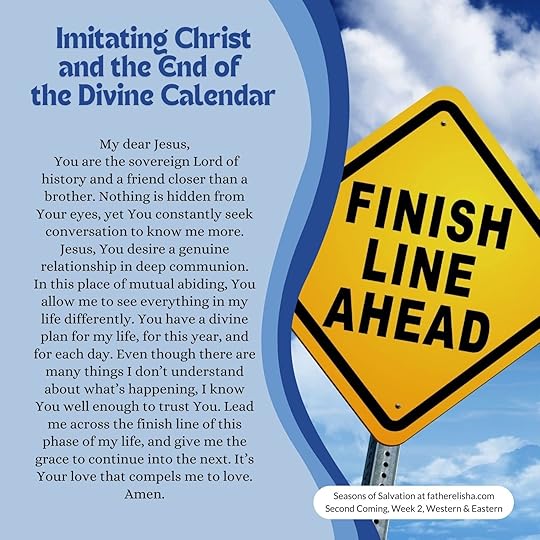
Therefore, when we read, meditate on, pray with, and live out Christ’s commandments, we abide in His love (John 15:10). This is why lawlessness causes love to grow cold. “And because lawlessness will abound, the love of many will grow cold” (Matt. 24:12).
If we see Christ’s commandments as our way of life, we suddenly find ourselves in Him. “If anyone loves Me, he will keep My word; and My Father will love him, and We will come to him and make Our home with him” (John 14:23). “And I have declared to them Your name, and will declare it, that the love with which You loved Me may be in them, and I in them” (John 17:26).
And so, our love begins to warm again.
It is comforting to know that keeping Jesus’ commandments is neither difficult nor oppressive. “For this is the love of God, that we keep His commandments. And His commandments are not burdensome” (1 John 5:3). “For My yoke is easy and My burden is light” (Matt. 11:30). In Greek, the word yoke can also mean “servitude,” “a law,” and “an obligation.”
This is because grace is here to help. In its essence, grace is the life that Jesus lived. It enables us to do what is impossible for our fallen human nature. “… for it is God who works in you both to will and to do for His good pleasure” (Phil. 2:13).
When lawlessness abounds, grace empowers us to keep Christ’s commandments and remain in His love. “But where sin abounded, grace abounded much more…” (Rom. 5:20b).
Imitating Christ
In Matthew 24:13, Jesus says, “But he who endures to the end shall be saved.” The Greek word translated endures means “to stay under,” “to remain,” “to bear,” “to persevere,” and even “to suffer.” This speaks of enduring the friction caused by surrounding lawlessness while we remain faithful to His commandments—imitating Christ.
There’s nothing to endure if we simply go with the flow. But the moment we go against the current of a society’s drifting from God’s commandments, we will feel that friction—guaranteed.
Jesus calls us to stand our ground and not give in to the pressures and standards of a lawless world. How can we find the strength to do this? By keeping Christ’s commandments. The Apostle Paul wrote, “Imitate me, just as I also imitate Christ” (1 Cor. 1:11). And Jesus told him, “My grace is sufficient for you, for My strength is made perfect in weakness” (2 Cor. 12:9).
When we place all our confidence in Jesus—that He will enable us to obey His commandments even when we feel unable—we will do what we once thought was impossible.
As we forgive wounds from long ago that still haunt us, change the subject when a colleague gossips about the manager, read the Bible during our lunch break, or return to our morning and evening devotions … Let us pray this week for the grace to keep standing our ground.
As we approach the beginning of a new liturgical year, let us allow Christ’s commandments to paint a picture of Him standing before us—His face radiant with joy, and His hand extended—as He says, “Follow me.”

Photo by Mike Newbry on Unsplash
Connecting the Years of the Divine CalendarWe have reached the end of our long journey—and we have learned so much. We know more about God and His perfect, complete work of salvation, more about ourselves, and more about the ways of the evil one. And … we have become a little more like Jesus.
But there is no need to despair, because the journey begins again—our story with Jesus continues—and it is not a repetition. Our life with God is alive and active—and so is the annual journey through the Divine Calendar. Though we walk through the same Seasons of Salvation year after year, our personal journeys continue to deepen and grow.
We may wonder—is there something that connects the years of the Divine Calendar together? Yes, there is.
At the end of the Divine Calendar, God gathers the fruit from our lives. We have journeyed through all the Seasons, and now we offer Him the fruits of this year. Yet some of that fruit contains seeds—seeds that will be sown into the soil of our soul for the coming year. These are connected to the new, specific area of our soul that the Holy Spirit will highlight during the upcoming Season of the Kingdom of God.
In this way, the Holy Spirit links His work from year to year, each Season building upon the last.
The Forerunner, the Martyrs, and the Cross
During this final week of the Divine Calendar, we also commemorate a minor feast: the beheading of the Forerunner, John the Baptist.
It is worth remembering that the Season of the Kingdom of God begins by highlighting John the Baptist and his message of repentance. The Divine Calendar begins with the Forerunner’s call and ends with his martyrdom—his entrance into the eternal kingdom he proclaimed.
After focusing on living in tents—as strangers and pilgrims in this world—and reflecting on the themes of the end times and eternity, we begin to resemble the martyrs a little more. We can die small deaths each day, because we belong to Heaven. We live for eternity and eternal purposes. This is how we follow in Christ’s footsteps—and this is how we carry our cross.
We might remember that the cross appears both at the beginning and at the center of the Divine Calendar. It is present at the Feast of the Elevation of the Holy Cross near the start, and at the heart of the Calendar during Lent and the Crucifixion of Jesus in Holy Week.
This perspective—carrying the cross with eternity set before us—is key as we move from year to year in the Divine Calendar.
Why Travel Through the Divine Calendar?
Let us summarize the main purposes of journeying through the Divine Calendar:
To know Jesus more deeply by following His footsteps (1. Peter 2:21).To work out our salvation—Christ being formed in us here on earth, and us being established in Christ in our life in the heavenly places.To allow the Kingdom of God to first manifest internally in our spiritual life—implying the formation of King Jesus within us—so that the Kingdom can then manifest externally around us through our unique callings.To uncover more of the purpose of our lives while following Jesus—and to complete that purpose—ending our lives as a testimony to the great salvation Jesus has accomplished for us. In this way, our lives can speak for themselves—even after death, as it is written of Abel and Enoch:“By faith Abel offered to God a more excellent sacrifice than Cain, through which he obtained witness that he was righteous, God testifying of his gifts; and through it he being dead still speaks. By faith Enoch was taken away so that he did not see death, ‘and was not found, because God had taken him’; for before he was taken he had this testimony, that he pleased God (Heb. 11:4–5).
Concluding Imitating Christ and the End of the Divine CalendarAs this final week of the Divine Calendar ends, a new journey begins—one that builds upon everything we’ve just completed.
May we recognize how God’s harvest from the past year lays the foundation for the year ahead. And even though we’ll walk through the same eight Seasons of Salvation, you are not the same. Christ has been more fully formed in your inner man than He was a year ago.
That’s what makes this familiar path both a continuation and a completely new journey.
I hope you’ll walk this journey with me for another year—and maybe even invite a friend to come along. It would be a great joy and honor to travel with you again.
Also, you may want to look at the post on the Beheading of John the Baptist, the final commemoration this in this liturgical year.
Please leave a comment below—we’d love to hear your thoughts. If you found this post helpful, feel free to share it using the buttons at the top of the page.
Join the Journey Through the Seasons of SalvationJoin us on this weekly journey through the Seasons of Salvation as we walk in the footsteps of Jesus Christ through the key seasons of His life.
Sign up to receive this year’s Divine Calendar, which introduces the Seasons of Salvation and guides you through the journey ahead. As a welcome gift, you’ll also receive my young adult novel, The Legend of the Divine Calendar, delivered straight to your inbox.
Visit the Seasons of Salvation blog for insights into the coming week, posted every Saturday. We’d be honored to have you join us.
Save Your Prayer Card on Your Smartphone
The post Second Coming 2 (Western & Eastern): Imitating Christ and the End of the Divine Calendar first appeared on Father Elisha: Let me take you on an intriguing journey..


August 15, 2025
Second Coming 1 (Eastern): Jesus’ Return and Platforms of Deception
The Spiritual Mysteries of the Divine Calendar: Jesus’ Return and Platforms of Deception ~ August 17–23, 2025 ~ We recently celebrated the Feast of the Dormition, and the final Season of Salvation of the Divine Calendar is upon us, drawing our attention to the Second Coming of Jesus Christ, the Church maturing as the Bride of Christ, and our departure from this life into eternity. During this two-week Season, and the Holy Spirit desires to highlight the end of the age, bringing the liturgical year to a close and inviting us to reflect on how Jesus’ return should shape our spiritual lives here and now.
If you attend an Old Calendar parish, I believe you will enjoy this talk from Week 1 of Heavenly Participation on the New Calendar: The Heavenly Places in Christ.
The coming of Jesus connects the end of the Divine Calendar to the beginning of a new cycle in September, as the first Season of Salvation focuses on the Kingdom of God and the first coming of Jesus. The theme of consecration, introduced in the previous Season—Heavenly Participation—also continues into the Season of the Second Coming.
“… we know that when He is revealed, we shall be like Him, for we shall see Him as He is. And everyone who has this hope in Him purifies himself, just as He is pure” (1 John 3:2–3 [NKJV]).
A Saying from St. Anthony the GreatThe father of monasticism, St. Anthony the Great (251–356), told his monastic disciples to view every day as our first and our last.
On the first day, a new world—a Kingdom—lies before us, ready to be discovered. Our love for Jesus blazes with faith, full of expectation for what awaits around the corner. Our last day becomes the ultimate opportunity to give our all for Him, to make things right with everyone, and to prepare for the final exodus—our last breath.
The Key to the End
In the three synoptic Gospels, Jesus speaks about the destruction of the temple and the signs of His Second Coming. Today, reading Mark 13 or Matthew 24 can feel like watching the evening news.
The Divine Calendar draws our attention to the Church prepared as a Bride for Christ, and to the world prepared for the return of Jesus, the Bridegroom King. This Season retains the key from the previous Season of Salvation—the tabernacle or tent—to help us enter into the mysteries of this final Season. The theme of consecrating our lives and ministries naturally progresses into our becoming the Bride of Christ.
The Bride forgets “your own people also, and your father’s house; so the King will greatly desire your beauty; because He is your Lord, worship Him” (Ps. 45:10a–11). Therefore, we live in our tabernacles, uprooted from this world.
Jesus the Bridegroom is preparing the eternal home we will share with Him, while we complete our souls’ bridal adornments—our sanctification—until He comes to lead us to our new Home. “I adorned you with ornaments, put bracelets on your wrists, and a chain on your neck” (Ez. 16:11). “I go to prepare a place for you. And if I go and prepare a place for you, I will come again and receive you to Myself; that where I am, there you may be also” (John 14:2b–3).
Jesus’ Return
In Mark 13:28–30, Jesus says: “Now learn this parable from the fig tree: When its branch has already become tender, and puts forth leaves, you know that summer is near. So you also, when you see these things happening, know that it is near—at the doors! Assuredly, I say to you, this generation will by no means pass away till all these things take place.”
The Greek word translated as it is in the phrase “know that it is near” can also be translated as “He is near.” Additionally, the word “generation” in Scripture refers to a period ranging from 40 to 100 years. It refers to a single generation in Numbers 32:13, the average human lifespan in Psalm 90:10, and as much as a century in Genesis 15:13–16.
Either way, 40 to 100 years is a relatively short period in a biblical or historical context. This suggests that “a generation” will witness the fullness of all the signs described in Mark 13, including the Second Coming.
Jesus’ Return: The Fig Tree and the Spiritual State of Israel
Of course, the big question is: has this generation already been born? We can’t know for sure, but Jesus gives us a clue through the parable of the budding fig tree before summer arrives. Many view this fig tree as a symbol of the spiritual state of the nation of Israel, based on Old Testament passages like Jeremiah 24:3–7:
“Then the Lord said to me, ‘What do you see, Jeremiah?’ And I said, ‘Figs, the good figs, very good; and the bad, very bad, which cannot be eaten, they are so bad.’ Again the word of the Lord came to me, saying, ‘Thus says the Lord, the God of Israel: “Like these good figs, so will I acknowledge those who are carried away captive from Judah […] Then I will give them a heart to know Me, that I am the Lord; and they shall be My people, and I will be their God, for they shall return to Me with their whole heart”’” (Jer. 24:3–5a, 7).
As prophesied by Isaiah, Israel returned to the family of nations on May 14, 1948. “Who has heard such a thing? Who has seen such things? Shall the earth be made to give birth in one day? Or shall a nation be born at once?”
However, the leafing out of the fig tree refers not just to national restoration but to the spiritual rebirth of Israel—more specifically, the rise of the Messianic Jewish movement: Jews who believe in Yeshua (Jesus) as their Messiah.
Jesus’ Return: The Rebirth
Both Isaiah and Ezekiel prophesied that once the land of Israel was being cultivated again, the eyes and ears of the nation would also begin to open. This could only happen after May 14, 1948, when the modern state of Israel was born—because the nation had ceased to exist after the Romans destroyed Jerusalem and the Second Temple in A.D. 70, just as Jesus prophesied in Matthew 24:1–2:
“Then Jesus went out and departed from the temple, and His disciples came up to show Him the buildings of the temple. And Jesus said to them, ‘Do you not see all these things? Assuredly, I say to you, not one stone shall be left here upon another, that shall not be thrown down.’”
We read in Isaiah 6:10–11: “‘Make the heart of this people dull, and their ears heavy, and shut their eyes; lest they see with their eyes, and hear with their ears, and understand with their heart, and return and be healed.’ Then I said, ‘Lord, how long?’ And He answered: ‘Until the cities are laid waste and without inhabitant, the houses are without a man, the land is utterly desolate.’”
Also, in Ezekiel 36:24–27: “For I will take you from among the nations, gather you out of all countries, and bring you into your own land. Then I will sprinkle clean water on you, and you shall be clean; I will cleanse you from all your filthiness and from all your idols. I will give you a new heart and put a new spirit within you; I will take the heart of stone out of your flesh and give you a heart of flesh. I will put My Spirit within you and cause you to walk in My statutes.”

Photo by Johannes Plenio on Unsplash
Jesus’ Return: The Prophetic ClockWe can conclude that “the generation” (referring to a period of 40 to 100 years) that will witness the fullness of the signs of the end times—culminating in the Second Coming—will begin sometime after May 14, 1948. Therefore, we would expect the world to furiously oppose the state of Israel, since “the whole world lies under the sway of the wicked one” (1 John 5:19).
Jesus also said, “And you will be hated by all for My name’s sake. But he who endures to the end will be saved” (Matt. 10:22).
The creation of the state of Israel in 1948 set the prophetic clock ticking toward the return of Jesus.
Soon, He will set His nail-pierced feet upon the Mount of Olives and return to the city of Jerusalem. “Men of Galilee, why do you stand gazing up into heaven? This same Jesus, who was taken up from you into heaven, will so come in like manner as you saw Him go into heaven” (Acts 1:11).
“And in that day His feet will stand on the Mount of Olives, which faces Jerusalem on the east. And the Mount of Olives shall be split in two, from east to west, making a very large valley; half of the mountain shall move toward the north and half of it toward the south” (Zech. 14:4).
Jesus’ Return: World Peace
After all, Jesus said that Jerusalem “is the city of the great King” (Matt. 5:35). At His Second Coming, Jesus will establish Jerusalem as the capital of the world:
“Now it shall come to pass in the latter days that the mountain of the Lord’s house shall be established on the top of the mountains, and shall be exalted above the hills; and all nations shall flow to it. Many people shall come and say, ‘Come, and let us go up to the mountain of the Lord, to the house of the God of Jacob; He will teach us His ways, and we shall walk in His paths.
“For out of Zion shall go forth the law, and the word of the Lord from Jerusalem. He shall judge between the nations, and rebuke many people; they shall beat their swords into plowshares, and their spears into pruning hooks; nation shall not lift up sword against nation, neither shall they learn war anymore” (Isa. 2:2–4).
“Amen. Even so, come, Lord Jesus!” (Rev. 22:20)
Summer Is Near
What do we mean by the fullness of the signs of the end times? When Jesus speaks about the end times in Matthew 24, Mark 13, and Luke 21, He lists many signs—such as earthquakes, famines, and wars—that have been present throughout history. So, how do we discern the intensity of these events that Jesus is referring to?
It helps to consider the perspective from which Jesus is speaking. He is sitting on the Mount of Olives in Jerusalem, addressing His Jewish disciples. Israel and the Jewish people are the primary point of reference for these events—not the Church in New Zealand, the United States, or England.
Of course, Jesus is also speaking to every Christian in every nation, as we too will increasingly experience these events as we draw closer to the Second Coming. Every Christian is a spiritual Israelite. “And as many as walk according to this rule, peace and mercy be upon them, and upon the Israel of God” (Gal. 6:16).
“There is neither Jew nor Greek, there is neither slave nor free, there is neither male nor female; for you are all one in Christ Jesus” (Gal. 3:28).
Signs of the End Times
If we put ourselves in the shoes of a Messianic Jewish family living in the Holy Land today, we can begin to understand how deeply Jesus’ words would resonate with what they might be feeling. Mark 13:3 begins with: “Now as He sat on the Mount of Olives opposite the temple …”
“But when you hear of wars and rumors of wars…” (Mark 13:7).“For nation will rise against nation, andkingdom against kingdom” (Mark 13:8).“And there will be earthquakes in various places, and there will be faminesand troubles” (Mark 13:8).“Butwatch out for yourselves, for they will deliver you up to councils” (Mark 13:9)“… you will be beaten in the synagogues” (Mark 13:9)“But when they arrest you and deliver you up, do not worry beforehand” (Mark 13:11)“Now brother will betray brother to death, and a father his child; and children will rise up against parents and cause them to be put to death” (Mark 13:12)“And you will be hated by all for My name’s sake” (Mark 13:13).“Andthe gospel must first be preached to all the nations” (Mark 13:13)—we are close to reaching this point.One thing is certain: we are closer to the Second Coming of Jesus Christ than at any other point in history—closer than we were yesterday. This realization helps us to “take heed, watch and pray” (Mark 13:33a), and when we “see these things happening, know that the kingdom of God is near” (Luke 21:31).
Lift Up Your Heads
Although these signs may cast an ominous shadow, notice what Jesus tells us in Luke 21:28: “Now when these things begin to happen, look up and lift up your heads, because your redemption draws near.” We are called to look forward with great anticipation to His coming, not with despair.
Instead of allowing fear and anxiety to hold us back, these severe shakings can awaken our spiritual heartbeat and ignite a longing to see Jesus face-to-face—living with zeal for the coming King. This is the grace the Holy Spirit desires to impart to us during these two weeks—the zeal of the Bride of Christ.
“Let not your heart be troubled; you believe in God, believe also in Me” (John 14:1). “…but we know that when He is revealed, we shall be like Him, for we shall see Him as He is” (1 John 3:2c).

Photo by Leon Rockel on Unsplash
Platforms of DeceptionJesus warns us in Mark 13:5–6 and 21–22 about deceivers, false christs, and prophets who mislead many through supernatural signs and wonders. This refers to a powerful deception that will sway and mislead the masses.
Deceiving voices build their platforms both outside and within the global Church today, and our greatest protection is simply knowing the truth. Just as experts who detect counterfeit money focus on studying genuine notes to easily identify fakes, we too must deeply know the truth in order to recognize deception.
We need a fresh hunger to read the Word of God and saturate our minds with truth, so when deceptive voices speak their lies, we recognize them immediately. Let us seek the Lord during these days to stir a renewed appetite to devour the Scriptures and proclaim their truth to ourselves as we read.
If we fill our spirits by reading the Living Word, then when deceptive voices call us out, we will experience the truth of Mark 13:11: “But when they arrest you and deliver you up, do not worry beforehand, or premeditate what you will speak. But whatever is given you in that hour, speak that; for it is not you who speak, but the Holy Spirit.”
Standing Against the Spirit of the Antichrist
In Mark 13:14–16, Jesus speaks about the moment when the Antichrist will enthrone himself in the Temple in Jerusalem. Even now, we see the spirit of the antichrist at work in society, demanding we submit to its rebellion against biblical truths and values. How can we be prepared to stand against its influence? Jesus gives us a practical answer—it’s a form of fasting.
“Let him who is on the housetop not go down into the house, nor enter to take anything out of his house. And let him who is in the field not go back to get his clothes” (Mark 13:15–16).
The Key of the Tabernacle
As in the previous Season—the Season of Heavenly Participation—the Holy Spirit continues His work of revealing any bonds we may have to earthly things. Spiritually speaking, living in a tent and not settling on the earth is the key to receiving the grace of the Holy Spirit in this Season as well.
The “fasting” that protects us from giving in to the mounting pressure of the spirit of the antichrist is a separation from the spirit of the world. “Now we have received, not the spirit of the world, but the Spirit who is from God, that we might know the things that have been freely given to us by God” (1. Cor 2:12).
The spirit of the world cannot lay hold of the Bride, and Jesus presents “her to Himself a glorious church, not having spot or wrinkle or any such thing, but that she should be holy and without blemish” (Eph. 5:27). If we sense any attachment to material things—not simply using them, but being addicted to them—then God helps us identify and break these bonds.
“Do not love the world or the things in the world. If anyone loves the world, the love of the Father is not in him. For all that is in the world—the lust of the flesh, the lust of the eyes, and the pride of life—is not of the Father but is of the world. And the world is passing away, and the lust of it; but he who does the will of God abides forever” (1 John 2:15–17).
In these days, the Holy Spirit lifts our eyes toward eternity and reveals how hidden earthly attachments can distract us from the return of Jesus.
The Hour Is Already Late
In Matthew 14:13–21, the disciples grow anxious as the afternoon wears on and the crowds remain without food. But Jesus responds by giving them a task …
We read in Matthew 14:15–16: “When it was evening, His disciples came to Him, saying, ‘This is a deserted place, and the hour is already late. Send the multitudes away, that they may go into the villages and buy themselves food.’ But Jesus said to them, ‘They do not need to go away. You give them something to eat.’”
Jesus says in His end-time discourse, “And the gospel must first be preached to all the nations” (Mark 13:10). When we think about the Second Coming of Jesus, we often worry that so many have yet to respond to the Gospel and join the Church.
But Jesus promises His Church exceptional grace at the end times to bring in the final harvest. This grace, however, will be poured out upon communities in unity. “Behold, how good and how pleasant it is for brethren to dwell together in unity! It is like the precious oil upon the head …” (Ps. 133:1–2a)
“Moreover the law entered that the offense might abound. But where sin abounded, grace abounded much more” (Rom. 5:20). “And also on My menservants and on My maidservants I will pour out My Spirit in those days” (Joel 2:29).
Even if we feel the hour is late and that Jesus is standing at the door, ready to return to earth, we can still offer Him our “five loaves and two fish” (Matt. 14:17) with greater faith. His grace will multiply our efforts, giving every person a chance to respond to the Gospel of Jesus. And then, He will come.
Sunday Gospel for Jesus’ Return and Platforms of Deception: Matthew 17:14–23 (NKJV)
In the Eastern Church, this week’s Sunday Gospel—according to this year’s liturgical calendar—does not directly relate to the Season of the Second Coming and is therefore not included or reflected upon in this post.
Concluding Jesus’ Return and Platforms of DeceptionIt’s been a long journey, but we’re now entering the final stretch of the Divine Calendar. The end is near, and it’s been my honor to travel with you.
Let us pray that we receive the grace of watchfulness, and that the shakings in the world will not shake us, “since we are receiving a kingdom which cannot be shaken” (Heb. 12:28a).
Please leave a comment below—we’d love to hear your thoughts. If you found this post helpful, feel free to share it using the buttons at the top of the page.
Join the Journey Through the Seasons of SalvationJoin us on this weekly journey through the Seasons of Salvation as we walk in the footsteps of Jesus Christ through the key seasons of His life.
Sign up to receive this year’s Divine Calendar, which introduces the Seasons of Salvation and guides you through the journey ahead. As a welcome gift, you’ll also receive my young adult novel, The Legend of the Divine Calendar, delivered straight to your inbox.
Visit the Seasons of Salvation blog for insights into the coming week, posted every Saturday. We’d be honored to have you join us.
Save Your Prayer Card on Your Smartphone
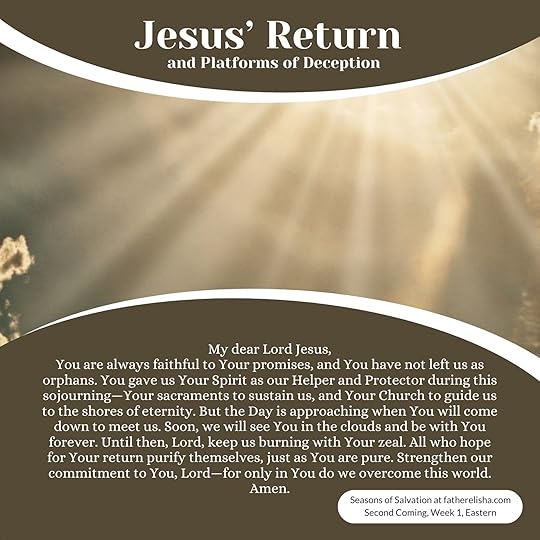
Photo by Thomas Kinto on Unsplash
The post Second Coming 1 (Eastern): Jesus’ Return and Platforms of Deception first appeared on Father Elisha: Let me take you on an intriguing journey..
Second Coming 1 (Western): The Return of Jesus and the Parable of the Fig Tree
The Spiritual Mysteries of the Divine Calendar: The Return of Jesus and the Parable of the Fig Tree ~ August 17–23, 2025 ~ After celebrating the Feast of the Dormition, the final Season of Salvation of the Divine Calendar is upon us, drawing our attention to the Second Coming of Jesus Christ, the Church maturing as the Bride of Christ, and our departure from this life into eternity. This Season lasts only two weeks, and the Holy Spirit desires to highlight the end of the age, bringing the liturgical year to a close and inviting us to reflect on how the return of Jesus should shape our spiritual lives today.
The coming of Jesus links the end of the Divine Calendar to the beginning of a new cycle in September, as the first Season of Salvation focuses on the Kingdom of God and the first coming of Jesus. The theme of consecration, introduced in the previous Season—Heavenly Participation—also continues into the Season of the Second Coming.
“… we know that when He is revealed, we shall be like Him, for we shall see Him as He is. And everyone who has this hope in Him purifies himself, just as He is pure” (1 John 3:2–3 [NKJV]).
The father of monasticism, St. Anthony the Great (251–356), told his monastic disciples to view every day as our first and our last.
On the first day, a new world—a Kingdom—lies before us, ready to be discovered. Our love for Jesus blazes with faith, full of expectation for what awaits around the corner. Our last day becomes the ultimate opportunity to give our all for Him, to make things right with everyone, and to prepare for the final exodus—our last breath.
The Key to the EndIn the next two Sunday Gospels, Jesus speaks about the destruction of the temple and the signs of His Second Coming. Today, reading Mark 13 or Matthew 24 can feel like watching the evening news.
The Divine Calendar draws our attention to the Church prepared as a Bride for Christ, and to the world prepared for the return of Jesus, the Bridegroom King. This Season retains the key from the previous Season of Salvation—the tabernacle or tent—to help us enter into the mysteries of this final Season. The theme of consecrating our lives and ministries naturally progresses into our becoming the Bride of Christ.
The Bride forgets “your own people also, and your father’s house; so the King will greatly desire your beauty; because He is your Lord, worship Him” (Ps. 45:10a–11). Therefore, we live in our tabernacles, uprooted from this world.
Jesus the Bridegroom is preparing the eternal home we will share with Him, while we complete our souls’ bridal adornments—our sanctification—until He comes to lead us to our new Home. “I adorned you with ornaments, put bracelets on your wrists, and a chain on your neck” (Ez. 16:11). “I go to prepare a place for you. And if I go and prepare a place for you, I will come again and receive you to Myself; that where I am, there you may be also” (John 14:2b–3).
The Return of Jesus
In Mark 13:28–30, Jesus says: “Now learn this parable from the fig tree: When its branch has already become tender, and puts forth leaves, you know that summer is near. So you also, when you see these things happening, know that it is near—at the doors! Assuredly, I say to you, this generation will by no means pass away till all these things take place.”
The Greek word translated as it is in the phrase “know that it is near” can also be translated as “He is near.” Additionally, the word “generation” in Scripture refers to a period ranging from 40 to 100 years. It refers to a single generation in Numbers 32:13, the average human lifespan in Psalm 90:10, and as much as a century in Genesis 15:13–16.
Either way, 40 to 100 years is a relatively short period in a biblical or historical context. This suggests that “a generation” will witness the fullness of all the signs described in Mark 13, including the Second Coming.
The Return of Jesus: The Fig Tree and the Spiritual State of IsraelOf course, the big question is: has this generation already been born? We can’t know for sure, but Jesus gives us a clue through the parable of the budding fig tree before summer arrives. Many view this fig tree as a symbol of the spiritual state of the nation of Israel, based on Old Testament passages like Jeremiah 24:3–7:
“Then the Lord said to me, ‘What do you see, Jeremiah?’ And I said, ‘Figs, the good figs, very good; and the bad, very bad, which cannot be eaten, they are so bad.’ Again the word of the Lord came to me, saying, ‘Thus says the Lord, the God of Israel: “Like these good figs, so will I acknowledge those who are carried away captive from Judah […] Then I will give them a heart to know Me, that I am the Lord; and they shall be My people, and I will be their God, for they shall return to Me with their whole heart”’” (Jer. 24:3–5a, 7).
As prophesied by Isaiah, Israel returned to the family of nations on May 14, 1948. “Who has heard such a thing? Who has seen such things? Shall the earth be made to give birth in one day? Or shall a nation be born at once?”
However, the leafing out of the fig tree refers not just to national restoration but to the spiritual rebirth of Israel—more specifically, the rise of the Messianic Jewish movement: Jews who believe in Yeshua (Jesus) as their Messiah.
The Return of Jesus: The Rebirth
Both Isaiah and Ezekiel prophesied that once the land of Israel was being cultivated again, the eyes and ears of the nation would also begin to open. This could only happen after May 14, 1948, when the modern state of Israel was born—because the nation had ceased to exist after the Romans destroyed Jerusalem and the Second Temple in A.D. 70, just as Jesus prophesied in Matthew 24:1–2:
“Then Jesus went out and departed from the temple, and His disciples came up to show Him the buildings of the temple. And Jesus said to them, ‘Do you not see all these things? Assuredly, I say to you, not one stone shall be left here upon another, that shall not be thrown down.’”
We read in Isaiah 6:10–11: “‘Make the heart of this people dull, and their ears heavy, and shut their eyes; lest they see with their eyes, and hear with their ears, and understand with their heart, and return and be healed.’ Then I said, ‘Lord, how long?’ And He answered: ‘Until the cities are laid waste and without inhabitant, the houses are without a man, the land is utterly desolate.’”
Also, in Ezekiel 36:24–27: “For I will take you from among the nations, gather you out of all countries, and bring you into your own land. Then I will sprinkle clean water on you, and you shall be clean; I will cleanse you from all your filthiness and from all your idols. I will give you a new heart and put a new spirit within you; I will take the heart of stone out of your flesh and give you a heart of flesh. I will put My Spirit within you and cause you to walk in My statutes.”
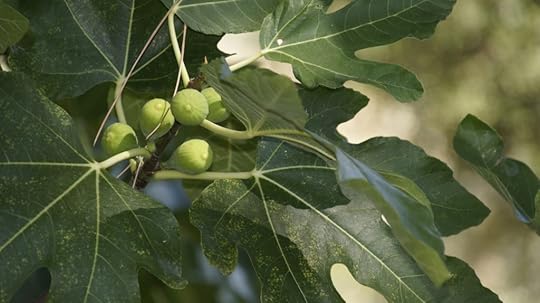
Photo by Kalina O. on Unsplash
The Return of Jesus: The Prophetic ClockWe can conclude that “the generation” (referring to a period of 40 to 100 years) that will witness the fullness of the signs of the end times—culminating in the Second Coming—will begin sometime after May 14, 1948. Therefore, we would expect the world to furiously oppose the state of Israel, since “the whole world lies under the sway of the wicked one” (1 John 5:19).
Jesus also said, “And you will be hated by all for My name’s sake. But he who endures to the end will be saved” (Matt. 10:22).
The creation of the state of Israel in 1948 set the prophetic clock ticking toward the return of Jesus.
Soon, He will set His nail-pierced feet upon the Mount of Olives and return to the city of Jerusalem. “Men of Galilee, why do you stand gazing up into heaven? This same Jesus, who was taken up from you into heaven, will so come in like manner as you saw Him go into heaven” (Acts 1:11).
“And in that day His feet will stand on the Mount of Olives, which faces Jerusalem on the east. And the Mount of Olives shall be split in two, from east to west, making a very large valley; half of the mountain shall move toward the north and half of it toward the south” (Zech. 14:4).
The Return of Jesus: World Peace
After all, Jesus said that Jerusalem “is the city of the great King” (Matt. 5:35). At His Second Coming, Jesus will establish Jerusalem as the capital of the world:
“Now it shall come to pass in the latter days that the mountain of the Lord’s house shall be established on the top of the mountains, and shall be exalted above the hills; and all nations shall flow to it. Many people shall come and say, ‘Come, and let us go up to the mountain of the Lord, to the house of the God of Jacob; He will teach us His ways, and we shall walk in His paths.
“For out of Zion shall go forth the law, and the word of the Lord from Jerusalem. He shall judge between the nations, and rebuke many people; they shall beat their swords into plowshares, and their spears into pruning hooks; nation shall not lift up sword against nation, neither shall they learn war anymore” (Isa. 2:2–4).
“Amen. Even so, come, Lord Jesus!” (Rev. 22:20)
Summer Is Near
What do we mean by the fullness of the signs of the end times? When Jesus speaks about the end times in Matthew 24, Mark 13, and Luke 21, He lists many signs—such as earthquakes, famines, and wars—that have been present throughout history. So, how do we discern the intensity of these events that Jesus is referring to?
It helps to consider the perspective from which Jesus is speaking. He is sitting on the Mount of Olives in Jerusalem, addressing His Jewish disciples. Israel and the Jewish people are the primary point of reference for these events—not the Church in New Zealand, the United States, or England.
Of course, Jesus is also speaking to every Christian in every nation, as we too will increasingly experience these events as we draw closer to the Second Coming. Every Christian is a spiritual Israelite. “And as many as walk according to this rule, peace and mercy be upon them, and upon the Israel of God” (Gal. 6:16).
“There is neither Jew nor Greek, there is neither slave nor free, there is neither male nor female; for you are all one in Christ Jesus” (Gal. 3:28).
Signs of the End Times
If we put ourselves in the shoes of a Messianic Jewish family living in the Holy Land today, we can begin to understand how deeply Jesus’ words would resonate with what they might be feeling. Mark 13:3 begins with: “Now as He sat on the Mount of Olives opposite the temple …”
“But when you hear of wars and rumors of wars…” (Mark 13:7).“For nation will rise against nation, andkingdom against kingdom” (Mark 13:8).“And there will be earthquakes in various places, and there will be faminesand troubles” (Mark 13:8).“Butwatch out for yourselves, for they will deliver you up to councils” (Mark 13:9)“… you will be beaten in the synagogues” (Mark 13:9)“But when they arrest you and deliver you up, do not worry beforehand” (Mark 13:11)“Now brother will betray brother to death, and a father his child; and children will rise up against parents and cause them to be put to death” (Mark 13:12)“And you will be hated by all for My name’s sake” (Mark 13:13).“Andthe gospel must first be preached to all the nations” (Mark 13:13)—we are close to reaching this point.One thing is certain: we are closer to the Second Coming of Jesus Christ than at any other point in history—closer than we were yesterday. This realization helps us to “take heed, watch and pray” (Mark 13:33a), and when we “see these things happening, know that the kingdom of God is near” (Luke 21:31).
Lift Up Your Heads
The two Sunday Gospels during the Season of the Second Coming focus on the signs of the end times—calling us to pay attention because the return of Jesus is near. “Now when these things begin to happen, look up and lift up your heads, because your redemption draws near” (Luke 21:28).
Although these signs may cast an ominous shadow, notice what Jesus tells us: “Look up and lift up your heads.” We are called to look forward with great anticipation to His coming, not with despair.
Instead of allowing fear and anxiety to hold us back, these severe shakings can awaken our spiritual heartbeat and ignite a longing to see Jesus face-to-face—living with zeal for the coming King. This is the grace the Holy Spirit desires to impart to us during these two weeks—the zeal of the Bride of Christ.
“Let not your heart be troubled; you believe in God, believe also in Me” (John 14:1). “…but we know that when He is revealed, we shall be like Him, for we shall see Him as He is” (1 John 3:2c).
Sunday Gospel for the Return of Jesus: Mark 13:3–37 (NKJV)The Signs of the Times and the End of the Age
Now as He sat on the Mount of Olives opposite the temple, Peter, James, John, and Andrew asked Him privately, 4 “Tell us, when will these things be? And what will be the sign when all these things will be fulfilled?”
5 And Jesus, answering them, began to say: “Take heed that no one deceives you. 6 For many will come in My name, saying, ‘I am He,’ and will deceive many. 7 But when you hear of wars and rumors of wars, do not be troubled; for such things must happen, but the end is not yet. 8 For nation will rise against nation, and kingdom against kingdom. And there will be earthquakes in various places, and there will be famines and troubles. These are the beginnings of sorrows.
9 “But watch out for yourselves, for they will deliver you up to councils, and you will be beaten in the synagogues. You will be brought before rulers and kings for My sake, for a testimony to them. 10 And the gospel must first be preached to all the nations. 11 But when they arrest you and deliver you up, do not worry beforehand, or premeditate what you will speak. But whatever is given you in that hour, speak that; for it is not you who speak, but the Holy Spirit. 12 Now brother will betray brother to death, and a father his child; and children will rise up against parents and cause them to be put to death. 13 And you will be hated by all for My name’s sake. But he who endures to the end shall be saved.
The Great Tribulation
14 “So when you see the ‘abomination of desolation,’ spoken of by Daniel the prophet, standing where it ought not” (let the reader understand), “then let those who are in Judea flee to the mountains. 15 Let him who is on the housetop not go down into the house, nor enter to take anything out of his house. 16 And let him who is in the field not go back to get his clothes. 17 But woe to those who are pregnant and to those who are nursing babies in those days! 18 And pray that your flight may not be in winter. 19 For in those days there will be tribulation, such as has not been since the beginning of the creation which God created until this time, nor ever shall be. 20 And unless the Lord had shortened those days, no flesh would be saved; but for the elect’s sake, whom He chose, He shortened the days.
21 “Then if anyone says to you, ‘Look, here is the Christ!’ or, ‘Look, He is there!’ do not believe it. 22 For false christs and false prophets will rise and show signs and wonders to deceive, if possible, even the elect. 23 But take heed; see, I have told you all things beforehand.
The Coming of the Son of Man
24 “But in those days, after that tribulation, the sun will be darkened, and the moon will not give its light; 25 the stars of heaven will fall, and the powers in the heavens will be shaken. 26 Then they will see the Son of Man coming in the clouds with great power and glory. 27 And then He will send His angels, and gather together His elect from the four winds, from the farthest part of earth to the farthest part of heaven.
The Parable of the Fig Tree
28 “Now learn this parable from the fig tree: When its branch has already become tender, and puts forth leaves, you know that summer is near. 29 So you also, when you see these things happening, know that it is near—at the doors! 30 Assuredly, I say to you, this generation will by no means pass away till all these things take place. 31 Heaven and earth will pass away, but My words will by no means pass away.
No One Knows the Day or Hour
32 “But of that day and hour no one knows, not even the angels in heaven, nor the Son, but only the Father. 33 Take heed, watch and pray; for you do not know when the time is. 34 It is like a man going to a far country, who left his house and gave authority to his servants, and to each his work, and commanded the doorkeeper to watch. 35 Watch therefore, for you do not know when the master of the house is coming—in the evening, at midnight, at the crowing of the rooster, or in the morning— 36 lest, coming suddenly, he find you sleeping. 37 And what I say to you, I say to all: Watch!”
Photo by Juan Encalada on Unsplash
Platforms of DeceptionIn today’s Sunday Gospel, Jesus warns us in Mark 13:5–6 and 21–22 about deceivers, false christs, and prophets who mislead many through supernatural signs and wonders. This refers to a powerful deception that will sway and mislead the masses.
Deceiving voices build their platforms both outside and within the global Church today, and our greatest protection is simply knowing the truth. Just as experts who detect counterfeit money focus on studying genuine notes to easily identify fakes, we too must deeply know the truth in order to recognize deception.
We need a fresh hunger to read the Word of God and saturate our minds with truth, so when deceptive voices speak their lies, we recognize them immediately. Let us seek the Lord during these days to stir a renewed appetite to devour the Scriptures and proclaim their truth to ourselves as we read.
If we fill our spirits by reading the Living Word, then when deceptive voices call us out, we will experience the truth of Mark 13:11: “But when they arrest you and deliver you up, do not worry beforehand, or premeditate what you will speak. But whatever is given you in that hour, speak that; for it is not you who speak, but the Holy Spirit.”
Standing Against the Spirit of the Antichrist
In Mark 13:14–16, Jesus speaks about the moment when the Antichrist will enthrone himself in the Temple in Jerusalem. Even now, we see the spirit of the antichrist at work in society, demanding we submit to its rebellion against biblical truths and values. How can we be prepared to stand against its influence? The Sunday Gospel gives us a practical answer—it’s a form of fasting.
“Let him who is on the housetop not go down into the house, nor enter to take anything out of his house. And let him who is in the field not go back to get his clothes” (Mark 13:15–16).
The Key of the Tabernacle
As in the previous Season—the Season of Heavenly Participation—the Holy Spirit continues His work of revealing any bonds we may have to earthly things. Spiritually speaking, living in a tent and not settling on the earth is the key to receiving the grace of the Holy Spirit in this Season as well.
The “fasting” that protects us from giving in to the mounting pressure of the spirit of the antichrist is a separation from the spirit of the world. “Now we have received, not the spirit of the world, but the Spirit who is from God, that we might know the things that have been freely given to us by God” (1. Cor 2:12).
The spirit of the world cannot lay hold of the Bride, and Jesus presents “her to Himself a glorious church, not having spot or wrinkle or any such thing, but that she should be holy and without blemish” (Eph. 5:27). If we sense any attachment to material things—not simply using them, but being addicted to them—then God helps us identify and break these bonds.
“Do not love the world or the things in the world. If anyone loves the world, the love of the Father is not in him. For all that is in the world—the lust of the flesh, the lust of the eyes, and the pride of life—is not of the Father but is of the world. And the world is passing away, and the lust of it; but he who does the will of God abides forever” (1 John 2:15–17).
In these days, the Holy Spirit lifts our eyes toward eternity and reveals how hidden earthly attachments can distract us from the return of Jesus.
Preparing for the Return of Jesus
In Mark 13:32–37, Jesus gives His final instruction on how to prepare for His Second Coming: keep your eyes lifted, watching for His return. We don’t know the exact time—only the Heavenly Father knows the year, month, day, hour, minute, and what you’ll be doing at that moment when heaven split and “He is coming with clouds, and every eye will see Him” (Rev. 1:7).
Every screen—iPads, iPhones, news broadcasts—will show Him. “Even they who pierced Him” (Rev. 1:7) will see, for “in that day His feet will stand on the Mount of Olives, which faces Jerusalem on the east” (Zech. 14:4).
Jesus tells us, “Take heed, watch and pray; for you do not know when the time is” (Mark 13:33). In Greek, the word “watch” means to be sleepless—to stay awake. This isn’t about physical sleep, but about spiritual alternes: to “watch and be sober. For those who sleep, sleep at night, and those who get drunk are drunk at night. But let us who are of the day be sober, putting on the breastplate of faith and love, and as a helmet the hope of salvation (1 Thess. 5:6–8).
Watch and Pray
To watch means discerning deception through our knowledge of the Word of God. It means living free from addiction to material things and worldly pleasures. Watching also means equipping ourselves with faith and love as spiritual protection, because “this is the victory that has overcome the world—our faith” (1 John 5:4), and “perfect love casts out fear” (1 John 4:18).
Finally, to watch means guarding our thoughts—protecting ourselves from despair through the unwavering hope of our salvation in Jesus.
Prayer is our spiritual lifeline. Whatever we do, we must never abandon it. At times, prayer may feel dry, boring, fruitless, or even meaningless. At other times, it feels vibrant, joyful, and life-giving. But no matter how it feels, we must not stop. We must keep praying.
And if we don’t know what to pray, we can simply do what the monks do. Every morning and evening, they choose a few psalms from the Book of Psalms and read them aloud as their own personal prayers. Between each one, they make a prostration, then continue—day after day, year after year. For fifty years or more in the quiet of their monasteries, they never run out of prayers.
The Holy Spirit desires to lift our eyes toward eternity—especially during these two weeks—and offers us grace to hunger for God’s Word, to break free from material attachments, and to watch and pray.
Let us pray and seek these blessings with open hearts.
Concluding the Return of Jesus and the Parable of the Fig TreeThank you for joining me in this final stretch of our journey through the Divine Calendar. It’s been quite a trip—and it’s been my honor to walk it with you.
Let us pray that we receive the grace of watchfulness, and that the shakings in the world will not shake us, “since we are receiving a kingdom which cannot be shaken” (Heb. 12:28a).
Please leave a comment below—we’d love to hear your thoughts. If you found this post helpful, feel free to share it using the buttons at the top of the page.
Join the Journey Through the Seasons of SalvationJoin us on this weekly journey through the Seasons of Salvation as we walk in the footsteps of Jesus Christ through the key seasons of His life.
Sign up to receive this year’s Divine Calendar, which introduces the Seasons of Salvation and guides you through the journey ahead. As a welcome gift, you’ll also receive my young adult novel, The Legend of the Divine Calendar, delivered straight to your inbox.
Visit the Seasons of Salvation blog for insights into the coming week, posted every Saturday. We’d be honored to have you join us.
Save Your Prayer Card on Your Smartphone
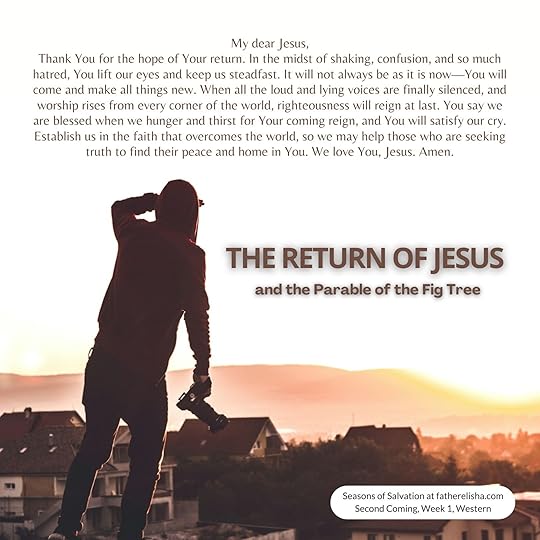
Photo by Adrian Dascal on Unsplash
The post Second Coming 1 (Western): The Return of Jesus and the Parable of the Fig Tree first appeared on Father Elisha: Let me take you on an intriguing journey..
August 8, 2025
Heavenly Participation 2 (Western & Eastern): The Dormition of the Virgin Mary
 The Spiritual Mysteries of the Divine Calendar: The Dormition of the Virgin Mary ~ August 15 / August 28 (Eastern Old Calendar), 2025 ~
 The Feast of the Dormition of the Virgin Mary concludes the two-week-long Season of Heavenly Participation. We celebrated the Feast of the Transfiguration in the first week, and in this final week, after reflecting on Our Heavenly Family (or Fulfilling God’s Will on the Eastern Calendar), we conclude this seventh Season of Salvation and the Dormition Fast with today’s celebration.
The Feast of the Dormition of the Virgin Mary, of the “falling-asleep of the Mother of the Lord,” is sometimes called the Assumption. It commemorates the death, resurrection, and glorification of Christ’s mother. God received the Virgin Mary into the heavenly kingdom in her glorified body.
Taken To HeavenThere are no scriptural references to the Dormition of the Virgin Mary, just as there are none for the feasts of the Nativity of the Virgin Mary (in the Season of the Kingdom of God) and her Entrance into the Temple (during the Season of Incarnation). However, church history provides the account of the end of the Virgin’s life.
During the crucifixion, Jesus told John the Beloved to take care of His mother, and John took her into his home in Jerusalem. “Then He said to the disciple, ‘Behold your mother!’ And from that hour that disciple took her to his own home” (John 19:27).
We know she was with the disciples in the upper room between the Ascension and Pentecost. “These all continued with one accord in prayer and supplication, with the women and Mary the mother of Jesus, and with His brothers” (Acts 1:14).
After this point, the Bible is silent about what happened to the Mother of Jesus, but church history tells us she continued to live in Jerusalem, ministering. At the time of her death, the Apostles gathered around the Virgin Mary, including the Apostle Paul. However, Apostle Thomas arrived later …
When the Virgin Mary died, Jesus descended and carried her soul into Heaven. The icon of the Feast of the Dormition depicts this scene. After she fell asleep, the Apostles carried her body in a procession and laid her in a tomb near the Garden of Gethsemane. Three days later, the Apostle Thomas finally arrived and wanted to see her body.
But Apostle Thomas found an empty tomb …
Life Conquered Death
Like the prophets Moses and Elijah—who appeared in the scene of the Feast of Transfiguration—the body of the Virgin Mary was taken into Heaven: the Assumption.
What does this signify? The Assumption of the Mother of Life is a powerful symbol of the Christian hope of eternal life. Jesus achieved complete victory over death, to the point that God even prevented the bodies of some Saints throughout history from seeing decay. This is the great salvation of God.
Most of us will experience death as the gradual decay of our bodies, but this is not the end for us. The Mother of the Incarnated Life showed us that even our bodies will be glorified and translated into Heaven at the Second Coming of Jesus—the final Season of Salvation that follows this Feast.
“For the trumpet will sound, and the dead will be raised incorruptible, and we shall be changed. For this corruptible must put on incorruption, and this mortal must put on immortality. So when this corruptible has put on incorruption, and this mortal has put on immortality” (1 Cor 15:52b–54a).
The Dormition of the Virgin Mary directly fulfills Jesus’ words in John 11:25–26: “Jesus said to her, ‘I am the resurrection and the life. He who believes in Me, though he may die, he shall live. And whoever lives and believes in Me shall never die. Do you believe this?’”
The Virgin’s assumption into Heaven demonstrates the greatness of the salvation Her Son made available for us. She was full of grace, glory, and the Word to such a degree that God saved even her body from decay. “Death is swallowed up in victory. O Death, where is your sting? O Hades, where is your victory?” (1 Cor. 15:54–55).
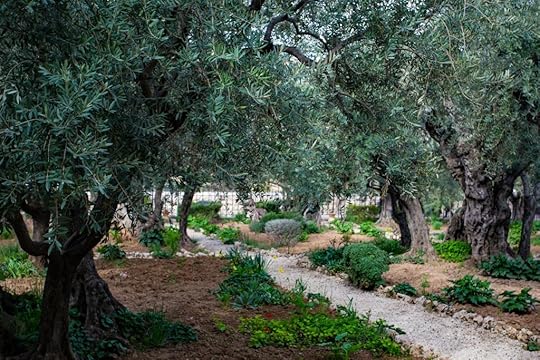
Photo of the Garden of Gethsemane, Jerusalem, by Stacey Franco on Unsplash
Gospel Passages for the Feast (NKJV)The Dormition Matins Gospel: Luke 1:39–49, 561:39 Now Mary arose in those days and went into the hill country with haste, to a city of Judah, 40 and entered the house of Zacharias and greeted Elizabeth. 41 And it happened, when Elizabeth heard the greeting of Mary, that the babe leaped in her womb; and Elizabeth was filled with the Holy Spirit.
42 Then she spoke out with a loud voice and said, “Blessed are you among women, and blessed is the fruit of your womb! 43 But why is this granted to me, that the mother of my Lord should come to me? 44 For indeed, as soon as the voice of your greeting sounded in my ears, the babe leaped in my womb for joy. 45 Blessed is she who believed, for there will be a fulfillment of those things which were told her from the Lord.”
46 And Mary said: “My soul magnifies the Lord, 47 and my spirit has rejoiced in God my Savior. 48 For He has regarded the lowly state of His maidservant; for behold, henceforth all generations will call me blessed. 49 For He who is mighty has done great things for me, and holy is His name. […] 56 And Mary remained with her about three months, and returned to her house.
The Dormition Liturgy Gospel: Luke 10:38–42; 11:27–28
10:38 Now it happened as they went that He entered a certain village; and a certain woman named Martha welcomed Him into her house. 39 And she had a sister called Mary, who also sat at Jesus’ feet and heard His word. 40 But Martha was distracted with much serving, and she approached Him and said, “Lord, do You not care that my sister has left me to serve alone? Therefore tell her to help me.”
41 And Jesus answered and said to her, “Martha, Martha, you are worried and troubled about many things. 42 But one thing is needed, and Mary has chosen that good part, which will not be taken away from her.”
11:27 And it happened, as He spoke these things, that a certain woman from the crowd raised her voice and said to Him, “Blessed is the womb that bore You, and the breasts which nursed You!” 28 But He said, “More than that, blessed are those who hear the word of God and keep it!”
Fullness Led to the DormitionFrom Luke, Chapter 1, we see the Virgin Mary described as full of grace, full of glory, and full of the Word.
“And having come in, the angel said to her, ‘Rejoice, highly favored one, the Lord is with you; blessed are you among women!’” (Luke 1:28) “Highly favored one” also means “to grace” and “graciousness” in Greek, and is sometimes translated as full of grace.
She was also full of glory. “And the angel answered and said to her, ‘The Holy Spirit will come upon you…’” (Luke 1:35). “And it happened, when Elizabeth heard the greeting of Mary, that the babe leaped in her womb; and Elizabeth was filled with the Holy Spirit” (Luke 1:41). The Virgin Mary was filled with the Holy Spirit—full of glory—since she carried Jesus in her womb, and her simple “Shalom” filled Elizabeth with the Holy Spirit.
The praise of the Virgin Mary (the Magnificat) reflects her knowledge of Hanna’s prayer, the mother of the prophet Samuel. This shows that the Virgin was also full of the Word of God.
Photo by Sixteen Miles Out on Unsplash
Hearing and Keeping the WordOur relationship with God’s Word grows as we spend time reading, studying, and praying with it. The Word (Logos in Greek) comes to us in different forms: the written Word, the Scriptures, and the incarnated Word, Jesus Christ. The more we are able to understand and go deeper into the Word of God, the deeper our relationship with the Logos becomes.
Another important aspect that affects our growth in our relationship with the Word is our obedience. “But He said, ‘More than that, blessed are those who hear the word of God and keep it!’” (Luke 11:28) “But be doers of the word, and not hearers only, deceiving yourselves” (James 1:22).
As our relationship with the Word of God matures, we begin to filter everything we say and do throughout the day through our knowledge of the Word—leading to obedience. The sharper this discernment becomes, the deeper our relationship with the Word grows. Eventually, we reach a point where we experience the Word of God as both Life and a way of life. “The words that I speak to you are spirit, and they are life” (John 6:63b).
Spirit and Life
In our time, we know how much we need a daily dose of spirit and life to shake off any weight or remnant of death—whether it tries to settle within us or is thrown at us throughout the day. We can develop a loving relationship with the Scriptures, so that we receive life each time we engage with them.
Most of the time, this isn’t an emotional experience, but we do feel lighter, sharper, and more alert. This is because the words of spirit and life enter our spirit (heart) first, before shining into our soul and affecting our emotions. This relationship with the Logos protects us from feeling heavy, sad, or depressed.
Blessed Are Those Who Hear the Word
As we grow in our relationship with the Word, it gains authority in our lives and becomes our guide in all circumstances. The Word becomes a steady light each time we face decisions. “Your word is a lamp to my feet and a light to my path” (Ps. 119:105).
We have one Teacher: Jesus Christ. “And do not be called teachers; for One is your Teacher, the Christ” (Matt. 23:10).
How does Jesus teach us? Through His Word and through fellowship with the Holy Spirit. “But the Helper, the Holy Spirit, whom the Father will send in My name, He will teach you all things, and bring to your remembrance all things that I said to you” (John 14:26).
The Virgin Mary lived out a deep relationship with the Word of God. We see this through her knowledge of the Scriptures—and through what Jesus Himself said about His Mother in the Gospel passage for this Feast:
“And it happened, as He spoke these things, that a certain woman from the crowd raised her voice and said to Him, ‘Blessed is the womb that bore You, and the breasts which nursed You!’ But He said, ‘More than that, blessed are those who hear the word of God and keep it!’” (Luke 11:27–28)
The Dormition: The End of the Season of Heavenly Participation
There are still a few days left, but this feast brings a conclusion to the seventh Season of Salvation. In the Feast of the Dormition, we witness the bodily assumption of the role model of the Dormition Fast—the fast of consecration.
Ultimately, our consecration leads to our gathering with the Heavenly Church at the Second Coming of Jesus Christ.
“Beloved, now we are children of God; and it has not yet been revealed what we shall be, but we know that when He is revealed, we shall be like Him, for we shall see Him as He is. And everyone who has this hope in Him purifies himself, just as He is pure” (1 John 3:2–3).
Even though this Season is short, it still plants a new desire in us to deepen our consecration. We also remember the key word—tent or tabernacle—and what it means to live as pilgrims and sojourners in this life.
If anything is crystal clear in the life of the Virgin Mary, it is that she lived for the Kingdom of Heaven. Heaven came down and was incarnate in her life, and at her falling asleep, Jesus took her back into Heaven.
“And if I go and prepare a place for you, I will come again and receive you to Myself; that where I am, there you may be also” (John 14:3).
Blessed feast!
Concluding the Dormition of the Virgin MaryThank you for joining this journey with Jesus and for taking the time to read. Next Sunday, we will enter the final Season of Salvation in the Divine Calendar: the Season of the Second Coming.
If helpful, you can also review what we previously discussed regarding How Do I Feast?
Please leave a comment below—we’d love to hear your thoughts. If you found this post helpful, feel free to share it using the buttons at the top of the page.
Join the Journey Through the Seasons of SalvationJoin us on this weekly journey through the Seasons of Salvation as we walk in the footsteps of Jesus Christ through the key seasons of His life.
Sign up to receive this year’s Divine Calendar, which introduces the Seasons of Salvation and guides you through the journey ahead. As a welcome gift, you’ll also receive my young adult novel, The Legend of the Divine Calendar, delivered straight to your inbox.
Visit the Seasons of Salvation blog for insights into the coming week, posted every Saturday. We’d be honored to have you join us.
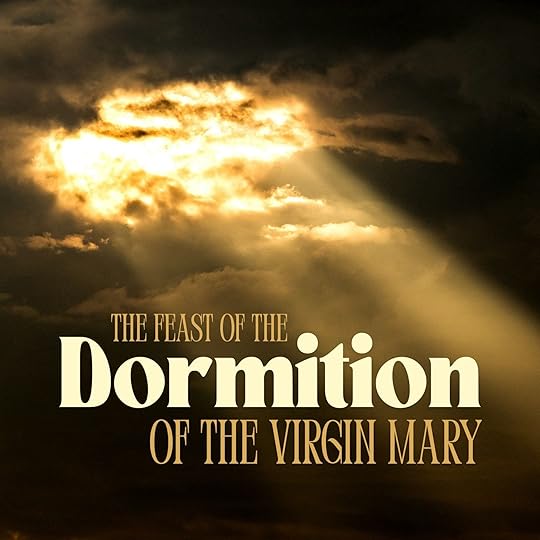
Photo by Liu JiaWei on Unsplash
Other Recommended Scriptures For MeditationAlongside to the designated Gospel passages for the Dormition of the Virgin Mary, these Scriptures are great to read, meditate on, and pray with in order to receive the grace of the Feast:
Genesis 28:10–17 (NKJV)
Now Jacob went out from Beersheba and went toward Haran. 11 So he came to a certain place and stayed there all night, because the sun had set. And he took one of the stones of that place and put it at his head, and he lay down in that place to sleep. 12 Then he dreamed, and behold, a ladder was set up on the earth, and its top reached to heaven; and there the angels of God were ascending and descending on it.
13 And behold, the Lord stood above it and said: “I am the Lord God of Abraham your father and the God of Isaac; the land on which you lie I will give to you and your descendants. 14 Also your descendants shall be as the dust of the earth; you shall spread abroad to the west and the east, to the north and the south; and in you and in your seed all the families of the earth shall be blessed. 15 Behold, I am with you and will keep you wherever you go, and will bring you back to this land; for I will not leave you until I have done what I have spoken to you.”
16 Then Jacob awoke from his sleep and said, “Surely the Lord is in this place, and I did not know it.” 17 And he was afraid and said, “How awesome is this place! This is none other than the house of God, and this is the gate of heaven!”
Ezekiel 43:27-44:4 (NKJV)
When these days are over it shall be, on the eighth day and thereafter, that the priests shall offer your burnt offerings and your peace offerings on the altar; and I will accept you,’ says the Lord God.”
44 Then He brought me back to the outer gate of the sanctuary which faces toward the east, but it was shut. 2 And the Lord said to me, “This gate shall be shut; it shall not be opened, and no man shall enter by it, because the Lord God of Israel has entered by it; therefore it shall be shut. 3 As for the prince, because he is the prince, he may sit in it to eat bread before the Lord; he shall enter by way of the vestibule of the gateway, and go out the same way.”
4 Also He brought me by way of the north gate to the front of the temple; so I looked, and behold, the glory of the Lord filled the house of the Lord; and I fell on my face.
Proverbs 9:1-11 (NKJV)
Wisdom has built her house, she has hewn out her seven pillars; 2 She has slaughtered her meat, she has mixed her wine, she has also furnished her table. 3 She has sent out her maidens, she cries out from the highest places of the city, 4 “Whoever is simple, let him turn in here!” As for him who lacks understanding, she says to him, 5 “Come, eat of my bread and drink of the wine I have mixed. 6 Forsake foolishness and live, and go in the way of understanding.
7 “He who corrects a scoffer gets shame for himself, and he who rebukes a wicked man only harms himself. 8 Do not correct a scoffer, lest he hate you; rebuke a wise man, and he will love you. 9 Give instruction to a wise man, and he will be still wiser; teach a just man, and he will increase in learning.
10 “The fear of the Lord is the beginning of wisdom, and the knowledge of the Holy One is understanding. 11 For by me your days will be multiplied, and years of life will be added to you.
The post Heavenly Participation 2 (Western & Eastern): The Dormition of the Virgin Mary first appeared on Father Elisha: Let me take you on an intriguing journey..
Heavenly Participation 2 (Eastern): Fulfilling God’s Will
The Spiritual Mysteries of the Divine Calendar: Fulfilling God’s Will ~ August 10–16, 2025 ~ The theme of the second and final week of the seventh Season of Salvation, the Season of Heavenly Participation, is fulfilling God’s will. Toward the end of the Divine Calendar, the Holy Spirit seeks to establish us more in our heavenly inheritance in Christ while loosening our earthly attachments.
Last week, we looked at The Heavenly Places in Christ, alongside celebrating the Feast of the Transfiguration, which serves as the foundation for this Season of Salvation. This short Season also overlaps with the two-week-long Fast of the Dormition, which will come to an end this week, on August 15 (August 28 on the Old Calendar), through the Dormition of the Virgin Mary.
Even though this is a short Season, it is spiritually rich. “Blessed be the God and Father of our Lord Jesus Christ, who has blessed us with every spiritual blessing in the heavenly places in Christ” (Eph. 1:3 [NKJV]).
If you attend an Old Calendar parish, I believe you will enjoy this talk from Mission Week 5 on the Western calendar: God’s Harvest from Our Mission and the Dormition Fast.
A Mystery Leading Us Toward Our Heavenly FamilyDuring the Transfiguration of Jesus on Mount Tabor, we read about Peter’s somewhat bewildered response to the overwhelming sigh of Jesus in His divine nature: “Then Peter answered and said to Jesus, ‘Lord, it is good for us to be here; if You wish, let us make here three tabernacles: one for You, one for Moses, and one for Elijah’” (Matt. 17:4).
The tabernacle is the key to entering this season.
We are children of the faith of Abraham. “And if you are Christ’s, then you are Abraham’s seed, and heirs according to the promise” (Gal. 3:29). And Abraham “dwelt in the land of promise as in a foreign country, dwelling in tents with Isaac and Jacob, the heirs with him of the same promise; for he waited for the city which has foundations, whose builder and maker is God” (Heb. 11:9–10).
When Abraham’s faith becomes our worldview—and we live in figurative tents (tabernacles) as sojourners and pilgrims on Earth—we begin to see our lives differently. The more we find our home among the invisible, heavenly church (as we discussed last week), the smaller the things of this life become, and the greater the things of eternity appear.
Sojourners on Earth with a Heavenly Family
What is truly important for us at this stage in our lives? What can we let go of? What relates only to this life?
Of course, we live in a material world, and every member of a family has responsibilities that relate to this life. But during these two weeks, we are called to look beyond our physical horizon. And by doing so, we realize that “if our earthly house, this tent, [our body] is destroyed, we have a building from God, a house not made with hands, eternal in the heavens” (2 Cor. 5:1).
With the help of the Holy Spirit, may He guide us to discover how we may have settled on Earth, when, in truth, we are strangers here with God—“a sojourner, as all my fathers were” (Psalm 39:12).

Photo by Long Ma on Unsplash
Fulfilling God’s WillIn this season, the Divine Calendar announces the focused work of the Holy Spirit toward the end of the liturgical year: our heavenly belonging and participation with the unseen Church that ministers with Jesus in Heaven. This reality can be a great blessing for our lives and ministry, if we understand it correctly.
We can become like the heroes of faith throughout the ages who are now rejoicing in Heaven. They are our family, and they are more alive than they have ever been. They fulfilled God’s will to a remarkable degree in their lifetime, by the power and grace of God. “For whoever does the will of God is My brother and My sister and mother” (Mark 3:35).
The lives of these great men and women of God inspire us. We can learn from how they overcame the challenges of their days, but there is a deeper mystery related to this Season.
The Holy Trinity reveals a unique facet of Himself through the lives of the Saints in Heaven. Imagine of photomosaic of Jesus the Bridegroom, composed of myriads of pictures of the bridal souls of the Church.
While on Earth, the lives of our heroes of faith became declarations—statements—of what the grace of God can do through man. “The eyes of your understanding being enlightened; that you may know what is the hope of His calling, what are the riches of the glory of His inheritance in the saints” (Eph. 1:18).
Heavenly Portions
We read in Ephesians 1:11–12: “In Him also we have obtained an inheritance, being predestined according to the purpose of Him who works all things according to the counsel of His will, that we who first trusted in Christ should be to the praise of His glory.” Also, we can read 2 Thessalonians 1:10: “When He comes, in that Day, to be glorified in His saints and to be admired among all those who believe, because our testimony among you was believed.”
We can ask for the same presence and activity of the Holy Trinity that we see in the lives of the Saints in Heaven—even if only a portion. We worship God for what His grace accomplished in the lives of His beloved children.
Here is another mystery behind the Season of Heavenly Participation: we can receive God’s grace and enablement to do the same as we see our heavenly family did in their lifetimes. We are not alone in our mission, but surrounded by historic declarations in the Spirit of what God did through people like you and me.
We can pray: “Lord, I can see what You did in the life of Saint John the Baptist. Can You please create in me—even just a portion—such humility?” This is a practical approach to the blessings the Divine Calendar wants to show us in this Season.
We can ask God for the blessings we see in the lives of our departed brothers and sisters in Christ. We can pray: “Lord, You did this in the life of Saint Mary Magdalene—do it again in my life. Give me the disposition for the one thing that is needed. Grant me, even just a portion, of the grace I see in her life.”
Fulfilling God’s Will In Layers
We read in Hebrews 12:1–2: “Therefore we also, since we are surrounded by so great a cloud of witnesses, let us lay aside every weight, and the sin which so easily ensnares us, and let us run with endurance the race that is set before us, looking unto Jesus, the author and finisher of our faith…”
The Saints in Heaven have finished their journey and now sit with Jesus. “And raised us up together, and made us sit together in the heavenly places in Christ Jesus” (Eph 2:6).
They join Jesus, the High Priest, in His intercession for the world. As we read in the Bible about these members of the heavenly Church, or in the countless biographies of the Saints throughout history, we see how they fulfilled God’s will to such a degree that we might think it can never happen again. But it can. That is what this Season seeks to remind us.
God has layers of His will for our lives, waiting for us to go deeper and uncover them. He places no limits on what we can do together with Him. “Most assuredly, I say to you, he who believes in Me, the works that I do he will do also; and greater works than these he will do, because I go to My Father” (John 14:12).
However, we put limitations on ourselves—or rather, our readiness does. We might think we are ready, but God says, “Not yet, My beloved. But if you don’t give up and keep walking together with Me, we’ll soon get there.”
Fulfilling God’s Will and the Dormition Fast
By looking at how the unseen Church fulfilled its mission, we can receive grace these days that will move us forward to fulfill God’s will for our lives as well.
May we be able to pray like Jesus at the end of our earthly lives: “I have glorified You on the earth. I have finished the work which You have given Me to do” (John 17:4).
For these reasons, we can better understand why the historical Church established the two weeks of Heavenly Participation as a fast. Through the Dormition Fast, we seek the grace we see in the lives of God’s people in the past—the Virgin Mary being the brightest example, since God chose her to give birth to His Son, Jesus Christ.
Also, as we mentioned at the beginning of the Dormition Fast, this is a fast of consecration. We seek to be set apart for God in holiness and turn our backs on things that can lead us to sin, so that we can fulfill God’s will for our lives.
Mark 3:35: “For whoever does the will of God is My brother and My sister and mother.”
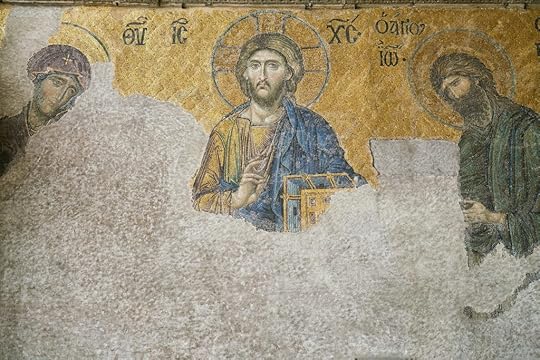
Photo by Engin Akyurt on Unsplash
Sunday Gospel for This Week of Fulfilling God’s Will: Matthew 14:22–34 (NKJV)Immediately Jesus made His disciples get into the boat and go before Him to the other side, while He sent the multitudes away. 23 And when He had sent the multitudes away, He went up on the mountain by Himself to pray. Now when evening came, He was alone there. 24 But the boat was now in the middle of the sea, tossed by the waves, for the wind was contrary.
25 Now in the fourth watch of the night Jesus went to them, walking on the sea. 26 And when the disciples saw Him walking on the sea, they were troubled, saying, “It is a ghost!” And they cried out for fear.
27 But immediately Jesus spoke to them, saying, “Be of good cheer! It is I; do not be afraid.” 28 And Peter answered Him and said, “Lord, if it is You, command me to come to You on the water.”
29 So He said, “Come.” And when Peter had come down out of the boat, he walked on the water to go to Jesus. 30 But when he saw that the wind was boisterous, he was afraid; and beginning to sink he cried out, saying, “Lord, save me!”
31 And immediately Jesus stretched out His hand and caught him, and said to him, “O you of little faith, why did you doubt?” 32 And when they got into the boat, the wind ceased. 33 Then those who were in the boat came and worshiped Him, saying, “Truly You are the Son of God.” 34 When they had crossed over, they came to the land of Gennesaret.
Introducing The Dormition of the Virgin Mary
This week, on August 15, we commemorate the Dormition, the Falling Asleep of the Virgin Mary (August 28 on the Old Calendar).
The life of the Virgin Mary is an example for all generations. The Gospel passages of this feast include the following: “And she had a sister called Mary, who also sat at Jesus’ feet and heard His word. […] And Jesus answered and said to her, ‘Martha, Martha, you are worried and troubled about many things. But one thing is needed, and Mary has chosen that good part, which will not be taken away from her’” (Luke 10:39, 41–42).
This passage (though referring to another Mary) highlights one aspect of the Virgin Mary’s life that the Church places before us at the Dormition: She was a disciple of the Lord—always a learner, maintaining a humble position at His feet.
We read in Deuteronomy 33:3: “Yes, He loves the people; all His saints are in Your hand; they sit down at Your feet.” Every icon of the Virgin—painted according to the understanding of the early Church—depicts her holding her Son while pointing to Him.
The Virgin is wholly focused on her Son. She is always pointing toward Jesus. She is at His feet because of her humility and immense love for Him. This is a major grace for us this feast, as we reflect on the Virgin’s departure from this life. She sat at her Son’s feet and always pointed toward Him—let us follow her example.
Fulfilling God’s Will: For God, All Things Are …
We are in the Season of Salvation which highlights the importance of living in a tabernacle—spiritually speaking—and offers the grace to confess that we are “strangers and pilgrims on the earth. For those who say such things declare plainly that they seek a homeland. And truly if they had called to mind that country from which they had come out, they would have had opportunity to return. But now they desire a better, that is, a heavenly country” (Heb. 11:13–15).
In Matthew 19:26, Jesus says: “With men this is impossible, but with God all things are possible.” The word “impossible” here is the Greek word dunatos, which means “powerful,” “capable,” “strong,” and “power.” Luke uses the same word (translated “mighty”) in the Virgin Mary’s Magnificat in Luke 1:49: “For He who is mighty has done great things for me, and holy is His name.”
Let us seek the grace this week to be more like the Virgin Mary. “Trust in the Lord with all your heart, and lean not on your own understanding” (Prov. 3:5). Let us pray for the grace to open our hearts as channels for God’s work and power, enabling us to do what our minds might deny us even from considering.
Concluding Fulfilling God’s WillIt’s my honor to journey through the Seasons of Salvation alongside you. Thank you so much for reading. The last day of the Fast of the Dormition is this week, on August 14 (August 27 on the Old Calendar).
The following day, August 15 (August 28 on the Old Calendar), is the Dormition of the Virgin Mary. Make sure you don’t miss the post.
If you take part in the Fast of the Dormition from August 1–14 (August 14–27 on the Old Calendar), you might find it helpful to review what we said last time about How Do I Observe the Fast of the Dormition?
Please leave a comment below—we’d love to hear your thoughts. If you found this post helpful, feel free to share it using the buttons at the top of the page.
Join the Journey Through the Seasons of SalvationJoin us on this weekly journey through the Seasons of Salvation as we walk in the footsteps of Jesus Christ through the key seasons of His life.
Sign up to receive this year’s Divine Calendar, which introduces the Seasons of Salvation and guides you through the journey ahead. As a welcome gift, you’ll also receive my young adult novel, The Legend of the Divine Calendar, delivered straight to your inbox.
Visit the Seasons of Salvation blog for insights into the coming week, posted every Saturday. We’d be honored to have you join us.
Save Your Prayer Card on Your Smartphone
Photo by Jose Llamas on Unsplash
The post Heavenly Participation 2 (Eastern): Fulfilling God’s Will first appeared on Father Elisha: Let me take you on an intriguing journey..
Heavenly Participation 2 (Western): Our Heavenly Family
The Spiritual Mysteries of the Divine Calendar: Our Heavenly Family ~ August 10–16, 2025 ~ Our Heavenly Family is the theme of the second and final week of the seventh Season of Salvation, the Season of Heavenly Participation. Toward the end of the Divine Calendar, the Holy Spirit seeks to establish us more firmly in our heavenly inheritance in Christ while loosening our earthly attachments.
Last week, we focused on Our Heavenly Identity, alongside celebrating the Feast of the Transfiguration, which serves as the foundation for this Season of Salvation. This short Season also overlaps with the two-week-long Dormition Fast, which will come to an end this week, on August 15, through the Dormition of the Virgin Mary.
Even though this is a short Season, there is much happening at once. “Blessed be the God and Father of our Lord Jesus Christ, who has blessed us with every spiritual blessing in the heavenly places in Christ” (Eph. 1:3 [NKJV]).
A Mystery Leading Us Toward Our Heavenly FamilyDuring the Transfiguration of Jesus on Mount Tabor, we read about Peter’s somewhat bewildered response to the overwhelming sigh of Jesus in His divine nature: “Then Peter answered and said to Jesus, ‘Lord, it is good for us to be here; if You wish, let us make here three tabernacles: one for You, one for Moses, and one for Elijah’” (Matt. 17:4).
The tabernacle is the key to entering this season.
We are children of the faith of Abraham. “And if you are Christ’s, then you are Abraham’s seed, and heirs according to the promise” (Gal. 3:29). And Abraham “dwelt in the land of promise as in a foreign country, dwelling in tents with Isaac and Jacob, the heirs with him of the same promise; for he waited for the city which has foundations, whose builder and maker is God” (Heb. 11:9–10).
When Abraham’s faith becomes our worldview—and we live in figurative tents (tabernacles) as sojourners and pilgrims on Earth—we begin to see our lives differently. The more we find our home among the invisible, heavenly church (as we discussed last week), the smaller the things of this life become, and the greater the things of eternity appear.
Sojourners on Earth with a Heavenly Family
What is truly important for us at this stage in our lives? What can we let go of? What relates only to this life?
Of course, we live in a material world, and every member of a family has responsibilities that relate to this life. But during these two weeks, we are called to look beyond our physical horizon. And by doing so, we realize that “if our earthly house, this tent, [our body] is destroyed, we have a building from God, a house not made with hands, eternal in the heavens” (2 Cor. 5:1).
With the help of the Holy Spirit, may He guide us to discover how we may have settled on Earth, when, in truth, we are strangers here with God—“a sojourner, as all my fathers were” (Psalm 39:12).
Sunday Gospel for Our Heavenly Family: Mark 3:22–35 (NKJV)
And the scribes who came down from Jerusalem said, “He has Beelzebub,” and, “By the ruler of the demons He casts out demons.”
23 So He called them to Himself and said to them in parables: “How can Satan cast out Satan? 24 If a kingdom is divided against itself, that kingdom cannot stand. 25 And if a house is divided against itself, that house cannot stand. 26 And if Satan has risen up against himself, and is divided, he cannot stand, but has an end. 27 No one can enter a strong man’s house and plunder his goods, unless he first binds the strong man. And then he will plunder his house.
28 “Assuredly, I say to you, all sins will be forgiven the sons of men, and whatever blasphemies they may utter; 29 but he who blasphemes against the Holy Spirit never has forgiveness, but is subject to eternal condemnation”— 30 because they said, “He has an unclean spirit.”
31 Then His brothers and His mother came, and standing outside they sent to Him, calling Him. 32 And a multitude was sitting around Him; and they said to Him, “Look, Your mother and Your brothers are outside seeking You.”
33 But He answered them, saying, “Who is My mother, or My brothers?” 34 And He looked around in a circle at those who sat about Him, and said, “Here are My mother and My brothers! 35 For whoever does the will of God is My brother and My sister and mother.”
Photo by Nadot Yannick on Unsplash
Declaring the Will of GodIn this season, the Divine Calendar announces the focused work of the Holy Spirit toward the end of the liturgical year: our heavenly belonging and participation with the unseen Church that ministers with Jesus in Heaven. This reality can be a great blessing for our lives and ministry, if we understand it correctly.
We can become like the heroes of faith throughout the ages who are now rejoicing in Heaven. They are our family, and they are more alive than they have ever been. They fulfilled God’s will to a remarkable degree in their lifetime, by the power and grace of God. As we just read in the Sunday Gospel: “For whoever does the will of God is My brother and My sister and mother” (Mark 3:35).
The lives of these great men and women of God inspire us. We can learn from how they overcame the challenges of their days, but there is a deeper mystery related to this Season.
The Holy Trinity reveals a unique facet of Himself through the lives of the saints in Heaven. Imagine of photomosaic of Jesus the Bridegroom, composed of myriads of pictures of the bridal souls of the Church.
While on Earth, the lives of our heroes of faith became declarations—statements—of what the grace of God can do through man. “The eyes of your understanding being enlightened; that you may know what is the hope of His calling, what are the riches of the glory of His inheritance in the saints” (Eph. 1:18).
Heavenly Portions
We read in Ephesians 1:11–12: “In Him also we have obtained an inheritance, being predestined according to the purpose of Him who works all things according to the counsel of His will, that we who first trusted in Christ should be to the praise of His glory.” Also, we can read 2 Thessalonians 1:10: “When He comes, in that Day, to be glorified in His saints and to be admired among all those who believe, because our testimony among you was believed.”
We can ask for the same presence and activity of the Holy Trinity that we see in the lives of these heroes in Heaven—even if only a portion. We worship God for what His grace accomplished in the lives of His beloved children.
Here is another mystery behind the Season of Heavenly Participation: we can receive God’s grace and enablement to do the same as we see our heavenly family did in their lifetimes. We are not alone in our mission, but surrounded by historic declarations in the Spirit of what God did through people like you and me.
We can pray: “Lord, I can see what You did in the life of John the Baptist. Can You please create in me—even just a portion—such humility?” This is a practical approach to the blessings the Divine Calendar wants to show us in this Season.
We can ask God for the blessings we see in the lives of our departed brothers and sisters in Christ. We can pray: “Lord, You did this in the life of Mary Magdalene—do it again in my life. Give me the disposition for the one thing that is needed. Grant me, even just a portion, of the grace I see in her life.”
The Layers of God’s Will for Us
We read in Hebrews 12:1–2: “Therefore we also, since we are surrounded by so great a cloud of witnesses, let us lay aside every weight, and the sin which so easily ensnares us, and let us run with endurance the race that is set before us, looking unto Jesus, the author and finisher of our faith…”
The saints in Heaven have finished their journey and now sit with Jesus. “And raised us up together, and made us sit together in the heavenly places in Christ Jesus” (Eph 2:6).
They join Jesus, the High Priest, in His intercession for the world. As we read in the Bible about these members of the heavenly Church, or in the countless biographies of the saints throughout history, we see how they fulfilled God’s will to such a degree that we might think it can never happen again. But it can. That is what this Season seeks to remind us.
God has layers of His will for our lives, waiting for us to go deeper and uncover them. He places no limits on what we can do together with Him. “Most assuredly, I say to you, he who believes in Me, the works that I do he will do also; and greater works than these he will do, because I go to My Father” (John 14:12).
However, we put limitations on ourselves—or rather, our readiness does. We might think we are ready, but God says, “Not yet, My beloved. But if you don’t give up and keep walking together with Me, we’ll soon get there.”
Our Heavenly Family and the Dormition Fast
By looking at how the unseen Church fulfilled its mission, we can receive grace these days that will move us forward to fulfill God’s will for our lives as well.
May we be able to pray like Jesus at the end of our earthly lives: “I have glorified You on the earth. I have finished the work which You have given Me to do” (John 17:4).
For these reasons, we can better understand why the historical Church established the two weeks of Heavenly Participation as a fast. Through the Dormition Fast, we seek the grace we see in the lives of God’s people in the past—the Virgin Mary being the brightest example, since God chose her to give birth to His Son, Jesus Christ.
Also, as we mentioned at the beginning of the Dormition Fast, this is a fast of consecration. We seek to be set apart for God in holiness and turn our backs on things that can lead us to sin, so that we can fulfill God’s will for our lives.
Mark 3:35: “For whoever does the will of God is My brother and My sister and mother.”
Photo by Andrei Mike on Unsplash
Three ParablesThis week’s Sunday Gospel might appear as three unrelated parables, but we can see a common thread related to this Season. In verses 22–27, Jesus says that if He casts out demons by the power of Satan, then Satan works against himself, because Satan’s power—obviously—serves Satan’s bidding.
Structure, hierarchy, and obedience exist even in the kingdom of darkness. We might think that demons rebel against anything and everything, but they are obedient to their higher power. Even the evil powers follow the evil will of their “household,” and communication flows efficiently.
Verses 28–30 contain the controversial passage about the unpardonable sin of blaspheming against the Holy Spirit. I believe this sin is simply rejecting the testimony of the Holy Spirit that Jesus is both Son of Man and Son of God, human and divine, “declared to be the Son of God with power according to the Spirit of holiness, by the resurrection from the dead” (Rom. 1:4).
If we refuse to believe that the Man Jesus is the Son of God, we deny the Holy Spirit’s witness of Him in our hearts and conscience, and we have no access to the New Covenant, which is the basis of our salvation. “But he who does not believe is condemned already, because he has not believed in the name of the only begotten Son of God” (John 3:18).
Doing God’s Will Makes Us Heavenly Family Members
How do these two passages relate to one another? If we want to abide in obedience and no longer be “strangers and foreigners, but fellow citizens with the saints and members of the household of God” (Eph. 2:19), it is “the Helper, the Holy Spirit, whom the Father will send in My [Jesus’] name, He will teach you all things, and bring to your remembrance all things that I said to you” (John 14:26). The Holy Spirit is the means by which we receive knowledge of the Father’s will through our place in Jesus Christ, so that we can function as members of the Heavenly Household.
In verses 31–35, Jesus essentially asks, “Who are My family members?” It is those who do the will of God whom Jesus considers His family. Hardly anyone has been more surrendered to the will of God than His mother, Mary: “Behold the maidservant of the Lord! Let it be to me according to your word” (Luke 1:38). Jesus says, “whoever does the will of God is My brother and My sister and mother” (verse 35).
Participation with Our Heavenly Family
Doing the will of the Head of the Household reveals who is a family member and who is not. Those outside the Household of our Heavenly Father don’t know His will, but those who are obedient to His Son do. “So then, those who are in the flesh cannot please God” (Rom. 8:8).
Last week, we saw how the Church comprises members on Earth and in Heaven, all united in the Holy Spirit. This week, Jesus says we know the will of God through the Holy Spirit. A prayer this week is that we may come to know, and act upon, the will of God. “And this I pray, that your love may abound still more and more in knowledge and all discernment, that you may approve the things that are excellent, that you may be sincere and without offense till the day of Christ” (Phil. 1:9–10).
All the members of the Heavenly Household are active. They also fulfill the will of the Father in the Holy Spirit. As we mentioned last week, the believers who went before us are our co-workers in worship, intercession, and—probably—ministry on Earth.
May the Holy Spirit reveal more to us this week about our Heavenly Participation, and how all the generations of faithful souls desire to work with us—even today.
Concluding Our Heavenly FamilyThank you for taking the time to read. It’s my privilege to be on this journey together. The last day of the Dormition Fast is this week, on August 14.
The following day, August 15, is the Dormition of the Virgin Mary. Make sure you don’t miss the post about this event.
If you take part in the Dormition Fast from August 1–14, you might find it helpful to review what we said last time about How Do I Observe the Dormition Fast?
Please leave a comment below—we’d love to hear your thoughts. If you found this post helpful, feel free to share it using the buttons at the top of the page.
Join the Journey Through the Seasons of SalvationJoin us on this weekly journey through the Seasons of Salvation as we walk in the footsteps of Jesus Christ through the key seasons of His life.
Sign up to receive this year’s Divine Calendar, which introduces the Seasons of Salvation and guides you through the journey ahead. As a welcome gift, you’ll also receive my young adult novel, The Legend of the Divine Calendar, delivered straight to your inbox.
Visit the Seasons of Salvation blog for insights into the coming week, posted every Saturday. We’d be honored to have you join us.
Save Your Prayer Card on Your Smartphone
Photo by Road Ahead on Unsplash
The post Heavenly Participation 2 (Western): Our Heavenly Family first appeared on Father Elisha: Let me take you on an intriguing journey..
August 1, 2025
Heavenly Participation 1 (Western & Eastern): The Feast of the Transfiguration
The Spiritual Mysteries of the Divine Calendar: The Feast of the Transfiguration ~ August 6 / August 19 (Eastern Old Calendar), 2025 ~ During the first week of the two-week-long Season of Heavenly Participation, we celebrate the Feast of the Transfiguration, which allows us to partake in another glorious event in the life of Jesus: His transfiguration on Mount Tabor (see Matt. 17:1–13; Mark 9:2–10; and Luke 9:28–36).
It is easy to understand how the Crucifixion and the Resurrection are part of Jesus’ work of salvation—and after journeying through the Seasons of Salvation, we rediscover each year how Jesus laid the foundation for the salvation of our souls.
But why the Transfiguration? Why does the Divine Calendar draw our attention to this event directly after the Season of Pentecost? The transfiguration took place about six months before the Crucifixion—so why highlight it now?
Our Journey Toward the Feast of the TransfigurationThe SealAt Pentecost, through the outpouring of the Holy Spirit, Jesus completed His work of salvation on earth. “Therefore being exalted to the right hand of God, and having received from the Father the promise of the Holy Spirit, He poured out this which you now see and hear” (Acts 2:33).
We can summarize Jesus’ salvific acts in the Incarnation, Crucifixion, Resurrection, Ascension, and Pentecost. Therefore, most churches center their liturgical calendars on these events. On our journey, however, we add three Seasons of Salvation to give greater depth to the work of the Holy Spirit in and around us.
After Jesus’ Ascension, the Father sent the Holy Spirit as He had promised His Son, and the Spirit sealed the work of salvation in us. “In Him you also trusted, after you heard the word of truth, the gospel of your salvation; in whom also, having believed, you were sealed with the Holy Spirit of promise, who is the guarantee of our inheritance until the redemption of the purchased possession, to the praise of His glory” (Eph. 1:13–14).
The Image of God
Right now, Jesus serves as our High Priest in Heaven, interceding for us and for all creation. He desires that we join Him as kings and priests, participating in worship and intercession in the heavenly places.
“Therefore He is also able to save to the uttermost those who come to God through Him, since He always lives to make intercession for them. For such a High Priest was fitting for us …” (Heb. 7:25–26). “But you are a chosen generation, a royal priesthood, a holy nation, His own special people, that you may proclaim the praises of Him who called you out of darkness into His marvelous light” (2 Pet. 2:9).
After the outpouring of the Holy Spirit, humanity is once again brought into fellowship with the Holy Trinity. The conversation between God and man—tragically broken at the fall in the Garden of Eden—can now resume. “Then the Lord God called to Adam and said to him, ‘Where are you?’ So he said, ‘I heard Your voice in the garden, and I was afraid because I was naked; and I hid myself’” (Gen. 3:9–10).
The Spirit of God, which lifted from humanity when Adam and Eve trusted the serpent instead of their Heavenly Father, returned to the heart of man at Pentecost. At that moment, God began restoring His perfect image in Adam—that is, all of humanity—a likeness that had been lost at the Fall. This restoration is a potential we must “work out” (Phil. 2:12) through a life of faith, “being transformed into the same image from glory to glory, just as by the Spirit of the Lord” (2 Cor 3:18b).
The Feast of the Transfiguration
When Jesus brought Peter, James, and John up on Mount Tabor, He revealed His divinity—just slightly. “His face shone like the sun, and His clothes became as white as the light” (Matt. 17:2). Jesus’ true divine-human nature astonished the disciples, and they were overcome with fear and wonder. He shone so brightly they couldn’t bear to look at His face. We live in a fallen world, and our current, fragile frame cannot yet endure the fullness of the glory of God.
Jesus’ Transfiguration shows us what Adam would have looked like had he never fallen. The Transfiguration reveals the image of the redeemed human being—what we will become once the work of sanctification is complete and our resurrected bodies are glorified at the Second Coming of Jesus. The disciples could not endure the glory radiating from Him, because “it has not yet been revealed what we shall be, but we know that when He is revealed, we shall be like Him, for we shall see Him as He is” (1 John 3:2b).
We read in Romans 3:23, “for all have sinned and fall short of the glory of God.” In the Transfiguration, Jesus reveals the very glory we have fallen short of.
This is why we celebrate the Feast of the Transfiguration after the Season of Pentecost, which marks the completion of Christ’ work of salvation. The Transfiguration stands as a beacon, pointing toward our future glorification—when the Holy Spirit’s work of sanctification has reached its fullness in us. “Being confident of this very thing, that He who has begun a good work in you will complete it until the day of Jesus Christ” (Phil 1:6).
Blessed feast!

Photo by Artem Sapegin on Unsplash
Western Gospel Passage for the Feast of the Transfiguration: Mark 9:2–13 (NKJV)Now after six days Jesus took Peter, James, and John, and led them up on a high mountain apart by themselves; and He was transfigured before them. 3 His clothes became shining, exceedingly white, like snow, such as no launderer on earth can whiten them. 4 And Elijah appeared to them with Moses, and they were talking with Jesus.
5 Then Peter answered and said to Jesus, “Rabbi, it is good for us to be here; and let us make three tabernacles: one for You, one for Moses, and one for Elijah”— 6 because he did not know what to say, for they were greatly afraid.
7 And a cloud came and overshadowed them; and a voice came out of the cloud, saying, “This is My beloved Son. Hear Him!” 8 Suddenly, when they had looked around, they saw no one anymore, but only Jesus with themselves.
9 Now as they came down from the mountain, He commanded them that they should tell no one the things they had seen, till the Son of Man had risen from the dead. 10 So they kept this word to themselves, questioning what the rising from the dead meant. 11 And they asked Him, saying, “Why do the scribes say that Elijah must come first?”
12 Then He answered and told them, “Indeed, Elijah is coming first and restores all things. And how is it written concerning the Son of Man, that He must suffer many things and be treated with contempt? 13 But I say to you that Elijah has also come, and they did to him whatever they wished, as it is written of him.”
Eastern Gospel Passage for the Feast of the Transfiguration: Matthew 17:1–9 (NKJV)Now after six days Jesus took Peter, James, and John his brother, led them up on a high mountain by themselves; 2 and He was transfigured before them. His face shone like the sun, and His clothes became as white as the light. 3 And behold, Moses and Elijah appeared to them, talking with Him. 4 Then Peter answered and said to Jesus, “Lord, it is good for us to be here; if You wish, let us make here three tabernacles: one for You, one for Moses, and one for Elijah.”
5 While he was still speaking, behold, a bright cloud overshadowed them; and suddenly a voice came out of the cloud, saying, “This is My beloved Son, in whom I am well pleased. Hear Him!” 6 And when the disciples heard it, they fell on their faces and were greatly afraid. 7 But Jesus came and touched them and said, “Arise, and do not be afraid.” 8 When they had lifted up their eyes, they saw no one but Jesus only.
9 Now as they came down from the mountain, Jesus commanded them, saying, “Tell the vision to no one until the Son of Man is risen from the dead.”
The Vision They Never ForgotAt the beginning of the Season of Heavenly Participation, Jesus is transfigured before Peter, James, and John on Mount Tabor. In this moment, we glimpse His partnership with the heavenly dwellers—the invisible church and our heavenly family.
Jesus knew the Cross was only six months away, so He strengthened the disciples ahead of that coming trial. But He did more than simply fortify their faith to prevent doubt about who He truly was—He enlightened their minds, burning the light of His divinity into their memory and making their ultimate goal unmistakably clear. The grace of the Holy Spirit would soon begin transfigure them as well.
“But we all, with unveiled face, beholding as in a mirror the glory of the Lord, are being transformed into the same image from glory to glory, just as by the Spirit of the Lord” (2 Cor. 3:18).
Peter said: “Lord, it is good for us to be here; if You wish, let us make here three tabernacles: one for You, one for Moses, and one for Elijah” (Matt. 17:4). We can catch a glimpse of Peter’s experience through worship and prayer, but ultimately, “at the last trumpet” (1 Cor. 15:52), when Jesus returns to earth, we too shall be transfigured like Him.
“In a moment, in the twinkling of an eye, at the last trumpet. For the trumpet will sound, and the dead will be raised incorruptible, and we shall be changed” (1 Cor. 15:52).
Peter’s heart cried out to Jesus: “I want to be here! I don’t want to leave this place! I need to be here, with You—my Lord and my God.” It is clear the three disciples never forgot this moment.
Peter’s and John’s Writings about the Transfiguration
Peter wrote in 2 Peter 1:16–18:
“For we did not follow cunningly devised fables when we made known to you the power and coming of our Lord Jesus Christ, but were eyewitnesses of His majesty. For He received from God the Father honor and glory when such a voice came to Him from the Excellent Glory: ‘This is My beloved Son, in whom I am well pleased.’ And we heard this voice which came from heaven when we were with Him on the holy mountain.”
And John wrote in 1 John 1:1–2:
“That which was from the beginning, which we have heard, which we have seen with our eyes, which we have looked upon, and our hands have handled, concerning the Word of life—the life was manifested, and we have seen, and bear witness, and declare to you that eternal life which was with the Father and was manifested to us.”

Photo by Marek Piwnicki on Unsplash
The Feast Of Tabernacles (Sukkot)Peter said to Jesus in Matthew 17:4: “If You wish, let us make here three tabernacles: one for You, one for Moses, and one for Elijah.”
The Transfiguration of Jesus took place around the same time as the Jewish Feast of Tabernacles (Sukkot). In the Old Testament—and still today among Jews—the Feast of Tabernacles is a weeklong celebration remembering God’s provision during the forty-year wilderness journey after the Israelites escaped Egypt (a symbol of the world). They were on a pilgrimage to the Promised Land, a journey that forms the foundation of the theme of the Season of Heavenly Participation.
“You shall keep it as a feast to the Lord for seven days in the year. It shall be a statute forever in your generations. You shall celebrate it in the seventh month. You shall dwell in booths for seven days. All who are native Israelites shall dwell in booths, that your generations may know that I made the children of Israel dwell in booths when I brought them out of the land of Egypt: I am the Lord your God’” (Lev. 23:41–43).
During the Feast of Tabernacles, the Jews moved outside Jerusalem and dwelled in tents for a week. They read the Law—publicly every sabbatical year (Deut. 31:10–13)—and renewed their relationship with God. By living in tents (booths or tabernacles), they remembered what it meant to live as strangers. They recalled the day they fled Egypt and their calling to be God’s own people. God did not call them to settle permanently on earth, but to live as sojourners with a specific purpose.
The Key to the Feast of the Transfiguration
“Hear my prayer, O Lord, and give ear to my cry; do not be silent at my tears; for I am a stranger with You, a sojourner, as all my fathers were” (Ps. 39:12).
The Divine Calendar emphasizes the pilgrim identity of the Church as well. For two weeks, we are reminded that we are not of this world, but of Heaven. We have many friends and fellow citizens in the Kingdom of Heaven.
The current Season of Salvation moves us out of a settled, earthly mindset and reminds us that we are soon to depart for our true homeland. We carry a heavenly identity and await a mansion in the City that comes from above. In this way, the Season of Heavenly Participation prepares us for the final Season in the Divine Calendar: The Season of the Second Coming.
“By faith [Abraham] dwelt in the land of promise as in a foreign country, dwelling in tents with Isaac and Jacob, the heirs with him of the same promise; for he waited for the city which has foundations, whose builder and maker is God” (Heb. 11:9–10).
We find the key to entering the mystery of this Feast—and the spiritual atmosphere of the Season of Heavenly Participation—in Matthew 17:4: “Lord, it is good for us to be here; if You wish, let us make here three tabernacles [emphasis added]: one for You, one for Moses, and one for Elijah.”
As we reflected on the first Sunday of this Season, the key to both the Feast of the Transfiguration and this Season of Salvation is the tabernacle, or tent. We are sojourners on the earth, and we belong to Heaven. Our ultimate goal is to be transfigured like Jesus.
General Assembly in Heaven
We read in Mark 9:4–6: “And Elijah appeared to them with Moses, and they were talking with Jesus. Then Peter answered and said to Jesus, ‘Rabbi, it is good for us to be here; and let us make three tabernacles: one for You, one for Moses, and one for Elijah’— because he did not know what to say, for they were greatly afraid.”
Why did the prophet Elijah appear with Moses before the three disciples, yet speak only with Jesus? Elijah and Moses didn’t address the disciples directly. Jesus wanted them to understand that He was communicating with “the general assembly and church of the firstborn who are registered in heaven” (Heb. 12:23)—even while in His human body, the same new human nature we now share through His salvific work.
“Therefore, from now on, we regard no one according to the flesh. Even though we have known Christ according to the flesh, yet now we know Him thus no longer. Therefore, if anyone is in Christ, he is a new creation; old things have passed away; behold, all things have become new.” (2 Cor. 5:16–17).
Peter said: “Rabbi, it is good for us to be here; and let us make three tabernacles: one for You, one for Moses, and one for Elijah” (Mark 9:5). He didn’t say six—to include himself, John, and James—because he was afraid. Yet, it was good to be there because Peter felt at home and didn’t need any tabernacle. The light of Jesus’ glory met all his needs, and he had no need for shelter. But why did he suggest making tabernacles for Jesus, Moses, and Elijah?
Earthly Projection of Heaven
Sometimes we unknowingly apply earthly images to Heaven, projecting earthly realities onto eternity without realizing how vastly different Heaven is from our current existence—especially since little is revealed in the Word of God.
“‘Therefore, in the resurrection, whose wife of the seven will she be? For they all had her.’ Jesus answered and said to them, ‘You are mistaken, not knowing the Scriptures nor the power of God. For in the resurrection they neither marry nor are given in marriage, but are like angels of God in heaven’” (Matt. 22:28–30).
“They said to Him, ‘Grant us that we may sit, one on Your right hand and the other on Your left, in Your glory.’ But Jesus said to them, ‘You do not know what you ask. Are you able to drink the cup that I drink, and be baptized with the baptism that I am baptized with?’” (Mark 10:37–38)
But when our eyes of faith are opened to heavenly realities, we are not only filled with joy and hope, but also strengthened in our longing for the Second Coming of Christ, knowing He will resolve and fulfill all concerns related to this life.
“Now to Him who is able to do exceedingly abundantly above all that we ask or think, according to the power that works in us, to Him be glory in the church by Christ Jesus to all generations, forever and ever. Amen” (Eph. 3:20).
May this feast deeply reassure us that Jesus can do exceedingly abundantly above all that we ask or imagine.
Concluding the Feast of the TransfigurationThank you for being on this journey with me. It’s my joy to travel alongside you. We have reached a significant landmark and may sense that we are nearing the end of our annual journey through the Divine Calendar.
Our focus now lifts toward what lies ahead—reaching into eternity. May the grace of the Feast of the Transfiguration free us from any earthly chains, so we may experience the freedom of our new creation in Christ. Have a blessed week, living in your tent.
If helpful, you can also review what we previously discussed regarding How Do I Feast?
Please leave a comment below—we’d love to hear your thoughts. If you found this post helpful, feel free to share it using the buttons at the top of the page.
Join the Journey Through the Seasons of SalvationJoin us on this weekly journey through the Seasons of Salvation as we walk in the footsteps of Jesus Christ through the key seasons of His life.
Sign up to receive this year’s Divine Calendar, which introduces the Seasons of Salvation and guides you through the journey ahead. As a welcome gift, you’ll also receive my young adult novel, The Legend of the Divine Calendar, delivered straight to your inbox.
Visit the Seasons of Salvation blog for insights into the coming week, posted every Saturday. We’d be honored to have you join us.
Photo by Ben Krb on Unsplash
Other Recommended Scriptures For MeditationAlongside to the designated Gospel passages for the Feast of the Transfiguration, these Scriptures are great to read, meditate on, and pray with in order to receive the grace of the Feast:
Exodus 24:12–18 (NKJV)
Then the Lord said to Moses, “Come up to Me on the mountain and be there; and I will give you tablets of stone, and the law and commandments which I have written, that you may teach them.”
13 So Moses arose with his assistant Joshua, and Moses went up to the mountain of God. 14 And he said to the elders, “Wait here for us until we come back to you. Indeed, Aaron and Hur are with you. If any man has a difficulty, let him go to them.” 15 Then Moses went up into the mountain, and a cloud covered the mountain.
16 Now the glory of the Lord rested on Mount Sinai, and the cloud covered it six days. And on the seventh day He called to Moses out of the midst of the cloud. 17 The sight of the glory of the Lord was like a consuming fire on the top of the mountain in the eyes of the children of Israel. 18 So Moses went into the midst of the cloud and went up into the mountain. And Moses was on the mountain forty days and forty nights.
Exodus 33:11–16 (NKJV)
So the Lord spoke to Moses face to face, as a man speaks to his friend. And he would return to the camp, but his servant Joshua the son of Nun, a young man, did not depart from the tabernacle.
12 Then Moses said to the Lord, “See, You say to me, ‘Bring up this people.’ But You have not let me know whom You will send with me. Yet You have said, ‘I know you by name, and you have also found grace in My sight.’ 13 Now therefore, I pray, if I have found grace in Your sight, show me now Your way, that I may know You and that I may find grace in Your sight. And consider that this nation is Your people.”
14 And He said, “My Presence will go with you, and I will give you rest.”
15 Then he said to Him, “If Your Presence does not go with us, do not bring us up from here. 16 For how then will it be known that Your people and I have found grace in Your sight, except You go with us? So we shall be separate, Your people and I, from all the people who are upon the face of the earth.”
Exodus 33:18–23 (NKJV)
And he said, “Please, show me Your glory.” 19 Then He said, “I will make all My goodness pass before you, and I will proclaim the name of the Lord before you. I will be gracious to whom I will be gracious, and I will have compassion on whom I will have compassion.”
20 But He said, “You cannot see My face; for no man shall see Me, and live.” 21 And the Lord said, “Here is a place by Me, and you shall stand on the rock. 22 So it shall be, while My glory passes by, that I will put you in the cleft of the rock, and will cover you with My hand while I pass by. 23 Then I will take away My hand, and you shall see My back; but My face shall not be seen.”
1 Kings 19:9–13, 15–16 (NKJV)
And there he went into a cave, and spent the night in that place; and behold, the word of the Lord came to him, and He said to him, “What are you doing here, Elijah?”
10 So he said, “I have been very zealous for the Lord God of hosts; for the children of Israel have forsaken Your covenant, torn down Your altars, and killed Your prophets with the sword. I alone am left; and they seek to take my life.”
11 Then He said, “Go out, and stand on the mountain before the Lord.” And behold, the Lord passed by, and a great and strong wind tore into the mountains and broke the rocks in pieces before the Lord, but the Lord was not in the wind; and after the wind an earthquake, but the Lord was not in the earthquake; 12 and after the earthquake a fire, but the Lord was not in the fire; and after the fire a still small voice.
13 So it was, when Elijah heard it, that he wrapped his face in his mantle and went out and stood in the entrance of the cave. Suddenly a voice came to him, and said, “What are you doing here, Elijah?”
(…) 15 Then the Lord said to him: “Go, return on your way to the Wilderness of Damascus; and when you arrive, anoint Hazael as king over Syria. 16 Also you shall anoint Jehu the son of Nimshi as king over Israel. And Elisha the son of Shaphat of Abel Meholah you shall anoint as prophet in your place.
2 Peter 1:10–19 (NKJV)
Therefore, brethren, be even more diligent to make your call and election sure, for if you do these things you will never stumble; 11 for so an entrance will be supplied to you abundantly into the everlasting kingdom of our Lord and Savior Jesus Christ.
12 For this reason I will not be negligent to remind you always of these things, though you know and are established in the present truth. 13 Yes, I think it is right, as long as I am in this tent, to stir you up by reminding you, 14 knowing that shortly I must put off my tent, just as our Lord Jesus Christ showed me. 15 Moreover I will be careful to ensure that you always have a reminder of these things after my decease.
16 For we did not follow cunningly devised fables when we made known to you the power and coming of our Lord Jesus Christ, but were eyewitnesses of His majesty. 17 For He received from God the Father honor and glory when such a voice came to Him from the Excellent Glory: “This is My beloved Son, in whom I am well pleased.” 18 And we heard this voice which came from heaven when we were with Him on the holy mountain.
19 And so we have the prophetic word confirmed, which you do well to heed as a light that shines in a dark place, until the day dawns and the morning star rises in your hearts.
The post Heavenly Participation 1 (Western & Eastern): The Feast of the Transfiguration first appeared on Father Elisha: Let me take you on an intriguing journey..
Heavenly Participation 1 (Eastern): The Heavenly Places in Christ
The Spiritual Mysteries of the Divine Calendar: The Heavenly Places in Christ ~ August 3–9, 2025 ~ We have arrived at the seventh and second-to-last Season of Salvation in the Divine Calendar. The goal of the Season of Heavenly Participation is to establish us more firmly in our heavenly inheritance in Christ and to uproot us further from the earth. This week, we begin by reflecting on the heavenly places in Christ, and on August 6 (August 19 on the Old Calendar), we celebrate the Feast of the Transfiguration, which serves as the foundation for this Season.
This short season consists of only two weeks, overlapping with the Fast of the Dormition, and is framed by the Feast of the Transfiguration in the first week and the Feast of the Dormition of the Virgin Mary in the second.
If you attend an Old Calendar parish, I believe you will be blessed by this talk from Mission Week 4 on the Western calendar: The Missionary’s Greatest Spiritual Battle.
The Journey to the Season of Heavenly ParticipationOur journey through the Divine Calendar began last September with the Season of the Kingdom of God. Repentance—the call of John the Baptist, the Forerunner—was the key that unlocked the specific work of the Holy Spirit in the first Season of Salvation. It laid the foundation for the rest of our voyage.
The Holy Spirit highlighted an area of our soul where Christ’s reign was lacking. King Ego still ruled that part of our life, and the journey began with the goal of dethroning the fallen human nature and enthroning Christ, the Heavenly King. “Therefore do not let sin reign in your mortal body, that you should obey it in its lusts. (…) For sin shall not have dominion over you, for you are not under law but under grace” (Rom. 6:12, 14).
Even though we are Christians and have been adopted into the Heavenly Kingdom through the death and resurrection of Jesus Christ, we know there are still areas in our lives where the old man reigns—if we’re honest with ourselves.
“For I delight in the law of God according to the inward man. But I see another law in my members, warring against the law of my mind, and bringing me into captivity to the law of sin which is in my members. O wretched man that I am! Who will deliver me from this body of death? I thank God—through Jesus Christ our Lord!” (Rom. 7:22–25a)
From Christmas to Easter
God’s redemption plan for this specific part of our soul began with the second Season of Salvation—the Season of Incarnation—and the Empty Manger was the key. After the Holy Spirit prepared us with grace to empty ourselves from our pride and prestige, the grace of Christmas imparted the divine nature of Jesus as a spiritual seed into the chosen area of our soul.
King Jesus was born within us as a potential—like a seed—and the grace of Incarnation began performing inner miracles.
The fallen human nature, under the rule of King Ego, immediately resisted this newborn King within us. This resistance led us into the third Season, the Season of Crucifixion and Great Lent, with the climax during Holy Week.
Through the key of the Wilderness, the Holy Spirit released grace to fast and pray with Jesus during His own fast. We defeated temptations and Satan’s tricks, which sought to bury the grace of Christmas deep within our souls. Finally, in Jerusalem during Holy Week, Jesus conquered the fallen human nature by uniting us to His death on the cross.
“For if we have been united together in the likeness of His death, certainly we also shall be in the likeness of His resurrection” (Rom. 6:5).
From Easter to Ascension
Jesus’ triumphant victory of death and Hades at the end of Holy Week immediately ushered us into the fourth Season of Salvation: The Season of Resurrection. The mysterious key of the Heavenly Places released the grace of resurrection and life into the part of our soul that God sought to redeem.
The resurrection enthroned Jesus and defeated King Ego within us. Jesus’ resurrection also led us to discover our new nature in Christ—including our heavenly identity: our place in the heavenly places. “And raised us up together, and made us sit together in the heavenly places in Christ Jesus” (Eph. 2:6).
This led us into the Season of Ascension, where Jesus lifted us up and presented us before our Heavenly Father. The fallen part of our soul received its dignity, being made in the image of Christ, and our calling as priests and kings with Jesus in Heaven was revealed through the key of the Mount of Olives as we gazed into the heavens.
“To Him who loved us and washed us from our sins in His own blood, and has made us kings and priests to His God and Father, to Him be glory and dominion forever and ever. Amen” (Rev. 1:5b–6).
Pentecost
In the sixth Season of Salvation, the Season of Pentecost, the key of the Upper Room—with its corporate worship and prayer—became the period when Christ was anointed as King in the part of our soul that God focused on. The Gift of gifts, the Holy Spirit Himself, filled us, taught us about Himself, and anointed us for our mission.
The part of our soul that once hindered us was now anointed as a strength—through the grace of Pentecost—not only to expand the reign of the Kingdom of God within us, but also to extend our external sphere of influence.
But most importantly, the Holy Spirit transformed us further, making us genuine citizens of Heaven, with deeper knowledge of the infinite riches of living in communion with the Holy Trinity.
“But as it is written: ‘Eye has not seen, nor ear heard, nor have entered into the heart of man the things which God has prepared for those who love Him.’ But God has revealed them to us through His Spirit. For the Spirit searches all things, yes, the deep things of God” (1 Cor. 2:9–10).

Photo by Austin Schmid on Unsplash
The Seventh Season of Salvation: The Season of Heavenly ParticipationHaving traveled through the Season of Pentecost, we have received a fresh infilling of the Holy Spirit. Christ now reigns as King in a new area of our inner lives, and we have received a new anointing for the work ahead.
In the second half of Pentecost, the mission period, the Holy Spirit especially focused our attention to the qualifications of the Lord’s servant—a laborer in His vineyard.
Now, the Holy Spirit wants to reveal that we are not alone on our mission; we are members of the body of Christ—both on Earth and in Heaven. When a Christian falls asleep (dies), the Holy Spirit does not depart the person’s spirit. We are the temple of the Holy Spirit. “Do you not know that you are the temple of God and that the Spirit of God dwells in you?” (1 Cor. 3:16)
Since the Holy Spirit does not depart from the believer’s spirit when he or she passes away, the person continues to enjoy fellowship with the Lord until His Second Coming to our world (the theme of the eighth and final Season of Salvation in the Divine Calendar). From the day of Pentecost two thousand years ago to the present, the Holy Spirit has dwelt with every Christian who has fallen asleep.
The Heavenly Places in Christ: We Are Not Alone
Even if the world forgets that we ever walked on Earth, God never will. We will never be forgotten or abandoned. The primary goal of Christ’s work of salvation is to bring us back into communion with the Holy Trinity—with the Father, the Son, and the Holy Spirit. But it goes even beyond this.
There is a general assembly and church of the firstborn in the Holy Spirit in Heaven—the heavenly Church.
“But you have come to Mount Zion and to the city of the living God, the heavenly Jerusalem, to an innumerable company of angels, to the general assembly and church of the firstborn who are registered in heaven, to God the Judge of all, to the spirits of just men made perfect, to Jesus the Mediator of the new covenant, and to the blood of sprinkling that speaks better things than that of Abel” (Heb. 12:22–24).
In the Holy Spirit, the Church on Earth is united with the heavenly Church. Since the Church has members both in Heaven and on Earth—and there are far more members in Heaven than on Earth—we are part of the historical family of God. We are all members of the household of God.
“Now, therefore, you are no longer strangers and foreigners, but fellow citizens with the saints and members of the household of God, having been built on the foundation of the apostles and prophets, Jesus Christ Himself being the chief cornerstone” (Eph. 2:19–20).
The Heavenly Places in Christ and Heavenly Participation
We read in Ephesians 1:3: “Blessed be the God and Father of our Lord Jesus Christ, who has blessed us with every spiritual blessing in the heavenly places in Christ.” And in 1 Corinthians 12:13: “For by one Spirit we were all baptized into one body—whether Jews or Greeks, whether slaves or free—and have all been made to drink into one Spirit.”
Another gift following the grace of Pentecost is that the Holy Spirit unites us more deeply into the Body of Christ in Heaven. Therefore, the Divine Calendar includes a short, two-week Season of Salvation toward the end of its annual cycle, focusing on our Heavenly Participation.
These two weeks—including the ongoing Dormition Fast and this Season’s two feasts—help us better comprehend what it means to be united with the heavenly Church and to receive the grace and blessing of being pilgrims and sojourners on Earth.
The Holy Spirit desires to encourage, inspire, and help us on our journey, knowing that our heavenly family is cheering us on. God’s heavenly household—“our citizenship is in heaven” (Phil. 3:20)—has left the stories of their lives so we can find strength from their examples.
Scriptural references suggest that the spirits in Heaven take part in what’s most important to Jesus today—completing the Great Commission (Matt. 28:18–20) and preparing the nations for His Second Coming. The primary reference is the appearance of the prophets Moses and Elijah during the Transfiguration of Jesus.
We have reasons to believe that our heavenly spiritual family prays for us and the rest of the world, because if Jesus hasn’t forgotten about this world, why would our brothers and sisters in Heaven not be involved?

Photo by Sergey Pesterev on Unsplash
The Key to the Season of Heavenly ParticipationThe key that helps us enter the spiritual atmosphere and more easily receive the grace of this Season comes from the Feast of the Transfiguration. This key also continues into the next and final Season of Salvation.
We read about the Transfiguration in Matthew 17:4: “Then Peter answered and said to Jesus, ‘Lord, it is good for us to be here; if You wish, let us make here three tabernacles: one for You, one for Moses, and one for Elijah.’”
The Tabernacle or tent is the key, pointing to our identity as sojourners on Earth. We are not of this world. “I have given them Your word; and the world has hated them because they are not of the world, just as I am not of the world” (John 17:14).
We are a heavenly creation, belonging to Heaven, and our goal is to be transfigured like Jesus. We are not called to be bound to earthly concerns—we are here only for a short time, for a purpose.
“These all died in faith, not having received the promises, but having seen them afar off were assured of them, embraced them and confessed that they were strangers and pilgrims on the earth” (Heb. 11:13).
Abraham sojourned with God throughout his entire life, carrying only his tent and altar. Abraham would say, “I will always be a stranger. I am not of this world.”
The tabernacle or tent turns our focus upward and releases the grace to strengthen our heavenly participation. This aspect of being strangers on Earth makes us, consequently, members of the “church of the firstborn who are registered in heaven” (Heb. 12:23).
“Blessed is the man whose strength is in You, whose heart is set on pilgrimage” (Ps. 84:5).
Sunday Gospel for This Week of the Heavenly Places: Matthew 14:14–22 (NKJV)
And when Jesus went out He saw a great multitude; and He was moved with compassion for them, and healed their sick. 15 When it was evening, His disciples came to Him, saying, “This is a deserted place, and the hour is already late. Send the multitudes away, that they may go into the villages and buy themselves food.”
16 But Jesus said to them, “They do not need to go away. You give them something to eat.” 17 And they said to Him, “We have here only five loaves and two fish.”
18 He said, “Bring them here to Me.” 19 Then He commanded the multitudes to sit down on the grass. And He took the five loaves and the two fish, and looking up to heaven, He blessed and broke and gave the loaves to the disciples; and the disciples gave to the multitudes. 20 So they all ate and were filled, and they took up twelve baskets full of the fragments that remained. 21 Now those who had eaten were about five thousand men, besides women and children.
22 Immediately Jesus made His disciples get into the boat and go before Him to the other side, while He sent the multitudes away.
With this, let us conclude this first week of the Season of Heavenly Participation.
Concluding the Heavenly Places in ChristThank you for taking the time to read and for joining me on this journey in Jesus’ footsteps. It’s an honor to walk alongside you. May God bless you as we enter the seventh Season of the Divine Calendar.
Be sure not to miss the post on the Feast of the Transfiguration, celebrated this Wednesday, August 6 (Tuesday, August 19 on the Old Calendar).
If you take part in the Dormition Fast from August 1–14 (August 14–27 on the Old Calendar), you might find it helpful to review what we said last time about How Do I Observe the Fast of the Dormition?
Please leave a comment below—we’d love to hear your thoughts. If you found this post helpful, feel free to share it using the buttons at the top of the page.
Join the Journey Through the Seasons of SalvationJoin us on this weekly journey through the Seasons of Salvation as we walk in the footsteps of Jesus Christ through the key seasons of His life.
Sign up to receive this year’s Divine Calendar, which introduces the Seasons of Salvation and guides you through the journey ahead. As a welcome gift, you’ll also receive my young adult novel, The Legend of the Divine Calendar, delivered straight to your inbox.
Visit the Seasons of Salvation blog for insights into the coming week, posted every Saturday. We’d be honored to have you join us.
Save Your Prayer Card on Your Smartphone
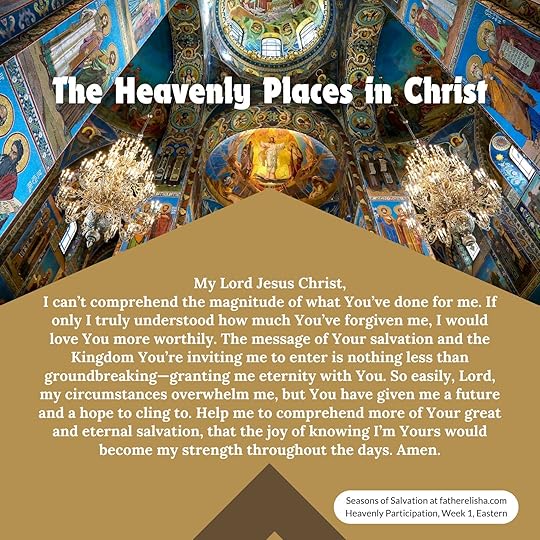
Photo by Svklimkin on Unsplash
The post Heavenly Participation 1 (Eastern): The Heavenly Places in Christ first appeared on Father Elisha: Let me take you on an intriguing journey..
Heavenly Participation 1 (Western): Our Heavenly Identity
The Spiritual Mysteries of the Divine Calendar: Our Heavenly Identity ~ August 3–9, 2025 ~ We have arrived at the seventh and second-to-last Season of Salvation in the Divine Calendar. The goal of the Season of Heavenly Participation is to establish us more firmly in our heavenly inheritance in Christ and to uproot us further from the earth. This week, we begin by reflecting on our heavenly identity, and on August 6, we celebrate the Feast of the Transfiguration, which serves as the foundation for this Season.
This short season consists of only two weeks, overlapping with the Dormition Fast, and is framed by the Feast of the Transfiguration in the first week and the Feast of the Dormition of the Virgin Mary in the second.
The Journey to the Season of Heavenly ParticipationOur journey through the Divine Calendar began last September with the Season of the Kingdom of God. Repentance—the call of John the Baptist, the Forerunner—was the key that unlocked the specific work of the Holy Spirit in the first Season of Salvation. It laid the foundation for the rest of our voyage.
The Holy Spirit highlighted an area of our soul where Christ’s reign was lacking. King Ego still ruled that part of our life, and the journey began with the goal of dethroning the fallen human nature and enthroning Christ, the Heavenly King. “Therefore do not let sin reign in your mortal body, that you should obey it in its lusts. (…) For sin shall not have dominion over you, for you are not under law but under grace” (Rom. 6:12, 14).
Even though we are Christians and have been adopted into the Heavenly Kingdom through the death and resurrection of Jesus Christ, we know there are still areas in our lives where the old man reigns—if we’re honest with ourselves.
“For I delight in the law of God according to the inward man. But I see another law in my members, warring against the law of my mind, and bringing me into captivity to the law of sin which is in my members. O wretched man that I am! Who will deliver me from this body of death? I thank God—through Jesus Christ our Lord!” (Rom. 7:22–25a)
From Christmas to Easter
God’s redemption plan for this specific part of our soul began with the second Season of Salvation—the Season of Incarnation—and the Empty Manger was the key. After the Holy Spirit prepared us with grace to empty ourselves from our pride and prestige, the grace of Christmas imparted the divine nature of Jesus as a spiritual seed into the chosen area of our soul.
King Jesus was born within us as a potential—like a seed—and the grace of Incarnation began performing inner miracles.
The fallen human nature, under the rule of King Ego, immediately resisted this newborn King within us. This resistance led us into the third Season, the Season of Crucifixion and Great Lent, with the climax during Holy Week.
Through the key of the Wilderness, the Holy Spirit released grace to fast and pray with Jesus during His own fast. We defeated temptations and Satan’s tricks, which sought to bury the grace of Christmas deep within our souls. Finally, in Jerusalem during Holy Week, Jesus conquered the fallen human nature by uniting us to His death on the cross.
“For if we have been united together in the likeness of His death, certainly we also shall be in the likeness of His resurrection” (Rom. 6:5).
From Easter to Ascension
Jesus’ triumphant victory of death and Hades at the end of Holy Week immediately ushered us into the fourth Season of Salvation: The Season of Resurrection. The mysterious key of the Heavenly Places released the grace of resurrection and life into the part of our soul that God sought to redeem.
The resurrection enthroned Jesus and defeated King Ego within us. Jesus’ resurrection also led us to discover our new nature in Christ—including our heavenly identity: our place in the heavenly places. “And raised us up together, and made us sit together in the heavenly places in Christ Jesus” (Eph. 2:6).
This led us into the Season of Ascension, where Jesus lifted us up and presented us before our Heavenly Father. The fallen part of our soul received its dignity, being made in the image of Christ, and our calling as priests and kings with Jesus in Heaven was revealed through the key of the Mount of Olives as we gazed into the heavens.
“To Him who loved us and washed us from our sins in His own blood, and has made us kings and priests to His God and Father, to Him be glory and dominion forever and ever. Amen” (Rev. 1:5b–6).
Pentecost
In the sixth Season of Salvation, the Season of Pentecost, the key of the Upper Room—with its corporate worship and prayer—became the period when Christ was anointed as King in the part of our soul that God focused on. The Gift of gifts, the Holy Spirit Himself, filled us, taught us about Himself, and anointed us for our mission.
The part of our soul that once hindered us was now anointed as a strength—through the grace of Pentecost—not only to expand the reign of the Kingdom of God within us, but also to extend our external sphere of influence.
But most importantly, the Holy Spirit transformed us further, making us genuine citizens of Heaven, with deeper knowledge of the infinite riches of living in communion with the Holy Trinity.
“But as it is written: ‘Eye has not seen, nor ear heard, nor have entered into the heart of man the things which God has prepared for those who love Him.’ But God has revealed them to us through His Spirit. For the Spirit searches all things, yes, the deep things of God” (1 Cor. 2:9–10).
Photo by Avery Cocozziello on Unsplash
The Seventh Season of Salvation: The Season of Heavenly ParticipationHaving traveled through the Season of Pentecost, we have received a fresh infilling of the Holy Spirit. Christ now reigns as King in a new area of our inner lives, and we have received a new anointing for the work ahead.
In the second half of Pentecost, the mission period, the Holy Spirit especially focused our attention to the qualifications of the Lord’s servant—a laborer in His vineyard.
Now, the Holy Spirit wants to reveal that we are not alone on our mission; we are members of the body of Christ—both on Earth and in Heaven. This may be a new concept for some parts of the Body of Christ, due to different views on what happens to our spirits after we depart this life.
But for us, on our journey through the ancient and traditional Divine Calendar, let us focus on one truth that unites us all: when a Christian falls asleep (dies), the Holy Spirit does not depart the person’s spirit. We are the temple of the Holy Spirit. “Do you not know that you are the temple of God and that the Spirit of God dwells in you?” (1 Cor. 3:16)
Since the Holy Spirit does not depart from the believer’s spirit when he or she passes away, the person continues to enjoy fellowship with the Lord until His Second Coming to our world (the theme of the eighth and final Season of Salvation in the Divine Calendar). From the day of Pentecost two thousand years ago to the present, the Holy Spirit has dwelt with every Christian who has fallen asleep. To this point, we can all agree.
Our Heavenly Identity: We Are Not Alone
Even if the world forgets that we ever walked on Earth, God never will. We will never be forgotten or abandoned. The primary goal of Christ’s work of salvation is to bring us back into communion with the Holy Trinity—with the Father, the Son, and the Holy Spirit. But it goes even beyond this.
There is a general assembly and church of the firstborn in the Holy Spirit in Heaven—the heavenly Church.
“But you have come to Mount Zion and to the city of the living God, the heavenly Jerusalem, to an innumerable company of angels, to the general assembly and church of the firstborn who are registered in heaven, to God the Judge of all, to the spirits of just men made perfect, to Jesus the Mediator of the new covenant, and to the blood of sprinkling that speaks better things than that of Abel” (Heb. 12:22–24).
In the Holy Spirit, the Church on Earth is united with the heavenly Church. Since the Church has members both in Heaven and on Earth—and there are far more members in Heaven than on Earth—we are part of the historical family of God. We are all members of the household of God.
“Now, therefore, you are no longer strangers and foreigners, but fellow citizens with the saints and members of the household of God, having been built on the foundation of the apostles and prophets, Jesus Christ Himself being the chief cornerstone” (Eph. 2:19–20).
Our Heavenly Identity and Participation
We read in Ephesians 1:3: “Blessed be the God and Father of our Lord Jesus Christ, who has blessed us with every spiritual blessing in the heavenly places in Christ.” And in 1 Corinthians 12:13: “For by one Spirit we were all baptized into one body—whether Jews or Greeks, whether slaves or free—and have all been made to drink into one Spirit.”
Another gift following the grace of Pentecost is that the Holy Spirit unites us more deeply into the Body of Christ in Heaven. Therefore, the Divine Calendar includes a short, two-week Season of Salvation toward the end of its annual cycle, focusing on our Heavenly Participation.
These two weeks—including the ongoing Dormition Fast and this Season’s two feasts—help us better comprehend what it means to be united with the heavenly Church and to receive the grace and blessing of being pilgrims and sojourners on Earth.
The Holy Spirit desires to encourage, inspire, and help us on our journey, knowing that our heavenly family is cheering us on. God’s heavenly household—“our citizenship is in heaven” (Phil. 3:20)—has left the stories of their lives so we can find strength from their examples.
Scriptural references suggest that the spirits in Heaven take part in what’s most important to Jesus today—completing the Great Commission (Matt. 28:18–20) and preparing the nations for His Second Coming. The primary reference is the appearance of the prophets Moses and Elijah during the Transfiguration of Jesus.
We have reasons to believe that our heavenly spiritual family prays for us and the rest of the world, because if Jesus hasn’t forgotten about this world, why would our brothers and sisters in Heaven not be involved?
The Key to the Season of Heavenly Participation
The key that helps us enter the spiritual atmosphere and more easily receive the grace of this Season comes from the Feast of the Transfiguration. This key also continues into the next and final Season of Salvation.
We read about the Transfiguration in Matthew 17:4: “Then Peter answered and said to Jesus, ‘Lord, it is good for us to be here; if You wish, let us make here three tabernacles: one for You, one for Moses, and one for Elijah.’”
The Tabernacle or tent is the key, pointing to our identity as sojourners on Earth. We are not of this world. “I have given them Your word; and the world has hated them because they are not of the world, just as I am not of the world” (John 17:14).
We are a heavenly creation, belonging to Heaven, and our goal is to be transfigured like Jesus. We are not called to be bound to earthly concerns—we are here only for a short time, for a purpose.
“These all died in faith, not having received the promises, but having seen them afar off were assured of them, embraced them and confessed that they were strangers and pilgrims on the earth” (Heb. 11:13).
Abraham sojourned with God throughout his entire life, carrying only his tent and altar. Abraham would say, “I will always be a stranger. I am not of this world.”
The tabernacle or tent turns our focus upward and releases the grace to strengthen our heavenly participation. This aspect of being strangers on Earth makes us, consequently, members of the “church of the firstborn who are registered in heaven” (Heb. 12:23).
“Blessed is the man whose strength is in You, whose heart is set on pilgrimage” (Ps. 84:5).
Photo by Alejandro Ortiz on Unsplash
Sunday Gospel for Our Heavenly Identity: Luke 1:26–38 (NKJV)Now in the sixth month the angel Gabriel was sent by God to a city of Galilee named Nazareth, to a virgin betrothed to a man whose name was Joseph, of the house of David. The virgin’s name was Mary. And having come in, the angel said to her, “Rejoice, highly favored one, the Lord is with you; blessed are you among women!”
29 But when she saw him, she was troubled at his saying, and considered what manner of greeting this was. Then the angel said to her, “Do not be afraid, Mary, for you have found favor with God. And behold, you will conceive in your womb and bring forth a Son, and shall call His name Jesus. He will be great, and will be called the Son of the Highest; and the Lord God will give Him the throne of His father David. And He will reign over the house of Jacob forever, and of His kingdom there will be no end.”
34 Then Mary said to the angel, “How can this be, since I do not know a man?”
35 And the angel answered and said to her, “The Holy Spirit will come upon you, and the power of the Highest will overshadow you; therefore, also, that Holy One who is to be born will be called the Son of God. Now indeed, Elizabeth your relative has also conceived a son in her old age; and this is now the sixth month for her who was called barren. For with God nothing will be impossible.”
38 Then Mary said, “Behold the maidservant of the Lord! Let it be to me according to your word.” And the angel departed from her.
Consecration and Our Heavenly Identity
As we introduced last week, we are currently observing the Dormition Fast (August 1–14), a fast of consecration. Now, we can better appreciate this fast, as the key of the Season of Heavenly Participation draws our attention to our heavenly identity as pilgrims on Earth.
Therefore, the first Sunday Gospel of this Season draws our attention to the Virgin Mary, the Mother of Jesus, as she is the most radiant example of consecration in the Bible. After all, God chose her to be the mother of Jesus Christ. Her famous reply in verse 38 says it all: “Behold the maidservant of the Lord! Let it be to me according to your word.”
Consecration and living in a tent—the life of a pilgrim—are two sides of the same coin. “Listen, O daughter, consider and incline your ear; forget your own people also, and your father’s house; so the King will greatly desire your beauty; because He is your Lord, worship Him” (Ps. 45:10–11).
“And what agreement has the temple of God with idols? For you are the temple of the living God. As God has said: ‘I will dwell in them and walk among them. I will be their God, and they shall be My people.’ Therefore ‘Come out from among them and be separate, says the Lord. Do not touch what is unclean, and I will receive you. I will be a Father to you, and you shall be My sons and daughters, says the Lord Almighty’” (2 Cor. 6:16–18).
Living in Tents
For those living in tents—not literal tents, but a sojourners’ lifestyle—an encounter with an angel or a departed saint is as normal as talking to a fellow human being. It may sound lofty, but throughout history, many heroes of our faith lived like this.
As we discussed earlier, after our journey of being prepared to serve the people of God, the spiritual calendar leads us into this new phase, building upon all the previous Seasons of Salvation. We are not alone—we have a heavenly family.
This might be hard to comprehend, and that’s okay. But, simply put, all departed believers are still in the Holy Spirit. They are the invisible Church, waiting for our participation in worshiping God, interceding for the world, and in the ministry of making disciples of all nations.
Even the angels are eager to cooperate with us, as we read in Hebrews 1:14: “Are they not all ministering spirits sent forth to minister for those who will inherit salvation.”
The Virgin Mary’s Heavenly Participation
The Early Church was diligent in remembering and recording the lives of the believers who had finished their race and gone before them to their heavenly home. Especially, the Virgin Mary captured their attention. She demonstrated exceptional humility and extraordinary servanthood.
“Behold the maidservant of the Lord! Let it be to me according to your word” (verse 38). Traditionally, the Church used the Virgin Mary’s life as an example for us all, encouraging us to see how our lives can be transformed into incarnated love, trust, and surrender to God.
Mary’s heavenly participation with the Archangel Gabriel becomes a powerful image of a life of consecration. During this Dormition Fast, we seek to deepen the consecration of our lives as well. There is grace to live more uprooted from this world—living in tents as pilgrims journeying toward Heaven.
May these lofty thoughts guide us into the mysteries of this short but precious Season of Heavenly Participation.
“For we know that if our earthly house, this tent, is destroyed, we have a building from God, a house not made with hands, eternal in the heavens” (2 Cor. 5:1).
Concluding Our Heavenly IdentityThank you for taking the time to read. It’s an honor to be on this journey with you. May God bless you as we enter a new Season.
Be sure not to miss the post on the Feast of the Transfiguration, celebrated this Wednesday, August 6.
If you take part in the Dormition Fast from August 1–14, you might find it helpful to review what we said last time about How Do I Observe the Dormition Fast?
Please leave a comment below—we’d love to hear your thoughts. If you found this post helpful, feel free to share it using the buttons at the top of the page.
Join the Journey Through the Seasons of SalvationJoin us on this weekly journey through the Seasons of Salvation as we walk in the footsteps of Jesus Christ through the key seasons of His life.
Sign up to receive this year’s Divine Calendar, which introduces the Seasons of Salvation and guides you through the journey ahead. As a welcome gift, you’ll also receive my young adult novel, The Legend of the Divine Calendar, delivered straight to your inbox.
Visit the Seasons of Salvation blog for insights into the coming week, posted every Saturday. We’d be honored to have you join us.
Save Your Prayer Card on Your Smartphone
Photo by Ameenfahmy on Unsplash
The post Heavenly Participation 1 (Western): Our Heavenly Identity first appeared on Father Elisha: Let me take you on an intriguing journey..
July 25, 2025
Pentecost: Mission 5 (Eastern: New) / Mission 3 (Eastern: Old): The Fruit God Seeks and the Fast of the Dormition
 The Spiritual Mysteries of the Divine Calendar: The Fruit God Seeks and the Fast of the Dormition ~ July 27 – August 2, 2025 ~
 We have arrived at the end of the Season of Pentecost, and so we conclude the second half of this Season of Salvation—a five-week period focusing on God’s messengers and our individual calling. As we leave the Season of Pentecost, the Fast of the Dormition will bring us into the last two Seasons of Salvation in the Divine Calendar.
But before we discuss the Fast of the Dormition, let us first conclude the current sixth season in the Divine Calendar.
This is the fifth and final week of the mission period, when the Holy Spirit reveals the features of the ambassadors—the missionaries—of the Kingdom of God. The mission period began with the Feast of the Apostles.
In the first week, we discussed What Is Our Mission? The second week explored Living Under God’s Authority, and the third week focused on How To Win Our Battles as missionaries. In the fourth week, we turned our attention to The Groundbreaking Message of Jesus. Today, we conclude with The Fruit God Seeks and the Fast of the Dormition.
The Fruit God DesiresWhat is the fruit God seeks from our personal vineyards? “Then He began to tell the people this parable: ‘A certain man planted a vineyard, leased it to vinedressers, and went into a far country for a long time. Now at vintage-time he sent a servant to the vinedressers, that they might give him some of the fruit of the vineyard’” (Luke 20:9–10a).
The vineyard God has entrusted to each of us looks different, depending on the responsibilities He has given us in His Kingdom. As we discussed at the beginning of the mission period, our assignment doesn’t only mean becoming a traditional cross-cultural evangelist. Our mission develops throughout our lives and can include anything—from intercession to work as a molecular biologist, seeking a cure for cancer through God’s creative inspiration.
Good Grapes
God expects our vineyard to bring “forth good grapes” (Isa. 5:2). This is the fruit Jesus thirsted for when He hung on the cross. “After this, Jesus, knowing that all things were now accomplished, that the Scripture might be fulfilled, said, ‘I thirst!’ Now a vessel full of sour wine was sitting there; and they filled a sponge with sour wine, put it on hyssop, and put it to His mouth” (John 19:28–29).
However, they offered him sour fruits instead. “Why then, when I expected it to bring forth good grapes, did it bring forth wild grapes?” (Isa. 5:4b)
The first miracle Jesus performed was turning water into wine at a wedding. “When the master of the feast had tasted the water that was made wine, and did not know where it came from…” (John 2:9) Wine is a symbol of love.
Our Heavenly Father is the vinedresser, and Jesus is the true vine. “I am the true vine, and My Father is the vinedresser […] I am the vine, you are the branches. He who abides in Me, and I in him, bears much fruit; for without Me you can do nothing” (John 15:1, 5).
The Fruit of Love
If we abide in Christ—and Christ is the vine—what fruit do we produce? Grapes, a symbol of love. We produce love. “As the Father loved Me, I also have loved you; abide in My love. If you keep My commandments, you will abide in My love, just as I have kept My Father’s commandments and abide in His love” (John 15:9–10). “A new commandment I give to you, that you love one another; as I have loved you, that you also love one another” (John 13:34).
The fruit God seeks to reap from our lives toward the end of the Divine Calendar is love—love toward Him and love toward others. If we have love, our vineyard is in good shape. If we don’t have love, we become like those vinedressers who envy glory for themselves rather than glorifying God. They seek an inheritance for their own names instead of being co-heirs with Christ.
“I remember you, the kindness of your youth, the love of your betrothal, when you went after Me in the wilderness, in a land not sown. Israel was holiness to the Lord, the first fruits of His increase” (Isa. 2:2b–3a).
Let us ask the Holy Spirit to reveal the condition of our vineyard. May we find fresh fruit to offer our merciful Lord, who loved us “to the end” (John 13:1).
Photo by Nacho Dominguez Argenta on Unsplash
Sunday Gospel: Matthew 9:27–35 (NKJV)When Jesus departed from there, two blind men followed Him, crying out and saying, “Son of David, have mercy on us!” 28 And when He had come into the house, the blind men came to Him. And Jesus said to them, “Do you believe that I am able to do this?” They said to Him, “Yes, Lord.”
29 Then He touched their eyes, saying, “According to your faith let it be to you.” 30 And their eyes were opened. And Jesus sternly warned them, saying, “See that no one knows it.” 31 But when they had departed, they spread the news about Him in all that country.
32 As they went out, behold, they brought to Him a man, mute and demon-possessed. 33 And when the demon was cast out, the mute spoke. And the multitudes marveled, saying, “It was never seen like this in Israel!” 34 But the Pharisees said, “He casts out demons by the ruler of the demons.”
35 Then Jesus went about all the cities and villages, teaching in their synagogues, preaching the gospel of the kingdom, and healing every sickness and every disease among the people.
For the Right or Wrong Reasons?
A theme in this week’s Sunday Gospel is seeking Jesus for the right reasons. What does that mean? It means we can sometimes be tempted to seek benefits from Jesus for the wrong reasons—apart from a genuine relationship with Him.
In verse 27, we read: “When Jesus departed from there, two blind men followed Him, crying out and saying, ‘Son of David, have mercy on us!’” As Jesus left the village (likely Capernaum), two blind men cried out after Him and, amazingly, followed Jesus despite their blindness.
When they entered the house, Jesus gave words to what had moved the blind men to seek Him. We read in verse 28: “And when He had come into the house, the blind men came to Him. And Jesus said to them, ‘Do you believe that I am able to do this?’ They said to Him, ‘Yes, Lord.’”
Jesus’ question confirmed the right reason the blind men came to Him: they had faith. The kind of faith that diligently seeks Him is what Jesus desires. “But without faith it is impossible to please Him, for he who comes to God must believe that He is, and that He is a rewarder of those who diligently seek Him” (Heb. 11:6). The heart that diligently seeks Jesus moves Him, and He rewards such pursuit.
These blind men didn’t seek entertainment or to satisfy their curiosity—the wrong reasons. Verse 33b tells us, “And the multitudes marveled, saying, ‘It was never seen like this in Israel!’” The blind men didn’t come to catch Jesus in His words or to witness a sign they could use to falsely accuse Him—again, for the wrong reasons.
Rewarded Faith
The blind men came because of the faith awakened in their hearts. This is the very faith Jesus seeks to restore in every person—faith that was broken in the Garden of Eden when humanity trusted the serpent instead of their Heavenly Father.
In verse 29, we read: “Then He touched their eyes, saying, ‘According to your faith let it be to you.’” Jesus rewarded their faith. It is this kind of faith—one that diligently seeks Him—that is especially precious to Jesus. He loves when we pursue Him wholeheartedly, refusing to let our limitations hold us back, and He honors that faith by granting our requests. When we eagerly come to Jesus and believe He is who He says He is, He will answer us.
Driven by the Right Desires
But there is a warning for us at the end of the Season of Pentecost: because of our fallen human nature, we may be tempted to seek the gifts of being a servant of God for the wrong reasons. One of these is the desire to attract a crowd—not for the glory of God and His purposes, but for self-glorification and prestige.
After the blind men received their sight, we read in verse 30: “And their eyes were opened. And Jesus sternly warned them, saying, ‘See that no one knows it.’” Jesus doesn’t want people to seek Him only for benefits—or for the wrong reasons. He desires to draw hearts that are awakened by faith and thirsty for eternal life.
“Do not labor for the food which perishes, but for the food which endures to everlasting life, which the Son of Man will give you, because God the Father has set His seal on Him” (John 6:27).
May the right reasons drive our desire to enter more deeply into our personal mission: “But when He saw the multitudes, He was moved with compassion for them, because they were weary and scattered, like sheep having no shepherd. Then He said to His disciples, ‘The harvest truly is plentiful, but the laborers are few. Therefore pray the Lord of the harvest to send out laborers into His harvest.’” (Mark 9:36–38—the three verses that follow our Sunday Gospel.)

Photo by Raychan on Unsplash
The Fast of the Dormition:August 1–14 (New Calendar) / August 14–28 (Old Calendar)The Season of Pentecost ends with the theme of offering God the fruit of His grace at work in our lives. “And now abide faith, hope, love, these three; but the greatest of these is love” (1 Cor. 13:13).
The Divine Calendar returns to the theme of bridal love toward the end of its annual journey—the same theme running through Lent and Holy Week, the center of the liturgical year. We will explore why later, but the theme of the Bride resumes with the Fast of the Dormition, starting August 1 (or August 14 on the Old Calendar).
This two-week fast centers on the theme of consecration—setting ourselves apart for the Lord—and concludes with the Feast of the Dormition of the Virgin Mary on August 15 (or August 28 on the Old Calendar). The Divine Calendar dedicates this feast to the event in Church history when the Mother of Jesus fell asleep and was received into Heaven. We will explore this on the feast day itself.
Origin
Originally, the Divine Calendar contained the three fasts we have journeyed through so far: the Nativity Fast (Incarnation Fast), Great Lent, and the Fast of the Apostles (the Fast of the Holy Spirit).
However, the monastics of the early centuries sought an additional fast dedicated to consecration. Over time, this monastic fast spread, and eventually, the broader Christian community embraced it as well.
Role Model
Traditionally, the Mother of Jesus, the Virgin Mary, has captured the attention of many. Though fully human like the rest of us, Mary was exceptionally humble, and her servanthood was utterly extraordinary. Her response to God in love, adoration, faith, and obedience was so unique that God chose her to be the gate through which His Son entered the world. Jesus took on our human nature through her.
The Virgin Mary was also our role model during the Nativity Fast. “Behold the maidservant of the Lord! Let it be to me according to your word” (Luke 1:38). Traditionally, the Church holds up Mary’s life as an example for us all. The Divine Calendar encourages us to believe that the grace of this fast can transform our lives, increasing our love, trust, and surrender to God.
We seek to have Christ formed in our inner man (Gal. 4:19); therefore, looking at the life of the Virgin Mary, who received the Son of God physically, strengthens us. Although Scripture is relatively silent about her, the little we do know tells us much. The Divine Calendar reminds us we are all called to be like the Virgin Mary. Her example of worship, prayer, and servanthood was not meant to be unique to her, but to be lived out in our own lives.
Below are some practical points on how to observe the Fast of the Dormition.
Concluding the Fruit God Seeks and the Fast of the DormitionIt’s my honor to journey with you through the Seasons of Salvation. Thank you for reading. As the Fast of the Dormition begins, I pray it will be a time of renewal for you and your spiritual life.
Please leave a comment below—we’d love to hear your thoughts. If you found this post helpful, feel free to share it using the buttons at the top of the page.
Join the Journey Through the Seasons of SalvationJoin us on this weekly journey through the Seasons of Salvation as we walk in the footsteps of Jesus Christ through the key seasons of His life.
Sign up to receive this year’s Divine Calendar, which introduces the Seasons of Salvation and guides you through the journey ahead. As a welcome gift, you’ll also receive my young adult novel, The Legend of the Divine Calendar, delivered straight to your inbox.
Visit the Seasons of Salvation blog for insights into the coming week, posted every Saturday. We’d be honored to have you join us.
Save Your Prayer Card on Your Smartphone
Photo by Tim Mossholder on Unsplash
How Do I Observe the Fast of the Dormition?August 1–14 (New Calendar) / August 14–28 (Old Calendar)I. Fasting during the Fast of the Dormition
Jesus said, “Moreover, when you fast, do not be like the hypocrites” (Matt. 6:16). Jesus didn’t say if you fast, but when. Fasting has a long tradition in all parts of Christianity.
Fasting doesn’t earn us anything, nor do we prove ourselves before God as being worthy to receive His grace. “He who eats, eats to the Lord, for he gives God thanks; and he who does not eat, to the Lord he does not eat, and gives God thanks. […] Therefore, whether we live or die, we are the Lord’s” (Rom. 14:6, 8b).
The heart of this fast is to deepen the consecration of our hearts as the Bride of Christ and to be ready for His Second Coming as a sign to the nations. “That He might sanctify and cleanse her with the washing of water by the word, that He might present her to Himself a glorious church, not having spot or wrinkle or any such thing, but that she should be holy and without blemish” (Eph. 5:26–27).
Fasting will not impress God. Instead, it constricts our fallen human nature and releases our spirit to more easily receive impressions and grace from the Holy Spirit. Fasting simply helps us to focus and tune in on the work of the Holy Spirit, so the grace He brings from Jesus’ life enters our souls and into “a noble and good heart” (Luke 8:15).
Traditional View of Fasting
Many view fasting as abstaining from food or drink for a day or longer. However, the traditional way of fasting is a fasting lifestyle. We choose not to eat dairy products and meat for a period.
A vegan diet three times a day is still fasting. Even though we eat, we restrict the instinct of our fallen human nature by not eating as we normally do. This voluntary restriction will, even after a few days, produce spiritual vigilance as if we didn’t eat at all for a day or two.
If you have experience with fasting, and maybe already have a fasting lifestyle, you simply increase what you normally do during the Fast of the Dormition. Maybe postpone your first meal until 10 a.m., depending on how God’s grace sustains your fasting. If you have been fasting regularly for over five years, you may extend your fast until noon or even 3 p.m. on some weekdays.
We maintain the fasting diet during the weekend, but we do not postpone any meals on Saturdays and Sundays. So, if you eat breakfast at 10 a.m. from Monday through Friday, you would have your breakfast as normal during the weekend.
The main reason for reducing the fast on the weekend is to celebrate the grace of Resurrection on Sunday and create a break in the rhythm of fasting. Each Monday then becomes a fresh start—a renewed offering of sacrifice through fasting. This pattern helps prevent fasting from becoming habitual or stagnant.
The goal of fasting is not to impress God or ourselves, but restriction, emptying, and repentance, and hence welcoming the Holy Spirit. “As they ministered to the Lord and fasted, the Holy Spirit said…” (Acts 13:2a)
Final Comments
Fasting is like tightening a spiritual belt around our waist—one that carries new equipment to help us remain spiritually alert.
Fasting allows us to receive the grace of consecration differently—not because God rewards our fasting by giving more grace, but because we are preparing our souls to receive what is already available during this Fast. God offers us the same grace whether or not we fast, but our capacity to receive increases through the discipline of fasting.
“Then the Lord spoke to Moses, saying, ‘Consecrate to Me all the firstborn, whatever opens the womb among the children of Israel, both of man and beast; it is Mine’” (Ex. 13:1–2).
Will we lose in the end then if we do not fast? Not necessarily. God is God. He can defeat our fallen human nature whether or not we fast, but… “Blessed are those who hunger and thirst for righteousness, for they shall be filled” (Matt. 5:6). And “without faith it is impossible to please Him, for he who comes to God must believe that He is, and that He is a rewarder of those who diligently seek Him” (Heb. 11:6).
Lastly, a warning for every eager soul: Never fast beyond what grace allows. If we push ourselves—often because we want to impress ourselves or feel good about our achievements—our fasting will have the opposite effect.
Unbalanced fasting actually blocks our spirit rather than releasing it. This happens because the power of the flesh (our ego) drives exaggerated fasting, which fuels our pride instead of opening us to the Holy Spirit, who inspires humility and contrition.
II. Prayer during the Fast of the Dormition
Fasting frees up time to nourish our inner man through prayer and Bible reading. When we fast, let us replace our meal with prayer. It is helpful to use Scriptures about consecration (such as Psalm 45) as a starting point for our prayers. Combining prayer with the Word of God focuses our mind and spirit, unlocks prophetic inspiration, and strengthens our inner man.
III. Bible Reading during the Fast of the Dormition
During the Fast of the Dormition, it is beneficial to slightly increase our daily Bible reading in order to fill ourselves with the Word of God—just as the Virgin Mary sings in her praise: “He has filled the hungry with good things” (Luke 1:53).
IV. The Role of Giving in the Fast of the Dormition
Selfless acts of giving our time, energy, abilities, and finances to help others support the battle against the old human nature within our souls. These acts of mercy and love put to death our ego and bless the world with the love of Christ.
V. The Fast of the Dormition and Silence
Silence means more than simply not talking. While we still need to communicate, we can choose to engage in less unnecessary conversation and spend less time on media in order to increase our sensitivity to the voice of the Holy Spirit.
If we have the time and opportunity, setting aside moments in a private space for literal silence can lead us into deep, interior, and wordless prayer.
VI. Repentance and the Fast of the Dormition
Last but not least, all the spiritual practices listed above stir the Holy Spirit to lead us into deep, revelatory repentance—and repentance is actually more important than fasting. Repentance is our strongest weapon in the battle against our fallen human nature, because “if we confess our sins, He is faithful and just to forgive us our sins and to cleanse us from all unrighteousness” (1 John 1:9).
A helpful practice we mentioned during the Incarnation Fast is to “settle accounts” at the end of the day. Before going to sleep, we can spend a few minutes in prayer and ask the Holy Spirit to review the day with us.
Then we confess whatever stirs our conscience, receive forgiveness under the Blood of Jesus, read and pray a Scripture verse that communicates the opposite truth of the sin, and finally ask for God’s guidance to complete the repentance by taking any needed steps to repair the damaged caused.
If we notice our old self revealing itself during the day, it’s good to repent immediately, if possible. Even a simple mental prayer—like the Jesus Prayer: “Lord Jesus Christ, Son of God, have mercy on me, a sinner”—welcomes the Holy Spirit when prayed with focus and love for the name of Jesus.
“For thus says the High and Lofty One Who inhabits eternity, whose name is Holy: ‘I dwell in the high and holy place, with him who has a contrite and humble spirit, to revive the spirit of the humble, and to revive the heart of the contrite ones’” (Isa. 57:15).
These six pillars—fasting, prayer, Bible reading, giving, silence, and repentance—help us grow immensely as the consecrated Bride of Christ.
The post Pentecost: Mission 5 (Eastern: New) / Mission 3 (Eastern: Old): The Fruit God Seeks and the Fast of the Dormition first appeared on Father Elisha: Let me take you on an intriguing journey..