
Joseph Loconte's Blog, page 13
December 19, 2016
Providence: Reagan, the Soviets, & the Ash-Heap of History
This article was originally posted at Providence.
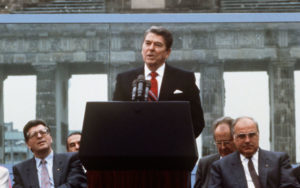
In one of the most prophetic speeches of the twentieth century, Ronald Reagan predicted the moral and political collapse of the mighty Soviet Union—a full decade before it occurred. At a time when the liberal establishment took the continued presence and influence of Soviet communism for granted, Reagan saw fatal internal weaknesses and contradictions. Addressing the British Parliament at Westminster Palace in June 1982, he explained:
We’re approaching the end of a bloody century plagued by a terrible political invention—totalitarianism. Optimism comes less easily today, not because democracy is less vigorous, but because democracy’s enemies have refined their instruments of repression. Yet optimism is in order, because day-by-day democracy is proving itself to be a not-at-all-fragile flower. From Stettin on the Baltic to Varna on the Black Sea, the regimes planted by totalitarianism have had more than 30 years to establish their legitimacy. But none—not one regime—has yet been able to risk free elections. Regimes planted by bayonets do not take root…It may not be easy to see; but I believe we live now at a turning point. In an ironic sense Karl Marx was right. We are witnessing today a great revolutionary crisis, a crisis where the demands of the economic order are conflicting directly with those of the political order. But the crisis is happening not in the free, non-Marxist West, but in the home of Marxist-Leninism, the Soviet Union. It is the Soviet Union that runs against the tide of history by denying human freedom and human dignity to its citizens.
Part of the genius of Reagan’s insight—ignored and disparaged by modern liberalism—was that regimes based upon the rejection of God and negation of human freedom would not endure. Respect for the natural rights and dignity of the individual, Reagan argued, was an essential foundation for a prosperous society. Reagan went on to lay out a strategy for promoting democratic reform around the globe, including the creation of the National Endowment for Democracy. He then delivered a line that would enrage the apparatchiks in the Kremlin: “What I am describing now is a plan and a hope for the long term—the march of freedom and democracy which will leave Marxism-Leninism on the ash-heap of history, as it has left other tyrannies which stifle the freedom and muzzle the self-expression of the people.”
Twenty-five years ago, Reagan’s vision was vindicated when the Soviet Union was officially dissolved in December 1991. Soviet leader Mikhail Gorbachev resigned as General Secretary on Christmas Day. Nearly beyond all hope or imagination, the forty-year-old Cold War between democratic capitalism and Soviet totalitarianism came to a peaceful end.
Almost no one saw it coming. Conventional liberal wisdom was that the United States and the Soviet Union had equally flawed political systems. They must work to “converge” and compromise for the sake of world peace. “Each superpower has economic troubles,” announced historian Arthur Schlesinger after a 1982 trip to Moscow. “Neither is on the ropes.” MIT economist Lester Thurow called it “a vulgar mistake to think that most people in Eastern Europe are miserable.” The intelligentsia concluded that Reagan’s prediction of Soviet decline was pure fantasy. Columbia University’s Seweryn Bialer insisted in 1982 that “the Soviet Union is not now nor will be during the next decade in the throes of a true system crisis, for it boasts enormous unused reserves of political and social stability that suffice to endure the deepest difficulties.”
After Reagan’s Westminster speech, historian Robert F. Byrnes collected essays from thirty-five experts on the Soviet Union—the cream of American academia—in a book titled After Brezhnev. Their conclusion: any thought of winning the Cold War was a pipe dream. “The Soviet Union is going to remain a stable state, with a very stable, conservative, immobile government,” Byrnes said in an interview. “We don’t see any collapse or weakening of the Soviet system.” As late as 1984, Harvard’s John Kenneth Galbraith echoed the mood of moral equivalency. “The Russian system succeeds because, in contrast to the Western industrial economies, it makes full use of its manpower.”
Well, now. Rarely in the field of human prognostication have so many self-appointed experts been so wrong about so much. It turns out that Ronald Reagan was not the naïve, warmongering ideologue of liberal imagination. Instead, the American president—who believed deeply in American exceptionalism—developed a coherent and plausible strategy to actually defeat the Soviet Union. Lou Cannon, the Washington Post reporter who covered the Reagan administration, later admitted: “the Westminster speech stands the test of time as the most farsighted and encompassing of Reagan’s anti-communist messages.”
Poland’s Solidarity Movement
What became known as the Reagan Doctrine effectively began in 1981, during the communist crackdown on the pro-democracy Solidarity movement in Poland. In December, Polish security forces invaded their own country: tanks rolled into Warsaw, roadblocks were set up, and the borders were sealed. Five thousand Solidarity members were rounded up in a single night. On December 13, the government declared martial law, driving the trade union underground.
The next day Reagan called Pope John Paul II, a native son of Poland, to seek ways they could cooperate to assist Solidarity. Reagan then told his staff at a National Security Council meeting: “We can’t let this revolution against Communism fail without our offering a hand. We may never have an opportunity like this in our lifetime.”
The White House authorized the CIA to finance protests, supply computers and fax machines to promote the democratic cause within Poland, and support television and radio broadcasts articulating the evils of Soviet domination. From 1981-88, the CIA spent about $50 million helping the trade union survive. Working with the Pope and British Prime Minister Margaret Thatcher, Reagan helped Solidarity to stay in touch with the West. The Pope met personally with Lech Walesa, the founder of Solidarity. In 1987, Thatcher became the first Western leader allowed to visit him. At a dinner with the communist leadership, Thatcher bluntly expressed her support for “freedom of expression, freedom of association and the right to form free and independent trade unions.”
Reagan also began funding insurgency groups combating communist dictatorships, from Latin America to the Near East. In Afghanistan, Reagan boosted support for the mujahadeen, the Islamic militants fighting the Soviet Army. The administration’s plan was to turn the Soviet invasion of Afghanistan into a Vietnam-style quagmire. It worked: The United States made the Soviets bleed in Afghanistan, and in 1989 the Soviet Army withdrew in defeat and disgrace.
The U.S. Military Build-Up
Although Moscow tried to conceal the truth from the West, the Reagan White House knew that the Soviet Union was in the throes of an economic crisis. Reagan adopted a defense strategy aimed not only at deterring Soviet aggression but also exploiting the economic weaknesses of the regime.
The pillars of Regan’s foreign policy toward the Soviet Union were established early in the administration, in its first major statement of Cold War strategy, National Security Decision Directive 75, approved in December 1982. The document describes two major objectives: first, to “contain and over time reverse Soviet expansionism. This will remain the primary focus of U.S. policy toward the USSR (italics added).” In other words, Reagan intended from the start to go beyond containment and to undo Soviet influence around the world. The second objective was “to promote…the process of change in the Soviet Union toward a more pluralistic political and economic system.” There was no liberal talk of “convergence” between the two rival systems, but rather the transformation of Soviet communism.
The Reagan Doctrine underwrote a massive military build-up—a five-year $1 trillion defense program—to convince the Russians they could never win a nuclear or conventional war against the United States. The White House also announced the Strategic Defense Initiative—dubbed “Star Wars”—a plan to use satellite technology to destroy nuclear missiles in flight. The idea was to outspend the Soviet Union in arms production to hasten its economic decline. As Reagan explained: “They [the Soviets] cannot vastly increase their military productivity because they’ve got their people on a starvation diet.”
All of these policies were controversial. But they placed immense pressures on the Soviet Union. “Someone in the Kremlin had to realize that in arming themselves to the teeth, they were aggravating the desperate economic problems in the Soviet Union,” Reagan wrote later, “which were the greatest evidence of the failure of Communism.”
Someone in the Kremlin did realize the dilemma—Mikhail Gorbachev. After becoming Soviet Premier in March 1985, Gorbachev at first reasserted the superiority of the communist system. “We are motivated by the ideas of the 1917 October Revolution,” he said, “the ideas of Lenin.” He bristled at Reagan’s critique of Soviet communism: “Those hoping to overstrain the Soviet Union” are “presumptuous,” he said. “So do not rush to toss us on the ‘ash heap of history.’ The idea only makes Soviet people smile.” Nevertheless, Gorbachev positioned himself as a reformer. His 254-page manifesto, called Perestroika (restructuring), promised to make the Soviet Union “richer,” “stronger,” and “better.” His programs of perestroika and glasnost (openness) were an attempt to rescue the Soviet economy from ruin.
1989: The Year of the Century
When Ronald Reagan turned over the presidency to George H.W. Bush in January 1989, the Soviet Union was on the brink of a geo-political freefall. But it didn’t look that way on the surface. At the start of the year, Moscow was firmly in control of its Eastern Bloc. In fact, two months before the 1988 presidential elections, the CIA excluded the possibility of any significant changes in the satellite states. “There is no reason to doubt ultimate Soviet willingness to employ armed force to maintain Party rule,” according to their report, “and preserve the Soviet position in the region.” Reagan dismissed the CIA’s skepticism.
Gorbachev’s policies of glasnost and perestroika, in fact, were emboldening populations fed up with the failures of the communist system: the empty shelves in the markets, the bread lines, the low wages, failing health system, and lack of basic freedoms. Gorbachev thought he could reform the Soviet system, liberalize it, and revive the entire communist project in the Soviet Union. It was a fool’s errand.
Beginning in 1989, opposition movements were gaining ground in virtually all of the Soviet Bloc states. Poland—the nation that first drew the democratic support of Reagan, Thatcher, and the Pope—lit the match that set off the revolutions of 1989. The Polish government, in the hands of beleaguered communist bureaucrats, agreed to hold free elections in June. Ninety-nine out of 100 seats in the legislature were won by Solidarity candidates.
Would Moscow allow the election results to stand?
Gorbachev called the head of the Polish Communist Party and said the Soviet Union would accept the outcome of the election. Lech Walesa was elected president, giving the country a democratic leader and a government with a communist minority: The communists in Poland surrendered power. The Brezhnev Doctrine—the principle that no state that had become communist could leave the Soviet fold—was effectively dead. Gorbachev’s phone call may have been the call that ended the Cold War.
Next came Hungary. In October, on the anniversary of the 1956 democratic uprising, Hungary abolished its communist party, declared itself a multi-party republic, and opened its borders. In November, it was East Germany’s turn: Watching these events at home, East Germans started pouring through Hungary into West Germany, destabilizing the East German government. Meanwhile, mass marches and demonstrations were held throughout cities such as Berlin and Leipzig. The German communist leadership asked Moscow to send in troops and tanks. Gorbachev told them to either enact reforms or get out of the country. The government opened the borders, and soon the Berlin Wall—the wretched symbol of totalitarian control—crumbled. Within weeks, demonstrations in Czechoslovakia led to a general strike and a parliamentary election that anointed a dissident poet, Václav Havel, as prime minister. It was called the Velvet Revolution.
It seemed unimaginable: peaceful democratic revolutions succeeded in virtually the entire Eastern Bloc, making 1989 the year of the century.
The Disintegration of the Soviet Union
The atmosphere of freedom soon enveloped the Soviet Union itself. Economic stagnation spurred independence movements in the Baltic states of Estonia, Lithuania, and Latvia. By March 1990, they all broke from Moscow. Meanwhile, democratic reformer Boris Yeltsin was elected president of Russia and promptly resigned from the Soviet Communist Party.
All of this was too much for Kremlin hardliners. On August 18, 1991, they placed Gorbachev under house arrest and staged a coup. Yeltsin climbed on top of a tank outside the parliament building and rallied anti-coup demonstrators in Moscow. The coup plotters, incompetent and shaken by the crowds, backed down. Gorbachev was restored to power, but his days were numbered—and so were those of the Soviet Union.
“Some people have urged the United States to choose between supporting President Gorbachev and supporting independence-minded leaders throughout the U.S.S.R.,” President Bush told an audience in Ukraine. “I consider this a false choice. In fairness, President Gorbachev has achieved astonishing things, and his policies of glasnost, perestroika, and democratization point toward the goals of freedom, democracy, and economic liberty.”
This was Bush-style diplo-speak: Gorbachev’s policies were supposed to revive and strengthen the Soviet Union—not inaugurate democratic capitalism or hasten the dissolution of the empire. Between August and December, ten republics declared their independence from Moscow. On December 1, in a popular referendum in Ukraine, ninety percent of voters chose independence. The exit of Ukraine—the second-most powerful republic—meant the end of any hope of preserving even a shrunken version of the Soviet Union. A week later, Russia, Ukraine, and Belarus formed a loose Confederation of Independent States.
On Christmas Day, December 25, 1991, Gorbachev resigned as General Secretary, and the Soviet flag flew over the Kremlin in Moscow for the last time. “This society has acquired freedom. It has been freed politically and spiritually, and this is the most important achievement that we have yet fully come to grips with,” Gorbachev said in a televised address. “And we haven’t, because we haven’t learned to use freedom yet.” History suggests that the desire for freedom is not enough—not when the state holds all the guns and runs the secret police. A political opening is required. By allowing Eastern Europe to go its own way, Gorbachev provided the opportunity.
The next day, the Supreme Soviet formally declared that the Soviet Union had ceased to exist as a functioning state. And what of its legacy? Over its seventy-year lifespan, roughly twenty-five million people are believed to have perished because of its violent experiment in Marxism-Leninism. No ideology had set out with such ruthlessness to destroy the Judeo-Christian heritage of Europe. No regime in history had amassed such a catalogue of human suffering: the purges, show trials, man-made famines, the gulags, ethnic cleansings, mass executions, and the culture of terror and paranoia. And when the awful, tortuous, and tragic story finally ended, no one—at least none of its victims—mourned its passing.
The Triumph of the Reagan Doctrine
Who gets credit for ending the Cold War? Liberals usually attribute the fall of the Soviet Union to its “structural weaknesses.” Strobe Talbott, a former Clinton administration official and now president of the Brookings Institution, has argued that the Soviet Union collapsed on its own accord because of its economic problems. “The Soviet system has gone into meltdown because of inadequacies and defects at its core,” Talbott wrote, “not because of anything the outside world has done or not done…The doves in the great debate of the past 40 years were right all along.”
It is hard to imagine a more impoverished political judgment: a thoroughly secular, materialistic view of the human person. The American Left ignores the fact that the people of Eastern Europe—people from all walks of life—never abandoned their hopes for political and spiritual freedom. With leaders such as Margaret Thatcher, Pope John Paul II, and Ronald Reagan supporting them, they persevered in their struggle for human dignity. Their moral courage helped to bring the Soviet leadership to its knees.
Equally important, four decades of patient containment by the democratic NATO alliance took its toll on the Soviet system. The Reagan Doctrine—the projection of U.S. military power to defeat communism—finally brought the crises of the Soviet Union to a boiling point. And what of Gorbachev’s role? We should first ask why a reformer of his kind rose to power in the Kremlin in the first place—and during Reagan’s presidency. Ilya Zaslasky, a member of the democratically elected Russian parliament, provided an answer: “Ronald Reagan was the father of perestroika.” Poland’s Lech Walesa agreed: “I wonder whether today’s Poland, Europe and world could look the same without President Reagan. As a participant in those events, I must say that it’s inconceivable.”
Against his critics, Reagan employed tough diplomacy, with moral clarity and spiritual insight, to challenge Soviet communism. It is easy to forget how deeply unpopular Reagan’s views were throughout the 1980s. His rhetoric about the Soviet Union as “an evil empire” sent leftist elites into apoplexy. The New Republic denounced his “primitive prose and apocalyptic symbolism.” Princeton University’s Stephen Cohen dismissed Reagan’s policies as “a pathological rather than a healthy response to the Soviet Union.”
If there was a pathology involved in America’s confrontation with Soviet communism, it was the sickness of mind that could not distinguish between the flawed democracy of the United States and the totalitarian horror of the Soviet Union. This pathology, this debased mental outlook about America’s influence in the world, is alive and well in modern liberalism. Its pre-eminence during the Age of Obama has allowed new forms of terror to thrive. “If history teaches anything,” Reagan warned, “it teaches that self-delusion in the face of unpleasant facts is folly.”
It will take a new generation of leaders, in the pattern of Ronald Reagan, to lift the fog of delusion and folly in our own day.


December 7, 2016
Providence: Countdown to Infamy
This article was originally posted at Providence.
Twelve days before the Japanese attack on the United States at Pearl Harbor, one of the nation’s most prominent liberal clergymen, Charles Clayton Morrison, denounced the growing talk of American involvement in the European war against Nazism. As editor of the Christian Century, Morrison had used his influential magazine to support every international peace plan imaginable to avoid a confrontation with Hitler’s resurgent Germany. All of those schemes had failed—while most of Europe lay prostrate before the German Wehrmacht.
Nevertheless, Morrison was unmoved. Talk of an Anglo-American alliance to defeat fascism, he wrote on November 26, 1941, “concealed the most ambitious imperialism every projected.” An Anglo-American victory in Europe, he intoned, would simply replace one kind of dictatorship with another:
The American citizen, with his boundless beliefs in his own capacities, is asked to prepare to fight a war so that he and his kind can take over the control of the world…Many Christians, who have finally brought themselves to consent to American entrance into the war as a means of destroying Hitler, have not yet grasped the potency of this dark logic, which will turn victory into the proclamation of a new imperialism.
President Franklin Roosevelt called the Japanese surprise attack on December 7 “a date which will live in infamy.” Perhaps an even greater infamy was the vacuous form of liberalism that denied the existence of radical evil, making it almost incapable of distinguishing between flawed democracies and fascist barbarism.
Groomed on Wilsonian idealism, Roosevelt had imbibed the spirit of the age. Like his European counterparts, the president responded meekly to the rise of totalitarianism in Europe and Asia. Japan’s brutal war in China, beginning in 1937, had revealed a nation in crisis: a despotic and militarized society. “Long before the European war broke out, Japan was a tense, underfed, increasingly desperate totalitarian country,” writes historian Paul Johnson, “which had alienated all its neighbors, abolished its constitutional and democratic system, abandoned the rule of law…and had adopted the expedient of using force to smash its way out of its difficulties, which were increasingly self-created.”
When the Japanese signed the Tripartite Pact with Germany and Italy in September 1940, there was no change in America’s foreign policy posture. In July 1941, when Japanese forces occupied French Indochina, Roosevelt authorized sanctions against the Japanese. But at Pearl Harbor, the main Pacific base of the American fleet, it was business as usual. Even after two years of Nazi victories in Europe, with Great Britain struggling for survival, FDR sought no significant build-up of U.S. military forces. As the president declared during his 1940 re-election campaign: “I have said this before, but I shall say it again and again and again: Your boys are not going to be sent into any foreign wars.” When the Japanese attack came, there were about 188,000 men in the American army, which in troop strength put it somewhere between Bulgaria and Portugal.
On December 7, 1941, America’s isolationist fantasy turned to fairy dust. Roosevelt’s speech to Congress the next day is rightly praised for its determination to marshal the nation’s resources to defeat her enemies. “No matter how long it may take us to overcome this premeditated invasion,” he said, “the American people in their righteous might will win through to absolute victory.”
Yet it was another speech to Congress, a few weeks later, on December 26, that laid bare unpleasant truths left unspoken by the American president. When Winston Churchill appeared before a joint session of Congress, he drew attention to the dangerous folly of democratic weakness in the face of international aggression. “We have performed the duties and tasks of peace,” he said. “They have plotted and planned for war.” But the pacifist impulse, indulged in by both Great Britain and the United States, had been a mistake. “If we had kept together after the last war, if we had taken common measures for our safety, this renewal of the curses need never have fallen upon us.”
Although delighted and buoyed by America’s entry into the war, Churchill nevertheless thought it necessary to offer a painful history lesson. In a subtle criticism of Roosevelt’s pre-war leadership, Churchill reminded his new ally of the wretched cost of the policies of appeasement:
Five or six years ago it would have been easy, without shedding a drop of blood, for the United States and Great Britain to have insisted on fulfillment of the disarmament clauses of the treaties which Germany signed after the Great War…That chance has passed. It is gone. Prodigious hammer-strokes have been needed to bring us together again.
The painful and prodigious hammer-strokes would continue unabated. Within weeks of Pearl Harbor, Japanese forces advanced across the Pacific and South-East Asia in a daring offensive that left American and British troops staggering in defeat and surrender. By the spring of 1942, Japan had executed a blitzkrieg of its own, as devastating as that of the Germans in Europe.
But the Japanese, like the Germans, had vastly underestimated the martial fury of the American people once they are forced into war. Virtually overnight, the United States overcame its deficit of moral seriousness: nonsense talk about American imperialism gave way to a message of national unity to defeat totalitarianism. Pearl Harbor accomplished in an instant what the American president could never have achieved on his own: it persuaded the United States to engage in a total war, a just war, with every ounce of its combined economic and military strength.
Now, finally, the “arsenal of democracy” would do its work.
November 18, 2016
Providence: The Failure to Protect: Syria, the Christian Church, and Humanitarian Intervention
This article was originally posted at Providence.

What follows is an edited version of Loconte’s remarks at the Evangelicals for Peace conference “Christians Engaging Global Conflict: Syria,” held on Nov. 16-17, 2016, in Washington, DC.
When history renders its judgment of the conduct of the Western democracies toward the Syrian civil war, what will it be? And how will the conscience of the West—especially its Christian conscience—stand up under that judgment?
Listen to historian C.V. Wedgwood: “Aggression, dynastic ambition, and fanaticism are all alike present in the hazy background behind the actual reality of the war.” Wedgwood was actually writing about the last religious war in the West, the Thirty Year’s War, which ended in 1648.
“Morally subversive, economically destructive, socially degrading, confused in its causes, devious in its course, futile in its result,” she said, “it is the outstanding example in European history of meaningless conflict.”
Whatever meaning we attach to the Syrian conflict, we are witnessing once again the deadly interplay of political ambitions and sectarian zeal. The will to power under the cloak of religion.
In the Thirty Year’s War, the Catholic League squared off against the Protestant Union. But that rivalry was overshadowed by the spectacle of the two great Catholic powers of Europe—France and Spain—battling it out like scorpions in a bottle.
Out of the desolation of that conflict came not only the Treaty of Westphalia, with its respect for the territorial integrity of other nations, the idea of sovereignty. Thanks to Protestant thinkers such as Hugo Grotius, new principles were articulated for warfare: how to conduct wars, how to treat prisoners of war, and how to conclude wars with a semblance of justice.
Consider Grotius in his treatise, On Laws of War and Peace (1625):
Though there may be circumstances, in which absolute justice will not condemn the sacrifice of lives in war, yet humanity will require that the greatest precaution should be used against involving the innocent in danger, except in cases of extreme urgency and utility.
The human carnage of the Syrian civil war has been on display in ways we have not seen for decades. It was the remorseless violence of the 1990s—the genocide and the ethnic cleansings in Rwanda, in the Balkans, and in Sudan—which prompted the international community to think differently about its obligation to prevent crimes against humanity.
The Responsibility to Protect
Political leaders began to embrace a new concept in international relations: The Responsibility to Protect.
As described in the UN’s “World Summit Outcome” document, approved by the General Assembly in September 2005, member states have a “collective responsibility to protect” people from genocide and other human rights abuses. The concept comes from a 2001 report by the International Commission on Intervention and State Sovereignty (ICISS). The commissioners argued that membership in the United Nations carries obligations: States that fail to protect their citizens, they said, should not be allowed to hide behind the doctrine of national sovereignty to escape international censure—or military action.
“Where a population is suffering serious harm…the principle of non-intervention yields to the international responsibility to protect,” the commissioners wrote.
Secretary General Kofi Annan endorsed the report’s recommendations.“It cannot be right, when the international community is faced with genocide or massive human rights abuses, for the United Nations to stand by and let them unfold to the end,” Annan said. “I believe that we must embrace the responsibility to protect, and, when necessary, we must act on it.”
The Responsibility to Protect expresses a universal norm, morally binding on all member states.
What does any of this have to do with the Christian church? There are, after all, secular arguments for this principle of intervention. And none of the various UN documents supporting the Responsibility to Protect mention any religious sources for the new doctrine.
Yet the philosophical fingerprints of the doctrine are unmistakable: The Responsibility to Protect owes its greatest debt to a religiously rooted approach to achieving peace with justice, the Christian just war tradition.
Listen to Thomas Weiss, professor at the City University of New York, who led the Commission’s research team: “The principles are derived directly from the just war tradition,” he told me in an interview. The basic tenets of the Judeo-Christian moral vision were “front and center in the discussion” and provided the “intellectual underpinnings” of the rationale for intervention.
The Christian just war tradition begins with the God-given worth and equality of every human life, and then insists on the state’s obligation to defend that life against harm—using lethal force if necessary.
It draws both from the Hebrew Bible, from the Genesis account of man’s inherent dignity, as well as from the Christian New Testament, with its doctrine of a political authority empowered to restrain evil.
Indeed, the UN’s criteria for military engagement—duplicated in nearly all successive UN documents—follow precisely those articulated by Christian theologians starting with Augustine: The motive must be to prevent human suffering (right intention); means short of force must be judged as unlikely to stop the aggressor (last resort); the military option must be proportional to the threat (proportionality); and the consequences of action must not be worse than inaction (reasonable prospects).
This is classic Christian just war theory.
The Failure to Protect
If the Responsibility to Protect doctrine has gained international approval, then why is the international community still paralyzed in the face of this latest episode of crimes against humanity?
I think there are several reasons.
First, there is the dismal example of Libya. During the uprising against Muamar Gaddafi, the UN Security Council invoked the “responsibility to protect” to intervene. The regime was toppled, and Libya quickly descended into chaos.
The failure of the United States and our European allies to help stabilize Libya has discredited the doctrine among many political leaders and leaders in humanitarian organizations.
Second, there is a widespread belief that any conflict in the Middle East is fueled by religious ideology, and that Western intervention will only make the situation worse. Radical Islam will use the presence of Western military forces as a recruiting tool.
Third, there has been a complete lack of imagination by the Obama administration about how to address the Syrian conflict and protect civilians. There is no moral vision for the United States in this epic crisis.
To hear President Obama tell it, we should congratulate the White House for its prudence and geo-political humility with regards to Syria: No American soldiers, after all, have died in this war. But Mr. Obama has much less to say about the 470,000 Syrians who have perished violently because of Assad’s determination to remain in power, or the fact that half of the population of Syria have become refugees.
As the president’s chief foreign policy advisor, Ben Rhodes, put it to a group of Syrian activists: “Nothing we could have done would have made things better.” Let that sentence hang in the air: Nothing we could have done would have made things better.
Here is fatalism masquerading as foreign policy.
Fourth and finally, most decision-makers remain slavishly devoted to the United Nations—especially the UN Security Council—as the only legitimate institution to confront human rights crises.
But one of the principles of just war thinking is the need for a legitimate political authority. The 15-nation UN Security Council is a mix of democracies and dictatorships. It grants veto power to autocratic regimes that, by definition, have little regard for the rights of the weak. Russia, for example, a permanent member of the Security Council, is the strongest supporter of the Assad regime—the government that is primarily responsible for the bloodletting.
James Turner Johnson, a leading just war theorist, observes that the United Nations has a history of paralysis in this regard. “The structure of the UN is such,” he writes, “that clear purpose and effective command and control are virtually unimaginable.” These are geo-political realities.
Wanted: Christian Realism
Misplaced faith in the UN system to protect civilian populations owes much to secular assumptions about human nature and political societies. The Syrian civil war has been deepened by the liberal notion that diplomatic talk can solve virtually any crisis—exemplified by Secretary of State Kerry’s feckless peace agreements, which have only strengthened the hand of Bashar al-Assad, not to mention the insidious influence of Putin’s Russia.
Protestant theologian Reinhold Niebuhr, writing when Nazi Germany had unleashed its Blitzkrieg on Europe, identified this diplomatic mindset as one of liberalism’s great defects. He was appalled by religious liberals who were calling for a peace conference even after Hitler controlled most of continental Europe:
[Liberalism] is full of illusions about the character of human nature, particularly collective human behavior. It imagines that there is no conflict of interest which cannot be adjudicated. It does not understand what it means to meet a resolute foe who is intent upon either your annihilation or enslavement.
We need a dose of Niebuhr’s Christian realism.
We have heard repeatedly the mantra that “there is no military solution to this crisis.” Behind this slogan lies a utopian impulse: the desire to make the ethics of the Sermon on the Mount—love your neighbor as yourself—a road map for U.S. foreign policy. This represents a profound intellectual confusion: the conflation of the nature and responsibilities of the State with the nature and responsibilities of the Church.
Of course the work of the Christian church, of Christian relief organizations, is critical to helping people in great humanitarian need. This is the task of civil society.
Christian humanitarian work is the mirror image of the Responsibility to Protect: believers, operating with their resources of love and compassion and mercy, reach out to help their neighbors in need. But this work, as important as it is, may not advance the cause of justice. That is primarily the role of the State: to punish the aggressor and protect the innocent from great harm.
Herein lies the deep flaw in the thinking of progressive theologians such as Stanley Hauerwas, who endorse an essentially pacifist position in the face of genocide and crimes against humanity. “My only response is I do not have a foreign policy,” Hauerwas boasts. “I have something better—a church constituted by people who would rather die than kill.”
This “theology of love,” as they call it, offers no effective protection to the neighbor in need—whether they are the Jews at Auschwitz or the Christians in Kirkuk or the Muslims in Aleppo. As the Somali poet, Warsan Shire, explains: “No one puts their children in a boat unless the water is safer than the land.” Today, five years into the civil war, there is no safety for millions of men, women, and children in the land of Syria.
How will history judge the West in light of this catastrophe?
Consider the verdict of Winston Churchill, days after the Munich Agreement of 1938, which delivered the democratic state of Czechoslovakia to Nazi Germany, into the hands of terror and totalitarianism—all for the promise of peace. Substitute Syria for Czechoslovakia, and the United States for Britain and France:
But we cannot consider the abandonment and ruin of Czechoslovakia in the light only of what happened…last month. It is the most grievous consequence…of what we have done and of what we have left undone in the last five years—five years of futile good intention, five years of eager search for the line of least resistance, five years of uninterrupted retreat of British power…Those are the features which I stand here to declare and which marked an improvident stewardship for which Great Britain and France have dearly to pay.
To borrow from Churchill, “we are in the presence of a disaster of the first magnitude.” No, a “theology of love” divorced from the Biblical demands of justice will not do. What should we call this theology—this ideology that allows the forces of terror to triumph, this pietism that adds to the catalogue of human suffering?
Here, it seems, is a distortion of the heart of the gospel message, the Christian doctrine of the atonement. As Niebuhr explained, “the divine mercy, apprehended by Christian faith in the life and death of Christ, is not some simple kindness indifferent to good and evil.” Any political attempt to bring about a more just society, he said, must face the intractable nature of human sin.
The Biblical answer to the problem of evil in human history is a radical answer, precisely because human evil is recognized as a much more stubborn fact than is realized in some modern versions of the Christian faith. These versions do not take the problem of justice in history seriously, because they have obscured what the Bible has to say about the relation of justice to mercy in the very heart of God.
Radical evil demands the radical answer of the gospel: Mercy and Justice. Love and Truth. The Lamb of God and the Lion of the Tribe of Judah. Here is good news, a gospel worthy of the name.
Whatever else we do, or attempt to do: may we help our neighbors in Syria come to know this gospel, and to know a measure of the peace that comes with this knowledge—not peace as the world gives, but the peace that endures.
November 7, 2016
Huffington Post: Choking Like a Dog

Early in this sordid and salacious campaign season, Republican presidential candidate Donald Trump derided Mitt Romney for losing his 2012 presidential bid against Barack Obama with these words: “He choked like a dog.”
But the choking dog today has orange hair. Nominated by the party of Lincoln, the Great Emancipator, Trump ranks among the most morally and emotionally unfit candidates for president in the history of the republic. This choking dog has, in fact, been choking since the day he announced his candidacy: coughing up the bile of nativism, racism, misogyny, and all the rest. Meanwhile, he has a risible counterpart in his Democratic opponent, Hillary Clinton. As the leaked Clinton emails reveal, she and her party have substituted Trump’s vilification of immigrants with the demonization of conservative Christians. Trump’s disregard for the basic rules of civility is mirrored by Clinton’s contempt for the constitution and the rule of law. His ignorance of America’s national security interests is matched by her indifference to national security in the pursuit of wealth and political power.
America is in the throes of a leadership crisis. It is, at its heart, a religious and cultural crisis—yet those leaders who should understand this fact and face it squarely seem to have escaped into another reality. Conservative commentators and think tanks have embraced Trump almost as a messianic figure who will “blow up the system” and give them privileged seats at the new table. Some have compared him to Ronald Reagan, others have hailed him as “the Winston Churchill of our time.” Many conservative Christians support Trump as “the lesser of two evils,” fearing that a Clinton victory means the “end of democracy, period.” Others accuse fellow Christians of moral cowardice for refusing to get on the Trump train, even likening them to Christians in Nazi Germany who failed to take a stand against Hitler.
Conservatives sully their cause, however, when they ignore history—or reach for it like a club to bludgeon and emotionally browbeat their critics. “A man who has lived in many places is not likely to be deceived by the local errors of his native village,” wrote C.S. Lewis. “The scholar has lived in many times and is therefore in some degree immune from the great cataract of nonsense that pours from the press and the microphone of his own age.”
We have endured a great cataract of nonsense during this campaign, from Christians as well as the secular-minded. Partisans on both sides have defended the indefensible—and have done so with a breathtaking degree of condescension, dogmatism, and intellectual dishonesty. Part of Lewis’s remedy for the phony moralizing of his age was a deep appreciation for history: an honest understanding of our civilization, with all of its faults, follies, and achievements.
Yes, America appears to be in the grip of a political and cultural crisis—no matter who wins this presidential election. But the United States has survived much darker days than these.
Conservatives who rightly worry about the composition of the Supreme Court, or the abuse of executive power, or a deepening racial divide, or the threat of terrorists slipping in among a refugee population ought to reflect on America in the 1930s and early 1940s. Back then, a liberal, Democratic president, Franklin Roosevelt, tried to subvert the constitution by stacking the Supreme Court with hand-picked nominees who would approve his “New Deal” legislation. He was substantially rebuked. As for racism, in the name of “national security,” the same liberal Democratic president ordered the forced “internment” of tens of thousands of Japanese-American citizens. Families were torn apart, lives ruined. The policy was eventually abandoned and repudiated. (Racism directed at African-Americans, of course, continued apace, as they were denied their civil rights and legally segregated from virtually all white establishments.) As for the immigration debate, throughout the 1930s neither Franklin Roosevelt nor Congress lifted a finger to help German Jews escape the fires of Nazism and find sanctuary in the United States. One of the reasons: the association of European Jews with Soviet Bolshevism, the great ideological enemy of the democratic West. We rightly look back on that lurch into nativism with sorrow and regret. Yes, to borrow the words of W.H. Auden, “it was a low, dishonest decade.”
It has been a low and dishonest presidential campaign—perhaps the lowest in our history. To borrow Trump’s words, both candidates are choking like a dog: eviscerating, that is, our public standards of decency, truth-telling, and integrity. In this, they are aided by a roster of sycophantic media, crony capitalists, and political hacks.
Can the United States endure under a Trump or Clinton regime? Yes, but history suggests that there will be a cost involved. We cannot fully anticipate the damage that either will inflict to our democracy, or to America’s democratic influence in the world. So what are people of faith, or of otherwise good conscience, to do? History and common sense tell us that we are not morally obligated to validate either candidate with our vote. An affirmative vote for either one makes it more likely that we shall see more of their kind—more leaders who incarnate political corruption, more demagogues who inflame our fears and resentments.
America can survive a Trump or a Clinton, but not a succession of Trumps and Clintons. To paraphrase a verse from the Book of Proverbs: “As a choking dog returns to his vomit, so a fool repeats his folly.” Leave the sad creature alone, walk away, and give him no aid.
Joseph Loconte is an associate professor of history at the King’s College in New York City and the author of A Hobbit, a Wardrobe, and a Great War: How J.R.R. Tolkien and C.S. Lewis Rediscovered Faith, Friendship, and Heroism in the Cataclysm of 1914-1918.
BBC: The President, the electorate and religion
This article was originally posted at BBC Radio Wales.

http://www.josephloconte.com/wp/wp-content/uploads/2016/11/AllThingsConsidered-20161106-ThePresidentTheElectorateAndReligion.mp3
On Wednesday, we should know who will become the most powerful person in the world. The US Presidential election has been called ‘the biggest unpopularity contest in America’s recent history’, with torrents of allegations about both candidates, and revelations ranging from the breathtaking to the simply squalid.
Yet it could make history by choosing the first woman president. Or a maverick outsider. Roy Jenkins asks how significant religious groups have been in this campaign. Is their involvement likely to swing the result – and even if it does will it leave them damaged? And how much do we know of what Hillary Clinton and Donald Trump actually believe?
Joseph Loconte is an associate professor of history at the King’s College in New York City and the author of A Hobbit, a Wardrobe, and a Great War: How J.R.R. Tolkien and C.S. Lewis Rediscovered Faith, Friendship, and Heroism in the Cataclysm of 1914-1918.
October 29, 2016
The Times: How a Catholic Humanist Inspired the Reformation
This article was originally posted at The Times.

Next year marks the 500th anniversary of Martin Luther’s challenge to the Catholic Church that launched the Protestant Reformation. However, it was in 1516 that a brilliant scholar and reformer — a Catholic humanist — cleared a path for the spiritual revolution that would shatter the unity of Christendom.
Desiderius Erasmus, the foremost disseminator of classical culture in Europe, published his greatest literary achievement 500 years ago: an edition of the Greek text of the New Testament, the first of its kind in print, with a parallel Latin translation and commentary. Erasmus was appalled by the moral turpitude of the church: the warrior popes, heresy trials, priestly concubines and lust for wealth and worldly power. Dogma had displaced authentic piety. A return to the original text of Scripture, he believed, would make possible “the restoration and rebuilding of the Christian religion”.
Erasmus’s new text, based on a study of original Greek manuscripts, casts doubt on the Latin (Vulgate) translation of the Bible, first made by Jerome in AD382 and endorsed as authoritative by the Church. Erasmus translated a statement from Jesus in Matthew iv, 17, for example, as “repent, for the kingdom of Heaven is at hand”. This was at odds with the Latin rendering “do penance”, cited by the Church to justify its elaborate system of punishments as payment for sin.
The work set off a storm of controversy. One critic warned that if the Vulgate was in error, “the authority of theologians would be shaken, and indeed the Catholic Church would collapse from the foundations”.
Yet Erasmus saw no conflict between the aims of the Christian educator and the tools of the humanist scholar, namely the study of ancient texts in their original grammatical and historical setting. His Greek translation was the opening barrage in a battle for the right of biblical criticism.
Martin Luther received the new translation in Wittenberg while he was lecturing on the book of Romans. From that moment, according to the biographer Roland Bainton, the Erasmus text “became his working tool”. Topping the list of Luther’s 95 indictments, hammered to the door of All Saints’ Church on October 31, was an assault on penitential theology. “When our Lord and Master, Jesus Christ, said ‘repent’, he called for the entire life of believers to be one of repentance,” he declared. “The word cannot be properly understood as referring to the sacrament of penance . . . as administered by the clergy.”
Perhaps the most subversive quality of Erasmus’s humanism was his attempt to recover the moral life of Jesus — a life of humility, compassion and love for one’s enemies. “What else is this philosophy of Christ, which he himself calls being born again,” he wrote in the preface to his Greek New Testament, “but the renewal of human nature well formed?” He wanted the Bible “translated into all languages” and made accessible to ordinary believers. “I would that even the lowliest woman read the Gospels and the Pauline Epistles,” he said.
On the eve of the Reformation, Erasmus — a counsellor to princes and cardinals alike — was at the height of his influence and fame. Luther was emboldened by his example. Like Erasmus, Luther believed that the Church had exchanged a message of grace for a mechanical and legalistic religion.
Thus Luther produced his own translation of the Bible into German. It was a watershed event: with the increasing availability of the printing press, there was no stopping him.
Although Luther ultimately broke with Erasmus over his loyalty to the Catholic Church, Erasmus never publicly condemned him. Instead, Erasmus criticised church leaders as “a pestilence to Christendom” for attacking Luther’s Ninety-five Theses and his campaign for reform. “If, as appears from the wonderful success of Luther’s cause, God wills this, and He has perhaps judged such a drastic surgeon as Luther necessary for the corruption of these times,” he wrote, “then it is not my business to withstand him.”
Once Erasmus helped to set the surgeon loose, the west would undergo both trauma and recovery—a Reformation from which there was no retreat.
Joseph Loconte is an associate professor of history at the King’s College in New York City and the author of A Hobbit, a Wardrobe, and a Great War: How J.R.R. Tolkien and C.S. Lewis Rediscovered Faith, Friendship, and Heroism in the Cataclysm of 1914-1918.
October 13, 2016
Huffington Post: Trump, Truth, And The Christian Right
This article was originally posted at Huffington Post.

The Donald Trump “sex tape” that has sent Republicans scurrying like rats from a sinking barge—just weeks before the presidential election—is spectacle enough. Now add to this cavalcade of confusion the volte-face of a handful of prominent evangelical voices who, up until this moment, declared Trump “a morally good choice.” Such reversals do not signal remorse and enlightenment, however, but rather desperation and denial.
Everyone who has endorsed Trump, politician or preacher, has been diminished by the association. Yet chief among these tragic figures is Wayne Grudem, professor of theology and biblical studies at Phoenix University and author of Systematic Theology: An Introduction to Biblical Doctrine, a required text in many evangelical colleges and seminaries. In late July, Grudem published a 5,000-word defense of Trump that kicked up a firestorm. No other evangelical thinker attempted such an ambitious project—the reconstruction of Donald Trump into a credible presidential candidate—couched in the language of moral theology and prudential politics.
In reality, Grudem’s polemic was shot through with half-truths, facile assumptions, tortured logic, and emotional manipulation. His eleventh-hour abandonment of Trump suggests something of the anguished state of militant evangelicalism.
Offering not a scintilla of evidence, Grudem at first concluded that “Trump’s character is far better than what is portrayed by much current political mudslinging, and far better than his opponent’s character.” Declaring the need to make “an ethical decision” in this election, Grudem wrote, “we should base the decision on the most likely results. In this case, the most likely result is that Trump will do most or all of what he has said.” Put aside the inconvenient fact that Trump’s political views are amorphous and malleable, that he shows no capacity to work with the legislative branch of government, and that much of his agenda represents an assault on the constitution and the international norms upholding human rights.
Grudem ended his essay with a moral taunt about as damning as any Puritan jeremiad ever delivered:
But the most likely result of not voting for Trump is that you will be abandoning thousands of unborn babies who will be put to death under Hillary Clinton’s Supreme Court, thousands of Christians who will be excluded from their lifelong occupations… thousands of sick and elderly who will never get adequate medical treatment when the government is the nation’s only healthcare provider, thousands of people who will be killed by an unchecked ISIS, and millions of Jews in Israel who will find themselves alone and surrounded by hostile enemies. And you will be contributing to a permanent loss of the American system of government due to a final victory of unaccountable judicial tyranny.
Yes, gentle Christian voter, this apocalyptic cascade of events—the abandonment of entire classes of people to perdition and the permanent loss of American democracy—must be placed on your shoulders for failing to endorse Donald Trump for president. This is what passes as serious ethical reflection in evangelical circles.
But of course that was Wayne Grudem’s position in late July. The Trump video, in which the candidate boats of sexually assaulting women, apparently transformed Grudem’s political theology overnight. His pious defense of the Republican nominee morphed into a slippery, Trump-like non-apology for having done so. “I previously called Donald Trump a ‘good candidate with flaws’ and a ‘flawed candidate,’” he wrote in Townhall.com, “but I now regret that I did not more strongly condemn his moral character.”
The deepest problem for Grudem, and others like him, is that his original manipulation of Trump’s record was a deliberate evasion of the truth. Even now, Grudem cannot speak frankly, in total candor, about his previous endorsement. “I did not take the time to investigate earlier allegations in detail, and I now wish I had done so,” he says. “If I had read or heard some of these materials earlier, I would not have written as positively as I did about Donald Trump.”
The evasion of truth persists: Grudem expended 5,000 words to reimagine Donald Trump according to his liking, but “did not take the time to investigate” Trump’s public record and character? Like everyone else following Trump’s ascendancy, he knew all about the lies and misstatements, the infidelities, the misogyny, the mockery of the disabled, the race-baiting rhetoric, the attacks on a grieving gold-star family, and on and on. Grudem did not merely write “positively” about Trump; he wrote dogmatically, with moral certitude. “I feel the force of the words of James,” he intoned. “Whoever knows the right thing to do and fails to do it, for him it is sin.” And for all this sanctimony he offers no apology—not to his students, for whose moral formation he is partially responsible, nor to the larger Christian community he hoped to influence.
In the war of words during this disgraceful campaign, on both sides of the political aisle, truth has been the most conspicuous casualty. But how do we explain the failure to uphold basic norms about truth-telling among Bible-believing Christians?
History offers some clues. There is a belligerent strain in Protestant Christianity, embodied in the Calvinist tradition to which Grudem belongs, which has been willing to sacrifice moral and biblical truth in the pursuit of noble ends. John Calvin, supremely confident he had recovered a neglected view of predestination, sought to build a community of “the elect” in Geneva—and adopted a theology justifying the banishment, vilification, and execution of dissenters in order to achieve it. His doctrine was a violent rejection of the life and teachings of Christ. The English Puritans, overwhelmingly Calvinist, viewed the kingship of Charles I as the great obstacle to their hopes for a godly commonwealth. They wanted to blow up the old order. They instigated a civil war, orchestrated the king’s execution, and turned to a “man on horseback” to inaugurate a new regime: Oliver Cromwell. Like the Puritan project in Salem, Massachusetts, the experiment did not end well.
It is perhaps no accident that Grudem is considered a leading light among the “new Calvinists,” a small but vocal group of hard-line thinkers and preachers who hold an uncompromising view of the Calvinist doctrines of election and predestination. Like the old Calvinism, the new Calvinism teaches its adherents that they are a righteous remnant battling a godless and hostile political culture. This is not the place to debate Protestant theology, but the tribalism and dogmatism of historic Calvinism may have found a political outlet. As one theologian and critic put it recently: “I think Calvinism is the Donald Trump of theology.”
That’s a harsh verdict. Many believers outside the Calvinist or Reformed tradition, after all, have endorsed Trump, and some prominent Calvinists have denounced him as unfit for the presidency. Nevertheless, the rise of Trump represents an illness in the body politic—a politics of self-righteous rage that has an analog in militant Christianity. It is time, inside the church, for a ruthless moral inventory. As the Scripture warns: “Judgment begins in the house of God.”
Joseph Loconte is an associate professor of history at the King’s College in New York City and the author of A Hobbit, a Wardrobe, and a Great War: How J.R.R. Tolkien and C.S. Lewis Rediscovered Faith, Friendship, and Heroism in the Cataclysm of 1914-1918.
October 7, 2016
Providence: The Syrian Catastrophe: There Is No Plan B
This article was originally posted at Providence.

Perhaps the most telling political moment of the Syrian refugee crisis arrived last week, during a verbal bout between Senator Bob Corker, Chair of the Senate Foreign Relations Committee, and Antony Blinken, Deputy Secretary of State. Their exchange occurred just as the latest “cease-fire” agreement, intended to allow humanitarian aid into the besieged city of Aleppo, had collapsed. Russian and Syrian aircraft, in fact, had just targeted and destroyed an aid convoy into Aleppo, killing many civilians and aid workers. What would be the response of the United States?
Corker’s relentless demand for an explanation of White House policy opened up a window into the soul of the Obama administration. It would take a Dante, however, to describe its contorted and degraded condition: “Mercy and Justice deny them even a name,” he wrote in The Inferno. “Let us not speak of them: look, and pass on.”
When history renders its awful verdict of Barack Obama’s responsibility for the human catastrophe of Syria, the Corker-Blinken confrontation will be part of the brief.
The Senate committee hearing addressed the claim, first uttered by Secretary of State John Kerry, that if negotiations with Russia over a Syrian cease-fire failed, the United States was prepared to execute “plan B” to help resolve the standoff with President Bashar al-Assad. Kerry made the claim in February, on the eve of an earlier cease-fire plan that quickly disintegrated. As Kerry warned at the time: “Assad himself is going to have to make some real decisions about the formation of a transitional government process that is real…there are certainly plan B options being considered.”
Corker: “I have never seen signs of a plan B…Assad doesn’t believe there’s a plan B and Iran doesn’t believe there’s a plan B. So how can the Secretary of State have any chance of success in ending the murder, torture, and bombing of innocent people? How does the Secretary of State have any chance of success when the White House is unwilling at any level to have a back-up plan if diplomacy fails?”
As the Senate committee was meeting, Russian and Syrian aircraft were renewing their attacks on Aleppo, using bunker-busting bombs, cluster bombs, barrel bombs, and thermobaric bombs, which disperse a cloud of explosive particles before setting off devastating blasts. The failure of the latest ceasefire means that over 275,000 civilians, including at least 100,000 children, are trapped in Aleppo with no reliable sources of food, water, or medicine. Yet one of America’s top diplomats responds as though he were an accountant discussing an audit.
Blinken: “All of these issues, including Syria, are being worked through a very deliberative process involving all of the agencies relevant to the issue…And we have tried to work through these things deliberately and to make the best possible assessment of the best way to advance our interests and evaluate both the benefits and risks of any course of action, and that is what we have done in this case. Any policy that emerges is the product of these deliberations. The Secretary of State is very much fully a part of it. In the case of Syria, I think it’s useful for a second to step back and ask yourself this question: how do civil wars end? We know from experience—”
Corker cuts him off.
Corker: “I don’t want a history lesson. I would just like to understand what plan B is. The mysterious plan B that has been referred to since February. The mysterious plan B that was supposed to be leveraged to get Russia to quit killing innocent people, to get Assad to quit killing innocent people. Just explain to us the elements of plan B.”
Now the accountant-diplomat begins to sound like a first-year law student with a tenuous grasp of English grammar.
Blinken: “In the first instance, plan B is the consequence of the failure as a result of Russia’s actions of plan A, in that what is likely to happen now is if the agreement cannot be followed through on and Russia reneges totally on its commitments, which it appears to have done, is this is going, of course, to be bad for everyone, but it’s going to be bad first and foremost—”
Corker cuts him off again.
Corker: “I understand that. What is plan B? Give me the elements of plan B.”
Now, in a supreme act of obfuscation, the law student and the accountant become one.
Blinken: “Again, the consequences I think to Russia as well as to the regime will begin to be felt as a result of plan A not being implemented because of Russia’s actions. Second, as I indicated, the president has asked all of the agencies to put forward options, some familiar, some new, that we are very actively reviewing. When we are able to work through these in the days ahead, we will have an opportunity to come back and talk about them in detail. But we are in the process of doing that.”
Corker: “Ok, so let me just say what we already know: There is no plan B.”
Senator Corker attempted to explain to a senior Obama administration official that diplomacy without the projection of American power could never succeed. He attempted, unsuccessfully, to persuade this official that Russia is not suffering unhappy consequences from the failure of diplomacy in Syria—quite the opposite. “The consequence that you are laying out,” Corker said, “is that Russia will fully determine the future of Syria.”
Thanks to an intellectually confused and morally debased U.S. foreign policy—relying on meaningless multilateralism, phony threats of military action, and fictitious plan Bs—the future of Syria is as dark as anything in Dante’s imagination.
Nevertheless, like many of the desperate souls in Dante’s epic work, the White House and its chief advisors have chosen the path of cowardice and self-delusion. Despite all evidence to the contrary, Blinken insisted that “Russia is going to bear significant consequences” for its support of the Assad regime. John Kerry, while brokering a truce that everyone knew would fail, claimed with a straight face: “There are no illusions. Eyes are open.”
Perhaps the moral blindness of Barack Obama and his senior diplomats—cynical, arrogant, and remorseless—has finally run its course. In Aleppo, at least, the scale of human suffering summons the clarifying light of conscience. After Aleppo, the president and his surrogates may be forced out of the shadows of a deranged diplomacy: “Let us not speak of them: look, and pass on.”
Joseph Loconte is an associate professor of history at the King’s College in New York City and the author of A Hobbit, a Wardrobe, and a Great War: How J.R.R. Tolkien and C.S. Lewis Rediscovered Faith, Friendship, and Heroism in the Cataclysm of 1914-1918.
October 5, 2016
Standpoint: Cicero’s Analysis Of Decline Offers Lessons For The West
This article was originally posted at Standpoint.

Rome’s greatest statesman, a man deeply admired by the American Founders for his insights into morality, law, and politics, drew his last breath in Formia. Marcus Tullius Cicero was at his seaside villa, north of Naples, along the old Appian Way, when soldiers sent by Mark Anthony arrived on December 7, 43 B.C. At the age of 64, he was retired from politics but continued to denounce the forces tearing apart Rome’s political and civic life. As the assassins approached him with swords drawn, Cicero reportedly displayed a calm defiance, born of his Stoic philosophy: “There is nothing proper about what you are doing, soldier, but try to kill me properly.” They cut his throat.
Thus Cicero’s decades-long struggle to preserve Rome’s republic — with its “mixed” or “balanced” constitution — came to an end. The advocates of oppression and terror had triumphed. For all practical purposes, when Cicero fell the republic fell with him. “Cicero came to stand for future generations as a model of defiance against tyranny,” writes Anthony Everitt in Cicero: The Life and Times of Rome’s Greatest Politician. “For the Christian Fathers he was a model of the good pagan.”
Of course, the decay of Rome’s political institutions — what Cicero called “the enemy within” — had been raging for many years. When he wrote his seminal works, The Republic and The Laws, the age of the Caesars was already upon him. What strikes the modern reader is how Cicero’s analysis of Rome’s decline — the betrayal of its republican constitution, the rampant corruption, the partisan divisions — offers the West some profoundly disturbing lessons.
Rome initially managed to absorb and tolerate a great diversity of cultures, and gradually expanded its offer of citizenship to conquered peoples. But by the time Cicero drafted The Republic (54-52 BC), Rome’s political institutions were ineffective. Worldly senators blocked economic reforms being demanded by an urban proletariat alienated from the political system. There were deep economic disparities, worsened by a tax system that crippled private initiative. There were massive public works programmes, with no sensible scheme to finance them. Mob violence was on the rise. An over-extended military, dominated by ambitious generals, struggled to maintain discipline. In the city of Rome — a cosmopolitan centre of roughly a million people — everybody complained about the traffic.
Historians observe that Cicero failed to take account of Rome’s structural failings, focusing instead on its cultural problems. Rome’s institutional weaknesses were real enough: it was not a city-state, as Cicero sometimes imagined it, but rather a vast and multicultural empire built upon slave labour. In his fierce attachment to Rome’s constitution, Cicero neglected its shortcomings.
Nevertheless, the political maelstroms of his day did not occur in a moral vacuum, and no ancient pagan author wrote with greater clarity about the link between cultural rot and political decline: “For it is not by some accident — no, it is because of our own moral failings — that we are left with the name of the Republic, having long since lost its substance.”
Let’s start with Cicero’s understanding of natural law, which seems to be the touchstone for his discussion of politics and ethics. Cicero believed that a rational Providence oversaw the universe — a universe embedded in divine law, or a set of moral and religious truths that govern the human condition. This was the basis for all sound civil law. “The nature of law must be sought in the nature of man,” he wrote in The Laws. “Man is a single species which has a share in divine reason and is bound together by a partnership in justice.”
A political commitment to justice, according to Cicero, was only possible because of the universal and immutable character of natural law. It alone provided “the bond which holds together a community of citizens”:
We cannot be exempted from this law by any decree of the Senate or the people; nor do we need anyone else to expound or explain it. There will not be one such law in Rome and another in Athens, one now and another in the future, but all peoples at all times will be embraced by a single and eternal and unchangeable law; and there will be, as it were, one lord and master of us all — the god who is the author, proposer and interpreter of that law. Whoever refuses to obey it will be turning his back on himself. Because he has denied his nature as a human being he will face the gravest penalties for this alone.
It’s worth remembering that the Anglo-American political tradition — from John Locke to James Madison — owes a profound debt to the natural law philosophy that can be traced to Cicero. Without a belief in “the Moral Law”, there would have been no argument for the “inalienable rights” of every human being. Without natural law, there was no foundation for a political community based on equal justice. Whoever refuses to obey it will be turning his back on himself.
Today, of course, the natural law tradition has been discarded by Western liberal elites. And what have been the results? Cicero might have predicted them, based on what he had to say about the moral trajectory of Rome. There were staggering social injustices, and little regard for the common good; factions were the order of the day. “Nothing can be sweeter than liberty,” he wrote. “Yet if it isn’t equal throughout, it isn’t liberty at all.”
Is there any more conspicuous feature of contemporary democracies — especially the United States — than the denigration of the idea of the common good? The breakdown in a “partnership in justice” is nearly complete.
For Cicero, the great symptom of decline was Rome’s ongoing crisis in political leadership. By rejecting natural law — and its ability to both restrain vice and inspire virtue — Rome’s leaders behaved as though their “private lives” bore no relationship to the public good. The wrong kinds of men were entering politics for all the wrong reasons. Thanks to a “vulgar misconception,” Cicero wrote, “a few with money, not worth, have gained control of the state.” Welcome to American political culture on the eve of a presidential election.
A massive societal shift was taking place, Cicero wrote, and it was laying waste to the foundations of the republic: through greed, ambition, and malice Rome’s leaders were squandering their republican inheritance. Nothing was more appalling to Cicero than the desperate deficit of enlightened and principled leadership. “Long before living memory our ancestral way of life produced outstanding men, and those excellent men preserved the old way of life and the institutions of their forefathers,” he observed. “Our generation, however, after inheriting our political organisation like a magnificent picture now fading with age, not only neglected to restore its original colours but did not even bother to ensure that it retained its basic form and, as it were, its faintest outlines.”
No wonder Cicero has been such a popular author among the champions of constitutional government. Renowned for his oratory, he rose through the ranks of Rome’s political order, serving as consul in 63 BC. As Anthony Everitt observes, Cicero’s rhetorical style can be detected in the speeches of Thomas Jefferson, William Pitt the Younger, Abraham Lincoln and Winston Churchill. The American Founders searched his writings for insights about how political communities either thrive or perish.
Unbridled, selfish ambition was among the greatest fears of the framers of the constitution. Republican government, they believed, offered the best hope of checking ambition and preserving both freedom and order — provided its citizens possessed the virtues necessary for self-government.
“In framing a government which is to be administered by men over men, the great difficulty lies in this: you must first enable the government to control the governed; and in the next place oblige it to control itself,” wrote James Madison in The Federalist Papers. “A dependence on the people is, no doubt, the primary control on their government; but experience has taught mankind the necessity of auxiliary precautions.”
The precautions against an oppressive state have largely atrophied. Why? In part because of the political abandonment of universal moral laws: their rejection has set loose the corrosive forces of factionalism. An ethos of relativism and materialism promises to eviscerate civic and political life, inviting greater state intervention.
Such was the Rome of Cicero’s day: a republic in name only, riven by divisions, corruption and remorseless violence. Yet until the moment that assassins took his life, he resisted dictatorships, for they represented a political community with a degraded conscience. For Cicero, Rome was in the dock. “Of this great tragedy we are not only bound to give a description,” he wrote, “we must somehow defend ourselves as if we were arraigned on a capital charge.”
Today, it seems, another great republic is on trial for its life. George Washington, known as America’s “indispensable man”, once warned of the global consequences should its experiment in self-government end in failure: “What a triumph for the advocates of despotism, to find that we are incapable of governing ourselves, and that systems on the basis of equal liberty are merely ideal and fallacious.”
Joseph Loconte is an associate professor of history at the King’s College in New York City and the author of A Hobbit, a Wardrobe, and a Great War: How J.R.R. Tolkien and C.S. Lewis Rediscovered Faith, Friendship, and Heroism in the Cataclysm of 1914-1918.
October 3, 2016
Weekly Standard: A Marxist Manifesto
This article was originally posted at The Weekly Standard.

Ventotene, Italy
On this ragged and remote island in the Tyrrhenian Sea, when Europe was in the throes of the Second World War, a political prisoner dreamed of a continent unified and at peace.
Altiero Spinelli, who had joined the Italian Communist party as a young man in the 1920s, was arrested for his activities opposing Mussolini’s fascist regime and sentenced to 16 years in prison. He was not idle. Writing on cigarette papers, Spinelli and a fellow inmate, Ernesto Rossi, produced a political treatise now considered the birth certificate of the European Union. Their “Ventotene Manifesto,” smuggled out of prison in the summer of 1941, called for a European federation of democratic states, a political union designed to permanently tame aggressive nationalism.
“A free and united Europe is the necessary premise to the strengthening of modern civilization, which has been temporarily halted by the totalitarian era,” they wrote. “The question which must be resolved first, failing which progress is no more than mere appearance, is the definitive abolition of the division of Europe into national, sovereign States.”
The manifesto was widely circulated and soon a new social-political movement, the Movimento Federalista Europeo, was born. As leader of the MFE after the war, Spinelli played a decisive role in furthering European integration—as a writer, activist, and member of the European parliament. Always the radical in the room, Spinelli enjoyed a career that is a case study in political idealism rising from the ashes of war.
In the years after the First World War, the watchword was disillusionment. Italian society was in tatters. About 578,000 soldiers were dead, over 10 percent of those mobilized. Returning soldiers encountered a staggering degree of poverty, one of the highest inflation rates in Europe, and stark class differences. Although Italy had fought with the victorious Allies, the government failed to win territorial concessions at the Versailles peace conference. Critics assailed “the ruling class,” which “humiliated and betrayed our soldiers” and “finally wasted and utterly destroyed our victory.”
Benito Mussolini and his “Black-shirts” swept into Rome in October 1922, promising to restore Italy’s ancient greatness and declaring the end of Europe’s experiment in liberal democracy. “For the Fascist, everything is in the State,” he proclaimed, “and nothing human or spiritual exists, much less has value, outside the State.” Two years later, Spinelli joined the Communist movement to thwart this nationalist and totalitarian vision.
Many Italians, of course, voted with their feet: Hundreds of thousands, including my grandparents, arrived in the United States between the wars. My maternal grandfather, Giuseppe Aiello—coincidentally a native son of Ventotene—arrived in Brooklyn just months before Mussolini’s rise to power. Michele Loconte, a veteran of the Great War, brought his family to New York City in the 1930s—and never looked back. For many Italians, the future seemed bound up with America’s democratic example of prosperity, opportunity, and political freedom.
Though a lifelong Communist, Spinelli admired the American system with its checks and balances and “infinite productive resources.” While among the ranks of the confinati—the antifascists imprisoned under Mussolini—he reportedly studied the federalist debates over the American Constitution. He would become a tireless advocate for “a United States of Europe.”
The 1957 Treaty of Rome, creating the European Economic Community (EEC), was a major step in that direction. But Spinelli was unsatisfied: An adviser to federalist leaders such as Alcide De Gasperi, Paul-Henri Spaak, and Jean Monnet, he pushed hard for the creation of a parliamentary assembly, a European constitution, and a common economic policy. Nearly every proposal for European integration bore his fingerprints.
Two years before his death in 1986, Spinelli helped to write the treaty establishing a federal European Union, dubbed “the Spinelli plan,” adopted overwhelmingly in the European parliament. Though member states rejected the agreement, it gained new life in the 1990s, inspiring the 1992 Maastricht Treaty, which created a European economic and monetary union.
Seventy-five years later, Spinelli’s belief that America’s political union could be replicated across Europe—at the expense of national sovereignty—is crumbling. The institutions he helped to create, centered in Brussels, are struggling to cope with a debt crisis, moribund economic growth, and rising resentments over immigration. Britain’s decision to leave the European Union may signal the beginning of a general unraveling.
Earlier this year, Italian president Matteo Renzi warned that “Europe is in danger of collapsing.” Last month, in a symbolic effort to “relaunch” the European project, Germany’s Angela Merkel and France’s François Hollande joined Renzi in Ventotene to pay homage at Spinelli’s gravesite. Europe can enjoy a future of “unity and cohesion,” Hollande said, but only if its leaders combat “dislocation, egotism, folding in on ourselves.”
Living through the Second World War, many like Spinelli viewed nationalism as Europe’s greatest enemy. “Men are no longer considered free citizens who can use the State in order to reach collective purposes,” he complained bitterly in 1941. “They are, instead, servants of the State, which decides their goals.” His idea of Europe as a tightly integrated political and economic community—a monolithic super-state—was intended as the remedy.
But Spinelli’s political vision—grounded in Marxist materialism—failed to reckon with the deep attachments intrinsic to human societies: a shared sense of history, culture, language, and religion. Faith in a borderless, supranational Europe was destined to collide with the realities of the human condition.
Herein lies the paradox: For his entire political career, Spinelli denounced the impulse to regard the nation-state as “a divine entity.” Yet to a growing number of Europeans, the administrators of the European project—aloof, autocratic, and lacking accountability—have demanded a similar obeisance. Perhaps it’s time to look for more modest, earth-bound alternatives.
Joseph Loconte is an associate professor of history at the King’s College in New York City and the author of A Hobbit, a Wardrobe, and a Great War: How J.R.R. Tolkien and C.S. Lewis Rediscovered Faith, Friendship, and Heroism in the Cataclysm of 1914-1918.
Joseph Loconte's Blog

- Joseph Loconte's profile
- 70 followers

