
Michelle Ule's Blog, page 85
March 14, 2014
Who is My Neighbor and Other Conundrums

This is NOT Steve
What comes to mind when you review Jesus’ admonition to “love your neighbor as yourself?”
What does it really mean, and what if your neighbor doesn’t want love?
My neighbors and I ran into this conundrum long ago while living in military housing. We lived on the corner of a two-car wide asphalt street without sidewalks, gutters or anything else demarking where your yard ended and the street began. Particularly when cars parked on the verge, the curve was blind.
Four children under four years-old lived in five houses on that curve. We watched them vigilantly and all of us had yanked one of the kids back from being hit on several occasions.
All except one mother, whom we rarely saw.
Military families in places far from home generally are friendly and help one another. In this spot, we socialized outside and a group of us pushed strollers around the neighborhood an hour every morning after the big kids caught the bus for school. We knew each other, some of our spouses worked together, and it was a good, neighborhood-watch kind of community.
When the houses turned over, we showed up on the door step with cookies and introduced ourselves to the new neighbors. We were always pleased to see another potential playmate and encouraged the children to play together–under our watchful eye.
All except one mother, whom we rarely saw.
This would not have been a problem–we know about the fishbowl life of military housing and would leave someone alone if they didn’t want to socialize–except she had a three year-old, whose name escapes me now. Let’s call him Steve.
Steve’s dad was a friendly guy, happy to greet us when he was home and who often played with Steve.
Mom? We saw her escort him to the BMW when they went to the gym. She was gorgeous and fit. I don’t remember her name either.
I didn’t see her much.
But Steve was out in the yard and running across the street frequently. It was like she let him out to play and didn’t pay attention. We on the corner, though, did.
We had to.
Steve ran into the street all the time.
Cars missed him by inches more than once.
We were terrified.
We rarely saw his mother, however.
(Am I judging her?)
One brave neighbor went to the beautiful woman’s door and pointed out Steve wandered and had nearly been hit by a car.
She shrugged.
On Christmas day, she let him out to play and he spent the entire day at my house, joining my family’s celebration.
We knew Steve’s dad was home, but couldn’t figure out why a couple would let a three year-old spend Christmas day with neighbors.
Were we this little boy’s keepers? Click to Tweet
We lived on a blind curve. We had to be.
Since we seldom saw the mother, the three other mothers decided we needed to protect Steve. We put up cones and signs asking everyone to slow down coming around that corner. We looked into a speed bump (“No deal,” the Navy said). We stopped people and asked them please to slow down (we knew most of them).
One woman in a Volvo, however, didn’t seem to get the message. She became notorious among the three mothers as “that woman in the Volvo.”

1994 Volvo 850 Turbo. (Photo credit: Wikipedia)
One day in irritation (the posted speed limit was 10 mph, by the way), one of us (maybe me?) threw a towel at her car to make her slow down. She slammed on the brakes, glared at us, and went on.
We felt badly about that, but Steve needed protection.
Eventually the glamorous mother we only saw when she got into her glamorous car, put Steve in preschool and we didn’t have to worry about him except on weekends. Dad was usually home then, and Steve was much safer. We breathed a sigh of relief. We’d succeeded as neighbors.
Bible Study started up shortly thereafter. I’d posted notices on the bulletin board to meet at the community center. We three corner wives and another half-dozen brought our children down to play while we looked at Scripture. But that day, we had a new member.
A woman in a gray Volvo drove up.
Steve’s next door neighbor turned to me with wide eyes. “It’s her!”
The Volvo woman got out of the car, recognized me, put back her shoulders, grabbed her Bible and walked in my direction.
Could I pretend I didn’t know her?
When she reached me, I opened my mouth: “The thing is, a little boy lives on that corner and his mother never watches him. We’ve been scared to death.”
“I’m an ER nurse, I’d never hit a child.”
We shook hands and welcomed her to the Bible study.
I’ve got the Bible she gave me sitting beside me right now.
Who was my neighbor? And how did I love her best? Click to Tweet
What would you have done in this situation?

The post Who is My Neighbor and Other Conundrums appeared first on Michelle Ule, Author.


March 11, 2014
Oswald Chambers’ Death and Burial

Cadbury Research Library Special Collections, The University of Birmingham, UK
I’ve spent the last year writing a book that features Oswald Chambers. Last week I wrote about his death.
Controversy rages about whether he died foolishly or within God‘s timing. I made my case here.
The facts are straight forward. Living in a YMCA camp in Egypt and preparing to join the British troops as a YMCA chaplain on their march to Jerusalem, Chambers became ill.
Those of you who have spent time in challenging environments, will understand that it might have been a “Cairo crud,” or other stomach ailment that Chambers didn’t think required a doctor visit. He’d been working hard and was preparing for more hardship with the troops. He’d already begun putting together his “kit.” With a seeming stomach ailment and feeling very tired, he uncharacteristically spent a day in bed.
And then another day.
And another.

Many people urged him to go to the hospital, but he knew the big battle was coming and didn’t want to take a bed from a wounded soldier. Perhaps he thought this would be good practice for his companions, to substitute for him in the lectures and services–once he left with the troops, they’d be taking over all his responsibilities.
Even his diary for those days didn’t mention sickness. Knowing the ending was coming, I read through them last week, reflecting and trying to flesh out my story. This is from Chambers’ final entry on October 28:
In the early morning the passing of an Eastern night before the dawn brought out all its characteristics, limitless silver, grey-black shadows, dim white walls, violet blue skies. There is no idea of distance, and it is a thing to be witnessed. Biddy took the morning service in the Devotional hut, she has what we in Scotland mean when we speak of a “lift,” or an inspiration, her subject was Romans xii.1. We had many people to dinner, Woodbine among them. Cross of the Remounts turned up, thus we are kept always in touch with many men.
The next day, in unbearable pain, he consented to be taken to the Red Cross Hospital not far from the pyramids at Giza. A surgeon performed an immediate appendectomy.

Photo from Cadbury Library Special Collections, Birmingham University, UK
He rallied, failed, rallied, failed, saw his four year-old daughter one last time and finally hemorrhaged in his lungs. He died on November 17, 1917. Oswald Chambers was 43 years old.
In that part of the world, burial usually takes place the same day, but in Chambers’ case, officials elected to wait another day. They wanted to provide him with a military funeral.
David McCasland’s Abandoned to God provided me with information: 100 soldiers accompanied the casket on a gun carriage from the hospital on the west side of the Nile, to the cemetery in Old Cairo. They carried their rifles pointing down.
People from all walks of life attended the graveside service, including Europeans, soldiers from several nations, YMCA secretaries, even the native worker from Chambers’ own camp.
I had two grainy photos from that service and I examined them closely last week, trying to gain insight into what the day was like and who attended. I wasn’t even certain the flag covering the casket was a Union Jack, though that made perfect sense (unless it was a Scottish flag since Chambers was Scottish, but it didn’t look like it to me).
Following the service, Biddy, daughter Kathleen and a friend left to spend two weeks in Luxor–to mourn.
The next day, a service was held at Zeitoun where Chambers worked. A thousand people crammed into the reed YMCA hut to remember Oswald Chambers. George Swan, neighbor and a member of the Egypt General Mission, talked about Oswald Chambers’ ministry and his family life. YMCA worker Gladys Ingram sang “Jesus Triumphant.”
“S.B” described the service on November 18 as follows:
“The service all through was one of glad triumph and thanksgiving for the life that had been taken, and–in memory of him–we re-consecrated our lives to the Master he loved above everything else and obeyed without question. Through the singing of the hymn “God is our refuge and our strength,” the realization came afresh with overpowering knowledge and conviction, even with our loss, that God was with us yet.
Words of real testimony were given by different ones how, when groping in the dark, Mr. Chambers had guided them to Jesus Christ. Their testimonies were only a sample of what might be given by thousands of our fighting men. Sidrak Eff, the native carpenter, spoke in a most touching and affectionate way of Mr. Chambers and his good teaching, and how gentle he had been with him and with all the Egyptian servants.”

Cadbury Research Library Special Collections, Birmingham University, UK
I finished writing about Oswald Chambers’ death and burial on a Tuesday night. The next evening, I received an email from an Australian man seeking information about Oswald Chambers. His grandfather had been a YMCA chaplain in Egypt during WWI. He had attended Oswald Chambers’ burial. My correspondent had a photo.
I call that research serendipity.
He also had links to other photos and those are what appear in this blog post.
Thank you Peter Wenham. Thank you Cadbury Research Library Special Collections at Birmingham University in the United Kingdom. We’d never seen these photos before.

Tweetables
The death of a great man: Oswald Chambers Click to Tweet
Buried with military honors: Oswald Chambers Click to Tweet
More research serendipity: Oswald Chambers Click to Tweet

The post Oswald Chambers’ Death and Burial appeared first on Michelle Ule, Author.
March 7, 2014
Needing to Trust What You Know

There comes a point in researching a book where you have to trust what you know.
I’ve been reading, thinking, listening, experiencing, visiting, watching, facebooking, pinning and contemplating World War I for over a year now.
I finally started keeping track on Pinterest of the material I’d examined. Ninety titles today, but still counting.
My poor husband is so tired of watching World War I movies, that he actually brightened a moment when I brought home a famous WWII movie–until he saw it was Saving Private Ryan.
Soon.
It has to. I’m 80% done writing the book.
My husband’s an engineer who mastered math and science in school. He never worried about tests because he knew the hard fact subject matter. Plug in the formula, write out the answer. Simple.
I come from the liberal arts side of campus where answers were seldom definitive and subject to interpretation no matter who wrote out the “facts.”
I never felt like I mastered subject matter. There always was another book to read, another opinion to seek, another side of the story.
That plays into my life when it’s time to write a novel. I’ve written before about knowing when to quit researching and just write, but there’s another side of the experience: knowing when to trust what you know.
Sure, I could go back and verify when a fact happened, what exact day General Allenby took Jerusalem, but if it’s not germane to my story (only peripherally), I don’t need to double check the date.
I’m writing a novel, I don’t need the exact information. I can trust what I know about the events and write them as beautifully as possible.
That’s what art is, right? An artist/novelist’s rendition of an event. It’s colored by what I know about the facts and how they need to be presented in my story.
The fact I’ve read a library full of books, watched innumerable movies, listened to all sorts of WWI songs on Youtube and bored everyone I know silly with the war, is immaterial.
Surely you the reader trust that I’ve done my homework? Click to Tweet
Do I need to prove anything more than I’ve written a story of interest? Click to Tweet
That’s what I’m banking on. :-)
Because I trained as a journalist back in the dark ages, I’m a little more fervent about facts than, perhaps, others.
But do you, the reader care about the exact date of Allenby’s arrival in Jerusalem?

עברית: Allenby ceremony in Jerusalem 1917 טקס כיבוש ירושלים על ידי אלנבי ב-11 בדצמבר 1917 בכניסה למגדל דוד (Photo credit: Wikipedia)
Then why should I?
Because, for me, it makes a difference.
December 9, 1917.
Do you trust what you know?
I didn’t.
I double checked. :-)
And got the date right.
Sort of.
When do you trust yourself with any facts? Do you double check everything? Why?

The post Needing to Trust What You Know appeared first on Michelle Ule, Author.
March 4, 2014
The Southwest Death March
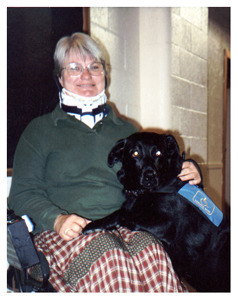 Okay, I know it’s hyperbole (with apologies to Bataan survivors), but my friend Linda and I came to see our trip through the southwest desert as just that eleven years ago: a near death march with a happy ending.
It started out innocently enough. I sat at my computer supposedly writing a novel when Linda sent an email. A semi-handicapped friend who frequently used a wheelchair, she was driving home from her daughter’s Virginia wedding and was in Texas, exhausted. She needed prayer to make it to northern California.
School would be out in three days. I had a Southwest airlines frequent flyer coupon. My dear friend Wendy lived in El Paso, which was on the way. I called my husband. “Should I fly to Texas tomorrow and help Linda drive home? I’ll be gone about five days.”
He’s a saint. “Sure.”
My concern was she not travel through the desert by herself (and Pepper the black lab service dog). That’s why I thought God wanted me to go, just in case something happened.
“I can’t handle heat,” I told her. “But as long as your air conditioning works, I can do this drive.”
Surprised and thankful, Linda had one assurance: “I just had the car serviced. No problem.”
I flew to Houston. The next day we drove 10 straight hours down I-10 to Wendy’s house in El Paso.
Day three saw us up early. Wendy and Loren prayed for our trip, we got into the blue handicapped van and returned to I-10. We were headed to Tucson for lunch with Linda’s father and thence to Mesa, Arizona where she had arranged to meet an Internet pal at a 7 o’clock church service.
A full day.
The New Mexico desert was cool when we started out, but quickly grew hot in the June sun. An hour east of Tucson with the heat blazing down and reflecting back up, we heard a bang and power drained. Linda pulled over to the side of the desolate freeway. I saw only cacti when I jumped out of the passenger seat..jpg)
“Lord,” I prayed. “This is why I came, in case of trouble. Keep us safe and get us home safely, please.”
We opened the hood–a total joke where I’m concerned.
“Whatever’s broken, stand up and wave.”
Nothing happened.
Trucks breezed by on the freeway, cars zoomed past. Neither cell phone picked up a signal. We looked at each other. Time to pray?
A sedan pulled to a stop some distance up the shoulder. Two heads with very short hair. We looked at each other. “Please, Lord, keep us safe.”
The car backed down the freeway. When it reached us, the passenger got out and walked our way.
She was middle aged with a very short haircut. And if I was not mistaken, a mustard seed necklace around her neck.
“My husband is a mechanic. Are you having trouble? He’d be happy to take a look.”
No surprises. His tee-shirt proclaimed their beliefs in colorful lettering: Maranatha!
“I think it’s a problem with your air conditioning.” He tweaked something in the engine. “You’re safe to get to Tucson, maybe even back to California if you’re careful. We’ll follow you into Tucson to make sure.”
Rejoice! God had sent me to the desert southwest so Linda would be safe. I knew it.
Could I be saintly without air conditioning?
We drank lots of ice water and lemonade that roasting day at lunch and carried several water bottles with us. I had the 100 mile Tucson to Mesa leg.
I don’t do well in hot weather. The window was open. I drank all the water.
I should have quit driving 50 miles in. By the time we got to Mesa, I was nearly hallucinating from the heat.
We pulled up to the large church at five o’clock and I staggered to the building. Opening the door, I nearly collapsed from the icy shock of air conditioning. I guzzled frigid water from the drinking fountain and then laid down on a pew outside the sanctuary.
My head spun. I closed my eyes and pretty much faded away.
We skipped the five o’clock service that Saturday night, and met her friend for the seven o’clock service. I still felt woozy and shaky.
It was an odd service; I’d never really attended a mega-church service before. Fuzziness still framed my vision.
Until communion.
Eating that tiny pebble of bread and drinking that thimbleful of grape juice revived me. Completely. My head cleared and I could sing, respond and think once more.
We spent that night in a hotel and got up at four o’clock to cross the desert into the promised land of California.
The Southwest death march was over–and the blessings came for me in California.
It was Father’s Day. Many family members lived just off I-10, all the way to the Pacific Ocean! I visited my uncle and aunt and then saw my father in Santa Monica for what turned out to be the penultimate time. We picked up my son from college and he drove us home to northern California Sunday night. We were safe. Linda got the air conditioning fixed a week later.
Even at the time I didn’t see the trip as much of a sacrifice; it was an adventure.
God gave me the chance to help a needy friend and then overwhelmed me with blessings.
The best one of all? That answer to prayer on an Arizona highway.
By the way, Linda no longer needs her wheelchair. Her remarkable story (including a reference to the southwest death march) can be found here: I am a Moon Jogger.
Rejoice with us! God answers prayer.
How about for you?

The post The Southwest Death March appeared first on Michelle Ule, Author.
February 28, 2014
World War I and the YMCA
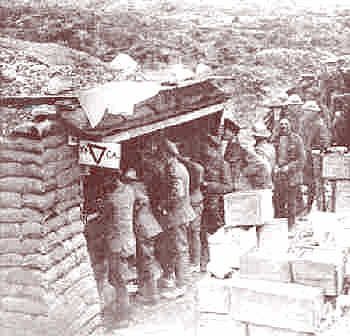 When I was growing up in southern California, the Young Men’s Christian Association (YMCA) was a gym where kids learned to swim and I took gymnastics lessons.
We called it the “Y” and I never gave any thought to its real name.
The distinctive YMCA logo also hung on a multi-storied building in downtown San Pedro, where it was known as the Army and Navy YMCA–probably because of Fort MacArthur and the Navy ships that routinely visited. We had a YWCA (Young Women’s Christian Association)as well and I learned to play the guitar there. Eventually, I discovered basketball the YMCA was an early supporter of basketball as a simple way to keep men entertained in a healthy fashion. That was about it.
But I’m writing a book right now about World War I, and I’ve been surprised by the amount of work done by that same YMCA. They organized canteens at the front lines in France. They entertained troops and provided writing materials in all the theaters of war. Run by “secretaries,” YMCA huts or tents were the only places of respite for many soldiers in the front lines. I had no idea.
They began working with soldiers before the Civil War, according to The History of the YMCA in World War I. Since the YMCA predated the Red Cross (founded by Clara Barton but not chartered until 1900), it was the major ministry to the military for many years.
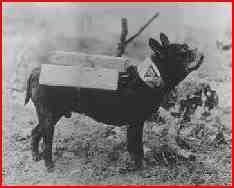
YMCA cigarette dog
During the Great War, 90% of the “general welfare” work done for the troops was through the 26,000 paid staff. 35,000 others volunteered. The troops numbered over 4 million.
Nearly 1500 entertainers met with the troops in their off hours: singers, dancers, musicians. The huts usually had a grammaphone and records. Dances were organized in big cities like Paris and London.
The YMCA had its own letterhead. It sold postcards, sundry items, and managed the mail. Volunteers sat with soldiers and helped them write letters home. Some taught French classes, others, hygiene.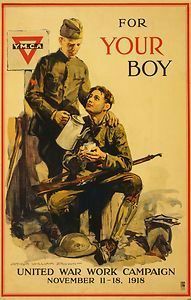
The British sent out YMCA workers early in the war, and they huddled near the men in the trenches of France. Oswald Chambers served as a chaplain in Egypt and wore a uniform not much different from the regular Army officers.
The YMCA produced pamphlets with titles like The Christian Witness in War, and The Canadian Soldiers’ Song Book for the huts devoted to spiritual growth and religious activities. They stocked libraries, raised money back home in the US, and generally looked out for the general welfare of the troops. General John Pershing endorsed the YMCA on a poster that appeared everywhere:
“I have [had] opportunity to observe its operations , measure the quality of its personnel, and mark its beneficial influence upon our troops and I wish to unreservedly commend its work for the Army.”
Young men overseas for the first time, away from home and facing death in wartime, needed reassurance. The military commands appreciated the YMCA units because of their positive influence. In some sectors, notably Cairo, venereal disease was a continual problem and the YMCA provided alternate and wholesome entertainment. The YMCA rented three acres of Ezbekieh Gardens to provide roller skating, movies, swimming, eats, library (300 books) and a post office. Thousands of men flocked there each night after work. Church services and lectures were also provided.
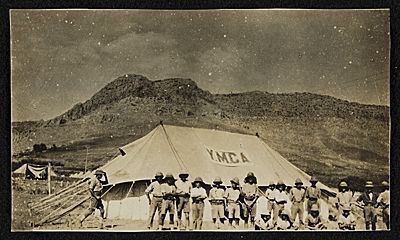
YMCA camp for survivors, Baghdad circa 1918
Mobile canteens in Europe made countless cups of coffee and tea, served donuts and provided cigarettes as needed. Most of their supplies had to be paid for by the soldiers, but in some areas, notably Egypt, tea was given away for free.
In France, the YMCA made arrangements for rest and recreation centers where particularly American soldiers could leave the front and relax away from the fighting. The YMCA arranged for tours of historic locations in Egypt, and provided humanitarian services for prisoners of war after the armistice was signed in November, 1918. Many staff secretaries and volunteers stayed on after the hostilities ended to help sort everything out.

Letterhead for soldiers writing home from YMCA huts
286 YMCA workers were injured during the war; six died while serving. Who knows how many caught the flu, but those working near the front lines suffered the same poor food, lice, and constant fear as the soldiers. Truly, it was an act of service.
To see more WWI and the YMCA-related photos, check out my Pinterest board here.
Tweetables:
A little YMCA history: WWI Click to Tweet
Athiests in trenches if the YMCA was there? Click to Tweet

The post World War I and the YMCA appeared first on Michelle Ule, Author.
February 25, 2014
Monuments Men, Salt Mines, Books, and Me

We saw The Monuments Men this weekend and enjoyed it.
The movie had what we liked: Europe, art, humor, pathos, and heroic military guys. Lots of fun.
And it reminded me of my first visit to Europe at the gangly age of fourteen.
Like the Monuments Men, my family was on a mission: to see all the great art works of Europe.
Mom was determined we would learn about art and culture. After the third straight museum, I figured out what was important about art and what I liked. You can read about my perspective here.
But all that exposure to good art served Mom’s purpose. I saw familiar canvases in the movie and whispered the names of artists, even as I cringed at seeing those works piled against an army truck.
My father’s focus was on history. He wanted us to know what happened in Europe–particularly during World War II.
So we visited Dachau, saw the Black Forest, hiked in the Alps and eventually headed to the Austrian Salt Mines not far from Salzburg.
Reading about it in Europe on Five Dollars a Day, the salt mine tour sounded like a European version of a Disneyland ride. We wore white coveralls over our clothing and waited in line a long time to sit astride a wide log and slide in the dark 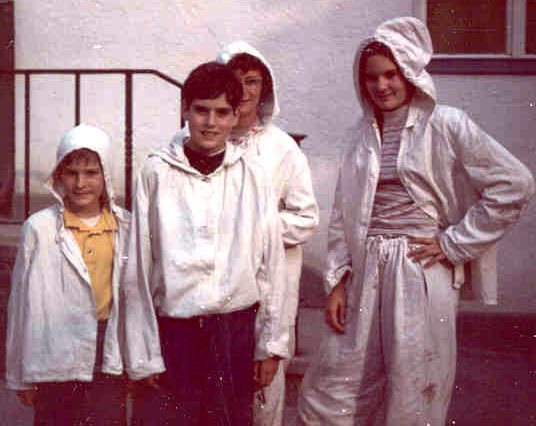 through the interior of a mountain. We even floated across a dark lake on a boat and saw stalactites.
(I began to understand claustrophobia for the first time when I thought about how much of the mountain was above my head).
My father was energized at what the salt mine represented–and we heard the same surprising story the Monuments Men discovered: that a salt cave deep inside a mountain maintains the perfect temperature in which to store works of art. Hitler’s alpine residence, Berchestgarden, wasn’t far from Saltzburg and it was here in Altaussee that Nazi thieves stored purloined art.
This is the salt mine at the end of the movie where more than 6500 paintings, estimated in valuable of about $3.5 billion, were stored, including works by Michaelangelo, Durer, Rubens and Vermeer. The Altaussee Salt Mine web site explains:
In April 1945, the Nazi Gauleiter decided to destroy all masterpieces. For this reason, he had eights airplane bombs moved into the salt mine. To prevent damage to the artwork, the entries to the mine were blocked with explosives. When Altaussee was occupied by the American troops, works to reopen the tunnels and save the cache of masterpieces began.
I knew the story, but it was fun to watch it on the big screen.
What does it say about an army that resources would be dedicated to saving art during a war?
It’s an interesting question that has been the theme of several recent books–to what end will art lovers go to ensure the safety of artwork?
My friend Tricia Goyer and Mike Yorkey wrote Chasing Mona Lisa, the story of French efforts to hide Leonardo daVinci’s Mona Lisa from the acquisitions Nazis. It’s a fast-paced romance involving danger, French Resistance and heroism–with the painting of a beautiful woman with a mysterious smile as the prize.
Another fine story about the driving quest for art is the recent The Girl You Left Behind by Jojo Moyes. Her tale is a quest in the present to discover what came of a Frenchman’s painting during World War I. The Germans are the bad guys once again and a fine painting is at stake.
They’re both enjoyable reads.
The Monuments Men asked an interesting question and it’s touched on in the two novels:
Is a work of art worth a man or woman’s life?
Who should decide?

The post Monuments Men, Salt Mines, Books, and Me appeared first on Michelle Ule, Author.
February 21, 2014
February 18, 2014
Pinterest and the Hunt for Research Information

US Navy photo
I’ve discovered Pinterest as a new tool in my research toolbox.
Like many, I didn’t pay it much mind when it first appeared on the social media scene. I had more pressing matters to seek out using my trusty pal Google.
But when a friend posted the covers of her books on a Pinterest page and I decided I could do at least that much.
A whole new world opened up.
I began easy: posting photos of my co-writers for all my novella collections. Then the books themselves. Then, well, why not? Photos related to my novellas and the novel Bridging Two Hearts.
(A Navy photo of SEALs in basic training camp is my most shared pin on Pinterest).
I documented what happened one night when I went looking for the photo link for An Inconvenient Gamble. I found a photo of my great-grandmother–one I’d been seeking for 20 years!
(The photo wasn’t on Pinterest, but on a website I was linking to my Pinterest board.)
At that time, I used my own outside resources to pin on my board–which many people do. I even took a tutorial on how to put together interesting pins.
But I didn’t have time to make pins, I needed to be writing and researching my books.
Once I learned about the search feature in Pinterest, my research abilities jumped.
For example, I went looking for Ezbekiah Gardens.
I tried Google, but didn’t turn up a whole lot–which surprised me. In 1916, the period I’m studying, the opera house was across the street and Shepherd’s Hotel was a few blocks north. How could it be so hard to find?
I’d been idly hunting for photos of World War I era Cairo to get a sense of the clothing and the lifestyle my characters might have had. I looked at Shepherd’s Hotel where the glitterati stayed, saw lots of fun photos of the pyramids with different types of visitors (and camels), and even caught glimpses of chador-clad Muslim women from the turn of the last century. The photos were fascinating and you can see my Pinterest board on Egyptian Scenes here.
I typed in Ezbekiah Gardens one night and to my surprise, photos turned up.
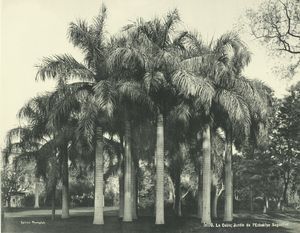
New York Public Library Digital Collection
Only two others have turned up (if you hunt now, you see photos I’ve posted), but in my searching, I met others looking for photos of old Cairo. (Thank you, Green9999) and because of my time frame, all those Amelia Peabody fans have provided lots of pertinent shots.
I’ve also discovered maps and references to things I hadn’t anticipated. Who knew the tram went past Ezbekieh Gardens until I hunted for the Cairo Opera House?
Here’s the key: Scouring Pinterest to find pertinent information which may not have anything to do with photos.
For example, today I needed to learn something about Ismailia. My Baedekker’s Guide to Egypt, 1914, notes
“Hurried travelers may omit Ismailia the attractions of which are not very great. The town is on the north side of Lake Timsah and reportedly has lovely beaches.”
It didn’t list any hotels nor names of restaurants. These are not crucial to my story, but being able to say where they stayed gives verisimilitude to my tale. On a whim, I typed the town’s name into Pinterest.
Lots of photos turned up.
I posted them on my Egyptian Scene and World War I Egypt boards. Now I have a good idea of the type of houses and the fauna that could be found in that town.
Pinterest, of course, can be problematic for sharing the photos on my blogsite–all on these pages were picked off Wikipedia Commons, for example.
But since I’m leaving other people’s photos on my boards merely for research, I think I’m okay with copyright laws.
If you’re stymied in something you’re seeking, or need fuller ideas about a subject, why not try Pinterest?
It worked for me!
All my Pinterest boards can be found here.

The post Pinterest and the Hunt for Research Information appeared first on Michelle Ule, Author.
February 14, 2014
Conviction and a Different Ruth Story.
 You may think you know where I’m going with my version of the story of Ruth, but you don’t.
It’s a different Ruth, not the Biblical Ruth, and it’s a story about God working conviction in my heart and hers.
It took place long ago when I was a young woman, convinced I knew everything.
I attended a Bible study in Connecticut with a group of women from Bishop Seabury Episcopal Church. They were a wise and fun group that spanned the ages from me with small children to Jo, a great-grandmother.
Most of us were married and had children.
And then there was Ruth.
Glamorous, gorgeous Ruth.
Of whom we knew just a little: boyfriend with two small children, fantastic fashionable red glasses, a job at a local restaurant where she wore a cute uniform.
She also had a really wise mother whom she quoted often, particularly in tricky Bible passages.
We studied Scripture together for maybe a year or so. I saw her at church with the boyfriend’s children. I liked her. She was smart and she understood the Bible.
But one day she made a reference to her boyfriend, Dan, and slipped up. No one else caught the remark, but I was a trained journalist. I suddenly realized she lived with Dan and his children.
I was flabbergasted! (Remember, I thought I knew everything).
I went home and stewed for days. How could Ruth, wise, smart Ruth with the spiritually-deep mother not know living with her boyfriend without marriage was sin?
Someone needed to tell her!
I should call the pastor!
She needed to be confronted!
Even as I grumbled, my intelligence argued. Wait. You’ve studied the Bible with Ruth for over a year. You know she’s wise. She must know what she’s doing.
But she was sinning!
I had to ask myself a hard question: am I the Holy Spirit?
I knew she knew the truth. But that meant she was deliberately disobeying the Bible..jpg)
What should I do?
I decided to pray.
A month later Ruth disappeared.
Dan showed up at church the following Sunday with the children.
They came the next Sunday, and the next. He became a regular.
The Bible study ladies were confused, but someone had heard Ruth went home to her mother.
“Why?”
No one knew.
We continued on, as Bible studies do and another year passed.
Ruth showed up one Wednesday.
She had a wedding band on her finger and a story to tell.
“Once upon a time, my sexuality was the most important part of my life. I didn’t care what the Bible said, I wanted to be free to do whatever I wanted.”
Ruth looked directly at me.
At me!
“If someone had come to me and challenged me about the sin of living with Dan, I would have walked out the door of this church and never returned.”
I knew enough to remain silent and nod in acknowledgment of her words.
“I’d hoped I could convince Dan of the importance of coming to church. My mother did not approve of my living with him.”
We all nodded.
“One day I realized I needed to leave, for his sake as well as my own. When he went to work, I packed my things and wrote him a letter. I went home to my mother.”
Ruth’s letter broke Dan. He begged her to come back. She said no. He started attending church. He told Ruth he’d continue if she came back and he’d marry her.
Ruth decided to wait to see if the change in him was real.
After a year, she decided it was. They’d gotten married the week before her return.
We all welcomed her back.
I trembled as I drove home, realizing how close I had come to destroying a work of God in Ruth’s life.
Am I the Holy Spirit?
Of course not.
On that day long ago, God gave me insight into a sin in a respected Christian sister’s life. I see that, now, as having been drafted into God’s prayer army.
Ruth needed me to pray for her–that she would be convicted by the Bible she well knew.
She did not need me to judge her.
When God gives us insight into another’s sin, we need to keep our mouths shut and pray.
Conviction is the work of the Holy Spirit. Not me.
How have you handled the shock that someone you know and like is willfully choosing to sin?

The post Conviction and a Different Ruth Story. appeared first on Michelle Ule, Author.
February 11, 2014
World War I and the Influenza Horror
Maybe we’ll never know what brought influenza to America in 1918.
Some believe it started here.
Whatever the case, for a country so far removed from four years of butchery across the Atlantic Ocean, the quiet, stealthy approach of a deadly killer must have seemed like the end of the world.
Millions of people already had died burrowed in the dirt of the European western front. Many had perished in the plains between Russia and Germany. The Gallipoli suffering was legendary. The nations had taken their fights to their colonies. (The African Queen film is about blowing up a German war ship in central Africa.) Germany tried to introduce it into Mexico (The Zimmerman telegram).
The world had gone mad.
In the United States, President Woodrow Wilson, a flinty-strict Presbyterian, had devotedly kept his country out of war until it became too much to avoid. When the US finally did head “over there,” they brought a determination to win at any cost.
What the US did not count on was influenza bringing so much death to North America.
It was just influenza, nothing more, as John M. Barry recounted so brilliantly in his book The Great Influenza: The Epic Story of the Deadliest Plague in History.
It killed between 50-100 million people world-wide between 1918 and 1920 when it suddenly disappeared.
Read that number again: 50,000,000-100,000,000 people died from influenza.
3-5% of the world’s population died; the majority within one 12-week period in the fall of 1918. India lost 5% of their entire population.
A large majority of those dead were young adults, struck down in their prime because of the nature of the disease. One in every sixty-seven soldiers in the army died of influenza and its complications.
(Disease often kills in greater numbers than battle in wars. Soldiers who have never been exposed to illness, brought together into camps and living in unsanitary conditions, often die from common ailments like the measles).
It’s a good thing the armistice was declared in November, 1918.
It’s known as the Spanish flu because the American, French, German and British newspapers kept it censored from the public–they were afraid, justifiably, of the morale problem as WWI ground to an armistice.
But Spain was neutral, and reported the story, thus earning it the moniker of what was a deadly pandemic. (A pandemic is an illness that spreads world wide and infects a large proportion of the populace).
Influenza came on quickly.
Many young people went to work in the morning and were dead by nightfall.
 Symptoms began with a headache, then quickly moved to body aches, fever, exhaustion and a cough. The pain was terrible, and for those looking on, the body changes horrific. A nose bleed often was the first sign of serious illness. Those whose skin flushed to a lavender color would die quickly. Little could be done to save them.
The United States had sent many nurses to Europe for the war effort. There weren’t enough medical personnel in the country, doctors or nurses, to care for all the people who contracted the flu. Medicine wasn’t available to help. The best suggestion was to go to bed and stay there until the influenza ran its course or you died.
So many people died in such a dramatically short period of time, they ran out of coffins. Bodies stacked up like cordwood–turning black from the disease. No one would touch the bodies, no one was available to dig the graves, even in cities as large as Philadelphia.
I can’t imagine the horror.
Municipalities were empty; all civic meetings were curtailed. Shipyard workers in Philadelphia didn’t work.

English: Woodrow Wilson. (Photo credit: Wikipedia)
President Wilson, in France for the treaty discussion in 1919, also came down with the flu. They conjecture it may have played a role in his stroke which incapacitated him for the rest of his presidency.
Influenza’s disorienting fever also may have played a part in the vindictiveness wrought on Germany after the war–which paved the way to Hitler and World War II.
The influenza horror was a coda to the war to end all wars–and killed far more people.
Tweetables
Influenza caused more deaths than the trenches of WWI. Click to Tweet
5% of the world’s population died from the flu Click to Tweet
How do you live through a silent horror like the flu after the war to end all wars? Click to Tweet

The post World War I and the Influenza Horror appeared first on Michelle Ule, Author.



![[image error]](http://commons.wikipedia.org/wiki/File:Suez_Canal_Ismailia2.jpg)