Monuments Men, Salt Mines, Books, and Me

We saw The Monuments Men this weekend and enjoyed it.
The movie had what we liked: Europe, art, humor, pathos, and heroic military guys. Lots of fun.
And it reminded me of my first visit to Europe at the gangly age of fourteen.
Like the Monuments Men, my family was on a mission: to see all the great art works of Europe.
Mom was determined we would learn about art and culture. After the third straight museum, I figured out what was important about art and what I liked. You can read about my perspective here.
But all that exposure to good art served Mom’s purpose. I saw familiar canvases in the movie and whispered the names of artists, even as I cringed at seeing those works piled against an army truck.
My father’s focus was on history. He wanted us to know what happened in Europe–particularly during World War II.
So we visited Dachau, saw the Black Forest, hiked in the Alps and eventually headed to the Austrian Salt Mines not far from Salzburg.
Reading about it in Europe on Five Dollars a Day, the salt mine tour sounded like a European version of a Disneyland ride. We wore white coveralls over our clothing and waited in line a long time to sit astride a wide log and slide in the dark 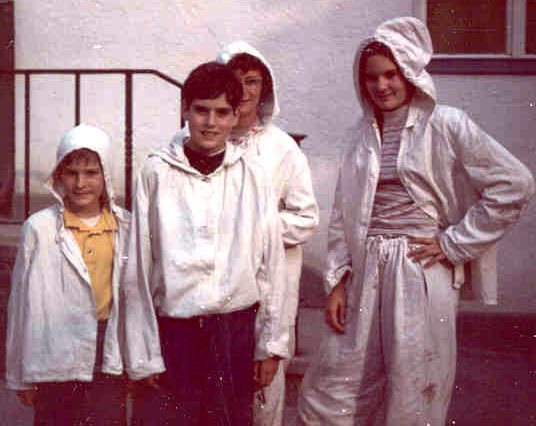 through the interior of a mountain. We even floated across a dark lake on a boat and saw stalactites.
(I began to understand claustrophobia for the first time when I thought about how much of the mountain was above my head).
My father was energized at what the salt mine represented–and we heard the same surprising story the Monuments Men discovered: that a salt cave deep inside a mountain maintains the perfect temperature in which to store works of art. Hitler’s alpine residence, Berchestgarden, wasn’t far from Saltzburg and it was here in Altaussee that Nazi thieves stored purloined art.
This is the salt mine at the end of the movie where more than 6500 paintings, estimated in valuable of about $3.5 billion, were stored, including works by Michaelangelo, Durer, Rubens and Vermeer. The Altaussee Salt Mine web site explains:
In April 1945, the Nazi Gauleiter decided to destroy all masterpieces. For this reason, he had eights airplane bombs moved into the salt mine. To prevent damage to the artwork, the entries to the mine were blocked with explosives. When Altaussee was occupied by the American troops, works to reopen the tunnels and save the cache of masterpieces began.
I knew the story, but it was fun to watch it on the big screen.
What does it say about an army that resources would be dedicated to saving art during a war?
It’s an interesting question that has been the theme of several recent books–to what end will art lovers go to ensure the safety of artwork?
My friend Tricia Goyer and Mike Yorkey wrote Chasing Mona Lisa, the story of French efforts to hide Leonardo daVinci’s Mona Lisa from the acquisitions Nazis. It’s a fast-paced romance involving danger, French Resistance and heroism–with the painting of a beautiful woman with a mysterious smile as the prize.
Another fine story about the driving quest for art is the recent The Girl You Left Behind by Jojo Moyes. Her tale is a quest in the present to discover what came of a Frenchman’s painting during World War I. The Germans are the bad guys once again and a fine painting is at stake.
They’re both enjoyable reads.
The Monuments Men asked an interesting question and it’s touched on in the two novels:
Is a work of art worth a man or woman’s life?
Who should decide?

The post Monuments Men, Salt Mines, Books, and Me appeared first on Michelle Ule, Author.