Michelle Ule's Blog, page 84
April 22, 2014
Real Life and Point of View
 Because I’m a writer, I think a lot about point of view in the literature sense, but I also think it’s germane to real life.
I thought about that concept this week after seeing this meme on Facebook (I don’t know who did it or I’d give them credit)
This is an excellent example of point of view.
The actual definition is: “The perspective from which a speaker or writer recounts a narrative or presents information.”
We live with our pets and often taken them for granted. They’ve got a limited life span, however, and we usually outlive them.
(Someone said once we’re given pets so we understand life is not finite and it teaches us how to grieve. We learned that a year ago when our beloved Gordon Setter Suzie died. You can read how wonderful she was here.)
This meme turns our understanding around when we look at a dog’s life through the dog’s eyes–his time with us is his entire life.
The same is true with children. They have a limited perspective. They think mothers are supposed to be like their mother–whether their mother is a good mother or not.
A Lamaze teacher liberated me from unrealistic expectations when she said, “You’re the child’s parent. Raise them the way you want to. If you don’t feel like giving them a bath every night, don’t bother. The child will never know they’re ‘supposed’ to get a bath every night.”
Wow. What a concept. I determined what “reality” was for my family.
Understanding a different person’s point of view (one of the reasons for reading literature), also enables us to develop compassion and empathy–and those are important elements to getting along with others and being successful in real life.
Back in the dark ages when I trained to be a reporter, I learned that all of us have biases. Our point of view determines how we think and look at events.

But a good reporter needed to “turn the prism,” on their personal point of view to grasp both sides of a story. I was taught you did not have to agree with both sides of a story (how could you?), but you needed to be able to respectfully articulate both sides in order to present a reasonable newspaper story.
The goal was to be as impartial as possible in telling the story so the reader could reach their own conclusions (which, of course, would be slanted by their personal point of view).
I’ve taken that training into my real life and I often find myself looking for the alternate responses to events or reactions. It’s helped me in my writing (where you have to stay in one point of view in each scene so as to not confuse the reader) and in raising my children. If I didn’t understand why they behaved a certain way, I’d stop and try to envision the circumstances from their limited-life-experience point of view.
It was very helpful, even if I didn’t change my mind.
Recognizing different points of view helps in political settings, in social circumstances, in my marriage. (Author Larry Burkett famously said, “opposites usually attract in marriage and that’s a good thing. If you both thought and acted the same, one of you would be superfluous.”)
It’s smoothed the way when I realize a challenging individual may not be vexing on purpose, they just might be operating from a skewed point of view.
What tricks do you use to understand someone else’s point of view?
Tweetables
How to see beyond your biases. Click to Tweet
How your point of view reflects real life. Click to Tweet
If you both thought the same, one of you would be superfluous. Click to Tweet

The post Real Life and Point of View appeared first on Michelle Ule, Author.


April 18, 2014
What Does it Take to Kill Jesus?

What did the Romans have to do to kill Jesus on Good Friday?
Nothing.
They were pawns in God’s hand.
That’s not exactly true. They had to play along with Pontius Pilate, who was manipulated by the High Priest Caiphas and his minions–men who decided it was better that one man should die (Jesus) than they lose power.
At least they thought they had decided that.
In actuality, the events of Jesus’ last week on earth were orchestrated according to prophecies made long before. Jesus told his disciples what would happen.
They didn’t like hearing Jesus had no plans to be an earthly king and so while they heard what Jesus said (they will take and kill me and three days later I will be raised from the dead), they didn’t want to believe it.
It’s all there in the Bible–prophecies in the Old Testament, Jesus fulfilling them in the New Testament.
For Christians, Good Friday is the major stop in the holy week between Jesus Christ’s triumphant entrance into Jerusalem on Palm Sunday and his glorious resurrection from the dead on Easter Sunday.
Many of us spend “passion week” reviewing Jesus’ last days on earth in human form.
There’s an interesting story that happened prior to that week that often gets overlooked but which is pertinent.
I shake my head every time I read it.
You remember–Lazarus of Bethany raised from the dead?

It’s such a dramatic moment, and Jesus himself reminds Lazarus’ sister Mary that Jesus’ delay in getting to Lazarus’ sickbed had everything to God being glorified.
Jews from Jerusalem had come the seven miles to see what Jesus would do. A large crowd gathered around the tomb–where Lazarus had laid for three days, and decay would have set in.
Jesus ordered the large stone blocking the tomb to be rolled away. There were protests about the possible smell, but they moved the stone.
“Lazarus, come forth!” Jesus called.
Lazarus stumbled out. Alive. Raised from the dead.
The Scriptures record a variety of responses to that resurrection. His sisters Mary and Martha were joyful. So was Jesus.
The ruling Jews, however, had a different response. From the text John 11:45:
Then many of the Jews who had come to Mary, and had seen the things Jesus did, believed in Him. But some of them went away to the Pharisees and told them the things Jesus did. 47 Then the chief priests and the Pharisees gathered a council and said, “What shall we do? For this Man works many signs. If we let Him alone like this, everyone will believe in Him, and the Romans will come and take away both our place and nation.”
The High Priest Caiaphas, a crafty politician had the last word:
“You know nothing at all, nor do you consider that it is expedient for that one man should die for the people, and not that the whole nation should perish.”
From that day on, they plotted to put Him to death.

Giotto’s depiction of Jesus before Caiaphas in the morning based on Luke 22 (Photo credit: Wikipedia)
I always wonder what they were thinking. They just saw Jesus call a man back to life who had died. How did they think they would kill Jesus himself if he had such power? Click to Tweet
Obviously, they weren’t thinking.
God sent Jesus to earth to “give himself up to death,” for the sins of the world. Christian theology teaches us that he was the “Lamb of God,” as John the Baptist pointed out, “come to take away the sins of the world.” I can’t explain why God put the world into this order, but this is what he required.
Jesus’ birth, life, death, resurrection and current status all were foretold in the Old Testament prophecies. Some Bible scholars believe there are more than 300. You can review a list of forty-four of them here.
Jesus came to die. If the Romans hadn’t done it, someone else would have. The point is, Jesus’ passion–the horror he went through–was a choice he made. He could have called those legions of angels down at any moment to save him–but to do so would have negated the reason he was born.
God sent him as savior of the world–Jesus had to die to do that.
Sometimes I feel sorry for the Romans and the Pharisees and High Priest Caiphas. Even Judas. God used them to accomplish his will.
(Some traditions believe Pontius Pilate and his wife had a happier ending).
Regardless, no one really killed Jesus. Jesus willingly gave himself up to die.
Could anyone really kill Jesus? Click to Tweet
Killing Jesus. With Lazarus still walking around? Impossible! Click to Tweet

The post What Does it Take to Kill Jesus? appeared first on Michelle Ule, Author.
April 15, 2014
Research Rabbit Trails
 Don’t you love research rabbit trails?
I’m in the middle of writing this year’s Christmas novella, The Yuletide Bride, part of Barbour’s The Twelve Brides of Christmas.
Google has allowed me back into their research tool (after banning me for a couple days when I finished writing my World War I novel–overuse. Joke!), and I’ve been verifying facts.
But sometimes, okay almost always, I stumble on other interesting facts or stories. They catch me by surprise and I want to share them too, even though there’s no room in my story.
What’s a writer to do?
Post them on Facebook! You can view my writer page here.
This week I found two very different items I’d like to share before I get back to work.
The Yuletide Bride takes place circa 1873 Nebraska. Remembering events from Laura Ingalls Wilder‘s On the Banks of Plum Creek, I wanted to find out if the grasshoppers plagued Nebraska.
They did.
In 1874.
I found photos and drawings:
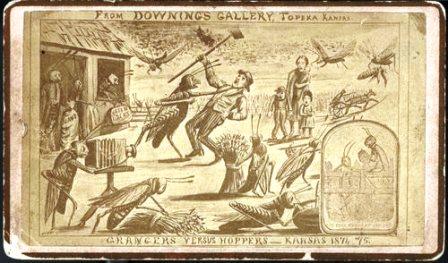
From Kansas Historical Foundation, created by Henry Worrall
Drawn during the time of the invasion, Worrall’s work expresses well the revulsion farmers felt when grasshoppers first ate all their crops (including the wool off the sheep!) and then dug their eggs into the soil leaving the land vulnerable for another cycle of devastation.
The actual creature was the Rocky Mountain Locust, and they returned in the 1930s, as well. Locust invasions still happen. Youtube had a video on one in the Congo. Watch if you dare, here.
What does this have to do with The Yuletide Bride?
Absolutely nothing. It’s just something I’d read and thought interesting.
A research rabbit trail.
Eventually I discovered what I really wanted to know–land policies in 1873 Nebraska–and returned to writing my novella.
But first, I stopped off at Pinterest to look at photos of the Nebraska landscape, particularly along rivers and streams–which is pertinent to my story.
I got distracted there, however, by photos of the Russian Romanov family, which I’ve read about since I wrote an award-winning story based on their horror in high school. I’d not seen a lot of those photo before and wasted far too much time examining them. (All you other fans can admire them here.)
One Pinterest board turned up a delightful smiling photo of Queen Victoria . Unfortunately, copyright won’t let me show it to you. Look at this Pinterest link.
Here’s another photo, however, that Wikipedia allows:

Queen Victoria I and Princess Beatrice
What I was struck by on the Pinterest photo, was how much Queen Victoria’s great-grandaughter, Queen Elizabeth II, looked like her. I’m not sure you can see it in this next photo of the current queen:
Anyway, you can see I had fun examining photos.
What did this have to do with my current project?
Almost nothing. The British royal family has no role in my story at all–except in regards to the bagpipes.
Maybe.
Where do research rabbit trails usually take you? Click to Tweet
Don’t you love research rabbit trails? Click to Tweet
Does the thought of a grasshopper invasion give you the heebie jeebies? Click to Tweet

The post Research Rabbit Trails appeared first on Michelle Ule, Author.
April 11, 2014
What the USS Thresher Taught Me About Death

USS Thresher (SSN-593)
The USS Thresher (SSN-593), a fast attack nuclear submarine, sank for good on April 10, 1963.
That accident, which occurred when I was a child, changed my life.
The Thresher was going through overhaul at Portsmouth Naval Shipyard. She went out on her sea trials, in which ships accompany her, lots of extra Shipyard experts rode her and the initial trials were monitored by people on the surface–listening and in constant communication with the crew.
They took her down slowly, ensuring there were no problems, but when she got to “test depth,” (Whatever that is, my in-house submariner only says, “submarines can go lower than 400 feet.”), problems arose. They spoke of emergency “blowing” the boat (which means emptying all the ballast tanks and flying up out of the water: see the movie The Hunt for Red October.), followed by one more garbled message and that was it.
The people on the surface, according to the stories I’ve heard (though Wikipedia doesn’t report it), heard the boat breaking up.
No one survived.
It was the first submarine the US Navy lost and sent shock ways through the fleet. Many refinements and corrections in safety were made on the nuclear boats as a result of the accident. My husband joined the fleet 15 years later, and spoke often about “sub-safe” requirements. (Only one other US submarine has been lost: The USS Scorpion. A story for another time)
The 1963 Thresher accident also touched me during my husband’s tour at basic submarine school in Groton, Connecticut, many years later.
 The Thresher CACO (Casualty Assistance Calls Officer)–the officer who visited all the newly-widowed Navy wives–never got over the experience and he spoke to my husband’s class and their wives. He got us twenty-something, mostly newlywed, women into a room and lectured us about submarine life. His first words?
“The best way to become a good Navy wife is to learn how to be a widow.”
We all gasped. He explained how horrified he was to meet all those Thresher widows in 1963 who didn’t know anything about taking care of themselves. They didn’t know anything about insurance, managing money, auto repair, etc.
Being the scrupulous researcher that I am, I followed directions and did a study on how to be a good widow. I read books about widowhood and what to prepare for ahead of time. My Lieutenant (junior grade) and I made a plan of what I would do if he died.
Fortunately, I never had to execute the plan, but this is what has stayed with me all these years:
*Do nothing the first year. Your objective is to survive.
*Make no major decisions. Do not sell your house or car unless you absolutely have to.
*Get trusted advisors and listen to them.
*After a year, take a trip away from where you live and think about what you want to do with your life.
*Make a new plan for your life and move forward.”
I’ve shared this information with women for years. I’m glad I have it but am even more thankful I’ve never had to use it–thanks to the USS Thresher.

A submarine officer: note the gold “dolphins” above the ribbons.
Navy wife plan for widowhood. Click to Tweet
What a submarine accident taught me about death Click to Tweet

The post What the USS Thresher Taught Me About Death appeared first on Michelle Ule, Author.
April 8, 2014
A Bible Teacher’s Worshipful Memorial Service

English: Bible in candlelight. (Photo credit: Wikipedia)
For all he was a man of slight build, Don Bauman packed an enormous punch into our lives. We said farewell to him on Saturday, in a memorial service that left us all rejoicing at what Don Bauman taught us.
When I told his wife, Inez, how much I enjoyed the service, she beamed. “It was a worship service, wasn’t it? That’s what Don wanted.”
Could there have been any better way for a man who loved the God, the Bible, and singing?
Don retired in 2010 from more than 50 years of teaching Bible study into the debilitation of Parkinson’s Disease. Inez stayed by his side, a loving caregiver, and a variety of people regularly visited him.
One of them was Doris, who regularly took the notes from our Tuesday morning Bible study to share.
(We smiled to think Don’s final study was on Women of the Old Testament).
As long as it was the Bible, Don was happy.
”Bible study for me is a joy. The Bible show me my God and what He’s done for me; the love He has for me, what He did for me on the cross and what He still does in my life today. You learn to worship as you read the Bible. I don’t know what kind of person I’d be if I didn’t have Christ in my life. Studying the Bible helps me grow.”
Don knew Parkinson’s would take his life and so he planned his memorial service long ago.
He wanted to focus to be on Jesus, not on him.
So, what Bible passages does a man who taught for so many years want in his service? He started with scripture: Psalm 95: 1-7.
Our choir sang it as rendered in The Venite from the Order of Matins.

http://www.youtube.com/watch?v=Q2KYFhk5-Hc
A lifelong Lutheran, he wanted a statement of Faith, and he used Martin Luther’s Explanation of the second Article of the Apostles’ Creed from the 1529 Small Catechism:
”I believe that Jesus Christ, true God, Son of the Father from eternity and true man, born of the Virgin Mary, is my Lord. He has redeemed me, a lost and condemned person, saved me at great cost from sin, death and the power of the devil, not with silver or gold, but with His holy precious blood and His innocent suffering and death. All this He has done that I may be His own, live under Him in His kingdom, and sever Him in everlasting righteousness, innocence and blessedness, just as He is risen from the dead and lives and rules eternally.”
I’d never attended a funeral or memorial service that included the Apostle’s Creed.
Yet, it seemed like the right thing to do.
Don liked to understand what he read, studied and believed.
”It’s easy to just read the Bible, but not get anything out of it. I try not to leave a passage until I’ve got the answer in my own mind of what it means, otherwise it’s too easy to skip over.”
The other Bible passages were familiar, and to the point: Psalm 23 (The Lord is My Shepherd); Romans 11:33-36 (Oh, the depth of the riches and wisdom and knowledge of God!); 1 Corinthians 15:55-58 (Oh, death, where is your victory?) and John 11: 25-27 (Jesus: “I am the resurrection and the life”).
Don played musical instruments, sang and had an impish and clever sense of humor. His musical choices were traditional, much like the stringed group he led for many years, and included He Lives, Rock of Ages, Jesus Lover of My Soul and Jesus, Savior, Pilot Me.
We also sang classic hymns. Holy, Holy, Holy, Beautiful Savior and finished with I Know that My Redeemer Lives.
Don lived a full and rich life, devoted to his family and his God. He served his fellow brothers and sisters in Christ for more than 50 years, pointing them back to their Creator and their Savior.
Well done, good and faithful servant.

Don Bauman
Thanks for a morning full of worship, even as we wiped away our tears. Click to Tweet
I’ve written before about music for my funeral.
What music and Bible passages would you want at your memorial service? Click to Tweet

The post A Bible Teacher’s Worshipful Memorial Service appeared first on Michelle Ule, Author.
April 4, 2014
The Joy of Starting a Novel
 To counterbalance last week’s post about the joy that comes from finishing a novel, today I’m starting a novel.
I’m on deadline for this novella, The Yuletide Bride, due out as an ebook on November 3, 2014 from Barbour, as part of The Twelve Brides of Christmas.
(More information will come later)
Still on my euphoric high and thus quite cheerful, I wondered this morning how I should mark this auspicious day.
Should I have a ritual for starting to write a project?
I couldn’t think of one and since I’m a writer by trade, today was just another day in the office. I put on my “winter writing clothes” (see photo), which includes my UCLA vest and jeans. I opened the window a crack, printed out the synopsis and went to work.
Pure joy.
Chapter One.
I was off.
The Yuletide Bride is the story of a young couple in 1870 Nebraska. I’m not going to tell you any more because while I have a synopsis that is going smoothly, I often tweak things and plot points change as I write. I know how it ends (it’s a romance; you do, too), but how they progress and the extra layering that will come is not yet firm.
I wrote the synopsis nearly three months ago and remembered it was good. I drew my usual plotting diagram (this time on a blue card), and it’s been waiting for me to return to the story. I suspect, as usual, that I have too much story for the allotted word count, so I took the synopsis and broke it up into the appropriate chapters: odd chapters are told from Ewan’s point of view, even chapters from Kate’s.
That presented a few problems because I wanted the final chapter in Ewan’s point of view, but I think I’ve figured out how to make it all work.
Today I wrote nearly three complete chapters; 4500 words of the 15,000 word novella. I’m optimistic and enjoying myself.
I like to leave off before I’ve finished writing a chapter, so I can jump right back in when I return to the project.
If I finish a chapter before quitting time, I often will start the next one, even if I only write five or six paragraphs–again, to enable me to get started right away with the story.
I like to think of it like sourdough starter. You add some flour and stir everyday to keep it growing.
It also gives the boys in the basement something to think about while I’m living real life.
I ran into a couple facts that needed checking and Google has been helpful. I hope to personally handle a set of bagpipes soon, and I’ve got notes on fiddle playing. I’ve been listening to renditions of the music Charles Ingalls played to his family about the same time as the setting for my story.
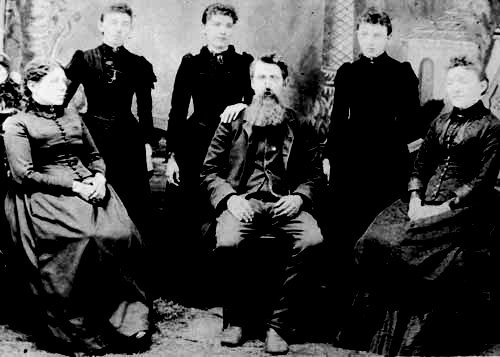
The Ingalls family
Thinking about Ma and Pa Ingalls, Laura, Mary and Carrie, cheers me considerably (even though they’re not in this story).
I interviewed a couple friends on the phone, consulted a list of Scottish last names, scanned photos from a book about musical instruments, and looked through photos of Nebraska on Pinterest.
This novella is not requiring researching depth anything near what I’ve just gone through with my World War I story. For an overview of that research project, read my post on the Books & Such Literary Agency blog here.
It’s been a good day.
I’m thankful.
How do you go about starting a project? Do you have a ritual?
Are you nervous when you type Chapter One? Click to tweet
What’s the worst part about starting a new project? Click to Tweet

The post The Joy of Starting a Novel appeared first on Michelle Ule, Author.
April 1, 2014
Writing a Novel Out of Order: 5 Reasons Why It Can Help
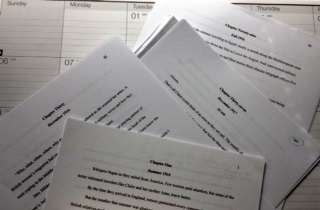 I’ve just completed writing a novel I wrote out of order.
I’m not alone in realizing you don’t have to write a story in a linear fashion.
Writer J. K. Rowling famously wrote her entire Harry Potter series toward one conclusion: a chapter she wrote at the beginning of her career and kept locked in a safe deposit box.
Five reasons why it can be helpful to write out of order:
1. If like Rowling you’ve written the ending first, you know exactly what you’re writing to achieve.
I got bored (bad sign!) with the novel I wrote and dreaded what was up next (death). So, I granted myself permission to take the day off from straight forwarding writing and I wrote the last three chapters instead.
That re-inspired me, gave me the ending, and helped me “salt” other things into the manuscript I might not have seen before.
2. It breaks up writer’s block.
Like the above, some days you just don’t feel like writing a particular scene or you can’t imagine what needs to happen next. The last 20% of my book, 14 chapters, was written in the following order:
Chapters 47-48, 50, 49
Chapters 37-41
Chapters 42-44
Chapter 47
Chapter 45
3. Giving yourself permission to write out of order enables you to work out whatever chapter comes to mind while you’re walking the dog.
When the boys in the basement get busy, they don’t necessarily pay attention to your outline. They know the basic scope, of course, but they’re trying on different ideas to fit what you’re writing. If you give yourself permission to write whatever they turn up (usually because something you’ve seen or done inspired them), creativity can flow easily.
4. You don’t have to keep renewing the reference books from the library, much less pay overdue fines.
I waited a long time to get a copy of General John J. Pershing‘s memoirs of World War I. I flipped through it and wrote the chapters in which he appeared–so I could return the book.
I did the same thing with The Great Influenza: The Epic Story of the Deadliest Plague in History. Indeed, I hadn’t planned to write an entire chapter on the Spanish Flu (much less a blog post you can read here), but when I read the book, I was so taken with the subject, it turned up four different times in my novel. By writing that chapter, I could “set up” things prior to its appearance in the story (Chapter 9 of the ending)
5. You can be pleasantly surprised when you get to the end of your novel and discover how much you’ve actually already written!

My desk at the end
I’d forgotten how much of the ending I’d written and was watching the word count nervously. Such a delight to realize I’d already finished the book! The last line came from chapter 45: “God walks with you, Claire. He always will. You can count on him.”
There are risks, of course: names change, you have to write in things you didn’t anticipate, you forget what you’ve already written, you may repeat yourself, chapters often need to be reordered.
But doing things out of order when the creativity flows? Joy! Click to Tweet
Do you ever do things out of order? Click to Tweet

The post Writing a Novel Out of Order: 5 Reasons Why It Can Help appeared first on Michelle Ule, Author.
March 28, 2014
Adrenaline High: Finishing a Novel
My desk at the end
I just finished writing my novel and I’m still on an adrenaline high.
I’ve finished writing long novels before (though not this long at nearly 106,000 words), but I’ve never felt quite like this before.
Jazzed.
Thrilled.
Excited.
Heart pounding emotional.
Weepy.
Thankful.
Blessed.
I started writing it nearly 15 months ago and it has been an intense period in my life.
2013 started out adrenaline-fueled enough with four (count ‘em, FOUR) books launching in a single year. My son and daughter-in-law added a baby to the excitement.
Another son and daughter-in-law bought our house unexpectedly which meant in addition to launching four (FOUR!) books with all their marketing plans, I had to pack out my entire house for the first time (Thank you, American Taxpayer. The Navy always did it before), find a new house in a seller’s market, move, and unpack.
I also took three book-related research trips.
But this glorious story fell into my lap the last week of January.
A total and unexpected gift from God (which I’ll write about in the future), but oh, the work!
I actually knew more about World War I than I thought I did, but I didn’t feel like I knew enough to write intelligently without doing additional research.

English: Uncle Sam recruiting poster. (Photo credit: Wikipedia)
So, in between everything else surging the adrenaline through my bloodstream (Did I mention the benign health scare?), I had to immerse myself in the Great War. The War to End all Wars. My grandfather’s war.
You can scan some of the 90+ books, magazines, articles, blog posts and movies I examined in conjunction with this project on my World War I Research Pinterest Board.
I wrote blog posts, visited the Somme, tormented my husband with military discussions, listened to music provided by friends (Thank you, Kim), read about the Schliefflin plan from a friend who wrote about it at the Naval War College (Thank you, Chas), and consulted with experts in several fields related to my subject.
Along the way, I became something of an authority on World War I and the YMCA–at least on Pinterest! :-)
I can’t reveal a lot about my book just yet, but it touches on themes that I believe are important: how to love God in the midst of negative family-pressure; coming of age during a war; which is the better man to love?; journalism; Egypt; marriage; honoring a great teacher; following hard after God. It’s rich. I’m thrilled.
I was just the hands and feet, mind and organizer. The story came from the author of our faith.
When your adrenaline courses along with God’s plans, amazing things unfold. I had fantastic research opportunities. Got to meet wonderful people. Sat back amazed as God twisted and turned this story into something that surprises even me.
In the last six days, I wrote 22,000 words, worked a job, taught a Bible study, cooked, and cleaned for a dinner party, went to church, sang in the choir twice and played with that adorable granddaughter born last year.
When God moves, he moves. It’s his adrenaline that sparks it all.
What helps you finish an important project? Click to Tweet
How do you celebrate when an important project is done? Click to Tweet
How does it make you feel to have completed something significant?
As for me? The war is over. My task is complete. (Well, other than editing). God is good.
I can hardly wait to actually read it!

The post Adrenaline High: Finishing a Novel appeared first on Michelle Ule, Author.
March 21, 2014
Blood Flow and Catching a Novel’s Scene

This is not me. My dog was more beautiful
Since exercise is so beneficial for everything else, why not in writing a novel’s scene?
As I drove home from the gym yesterday, I was mulling a tricky scene I needed to write. I couldn’t figure out how to pull it off and the more I thought about it, the more discouraged I became. As things stood, I’d need to write far more about the Spanish influenza than I wanted to and I’d have to write yet another chapter to finish off the loose ends for the entire book–we were at the penultimate chapter, now.
But all that exercising must have sent blood flowing to my brain and I suddenly saw how to do it, easily, simply, in conjunction with what had already happened and without having to write another chapter.
Eureka!
I’ve noticed this before, the advantage of taking a brain for a walk–exercising the rest of the body and getting the blood moving while the brain sorted everything else. One spot in particular near our house was often a place where elements of the story came together and I could “see” the entire scene.
That was the advantage of having a dog–I had to walk her and my brain (usually) came along as well.
Since I walked in a deserted neighborhood, I could work out–by speaking aloud–almost all the dialogue. By the time I got home, all I had to do was type it into the computer. Voila! Another scene done.
Maybe it’s not exercise but increased blood flow to the brain? Click to Tweet

This IS the inspiring shower!
Don’t you get all your great ideas in the shower? Click to Tweet
I’m not sure how many times I’ve figured out a knotty problem in my writing while taking a shower. Just last week, I burst out of the flowing water, through on a robe, scurried to my computer and wrote notes for everything I’d invented while washing my hair. I had to call my walking partner and ask for a short reprieve while I wrote the new scene.
It was a good scene.
No water in it.
I’ve written before about the need to take a break from a project and to allow the “boys in the basement” to work out plotting issues.
I have writer friends who gather to brainstorm their stories together. I envy them.
For me, it’s just God and in the good old days, my dog: thinking, plotting, contriving, examining and marveling at the twists of a story line.
As the long as the blood flows to my head, we’ll keep it up.
Where do you get your best ideas, whether you’re writing a scene or just living?

The post Blood Flow and Catching a Novel’s Scene appeared first on Michelle Ule, Author.
March 18, 2014
On Being a Celebrity’s Aunt

Photo by Dave Kronberg
Because I grew up in Los Angeles and attended UCLA, I’ve occasionally met a celebrity.
One of my relatives is even a close friend to a famous movie star.
When I was younger, I held them in awe–wow, a famous person–but that changed the day I parked next to a Navy pediatrician at the commissary. (Pediatricians are god-like celebrities when you have a newborn).
I was loading in my groceries when she rushed up, toddler in tow. “I don’t know what I”m going to do,” she said. “I left the whole basket of groceries in the store and ran out.”
When I glanced at the child, I saw the reason.
Fortunately, I had baby wipes and a spare diaper in the car. I started handing over the goods and earned her gratitude.
I’ve been amused by the personal life of a celebrity ever since. I love seeing pictures of President Obama and his daughters–particularly when the teenager rolls her eyes.
I sometimes wonder what it would be like to be in such a family–where the famed family member draws attention wherever you go and even if it’s your band concert people ignore you to get the attention of that celebrity.
But last weekend, I saw how proud you can feel, while having a head shaking moment as the past overlaid the present and the celebrity was, still, the boy I’d loved for 31 years.
Members of our family traveled to Seattle to watch the Seattle Sounders soccer team open their season against the Kansas City Sporting professional soccer team.
It was a big event because Kansas City won the national championship last fall. There were 40,000 people in the stadium.
Our family went for an even bigger event: my nephew was starting as the Kansas City goalkeeper.
After Kansas City won the national championship last fall, their goalkeeper retired. The backup goalie, Eric Kronberg, was promoted to the spot.
We were thrilled.
Eric is a great guy and had waited a long time to earn this slot.
I don’t follow any soccer that doesn’t have anything to do with my nephew, and I’ve never been to Kansas City to watch his team play.
My husband and I, two of our sons, and Eric’s parents journeyed to the Emerald City to watch Eric start.

These were the KC fans we sat with.
We weren’t the only ones wearing Kansas City Sporting gear and cheering.
While we had purchased fine seats, when we arrived at the section designated for KC fans, we (because we were wearing KC hats) were directed to join them.
My husband and Jon went to our seats, but Nick and I stayed with the fans.
I thought it would be fun.
It was gloriously fun! But also awe-inspiring.
When Eric came out to warm up, the crowd stood and began to chant: “E-ric Kron-berg.”
How could I have been in such a fog? Of course these rabid fans would know the name of the goalie!
Nick and I looked at them, amazed, and then joined in.
I nudged him. “That’s my nephew.”
He nudged me back. “That’s my cousin.”
(As the blood relative, he won.)
They cheered for Eric, hooted and hollered.
It was thrilling. But a little disconcerting.
They were screaming with excitement for a rugged 6′ 5,” 210-pound muscular athlete. I saw him, too.
But in my mind I also saw a snub-nosed freckled six year-old, anxiously watching between the older cousins as a game was decided.
I saw a triumphant bridegroom jumping into the air on a Mexican beach.
I remembered a joyous exclamation from my mother-in-law early one morning when the phone rang: “Eric’s here!”
Mostly, though, I thought about what a kind, loving, thoughtful, sweetheart my powerhouse and competitive nephew is.

Odd to see him on the big screen!
I’m so proud of him because while he’s a great athlete, he’s a fine man.
I’m now a rabid fan.
Have I mentioned I’m his aunt? :-)
Maybe it’s not so hard to be related to a celebrity. 
(They lost the game in the last second on a team mistake, 1-0. Eric blocked four shots. At least I think that’s what they’re called . . . )
(Note: I have three nephews and nine nieces, along with assorted outlaws and adorable great-nieces. All are fine people it is a pleasure to know, love, and enjoy. Eric just happens to be the most famous.)
Tweetables
A thrilling player, terrific nephew: Eric Kronberg. Click to Tweet
On being a celebrity soccer player’s aunt. Click to Tweet
Related articles
MLS Season Kicks Off With Wild, Late Goal In Seattle (VIDEO) (huffingtonpost.com)

The post On Being a Celebrity’s Aunt appeared first on Michelle Ule, Author.