
Elisabeth Storrs's Blog, page 9
October 2, 2018
Interview with Catherine A Wilson & Catherine T Wilson
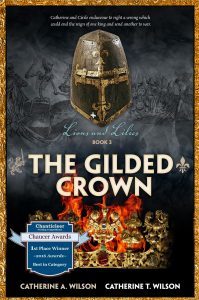
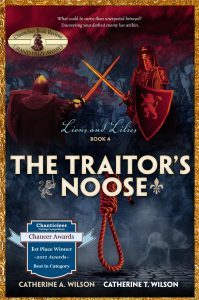
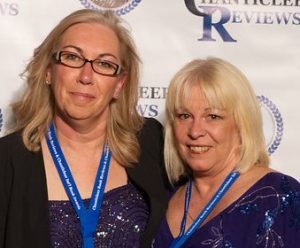 Double delight this month! I have the pleasure of interviewing a writing duo with a spark of serendipity between them given they both share the same first and second name as well as a passion for medieval historical fiction. Catherine A Wilson and Catherine T Wilson are the authors of the Lions and Lilies series. You might like to watch this Youtube video where the Catherines explain how they met and began their joint writing journey. Both were born in England but made their way Downunder. Each book in the series has received a first place in their category in the Chanticleer Book Review Awards with The Traitor’s Noose receiving the coveted Chaucer Award Grand Prize for historical fiction for 2017. Congratulations!
You can connect with both Catherines via their website, Youtube and their Lions and Lilies blog. On Facebook you can find them at Lions and Lilies, Catherine A Wilson and Catherine T Wilson.
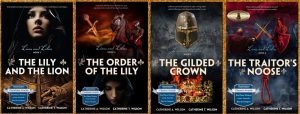
You can order all four books here.
Catherine A Wilson was born in London, England, and immigrated to Australia in 1972 to reside in and around the leafy suburbs of Eastwood, Epping and Dundas. Without a particular path in mind she simply took the first job she was offered, which happened to be the position of Layout Artist for a well-known map publisher but changed course and selected a career in nursing. She later enlisted in the Royal Australian Air Force, before resigning to a quiet life at home.
She lives in the Blue Mountains, west of Sydney, with her husband and two beautiful children, several Jack Russells, a large flock of flighty chickens, goldfish and budgies. When not writing (which is not often) she likes to garden, read books, shop, read books, drink copious cups of strong coffee with friends and read plenty of books.
Catherine T Wilson was born in Burnley, England, but moved to Australia when she was eleven months old. She grew up in Elizabeth, South Australia, relocating to Queensland when she was fourteen. She worked in communications, before finally deciding to fulfil her dream as a writer. The raw draft of her first novel, a Viking romance, won an encouragement award of $1,000 from six hundred entries, in a popular women’s magazine competition. She visited Europe in 2006 to witness the annual re-enactment of ʻThe Battle of Agincourt,ʼ and then travelled extensively throughout Britain and France, researching material for Lions and Lilies. In 2016, she returned to Europe for further research in Morocco, Spain, Portugal and France. Her visit to Chartres cathedral to ‘walk the labyrinth’ and then stroll through the medieval old town during its summer light show was an experience she’ll never forget. And the second visit to Bellegarde remains among her most treasured memories.
Catherine T lives on a small bushland property, on a mountain range west of Brisbane and yes, you need only walk into her house to see her first love. Pictures of maidens on horseback grace the walls, and every corner and mantel is filled with knights and battle axes, the bookshelves overflowing with tales of chivalry.
What or who inspired you to first write?
 CA – My maternal grandmother was a wonderful story teller and it was she who inspired me to follow in her footsteps. I was also very fortunate to encounter a fabulous English teacher in high school, Ms Toni Hurly, who took me under her wing and encouraged me to put pen to paper.
CT – It sprang from a desire to find my own niche. As a general ‘jack of all trades, master of none,’ I decided I wanted to find that one thing where I could say ‘this is what I do.’ Some friends knitted or sewed, some crocheted, some could paint, sing, be great at sports. I just needed to find and occupy my own space in the world.
Which authors have influenced you?
CA – As a child I my favourite author was L M Montgomery, but I would have to say I enjoy novels by Elizabeth Chadwick, Barbara Erskine, Diana Gabaldon and Victoria Holt. My greatest influence though would have to be my co-author, Cathy T.
CT – First and foremost was a French author, Juliette Benzoni, (when I was fourteen years old). Later came authors like Roberta Gellis, Jean Plaidy, Kathleen E Woodiwiss (The Wolf and the Dove), Elizabeth Chadwick and more recently, Australian author Isolde Martyn.
What is the inspiration for your current book?
CT – The current book, Roar of the Lion, is the fifth in the Lions and Lilies series and my story for this book was inspired by information I came across whilst researching. It also played perfectly into the relationship between three of the characters.
Is there a particular theme you wished to explore?
 CA – I want to really explore the political influences placed on Edward III during the later years of his life and how that played out during The Hundred Years War.
CT – Not specifically. It’s more about writing about all the different aspects to medieval life. Have you ever read a book where, at the end, when the characters go home, you just wanted to go with them? Well, Lions and Lilies does just that – takes you into their homes.
What period of history particularly inspires or interests you?
CA – I have always loved English history and have a particular interest in the middle to late medieval periods and the Tudor era. For me, it’s all about the romance – ruined castles, knights in armour, jousting, maidens on horseback, amazing battles and acts of bravery, religious fervour and holy pilgrimages.
CT – Medieval! Anything from the Vikings through to the crusades, all the way to the Renaissance. Then my next favourite is the French Revolution. I fell in love with the medieval period after reading a series of books when I was fourteen. They were set during The Hundred Years War, a bit further on from where Lions and Lilies takes place. The story included Joan of Arc and her demise and I was captivated with the era. I think I became fascinated with the French Revolution after watching ‘The Scarlet Pimpernel’ (1982 version with Anthony Andrews)
What resources do you use to research your book?
 CA – I use whichever resources I can find – printed books, the Internet, the library. I read extensively, included novels by authors I admire, particularly those set in the same time period that I am interested in. I have travelled to the UK several times and have been fortunate to gather information on each trip. Likewise, Cathy T has also provided me with information when she visited France and the UK.
CT – I use all the books I have in my library or public library for the first-draft, then as finer details are required, the internet. This can sometimes be tricky to verify the reliability of the source, so I check several places for the same information to see if they match. I also take ‘research holidays’ and visit many of the places that I write about as there is nothing quite like seeing it for yourself!
How long did it take to finish a novel?
 CA – It will take Cathy T and me at least twelve months to work on a concept, research and have the first draft down on paper. The first edit (conducted by Cathy T) can take a further two months and we often undertake several small rewrites. A second and third edit ensues and during this time we are also considering the cover design, back cover blurb, tag line, updating the glossary, character listing etc. We aim to have each project completed in eighteen months, but it can run over that time frame.
CT – Usually between 12 – 18 months. There is a lot of research to complete in the beginning, the actual writing, then the editing and re-write phases, however many it takes to get it to where we think it’s ready.
What do you do if stuck for a word or a phrase?
CA – I just keep writing and will go back to that section either later that day or up to a week later. By that stage my brain has managed to work through the issue.
CT – If a bit of researching doesn’t find it, I leave it and come back to it. Usually on the next read-through, it jumps right out at me.
Is there anything unusual or even quirky that you would like to share about your writing?
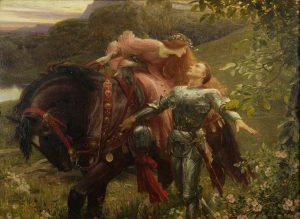
La belle dame sans merci by Frank Dicksee
CT – Going out on a limb here but more than once, I have written a scene before the research or visit takes place, only to find that I have written it correctly. It has happened more than once, even down to finding our characters names on a relevant family tree of 14 children some 18 months after we began writing—born in the same year and one was a nun! I also wrote a scene and when I travelled to France later and found the perfect keep, I located a 13thC church nearby. We walked through the church and cloister only to find the setting I had already described, even down to a piece of ‘unlikely’ furniture in a room at the top of the stairs. The hairs on my arms rose that day!
Do you use a program like Scrivener to create your novel?
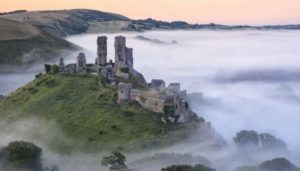
Corfu Castle, Dorset
CA – We occasionally use Autocrit, which is a great tool for identifying repetitions and spelling errors etc. however, Cathy T undertakes all my editing and she rarely misses anything.
CT – No. I’ve downloaded Scrivener and it looks great, but it’s fairly involved, and I think we’re too far along to change now. We have developed our own system and it works perfectly for us. Besides, the time I would need to get a handle on it, could be spent writing!
Do you ever write in long hand?
CT – No. I am a typist so long hand would be painfully slow for me, not to mention making my hand ache. Anyway, you’d probably only be able to read the first sentence!
Is there a particular photo or piece of art that strikes a chord with you?
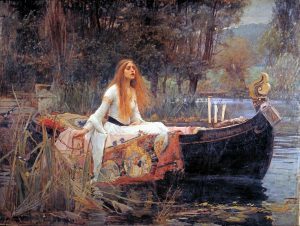
The Lady of Shallot by John Bell Waterhouse
CA – I love this image of Corfu Castle in Dorset England by Mark Bauer. Perched atop the Purbeck Hills it is one of the earliest castles in the UK to be built in stone.
CT – Hmm, I have two of equal measure. One is ‘The Lady of Shallot’ (John William Waterhouse) and the other is ‘La Belle Dame Sans Merci’ by Frank Dicksee. Please don’t ask me to choose because I simply cannot! Both show different sides to the ideal of courtly love; the Lady of Shallot for the sheer desperation of the lady’s love for Lancelot for which she was willing to chance death, and La Belle for the devotion shown by the lover to his lady, beseeching her to show him mercy and return his love. Such passion!
What advice would you give an aspiring author?
CA – The only difference between aspiration and accomplishment is the act itself. If you want to be a writer, sit down at your laptop and start typing.
CT – Like any apprentice, learn the tools of your trade; sentence construction, avoiding repetition, consistency of characters, spelling and grammar, etc. Then find your own style and niche and most importantly, never give up.
Tell us about your next book.
CA – Roar of the Lion, Book 5 in the Lions and Lilies series, follows on from The Traitor’s Noose and continues the story of Gillet and Cécile in France and Simon and Catherine in England. This novel explores the political climate in Europe during the late 1360’s and early 1370’s and specifically, the final years of Edward III rule in England and what influence Alice Perrers had on the ailing king’s decisions.
CT – In Roar of the Lion, four years have passed, and we take up the story just as the Spanish war commences with the French/ Castilian forces pitted against the Anglo/Castilian forces creating problems for the Armagnacs and Albrets who have family members on both sides. The outcome of this battle has serious consequences for the Plantagenet rule as well as our beloved characters.
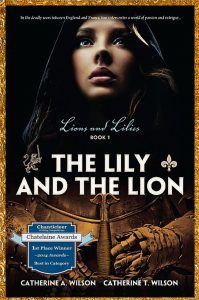
In the war between England and France a medieval adventure begins with a letter. Two sisters, Cécile and Catherine, enter a world of passion and intrigue, separated as infants, rediscovered by chance. Can they unravel a mystery and be re-united? 1st Place Chanticleer Chatelaine Award – 2013
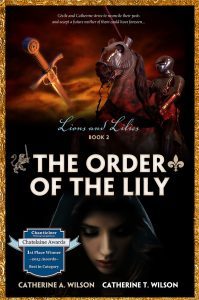
A tale of powerful alliances, deadly plots and royal secrets. In an age when women held no power, Cécile and Catherine must rely on the courage of the knights who are assigned to protect them. 1st Place Chanticleer Chatelaine Award – 2014
A dangerous power play between kingdoms, each must risk their life to foil a plot that could end the reign of one king and send another to war. In the darkest of hours, courage must be found. 1st Place Chanticleer Chaucer Award – 2016
What is worse than an unexpected betrayal? Discovering your darkest enemy lies within. When honour demands the ultimate sacrifice – loyalty, trust, love but you know, in the end, justice will be a traitor’s noose. Grand Prize WINNER Chanticleer Chaucer Award – 2017
 Haven’t subscribed yet to enter into giveaways from my guests? You’re not too late for the chance to win this month’s book if you subscribe to my Monthly Inspiration newsletter for giveaways and insights into history – both trivia and the serious stuff! In appreciation for subscribing, I’m offering an 80 page free short story Dying for Rome -Lucretia’s Tale.


September 8, 2018
On Inspiration: Interview with Mary Ann Yarde
 My guest today is Mary Anne Yarde, the Award Winning author of the International Best Selling Series — The Du Lac Chronicles. Set a generation after the fall of King Arthur, The Du Lac Chronicles takes you on a journey through Dark Age Briton and Brittany, where you will meet new friends and terrifying foes.
Born in Bath, England, Mary Anne grew up in the southwest of England, surrounded and influenced by centuries of history and mythology. Glastonbury — the fabled Isle of Avalon — was a mere fifteen-minute drive from her home, and tales of King Arthur and his knights were part of her childhood.
You can connect with Mary Anne Yarde via Facebook, Twitter and her blog. You can also purchase The Du Lac Chronicles series via Amazon.
 What or who inspired you to first write? Which authors have influenced you?
I cannot remember a specific moment when I suddenly felt inspired to write. Writing is always something that I just enjoyed doing. It was a hobby that I never took particularly seriously. About fifteen years ago I came up with this idea about a story set in Arthurian Britain. At the time one of my dearest friends was studying creative writing at university, and we started talking about the writing that she was working on and I said, “I’ve got this crazy idea about a story set in Arthurian times,” and as good friends do, she said, “Tell me your idea.” For the next hour that is what I did. When I had finished, my friend said, “You really have to write that book.” So that is what I did. I borrowed all her university textbooks and jumped in at the deep end. It took me twelve years to have a manuscript that I was happy with, so for me, it was certainly not a quick process.
I don’t think there is one particular author that influenced my writing. I am an avid reader, so I think that certainly helped.
What is the inspiration for your current book? Is there a particular theme you wished to explore?
 My latest release, The Du Lac Prophecy, is book four of The Du Lac Chronicles series. This series is set in the late fifth and the early sixth century in post-Arthurian Britain. This was a time of myths and legends, and I am fascinated by the stories that come from this period. I wanted to explore what happened after the death of the legendary King Arthur. I wanted to write a story about the next generation of knights and how they navigated a somewhat turbulent era in history. It was imperative that I made the backdrop to this series as realistic to the period of history as I could. During this time we saw the demise of the Western Roman Empire. Men such as Clovis took advantage of Rome’s weakness and, in his case, forged a kingdom for himself. While Clovis was creating a united Frank, Britain was desperately trying to defend her coasts, from the Saxon’s, Jutes and the Angles, but without the support of Rome, and without unity, she did not stand a chance. Then there was the ever-growing influence of The Roman Catholic Church, and their battle against what they saw as the pagan religions, and of course there was that very subtle split between the Church of Rome and what is now known as Celtic Christianity, which is something I wanted to explore in my series.
This was a time of considerable uncertainty and significant change. It is the perfect setting for my characters and my story. My books are set in France, Brittany, Southwest England, and Wales. A great deal was going on in all of these countries during this time, and of course, there is the ever-present Church. I wanted to bring the history and the legends together. For this era the two go hand in hand, and I am incredibly fascinated by that fact.
What period of history particularly inspires or interests you? Why?
That is probably one of the most challenging questions for me to answer. I actually tutor Modern History, but I have never felt inspired to write a story set during this time. I think, as an author, the Early Medieval era is perfect for me. It sounds strange, but I feel at home when I am writing about this period. I think I was initially drawn to it as a child because of the Arthurian connection to where I lived, but the more I researched this era, the more fascinated I became.
What resources do you use to research your book? How long did it take to finish the novel?
As with most historical fiction authors, I spend more time researching the era my books are set in than I do writing. I love books, and I have many, many books on the Early Medieval period. I like to be able to lay them all out on my desk and cross-reference them. I am a terrible person, I do make notes in the margins, and I scribble all around the text, and underline key sentences. I even bend the pages down if I find something particularly fascinating.
 The Internet is also a great resource in itself although I always try to make sure that the information I am reading is from a reliable source. I go to talks by historians. I watch documentaries, and of course, I visit some of the places where my books are set in. To bring an era to life, you have to know it really well, and I am continually researching. I am always looking things up. I am always learning something new.
As to how long it takes me to write. The first book took me twelve years. However, now, it usually takes me around six to eight months to have finished that all-important first draft.
What do you do if stuck for a word or a phrase?
I usually stare out of the window, with a frown on my face, for a little while. However, I am quite proactive, I will get the thesaurus out, and I will not write another word until I have found the one I wanted!
Do you use a program like Scrivener to create your novel? Do you ever write in long hand?
I do have Scrivener, but I don’t use it. I prefer to write in Microsoft Word. The only time I use the good old paper and pen is when I am researching. I never write in longhand. I don’t think my hand could keep up with the ideas that flow through my head and if it did, I am pretty sure my writing would be illegible!
Is there a particular photo or piece of art that strikes a chord with you? Why?
 I adore The Accolade by Edmund Leighton. It always make me think of the great Arthurian romances. I also find music very inspiring. I have many play lists that reflect the mood of the scenes I am trying to convey in my books.
What advice would you give an aspiring author?
Read. This would be my first piece of advice. Read widely, not just the genre you want to write in. I think Stephen King really nailed it when he said:
“If you don’t have time to read, you don’t have the time (or the tools) to write.”
Tell us about your next book.
I have just started the research for Book 5 in The Du Lac Chronicle’s series. This time I am getting to grips with 5th Century, Jerusalem, as one of my characters spent some time there. I have a mountain of books to read on Jerusalem and the Eastern Roman Empire. I am learning a great deal, and I am really enjoying researching this remarkable city.

Two Prophesies. Two noble Households. One throne.
Distrust and greed threaten to destroy the House of du Lac. Mordred Pendragon strengthens his hold on Brittany and the surrounding kingdoms while Alan, Mordred’s cousin, embarks on a desperate quest to find Arthur’s lost knights. Without the knights and the relics they hold in trust, they cannot defeat Arthur’s only son – but finding the knights is only half of the battle. Convincing them to fight on the side of the Du Lac’s, their sworn enemy, will not be easy.
If Alden, King of Cerniw, cannot bring unity there will be no need for Arthur’s knights. With Budic threatening to invade Alden’s Kingdom, Merton putting love before duty, and Garren disappearing to goodness knows where, what hope does Alden have? If Alden cannot get his House in order, Mordred will destroy them all.
Good luck with your new book, Mary Anne – and I’m jealous that you live in such a magical area of England!
The Du Lac Prophecy is available on Amazon US, Amazon UK, Amazon CA and Amazon AU.
Haven’t subscribed yet to enter into giveaways from my guests? You’re not too late for the chance to win this month’s book if you subscribe to my Monthly Inspiration newsletter for giveaways and insights into history – both trivia and the serious stuff! In appreciation for subscribing, I’m offering an 80 page free short story Dying for Rome -Lucretia’s Tale.
September 1, 2018
On Inspiration: Interview with Lauren Chater
 I have the pleasure of interviewing fellow Australian, Lauren Chater, today. I’ve known Lauren for some time and am very proud of her success with her debut novel, The Lace Weavers. Lauren writes fiction with a particular focus on women’s stories. After working for many years in a variety of media roles, she turned her passion for reading and research into a professional pursuit. In 2014, she was the successful recipient of the Fiona McIntosh Commercial Fiction scholarship. In addition to writing fiction, she established The Well Read Cookie, a blog which celebrates her love of baking and literature. She lives in Sydney with her husband and two children. The Lace Weaver, her first novel, was published by Simon & Schuster in April 2018. She is currently working on her second novel, Gulliver’s Wife.
You can connect with Lauren on Instagram, Facebook and Twitter. The Lace Weaver is available on Amazon or via her website.
What or who inspired you to first write? Which authors have influenced you?
 I was inspired to write my debut novel after stumbling across a book on handknitted Estonian lace in my local library. That serendipitous moment prompted me to travel to Estonia and Russia to research more about the histories of those countries and I was able to use what I learned there as the basis of my story about the oppression of the Baltic people under Stalin’s communist regime. I’m constantly inspired by (and in awe of) other authors. I love the way Geraldine Brooks melds fiction with fact and I can’t go past Tracy Chevalier, but I’ve also discovered many wonderful new historical authors recently, like Sandra Leigh Price and Jim Crace.
What is the inspiration for your current book? Is there a particular theme you wished to explore?
When I wrote The Lace Weaver, I was interested in exploring whether the lace shawls (which are such a big part of Estonia’s cultural identity) might have been used as a way to preserve traditions during the fraught occupation of that country by first the Russian Soviets and then the Nazis. As I became more invested in the research, other ideas presented themselves and other questions surfaced. I tried to follow them to their natural conclusion without tampering with history too much.
What period of history particularly inspires or interests you? Why?
Is it ridiculous to say that all history interests me? Every era has its zeitgeist and aesthetic and that’s completely fascinating to me. I love the idea that so much can change within a generation or two, yet in some sense, people are always concerned about the same things; births, deaths, war, work, spiritual afterlife (or lack thereof), government, politics… The past is a vast, never-ending source of rich material, especially for writers. I’m particularly interested in shining a light on women’s stories, as I feel their experiences have been overlooked in favour of projecting the usual male narratives.
What resources do you use to research your book? How long did it take to finish the novel?
 While researching The Lace Weaver, I read lots and lots of books, not only memoirs and life-stories written by people who have lived through WW2 and its aftermath, but ethnographic studies and research papers by academics who lived there. Those were helpful as they really gave me that outsider perspective and illuminated aspects of life (for example, religious or belief systems) which people living within the Estonian culture perhaps took for granted and didn’t bother to write about. I also read fairytales and poetry, conducted interviews, watched documentaries and then I travelled to Estonia in 2015 to conduct on-the-ground research. Going to Estonia was probably the most useful in terms of getting to know the geography, the layout of towns and forests, the seasons etc. It took me around two years to finish the novel from when I first started researching it, and then another six months of editing with the publisher.
What do you do if stuck for a word or a phrase?
My favourite phrase when writing is, ‘what’s that thing called?’ It’s like a game I play with myself every day although it’s absolutely infuriating and unpleasant. If I can’t think of a word, I usually type the closest word I can think of into thesaurus.com and then I flick through, narrowing down options until at last it appears. I used to put a lot of XXXX in my manuscripts and tell myself I would return later, but now I force myself to actually finish the thought and commit the idea to the page. Otherwise I can’t be sure if what I’m trying to say is worthy of being there.
Is there anything unusual or even quirky that you would like to share about your writing?
I’m pretty boring, I’m afraid! Nothing quirky here. I do like to get myself settled with a cup of tea and a bottle of water before I get to work (and if it’s winter, I’ll fill up my hot water bottle and pop it on my lap, because I’m sooky and hate being cold).
Do you use a program like Scrivener to create your novel? Do you ever write in long hand?
I have used Scrivener for storing research but I like to write in Word. I don’t know why, it just feels right to me. I would long to write long hand but it would take me about fifteen years to finish a novel. I write really slow and suffer hand cramp. Did I mention I’m a bit sooky?
Is there a particular photo or piece of art that strikes a chord with you? Why?
I love art galleries and could happily spend all day wandering around in them. Unfortunately, I have two small children so if we do get to a gallery, it’s usually more of a sprint through to the restaurant or the outside cafeteria. I remember going to see the Renaissance exhibition at the National Gallery in Canberra when my son was two; we’d just paid for all our tickets and he started screaming the house down. So my husband took him outside and I got to wander alone through the Raphael’s and Botticelli’s, admiring that exquisite ultramarine blue. It was bliss. I’ve always loved the Pre-Raphaelite artists and have many framed prints of their work on my walls.
What advice would you give an aspiring author?
I would give an aspiring writer the same advice I give myself; don’t make excuses, just do the work. Don’t be afraid of going to dark places in your writing. Let the words be your joy, resist the temptation to rely on outsiders to validate you, because that way lies disappointment. Read as many books as possible and form genuine connections with people who share your passions. Be kind and encouraging to other writers and don’t let professional jealousy destroy your sense of worth. Be your own cheer squad. All those things!
Tell us about your next book.
I’m currently finishing off my next fiction novel, set in 17th century London. Titled Gulliver’s Wife, it’s the story of Lemuel Gulliver’s long-suffering spouse, Mary Burton. She’s a midwife and herbalist whose life is turned upside down when her husband returns home, babbling about a small island of tiny people he has found. Is he mad or simply ill? Mary has to set off on her own journey of discover to find out.
A breathtaking debut about love and war, and the battle to save a precious legacy.
Each lace shawl begins and ends the same way – with a circle. Everything is connected with a thread as fine as gossamer, each life affected by what has come before it and what will come after.
1941, Estonia. As Stalin’s brutal Red Army crushes everything in its path, Katarina and her family survive only because their precious farm produce is needed to feed the occupying forces.
Fiercely partisan, Katarina battles to protect her grandmother’s precious legacy – the weaving of gossamer lace shawls stitched with intricate patterns that tell the stories passed down through generations.
While Katarina struggles to survive the daily oppression, another young woman is suffocating in her prison of privilege in Moscow. Yearning for freedom and to discover her beloved mother’s Baltic heritage, Lydia escapes to Estonia.
Facing the threat of invasion by Hitler’s encroaching Third Reich, Katarina and Lydia and two idealistic young soldiers, insurgents in the battle for their homeland, find themselves in a fight for life, liberty and love.
Haven’t subscribed yet to enter into giveaways from my guests? You’re not too late for the chance to win this month’s book if you subscribe to my Monthly Inspiration newsletter for giveaways and insights into history – both trivia and the serious stuff! In appreciation for subscribing, I’m offering an 80 page free short story Dying for Rome -Lucretia’s Tale.
August 5, 2018
On Inspiration: Interview with Imogen Clark
 Let’s welcome Imogen Clark who writes fiction set in the 1970s and 80s about the secrets that hide at the heart of the families she creates. Her first book Postcards From a Stranger was independently published last summer. However, it was quickly spotted by Lake Union and she was then offered a three book publishing deal. Postcards From a Stranger will be republished on 7th August 2018 and The Thing about Clare on 1st December with the third book coming out in 2019.
Imogen initially qualified as a lawyer but after leaving her legal career behind to care for her four children, she returned to her first love – books. She went back to University, studying part-time whilst the children were at school and graduated with a BA in English Literature with First Class Honours.
Imogen’s great love is travel and she is always planning her next adventure. If you’d like to connect then please visit her website at where you can also download a FREE heart-warming short story, ‘The Bucket List’, when you subscribe to her email list. Imogen can also be found on Facebook, Twitter, Pinterest and Instagram as Imogen Clark at Home.
What or who inspired you to first write? Which authors have influenced you?
The inspiration to write a novel came to me in a dream about ten years ago. I saw myself writing and when I woke up I thought I would have a go. I’ve always been a reader but until that night I had never thought about actually writing a book other than in that daydream kind of way that most people think about it.
I write stories about families and love books by Maggie O’Farrell and Kate Atkinson. A quirky narrator appeals to me as well as an usual turn of phrase.
What is the inspiration for your current book? Is there a particular theme you wished to explore?
I am a stay-at-home mum with four children having given up my career as a lawyer to look after them. Being at home turned out to be far harder than going to an office (who knew?!) and one day I was at the end of my tether. There is a local airport not far from my house and I thought quite seriously about just taking my passport and catching the first available flight to somewhere else to see if anyone noticed that I’d gone.
 Of course, I didn’t do it but it started me thinking about what might drive a mother to leave her children. There has always been a bit of a taboo when a mother leaves, as if her going is somehow worse that a father doing the same thing. However, society can be quick to judge and I wanted to explore what kind of situation might arise that would make a mother leave and how that might impact on the rest of the family. That’s what Postcards From a Stranger is all about.
What period of history particularly inspires or interests you? Why?
Most of my stories are set partly in the 70s and 80s because that’s when I was a teenager and I feel at home there. I hadn’t really thought of that as an historical period as such but now that its 40 plus years ago and has its own sub-culture, I’m beginning to think that it might be. I would also like to write something set in the 1950s but I’m waiting for that story to come to me.
What resources do you use to research your book? How long did it take to finish the novel?
Google! What did we do before Google? But also I use my community on Facebook if I can’t remember how something was and there is nothing like actually going to a place to get a feel for it. Postcards From a Stranger is set in Ilkley where I live and San Francisco which I visited with my family so that wasn’t too tricky. I also found some fabulous decade scrapbooks which are great. I think they are to help people suffering from dementia to look at familiar things from their past and the pages are filled with photographs of food packaging, magazines, cars and other everyday items from the decade in question. They are fascinating just to look at but also a fantastic resource for the writer.
It generally takes me between three and six months to finish a novel but three quarters of the way through my brain starts to buzz with ideas for the next one and I have to really concentrate on the matter in hand to get it completed.
What do you do if stuck for a word or a phrase?
Drive myself mad! I know it will come to me eventually but it is so frustrating whilst you wait. I have a paper thesaurus which can sometimes help but often I just use a different phrase and hope that the one I’m searching for comes back to me. My editor sometimes finds that I’ve used words that sound a bit like the correct one that I’ve typed in to try and trigger the old grey cells and then have forgotten to change. Sometimes they are quite funny!
 Is there anything unusual or even quirky that you would like to share about your writing?
I’m not sure that it’s that unusual but I can’t make a plan or write an outline. I have tried but it’s like my brain goes into a sulk when I ask it to focus on one thing. My best ideas come when I’m doing something else other than just thinking. Often that’s when I’m writing (which is great) but sometimes I can be listening to radio show or cleaning my bathroom and thinking about what to cook for tea. It’s an exciting way to work but it’s not ideal as it means that I’m never entirely sure what the book will be about until I get to the end.
Do you use a program like Scrivener to create your novel? Do you ever write in long hand?
I use Scrivener (although I think I barely touch the surface of what its capable of.) I like being able to easily break my work down into chapters so I can move them around and the colour coding is fab! I don’t write longhand although of course I have hundreds of beautiful notebooks that I buy for that purpose and never use. I would love to keep gorgeous handwritten bullet journals too but I lack the artistic talent. I do write a diary though and that is longhand (and consequently fairly illegible.)
Is there a particular photo or piece of art that strikes a chord with you? Why?
 Earlier this year I snatched back a little room in my house to use as a writing room and redecorated it. I was very inspired by the art of a local artist Kerry Stoker and decide to commission a painting for my new space. I was delighted with the result, Future Perfect and it hangs against a dark blue wall in pride of place in my writing room. Here it is on Kerry’s site. Kerry and I talked about my writing process, my inability to plan etc and I think the picture reflects that whilst also giving the impression of something being formed. I love the colours too and when I look at it, particularly when I’m struggling with something that I’m working on, it reminds me just to go with the flow and see where it takes me.
What advice would you give an aspiring author?
Don’t give up! I had written seven novels before I wrote one that I thought was good enough to show the world. People kept telling me to send them out to see what happened but I knew in my heart that it was too soon. So I just kept putting the books away and starting again until I finally wrote something that I thought might be right. If I’d stopped at that first book I don’t think I’d be where I am now.
Tell us about your next book.
My next book is The Thing about Clare which is due out on 1st December. It’s about four siblings and its themes are around what it’s like to have a favourite child and whether it’s nature or nurture that forms your personality.
I have also just finished the first draft of the one after that, as yet untitled but due out in 2019. That one is about two families who have more in common that they realise but I can’t say more than that without giving too much away.
A secret lies buried at the heart of her family—but it can’t stay hidden forever.
When Cara stumbles across a stash of old postcards in the attic, their contents make her question everything she thought she knew.
The story she pieces together is confusing and unsettling, and appears to have been patched over with lies. But who can tell her the truth? With her father sinking into Alzheimer’s and her brother reluctant to help, it seems Cara will never find the answers to her questions. One thing is clear, though: someone knows more than they’re letting on.
Torn between loyalty to her family and dread of what she might find, Cara digs into the early years of her parents’ troubled marriage, hunting down long-lost relatives who might help unravel the mystery. But the picture that begins to emerge is not at all the one she’d expected—because as she soon discovers, lies have a habit of multiplying . . .
Many thanks Imogen. Good luck with the release of Postcards from a Stranger.
Imogen’s books are available for pre-order via her Amazon pages in the UK, US and Australia.
Haven’t subscribed yet to enter into giveaways from my guests? You’re not too late for the chance to win this month’s book if you subscribe to my Monthly Inspiration newsletter for giveaways and insights into history – both trivia and the serious stuff! In appreciation for subscribing, I’m offering an 80 page free short story Dying for Rome -Lucretia’s Tale.
July 1, 2018
On Inspiration: Interview with David Johnson
 My guest today is David Johnson who has developed a reputation as a writer of “books with heart.” His novels feature strong, unforgettable characters from humble backgrounds who have to grapple with the unexpected turns of everyday life. He is the author of the riveting “Tucker” series, one of the best-selling series on Amazon. The series has collected over 5,000 reviews, averaging 4.7 stars, and sales of the books will soon approach 500,000 copies. He has now ventured into historical fiction with The Woodcutters’ Wife.
David maintains a very busy life outside of writing. He’s a full-time Marriage and Family Therapist, is Director of a community chorus (soon to celebrate its 20th year!) that performs all across the Southeast, performing 15 shows a year. He maintains The Front Window blog . He’s been married for 45 years, has two daughters and six grandchildren.
David would love to hear from you. Send him a note to davidjohnsonbooks@gmail.com and join him on Facebook – David Johnson, Author.
You can purchase all of David’s books via his Amazon author page.
What or who inspired you to first write? Which authors have influenced you?
I learned much about writing from a college professor, Porter King. He made writing fun and helped me learn how to write.
Authors that have influenced me? It’s an eclectic group: Charles Dickens, James Fennimore Cooper, Edgar Rice Burroughs, Dean Koontz, Patricia Cornwell, Janet Evanovich.

What is the inspiration for your current book? Is there a particular theme you wished to explore?
I had never written a historical fiction book until the idea for The Woodcutter’s Wife, which is set in the Civil War, came to me. It wasn’t the battles in the war that interested me; it was the war’s effect on the people who stayed home. I began wondering, what did the women do when their husband, who did not own a plantation nor slaves, do when he left to fight in the war? How did they survive? Of course, that led to other questions, like, how did they deal with loss and subsequent depression? How did they resolve their resentment and bitterness?
All of my books center around ordinary but flawed people facing obstacles and challenges and how they overcome them. Mary, the main character in The Woodcutter’s Wife, has to carve a path through these kinds of situations, plus she has to decide if it is possible for a woman to love two men at the same time.
What period of history particularly inspires or interests you? Why?
 I’m particularly interested in the American Civil War. Less than one hundred years after it was established, the United States of America nearly came crashing down in a heap. Brother was pitted against brother, and many had no idea what the war was really about.
We in the U.S. are aghast today when we see countries engaged in civil war and wonder how that is possible, but we forget our own brief history.
What resources do you use to research your book? How long did it take to finish the novel?
From the time I started writing The Woodcutters’ Wife until publication was ten months. My resources:
The interpreters at the 1850s Homeplace in Land Between the Lakes (located in northwest Tennessee and western Kentucky and maintained by the US Department of Agriculture Forest Services), especially Cindy Earls.
Suzette Raney at the Chattanooga Public Library
The rangers and staff of Chickamauga and Chattanooga National Military Park, especially historian Jim Ogden
The civilwar.org websites, which give a wealth of information on all the major battles of that conflict
Mark McCutcheon’s book Everyday Life in the 1800s
Donald L. Winter’s book Tennessee Farming, Tennessee Farmers

What do you do if stuck for a word or a phrase?
I believe writers get “stuck” because they are searching for the “perfect” word or phrase or the setting up of a scene. It’s not that they can’t think of a word (because there are scores of words dancing in their head), it’s that they want it to be perfect. My practice is to pause for only a bit, then throw a word on the page and keep writing because I have found that when I go back through the manuscript editing it that that “perfect” word will magically appear.
Is there anything unusual or even quirky that you would like to share about your writing?
 Before I start writing a book I nearly always have in my mind the opening scene and the closing scene. The challenge then becomes taking the reader on a journey to the end in a manner that is clear and concise.
Something that is probably a bit weird is that I can write for fifteen minutes, get interrupted (even in the middle of a sentence), and can come back to where I stopped an hour or even a day or two later and am able to pick up the thread and go with it like I never stopped.
Another thing is that although I had written scores of essays and articles in the past, I didn’t start writing books of fiction until six years ago when I was just shy of sixty years old.
Do you use a program like Scrivener to create your novel? Do you ever write in long hand?
I’ve always used Microsoft Word.
Is there a particular photo or piece of art that strikes a chord with you? Why?
I have a print of “The Story Teller” by Stephen Scott Young that I just love. I can almost hear the voice of the old man as he spins a yarn or tells a tale of when he was growing up, and the small child is completely absorbed in the telling. It is a perfect picture of what an author tries to achieve.

What advice would you give an aspiring author?
You are not an aspiring author unless you are writing. Quit thinking about writing and start writing. Write every day, even if it’s only two hundred words. Good singers sing, and good writers write.
Tell us about your next book.
My current work in progress is Living in Quicksand and is inspired by many of the news headlines today. It explores the themes of teen suicide, bullying, clinical depression, infidelity and sex addiction. I’m hoping it will be published in September or October of this year.

Set against the backdrop of the Civil War comes a tale of love lost and found.
Mary Thomson is no ordinary woman. She works alongside her husband William cutting firewood to sell in the city, earning the nickname “The Woodcutter’s Wife.” She kills a bear with her bare hands. And she prefers plowing a field to cooking a meal. The one thing she cannot seem to handle is the melancholy that has enveloped her. Mary lost four children before they were a year old, and the doctor says she will never be able to conceive again.
Mary’s world flies apart when William disappears, leaving her with the arduous task of tending their farm by herself. Using her fierce independent spirit to cope as the war rages around her, she finds help in the form of a freed slave who offers his help. But fate throws her another dramatic curve, forcing her to make the most difficult choice of her life.
David Johnson, author of the bestselling Tucker Series, has written another of his signature “Books with Heart.”
You can purchase The Woodcutter’s Wife here.
Many thanks David – wonderful advice and a great list of resources!
 Haven’t subscribed yet to enter into giveaways from my guests? You’re not too late for the chance to win this month’s book if you subscribe to my Monthly Inspiration newsletter for giveaways and insights into history – both trivia and the serious stuff! In appreciation for subscribing, I’m offering an 80 page free short story Dying for Rome -Lucretia’s Tale.
June 2, 2018
On Inspiration: Interview with Camille Di Maio
 My lovely guest today is Camille Di Maio is the bestselling author of The Memory of Us, Before the Rain Falls, and The Way of Beauty, and she is part of the Romance Writers of America Honor Roll. She has been married for twenty years and has four children. She’s lived in four states, and held careers in political campaigning and real estate before giving it all up to pursue her dream of writing. Her other passion is travel and her bucket list is never-ending. You can connect with Camille via Twitter, Instagram, Facebook, Bookbub or her website. Learn more about her on Amazon. And here are the links to purchase The Way of Beauty, The Memory of Us and Before the Rain Falls.
What or who inspired you to first write?
I spent most of my recesses in grade school in the library and I read through nearly everything they had. I was fascinated by words, stories, and authors. And I wanted to be one of them someday.
Which authors have influenced you?
Early on, I was really inspired by Charlotte Brontë, L. M. Montgomery, and Laura Ingalls. My two favorite authors are Agatha Christie and Kate Morton.
What is the inspiration for your current book? Is there a particular theme you wished to explore?
 My inspiration for The Way of Beauty was the original Penn Station in New York City. It was absolutely remarkable – from its inception to its building. And yet, it was torn down to build Madison Square Garden. Its loss brought about the preservation groups that went on to save hundreds of other buildings in the city. But a theme that started to emerge was that of women and I started to see a pattern in the life span of the train station and the arc of a woman’s life. I explored how they fought for the right to vote, how they took on the jobs of men during the war, and how they adjusted to a new, modern world in the middle of the century.
What period of history particularly inspires or interests you? Why?
I really love the first half of the 20th century. They faced many of the same challenges we do, but without the benefit of all of the technologies that we have. I’m inspired by what they had to sacrifice during war and how innovated they needed to be to straddle new opportunities.
What resources do you use to research your book? How long did it take to finish the novel?
 I have been to New York many times, so I utilized my own experiences in the city and supplemented it with books, documentaries and Google Maps. It took me about a year to write the book, but I was thinking about it for several years before that. Most books spin in my head for a few years before I type one word on my laptop.
What do you do if stuck for a word or phrase?
I usually look up to the ceiling as if it will provide the answer! But if I don’t come up with what I want to say, I go to thesaurus.com and just start looking at lots of words until the right one calls out.
Is there anything unusual or even quirky that you would like to share about your writing?
I would say that my life is quirky and fitting writing into it is definitely unusual. I homeschool my four children (though my first is actually off to college, so three are at home now) and my husband works at home. So, the house has not been the best place to write. I steal away to the library or a coffee shop for a few hours a week and get in as much writing as I can.
Do you use a program like Scrivener to create your novel? Do you ever write in long hand?
I’m pretty old fashioned! I’m only a recent convert to depositing money in an ATM rather than walking in a bank, and I don’t have a bank app on my phone. So, no, I haven’t switched to the glory that I hear Scrivener is. I use Word, but it works for me! I don’t write my books in long hand, but I do write lots and lots of letters to people. I try to write about one letter per day.
Is there a particular photo or piece of art that strikes a chord with you? Why?
 This has nothing to do with writing, but one of my favorite photos ever is the one of Princess Diana and Mother Teresa holding hands. I am struck at how the statuesque princess and the tiny old nun shared a sense of loving the less fortunate.
What advice would you give an aspiring author?
See a first draft for what it is. A draft. Do not try to compare it to the finished works that you read. By the time a book is published, it has gone through countless drafts, a developmental edit, a copy edit, a proofread, and many other steps. If you believe you have a nugget of something good, just keep at it. Refine, refine, refine, but do not get discouraged because of comparison.
Tell us about your next book.
I’m just finishing my fourth, as-yet-untitled book. It is set in Coronado, California in the 1950s. There is a ghost, a mystery, a love story, and the tale of a young woman emerging from the expectations of her family. I loved writing something set at a beach!

Hearts and dreams evolve in the shadow of the once-magnificent Penn Station.
Vera Keller, the daughter of German immigrants in turn-of-the-century New York City, finds her life upended when the man she loves becomes engaged to another woman. But Angelo Bellavia has also inadvertently opened up Vera’s life to unexpected possibilities. Angelo’s new wife, Pearl, the wealthy daughter of a clothing manufacturer, has defied her family’s expectations by devoting herself to the suffrage movement. In Pearl, Vera finds an unexpected dear friend…and a stirring new cause of her own. But when Pearl’s selfless work pulls her farther from Angelo and their son, the life Vera craved is suddenly within her reach—if her conscience will allow her to take it.
Her choice will define not only her future but also that of her daughter, Alice.
Vera and Alice—a generation and a world apart—are bound by the same passionate drive to fulfill their dreams. As first mother and then daughter come of age in a city that is changing as rapidly as its skyline, they’ll each discover that love is the only constant.
Congratulations on your new release, Camille! Many thanks for sharing your sources of inspiration with us. You can purchase your copy of The Way of Beauty here.
Haven’t subscribed yet to enter into giveaways from my guests? You’re not too late for the chance to win this month’s book if you subscribe to my Monthly Inspiration newsletter for giveaways and insights into history – both trivia and the serious stuff! In appreciation for subscribing, I’m offering an 80 page free short story Dying for Rome -Lucretia’s Tale.
May 31, 2018
Guest Post: Research and reaching across the ether
I love research! I was delighted that Mary Anne Yarde asked me to tell the story of how I reached across the internet to various historians for assistance – it ended in my characters voicing an audio-visual exhibition in a museum outside Rome where my saga was set! Read ‘Research and reaching across the ether’ here.
April 30, 2018
On Inspiration: Interview with Carol M Cram
 My guest today is Carol M. Cram. She is the author of three works of historical literary fiction. Her first novel, The Towers of Tuscany (Lake Union Publishing, 2014) and her second novel, A Woman of Note (Lake Union Publishing, 2015) were both designated Editors’ Choice by the Historical Novel Society in the UK, and both won First in Category for the Chaucer and Goethe Awards (Chanticleer Book Awards), with The Towers of Tuscany also winning the Grand Prize Chaucer Award for best historical novel pre-1750. The Muse of Fire, Carol’s third novel, was released in January, 2018 by Kindle Press (e-book) and New Arcadia Publishing (paperback). The Muse of Fire was recently awarded a Bronze in the Historical Fiction category from the Independent Publishers Book Awards (the IPPYs).
Carol is also the author of over fifty best-selling college textbooks in computer applications and communications for a major US publisher (Cengage Learning) and was on faculty at Capilano University in North Vancouver for over two decades. In addition, she was Vice President of Clear Communications Consultants and facilitated numerous communications workshops for corporate and government clients. Carol holds an MA in Drama from the University of Toronto and an MBA from Heriot Watt University in Edinburgh. She lives with her husband, painter Gregg Simpson, on beautiful Bowen Island near Vancouver, BC, where she teaches Nia dance and volunteers for the local arts council after serving as its president for 10 years.
You can connect with Carol via her website and Twitter
You can purchase her books via these links The Towers of Tuscany, A Woman of Note and The Muse of Fire.
What or who inspired you to first write? Which authors have influenced you?
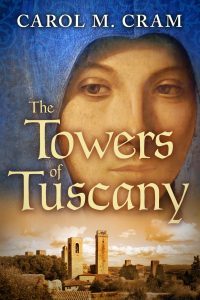 I’ve wanted to be a writer pretty much all my life and certainly since I was about eight years old when I first responded to a writing assignment by producing many more pages than the teacher requested. By the time I was a teenager, I knew for sure that I would become an author. I remember how incredible I felt when my English teacher told me that he’d “see me in print one day.” He helped me believe I might be able to tell stories that people wanted to read.
My biggest influence is Jane Austen, hands down, followed by an eclectic selection that includes Tracey Chevalier, L.M. Montgomery, J.K. Rowling, Marion Keyes, and Maeve Binchy in addition to fun reads like Nora Roberts and Sophie Kinsella. I love historical fiction that helps me learn about a certain period while also delivering a great story and literary fiction by some of our wonderful Canadian authors (Lawrence Hill, Margaret Lawrence, Will Ferguson, Richard Wagamese). I get inspired by great writing and fortunately there is a lot of it out there! I aim to read at least one book every week, although I don’t always manage that.
What is the inspiration for your current book? Is there a particular theme you wished to explore?
When I was in the middle of writing my first novel, The Towers of Tuscany, a few years ago, I was doing the usual writer procrastination thing and cleaning out my office. I came across an essay I wrote as a graduate student in the Centre for Drama at the University of Toronto about the longest running riot in British theatrical history—the 66-day Old Price Riots of 1809 at the Theatre Royal, Covent Garden. As I was reading the essay—now as an author rather than as an academic – I started to wonder about the stories behind the events. How had the actors and actresses felt as they performed every night during the riots? What about the rioters themselves? In a lot of ways, the rioters—mostly young men out for a good time – were not much different from the hockey and soccer hooligans of today. The theatre was a major form of entertainment in those days and when the managers put the ticket prices up, people were incensed. I wanted to tell the stories behind the riots. The Muse of Fire combines real life events and people with fictional characters.
The Muse of Fire is also inspired by my love of Shakespeare. In fact, I start every chapter with a Shakespeare quote. There’s nothing like the Bard for helping me zero in on a chapter’s central theme. The title of the novel comes from the Prologue to King Henry V:
O for a Muse of fire, that would ascend
The brightest heaven of invention,
A kingdom for a stage, princes to act
And monarchs to behold the swelling scene!
I was also intrigued by the wonderful, lively and tumultuous life of the theatre in early 19th Century London. The theatre played a central role in the lives of all classes of people, which is why they rioted for 66 days when the theatre’s managers raised the ticket prices! I also would like readers to enjoy my main character’s journey and to appreciate that even though she made some unwise choices, she remained true to herself and what she saw as her purpose in life.
What period of history particularly inspires or interests you? Why?
 I’m pretty eclectic in my history interests. The Towers of Tuscany was set in 14th Century Tuscany; A Woman of Note, in 1830s Vienna, and The Muse of Fire in early 19th Century London. These novels form a loosely-themed trilogy about women in the arts – painting, music, and theatre. My focus up to now has been on the arts/woman theme rather than a fascination with any particular period in history. That said, I’m pretty sure I’m going to return soon to medieval Italy. The 14th Century is such a rich period with wonderful art, plenty of drama, and the glimmerings of modern thought as people slowly began to explore humanism. I do have a sequel to The Towers of Tuscany started. Called The Merchant of Siena (at least at the moment!), it’s set in the second half of the 14th Century. However, I can also see myself exploring other historical periods such as Byzantium in the 6th Century (the story of the Empress Theodora fascinates me), 19th Century American/Canadian pioneers (my own heritage), World War I (my great-grandmother’s story), and perhaps World War II. One thing about history—there’s a lot to choose from!
What resources do you use to research your book? How long did it take to finish the novel?
The Muse of Fire took about five years to write on and off and then two full years of intense work. I consulted books and newspapers from the period and consulted with several experts in early 19th Century British theatre, and was particularly lucky to connect with a professor who wrote the definitive book about the Old Price Riots of 1809—the central historical event in the novel. He was incredibly generous and helpful, reading two drafts and providing me with lots of useful feedback.
What do you do if stuck for a word or a phrase?
I tend to get bogged down when writing a first draft, but not during the editing process when coming up with more elegant phrasing is easier. So, to minimize the amount of time I spend staring into space looking for the right words, I have gotten into the habit of setting a timer and just writing out a scene as quickly as possible. Once the words are out, I can then go back and polish.
Is there anything unusual or even quirky that you would like to share about your writing?
Much to my husband’s dismay, one of my most creative times for writing when I’m at home is from 5 to 6:30 in the evening (right at our dinner time!) I am the cook in the family and have burned many a meal while writing just one more sentence. Fortunately, my husband is a painter and understands the creative process. He’s incredibly supportive (and sometimes rather hungry).
Do you use a program like Scrivener to create your novel? Do you ever write in long hand?
I’m a Microsoft Word girl and make extensive use of outlining and styles to organize my novels. I tried Scrivener and found it much more limited than Word, probably because in my other life, I write textbooks that teach students how to use Microsoft products such as Word and Excel and so I have a pretty advanced level of knowledge that serves me well as an author! And yes, sometimes I write long hand. I still love to sit in a corner with my notebook!
Is there a particular photo or piece of art that strikes a chord with you? Why?
While writing The Muse of Fire, I often referred to the amazing cartoons created during the period of the Old Price Riots by George Cruikshank, a noted caricaturist of the early 19th Century. Here are a few examples of cartoons he created to lampoon the riots and particularly the manager of Covent Garden theatre, Mr. John Philip Kemble, who plays an integral role in my novel.


What advice would you give an aspiring author?
Don’t worry about getting published. Just work on being the best writer you can be. Find mentors, read lots of books about writing, read lots of books period (in and out of your genre), and of course, write – a lot! I found that I really started to make progress as a writer when I let myself “be bad.” Writing to a timer really helps turn off that pesky inner critic and just let the words flow without censure. You can always go back and rewrite. It really doesn’t matter if the first words are good, bad, or indifferent—they’re just a start of what could be something wonderful!
Tell us about your new publishing venture.
 Another favourite image of mine is a painting called A New Arcadia by my husband Gregg Simpson. This painting is the inspiration for my new publishing company New Arcadia Publishing. I recently published a novel by an amazing literary writing, Edythe Anstey Hanen, called Nine Birds Singing.
Tell us about your next book.
I’ve almost completed my fourth novel. Called Escape to Tuscany, the novel is set in modern times and tells the story of an art professor who, following the sudden death of her husband, buys an art school in Tuscany. Dreams clash with reality with a bit of the supernatural thrown in when the ghosts of the medieval past still clamour for attention and painful choices must be made.

After the death of her mother, Grace Johnson follows her abusive father to London and discovers a passion for the stage. But she must fight against social norms to find her place as a Shakespearean actress in the fraught world of early 19th Century theater. Aided by Ned, a foundling who takes charge backstage at the Theatre Royal, Covent Garden, Grace becomes ensnared by intrigues and setbacks that mar the pathway to stardom she craves. Set against the tumultuous backdrop of the Old Price Riots of 1809, Grace and Ned find common purpose in a quest that threatens to tear both their worlds apart.
Many thanks Carol. I love that you move between eras and have a theme of the arts in your books. Best of luck with The Muse of Fire and New Arcadia Publishing.
 Haven’t subscribed yet to enter into giveaways from my guests? You’re not too late for the chance to win this month’s book if you subscribe to my Monthly Inspiration newsletter for giveaways and insights into history – both trivia and the serious stuff! You’ll also receive an 80 page free short story Dying for Rome -Lucretia’s Tale.
April 22, 2018
Chaucer Awards: Call to Juno wins a First Place in Category
Absolutely delighted that Call to Juno has won a first place in the Ancient Fiction category in the Chanticleer Reviews Chaucer Award. Lovely that an Aussie can gain a prize over in America.
March 31, 2018
On Inspiration: Interview with Soraya M Lane
 My guest today is a fellow Antipodean from across ‘The Ditch’ (ie the Tasman Sea between Australia and New Zealand.) It’s wonderful to see how Soraya M. Lane has succeeded in reaching an international audience as the author of historical and contemporary women’s fiction. Her novel Wives of War was an Amazon #1 bestseller.
Soraya graduated with a law degree before realising that law wasn’t the career for her and that her future was in writing. She lives on a small farm in her native New Zealand with her husband, their two young sons and a collection of four-legged friends. When she’s not writing, she loves to be outside playing make-believe with her children or snuggled up inside reading.
You can connect with Soraya on Facebook, Twitter or at her website. Wives of War, Voyage of the Heart and Hearts of Resistance are available via her Amazon page.
What or who inspired you to first write? Which authors have influenced you?
I have always loved reading and I think it was a natural progression for me to start writing. I still have notebooks full of half-written stories from my childhood that I love to glance through sometimes – I was the kid always scribbling down ideas and reading books long after the lights were supposed to be out at night! When I was in my early twenties, my husband asked me what my dream job would be, and answering that question made me determined to actually write a novel from start to finish. Seven long manuscripts later and I sold my first book.
What is the inspiration for your current book? Is there a particular theme you wished to explore?
 I write mainly historical women’s fiction now, and I love to explore the WWII period and write about women who were feminists before their time. My latest book, Hearts of Resistance, features some very brave women who are so incredibly inspirational, and I love writing about strong female characters.
What period of history particularly inspires or interests you? Why?
To be honest, I’m inspired by many periods of history – I find so many things about the past fascinating. But my readers are currently enjoying my WWII fiction, and there are still many interesting places and events from the 1940s that I’d like to explore before moving on to a different time period, so I’ll be sticking with WWII for the near future.
What resources do you use to research your book? How long did it take to finish the novel?
For two of my historical projects I’ve had a research assistant, however for this novel I completed all the research myself. I usually take a month to research the story and write the outline of the story to send to my editor, then I’m about four months of solid writing to complete my first full draft. I would then spend roughly a month on editing the novel, based on revision notes from my editor, so for a 100,000 word novel, it would be a 6 month project.
What do you do if stuck for a word or a phrase?
I’m a fast writer and nothing annoys me more than being stuck for a word or description. So I’ll just type XXX and highlight the section, and come back later when I have time to re-read my writing and/or do some more research to find the right word or terminology. I often tell aspiring writers not to get stuck on words or names, just mark it clearly and come back to it later when you’re in editing mode. I’m a big fan of just getting as many words on the page as I can when I’m writing.
Do you use a program like Scrivener to create your novel? Do you ever write in long hand?
I don’t use a program, I just type straight into Word. Many years ago I used to do a lot of writing by hand, but I developed trigger fingers and tendonitis in my lower arm, which made handwriting very painful – my fingers would actually seize up. I found that typing isn’t so bad for me, although I do still have a larger lower arm on my right arm from the tendonitis. If I was more adventurous, I’d probably try dictation software!
Is there a particular photo or piece of art that strikes a chord with you? Why?
I always have a Pinterest board to “show” me what my characters and my setting looks like, however I’m not a huge art fan necessarily so I can’t think of a particular piece. I love admiring works of art, but it’s not something that I’m naturally drawn to or have much of in my home. My father cluttered all of our walls with art in our family home, he was obsessed with art and I found most of the paintings he loved very dreary, so now in my own home it’s all crisp white walls and very minimal art! I do love black & white prints, such as the Vogue collection though.
What advice would you give an aspiring author?
 Just write! Seriously, if you’re already writing a story, you are so much closer to achieving publication than all those people who say they want to write a book, but aren’t actually writing. Try to write every day, even if it’s just for 10-15 minutes, and don’t second-guess yourself – just write. The more you write, the better you will become, and try to think of your pre-publication years as your apprenticeship.
I am a big fan of setting a timer for 15 minutes and just writing as much as you can with no distractions during that time. I do this on a daily basis, many many times a day, and I have another author friend who I “work” with – we set our timers and text message each other our word count for each 15 minute session, so we get a lot done in short bursts of time. We can become quite competitive, and it’s a great motivation tool – even though we live in different parts of the country we can still write together.
Read your favourite books and think about why you loved the story – was it the conflict or the characters? What was the setting like? Once I understood how to develop conflict properly, it really helped me to create better, more three-dimensional flawed characters, and that’s when I sold my first book. Also, make sure you join a great writer’s organisation such as Romance Writers of Australia – the support and advice you can get from their conference is second to none.
Tell us about your next book.
I’m currently waiting on revisions for my next book, which is tentatively titled Spitfire Girls. It’s about the amazing female ferry pilots who worked in the UK for the ATA and in the US as the WASP, during WWII. These women were so brave and talented, but they were treated terribly in the beginning for doing what was seen as a “man’s job”. I can’t wait to share this story with my readers!

At the height of World War II, three women must come together to fight for freedom, for the men they love—and for each other.
When Hazel is given the chance to parachute into Nazi-occupied France, she seizes the opportunity to do more for the British war effort than file paperwork. Alongside her childhood friend, French-born Rose, she quickly rises up the ranks of the freedom fighters. For Rose, the Resistance is a link to her late husband, and a way to move forward without him. What starts out as helping downed airmen becomes a bigger cause when they meet Sophia, a German escapee and fierce critic of Hitler who is wanted by the Gestapo. Together the three women form a bond that will last a lifetime.
But amid the turmoil and tragedy of warfare, all three risk losing everything—and everyone—they hold dear. Will their united front be strong enough to see them through?
Thanks so much for sharing your sources of inspiration, Soraya. Lovely to have a ‘Kiwi’ visit my Triclinium.
You can buy Hearts of Resistance here.
Haven’t subscribed yet to enter into giveaways from my guests? You’re not too late for the chance to win this month’s book if you subscribe to my Monthly Inspiration newsletter for giveaways and insights into history – both trivia and the serious stuff! You’ll also receive an 80 page free short story Dying for Rome -Lucretia’s Tale.


