
Elisabeth Storrs's Blog, page 2
November 21, 2024
Cornelia Africana – My latest post on The History Girls
In my post on The History Girls I tell the story of the impressive Cornelia Africana – epitome of the Roman Matron yet she was far more than just the mother of The Gracchi Brothers and daughter of Scipio Africanus as described on her commemorative statue. Read more
The post Cornelia Africana – My latest post on The History Girls first appeared on Elisabeth Storrs Historical Novels.


October 25, 2024
On Inspiration: Interview with Aimie K Runyan
 My guest today is Aimie K Runyan who writes fiction, both historical and contemporary, that celebrates the spirit of strong women. In addition to her writing, she is active as a speaker and educator in the writing community. She lives in Colorado with her amazing husband, kids, cats, and pet dragon. She has been honored as a Historical Novel Society Editors’ Choice selection, as a three-time finalist for the Colorado Book Awards, and as a nominee for the Rocky Mountain Fiction Writer of the Year. Her previous historical novels include The School for German Brides, Daughters of the Night Sky and A Bakery in Paris.
To learn more about Aimie, please visit her website.
You can find all Aimie’s books on her Amazon page. You can buy Mademoiselle Eiffel here.
What or who inspired you to first write? Which authors have influenced you?I was assigned to write a short story in third grade, and I thought it was the coolest thing ever. I’d loved reading and stories, and getting permission to tell my own was heady stuff. I was then cast as Scribbler Mouse in the school play later that year, and the rest is history!
What is the inspiration for your current book? Is there a particular theme you wished to explore?I wanted to write a book set in the Belle Epoque as a sort of follow on to A Bakery in Paris. I came across Claire Eiffel’s story—or at least a few snippets about her—and I was riveted. I really wanted to explore the themes of feminine duty and sacrifice.
What period of history particularly inspires or interests you? Why?I love any period of great upheaval or growth. Post war periods, periods of rebirth. That’s why A Bakery in Paris and then Mademoiselle Eiffel were so much fun to write.
What resources do you use to research your book? How long did it take to finish the novel?I used a large number of scholarly works, of course, as well as some on the ground research in Paris and quite a long dive into the archives at the Musée d’Orsay. It was so much fun to research!
Is there a particular photo or piece of art that strikes a chord with you? Why?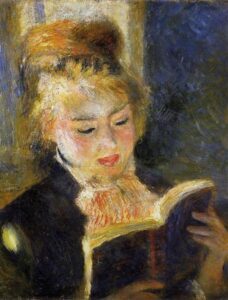 For years I loved Renoir’s “Woman Reading”. It seems on its surface to be a rather nice impressionist tableau of a woman with strawberry blonde hair dressed in black and reading a book. When one learns that Renoir preferred women who couldn’t read because they had sweeter tempers, and I’m rather glad she gets to defy the very man who painted her for as long as the painting exists.
I’ll put whatever bland word I can think of and go back. Writing is re-writing and I’m not afraid to go back and do some polishing.
Is there anything unusual or even quirky that you would like to share about your writing?I do love writing in my recliner. And I generally prefer to write when there’s no one in the house. Solitude helps a lot.
Do you use a program like Scrivener to create your novel? Do you ever write in long hand?I do use Scrivener, and I love it. I think in scenes, so it’s very intuitive in many respects. I write in longhand when I am stuck and occasionally for “morning pages”. Fountain pens are a thing of beauty and a joy forever.
What advice would you give an aspiring author?Stop aspiring, start writing. Make like-minded writer friends who will give you honest feedback, and work on developing a thick skin. Your toolbox will require discipline, a solid group of writer pals, and a whole truckload of resiliency if you’re going to make it in the crazy business.
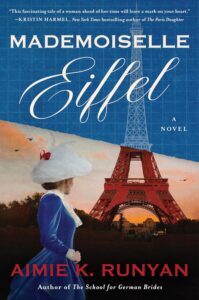
From the author of The School for German Brides and A Bakery in Paris, this captivating historical novel set in nineteenth-century Paris tells the story of Claire Eiffel, a woman who played a significant role in maintaining her family’s legacy and their iconic contributions to the city of Paris.
Claire Eiffel, the beautiful, brilliant eldest daughter of the illustrious architect Gustave Eiffel, is doted upon with an education envied by many sons of the upper classes, and entirely out of the reach of most daughters. Claire’s idyllic childhood ends abruptly when, at fourteen, her mother passes away. It’s soon made clear that Gustave expects Claire to fill her mother’s place as caregiver to the younger children and as manager of their home.
As she proves her competence, Claire’s importance to her father grows. She accompanies him on his travels and becomes his confidante and private secretary. She learns her father’s architectural trade and becomes indispensable to his work. But when his bright young protégé, Adolphe Salles, takes up more of Gustave’s time, Claire resents being pushed aside.
Slowly, the animosity between Claire and Adolphe turns to friendship…and then to something more. After their marriage in 1885 preserves the Eiffel legacy, they are privileged by the biggest commission of Eiffel’s career: a great iron tower dominating the 1889 World’s Fair to demonstrate the leading role of Paris in the world of art and architecture. Now hostess to the scientific elite, such as Thomas Edison, Claire is under the watchful eye not only of her family and father’s circle, but also the world.
When Gustave Eiffel’s involvement in a disastrous endeavor to build a canal in Panama ends in his imprisonment, it is up to Claire to secure her father’s freedom but also preserve the hard-won family legacy.
Claire Eiffel’s story of love, devotion, and the frantic pursuit to preserve her family’s legacy is not only an inspired reflection of real personages and historical events, but a hymn to the iconic tower that dominates the City of Lights.
Thanks so much, Aimie. What an incredible story of the woman behind the most famous iconic landmark!
 Haven’t subscribed yet to enter into giveaways from my guests? You’re not too late for the chance to win this month’s book if you subscribe to my Inspiration newsletter for giveaways and insights into history – both trivia and the serious stuff! In appreciation for subscribing, I’m offering an 80 page free short story Dying for Rome -Lucretia’s Tale.
The post On Inspiration: Interview with Aimie K Runyan first appeared on Elisabeth Storrs Historical Novels.
September 23, 2024
On Inspiration: Interview with Crystal King
 I’m delighted Crystal King has joined me again to share her journey in writing her latest novel, In The Garden of Monsters, a retelling of the Hades and Persephone myth, told from the point of view of a model Salvador Dali brings to Italy’s Sacro Bosco garden in 1948. She is also the author of The Chef’s Secret and Feast of Sorrow, which was long-listed at the Center for Fiction’s First Novel Prize and designated as a MassBook Awards Must Read. Crystal’s writing is fueled by a love of history and a passion for the food, language, and culture of Italy.
You can connect with Crystal via her website, Instagram, Threads @crystallin14, Substack, Youtube and Facebook. Follow her at Bookbub, Goodreads and Amazon.
You can purchase all Crystal’s books here.
What is the inspiration for In the Garden of Monsters? Is there a particular theme you wished to explore?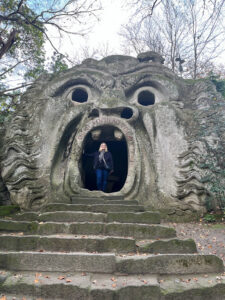 During the pandemic, I was trying to sell a historical novel about a meat carver to a Renaissance cardinal, and it wasn’t selling. I was talking to a friend of mine and lamenting this, and she suggested that gothics are hot. I thought, if I were going to write a gothic, where would I set it? I first thought of this garden I had visited in Italy a couple of years before: the Sacro Bosco, a garden in Bomarzo, Italy, filled with stone monsters. There is a castle on the hill that overlooks this garden. Inside the garden are statues of ancient gods and goddesses, and that was the beginning of my story.
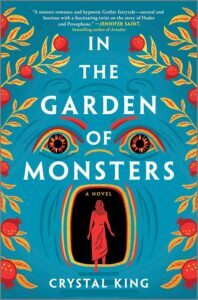 Persephone has been written about so many times, including some popular books about her that are out now. I don’t think I would have written about Persephone if I hadn’t been inspired by the statues in the garden. There is a Mouth of Hell, a statue of Demeter, another of Persephone, and many other mythological gods and creatures. It made sense to explore the story from there. I included Salvador Dalí because he visited the garden in 1948, and the garden is very surrealistic. I thought it would be perfect to include him to play upon some of that strangeness in this story. The Sacro Bosco is a wonderfully unusual place. You can learn more about the garden on my website.
My biggest challenge was getting access to Palazzo Orsini during the pandemic. I could visit the garden, but the Palazzo, where much of the book is set, was closed when visited during the time I was working on the novel. It wasn’t until I was finished that I could finally see the inside. Fortunately, there’s a lot of good information online, including many images and videos I could access.
While it wasn’t a research challenge, I also faced an interesting dilemma about how to include Salvador Dalí because he was a very problematic figure. If he lived today, he’d be canceled in a hot minute. I needed to figure out how to strike a balance between his charismatic and interesting side and his less savory aspects.
Is there a particular photo or piece of art by Salvador Dalí that strikes a chord with you? Why? I wasn’t a big fan of Dalí before I began researching him. He has a lot of paintings that are very unattractive in my mind or depict things that I find disgusting and strange. But there are many paintings that are quite beautiful and inspire you to use your imagination. I appreciate the side of him when he is trying less to shock and more to awe. He has a couple of paintings with pomegranates in them, the most famous being ‘Dream Caused by the Flight of a Bee around a Pomegranate a Second before Waking’. But there is also a painting that has come to be very special to me, and it’s one that is very rarely referenced. I discovered it when I was looking to see what he painted in 1948, potentially after he might have visited the garden. While the painting that I’m thinking of, which is untitled, does not include any real elements of the garden, there is a monstrous pomegranate floating in midair with an interesting frame around it against a landscape background. There’s a little tiny man playing a trumpet, and he’s sitting on the top of the frame. I included that man sitting on top of the building in the garden, and that painting features prominently at the end of the book. You can see both of these images on my page about Dalí .
One of my favorite images, though, is one my husband bought for me as a lithograph for a recent milestone birthday. It’s part of a series that he did for Dante’s Inferno, and it’s of Cerberus rearing back in front of Dante.
Your first two books were about culinary figures, and there was a lot of food in their pages. Does this book have any food?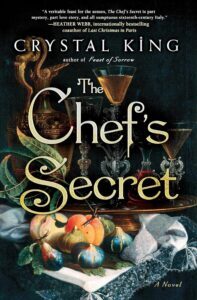 I think this book has more food in it than my previous two combined. Because much of the myth of Persephone centers around her eating pomegranate seeds, that gave me incredible creativity to play with. The book takes place over the course of a week, and every day, the characters partake in incredible feasts. I explore several different Italian eras in the food they eat, and I also highlight some of the recipes that are in the Dalí cookbook that came out much later, in 1978. I tease the idea that Dalí had been thinking of the food long before. Like my previous novels, I have a free companion cookbook for In The Garden of Monsters, which features recreations of the dishes in the novel, made by food book bloggers, chefs, food historians, and me.
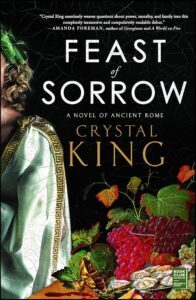 I didn’t expect to fall in love with Italy in the way that I did. I had just finished writing Feast of Sorrow, my first novel, and I thought I probably should visit Rome, considering so much of it is set there. So I went with my husband, who is a third-generation Italian. We fell in love from the moment we stepped foot in the city of Rome. I knew it was somewhere I was meant to be; it was like I had come home. There’s no way to describe that sensation. I don’t know if I believe in past lives or anything like that, but I felt like this was a place where I inherently belonged. Rome is truly where my heart is. I love Italy, I love the people, I love the culture. I just passed the language test to be able to apply for my citizenship, and I’m just passionately in love with the country.
The best advice is the simplest: put your butt in the chair. It’s better if you can do it consistently. I wrote my whole first novel on weekends over the course of three or four years, but now I write every day for an hour. I can tell you that when you do that, there is a very, very big difference in how the stories live in your head. I think you become a more thoughtful writer, a better plotter, and more in tune with your characters when you are consistent about working on your story.
Tell us about your next book.My new novel is not historical fiction, and it doesn’t have any food in it, which doesn’t sound like a Crystal King novel, I realize! But it is still set in Italy, at least partially. It’s a story about some lesser-known nefarious Greek gods that are stealing happiness from the world. You might think of it as a reverse Pandora’s box. More to come on that in the coming months.
Julia Lombardi is a mystery even to herself. The beautiful model can’t remember where she’s from, where she’s been, or how she came to live in Rome. When she receives an offer to accompany celebrated eccentric artist Salvador Dalí to the Sacro Bosco—Italy’s Garden of Monsters—as his muse, she’s strangely compelled to accept. It could be a chance to unlock the truth about her past…
In The Garden of Monsters is a retelling of the myth of Hades and Persephone, inspired by Salvador Dalí’s 1948 visit to the Sacro Bosco Mannerist statue garden.
Thanks so much, Crystal. I also love Rome and Italy. It’s fantastic you are going to become an Italian citizen! And congrats on the release of In the Garden of Monsters. Brava!
You can buy In the Garden of Monsters and Crystal’s backlist here.
Haven’t subscribed yet to enter into giveaways from my guests? You’re not too late for the chance to win this month’s book if you subscribe to my Inspiration newsletter for giveaways and insights into history – both trivia and the serious stuff! In appreciation for subscribing, I’m offering an 80 page free short story Dying for Rome -Lucretia’s Tale.
The post On Inspiration: Interview with Crystal King first appeared on Elisabeth Storrs Historical Novels.
August 17, 2024
Stephanie Dray on Becoming Madam Secretary
 I’m absolutely delighted to feature Stephanie Dray again on Triclinium. She is not only a talented author but a lovely person who is very generous with her time. She is a New York Times, Wall Street Journal & USA Today bestselling author of historical women’s fiction. Her award-winning work has been translated into many languages and tops lists for the most anticipated reads of the year. Now she lives in Maryland with her husband, cats, and history books.
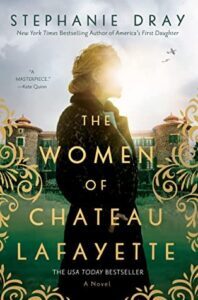
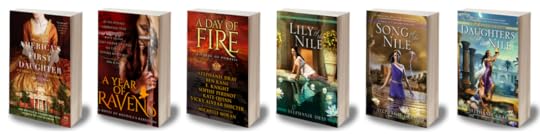
As fellow ancient history buff, I loved Stephanie’s Egyptian novels but she has moved forward in recent years to explore America’s history with America’s First Daughter, My Dear Hamilton, The Women of Chateau Lafayette and now Becoming Madam Secretary.
You can connect with Stephanie via Facebook, Instagram and her Amazon page. She also runs a terrific newsletter with lots of giveaways so be sure to sign up via her website.
Becoming Madam Secretary is a captivating and richly dramatic novel about Frances Perkins, one of the greatest political figures of the twentieth century, and an unsung heroine whose legacy is woven into the fabric of every American life. I was interested to learn more about Frances and how Stephanie came to write the novel.
 Can you tell me how you came across Frances Perkins?
I knew that she was a groundbreaking political figure–our first woman to serve in a presidential cabinet. And I thought someone ought to write about her; I just wasn’t convinced it ought to be me. I had the impression that she was matronly, stern and dull. That is, until I stumbled over a photo of a very young Frances Perkins, who was stylish, dashing, and anything but dull. She used to go undercover to expose pimps and human traffickers, for goodness sake. So I had to know how the intrepid young Fannie Perkins, the daughter of a stationery store owner, rose to White House. And it’s quite a story!
How did you approach researching her story?I started the novel in March of 2020 just as everything was shutting down for the pandemic, so I knew I would have to approach this differently. I couldn’t go anywhere or talk to anybody face to face, so I started out relying heavily on biographies and her transcribed oral history at Columbia University. Eventually I was able to get eyes on her personal papers too, but it didn’t start from that point of view.
What challenges do you face in bringing strong women characters to the fore within the limitations placed on them during the era?I love writing about women who I consider to be Founding Mothers of my country. It’s been clear to me that Jefferson, Hamilton, Lafayette, and the others could never have been what they were without the women behind and beside them. But I’m often reconstructing their lives based on the fragments we find about the men in their lives. There’s little primary source material on the ladies. For me, it was a natural jump to Frances Perkins, who is undoubtedly a Founding Mother of the 20th century, whose work shaped an entire century. But what was different about her from the start is that there was an enormous public record I could use. She was in the newspapers constantly. And she had far more agency than most of the ladies I’d written about before. I knew she would have found a way to be consequential with or without Franklin Delano Roosevelt. In fact, he wasn’t even her first political partner. So even though she was in FDR’s orbit, he was also in hers and that made the difference to his whole presidency.
 What was the most surprising thing you learned about Frances?
That she had a great and playful sense of humor. People talk about her as an unfailingly serious person of boundless wisdom and philosophical depth. She certainly was that. But her own oral history proves that she was also funny and she enjoyed being around party girls like Mary Rumsey and cut ups like Sinclair Lewis. I feel like women are always expected to fit into one box. The madonna or the whore. The brainiac or the bimbo. And so on. I think Frances wanted us to put her in the box of serious cabinet secretary, because she thought that’s what she had to be to represent other women well, to represent the country well, and to fulfil her mission as she saw it. But Frances wasn’t only ever one thing. None of us ever is.
Did you form a different view about Franklin D Roosevelt after learning about Frances’ interaction with him?Yes!! I still think FDR is one of the greatest and most consequential presidents in the country’s history. I put him up there in the top tier with Washington and Lincoln. But oh, he could be such a jerk. Such a completely opportunistic political animal. Such a coward at times. LOL. Again, I guess that just goes to show you that people–especially leaders–are very complicated.
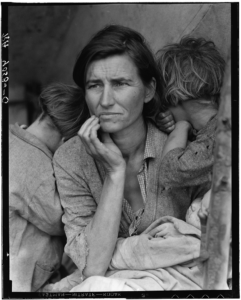 Do you have a particular favourite image or artwork associated with the period in which your book is set? Why?
Dorothea Lange’s iconic image from the Great Depression “The Migrant Mother” is emblazoned on my brain. It effectively conveys the kind of struggle and desperate trouble the country was in when Frances Perkins was called to serve.
Is there anything unusual or even quirky that you would like to share about your writing of Becoming Madam Secretary?I don’t know if this is exactly quirky or unusual, but it is meaningful to me, so I will say that four of my grandparents lived through the Great Depression and they all had stories. One of the most tragic was that my grandfather’s teenaged older brother decided, in desperation, to steal coal from a passing train to keep the family warm during a very cold Rochesterian winter. He died in that attempt and the family never got over that loss. My grandfather would go on to join the Civilian Conservation Corps when he was old enough and he was very proud of the lumberjacking skills he learned serving the country, and of his ability to send home some money to keep the family afloat. So I was very moved to learn just how involved Frances Perkins was in that program. I’m not sure my family would have survived without her and then I wouldn’t be here to tell the tale!
Tell us about your next book.Thanks for asking! I’m now working on a novel with my good friend and sometime co-author Laura Kamoie about a little-known Founding Mother named Abigail Adams!
Raised on tales of her revolutionary ancestors, Frances Perkins arrives in New York City at the turn of the century, armed with her trusty parasol and an unyielding determination to make a difference.When she’s not working with children in the crowded tenements in Hell’s Kitchen, Frances throws herself into the social scene in Greenwich Village, befriending an eclectic group of politicians, artists, and activists, including the millionaire socialite Mary Harriman Rumsey, the flirtatious budding author Sinclair Lewis, and the brilliant but troubled reformer Paul Wilson, with whom she falls deeply in love.
But when Frances meets a young lawyer named Franklin Delano Roosevelt at a tea dance, sparks fly in all the wrong directions. She thinks he’s a rich, arrogant dilettante who gets by on a handsome face and a famous name. He thinks she’s a priggish bluestocking and insufferable do-gooder. Neither knows it yet, but over the next twenty years, they will form a historic partnership that will carry them both to the White House.
Frances is destined to rise in a political world dominated by men, facing down the Great Depression as FDR’s most trusted lieutenant—even as she struggles to balance the demands of a public career with marriage and motherhood. And when vicious political attacks mount and personal tragedies threaten to derail her ambitions, she must decide what she’s willing to do—and what she’s willing to sacrifice—to save a nation.
Thanks so much for taking the time to tell us about Frances Perkins. As an Australian, I always find it fascinating to learn about pockets of American history that is not familiar to me. You can buy Becoming Madam Secretary and all Stephanie’s back list here.
Haven’t subscribed yet to enter into giveaways from my guests? You’re not too late for the chance to win this month’s book if you subscribe to my Inspiration newsletter for giveaways and insights into history – both trivia and the serious stuff! In appreciation for subscribing, I’m offering an 80 page free short story Dying for Rome -Lucretia’s Tale.
The post Stephanie Dray on Becoming Madam Secretary first appeared on Elisabeth Storrs Historical Novels.
July 17, 2024
On Inspiration: Interview with Gian Sardar
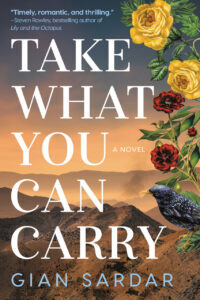
 Gian Sardar is my guest this month. She was born in Los Angeles, California. Her father is from Kurdistan of Iraq, and her mother is Belgian American and from Minnesota. She studied creative writing at Loyola Marymount University, is the author of the novels Take What You Can Carry and You Were Here, and is the coauthor of the memoir Psychic Junkie. Gian’s work has appeared in the New York Times and Confrontation Magazine and on Salon.com, among other places. She lives in Los Angeles with her husband, son, and insane dog, and she enjoys gardening, cooking, and other forms of procrastination.
You can connect with Gian via her website, Facebook and Instagram.
Gian’s latest release is When the World Goes Quiet which is available on Amazon, Bookshop and Barnes & Noble. All Gian’s books can be found on her website or Amazon page.
As always, I’m intrigued by an author’s inspiration and journey. Gian was kind enough to drop by to answer my questions.
What or who inspired you to first write? Which authors have influenced you?I don’t think one person inspired me to written, but certainly my mother inspired my love of reading. She used to say that when I was little I wouldn’t fall asleep in my crib until all my favorite books were beside me. In terms of authors, Mona Simpson was one of the first authors who truly inspired me. From there, I gravitate to authors who tend to be a bit poetic with their language…authors like Anthony Doerr or Lauren Groff.
What is the inspiration for your current book? Is there a particular theme you wished to explore?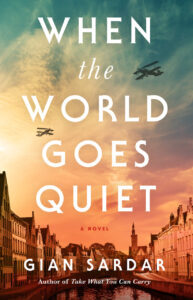 I love ancestry and exploring my family’s past. Take What You Can Carry was inspired by my father’s life growing up in Kurdistan of Iraq, and my latest novel, When the World Goes Quiet, was inspired by my mother’s family in Belgium, during World War I. Whereas with my father I grew up hearing his stories (directly from him) and so knew his world very well, my family’s life in Belgium was further in the past, which involved much more research and exploration. So much of this novel was an excuse to try and know and imagine the world they lived in. In addition to being drawn to my own family’s history, and what they might have faced, I have always been interested in WW1, just in general terms.
The Great War was truly horrific, and one thing I gravitated towards was the fact that you had neighbors and neighboring countries that were suddenly turned against each other, and in many cases they weren’t sure why. By the end of the war there were soldiers and civilians who all understood they’d been dragged into a war that had nothing to do with them, and I gravitated towards this uncertainty and confusion. People tend to want the world to be composed of good guys and bad guys, and right and wrong, but this just isn’t the case. World War 1 was an interesting arena for me to explore the theme of life existing in a gray area, and how uncomfortable people are with that fact.
What period of history particularly inspires or interests you? Why?Pretty much all of history interests me, but in addition to what I said about WW1, I must say I am also drawn to places/countries/locations. It often happens that while trying to research a place that I will find time periods in which that place was especially challenged, and that’s interesting to me.
 What resources do you use to research your book? How long did it take to finish the novel?
I will read just about every book I can get my hands on – both fiction and nonfiction, as well as watch documentaries, visit places (even if long plane rides are involved!) and do tours, and of course spend countless hours on-line trying to find appropriate websites and material. I even tend to buy a Sears Roebuck catalogue if the time I’m writing about takes place when the catalogue existed, or a LIFE Magazine just to look at ads. With this last novel, the research itself took about 6 months, and writing took longer because I started over twice. I think from the first word of the first draft to when I had a complete draft (that I was happy with) took about 2 years.
What do you do if stuck for a word or a phrase?I will read, walk around the house, or if it’s just a matter of finding a word I like to refer to a Notes document on my phone where I collect words I’d like to use.
Is there anything unusual or even quirky that you would like to share about your writing?I tend to write best when accompanied by almonds? :) Delicious smelling candles and rain also helps. Lol.
Do you use a program like Scrivener to create your novel? Do you ever write in long hand?Everything I do is in Word.
Is there a particular photo or piece of art that strikes a chord with you? Why?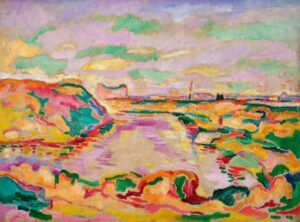 There are many many photos and artworks that strike a chord with me, so I wouldn’t even know where to begin. I am a very visual person so both art and photography are important to me. I more recently was drawn to trench art and art that came out of WW1 because of my latest book, but also the art that I was writing about (the Fauves and art from about 1905-1920) all really resonated with me. My book mentions several pieces, all which were very carefully chosen and perfect for the story. There is a “main” painting, which my character is promised if she completes a harrowing task, and that painting is Landscape Near Antwerp by Georges Braques. The painting is an escape for my character, as well as a promise, and teaches her that her world doesn’t need to be the one others see.
Your tastes will not be for everyone, but that also means it’s impossible to make everyone happy. What one person loves is the exact thing someone else will mention they hated – so try to just stay true to your own interests and style and you’ll find your people. Also try to trust. That’s a big one for me. Trust that you will find the heart of the story, that you will figure out a plot point, that you will make it better. First drafts are always hard and not always great, so trust that it’s part of the process and keep going.
Tell us about your next book.I don’t want to say too much without jinxing it, but this one takes place in 1933 and in Los Angeles, so for once I don’t have to get on a plane for research, which certainly makes things easier!
In the final days of World War I, an aspiring artist’s courageous journey is just beginning in a powerful novel about love, danger, and survival by the author of Take What You Can Carry.
It’s 1918 in German-occupied Bruges, Belgium. With luck, Evelien will make it to the end of the war and be given what she was promised: a prized painting in exchange for safeguarding her employer’s possessions. Until then, Evelien knows to keep her head down and stay out of trouble. But life never goes to plan, especially in war.
A member of the resistance approaches Evelien: steal a list of names hidden in her employer’s home. In return, she’ll get a letter from her long-missing husband, Emiel. She’d lost hope of Emiel’s survival, but the promised letter puts her certainty of his death in question. Evelien begins her mission and soon forms a friendship with a soldier who is struggling with the devastating demands of battle. Their shared passion for art deepens the bond, and Evelien faces a heart-wrenching truth: she longs for Emiel’s safe return…but not necessarily to her.
As the final days of the war loom closer, Evelien has never been in more danger. And should she survive the war’s bitter end, what choices will she make for a life beyond liberation?
Thanks so much for sharing your inspiration and the links to your family’s own history, Gian. All the best with your wonderful new novel.
When the World Goes Quiet is available on Amazon, Bookshop and Barnes & Noble.
Haven’t subscribed yet to enter into giveaways from my guests? You’re not too late for the chance to win this month’s book if you subscribe to my Inspiration newsletter for giveaways and insights into history – both trivia and the serious stuff! In appreciation for subscribing, I’m offering an 80 page free short story Dying for Rome -Lucretia’s Tale.
The post On Inspiration: Interview with Gian Sardar first appeared on Elisabeth Storrs Historical Novels.
June 10, 2024
When Thrones and Kingdoms are in Play
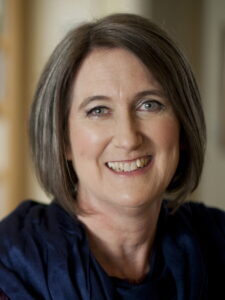 My guest this month is the wonderful Judith Starkston who writes historical fantasy set in the Bronze Age of the Greeks and Hittites. Her five novels bring women to the fore—whether the Trojan War captive Briseis or a remarkable Hittite queen whom history forgot, even though she ruled over one of the greatest empires of the ancient world.
Judith has spent too much time reading about and exploring the remains of the ancient world. She has degrees in classics from the University of California, Santa Cruz and Cornell. She lives in Davis, California with her husband and a rambunctious garden.
You can connect with Judith on her Website, Twitter, Facebook, Instagram and Tiktok. Sign up to her newsletter for book news and a free griffin novella, The Scent of Slaughter and Love.
Judith’s latest release is Flights of Treason, the final book in her historical fantasy series about the Hittite queen. I asked Judith to give an insight into the inspiration and history behind the book. Please enjoy her post which reveals her approach to writing a challenging battle scene based on archaeological facts laced with magic. You can also catch up with a previous interview I did with Judith about Queen Puduhepa, the model for her fictional queen, Tesha.
Flights of Treason is available on Amazon. You can find the entire series here.
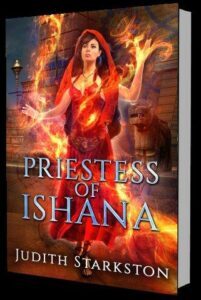
When Thrones and Kingdoms are in Play…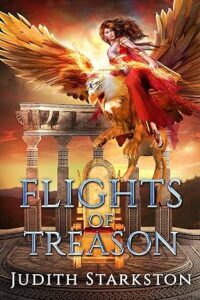 I began writing the true-life story of a remarkable Hittite queen because I admired her style of leadership and wanted to pull her from the dustbin of historical forgetfulness. Whether readers start at the beginning of my Tesha series with Priestess of Ishana, or jump into the latest release, the fourth and final book, Flights of Treason, I hope to immerse them in a world inspired by one of history’s least known empires and its most respected queen, the Bronze Age (1650-1200 BCE) Hittite kingdom stretching over what is today Turkey, Syria, and Lebanon. My series covers the years in this queen’s life when as a young woman she first stepped into the historical record and gradually rose to power.
This Hittite queen was also a priestess who believed in what we call magic. I followed the premise that if the historic person thought something magical could happen, I’d let it happen. The fantastical elements grounded in Hittite culture gradually extended further into the imaginary over the series. For example, I introduced griffins, fantastic beasts found in Hittite artwork, as characters with their own realm and mythology. The result is a series that blends history and fantasy to portray a woman’s journey to sovereignty.
The series is not a tale of burning ambition or selfish striving to slash her way to the top. The historic woman’s actions and words (found on clay tablets written in cuneiform) had revealed to me a nuanced, subtle balance of self-interest and the needs of others—her family and the empire overall. She struggles with murky moral issues and doesn’t always come out on the “right” side of them, but she refuses to ignore those big uncomfortable questions. I find that a refreshing change for a story of thrones and power and for the “real” world of today.
This fourth book took me to a challenging place as a writer, an aspect of writing historical fiction that I’d managed to skirt around up to now, and one that placed me deep in my layered mix of history/archaeology on the one hand, and sorcery/fantasy on the other: the epic battle scene.
Placing women to the fore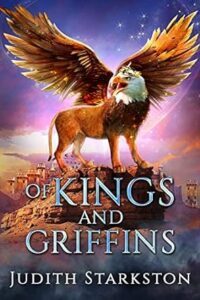 I put women to the fore in my fiction, and therefore, in an ancient world setting, they have previously observed battles but not participated in them. In my first novel, Hand of Fire, set in the Trojan War, Briseis watches key battles, overwhelmed with emotional involvement but not wielding weapons. In the Tesha series, Tesha’s husband, a brilliant general, has gone off to do his thing at essential times. But in this book, everything comes to a moment of such crisis that no one can stand back, and Tesha has grown into a woman of many skills, including strategy and sorcery.
First off, I don’t like drenching scenes in blood and violence. Even in the context of war, a blood bath isn’t required. I think what readers care about is the fate of each now-familiar character as the battle unfolds. A good battle scene is more about emotion and keeping the reader on edge than it is about blood and guts. Or so I’ve built into my battle. Perhaps I’d call it “just enough” chopping, wounding, and violence. And this time, Tesha participates, although with her own, unusual skill set.
Here in this fourth book, the epic battle moment was set for me by the historic record. The location has been reasonably identified by archaeologists. Clay tablets, now excavated and translated, describe the battle and include at least one participant’s interpretation of what happened and how divine will played a part. One of the rules of my fiction has been to preserve the skeleton structure provided by the fragmentary “knowns” of this queen’s life. So I wrote into my plot this battle at this location.
 An Epic Battle
These historical facts are still incredibly fragmentary, leaving a lot to be filled in, but they’re great for inspiration. From the most recent archaeological site reports, I found details about fortification walls that were stronger in one area than another. A river and cliffs. A dam. A meadow perfect for deploying an army, but also where the walls were strongest. A wall collapse and what might have caused it. I paired these “knowns” with the snippets found in the written record. The sword and spear warfare, the city siege, ancient engineering and battle plans all arose based on these details.
Sorcery and DemonsI added the elements of sorcery and demons that I’d woven into the series from Hittite and Egyptian mythology and religious beliefs. One of the aspects of this fourth book is the notion of an ensemble of heroes. No one alone can “save the day.” By the end of weeks of writing, I had an epic battle scene with a lot of participants, all with essential roles. I enjoyed balancing dueling sorcerers with duking-it-out armies, and a few other elements that would be spoilers to reveal. Keeping everyone’s contributions “equal” both toward the battle’s win or loss, and toward the reader’s engagement was a juggling act I’d never before tried on this scale. My brain hurt trying to pull it off. There were, of course, many edits. But in the end, it worked. Such fun.
I hope you’ll enjoy my series about a long-ignored woman in a patriarchal world who navigated into power, along with her extended group of family and friends, human and griffin. Just as griffins are a hybrid creature, part lion and part eagle, so my novels are a combination of painstakingly accurate history and wildly imaginative fantasy.
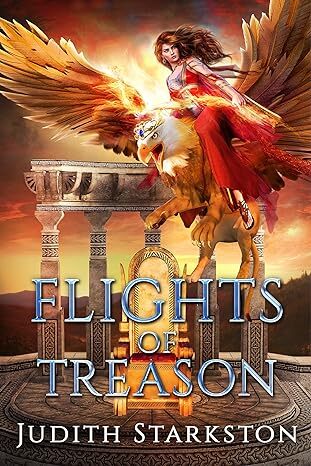
Treason threatens the thrones of the Hitolian Empire and the griffin realm. Can an unlikely ensemble of heroes save them?
As rulers of a vassal kingdom within the Hitolian Empire, Tesha and her husband Hattu have propped up a treacherous Great King. But balancing on the blade of a royal dagger is only half the problem. Unknown to them, Tesha’s blind sister is communicating with the king of the human-hating griffins.
Then hidden foes tip their lives toward disaster, and crises in both worlds collide.
The heroes fight battles with swords, claws, and sorcery. Will Tesha be forced to use the magic that might kill her daughter? Who truly unleashed these lethal strands of chaos? Will the empire—or Tesha’s family—survive?
Escape into the final book of this historical fantasy series, inspired by the true-life of a remarkable Hittite queen who ruled for decades over one of history’s most powerful empires.
“Starkston wraps history and magic together in an unforgettable package.”—the Book Review Crew
Thanks so much Judith. You’ve done an amazing job drawing the historical and mystical threads together across the series and definitely in that epic battle scene!
Flights of Treason is available on Amazon. You can find the entire series here.
 Haven’t subscribed yet to enter into giveaways from my guests? You’re not too late for the chance to win this month’s book if you subscribe to my Inspiration newsletter for giveaways and insights into history – both trivia and the serious stuff! In appreciation for subscribing, I’m offering an 80 page free short story Dying for Rome -Lucretia’s Tale.
The post When Thrones and Kingdoms are in Play first appeared on Elisabeth Storrs Historical Novels.
May 29, 2024
I Dadi D’oro is here!
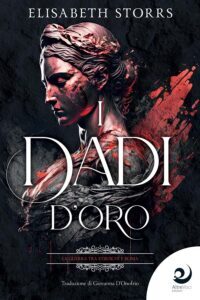 The dream continues. I’m thrilled I Dadi D’Oro has been released! It’s the Italian edition of The Golden Dice. Many thanks to Altre Voci Edizioni and the wonderful Marco Paganini who has enabled my Roman story to reach Italian readers. It hardly seems like a year has passed since I was in Rome celebrating the release of Il Velo Nuziale.
My thanks go to Giovanna D’Onofrio for the hard work performed to translate the book. I’m looking forward to next year when Call to Juno will appear as Il patto di Giunone – Juno’s Pact. I love the striking cover images. They show the strength of Caecilia who began as a pawn for Rome but rises to be an Etruscan queen.
The post I Dadi D’oro is here! first appeared on Elisabeth Storrs Historical Novels.
May 24, 2024
The History Girls – Websurfing and a C16 entrepeneur
Here’s my latest post on the History Girls blog – ‘Web-surfing and a C16th entrepreneur’. It’s about the dangers and pleasures of historical research. Clicking hyperlinks can take you down a wondrous rabbit hole and land you in the tarpit of research! This time I found Guillame Rouille, master entrepeneur and iconography expert. Read more on the History Girls website.
The post The History Girls – Websurfing and a C16 entrepeneur first appeared on Elisabeth Storrs Historical Novels.
November 26, 2023
The History Girls – Tullia Minor: Rome’s Murderous ‘Bad Girl’
My latest post on the History Girls blog features the story of the vicious last queen of Rome – Tullia Minor. Her conniving ruthlessness to place her husband, Tarquinius Supberbus, on the throne led to a string of murders culminating in the desecration of her father’s corpse. Definitely one of Rome’s legendary but lesser known psychopaths! Read more on the History Girls website.
The post The History Girls – Tullia Minor: Rome’s Murderous ‘Bad Girl’ first appeared on Elisabeth Storrs Historical Novels.
June 4, 2023
The Wedding Shroud – Italian edition! Il Velo Nuziale
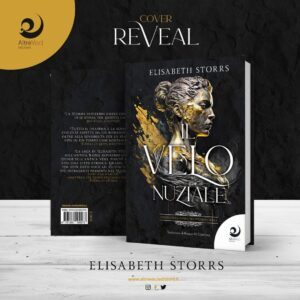 I met Iefke ten years ago when she guided me around the remains of Veii and provided valuable assistance with my research. I was stunned when she asked if she could use my characters’ dialogue to voice her ‘Talking Heads’ audio visual exhibition which features beautiful votive heads found at Veii dating from the C6th to C4th/C3rd BCE. In doing so, she has managed to convey the famous story of the war between Rome and Veii in 406-396 BC for visitors to the museum.I’ve long wished to return to Italy to see the installation in the high vaulted Salon of Roman Trophies (so named for the Renaissance freize on its walls). You can imagine my delight at seeing these sculptures light up and speak. Most of the votives match the era in which I set the trilogy which is extraordinary. The most valuable head in the collection is exquisite so I’m proud my Caecilia gives her new life. And the oldest votive dating to late C6th is my Etruscan mother character, Larthia. The ‘Storrs Saga’ is in both English and Italian which meant I could understand everything.
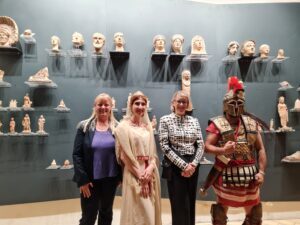 The presentation was fun. I was interviewed by Iefke who valiantly translated my words to a charming audience. And to add atmosphere to the proceedings, Andrea Oliverio (who first contacted me to suggest an Italian edition) arranged for reenactors to appear so I was overseen by an elegant Etruscan lady, Serena, (with gorgeous red shoes) and a very menacing Etruscan warrior called Christian! It’s just a pity Andrea couldn’t attend due to a family emergency.The museum is housed in the wonderful Palazzo Chigi which dates back in parts to the 1200s when it was owned by the prestigious Orsini family. In the 1661 Cardinal Flavio Chigi acquired the palace and introduced a ‘Museum of Curiosities’ so it’s fitting that his residence should later become the place where the new museum has been established.
The post The Wedding Shroud ��� Italian edition! Il Velo Nuziale first appeared on Elisabeth Storrs Historical Novels.


