
Elisabeth Storrs's Blog, page 22
November 29, 2011
A Queen, an Eagle and Destiny

'Tarchon pointed to the eagle as it soared into the stillness. 'An eagle brought a sign to Tanaquil that her husband would be King of Rome.'Caecilia refused to look at the bird, not wanting to hear another of Tarchon's tales, especially about an Etruscan woman who became a Roman queen.' The Wedding Shroud
As can be seen from the tragic stories of Lucretia and Virginia, the women of early Rome only gained fame when used as exemplars of Roman virtues. In each case their deaths were the catalyst for revolution against oppressive rulers.
Yet one famous woman of early Rome did hold power. Her name was Tanaquil. She was not Roman, though, but Etruscan. And she did not gain fame for dying but for being a prophetess and a queen.
Tanaquil was an Etruscan noblewoman from the city of Tarquinia. As her husband, Lucumo, was the son of an immigrant Greek, Tanaquil knew that he would not gain power in her city and she convinced him to travel to Rome to seek his fortune.
As their carriage ascended the Janiculum Hill, an eagle swooped down and snatched Lucumo's cap, carrying it aloft before once again replacing it on his head. Skilled as a seer, Tanaquil predicted that, as the bird had flown from the direction of Rome and taken the cap from the crown of Lucumo's head, her husband was destined for greatness.
On arrival in Rome, Lucumo became friend to the king, Ancus Marcius, as well as guardian to his children. When Marcius died before his children were old enough to take the throne, Lucumo was elected to be king by the Romans and changed his name to a Latin one - Lucius Tarquinius Priscus. He was to be the first of three Etruscan kings who ruled Rome before the third, Tarquinius Superbus, was expelled after the rape of Lucretia.
So could the myth of a prophetess such as Tanaquil be based in fact? The Etruscans were indeed skilled in the art of foretelling the future from the flight of birds. And there is evidence from funerary art and tomb inscriptions that women may well have been priestesses of high standing. The Roman author, Livy, who tells us Tanaquil's tale, does not question her ability. In fact he writes that her powers of prophesy proved correct again when she saw a slave boy called Servius Tullius asleep with a blue flame burning above his head. Tanaquil predicted that he would also rule Rome. When her husband was murdered, Tanaquil cemented her own power by supporting Servius Tullius in being appointed the monarch. He in turn was to become one of the greatest and most just Kings of Rome (but that is another story…)
What is fascinating about Tanaquil is the fact she was, in every way, a player rather than a victim. As a queen and seer, she was instrumental in establishing and continuing the reigns of the Etruscan kings over the Romans. Her ambitions became those of the men she influenced. Unlike Lucretia and Virginia who were controlled by men and whose fate was to die for Rome, Tanaquil moulded destiny to her purpose. And strangely, whereas Etruscan women were usually criticised as wicked and corrupt by the Romans due to the freedoms afforded to them, Tanaquil was not reviled but revered. There are some who posit that she was later deified as a Roman Goddess of Fire, the Hearth, Healing, and Women.
The image is of Tanaquil as painted by Domenico Beccafumi, (1486 – May 18, 1551) an Italian Renaissance – Mannerist painter who was a representative of the Sienese school of painting. This is apt as Siena was one of the cities of ancient Etruria. Image is courtesy Wikipedia Commons


October 1, 2011
Dying For Rome - Virginia

Does this picture look familiar? No, it's not Lucretia (Dying for Rome) but this woman's story is depressingly similar to that of the tragic Roman matron who was raped by an Etruscan prince.
She is Virginia, whose death, just like Lucretia's, was the catalyst for significant change in Rome. The image is deceptive, though, because the man stabbing her is not her rapist but her father.
Once again, Virginia's existence is debatable but her story is an example of how Roman women were supposed to be paragons of modesty, chastity and fidelity. Accordingly any actual or perceived breach of these virtues entitled their husbands or fathers to kill them because of the resulting stain on them and their family's reputation.
Virginia's story is even more tragic than Lucretia's because she did not get a chance to choose her fate. She was truly a pawn whose death once again stirred the men of Rome to rise up and depose an oppressive government.
She was the daughter of a centurion, Virginius. The plebeian maiden caught the eye of the patrician judge, Appius Claudius. The judge was one of the ten corrupt Decemvirs (literally 'ten men') who had been elected to rule Rome after the Etruscan kings had been booted out after Lucretia killed herself. Whilst Virginius was away, Appius Claudius organized for a friend to bring a court case claiming that Virginia was his slave on the basis that he would then hand the girl over for Claudius to use. Even though Virginius returned in time to discover the scheme, Claudius, in his role as judge, held that Virginia should be removed from her father's house anyway. Not wishing his daughter to be subjected to the shame of being a rich man's whore, the centurion took a butcher's knife and slew her. The outcry that followed led to the reign of the Decemvirs ending. Virginius himself was not condemned as a murderer, though, because he had power of life and death over his daughter.
Women were second class citizens in Rome ( Damn Whores and God's Police ) and their rights limited. The paternalism of these stories jars because we see these women only as victims of the 'system' rather than active champions of rebellion.
In my novel, The Wedding Shroud, my protagonist, Caecilia, is married to an Etruscan man, Vel Mastarna, to seal a truce between two warring cities. Caecilia, intolerant and self righteous, leaves Rome indoctrinated into believing that she must remain 'virtuous'. When she comes to Veii she grapples with conflicting moralities as she discovers that the Etruscans offer independence, education and sexual freedom to women. Over time she meets three women from different cultures: a Greek maid, a Cretan courtesan and an Etruscan matron. Through their stories she discovers that there is more to life than the restricted ideals of Rome. Caecilia's dead father was a plebeian, and so she also wonders if he would have killed her for living among the 'sinful' Etruscans just as Virginius did his daughter. And by the end of the novel, she finds herself in a position where she might change Rome's history just as Lucretia and Virginia before her.
The image is of a painting entitled The Death of Virginia, by the painter Girolamo Romani (Romanino) (c. 1485 – c. 1566) who was an Italian High Renaissance painter. During his long career he decorated the walls of Castello del Buonconsiglio, a castle in Trento, northern Italy. This painting is one of the frescoes that grace that castle's walls

September 10, 2011
Dying For Rome - Lucretia
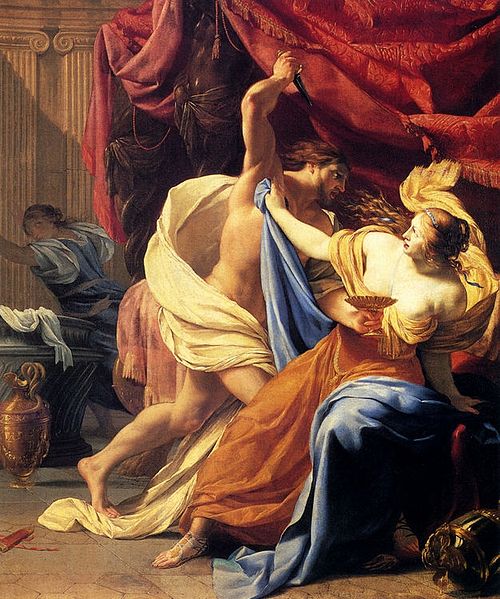
The women of the early Roman Republic were definitely second class citizens (see Damn Whores or God's Police). It is interesting, though, that two of them, Lucretia and Verginia, were catalysts for significant changes in early Roman history. While the existence of these women is debatable, their legends have been passed down through the ages as examples of the Roman virtues of chastity, modesty and fidelity. Here, in the first of two blog posts, are their stories.
The concept of a 'blood taint' is important here. A woman was expected to be chaste if she was a maiden, and faithful if she was a wife. A husband or father was entitled to kill their wife or daughter if she had an affair. They could also kill them if they deemed a woman's honour had been sullied regardless of whether she was innocent or guilty of the act that may have constituted her 'corruption'. This covered the spectrum from a girl being discovered alone with a man without a chaperone to the commission of a rape. Once a woman's sexual purity had been compromised her blood became 'tainted'.
A woman was also expected to value her honour as can be seen from the story of the rape of Lucretia. Here is her story:
Lucretia was married to the Roman nobleman, Collinatus. When he boasted that his wife was more virtuous than Etruscan wives, Sextus, the son of the Etruscan King, visited Lucretia to test this claim. Holding a sword to her throat, he demanded that she sleep with him. When she refused, he threatened to not only kill her but also leave the corpse of a naked slave beside her so that Collinatus (and all Rome) would think she had committed adultery with a servant. To avoid bringing such shame upon her husband, the matron yielded to Sextus. The next day Collinatus discovered the rape and was prepared to forgive Lucretia for her blood taint. Despite his pleas, though, she took her own life rather than live with dishonour. Her defilement and self sacrifice incited the Romans to rise up and rid Rome of their oppressive and depraved Etruscan rulers by expelling King Tarquinius Superbus. After this, the Romans vowed never again to be governed by a monarch and the Republic of Rome was born.
At the time this crime occurred the last of three Etruscan kings reigned over Rome. Despite the fact that these rulers introduced important political reforms and converted Rome from a village into a great city, the Romans hated them for what they perceived to be their decadence. In particular, Etruscan women were considered sinful and dissolute because of their independence. Hence Collinatus' boast as to the superior virtues of his Roman wife.
In my novel, The Wedding Shroud, my protagonist, Caecilia, lives in dread of having to live in the debauched Etruscan society. She questions whether or not she should follow Lucretia's example and kill herself rather than suffer such shame. However when she discovers the pleasures and freedoms of Etruscan women, she begins to grapple with conflicting moralities and realises that Rome's view of Etruria could well be flawed, and that she might not want to emulate Lucretia after all.
The image is of a painting of the Rape of Lucretia by the C17th painter, Simon Vouet. The story has been inspiration for numerous C6th and C17th painters such as Raphael, Rubens, Tintoretto and Rembrandt. She is a symbol of virtue and self sacrifice triumphing over corruption .

Lucretia - Dying For Rome
The women of the early Roman Republic were definitely second class citizens (see Damn Whores or God's Police). It is interesting, though, that two of them, Lucretia and Verginia, were catalysts for significant changes in early Roman history. While the existence of these women is debatable, their legends have been passed down through the ages as examples of the Roman virtues of chastity, modesty and fidelity. Here, in the first of two blog posts, are their stories.
The concept of a 'blood taint' is important here. A woman was expected to be chaste if she was a maiden, and faithful if she was a wife. A husband or father was entitled to kill their wife or daughter if she had an affair. They could also kill them if they deemed a woman's honour had been sullied regardless of whether she was innocent or guilty of the act that may have constituted her 'corruption'. This covered the spectrum from a girl being discovered alone with a man without a chaperone to the commission of a rape. Once a woman's sexual purity had been compromised her blood became 'tainted'.
A woman was also expected to value her honour as can be seen from the story of the rape of Lucretia. Here is her story:
Lucretia was married to the Roman nobleman, Collinatus. When he boasted that his wife was more virtuous than Etruscan wives, Sextus, the son of the Etruscan King, visited Lucretia to test this claim. Holding a sword to her throat, he demanded that she sleep with him. When she refused, he threatened to not only kill her but also leave the corpse of a naked slave beside her so that Collinatus (and all Rome) would think she had committed adultery with a servant. To avoid bringing such shame upon her husband, the matron yielded to Sextus. The next day Collinatus discovered the rape and was prepared to forgive Lucretia for her blood taint. Despite his pleas, though, she took her own life rather than live with dishonour. Her defilement and self sacrifice incited the Romans to rise up and rid Rome of their oppressive and depraved Etruscan rulers by expelling King Tarquinius Superbus. After this, the Romans vowed never again to be governed by a monarch and the Republic of Rome was born.
At the time this crime occurred the last of three Etruscan kings reigned over Rome. Despite the fact that these rulers introduced important political reforms and converted Rome from a village into a great city, the Romans hated them for what they perceived to be their decadence. In particular, Etruscan women were considered sinful and dissolute because of their independence. Hence Collinatus' boast as to the superior virtues of his Roman wife.
In my novel, The Wedding Shroud, my protagonist, Caecilia, lives in dread of having to live in the debauched Etruscan society. She questions whether or not she should follow Lucretia's example and kill herself rather than suffer such shame. However when she discovers the pleasures and freedoms of Etruscan women, she begins to grapple with conflicting moralities and realises that Rome's view of Etruria could well be flawed, and that she might not want to emulate Lucretia after all.
The image is of a painting of the Rape of Lucretia by the C17th painter, Simon Vouet. The story has been inspiration for numerous C6th and C17th painters such as Raphael, Rubens, Tintoretto and Rembrandt. She is a symbol of virtue triumphing over corruption and self sacrifice.
September 5, 2011
Ancient Bling

Etruscans loved shiny things. The more glittering and ornate the better. The most stunning examples of jewellery and art came from the era known as the 'Orientalizing' period from ca. 720-575BCE. This was a time when Phoenician and Greeks were attracted to Etruria due to its rich metal deposits. The Phoenicians were a sea faring people with extensive trading interests across the ancient world. Originally from the area we now know of as Lebanon, they also set up a colony in Carthage (modern Tunisia).Through their trading links, goods from Egypt and Assyria were imported into Etruria and graced the houses of the wealthy.
Enormous bronze and silver mixing bowls were decorated with mortal and mythical animals: scarabs, panthers, winged lions, chimeras and sphinxes. Ivory inlaid boxes were popular as well as faience vases (tin glaze on earthenware) and even decorated ostrich eggs (a symbol of fertility). Strange glass 'porcupine' vases in the shape of tiny coloured glass jugs with spiny bodies have been found and glass beads were used to decorate fibulae (brooches) and necklaces. Amber was popular and of course – gold. Sophisticated techniques that involved filigree, engraving, repousse (hammered relief decoration) and granulation (where tiny grains of gold were soldered to cover the surface of an object) were all employed by gold smiths to stunning effect.
Etruscans covered themselves with jewellery such as golden wreaths, necklaces with heavy ball shaped pendants, rings and bullae (lockets). Some pendant earrings were four inches long or were shaped in heavy grape clusters. Tiers of tiny gold beads were strung together as bracelets or diadems. And all this finery was kept in cylindrical containers known as cistae which were divided into compartments where mirrors, combs and perfume bottles were stored.
So when you think of designer jewellery –or stylish home wares– the Etruscans paved the way.
The image is of an intricately fashioned gold ear-stud with glass inserts. It is in the shape of a rosette surrounded by concentric bands with a central flower. 530–480 BC. British Museum. (Wikipedia Commons.)
More examples of Etruscan jewellery can be found here

August 24, 2011
Damn Whores or God’s Police

One of the main themes of my book is the exploration of the lives of women in the ancient world through the characters of a Roman girl, Greek slave, Cretan courtesan and Etruscan matron.
So what was the status and role of these women in classical times? In both Greece and Rome they were chattels possessed by men. Athenian women were cloistered within women’s quarters and were restricted to household duties. In Rome they were second class citizens without the right to vote or hold property. What’s more, Roman women rarely ate with their men and could be killed with impunity by their husbands or fathers for adultery or drinking wine.
In both cultures a woman’s primary purpose was to bear children in order to ensure the continuation of her husband’s bloodline. Their identities were defined by their relationship as either daughter or wife. Roman women were only known by one name, that of their father’s surname in feminine form. In death their remains were placed in a man’s tomb and they were not commemorated.
Furthermore, while wives weren’t given the opportunity for education and social freedom – in Athens, courtesans were. These hetairae were allowed to dine with men and drink wine at banquets while discussing politics, philosophy, literature and enjoying entertainments. Of course they also provided sexual favours to the patrons who owned them.
Discovering this made me realize that gender inequality is still prevalent today and varies only by degree. Many rights that women of the western world take for granted such as education, suffrage and property ownership have only been acquired in relatively recent times. Certainly the concept of women being either ‘damn whores or god’s police’ is still held by many cultures.
Etruscan women were believed to hold positions as high priestesses and even conduct businesses. They could share their husband’s dining couch and drink wine. They had two names denoting both paternal and maternal bloodlines. Some accounts also state that wives had sexual freedom and may even have been able to claim their illegitimate children in their own right.
My protagonist arrives in Veii as a treaty bride determined to remain true to Roman ‘virtues’ but instead grapples with conflicting moralities as she is slowly seduced by the freedoms offered to her by her husband. I also contrast her life as a Roman woman to other women from Etruria and Greece. In doing so I realized that customs, laws and religious beliefs may have been very different in past societies but emotions and motivations don’t vary between modern and ancient man. Power, love and duty remain eternal.
The image is on a banqueting scene from the Tomb of the Leopards in Tarquinia, Italy, 5th BCE. It depicts a husband and wife sharing a dining couch being served wine by a naked slave boy. The woman’s skin is pale compared to the ruddy skin of her husband ( an artistic convention of that time). Her hair is fair which may be a realistic detail. The both wear myrtle wreathes. Bright bordered mantles cover the semi naked body of the man and the chiton of the woman. There is an account from a contemporary Greek traveller to Etruria that Etruscan women not only drank wine and share their dining couches with men but also were known to raise toasts. Shocking!
(This post also appeared at Jayne Fordhams' The Australian Bookshelf blog http://australianbookshelf.wordpress....)

Damn Whores or God's Police
One of the main themes of my book is the exploration of the lives of women in the ancient world through the characters of a Roman girl, Greek slave, Cretan courtesan and Etruscan matron.
So what was the status and role of these women in classical times? In both Greece and Rome they were chattels possessed by men. Athenian women were cloistered within women's quarters and were restricted to household duties. In Rome they were second class citizens without the right to vote or hold property. What's more, Roman women rarely ate with their men and could be killed with impunity by their husbands or fathers for adultery or drinking wine.
In both cultures a woman's primary purpose was to bear children in order to ensure the continuation of her husband's bloodline. Their identities were defined by their relationship as either daughter or wife. Roman women were only known by one name, that of their father's surname in feminine form. In death their remains were placed in a man's tomb and they were not commemorated.
Furthermore, while wives weren't given the opportunity for education and social freedom – in Athens, courtesans were. These hetairae were allowed to dine with men and drink wine at banquets while discussing politics, philosophy, literature and enjoying entertainments. Of course they also provided sexual favours to the patrons who owned them.
Discovering this made me realize that gender inequality is still prevalent today and varies only by degree. Many rights that women of the western world take for granted such as education, suffrage and property ownership have only been acquired in relatively recent times. Certainly the concept of women being either 'damn whores or god's police' is still held by many cultures.
Etruscan women were believed to hold positions as high priestesses and even conduct businesses. They could share their husband's dining couch and drink wine. They had two names denoting both paternal and maternal bloodlines. Some accounts also state that wives had sexual freedom and may even have been able to claim their illegitimate children in their own right.
My protagonist arrives in Veii as a treaty bride determined to remain true to Roman 'virtues' but instead grapples with conflicting moralities as she is slowly seduced by the freedoms offered to her by her husband. I also contrast her life as a Roman woman to other women from Etruria and Greece. In doing so I realized that customs, laws and religious beliefs may have been very different in past societies but emotions and motivations don't vary between modern and ancient man. Power, love and duty remain eternal.
The image is on a banqueting scene from the Tomb of the Leopards in Tarquinia, Italy, 5th BCE. It depicts a husband and wife sharing a dining couch being served wine by a naked slave boy. The woman's skin is pale compared to the ruddy skin of her husband ( an artistic convention of that time). Her hair is fair which may be a realistic detail. The both wear myrtle wreathes. Bright bordered mantles cover the semi naked body of the man and the chiton of the woman. There is an account from a contemporary Greek traveller to Etruria that Etruscan women not only drank wine and share their dining couches with men but also were known to raise toasts. Shocking!
(This post also appeared at Jayne Fordhams' The Australian Bookshelf blog http://australianbookshelf.wordpress....)
August 18, 2011
Snail Mail, Rome and Ursula Le Guin

Old fashioned courtesy can go a long way. And so, too, can snail mail. When I requested Ursula Le Guin to endorse my novel I used both.
Last year my first novel, The Wedding Shroud, was published in Australia (and has now been released as an e-book world wide). The book is set in C5th BCE at a time when Rome was still scrapping for ascendancy over its Latin neighbours. The book compares the intolerant insular Romans with its enemies, the Etruscans, a people whose highly sophisticated civilisation spread throughout Italy and across the Mediterranean into northern Europe. My protagonist is a young Roman girl married to an Etruscan nobleman to seal a truce. Leaving behind a righteous society, she is determined to remain true to Roman virtues while living among the sinful Etruscans. Instead she finds herself tempted by a mystical, hedonistic culture which offers pleasure and independence to women.
As an unknown writer I faced the daunting task of gaining publicity and credibility amid a plethora of new releases in the market place. My publisher suggested I have the book endorsed by a well known author. Sounded like a great idea. Only problem was to find one who would do it!
My immediate thought was to find an historical fiction author whom I admired. There was no lack of these. I also thought it would be best if I could identify someone who was interested in the subject matter of my novel not just in history per se.
Around this time, a friend of mine mentioned that Ursula Le Guin's Lavinia had been released to rave reviews. I was fascinated by this as I only knew her as the eminent author of amazing fantasy novels. I was also intrigued by the title of her book as I recognised it as the name of the wife of Aeneas, the hero of The Aeneid, an epic written by the Roman poet Virgil.
I read Lavinia and was transported back to a time when Rome was yet to be founded and a war weary Trojan wanderer fell in love with the daughter of Latium's king. The character of Lavinia is not developed in The Aeneid but Ursula Le Guin created a complex woman whose love for a stranger started a war.
As a school girl I loved translating The Aeneid and it struck me that Ursula Le Guin must have a similar affection. In her Author's Note I read how she had visited the area in Italy where ancient Latium was situated. Her delight in walking the same land upon which her characters had dwelt was clear. Her enthusiasm resonated with me. I also had dreams of standing in the ruins of Veii, the Etruscan city in which my novel is set.
I looked at Ursula Le Guin's website and found that she was prepared to write blurbs for books but would only respond to letters i.e. snail mail. With a gentle sense of humour she also specified that overseas correspondents should include an international reply coupon if they expected a response due to the fact she would have to bear the costs of mailing a reply. As she personally answered her own correspondence this could take some time. In her own words 'Silence means I'm sorry: Art is long, life is short, and I want to get on with my own book.'
On the premise of 'she can only say no' or more to the point - reply with silence, I wrote her a letter. In it I explained how much I enjoyed Lavinia because of my fondness for Vergil's The Aeneid. I also provided a one page synopsis of my novel and explained how I, too, wished to walk upon ancient land in reality as well as in my imagination.
I have a vivid memory of hurrying to my local post office and asking for an international reply coupon before slipping the letter into the big red mailbox and crossing my fingers. To my utter astonishment, she responded only a few weeks later to say that she had always been fascinated by the Etruscans and would like to visit ancient Veii through reading my book. Imagine my excitement when she then agreed to endorse it! I still find it hard to believe she was gracious enough to reply let alone write a blurb.
Only Ursula Le Guin can tell why she was prepared to give her time and endorsement to an unknown Australian writer but in the end I believe that, in this world of Twitter, Facebook and email, the old fashioned courtesy of taking time to write and post a letter with a self addressed envelope and a reply coupon must have helped. It was also fate, too, because not longer after this Australia Post phased out international reply coupons. So maybe the Etruscan gods were smiling upon me. I'm certainly glad they did.
(This post also appeared at Sarah Johnson's historical fiction blog - Reading The Past)

August 14, 2011
A Flight Of Birds – A Glimpse Into The Future

As well as the ability to interpret the future from lightning bolts, the Etruscans also observed the flight of birds for the purposes of divination. The process of interpreting the patterns of flight was known as taking the auspices (literally 'looking at birds'). As was the case with understanding lightning portents, the sector of the sky where a bird flew was a determining factor to interpret the will of the gods based on the quadrant in which the relevant deity resided. The type of bird was also important. Doves transmitted messages from Turan (Aphrodite/Venus) whereas the king of the gods, Tinia (Jupiter/Zeus), used an eagle.
The Romans relied heavily on the act of auspication. It was an essential part of the politics of Rome. Before any decision of State was made, omens were observed through the flight of birds. This sometimes involved an augur releasing a flock of birds and watching whether they flew to the right or left. The term 'sinister' derives from sinistra the latin word for 'left' as it was considered an ill omen if the birds flew in that direction. Negative connotations of being left handed have continued for centuries and may well have stemmed from this concept.
In Rome the different bird calls of ravens, crows, owls and chickens were also used to identify divine will. The flight of eagles, vultures and woodpeckers all had significance too. The eating patterns of chickens were also observed. It was considered ill luck if, once released from a cage, the hens baulked at eating the proffered bread. I presume this form of divination allowed for some human manipulation of results!
The founding of Rome itself was based on auspication. When the two feuding brothers, Romulus and Remus, could not agree on the site upon which the city was to be built, they decided to test their abilities as augurs. Romulus saw twelve vultures settle on the Palatine Hill while Remus saw only six alight upon the Aventine. An interesting way to settle an argument.
The image is from the Francois Tomb in Vulci, Italy (circa 330BCE). It depicts the aristocratic Vel Saties who is wreathed with laurel and wrapped in a lavish purple cloak bordered with scrolls and embroidered with nude male figures holding shields. The Etruscan is observing a woodpecker in flight while his servant, Arnza, holds a female woodpecker attached by a string to attract the bird back. The woodpecker was sacred to the god of war Laran (Ares/Mars), and it is likely that Vel Saties was consulting the deity before a military encounter.

August 7, 2011
Myths and Treasure

The ancient world has always held a fascination for me. It must be in my genes because one of my fondest memories is that of my father telling me stories about the Greek gods. As a kid, I also found a book in our house that had been handed down from generation to generation within my family entitled The Myths and Legends of Ancient Greece and Rome by E.M. Berens. It was published in 1892.
This book has a leather cover, the spine frayed so that the webbing that binds the folios is exposed. The pages are mottled, yellowing. It is a treasure. Inside, the lives of the fickle, adulterous, benevolent or malevolent deities are revealed; their bickering and flaws similar to mortals but their ability to bless, curse and manipulate man's fate, divine.
Discovering Berens was not enough. I wanted to read such tales in the language of those times. Nerd that I was, I eagerly studied Latin at school and then Ancient Greek at university while also learning the history that gives context to such literature. It was wonderful to at last be able to translate parts of the works of classical authors and philosophers such as Livy and Homer, Plato and Socrates, Euripides and Julius Caesar.
The greatest impact upon me was that of the poignant tale told by the Roman poet Virgil of Trojan Aeneas, and Dido, the queen of Carthage. How tragic their love was! For Aeneas, fated to found Rome, deserted Dido causing her to throw herself upon a pyre in despair as his ship sailed away.
My novel also tells a love story between two people from different worlds: Rome and Etruria (a civilization in Italy that predated the Roman republic.) A young Roman girl, Caecilia, is married to Mastarna, a nobleman from the Etruscan city of Veii, to seal a truce between two implacable enemies. She is determined to remain true to her Roman beliefs but finds herself grappling with conflicting moralities when she discovers a sophisticated culture that offers her independence and pleasure. She is also introduced to a mystical religion which gives her the chance to defer her destiny. And so the gods play their role in Caecilia's life as she strives to woo the goddess of fate and avoid the demons of the Afterworld.
As for the myths of Greece and Rome, I still keep Berens beside my bed, a little piece of family history as well as a great resource. Sadly my father died a few years ago without reading my book. I think he would have liked learning about Etruria. I am certainly grateful to him for kindling my love of history. And I miss him too.(This post also appeared at historical fiction blog The Adventures of an Intrepid Reader)


