
Elisabeth Storrs's Blog, page 20
May 1, 2013
The Golden Dice - sequel to The Wedding Shroud to be released in July 2013
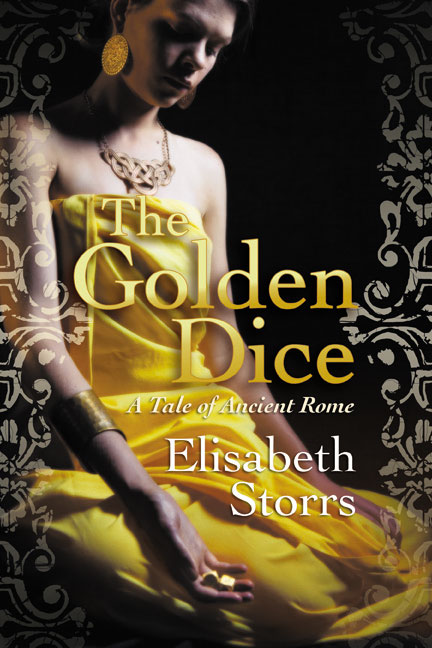
Over the last couple of years, many of you have been kind enough to express an interest as to when the sequel to The Wedding Shroud will be available. I'm now happy to announce that I plan to release The Golden Dice in July. It's been a roller coaster for me during this time as the contract with my Australian publisher fell through and I faced the prospect of being unable to publish this second book in the trilogy Tales of Ancient Rome. Luckily, the new world of independent publishing came to my rescue. As a result I've been able to reach readers all over the world instead of just in the Antipodes. I'm in the final stages of proofreading and formatting now.
Here's the blurb...
In The Golden Dice, sequel to The Wedding Shroud, three women follow very different paths to survive a ten year siege between Rome and the Etruscan city of Veii:
Caecilia forsakes Rome to return to her Etruscan husband, Vel Mastarna, exposing herself to the enmity of his people and the hatred of the Romans who consider her a traitoressâ¦
Semni, a reckless Etruscan girl, becomes a servant in the House of Mastarna, embroiling herself in schemes that threaten Caecilia's children and her own chance for romanceâ¦
Pinna, a tomb whore, uses blackmail to escape her grim life and gain the attention of Rome's greatest general, choosing between her love for him and her loyalty to anotherâ¦
In this second volume of the Tales of Ancient Rome trilogy, the lives of women in war are explored together with the sexuality, religion, and politics of Roman and Etruscan cultures, two great civilizations of ancient history.


March 22, 2013
On Inspiration: Interview with Sherry Jones

My guest today is Sherry Jones, an American journalist and the internationally best selling author of the controversial The Jewel of Medina and other historical fiction novels about women's power. She is also a speaker on issues including women's rights, free speech, and Islamophobia. Her novels explore the obstacles women have long faced in reaching their highest potential in a patriarchal world.
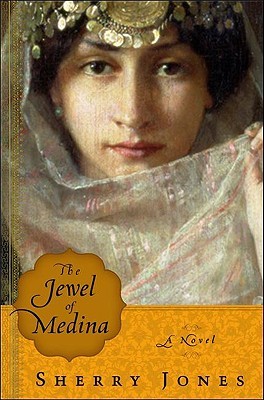
Sherry became the center of a national controversy in the summer of 2008 after Random House cancelled publication of her historical novel, The Jewel of Medina about Aisha, a wife of the Prophet Muhammad. Historical novelist, Colin Falconer, recently interviewed Sherry on her experience in his blog post If you write that, I'll kill you.
Given Sherry's determination and courage to publish The Jewel of Medina, I was particularly keen to learn about the sources of her inspiration and what's in the pipeline for her next book. You can connect with Sherry on Twitter , Facebook and on her website . Australian Fans can also keep up to date with Sherry's new on the Sherry Jones Australian Fan Club .
What or who inspired you to first write?My second-grade reading teacher, whose name I donât recall. She praised my writing in front of the whole class. âWhen you become a published author, keep your real name so I know itâs you.â It took me until age 47 to get there, so I donât know if sheâs even still alive.
 What is the inspiration for your current book? Is there a particular theme you wish to explore in this book?The true meaning of love â or the meaning of true love â is an important theme that is emerging as I write.
What period of history particularly inspires or interests you? Why?
The real-life people who serve as the basis for my characters, especially women who make a difference in the world, inspire me to write about them, no matter that the time period. Thatâs why The Jewel of Medina and The Sword of Medina , my first two books, are set in 7th century Arabia while White Heart and Four Sisters, All Queens take place in 13thcentury Europe. The book Iâm now working on takes place in the 12thcentury My next book may be something more contemporary â either post-Civil-War or the 1930s. But I also have a third book to write for my âJewel of Medinaâ trilogy, which would take me back to 8th century Arabia.
 What resources do you use to research your book/s?
 I go to the setting in person, when I can. I travelled to Egypt and Europe for Four Sisters, All Queens. For the book Iâm now writing, I made a special trip to France. Also I use libraries, the internet, Questia, chronicles of the era, literature, art, and music of the era, old newspapers (where applicable), used bookstores â this is my favorite. I love digging through stacks of history books and finding a gem with information about the period Iâm studying.
Which authors have influenced you?Hilary Mantel springs to mind for Four Sisters, All Queens. I had actually started writing it in third-person present tense, liking the sense of immediacy and intimacy while being able to write in my own voice, but worried that it wouldnât work in telling a tale that happened so long ago. When I read Wolf Hall, I saw that it could be done. That was huge for me. And then there are all those authors whoâve written about strong women: Debra Magpie Earling, whose lyrical style I so love; Ellen Gilchrist, the queen of the feisty Southern heroine; Dorothy Hansford Johnson, whose Helena trilogy makes you fall in love with her quirky heroine. Also, Nicole Krauss is an expert at voice. I also read lots of poetry to keep my writing fresh and beautiful. Natasha Trethewey, the U.S. Poet Laureate, is my current favorite. The English language is just breathtaking in its variety and all the possibilities it offers. When choosing a book to read, I look for poetic language first.
What do you do if stuck for a word or a phrase?I try, try again, and if Iâm still coming up short Iâll write any old thing and boldface it to change later. Revision is where the real art happens, anyway.
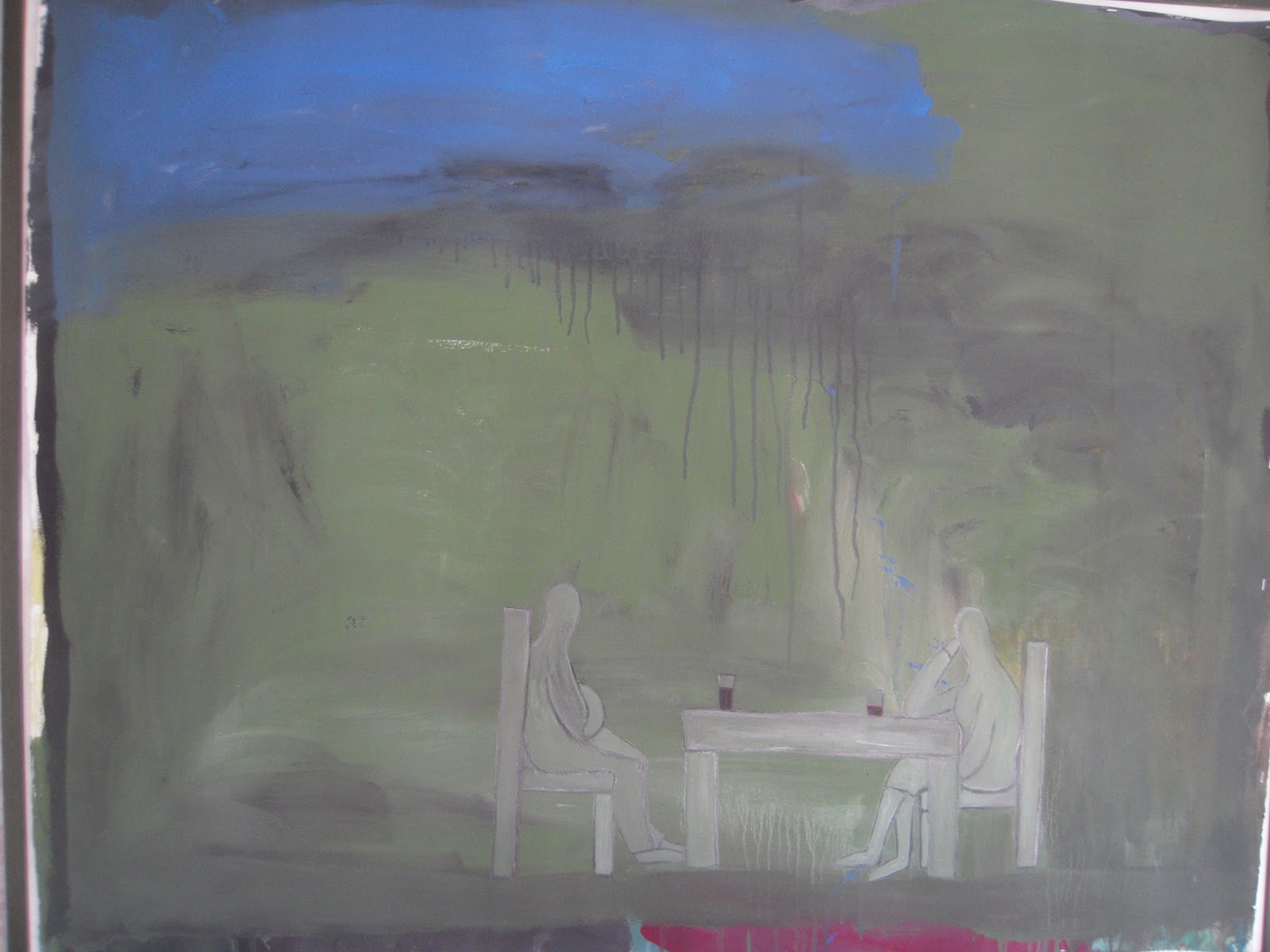
Is there a particular photo, piece of art, poetry or quote that strikes a chord with you? Why?The art of Sheila Miles, one of my best friends in the world, inspires me more than that of any other. Sheila, who now lives and works in Santa Fe, offers a unique and quirky look at life and love from a womanâs perspective. Her painting Passing Time, which I own, is one of my favorite pieces ever. It depicts a man and a woman sitting at a table across from each other but not engaging with each other at all. Heâs reading the newspaper and she just looks bored. Itâs a reminder of what Iâve had in relationships before, and what I never want again. I even wrote a poem about it! I have a number of paintings by Sheila in my home. You can see more of her artwork at www.artistmiles.com.
What advice would you give an aspiring author?Donât give up! And, even if you decide to self-publish, make sure you get a good literary agent. Mine, Natasha Kern, is indispensible.
Tell us about your next book.Abelard was the most famous philosopher in the world around the year 1115 when, as headmaster of the Notre Dame Cloister School, he met Heloise, an accomplished scholar living in Paris, a master of Latin, Greek, and Hebrew with a knowledge of literature that Abelard praised as unsurpassed. Theirs was a passionate, erotic affair that broke all the rules of Church and society, and which ended abruptly and tragically.
My next book, coming out in 2014, is the first retelling of the Abelard and Heloise tale since the scholar Constant Mews discovered and published, in 1999, their correspondence of 113 letters exchanged during their courtship. Previously we had only Abelardâs autobiography, disseminated during his lifetime, and several letters they wrote to each other beginning 15 years after their romance had ended.

Heloise, in particular, interests and inspires me. She defied the Church and her culture to live life on her own terms, and lost everything that mattered to her. My novel is a tale of passion and deep love, and of womenâs struggle throughout the ages to govern our own lives in a patriarchal, misogynistic world. Iâve tentatively titled it The Sharp Hook of Love, after a phrase Heloise used in her own, breathtakingly beautiful, letters.
Rich in intrigue and scheming, love and lust, Sherry Jonesâs vibrant historical novel follows four women destined to sway the fate of nations and the hearts of kings. . . . Amid the lush valleys and fragrant wildflowers of Provence, Marguerite, ElÃonore, Sanchia, and Beatrice have learned to charm, hunt, dance, and debate under the careful tutelage of their ambitious motherâand to abide by the countessâs motto: âFamily comes first.â
With Provence under constant attack, their legacy and safety depend upon powerful alliances. Margueriteâs illustrious match with the young King Louis IX makes her Queen of France. Soon ElÃonoreâindependent and daringâis betrothed to Henry III of England. In turn, shy, devout Sanchia and tempestuous Beatrice wed noblemen who will also make them queens.
Yet a crown is no guarantee of protection. Enemies are everywhere, from Margueriteâs duplicitous mother-in-law to vengeful lovers and land-hungry barons. Then there are the dangers that come from within, as loyalty succumbs to bitter sibling rivalry, and sister is pitted against sister for the prize each believes is rightfully hersâProvence itself.
From the treacherous courts of France and England, to the bloody tumult of the Crusades, Sherry Jones traces the extraordinary true story of four fascinating sisters whose passions, conquests, and progeny shaped the course of history.
Thanks so much Sherry, for the great interview - I'm looking forward to reading how you bring the ageless love story of Heloise and Abelard alive in The Sharp Hook of Love.
Image courtesy of Wikimedia Commons - Les Amours d'Heloise et D'Abielard by Jean Vignaud 1819
March 8, 2013
The Distorting Mirror - TD Griggs
My guest today is T.D.Griggs who has been kind enough to provide a fascinating post about how our links to historical events are closer than we think....

I have a great mate whose grandfather, as a child, knew a man who had been a powder monkey at the Battle of Trafalgar.
Yes, I did a double-take, too. But it stacks up. My friend, like me, is in his early sixties. His dad was born around 1920, the son of a 45-year-old father. So my mateâs granddad entered the world in 1875. Now, a lad who was fifteen years old at Trafalgar in 1805 would have been 90 in 1880. Not too fantastic, then, for my friendâs grandad, at seven or eight, to have sat open-mouthed at the old boyâs knee in 1883, listening to his incomprehensible tales of crashing broadsides and decks slippery with blood.
We empathise immediately when a personal link is made, or at least when we see that one is possible. It profoundly changes our reaction to history. We laugh about medieval murder (Horrible Histories) but youâd need a strong stomach to make a joke about Auschwitz, or even about the Somme. Even Blackadder treated that slaughter with reverence - remember the famous dissolve to a field of poppies? Both of these events are close enough for us to have known someone involved, or to know someone who knew someone.
Still, it always comes as a shock when we are forced to confront the truth - that people in history had loves and hates and fears precisely like our own.
What I find surprising about this is that it isâ¦well, surprising. But the fact is that when weâre young we believe the world started when we did. To take my own case, I was twelve in 1960. At that time men who had fought in the Battle of Britain were under 40, and those who had landed on the Normandy Beaches were in their mid thirties. Like most bloodthirtsy kids I was excited by battles and slaughter and general mayhem - but I have no recollection of the slightest curiosity about the experiences of any of these young veterans, several of whom I must have met. To me their personal histories ranked with Agincourt, impossibly distant and irrelevant to the point of invisibility. Yet it had all really happened less than 20 years earlier. World War Two was as recent then as the first Iraq War is now.
The sense that we are part of a continuum only grows as we grow. So when I now look into that distorting mirror we call the past, the Second World War seems far more immediate to me than ever it did when it was almost close enough to touch.
These days I feel a bit guilty about all that. Maybe it was this which led me to feature some of my long-dead fatherâs wartime experiences in my recent novel THE WARNING BELL (under pen-name Tom Macaulay, Orion 2010). Itâs a father-son mystery with links back to WW2, and my research led me to the astounding discovery that my fatherâs 1942 launch still existed, rotting in a junkyard in Catalonia. My brother and I tracked it down there and even climbed aboard it for the first - and last - time as a tribute to our father.


My latest book, DISTANT THUNDER (by T.D.Griggs, Orion 2013) will appear in Australian shops in March as a paperback. Itâs a Victorian epic, the story of two people whose relationship is caught up in the crushing machinery of empire. I donât have any direct personal link with the Victorian era, but nevertheless the story was triggered by a connection with my own life, though at one remove. Iâm old enough to remember Churchillâs funeral: indeed, this man lived so far into my own era that he could have bought the first Beatles LP (though I doubt he did). And yet he had been born early enough to take part in the last regimental cavalry charge of the British army. That was against the Mahdists at the Battle of Omdurman. This intrigued me. After all, the Battle of Omdurman in 1898 is the stuff of ripping yarns and picture books. A bit like Agincourt, really.
Yet when I discussed the idea with my editor, he told me an extraordinary story. âFunny thing,â he said, âI know an English girl whoâs just opened a Sudanese restaurant in London with her new husband.ââWhatâs funny about that?ââJust that her great-grandfather was at the Battle of Omdurman, in Kitchenerâs Army. But her husband is Sudanese. His great-grandfather was at the same battle - on the other side.â

T.D.GRIGGS was born in London and has lived and worked on four continents. He holds British and Australian nationality, and has worked variously as a truck driver, journalist, film extra, founder and MD of a successful communications consultancy in Sydney, and - for about seven sweaty hours - as a volunteer fire fighter. Despite that, much of the Australian bush survives. He has written many short stories, and four novels: the Victorian epic DISTANT THUNDER and modern day psychological drama REDEMPTION BLUES under his own name; and father-son WW2-linked drama THE WARNING BELL, written as Tom Macaulay. T.D.Griggs is also a professional business writer with an international client base. He lives with his wife Jenny in Oxford, UK. To find out more visit his Website or follow him on Twitter or Facebook

Bangalore, 1893. Frank Grayâs enchanted Indian boyhood comes to a brutal end the night his mother is savagely assaulted by a British cavalry officer. As the scandal destroys his family, Frank has only revenge left to live for.
Grace Dearborn grows up in England, wealthy and privileged. But once she learns the human cost of her familyâs fortune, she is on a collision course with the father she adores.
Frank and Grace share more than a hatred of injustice. Their personal demons drive them from bohemian Vienna to the savagery of the North-west Frontier, from the slums of London to the deserts of the Sudan. But escaping the past is the hardest battle of all.
Tim, thanks for this wonderful post. All the best with Distant Thunder!
March 6, 2013
On Inspiration: Jesse Blackadder
 Ingrid Christensen (left) and Mathilde Wegger on the way to Antarctica in 1931
My guest today is Jesse Blackadder who is fascinated by landscapes, adventurous women and very cold places. Her novel After the Party made the Australian Book Review list of favourite Australian novels in 2010. The Ravenâs Heart won the Varuna HarperCollins Manuscript Development Award and was published in Australia in 2011 and in the UK, USA and Canada in 2012. Chasing the light: A novel of Antarctica,which she wrote as part of a Doctor of Creative Arts, has just been released. Jesse won the 2011-12 Australian Antarctic Arts Fellowship and the 2012 Guy Morrison Prize for Literary Journalism. She has been a writer in residence in Alaska, Antarctica, outback NSW and Byron Bay. Her first childrenâs novel Stay: the last dog in Antarctica is coming out in 2013, as part of the Amazing Animals series.

What or who inspired you to first write?Reading, reading and more reading. I was one of those kids who read at night under the covers with a torch long after Iâd been told to put the light out, and read in the day under the desk at school until the teacher asked me a question. I adored the way books transported me into other worlds. Writing seemed a natural extension of that and I wrote my first ânovelâ at age 12 to entertain my friends.
What is the inspiration for your current book?Iâm inspired by two things â landscapes and characters. This book was inspired by the power of the Antarctic landscape and what it means to people, and by the Norwegian women who travelled there in the 1930s, while women from other parts of the world were refused positions on Antarctic expeditions.

Is there a particular theme you wish to explore in this book?The impact that a place like Antarctica can have on a person â how it can be transformative, and also bring someone up against the parts of themselves they find confronting. My characters all have some idea what it will mean to them to land on Antarctica â and all of them are mistaken.
What period of history particularly inspires or interests you? Why?Iâm attracted to characters and events rather than particular periods of history â hence the 350+ year leap in time and global leap in geography between Chasing the Light (set in Antarctica in the 1930s) and my previous novel The Ravenâs Heart (set in Scotland in the 1560s). However, having spent the past three years hanging out in the early twentieth century, I must say itâs a fascinating period and I expect Iâll be heading back there again soon.

What resources do you use to research your book/s?Iâm a writer who likes to use my two feet. Walking in my characterâs footsteps, in the places where the story takes place, is the most important research for me. The internet is useful for quick fact checking, but most of my other fun research happens in archives, books and through talking to people.
Which authors have influenced you?Jeannette Winterson has been a huge influence since the start of my writing life â she approached historical settings in such profoundly original, imaginative ways that you can hardly call her books âhistorical fictionâ. Sarah Waters showed me that lesbian characters can be enchanting and compelling to all readers, and James Herriotâs All Creatures Great and Small books about the life of a Yorkshire vet in 1930s-50s have been a favourite since I was a teen â epitomising how an appealing, humble character can drive even a simple story.
What do you do if stuck for a word or a phrase?Scribble in whatever comes to mind and come back to it later.
Is there a particular photo, piece of art, poetry or quote that strikes a chord with you? Why?That varies depending on what Iâm working on. There are many Antarctic quotes that I love (you can see some of them on my short video about how writers describe Antarctica at http://www.youtube.com/watch?v=rzpETZNLp28). Barry Lopez, the great nature writer, said of Antarctica ââ¦tell those who have never visited here what it is like⦠even if you only say what itâs like to see the sun reflecting off the Royal Society Range⦠we value each gift we receive by passing it on.â
 Blue Ice, Antarctica
 What advice would you give an aspiring author?Write, write, write, and read, read, read.
Tell us about your next book.Iâm writing a series of junior fiction novels (for 9-12 year olds) about amazing animals. The first one, was inspired by meeting âStayâ in Antarctica. Stay started life as a fibreglass seeing eye collection dog who was kidnapped from Hobart in 1981 and smuggled to Antarctica just as the last huskies were being removed permanently from the continent. Something happened to her in that process â she came to life in some way and has become a famous Antarctic character. Stay: the last dog in Antarctica is inspired by her real life adventures and in it, she is smuggled, liberated, repatriated, incarcerated and dognapped all over again, having plenty of Antarctic adventures while worrying about how to return the money sheâs raised for the guide dogs. Iâll be back into adult historical fiction in a few months time.

Thanks Jesse for giving us an insight into the sources of your inspiration. I'm looking forward to reading the copy of Chasing The Light you signed for me at your book launch :)
You can read more about Jesse and her books at her website. Connect with her at Facebook and Twitter - and be sure to visit her wonderful blog.
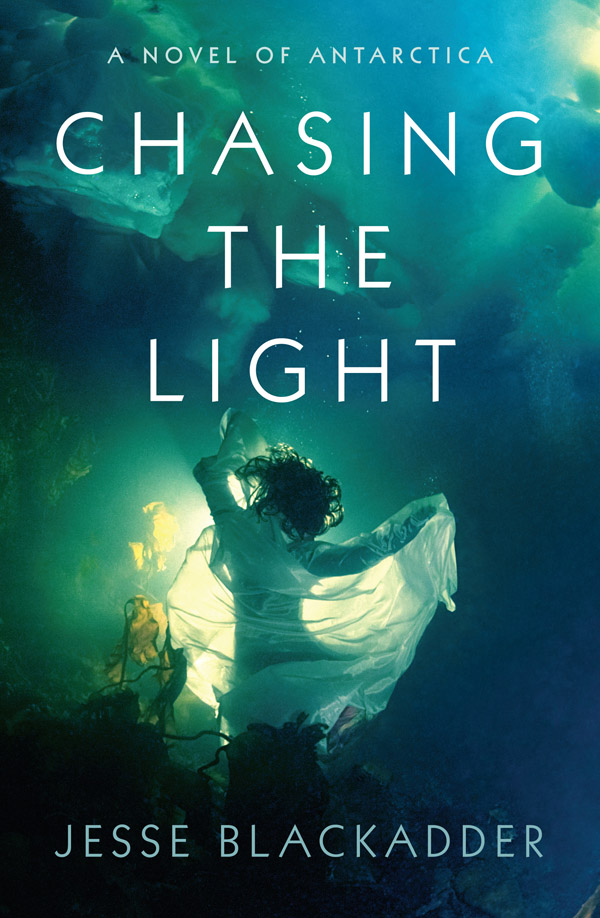
Itâs the early 1930s. Antarctic open-sea whaling is booming and a territorial race for the mysterious continent is in full swing.
Aboard a ship setting sail from Cape Town carrying the Norwegian whaling magnate Lars Christensen are three women: Lillemor Rachlew, who tricked her way on to the ship and will stop at nothing to be the first woman to land on Antarctica; Mathilde Wegger, a grieving widow whoâs been forced to join the trip by her calculating parents-in-law; and Larsâs wife, Ingrid Christensen, who has longed to travel to Antarctica since she was a girl and has made a daunting bargain with Lars to convince him to take her.
As they head south through icy waters, the race is on for the first woman to land on Antarctica. None of them expect the outcome and none of them know how they will be changed by their arrival.
Based on the little-known true story of the first woman to ever set foot on Antarctica, Jesse Blackadder has captured the drama, danger and magnetic pull of exploring uncharted places in our world and our minds.
PRAISE FOR JESSE BLACKADDER: âshe posits the ephemeral nature of humans against a weighty sense of history and an ageless landscape, something she does with an incisive grace that truly elevates her story ... she doesnât hit one wrong noteâ Sunday Telegraph âHer prose is both sexy and chaste, ruthless and tender, bringing out these elements in all her charactersâ Lambda Literary
March 4, 2013
The Wedding Shroud is now available as a paperback on Amazon.

January 30, 2013
Winner: Australia Day Book Giveaway Blog Hop

Thanks to all who participated in the Oz Day blog hop to win a copy of Kate Forsyth's Bitter Greens and an e-copy of The Wedding Shroud.
The winner is:
Mary Preston
Mary, please contact me at elisabeth(at)elisabethstorrs(dot)com to provide me with your address so I can send you the prizes :)
Thanks, everyone, for making the blog hop so enjoyable.
January 25, 2013
On Inspiration: Interview with Kate Forsyth : Australia Day Book Giveaway Bloghop

Aussies celebrate Australia Day this weekend! To give you a chance to share in the celebrations I'm offering the chance to win an e-book of Kate Forsyth's Bitter Greens in the AUSTRALIA DAY BOOK GIVEAWAY BLOG HOP.
Make sure you visit Shelleyrae at Book'd Out and the girls at Confessions from Romaholics to find out other blogs who are participating in the Blog Hop - more chances for you to win books by great Aussie authors!

Not only am I delighted to offer an e-copy of Bitter Greens, but I'm also pleased that Kate Forsyth has agreed to be interviewed on the sources of her inspiration. Kate is also participating in the AUSTRALIA DAY BOOK GIVEAWAY BLOG HOP so visit her blog and possibly win another of her books :)
The AUSTRALIA DAY BOOK GIVEAWAY BLOG HOP is open for entries until Midnight January 28. Open internationally! Winners will be announced before the following Friday. To be entered into the raffle, just read Kate's interview, comment and name the painter whose paintings were the source of her inspiration for Bitter Greens.
Kate is the bestselling and award-winning author of more than twenty books, ranging from picture books to poetry to novels for both children and adults. Her list is so extensive it's best to take a look at Goodreads to see all her books!

Since the Witches of Eileanan was named a Best First Novel in 1998 by Locus Magazine, Kate has won or been nominated for numerous awards, including a CYBIL Award in the US and is the only author to win five Aurealis awards in a single year, for her Chain of Charms series.
Kate's books have been published in 14 countries around the world, including the UK, the US, Russia, Germany, Japan, Turkey, Spain, Italy, Poland and Slovenia. She is currently undertaking a doctorate in fairytale retellings at the University of Technology, having already completed a BA in Literature and a MA in Creative Writing.


Her most recent book for adults is Bitter Greens, a retelling of the Rapunzel fairytale interwoven with the dramatic, true life story of the woman who first told the tale, the 17th century French writer, Charlotte-Rose de la Force.
What or who inspired you to first write?I donât remember! It feels like Iâve always wanted to write. I always loved to read and I guess at some point I realised people wrote the books I loved so much and so that is what I wanted to do. Certainly Iâve been writing poems and stories from the time I could first hold a pencil.
What is the inspiration for your current book?My latest novel, âBitter Greensâ is a retelling of the Rapunzel fairy tale, which has haunted me since I first read the story when I was a little girl in hospital. A savage dog attack had destroyed my tear duct and I spent most of my childhood in and out of hospital, suffering chronic infections and fevers. I felt such a strong connection to that girl in the tower, alone as I was alone, whose magical tears had healed the blinded eyes of the prince. I wished for my own tears to heal me. As I grew to adulthood, and read many fairy tale retellings, I thought more and more about doing my own retelling of Rapunzel.
The problem with retelling such a well-known tale is that itâs difficult to surprise the reader, or to create suspense. I began to wonder who first told the tale ⦠and then I stumbled on the extraordinary life story of Charlotte-Rose de la Force, a scandalous 17th century noblewoman who wrote the best known version of Rapunzel while locked away in a convent. When I discovered she had once dressed up as a dancing bear to rescue her much younger lover, I simply had to write about her!
Is there a particular theme you wish to explore in this book?I think the main theme in the book is that of having the courage to deal with whatever life throws at you.
What period of history particularly inspires or interests you? Why?The book is set in two of my favourite historical periods. The first narrative strand â the story of the witch and the girl in the tower â is set in Renaissance Venice which has always fascinated me. The second narrative strange âdealing with Charlotte-Roseâs life - is set in France in the late 17th century, another turbulent and intriguing era.

'Flora' - Titian
Is there a particular photo, piece of art, poetry or quote that strikes a chord with you? Why?Each book will be different. For âThe Starkin Crownâ, my most recent childrenâs book, it was a quote from Goethe: âWhatever you can do or dream you can, begin it. Boldness has genius, power and magic in it.â
For âBitter Greensâ, it was the paintings of Tiziano Veceill, better known in English as Titian. I had been wondering how to bring the life of my witch-character, Selena, to life. I knew she was a red-haired courtesan in Venice, and that she had used blood magic to preserve her youth and beauty far beyond what was natural.
One day I was looking on my art shelves for a book on William Blake to help my son with a school project. Another book fell out of the shelf on to my lap. It was a book on Titian and it opened at a page that had his famous painting âWoman with a Mirrorâ on one page, and âan Allegory of Vanityâ on the other. I was struck by the similarity in the faces. Turning the pages of the book, I saw the same face appear again and again over the course of more than half a century.
I was intrigued, and read up on Titian. I found out that scholars had once believed he was painting his mistress, thought to be a courtesan, but now think he was simply painting an idealised view of feminine beauty, since her face never changed or aged.
It was such an extraordinary serendipitous discovery. My skin rose in goose-bumps, I shivered with amazement and joy ⦠and rushed straight to my notebook. Now, of course, Tiziano is a key character in the book and so are his series of paintings of this mysterious muse. You may like to look at my Pinterest page on the subject.

A Woman With A Mirror - Titian
What resources do you use to research your book/s?Books and the internet, mainly. I tend to start building a library as soon as I begin working on a novel. I like to own the key research books as I will read them again and again, and put sticky notes in them, and highlight key passages. I find the internet an utterly brilliant resource as well â when I was writing âBitter Greensâ I pored over the Google map of Venice, for example.
Which authors have influenced you?My favourite authors are Tracey Chevalier, Sarah Dunant, Juliet Marillier, Philippa Gregory, Georgette Heyer, Susan Vreeland, Kate Morton, Karen Maitland â I love a tightly spun story that combines history, suspense, romance and a twist of magic or the supernatural.
What do you do if stuck for a word or a phrase?I put down an approximation of what I want to say, put three question marks after it, then keep on writing. Later, Iâll search out all my questions marks and rephrase it, or check my facts, or look up my thesaurus. I never interrupt my flow when its happening!
What advice would you give an aspiring author?Read a lot, write a lot, rewrite a lot.And trust in the universe to bring you what you need for your book.
 The Venus of Urbino - Titian
 Tell us about your next book.My next book will be âThe Wild Girlâ, published in Australia in March 2013, and in the UK a year later. It tells one of the greatest untold love stories of all time â the heart-breaking romance between Wilhelm Grimm and the young woman who told him many of his most famous stories. Her name was Dortchen Wild, and she grew up next door to the Grimm family in Hessen-Cassel, a small German kingdom that was one of the first to fall to Napoleon. It was a time of war and terror, when the collecting of a few old half-forgotten tales was all the young Grimm brothers could do to resist the tyranny of the French. I hope you all read and enjoy it!
Kate, thanks so much for sharing your sources of inspiration with us. I'm looking forward to reading The Wild Girl but will stock up on sleep first as I tend to stay up into the wee small hours when reading your books :) And I love the paintings you've selected - it would seem that Titian's muse was still weaving her magic when she inspired you to create your character of La Bella Strega.

Charlotte-Rose de la Force has been banished from the court of Versailles by the Sun King, Louis XIV, after a series of scandalous love affairs. She is comforted by an old nun, SÅur Seraphina, who tells her the tale of a young girl who, a hundred years earlier, is sold by her parents for a handful of bitter greens â¦
After Margheritaâs father steals a handful of parsley, wintercress and rapunzel from the walled garden of the courtesan, Selena Leonelli, he is threatened with having both hands cut off ⦠unless he and his wife give away their little girl.
Selena is the famous red-haired muse of the artist Tiziano, first painted by him in 1513 and still inspiring him at the time of his death, sixty-one years later. Called La Strega Bella, Selena is at the centre of Renaissance life in Venice, a world of beauty and danger, seduction and betrayal, love and superstition.
Locked away in a tower, growing to womanhood, Margherita sings in the hope someone will hear her. One day, a young man does â¦
Three women, three lives, three stories, braided together to create a compelling story of desire, obsession, black magic, and the redemptive power of love.
A list of locations where you can buy Kate's books can be found at her website and here is is a link to her Amazon books. You can connect with her on Facebook and Twitter
Don't forget to visit Kate's blog as well - and Book'd Out and Confessions From Romaholics for a chance to win more books by Aussie authors.
And don't forget to enjoy Australia Day on 26 January!
Elisabeth StorrsSubscribe to Triclinium - Sign up for email subscription at the bottom of the page or click the RSS feed button on the sidebar.
December 25, 2012
The Next Big Thing - An Author's Blog Hop
Loretta Proctor, author of The Long Shadow, Middle Watch and The Crimson Bed has tagged me in The Next Big Thing, an author's blog hop. Loretta was born in Cairo, Egypt to an English father and Greek mother. She won prizes in the 1970âs for essays and plays, wrote specialized articles, studied psychology and worked as a counselor. Now retired to Malvern, Worcestershire, she delights in storytelling and is pleased to be a distant relation of Elizabeth Barrett-Browning. You can read her contribution to The Next Big Thing at Books and Other Things
How The Next Big Thing Blog hop works: An author answers ten questions and then tags five authors (if you are able to find them at Christmas time!) to do the same thing the following week on the same day, which in this case is a Wednesday.
Here are the answers to the ten questions.What is the working title of your next book?The Golden Dice is the second book in a trilogy set in Ancient Rome and Etruria. It will be released in 2013. The novel follows on from The Wedding Shroud . Once again, the fates of familiar characters will be revealed as Etruscan and Roman worlds collide in a bitter siege. In addition to Caecilia, the young protagonist of the first book, I introduce the reader to Semni - a young Etruscan girl who finds herself embroiled in the dramas of the House of Mastarna, and Pinna - a Roman grave-whore uses blackmail to escape her grim life and ultimately gain the attention of a Consular General.
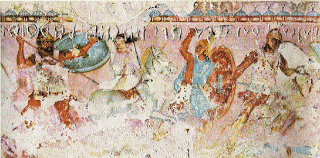
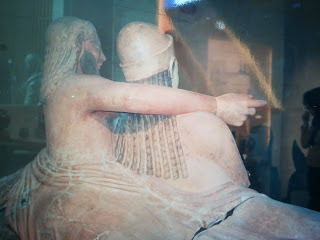
Where did the idea come from for the book?I have always been interested the Classical period of C5th â C4th BCE. Knowing that womenwerenât commemorated after death during this era, I was amazed when I saw a photograph of a casket depicting a husband and wife lying in a tender embrace upon their dining couch. I discovered that the couple were Etruscans, whose people existed in Italy from before archaic times in the areas now known as Tuscany, Umbria and Lazio. Etruria was a sophisticated society rivalling Athens. There was one major difference, though; the Etruscans granted independence, education and sexual freedom to their women. As a result they were considered wicked, decadent and corrupt by the rest of the ancient world.
When I decided to write about the Etruscans I thought it would have more impact if I could compare their sophisticated civilisation to Romeâs (which was still a tribal society scrapping with its Latin neighbours). That is when I learned of the little known story of the war between Rome and the Etruscan city of Veii. These cities were located only twelve miles across the Tiber River and were sworn enemies. It intrigued me that just by crossing a strip of water you could move from the equivalent of the Dark Ages into something similar to the Renaissance. The Wedding Shroud is set in the lead up to the war. The Golden Dice takes up the story seven years later at the height of the siege.
What genre does your book fall under?Historical fiction.
What actors would you choose to play the part of your characters in a movie rendition?Strangely enough I have an image in my mindâs eye of my characters and it would be difficult for me to cast actors to play them. I think Iâd end up fighting with the director as to whom to choose! However, I see an opportunity for three young actresses to secure debut performances playing Caecilia, Semni and Pinna. One thing I know is that Mastarna has to have Russell Croweâs voice!
What is the one-sentence synopsis of your book?Against the backdrop of a conflict between two implacable enemies of the ancient world, three women who are loyal to very different cultures must find courage to survive a ten year siege.
Will your book be self-published or represented by an agency? The Naher Agency represents me. We are waiting on news as to whether the paperback of The Golden Dice will be released in ANZ by the publishing house who took over Pier 9 Murdoch Books (the publisher of The Wedding Shroud paperback.) Nevertheless, I will be self-publishing the e-book of The Golden Dice in all other territories in 2013. Iâve been encouraged because the e-book of The Wedding Shroud rose to the top 10 on the Amazon historical fiction popularity list. So going âindieâ has worked there.
How long did it take you to write the first draft of the manuscript?It took me 12 months to write the first draft of The Golden Dice, then I revised it for another 6 months. It was a completely different experience to writing The Wedding Shroud which took ten years!
What other books would you compare this story to within your genre?I like to think my writing is similar to that of Tracy Chevalier or Sarah Dunant even though my novels are set in ancient Rome. I like the way those authors explore a characterâs psyche while instilling a sense of historical place. If you like Kate Quinn or Michelle Moranâs books, then you might also like The Wedding Shroud or The Golden Dice.
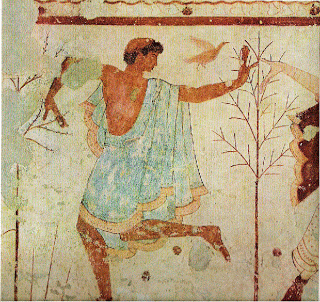
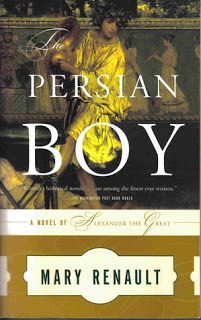
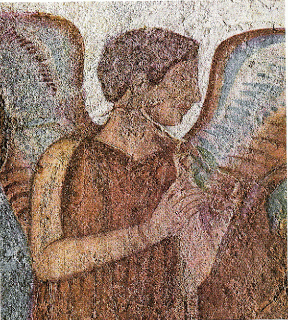
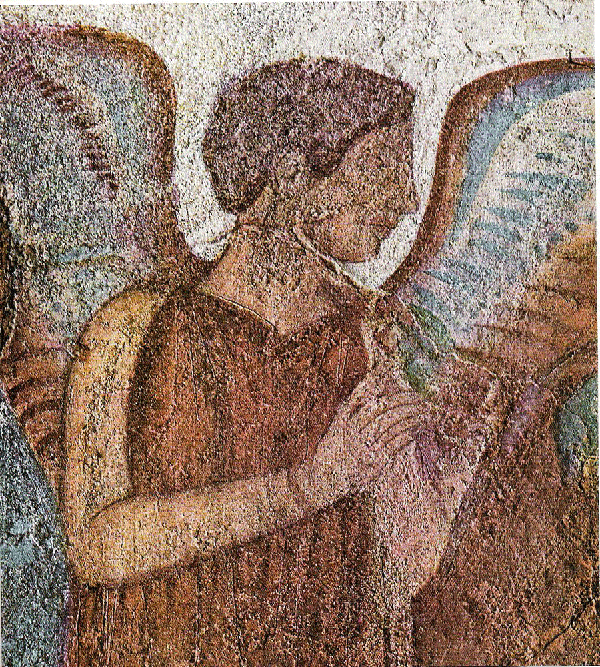
Who or what inspired you to write this book?As I mentioned above, Etruscan art inspired the trilogy. In fact whenever Iâm stuck for ideas, I always turn to the beautiful images of the life loving Etruscans. The author who most inspired me to write historical fiction was Mary Renault. If only I could write prose like hers!
What else about the book might pique the reader's interest?The Wedding Shroud explores sexuality in the ancient world together with the politics of Rome and Etruria. I continue to delve into these subjects in The Golden Dice. Also, the Etruscans practised a sophisticated religion that raised the art of prophecy to a science. The reader might be interested to learn how these societies relied on a pantheon of gods to determine their destinies.
Authors who I have tagged are:
Colin Falconer is the author of so many books that I refer you to his Goodreads page for his entire bibliography. His most recent book is Stigmata which introduces the reader to the Cathars of C13th France. Born in north London, Colin worked for many years in TV and radio and freelanced for many of Australiaâs leading newspapers and magazines. He has been a novelist for the last twenty years, with his work published widely in the UK, US and Europe and translated into nearly twenty languages. Colin blogs at Looking for Mr Good Story.
Diane Ascroft, author of Dancing Shadows, Tramping Hooves: A Short Story Collection and Hitler and Mars Bars, loves to lose herself in the past, particularly in stories set in Ireland and Scotland. Dancing Shadows, Tramping Hooves includes tales of outsiders who discover they belong, a humorous slice of life yarn, heartwarming love stories and a tale of taming fear. The shadows are on the wall, in the heart and clouding a womanâs memories while tangible foes tramp through the physical landscape.
Amazon: Dancing Shadows, Tramping Hooves & Hitler and Mars Bars Ascroft, eh? Blog Dianneâs Facebook Dianeâs Website
Author and playwright, Wendy J. Dunn is obsessed with Tudor History. Her first published novel, the award-winning "Dear Heart, How Like You This?" is described as "one of the best novels ever written about Anne Boleyn's life."
After completing her Masters in Writing at Swinburne University in 2009, Wendy took up a position as a sessional tutor in Writing. She became a PhD Candidate in August, 2010. Of course, the artefact for her PhD is another Tudor novel, this time a YA novel that revisits Anne Boleyn in the last months of her life.
Wendy's wordpress site:
Reviews of her first novel:
What we do for the sake of fiction:
Speaking the Silences: Writing, advocacy and enabling voice:
How The Next Big Thing Blog hop works: An author answers ten questions and then tags five authors (if you are able to find them at Christmas time!) to do the same thing the following week on the same day, which in this case is a Wednesday.
Here are the answers to the ten questions.What is the working title of your next book?The Golden Dice is the second book in a trilogy set in Ancient Rome and Etruria. It will be released in 2013. The novel follows on from The Wedding Shroud . Once again, the fates of familiar characters will be revealed as Etruscan and Roman worlds collide in a bitter siege. In addition to Caecilia, the young protagonist of the first book, I introduce the reader to Semni - a young Etruscan girl who finds herself embroiled in the dramas of the House of Mastarna, and Pinna - a Roman grave-whore uses blackmail to escape her grim life and ultimately gain the attention of a Consular General.

Where did the idea come from for the book?I have always been interested the Classical period of C5th â C4th BCE. Knowing that womenwerenât commemorated after death during this era, I was amazed when I saw a photograph of a casket depicting a husband and wife lying in a tender embrace upon their dining couch. I discovered that the couple were Etruscans, whose people existed in Italy from before archaic times in the areas now known as Tuscany, Umbria and Lazio. Etruria was a sophisticated society rivalling Athens. There was one major difference, though; the Etruscans granted independence, education and sexual freedom to their women. As a result they were considered wicked, decadent and corrupt by the rest of the ancient world.
When I decided to write about the Etruscans I thought it would have more impact if I could compare their sophisticated civilisation to Romeâs (which was still a tribal society scrapping with its Latin neighbours). That is when I learned of the little known story of the war between Rome and the Etruscan city of Veii. These cities were located only twelve miles across the Tiber River and were sworn enemies. It intrigued me that just by crossing a strip of water you could move from the equivalent of the Dark Ages into something similar to the Renaissance. The Wedding Shroud is set in the lead up to the war. The Golden Dice takes up the story seven years later at the height of the siege.

What genre does your book fall under?Historical fiction.
What actors would you choose to play the part of your characters in a movie rendition?Strangely enough I have an image in my mindâs eye of my characters and it would be difficult for me to cast actors to play them. I think Iâd end up fighting with the director as to whom to choose! However, I see an opportunity for three young actresses to secure debut performances playing Caecilia, Semni and Pinna. One thing I know is that Mastarna has to have Russell Croweâs voice!
What is the one-sentence synopsis of your book?Against the backdrop of a conflict between two implacable enemies of the ancient world, three women who are loyal to very different cultures must find courage to survive a ten year siege.
Will your book be self-published or represented by an agency? The Naher Agency represents me. We are waiting on news as to whether the paperback of The Golden Dice will be released in ANZ by the publishing house who took over Pier 9 Murdoch Books (the publisher of The Wedding Shroud paperback.) Nevertheless, I will be self-publishing the e-book of The Golden Dice in all other territories in 2013. Iâve been encouraged because the e-book of The Wedding Shroud rose to the top 10 on the Amazon historical fiction popularity list. So going âindieâ has worked there.
How long did it take you to write the first draft of the manuscript?It took me 12 months to write the first draft of The Golden Dice, then I revised it for another 6 months. It was a completely different experience to writing The Wedding Shroud which took ten years!
What other books would you compare this story to within your genre?I like to think my writing is similar to that of Tracy Chevalier or Sarah Dunant even though my novels are set in ancient Rome. I like the way those authors explore a characterâs psyche while instilling a sense of historical place. If you like Kate Quinn or Michelle Moranâs books, then you might also like The Wedding Shroud or The Golden Dice.
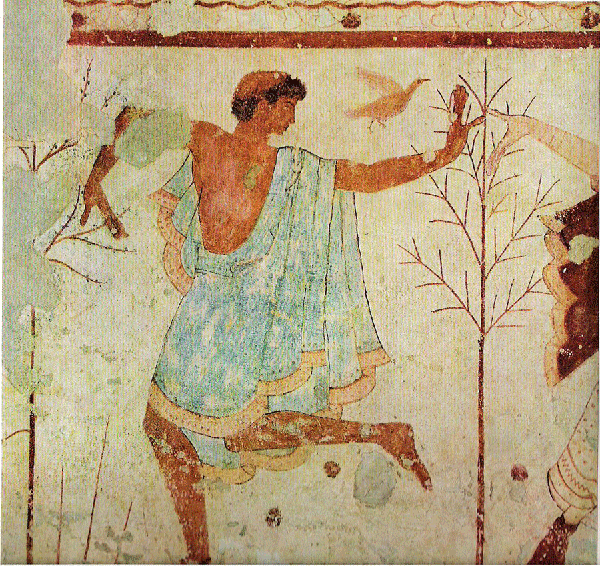
Who or what inspired you to write this book?As I mentioned above, Etruscan art inspired the trilogy. In fact whenever Iâm stuck for ideas, I always turn to the beautiful images of the life loving Etruscans. The author who most inspired me to write historical fiction was Mary Renault. If only I could write prose like hers!

What else about the book might pique the reader's interest?The Wedding Shroud explores sexuality in the ancient world together with the politics of Rome and Etruria. I continue to delve into these subjects in The Golden Dice. Also, the Etruscans practised a sophisticated religion that raised the art of prophecy to a science. The reader might be interested to learn how these societies relied on a pantheon of gods to determine their destinies.
Authors who I have tagged are:
Colin Falconer is the author of so many books that I refer you to his Goodreads page for his entire bibliography. His most recent book is Stigmata which introduces the reader to the Cathars of C13th France. Born in north London, Colin worked for many years in TV and radio and freelanced for many of Australiaâs leading newspapers and magazines. He has been a novelist for the last twenty years, with his work published widely in the UK, US and Europe and translated into nearly twenty languages. Colin blogs at Looking for Mr Good Story.
Diane Ascroft, author of Dancing Shadows, Tramping Hooves: A Short Story Collection and Hitler and Mars Bars, loves to lose herself in the past, particularly in stories set in Ireland and Scotland. Dancing Shadows, Tramping Hooves includes tales of outsiders who discover they belong, a humorous slice of life yarn, heartwarming love stories and a tale of taming fear. The shadows are on the wall, in the heart and clouding a womanâs memories while tangible foes tramp through the physical landscape.
Amazon: Dancing Shadows, Tramping Hooves & Hitler and Mars Bars Ascroft, eh? Blog Dianneâs Facebook Dianeâs Website
Author and playwright, Wendy J. Dunn is obsessed with Tudor History. Her first published novel, the award-winning "Dear Heart, How Like You This?" is described as "one of the best novels ever written about Anne Boleyn's life."
After completing her Masters in Writing at Swinburne University in 2009, Wendy took up a position as a sessional tutor in Writing. She became a PhD Candidate in August, 2010. Of course, the artefact for her PhD is another Tudor novel, this time a YA novel that revisits Anne Boleyn in the last months of her life.
Wendy's wordpress site:
Reviews of her first novel:
What we do for the sake of fiction:
Speaking the Silences: Writing, advocacy and enabling voice:
December 11, 2012
Warding Off Evil: The Power of a Loving Embrace
 Sarcophagus of the Married CoupleLate C6th BCEâThere was a smooth, round contentment to her as she sat upon a dining couch with her husband, head resting against his shoulder as he embraced her. Their happiness revealed by the curve of their lips and the ease of their touchâ¦â The Wedding Shroud
Lucy Bertoldi of Enchanted By Josephine Litblog recently featured my guest post on the beautiful Etruscan funerary art which often depicts lovers as a symbol of fertility which wards off evil after death. Lucy is a dedicated reviewer of historical fiction and often sponsors giveaways. Why not visit her blog - I'm sure you will enjoy it.
Here is the post: Warding Off Evil: The Power of a Loving Embrace
I was inspired to write my novel, The Wedding Shroud â A Tale of Ancient Rome, when I found a photo of a C6th BCE sarcophagus of a man and women lying on their bed in a tender embrace. The casket (known as the Sarcophagus of the Married Couple) was unusual because, in this period of history, women were rarely commemorated in funerary art let alone depicted in such a pose of affection. The image of the lovers remained with me. What kind of culture exalted marital fidelity while showing such an openly sensuous connection? What ancient society revered women as much as men? Discovering the answer led me to the Etruscans, a society that existed from before archaic times in Italy and was mainly situated in the areas we now know as Tuscany and Lazio.
Etruscan women were afforded education, high status and independence. As a result they were often described as âwickedâ by Greek and Roman historians and travellers whose cultures repressed women. Etruscan women dined with their husbands at banquets and drank wine. In such commentatorsâ eyes, this liberal behaviour may well have equated with depravity. One famous account claims that wives indulged in orgies. And so modern historians continue to debate the contradictory depictions of Etruscan women âwere they promiscuous adulterers or faithful wives?
Etruscan society clearly celebrated both marriage and sex. The image of men and women embracing is a constant theme in their tomb art and ranges from being demure, as in the case of the Married Couple, to the strongly erotic (Tomb of the Bulls) and even pornographic (Tomb of the Whippings.) The latter illustrations seem to confirm the more prurient view of Etruscan women but the symplegma or sexual embrace was not a gratuitous portrayal of abandon but instead was an atropaic symbol invoking the forces of fertility against evil and death.
No better example of this is a particularly striking double sarcophagus found in Vulci in Italy and which is now located in the Museum of Fine Arts, Boston. Wrought in fine white limestone, the man and woman lie entwined in each otherâs arms. However, unlike the anonymous Married Couple, this husband and wife can be identified. They are Larth Tetnies and Tanchvil Tarnai. The very fact that Tanchvil has two names is evidence of the status of Etruscan women. In Rome, females only had one name â that of their fatherâs in feminine form. In Etruria, the bloodlines of both sides of a womanâs family were often recorded on their casket.

Larth Tetnies and Tanchvil Tarnai Late C4th early 3rd BCE
The image of the couple is both intimate and yet openly erotic. The spouses are not young but are nevertheless beautiful. Tanchvil gently clasps the nape of Larthâs neck as the lovers gaze into each otherâs eyes. They are naked, the outline of their limbs evident beneath the sculpted folds of the mantle that covers them. However nudity cannot hide their status. Their luxurious hairstyles and elegant jewellery declare their wealth, as does the wide, decorated double bed upon which they lie.
There was a second sarcophagus found in the sepulchre at Vulci. It is narrow and only held the remains of a woman, Ramtha Visnai, but its lid depicts her embracing her husband, Arnth Tetnies. They are the parents of Larth. This coffin is made of rough nenfro stone. Wrapped in their shroud, the figures embrace each other on their bed. Unlike the sexually charged younger couple, the older pair are more contemplative as they face each other although the sight of their feet peeping from beneath the covers hints at the relaxed familiarity of their marriage.
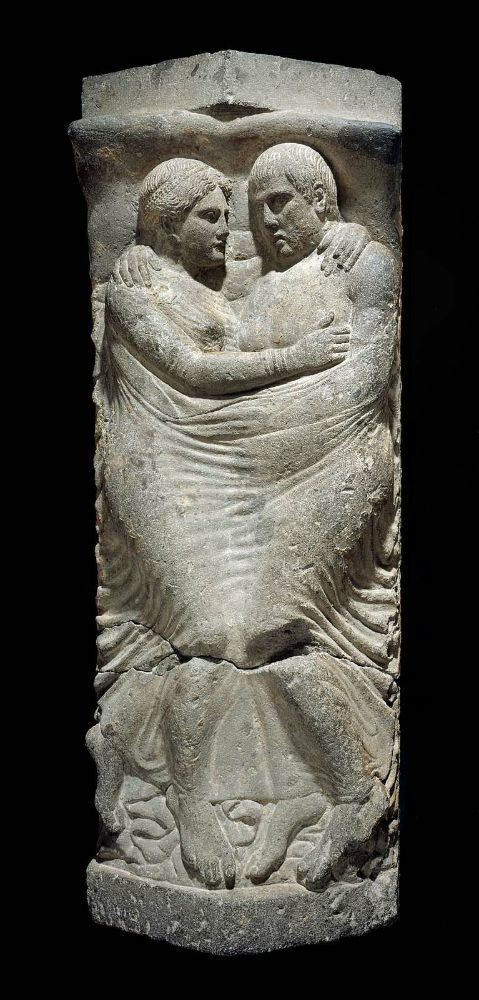
Ramtha Visnai and Arnth TetniesC450-400 BCE
âShe lay naked in effigy upon her coffin, fixed forever in her nuptial bed. Lying on her side, she faced her husband, their arms encircling each other, swathed in their transparent wedding shroud and unconcerned that their bare feet were uncovered in abandon.â The Wedding Shroud
The Married Couple inspired me to write my novel, but the two caskets in the Tetnies tomb were the inspiration for the title of The Wedding Shroud. For both couples lie beneath mantles that I came to understand could symbolise the large veil under which an Etruscan bride and groom stood when they took their vows. In effect the spouses were swathed in their wedding shroud for eternity, their union protecting them from the dark forces that lay beyond the grave.
As for the conflicting views of Etruscan women it is clear from studying this societyâs art that they celebrated life. Many worshipped the religion of Fufluns, the Greek Dionysus and Roman Bacchus, whose later cult adherents were famous for indulging in debauchery but in its purest form was a belief in the power of regeneration. So which version is correct? Sinners indulging in group sex or steadfast wives? Perhaps both, because the concept of a culture that condones female promiscuity while also honouring wives and mothers is not necessarily contradictory. For while it can be erroneous to compare modern societies with ancient ones, it could be argued that this attitude to females occurs in many present-day Western cultures today.
Either way, the erotic and sensual image of an embrace transcends any moralising in which historians might indulge. Ultimately I believe that the symplegma is not just an atropaic symbol but something more powerful. Whether sculpted in stone, moulded in terracotta or painted in a mural, the embrace of two lovers remains, above all, an eternal celebration of abiding love.
Tetnies Sarcophagi photographs © 2010 Museum of Fine Arts, BostonThe Married Couple courtesy Wikimedia Commons
Elisabeth StorrsSubscribe to Triclinium - Sign up for email subscription at the bottom of the page or click the RSS feed button on the sidebar.

November 9, 2012
On Inspiration: Interview with Christy English
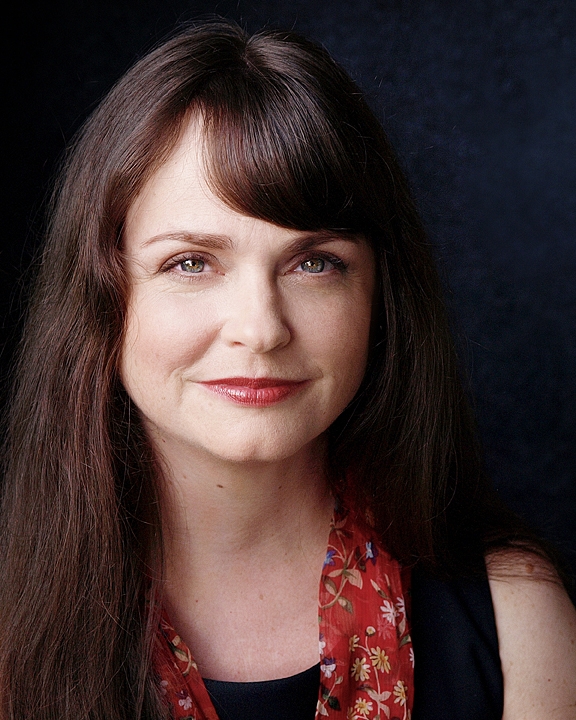
My guest today is Christy English, author of The Queen's Pawn and To Be Queen . After years of acting in Shakespeare's plays, Christy is excited to bring the Bard to Regency England in her new novel How To Tame A Willful Wife which has just been released. When she isn't acting, roller skating, or chasing the Muse, Christy writes from her home in North Carolina.You can find out more about her books at her website and follow her on Facebook and Twitter


What or who inspired you to first write?My love of reading made me want to tell stories. My parents read to me as a child, and I remember drinking in the words as if they were a sort of magic elixir that could take me to another world. That hasnât changed. Words still do that for me.
What is the inspiration for your current book?I had a dream in 2007 that gave me the scenes of the first chapter of my current novel. I wrote the chapter the next week, after I ruminated over it for a bit. With editing, the chapter has changed, but the overall relationship between my characters, the true heart of the story, Iâve kept.
Is there a particular theme you wish to explore in this book?When I was writing How To Tame A Willful Wife , I was trying to figure out if two strong-willed, stubborn people could learn to live together as equals. Hopefully, I managed to find out.
What period of history particularly inspires or interests you? Why?My particular obsession, beyond my love for Regency England, is Eleanor of Aquitaine, who lived during the high middle ages from 1122-1204. Duchess of Aquitaine in her own right at the age of fifteen, Queen of France and later Queen of England, this woman embodies all the self-control and power of any politician alive today. Actually, I think there have been few people in history, men or women, who could hold a candle to her. She is truly an amazing woman. So amazing that, though she has been dead for over 850 years, I still think of her in the present tense.
Is there a particular photo, piece of art, poetry or quote that strikes a chord with you? Why?
My favourite piece of art in the world is the Nike of Samothrace in the Louvre. Every time I visit, I sit beside her just off the grand staircase where they keep her, and I drink her in. There is so much beauty in this piece, but also a true sense of limitlessness, of flying, of spreading wings in joy and motion. I want to feel this way when I work. She makes me think of my work as I want it to be.

What resources do you use to research your book/s?I am old fashioned and prefer hard cover books that I can go back to and mark up and generally cling to as I work to create a new world. I do the occasional online search, especially to find images to help me understand something specific, like a Regency ladyâs side saddle for example. But overall, books are where I do my research.
Which authors have influenced you?My favourite author of all time is Mary Renault. The beauty of her prose, her ability to draw me into another world and make me live with her in it, made me want to be a writer. I also adore anything by Lisa Kleypas and Nicola Cornick. Fabulous romance authors.
What do you do if stuck for a word or a phrase?I move on. I ask the character what she thinks and if she doesnât have an opinion, I leave a blank and come back to that word or sentence later. And often, as I move on with the scene, the right phrase or word comes to me. If not, I keep moving anyway. In a first draft especially, momentum is everything.
What advice would you give an aspiring author?Never give up. Stay in the chair. Write for yourself, first, last and always. Listen to your characters and to your own heart. They mean more than anything else. No one else can write your story. It is yours alone.
Tell us about your next book.
My new novel, coming out November 6, is a Regency romance called How to Tame A Willful Wife. It is a take off on Shakespeareâs The Taming of the Shrew, and it tells the story of a very stubborn couple who learn to live together as equals. No easy task in any age, but one even more difficult in 1817. Hereâs a description of the novel as it appears online:

How To Tame A Willful Wife:1. Forbid her from riding astride
2. Hide her dueling sword
3. Burn all her breeches and buy her silk drawers
4. Frisk her for hidden daggers
5. Don't get distracted while frisking her for hidden daggers...
Anthony Carrington, Earl of Ravensbrook, expects a biddable bride. A man of fiery passion tempted by the rigors of war into steely self-control, he demands obedience from his troops and his future wife. Regardless of how fetching she looks in breeches.
Promised to the Earl of Plump Pockets by her impoverished father, Caroline Montague is no simpering miss. She rides a war stallion named Hercules, fights with a blade, and can best most men with both bow and rifle. She finds Anthony autocratic, domineering, and...ridiculously handsome.
It's a duel of wit and wills in this charming retelling of The Taming of the Shrew. But the question is...who's taming whom? Thanks so much Christy. And my favourite author is Mary Renault, too! Good luck with your new novel - it must be an exciting time for you.
You can buy How To Tame A Willful Wife at Amazon and Barnes & Noble.
Elisabeth StorrsSubscribe to Triclinium - Sign up for email subscription at the bottom of the page or click the RSS feed button on the sidebar.


