Hal Young's Blog, page 22
October 5, 2015
Q&A: How do I stop my son from stealing?
A reader asks, “I am having a problem with my 8 year old stealing things. He takes small things from people at school as well as things from his little brothers. A few weeks ago he took one of my diamond rings to school. I need some advice on what to do to help him see that this is wrong. Thank you!”
Wow, that’s hard! A multi-pronged approach is usually needed when you are seeing a pattern of sin like this.
First, some instruction. Over the course of several days, we would sit down with him and study what the Bible says about stealing. Read him the Ten Commandments (Exodus 20 and Deuteronomy 5). Explain that coveting and stealing hurts other people, too. (The story of Achan is tough, but it illustrates this pretty thoroughly in Joshua 7). Tell him that Christians are supposed to put this stuff behind them (Ephesians 4:28). Reading the Bible is really important, because God’s Word can reach their hearts when our words seem to be completely ignored. A great resource for this is For Instruction in Righteousness from Doorposts.
Second, we’d try to spend some time really talking and listening to him and see if something is going on at school that is tempting him to act out. Is he trying to impress someone? Is he trying to appease someone? Is he being bullied? Does he have friends? See if you can figure out if there is something beyond the sinful nature we all have that is egging him on.
As hard as it is to be consistent, we would discipline him every single time for something like this. Some good, solid Biblical discipline is completely appropriate here. Stealing is sin and we need to “nip it in the bud” as Barney Fife used to say in The Andy Griffith Show.

“Intense discipleship” can really help with something like this. That is, pretty much keep him with an adult all the time for awhile. “Son, I’m sorry, but you have shown us that we can’t trust you. Until we can, you’ll need to stay with one of us all the time. I know you want to be off doing your own thing, but you’ve got to learn to resist temptation in order to do that.”
Then talk to him about practical ways to resist temptation. You could even role play some ways he might be tempted.
We had a child who sometimes struggled with this and with honesty. It wasn’t easy, but he’s now a grown up who is one of the most completely honest men we know. He never even shades the truth. We pray the Lord would help your son to overcome this just as thoroughly!
For more on teaching practical ways to resist temptation and to handle discipline, I think our book, Raising Real Men, would be a real help to you. You can get it here.
Your friends, 
Hal & Melanie


October 4, 2015
Q&A: My Son Says He’s an Agnostic. Help?
Please pray. My son says he is an agnostic. I am so worried about him. He said he’d accepted Christ when he was six, but now this. What do I do?
This can be one of the most upsetting things a parent can deal with. I will never forget the day I was driving along with our children and our then nine-year-old suddenly said, “Mom, I think I’m an atheist.” I panicked. This was the child we prayed over since the day he was conceived. This was the child who claimed Christ when he was six and seemed so concerned about spiritual things. It was an awful moment. Really, it was awful few months.
It’s not at all unusual, though. In fact, it’s pretty typical for kids in the preteen years to struggle with spiritual doubts. When their hormones start to flow, their emotions become confused at the same time that their brains are rapidly changing and developing. Six-year-olds seem to discover there is a spiritual reality out there; nine-year-olds seem to realize there may be other explanations about that world than the one Mom and Dad gave him. A recent study of adults raised in Christian homes found that many who later left the faith began having doubts in middle school, and a second group began to wonder in high school. If those doubts aren’t addressed – and sometimes, our kids may not mention them out loud – then those thoughts may carry into the teens and beyond. It’s a critical time!
So, what can you do?
Probably the most important thing is to maintain a strong, loving relationship with your child. The Gen2 Survey found that a good relationship with a Christian mother or Christian father was one of the strongest predictors that a child would grow up to continue in the faith he’d been taught. Don’t let their doubts keep you from showing them your love.
Don’t freak out. You really do want to know if your child is having spiritual doubts, don’t you? Of course – otherwise, how would you know how to pray and talk with him? We need to keep communication open, and if our kids feel like they can’t discuss a problem with us, then they won’t — instead, they may not share their struggles until they find a place where their doubts are welcomed. Listen to our podcast with Carol Barnier. She describes her battle with doubts as a teen and how she eventually came to Christ after several years as an atheist.
Listen to them. “I’m glad you told me you are feeling that way. Let’s talk about it.”
Address their questions. You’ve got to listen to know what they are, but once you do, make sure you let them know this, “There are answers. I may not know the answer to everything you ask, but I will sure help you find the answer!”
The Word says, “Come now, let us reason together, says the Lord: though your sins are like scarlet, they shall be as white as snow; though they are red like crimson, they shall be as wool.” (Isaiah 1:18) We don’t have to leave our minds behind to come to Christ. Ours is a reasonable faith and you can have the confidence that we have nothing to fear from the truth.
Here are some great resources to help your skeptic get those doubts answered:
More Than a Carpenter by Josh McDowell (probably the easiest read).
Mere Christianity by C.S. Lewis (the most philosophical).
Evidence That Demands a Verdict by Josh McDowell (a stunning collection of real evidence).
The Case for Christ by Lee Strobel.
The Lie: Evolution by Ken Ham (many struggle with doubts because of what they’ve heard about evolution – this was a huge thing for Melanie as a teen).
Get those books and read through them with your child.
Encourage them to seek God themselves, to hunt down the answers to their questions. It’s the most important quest of their lives. There are some precious promises to those seekers:
“And you will seek Me and find Me, when you search for Me with all your heart.” (Jeremiah 29:13)
“I love those who love me, And those who seek me diligently will find me.” (Proverbs 8:17)
Encourage them to be like the father of the demon-possessed child, who cried out, “Lord, I believe; help my unbelief!”
That nine-year-old boy who told us he thought he was an atheist, came to Christ just a few months later. It was very obvious he was changed. He had made his faith his own. He had a real and abiding faith. He’s now an adult who is a rock solid Christian and a very real blessing to us.
We pray your doubting child will come to Christ with all his heart — and soon!
We have two great online classes for parents that discuss this and other issues common to the preteens (Boot Camp 9-12, click here) and teens (PreFlight, click here). They are some of the most popular and encouraging things we do!

Your brother and sister in Christ,
Hal & Melanie
October 3, 2015
Q&A: What’s Wrong with my 17yo?
A reader asks, ” I have a seventeen year old boy . He has always been brilliant at school – loved school, loved life. Two years ago he began a downward spiral, he has bashed myself and his sister a number of times. He refuses to go to school. He wants to stay up all night and play on his phone. I’m a single mum… 5 ft and he is 5ft 8in and strong. My son has high functioning autism and is so accustomed to people excusing his outrageous behaviour he excuses himself. He is in danger of not matriculating because of not attending school and I at my wits end.”
Dear friend, that is so hard!
The thing that stands out to me when I read your question is that the change is probably the significant part here. You’ve got a good boy with good grades who is now depressed and refusing to go to school and is behaving badly towards his family. It looks like something is really wrong in his life.
I would look for signs of an addiction to porn or gaming. Depression and apathy are huge signs of these problems. Both porn and gaming cause a hormonal response in the brain that causes an addiction similar to alcohol or heroin. Kids begin to live for their next fix. It’s not as obvious as a drug or alcohol addiction, though, because you don’t see the spaciness or physical damage that comes with those things – they look clean.
I would suggest sitting down with him and *lovingly* explaining reality, “Son, I’m worried about you. In just a short time you are going to have to either get a job or go to a university. Right now, you couldn’t do either. I want you to succeed. I love you! It seems to me that there is something bothering you, something making life harder for you.”

Explain to him how things like that can be addictive. There are resources to help you do that on our site here: raisingrealmen.com/purity. Tell him you are on his side and want to help him, but he’s got to cooperate. Talk through the effects this addiction is having on his life, how hard it will be to quit, but how much you love him and want to help him.
I’d then ask him for his phone and tell him you think he needs a break from it. Be sure to express your love and concern all the way through. Expect him to get super upset after a few days without his phone — that’s normal, there really is a physical withdrawal and that can be pretty upsetting. You’ve got to remember he’s seventeen and can walk away from you very soon. You’ve got to preserve your relationship with him to have any long term influence on him. You have got to persuade, not so much demand, with a young man this close to leaving home.
Of course, there may be something else going on, but this is my first thought. May the Lord give you the grace and wisdom to help him!
Your friends, 
Hal & Melanie
October 2, 2015
Disaster Planning (Homeschool Edition)
When disaster strikes, groups like the American Red Cross, Southern Baptist Disaster Relief, and Mennonite Disaster Service do a tremendous job getting people shelter, clothing, and safe food and water. But when the yellow buses start to roll, homeschoolers have a different problem–one we need to solve ourselves!

When Hurricane Floyd destroyed or damaged nearly 80,000 homes in eastern North Carolina, you bet homeschoolers were affected. Our state homeschool organization and a support group leader in the state capital were able to organize a program that replaced educational supplies and curriculum for hundreds of families in the flood zone. In the process, we learned some key pointers from their experience:
Disasters can happen to anyone. It doesn’t have to be an earthquake or hurricane. We know homeschooling families who’ve had to deal with house fires, chemotherapy, a baby in ICU, relocations, foreclosure, or even the death of a parent. We’ve had some of these ourselves! If you have a plan to deal with disruptions, you can adapt it to many kinds of emergency.
Include your home school in your emergency plans. When we lived in Florida, we had very definite “bug out” plans. Whatever plans you have in the event of fire, flood, evacuation, or the like, you need to include your home school. If an emergency disrupts things for more than a couple of days, you’ll need to do something to continue school in the midst of it. Your kids will be under enough stress already, and dropping them off at the school bus stop – “Mom’s very sick, so here’s an entirely new school culture for you to learn” – is not likely to make things easier for anybody. Think about how you’ll keep going at least for a while.
Be sure your records are safe. Whatever your law requires, you will want to keep your own records safe and secure. We use Dropbox, but Google Drive or any other cloud storage works as well. This is critically important for older students – you really don’t want to have to reconstruct a high school transcript from memory — or for special needs students who may have IEPs, for instance. Physical copies might be kept in an inexpensive fireproof safe – a good thing to have, anyway.
Don’t forget your own documents. We’ve met families who moved to a new state after a disaster, and had to move their home school to a new legal situation. Keep a copy of your high school or college diploma, along with anything like a marriage certificate, adoption papers, or passport, in case you need to prove your credibility somewhere.
Keep at least a basic school plan. When we had to spend weeks in ICU with a very sick baby, our mothers were able to keep homeschooling going because we had an outline to give them. It doesn’t have to be super-detailed, but at least have a list of which child is working in which book; all but the youngest should be able to “Do the next lesson” if someone reminds them!
Remember supplies are easy to replace but curriculum isn’t. If your home is flooded out, pencils and calculators can be bought down the street – but the textbooks can’t. If you have to leave, take the hard-to-find and expensive books first. Remember the public library has lots of the literary works, too – rescue the teacher’s manual, not the copy of Wuthering Heights!
(continued …)

Stay in touch! After Floyd, we had a hard time locating some families to offer help–their homes were wrecked, their mail was returned “Undeliverable” and we had no way to trace them! Take a moment to reach out to your local support group and your state homeschool association – let people know where you’ve gone, and how they can pray for you.
Embrace God’s plan and timing. We’ve had a lot of ups and down in our family life, including cancer, high-risk pregnancy, hospitalization, job loss, and more – and by God’s grace, we were able to homeschool through them all! What we’ve learned along the way is that God truly is a loving father who cares for His children ( 1 Peter 5:6-7 ), and that all things – even disasters – truly do work together for good to those who love God and are the called according to His purpose. ( Romans 8:28 )
He proved Himself trustworthy, and that makes a difference in how we receive the disruptions big and small.
FRIENDS
As Hurricane Joaquin seems to be repeating the path of Hurricane Floyd,
we know many of you may be making plans!
We have a special workshop, “Homeschooling Through Hard Times,” that we’d like to offer you for free. –
The CD is normally $5 at conferences, but we want you to have the recording for no charge if you’ll sign up for our newsletter:
You can cancel at any time, if you must …
 … but we hope you won’t
Yours in fair weather or foul,
In Christ, Hal and Melanie
Photo Credits:
Top, Cyclone Catarina from the ISS on March 26 2004, NASA/Johnson Space Center
Bottom, “Hurricane Katrina August 28 2005 NASA”, Jeff Schmaltz, MODIS Rapid Response Team, NASA/GSFC
Q&A How & When Do You Share Disturbing News with Your Children?
After the Oregon shooting this week, a reader asked, “How and when do you share news like this with your children? I haven’t shared much “news” with my children but I have older ones and I want to expose them to more. What sources do you use or do you just pass the news to them?”
When we read the news yesterday about a mass shooting at an Oregon community college, and especially when we saw that Christians had been targeted, we had the same thought: Is this something we need to discuss with our children? For us, we make these decisions on a case by case basis. Here are our considerations:
Is this a situation our kids might face themselves? We have college kids and it’s possible. Now, of course, they all read the news and knew about it anyway, but we still probably want to bring it up to them and talk about it. Something like this, where people were asked if they were Christians and were shot in the head if they were, is bound to make anyone question the solidity of their faith, thinking, “Would I have the courage to claim Christ?”
Are they bound to hear about it anyway? If so, I would a whole lot rather they hear it from me first, in a loving and Biblical context. Here’s where you need to judge for your own family. Do you always have the news on? Will they overhear big siblings talking about it? Will they be at a friend’s or relative’s house where they’ll hear about it? If so, you need to bring it up yourself.
Is it news your family will need to act on? We had a talk about the hurricane and possible flooding yesterday because we need to make some preparations. Our youngest was very alarmed and had a hard time sleeping, even though we reassured her again and again. Nonetheless, she was bound to hear about it, better to do so in family discussion.
Can your child handle it? Some kids are just more worry-prone than others. Once we visited Yellowstone National Park and hiked up to see the mud volcanoes. Although most of our kids loved it, one of our children was so terrified by the experience, she freaked out at the word volcano for several years. Some kids just worry more than others and will need to be protected longer. We generally spare her hard news for now.
Is there a lesson in it? Recently a friend of a friend lost a child to “the choking game.” That’s when kids choke themselves to produce a high. We’ve known of several families whose children died from this foolishness, so we talked to our children about it. We left out the youngest, but discussed with our older kids how foolish it was to risk your life for a thrill or for anything not worth dying for. We talked about the grief and trauma they caused their families. We encouraged our kids to tell us, or another adult if we weren’t there, if any of their friends talked about doing something like this. It was a good lesson for them.
Are they ready to learn more about the world? As our children grow, we need to read and discuss the news with them. We bring up current events, show them videos, read them articles and we talk about them. After they have internet access and social media of their own, we watch for news stories they might see so that we can discuss them together and others to bring to their attention. One thing that has helped is our ongoing family chats. We have a secret family Facebook group we can share things in and discuss them together. We also have an ongoing family Skype chat that various of us post in as things come up.
Our goal is to protect our children when they are little and need it, but to also prepare them to become strong, independent adults. That means we want to introduce them to the hard things of life in a thoughtful way, giving them more filtering and more guidance when they’re young and less filtering and guidance as they grow in wisdom and grace.
How do you decide what to tell your kids about the news?
Your friends,
Hal & Melanie
For more on how to help your boys develop a godly character, get our book, Raising Real Men!
October 1, 2015
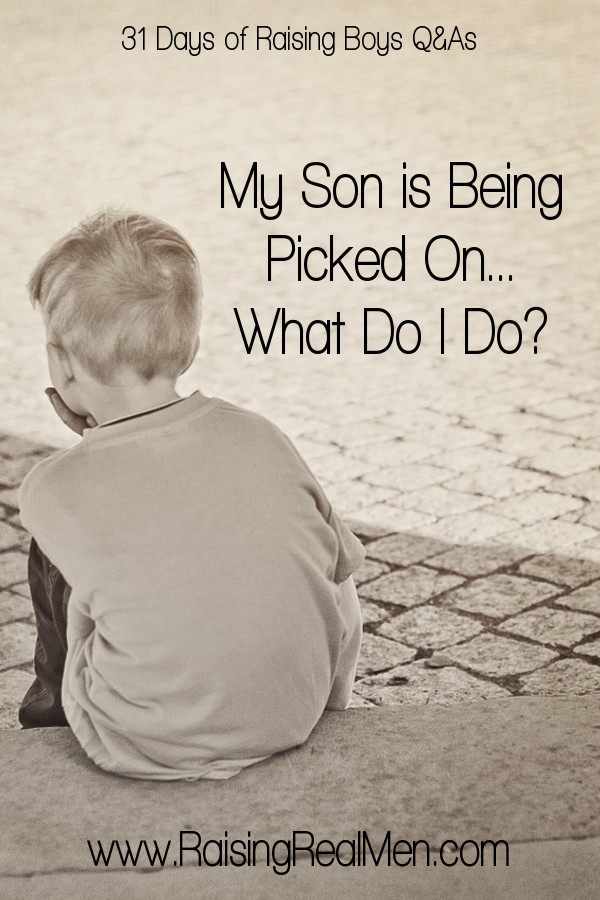
Q&A: My Son is Being Picked On … What Do I Do?
A reader asks, “I am looking for some advice to help my son deal with children who are unkind. He is 6 years old and in 1st Grade now. He is a very bright and kind child. He is having difficulty learning to stick up for himself. He tells me that he is not brave enough. I have coached him with things to say and encouraged him to avoid certain children that he feels affect him in a negative way.
My heart is breaking watching him sob.
Generally speaking there has been a little girl since preschool every year who has given him trouble. Not the same girl, but a different one each year. He is a very sensitive child and he is having a hard time dealing with people who hurt his feelings. I am considering having him speak to the guidance counselor to see if there are any skills they can share to help him feel safe when he needs to stand up for himself.
As he was crying and we were talking he actually pulled a piece of hair out of my head and ask to put it in a plastic bag and for me to kiss it. I think I have raised him to rely on me for his bravery. I really need assistance in figuring out ways to help him cope. Thank you.”
Poor kid! It’s hard when you don’t feel safe and happy where you are spending so much time. Some really nice kids seem to get picked on a lot and it’s a shame.
First, I would explain to him that people are like chickens, they peck on those they perceive to be weak or different. You could even look up some videos about this. Explain that he’s going to have to learn to look like a big rooster, to fluff up his feathers and be bold, because nobody picks on those roosters.
Help him with his body language. Teach him how to sit strong, with knees apart, elbows spread, and leaning back. Show him how to walk boldly, striding with his head up, and arms swinging slightly. Help him to hold his hands in a manly way. Some kids will pick this stuff up by just watching others, but some will need to be shown. Weirdly, taking a strong stance can make the body release hormones that make you feel more confident!
Then, help him role play some strong and confident responses to things people might say to him. Take turns being the one picked on and help him to practice firm, confident, funny, even somewhat aggressive responses depending on the situations he might face.
Pray with him. Encourage him. Praise him. Being teased and picked on is tough on you. It’s easy for kids to think something is wrong with them instead of realizing that the one being unkind is the one with a problem.
Do consider homeschooling, if you possibly can. I can’t tell you how much more healthy the kid-to-kid interactions tend to be when the parents are always around. It has been amazing to me how little angst our children have had about other children. It’s a breath of fresh air!
I’m so sorry you are both dealing with this. It’s not easy being a kid or a parent, is it?
Your friends,
Hal & Melanie
September 29, 2015
What A Man’s Gotta Do
My wife, weak from the stomach flu, came out of the bathroom where she’d been hiding out—hiding by my request, I should say.
“I’m so sorry,” she said, shakily. “I feel like I shouldn’t have left you out there to do that.”
She had just stepped into the bathroom for the bedtime rituals when one of our younger children stumbled to the door of our bedroom and was gloriously sick—on me, on the laundry beside the door, the surroundings generally. Knowing Melanie was in a dicey state already, I had called out to her, “You stay where you are—we’ll take care of it.” Two of my sons scrambled for towels, trash bags, all the stuff needed to get the situation at least stabilized, and in a few minutes we got the sick child off to a different bathroom, the first load in the laundry, and Ground Zero restored to a more hygienic state.
It made me think about my father, who passed away while I was in college. Dad was a strong man with a weak stomach. My mother used to tell me that if my sister or I were sick, or even needed a serious diaper change, Dad would take care of the cleanup without hesitation or complaint, and when the crisis was over, excuse himself to the bathroom and be privately ill. Mom tried to spare him that indignity whenever possible, but even so, as often as not, he went ahead and did it. It was like the call of duty to him.

Most Christians are not going to face lions in the Coliseum. More often, we’re pecked to death by chickens. We hope that when the chips are down, we’ll rise to heroism. We’ll fight the desperados, wrestle grizzlies, stand against the zombie horde … all that cool stuff. But most of us never get that call. It’s the little things, added up day by day, which are the ordinary proof of character.
My dad never took a bullet for any of us, he never took newsworthy public stands or did remarkable feats of heroism, but he lived a life of quiet faithfulness to the needs of his family. I’m sure he would have run into burning buildings for any of us, but he answered the call of marriage and fatherhood by doing the routine, boring, even nauseating stuff, just as a matter of course.
The old Western-movie cliché is “Sometimes a man’s gotta do, what a man’s gotta do.” I learned from my dad that most of what a man’s gotta do is not the stuff of movies or newsreels, but the simple willingness to sacrifice his own desires and comfort for the needs of someone else.
I hope my sons are learning the same lesson from me.
In His Service,
Hal
Learn more about raising godly sons in our book, Raising Real Men, 2011 CSPA Book of the Year!
September 23, 2015
Depressed Parents, Depressed Kids
“It’s a fallen world.” How often we find ourselves saying that! But it’s true that every person will have times of disappointment, loss, trials, or failure – it comes with being human. The question for each of us is, “How do I deal with this?” And sometimes, we may find ourselves in a dark place emotionally and spiritually. What should we do about that?
1. Understand it.
Depression is a real thing which is more than just “feeling blue.” It has a serious physical side, both in cause and effect, as it deals with our brain chemistry. It’s not proof of spiritual weakness or flawed character!
Many heroes of the faith have grappled with depression – Martin Luther and Charles Spurgeon, for example. Depression can be a trial of its own, or the result of some other cause.
2. There may be a spiritual component, but the physical often makes it persistent.
God created us with bodies as well as spirits, and while we’re on earth we can’t completely separate the two. When our body is sick, it may be because of our actions or lifestyle, or it may not. You might have cancer because you smoke three packs a day, or you may have cancer because of a genetic condition you inherit. But whatever the cause, you may end up sick and have to deal with the sickness with or without root causes. Depression might be caused by sinful decisions, or it may be a result of illness or other disorder. Once it sets in, though, it’s hard or impossible to just “snap out of it” because our brain chemistry has gotten out of whack. Maybe we got depressed because of some outside cause, but we might stay depressed because now we feel hopeless.
3. There are practical things you can do for mild depression, without prescriptions
Sometimes we need to change our activities to change our feelings. If you’ve lost a job and have nowhere to be in the morning, don’t decide to sleep till noon and sit around in your bathrobe all day. Go ahead and get up, get dressed, and act purposeful; it actually does help! Often depression will make you feel like withdrawing from social contact; that may be the time you most need the interaction and encouragement of being around people. Start with your family and move on to your church — don’t forsake assembling together with other believers!
Some kinds of depression are seasonal. We have a friend who grew up in cloudy, cold New England; she said, “I never knew you could be happy during the winter until we moved south!” Melanie felt truly oppressed when we lived through a California winter — in the Central Valley, where we lived, a heavy fog obscured the sky every day for weeks at a time, and only lifted a few feet during midday. Sunlight and vitamin D supplements can be an amazing help.
We found that we have better mood and better concentration when we take fish oil supplements. The omega-3 fatty acids in fish oil, krill, and some nuts are concentrated in the brain, and you have to get them from your food or take supplements.
There is some research suggesting that an overgrowth of intestinal yeast can impact depression. The yeast blocks the places in the intestine where the body moderates serotonin, a mood-balancing hormone; you can sometimes improve things by taking a good probiotic supplement, which will compete with the yeast but not interfere with serotonin use.
St. John’s Wort also works on serotonin levels. It’s an over-the-counter supplement which has been used in Europe for many years, and has gained more acceptance and use in the United States in the past decade or so. You can buy it without a prescription, but it can have pretty strong effects. You may want to consult your doctor before starting this one!
4. Sometimes medical help is needed – and life saving
The Bible balances two facts – that the God who made our bodies is the One who ultimately heals our bodies, and at the same time, He gave us doctors and treatments which may be the way He does it. John Piper said, “I believe in God’s power to heal—by miracle and by medicine. I believe it is right and good to pray for both kinds of healing.” (link)
There are times when you can afford to experiment with alternative treatments for yourself – when the risk is low if they are ineffective. But if you are grappling with a crippling or self-destructive level of depression, it is time to seek professional help.
5. So be on the lookout, and know when you need help – or when a friend or loved one may need your help. You’ll be thankful later.
In Christ,
Hal and Melanie
You can hear more about this and about interacting with your kids about depression on episode 97 of our podcast, Making Biblical Family Life Practical – CLICK HERE TO LISTEN IN!
DISCLAIMER: We are not medical professionals! This article is simply advice from our own experience and reading. Please take these suggestions as just that, suggestions, and consult your own doctors and counselors.
Are dealing with trials and temptations? Grappling with “hard times”? We’ve had our share, for certain, and learned some valuable lessons about how to manage the day-to-day life in the midst of sickness, unemployment, sorrow, and other challenges. We have a workshop called Just As I Am: Homeschooling Through Hard Times that would bless you, and we’d love to give you a copy for free if you sign up for our newsletter here:
September 15, 2015
Homeschooling High School? Sure, Why Not?
Do you ever ask yourself that? And maybe doubt how you’ll answer?
Many years ago, we started homeschooling our first child, thinking we’d do it till he hit high school. Once we started, though, we found so many benefits to homeschooling we didn’t want to give it up! Now we’ve graduated three, and all have gone to college on scholarship – one even studied a year at Oxford, and no one in college admissions ever blinked at our homeschool transcripts (or ever asked, “But did you finish every page of your 5th grade math book?”)
We’ve found that high school at home is definitely possible, and today is even easier than when we first tried it. You can find online classes, tutoring programs, and self-study resources for nearly any subject (we even learned to speak Mandarin Chinese as a family – and none of us had experience when we started).

We talk about it in episode 96 of our podcast – CLICK HERE!
Here are three key facts to keep in mind:
1. You can do it! Even if you struggled as a 14-year-old, you’ll bring a grown-up mind to those subjects this time. You won’t be worried about finding a date for the prom or whether your shoes are cool enough, and often, you’ll find yourself learning things you missed the first time. Don’t be shy about growing in knowledge right alongside your students – it’s fun, and we can almost guarantee you’ll be better educated yourself after teaching your children.
2. Start at the end and work backwards. Remember the senior level classes are built on earlier coursework (you can’t do Algebra II until you’ve finished Algebra I, right?) so think about what your student should know when they graduate, and plan backwards to make sure they have the foundations they need as high school freshmen. If you’re not sure what the end of high school might look like, Google the admission standards for your state university and graduation requirements for a public school diploma. And if you look at your 10-year-old and think, “This child will never make it to college,” don’t shortchange their high school as if they don’t matter–you’ll be surprised how much your kids grow and develop the last few years, and their plans will likely change.
3. Trust God and go ahead! “I am God, and there is none like Me,” God said, “declaring the end from the beginning, and from ancient times the things that are not yet done.” (Isaiah 46:9-10) Only God knows exactly what your child’s future will be. Don’t fret and stagger because you can’t predict your student’s college major when they’re 12 years old (they’ll likely change interests a dozen times before then). Aim for a broad education that challenges the whole child – academically, spiritually, and physically, too. We’ve never looked back at the things we learned and said, “Well, that was a total waste!”
That’s our strategy in a nutshell. The most important principle, though, is to always remember homeschooling is really about discipleship. Your kids will experience so much change, uncertainty, doubt and fear as they move into the teenage years – don’t you want to be there to answer their questions as soon as they arise? When you teach your own, you re-gain 35 hours a week to interact with your student – and avoid so many distractions and detractions that come in school culture. In fact, homeschooling high school may be the most important years to do it!
Yours in the battle,
Hal and Melanie
Thinking about high school? Worried about coursework, grading, creating a transcript? Join us September 17 for a free webinar with Lee Binz of The Home Scholar, “The Homeschool Parent’s Guide to High School Grades, Credits, and Transcripts”. Attend live and you’ll also get several downloadable resources, too! [ Click here to sign up or for more information! ]
Copyright 2014. Used with permission. All rights reserved by authors. Originally appeared August 6, 2014, in The Homeschool Minute™, an E-Newsletter published by The Old Schoolhouse® Magazine. Read this family education magazine free at www.TOSMagazine.com or read it on the go and download the free apps at www.TOSApps.com to read the magazine on your mobile devices. For free homeschool information visit ConsideringHomeschooling.info.
September 13, 2015
Review: Grape Stuff BBQ Grill Mats
Labor Day doesn’t mean the end of summer – it means the start of tailgating season!
Of course, here in the so-called sunny South, there’s a lot of good outdoor time to come, and for many of us, that means time with the grill – in the backyard, or at the stadium. Our friend JoJo Tabares sent us a sample of these grill mats from her company, Grape Stuff.
No More Aluminum Foil! No More Skewers!
One of the limitations of grill cooking is how to handle items which can fall through the grating. Sometimes you can grill shrimp or fruits and vegetables by slipping them on skewers; other items like fish are simply too fragile, and require extra hardware to cook outdoors – if even possible. This product overcomes that problem!
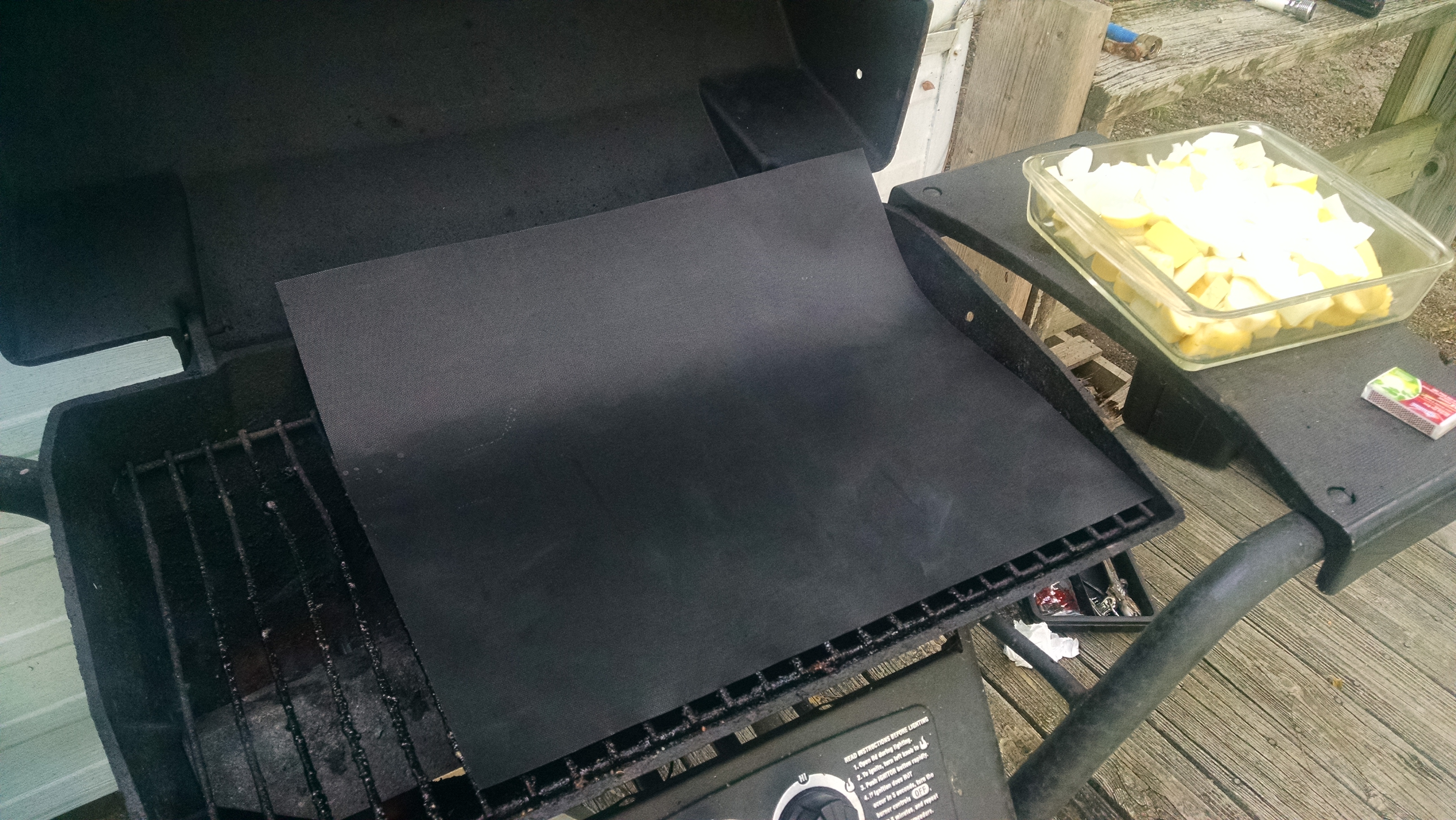 The package comes with two 16×13-inch sheets of a black, stiff-but-flexible synthetic fabric. If you plan to use it at home, you might trim it to size with scissors; since we were on vacation and not our “home” grill, I opted to leave the sheets full size and just curl up the edges where needed. It’s a very tight weave, tight enough that I’ve heard you can even cook eggs on it — though we didn’t test that.
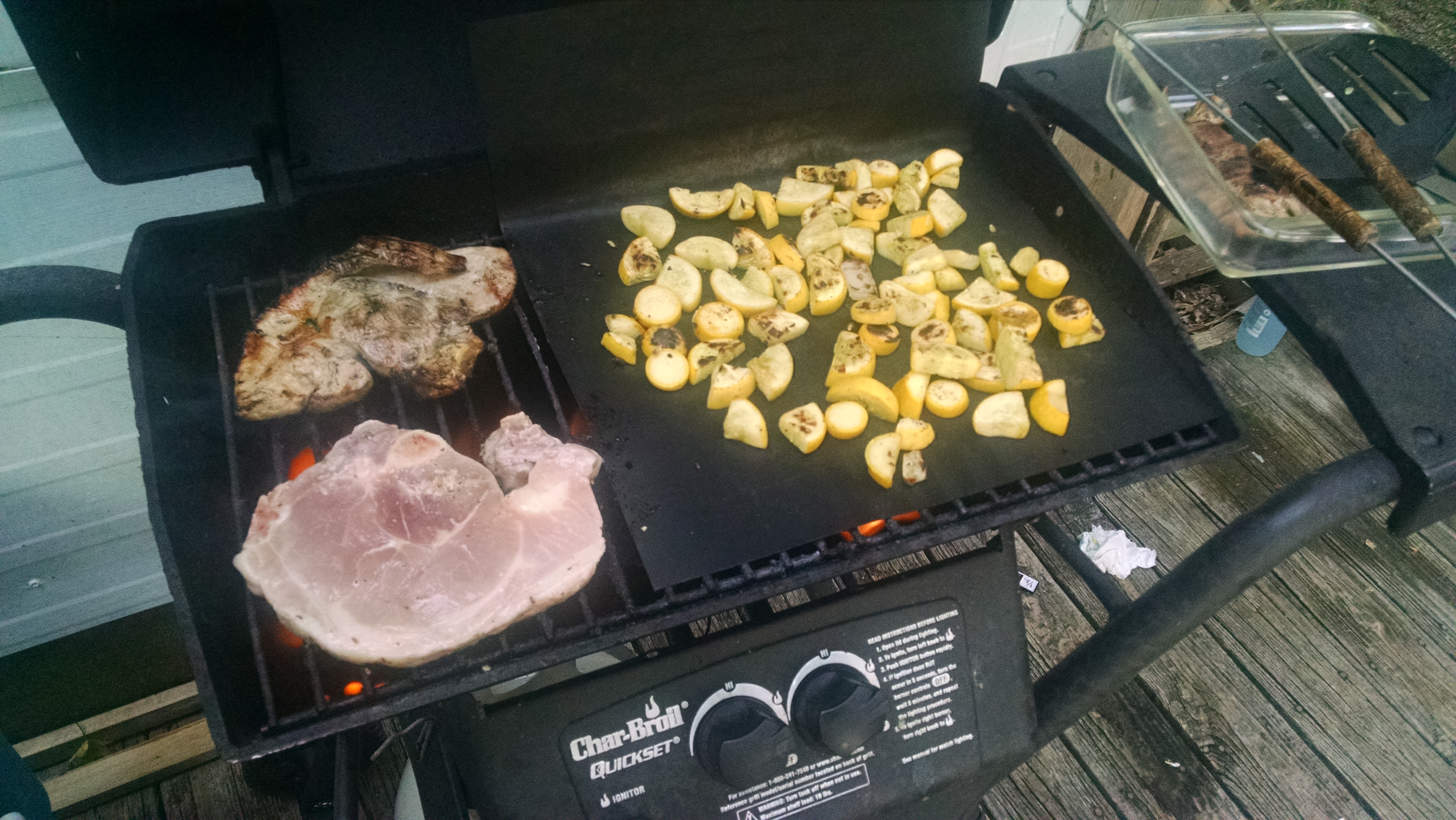
Instead, we cooked a batch of diced squash and onions – not our usual grill fare!
First, the fabric transferred heat well, though not 100% – there was definitely a hot band at the edges, where the excess hot air was slipping around the sheet. Instead of roasting like an open grill would do, the fabric allows the grill to act more like a griddle. I found the vegetables didn’t stick to the sheet, but they could scorch, if I wasn’t careful. The sheet greatly increases the contact area so you may want to turn down the flame a bit or just be sure to keep the food moving as it cooks. A little bit of fat or vegetable oil might help too.
 We also tried it with a batch of pork chops to see how meat behaved. Surprisingly, this was a little more tricky than the vegetables – the fat from the meat doesn’t seep through the fabric, but instead runs to the edge. That means you need to be sure the fabric doesn’t hang over the edge of the grill. I curled up the back edge and positioned the sheet so the front edge had a gap to let the fat drip into the fire and not my shoes.
One nice feature is you can mix items on the grill without concern. We often cook onions and hamburgers together in the pan, and you can do the same on the grill with these mats. And you can orient your bratwurst and hot dogs however they fit best, not worrying about properly bridging the spaces in the grill.
I wasn’t able to get sear marks on anything while using the mats; the illustrations on the package show grill marks on both chicken and vegetables, so I may have been doing it wrong. [Disclaimer: I’ve never used foil on the grill so some of these observations may not be surprising to readers!]
Besides the cooking, the grill mat simplifies clean up. I have to confess, with our grill’s many years of use, it has a permanent patina of sorts and you wouldn’t be able to see the difference for this test. Using these mats from the start with a new (or newly scrubbed) grill would prevent the usual baked-on buildup – and unlike aluminum foil, I don’t think this material would tear or wear out. This would be a great help for picnic or tail-gating situations, where you can just wipe off the loose residue with a paper towel, then roll up the grill mats to carry home in a plastic bag — much easier than managing a bulky, greasy grill in your car!
Cleanup is easy – we just used dishwashing liquid and a dish brush in the sink. The fabric sheds water so the mats can be dried off and put away immediately. The material will probably crease – it’s delivered flat and unfolded from Grape Stuff – so I’d recommend rolling it for storage, if you don’t leave it on the grill for next time.
The biggest advantage? Instead of having someone inside cooking the things we couldn’t cook on the grill, it can all be cooked out on the deck looking at the lovely view! Grab a set for your cookouts this fall here.
[Disclaimer: We received a free sample of BBQ Grill Mats from Grape Stuff in exchange for this objective review.]
In Christ,
Hal