Hal Young's Blog, page 18
January 20, 2016
How Do You Sort Out Conflicting Stories?
One of our webinar participants asked a simple but significant question:
When two children have an argument, how do you determine the truth when the two disagree?
What do you do when you get two different stories?
“Mama, would you please lower the boom on somebody?”
Often when the kids have a disagreement, we only find out because someone has “run to tell” – in other words, they want to call down some parental thunder on their mean old brother’s head. Usually, though, they haven’t followed Jesus’ directions about dealing with offensive people:
“… If your brother sins against you, go and tell him his fault between you and him alone. If he hears you, you have gained your brother. But if he will not hear, take with you one or two more, that ‘by the mouth of two or three witnesses every word may be established.’ And if he refuses to hear them, tell it to the church…”
(Jesus, in Matthew 18:15-18 – NKJV)
“Have you talked with your brother about this first?”
“The Bible tells us when we have a problem with a brother, we’re supposed to go to him privately and try to work it out,” we might say. “Have you done that?”
Almost always, they haven’t!
So we send them back with the reminder, and commonly, that’s the last we hear of it. It’s plain the complaint wasn’t a call for justice, it was a request for an air strike against the enemy.
But if that fails …
The passage goes on to say, “Take a witness.” Sometimes, if the complaint comes back, we’ll ask, “Did anybody see or hear what happened?” If so, you can suggest they get their witness and go back to the offending party.
But on the minor stuff kids argue about, we usually skip to the last stage – which is, to go to the authority over the matter. Between believers, it’s the church; between siblings, it’s the parents. At this point, we’ll call them both in and let the offended brother tell his side of the story first, without interruption — but with the promise that you’ll listen to both sides.
When the offended brother has shared his complaint, we’ll turn to the “defendent” and ask, “You’ve heard your brother’s story. Is that basically correct? Is there anything you’d like to add or change?”
That’s an important part of it – when you demonstrate that each will have their time and their say all the way through, it says that we’re committed to justice and not just fixing the blame. Typically, we’ll have to stop both sides from jumping into the other’s narrative, too. “No, you had your say …” or “You’ll have your turn next …” This is a great place to show your fairness!
If there were any witnesses, sometimes we’ll ask for confirmation or correction.
Sometimes this is enough to demonstrate what’s going on … but frequently, a problem that’s gone to this stage has picked up a lot of secondary offenses along the way. It’s not as simple as “He’s bad, I’m innocent.”

Often they’re both wrong
We have conversations like this:
Little Brother: “He hit me!”
Dad to Big Brother: “You hit him?”
Big Brother: “Well, yes … ”
Dad: “Why?”
Big Brother: “Well, he threw my book down the stairs.”
Dad to Little Brother: “You threw his book down the stairs? Why?”
Little: “Well, yeah, but he called me a name!”
Dad to Big: “Did you call your brother a name?”
Big: “Well, I said he was a pest because he wouldn’t let me read …”
D. to L. “You wouldn’t let him read?”
L. : “Well, I wanted him to play with me and he wouldn’t …”
… and so on.
By that time, we can usually show them that whatever may have started the disagreement, both of them made decisions to continue the disagreement. You can explain all the places where someone decided to argue when they could have done what his brother wanted, or accepted his brother’s refusal. “You could have stopped here or here or here …”
And — here’s the kicker — you can show them that since both of them broke rules (whether the law of God or your own family’s rules) … both of them deserve punishment. Maybe one of them needs more correction than the other – that, too, is handled in private, so neither brother really knows what discipline the other received – but in many cases, if there was ever an “innocent” party, he lost the moral high ground when he decided to be disagreeable in return.
We find that often, that realization that everyone may share some guilt encourages them to find a way to settle. And next time, there’s some memory of that possibility – that maybe we can resolve this privately, and not get the parents involved!
One of our favorite resources is Doorposts’ “The Brother Offended Checklist.” CLICK TO FIND OUT MORE.
Like some more ideas for dealing with family friction? Check out these downloadable resources —
A House NOT Divided – a workshop on positive ways to build family unity
How To Fight So You BOTH Win – no, really! Get to the root of conflicts and find acceptable solutions – in all kinds of relationships!
In Christ,
Hal & Melanie


January 13, 2016
When Your Boys Gang Up On Each Other
In one of our webinars, a class member with several boys asked,
“How do you handle the constant ganging-up on each other?”

In one sense, it’s very simple – We don’t allow it!
It’s very important that your home be a haven, and that means if any kid feels persecuted, if they say “Stop it!” to their brother, whatever it is has to stop immediately – or we’re going to deal with it very sharply.
There are several things which can be going on here. There is bullying where someone is using their increased strength or position to have their will or to persecute someone smaller or younger. If someone is consistently being a bully, some physical discipline is warranted.
But then there is also what we call “pesting,” where you use your position as the smaller or weaker sibling to try to get the older person in trouble, egging them on or pestering them to a breaking point!
One of the things we do which is especially effective with the second one is to say, “If you lead your brother into sin – if you tease your brother to the point that he loses his temper and starts fighting with you …” – or from the other direction, “If you send your little brother to go steal a cookie when you’ve been told not to have one …” – then guess what? “… You are going to get the same trouble that he just earned!”
The person that provokes and the person who gets provoked, both, get punished. That really squelches it – it takes all the fun out of it!
If you have two that are just at each other’s throats, we found it really effective to make them team up. One of the things we did was take a bungee cord and hook it on their belt loops and tell them, “You two are teammates today; you can’t unhook it.” That really helped them to stop persecuting each other because they were so angry with their parents! But by the end of the day they thought it was funny … and they were dealing with their original disagreement.
What you really have to watch out for is if there is one child that is always being bullied.
Then it’s time to get alone with each of the kids that’s doing that and read them the Riot Act. Explain to them what the Scripture requires of them, that Jesus is compared to a brother (as in Proverbs 18:24, there is a friend who sticks closer than a brother) and brothers have to hang together.
“Are you the kind of brother that Jesus could use as a good example?” we ask.
And we remind them – we’ve had to do this with ours, a few times – remind them that one day, we parents are going to be dead and gone to heaven, and the only people that will remember the things of their youth, the fun we had and the things we did, will be their siblings.
We simply will not allow them to develop the kind of relationship now that destroys their future relationship as adults. We know of families where that’s happened!
Also, recognize that the Bible does have specific passages dealing with people who make fun of folks for their disabilities or their weaknesses, about people who mock one another, people who disparage one another’s character, and so on. There are passages that condemn that kind of behavior very specifically. And those are the kind of things that happen sometime when boys get a bad attitude toward each other. You’ve got to just step on that behavior. You’ve got to squash it – flat.

Photo: FreeImages.com/Tila Ollivi
One of the things we do is encourage our guys to think of the family as a team:
We sort out our differences with one another.
We don’t pick on each other;
instead, we support one another.
We help one another along.
We handle our disagreements at home, in private – so we can stand together outside.
When there’s an ongoing problem, it tends to be the brothers who are right next to each other in age, because they’re more in competition with each other – or so they think. Competition comes very naturally to boys, and when it leaves the playing field or the game board and bleeds over into family life, it can become corrosive.
We remind our boys that a football team that starts tackling each other when the ball is snapped is never going to win.
It will be something to remind your kids over and over – they’re not in that sort of competition against their brothers. You have to explain that you do love them all now and will continue to love them all regardless. (Note To Self: Be sure to express this often!).
Instead, our family is a team competing against the rest of the world. We’re on a mission together. That means we rejoice with our brother when he has a reason to rejoice, we grieve with him when he grieves, we stand by him when he needs us most. We can expect him to do the same for us. And we always remember:
“He’s not the one I’m trying to beat – it’s the rest of the world!”
What’s worked for your family? How do you help your kids see each other as part of a team, not as rivals?
Hal & Melanie 

From our podcast, Making Biblical Family Life Practical:
Sibling Rivalry (episode 91) – CLICK HERE to listen
Building Family Unity (episode 92) – CLICK HERE to listen
If you haven’t read our book, Raising Real Men, then check it out here!
Photo Credits:
Fighting in the Old West — Gerd Paulsen / FreeImages.com
Meerkats —
When Boys Gang Up On Each Other
In one of our webinars, a class member with several boys asked,
“How do you handle the constant ganging-up on each other?”
In one sense, it’s very simple – We don’t allow it!
It’s very important that your home be a haven, and that means if any kid feels persecuted, if they say “Stop it!” to their brother, whatever it is has to stop immediately – or we’re going to deal with it very sharply.
There are several things which can be going on here. There is bullying where someone is using their increased strength or position to have their will or to persecute someone smaller or younger. If someone is consistently being a bully, some physical discipline is warranted.
But then there is also what we call “pesting,” where you use your position as the smaller or weaker sibling to try to get the older person in trouble, egging them on or pestering them to a breaking point!
One of the things we do which is especially effective with the second one is to say, “If you lead your brother into sin – if you tease your brother to the point that he loses his temper and starts fighting with you …” – or from the other direction, “If you send your little brother to go steal a cookie when you’ve been told not to have one …” – then guess what? “… You are going to get the same trouble that he just earned!”
The person that provokes and the person who gets provoked, both, get punished. That really squelches it – it takes all the fun out of it!
If you have two that are just at each other’s throats, we found it really effective to make them team up. One of the things we did was take a bungee cord and hook it on their belt loops and tell them, “You two are teammates today; you can’t unhook it.” That really helped them to stop persecuting each other because they were so angry with their parents! But by the end of the day they thought it was funny … and they were dealing with their original disagreement.
What you really have to watch out for is if there is one child that is always being bullied.
Then it’s time to get alone with each of the kids that’s doing that and read them the Riot Act. Explain to them what the Scripture requires of them, that Jesus is compared to a brother (as in Proverbs 18:24, there is a friend who sticks closer than a brother) and brothers have to hang together.
“Are you the kind of brother that Jesus could use as a good example?” we ask.
And we remind them – we’ve had to do this with ours, a few times – remind them that one day, we parents are going to be dead and gone to heaven, and the only people that will remember the things of their youth, the fun we had and the things we did, will be their siblings.
We simply will not allow them to develop the kind of relationship now that destroys their future relationship as adults. We know of families where that’s happened!
Also, recognize that the Bible does have specific passages dealing with people who make fun of folks for their disabilities or their weaknesses, about people who mock one another, people who disparage one another’s character, and so on. There are passages that condemn that kind of behavior very specifically. And those are the kind of things that happen sometime when boys get a bad attitude toward each other. You’ve got to just step on that behavior. You’ve got to squash it – flat.
One of the things we do is encourage our guys to think of the family as a team:
We sort out our differences with one another.
We don’t pick on each other;
instead, we support one another.
We help one another along.
We handle our disagreements at home, in private – so we can stand together outside.
When there’s an ongoing problem, it tends to be the brothers who are right next to each other in age, because they’re more in competition with each other – or so they think. Competition comes very naturally to boys, and when it leaves the playing field or the game board and bleeds over into family life, it can become corrosive.
We remind our boys that a football team that starts tackling each other when the ball is snapped is never going to win.
It will be something to remind your kids over and over – they’re not in that sort of competition against their brothers. You have to explain that you do love them all now and will continue to love them all regardless. (Note To Self: Be sure to express this often!).
Instead, our family is a team competing against the rest of the world. We’re on a mission together. That means we rejoice with our brother when he has a reason to rejoice, we grieve with him when he grieves, we stand by him when he needs us most. We can expect him to do the same for us. And we always remember:
“He’s not the one I’m trying to beat – it’s the rest of the world!”
What’s worked for your family? How do you help your kids see each other as part of a team, not as rivals?
Hal & Melanie
From our podcast, Making Biblical Family Life Practical:
Sibling Rivalry (episode 91) – CLICK HERE to listen
Building Family Unity (episode 92) – CLICK HERE to listen
If you haven’t read our book, Raising Real Men, then check it out here!
January 5, 2016
Convention Season – Should You Go?
 When our eldest was just one, we went to our first homeschool convention – in a picnic shelter (really!) in Modesto, California. It was so exciting to talk to homeschoolers and to look through all the books. We knew we wanted to homeschool and this little taste of it just whet our appetites. We’ve only missed going to a homeschool convention once in the twenty-five years since then!
It’s true the Internet has changed things. It’s easier to get information and easier to “talk” to other homeschoolers than ever before. You can even download workshop sessions from your favorite speakers whenever you like.
So why should you go to a live homeschool convention?
It’s different when you are actually there. We love the time after our workshops when we get to talk to moms and dads face to face and pray with them. You can really get to know the speakers you enjoy – and they can get to know you.
Often the people who wrote the curriculum you are interested in are right there in the book fair. Even if they’re not, there will be knowledgeable folks running each booth, usually people who’ve used those books themselves. You can talk to other parents there and gain from their experience, and take a look at new things you’ve never even heard of before.
It’s good to be away from home, too. It’s hard to focus on your own learning when the children are running in and out and the laundry is calling. It’s so relaxing to sit back next to your mate, listen and learn, then head to lunch together talking about where the Lord is leading your family. It’s good for you and good for your marriage and children, as well.
The best reasons, though, are the divine appointments. Cool things happen when you put a few thousand homeschoolers in a building together. It happens all the time. We see two dads bouncing cranky toddlers in the hall and the dad who’s been worried about high school talks about the teens he’s met there. Teens who’d been restless at home gain a new perspective and a bunch of new friends in the teen sessions. A group of moms chatters up a storm waiting for a session to start, then settles back happy with some new ideas. Old friends call delighted greetings over stacks of books. The energy and joy is amazing!

We’re going to be speaking at a number of conventions this year, including:
Rockport, Maine. – Homeschoolers of Maine (HOME)
Peoria, Ill. – Association of Peoria Area Christian Home Educators (APACHE)
Indianapolis, Ind. – Indiana Association of Home Educators (IAHE)
Harrisburg, Penn. – Christian Homeschool Association of Pennsylvania (CHAP)
Orlando, Fla. – Florida Parent Educators Association (FPEA)
Winston-Salem, N.C. – North Carolinians for Home Education (NCHE)
Rocklin (Sacramento), Calif. – Sacramento Christian Organization of Parent Educators (SCOPE)
Phoenix, Ariz. – Arizona Families for Home Education (AFHE)
If you come to one, stop by and say, “Hi!”
For more times and places, visit our Events page at RaisingRealMen.com/calendar
This article originally appeared in The Homeschool Minute.
[ CLICK HERE for our podcast on why you really ought to go to a convention! ]
[AND HERE for some ideas how to get the most from a convention ]
January 1, 2016
Keeping a Journal – Why, and How!

One of the surprising discoveries of our family life has been the usefulness of keeping a journal or diary — at least one per family.
I tried keeping a diary when I was a kid, with limited success. My English teacher in high school introduced us to “journalling” for literary practice — an idea I didn’t really catch up with until blogging came around. Go looking for a “diary” in the store, and you’re likely to end up in the Lisa Frank section, full of rainbows and dewy-eyed unicorns, and not much to grab a boy’s heart.
But keeping a diary or journal has a long and honored history. One of our family’s treasures is a hand-written ledger kept by my great-great-great-grandfather to chronicle the goings-on at his South Carolina farm. It’s simple, not more than a line or two a day, but we read about the rhythms of planting, harvesting, plowing and ditching; about the seasonal floods and the Really Big One they had; about the texts of sermons and the days of sickness and celebrations with family.
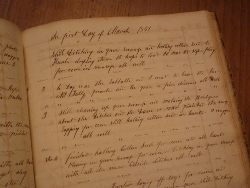
the first Day of March 1851
Still Ditching in gum Swamp and halling cotton seed to Sumt. droping them 12 heeps to load 20 roas 25 steps plowing for corn in swamp all well
” ” ” ” ” ” ” ” ” ” ” ” ” ” “
2 to Day was the Sabbath and I went to hear the Rev. Mr. Tally preach and he gave a fine discours all well
” ” ” ” ” ” ” ” ” ” ” ” ” ” “
3 Still cleaning up gum Swamp and making the bridges about the ditches and the Dam or road finished the swamp Tapping for corn Still halling cotton seed in Sumter 3 waggons all well
It was mostly trivia then, but it’s priceless now … which hints that the journal we keep today may become a treasure to our grandchildren, too.
Several years ago I started two journals of my own. One was when I realized that most of my reading was newspapers and magazines; I decided I wanted to read something of spiritual value and something of professional value every month. I started a list of what I was reading, and it was a great help to improving my intellectual life!
The second was a practical matter — I had to keep track of daily activities so I could write weekly or monthly reports for my job. Like the reading list, it was a daily check for me — what had I done with my time for the day? Was it profitably spent, or was the time mislaid or wasted somehow? And it made sure nothing escaped mention when it was time for reports — or annual reviews.
Now, at the end of the year, my journal (which has morphed into more of a traditional diary) is the baseline for our family’s annual review. How have we spent our year? What has God done for us? What have we attempted for God? And what do we simply want to remember, both hard times and good times?
Maybe you already have a family historian. Maybe it’s time to find one! Or maybe everybody might put down a few thoughts once a day or once a week even, just to keep your memories fresh. Here are a few ideas:
Library Thing — I learned about this website from a local pastor. It’s basically a cataloging program – you can index your whole library, or keep a record of books in a series you collect, or maintain a list of what you’ve been reading, like I do. A free membership lets you enter 200 titles, and it’s easy to download the list at the end of the year and clear out space for next year’s books. It’s linked to several other sites so it’s easy to find the title, edition, and even the cover image of the book you’re holding.
Google Calendar — We began using this a couple of years ago when our different schedules — homeschooling activities, family businesses, church and employer and all — started running into each other. It’s a simple tool with some great features for planning ahead. BUT … you can use it as a time sheet or log, to record what you’ve done. And even if you use it the traditional, “what’s up next week?” way, you can look back at the end of the month and see what happened (or at least, what you planned to be doing!).
The Reagan Diaries for inspiration — If you liked President Reagan, you’ll enjoy this thick volume, lightly edited by Douglas Brinkley. Even if you don’t like The Gipper, take a look at the book in the library or a bookstore (or Google Books even). For his eight years in the White House, Reagan managed to find time to write at least a few sentences every day; the only exception was while recovering from a bullet wound! This is both encouraging and convicting, Whenever I feel lazy about my journal, I ask myself if I’m really busier than the president — then I find time to write! (It’s also a good reminder that an effective journal doesn’t need to be a collection of page-long essays with moody photographs or hand-drawn illustrations — not if the grand design gets in the way of actually doing it.)
Keeping a journal is a great way to capture a lot of life that you’ll forget by the end of the year. It will help you truly appreciate how God works in your life. You’ll be able to point your children to God’s faithfulness and protection day after day. And just by the way, when you get to December and your tax-figuring spouse looks up from a receipt and say, “What were we doing in Salisbury on June 17th?”, you’ll be able to tell – and that may have a very tangible value of its own, right now!

In Christ,
Hal
Our podcast talks about starting the new year with more Christ-centered focus – CLICK HERE to listen!
December 31, 2015

Keeping a Journal – Why, and How!
One of the surprising discoveries of our family life has been the usefulness of keeping a journal or diary — at least one per family.
I tried keeping a diary when I was a kid, with limited success. My English teacher in high school introduced us to “journalling” for literary practice — an idea I didn’t really catch up with until blogging came around. Go looking for a “diary” in the store, and you’re likely to end up in the Lisa Frank section, full of rainbows and dewy-eyed unicorns, and not much to grab a boy’s heart.
But keeping a diary or journal has a long and honored history. One of our family’s treasures is a hand-written ledger kept by my great-great-great-grandfather to chronicle the goings-on at his South Carolina farm. It’s simple, not more than a line or two a day, but we read about the rhythms of planting, harvesting, plowing and ditching; about the seasonal floods and the Really Big One they had; about the texts of sermons and the days of sickness and celebrations with family.
the first Day of March 1851
Still Ditching in gum Swamp and halling cotton seed to Sumt. droping them 12 heeps to load 20 roas 25 steps plowing for corn in swamp all well
” ” ” ” ” ” ” ” ” ” ” ” ” ” “
2 to Day was the Sabbath and I went to hear the Rev. Mr. Tally preach and he gave a fine discours all well
” ” ” ” ” ” ” ” ” ” ” ” ” ” “
3 Still cleaning up gum Swamp and making the bridges about the ditches and the Dam or road finished the swamp Tapping for corn Still halling cotton seed in Sumter 3 waggons all well
It was mostly trivia then, but it’s priceless now … which hints that the journal we keep today may become a treasure to our grandchildren, too.
Several years ago I started two journals of my own. One was when I realized that most of my reading was newspapers and magazines; I decided I wanted to read something of spiritual value and something of professional value every month. I started a list of what I was reading, and it was a great help to improving my intellectual life!
The second was a practical matter — I had to keep track of daily activities so I could write weekly or monthly reports for my job. Like the reading list, it was a daily check for me — what had I done with my time for the day? Was it profitably spent, or was the time mislaid or wasted somehow? And it made sure nothing escaped mention when it was time for reports — or annual reviews.
Now, at the end of the year, my journal (which has morphed into more of a traditional diary) is the baseline for our family’s annual review. How have we spent our year? What has God done for us? What have we attempted for God? And what do we simply want to remember, both hard times and good times?
Maybe you already have a family historian. Maybe it’s time to find one! Or maybe everybody might put down a few thoughts once a day or once a week even, just to keep your memories fresh. Here are a few ideas:
Library Thing — I learned about this website from a local pastor. It’s basically a cataloging program – you can index your whole library, or keep a record of books in a series you collect, or maintain a list of what you’ve been reading, like I do. A free membership lets you enter 200 titles, and it’s easy to download the list at the end of the year and clear out space for next year’s books. It’s linked to several other sites so it’s easy to find the title, edition, and even the cover image of the book you’re holding.
Google Calendar — We began using this a couple of years ago when our different schedules — homeschooling activities, family businesses, church and employer and all — started running into each other. It’s a simple tool with some great features for planning ahead. BUT … you can use it as a time sheet or log, to record what you’ve done. And even if you use it the traditional, “what’s up next week?” way, you can look back at the end of the month and see what happened (or at least, what you planned to be doing!).
The Reagan Diaries for inspiration — If you liked President Reagan, you’ll enjoy this thick volume, lightly edited by Douglas Brinkley. Even if you don’t like The Gipper, take a look at the book in the library or a bookstore (or Google Books even). For his eight years in the White House, Reagan managed to find time to write at least a few sentences every day; the only exception was while recovering from a bullet wound! This is both encouraging and convicting, Whenever I feel lazy about my journal, I ask myself if I’m really busier than the president — then I find time to write! (It’s also a good reminder that an effective journal doesn’t need to be a collection of page-long essays with moody photographs or hand-drawn illustrations — not if the grand design gets in the way of actually doing it.)
Keeping a journal is a great way to capture a lot of life that you’ll forget by the end of the year. It will help you truly appreciate how God works in your life. You’ll be able to point your children to God’s faithfulness and protection day after day. And just by the way, when you get to December and your tax-figuring spouse looks up from a receipt and say, “What were we doing in Salisbury on June 17th?”, you’ll be able to tell – and that may have a very tangible value of its own, right now!
In Christ,
Hal
Our podcast talks about starting the new year with more Christ-centered focus – CLICK HERE to listen!
December 18, 2015
Star Wars: The Force Awakens Review and Discussion Guide
We’ll have a more extensive review in a few days after we ruminate a bit and discuss it, but we know your kids are nagging you to take them now, so we want to share a few initial thoughts from the opening night, PLUS a guide to help you discuss the movie with them.
Let me be upfront. I love Star Wars. The original Star Wars was released when I was a young teen and I think I saw it 5 or 6 times the first month. It was a grand story of nobility and sacrifice, knights and princesses, tyranny and resistance, epic battles and spaceships. Spaceships! It was hard not to love it.

The Force Awakens delivers what we all were craving – revisiting the good old days of the early Star Wars franchise. Our favorite characters are all there again, older and with more miles on them – and the audience in the theater burst into cheers and applause as each one appeared in the story. You can hear bits of the original score in the soundtrack. Memorable moments from the first movie (the real first movie, number “IV”) are reprised so many different ways it almost seems like a fan film; there is a new character on a desert planet, a droid with secret information, a prisoner on the Death Star, an escape on the Millennium Falcon. Altogether, though, it was fun and mostly satisfying.
The rub is what it always is with Star Wars movies. They are essentially religious movies and the religion isn’t Christianity or even theism. The Jedi Knights and presumably the Ren and the Sith are all orders of warrior monks in a taoistic faith. Taoism is a form of dualism that sees good and evil as outworkings of the same animistic force that balance one another. This concept has been extremely influential in Buddhism, as well as other Eastern religions.
Maz Kanata advises Rae, “The Force moves through and surrounds every living thing. Close your eyes and feel it. The light has always been there.” Looking into ourselves to find the source of wisdom and power is antithetical to Christianity, which teaches that God made us, His Word instructs us, and we find salvation in trusting Him. The religion of Star Wars is pagan.
That’s the main issue, though it is pretty central to the whole series. There’s no sexuality or language (that I noticed). The violence, while extreme (whole planets are destroyed and people are tortured and slaughtered) is remarkably lacking in blood.

One disappointment to me is that this movie loses some of the delight of the first heroine, Princess Leia. In A New Hope (the original Star Wars movie – I don’t know if I’ll ever get used to calling it that!), Leia is intensely feminine, a princess in flowing white dresses, who is also brave, smart, and a leader. Let’s just say there’s not much of anything feminine in The Force Awakens despite female leads.
I would not take a younger child to see any of the Star Wars movies. The dualistic religion is such a part of the story that it is sure to become a part of their play. They just aren’t old enough to be trusted not to be influenced. Also there were a number of disturbing trailers before the feature film that are too much for a child, including an ad for Maltesers candy that showed a woman flashing a man (from the back, thankfully) and previews of X-Men:The Apocalypse with weird Biblical references, Independence Day: Resurgence, The Fifth Wave, and Gods of Egypt, with the idols of Egypt as real beings.
If you take your teens, go with them and talk about it. This can be a great opportunity to discuss important ideas with them, but only if you’ve seen it, too.
Here are some discussion starters (and hints):
As you watch, keep in mind the distinction between technical skill and the theme or content that’s communicated (” art v. message”) – CLICK HERE for an explanation! – and watch for examples of each.
[ SPOILERS BELOW THE GRAPHIC – CLICK HERE TO SKIP ‘EM! ]

Discussion Guide
Let’s talk about the religion in Star Wars. The Force has a dark side and a light side, an evil side and a good side. In reality, does God have an evil side? [ Answer: No. “God is light and in Him is no darkness at all.” 1 John 1:5 says,]
How does the religion of Star Wars differ from Christianity? [The religion of Star Wars does not include a personal God, only an impersonal Force. In this religion, there is no Creator outside of the created world, no need for repentance, and no need for a sacrifice for sin.]
What regrets do General Leia and Han Solo have? [Sending their son away, his turn to darkness, their separation.]
What changes Finn from a runaway who wants nothing more than to keep running, to the brave man that insists on invading the Starkiller Base? [His friendship, possibly love for Rey]
One of the most powerful moments in the film occurs when Han Solo reaches out lovingly to his son on his deathbed. How is it possible for him to do that? [The unconditional love of a parent. Note, this is a great time to express your own!]
How is the confrontation between Kylo Ren and Han Solo foreshadowed? [Foreshadowing is giving you hints about upcoming plot points to increase suspense. One key episode of foreshadowing is Kylo Ren’s prayer to Darth Vader, his grandfather, to help him resist the call to the light. Why do you think he asked forgiveness? Is there something Kylo Ren doesn’t know about Vader?]
Tell me what you noticed about the influence of family heritage in this movie. How does family impact the movie? [The relationship of Han Solo and Leia, the longing of Rey for her family’s return, the struggle between following the light side of the force and the dark side for Kylo Ren is related to his father and mother versus his grandfather’s opposing heritage, Finn mentions being torn from his family.]
What is the theme, or message, of this movie? Why do you say that? [There are several possible answers, including “laying down your life for your friends,” “love casts out fear,” and “there comes a time you have to choose to do right or allow yourself to do wrong.” Others may be justifiable, too.]
How do you think that theme is carried out in the movie? [For example for the first theme above, Finn runs toward danger to rescue Rey, Solo says, “We’re not leaving without her,” and Rey refuses to sell BB-8 even though she really needs food.]
What didn’t really work in the movie? [There were several things: How quickly Rey learned to use the Force; yet another Death Star; Rey couldn’t pilot well enough to keep her ship off the sand, then suddenly she is able to pilot safely through another ship; first Finn then Rey manage to use a completely unfamiliar weapon skillfully enough to fend off a master.]
What was your favorite part? [For me, it was Han Solo and Chewbacca. Glad to see them again and in fine form – “Escape now, hug later!” ]
Discussing movies with your children is one of the easiest ways to teach them to be discerning about media and to see things from a Christian worldview. It’s a lot of fun, too – we still enjoy seeing movies with our adult kids!
If you want to keep practical help like this coming your way, please consider shopping with us. We’re taking orders through midnight Sunday night with $10 flat rate Priority Mail for delivery by Christmas! We have GREAT character-building gifts that your kids will love, everything from training swords to chain mail kits and more – shop now.

Melanie Young for
The Raising Real Men Review Team
December 17, 2015
Movie Night: Are Your Kids Prepared?

The holiday season is prime time for big movie releases. Everything from Alvin and the Chipmunks to the new Star Wars episode are rolling out this month, and you may be joining the crowds for some opening night or first-weekend viewing. Have you prepared your kids to see the new films through a Christian worldview?
We learned a useful way to think about it from Francis Schaeffer’s essay, Art and the Bible. Every piece of art communicates an idea – it has a message, whether it’s a clearly stated moral or simply a feeling it creates. And every piece of art expresses the skill of the artist – the technique or artistry, if you will.
Sometimes we find a thing with a good message that is poorly produced. It may be a good story with clumsy actors or a useful book which was badly printed. Often we’ll overlook the shortcomings because the content is so good.
The difficulty comes when a bad message is packaged in very good art.
One of our teachers was at the public library one day when a very proper elderly lady returned a scandalous novel. The librarian raised an eyebrow and said, “Why, Miss Johnson! I wouldn’t have thought you would read this?” The older lady blushed and stammered, “Well … ahem … it’s very beautifully written!”
It happens all the time! And the danger is that good art can distract us from the danger of a bad message, and the catchy tunes or exciting special effects may encourage us to accept the underlying message even if we know it’s not true. We don’t want to fill up our minds with bad ideas, even if they come in attractive colors with a really great musical score.
So whenever we watch something with the kids – or by ourselves! – we always ask, What’s the message?
There may be more than one “message” but you can be sure there’s at least one. What is the author, singer, or director telling you about the world, about life, about people, about God?
Then we always follow up, Is it true?
Some things are open for personal tastes and opinions or your family’s “house rules,” like “I don’t eat broccoli” or “Dogs should sleep in the garage,” for example.
But the Bible tells us some rules just aren’t negotiable. “Thou shalt not commit adultery” doesn’t come with an escape hatch. A movie which glorifies a man’s choice to leave his wife and family and live happily ever after with a mistress is simply a bad message. It’s untrue. God doesn’t give us “happily ever after” as the reward for breaking His clear commandment, and in fact warns that there are terrible consequences to sin.
Schaeffer pointed out that we can recognize talent even when it’s misused, and we shouldn’t reject every work of art because it doesn’t share an evangelistic message or portray a story from the Bible. The earth is the LORD’s, and all it contains (1 Corinthians 10:26, NASB), and art which shows the beauty and awesomeness of creation, or honestly portrays the complexity of man, or communicates the patterns and order of God’s designs, or affirms the concepts of truth, compassion, and justice, may bring Him glory – even if the artist didn’t intend it!
But always remember Paul’s instructions, “Test all things; hold fast to what is good. Abstain from every form of evil.” (1 Thesssalonians 5:21-22, NKJV).
And when you go to the movies this month, be sure and ask yourself – is this good art? With a good message? Or is it something else? And why?

In Christ,
Hal and Melanie
(P.S. Our Review Team is on their way to opening night of The Force Awakens — we’ll have our review posted as soon as we’re able!)
December 16, 2015
Be Kind To Fish

The term “idiot” comes from a Greek root which means a person with no sense of public duty, or even any appreciation for the needs and concerns of anyone other than himself. It’s a pretty good description of the clown who poured two betta fish into one container at Walmart this evening.
If you don’t know them, they’re sometimes called Siamese fighting fish. They’re actually right pretty, deep reds and blues, lots of floating curtain-like fins. When something infringes on their territory, they flare out the fins for maximum apparent size, then attack. Not the kind of fish who like company in the water.
Oddly enough, they can be good company of sorts for people. When I first started working from home, my work space was sometimes called “the kitchen table,” and I shared a table top with my son’s pet betta. “Alpha-Betta-For- The-Lord Young”, as he was called, lived in a gallon jar with a non-descript aquatic plant. They’re not very active fish, and this one would float up to a branch on the plant, then settle himself on his pectoral fins, just like a buzzard perching in a tree. If someone came in the room, he’d float around to the nearest side of the jar and watch them. If there was nobody but me, he’d sit and watch me all morning. I missed him when he went into The Final Drift.
Melanie and I had just come back from a conference trip to Florida, and we returned with a new betta which had been a table decoration at one of the dinners. I stopped by the pet section at Walmart to get some water treatment stuff, and found these two red fish warily eyeballing each other in one over-filled container. Apparently some joker thought it would be entertaining to pour one fish’s whole world into another fish’s jar. At least he’d left the empty container beside the finny unfortunates, who were now rushing, now circling, occasionally nipping at one another.
Well, this won’t do, I thought. There was no one nearby to take charge of the situation, so I carefully poured half the water back into the empty container, wet my fingers, and scooped one fish back into a private room. Both fish looked immediately relieved. Really, they did. I left two thankful fish on that shelf.
If you can imagine it, there are a couple of Biblical principles involved in this.

A righteous man regards the life of his animal, Proverbs 12:10 tells us. The God who said “Let Us make man in Our image, according to Our likeness; let them have dominion over the fish of the sea,” (Genesis 1:26) expects us to have some concern for the animals in our control. Do I kill bugs? Sure, but I kill them quickly. A righteous man doesn’t pull the wings off flies, and he doesn’t put aggressive fish together in a small container for fun, either.
And even if the animal isn’t yours – even if it belongs to your personal enemy – God expects you to take care of it, not only for the animal’s sake, but for your neighbor’s. “If you meet your enemy’s ox or his donkey going astray, you shall surely bring it back to him again. If you see the donkey of one who hates you lying under its burden, you shall surely help him with it.” (Exodus 23:4-5). I’m a business owner myself, as well as a fish minder, I guess; I hated to think that the fish might harm one another and become worthless, because of some customer’s foolish prank.
So in the middle of grocery shopping, a little pause for Biblical application and kindness to fish.
Isn’t it interesting how even the smallest things in life can point us back to the principles of God’s word?
In Christ,
Hal

Is There a Boy on Your Shopping List?
Then why not check out our Great Gifts for Boys guide?
SAVE on great presents – some you can’t find anywhere else!
and SAVE on SHIPPING too
PRIORITY MAIL SHIPPING ACROSS THE U.S. TILL MIDNIGHT SUNDAY