Hal Young's Blog, page 21
October 17, 2015
Q&A: How Can I Manage My Wiggle-Worm?
A mom asked, “How on earth do I manage my constantly wiggling six year old? This child won’t sit still! Family devotions are so stressful – and don’t even mention schoolwork or church. What can I do?”
I am so with you here! Our youngest, a girl(!) has been one of those churning and burning children from the beginning. With six boys, we’ve had our share of the wiggles, but some kiddos take it to the next level, don’t they?

Somehow we’ve got to get them to learn to sit still and focus. That’s one of the great things about homeschooling. We can make sure they sit when they have to, but we also have the freedom to keep those times short and doable and give them lots of activity, too. Here are some things we’ve found out:
Some children need some kind of stimulation to sit still. I’ve found brushing my daughter’s hair while we do family devotions keeps her calm and still. Stroking an arm or letting them use their hands to squeeze a ball or play with a small toy can help.
You can let them color or draw, too. This works especially well in church. We’ll often divide a piece of paper into big squares and tell our children to draw anything they understand from the sermon. Just ignore anyone who glares at you for letting them draw. It’s amazing what they will learn and understand while they do. One time one of ours drew every point of a sermon about the qualifications of elders/pastors. She was seven!
Using their big muscles before you expect them to be still helps, too. When we make stops when we’re driving, we try to stop at a rest area where there’s grass to throw a frisbee, run, or play football. When our guys start losing focus in school, we have them run up and down the stairs or jump on the mini-trampoline. That thing is a life-saver! Research shows boys actually do learn better after they’ve used their big muscles.

It’s a stretch for all of us. Learning to be still and quiet is a stretch for our wigglers, but learning to be patient with them is a stretch for me, too. It’s important that we keep our tempers and don’t blow up – even when they really get on our nerves! They usually don’t mean to be so frustrating. They’re just stuck in a body that wants to move when everyone else is saying, “Don’t!” It’s hard for them, too.
It’s hard for all of us, but it does get better! Some of those churners and burners of ours are grown men who really can sit still during meetings at work. (I’m not saying it’s easy, son.  ) They’ll learn self-control. Really, they will.
Your friend,
Melanie


Q&A: How Can I Help My Son Be On Time?
A reader asks, “How can we help our 17 year old care more about being on time? We have tried to explain that it’s selfish to make other people wait on him. He has never had a hurry “button.””
This is kind of hard. I know this is frustrating – and you’re no doubt worried about what will happen to him when he gets in the real world. Been there.

First, let me encourage you that it’s amazing how quickly they learn when they have to. The same kid who won’t get out of bed at home will set three alarms and get up on time every day when he realizes he has to.
Even if he doesn’t, sometimes kids just have to learn the hard way. A slept-through test and all the complications that come from it is pretty curative, I’ve seen.
At seventeen, they really have to be teachable for you to be able to teach them. That means, you’ve got to convince him he’ll need to learn to be on time before you can teach him to. Explain to him without rancor that you are worried about him, that he’ll have to support himself soon and he might struggle to keep a job or graduate from college if he’s consistently late. One of our sons had a professor that locked the door at class time and would not let latecomers enter. If you missed just a few classes, he would fail you. Man! That worried me, but our son did fine.
He’ll be grown and out of your house so fast that you can hardly imagine it. You don’t have much time left and timeliness is probably not the most important thing you need to tell him between now and then, so don’t major on it. Your relationship is worth more than that.
If he understands the need and wants help, here are some things that might help:

Help him figure out how long it takes him to get ready to go, realistically without feeling rushed. The first few times only, remind him what time he’ll need to start getting ready. Don’t nag, just say, “You said you needed 45 minutes (or whatever) to get ready and we’re leaving in 45 minutes.”
Get him an alarm clock and timer or encourage him to use the ones on his phone. You need to get out of the equation as much as possible. You don’t plan to leave home with him, so he’s got to learn to do this on his own.
Sometimes it’s a just a mismatch of personalities on this issue. Hal never gets in a hurry. So calm. He hates flurry. Melanie always knows what time it is. Always. She can’t stand being late. She keeps telling herself Hal is probably not going to die of a heart attack like his dad did. It’s good for us both, really, to learn to cope together.
If you and your teen need to get on the same page, you guys should join us for PreFlight, our online class series for teens and their parents about preparing for the transition to adulthood. It’s going on right now, but you can watch the first session recorded to catch right up!
Your friends,
Hal & Melanie
October 16, 2015
Q&A What’s Up With My Air-Headed 8th Grader?
Nicole asks on our page, “I am looking for some practical ways to deal with my, for true lack of a better word, air-headed 8th grade man-child. I thought we were coming out of this stage, but lately if I tell him to clean the living room and vacuum, he will clean the living room and an hour later, I realize he hasn’t vacuumed. I remind him, he vacuums, then leaves the vacuum in the middle of the living room.
Everything is like this! We are getting ready to start our homeschool back and I am just not up for babysitting him anymore. It is high time for him to figure out completion, and time management. No matter how many times I say when we are walking out the door, it always comes as a surprise to him. Its like he’s listening to a song in his head that no one else hears.”

You are not alone! This is very common during the middle school years.
During puberty, the area of the brain that controls the executive functions (focus, priority-setting, problem-solving, etc) literally unravels before it reforms into the adult version. Kids this age are by nature addle-headed and distractible, which is massively frustrating when they could handle those things better a couple of years ago.
Here are some things that might help:
Give him a list. Boys like having something to conquer and like having a set ending to their task. Mine often say, “Just tell me what you expect,” because they want to put their shoulder down and get it out of the way.

Remind him. Again. He really probably doesn’t remember you told him. I know that’s hard to imagine, but it’s true and that brings us to the next part…
Be patient. He honestly has a very real struggle with this stuff – it’s not just laziness or lack of caring. His brain isn’t working the same way it did a couple of years ago. It is annoying, though!
It really is normal and survivable. At thirteen, you sometimes wonder if he’ll ever learn enough to fill out an application to flip hamburgers, much less ever live on his own. At seventeen, sometimes you’ll look at him in wonder that God allowed you to give birth to such an amazing young man. Really.
This is something we talk about in the first session of Boot Camp 9-12, an online series for parents of preteens. It’s really, seriously, a life-saver. I sure wish we’d known these things when our oldest kids were that age! Come join us.
Your friends,
Hal & Melanie
October 15, 2015
Q&A: What if your kids knew you before you were Christians?
A member of one of our online programs asked, “What if you were parents before you were Christians, and your oldest son had to witness some terrible emotional events between family members?”

The most fundamental truth about mankind after Eden is that there is none righteous, no, not one … all have sinned and fall short of the glory of God. (Romans 3:10,23) None of us are perfect, and our kids are well aware of that. Of course you look back on your misdeeds and sinful behavior from before you were saved, and you probably cringe–especially if you think your actions shamed you in the eyes of your children.
But the fact is that when God applies Christ’s obedience and sacrifice to our account, He’s taken care of those things.
For as the heavens are high above the earth,
So great is His mercy toward those who fear Him;
As far as the east is from the west,
So far has He removed our transgressions from us.
As a father pities his children,
So the LORD pities those who fear Him,
For He knows our frame,
He remembers that we are dust. (Psalm 103:11-14)
Do you feel like your past somehow disqualifies you from teaching God’s truth to your child? Don’t. God’s moral authority doesn’t rest on our personal piety — it’s the other way around, and any good in us is simply a gift of God’s grace! What’s more, God appointed you to be this child’s parents, and placed this child in your particular family – with all its problems.

In fact, your early experience means you can approach the task of parenting with humility and wisdom. You know what a bad lifestyle looks like, you’ve experienced how bad it can be, so you can warn with the hard won lessons you endured. It’s balanced with humility, because you realize that you have been guilty of these things before Christ purified you.
Because you had a rough start, you can demonstrate what repentance looks like–even if your “old man” shows up and you slip into old, sinful behaviors.
And because he witnessed the conflict and turmoil of your old life, your son can testify to the difference which Christ makes in a family.
We have family members who lived many years in rebellion against God–drunkenness, anger, abusive speech, profanity–and experienced God’s grace and cleansing in later life. Those who met them “after” were amazed at family stories of “before” — but we are encouraged by their example and praise the God who provides all the grace for all of us, sinners who need it!

Hal and Melanie
For more on parenting from a Christ-centered perspective, get our award-winning book, Raising Real Men below or click here to learn more.
October 13, 2015
Q&A: What About A Child Who Wants To Boss His Siblings?
Often we’re asked, what do you do about a child who wants to police his younger brother, boss him around, and assume authority over him?

Is it ever appropriate for an older sibling to have authority over a younger one? Well, sure — sometimes your teenager is babysitting the little ones, or driving his siblings to baseball practice or dance rehearsal, or leading a household project. For safety and efficiency’s sake, someone has to be in charge, and this is a natural job for the “senior brother” in the group. These are great opportunities to train your older children in leadership skills.
In this case, we appoint his as Mom and Dad’s deputy. In fact, we’ll make a formal announcement to be sure everybody understands:
“Kids, while Mom and I are at this meeting, Robert is in charge. He’s representing us while we’re gone, so don’t argue or give him trouble, or you’ll have to deal with us when we get back.
Robert, you’ll be responsible until we return. You don’t have permission to spank anybody, but if they are disobedient or give you too much flak, just send them to bed and we’ll take care of it when we’re home.”
That makes is plain that big brother Robert has not been crowned Dictator For Life, but for a specific time and reason, he is given limited authority to go with his responsibility. (If you want to issue a badge of authority, that’s fine And be sure to ask both the big brother and the younger ones, “How’d it go?” afterward … and deal with whatever you find happened!
It’s important that big brother is properly prepared for this role. For example, we send our young guys to a program called “Safe Sitter,” taught at our local hospital, to get trained on how to be in charge of younger children in all kinds of situations — and when to call for help!
But what about a more general desire just to be in charge and lord it over the younger siblings?
Look to Jesus’ example. When the disciples squabbled over who would be the greatest among them, Jesus said,
The kings of the Gentiles exercise lordship over them, and those who exercise authority over them are called ‘Benefactors;’ but not so among you. On the contrary, he who is greatest among you, let him be as the younger, and he who governs as he who serves.” (Luke 22:25-26)
Often people only see the public aspect of leadership — the leader gets to choose direction, or give orders, or make the final decision. Our children see us parents and think, “I wish I got to make all the choices, like they do!” What neither see is the hours of work and service behind the scenes, and the frequent troubles that a leader has to just handle or endure. Harry Truman’s dictum was, “The buck stops here.” It’s not, “The bus stops here, and it’s all for me!”

Explain there’s a hidden cost to leadership perks. One thing we found helpful is to explain to the bossy child, “When you have authority over something, you also carry the responsibility for it. The captain of the ship is responsible for the actions of his crew. Your parents are responsible for the behavior of you children. And so, if you want to have authority over your little brother, you know we’ll have to make you responsible for him, too. If he doesn’t clean up his toys, you’ll have to be punished just like he will. If he doesn’t behave and has to take a nap, you probably will have to take one, too. Is that what you wanted?”
Certainly, there are blessings and honors which come from being a faithful leader. From our kids’ perspective, being a grown up and a parent must be a pretty sweet deal. Let’s counter their naturally selfish desire to be In Charge, with a good example of service and responsibility we hope they grow up to follow!
 In Christ,
Hal and Melanie
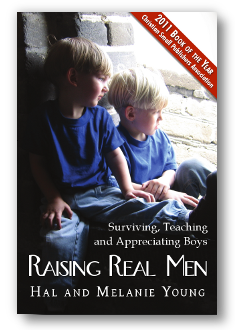 Do you wonder how to balance teaching your son to obey his parents and follow instructions, with preparing him to be a leader of a family, church, or community some day?
How do you get a well-behaved boy today, without squelching his ambition to step out and take the lead as an adult?
We spend a whole chapter on this in our book, Raising Real Men: Surviving, Teaching and Appreciating Boys. You can read a sample chapter here, or you can order your copy below – in print, audio CD, or downloadable formats!
October 10, 2015
Q&A: How Do I Get My Boys to Listen in Parking Lots?
Pamela asked on our page, “I have three crazy….er…highly spirited boys. They don’t seem to hear me or take me seriously until I yell, they’ve been disciplined for it and everything. We’re out in public a lot more now so I’m most concerned about them getting out of hand in the parking lot. How do you get wild boys to listen, the first time??”

Boys really, seriously do not hear the tones of the human voice as well as girls, so you may need to raise your voice (not yell! ) to get your guys’ attention.
Don’t feel bad about that. I remember when a friend of ours who only had girls told me that I shouldn’t speak loudly to our boys, but only whisper when I wanted their attention, so they would learn to listen for Mama’s voice. Uh, no. Utter fail. They never even knew I was speaking! Now, Hal tried that with our super-busy little girl once we had girls. Wow, she was rocketing through the room, but when she heard Daddy whisper, “Hey, let me tell you a secret,” she vectored right in and was all ears! Boys and girls are different!
Safety issues, though, require more than patience, don’t they? We always had pretty stiff rules about behavior in parking lots – they are so dangerous!

Getting out of the car: We required our guys to put a hand on the van when they got out and wait there until I got everyone else out.
Walking through parking lots: They always had to hold on to the buggy or someone’s hand while we were in the parking lot.
When they wouldn’t cooperate: If they didn’t hold on the van or cart when they were supposed to, If they didn’t, I would take their hand and put it where it belonged. If they refused to listen to me, we would pack up and go home and administer some discipline. Although that is a huge pain in the neck, you usually only have to do that once per child.
Our book, Raising Real Men, talks about all kinds of issues like this – discipline, normal behavior, how to keep from going crazy and how to raise Godly sons. Check it out here.
We’re also about to start a new online class series of Boyhood Boot Camp. This is the one that helps parents of younger boys get up to speed on all things Boy – discipline, schoolwork, media, talking about the Lord, the stuff we wish we’d known when our oldest guys were boys. Come join us!
Your friends,
Hal & Melanie
October 9, 2015
Q&A: My 16yo Won’t Grow Up! How Can I Get Him to be Responsible?
A mom asks, “My 16yo is driving me crazy! He won’t do his schoolwork. He argues with everything we say. He blames someone else for everything that happens. He’s not obeying and he’s disrespectful. If we say he can’t use the internet, he does anyway and says we don’t trust him. He just won’t grow up! It’s so hard! What do I do?”

If we were talking to this mom, it might sound like a weird question, but we’d ask, “What kind of things do you have him doing that require independence? What kind of things is he responsible for?”
Sometimes we see this kind of behavior when older teen guys are feeling constrained. They want to grow up but they are still being treated like children. The hardest part is that they tend to respond by acting *more* irresponsible, hard-headed, and childish, which makes their parents give them less independence and responsibility, which strains the relationship, and you’re on a downward spiral.
Your mileage may vary, but here’s what we’d do: We would sit him down and say, “Son, it’s time to talk reality. You’ve got two years to go before you have to be supporting yourself. What are your plans??”
Whatever he says is likely to be unrealistic at this point, but you need to take it very seriously and talk it through. You plan to get a job at _______? You do know they won’t hire someone who drops out of high school? Honey, I just can’t graduate you unless you meet basic standards! (We homeschool. If you don’t, his report cards will help out here.) Even you do graduate, let’s look at what it takes to live on around here. Is it possible to support a family on what you could make doing that?
You plan to go to college? But, son, most colleges require you to have a year beyond Algebra 2 and you’re nowhere near getting that much math done. That’s not going to work.
Don’t be snarky, be concerned. He really needs to sober up. If you take it seriously, he is more likely to do the same. You’re probably going to need to really do some research here and show him what a mess he’ll be in if he doesn’t get going.
Yeah, I know, son, you’re kind of up a tree. We’ll help you all we can, but really, you’re a man and you’ve got to decide how you’re going to take care of this part of your life. We know you want to have a wife and children one day, and we’ve seen that would be really hard on the kind of job you could get without finishing your education well.
You know what, though. You are really smart and determined and we believe you can catch up to where you need to be. Let’s make a list of what you are going to need to have accomplished in the next 24 months — you’ll be starting your senior year then. Okay, I want you to spend tomorrow coming up with a plan of how you’re going to do this. We’ll meet again tomorrow night.
You’ll need to address his attitude, but FIRST he’s got to own his life and education. At 16 years old you can no longer drag him through life, as you’ve found out. Taking responsibility for himself will help out the other problems, too, most likely.

Here’s the deal, son. We live in a household together here. I know you want to be treated like an adult. We want to do that, too.
An adult, however, is someone that takes responsibility for his own behavior. A man takes the blame he has coming, and the consequences, too, he doesn’t try to weasel out of it. A man does his duty. A man lives courteously with his family and housemates. I’m just not seeing that. I think you can do that and I expect you to do that. For one thing, I’m going to tell you just like I would any man, “You’re not going to talk to my bride that way.” I’m going to try to recognize that you will soon be on your own and treat you like an adult in this house and you are going to act like one. All right?
The next part is the most important.
You have got to show your love and delight in him, hard as it might be (men crave respect) and restore your relationship. In a couple of short years he can walk away from you. You have got to show him love, tell him what he’s doing right, enjoy him, and perhaps most importantly, listen to him. If authority doesn’t transition to trust and relationship in these next few years, you will lose the influence you have over him. A good relationship with mom and dad is the biggest predictor a kid will stay in the faith. Parenting has to change as our kids approach independent adulthood — and at that point, relationship is the most critically important thing. He knows where you stand. Show him how you care., too.
Dealing with older teens is a balancing act. We’ve got to keep our tempers when they don’t. Stay on an even keel when they’re thrashing around in a storm of emotion. Remain kind when they are ugly. We’ve got to be firm on essentials, but let them stand on their own in more and more things and eventually just about everything. It isn’t easy, but it’s very worth it. Our adult children are some of the biggest blessings in our lives.
We’ll be talking with you and your teens about taking charge of their own education and taking responsibility for their own lives in our newest online class series, PreFlight. We’re starting in a few days. Y’all join us!
Yours in the battle,
Hal & Melanie
October 8, 2015
Q&A: How Are We Supposed to Interact With Our Son’s Girlfriend?
A reader asks, “How and when do you embrace the special girl in your adult son’s life? My son is 20 and this is his first “girlfriend”. They’ve been developing this relationship for 4 months and it seems serious. We have her over periodically but don’t know when to take that next step.”

It’s a good thing when our children get to be old enough to pursue a mate! We’ve been praying for our children’s mates as long as we’ve had children. We can’t wait to meet them!
How do you know, though, how to interact when they’re “interested” — when they’re in a relationship, but it’s not permanent yet? What if it doesn’t work out? What if it does?
This is such a balancing act. Our policy is to be friendly and welcoming, just the same as we would be with one of their male friends. They’re invited to activities and we try to make them feel very welcome. After all, we’d like to meet the people who are important in our adult kids’ lives – especially if there’s more than a co-worker friendship involved.
However, we think it’s important not to act like she’s part of the family until she is – or nearly so. The truth is, every relationship doesn’t result in marriage–a successful relationship may be one where the two friends realize they’re not right for each other! So to avoid awkwardness in the future, we try to get at least a few pictures that include the special guest, and a few that don’t. An easy way to handle this is ask her to be the photographer for a few of the family snapshots.
And some events like family reunions and weddings might be better left until the couple’s engaged … to avoid awkward memories and questions from the extended family if the present relationship doesn’t work out!
If this really might be “the one,” how can you start on a good footing? There’s a lot of value in just befriending your son’s special friend. I’ve appreciated the girls’ invitations to be friends on Facebook and enjoyed it when they started conversations that allowed us to get to know one another. We moms have to be careful, though, to let the young folks take the lead – to be open and friendly, but not pushy or stalkerish! I want to have a good relationship with my son’s wife in the future!
Moms need to be careful to guard their hearts, too. It’s easy to let ourselves develop strong affection for or dislike of someone their son is considering. This has got to be their decision, ultimately, because they’ve got to live with them. Of course, we’ll share any red flags we see – and our kids are much more likely to consider them if we’re leaving them in the lead.
Also, this is a great time to be a blessing to your son in helping him think things through. Ask him sometimes, “How’s it going with this relationship? Where do you see it going next? What kind of time frame do you have in mind?” Ask him if they are studying the Bible together and encourage him to bring up the questions he’ll need to get answered before the next step.
We need to give our guys wisdom in this area without being bossy or directive, since they’re adults. We are working on something to help with that. It’s an app with conversation starters for young people in relationships. Now, this is a super-secret beta-testing preview version, and it’s not quite ready for prime time, but you guys are welcome to have your kids check it out. The earlier stages are more complete than the later ones and we’ll be adding user accounts soon, but here you go… It’s called More Than Friends! If you check it out, we’d love to hear your feedback.

One of my friends said her son told her, “Mom, you guys have done a great job teaching me how to be a husband, but I have no idea how to be a boyfriend!” Even for those who believe in a courtship model, there’s got to be some courtship going on! After all, our sons do need to win the heart of the girl they will marry. As they get more and more of their questions answered and everything looks like a green light, they need to be getting more romantic. Our guys may need some suggestions here for flowers or cards or candy. They might need you to help them think of fun, romantic things to do.
This is also a great time to encourage our guys to guard themselves and the girl they care for against sin. Talk to them about “error-likely situations” they may face – being alone too much, being tired, being together too late at night, and how to avoid them. Encourage them to discuss standards with each other and to commit to maintaining a pure relationship.
That’s a long answer to your question, but it is such an important one. Family is a key part of the process of finding a mate. We tell our guys to get to know the other family “…because if this works out, they’ll be your family, too.” Likewise, our guys have wanted us to get to know the girls they’ve been interested in, “Because I really like my family, I want someone who likes them, too!”
We’ll be talking about finding a mate and lots of other important topics to discuss with your teens in our newest online class series, PreFlight, which starts in just a few days. Come join us!
Your friend,
Melanie
October 7, 2015
Q&A: My Ten Year Old is Looking Up Sex Online! What Do I Do?
A reader writes, “I follow your page all the time. I first heard you guys speak at the homeschooling conference in North Carolina. I need HELP! I have 4 boys. I have already dealt with the introduction to porn with my first two, both were exposed to it at a Christian friend’s home. We have had protection on computers, we pay for [protection software] for the older boys’ phones and computers.
We just got a new computer and set it up. It was supposed to have a parental filter on it. I had to go out of town and had just not gotten around to testing it. My 10-year-old looked up “YouTube sex” while I was gone. I am MAD – not at him, but at Satan and this whole mess that our boys have to deal with in spite of our zealousness, that one mistake can lead to exposure.
I don’t know how to protect them. I have read several of your articles dealing with this and thought we were protecting them pretty well. TWO questions, 1. what is the best parental control I can put on the computers? 2. What do I do now to deal with this exposure? I want to help my boys.”

Sadly, this is one of the most common questions we receive. The ages of the children seem to be getting lower and lower, too.
Let’s look at your second question first: What do you do now to deal with the exposure?
You didn’t say what ages your four sons are, but it sounds like your 10-year-old may be one of the younger two – and may not have had the talk you had with his older brothers when they were exposed to porn. Obviously, it’s time to have the talk with this son, too, and maybe your fourth son as well.
On the one hand, it’s understandable if a young guy is curious about the subject. At ten years old, he is just beginning to feel the nudge of the hormones which will transition him to manhood … and that transition includes an awakening to sexual feelings and urges.
However, the world’s view of sexuality is so far astray from God’s design, we really have to teach the Biblical message intentionally to our sons. The Bible tells us that God created sex, and the love between a husband and wife is both holy and full of joy, but cutting corners and running outside God’s boundaries with our sexuality is sin – a kind which not only leads to shame and guilt, but can undermine or destroy our health, relationships, and our happiness and peace of mind, too!
We need to share Jesus’ teaching on the subject. Did Jesus ever talk about pornography? Really, this is covered in the Sermon on the Mount, when He said,
“You have heard that it was said to those of old, You shall not commit adultery.’ But I say to you that whoever looks at a woman to lust for her has already committed adultery with her in his heart.” (Matthew 5:27-28)
This is important, because we have a tendency to excuse our own sin if we think, “nobody was actually hurt” or “I didn’t actually do the act myself.” Jesus said the problem is not just the sexual act itself, but our heart’s desire or lust for sinful acts.
He needs to understand that what he’s doing is illegal – and can open the door to other sins. Your conscience can get numb if you keep acting against it. You can become accustomed to doing evil, and end up doing things you never thought you’d do.
He needs to understand that people (besides himself) actually are being hurt by the porn industry. The money that feeds the porn industry is driven by the numbers of people that watch it – that’s what sets the price for advertising and the more depraved products. Even if you don’t pay for what you watch, you’re feeding the beast — and providing demand for actors and actresses to appear in these de-humanizing videos. Anyone who watches porn shares in the victimization of the people on the screen!
That’s a lot to lay on a ten-year-old. But this is the reality of what he’s stumbled in to, and sadly, the world and the Tempter are forcing this issue on all of us. He needs to understand the basic sinfulness and danger of watching porn, at any age, but especially at his young years.
The other question is, what’s the best parental control you can install?

We have used and recommended Covenant Eyes for years. They offer filtering for younger users and accountability for older kids and adults (yes, everyone gets their own sign), and you can adjust the sensitivity for greater or lesser supervision. Plus they allow you to install the program on as many devices as you need, for the same low family price for all of you.
TRY IT FOR FREE FOR THIRTY DAYS – CANCEL AT ANY TIME
But remember, software and hardware systems are tools, not solutions. The real power lies in relationships – the vertical relationship with God and the Holy Spirit, and the horizontal relationship with parents and trusted advisors. Be sure to share the Gospel with your kids, because they need God’s grace in every part of their lives – just like we do. Yes, Christians struggle with these temptations and failures too, but the Holy Spirit works with them to become more and more Christlike as time goes on.
But be sure to build and maintain the relationship between you and your child, too. If he knows you love him, will do your best to answer his questions, and will listen before you react or judge him, he’s more likely to come to you with those questions and concerns – and that’s your chance to share Biblical wisdom and God’s love.
Yours in the battle, Hal and Melanie
Want more ideas?
Check out our resource page and our workshop, Shining Armor, to get a Biblical view of sexuality and purity as it relates to boys – of all ages
Join us for one of our popular webinar series – and get your questions answered!
Boyhood Boot Camp for parents of younger guys – new series starts October 22!
Boot Camp 9-12 for parents of pre-teen sons – recordings available now, and live series beginning in January
PreFlight for parents of teens (both boys and girls) – series starting October 13!
Sign Up or Order All Of Them Below!
October 6, 2015
Q&A: My 10-yo Threatened to Run Away!
A reader asks, “How do you deal with a child who threatens to run away from home, or if your child has done it, how did you deal with it?
I don’t know what my options are, but my 10 year old lately has been acting very immature, and when I told him to clean his room, or I would do it, it turned into this big power play. After he tried to assert himself as the boss of me, I let him know that that bedroom and everything in it was NOT his, but mine, so his response was “Well, I’ll go live somewhere else.”
I’m just not sure how to handle this. He’s not abused in any way, he’s too big for spankings, but he’s really unreasonable and stubborn when he doesn’t get his way and he likes to try and assert his power and is immature. I’m not looking for discipline advice, but for advice on how to handle this running away thing.”

This is such a challenging age! Even before you see any physical changes, the hormones which cause them are flowing and that means they are full of extreme emotions at a time that their brains are changing rapidly. The part of the brain that decides, “This is not a good idea,” the executive functions, are particularly challenged. Let me tell you how we handled that kind of thing.
First, pray for help to leave your own emotions at the foot of the cross. Kids this age can be maddening, but losing it yourself won’t help.
Then calmly say, “Let’s sit down and talk about this. Tell me what’s this all about?” and *let him talk.* Let him get it all out until he starts acting more or less rational again.
Then it’s time to give him a reality check. Explain, “I get that you are angry and you don’t think it’s fair, but threatening to run away is another thing entirely. That’s a dangerous line of thinking and I want to talk to you about that.”
Then I’d give him a very frank lesson on what generally happens to run aways. Make sure no younger children are around to be frightened. We don’t live in Mayberry anymore. Tell him you love him so much that you want him to understand that would be a horrible decision.
Then, and only then, explain, “As you know, you’ve got to have some consequences for the way you’ve behaved…” and deal it out: extra chores, losing privileges, push-ups, whatever.
If he actually does something towards running away, you need to take it more seriously still. Any child who can’t be trusted needs constant supervision for a time for their own protection. Of course, following Mom and Dad around all day gets old pretty fast, but that’s not a bad thing.

Yours in the battle,Hal and Melanie
A lot of the frustration of this age is what they are going through emotionally, mentally, and spiritually in the changes of the preteen years. It’s a critical time of parenting. So much so, we’re in the process of writing a book about it.
We also have a webinar series for parents focused entirely on this age range, called Boot Camp 9-12.
If you sign up for our newsletter, we’ll give you a 50% discount on Boot Camp 9-12!