Hal Young's Blog, page 25
March 30, 2015
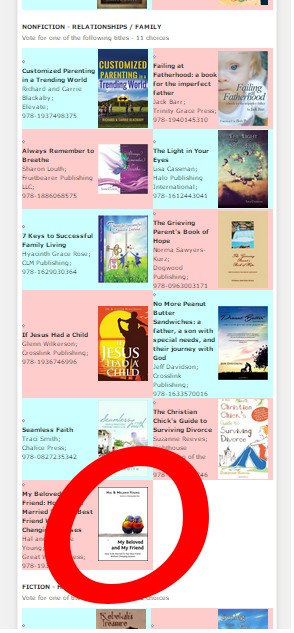
Can We Get Your Vote for My Beloved and My Friend?
 Our book on marriage, My Beloved and My Friend: How To Be Married To Your Best Friend Without Changing Spouses, is in the running for the Christian Small Publishers “Book of the Year” Award. This award is based on votes from publishers, booksellers, readers – anyone interested in promoting books from independent Christian publishers – and we’d love to get your support!
Here’s how you can help:
 1. Sign in on the voting page HERE
2. Scroll down to the Family and Relationships category – or CLICK HERE - and find My Beloved and My Friend (it’s at the bottom of the category)
3. Click on the button to make your selection, then
4. Scroll to the bottom (or CLICK HERE) and click to SUBMIT VOTES
But don’t delay – voting ends March 31! And thank you for your support!
Do you have a friend who could use a boost in their marriage? Do you have adult children who could use a well-rounded, Biblical vision of what to look for and what they can build into a relationship? Maybe you wouldn’t mind some encouragement and perspective for yourself! My Beloved and My Friend – How To Be Married To Your Best Friend Without Changing Spouses is available in paperback, audiobook, and downloadable ebook and mp3 formats, too!


March 16, 2015
Coming of Age: What Would You Say To A Young New Adult?
In our family, we believe it’s helpful to set a particular time in a young man’s life to begin transitioning him to adult roles. We talked about our reasons here, and explained who we involve in that formal time of recognition, here. (link)

We want to impress on the young man that these new expectations and opportunities he will be experiencing are common to all men, not just the notions of his parents. It’s powerful to hear wisdom from many people, not just Mom and Dad, and it’s especially powerful when you hear the truth your parents have spoken being repeated in different words from a whole community.
The ceremony can take whatever form suits your sense of propriety and style. Some families have adopted symbolic rituals much like conferring knighthood on a squire, with the traditional accolade with a long sword which is them presented to the young man. (Historically, knighthood was sometimes conferred by the monarch approaching the candidate and sounding boxing his ears. We don’t recommend this practice!) Others have long periods of preparation and study with their sons memorizing passages of Scripture or catechisms, preparing a speech or message to deliver at the ceremony.
We use a less elaborate form, focusing on words of welcome, exhortation, and encouragement to the young man. In our ceremony, we invite several men of significance to the boy’s life to prepare short presentations about what it means to be a man. These will each focus on a character trait, some wisdom which the speaker has learned; we encourage the men we invite to think, “What do you wish you had known when you were 13?”

We also encourage the men to bring an inexpensive item as an object lesson to illustrate their point. This can be a lot of fun for all concerned. Some examples we’ve seen:
= A man should be visionary, looking to the road ahead, and seeking insight where he doesn’t see it himself. The gift was a small pair of binoculars, a way for a hunter to see his quarry far off; in the same way, a man should seek ways and counselors to help him understand what lies ahead.
= A man’s gifts and skills can be used constructively, to build and to beautify useful objects. The same skills can be abused, though, and turned into destructive ends. The gift was an antique carpenter’s plane from a relative’s collection of handmade tools.
= A man should be prepared for all kinds of situations. The gift was a folding multi-tool, as an example of an easily-carried solution for many unexpected needs.
In our family, the culminating presentation is always given by Hal, encouraging our son to be a faithful student of God’s word, looking to the Bible for God’s wisdom and direction in every part of life. The gift here is a leather-bound study Bible of the sort both parents have used for years. This actually is a follow up to an earlier gift – when each of our children has learned to read, we celebrated that achievement with a large-print presentation Bible of their own. The inexpensive Bible we give then recognizes that young children can be pretty careless with their belongings; by the time they’re 13, usually the old Bible is pretty worn, and a high-quality replacement has double meaning to them!
Next: Who Should Speak To The Next Young Man?
March 8, 2015
Coming of Age: The Value of Ceremony
People often ask if we’d describe what we do for a coming-of-age ceremony with our boys. Surely with six boys we’ve done something of the sort … and the answer would be, “Yes, indeed!”

You’ve probably heard of the Jewish “Bar Mitzvah” tradition – where a Jewish boy is officially welcomed to adult status in the synagogue and the community. The term means “Son of the Law” so technically, it’s the person who’s the “bar mitzvah,” not the ceremony. But at that time, the young man is invited to play a part in the synagogue meetings, counts as one of the men for the minyan or synagogue quorum, and is responsible for his own faithfulness towards God.
We think there’s some value to this. Psychologists Joseph and Claudia Allen, in their book Escaping the Endless Adolescence, relate that many in their field are saying that the time of adolescence now continues into the early thirties, and “Twenty-five is the new fifteen.” Sadly, the level of maturity we used to see in teenagers is all that is expected of twenty-somethings today. ()
We thought it made better sense to call our sons to step up for more adult responsibility rather than settle back for an extended childhood mentality. Where the Bible speaks about “youth” and “youthfulness,” it often describes adult roles in the same context – the giant Goliath was a warrior from his youth, men are encouraged to rejoice in the wife of one’s youth, God blesses the children of one’s youth, and a missionary pastor in a pagan culture – Timothy – is counseled to not let anyone look down on his youthfulness. Being youthful doesn’t have to mean being childish and irresponsible (though there are examples of that in Scripture, too), but apparently Biblical youthfulness is a time which extends well into young adulthood.
So when our sons turn 13, we hold a ceremonial welcome to young adulthood, and throw a celebration alongside. Just like the bar mitzvah tradition, it’s a time both serious and joyful. However, as Christians we are not under law, but under grace, and since we hope that our sons are growing in the knowledge and experience of God’s grace, we call our celebration a “Bar Chanon”, or “Son of Grace” ceremony.
In keeping with that recognition of grace, not law, we have to interject here that there is no commandment to have such an observance. The Bible mentions at times that there are milestones in life and suggests that at some time, a young man should be respected as an adult and able to take on adult responsibility. But whether you observe this transition in a formal way, or choose to ignore it as an occasion, you’re at liberty – if you decide to do something to mark the occasion, you can include all kinds of things in your celebration.
NEXT: Who We Invite
Yours,
Hal & Melanie
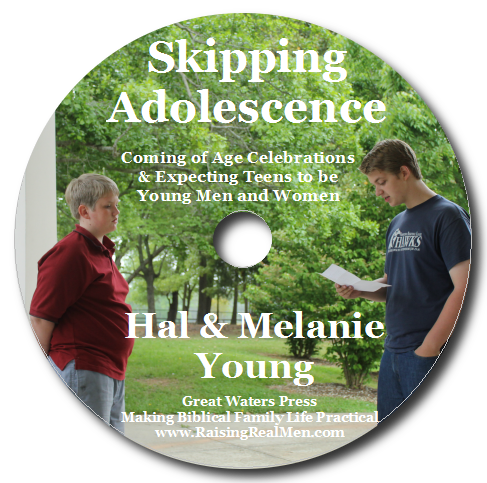 Do you have a pre-teen son? Are you looking forward to the teen years … with fear and dismay?
Or do you have a vision for something more than a sullen, rebellious, hormone-driven slacker?
You might enjoy our workshop, Skipping Adolescence! We don’t accept the conventional idea that all teenagers are simply doomed to be trouble at home and brainless abroad. This workshop session talks about creating and building a new vision for young adulthood – from recognizing the transition from childhood to something more, to dealing with low expectations, cultivating a standard of excellence, and drawing out the young man in your teenaged son. Order below and download it today!
March 6, 2015
Man Food: Pig Picking Cake
This is a super-fast, super-yummy, super-easy fancy cake. It’s called a Pig Picking Cake (or Pig Pickin’) because this is the dessert traditionally served at a Pig Picking here in Eastern North Carolina. A Pig Picking is a huge outdoor party where the main attraction is a whole pit-cooked pig (or one cooked in a cooker made out of a huge iron pipe or barrel cut in half and hinged to make the biggest grill you’ve ever seen.).
The meat is pulled off and seasoned with a peppery vinegar sauce. We eat slaw, boiled potatoes, Brunswick Stew (a spicy, tomatoey stew with veggies, chicken and pork), and corn sticks (cornbread fried in long narrow stick-shapes) or hush puppies with it. Fried chicken and fried pork skins are sometimes served, too. Sweet tea is de rigueur. Sweet tea so sweet hummingbirds will choose it over the flowers.

For dessert, you’ll often find Pig Picking Cake. It’s a citrusy, light-tasting dessert that is just perfect after barbecue. Honestly, you’ll love it and so will your guys. Here’s how to do it:
Pig Picking Cake
1 yellow cake mix
1 15oz can of mandarin oranges, don’t drain them
4 eggs
1/2 cup oil (I’ll bet coconut oil would be yummy in this. I think I’ll try it next time!)
For the topping/filling:
1/2 pint heavy whipping cream (okay, you can get 8oz of whipped topping, if you must)
1 can crushed pineapple, don’t drain this, either
1 small box of vanilla pudding mix, the instant kind
Dump the cake mix, mandarin oranges (oranges, juice or syrup and all), the eggs, and oil in a bowl and mix well. Spread in three buttered round 8″ or 9″ cake pans. Bake at 350 degrees until a straw stuck in the top comes out pretty clean. Baked goods are usually about done when you can smell them cooking.  Invert onto a plate, then invert again until top up on a plate. Let cool completely.
Whip the whipping cream (or defrost the whipped topping, but really you ought to try it with real whipped cream!). Mix the pineapple (juice and all) with the pudding mix until well mixed and beginning to thicken. Fold the whipped cream (or stuff in a tub) together with the pudding until it is one color. Spread about a fourth on the top of one layer of cake, top with another layer and repeat, top with another layer and the rest of the topping. Slice and serve. SO delicious!
This is a great dessert after any heavy meal or for a summer treat. Enjoy!
Your friends,
Hal & Melanie
March 4, 2015
Save on Hotels with Christian Hospitality Networks
We travel a lot. No, really, a LOT. As authors and speakers, we’re on the road more months than we’re home now.
We used to picture speakers as those glamorous people who flew in to the conference, stayed in the nicest rooms, and had everything taken care of. Then we became speakers. We didn’t want to leave our children behind while we flew around the country. We weren’t willing to lose our own children while helping other people to do a better job raising theirs.
Conferences, though, just aren’t going to pay for a speaker’s whole family to come, so that meant we had to make it work on our own. Forget flying, we’d drive. And driving meant a lot more time in travel. And that meant lodging along the way. Lodging we had to pay for.

Hotel rooms every night will eat up your budget pretty quickly, so we had to find an alternative. In the summer, we could throw our tents and sleeping bags in the cargo trailer and camp, but that doesn’t work so well in Indiana, Iowa, and North Dakota in March (where we’ll be this month!). Just no. This Southern blood is too thin for that.
Instead, we stay with other believers. We’re members of a couple of Christian hospitality networks that help us find families willing to host us for a night.
Sounds scary to stay with strangers? You know, not really. If there had ever been a problem with them, they would have been removed from the network.
Isn’t it embarrassing, though? Actually it’s not. If they didn’t have the gift of hospitality and enjoy welcoming new friends, well they certainly wouldn’t put their names down for something like that! Our eldest was horrified when he heard we’d be staying with people we didn’t know on a trip he took with us a while back (remember, he’s an adult, so he seldom travels with us). After staying in a few homes and seeing what a blessing it was to meet new brothers and sisters in Christ, he did an about-face and said he wanted to list his own home in the networks. It’s like visiting with friends you just haven’t met yet!
A Candle in the Window is probably our favorite network. It’s mostly Christian homeschool families and we’ve had an immediate connection with everyone we’ve stayed with. There is a $30 a year membership fee (free for missionaries or the first in a state or a country), but there is no fee when you stay with a family or have a meal with them. The network is still fairly new, so some areas do not have homes. Why not sign up? It’s a fantastic way to meet other believers and make new friends!
Mennonite Your Way isn’t just for Mennonites. Years ago, Amish and Mennonites would talk about “Mennoniting your way across the country,” as families would contact churches in each area and ask for someone to host them. Eventually, they made a directory and then other Christians discovered it. I think a Presbyterian family runs it now. It’s $30 to receive the directory, then they ask that you discreetly leave your hosts a donation (some of the families are struggling financially and it helps to cover the cost of your stay). The recommended donation is $10/adult, $2/child, and $2/meal. Even a big family will find that a lot cheaper than staying in a hotel room — and a much bigger blessing, too. Hospitality homes are most common in areas where there are many Mennonites since MYW is best known there.

But, how do you know if they can accommodate you? Each directory tells you something about the host family, such as how many people they can host and in what kind of accommodations. Often it tells you what kind of church background they have and even what they do for a living and how many children are in the home. Ultimately, though, you just contact them and ask if it’s convenient. Sometimes a certain host family will have to refuse (one we contacted was about to have surgery), but usually they welcome you with open arms.
But, really, isn’t it awkward?? Melanie is very shy (honestly!) and this is a bit of a stretch for her, but really, it is so worth it and it’s not just the money you save. We have very happy memories of the many different believing families that have hosted us – elderly couples, big homeschool families, empty nesters, young families, but every time it seemed like a divine appointment with something special God had for us and for them. Relationships require risk. If you never reach out, you won’t have the joy of making the connection.
We can’t tell you how much a blessing it is for you and your children to know Christians from all walks of life – rich and poor, Arminian and Calvinist, homeschoolers and public school teachers, people just like you and people from different cultures. When we stay in their homes and share meals together, it gives us perspective and humility.
And it’s a whole lot of fun, besides. We’ll never forget the family we stayed with in Manitoba who had built 300 meters of snow tunnels in their yard. They bundled up our children, gave them headlamps and took them for an amazing adventure in the dark! Or, the sweet family in Saskatchewan who turned out to be homeschoolers who had graduated all their children. The husband got up early that morning and went out to hunt down the traditional foods he’d eaten growing up and fixed us a very special breakfast. We’ll never forget them.
Oh, I forgot. This was supposed to be about saving money. Don’t worry, when you stay with Christian hospitality network families, you’ll save a lot of money — and you’ll enrich your lives, too.
Have you ever stayed in a Christian hospitality home? Do you know of any networks we’ve missed?
Your friends,
Hal & Melanie
February 25, 2015
Being a Boy Mom or Boy Dad!
People sometimes ask how we came to write and speak about raising boys. The answer is easy – we have six of them.
“Six boys!” the people at the checkout line say in mock horror. “Yes!” we say, and smile warmly. “Well, better you than me,” they conclude, shaking their heads. To be fair, not everyone reacts this way. Some cultures seem to place a special value on sons, like our Kenyan-born obstetrician, or the Hispanic families we meet at the store. We hear them counting quietly under their breath — “ … cuatro — cinco — seis niños!” and when Melanie turns around and confirms, “Sí, seis niños!” — nearly the total of her Spanish vocabulary — there are smiles all around.
Too often, though, we hear the negative wisecracks from our fellow Americans, and far too often, from our fellow Christians. We have a few snappy comebacks of our own if someone is remarkably crude, but usually we try to answer with grace and cheerfulness. We defend our decision to have a large family and we especially express our happiness to be the parents of many sons. The world pities us, but God says He has blessed us. Why, in the Old Testament God gave Heman fourteen sons to exalt him (1 Chronicles 25:5). We stand up to the world’s attitudes and smart remarks with confidence.
But back at home, privately, we admit to ourselves it’s not always rosy. The jokes sometimes have an element of truth to them. Yes, teenaged boys can put away a startling amount of groceries. Young boys can be downright destructive. They tend to be noisy at any age. They seem utterly unconcerned with personal hygiene. The dog has a longer attention span for schoolwork. Worse, they seem to come forth at birth with a chip on their shoulder. They are combative, aggressive, arrogant. They seem obsessed with power — whether powerful machines, powerful weapons, or personal power they can exert over people and things. They love to build things but have a perverse delight in tearing them down, and if fire and explosion come into the mix, surely boy-nirvana is close at hand. The older bullies the younger; the younger schemes to entrap the older; the middle son plays two ends against the middle for the joy of ratting out both of them. The youngest are like bantam roosters, strutting and posturing; they grow into wild bulls, crushing china, furniture, and family members without even noticing the havoc in their wake.
Or so it seems, some days.

If this is God’s chosen gift to us, and He says that it is, then why does it seem so hard?
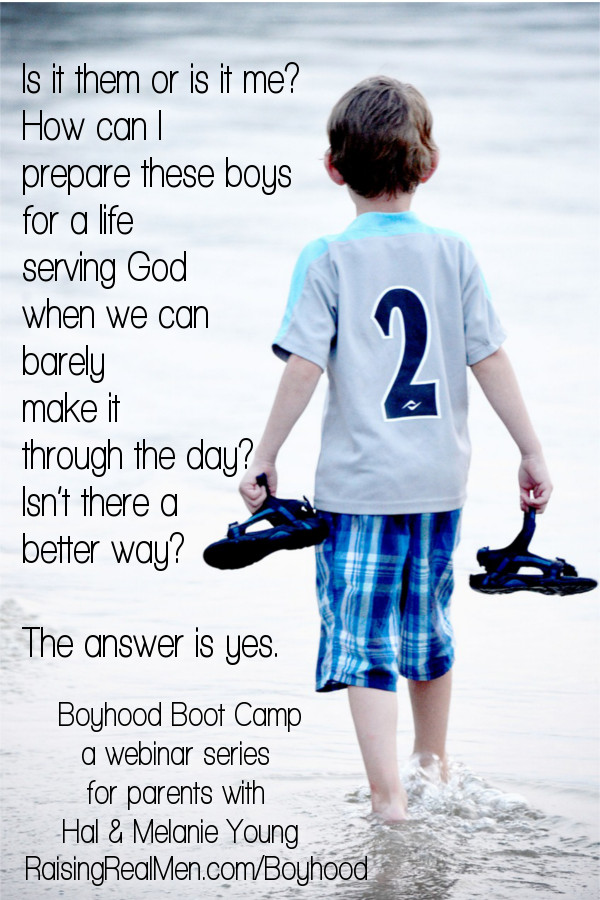
Is it them or is it me? How can I prepare these boys for a life serving God when we can barely make it through the day? Isn’t there a better way?
The answer is yes.
(From the introduction, Raising Real Men: Surviving, Teaching and Appreciating Boys)
Boys are a challenge all right, but they’re also a delight, a joy, and endless fun, we’ve found.
If this sounds familiar to you, and you’re privately struggling a bit to deal with the energy, noise, dirt, and sheer testosterone in your home, then you might appreciate Raising Real Men for practical help and real encouragement in raising and enjoying your boys! And for more personal help, we offer two online classes for parents of boys: Boyhood Boot Camp, which we’ll present live next week – and Boot Camp 9-12 – for parents of pre-teen sons who want to make the years ahead great!
CLICK HERE for more information on Boyhood Boot Camp! (and note, you get a discount on the book if you order it at the same time you sign up!)
Come laugh with us – and get practical help in raising your boys!
Your friends,
Hal & Melanie
February 19, 2015
Hey Mom! Watch This!
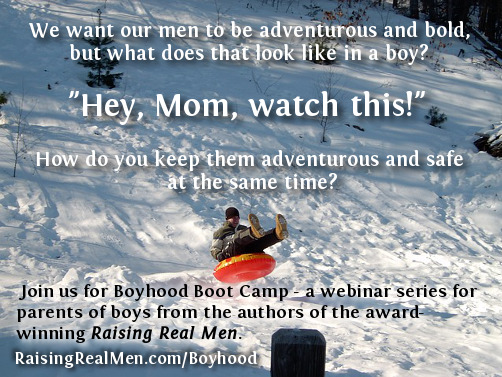 Young men have a tremendous desire to try their strength and to be tested in return. This is integral to their competitive nature, but let’s take a look at how it impacts their interaction with the real world, not the contrived world of competitions.
Adults sometimes equate a desire for adventure with immaturity and recklessness. The Bible makes a distinction and so should we. The desire to conquer, to win against the odds, to do great things — these can be admirable ambitions. The willingness to pit one’s nerve against an unsettling foe is frequently called for in Scripture: Have I not commanded you? Be strong and of good courage, is repeated six times to Joshua and Israel before initiating the conquest of Canaan. (see Deuteronomy 31 and Joshua 1, NASB) The same phrase appears in passages calling for moral courage to carry out God’s commandments or to undertake a major project (the building of the Temple!).(1 Chronicles 22:13 NASB) The righteous man is bold as a lion, and God gives His people boldness to preach the Gospel.(Proverbs 28:1, Acts 4) Paul — and all the churches of the Gentiles — say thanks to Aquila and Priscilla, “who risked their own necks for my life.” (Romans 16:4)
 On the other hand, overconfidence and rashness is soundly criticized. The Proverbs say, “He who is impulsive exalts folly…he sins who hastens with his feet.” (Proverbs 14:29, 19:2) When Satan tempted Jesus to presume on God’s protection, Christ rebuked him:
Then the devil took Him up into the holy city, set Him on the pinnacle of the temple, and said to Him, “If You are the Son of God, throw Yourself down. For it is written: ‘He shall give His angels charge over you,’ and, ‘In their hands they shall bear you up,/Lest you dash your foot against a stone.’”
Jesus said to him, “It is written again, ‘You shall not tempt the LORD your God.’” (Matthew 4:5-7)
The sin of presumption takes many forms, whether denying what God has clearly revealed, or attempting to test His patience and provision. The reckless man may be doing both; the one who is serving Him may be guilty of neither.
Without that adventurous spirit, there wouldn’t be many discoveries or inventions; few great soldiers; no great explorers. The question for us as parents is how to channel a God-given desire for adventure into productive, God-honoring endeavors, rather than let it slide into pointless, potentially self-destructive recklessness. Can we send them off with a cheer, or must it be with fear?
(from Raising Real Men, pp. 48-49)
 Do you worry about teaching your sons to take reasonable, considered risks for worthwhile goals? Or do you find your concern for their safety makes you put on the brakes – maybe more than you should? We’ll be talking about this important balance and more in Boyhood Boot Camp, starting Monday evening and running February 23, 24, 26, and 27. CLICK HERE for more information! (Plus get a discount when you order Raising Real Men at the same time!)
February 17, 2015
When Should You Get Your Kids Their Driver’s License?
 When we were teenagers, we couldn’t wait to get our driver’s license. It was a step toward adulthood, and we were eager to have the independence that driving represented. All our friends felt the same way, and our parents encouraged it.
Recently, though, we’ve been hearing something which frankly surprised us.
We were listening to a discussion of homeschool graduates in their twenties, and one mentioned matter-of-factly that when he founded his own business in a city 800 miles from home, his father had to give him a ride to his new apartment because he didn’t have a driver’s license. And we’ve heard parents saying they really didn’t think their kids needed to drive “before they’re 18 or 20,” and some who hesitate to teach their daughters to drive at all.
We don’t think this is the norm in the homeschooling community. Most of the people we’ve talked with about it have followed the traditional course – their 15- and 16-year-olds took Driver’s Ed, got their learner’s permit, and their license followed. But this course of actively discouraging young drivers is new to us.
We’ve traveled a good bit, including large cities in the U.S. and Canada, and extended periods overseas both in Europe and Asia. It’s plain that in places like New York City where parking is expensive or unavailable and public transportation is widespread, you might choose to live without a car. And it’s absolutely true that adding a young driver to your auto insurance is expensive (particularly for young men).
But we want to challenge this thinking as a rule. Like it or not, American culture is built with the assumption that adults will have personal transportation. It’s not a “love affair with the car” so much as a simple fact that when you can’t get around on your own, you’re either isolated or bound to other people’s schedules and availability.
 There are many romantic ideals about living and working in the modern day. Some yearn for the village life where church, work, friends, and commerce are just a bicycle ride from your cottage. Others dream of a day where cities are compact, neighborhoods are integrated, and safe, cheap, and frequent transport will carry us wherever we need to go if the neighborhood doesn’t provide it. And there are some families who find that sweet spot and praise God for it.
But for most of us, the ability to drive is simply a matter of necessity. The church which we believe best suited to our Christian growth is not within walking distance of our home (and nowhere near a bus stop). Grocery shopping for a family of ten would be a daily toil, walking a mile and back to the nearest store with what we could trundle home. A 15-minute trip in my own vehicle was an hour-long journey when I took the bus in our state capitol.
But how can this be managed as a practical matter?
You might object that teenagers have a high accident rate. It’s true, but data from the Insurance Institute of Highway Safety says that fatality rates peak for drivers in their early twenties; the rate for drivers aged 17-18 is nearly the same as their parents’. In other words, if you want to reduce risk by keeping your 16-year-olds off the road, you may as well make them wait till they turn thirty.
If you’re concerned about safety, though, we’d recommend starting early and giving your young driver lots of practice. The traffic fatality rate for teenaged drivers has dropped more than 70% since 1975, partly due to graduated licensing programs in place now in every state. As the supervising parents, we need to give our student drivers lots of practice, in every situation – city congestion, interstate speeds, and winding country highways. They need to drive in rain, darkness, and if it’s part of your climate, winter conditions, too. We need to be intentional about explaining our driving decisions, keeping in mind that most accidents don’t happen on the freeways but at intersections, parking lots, and neighborhood speeds. We have to teach them to anticipate conditions and other drivers’ actions (as one of our mothers said, “Watch out for the other fool!”).
Insurance costs can be managed to a degree, also. Unlicensed learners are usually covered under the supervising parent’s policy. A newly licensed driver doesn’t necessarily need his own vehicle yet. There are discounts for good students, safe drivers, and graduates of defensive driving classes. Plus if you let your agent know you’re looking at alternatives (i.e., the possibility of a different insurer), they can probably help you find their best deals possible. (It’s worth remembering if your teenager can’t drive, they may have trouble finding a job which pays enough for them to pick up their own insurance bill eventually!)
Some parents have told us their teenager “isn’t responsible enough” to drive. Our experience suggests that young people who are given responsibility to manage usually grow into the expectation. Waiting for some undefined milepost of maturity may mean a long wait.
Some have also suggested that giving their daughters the ability to drive might offend prospective husbands who prefer their brides be more bound to home. Our discussion with marriageable young men suggests a very different desire – for wives with the skills and confidence to be partners rather than mere dependents! Having the ability to drive increases one’s ability to manage a home or business effectively; possession of a cell phone or an Internet connection is likely to be a bigger distraction than a car in the driveway – for any of us. And as parents of girls ourselves, we’d be opposed to any suitor so controlling he didn’t want his wife to be able to drive.
 In our society, lack of a driver’s license will limit a person’s freedom to choose a church, minister to the needs of others, attend school, or accept employment. Discouraging, preventing, or delaying our young people from learning to drive seems to establish dependency in a time when they need to be moving toward more independence and personal accountability. Is that what our young adults need? Or should we see gaining a driver’s license as a necessary addition to the young adult’s skill set? We believe the latter!
We talked about this on our podcast, Making Biblical Family Life Practical on the Ultimate Homeschool Radio Network.
ANOTHER RESOURCE YOU MIGHT ENJOY:
Skipping Adolescence – Beat the low expectations of the teen years!
February 16, 2015
Celebrate Presidents Day with a Free Download!

Here’s a neat resource you can download for free and share with your sons in honor of Presidents Day — examples from the lives of great men who have led our country!
Several years before he became our 26th president, Theodore Roosevelt and his friend Henry Cabot Lodge wrote a collection of stories to teach character and patriotism to children. Their book Hero Tales From American History was meant
“to tell in simple fashion the story of some Americans who knew how to live and how to die; who proved their truth by their endeavor; and who joined to the stern and manly qualities … the virtues of gentleness, of patriotism, and of lofty adherence to an ideal.”
For Presidents Day, why not take a new look at the lives of our presidents?
These audio selections from our Hero Tales audiobooks have music and sound effects to engage even your youngest kids,
and we’d like to offer them to you for free:
The Life of George Washington outlines the story of his childhood in colonial Virginia, his rise to leadership through many challenges and setbacks, and the remarkable character of the man we call “The Father of His Country”
Washington and the Battle of Trenton describes how that character helped Washington turn a series of battlefield disasters into the legendary Delaware River crossing and the turning point which energized the faltering Revolution
Andrew Jackson and the Battle of New Orleans recounts how a frontier lawyer-turned-militia captain defended his country against invasion, whipped the British regulars who beat Napoleon–and gained a national reputation that led him to the White House
John Quincy Adams and the Right of Petition is a remarkable story of a true public servant, unashamed to return to Washington as a congressman after being president, whose quiet persistence on a point of order kept up pressure against the permanent acceptance of slavery.
Ulysses S. Grant at Vicksburg illustrates how a soldier who barely graduated West Point and failed at nearly every business he tried, developed the determination and focus to overcome all kinds of obstacles–and ultimately bring the Civil War to an end.
WHEN YOU CLICK SUBSCRIBE, YOU’LL BE TAKEN TO A PAGE TO DOWNLOAD YOUR FREEBIE.
… And if you like these stories as much as we did,
you can hear the rest of them in our audiobook series, Hero Tales from American History!

This set of five cds (or mp3 downloads!) will take you from the colonial era to the Civil War, and include music from the time and authentic sound effects (including historic machinery, period weapons, and actual Confederate soldiers) to make Roosevelt and Lodge even more entertaining!
CLICK HERE to find more Hero Tales from American History
or go ahead and order the whole series below!
February 13, 2015
A Question About Fifty Shades of Grey
This morning a friend asked, “Do you think I should watch Fifty Shades of Grey with my teen and talk about it?”
We’re not as strict on media as some are. We think there’s some value in watching things you don’t agree with and analyzing and discussing them with your teens. Sometimes, though, there’s more harm than good in a media choice.
We speak about purity and internet porn and we just finished the manuscript for a book for single guys about these things. In our research, we found some pretty concerning things.
There’s a disturbing change going on in our culture. Internet porn has become a huge influencer of young men. Most (really almost all) boys are exposed to porn before they’re 18. That’s bad enough. Internet porn, though, provokes a dopamine cycle (affiliate) that tempts users to seek out more and worse things in order to get the same thrill. Because of that (and the sinfulness of man, of course), perversion is everywhere out there. 88% of porn contains physical aggression. It’s even reaching young people – 23% of girls and 39% of boys have viewed sexual bondage. (Covenant Eyes Porn Stats, affiliate link)
One sad effect of all this is that there is a big disconnect between what young men of marriageable age think is a normal sexual relationship and what young women of that age do. The aggression, humiliation, and perversion of porn is affecting the expectations couples bring to marriage.

Now, we’re being invited to watch a movie that glorifies aggression, bondage, humiliation, and pain in sexuality. Is that something a Christian should do?
I hear people saying, “It’s just pretend,” but that dog won’t hunt for a Christian. The Lord says, “I say to you that whoever looks at a woman to lust for her has already committed adultery with her in his heart.” Matthew 5:28
It is wrong to pretend at sin. If rape is wrong, it is wrong for a husband to pretend to rape his wife. Fifty Shades of Grey goes beyond pretend, though.
When the book first came out, we did some research. I remember reading a scholarly article asking if the “consensual” sexual activity in the book rose to the level of domestic abuse. They concluded it did, but I learned something more. The short excerpts they included from the book upset me to the point of physical nausea. Do you really want the one who supposedly loves you the most to get off by hurting you? Really? Do we want that in our children’s marriages?
Marriage is supposed to be a picture of Christ and the Church, folks. The whole point of BDSM (bondage, domination, sado-masochism) is to inflict pain and humiliation for sexual excitement. How can we reconcile this? Would Christ inflict pain on his beloved Bride for fun? NO! Instead, he laid down His life and allowed His enemies to torture Him to death to save His Bride, His Church, from eternal death. For us to take our marriage relationship and play out evil is not right.
Satan loves to take what God created and turn it upside down. To completely reverse it. So, now we have Christian wives urging their husbands to go see this movie “to spice up their marriage.” Right. The men who are urged in Ephesians 5, “Husbands, love your wives, as Christ loved the church and gave himself up for her,” are now supposed to hurt and humiliate those wives? May it never be!

Would you take a moment and really read these verses that proceed the commands to husbands and wives in Ephesians 5?
But sexual immorality and all impurity or covetousness must not even be named among you, as is proper among saints. Let there be no filthiness nor foolish talk nor crude joking, which are out of place, but instead let there be thanksgiving. For you may be sure of this, that everyone who is sexually immoral or impure, or who is covetous (that is, an idolater), has no inheritance in the kingdom of Christ and God. Let no one deceive you with empty words, for because of these things the wrath of God comes upon the sons of disobedience. Therefore do not become partners with them; for at one time you were darkness, but now you are light in the Lord. Walk as children of light (for the fruit of light is found in all that is good and right and true), and try to discern what is pleasing to the Lord. Take no part in the unfruitful works of darkness, but instead expose them. For it is shameful even to speak of the things that they do in secret.
Seriously. It’s pretty sad that we even have to talk about this stuff. Instead of trying to hurt and humiliate one another in the marriage bed, we think even our sexual relationships should be marked by the fruit of the Spirit:
But the fruit of the Spirit is love, joy, peace, patience, kindness, goodness, faithfulness, gentleness, self-control; against such things there is no law.
That’s the kind of marriage we want to have and we want our children to have. We won’t be seeing this movie, much less watching it with our teens. Our culture is already a very long way from Biblical sexuality. Let’s not contribute to making it worse. And that doesn’t even touch how deeply we don’t want our children to think that this kind of abusive relationship is normal. Please Lord, no.
If you want to learn about making your physical relationship better in a godly way, this weekend you can download our newest workshop recording, Romance for the Exhausted, free! Just click here. And get our book, My Beloved and My Friend: How to be Married to Your Best Friend Without Changing Spouses. [Hint: Get our Marriage Retreat Online FREE when you buy the His and Hers Special of our book. Just sign up for the free workshop above to see the sale!]
Your friends,
Hal & Melanie