Hal Young's Blog, page 20
November 1, 2015
Get One of Our Webinars Free — and Other Great Homemaking Resources for Only 35 Cents Each!
I remember several years ago when we were brainstorming what to ask in the annual survey North Carolinians for Home Education asked at our annual conference.
Hal said, “Let’s ask what causes the most stress for homeschool moms. Is it teaching math? Or struggling learners? Or worries about high school? Or what?”
Melanie stared at him until he said, “What is wrong with you?”
“What stresses homeschool moms? It’s the house, Hal! No survey needed!”
Homemaking isn’t easy. It’s really not easy when you are trying to run a school and nurture a family at the same time. Now add in a home business, like many of us, and that dream of a beautiful, welcoming, restful home threatens to turn into a nightmare.
And that’s why our friends Erin and Stephanie created the Ultimate Homemaking Bundle… because as rewarding as it is, homemaking is hard work and it doesn’t always come easily.
I can’t wait to tell you all about it! We like it so much, we’re going to give you a HUGE bonus just to help you tip the scales in favor of getting it…

To help you nurture the beauty and productivity in your home and family relationships with proven, simple, and effective tools that really give you a boost as a homemaker – help, inspiration, tips, encouragement, resources at your fingertips…
… the Ultimate Homemaking Bundle is BACK FOR JUST TWO DAYS just for you.
It is a complete library of carefully selected eBooks, eCourses, audios, online conferences, and printable packs designed to help you turn your house into a home… without all the overwhelming part.
 >
>
What’s in the Ultimate Homemaking Bundle?
The first step in putting together this collection was to find the critical homemaking skills that you need to transform your house into a home.
Here they are:
Cleaning… create a healthy, toxin-free home
DIY/Homemade… fun and frugal ways to express your personal style
Devotionals and Faith… take a break from the daily grind to renew yourself
Finances… build a budget that works
Cooking & Meal Planning… serve easier, tastier meals in less time
Holidays & Special Events… brighten up old family traditions and create new
Homeschooling… homeschool with grace and ease
Marriage… heat up your marriage
Motherhood… find peace, balance & joy in mothering
Organizing… conquer the clutter and simplify your life
Pregnancy & Babies… enjoy a healthy pregnancy and prepare to nurture your baby
Health & Wellness… soothe aches & pains with natural remedies
Working from Home… hone your talents, live your passions and earn money to help your family
Look at all this!
















… a complete library of 86 eBooks and eCourses to help you nurture the beauty and productivity in your home and family relationships.

Overwhelmed by how many books there are in the Ultimate Homemaking Bundle?
Have you ever taken your family out for a buffet… and then been disappointed when you couldn’t eat every single morsel on display?
Well, yeah, sometimes, but I still enjoy the buffet!
There’s that first, wonderful moment when you see and hear and smell the amazing meal spread before you… and you think, “Where will I even start?”
But that’s the thing… because you do start… with something.
Maybe it’s a tender flaky biscuit, or a piece of delicious roast beef, or maybe you start with a piece of pie (mmm, blueberry or apple with whipped cream)?
So relax, enjoy, and start anywhere you like. Come back to the Ultimate Homemaking Bundle “buffet” as many times as you like. It’s all here for you.
Is the Ultimate Homemaking Bundle worth it?
In a word… yes! For one thing, just the bonus we’re going to give you — plus our book that is included in the Bundle comes to a value of $42, more than you are spending on the Bundle!
To be absolutely certain, Erin and Stephanie asked questions, tried techniques and just about drove themselves crazy making sure that the Ultimate Homemaking Bundle was the very best homemaking resource anywhere.
They dug through hundreds of websites and connected with dozens of authors and teachers.
And then we all worked together to make these resources the most affordable possible.
And They Were Delighted to Help…
The result? This collection is a fraction of the price of what someone would pay for each resource individually!
For a short time, you can get the Ultimate Homemaking Bundle… a complete library of tons of carefully selected resources designed to help you nurture the beauty and productivity in your home and family relationships… is only $29.97. (A total value of $913!!.)
That breaks down to less than 35 cents per book.
Your 30-Day 100% Satisfaction Guarantee
If for any reason, you decide that the Ultimate Homemaking Bundle is not for you, then please send an email to customerservice@Ultimate-Bundles.com and we will refund 100% of your investment. No questions asked.
Don’t Forget the Bonuses…
Of course, no Ultimate Homemaking Bundle would be complete without the generous, inspiring gifts donated by companies that understand homemakers like you. Every gift is yours to keep and enjoy.
Choose 1 FREE Online Class from Craftsy (Select from 24 of Their Most Popular Classes – Up to $60 Value) My daughter loved this one!!
1 FREE Kids Discovery Box from Green Kid Crafts ($19.95 Value) Our youngest loved this one!!
FREE $15 Credit to Hope Ink PLUS 2 FREE 8×10 Art Prints ($71 Value)
FREE $80 Healthy Moving Class Credit ($80 Value)
FREE 90-Day Pro Membership to ListPlanIt ($30 Value)
FREE 65 Tyndale Rewards Points to Be Used for a FREE Book or Towards Any Book of Your Choice ($15 Value)
PLUS When You Use Our Link, You Get Something More!
If you buy the Bundle through us, we’ll give you one Free Registration to either our Boyhood Boot Camp, a webinar series for parents of boys,

or Marriage Retreat Online, the only Marriage Retreat you don’t need a babysitter for!

or, PreFlight, our online class for teens and their parents, to help them get ready for the launch into life!

That’s a value of $32-39! With our book, My Beloved and My Friend, which is included in the Bundle, you get up to $49 worth of resources JUST FROM US! That’s more than you pay for the Bundle!

Once you’ve purchased the Bundle, come back and click here so we can register you for your free webinar series!

Now It’s Your Turn
I think Laura Ingalls Wilder said it best…
“Just as a little thread of gold, running through a fabric, brightens the whole garment, so women’s work at home, while only the doing of little things, is just like the golden gleam of sunlight that runs through and brightens the whole fabric of civilization.”
The proven, simple, and effective skills you need to transform your house into a home are all waiting for you in the Ultimate Homemaking Bundle.
This is your chance to get a bunch of love, support, guidance and inspiration you need to nurture the beauty and productivity in your home and family relationships with proven, simple, and effective tools that really give you a boost as a homemaker.
But time is running out! The Ultimate Homemaking Bundle will be available FOR THE LAST TIME from Midnight EST on Monday morning, November 2nd until 11:59 p.m. EST on Tuesday, November 3rd.
After that, the shopping cart closes and the deeply discounted price is gone.
Act now!
Click here for more info or to buy now.

Best wishes and happy homemaking!
Read the fine print about this bundle and read the answers to frequently asked questions about the bundle.
When you buy the Bundle through our link, we earn a commission that helps us keep going. Thank you for supporting our ministry!
Hal & Melanie
Don’t forget to come back and register for Boyhood Boot Camp or Marriage Retreat Online! Just click here.


October 31, 2015
Q&A: Are Violent Video Games Ever Appropriate?
Video games are wildly popular among young men – the Pew Research Center found that 84% of teenage boys play video games on a computer, game console, or portable device, and one survey found that 60% of daily gamers spend an hour or more every day. Two-thirds of teenage gamers say they play games with “considerable violence” at least some of the time. [source]
Not all of the popular games are trouble – our kids have enjoyed many with historical themes, educational games, or simply entertaining fun. But what about games with realistic action, a level of violence, and even first-person shooter situations? If you do allow video gaming, how do you discern what’s appropriate and what’s not for your son?

Every family has to make its own decision about video gaming – whether to even allow it at all, or what guidelines and guard rails to put around it. For our part, we do allow our sons some limited play of video games, with some restrictions on the more violent sort. Here are some of the questions we ask ourselves at each point:
Is the game’s scenario sinful at the core? Some popular games encourage and even reward players who take illegal or immoral actions (We wrote about them here). We don’t allow these in the house! But we believe there is a righteous, God-honoring use of force, too – for example, in law enforcement, military service, or even hunting to provide food. Games which simulate these kind of actions may be “first person shooter” games yet not be objectionable.
You may need to clarify your own convictions first. We’ve talked with parents who said “Violence is always evil” – until someone suggested that a policeman who responds to a home-invasion or an armed robbery comes ready to do violence if necessary to protect innocent victims. If you believe and teach a strict pacifist or non-violent view of force, then the military games will be inconsistent with your family’s values. If you believe there is a Biblical place for a Christian solider or a Christian law enforcement officer, then it might be appropriate for your young men to be thinking and role-playing these things (and a great opportunity to talk about God’s expectations in those roles). [footnote]
(If you don’t have a clue which games are which because you aren’t into gaming yourself, a helpful resource is the game review page on Plugged In )
How old are the players? These high action, realistic games are better reserved for young men (at least 13 and up) and not younger boys who have a more difficult time separating game and life. Our rules for these sort of games are similar to our rules about what movies we let our children watch – but more cautious, because the player is a participant and not just an observer!
How often and how much are they playing? Of course gaming can get out of hand, whether it’s a super-dramatic military game or a million quarters of fantasy football. It’s like any hobby or pastime – we try to train our sons to distinguish between work time and leisure time. But the participation level in the more exciting games can greatly increase the release of adrenaline and testosterone in our boys’ bodies. Frequent or long-lasting play is likely to end up with extremely irritable, aggressive and hyper boys … not good! Balance play on video games with hard, active, physical work or strenuous outdoor play.
Are they playing online? Be cautious about games played against unknown opponents online. Chat and video sharing are common in the online games and they can be an influence on your boys without your knowledge – often in an ungodly way. We tell our younger guys to meet up with friends from real life, if they want to play as a group. We’ve let our older sons connect online, but with some warnings and discussions about hazards there.
Can they (will they) stand apart from their online identity? One trap of intense gaming is the ability to re-create yourself in a role-playing situation. Some guys immerse themselves in their imaginary world so deeply they end up seeking attention and affirmation from their gaming community (a group of online identities which are likely as made-up as their own). They may avoid real life, real people, and real endeavors; schoolwork suffers, relationships suffer, and worse, they may begin violating their conscience with gameplay decisions they think are “just pretend, so they don’t count.” (Proverbs 10:23 applies here … )
Consider how you can regulate access. We really don’t want our guys to become habitual gamers (and they can truly become addictive!) so there needs to be some parental control in place. When a relative passed on his game console to our boys, we hit on the idea of keeping the setup at their grandmother’s house. That way, it’s a treat and not a daily distraction to them (it also gives them some entertainment when they go visit). An accountability package like Covenant Eyes not only watches for inappropriate content, it also lets you track if someone is spending too much time online or on certain websites.

At the end of the day, there can be a place for video gaming, the same as there’s room for sports, crafts, music, and other activities. There may even be room for dramatic or violent situations in gaming – especially when we consider our 15- or 16-year-old may be just a few years from starting a career which involves such drama! But be sure we’re teaching our kids – by example as well as word – how to exercise discernment in our entertainment decisions, and to keep all things in balance as faithful stewards of our time and attention.
Of course, if you have boys of any age you probably have asked how do you deal with the normal aggressiveness of boys? It’s not because of video games, it seems to be their natural temperament. Even when parents are uncomfortable about toy weapons and rough play, we see that boys will often seek it out or invent them on their own! (“My son nibbles his sandwich into a gun shape!” one mother complained to us) We talk about this at length in chapter 4 of our popular book, Raising Real Men – if you’re wondering about this whole issue, why not check it out yourself?
In Christ
Hal and Melanie
Footnotes:
[ 84% are gamers] http://www.pewinternet.org/2015/04/09...
[ Hours and violence] http://www.pewinternet.org/2008/09/16...
[ Christians in military or similar roles] Matthew 8:5-13, Luke 3:14, Acts 10, Romans 13:1-7
October 30, 2015
Q&A: My 16-Year-Old Wants to Be in a Relationship! What Do I Do?
Q. My wife wants to invite a nineteen year old young man over for dinner. He works with my sixteen year old daughter and brought her flowers last week. We’ve briefly talked about his interest. She came to Christ last year and she’s a good girl, but I’m just not comfortable with this – I don’t think she’s old enough or mature enough! What should we do?
They grow up fast, don’t they? It can be pretty alarming to suddenly be dealing with grown up situations like this when it seemed like just the other day they were carefree children.

There are several ways to handle a situation like this one:
You can just throw up your hands and let the relationship develop, and hope for the best. You already said you aren’t comfortable with that!
Or you can go all authoritarian and just forbid it. This might work if they were 15 and 12, but they’re not — and even if your daughter isn’t mature enough to get married yet, she’s old enough to think it might work. She’s only a couple of years from being old enough to marry without your approval, too.
And since she’s working with him, she’s going to be seeing him, often, without you being there.
Clearly, whatever course you decide, you’ve got to get her on board or you might create a situation where she’s hiding and sneaking … and that’s dangerous.
We’d recommend a middle course – one that will preserve your relationship with your daughter, but protect her, too.
If he’s bringing her flowers, there is no doubt that he’s desiring a romantic relationship and you need to have much more than a brief talk with your daughter. Right off the bat, you’ll need to find out her level of interest and what kind of relationship they already have (things may be farther along than you know!).
Then you need to share your concerns with her and talk it through. A useful thing to do with kids that want to leap into a relationship, but are still a little too young for that to be a good idea, is to take them very seriously and walk through it with them.
It might look like this:
“Okay, honey, so you think this guy might be the one? Let’s talk about how that would work.
“What are your plans for after high school? Are you planning to go to college? What about him?
“When do you think you’d be ready to be a wife and mother?
“What is he doing for a living? How much does he make? Okay, let’s look at what it takes to live around here …
“You could work, too? Better not plan on that. You might have difficult pregnancies or you might figure out — like many new mothers do — that you just can’t leave your baby in a daycare.”
You get the picture. Give her some reality therapy. Help her to realize she’s probably not all that close to being ready for marriage, but that’s what romance is about, that’s what it’s for! And it will give her a framework to think about future relationships for herself.
Their work situation offers one additional complication — what if the relationship develops into romance (with or without your agreement), and then doesn’t work out? Will your daughter feel awkward going to work around her ex-boyfriend? That might be a question to discuss if it looks like they’re going to become a couple.
We’ve been privileged to speak to thousands of parents and teens and answer their questions. In our experience, though it’s tempting to just go authoritarian, if you don’t win your older teen to your side, you are courting disaster. She’s not eleven any more. In a couple of years, she can just walk away from you. Build the relationship between the two of you and she’s much more likely to do what you hope she will.
Your friends,
Hal & Melanie
October 29, 2015
A Better October 31st
Q: So what is Reformation Day and why do you celebrate it?
We were delighted to find out that Christians have been celebrating Reformation Day as a holiday since at least 1567! As parents of six boys, we’ve loved having a holiday to remember a true Christian hero — a man who faced death and by that, opened the door for many to find life!
As a law student walking through the woods, young Martin Luther was alarmed by the onset of a large thunderstorm around him. Taking a bolt of lightning as a warning from God, he left his university and became a monk in the Augustinian order, but he did not find the peace he sought in that service. His restless search for peace with God led him to a doctorate in theology, then a professorship with the tiny University of Wittenberg in German Saxony. It was there, in his study of the Bible, that he was struck with the truth, “The just shall live by faith.” (Romans 1:17) He realized that all his works could not save him. Only what Christ did on the cross could pay the price for his sins!
 Luther became very concerned about certain abuses in the medieval Catholic Church, and the young theologian decided to challenge other scholars to debate a number of the practices he questioned. On October 31, 1517, he nailed the notice to the door of the university church, a common practice since the broad heavy doors were routinely used as bulletin boards. He chose that date, the Eve of All Saints’ Day (“All Hallows’ Eve”), to post his challenge because the next day a church festival would attract many of the scholars he wanted to discuss these things with.
Thanks to the fairly recent spread of the printing press, “The 95 Theses” (Luther’s list of debate propositions) quickly spread across Germany and then Europe, lighting a firestorm of controversy. Luther, thinking to provoke debate among academic scholars, incidentally drew the wrath of Pope Leo X and the Holy Roman Emperor Charles V as well!
The Emperor called him before the Imperial Diet at the town of Worms* and challenged Luther to withdraw his proposals and repudiate his writings. Everyone couldn’t help but think of the Czech reformer, Jan Hus, who had made many of the same propositions decades earlier — and was burned at the stake!

Luther begged for time to consider the Emperor’s demand. After spending a sleepless night in anxious prayer, he responded the next morning:
Since then Your Majesty and your lordships desire a simple reply, I will answer without horns and without teeth. Unless I am convinced by Scripture and plain reason–I do not accept the authority of popes and councils, for they have contradicted each other–my conscience is captive to the Word of God. I cannot and I will not recant anything, for to go against conscience is neither right nor safe.
Here I stand. I cannot do otherwise. God help me. Amen.
He knew what had happened to others who called for a return to grace and the Scriptures. Nevertheless, Luther stared death in the face and took his stand on the word of God – regardless of Pope or Emperor.
While a safe conduct agreement protected him in Worms, the Emperor placed Luther under his ban as an outlaw. By Charles’ decree, Luther faced
…confiscation and loss of body and belongings and all goods, fixed and movable, half of which will go to the Lord, and the other half to the accusers and denouncers. With other punishments as given more fully in the present edict and mandate.


This says loss of body! That’s called martyrdom. That’s what he faced. Among other things.
What an incredible, gutsy thing to do. It’s one of our favorite events in history.
What was Luther’s philosophy that put him in such conflict with the Church of the day? One way to summarize it is called the Five Solas:
Sola Scriptura – Scripture Alone
Solus Christus – Christ Alone
Sola Gratia – Grace Alone
Sola Fide – Faith Alone
Soli Deo Gloria – The Glory of God Alone
All five doctrines flowed out of Luther’s realization of the meaning of “the just shall live by faith.”
For by grace you have been saved through faith, and that not of yourselves; it is the gift of God, not of works, lest anyone should boast. Ephesians 2:8-9
Here at the Youngs’, we love Reformation Day (October 31). It’s a fantastic time to teach our children about some real heroes, the fathers of our faith. It’s a time to speak about salvation by grace, through faith in the substitutionary death of Jesus Christ. Because Jesus fully embodied both natures, God and man, He was infinite in holiness and had no sins of his own to die for, but voluntarily died to take the punishment due to his people for their sins. They deserved death, but their judge stepped down from the bench to pay the penalty in their place. What a rich, deep truth!
On Reformation Day, we eat German or Swiss, often bratwurst or knockwurst, sauerkraut and hot German potato salad, and watch Martin Luther, a terrific B&W movie starring Niall MacGinnis as the reformer. The movie was filmed at the actual location of some events, and they did a great job finding actors who actually looked like Luther, Charles, and Pope Leo. And the scene at Worms is classic! You’ll want to cheer!
(The Martin Luther movie we love is available from several places, and is now available streaming from (affiliate link) Amazon.)
During breaks we love to sing hymns of the Reformation.
A Mighty Fortress is Our God was written by Martin Luther himself.
Now Thank We All Our God, was written by a Lutheran pastor during the Thirty Years War of the Reformation. After a dreadful siege that saw him officiating at 50 funerals a day, this ringing anthem of thanksgiving celebrates the lifting of the siege.
We Gather Together was composed after a victory in the battle between the Reformed population of the Netherlands and the armies of Spain, whose General Alva had brutally slaughtered Protestant men, women, and children as heretics
And we have candy, too … we play “Pin the Theses on the Wittenberg Door.” We draw big ornate wooden doors on brown paper and label each panel with a different treat. We use Post-it(TM) notes for the Theses. Everybody gets a prize! (and for once, the boys don’t mind if there’s no ultimate winner, as long as they get lots of candy!)
Our friends get into it, too. One year friends of ours snuck up in the middle of the night and taped a copy of the Theses on our door with a bag of candy and a sign, “You’ve been nailed!”
Take the time to celebrate the heroes of the faith. Our guys need those examples!
*I’ve always loved thinking about “The Diet of Worms,” but to be fair, it’s pronounced “Vorms” in German.
Your friends,
Hal & Melanie
Christmas is coming and we’re planning some fantastic new character-building gifts! Get on our newsletter list to hear about them first and get the best prices!
Sign up below!
October 28, 2015
Q&A Do You Do Halloween? It’s Just Pretend, Right?
Readers ask us, “Do you guys celebrate Halloween?”
We had a lot of discussion about this when we were first married. We went back and forth between the fun we’d had as kids and the opportunity to perhaps share the gospel with neighbors who came to the door, and our discomfort with the whole celebration of gruesomeness Halloween was.
Many Christians we know find themselves torn, too.

Our friends who do celebrate Halloween tell us, “It’s just pretend. Ease up!” and “I give the neighbor kids really good candy and tracts.” Lately we’re hearing, “It’s a day to mock the devil and death. It celebrates that they have no power over us.” We’re not convinced.
Throughout Scripture, “just pretend” doesn’t cut it. It’s about our heart as much as our actions. Proverbs 26:18-19 says, “Like a madman who throws firebrands, arrows, and death is the man who deceives his neighbor and says, “I am only joking!” In the New Testament, the Lord assures us that merely looking at a woman lustfully is committing adultery in your heart, and hating your brother makes you a murderer at heart. We don’t think you should play at sin.
Although the Lord can use a tract handed out at Halloween, we think it’s more likely to cause resentment than repentance in unbelievers. That sort of evangelism isn’t in any sort of relationship context, and it’s not really appropriate to the situation. When we build a relationship with those around us, they can see our love and concern for them and know we’re not trying to add a scalp to our church belt. They know us enough to understand we’re sharing the most important thing in the world with them.
We’d rather lift up Christ than put down His enemy. Though we appreciate the boldness of our friends that say they are mocking the devil on Halloween, Luke 10:20 tells us, “Nevertheless, do not rejoice in this, that the spirits are subject to you, but rejoice that your names are written in heaven.” It doesn’t seem like “mocking the devil” is what we’re supposed to be doing.

Besides, the world doesn’t seem to be mocking these things as much as reveling in them. Demons, horrors, and death are not something to celebrate. Christ conquered sin and death, we don’t think they are things to celebrate.
Surely we can agree that Halloween, just across the culture, seems to be getting worse and worse, too. It’s not the same holiday we remember from childhood. Increasingly, it’s an adult holiday (representing over $2 billion spent in the U.S. each Halloween) and costumes are more and more troubling, with naughty nurse and sexy schoolgirl costumes even for young children.
Now, that’s scary!
Sure, it’s fun to dress up in costumes and eat candy, but those things aren’t limited to Halloween. Kids do love costumes (we talk about why here), so we shop online costume stores for fun things for our kids’ dress up boxes. The post-Halloween season is a great time to get good prices, too.
And we have our own celebration on October 31st, too. We celebrate a holiday older than Halloween – Reformation Day. It commemorates the day Martin Luther nailed the 95 Theses to the door of Wittenberg Cathedral. It was the start of the Protestant Reformation – October 31, 1517 – but we’ll tell you more about that tomorrow!
Want more? You might enjoy these other posts on similar topics:
Boo to All That! – Is the scary stuff real or not and does it matter?
Somebody’s Behind the Mask – Why do boys like to dress up so much?
Q: My Six Year Old is Obsessed with Spooky Things – Why and what do I do?
Your friends,
Hal & Melanie
October 27, 2015
The Write Time for A Novel Idea
 We’ve always found boys like a challenge and some competition — who’s fastest, strongest, and scores the most points. Here’s a program which plays right into that trait: See how much you can write in a month.
Several years ago I ran across a peculiar little project. The National Novel Writing Month is a tongue-in-cheek challenge to everyone who has an idea for a story: take the month of November and see if you can pour out 50,000 words.
The sponsors of “NaNoWriMo”, as they call, it say the first job of a writer is writing, and most people get stuck at the first blank page. The challenge is meant to break that mental log jam, knowing very well that the result will be just an eruption of uncorrected, first draft material. The goal is not to write well, but to write a lot. Once you have something on paper, then you can decide to edit and revise it, or declare victory and move on.
Fifty thousand is the grown-up target. For comparison, both our books, Raising Real Men and My Beloved and My Friend, ended up with something over 60,000 words, which makes a 250-page paperback when it’s properly typeset and published. If you’re not in the habit of counting, a single-spaced page is about 500 words, which means 50,000 will print out something like a hundred pages.
Just think – if you could write just three and a half pages a day, you’d reach 50,000 words with two days off for Thanksgiving!
But for younger writers, NaNoWriMo has a student competition which encourages the young person to set a more reachable goal–remembering that great literature like The Old Man and The Sea and The Great Gatsby were both about 25,000 words. Every novel doesn’t end up like War and Peace or The Lord of the Rings.
We have friends who take part in NaNoWriMo every year, cranking out a new story every season. A couple of my sons tried it one year, including one who had struggled with writing for years but produced a 24,000 word story in that burst of creativity. So why not give it a try? You may surprised at the result!

In Christ,
Hal
 Don’t think your young person can write something worthwhile? Let us introduce you to an award winning young novelist who started her first novel when she was thirteen!
Hope Auer’s debut novel A Cry From Egypt is an exciting story of faith, love, danger, and deliverance, in a Hebrew family in the days leading up to the Exodus. It’s Biblical, realistic, and you’ll come away with a new appreciation for the hand of God in the life of His people – and the kind of faith it took for them to trust Him when they couldn’t read the end of the story! Named Book of the Year by the Christian Small Publishers Association – and now part of three different curriculum programs!
And the sequel, A Stand At Sinai, will take you from the banks of the Red Sea to the foot of Mount Sinai – and the turning point in the life of the nation! Find out more, or order yours (below) now!
Q&A: Why Do My Boys (And My Husband) Like Such Dumb Entertainment?
It’s one of those mysteries between the sexes – what makes our choices of entertainment so different?
Wives and mothers shake their heads over boys’ choices of movies, videos, books, and so on. To their thinking, so much of it is just stupid. And it’s not simply childishness – dads and husbands are laughing too.
Why is there such a thing as “guy humor”?

Some “guy humor,” I think, is simply regressive behavior — “I’ll make digestive noises if I feel like it!” You know the sort. And some is nothing more than flirting with (or diving into) indecency — we don’t make a defense for that.
But for the innocent stupid stuff which seems to perplex wives and mothers, I have a theory. I think its humor, at least to males, comes from the roles men are expected to play.
For instance, before we consider comedy, consider the other sort of entertainment that attracts guys. What do guys seem to gravitate toward? What seems to be aimed at a male mindset?
How about action movies? Westerns, law-and-order shows, sci-fi thrillers, and adventure. There are common themes to all of these – power, for one. Courage. Determination. Men like to watch stories of strong men taking decisive action. Superhero movies, the Star Wars saga, war movies, movies about voyages and exploration – they all focus on men placed in dangerous and threatening situations, then rising to the occasion with courage, strength, and boldness. Sometimes it’s a coming-of-age or discovery situation, where the weakling at the beginning finds unexpected strength and virtue at the climax. Sometimes it’s a redemption story, where the bad guy is brought to repentance and reformation. There are all kinds of strength and courage, after all!
Consider that the courageous, selfless, disciplined use of strength is something praised by Scripture. Think of how the Old Testament praises the righteous courage of young David confronting the giant; lists the mighty men who served under David’s command; holds up the zeal of Daniel, Shadrach, Meshach, and Abednigo in Babylon; and the apostle Paul even tells the church in Corinth, “Be watchful, stand firm in the faith, act like men, be strong.” (1 Corinthians 16:13, ESV – footnote here).
That sort of strength and courage (both physical and moral courage) is not exclusive to men, but it’s characteristic of the best men.
But what about the admittedly dumb sort of guy humor? I think it may be from another aspect of our maleness in this fallen world.
What happened when Adam turned away from God’s commandment and brought all of Creation down to a state of brokenness?
Then to Adam He [God] said, “Because you have heeded the voice of your wife, and have eaten from the tree of which I commanded you, saying, ‘You shall not eat of it’:
“Cursed is the ground for your sake;
In toil you shall eat of it
All the days of your life.
Both thorns and thistles it shall bring forth for you,
And you shall eat the herb of the field.
In the sweat of your face you shall eat bread
Till you return to the ground,
For out of it you were taken;
For dust you are,
And to dust you shall return.”
(Genesis 3:17-19 NKJV)
Part of the curse for Adam and every son of Adam, is that the unavoidable, necessary work which occupies so much of a man’s daily life will be marked by toil, suffering, and frustration. He is called to work, to create, to provide for his family and others, and yet because of sin, it’s become a struggle rather than a simple joy. He’ll work hard for the basic needs of life, but too often it will be unproductive, the earth with yield unusable fruit, and in one sense, it will consume him in the end. (That’s hard stuff, but sin is that bad … and worse.) The Bible talks much about futility in our fallen world – and we all experience it!
 And just as men are attracted to movies about brave men who wield strength and power – because one day, each of us hopes to be hero-material ourselves – it could be that men identify with the dumb comedies because the daily business of life is seldom heroic but frequently absurd. Who hasn’t worked at a job that surrounded him with incompetent co-workers, malevolent petty-tyrant bosses, tools which fail, pipes which rupture, and unexpected jets of steam which inflate our clothing? (Well, maybe not so much the latter – not since I left the paper mill.)
Someone said we laugh because otherwise we’d have to cry. And the stupid comedies which show the idiot coping with ridiculous situations, or the one smart guy dumped into a world of dummies, or the arrogant blowhard who gets the pie-in-the-face treatment or falls into the septic tank or eats the hot peppers by mistake … these absurdities may just be projections of the frustrating life that every man has to engage.
One day, there will be no more slapstick – because there will be no more conflict, no more frustration, no more incompetence! There may be coconut creme pies, that’s possible, but we’ll have better manners then. For now, though, the dumb comedies remind us not to take ourselves too seriously–after all, there are banana peels all around.

In Christ
Hal
Footnote: Different translations render this differently – the KJV, ESV, and NASB all read the word andrizomai as “act like or behave like men,” while the NKJV says “be brave” and the NIV and RSV say “be courageous.” My limited knowledge of Greek suggests that since it is a verb which comes from a noun for “man” (aner) it may be fair to think of it as a call to “man up”!
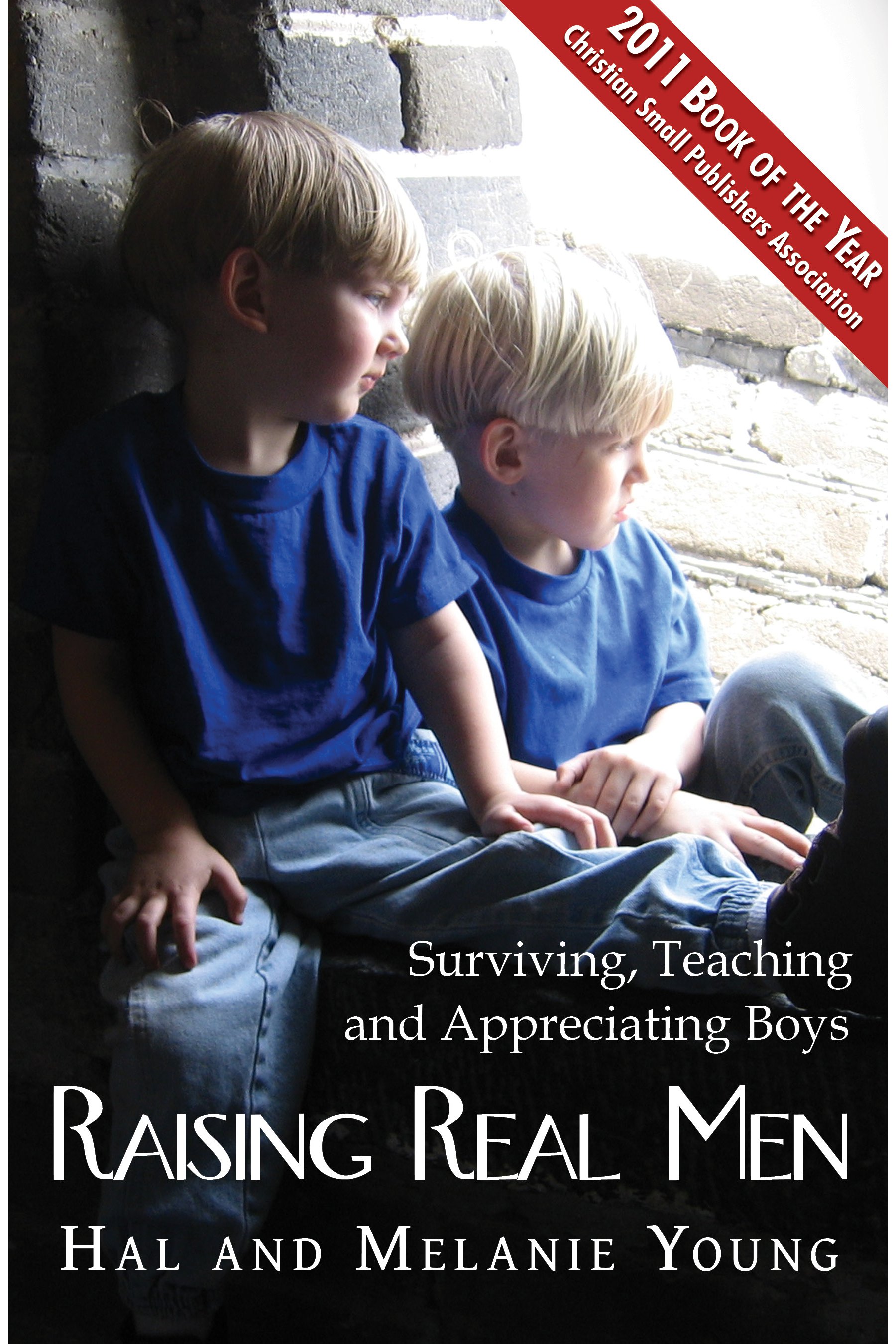 What part does heroism, adventure, and ambition play in your son’s life? Is there a serious side of play? Are you comfortable with the competitive, rough-and-tumble world your boys naturally inhabit? And even if you get it, are you comfortable explaining it to others? We think there are Biblical reasons for all of these things, and we start from Biblical principles and examples and take them to practical application for modern families. Check out a sample chapter or go ahead and order your own copy of our award-winning book, Raising Real Men — see below!
October 24, 2015
Q&A: What About A Boy Who’s A Slowpoke?
Erin asked a great question on our Open Wall Friday post, “One of our sons (almost 6) is a “slow-ski”. He is far from the youngest and always the last to put on his shoes, coat, come to the table, walk into the grocery store, keep up with the group, get out of the van or buckle up. This doesn’t come from inability. Nagging and encouragement when he’s not the last isn’t helping the situation, and we would love to motivate him to do his best to show some initiative here. It gets to the point of danger when he’s always lagging behind our large group in parking lots and crossing streets, and we have to divert our attention to calling out his name to keep on task. Any thoughts or advice?”

This is one of those personality quirks which can irritate others to the point of explosion! We answered another question about an older son who didn’t manage his time well as a young adult. This sort of slowness goes beyond simple appointment keeping – it’s a whole lifestyle slowed to a crawl!
What is he gaining by being slow? Is he simply distracted and daydreaming? Is it a desire to move at his own pace, regardless of other people? Is he trying to gain attention in some way? Or is a sort of passive aggression? Understanding the reason doesn’t mean ignoring or excusing the behavior — but it may give you some ideas how to deal with it!
Remove any obstacles which might be enabling this behavior. Be sure if there’s a deadline or departure time, it’s clearly communicated to him in particular – with eye contact and calling him by name! You know by now he either doesn’t notice when he needs to speed up … or he doesn’t care. Don’t give him the excuse that he doesn’t know!
Give him real-life consequences. We arrived at church one summer morning to find one of our leaders walking in with his family — with one pre-teen son in dress clothes but totally barefoot. His dad shrugged and said, “He didn’t put his shoes away and couldn’t find them at the last minute, and we told him, ‘Too bad, it’s time for the family to leave now — Get in the van!'”
You might look for opportunities where his slowness costs him something. If dragging his feet means he doesn’t get to go to a movie, or misses a trip to the library or the mall with the family, or something like that – sometimes that will start to wake him up. We’ve had to be careful, though, that our discipline of our own children doesn’t cause trouble for other families – for example, when a team or project meeting is depending on him being there, even if he’s late!
Do what you have to do to keep him and the family safe. Your parking lot illustration is a good example – if he’s as distracted as he is slow, he’s a danger to himself. And you’re right, if you’re responsible for a whole group, the extra attention needed to keep up with him could take your eyes off the risks to the rest. You
Sometimes slowness comes from too-perfectionism. When I was learning cursive in in the second grade, I took great pride in how perfectly my letters were formed. When I got to third grade, though, I started losing points on my grade because I wrote too slowly to finish the exercises! One of our family friends complained that she couldn’t cook with her adult son–a newly qualified doctor–because he chopped vegetables with a surgeon’s precision–slowly. Perfectionism is a tricky thing because of course we want to do good work – but sometimes, the need is not “perfection” but “performance.” We need to teach our kids to judge when it’s important to be super-exact, and when it’s better to be “good enough” – and finished on time!

Challenge him to a little more hustle – and reward it. When our sons reach middle school, they often become very distracted and slow-as-Christmas with their schoolwork. We discovered that putting a timer on their work helped them focus … and made a bit of a game of it. You can offer some small incentive, a gummi bear maybe, if he beats his previous best time – whether it’s finishing a math worksheet, or taking out the trash, or getting dressed and downstairs for breakfast.
Keep in mind that sometimes we get too impatient over a child who’s too slow. There is such a thing as temperament, and while some of us are very relaxed, others are very compulsive. We shouldn’t mistake our over-reaction for something which is only the child’s problem! But eventually we all have to work with all kinds of people, whether it means we personally need to step lively … or slow the pace a bit. But it’s best to learn the self-control and social awareness to be able to choose the tempo which is appropriate for the situation!

In Christ,
Hal and Melanie
Do you get the Raising Real Men News & Update? Our weekly newsletter will keep you informed, entertained, and encouraged about teaching and appreciating your sons — and let you know about members-only deals and discounts on great things for your whole family!
Plus if you sign up with this link, we’ll give your our popular workshop which can give you new insights about what makes your son tick – the reasons God made him that way – and how you can become a more effective (and joyful) parent of boys. And it’s free!
October 22, 2015
Q&A: My Two-Year-Old is Bright, Busy, and Destructive
A friend on Facebook said,
“My 2-yr old son is driving me insane with his destructive behavior (mainly out of curiosity and inventiveness). He’s very bright and physically and verbally advanced. But I’m losing my mind. Spanking doesn’t seem to help since he repeats messing with everything and breaking things. … I can not reason with him.

Boys have a natural curiosity about their world, linked with a desire to control it and change it, and a self-confidence which frequently doesn’t match their ability or good judgment! Ask us how we know!
It’s harder when it’s a first child. Someone told us years ago that it’s easier owning two dogs than owning one, because they entertain each other. We found that’s true with both dogs and children — a lonely child will look to the nearest parent for entertainment, or get busy with the nearest objects … usually with undesirable results. If you’re in that situation, don’t feel bad if you feel a bit overwhelmed!
The first concern is keeping him safe – and protecting other people! Obviously you need the house baby-proofed. If you have an active little boy, that means more than you might expect; we had one who actually climbed a six-foot step ladder to grab a wet paint roller which we thought was safely out of reach!
Discipline has to be consistent and persistent. Just be patient; you’ll have to repeat the lesson frequently with such a young one.
Here are some other ideas to help you both cope:
Try to get him involved in what you’re doing. Folding clothes? Give him a washcloth or hand towel and show him how to fold it. Putting away the dishes? Show him where to put the spoons, then hand him one at a time to put away. Look up suppliers for Montessori schools – they have lots of child-size brooms, garden tools, and more!
Get him more advanced toys than you think. Try toy tools, diecast cars, building blocks (ours loved the maple “schoolhouse” blocks — and the cardboard “bricks” that can be stacked and knocked over harmlessly)
Give him scenarios to pretend and play with. We found one of our two-year-olds playing “library,” using a box for a counter, talking with imaginary patrons, and “scanning” a book he’d found … just like he’d watched when we all went to the public library. Suggest games he can pretend from things he’s seen – “Can you build me a bookshelf like Daddy did for Mommy?”

Choose when and where he can burn off energy. You know he’s full of zoom — why not let him rip in a place and time you choose, instead of trying to calm him down all day? When we used to travel with our young boys, we’d schedule stops at rest areas and roadside parks with lots of grass – then let them run! There’s a reason for recess in first grade … you can do it at home, too.
Don’t underestimate the value of naps. Sure, they’re great for worn-out mommies, but an overtired toddler gets more frantic before he conks out. Our young guys got afternoon naps until they were four — and a well-rested boy is more manageable, trust us!
If you’re a mom, whether your toddler is your first child or your twelfth, we’ve got a couple of resources that you’ll appreciate – our workshops “Homeschooled From the Beginning,” about a gentle, relaxed approach for introducing your little ones to the joy of learning – and “Homeschooling a Houseful,” about how a mom (Melanie, actually!) can teach six grades at once – with a toddler in the room, too! Yes, really! Just give us your email below and we’ll give you those two workshops and our weekly Raising Real Men News & Update – for free!
It’s a busy time to be a parent, but it’s not forever. As Melanie says, the days are long but the years are short!

In Christ
Hal and Melanie
October 19, 2015
Q&A: How Do I Cope With My Really Emotional Boy?
“My son, who is 9, seems so sad all the time, keeps to himself, cries a lot, even when we try to do stuff he likes or stuff he asks. He can’t seem to think of anything to do by himself, but gets upset when his brother bosses him around. So, he’s bored, I’m at a loss with him.”

Emotions are complex things to deal with – they are both matters of the spirit and things with a physical component, too. Our feelings are related to different chemicals in the brain and body, and the balance of those chemicals can change for many different reasons. We might be alarmed or startled by some external event and feel a rush of adrenaline that makes us feel agitated, alert, and irritable. We might be feeling the same things from too much coffee! Or we might feel blue and depressed because of the death of a friend or the loss of a job, seriously sad events, but then some people feel that way from a lack of sunlight or a dietary deficiency.
That means sometimes we can’t point to a reason for a feeling, even though we feel it very strongly anyway.
When you said “9-year-old,” that immediately brings up something we’ve seen over and over again: the hormonal roller coaster of puberty. Nobody told us that boys get “hormonal” but after six of them we know, they really, really do. One minute they’re angry at the world and ready to fight it all, and twenty minutes later they’re weepy and sad.
In the earliest days of adolescence, long before you see outward signs of development (voice cracking, the start of facial hair, and a growth spurt, for instance), the hormones which cause those changes start to flow. The challenge is that they don’t seem to start gradually and ramp up smoothly — they seem to come in spurts and pulses, and that causes all kinds of mood swings. We joke about this as the boys’ PMS – Pre-Manhood Syndrome – that lasts about two years instead of a week.
The best thing for this sort of emotion is for you, the parent, to remain very calm. Think of your son as a sailor in a rowboat, tossed by rough waves; he needs a rock to anchor on, but sometimes the waves are crashing him against the rock and he thinks the rock is the problem. We find with our guys that when they go into an emotional churn, if we take a breath and keep our peace, their emo storm tends to run itself out. We can be a point of stability when their lives seem very confusing and upside down.
Boys seem to run toward anger and aggression during this time, but swing back toward sadness and dejection between the peaks. Some swing harder to the anger side, others swing harder toward the depression, but it’s important to remember than every emotion doesn’t have an immediate cause other than the chemistry boiling inside.
Sometimes you can help the chemistry without resorting to medication. We find a tendency to depression in our own family, and we all feel better when we get enough omega-3 fats in our diet. The easy way for us is just to take fish oil capsules once a day. We seem to concentrate better, too.
You might also look at a little extra vitamin D, or extra time out in the sun (without a heavy coating of sunscreen!) — a shortage of D lowers your immune system and it can affect your moods.
Encourage some perspective. It might be helpful to talk through situations and fears he may have. Emotions can overwhelm our logical thoughts, and if someone we trust can come along side and help us think again, the feelings may settle down. This last week I took our girls out on the beach at night; the youngest, a six-year-old, was very uneasy about walking in the unfamiliar darkness, but I held her hand, let her be a little clingy, and kept talking about how safe she was with Daddy, and how beautiful the stars and the waves were. After a while, she began to notice things on her own, and she was much happier at the end than she was at the beginning!
Help him understand that there may be a better way to behave than breaking down. Boys who cry easily often get bullied, which only makes them feel more sadness. It’s said that courage means doing the right thing even when you feel fear. If you feel sad but you try to “be brave,” sometimes it helps drive away the blue feelings — and it may prevent unkind people from treating you badly.
And even if there’s reason to feel sad, there are different ways to express it. Every parent knows the difference between a baby’s cries – there’s a difference between “I’m crying because I’m hurt and can’t help myself,” and “I’m crying because I’m MAD and want your attention!” If it’s attention he needs, show him better ways to ask for it.
Don’t automatically rule out something causing his feelings. Even dramatic kids who seem to be emotional all the time, occasionally have a good reason to be upset. Ask him to describe if something is worrying him, or if someone is treating him badly, or if he’s sick or hurt in some way.

The feelings are real even if he doesn’t know why he feels them. You can show sympathy because he really does feel sad, while asking questions to see whether there’s something wrong – or to encourage him to see there’s nobody making him feel that way. The good news is that lacking some ongoing cause – persistent bullying, a clinical level of depression, or some medical imbalance – you can expect your 9-year-old will get through this stage and seem like a very different young man soon.
In Christ
Hal and Melanie
Do you have real feelings of being the center of a whirlwind of emotional boyhood? Are you grappling with his rage and regret, back and forth? And by the way, his schoolwork is suddenly problematic, and he’s suddenly asking questions that are very uncomfortable to discuss? Then you need to check out Boot Camp 9-12, our intensive online program to help parents of pre-teen sons understand their rapidly-changing boys – and become more confident, effective parents for them! CLICK HERE to read more!
Live sessions start January 5 but you can get the pre-recorded version NOW.
 We talk about this at more length on episode 101 of our podcast,
Making Biblical Family Life Practical
on the Ultimate Homeschool Radio Network