Hal Young's Blog, page 16
March 31, 2016
Bullied Into Buying: Grownup Peer Pressure
Homeschooling allowed us to raise kids that were not peer-dominated, not bullied, not searching for affirmation and validation from every direction. Hooray! The problem is, we parents were not raised that way, and guess what? Often we’re the ones with peer group problems.
How Does This Happen?
One of the great doctrines of the New Testament is the grace of God and our freedom from bondage to the Law. From the very beginning, it seems, God’s people feel a pull to go back to Egypt – the slavery they knew that doesn’t require maturity, thought, discernment, or courage. God doesn’t want us to walk that way.
But God recognizes that there can be different convictions between sincere believers. Romans 14 (RTWT) talks about disputes between believers over issues like food and holiday observances – and rather than taking sides, Paul warns us against it –
Who are you to judge another’s servant? To his own master he stands or falls. Indeed, he will be made to stand, for God is able to make him stand. … But why do you judge your brother? Or why do you show contempt for your brother? For we shall all stand before the judgment seat of Christ. … [Each] of us shall give account of himself to God. Therefore let us not judge one another any more, but rather resolve this, not to put a stumbling block or a cause to fall in our brother’s way.
(Romans 14:4, 10, 12-13 – NKJV)
So if God warns us not to get judgmental over things which are directly mentioned in Scripture, why get that way over things which aren’t?
Beware the Perfect Curriculum
Our homeschool program is a case in point. It’s good to share experiences with different books and resources, but we always need to remember that our kids are not your kids, and our kids’ teacher is not your kids’ either. Our boys, for example, have always been active, outgoing, and noisy; we used a grammar program with lots of chanting, singing, and hand-waving, and got good results. We have friends whose children are entirely opposite – quiet, introverted, even shy. A program that gave great results with our boisterous crowd would be like punishment for those kids. The “best” curriculum for the quiet family will likely be different than the best one for ours – and that’s okay.
And that’s doubly true for bigger programs, like co-ops and organized classes, or an overall philosophy for teaching and learning. We’ve seen families so intimidated by a glossy program or a detailed scope and sequence, they will go into financial bondage rather than miss out on supposed benefits. It may be unschooling, it may be tightly structured classical education classes, it may be anything in between – either is permissible, neither is commanded – so don’t let someone else’s experience and agenda tie you into a situation which might not be best for your family.
Lifestyle questions are still troublemakers
The church in the 1st century had controversies and arguments over dietary choices, modesty in dress, the role of women, observance of holidays, and circumcision.
But after two thousand years “not under law, but under grace,” the homeschooling movement in the 21st century has controversies over … umm … dietary choices, modesty in dress, the role of women, observance of holidays, and circumcision.
Those are worthwhile things to discuss, and it’s good to have convictions about them. But we need to remember that convictions for me are not commandments for you. What’s more, matters which wise and Godly people have debated for literal millennia are probably not going to be “proved” one way or another in our local church or support group. Let’s stop pretending that they are, and where Scripture is silent or unclear, give each other grace to hold our own beliefs in peace.
We used to be in a support group, years ago, that held to some pretty strict views about some of these things. We had friends whose kids went down waterslides in blue jeans, and daughters went swimming in long denim skirts. Maybe they didn’t care for that style, and maybe they realized that it was interfering with good things they wanted to do … but maybe they were afraid people would talk if they broke the custom.
And the list can go on … anyone have an opinion about vaccination? Or breastfeeding? Or non-GMO food? Or essential oils?
Don’t be bullied one way or another – look at Scripture, consult wise counsel, pray over it, and decide what God would direct – or at least, permit – for your particular family!
…for the Kingdom of God is not eating and drinking, but righteousness and peace and joy in the Holy Spirit … Therefore let us pursue the things which make for peace and the things by which one may edify another.
(Romans 14:17, 19 – NKJV)
CLICK HERE to listen to the Making Biblical Family Life Practical podcast !

Yours in Christ,Hal and Melanie
 Are you looking for advice on curriculum? No pressure here! Melanie’s introductory Field Guide to Curriculum: Approaches and Choices is a one-hour workshop walking you through the different popular teaching and learning styles, with an eye toward finding materials that work for your family — not somebody else’s! Newly recorded at the 2016 Homeschoolers of Maine convention, this will encourage and enlighten anyone considering a new direction for their kid’s education!


March 24, 2016
Motivating Your Kids
One of the frequent questions we get asked is how to get kids motivated. How do you get them out of bed, off the couch, and taking care of their responsibilities?
The negative answer is obvious, and most of us have probably said something like this, one time or another:
“You can’t get on the computer until you finish your math.”
“No, you’re not going to the movie with your friends – not until you’ve done your chores!”
“I’m fixing ham and eggs for breakfast, but if you don’t get out of bed and downstairs right now, it’s toast for you!”
That’s the hard reality of life – when you have a responsibility or assignment, your duty needs to come before your pleasure or your comfort. And we all have a tendency to shirk when we can; consider that part of the judgment for Adam’s sin was increasing the difficulty, discomfort, and general drudgery of our daily work (Genesis 3:17-19). Our children need to learn to embrace their work even when they don’t feel like it – just like we should!
But “motivation” isn’t just about warnings and punishment. There are some other things which you might consider, to make a more positive approach to encouraging your kids’ work habits.
Are they disorganized? Face it, when you tell your 8-year-old “Go clean your room,” often it’s a daunting task. When your stuff looks like a tornado hit a thrift store, where do you even start? Suggest a way to make the task simpler. “Why don’t you get all the books up on the shelves first, then get the dirty clothes in the hamper? That will go quickly, and after that, you can sort the toys back into their sets and boxes.”
Even better, pitch in and work alongside them, at least to get them started. It’s a great time to talk, too.
Are they disheartened? Sometimes you have a task that seems so awkward and unpleasant, you procrastinate. After a couple of delays, it becomes a big, ugly monster – and even harder to get started.
We read a motto somewhere that said, “Eat a live frog first thing in the morning, and the rest of the day will be an improvement.” Is there something on your list that you really, really wish would go away? Then consider doing that thing first, absolutely first – and then it will be done and things really will seem brighter.
Are they distracted? Productivity expert David Allen recommends that whenever you look at your to-do list, ask yourself, “Can I finish this item in two minutes?” If so, then go ahead! And if not, don’t just put it back on the list – decide when to do it, and put it on your schedule. In fact, sometimes our desire to dodge the job takes longer than just doing it. “Son, you just spent longer arguing with me than it would take to actually carry out the trash like I asked. That’s not efficient, you know!”
There are lots of reasons your son or daughter may seem unmotivated. Sometimes, if it’s truly disobedience or defiance, you may need to give some negative consequences. But there are a lot of reasons your child may have trouble getting started, and honestly, some of them are the same reasons we struggle with! We talk about these things and how you can press through them to help your guy “get off your seat and on your feet!” on this week’s podcast. Listen here.
Your friends,
Hal & Melanie
For more on getting your guys to be diligent, read our award-winning book, Raising Real Men!
March 17, 2016
St. Patrick’s Day Celebration Guide
We’re not Catholic or Irish, but we love to have fun and we find that celebrating holidays with a little fun is a great way to drive home character lessons to our children and to teach them history, too. If you want to have some fun today learning about St. Patrick and the Irish, here’s a little help…
Who was St. Patrick anyway?
Patrick was a Britain-born teen when he was captured and enslaved by Irish traders. Made to work long hours out in the fields by himself, he turned to the Lord for comfort and became a Christian. He had learned the gospel as a young man raised in the faith. After six years in captivity, he managed to escape and return to Britain. About a year later, he had a dream that he was being called back to Ireland – this time as a missionary. He set out to study to become a priest and eventually made it back to Ireland. He was not the first to bring Christianity to Ireland, though there is no doubt the Lord used him to convert thousands of Irish from pagan druidism to Christianity.
What else can we learn?
Here are some great topics to research that are connected to St. Patrick and Ireland:
What was Patrick’s real name? Who gave him the name Patrick and why?
What’s a Celtic cross?
Learn at least part of Patrick’s poem, St. Patrick’s Breastplate. It starts “Christ before me…”
What is the Irish Potato Famine? How did it affect American history?
Why are so many people of Irish heritage, policemen and firemen in the Northeast?
Who was St. Columba?
Why is green associated with St. Patrick? Why is green associated with Catholics and orange with Protestants?
Read G.A. Henty’s book, Friends Though Divided or Orange and Green for historical fiction set in Ireland.
What to have for dinner?
We skip the beer so many have on St. Patrick’s Day. Parties with beer are a very recent tradition. In fact, until the late 20th century, pubs were closed by law on St. Paddy’s Day in Ireland! Besides, drunken revelry doesn’t seem a very good way to celebrate a Christian missionary’s life, does it?
Instead, let’s have some traditional Irish food! We love Irish food around here. It’s hearty and meaty, two of our boys’ top criteria for good food. We usually have Corned Beef and Cabbage and Irish Soda Bread. Here are links to 23 different Irish dinners so you can pick your favorites!

Irish Potato Bread
Irish Colcannon Soup
Guinness and Beef Stew
Corned Beef and Cabbage Bites Recipe
Irish Soda Bread
Corned Beef, Cabbage and Dubliner Pizza
Irish Corned Beef and Cabbage Recipe
Irish Dublin Coddle Crock Pot Version
Irish Coffee Muffins Recipe
Recipe for 100% Whole Wheat Brown Irish Soda Bread
Guinness Beef Stew
One Pot Irish Beef Stew
Irish Lamb Stew Recipe
Guinness Bread
Guinness-braised Brats and Broccoli-topped Baked Potatoes
Mini Shepherd’s Pies in Muffin Tins Recipe
Irish Colcannon
Guinness Lamb Stew
Easy Corned Beef Recipe
Pressure Cooker Corned Beef with Creamy Horseradish Sauce
Irish Stew with Irish Soda Bread {Crock Pot}
Corned Beef and Cabbage
Shepherd’s Pie with Lamb
I want to try them all!
What else can we do for fun?
Listen to Star of the County Down.
Make these super-cute exclusive St. Patrick’s Day gift boxes and tuck some treats in them! Sign up for our encouraging newsletter and you can download the pattern right away!

March 11, 2016
Young Messiah: Not for His Young Followers!
A movie based on the life of Jesus as a child? Sounds like a fun, sweet family outing for the Easter season, especially since reviews say the movie represents Jesus as the virgin-born Son of God. Our friends, Steve and Jane Lambert of Five in a Row, though, saw it last night and came away very concerned that it was inappropriate for young children. We asked them to share with you:
Young Messiah’s theme centers around the struggles of Mary and Joseph in knowing how to explain to Jesus that he was God. That’s the story in a nutshell and it DOES present some interesting opportunities for imaginative supposition: Sort of mental chewing gum. The acting, costumes and cinematography are in a vastly different class from most contemporary “Christian movies” if I may use that term. But the wild conjectures about Jesus raising the dead and performing many other miracles as a child along with the graphic attempts to show the violence of Roman occupation via dozens of crucifixions begins to wear thin rather quickly.

Where the movie takes a decidedly darker, non-family-friendly turn is with the depictions of King Herod Antipas and his court, along with the creepy/disturbing interactions with Lucifer. While it’s probably impossible to overstate either of those themes (Lucifer IS creepy/disturbing and Antipas was a perverted maniac) the depictions will cause most children and many adults nightmares. The court of Herod Antipas is repeatedly and graphically portrayed as a perverted, satanic, insane asylum with grotesque creatures surrounding a sadistic, sexually-obsessed emperor. Meanwhile, Lucifer repeatedly interacts with the movie’s characters in a way that may well haunt children’s dreams for years. Reminiscent of a Stanley Kubrick film at times, the attempts to depict depravity and evil move far beyond “family fare” and border on bizarro-porn.
As adults, some might be able to watch the film and while it will be disturbing, it may provide the basis for some interesting and thoughtful discussions about what could have happened during the 30 years of Jesus’ life that is largely undocumented. But my concern is that many will assume this would make a great “family” experience during the Easter season. NOTHING could be further from the truth.
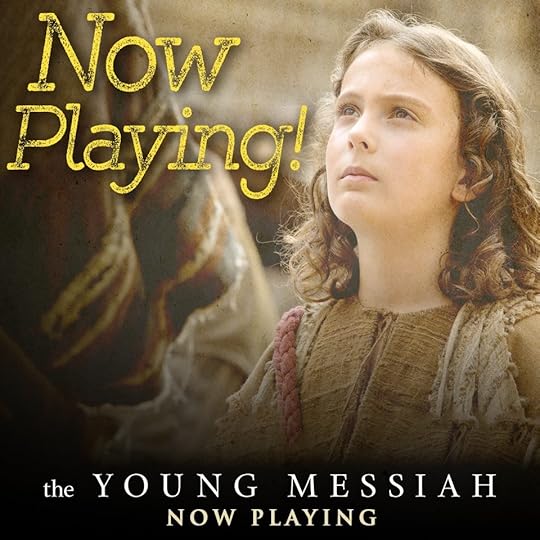
Jane and I kept nudging one another throughout the movie as each disturbing scene unfolded and each grand-leap of Biblical truth was portrayed until the final credits rolled. When it was revealed that the screenplay was based on a novel by gothic/horror/erotica-porn author Anne Rice we gasped simultaneously! Suddenly it ALL made sense. What COULD HAVE BEEN a thought provoking film about Jesus’ childhood came off as a mash-up of “Jesus of Nazareth” with “Interview With a Vampire” and “Clockwork Orange”.
I was VERY excited to see it based on the previews, but came away concerned for any children that might be exposed to the movie by unsuspecting parents.
Not recommended for children and young teens.

Steve Lambert
Publisher, Five in a Row
Young Messiah photos courtesy of Focus Features.
Steve Lambert photo courtesy of Steve Lambert
March 8, 2016
Welcome to Rough House!
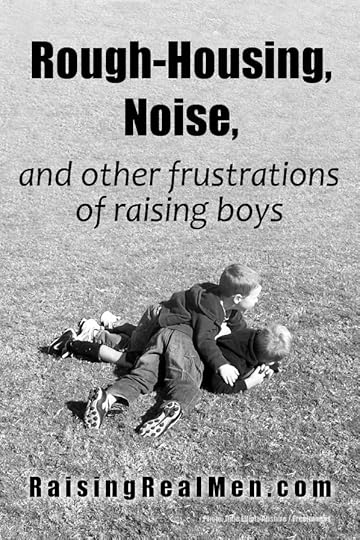

We have six boys (some of them grown now), and back when they were little, Melanie got a surprise.
When we lived in Louisiana, we had good family friends who moved from their home near Baton Rouge to Jackson, Mississippi, a good two hours away. Not long after, we were traveling back to visit our family in the Carolinas and made the slight detour to see them again. We pulled up in their driveway; the door of our station wagon opened and our eldest son, about five years old at the time, jumped out. His friend emerged from the house at about the same time. They met in the front yard and the conversation went something like this:
“Hi, John!”
“Hi, Peter!”
“Aarrgh!”
“Rrrr!”
And they locked arms and rolled in the grass, trying to pin one another to the ground. Both mothers, stunned, circled around them saying, “Boys! Boys!” The fathers, on the other hand, ignored this behavior as perfectly normal. [ * ]
Is this normal? Yes it is! Boys are made to become men. Their roles as grown-ups include working to support themselves and serve others, and that may mean hard labor, dangerous jobs, military or police service, and other situations that require physical toughness. They feel a satisfaction in testing their growing strength even if they don’t win every time (consider Psalm 19:5, describing how a strong man rejoices to run his course). Some rough-and-tumble exercise is appropriate behavior for young boys, just as more physical sports like football and lacrosse encourage a more disciplined physicality.
Is it appropriate for Christians? Actually, we think it is—with certain reservations. The Puritan theologian William Perkins wrote a remarkable passage on a biblical view of sports and entertainment, and among the recreation he recommends are wrestling, fencing, and shooting sports. (We talk about this in more length in our book.)
Research suggests that moms have a hard time with this! Writing for Psychology Today, Dr. Eileen Kennedy-Moore cites a study which showed subjects a series of videos of boys wrestling. Is it a fight, or are they just playing? Children ages eight and eleven got it right 85% of the time. Adult men, and adult women who had brothers growing up, could tell the difference 70% of the time. Adult women who didn’t have brothers, identified nearly every scene as a real fight. (RTWT)
How Do You Manage Rough Play?
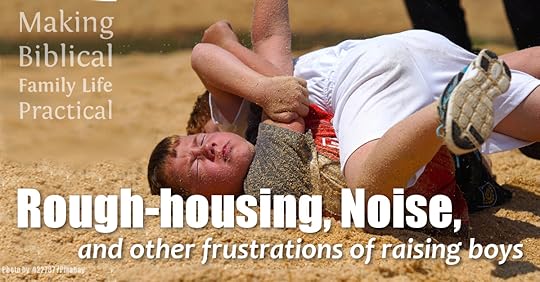
We don’t allow bullying – you know it when you see it. Big boys and small boys can wrestle and play physically without it becoming a demeaning thing – otherwise, how can fathers play with their toddlers? Learning to be physical without being overwhelming or brutal is an important life skill for a young man.
We have a “knock it off” rule – if they’re wrestling and someone calls “Knock it off,” they stop whatever they’re doing and check for problems. If they don’t, then it’s bullying.
We don’t play at sin. That’s foolish (Proverbs 14:9). Wrestling and physical competition are okay, but don’t pretend to be doing evil – we all have enough practice of sin without inventing games to rehearse it.
We also don’t allow boys and girls to mix it up. Even when they’re of similar size and strength, it’s not a good thing for either one. We know that high school wrestling is often co-ed in certain weight classes, but consider this angle – is it good to train our boys to overpower girls against their resistance? Really? Instead, it’s a cardinal rule for guys in our family, “You don’t fight girls, you protect them. Always treat them with gentleness.” We don’t want our girls to learn to expect the other treatment, either. (Read more here)
It’s appropriate to take it outside—especially as they get bigger. We’ve actually had to replace a couple of pieces of furniture.
If you don’t know, really know, then ask—”Is everybody having fun?” Are they smiling? Are they taking turns or repeating the contest? There are clues if you know where to look—and then, ask if you’re still not sure.
Sometimes it’s alarming, sometimes it’s hard on the clothing or the furniture, but it’s normal – maybe it’s time to clear some space and cheer it on!

In Christ,
Hal and Melanie
We talk about this and a lot more in our book (chapter 4 on rough play and chapter 6 on competition!) If you’d like your own copy today, why not order the downloadable version and start reading in minutes?
March 5, 2016
Sweet Rewards
The other day, a college president called our boy.
That boy. The one I wondered if I’d ever be able to teach him enough to fill out an application to work in fast food.
It all started when he was small. I was pretty confident when we started teaching him. His older brothers all learned to read early and well. I knew he was just as smart as they were. He seemed to be brilliant, even.
Somehow, though, he couldn’t seem to get it. He struggled to learn the alphabet at all. Some days he would sound a word out easily and I’d think, “Yes! We’re making progress.” The next day, looking at the same word, it was like he’d never seen the letters before.
I thought it must be the curriculum, so we tried another. And another. And another. He complained his head hurt or his stomach hurt when we did school. I thought he was just old-soldiering. I didn’t know that was common in dyslexia.
When he was finally diagnosed, we actually both felt a lot better. He was smart, he just had a learning glitch to overcome. We started using Dianne Craft’s materials to address those glitches and though there wasn’t any immediate change, we persisted — and that’s the year he learned to read! He was eleven.
It was exciting, but there seemed to be such a long road ahead. We’d worked hard to keep him up to speed with audiobooks and reading aloud, but to be just learning to read in middle school, and not being able to write at all at that point, was downright frightening. How could we prepare him for life??

I didn’t take into account the pure grit in our son and the pure grace of God. By the time he was 13 he was reading on a college level and beginning to write. His curiosity and drive took over from there. He just took off in learning.
And the other day, a college president called our son.
“The professors who met with you last week at Scholarship Day came to see me. They told me they were blown away by your interview, that you were the kind of man we wanted at our college, that I needed to make it happen. I would like to offer you our most prestigious academic scholarship.”
Tears. Oh, God, you are so good. I knew he was smart. I knew he could do well. I just didn’t know we would ever see this day.
To the mama who is struggling right along with her struggling reader: Don’t lose hope. Keep going. Get help. Keep up his spirits — and yours. One day there will be sweet rewards.
If you need some encouragement, my son and I did a workshop you can listen to with your struggling reader. If you need practical help, you can check out the materials we used to help him with his learning glitches. Be sure to read Special Needs Homeschooling for encouragement, too.
Your friend,
Melanie
March 2, 2016
Six Ways to Raise Kids Who Love to Read
We were just talking the other night about how much we love to read. Want to know what makes us feel rich? A stack of new books from a favorite author and time to dive in. Our kids love books as much as we do. It didn’t come naturally to all of them, though. Here are the ways we encouraged them to love reading just like their parents:
Read aloud. There’s just no substitute for pulling a child into your lap and reading them picture books. Those early experiences connect reading with love and attention.

Don’t stop reading aloud. We think of reading aloud as something we do before our kids read, but there is a lot to be said for sharing a book together at any age. We discovered this as newlyweds when we started reading to each other to help us stay awake driving. We loved reading the same thing, becoming immersed in the same story. Reading a book aloud as a family will draw you closer together.
Get lots of really good books. Not all literature is created equal. Love of reading isn’t built on tie-ins with the latest movie. Books like that are like cotton candy – big and exciting looking, but they dissolve to nothing. Surround your family with books that will become old friends. Here’s a list of our favorite picture books and here are some of our favorite books for older boys.
Develop a Culture of Reading in Your Home. If you read, enjoy, and talk about books, your children will see a lot more value to them. Don’t make reading like cod liver oil, instructing them to take a dose, but never going near it yourself. A literary home raises literary children. Not sure what to read? Tell us what genre you like (mystery, adventure, biography, etc) in the comments and we’ll try to make some suggestions.
Limit Electronics. Watching videos and playing games is just really easy. So easy that kids will preferentially choose that kind of entertainment even though the things they end up doing don’t build language and creativity the way books do. Sometimes you’ll just have to tell them no. When we’ve let ours spend too much time watching and too little reading and playing, it’s painful for awhile (those things can be addictive!), but they always come around and start doing more profitable things.

Leverage audiobooks.
As we’ve gotten busier, it’s been harder to find time to read aloud. Audiobooks multiply our time. They allow us to share books as a family in the van or to free up our hands to do mindless work like folding clothes while we listen.
Audiobooks are great for teaching reading comprehension. While reading is still a struggle, audiobooks teach kids to understand how the written language sounds and to follow a story. We especially love older stories like Hero Tales by Theodore Roosevelt, Pollyanna, Five Little Peppers, and G.A. Henty novels because an exciting book with complex language and vocabulary prepares kids to fly in comprehension once their decoding skills catch up.
Most of all, audiobooks show our kids the power of story (without the work of reading). Radio Theatre audiobooks, especially, like ours for A Cry From Egypt (with 50 actors!) make stories come alive for our children.When kids understand that a book can take them anywhere in the world, let them become anyone in history, and experience mysteries, wars, adventures, and more, they will want to read – badly!
Don’t despair! Sometimes it takes a while to raise a reader. One of our sons was 11 before he learned to read. It was tough, but he reads all the time for school and pleasure both now. It’s pretty exciting to us to hear him jump into a discussion and talk about books he’s been reading. Wow. Your children can grow up to be readers, too. It starts at home.
Your friends,
Hal & Melanie
March 1, 2016
Voting When There’s Not Much Choice
The presidential primary season is bursting into flame today with the “Super Tuesday” primaries in 11 states, followed by 14 more in the next two weeks. With 16 of the original 23 candidates out of the race, you might be looking at your second or third choice already! So what’s a Christian citizen to do?
The Bible doesn’t give many examples that look like a democratic election. Israel chose a king, and the New Testament church is told how to select elders and deacons. Beyond that, the major instruction seems to be, “Let every soul be subject to the governing authorities” – even when the authority isn’t our choice or isn’t even a righteous man or woman. We have a responsibility to obey God rather than man where there is a clear contradiction – but otherwise, we’re supposed to pray for our rulers and be good citizens (our paraphrase!).
But unlike the apostle Paul, we have the opportunity to choose our rulers. It’s matter of Christian stewardship to be informed and take part in the process.
A critical doctrine in American government
Our Founders brought many Biblical doctrines into our Constitution and legal system – for example, equality before the law, the right to face your accuser, the protection of property but with certain regulations, and more. But one of the most important is the doctrine of original sin. We all have it: “There is none righteous, no, not one … for all have sinned and fall short of the glory of God.”
There are practical political implications if you understand the problem of original sin:
Human perfection doesn’t exist so every candidate choice is between “two evils”
Power concentrated in one person will be magnified by that person’s sin
Shared powers are likely to balance one person’s weakness with another’s strength
So the Founders created a government in tension – three branches, each with some power over the other two, and approvals needed by more than one person or one branch for all the most important decisions.
The separation of powers has eroded, so the person in the presidency has become more important than ever. Consider how this has played out in recent years:
Executive Orders bypass the Legislative branch – Presidents from both parties have used executive action to initiate wars without a Congressional declaration and to suspend enforcement of laws which Congress enacts, yet Congress and the courts have not reigned this in. A president may not use this strategy, but the possibility makes it crucial to know what kind of man or woman will have the power.
The president’s judicial nominees may pass laws from the bench. The president has the Constitutional power to appoint judges to federal and Supreme Courts, but recent history has shown court rulings are treated as law – and the courts have discovered “rights” that the Founders probably would never recognize. What sort of judges is this president most likely to nominate?
The president’s Cabinet officers also create law. Often Congress passes sweeping legislation but leaves the details to the cabinet secretary who oversees the relevant department. This has created a maze of rules and regulations that burden individuals and businesses. What sort of people is the president likely to propose for Cabinet positions?
So whether you have a favorite candidate or feel like throwing up your hands, the decision of who occupies the White House is too important to leave to other people.
What we look for in a candidate
McKay Caston summed this up well in this article. He said we have to look at three principles:
Competence – Does this candidate have experience and skill to oversee a complex political organization? (recognizing that nothing is like being the president)
Character – What sort of person is this candidate? What’s their morality?
Convictions – What philosophy do they bring to the question of government and policy?
In light of the power in the president’s control now, especially in his appointment powers, we’d add one more point –
Colleagues – Who has the candidate been associated with? Who are his co-workers, partners, supporters, and so forth? Who does he trust? Because this is a pool of people he will likely consider for some of those crucial appointments.
Some advice we follow
The Buckley Rule – William F. Buckley said, in the hotly-contested 1964 primary, that he and his magazine (the conservative journal National Review) would support “the rightward-most viable candidate.” That’s not “the most electable” — but rather, the one who is right most of the time and still has a chance in the election. The candidate who is 98% perfect but only attracts 3% of his own party’s primary voters … sorry, he’s just not going to be on the ballot in November. But we’ll support the candidate who’s right 80% of the time over the 55%-er, even if the “moderate” polls better than the more principled option.
Protest votes – In a normal year, we’d say make the vote for that 98% candidate in the primary, then fall back to the best of the two major candidates in November. This year, though, we have two front-runners who are demonstrably dishonest people, one under federal investigation and another with ties to organized crime and seven-figure penalties for hiring illegal immigrant labor; what’s more, the Republican front-runner used to agree with most of the Democratic positions until recently and praises dictators who squelch human rights in their country. This year, we’d say the time for protest votes and reform candidates has passed early.
Don’t underestimate the effect of third party candidates – In our state in 2008, an active Libertarian candidate attracted votes nearly equal to the difference between the two major parties. Had those voters rallied around one of the two major parties, the 1- or 2-percent difference could have swung the election. On the national level, third party candidates have never reached 30%, but the two most successful third-party runs were immediately followed by civil war (1860) and Woodrow Wilson (1912). Third-party runs are often a reflection of unsettled times, and sometimes make them worse.
Celebrating Number 2 – One writer this week suggested that Republicans unhappy with their front-runner should support the second-place candidate in their state, in hope of propelling a more acceptable alternative state-by-state. That’s a strategy we might consider!
CLICK HERE TO LISTEN TO OUR PODCAST!
We live in an imperfect world. Well, let’s say it – it’s fallen. So with that in mind, what are we doing to choose the best of the imperfect, fallen candidates available? And are we taking the opportunity we’re given, to actually guide the process of electing the ruler we’re told to pray for and submit to for the next four years?

In Christ,
Hal and Melanie
February 26, 2016
Five Reasons (Besides Porn) That Teens Need Accountability on Their Devices
For most of us, the primary reason we install accountability and filtering software on our computer and devices is pornography – how can we protect our kids from it? What can we do to keep ourselves out of trouble? Is there someone in the family with an undetected problem?
But not every device problem deals with dirty pictures. A lot of times, our particular problem may be totally innocent under different circumstances. Yet, in the wrong time or place, we or our kids might be misusing our technology.
We found that the same software that tracks pornography use can clue you in to other things that need attention … for example:
They’re online when they should be doing something else. We realized one of our teens had been using his computer well after midnight—much more than once. His log showed he wasn’t going anywhere he shouldn’t, but he was online when he should have been asleep … which explains why he was so sleepy during school!
They should be working but they’re off in “the dark playground.” That’s what one blogger calls it when you sneak off to have online fun during work or school hours. If you finished your work first, you could relax with some guilt-free entertainment … but when you steal the time from something else, you’re in “the dark playground.” Have you ever caught a new Facebook post from a child who is “doing homework” in another room? Ahem. Accountability tracking helps you have a more factual conversation about their work habits!
They might be nibbling on a baited hook. Maybe your child’s not looking at porn … but you notice he’s been reading the cheerleader pages on his favorite football site. Umm … those are the wrong stats, son. That’s a good time to talk about the world’s attitudes toward women, the way advertisers attract men’s eyes, and where “innocent” temptations can lead.
They might be hanging out with sketchy characters. Unfortunately, a lot of websites which deal with traditional masculine interests like sports, hunting, gaming, and car repair, attract a wide range of readers who often don’t share your values. Your teen may have permission to be on those sites, but he needs to be aware that some in those communities are promoting lifestyles that he’d regret – and sometimes, those forums may offer enticing images on their sidebars and user avatars, or provide a hunting ground for predators.
Different needs at different ages
Blocking and filtering programs are great help protecting the younger kids, but our teens need to be learning to discern and then choose wisely. And that means more than just, “Avoid porn!” It also means being good stewards of their time, knowing when it’s time to work or time to sleep, and when to be on guard. Software like this is a great tool to foster those conversations – and maybe, to prove a point, sometimes!
Our family uses Covenant Eyes accountability and filtering software – we’ve had it for over ten years! We particularly like that reporting is super-easy. Everyone has a separate account and you can tell at a glance whether there is a problem or not.
Too many families wait for “a perfect solution,” and put off getting accountability. Instead, put some kind of protection on your systems today. CLICK HERE and you can try Covenant Eyes for 30 DAYS FREE. (Use our affiliate link and you help support this ministry, too – thanks!)
Your friends,
Hal & Melanie
For information on what to do if porn is the problem, download our workshop, Shining Armor, and check out the resources here.
February 24, 2016
Simple, Practical Ways to Get Rid of Whining
We all love our kids but there’s something that nearly every parent struggles with, something nearly every child does sometimes, and something which some kids do all the time.
WHINING. Oh, that awful sound.
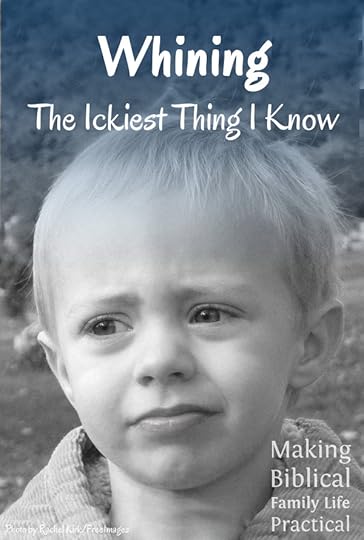
It’s no surprise when a baby cries, and it shouldn’t surprise us that a young child whines. A baby has to communicate its needs somehow, and if we’re paying attention—and willing to respond when the first warning signs appear—many babies can be nurtured and comforted quickly, without a stressful contest of who can cry the longest. We really don’t think a 6-month-old is being manipulative or malicious when they cry for nourishment, comfort, or even attention; they have needs and not much way to ask politely … or to exercise patience and self-denial.
Toddlers, well, that’s a different story. Little kids have very short attention spans—except for the ability to whine. That can go on forever.
Two observations that helped us
First, attention given early is often shortest. When the 3-year-old runs up to a distracted parent, how often we try to put him off. “Just a minute … not now … Mama’s busy …” Sometimes there’s no option. Often, though, if he doesn’t get a response from Mama, the whining starts … which grates on our nerves, and makes us even less patient (and less able to concentrate on what we were doing).
What if, instead, we try to pause what we might be doing—teaching spelling, answering an email, whatever—if we put our activity on hold for a moment and give the little one our full attention for just a minute? Eye contact, a hug, real engagement … Very often, thirty seconds of real connection will meet the little one’s need, and he’ll run off happily.
Or else, we can put him off as long as it takes … and try to be productive in spite of the increasing whine. Not really efficient … and not really that loving, usually.
But whining is a behavior, and that means you can train it! It’s a form of communication, and just like we teach children to say “Yes, ma’am” or “Please” and “Thank you”, we can teach our kids not to whine.
Invest the time to stop the whine
Do they even know what they’re doing? Small children aren’t very self-aware, other than, “I want” and “I feel.” If whining gets on our nerves (if?), then we need to teach them better ways to express their needs. Invest the time to stop the whine. Stop what you’re doing, if you can, and explain how to ask more politely.
“Sweetie, the way you’re speaking is very unhappy to listen to. ‘Maaaaaamaaaaa … I’m hunnnngry.’ That’s called ‘whining,’ and it makes people unhappy with you. Let’s try it this way–‘Mama, I’m hungry. Can I have a snack?’ Can you say it that way?”
And then reward improved behavior! (This is all about the tone, not the grammar … you can work on “Can I” vs. “May I” another time.)
After you’ve made this point, so the young one realizes that whinnnninnnng is something they need to avoid, then you can offer some negative reinforcement. This is normally just irritation and socialization, not a matter of sin and rebellion, so we use very mild corrections:
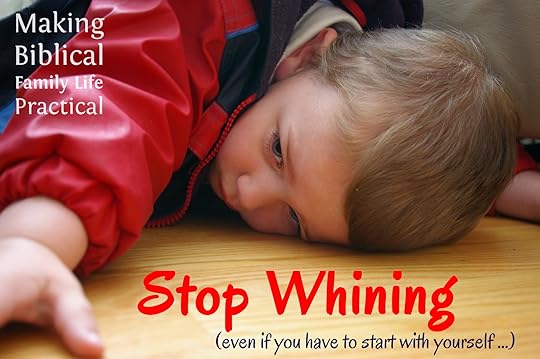
Time out for whining. This is probably the only time we recommend “time out” as an effective discipline! We told the whiner, “I’m sorry, that’s what I warned you about. You’ll have to be silent for one minute. You’re not allowed to talk until the timer goes off.” Whether you use a kitchen timer (tic tic tic tic tic tic tic tic …) or the countdown on your cellphone, make a big deal about starting and ending the quiet time. Add minutes if they start again. “Whoops, there’s that tone again. You can’t talk for two minutes this time …” We had one pessimistic child who worked up to twenty minutes before he changed his tone! But a two- or three minute pause can be very effective with a young, impatient child. If nothing else, you get a short break of listening to it!
Older kids need reminders, too. When a teenager gets whiney—and they do, sometimes—you can laugh it off. “I’m sorry, when I hear that tone of voice, my brain just shuts down. I don’t speak Whine. Can you re-phrase that in a normal tone?” (A co-worker asked a complainer in his office, “Would you like some cheese to go with that whine?”)
Don’t reward bad behavior. Sometimes it’s effective to make an “automatic no” rule—you whine, you don’t receive. Never give the impression that a big-enough bother will get the child what he wants. But use some mercy! If a child comes up to whine, “Maaaamaaa, I need a Baaaand-Aid …” he may actually need some first aid right then. And if a kid is grumpy and complaining at the end of a 300-mile car trip, who can blame him?
As a father pities his children, so the LORD pities those who fear Him. For He knows our frame, that we are but dust.
(Psalm 103:13-14)
Remember this is a long-term, low-intensity problem. You don’t have to slay every dragon every time. You’ll have plenty of opportunities to teach effective communication skills. Sometimes you hear the whine and it just makes sense to let it pass—you really can’t pause what you’re doing, or the child is sick or exhausted and can’t help themselves, or it’s just not a good time to engage this parenting issue. It’s okay to deal with it another day.
When you’re training them not to whine, though, don’t overlook the underlying problem …(to be continued …)
In Christ
Hal and Melanie