Hal Young's Blog, page 19
December 8, 2015
The Good Dinosaur -or- The Not-So-Good Dinosaur?
“They stole our story!” I told someone the first time I saw a trailer for Pixar’s The Good Dinosaur. The stunning shots of a human boy playing with a little dinosaur are firmly impossible in the standard evolutionary narrative—the dinosaurs supposedly died out eons before humans appeared on the scene, so theories of historical human and dino coexistence have been a creationist exclusive for a long time. The Good Dinosaur finds a way around that problem by presenting an alternate timeline where the Chixculub meteor barely misses the planet, briefly interrupting the feeding dinosaurs while it streaks across the heavens, but leaving a rich biosphere to evolve further towards the present day.

The film opens “millions of years later” on a lushly detailed landscape in the American West that is home to a wide variety of sentient saurians. On a particular pioneer homestead in the shadow of Grand Teton, Momma and Poppa Apatosaurus grow corn and look after their eggs—eggs that soon hatch into strapping young dinos Libby and Buck, and their diminutive brother Arlo.
Positive Themes
Poppa and Momma take their responsibilities seriously, and the children have chores and duties as well. The whole family is proud when the parents raise a stone granary to store their corn safely for the winter, and they sign their work with a forefoot print on the stone. The kids want to make their mark too, but Poppa tells them they must earn it through doing something greater than themselves. The two larger children soon find opportunities to stretch themselves and accomplish feats for the family. They earn the right to sign the silo alongside their parents, but anxious little Arlo can’t seem to do even his regular chores correctly, much less make his mark with something big.
Poppa takes Arlo in hand, making opportunities to spend time with him, and giving him tasks to stretch him, opportunities to prove his courage to himself and his siblings. But when a mysterious intruder raids the idyllic little farm, Arlo is out of his depth. Tragedy strikes, and Arlo is washed downriver–the little dinosaur who was terrified of lightning and aggressive chickens will need to face up to his fears and prove his mettle if he is ever to find his way back home again.
Digging Deeper
The Good Dinosaur presents an appealing narrative at first glance. Intensely sympathetic and personable characters are set in a world of spectacular Western scenery, and the central plot is built around the impossibly cute little dinosaur as he tries to find his way home. Poppa is a kind and gentle influence, teaching his little son persistence, responsibility, and forethought. The slightly contrived symbol of the footprints on the granary sets up the biggest theme of the film–Poppa tells the hatchlings that “You can’t just make your mark—you have to earn it…by going out and doing something bigger than yourself.” He adds, proudly, “You have it in you—and I can’t wait to see you make your mark someday.” Courage, sacrifice, and loyalty are recurring motifs throughout the film: a character tells an anxious Arlo that “fears are natural […] You can’t run from your fears—you have to fight through them, to find out what you’re made of.” The filmmakers said the landscape is a main character in the film, and it’s easy to see why. Soaring landscapes, stunning vistas, rivers and weather and mountains (mostly based on real GIS data, from real locations) pose the biggest challenges and dangers for the characters, and also carry them to literal mountaintop moments to pause and reflect.

Sadly, if the landscape is a character, the worldview is one too…and it’s not nearly as stunning. It’s no secret that much of the film follows Arlo and a little lost human boy through their journey home. The boy is cute, but depicted almost exclusively in an animal fashion—nonverbal, aggressive, violent, and valuable as a travelling companion mostly for his ingenuity and cleverness at finding or stealing what Arlo needs. He communicates solely in signs and howls, and runs around almost exclusively on all fours, scratching and biting and pawing like a dog. Physically, the human boy is indistinguishable from a modern cartoon child, but the characterization is primitive nearly to the point of inhumanity. Indeed, next to the wise and gentle sauropods, the little boy looks like nothing so much as a pet dog.
Even more disturbing is the depiction of the big villains of the piece—a pack of rapacious pterosaurs who cross Arlo’s path after a storm. The flying dinosaurs are ostensibly looking for survivors, but they are soon revealed to be eating anyone they ‘rescue’. Liberally larding their speech with religious imagery and not-so-subtle parodies of Christian phrases, these storm-worshipping hypocrites leave a very bad taste in the viewer’s mouth. On the other hand, the terrifying group of Tyrannosaurs that chase off the pterosaurs do not devour Arlo and his friend, but turn out to be bluff and helpful ranchers…Jurassic World this isn’t.
Even aside from philosophical problems, there’s a number of bizarrely gratuitous interludes in the film—eating a spoiled fruit provokes LSD-like hallucinations, dinosaurs tell gory stories around a campfire, a ghostly apparition appears to Arlo, and a creepy forest hermit tries to steal Arlo’s human friend, amid the not-insignificant scares and thrills integral to the main storyline. With frequent scenes of peril and violence, this is not a particularly preschooler-friendly film, despite the seeming kid-friendliness of the cute green dinosaurs. (It should be noted, however, that even violent death is not accompanied by visible blood and dismemberment.)
The Deal-Breaker
On the topic of suitability for children, the Pixar short shown before the film deserves a mention. Everyone loves Pixar’s cute, typically innocent little shorts. This one, however, is different. The film opens with a title card proclaiming it to be based on a true story, mostly. A young boy from the Indian subcontinent finds his ‘Super Team’ cartoons on TV conflict with his father’s worship of the household gods…when he reluctantly joins his father before their idols, they come alive to him and he sees depictions of the Hindu deities fighting to protect him and defeat evil. He’s so inspired that when he returns to his entertainment, he draws their likenesses in his notebook and declares them to be his ‘Super Team’.

The effect was nothing more or less than complete romanticization of the bloodsoaked, demonic worship of Hinduism as more-awesome superheroes. (If you think the the previous sentence is hyperbole, read something of the worship and veneration of Kali, the Hindu goddess of death.) This short film, “Sanjay’s Super Team”, is one of the most revolting things I have ever had the misfortune to see. Even if the feature presentation was perfect, this short alone makes it impossible to recommend getting theater tickets—please do not subject your children to seeing this travesty.
And unfortunately, this film is far from pure gold. Combine a glorious setting and score with intensely sympathetic characters, a laudable primary theme, gratuitous weirdness, a thoroughly evolutionary worldview, some not-so-subtle jabs at Christianity, and the end result fails to live up to its promise. Pixar may be known for predominantly innocent animated masterpieces, and this film, while visually stunning and emotionally sympathetic, fails to deliver on the innocence. The Good Dinosaur is unfortunately not a very good film, and cannot be recommended for its intended audience of children. Don’t forget the appalling pagan short that precedes it in the theater, and be cautious even if you want to pick it up on DVD or Bluray, as those releases usually include the short as well. For teens or adults, there’s certainly far more harmful entertainment available at the multiplex every weekend, but it’s sad if that’s the best reason you can come up with to see a much-anticipated release. For shame, Pixar, you can do better than The Good Dinosaur.
The Good Dinosaur, in theaters now. NOT Recommended.
-Raising Real Men Review Team
This review is our honest opinion and no free products were provided.
Get help teaching your family to use discernment in watching media in our workshop, Media-Proofing Your Kids.

Check out our shop for Character-Building Gifts you can feel great about giving and support our ministry at the same time!


Days Are Short and Shadows Are Long!
Guest post by artist/astronomer Jay Ryan
At Classical Astronomy, we simply try to point out the easily-observable aspects of sky observing that are usually overlooked in our modern generation. One of those aspects is the varying length of shadows over the span of the year.
As the Sun moves through the zodiac constellations over the annual cycle of the seasons, the Sun moves to its highest point overhead in the sky on the summer solstice. On this day, the noon shadows are the shortest. Because of the orientation of the sky, the height of the Sun corresponds to the length of daylight, so the Sun is highest in the sky on the longest day of the year.
Here’s a picture of our son Dave, taken a couple years ago and first reported in the Classical Astronomy blog. Dave is standing in our backyard compass on June 17, near the summer solstice, a little while before “high noon,” when the Sun crosses the meridian (not the same as “clock noon.”) Note how short his noon solstice shadow is, as seen from the latitude of Cleveland, Ohio (about 41 degrees north).
(Instructions for making your own backyard compass are included in Signs & Seasons and the companion workbook.)
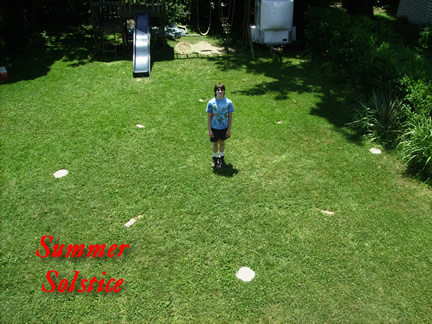
After the summer solstice, the Sun begins to move south through the constellations. The Sun’s noon height decreases over the summer, and the days grow correspondingly shorter.
Here’s a pic showing Dave’s shadow around noon on the autumnal equinox, September 23, when the daylight is the same length as the period of nighttime.

Note how much longer Dave’s shadow is, nearly as long as he is tall. See how long the shadows are of the trees and other objects in the backyard, and how our kid’s playset is in the shade, though it was in daylight at noon on the solstice. Also observe how different the noon sunlight looks when the Sun is at a slanting angle and not directly overhead.
Here’s a pic showing Dave’s noon shadow near the winter solstice. Note how long his shadow is, especially compared to the previous summer and autumn shots. On the winter solstice, the Sun is very low in the noon sky, and noon shadows around the shortest day of the year are nearly twice as long as the height of the persons or objects casting them, twice as long as on the equinox only three months before.
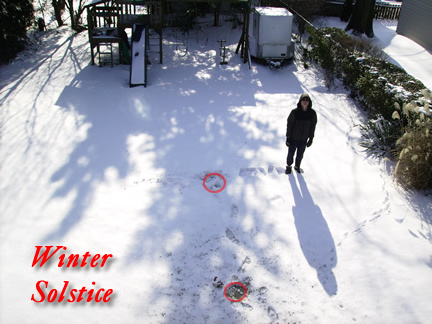
The shadows in our backyard were so long that Dave needed to stand next to the actual standing stone to find the Sun’s rays, since the shadow of the pine tree in our backyard covered the compass. The standing stone and the “North” marker stone are indicated with red circles to make them more clear, since we had a big snow storm the day before. However, our neighbor’s oak tree had lost its leaves, and didn’t cast much of a shadow now as it did in the summer and fall.
Throughout history, it was common for farmers and sailors to use such obvious signs in the sky to measure the passage of time, as the LORD provided in making the Sun, Moon and stars (Genesis 1:14). However, in our generation, we have become reliant on technology such as clocks and wall calendars, and we no longer consult such simple signs, not even to simply appreciate the LORD’s handiwork.
The time of the winter solstice is a good time of year for homeschoolers to begin noticing the noon shadows, since you can watch them get shorter between now and next June. The seasonal changes in the shadows are among the many things your homescholar can learn from Signs & Seasons, our Christian homeschool astronomy curriculum. We hope that you all will learn to take some time from your busy lives to observe these common, everyday wonders.
__________________
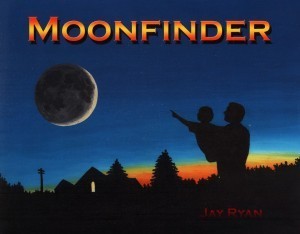
Jay, the author of this article is also the author and illustrator of one of the most beautiful picture books we own. Children will love learning about the scientific basis for the phases of the moon in Moonfinder – and you’ll build happy memories reading aloud to them! Get it in our shop now on sale.
November 30, 2015
Five Ways To Optimize Your Christmas Budget
 A lot of us are watching the budget very carefully this year. What heartless elf put open enrollment for health insurance right before the holiday season? (If it’s giving you pain, check out what we did.) And rich or poor, if you have a large family (like ours) you naturally look for ways to make the best use of your shopping dollars in every category.
Here are five ways we’ve found to optimize your gift budget:
Things that are both educational and fun. I used to dread the idea of “educational toys” as a child, but there are lots of toys and gifts which teach or encourage learning skills. Scrabble and Bananagrams are not “educational” games, but they encourage spelling skills and vocabulary, right? Strategic games like Risk, Settlers of Cataan, and Ticket to Ride teach some geography along the way. Take a good look and see if there aren’t some hidden lessons in your old favorite games and toys!
Things that are appropriate for multiple ages. Pit is an old classic—Theodore Roosevelt loved it—that doesn’t require advanced reading skill, just alertness and quick decisions! Mille Bournes is one of our family favorites that nearly any child can understand; it’s a French card game which simulates a road rally, with hazards and speed limits to slow down your opponent while you add up the milestones (the bournes) yourself.
Things that encourage interaction. A personal video game is a one-player show. A lot of console-based video games can be played either way. Something as simple as a deck of cards or a checkerboard invites two or more to join in together – and provides fun for multiple people at once.
Things with lasting value. Depending on your kids’ peer group and how much television you allow, you may experience upward peer pressure to shop for the hottest new item in the stores. “New” doesn’t mean “Good” or “Bad,” either one – but there’s value in choosing gifts which have been around a while and show some lasting value. And some of our favorite Christmas gifts have actually come from used book stores, library sales, and Goodwill!

Things which are constructive and creative. We have boys, and we have LEGOs … but I repeat myself. Really, though, things which can be used for different games or re-assembled in different ways have more entertainment value than a toy which only does one thing – and expects the child to sit and watch it. An introduction to a craft or artistic hobby – anything from watercolor kits and calligraphy pens to books on basic carpentry or gardening – can introduce your child to skills which can provide a lifetime of enjoyment. (And make shopping for them even easier in the future!)
A little novelty and excitement is okay – we don’t say, “Never buy into trends!” Some turn out to be the next generation of “classics”! But to make your gift-giving budget go as far and as deep as it can, it’s hard to beat these five patterns when you’re shopping for your family.
Of course, if you’d like some ideas, we have a neat collection of gift ideas on our website HERE – and special deals this week to make the dollars go still farther. Check it out!

In Christ,
Hal and Melanie
Photo credit: Shopping cart by Christy Thompson, FreeImages.com
November 25, 2015
Recipe: Fresh Cranberry Relish!
When you were a child, when you thought of cranberries, did you think of round slices of red jelly?
The good ol’ canned cranberry sauce is like comfort food – but this relish is awe inspiring.
It’s delicious, it’s beautiful on the table, and it’s easy.
You can make this in just a couple of minutes!

Fresh Cranberry Relish
1 12oz bag fresh cranberries
1 large or 2 small oranges
1 1/2 cup sugar
Instructions
Slice oranges (do not peel!)
Chop oranges and cranberries in food processor
Mix with sugar and set aside
Stir occasionally until thoroughly combined
Would you like some more ideas for side dishes, pies, or other treats for Thanksgiving?
Then quick, go download Christ-Centered Thanksgiving –
it’s free for our newsletter subscribers!
November 24, 2015
Avoid The Awkward Pause
One of the great joys of the holiday season is the chance to spend time with family members that you don’t get to see the rest of the year.
Unfortunately, that’s also one of the stressful things about the holidays – extended family that you don’t see the rest of the year.
Michael Hyatt recently shared a list of nine conversation starters to help get over the awkwardness, small talk, and unfortunate side-paths we sometimes find at extended-family gatherings. It’s a great way to be pro-active about the dinnertime fellowship; among other advantages, he says,
It filters out the weird. If you’ve got a track to run on and everyone can join in, you can also avoid a lot of the odd and awkward moments. Instead of feeling trapped, you can feel empowered.
We have some other thoughts that may help, too
Try and stay out of bad conversations altogether. The old rule of avoiding politics and religion is hard to do when anyone has strong convictions about them. However, it’s useful to have some inoffensive ways to step back from an invitation to confrontation:
“Don’t get me started,” said with a wry smile or rolling eyes. That communicates, “I’ve got an opinion, but this might not be the time to ask me about it.”
“Can I plead the Fifth on that?” again says, “I think that stating my opinion right now might get me in trouble, so I’d rather not.”
“Can we discuss this later?” is a little more direct, but it leaves the door open to talk about an issue one-on-one if it’s worthwhile.
“Thank you, I’ll consider that.” This is our favorite response to unwelcome advice. It says, “I hear you and I’m polite enough to think about what you say, but I’m not going to be bullied into a response right now – and the decision is mine to make, after all.”
Anticipate the worst questions and have an answer in mind
When I was doing media interviews as the spokesman for our state homeschool organization, I would try and think of the worst question they might ask. Was there anything I was just praying they wouldn’t ask? If so, that was the question I had to have an answer for!
If there’s anything controversial or embarrassing going on in your family – an unpopular child-rearing decision, a medical situation, someone in trouble – isn’t it likely someone will ask? Do you have an aunt or great-grandparent who’s always worried about your decision to homeschool? Are you expecting your fourth child and there wasn’t universal celebration of your third? Plan ahead how you’ll explain your position on it, politely and pleasantly, but firmly – and don’t ad lib!
You don’t want to be that relative yourself!
There is a story about a young man invited on a blind date. He was thinking the stereotypical thoughts about the poor girl who didn’t have any friends, probably awkward or plain, and such, and feeling very noble about himself. When he was introduced to her, though, she wasn’t just pretty – she was gorgeous, elegant, a knockout! And he suddenly realized that he was the “blind date,” not her.
We might get braced to deal with obnoxious and antagonistic relatives, but in fact, could we be the unpleasant person in the group? How can we avoid becoming the person everyone wants to avoid?
Figure out other people’s hot buttons – then don’t push them!
Know thyself and be on guard. Do you ever get into a certain frame of mind that you regret later? It doesn’t take an alcoholic buzz – you may get unfiltered when you’re tired, stressed, or hungry. You may be doing the family a kindness if you get yourself a snack instead of falling into crabbiness. Be aware of your own weaknesses and walk carefully around them.
Be quick to hear, slow to speak, slow to anger. That’s the advice of the apostle James, and it’s good to remember – all the time!
Grace, grace, grace. We all need grace from God, and we need grace from other people. We can start by showing grace to them first, and set the example in our family’s gatherings this year.
“Let your speech be always with grace, seasoned with salt, that you may know how you ought to answer each one.” (Colossians 4:6 NKJV)
In Christ
Hal and Melanie
Here’s some last minute help preparing for the trip and the celebration:
Some great audiobooks will make the travel go smoothly – CLICK HERE for downloadable family fun!
Our favorite Thanksgiving recipes and the Thanksgiving story, if you’re supposed to bring a casserole or devotional and you’ve drawn a blank, our downloadable Christ-Centered Thanksgiving will help – and it’s free if you’re on our newsletter list! CLICK HERE and get your copy for free!
(If you’re already on the list, go ahead and sign up to receive the ebook – you won’t be added to our mailing list twice!)
Our recent podcasts on Teaching Gratefulness and Preparing for Christ-Centered Holidays – always free!
November 18, 2015
The Scary Question, “What Grade Are You In?”

It’s funny the things that throw you for a loop when you’re homeschooling.
Teach four grade levels? No problem.
Volunteer at the local food pantry with kids in tow? Got it.
Lead a field trip with a dozen parents and a hundred children of all ages? No problem.
“What grades are your kids in?”
When we first started homeschooling, we’d dread that question. A sales clerk would ask, our child would look at us confused, we would jump in, stuttering, trying to explain that we homeschooled … and the innocent person behind the counter would look at us oddly.
That’s when we stopped to think, “What is this person actually asking?” Did they really want to know we’re way ahead in math, but slightly behind in language arts, or whatever? No! They’re just trying to show some interest.
What they are really asking is, “How old are you?”
So, we started coaching our children, “Honey, they just want to know how old you are. When someone asks what grade you’re in, just say, ‘Third,’ because that’s the grade someone your age would typically be in.”
Problem solved. If they remember. Hopefully …
But that’s not the only question that drives you crazy. “Are they all yours?” “Don’t you know what causes that?” and the ever popular, “I’d shoot myself if I had that many children!” are all favorites when we’re out shopping during the day. Not.
It helps to realize that most people don’t mean any harm. They’re trying to make conversation and they just don’t have any filters.
How do you handle it, though, when people ask questions you’d rather not deal with? What if they’re intrusive or too personal? What if you feel attacked?

We’ve found that people are a lot like chickens – they peck on those they perceive as weak. If you respond to questions with embarrassment or defensiveness, it just encourages them. On the other hand, if you fluff up your feathers and answer confidently, most people drop the offensive. Sometimes they’ll even change tone and agree with you. Maybe they’re afraid you’ll peck on them!
So the next time someone asks your child what grade they’re in and they stammer and look up at you, just smile really wide and say, “He’s ten and he’s doing so well in school!” – even if it’s been an awful week. It’ll get better. You know it.
 In Christ,
Hal and Melanie
Sometimes this confusion about grade levels gets really pronounced about fourth or fifth grade. Why’s that? Because there is a whole lot going on in that boy’s brain just before puberty sets in! You can both survive it and make the teen years great if you understand what God’s doing in your son’s life … and how you can be the most effective parent you can be! Check out our Boot Camp 9-12, five live online sessions to discuss all the stuff we wish we’d known when our first was a pre-teen — starting January 5, and you can get the recorded version to listen to right now, too! CLICK HERE and find out more!
Copyright 2015. Used with permission. All rights reserved by authors. Originally appeared August 19, 2015, in The Homeschool Minute™, an E-Newsletter published by The Old Schoolhouse® Magazine. Read this family education magazine free at www.TOSMagazine.com or read it on the go and download the free apps at www.TOSApps.com to read the magazine on your mobile devices. For free homeschool information visit ConsideringHomeschooling.info.
Guys That Help Around The House Are Just Being Biblical Men
This time of year, the housework goes into high gear – cooking, cleaning, and all that, getting ready for the holiday rush. If your home is like ours, the cry for “All hands on deck!” is deep, often, and heartfelt in November and December!
When we were a boys-only family, though, a friend with daughters chided Melanie for expecting our sons to help with household chores — that was “women’s work,” in her opinion. We’d like to suggest the opposite — it’s just work work, not unmanly at all. In fact, guys who help around the house are just being Biblical!
Cooking is singled out as a “womanly” task, yet Hosea 7:4 describes men as bakers, Abraham’s cook was a young man, and Isaac instructed his son to cook dinner before receiving his blessing. (Genesis 18:7, 27:4) The Levites cooked for their brethren in the Temple service so their duties could proceed uninterrupted.(2 Chronicles 35:14–15) The disciples did as Jesus had directed them; and they prepared the Passover.(Matthew 26:19)
(The Food Network has probably helped our cultural attitude on this, since it turned cooking into a competitive sport complete with trash-talking superstars and cheering fans.)
Clothing and Laundry: There are numerous commandments for men to wash their own clothing, and the Greek word for “launderer” is a masculine noun (note). God specifically commissioned two men, Bezelel the son of Uri and Aholiab the son of Ahisamach, to sew the elaborate priests’ garments. (Exodus 39)
Decorating: The same two craftsmen were assigned to design, teach, and do the work of weaving, engraving, and making embroidered tapestry and fine linen for the tabernacle.(Exodus 35:30–35; 38:22-23) Paul and Aquila both sewed tents by profession. (Acts 18:2–3)
Even caring for the baby is fair game for a guy. Moses complained to God, “Have I begotten this people, that thou shouldst say unto me, ‘Carry them in thy bosom, as a nursing father beareth the suckling child … ’” The Lord uses the same term, speaking through Isaiah of the restoration of Israel, saying, “Behold, I will lift up mine hand to the Gentiles … and they shall bring thy sons on their arms and thy daughters upon their shoulders, and kings shall be thy nursing fathers … ” (Numbers 11:12, Isaiah 49:22–23 (KJV – note)
 Even In Our Culture
There are plenty of examples within our own culture; in fact, the military provides prime examples. The thought of a young man stirring a pot being “less than manly” doesn’t stand up to KP duty in the military; “Cookie” serving in the chow line is almost always portrayed as a sweating bruiser of a man. Sailors were called “swabbies” because mopping the deck was their daily task. Does it make a difference that the sailor wore white bell–bottoms and a square collar? Maybe if we provide our sons with a business–like canvas apron rather than one of Mom’s, we could see kitchen duty in a different light at home, too. In civilian life, men are tailors and dry cleaners, too, and the most famous chefs are men. So why would we balk at asking our sons to do similar tasks for the family?
In Christ,
Hal and Melanie
On laundry duty: Numbers 8:21 refers to the purification of the Levites for service in the Tabernacle; they were all adult men. There are dozens of references to a man washing his clothing for ritual impurity. Mark 9:3 is the only use of the term gnafeus for a fuller (KJV) or launderer (NKJV), but it appears in the Greek Old Testament (the Septuagent) in 2 Kings 18:17 and Isaiah 7:3 and 36:2.
On “nursing fathers”: Newer translations render the term “guardian” or “foster father”, which basically means the same thing; a foster mother of an infant at that time would be expected to nurse the child, after all.
This is excerpted from our book, Raising Real Men: Surviving, Teaching and Appreciating Boys. We find that when you look at the whole sweep of Scripture, the life of a godly man includes not just courage, boldness, and strength, but compassion, courtesy, and yes, household chores, too! We need more of all these things in the church and the culture …
… and if you’d like some ideas for making these Biblical principles a practical reality with your son, [ CLICK HERE! ]
November 10, 2015
Talking to Your Kids (All of Them) About Choking
A dear sweet friend of mine nearly lost her son the other night. Just a few seconds, maybe a minute more and she’d be planning a funeral right now. Here’s her story:
Sam, our fourteen-year-old, came stumbling into my bedroom on Saturday night at ten, crying pretty hard and saying, “Mom, I don’t know what happened, I don’t know what happened…”
I asked him repeatedly what was wrong, but he was nearing hysteria, so I got him calmed down a bit, and he was finally able to speak.

Sam said, “I was standing by John’s bed (our 12 yr old), and we were talking about the football games we’d watched today. The next thing I remember was hearing really loud buzzing, and he said I put a scarf around my neck and started choking myself. I wouldn’t stop, Mom, and look at my neck!!!!”
I looked, and y’all, his neck had really bad purple bruises on it, like bad rope burns. He was very near hysteria again, so I ran and got the younger one out of bed and brought him in my room. My hubby was in the shower, so I sat on my bed, just loving on both boys while they both just sobbed, and asked hubby to please hurry.
In the meantime, I prayed with the boys, asking God to reveal to us exactly what had happened. I was VERY frightened, because he obviously had NO CLUE how or what had happened.
Hubby came out, and I managed to get the younger brother calm enough to speak, although it was extremely difficult for him. Here’s what he told us:
“Sam was standing by my bed, and we were talking about the games. There was a crocheted scarf tied onto the foot of the upper bunk, and while we were talking, he started messing with the scarf. Then he looped it over his head. When he got it over his head, he stepped down, and then he started acting really funny. I thought he was messing with me, so I turned over and faced the wall.
Sam started making noises, so I looked back at him, and he was kind of jerking around and acting weird, but I still thought he was fooling around so I told him to cut it out, and I turned back over again.
The noises got louder, and when I turned back over, his face was really purple and he was twitching and his body was like jerking and there was drool running out of his mouth. So I hollered at him, “Are you okay?? Sam?? Sam???
And then I realized that he was choking, so I jumped up out of my bed and I lifted him underneath his arms, and I held him there against my body, and I worked the scarf back over his head. Then he fell to the floor and he wouldn’t wake up. I kept trying to wake him up, and he finally opened his eyes, and he came to your room.”

At this point, both boys were really crying hard again, but the Lord is faithful and showed me exactly what happened. Our son literally has NO MEMORY of putting that scarf over his head. But I was able to explain to him that because of the oxygen deprivation, he simply can’t remember it.
His neck looks pretty bad, and he said it hurts on the inside a lot, like a sore throat. He now remembers standing there talking to his brother, and then experiencing a loud buzzing sound, and he remembers hearing the sound of himself trying to breathe, and then he was on the floor and had no idea how he got there.
I am honestly still struggling a lot. It was so close.
We are all still quite tender from the experience, and I hope we will be for a while. I have had two children be within hours of death before, one from an asthma attack and one from dehydration due to the Rotavirus.
But this was different. And to be honest, it has scared the spit out of me. PLEASE warn your kids about playing with ropes and scarves. I thought my 14 yr old knew better, and he DID, but boys will be boys and he was just messing around.
It is never too late to remind your kids of the dangers of tying things around ANY PART of their body.
PRAISE GOD that John knew what to do for his brother, and by the way, Sam is about 4 inches taller and 30 lbs heavier than he is. John is our peanut; 12 yrs old, and about 60 lbs, and about 4’6. How he managed to lift him and hold him there is an amazing act. Adrenaline is a beautiful thing.
HUG YOUR KIDS.
This was an accident, it seems, and nearly cost this young teen his life, but there are teens doing this all the time on purpose!
In the Choking Game, kids choke themselves in order to experience a high. Unfortunately, it’s very popular among Christian kids because it doesn’t involve drugs or alcohol, so they thing it must be okay (It’s NOT.). It’s highly dangerous – over 900 people have died from it, with the most common age being 12. There’s a list of victims at Games Adolescents Shouldn’t Play. We know two different families who have lost children to it. It is SO common that we think it is worth warning your kids about.
So, how do you talk about something like that? Won’t it just make them curious? If they heard about the high, but not the deaths, maybe so, but we find that talking about the kids who lost their lives pretty much cures the curiosity. That’s especially true when it’s a kid a lot like them.
Here’s what that talk looked like for us:
“Guys, we need to talk. I was just reading about a family a lot like ours whose 14-year-old son nearly died this weekend! [Read them the story.] That was an accident, but some kids actually try to choke themselves for fun. They think it’ll make them feel good, but it could kill them! Do not EVER wrap anything tightly around your neck. Do not EVER choke yourself or someone else. It’s too dangerous. And listen, if any of your friends ever talk about doing something like this, please come tell us right away – you could save their life. Have you heard anyone talking about this?”
Just do it. Talk to them. You want them to know this is a deadly game before they hear about it from a friend.
It could save their life.
Your friends,
Hal & Melanie
 For the first time ever, we’re giving away our book, Christ-Centered Thanksgiving this week only! Head over here to find out more.
November 9, 2015
Preparing for Christ-Centered Holidays

The holidays are rapidly approaching, and while we all enjoy the feasts and the fun, there’s so much more than that. The trick, really, is remembering why we celebrate, being sure to teach that to our kids, and somehow figuring out how to plan a big family celebration without losing sight of the One who gave us the reason we’re rejoicing!
This week’s podcast, we talk about some ways we do that here … CLICK HERE FOR A PREVIEW! (2 minutes)

CLICK HERE TO LISTEN TO PODCAST ON THE ULTIMATE HOMESCHOOL RADIO NETWORK!
My Son Wants to Use Stronger Words
A reader asks, “I have a question I’d appreciate being posted anonymously, please. My 12-year-old son came to me with this: he would like permission to use some “stronger” words to use on certain occasions. He had some good friends who use words like “cr-p”and “dang”, and he says he feels left out when all he can say is “oh, man.” Lol. I want to tell him to always have his words be kind and good, etc. But, barring swear words of course, IS there a place for stronger words in a young man’s vocabulary?”
I have really mixed feelings about this one. Most of those things don’t offend me and you’ll occasionally hear some strongish interjections around here (but no profanity). However, an old friend once challenged a group of us at her house for a mom’s night out to consider our hearts.
Yeah, once again, it’s a heart issue.
If you use a sanitized swear word because it’s socially acceptable, how is your heart any different than if you are swearing? Christ makes it very plain that our hearts are what matter. It made me rethink a lot of things. Why did I feel the need to say something stronger than ordinary language? Was I railing against God’s providence? What ever happened to “I have learned in all things to be content?”
All that to say, that I’m not upset if I hear a son express surprise or dismay, but we discourage even sanitized cursing (jeez, dang, durn) that just seems to be another way to express ungodly anger or expressions, such as using the Lord’s name in vain or calling for His curse on something or someone unjustly. We tell them, “You speak English. Say what you need to say in real words.” (This works just as well in any language.  )
)
Let the words of my mouth and the meditation of my heart Be acceptable in Your sight, O Lord, my strength and my Redeemer. Psalm 19:14
Another big issue, though, is his desire to fit in at the cost of using words your family doesn’t. That’s a dangerous path to start on. Are other kids making fun of him? Is he just wanting to be like them?
It’s probably time for a talk with him about friendships and leadership, dares and teasing. Most kids feel very socially awkward in the preteens and early teens and it may be just a passing desire to be more comfortable, but there’s no time like the present to talk about peer pressure and how to stand strong while the temptations aren’t all that big!
Young men (and women) need to be prepared to be leaders in their friendships.
They need to know how to respond to teasing by laughing themselves, ignoring it, or teasing back, but not by getting defensive or angry.
They need to know how to respond to dares. Teach them only cowards do things they don’t want to because they’re afraid of what their friends will say.
Especially, they need to understand that a true friend doesn’t tempt you to do wrong but encourages you to righteousness.
Your friend,
Melanie
If you are new, welcome aboard! You can unsubscribe at any time by emailing unsubscribe@raisingrealmen.com or use the link at the bottom of each message.