Randy Susan Meyers's Blog, page 30
April 29, 2014
Can You Define ‘Women’s Fiction’?

How good does a female athlete have to be before we just call her an athlete? —Author Unknown
When did women’s fiction come to be? In 1956, the New York Times reviewed Peyton Place. It was called lurid, an expose, and earthy.” Grace Metalious is compared with Sherwood Anderson, Edmund Wilson, John O’Hara and Sinclair Lewis. I have no doubt that today (in our more feminist times?) she would be classified as a writer of ‘women’s fiction’ I’ve hit the caste system of novels before, from commercial versus literary fiction, to racial reading divides, to micro-indignities. Even name-calling. I thought perhaps I’d give it a rest this year, but alas my (woman’s? human?) hackles have once again been raised. A dear friend, whose soon-to-release book (okay, you pulled it out of me, it’s Robin Black and the book is Life Drawing) deserves everything from the NYT bestseller list to a National Book Award, has received excellent early reviews. (Life Drawing “might be the nearest thing to a perfect novel that I have ever read.”—The Bookseller, UK.)
It’s a great book. (I was lucky and received an early copy.) I absolutely raced through it. And, I have observed, more than one glowing review has finished by saying that both “women’s fiction fans” and “readers of literary fiction” will enjoy it. What does this mean? I’m compelled to parse that sentence; omnivorous review reader that I am, I’ve yet to see an analysis of a male-written book which states: Both men’s fiction readers and readers of literary fiction will enjoy this book. Why? Because there is no genre referenced in reviews as “men’s fiction.” Googling it, I couldn’t find much beyond Esquire’s self-proclaimed short stories labled “fiction for men.” In “Dummies.com” the categories listed are commercial, mainstream, literary, mystery, romance, historical, suspense, thriller, horror, young adult. And there is an entirely separate description of women’s fiction:
“It’s common knowledge in the publishing industry that women constitute the biggest book-buying segment. So, it’s certainly no accident that most mainstream as well as genre fiction is popular among women. For that reason, publishers and booksellers have identified a category within the mainstream that they classify as Women’s Fiction. And its no surprise that virtually all the selections of Oprah’s Book Club are in this genre. From a writer’s perspective, some key characteristics of these books include a focus on relationships, one or more strong female protagonists, women triumphing over unbearable circumstances, and the experiences of women unified in some way. The field includes such diverse writers as Barbara Taylor Bradford, Anne Rivers Siddons, Alice McDermott, Judith Krantz, Anne Tyler, Rebecca Wells, and Alice Hoffman.”
One can only assume, seeing the above varied choices representing ‘women’s fiction’ that what one needs to write ‘women’s fiction’ is simply a uterus. Jests aside, this category seems suddenly entrenched in literary culture. If you want to publish on Amazon, you must pick a category from a list of wide ranging possibilities that include ten sub-genres of Women’s Fiction and, zero that are labeled Men’s Fiction. The message is clear. Men are the norm. Women are a sub-category. If we go to Wikipedia, we get this:
“Women’s fiction is an umbrella term for women centered books that focus on women’s life experience that are marketed to female readers, and includes many mainstream novels. It is distinct from Women’s writing , which refers to literature written by (rather than promoted to) women. There exists no comparable label in English for works of fiction that are marketed to males.”
Agentquery.com describes it thusly:
“Women’s fiction is just that: fiction about women’s issues for a female readership. However, it is not the same as chick lit or romance. While utilizing literary prose, women’s fiction is very commercial in its appeal. Its characters are often women attempting to overcome both personal and external adversity. Although women’s fiction often incorporates grave situations such as abuse, poverty, divorce, familial breakdown, and other social struggles, it can also explore positive aspects within women’s lives.”
Okay, now I’m really getting confused. If I’m not mistaken, are there not many books written by men and marketed to all genders that include abuse, poverty, divorce, familial breakdown, and other social struggles? Philip Roth, John Updike, Jonathan Tropper, Jonathan Franzen, Jeffrey Eugenides, Pat Conroy, and Wally Lamb – to name a few. The prejudice is clear, but there is also a practical problem here. If ‘women’s fiction’ is a marketing device, it’s confusing as thus. Label a novel ‘women’s fiction’ — is the message ‘not for men’? By carving and dicing books into thin-as-lox slices, women writers lose readership. With ‘women’s fiction’ are half the potential readers in the world blocked off before the books hit the shelves?[image error]

As a teenager, when I read my first ‘adult’ books, I chose, Exodus, Marjorie Morningstar, Jubilee, Peyton Place, Crime & Punishment, Martha Quest. These are the books that marked me. But might I have eschewed them had they been labeled war book, women’s fiction, black fiction, and literary fiction? I was perfectly happy knowing they fit into one of two categories: Novels and Classics. Classics meant the teacher assigned them, and novels meant . . . fiction. I could judge for myself after that.
My own novels have been labeled: women’s fiction, mainstream novel, literary fiction, commercial, upmarket—almost everything except horror and spy. But, as the nation of readership becomes more acclimated to categorization, more men have written me to say, I picked up your book from my wife’s side of the bed and was surprised how much I loved it. One man (who’d taken a writing seminar I taught) wrote the following: I bought “The Murderer’s Daughters” for my wife, to be supportive of you–since I loved your workshop. A few weeks later, I took my wife to the dentist and forgot my book. She had brought yours with her, so while she was in the chair (since I had nothing else) I picked it up. Wow. It’s great! So maybe we can start a new category? Dentist office books?
This is not a small issue, even if we place it under ‘micro-indignity.’ Last year, Amanda Filipacchi wrote in a New York Times Op-Ed, Wikipedia’s Sexism Toward Female Novelists:
” . . editors have begun the process of moving women, one by one, alphabetically, from the “American Novelists” category to the “American Women Novelists” subcategory. So far, female authors whose last names begin with A or B have been most affected, although many others have, too. The intention appears to be to create a list of “American Novelists” on Wikipedia that is made up almost entirely of men. The category lists 3,837 authors, and the first few hundred of them are mainly men. The explanation at the top of the page is that the list of “American Novelists” is too long, and therefore the novelists have to be put in subcategories whenever possible. Too bad there isn’t a subcategory for “American Men Novelists.”
Or too bad there are any sub-categories at all.

Just today, I read a piece on Galley Cat, “You Are What You Read: Infographic.” The lack of women writers was astounding. And this is why we need to keep on this topic. Because these lists become embedded in us, and the cycle of diminishing women’s work continues. We don’t need firemen and firewomen—they’re all fire fighters. And all those writers we love? We don’t need to call the writer-men and writer-women. We can call them writers. And we can call the novels they write just that. Novels.
I’m so disturbed when my women students behave as though they can only read women, or black students behave as though they can only read blacks, or white students behave as though they can only identify with a white writer.—bell hooks


April 10, 2014
How Reading Formed Me, Saved Me & Opened My Eyes
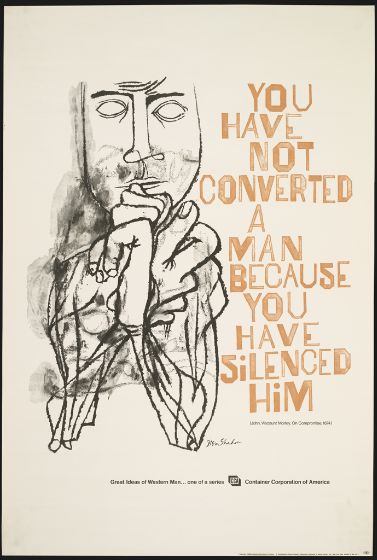
“I go along with Albert Camus, who famously said, ‘The responsibility of the writer is to speak for those who cannot speak for themselves,’ ” Matthiessen said. “And that’s always been kind of my informal motto.”
Listening to the soundtrack of my life this weekend (Yes. NPR. I am that person.) I caught the above quote from Peter Mattheissen, who died on Saturday, on a replay of his 1989 Fresh Air interview. He was fascinating for many reasons—for instance, when he founded The Paris Review (with George Plimpton) it was tied in with his stint at the CIA, using the magazine as a cover for his spying activities. Then, he moved dramatically to the left politically.
Thus, the above motto.
Camus’ words (via Mattiessen) have been the underpinning of almost everything valuable that I’ve absorbed and learned. I’ve never been a great in-person student, always preferring a self-study pace. The moment I was allowed to travel on my own (which now seems remarkably early—the age of 7) I made many trips per week to the Kensington, and later, Grand Army Plaza, branches of the Brooklyn Public Library. These thousands of books I lugged home formed my very core, my moral code.
“Conventionality is not morality. Self-righteousness is not religion. To attack the first is not to assail the last.” ― Charlotte Brontë, Jane Eyre
Reading made me who I am, and I am grateful that I read more than the comic books to which I was addicted. It was those books I read from grades 5 to 12 that defined my future.
From The Diary of Anne Frank by Anne Frank I learned fear of injustice. From Anne of Green Gables by Lucy Maud Montgomery and A Tree Grows in Brooklyn by Betty Smith I learned hope and a sense that I could do far more than seemed possible for a girl in my circumstance.
Karen by Marie Killea taught me that we’re not destined by our disabilities. Crime and Punishment by Dostoyevsky led me to examine guilt. Exodus by Leon Uris made me long to be brave.
Jubilee by Margaret Walker helped me touch the bitterness of slavery; the evil of racism. Reading Martha Quest by Doris Lessing lifted out of the ghetto of girly-world.
“The books that the world calls immoral are books that show the world its own shame.” ― Oscar Wilde
Reading The Doctor’s Case Against The Pill by Barbara Seaman kept me from swallowing the hormones of birth control pills.
I could list books forever. This week I bought Flash Boys by Michael Lewis, so I could educate myself on Wall Street’s crimes and misdemeanors. The Wizard of Lies by Diana Henriques opened my eyes to how Bernie Madoff got away with his financial sins for so long.
“Anything may happen when womanhood has ceased to be a protected occupation.” ― Virginia Woolf, A Room of One’s Own
My novels aren’t written for their moral themes—but I can’t find interest in writing books that don’t chase lies and darkness. Domestic crimes and misdemeanors interest me. I believe they are the underpinning of larger society ills. Violence against women at home and on the street is intertwined. Domestic drama illustrates the germ of what President Jimmy Carter says is the ‘worst human rights violation on Earth’—violence against women.
“Fiction is the lie through which we tell the truth.” ― Albert Camus
I don’t know if I can name or declare the worst sins we commit against each other; I do know that it is the power of words (and all other art) that uncover them. Whether it be the columns of New York Times writers Maureen Dowd or Charles Blow, the Op-Eds written by Derrick Jackson or Joan Wickersham of The Boston Globe, Maya Angelou’s poetry, Upton Sinclair’s muckraking, Alex Haley exposing racism and slavery, or Marilyn French breaking open the world of women, it is these chroniclers of life who keep us aware of those thin lines between right, wrong, and all the greys in-between.
“Always go too far, because that’s where you’ll find the truth” ― Albert Camus
March 22, 2014
New Novel ACCIDENTS OF MARRIAGE Available For Pre-Order
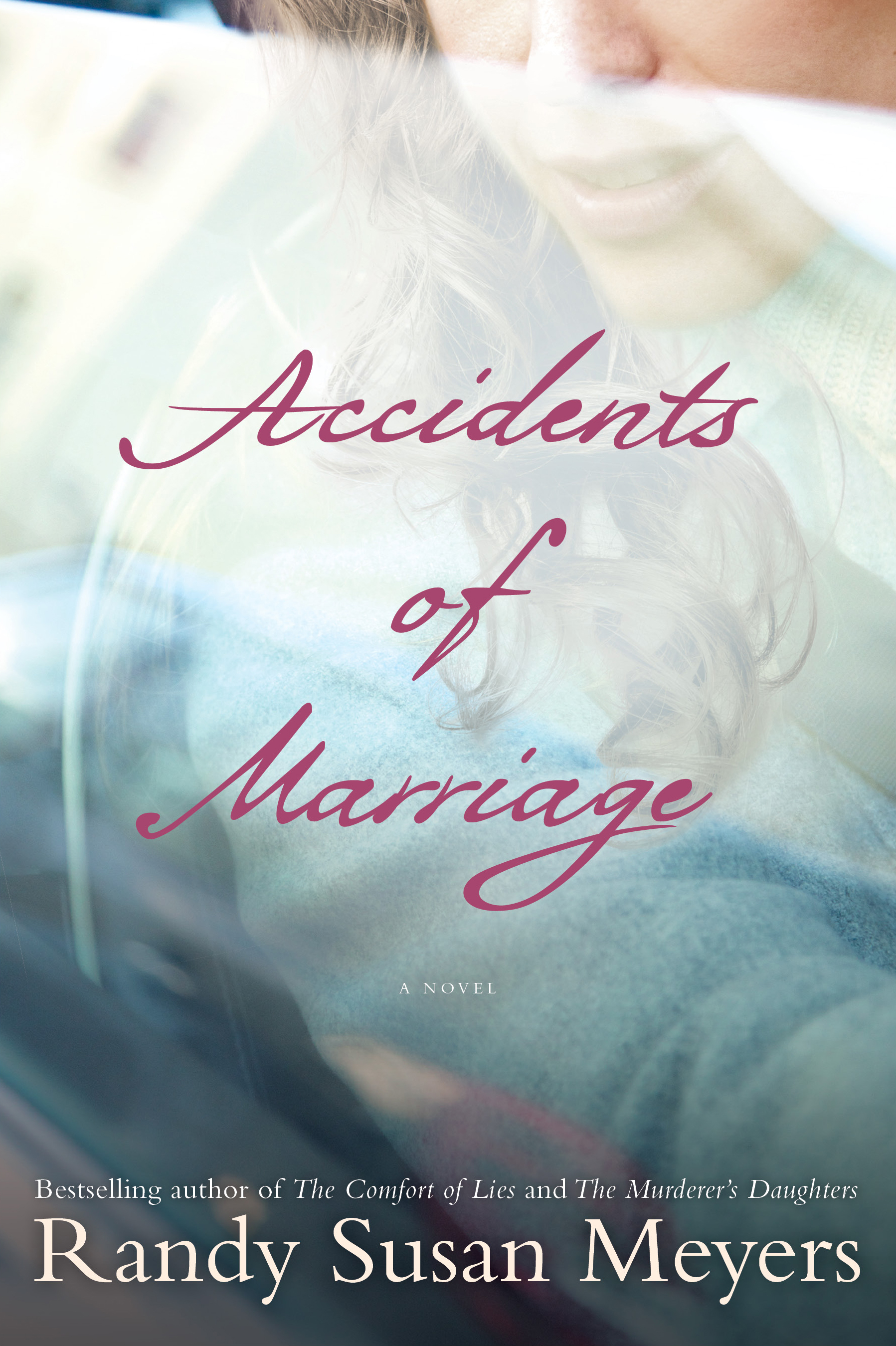
Randy Susan Meyers next novel Accidents of Marriage, coming from Atria Books 9/2/2104.
Accidents of Marriage explores the damaging effects of a spouse’s emotional abuse. Maddy is a working mother trying to balance her career and three children. Years ago, she fell in love with Ben, a public defender, drawn to his fiery passion, but now he’s lashing out during his periodic rages. She vacillates between tiptoeing around him and asserting herself for the sake of their kids, keeping a fragile peace until one rainy day when Maddy and Ben are in the car together. Ben’s temper gets the best of him and Maddy is left fighting for her life.
“Randy Susan Meyers is a genius of the human heart, and Accidents of Marriage is a profound education on the complexities of love, imperfection, damage, and responsibility. You’ll feel as though a magically insightful friend is sharing the behind-the-scenes secrets of a family you may well know. She tells it like it is. No sugar-coating here, only truth in all its compelling beauty and might.”
—Robin Black, author of Life Drawing
“Maddy and Ben have a complicated marriage. He’s got anger issues; she is messy and forgetful. One fateful morning these character traits clash – with devastating consequences. In this beautifully written novel, Randy Susan Meyers traces how the repercussions of a car accident expose fissures and long-held resentments from the past that force these characters to question everything. This is a wise and penetrating book.”
—Christina Baker Kline, #1 New York Times bestselling author of Orphan Train
“An incredibly accomplished and satisfying read with an important message.”
—Jane Green, New York Times and international bestselling author, Tempting Fate
“Every marriage has its secret deals and compromises. In Accidents of Marriage, Randy Susan Meyers explores the vast complexity of this bond and lays out how passion, allegiance and love can go terribly wrong. She gives us characters we root for, even when they’re at odds, and she asks the questions: What is forgivable? When does a marriage become too broken to fix? With wisdom, humor and great compassion, Meyers answers in a story you won’t soon forget.”
—Ann Bauer, author of The Forever Marriage
“I read Accidents of Marriage in one day. Like Meyers’ first two novels, this one—about a family paying a high price for rage and trying to reknit itself in the aftermath of the unthinkable—is compulsive reading. It’s amazing how warm Meyers’ writing is even as her stories grip you by the hand and don’t let go.”—Jenna Blum, New York Times bestselling author of Those Who Save Us
“With the heart of a novelist and the tenacity of an investigative journalist, Meyers flawlessly depicts the evolution and consequences of emotional abuse. A master of perspective with an uncanny understanding of human nature, she has managed to make us empathize with every member of this damaged family. This is an important story, one I’ll be thinking about for a long time.” —Brunonia Barry, New York Times and international best-selling author of The Lace Reader and The Map of True Places.
“A bold and poignant look into the complicated, slippery world of what constitutes emotional abuse, Accidents of Marriage explores what happens when tragic circumstance forces one family to reexamine the dysfunctional dynamics that have long-defined them. Meyers deftly pulled me in to this story from the first page, tying me to its tender and fearless heartbeat, and didn’t let me go until the extremely satisfying end.”—Amy Hatvany, author of Safe With Me
“The intertwined traumas of emotional abuse and brain injury careen through every family member in this disturbing and deeply insightful story. Meyers captures the necessity and complexity of excavating the truth as the foundation of life moving forward.”
—Janet Cromer, author of Professor Cromer Learns to Read: A Couple’s New Life after Brain Injury
Win an early copy on Goodreads.
Pre-order on Amazon Barnes & Noble Indiebound Powells Books-A-Million Indigo
March 7, 2014
Ice Bound: A Doctor’s Incredible Battle for Survival at the South Pole

(This post first ran in 2011)
In the continuous stream of NPR that is my life, I just learned that Jerri Nielson died of breast cancer. Dr. Nielson wrote a book I’ve read more than once, and that has now become the final solidification of my vow not to lend out well-loved books.
Her book, Ice Bound a Doctor’s Incredible Battle For Survival at the South Pole, co-written with Maryanne Vollers, fit every criteria I have for a great read: engrossing plot (which I remember in more detail than usual, considering I read it years and years ago) writing which flows (just read the first page on Amazon,) gotta-find-outness (for goodness sake, she discovers she has breast cancer while in Antarctica,) and all sorts of juicy subplots (family troubles, check; intriguing setting which is a story in itself, check; side characters who you deeply care about, check; heroics large and small, check, check, check.
Nielson was hired for one year at the Amundsen-Scott South Pole Station on Antarctica, a place where a year brings one sunrise and one sunset. It remains night for the entire winter; you can’t leave during this weather. “Winterover” crews are there for the duration, dependent only on each other.
Saying it’s cold is like saying ants are small.
Nielsen must perform a biopsy on herself after finding a lump in her breast. And that is just the beginning of this amazing tale of medical courage and adventure. I’ve already sent for two copies from Amazon—one for me, and one for lending. I know no better way to honor this woman, than by re-reading her memoir.
The best of authors become part of the book family who whom keep you going. They offer solace, fun, interest, company, adventure, insight, escape, and flashes of brilliance. Dr. Jerri Nielson felt like one of those friends. Rest in peace, Jerri.
(RE-RUN FROM 2010)
February 11, 2014
Secrets, Lies & Clothes: What We Do For Love & Work–Benefit for Girls Inc
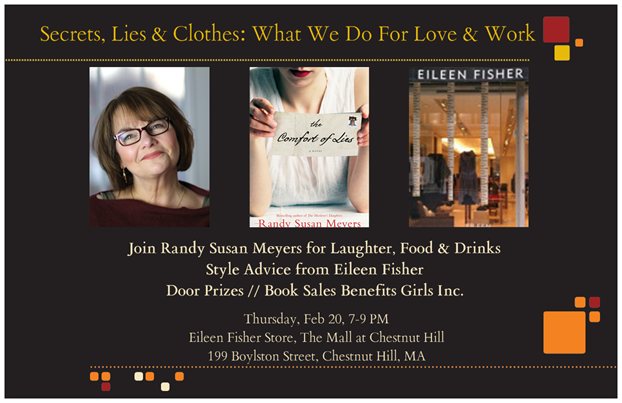
Writing fiction is basically lying for a living. For me, it was a perfect fit. I stopped working with criminals, started writing, and . . . oh, no! I realized I better trade in my schleppy refugee from the 70′s wardrobe for something with at least an edge of elegance. So I binged on style change (hair, clothes, make-up)—and then lied to my husband about the cost.
Please join me at the Eileen Fisher store in the Mall at Chestnut Hill, talking about finding love at 47 (after too many bad boys and so many lies, mine and theirs) switching careers at 57, and refashioning my life, inside and out.
Drink, Food & Fun: Free
Door Prizes from Eileen Fisher, Atria Books of Simon & Schuster & more
Book sales will benefit Girl’s Inc.
Purchasers will receive tickets to a private wardrobe seminar & sale with the author & Eileen Fisher stylists: Dressing Elegant & Easy
No Tickets–No RSVP Needed: Just Show Up!
Eileen Fisher Store at The Mall in Chestnut Hill
199 Boylston Street, Chestnut Hill, MA
Feb 20, 7-9 pm
February 7, 2014
Art Versus Artists: Does It Matter?

Last night I watched a TMC documentary: And The Oscar Goes To. Saying that I wept is about as meaningful as saying I sneezed—I am the easiest tears-mark in the world. Something about seeing actors fall on their proverbial knees in gratitude, brings out my crybaby side. I cried hardest listening to Tom Hanks talk about AIDS taking too many people, Hattie McDaniels, stunned words about this too-long-in-the-making recognition of black actors. Jane Fonda remembering how Vietnam overshadowed her Oscar win for Klute. Sidney Poitier refusing to answer when someone wanted him to speak as a representative of all black people—saying he needed to think before he spoke.
I cry with almost any award-winner, but men and women brave enough to address struggles around personal and social issues strike my core. They provide windows into goodness. Their acts deepen my appreciation of their art.
And—I know this about myself—the opposite is true.
An artist’s character colors the lens through which I read, see, hear them—it seeps into me. I don’t like to watch Alec Baldwin as much as I once did. His documented invectives, indicative of his character, spill onto my perceptions of him onscreen. My suspension of disbelief cracks because instead of seeing the work, I see the person behind it. Discomfort colors my laughter. Which, in many ways I hate. Because I thought he was terrific.
That he denies the impact of his comments, choosing excuses over facing his mistakes, makes it worse, makes it far more difficult for me to paper over his slurs and enjoy his performance.
I do not go looking for artist’s life stories, but when they hit me in the face, yes, I am affected. That Mariska Hargitay began a foundation to help victims of sexual abuse makes me more inclined to appreciate her art. Learning Mel Gibson to be anti-Semitic and abusive, I am less inclined to get lost in his world and more likely to skip watching him. Despite article after article, urging moral-free appreciation of art, when artists commit crimes, I do see their work through a new prism. And yes, I have my own tendencies, prejudices. I believe children when they say they were victimized. I don’t need to see a smoking gun. I know what abuse can do to a child. For a long list of reasons, they more often withhold information than reveal it.
Which brings us to Woody Allen, whose face is everywhere these days. It has been repeatedly written that Allen denies all allegations, but believing him begs this : are you choosing to think that Dylan Farrow is lying? Interesting choice. I worked with criminals for almost ten years. They would lie about their crimes even as I stared at the evidence before me. Pictures of black eyes and broken arms. Each group I ran, men lied and denied. Their lies scorched across the room.
 And they did a great job with their lies. Perpetrators are far better than victims at dissembling.
Can we not be cognizant of the breadth and statistics of sexual abuse within art, as well as life? If you believe someone has done wrong, after a certain point, does looking the other way become mute tacit approval?
Bystanders have responsibilities.
To be clear, my own belief system and past marks my stances. My identity is the culmination of numerous events: having my innocence taken by a family member; feeling a life-long vulnerability after reading The Diary of Anne Frank; working with violent men. A thick strand of anger against those in denial came from my experiences. It’s not that I can’t manage interactions with anyone who crosses a morality line. (Certainly my own life has been filled with transgressions.) It’s that I can’t bear to interact with those whom I perceive as being in complete denial of what they did and the effect it had on others: I was drunk, she wanted it, she was bad, my buttons got pushed. It never happened.
I believe Dylan Farrow. I am done watching Woody Allen films. That is my stance.
But if it’s true that an artist’s personal life influences my view of his work, it’s also turning out to be true that many people (probably I’ve done this) let their opinion of an artist’s work determine how they view the artist’s personal life.
If we like Allen’s work, we, of course, prefer not to feel guilty as we watch his movies. We don’t want to feel queasy if we choose to work with him as an actor. So we either declare the purported act of abusing his daughter separate from his art, or we put the word ‘adopted’ in the middle of the phrase Woody Allen’s daughter. We bang the drum about Soon-Yi not being his daughter, but only the daughter of his long-term girlfriend. We go on and on about she said, he said. We believe Allen’s decades long declaration of Mia Farrow as a vindictive woman. We say we will be objective until the law weighs in—despite not doing this in so many other cases. We make objectivity our king. We allow our admiration of him as an artist, and our own history with his work, to shape how we shape the story.
This is not a topic without gradation. I’m not above using the theory of relativity in my own need to read this or see that. But is it wrong of me to believe that it is more selfish to let our appreciation of art influence our moral standards when there is a child involved, when the “he said, she said,” reflects a debate about an event between a powerful adult man and a little girl?
Do I want a litmus test for artists, before I can appreciate their work?
No.
Do I have personally held beliefs that color my appreciation of art?
Yes.
I do measure intent in art. I do choose.
I choose Stephen Spielberg over Roman Polanski.
I vote with my pocketbook.
And I choose to draw lines.
Don’t take somebody’s life.
Don’t take someone’s innocence.
When choosing, choose honorable.
I often fail miserably, but I try, when choosing, to remember Jane Addams.

January 30, 2014
My Storied Food

When I was a girl, it was family lore that my Aunt Irene, when she cooked something awful, yelled, “it’s a loser” to my Uncle Bobby as he walked in the house. I’ve been known to come out with more than a few losers (like the time I served my new in-laws pie accidently made with Borax instead of sugar. (Lesson learned–be careful how you decant,) and I’ve made a few dishes that held an opium-like addiction, but it’s the stories behind both that make cooking a joy..
When I was newly married (19!) my then-husband and I moved to a farm located between Binghamton and Ithaca, New York. His job was being a farm hand. Mine was reading, cooking, and gaining weight as quickly as possible. We were isolated. When the farmer’s son’s wife invited me for breakfast, I was ecstatic. Upon arrival, she offered me a 7&7, a Pop-Tart, and a bowl of depression. Thus was shattered my Brooklyn girl idealization about life on a farm.
Christmas week, she invited me to a cookie exchange party. My excitement at having somewhere to go (a bit measured based on our Pop-Tart breakfast) was high enough for me to spend my next weekly library visit foraging for the most interesting and exotic cookie recipe I could find.
The cookies I brought (below) were everything I’d hoped. Complicated, sophisticated, delicious . . . and greeted with faces of horror. What were these lumpy brown things brought in by the Brooklyn Jew, which resembled nothing close to Christmas cookies? I handed out my Plain Jane bags, sans shiny ribbons curling down the sides. My New York style sweets might as well have been wearing little yarmulkes and speaking Yiddish for how much they stood out. All the other offerings were variations on a Christmas sugar cookie theme cut in the shapes of stars and Santa, and decorated (sparkles! red and green sugar! glittering gold balls!) with the skill of Rembrandtesque elves.
My cookies looked like the homely third cousin your mother forced you to invite to the Bar Mitzvah. But they were the tastiest. Try them. Really. The recipe is below.
Years ago, I began pulling together the recipes my daughters knew best, wanting, like many of you, to pass on my culinary secrets. As I copied from spattered cards, torn newspaper pages, and hand-written recipes, I realized the stories behind the recipes were as important as the food. Did my girls know their favorite brownies came from an ancient “found on the street” cookbook, circa my hippie days? How our Passover brisket had morphed into another family’s “Christmas meat?” The recipe that sealed the deal with my not-then-husband?
Pages piled up as I matched stories to recipes. From that was born The Comfort of Food— a cookbook to share with book clubs, not for sale, but as a thank you for joining me in my first passion, reading, by offering another love. Food.
Any book club choosing The Comfort of Lies or The Murderer’s Daughters as their book club choice will receive a hard copy and electronic version of The Comfort of Food. Simply go to the book club page on my website, www.randysusanmeyers.com and fill out the form.
French Lace Cookies
½ cup corn syrup
½ cup butter
⅔ cup brown sugar
1 cup flour, sifted
1 cup finely chopped nuts
Dark chocolate, melted (if desired)
Preheat oven to 325°. Combine corn syrup, butter, and sugar. Bring to boil. Combine flour and nuts w/liquid. Place by teaspoon 4″ apart and bake for 8-10 minutes.
To add a wonderful and delicious flourish , dip each cookie in melted dark chocolate when it comes from the oven. If you are talented and want to add a special flourish, roll the cookies while they are still warm, into a cylindrical shape and then when the rolled cookie is cool, dip it in the chocolate. If you are lazy, like I am, don’t worry about rolling; simply dip the flat cookies when they are cool. Lay on waxed paper while the chocolate hardens.
January 26, 2014
When Research Gets Giddy: Extreme Make-up Editon

Research is formalized curiosity. It is poking and prying with a purpose. Zora Neale Hurston
Novels require texture. Beneath the surface should reside volumes of information which will remain untold, but which informs and enriches every page of your story. Research is the imaginary and real travel of writing. You can’t build your entire novel on it, but oh, the places you’ll go.
Research is addictive. Even grim-road explorations challenge me to find enough self-control to stop digging and start writing. I lost hours to melancholy horror while writing The Murderer’s Daughters I watched operations on line, read detailed accounts of autopsies—and revisited my years working with batterers. The book spanned three decades, so nuggets of bright-colored information joined the grief and blood. Hippie ponchos. White Rain Hairspray. Patchouli.
But . . . what if I could take research from merely addictive to a giddy side bar perk? Research ensued for my second novel, (time out for brief brazen self-promotion—today is the paperback launch* of The Comfort of Lies) as I chose careers for my point of view characters. I studied pediatric pathology, listened to surgical lectures on You Tube, investigated treatment of the elderly, and read more than thirty books on adoption, birth mothers, and experiences of adoptees. Fascinating. But grim.

Mind pop! I’d make my third character different—not working with death, depression or arrests. Didn’t she have enough mishegos? (Infidelity, a hidden child, parents who loved her less than they did each other?) I gifted her with a successful organic skin care company. Moments of fun sliced into my autopsy work, as I learned skin-care techniques, ordered books on lotions and potions, and made lemon sugar olive oil scrubs. (Nice!) Building the imaginary company (what color scheme should the packages be? What to name it!!) provided rhythmic changes, pleasurably crackling my brain.
For my newest novel (Accidents of Marriage, releasing in September 2014) I investigated emotional abuse, social work in hospitals, car accidents, trauma and a host of complicated medical and legal topics. I needed the occasional relief of researching men’s relationships to their cars and varied versions of the song “Voulez Vous Coucher Avec Moi Ce Soir“

Now, writing number four novel—a nascent work in progress—which, in a nutshell, is about the ways women torture themselves and are tortured around weight issues, you can only imagine the places I go.
This is not a topic without emotional resonance. A host of dark research holes threatened to suck me into a permanent depression. Thus, as one of my main characters struggles with rescuing lost kids, the other is makeup artist, whose worked in stage, film, and every other layer of work with cosmetics. Instead of only being surrounded by books I wouldn’t want a child to stumble upon, I have piles of books like Makeup Is Art with a cover that could double as a photo on the wall. (No having to hide it when the family arrives.)

Naturally, a choice like this must make sense, and I knew that someone who imagined herself ugly would and could fall into a career of building human facades.
Truthfully, I have a love affair with makeup, though, like any romance, we’ve had ups and downs. I wore white lipstick as a teenager (leading an English teacher to remark that it was “such a delight to see girls spending money to look dead.” Being hip and cool lead to a long stage of using a dab of mascara while considering lipstick an affront to humanity.
There was the beige look. And the eighties, complete with color-printing, led to fuchsia on my cheeks. I had a graveyard of cosmetics.
And now, there was a perfectly legitimate reason to fall full face into my secret love. I had a legitimate reason to learn about using layers of powder to set lipstick, covering up over-eagerly-applied blush with a scooch of foundation, how to connect the dots of eye-liner, and in which order to apply the products I layered on at bedtime. It was okay to treat my skin like an over-indulged pet.
After reading Allure, Vogue, and books for months, I pulled friends, with an emphasis on writer friends, into my web. Moving far beyond book-learning, I scouted Chestnut Hill’s Bloomingdale’s cosmetic counter for someone who’d get excited by helping an author learn glamour, and found Jacqueline Harper at Bobbi Brown, who took me from my usual school marmish bit-o-paint to a full face ‘smoky eye’ look.
While it was fun to be made-up, I wanted more opportunity to watch artists at work (without looking like a pervert stalking women who were getting their lips lined.) Jacqueline and I worked up an at home party, where she, and two other Bobbi Brown make-up artists (Jaime Perez and Elaine Duggan) came to my house (schlepping ungodly amounts of make-up.) I provided lots of wine, chocolate and various carbs, and bribed/dragged 14 friends (11 of them authors) into my research web.

Love fest. That’s what it was. I learned. (And quizzed people about make-up and weight.) A hush fell over the group as Jacqueline and Jaime gave a demonstration on Becky Tuch and Meredith Goldstein.
Jane Roper asked Elaine to make her up as though she had to go to the Grammy’s—which she attended. (I like to think Elaine gave her a karmic push.) Elaine provided Dyan DiNapoli with the perfect lipstick for her Ted Talk. (Perhaps Elaine can specialize in writers on stage.)

Grammy-worth Glam Jane Roper
Beyond The Margins and Grub Street colleagues generously provided their eyes, lips, and cheeks for my benefit. (Even letting me get involved, as I insisted on having Kathy Crowley’s and Ann Bauer’s eyes lined, Juliette Fay’s lips popped, Necee Regis giving it a try, and Iris Gomez made full glam. (Somehow Nicole Bernier managed to sneak back to her kids before the brushes touched her.)
Watching You Tube, reading books, and diving into archives, it all fills many information gaps we need to write a novel. Hands-on work provides another layer of authenticity. Walk the streets to find your characters house. Take a first aid course for a modicum of medical feel. If your character is a lawyer, get thee to a courtroom.
And have some damned fun.

“Randy Susan Meyers’s second novel is sharp and biting, and sometimes wickedly funny when the author skewers Boston’s class and neighborhood dividing lines, but it has a lot of heart, too. Meyers writes beautifully about a formerly good marriage — the simple joys of stability, the pleasures of veteran intimacy — and deftly dissects just how ugly things can get after infidelity. The battles these women fight take place on a small stage, yet they’re anything but trivial: saving a marriage, making a meaningful career, learning to parent. In the end, thanks to Meyers’s astute, sympathetic observation, we want these women to win.”
—Boston Globe
Gallery of Make-Overs:

Meredith Goldstein & Becky Tuch, post make-over

Necee Regis getting first-time makeup from Jaime Perez

Ann Bauer with her beautifully lined eyes (I insisted.)

Iris Gomez incredibly glammed.

The Bette Davis eyes twins, Juliette Fay and Kathy Crowley

Bobbi Brown’s finest: Jacqueline Harper preparing my house for the party.

Me, wearing my first smokey eyes.

Dyan DiNapoli in Ted-Talk worthy lipstick.

Becky Tuch getting touched up by Elaine Duggan.

My house turned into a Bobbi Brown counter by Jaime Perez
January 23, 2014
Rescuing Children With Happiness, Once Again

Being invisible is pretty hard for a kid. Crummy childhoods take many forms and usually it’s an amalgam of yuck. Smacks and screams thankfully have a time limit, but neglect is the evil gift that never stops.
Even the most benign neglect—like being a latchkey kid—can foster loneliness.
When trouble fills a family, kids are pushed to the background. I lived in a land of my own imagining, where I believed my real parents, President Kennedy and Jackie, had left me to fend for myself, testing a ‘cream will rise to the top’ theory. Meanwhile my beleaguered sister, by nine, was trying her sullen best to cook me supper.
If it hadn’t been for the Federation of Jewish Philanthropies I doubt my sister and I could have ended up strong at the broken places. Our mom was a struggling single mother who did her very best. Our dad suffered in ways we’ll never understand, papering his sadness with drugs and dying at thirty-six.
But we had the summer! Through the magical generosity of the Federation of Jewish Philanthropies, we spent our summers at Camp Mikan, our paradise. We entered a bus somewhere in Manhattan’s Lower East Side and came out of the bus blinking in the sunlight and breathing the sweet green air of Harriman State Park. Sunshine! Swimming! Friends!
Visibility!

In memory, it was a Wizard of Oz transition from black and white to color. At camp we went from unnoticed to the coolness of being all summer campers. My sister became a big shot, a member of an envied clique, moving up the ranks of camp hierarchy until eventually she was head of the waterfront (only the coolest job in the world.) I became part of a pack of safely rebellious friends who kept me going through the lonely winters.
We got to be kids
I starred in Guys and Dolls. Jill gathered groupies! We hiked. Canoed. Short-sheeted counselors. Married head-counselors Frenchy and Danny taught me I could be lovable and through loving them I learned early on that interracial marriage was a non-issue. Luke Bragg taught me to get up on stage and from being with him, through osmosis, I learned gay or straight made no difference.
We got to be kids.
Women ran Mikan. They taught Jill and I that women were strong and loving and firm and trustworthy. They taught us that is was possible to be protected in this world.

Back home, we were once again invisible and quiet children cleaning the house, uncomplaining and obedient, waiting for the year to pass so we could again have a childhood. Summer came and once more we could swim, sing, mold clay, hit a ball, learn folkdance (I still dance the mizourlou in my mind) and unclench from being coiled watchers.
Doris Bedell, who ran the camp, shaped our lives more than she’d ever imagine. She loved us, she scolded us, and she made us feel seen. She probably helped my sister become the best teacher in Brooklyn. Her memory stayed with me when I ran a camp and community center in Boston.
Summer can save a kid. One person can offer a child enough hope to hang on. Think about this as we get ready to slide into school vacation.
One adult can change a child’s world.
Remember this.
Think of who you can touch.
Thank you Federation of Jewish Philanthropies. Thank you for my childhood.

The above words were written in 2010. Today I am incredibly honored to have been chosen as the Women’s Philanthropy 4th Annual One Book Read of the Greater Boston Combined Jewish Philanthropies. As I ready for the two events held today, I feel a bit shaky. One of the things that happen when your past is a bit off the rails, is that the present never seems quite true. Today I am happy–lucky to have a family I love, work I love, and a love of my life who I love. There’s a whole lot of loving going on. But the isolated girl from above lives on. (Isn’t that always the way?) Today, perhaps for the first time, I feel like I can bring them together. Thank you again, Combined Jewish Philanthropies.
January 14, 2014
Secrets, Lies & Clothes: What We Do For Love & Work–Join Me and the Eileen Fisher Staff in Chestnut Hill, MA

Writing fiction is basically lying for a living. For me, it was a perfect fit. I stopped working with criminals, started writing, and . . . oh, no! I realized I better trade in my schleppy refugee from the 70′s wardrobe for something with at least an edge of elegance. So I binged on style change (hair, clothes, make-up)—and then lied to my husband about the cost.
Please join me at the Eileen Fisher store in the Mall at Chestnut Hill, talking about finding love at 47 (after too many bad boys and so many lies, mine and theirs) switching careers at 57, and refashioning my life, inside and out.
Drink, Food & Fun: Free
Door Prizes from Eileen Fisher, Atria Books of Simon & Schuster & more
Book sales will benefit Girl’s Inc.
Purchasers will receive tickets to a private wardrobe seminar & sale with the author & Eileen Fisher stylists: Dressing Elegant & Easy
No Tickets–No RSVP Needed: Just Show Up!
Eileen Fisher Store at The Mall in Chestnut Hill
199 Boylston Street, Chestnut Hill, MA
Feb 13, 7-9 pm
snow date:
Feb 20, 7-9 pm