Randy Susan Meyers's Blog, page 26
January 19, 2015
(Impossibly Condensed) Checklists for Writing a Novel

Last week I taught an all day seminar at Grub Street on “Writing Tools for Beginning a Novel” where I learned how difficult it is to condense the process into six hours . . . and how exhilarating it is to step back and look at the entire process.
At day’s end it seemed as though I’d climbed a mountain where (for a day) I could look down at the forest and also take note of the trees. For those who appreciate concise road maps, my aerial view of writing a novel is below. Note the word “my.” There are as many methods and belief systems are there are writers—this one’s mine.
Overarching Hints of Huge Importance (to me)
Slay the reader over your shoulder. (Everyone thinks it’s you anyway: give it up.)
Let it rip without reservation during your first draft.
Be as hard on yourself as possible when revising
Read, read, and read some more—and with a critical eye
Built a great research library (and I advise ‘print’ books.)
Timeline to get from “first page” to “the end”
Find your ‘story.’ Find your pivotal character/s.
Write an overview of your story (only a page or two) Find the ‘what if’ you’re exploring
Start a character list; using as much or as little information as you feel is important at this stage. (Name your characters with care. Don’t repeat first letters, change rhythms. )
Chart your character’s connections to each other.
Capture scenes you will/can/might include—one scene per index card and then put them into a chronological order.
Outline the spine of the story, going as far into the cascading events as you can imagine. (Some see to the end right from the start, others do not.)
Write your first draft. Try to work from beginning to end without stopping, but it’s not always possible.
(Repeat numbers 8 through 16 below, until satisfied with novel)
When finished your first draft, let the manuscript cool down for at least three weeks, preferably 6 weeks.
Read the entire book (on paper!) from page 1 to the end.
Construct a “what is actually on the pages of the 1st draft” backwards outline.
Outline again, using what’s there that will be kept and what you plan for revisions
Revise for the large picture (Does the story work?)
Read aloud (‘text to voice’ software is useful.)
Revise to improve writing.
Revise for every possible detail. . . . and read aloud again.

Layers of Good Writing
1. Identify your genre (writing in one you respect) but don’t be a slave to a box.
2. Research (getting 90% more into your brain than you’ll use in the book.)
3. Character Description: Avoid thumbnails sketches; let characters unfold before the reader. Deepen descriptions.
Maria’s wardrobe was ninety percent denim and ten percent flannel tells the reader more than Maria had black hair and blue eyes.
4. Character Motivation & Crucible
Crucible:
* Vessel of a very refractory material (as porcelain) used for melting and calcinating a substance that requires a high degree of heat
* Severe test
* Place or situation in which concentrated forces interact to cause or influence change or development
Are you clear about the motivation(s) and crucibles of your character(s)? Why do your characters do what they do?
In Breaking Bad, one of Walter White’s crucibles is cancer. Another is losing his stake in a huge company. His motivation is building a lifetime of money for his family. Another is proving himself despite having left the company. He wants to leave a legacy. Motivation and crucibles build sympathy for complicated characters.
5. Setting: The right setting enhances and deepens a story, thus choose one you can write with authority—whether from familiarity, invention, or research.
6. Story, Plot & Structure:
What happens: that’s your story.
How it happens: that’s your plot.
Structure is the shape of that plot.
Do you know your story? Does your plot move that story along? Plots trace character’s changes during conflicts that are eventually resolved. (Changing plot structure so it reveals the story in as gripping a manner as possible is often your first step in revision.)
In Breaking Bad, the story is:
Walter gets cancer
Walter needs money for after he dies.
Walter becomes a meth maker-dealer.
How far will Walt go to get the money and how much at risk will he put his family?
The Breaking Bad story is fairly simple. The plot (how the story is told) is crazy-complicated. The structure is linear with an occasional (very occasional) back flash.
Examples of structural decisions are:
How and where you begin, length of chapters, point of view, direction of the story, purpose of structure—the list goes on, such as using a linear vs. striated structure.
Many novels use the three-act structure:
Act 1: Reveal character’s problems and carry them forward to breaking points.
Act 2. Complicate the story, adding tension. Characters become deeper; readers know more. Things become more difficult and then worse, until a turning point is reached.
Act 3. Trials surge and story comes to climax, followed by a resolution.
7. Outline (the map of your story & plot)
Controversy regarding plotters vs. pantsers (those who write by the seat of their pants) is common, but having, at the very least, an overview of your novel provides grounding.
8. Point of View
First person past: I married him.
Third person past: She married him.
Omniscient. Maria and Harried married. She’s beautiful, Harry thought. He’s rich, Maria realized
Second person past: You married him and found contentment.
First person present: I marry him.
Third person present: She marries him.
Second person present: You marry him.
9. Voice: Voice is the singular personality of your writing. Let it unfold. You find your voice; you don’t force it.
10. Tension: Want + Obstacle = Conflict
One needs tension for the reader to continue reading, a reason to go past the first pages. There must be sufficient questions they want answered. Why will they care about this character(s)? (Stephen King calls it the “gotta know.”) Characters must want something and they must have difficulty in attaining their goals, meeting their missions and getting attaining their desires to build tension and ‘gotta know.’
In Breaking Bad, Walter, Jesse, all the family members face crisis after crisis. It is interesting how the least gripping characters are those with the least (and the most boring) problems. (Marie. The son. Which comes first: chicken or egg?)
11. Scene vs. Summary vs. Sequel
A scene is an active unfolding of action. For increased drama, don’t have scenes ending with things better, but worse. For real tension, scenes end in disasters, which require sequels.
Sequels are quiet times in the story, time for the characters to think and process, react to disasters. Characters can make new goals to carry into the next scene.
Summary is a condensation of information needed by the reader, not requiring (nor interesting enough for) a scene.
12. Subplots: Subplots are secondary to the main plot, but they serve the story. They deepen and widen the story; they should connect and relate to the main plot.
13. Exposition (when it works, when it doesn’t): Exposition provides information that will inform the story. For example, your war novel will need some history of the conflict, but not all of it requires a scene.
14. Backstory: Backstory is what happened before the point where your story begins. Many believe that less is more. Backstory should be sprinkled, not wedged. Question to ask yourself: is this interesting just to me, or will it is of interest to the reader? Is it needed for the story?
15. Dialogue
See how it sounds
Read it out loud
Tempted to change wording when reading? Give in!
How smooth and polished is your dialogue?
Could you use more contractions, more sentence fragments,more run-on sentences?
Does the dialogue seem stiff?
Great dialogue is an art. A few hints (though you should read, read, and then read some more): Avoid adverbs and dialog tags other than ‘said’. Have the dialogue convey the emotion, not the ‘tag’.
Don’t: “You are an awful man and nobody likes you,” Maria declared loudly.
Do: “Not a soul cares about you. Not even your mother,” Maria said.
16. Interior dialogue: When is enough, enough? When are you missing it? There is a fine line between a character allowing readers access into his inner self and a character sharing every thought they have on everything they encounter every minute.
One deepens your story; the other makes it tedious.
17. The telling detail: Surround characters with the telling details of life: Are his dishes in the sink? Is her cut bandaged or has she left the scab showing? Does she wear a negligee or tee shirt in bed? Manicure? Pressed shirt? Dirty jeans? (This is different from throwing brand names down as a short cut.) Neatly lined pens or a heap in the drawer will tell the reader more than writing he was orderly.
18. Grammar & Active Writing
John Gardner says in addition to the fault of insufficient details and excessive use of abstraction there is a third failure:
“…the needless filtering of the image through some observing consciousness. The amateur writes: “Turning she noticed two snakes fighting in among the rocks.” Compare: “She turned. In among the rocks, two snakes were fighting.” Generally speaking–though no laws are absolute in fiction—vividness urges that almost every occurrence of such phrases as “she noticed” and “she saw” be suppressed in favor of direct presentation of the thing seen. ”
There is a world of great information available on this topic. (See list of books at the end)
Don’t have Mary nod her head, have Mary nod.
Don’t have John sit down, have John sit.
Don’t write: Maria was so pretty when she was walking along the sideway.
Do write: Heads turned when Maria passed the old men playing chess in the park.
19. D ramatic Question/s
In To Kill a Mockingbird one dramatic question was: Will Atticus Finch save his client, protect his children, and face down a racist community?
Know the question/s your book asks. And don’t write ‘the end’ until they’re answered.
20. Themes & Premises
You want a sense of your themes, but, as said by John Gardner: “Theme is not imposed on the story but evoked from within it—initially an intuitive, but finally an intellectual act on the part of the writer”
Theme is your central idea, your connecting thread. (For instance, in Mystic River, a theme is loyalty.) Don’t overthink. Theme is easier to discern when you are done.
Think of the premise upon which your book will rest.
Upon what central belief does your story rest?
“A premise is the truth the story proves, and helps reader extrapolate meaning from events” Jessica Morell.
A premise of the television show Breaking Bad is that we convince ourselves to do evil in the name of good. A premise of Cinderella is that goodness will shine through in the end.
The above is an outline, a mere checklist of the myriad topics you should study to go from ideas sparking to writing a terrific book. Below are justa few of the incredible books available to help you on the journey.
Books on Writing: A Starter List
THE MODERN LIBRARY WRITER’S WORKSHOP: A Guide to the Craft of Fiction by Stephen Koch. Reading this book is like having the best kind of writing teacher—kind, smart, clear—talking you through the rough spots and teaching you why you need motivation, action, clarity in your writing and how to go about getting it. Plus, Koch included advice from writer’s ranging from Ray Bradbury to Samuel Johnson.
BETWEEN THE LINES: master the subtle elements of fiction writing by Jessica Morrell. A gifted and experienced teacher, Morrell offers a full tour through writing a novel, starting with Chapter 1: Art & Artifice: Keeping Readers Spellbound, through Chapter 18: Transition. She had me at her chapter headings.
WRITING FICTION: A Guide to Narrative Craft by Janet Burroway. Burroway “attempts to guide the student writer from the first impulse to final revisions, employing concepts of fiction elements familiar from literature’s study, but shifting the perspective towards that of the practicing writer.” A thorough book.
ON WRITING by Stephen King. King weaves the story of his journey to becoming a writer, his life changing near death experience, and his struggle to overcome addiction with top-notch writing advice. Write much? Read. This. Book.
The Kick-Ass Writer by Chuck Wendig. Bite-sized chunks of wisdom that wedge into your mind. So helpful to have by the bedside or wherever else you need instant inspiration.
SELF-EDITING FOR FICTION WRITERS: How to edit yourself into print by Renni Browne and Dave King. What? You don’t already own this???
THE ARTFUL EDIT: On The Practice of Editing Yourself by Susan Bell. Bell uses Max Perkins editorial collaboration with F. Scott Fitzgerald as a teaching tool about the fundamentals of editing, including interviews with writers such as Ann Patchett and Tracy Kidder.
MANUSCRIPT MAKEOVER: Revision Techniques No Fiction Writer Can Afford to Ignore by Elizabeth Lyon. Lyon’s book bridges the ‘before’ and ‘after’ of writing your book, first outlining tools for a smart revision and rewrite, and then providing the how-to of preparing your manuscript (including suggestions for font and point!) and queries.
THE JOY OF WRITING SEX by Elizabeth Benedict. Don’t attempt sex scenes without reading this first. Just don’t. Practice safe writing and read this on first. You’ll never be tempted to use words like glisten again.
YOUR FIRST NOVEL: a published author and top agent share the keys to achieving your dream by Ann Rittenberg and Laura Whitcomb. This book takes you through every step from writing a novel to finding an agent to getting it published, from first sentence to editorial production—even how to break up with an agent.
TOXIC FEEDBACK: Helping Writers Survive and Thrive by Joni B. Cole. Joining a good critique group, writer’s group, or writer’s workshop is often a frightening move for a beginning (or not-so-beginning) writer. Cole’s enjoyable book speaks to the good and bad of both sides of this process, making this a great book for both teachers and participants.


Last week I taught an all day seminar at Grub Street on ...
Last week I taught an all day seminar at Grub Street on “Writing Tools for Beginning a Novel” where I learned how difficult it is to condense the process into six hours . . . and how exhilarating it is to step back and look at the entire process.
Exhausted and depleted, at day’s end it seemed as though I’d climbed a mountain where (for a day) I could look down at the forest and also take note of the trees. For those who appreciate concise road maps, my aerial view of writing a novel is below. Note the word “my.” There are as many methods and belief systems are there are writers—this one’s mine.
Overarching Hints of Huge Importance (to me)
Slay the reader over your shoulder. (They think it’s you anyway: give it up.)
Let it rip without reservation during your first draft.
Be as hard on yourself as possible when revising
Read, read, and read some more—and with a critical eye
Built a great research library (and I advise ‘print’ books.)
Timeline to get from “first page” to “the end”
Find your ‘story.’ Find your pivotal character/s.
Write an overview of your story (only a page or two) Find the ‘what if’ you’re exploring
Start a character list; using as much or as little information as you feel is important at this stage. (Name your characters with care. Don’t repeat first letters, change rhythms. )
Chart your character’s connections to each other.
Capture scenes you will/can/might include—one scene per index card and then put them into a chronological order.
Outline the spine of the story, going as far into the cascading events as you can imagine. (Some see to the end right from the start, others do not.)
Write your first draft. Try to work from beginning to end without stopping, but it’s not always possible.
(Repeat numbers 8 through 16 below, until satisfied with novel)
When finished your first draft, let the manuscript cool down for at least three weeks, preferably 6 weeks.
Read the entire book (on paper!) from page 1 to the end.
Construct a “what is actually on the pages of the 1st draft” backwards outline.
Outline again, using what’s there that will be kept and what you plan for revisions
Revise for the large picture (Does the story work?)
Read aloud (‘text to voice’ software is useful.)
Revise to improve writing.
Revise for every possible detail. . . . and read aloud again.
Layers of Good Writing
1. Identify your genre (writing in one you respect) but don’t be a slave to a box.
2. Research (getting 90% more into your brain than you’ll use in the book.)
3. Character Description: Avoid thumbnails sketches; let characters unfold before the reader. Deepen descriptions.
Maria’s wardrobe was ninety percent denim and ten percent flannel tells the reader more than Maria had black hair and blue eyes.
4. Character Motivation & Crucible
Crucible:
* Vessel of a very refractory material (as porcelain) used for melting and calcinating a substance that requires a high degree of heat
* Severe test
* Place or situation in which concentrated forces interact to cause or influence change or development
Are you clear about the motivation(s) and crucibles of your character(s)? Why do your characters do what they do?
In Breaking Bad, one of Walter White’s crucibles is cancer. Another is losing his stake in a huge company. His motivation is building a lifetime of money for his family. Another is proving himself despite having left the company. He wants to leave a legacy. Motivation and crucibles build sympathy for complicated characters.
5. Setting: The right setting enhances and deepens a story, thus choose one you can write with authority—whether from familiarity, invention, or research.
6. Story, Plot & Structure:
What happens: that’s your story.
How it happens: that’s your plot.
Structure is the shape of that plot.
Do you know your story? Does your plot move that story along? Plots trace character’s changes during conflicts that are eventually resolved. (Changing plot structure so it reveals the story in as gripping a manner as possible is often your first step in revision.)
In Breaking Bad, the story is:
Walter gets cancer
Walter needs money for after he dies.
Walter becomes a meth maker-dealer.
How far will Walt go to get the money and how much at risk will he put his family?
The Breaking Bad story is fairly simple. The plot (how the story is told) is crazy-complicated. The structure is linear with an occasional (very occasional) back flash.
Examples of structural decisions are:
How and where you begin, length of chapters, point of view, direction of the story, purpose of structure—the list goes on, such as using a linear vs. striated structure.
Many novels use the three-act structure:
Act 1: Reveal character’s problems and carry them forward to breaking points.
Act 2. Complicate the story, adding tension. Characters become deeper; readers know more. Things become more difficult and then worse, until a turning point is reached.
Act 3. Trials surge and story comes to climax, followed by a resolution.
7. Outline (the map of your story & plot)
Controversy regarding plotters vs. pantsers (those who write by the seat of their pants) is common, but having, at the very least, an overview of your novel provides grounding.
8. Point of View
First person past: I married him.
Third person past: She married him.
Omniscient. Maria and Harried married. She’s beautiful, Harry thought. He’s rich, Maria realized
Second person past: You married him and found contentment.
First person present: I marry him.
Third person present: She marries him.
Second person present: You marry him.
9. Voice: Voice is the singular personality of your writing. Let it unfold. You find your voice; you don’t force it.
10. Tension: Want + Obstacle = Conflict
One needs tension for the reader to continue reading, a reason to go past the first pages. There must be sufficient questions they want answered. Why will they care about this character(s)? (Stephen King calls it the “gotta know.”) Characters must want something and they must have difficulty in attaining their goals, meeting their missions and getting attaining their desires to build tension and ‘gotta know.’
In Breaking Bad, Walter, Jesse, all the family members face crisis after crisis. It is interesting how the least gripping characters are those with the least (and the most boring) problems. (Marie. The son. Which comes first: chicken or egg?)
11. Scene vs. Summary vs. Sequel
A scene is an active unfolding of action. For increased drama, don’t have scenes ending with things better, but worse. For real tension, scenes end in disasters, which require sequels.
Sequels are quiet times in the story, time for the characters to think and process, react to disasters. Characters can make new goals to carry into the next scene.
Summary is a condensation of information needed by the reader, not requiring (nor interesting enough for) a scene.
12. Subplots: Subplots are secondary to the main plot, but they serve the story. They deepen and widen the story; they should connect and relate to the main plot.
13. Exposition (when it works, when it doesn’t): Exposition provides information that will inform the story. For example, your war novel will need some history of the conflict, but not all of it requires a scene.
14. Backstory: Backstory is what happened before the point where your story begins. Many believe that less is more. Backstory should be sprinkled, not wedged. Question to ask yourself: is this interesting just to me, or will it is of interest to the reader? Is it needed for the story?
15. Dialogue
See how it sounds
Read it out loud
Tempted to change wording when reading? Give in!
How smooth and polished is your dialogue?
Could you use more contractions, more sentence fragments,more run-on sentences?
Does the dialogue seem stiff?
Great dialogue is an art. A few hints (though you should read, read, and then read some more): Avoid adverbs and dialog tags other than ‘said’. Have the dialogue convey the emotion, not the ‘tag’.
Don’t: “You are an awful man and nobody likes you,” Maria declared loudly.
Do: “Not a soul cares about you. Not even your mother,” Maria said.
16. Interior dialogue: When is enough, enough? When are you missing it? There is a fine line between a character allowing readers access into his inner self and a character sharing every thought they have on everything they encounter every minute.
One deepens your story; the other makes it tedious.
17. The telling detail: Surround characters with the telling details of life: Are his dishes in the sink? Is her cut bandaged or has she left the scab showing? Does she wear a negligee or tee shirt in bed? Manicure? Pressed shirt? Dirty jeans? (This is different from throwing brand names down as a short cut.) Neatly lined pens or a heap in the drawer will tell the reader more than writing he was orderly.
18. Grammar & Active Writing
John Gardner says in addition to the fault of insufficient details and excessive use of abstraction there is a third failure:
“…the needless filtering of the image through some observing consciousness. The amateur writes: “Turning she noticed two snakes fighting in among the rocks.” Compare: “She turned. In among the rocks, two snakes were fighting.” Generally speaking–though no laws are absolute in fiction—vividness urges that almost every occurrence of such phrases as “she noticed” and “she saw” be suppressed in favor of direct presentation of the thing seen. ”
There is a world of great information available on this topic. (See list of books at the end)
Don’t have Mary nod her head, have Mary nod.
Don’t have John sit down, have John sit.
Don’t write: Maria was so pretty when she was walking along the sideway.
Do write: Heads turned when Maria passed the old men playing chess in the park.
19. D ramatic Question/s
In To Kill a Mockingbird one dramatic question was: Will Atticus Finch save his client, protect his children, and face down a racist community?
Know the question/s your book asks. And don’t write ‘the end’ until they’re answered.
20. Themes & Premises
You want a sense of your themes, but, as said by John Gardner: “Theme is not imposed on the story but evoked from within it—initially an intuitive, but finally an intellectual act on the part of the writer”
Theme is your central idea, your connecting thread. (For instance, in Mystic River, a theme is loyalty.) Don’t overthink. Theme is easier to discern when you are done.
Think of the premise upon which your book will rest.
Upon what central belief does your story rest?
“A premise is the truth the story proves, and helps reader extrapolate meaning from events” Jessica Morell.
A premise of the television show Breaking Bad is that we convince ourselves to do evil in the name of good. A premise of Cinderella is that goodness will shine through in the end.
The above is an outline, a mere checklist of the myriad topics you should study to go from ideas sparking to writing a terrific book. Below are justa few of the incredible books available to help you on the journey.
Books on Writing: A Starter List
THE MODERN LIBRARY WRITER’S WORKSHOP: A Guide to the Craft of Fiction by Stephen Koch. Reading this book is like having the best kind of writing teacher—kind, smart, clear—talking you through the rough spots and teaching you why you need motivation, action, clarity in your writing and how to go about getting it. Plus, Koch included advice from writer’s ranging from Ray Bradbury to Samuel Johnson.
BETWEEN THE LINES: master the subtle elements of fiction writing by Jessica Morrell. A gifted and experienced teacher, Morrell offers a full tour through writing a novel, starting with Chapter 1: Art & Artifice: Keeping Readers Spellbound, through Chapter 18: Transition. She had me at her chapter headings.
WRITING FICTION: A Guide to Narrative Craft by Janet Burroway. Burroway “attempts to guide the student writer from the first impulse to final revisions, employing concepts of fiction elements familiar from literature’s study, but shifting the perspective towards that of the practicing writer.” A thorough book.
ON WRITING by Stephen King. King weaves the story of his journey to becoming a writer, his life changing near death experience, and his struggle to overcome addiction with top-notch writing advice. Write much? Read. This. Book.
The Kick-Ass Writer by Chuck Wendig. Bite-sized chunks of wisdom that wedge into your mind. So helpful to have by the bedside or wherever else you need instant inspiration.
SELF-EDITING FOR FICTION WRITERS: How to edit yourself into print by Renni Browne and Dave King. What? You don’t already own this???
THE ARTFUL EDIT: On The Practice of Editing Yourself by Susan Bell. Bell uses Max Perkins editorial collaboration with F. Scott Fitzgerald as a teaching tool about the fundamentals of editing, including interviews with writers such as Ann Patchett and Tracy Kidder.
MANUSCRIPT MAKEOVER: Revision Techniques No Fiction Writer Can Afford to Ignore by Elizabeth Lyon. Lyon’s book bridges the ‘before’ and ‘after’ of writing your book, first outlining tools for a smart revision and rewrite, and then providing the how-to of preparing your manuscript (including suggestions for font and point!) and queries.
THE JOY OF WRITING SEX by Elizabeth Benedict. Don’t attempt sex scenes without reading this first. Just don’t. Practice safe writing and read this on first. You’ll never be tempted to use words like glisten again.
YOUR FIRST NOVEL: a published author and top agent share the keys to achieving your dream by Ann Rittenberg and Laura Whitcomb. This book takes you through every step from writing a novel to finding an agent to getting it published, from first sentence to editorial production—even how to break up with an agent.
TOXIC FEEDBACK: Helping Writers Survive and Thrive by Joni B. Cole. Joining a good critique group, writer’s group, or writer’s workshop is often a frightening move for a beginning (or not-so-beginning) writer. Cole’s enjoyable book speaks to the good and bad of both sides of this process, making this a great book for both teachers and participants.
Que Será, Será

At first writing seems the perfect job for a control freak. You are alone. At your desk. Making your very own world.These characters you’ve dreamed up, they JUMP when you say JUMP. Okay, perhaps they squirm away from your outline a bit. Or they do that thing where they start musing about the time in high school when they almost dated that awful guy and didn’t he have the worst clothes ever, and you gotta pull them back—but for the most part, everyone know who’s in charge.
Enjoy this.
Make it last.
Do not go to the next step until you are sure you have done all you can to make the greatest book you could dream up, write down, and edit.
Because now comes the part where the control freak in you might just freak out .
Let’s see. Take this simple test to determine how much you’ll enjoy experience of getting published:
1) When I need someone to help me take an important professional step, I like to:
a) Send out endless emails and letters to complete strangers so they can judge me!
b) Conduct extensive research to identify the best 35 candidates, hoping this will ensure a good match.
c) Pick the one person I want to work with based on my carefully formed opinions.
2) After procuring an agent (see above) I want to find a publisher based on:
a) Hey, whoever is willing to print my words is okay with me! Throw the manuscript out there and see what sticks! My agent doesn’t even have to tell me who is getting it.
b) Work in tandem with my agent, knowing that ultimately she will make the best choices.
c) Tell my agent exactly who I think will do the best by my book and have her write the letter I’ve dictated.
3) After my book is published, my plan is to:
a) Seeing that book out there is enough! I don’t care what anyone says about it, as long as I can hold a printed copy in my hands.
b) Work with my publicist constantly—knowing that I must also work on my own seven days a week for a while in order to get the attention of readers.
c) Have my publicist get reviews in all the major papers and follow up on every lead I suggest. Oh, and Oprah before she leaves. My book is PERFECT for her. And Terri Gross. And . . .
If you have all ‘a’ answers—you’re sweating it too little. The Universe may come through for you, but probably you shouldn’t count on it.You may need to learn some techniques for worrying. (I’m available for tutoring.)
If you have all ‘b’ answers, okay. You probably have a realistic idea of just how much compromise and work is ahead of you.
If you have all ‘c’ answers, well—prepare for agita.
This is what I’ve learned, 3 tiny months after my book launch. Debuting a book is similar to taking your beloved, cherished baby to market and putting her before a crowd of strangers, who plan to nudge her into shape and tell the world if she’s good enough to make it or if you should perhaps try making another new and better baby.
1) As a very smart agent said at a Muse and The Marketplace Writer’s Conference: “No one will care about your book as much as you do. No one.” Thus, you can’t expect anyone will work as hard as you will. Lesson learned: if you want your book to get noticed, you have to be a partner in letting the world know.
2) Publishing is a long process with lots and lots of people involved. Many of them don’t care what you want and it all happens without your input. Waiting is what happens between looking for an agent and holding your beautiful book. Lesson learned: This is an excellent time to start drafting your next book. Because once you’re published, you will spend all your time promoting your book and yourself. Leading to:
3) Everyone has an opinion. For instance, I was having a massage: it was 3 months post-launch; tension had fused my shoulders to my ears. All I wanted was an hour of unkinking. My masseuse thought it was a good time to share her opinion of my character’s choices. Lesson learned: Once your book is out there, everyone wants to tell you what they think.
You will get reviews so good you will want to send them a dozen roses, chocolates and wash their car. Lesson learned: I’ve been told this would be inappropriate and perhaps punishable under stalking laws.
You will get reviews so hurtful you will want to hide in bed for a week. Lesson learned: There is a pot for every cover—but no cover fits all pots.
Catastrophes will happen: bookstores won’t receive your book in time for your reading; a glitch will send your Amazon page off-line the week you’re on NPR, an ice-storm will hit the night of your biggest event.
Blessings will rain down: readers will write emails that will warm you for days, long-lost friends will contact you with loving messages, unexpected kindnesses will unfold at that library you’re visiting and that bookstore where you’re reading, bookstore staff will knock themselves out for you, friends and family will hold your hand and hug you and provide so much love you think you’ll explode.
The good far outweighs the scary parts. And it is a miracle to share your work with the world. Wow, people, I mean strangers, are really reading your words! This is the career you’ve dreamed of.
You really are the luckiest person in the world.
But you gotta give up control. Once your baby’s out there—everyone owns it.
Que será, será
What will be, will be.
December 24, 2014
Words for Peace

“I speak not for myself but for those without voice... those who have fought for their rights... their right to live in peace, their right to be treated with dignity, their right to equality of opportunity, their right to be educated.”
Malala Yousafzai
“If you want to make peace with your enemy, you have to work with your enemy. Then he becomes your partner.”
Nelson Mandela
“I am not only a pacifist, but a militant pacifist. I am willing to fight for peace. Nothing will end war unless the people themselves refuse to go to war.”
Albert Einstein

“While you are proclaiming peace with your lips, be careful to have it even more fully in your heart.”
Francis of Assisi
“I simply can’t build my hopes on a foundation of confusion, misery and death... I think... peace and tranquillity will return again.”
Anne Frank
“That idea of peace and love toward humanity shouldn’t be nationalistic or denominational. It should be a chief concern for all mankind.”
Mos Def

“Revenge only engenders violence, not clarity and true peace. I think liberation must come from within.”
Sandra Cisneros
“If you want peace, you don’t talk to your friends. You talk to your enemies.”
Desmond Tutu
“Mankind must remember that peace is not God’s gift to his creatures; peace is our gift to each other.”
Elie Wiesel

“We cannot be both the world’s leading champion of peace and the world’s leading supplier of the weapons of war.”
Jimmy Carter
“Our stories come from our lives and from the playwright’s pen, the mind of the actor, the roles we create, the artistry of life itself and the quest for peace.”
Maya Angelou
“It isn’t enough to talk about peace. One must believe in it. And it isn’t enough to believe in it. One must work at it.”
Eleanor Roosevelt
December 17, 2014
Oh Santa Baby, I Just Can’t Quit You
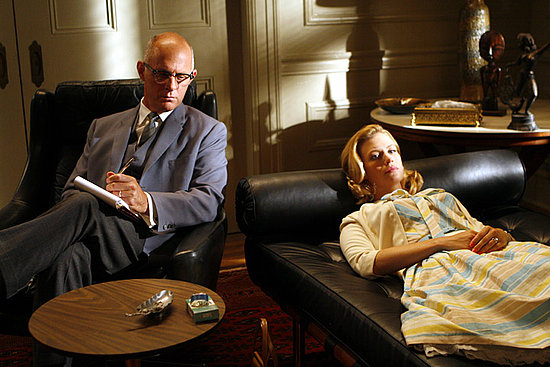
Oh, Santa. Baby. How long will our merry go round keep going round? Do we need couples counseling again this year?
You and I have been in our indescribably on-again-off-again relationship for too long. I’ve been writing about our tortured love for how many years?
In 2011 it was off.
2012, back on again.
In 2013 we acted like friends with benefits.
But it wasn’t enough. Sure I had Adam Sandler for Thankschanukah, but you can’t intersperse dreidels with Christmas cookies and call it one big happy holiday. Thankschanukah is gone, and as my friend’s 3-year-old said as she wept for a Christmas tree (when reminded of her joyous Hanukkah celebration) “But I’m so over Hannukuh!”
Ah, Santa, sweetheart—you’ve tortured me since childhood. You took the place of Kathy Murphy (hissing at me when I was 9 years old, “You’ll never get into Heaven, no matter what you do.”
Year in, year out, there I was again, knocking on the pearly gates. (Because that’s what Christmas can look like when you’re child’s nose is pressed up against those gleaming Macy’s windows. Heaven on earth.)

In 2012, my therapist had enough. He told me I’d been whining about my unrequited love for too long. “It’s not him; it’s you,” said Dr. Dreidel. “Enough. Get over it. You want him so bad? Go after him.”
So I celebrated. I wriggled back into your fuzzy red arms. But really, were you there for me?

I know, baby. There are many (maybe most) Jewish people who grow up warm and secure in their faith, those for whom the eight days of Hanukah don’t have to compete with Christmas: Jewish nurses and firefighters who take Christmas Eve shifts to ensure that their Christian brethren are home for the holidays. These are the lucky Jews with long standing traditions of Chinese food and a movie on Christmas.
But darlin’, I’ve never been one of them.
There were no Hanukkah (I can’t even figure out how to spell it right) traditions in my house, nothing to fall back on, so I longed for that Rockefeller Center sparkle. My sister and I even hung stockings one year. (What were we thinking? That the keys to the kingdom lay in our old limp socks?) Mom was out on a date; we stayed up as late as possible, until, exhausted, we went to bed giddy with the prospect of what would be spilling out the tops of those socks.
Mom must have thought we’d once again left our dirty clothes around the house, because when we woke, those damn socks were in the hamper.
As a teen, I went out with a similarly disposed Jewish friend and bought a pathetic Charlie Brown tree on Christmas Eve and smuggled it up to her room, decorating it with God knows what. The dangly earrings we’d buy with our baby sitting money? Her mother was not happy.

Other years I spent a Christmas with my best friend’s family, trying to be as adorably Christian as possible, praying they’d invite me back.
Finally, I left home and gave you up, big guy, for a few blessed too-hip-for-holidays years.
Then I became a mother. Christmas reared its head. I was determined that my children would have a big old piece of the American pie. Why shouldn’t you love us, Santa? We lived with a non-Jewish couple in a rambling Victorian House and I fell into Christmas as though I were Jesus’ sister. Religion played no role for any of us: it was simply an orgy of food, presents, lights, good will, and Christmas stockings so full we needed overflow bags. You were there, Santa baby. (Though there was always a fly in my Christmas pie. Friends, who hadn’t stepped in a church since they were baptized, exclaimed as though I were crashing their personal kingdom: “you celebrate Christmas?”)

The kids got older. Christmas became firmly entrenched, including building our own family heirlooms straight from the Crate & Barrel collection. Still, I felt as though I were crashing Jesus’ birthday party. At a certain point I began to get that Barbra Streisand in “The Way We Were” feeling with you, Santa. You were my goyishe Robert Redford who I’d never truly possess. You’d hang out with me, for years even, but you’d never really make a commitment.

I’d never get your ring.

The kids got even older. I shrunk Christmas. I got a little standoffish with you. A miniature rosemary tree replaced the light-crusted evergreen. Orgy of presents stayed, but some years I’d name them presents.
But it wasn’t enough, Santa baby. I just couldn’t quit you. I didn’t have the will to spend the entire day at the movies. Chinese food wasn’t enough after years of licking peppermint sticks. It was good when we met up last year, right? But I’m tired of our back and forth, honey. I find myself jonesing for you again.
I got those old Santa Blues. I put that weird aluminum tree up again—the one I tell my husband is hung with Stars of David. (Will he notice you in the corner, Santa? Does he see you hiding behind the menorah?)

But we know, right? No one will be the wiser if I throw a bit of glitter in with the Chinese food. Come on in, Santa. Just this once. One bite of brisket never hurt anyone.
December 11, 2014
Five Ways to Give When Gifting
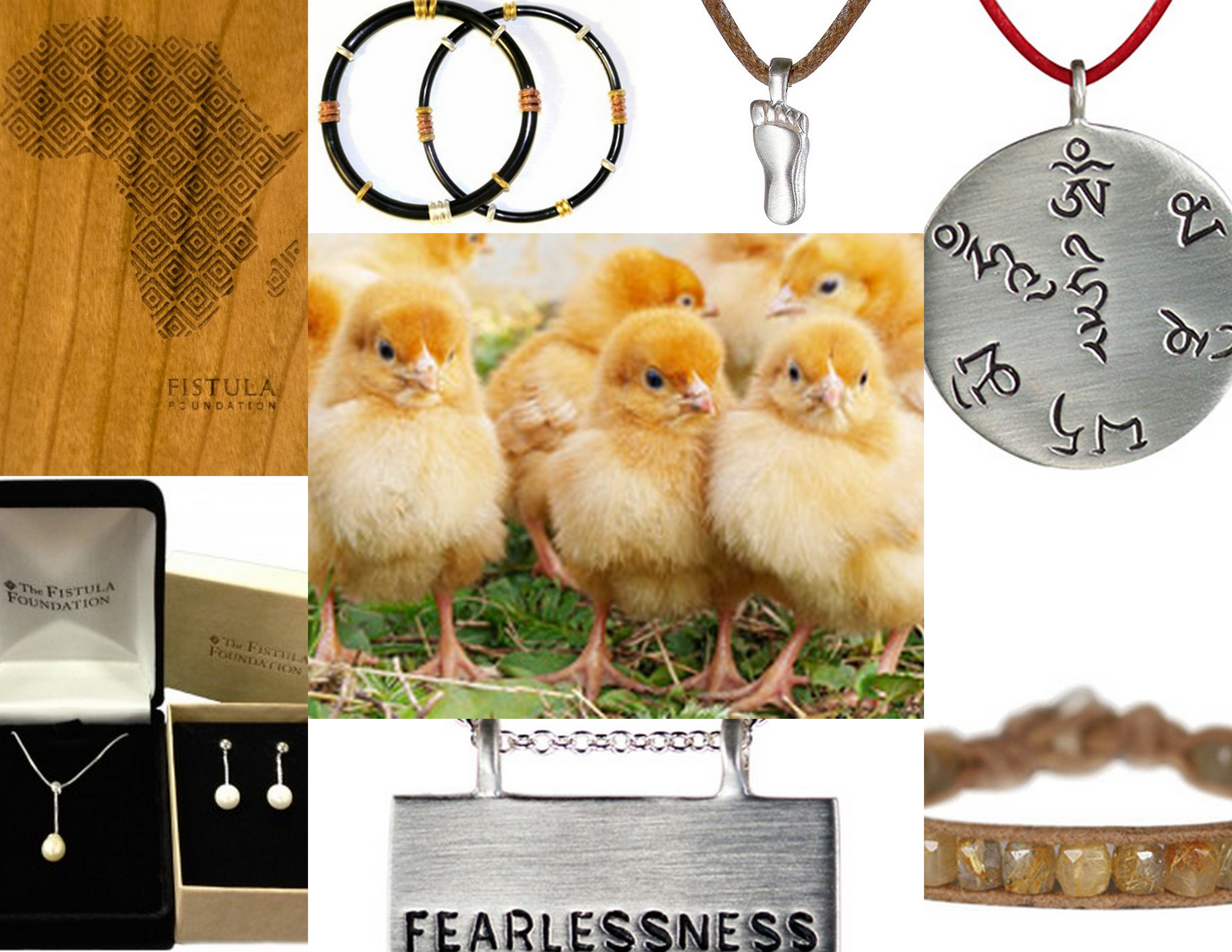
Below are five of my most trusted ways to give twice when I gift a friend or family member. From book marks to magnificent jewelry, y.ou can’t go wrong with any of the organizations and sites below
“Since 1993, Women for Women International has helped nearly 420,000 marginalized women in countries affected by war and conflict. We directly work with women in 8 countries offering support, tools, and access to life-changing skills to move from crisis and poverty to stability and economic self-sufficiency.
This year, give your loved ones meaningful holiday gifts that help women survivors of war rebuild their lives. This holiday season, browse our Gifts that Give Back catalog and honor someone special with a gift that will leave a lasting impact on women’s lives.”

“Fistula Foundation believes no woman should endure a life of misery and isolation simply for trying to bring a child into this world. That’s why we’re dedicated to ending the suffering caused by obstetric fistula, a childbirth injury caused by prolonged, unrelieved obstructed labor that renders a woman incontinent – an injury that can only be treated through surgery.”
Fourteen lovely gifts to chose from—all for supporting the Fistula Foundation
“In thanks for your donation of $50 or more, we offer these custom-designed silver-plated earrings featuring cultured pearls to express our gratitude for supporting the work of the Foundation. Your earrings (for pierced ears only) are designed to match our pearl necklace so they can be worn together or separately.”

Me & Ro (beautiful jewelry makers) sell four pieces where 100% of the proceeds go to support: The Brooklyn Academy of Music, Joyful Hear Foundation, Kageno & the Tibet Fund.

Do Ubuntu Orphan Bracelet Campaign: “The Orphan Bracelet Campaign (OBC) helps AIDS orphans by equipping their primary caretakers – usually women – with the means to sustain themselves and improve their health. This includes training women to make bracelets to sell for an income and establishing community-based permaculture gardens. The OBC was founded by director Louise Hogarth, who was inspired by the women and children in her film “Angels in the Dust.”
“Each orphan bracelet is handcrafted by local South African women living with HIV/AIDS. We use only lead-free copper, brass and aluminum wire, as well as recycled rubber. 100% of the proceeds go towards helping mothers and children in Africa whose lives have been severely impacted by HIV/AIDS. Wear your orphan bracelet for any occasion. They are great to stack and won’t set off airport security. DO wear them in the shower.”

“Rosie’s Place was founded in 1974 as the first women’s shelter in the United States. Our mission is to provide a safe and nurturing environment that helps poor and homeless women maintain their dignity, seek opportunity and find security in their lives.
Today, Rosie’s Place not only provides meals and shelter but also creates answers for 12,000 women a year through wide ranging support, housing and education services. Rosie’s Place relies solely on the generous support of individuals, foundations and corporations and does not accept any city, state or federal funding. Thanks to these donations, 86 cents of every dollar raised goes directly to services for poor and homeless women.”
“The artisans of the Women’s Craft Cooperative at Rosie’s Place create gorgeous hand-crafted items that make a difference in our guests’ lives.This successful social enterprise, established in 1996, hires Rosie’s Place guests to craft unique gifts and jewelry of all types. “

December 10, 2014
STORIED RECIPES: A New Cookbook for Cookclubs
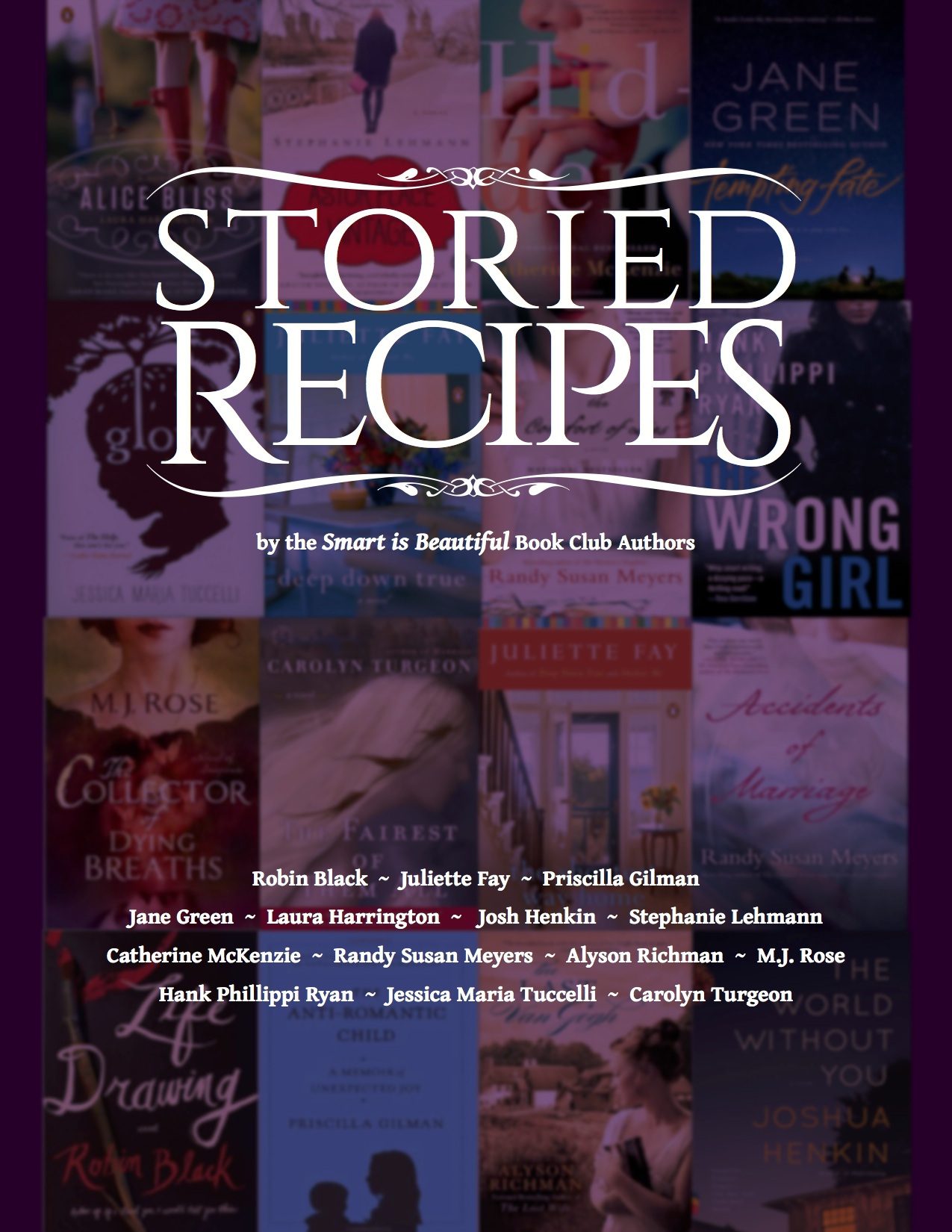
Q: What could be luckier than getting to send The Comfort of Food , my limited edition cookbook to book clubs?
A: Having worked with thirteen other authors to bring out a new book club cookbook: Storied Recipes.
Whether it’s sweet or savory, these are time-tested recipes from fourteen of us, with recipes ranging from “First Date Beef with Wine”to “Truffle-Studded Chicken” to the vegetarian “Fromage Forte” to “White Gazpacho” — from cherry pie to springerle to chocolate chip elephant ears, the recipes run from the easy to the more challenging, but all come with our cooking, love, or family stories.
Contact any of the authors below and find out how you can get a copy of the cookbook. Each of us might do it a bit differently, but all of us are eager to meet you, your book clubs and share our books and recipes.
December 8, 2014
15 Bookish & Arty Gifts to Buy Without Leaving Your Couch
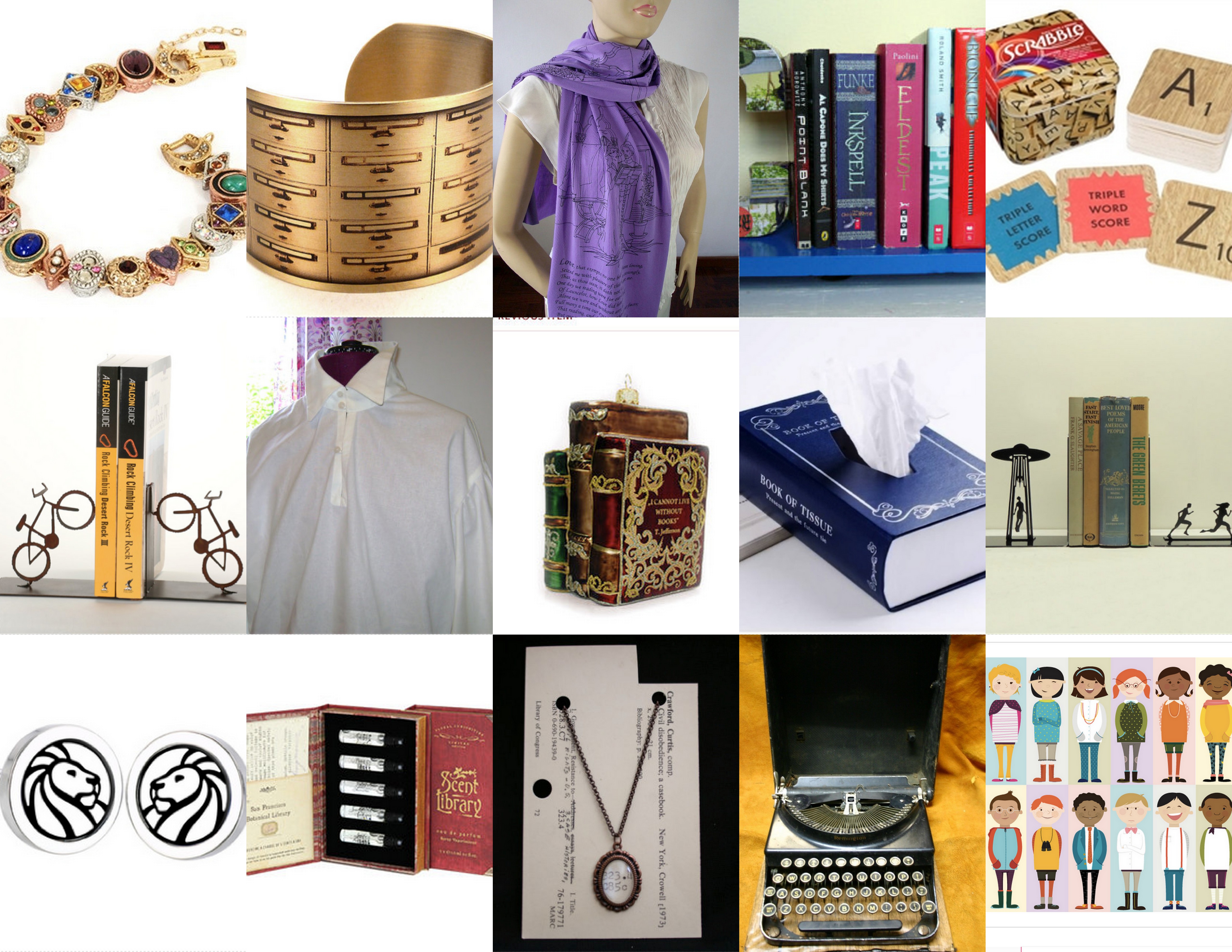
Avoiding malls at holiday time can be your best treat. Small shopping, with artists & small shops—or library shops!—is a treat for all. Below, a sampling of ways to do good, gift friends and family with love, and do it all in your pj’s online.
1) Do you have an ornament lover in your life who is also passionate reader? Combine them with this ornament from the .
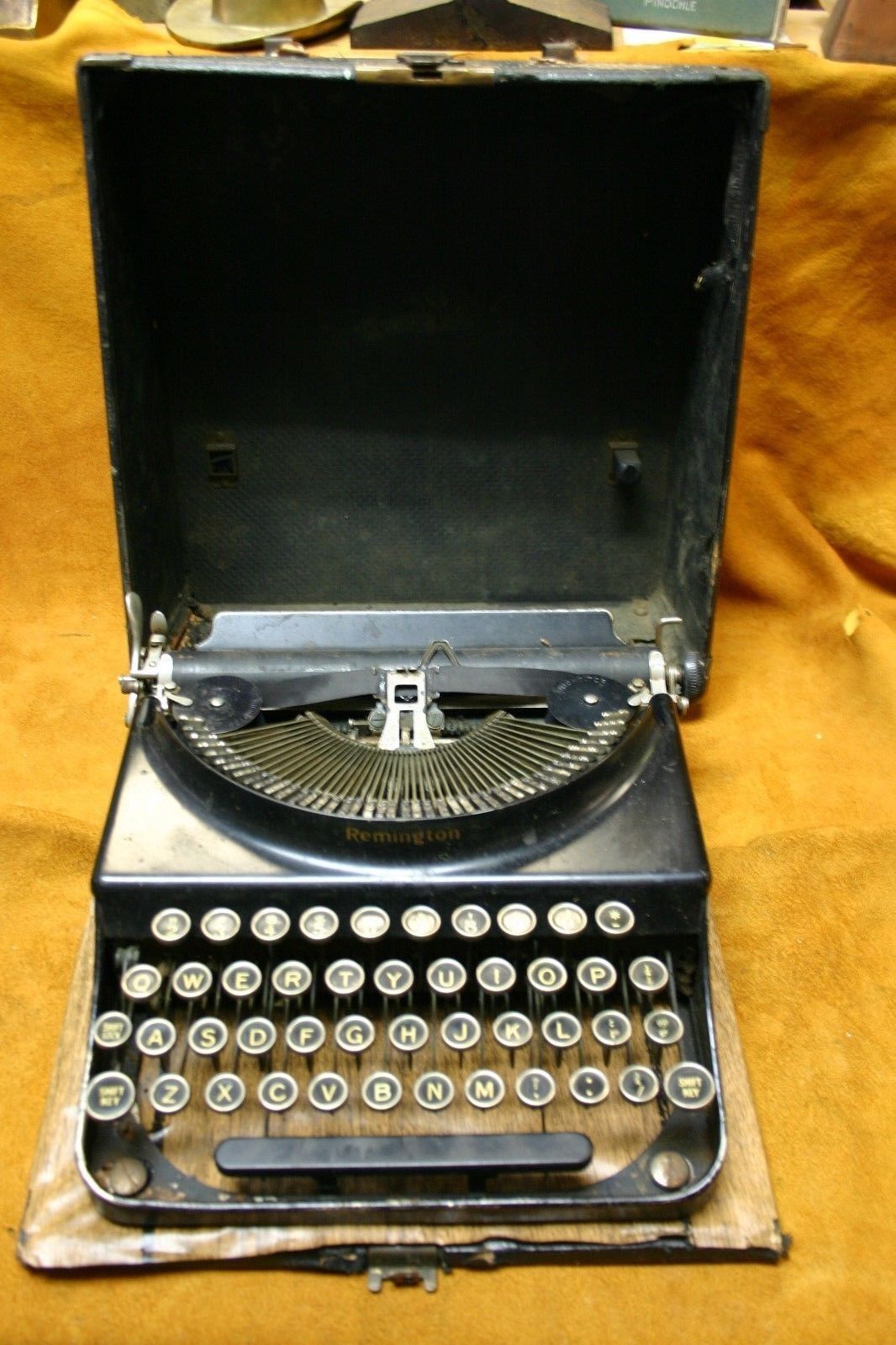
2) Reach into the way back machine and find an antique typewriter (or at least vintage.) Hours can be spent searching on Ebay, or it can be done quick by following the link provided.
3) Please feel free to gift me with this Ineke Scent Library eau de parfum from the Library Foundation of Los Angeles Gift Shop. San Francisco based perfumer and avid gardener Ineke Ruhland designed these handmade scents from the unique, rare botanicals she cultivates. The Scent Library includes five 2.5 ml eaux de parfums in a charming “book” with “library cards” describing each of the scents.
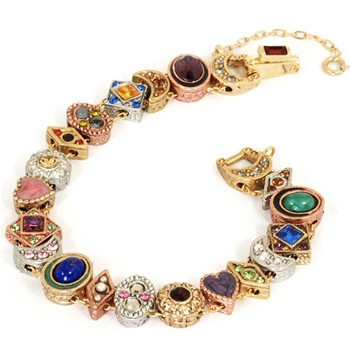
 4) Tell my husband about what’s on sale at the Huntington Library in California: this lovely art to wear: “During the Victorian era, slide bracelets were made from old keepsake jewelry parts, stickpin heads, rings, small pins and buttons. They became known as ‘slide’ bracelets because of the movement of the pieces on the chain. Ours is a dainty sequence of ovals, diamonds, hearts and squares.”
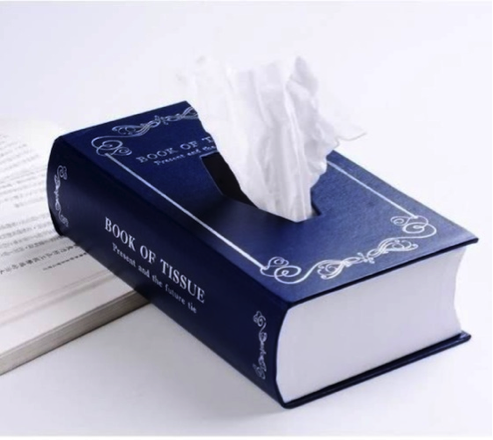
5) We all need to dab at our noses. Why not use this perfectly bookish holder for tissues, from The Gadget Flow
6) Is your man about to win a Pulitzer? Or act like he is? Get him a pair of New York Library Lion’s cufflinks, from (where else?) the NYPL shop (There is a ton of great stuff here—and you support the library!)

7) Perfect for that Scrabble obsessive in the family, coasters marking their love, with support for the Springfield-Greene County Libraries in Missouri.

8) What could be more artistic and bright than teaching your little one how many varieties of kids there are? This “Mixmates Boys & Girls are colorful wooden blocks with characters as diverse as the children that play with them. Made of hardwood and durable inks, Mixmates will survive the bumps that go along with being a child’s favorite toy. As children mix, stack and play, they develop fine motor skills as well as language as they describe their creations.”

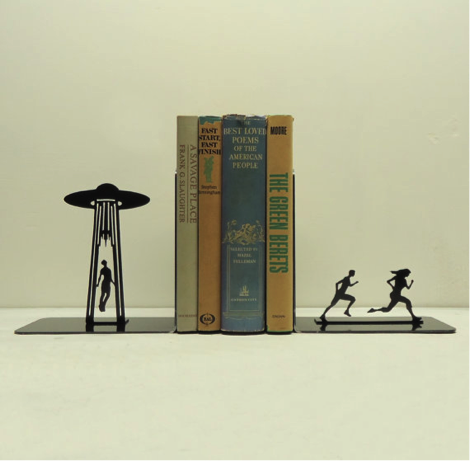
9) If you have a book and alien abduction fascination, here’s your perfect present from, where else? Etsy: UFO Abduction Metal Art Bookends
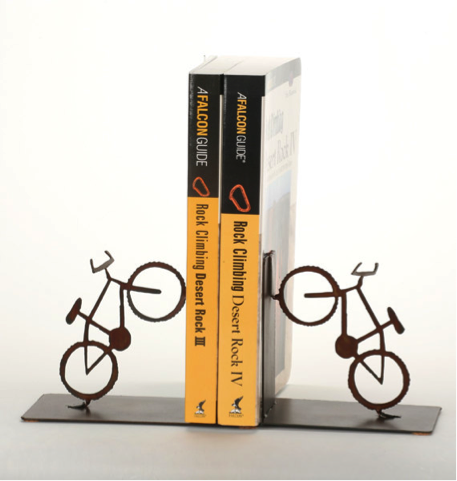
10) Also on Etsy, for the outdoor enthusiast biker, a less alien set of bookends.
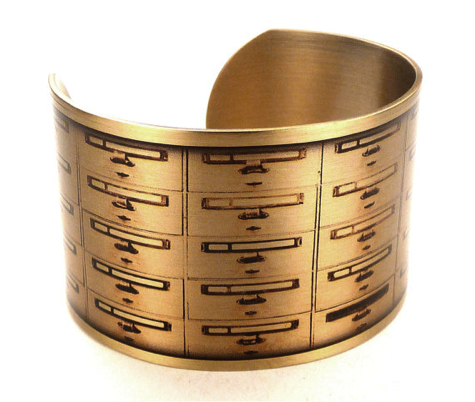
11) And you know that you need card catalog cuffs (bracelets, that is.) I know I’d like one (hint, hint.)
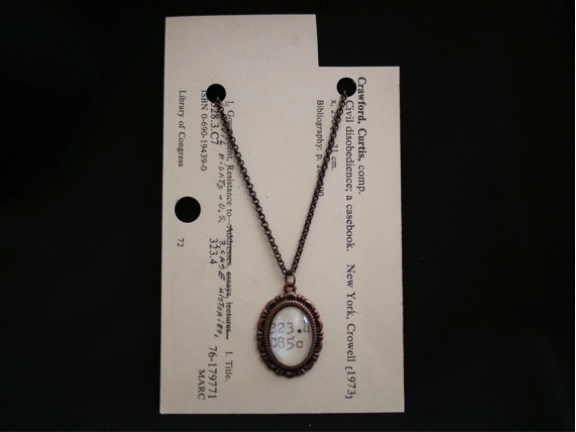
12) For those who remember those library catalog cards, what could be more romantic than wearing a Dewey decimal number locket around your neck? Here’s one representing “Civil Disobedience” —timely, yes?
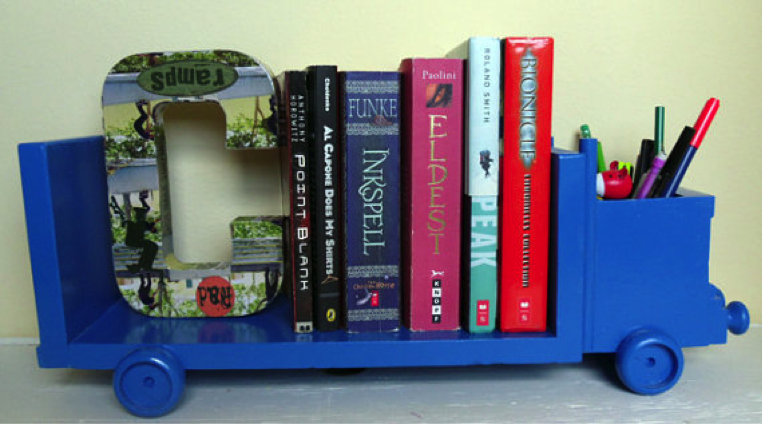
13) Of course we want our kids to read and to keep their rooms tidy. At least the book section? Here’s some encouragement for little ones, with a truck for their books.
14) For those on your list for whom wearing Dante around their neck would be perfect: the “Divine Comedy -Literary Scarf.”

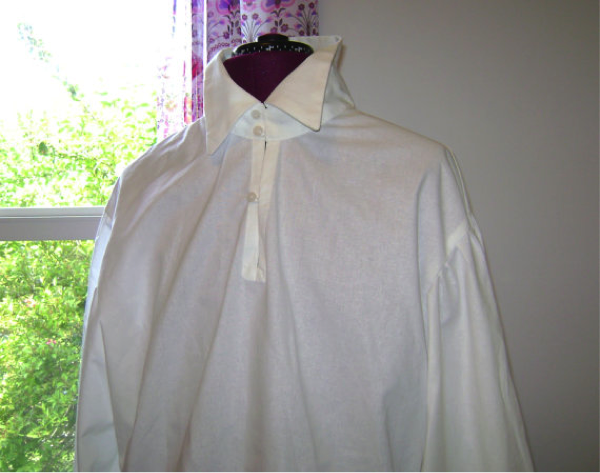
15) Does your fantasy involve having your very own Darcy? Perhaps you should buy your man this Regency era Men’s dress shirt. (And see how far he will go to prove his love. Will he wear it for New Years?)
And if books are what you want, here’s a selection from my fellow members of Beyond The Margins, past & present, and a great selection of independent bookstores:
Chris Abouzied
ANATOPSIS from Porter Square Books

Ann Bauer
THE FOREVER MARRIAGE from Magers & Quinn

Nichole Bernier
THE UNFINISHED LIFE OF ELIZABETH D. from Wellesley Books

Robin Black
LIFE DRAWING from Concord Books

Juliette Fay
THE SHORTEST WAY HOME from Odyssey Books

Laura Harrington
ALICE BLISS from RJ Julia

Randy Susan Meyers
ACCIDENTS OF MARRIAGE from Foxtale Bookshoppe

E.B. Moore
AN UNSEEMLY WIFE from Gibson’s Bookstore

Henriette Lazaridis Power
THE CLOVER HOUSE from Brookline Booksmith

Anna Solomon
THE LITTLE BRIDE from Blue Willow Bookshop

Kim Triedman
THE OTHER ROOM from Acorn Books

Julie Wu
THE THIRD SON from Hickory Stick Bookshop

Laura Zigman
ANIMAL HUSBANDRY from Harvard Bookstore

Or shop in person at your local indies; in Massachusetts we’re especially blessed. Along with the above, who also offer online, please visit the wonderful:
Andover Bookstore in Andover
Buttonwoods Books and Toys in Cohasset
Newtonville Books in Newton
New England Mobile Book Fair in Newton
Papercuts in Jamaica Plain
Westwinds Bookstore in Duxbury
December 1, 2014
Guest Post: Doctors Who Write: Who Owns The Stories?
 A GUEST POST
“When faced with the opportunity to read a book by someone who isn’t by profession a writer, I always go for the doctor.” —Stephen J Dubner
(And can I just say here, Mr. Dubner, doctor-writers everywhere – and their publishers — thank you.)
I write fiction, most of the time, because that’s what I like to write, but also because writing about my work raises all kinds of complications. Every once in a while, though, I am so moved by my experience with a patient, that his or her story becomes my story, too. Several years back I wrote a piece about a patient of mine. Mr. Z. was an elderly man who bragged about his Nazi past but otherwise kept lots of secrets. He had a family he had driven away from him, a house he wouldn’t leave, a dog he couldn’t care for, and a loaded gun on his kitchen table. (Perhaps because this is real life, Dr. Chekhov, and not one of your carefully crafted stories, the gun was never fired.)
I had been Mr. Z’s primary care doctor for years and had tried unsuccessfully to help as dementia overtook his life. One day he came into clinic saying he planned to destroy everything in his home of value, then kill his wife and himself. He was very calm as he related this to me. I contacted his family, told them of his threats, then escorted him to the ER. After evaluation by a psychiatrist, he was “sectioned” (admitted to the hospital against his will) and confined to his bed with elephant doses of haldol and soft restraints. When I went to see him that evening, he raised his head, spit at me, and turned away.
Of course there was the high drama of his war crimes, dementia-induced paranoia, a loaded gun. But that was his ugly and unfortunate story. For me there was this: his hatred toward me, his complete sense of betrayal, my professional certainty — and personal discomfort – with the the role I had played. It felt important to me. It changed me as a physician. I was a writer long before I was a physician, so I did what writers do — I wrote it down. His story, my story, the whole thing. And then put it away. (Actually, it was on my computer – but you get the idea.)
A year or two later, I was asked to give a reading, and I pulled out the story of Mr. Z. I could have chosen one of the stories I had published or an excerpt from my novel-in-progress, but instead, I picked Mr. Z. Afterward, a member of the crowd approached me to ask, “Have you published that yet? It’s a wonderful piece.”
I hadn’t published it, of course, and even had second thoughts about reading it in front of a small crowd. It felt like a violation. I protected his privacy in a superficial sense – changed names, locations, etc. – but still, writing this story of betrayal felt like more betrayal. The complication – or the loss — for me was that it felt like my story, too. I wanted not just to WRITE the story, but to have someone read it, hear it, share it.
Which brings me to my closing thought. We all want to own, or at least share, the narrative. It has power. We see it in politics. We see it with husbands and wives, between siblings and among friends. And, of course, between doctors and patients.
Robert Coles, in his book The Call of Stories, talks about the importance of giving patients the opportunity to tell their story. The book came out when I was a medical student. I read it and took the message to heart. (It continues to cost me an awful lot of time in clinic, but still may be the best doctoring advice I’ve ever gotten.) He also advocates for doctor’s sharing their stories with patients, because storytelling, he suggests, is how we enter each other’s lives.
As unlikely as it seems, Mr. Z’s story had a not-so-bad ending. He was transferred to a psychiatric hospital, did well with medication and therapy, and moved away to live with one of his children. I never got to tell him my story – to let him know how the experience had affected me. It would never have occurred to me at the time, but maybe I should have. Maybe that’s something doctors should do more often.
As one of Dr. Coles’ patients instructed him: “You tell me your story, and I’ll tell you mine.”
.
Kathy Crowley’s short stories have appeared in Ontario Review, Fish Stories, The Literary Review, New Millenium Writings and The Marlboro Review. Her stories have been short-listed for Best American Short Stories, nominated for a Pushcart Prize and anthologized. In 2006 she was awarded a Massachusetts Cultural Council Grant. She recently finished her first novel,On Locust Street. When she’s not busy preparing for her future literary fame and fortune, she provides care and feeding to her three children and works as a physician at Boston Medical Center. She is a graduate of Brown University and Tufts University School of Medicine. Kathy can be found on Twitter at @OnLocustStreet
November 17, 2014
Get a Manuscript Critique and Help Care-Givers: One Stone, Two Great Birds
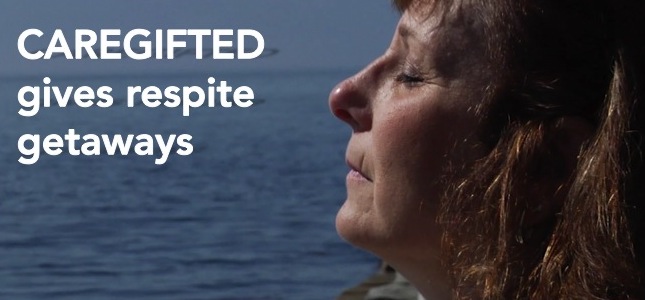
There is a wonderful Yiddish proverb that describes those carrying troubles: “God gave burdens; he also gave shoulders.” But sometimes those shoulders need help. In the case of this CAREGIFTED fundraising initiative, writers–from world-renowned to beginners–are providing that help as writers bid on manuscript critiques provided by celebrated authors.
I first heard of CAREGIFTED from my friend, author Robin Black. CAREGIFTED is a non-profit founded by MacArthur winning poet Heather McHugh, to provide weeklong respite vacations for long term caregivers to severely disabled family members. Robin, the mother of a special needs child herself, and a CAREGIFTED Board Member, has devised a fundraising scheme unlike any other. On November 25, more than three dozen of the world’s most renowned authors are selling manuscript critiques to emerging writers, with all proceeds going to CAREGIFTED. I asked Robin a few questions about the organization and about this initiative.
RSM: Can you tell me a little about how CAREGIFTED began? It seems like an unusual project for a poet, like Heather McHugh, to take on.
RB: Heather’s an unusual woman – in all the best ways. Five or so years back, when she won the MacArthur, she also learned that a young couple in her close circle had a new baby with severe disabilities. As I understand it, and we have talked about this a lot, she was thunderstruck by the reality of what the rest of their lives would include, in terms of nonstop physical caregiving, and all the strains inherent in that. Not to mention the heartache. And those realizations opened up a whole world to her: that of people whose lives are dominated and defined by the medical condition of someone for whom they care. Heather decided to try to do something to help as many of those people as she could, and so, with the grant money she had just been awarded, she founded CAREGIFTED.
RSM: How did you get involved?
RB: I kind of elbowed my way in. I have a child with special needs, though not nearly as severe as those in the care of the people we help. And I grew up in a home with a grandmother who was paralyzed from the waist down. I have always had a keen awareness of how a life can change direction drastically when the kind of functions many of us take for granted are absent or impaired. And I had a connection to Heather through the MFA program I attended, where she teaches. I used good old Facebook, and wrote her, just thanking her for thinking of people in this sort of need. That was my first email.
After that, and a gracious response from her, I sent a slightly pushier one, full of my own thoughts about what caregivers need, and of ways to raise money. I described it as “unasked for advice” which it was, and I apologized. But Heather is so open, and I guess she saw something sincere behind my presumption, so before I knew it I was on the team, and then a Board Member, specifically charged with finding ways to use the arts to raise money. This has been important throughout, and in fact filmmaker Adam Larsen, whose amazing film about autism, Neurotypical, was aired on PBS last year, has been involved from the start making a film about CAREGIFTED that should be complete in 2015. He has filmed many of the getaways and also filmed the families in their homes to give a sense of what it is from which they are taking this break.
RSM: What are the respite vacations actually like? Where do the caregivers go?
RB: I guess one answer to what they’re like is miraculous. It’s hard for people to grasp but for many people, this single week away is the only week away they’ll have from full-time, hands-on caregiving for decades, often for the rest of their lives. And you could say, “Oh, it’s just a week!” but that week, according to the people who have had the chance, can be life-altering.
And I’ve always thought it goes beyond the week. It’s also just the fact of knowing that there are people who care. When you’ve been hand-feeding, toileting an adult child who cannot speak, for twenty years of more, and are unable to participate in life without constant worry and constant fear for that child’s well-being, well, it’s hard for me to imagine a lonelier existence. It must so often feel like the world has forgotten you. But Heather is holding up a banner saying “You are remembered! Somebody cares!””
The trips themselves are increasingly taking place in Victoria, British Columbia, and have involved everything from boat rides, to shopping expeditions, to special meals, to massages, to days of having absolutely no demands. Heather herself has been on many of them as a companion and to facilitate the activities, but thankfully we are able to do more than any one person could attend. So we are in the process of locating more people who can serve in that role of “concierge.”
RSM: And now you are having this fundraiser. How does that work?
RB: As I said, from the beginning Heather wanted this undertaking to include a big component of artists helping caregivers. There’s a way in which it’s an intuitively logical connection that people whose lives are devoted to creativity might find ways to use their talents for others. The arts are so much about reaching out to people one doesn’t know, trying to say something meaningful about the human condition – whether in words or with music or through film or painting. CAREGIFTED, like all non-profits, needs other kinds of contributions, donors, and grants, but this was always part of the plan.
My own very small contribution has been to conceive and spearhead now two manuscript critique sales. This time around, on November 25th, we’ll be offering for sale critiques from some of the world’s most admired and accomplished writers. So,Billy Collins will be “selling” the reading of a poetry manuscript, by an emerging poet. And Elizabeth McCracken, will read an entire novel – up to 200 pages – by an aspiring novelist, and will give a written response. And the list goes on and on. All proceeds go to CAREGIFTED, but the benefits are much shared by those who receive these amazing consults. We have three dozen or so participating authors, and in some cases, this is the only way to receive feedback from them.
It takes place on November 25th, and the information is on the CAREGIFTED website. For writers who want such responses, but aren’t in the kind of formal setting like a school where that’s available, this is an incredible opportunity.
RSM: And what does the future hold for CAREGIFTED?
RB: Great things, I hope! But the truth is, it’s early days still. All initiatives face decisions about how much to expand, what broader projects to take on – or not. Right now, if we can keep sending these overworked, underappreciated people away for just that one week; if we can raise awareness about their lives; if we can see this amazing film by Adam Larsen to its completion; and if we can keep Heather’s initial vision alive; we’re satisfied. But in the future? Wouldn’t it be great to have larger and larger networks for caregivers? Greater and greater ways to diminish that sense, that reality, of a forgotten, underserved group?
I have a lot of faith that what Heather started may very well lead that way. And thanks so much for asking, Randy! You’re now officially part of the team.